


A freelance website is not a portfolio dump. It is a conversion system that turns visitors into paid conversations. This guide gives you a 2026 blueprint for building a freelance website that wins trust, proves outcomes, and supports consistent client acquisition. You will get a positioning framework, a decision tree, a build checklist, and real-world data you can cite in your own marketing.
Search intent for "freelance web site" is mixed. Some readers want to know what a freelance website should include, others want proof that the market is growing, and many want a practical checklist to launch quickly. You will get all three, plus a short promotional section that shows how Markework supports freelancers.
If you want to compare freelance platforms and learn how to position your services, browse the Markework blog, explore the freelancer directory, or check the find work hub.
A freelance website has three jobs: clarify who you help, prove that you can deliver outcomes, and make the next step easy. If any of those are missing, you will get traffic without conversations. The most effective freelance websites read like focused landing pages: one niche, one offer ladder, and a short path to contact or booking.
Your website should complement marketplace profiles, not replace them. Marketplaces provide demand. Your site provides differentiation, proof, and control over your positioning. Use both for a balanced pipeline.
- Freelancers contributed $1.27 trillion in annual earnings to the U.S. economy in 2023 (source: Upwork Freelance Forward 2023).
- 64 million Americans freelanced in 2023, or 38% of the U.S. workforce (source: Upwork Freelance Forward 2023).
- Freelancing grew by 4 million people from 2022 to 2023 (source: Upwork Freelance Forward 2023).
- 20% of freelancers regularly use generative AI versus 9% of non-freelancers, a 2.2x gap (source: Upwork Freelance Forward 2023).
- 47% of freelancers provide knowledge services such as marketing, IT, and business consulting (source: Upwork Freelance Forward 2023).
- 52% of Gen Z professionals and 44% of Millennials performed freelance work in 2023 (source: Upwork Freelance Forward 2023).
- Occasional independents grew from 15.8 million in 2020 to 36.6 million in 2023, a 130% increase (source: MBO Partners State of Independence 2023).
- 26 million full time independents in 2023, up 20% year over year (source: MBO Partners State of Independence 2023).
- 40% of independents who serve businesses used an online talent platform in the past 12 months (source: MBO Partners State of Independence 2023).
- BLS estimates 9.1 million unincorporated self-employed workers in Q4 2023, or 5.7% of nonagricultural employment (source: U.S. Bureau of Labor Statistics).
- WordPress powers about 43.6% of all websites (source: W3Techs WordPress usage).
- WordPress accounts for about 62.6% of websites using a known CMS (source: W3Techs CMS market share).
- The median desktop page weight is 2,652 KB (source: HTTP Archive Page Weight).
- The median mobile page weight is 2,311 KB (source: HTTP Archive Page Weight).
- U.S. internet advertising revenue reached $258.6 billion in 2024, up 14.9% year over year (source: IAB 2024 Internet Advertising Revenue Report press release).
Before you build pages, lock positioning. The SIGNAL framework helps you reduce noise and clarify your offer so the website has a single message.
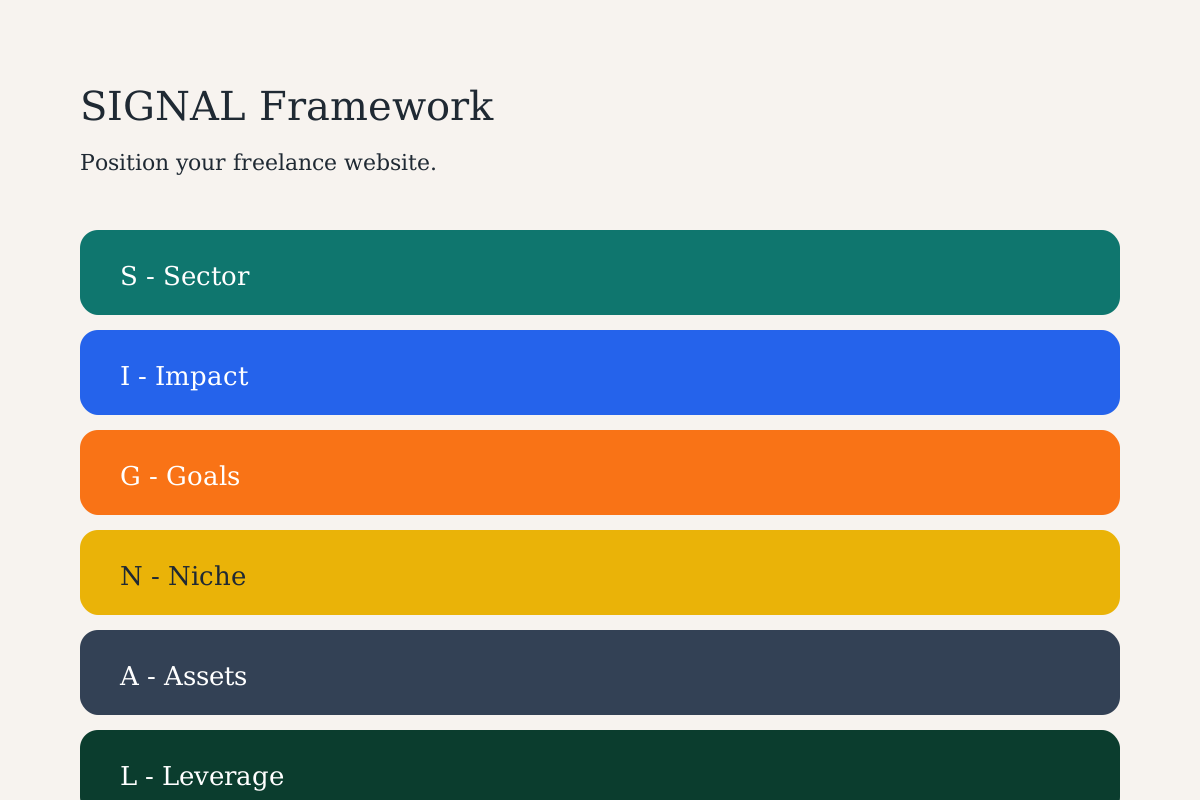
- Sector: Choose the industry you understand best.
- Impact: Define the business outcome you improve.
- Goals: Name the KPIs you influence.
- Niche: Focus the service so you can be the obvious choice.
- Assets: Create proof that travels across channels.
- Leverage: Build systems that reduce time per win.
If you can state your SIGNAL in one sentence, your homepage headline will write itself.
A strong freelance site can be a single page if it includes the right sequence.
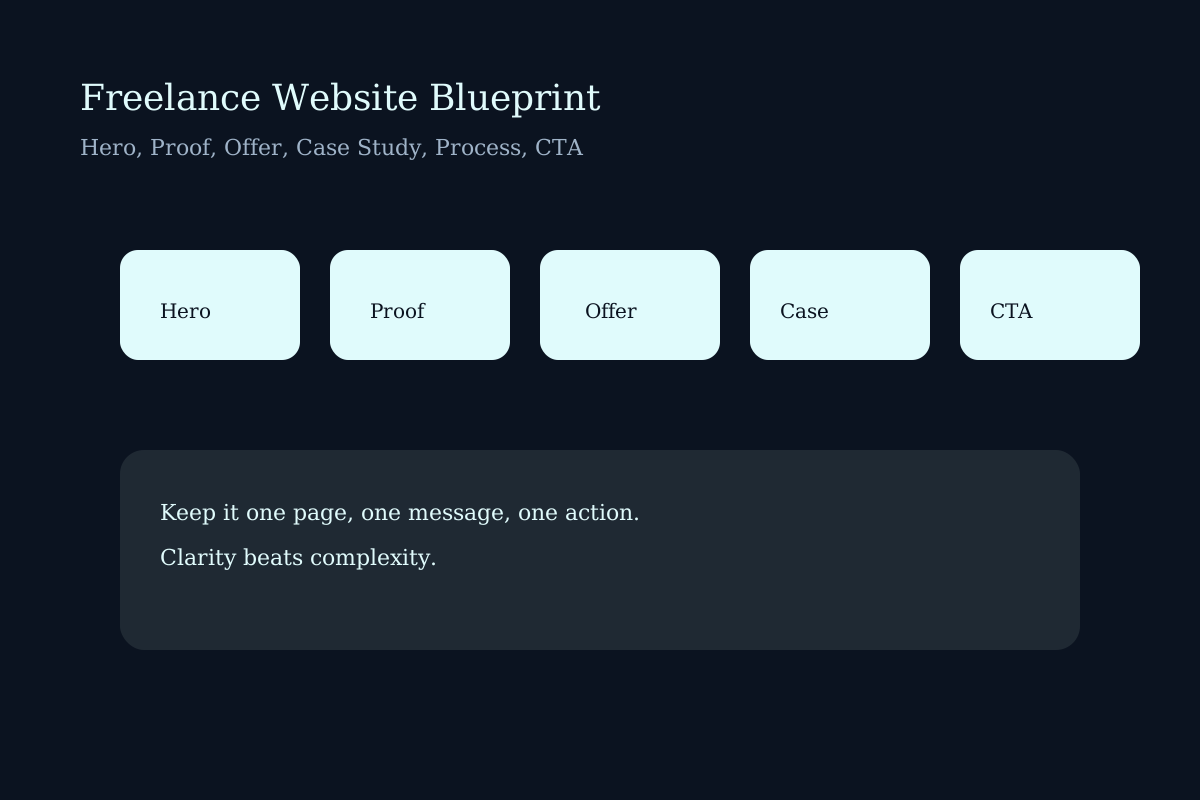
- Hero section with outcome-driven headline.
- Proof bar with metrics, logos, or short results.
- Offer ladder with 2 to 3 service tiers.
- Case study or before-and-after snapshot.
- Process section with milestones.
- Call to action with clear next step.
- Can you describe your niche and outcome in one sentence?
- Do you have at least one proof asset with a metric?
- Is the call to action visible above the fold?
- Can a visitor understand pricing or scope in 30 seconds?
- Do you have a simple contact or booking flow?
If you answered no to two or more questions, refine before launch.
Your website should show a clear ladder: an entry offer, a core offer, and a retainer. This reduces decision friction and prevents scope confusion.
- Entry offer: Audit or teardown with fast delivery.
- Core offer: Implementation project with defined milestones.
- Retainer: Monthly optimization with KPI reporting.
- Performance bonus: Optional upside for revenue wins.
Treat client acquisition and admin time as real costs. If you target $8,000 per month and can sustainably deliver 32 billable hours, your base rate is $250 per hour. Add a 15% fee buffer and a 10% marketing buffer, and you need to price closer to $312 per hour. If that feels high, tighten the offer or increase the value delivered per hour.
- Fee buffer: 10 to 20% to cover platform take rates.
- Marketing buffer: 10 to 20% to cover outreach time.
- Ops buffer: 5 to 10% for tools, software, and reporting.
- Floor rate: The minimum you accept after buffers.
Use this checklist to ship quickly without sacrificing trust.
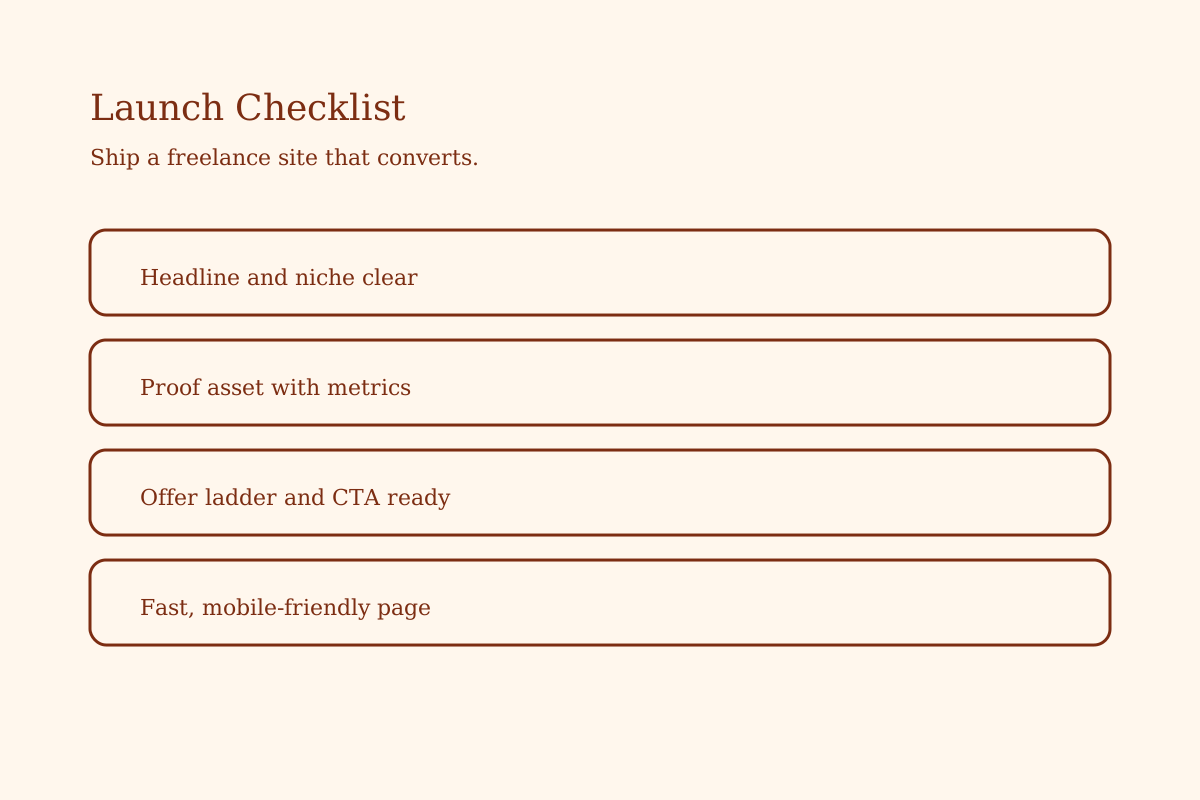
- Headline with niche and outcome.
- One proof asset with metrics.
- Clear offer ladder and scope.
- Single CTA with contact or booking.
- Fast page load and mobile friendly layout.
- Basic SEO: title, meta description, and clean URL.
- Leading with tasks instead of outcomes.
- No proof assets or metrics.
- Too many services with no clear niche.
- Hidden pricing or vague scope.
- Multiple calls to action that split focus.
Marketplaces like Upwork or Markework provide demand, but they do not give you full control of your story. Your website is where you decide the narrative, the proof, and the call to action. The strongest freelancers use both: marketplaces for reach and their site for conversion.
- Marketplace profile: demand and discovery.
- Website: positioning, proof, and long-term brand value.
- Hybrid approach: win clients on platforms and move referrals through your site.
You do not need advanced SEO to win with a freelance website. You need clarity, speed, and a small set of relevant keywords. Focus on a single service page and a focused case study page. That is enough for most freelancers to rank for niche terms and convert referrals.
- Use one primary keyword in your headline and page title.
- Add a short meta description that explains your niche and outcome.
- Include one case study page or section with metrics.
- Use a clean URL such as /freelance-seo-audit.
- Keep page weight low so mobile users do not bounce.
Performance is a trust signal. A slow site reduces conversions, especially on mobile. Use fewer images, compress assets, and keep the site lightweight. Combine that with trust signals such as testimonials, client logos, and short metrics.
- Load speed under 3 seconds on mobile.
- One hero image, not five.
- Short testimonials with clear outcomes.
- A simple contact flow with minimal fields.
A freelance website should reduce the steps between interest and contact. Use one CTA and one primary action. If you use a form, keep it short and ask only for project type, budget range, and timeline. For high-ticket services, a booking link works well.
- One CTA above the fold.
- Short intake form or booking link.
- Response time promise such as 24 to 48 hours.
Retainers are sold on predictability. Your website should show that you can deliver consistent progress, not just one-off wins. The simplest approach is to show a before-and-after metric, a short process timeline, and a monthly reporting example. This signals that you have a system, not just a skill.
- One chart or metric that shows sustained improvement.
- A 30-60-90 day plan in three bullets.
- A short monthly reporting snapshot or template.
- A clear statement of the ongoing value you provide.
You do not need a blog to make a freelance website work, but one or two focused resources can improve trust and SEO. A single in-depth guide or case study page often outperforms a dozen thin posts. Publish one piece that demonstrates expertise in your niche and keep it updated.
- One flagship guide that answers a buyer question.
- One case study page with measurable results.
- One short FAQ section to remove objections.
Small signals reduce buyer risk. A short privacy note, a professional email domain, and a clear response time can increase trust even more than design polish.
- Professional email address, not a free inbox.
- Short privacy note on contact forms.
- Response time promise and availability window.
A CRO freelancer built a one-page site with a single headline and one case study showing a 1.4% conversion lift. That proof asset alone doubled inbound leads in 60 days.
A content strategist created a niche site focused on SaaS onboarding content. She published one deep case study and a pricing ladder. The site became the primary driver of retainer inquiries.
A paid media freelancer positioned around audit sprints, with a clear CTA and a short process section. The site reduced pre-sales calls and increased close rates.
Markework is built for marketing and creative freelancers who want less noise and clearer alignment with client goals. If your work is outcome-driven and you want to show proof fast, use Markework as a quality-focused channel alongside your freelance website.
Learn more on the Markework homepage, review the pricing page, and see how the platform positions trust on the why Markework page. For direct inquiries, use the contact page. You can also browse common questions in the FAQ.
One page is enough if it includes positioning, proof, offer, process, and a clear call to action.
Yes, but keep it focused. One or two case studies with metrics are more powerful than a large gallery.
A pricing range or clear scope is helpful. It filters out low-fit leads and speeds decisions.
Use a mix of marketplace profiles, referrals, and one or two content channels. Your website should convert that traffic, not generate it alone.
A single action such as book a call or send a project brief. Multiple CTAs reduce conversion.
If you want fast updates and plug-ins, a CMS is fine. Keep the site fast and focused either way.
- Freelancers contributed $1.27 trillion to the U.S. economy in 2023 (source: Upwork Freelance Forward 2023).
- 64 million Americans freelanced in 2023, or 38% of the U.S. workforce (source: Upwork Freelance Forward 2023).
- WordPress powers about 43.6% of all websites and 62.6% of CMS sites (source: W3Techs).
- Median desktop page weight is 2,652 KB and mobile is 2,311 KB (source: HTTP Archive Page Weight).
- U.S. internet advertising revenue reached $258.6 billion in 2024, up 14.9% year over year (source: IAB 2024 Internet Advertising Revenue Report press release).
- Positioning: The clear statement of who you help and what outcome you deliver.
- Proof asset: A case study, audit, or KPI snapshot that builds trust quickly.
- Offer ladder: A set of services that moves clients from low risk to retainer.
- Win rate: The percent of proposals or calls that become paid work.
- Retainer: A monthly agreement tied to ongoing optimization and reporting.
- Pick a focused niche and define a clear outcome.
- Build one proof asset with real metrics.
- Ship a one-page site with a clear CTA.
- Add a simple offer ladder and process.
- Convert wins into retainers with KPI reporting.
Disclaimer: This blog post is provided for informational purposes only and is provided as-is. Markework, its owners, and contributors assume zero liability for any losses, damages, or outcomes resulting from the use of this information.