


Freelance writing gigs are everywhere, but consistent income is not. The difference is a system: clear positioning, proof assets, and a repeatable process for pitching, delivering, and retaining clients. This guide gives you a 2026-ready playbook with frameworks, checklists, and data-backed insights so you can win better writing gigs and build predictable revenue.
Search intent for "freelance writing gig" is mixed. Some readers want to know where to find gigs, others want to know how to price and get repeat work. This guide covers both, and adds a decision tree, a scoring rubric, and linkable assets you can reuse in your own outreach.
To compare platforms and see how Markework supports freelancers, browse the freelancer directory, check the find work hub, and read the Markework blog.
A freelance writing gig is a paid writing engagement where you deliver a specific outcome: content that drives leads, messaging that improves conversion, or documentation that reduces support costs. Great writing gigs are not about word count. They are about business impact and clarity for the reader.
The fastest path to better gigs is to narrow your focus. Choose a niche, define the outcomes you deliver, and build proof that travels. That is the difference between chasing gigs and being hired for them.
- Freelancers contributed $1.27 trillion in annual earnings to the U.S. economy in 2023 (source: Upwork Freelance Forward 2023).
- 64 million Americans freelanced in 2023, or 38% of the U.S. workforce (source: Upwork Freelance Forward 2023).
- Freelancing grew by 4 million people from 2022 to 2023 (source: Upwork Freelance Forward 2023).
- 20% of freelancers regularly use generative AI versus 9% of non-freelancers, a 2.2x gap (source: Upwork Freelance Forward 2023).
- 47% of freelancers provide knowledge services such as marketing, IT, and business consulting (source: Upwork Freelance Forward 2023).
- 23% of freelancers create influencer style content like social media videos or blogs (source: Upwork Freelance Forward 2023).
- 52% of Gen Z professionals and 44% of Millennials performed freelance work in 2023 (source: Upwork Freelance Forward 2023).
- Occasional independents grew from 15.8 million in 2020 to 36.6 million in 2023, a 130% increase (source: MBO Partners State of Independence 2023).
- 15% of traditional job holders reported a freelancing or consulting side gig in 2023 (source: MBO Partners State of Independence 2023).
- 26 million full time independents in 2023, up 20% year over year (source: MBO Partners State of Independence 2023).
- BLS estimates 9.1 million unincorporated self-employed workers in Q4 2023, or 5.7% of nonagricultural employment (source: U.S. Bureau of Labor Statistics).
- Writers and authors had a median annual wage of $72,270 in May 2024 (source: BLS Occupational Outlook Handbook).
- Writers and authors: lowest 10% earned less than $41,080 and highest 10% earned more than $133,680 in May 2024 (source: BLS Occupational Outlook Handbook).
- U.S. internet advertising revenue reached $258.6 billion in 2024, up 14.9% year over year (source: IAB Internet Advertising Revenue Report 2024 PDF).
- Search advertising reached $102.9 billion in 2024 and held a 39.8% share of total ad revenue (source: IAB Internet Advertising Revenue Report 2024 PDF).
- Digital video reached $62.1 billion in 2024, up 19.2% year over year (source: IAB Internet Advertising Revenue Report 2024 PDF).
- Retail media hit $53.7 billion in 2024, up 23.0% year over year (source: IAB Internet Advertising Revenue Report 2024 PDF).
Use WRITE to clarify your offer and improve your win rate. Each step removes a common reason clients say no.
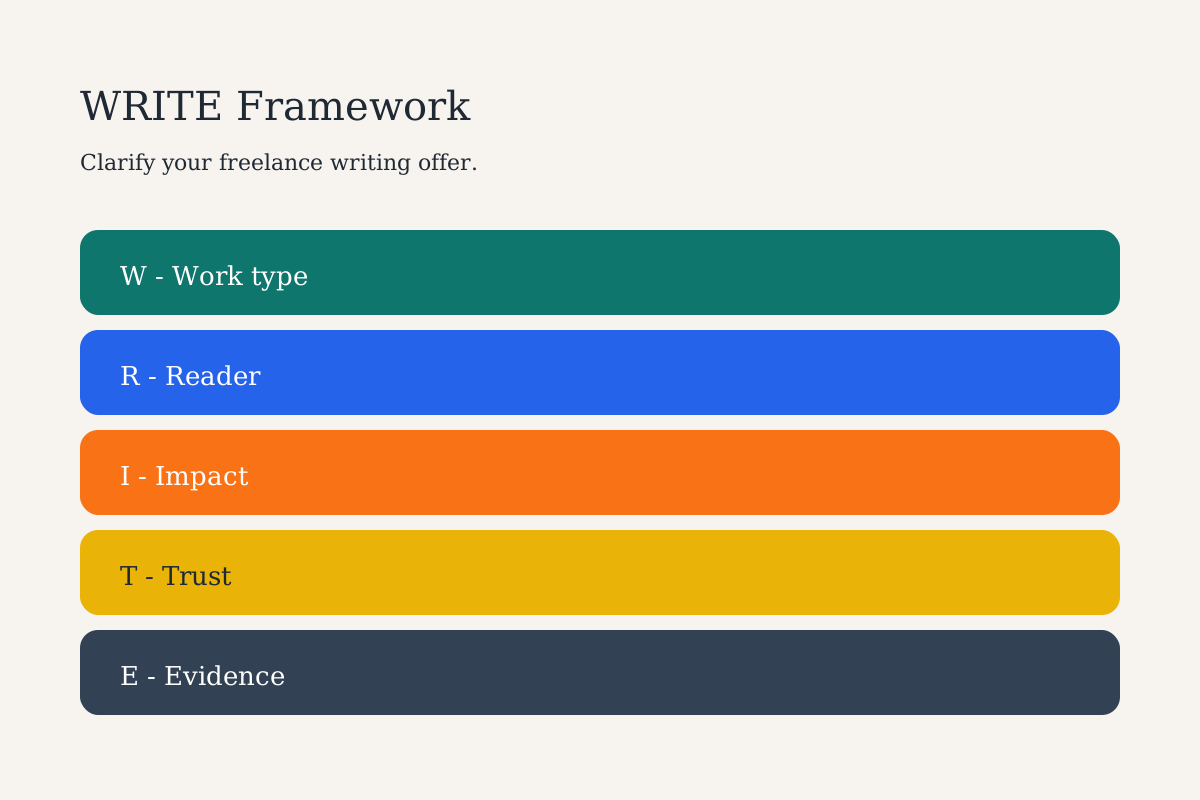
- Work type: Define the content you specialize in (blog posts, landing pages, case studies, docs).
- Reader: Name the audience and buyer persona.
- Impact: State the business outcome you drive.
- Trust: Show credibility with proof and process.
- Evidence: Provide metrics, samples, or results.
If you can explain your WRITE in one sentence, your pitch will be shorter and your close rate will rise.
Not all gigs are equal. This table helps you choose gigs that match your goals and risk tolerance.
| Gig type | Best for | Strengths | Tradeoffs |
|---|---|---|---|
| Blog content | Consistent demand | Repeat work potential | Price pressure |
| Landing pages | Higher fees | Direct revenue impact | More revisions |
| Case studies | B2B specialists | High trust signal | Longer timelines |
| Technical docs | Specialists | High rates | Requires domain knowledge |
| Email sequences | Lifecycle writers | Retention impact | Needs performance data |
- Is the scope clear and tied to an outcome?
- Is there a budget range or rate expectation?
- Do you have relevant samples or proof?
- Is the timeline realistic for quality work?
- Will this gig improve your portfolio or lead to repeat work?
If you answer no to two or more questions, decline or re-scope. Protect your time.
Winning writing gigs is a pipeline problem. Use a simple workflow to build consistent demand.
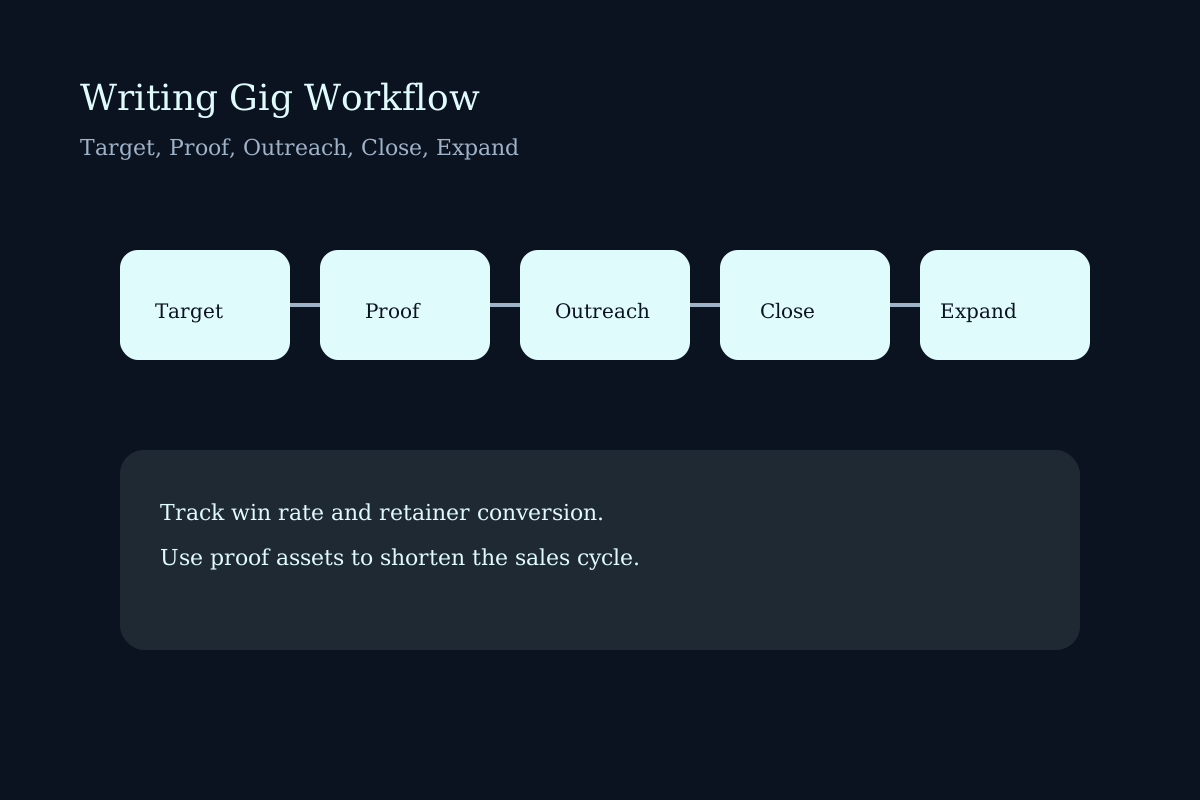
- Target: Choose a niche and a content type.
- Proof: Build two writing samples with outcomes.
- Outreach: Pitch a consistent number of prospects weekly.
- Close: Use a short discovery call and a clear decision date.
- Expand: Turn wins into retainers with ongoing content plans.
Pricing writing gigs is easier when you anchor to outcomes and time. If you target $8,000 per month and can sustain 32 billable hours, your base rate is $250 per hour. Add a 15% fee buffer and a 10% marketing buffer, and you need to price closer to $312 per hour. If that feels high, narrow the offer or increase value per deliverable.
- Fee buffer: 10 to 20% to cover platform take rates.
- Marketing buffer: 10 to 20% to cover outreach time.
- Ops buffer: 5 to 10% for tools, software, and reporting.
- Floor rate: The minimum you accept after buffers.
Use this short format and customize the first two sentences. The rest is a reusable structure.
- Goal summary and target reader.
- 3-step plan with timeline.
- Deliverables and revision limits.
- Proof asset or metric.
- Clear next step and decision date.
Use this checklist before delivery to reduce revisions and protect margins.
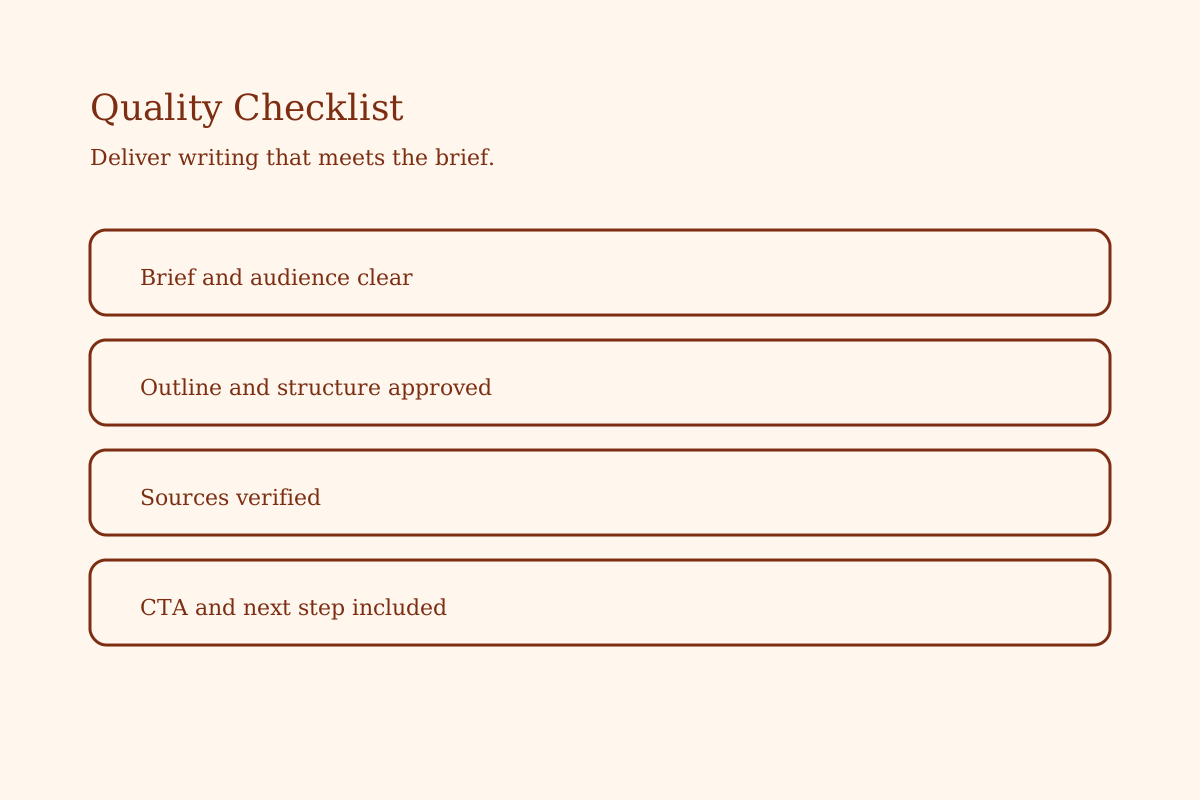
- Brief confirmed and audience defined.
- SEO or messaging goals clarified.
- Outline approved before drafting.
- Citations and sources verified.
- Tone and style aligned with brand.
- CTA or next action included.
Retainers turn writing gigs into stable income. The key is consistent outcomes and a clear reporting rhythm.
- Define monthly output and KPIs.
- Use a content calendar and editorial workflow.
- Send a short monthly results summary.
- Set a minimum 3-month commitment.
Most objections are about risk, not price. Clients want to know if you can deliver, how revisions work, and what happens if scope changes. Address these early to protect your time.
- Budget is tight: Offer a smaller pilot tied to one KPI.
- We are not sure about timelines: Provide a milestone plan with weekly updates.
- We have had bad writer experiences: Share a case study and your delivery checklist.
Use this lightweight template to move a writing gig into a monthly retainer. It is designed to be pasted into proposals.
- Objective: One KPI and a clear baseline.
- Monthly deliverables: 3 to 5 content pieces or updates.
- Reporting: One dashboard and one monthly summary.
- Decision cadence: One review call per month.
- Terms: Minimum 3-month commitment to see compounding results.
Track your own marketing like a client campaign. A simple dashboard makes improvement obvious and protects your pipeline.
- Pitches sent per week.
- Discovery calls booked.
- Win rate by channel.
- Average project value.
- Retainer conversion rate.
If you are starting from scratch, a 90-day plan creates momentum without overwhelm. The goal is to build one proof asset, one repeatable offer, and one dependable channel.
- Days 1-30: Define niche, write your positioning statement, and build one case study or proof snapshot.
- Days 31-60: Launch a simple offer ladder and start a weekly outreach cadence.
- Days 61-90: Convert your first wins into a retainer and document a delivery workflow.
If outreach feels overwhelming, reduce scope. A smaller weekly target done consistently is more powerful than a bursty marketing push that you cannot sustain.
Expect more AI-assisted drafting, heavier emphasis on editorial judgment, and stronger demand for writers who can connect content to revenue. Writers who combine strategy with execution will win the best gigs.
Not all niches value writing equally. The highest-paying gigs are typically tied to revenue or risk reduction. That includes SaaS onboarding, fintech compliance content, developer documentation, and B2B case studies. Choose a niche where writing is a lever, not a nice-to-have.
- Revenue-driven: landing pages, product messaging, email sequences.
- Trust-driven: case studies, compliance content, security documentation.
- Retention-driven: onboarding guides, help centers, lifecycle email.
Writing gigs stall when scope is vague. Use a simple contract that defines deliverables, revision limits, and approval timelines. This protects your margin and makes delivery smoother for the client.
- Deliverables and word count or scope.
- Revision limits and response windows.
- Milestones tied to outlines and drafts.
- Payment terms and late approval rules.
A clear scope also improves referrals. When clients know what to expect, they are more likely to recommend you after a successful delivery.
- Taking every gig without a niche.
- Pitching with samples that do not match the client industry.
- Skipping discovery and writing without clear outcomes.
- Pricing by word count instead of value.
- Letting projects end without a retainer offer.
A writer specializing in SaaS case studies used a 3-step interview process and a one-page outline template. Her close rate improved because prospects saw a repeatable workflow and a clear output.
An SEO writer focused on fintech built two sample articles with ranking data and converted one-off gigs into a monthly content retainer.
A technical writer packaged onboarding documentation for developer tools and used a single proof asset with support-ticket reduction. That outcome unlocked higher rates.
Markework is built for freelancers who want less noise and clearer alignment with client goals. If you specialize in writing that drives measurable results, Markework can be a quality-first channel in your mix.
Learn more on the Markework homepage, review the pricing page, and see how the platform positions trust on the why Markework page. For direct inquiries, use the contact page. You can also browse common questions in the FAQ.
Start with niche communities, referrals, and curated platforms. Quality beats volume.
Start with income targets and billable hours, then add buffers for fees and marketing time.
Per project is usually better because it aligns with outcomes and scope.
Write two niche-specific samples and include real metrics if possible.
Offer a monthly content plan with KPIs and a consistent reporting cadence.
Certifications help, but outcomes and proof assets close deals faster.
- Freelancers contributed $1.27 trillion to the U.S. economy in 2023 (source: Upwork Freelance Forward 2023).
- 64 million Americans freelanced in 2023, or 38% of the U.S. workforce (source: Upwork Freelance Forward 2023).
- Writers and authors had a median annual wage of $72,270 in May 2024 (source: BLS Occupational Outlook Handbook).
- Search advertising reached $102.9 billion in 2024 and held a 39.8% share of total ad revenue (source: IAB Internet Advertising Revenue Report 2024 PDF).
- Digital video reached $62.1 billion in 2024, up 19.2% year over year (source: IAB Internet Advertising Revenue Report 2024 PDF).
- Positioning: The clear statement of who you help and what outcome you deliver.
- Proof asset: A case study, audit, or KPI snapshot that builds trust quickly.
- Offer ladder: A set of services that moves clients from low risk to retainer.
- Win rate: The percent of proposals or calls that become paid work.
- Retainer: A monthly agreement tied to ongoing optimization and reporting.
- Pick a writing niche and define outcomes.
- Build two proof assets with metrics.
- Choose two channels and commit to weekly outreach.
- Use a clear pricing buffer and deliverable scope.
- Convert wins into retainers with a content plan.
Disclaimer: This blog post is provided for informational purposes only and is provided as-is. Markework, its owners, and contributors assume zero liability for any losses, damages, or outcomes resulting from the use of this information.