


A freelancing platform is more than a place to apply for gigs. It is an ecosystem that shapes how you price, how you get discovered, how you get paid, and how you protect your time. If you are building a sustainable freelance business in 2026, you are choosing a distribution channel, a trust system, and a workflow stack all at once. This guide breaks down what matters most, how to evaluate options, and how to win more of the right work without burning out. It also includes data-backed snapshots, a decision framework, and practical checklists you can reuse every time you test a new marketplace.
The search intent behind the keyword "freelancing platform" is mixed. Most freelancers want clear comparisons and practical guidance, while also scanning for specific places to find work. So you will see both: a strategic view of platform selection and step-by-step tactics you can apply immediately. If you are new, start with the core framework below. If you are experienced, jump to the pricing math, the risk checklist, and the case studies.
For a quick tour of how Markework connects marketers and clients, browse the freelancer directory and the find work hub. You can also skim recent marketplace insights on the Markework blog as you compare platforms.
Most platforms promise access to clients, but the underlying mechanics are more nuanced. A platform typically handles lead distribution, payment processing, dispute resolution, and reputation signals like reviews or skill verifications. These are powerful, because they reduce friction for buyers and standardize evaluation for sellers. The tradeoff is that you are renting attention in a system you do not control. Fees, ranking algorithms, and account policies can change, so treat platform success as a channel strategy, not a permanent dependency.
A platform does not automatically guarantee alignment or profitability. It cannot decide your niche, craft your offers, or protect your calendar. The best freelancers use platforms to validate a positioning, then build assets that travel: case studies, pricing anchors, and a repeatable delivery process. That is why you should link your platform profile to a simple home base such as a one-page portfolio or a contact path, like the Markework contact page, so leads can follow you across channels when it is appropriate.
- 64 million Americans freelanced in 2023 (source: Upwork press release).
- Freelancing represented 38% of the U.S. workforce in 2023 (source: Upwork Freelance Forward 2023).
- Freelance earnings added $1.27 trillion to the U.S. economy in 2023 (source: Upwork press release).
- 20% of freelancers used generative AI in 2023 versus 9% of non-freelancers (source: Upwork press release).
- Freelancers were 2.2x more likely to use AI than non-freelancers (source: Upwork press release).
- 47% of freelancers deliver knowledge services (source: Upwork Freelance Forward 2023).
- 23% of freelancers create influencer content (source: Upwork Freelance Forward 2023).
- 52% of Gen Z Americans freelanced in 2023 (source: Upwork Freelance Forward 2023).
- 44% of Millennials freelanced in 2023 (source: Upwork Freelance Forward 2023).
- Nonagricultural self-employed workers totaled 9.1 million in the U.S. in Q4 2023 (source: U.S. Bureau of Labor Statistics).
- The U.S. nonagricultural self-employment rate was 5.7% in Q4 2023 (source: U.S. Bureau of Labor Statistics).
- Occasional independents grew 130% from 15.8 million in 2020 to 36.6 million in 2023 (source: MBO Partners).
- Almost one-quarter of independents say online talent marketplaces are a top-three method for finding work (source: MBO Partners).
- 40% of independents who provide services to businesses used a platform to find work (source: MBO Partners).
- In the EU, the share of self-employed workers fell from 15.4% in 2010 to 13.7% in 2022 (source: Eurofound).
- OECD countries had about 10 million migrant entrepreneurs in 2022 (source: OECD International Migration Outlook 2024).
- Immigrants accounted for 17% of self-employed people on average across OECD countries in 2022, up from 11% in 2006 (source: OECD International Migration Outlook 2024).
- The self-employment rate was 13.8% for foreign-born workers versus 13.4% for native-born workers in OECD countries (source: OECD International Migration Outlook 2024).
When freelancers evaluate a platform, they often fixate on hourly rates or the size of the job board. Those are real, but they are not sufficient. The TRUST framework gives you a consistent scorecard you can use across marketplaces. It keeps you focused on what leads to durable, profitable relationships.
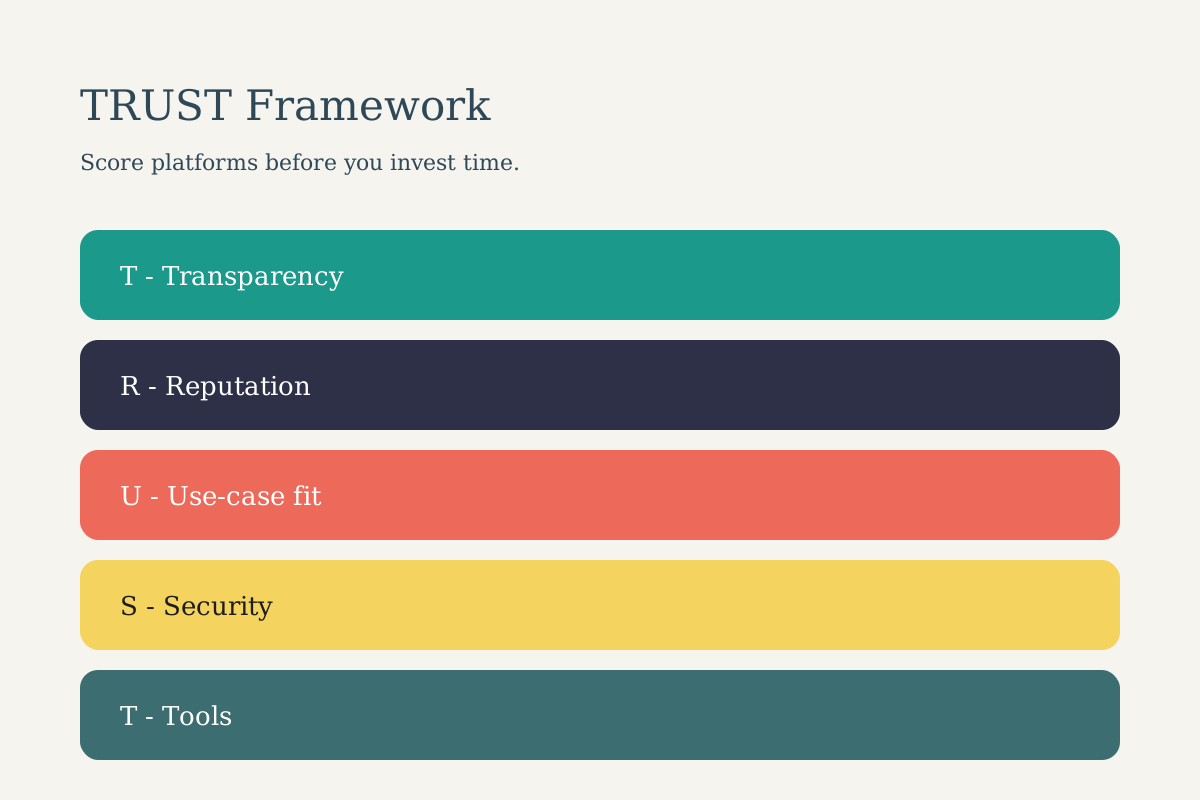
- Transparency: How clear are fees, payout timing, and client expectations? Hidden fees or ambiguous terms are expensive.
- Reputation: How is work verified, reviewed, or ranked? Strong trust signals reduce sales time.
- Use-case fit: Does the platform attract the buyers and project sizes you want? Fit beats volume.
- Security: Are payments protected? Is there a fair dispute process? Security protects your cash flow.
- Tools: Does the platform support contracts, milestones, collaboration, and asset delivery? Tools reduce operational drag.
Not all freelancing platforms are built the same. The table below compares common models so you can match the platform type to your offer and selling style.
| Platform type | Best for | Strengths | Tradeoffs | Typical fees |
|---|---|---|---|---|
| Open marketplace | New freelancers and broad services | High volume of listings, fast feedback | Price pressure, more competition | Platform fee on earnings |
| Curated talent network | Specialists with proofs | Higher-quality leads, premium rates | More vetting and slower entry | Membership or placement fees |
| Niche directory | Focused expertise | Targeted buyers and relevance | Smaller volume | Low or flat listing fees |
| Managed services platform | Done-for-you delivery | Sales handled by platform | Less control and lower margins | Higher platform fees |
| Agency-style marketplace | Teams or partnerships | Larger projects, repeat clients | More ops complexity | Revenue share or retainer cut |
Use this short decision tree before you invest serious hours. If you hit a "no" early, pause and look elsewhere.
- Does the platform have buyers who actually purchase your kind of work at your target price?
- Can you explain your offer in one sentence that fits the platform profile format?
- Are there clear guardrails for payment, revisions, and scope changes?
- Can you win at least 20% of proposals after you refine your positioning?
- Do the time costs (bidding, messaging, admin) still leave a healthy margin?
High-performing profiles read like landing pages. They lead with outcomes, not job titles. They show proof, not just promises. Start by writing a single-sentence positioning line: who you help, what you deliver, and what makes it different. Then support it with three proof points: a case study, a quantified result, and a sample deliverable. If you are not sure how to structure it, the Markework pricing page and why Markework pages are good benchmarks for clarity and trust cues.
Your proposal should mirror the buyer journey. First, restate the goal in the buyers language. Second, show a short plan with milestones. Third, anchor a price with a rationale (scope, speed, and risk). Finally, specify your next step so the conversation does not stall. The faster you guide a client to a decision, the more you can focus on delivery instead of endless pre-sales.
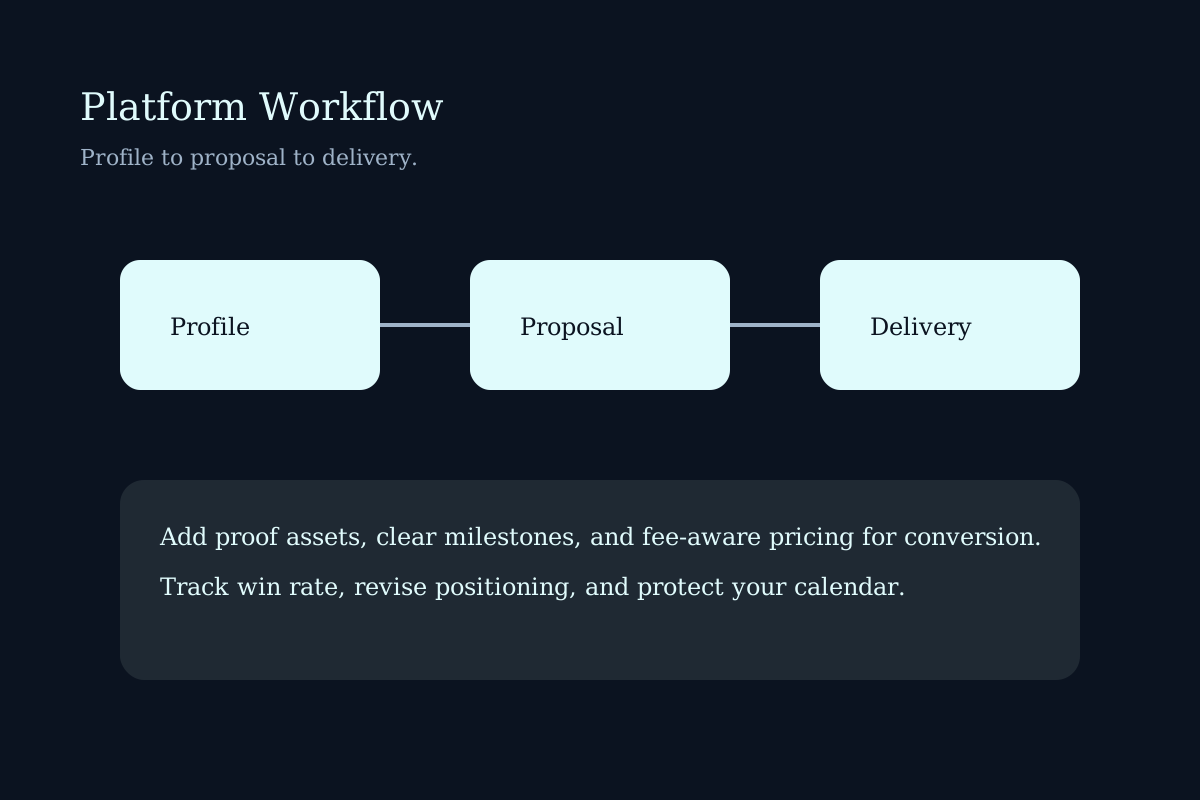
Platform fees change your effective rate. Treat fees like a cost of acquisition. If a platform takes 10% and you spend two hours per week prospecting on it, your pricing must cover both the fee and the overhead. A simple test: calculate your target monthly income, divide by billable hours, then add a fee buffer (10-20%) and a marketing buffer (another 10-20%). If your final rate feels uncomfortable, your platform mix is wrong or your offer is too broad. Narrowing the offer is often the fastest path to higher rates.
- Competing on price instead of position. Buyers pay for risk reduction, not the cheapest bid.
- Using generic portfolio samples that do not match the buyers industry.
- Ignoring platform category tags or search signals that control discoverability.
- Underestimating the time cost of proposal writing and messaging.
- Failing to build a repeatable delivery process that scales beyond one-off gigs.
A paid media freelancer moved from a general marketing category into a narrow niche: DTC subscription brands. She rewrote her profile to focus on LTV and retention outcomes, added two case studies with before-and-after charts, and built a 3-step audit offer. Within 60 days, her win rate improved and her average rate doubled. The platform did not change. Her positioning did.
A two-person creative team wanted predictable lead flow. They chose a managed services platform, accepted higher fees, and standardized a delivery process for brand audits. The tradeoff was less control, but the payoff was consistent pipelines and fewer sales calls. They used this channel to fill baseline capacity while running their own outbound for higher-margin projects.
A new freelancer with minimal portfolio started on a marketplace with fast turnaround projects. He priced low for the first three projects, asked for detailed reviews, and used those to move into higher-budget listings. He also linked to a personal resource hub so clients could see his process. This approach helped him build social proof quickly without getting stuck in low-price work.
This checklist is designed to be reusable. Each item includes the rationale so you can adapt it to any platform or niche.
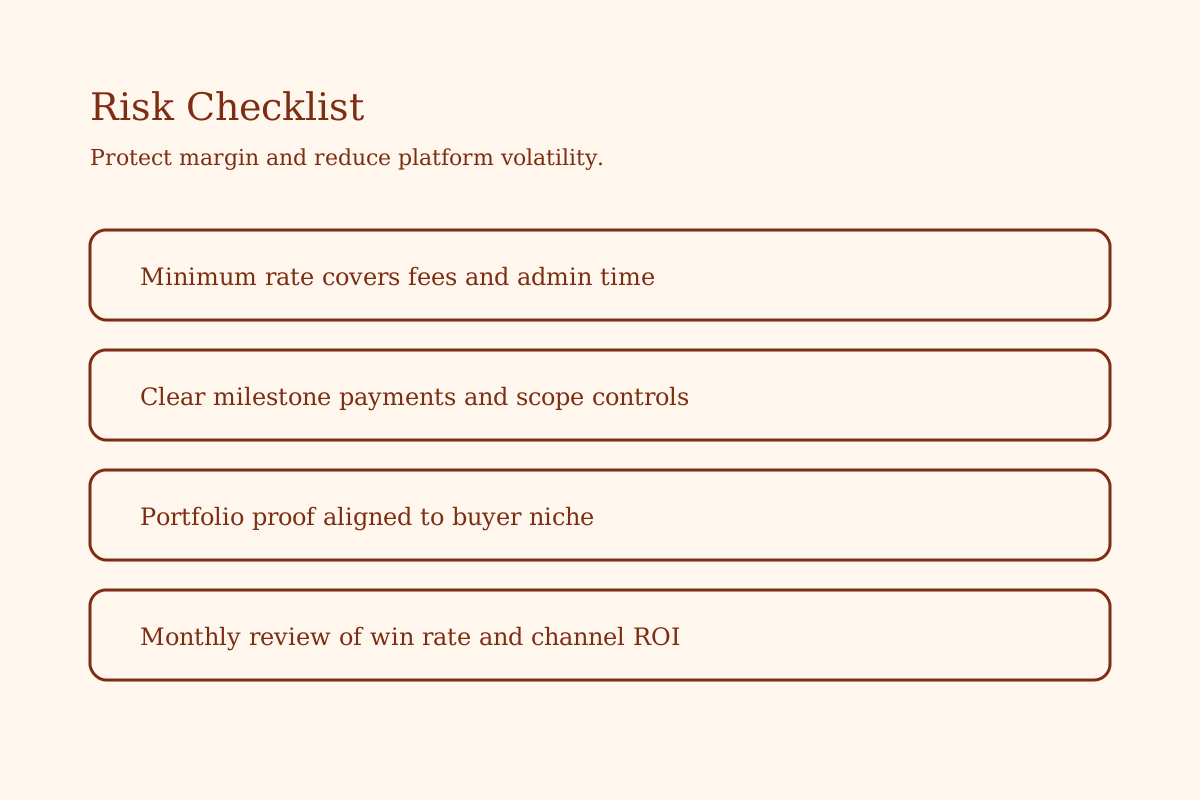
- Define a narrow buyer persona before you update your profile, so every sentence speaks to a real buyer.
- Create a one-page proof asset (case study or audit) so buyers can trust you quickly.
- Prewrite three proposal templates for common project types to reduce response time.
- Set a minimum viable rate that covers platform fees and admin time, then refuse work below it.
- Document a delivery workflow (intake, milestone, revision, handoff) so you scale without chaos.
- Track your win rate by platform to know which channel deserves your time.
Expect three trends to shape marketplaces in the next two years. First, AI matching will improve lead quality but reduce visibility for generic profiles. Second, verification systems (identity, skills, and portfolio authenticity) will become table stakes. Third, buyers will demand more pricing transparency as budgets tighten. The freelancers who win will be those who can clearly quantify outcomes and show proof fast.
Another trend is platform diversification. The data shows that freelancers use multiple channels and that platform dependency is risky. Building a platform mix that balances volume, margin, and relationship depth is a defensible strategy. That is why marketers who build a presence on Markework often combine it with one or two other channels instead of relying on a single marketplace.
If you are a marketer or creative professional, Markework is designed to make discovery and matching simple without the noise of a massive general marketplace. It helps you highlight focused expertise and connect with clients who value specialized outcomes. You can learn more about the platform and its values on the Markework homepage and explore community expectations in the FAQ.
Use Markework as a quality-first channel in your platform mix. Combine it with a repeatable delivery process, and you will turn more of your marketplace conversations into long-term relationships.
The best platform for beginners is the one that offers quick feedback and manageable project sizes. Focus on platforms with clear categories, strong dispute protection, and buyers who post detailed briefs. Start small, gather reviews, then move upmarket.
Two to three is usually enough. One platform for volume, one for quality, and one owned channel (like a portfolio site or referral engine). Too many platforms dilute your focus and reduce response speed.
They can if you let the platform set the terms. Your pricing power comes from positioning and proof. Use platforms to find buyers, but control the narrative with clear outcomes and case studies.
Create a qualification checklist and enforce boundaries early. Require clear scope, use milestone payments, and avoid clients who ignore platform guidelines or push to move off-platform immediately.
Restate the goal, outline the plan, define milestones, and include assumptions. End with a clear next step and a deadline to reduce stalls.
Most freelancers need 4 to 8 weeks of consistent activity to see traction. Track your response and win rates weekly so you can adjust fast.
- Freelancing reached 64 million Americans in 2023, contributing $1.27 trillion to the U.S. economy (source: Upwork press release).
- Freelancers make up 38% of the U.S. workforce, with strong participation from Gen Z (52%) and Millennials (44%) (source: Upwork Freelance Forward 2023).
- Freelancers adopt generative AI at higher rates: 20% versus 9% among non-freelancers (source: Upwork press release).
- Self-employment in the U.S. stood at 9.1 million workers and a 5.7% rate in Q4 2023 (source: U.S. Bureau of Labor Statistics).
- Occasional independent work grew 130% from 2020 to 2023, rising from 15.8 million to 36.6 million (source: MBO Partners).
- EU self-employment fell from 15.4% in 2010 to 13.7% in 2022, showing shifting labor dynamics (source: Eurofound).
- OECD countries reported about 10 million migrant entrepreneurs in 2022, with immigrants accounting for 17% of the self-employed (source: OECD International Migration Outlook 2024).
- Platform fee: The percentage a marketplace deducts from your earnings.
- Client acquisition cost: The time and money you invest to win a project.
- Milestone payment: A staged payment released after defined deliverables.
- Positioning: The clear statement of who you help and what outcome you deliver.
- Proof asset: A case study, audit, or sample that demonstrates results.
- Choose a platform type that matches your offer and ideal buyer.
- Score each platform using the TRUST framework.
- Build a profile that leads with outcomes and proof.
- Calculate a fee-adjusted rate and set a minimum.
- Use a consistent proposal and delivery workflow.
- Review performance monthly and prune weak channels.
Disclaimer: This blog post is provided for informational purposes only and is provided as-is. Markework, its owners, and contributors assume zero liability for any losses, damages, or outcomes resulting from the use of this information.