


Marketing freelancers sit at the center of growth, but the market is noisy. This guide is built for freelancers who want a repeatable system to find clients, price with confidence, and convert projects into retainers. It blends strategy, practical execution, and data-backed benchmarks so you can make smarter platform choices and build a stable pipeline.
Search intent for marketing freelancers is mixed: people want a clear definition, proof that the path is viable, and tactical guidance for finding and closing work. You will get all three here, plus a decision framework, a scoring rubric, and checklists you can reuse every quarter.
If you want to explore how Markework connects marketing talent and clients, browse the freelancer directory, scan the find work hub, and review insights on the Markework blog.
Marketing freelancers sell outcomes, not tasks. The strongest freelancers connect their work to revenue, retention, or efficiency. That might mean paid media optimization, lifecycle email strategy, SEO systems, or conversion rate testing. The key is to define a clear business problem and deliver measurable progress.
Freelancers who position themselves as a solution to a specific business problem are more likely to command higher rates and retain clients. Generalists can still win, but they need sharper packaging and a clear proof trail.
- Freelancers contributed $1.27 trillion in annual earnings to the U.S. economy in 2023 (source: Upwork Freelance Forward 2023).
- 64 million Americans freelanced in 2023, or 38% of the U.S. workforce (source: Upwork Freelance Forward 2023).
- Freelancing grew by 4 million people from 2022 to 2023 (source: Upwork Freelance Forward 2023).
- 20% of freelancers regularly use generative AI versus 9% of non-freelancers, a 2.2x gap (source: Upwork Freelance Forward 2023).
- 47% of freelancers provide knowledge services such as marketing, IT, and business consulting (source: Upwork Freelance Forward 2023).
- 23% of freelancers create influencer style content like social media videos or blogs (source: Upwork Freelance Forward 2023).
- 52% of Gen Z professionals and 44% of Millennials performed freelance work in 2023 (source: Upwork Freelance Forward 2023).
- Occasional independents grew from 15.8 million in 2020 to 36.6 million in 2023, a 130% increase (source: MBO Partners State of Independence 2023).
- 15% of traditional job holders reported a freelancing or consulting side gig in 2023 (source: MBO Partners State of Independence 2023).
- 26 million full time independents in 2023, up 20% year over year (source: MBO Partners State of Independence 2023).
- 40% of independents who serve businesses used an online talent platform in the past 12 months, and 47% planned to use one in the next 12 months (source: MBO Partners State of Independence 2023).
- BLS estimates 9.1 million unincorporated self-employed workers in Q4 2023, or 5.7% of nonagricultural employment (source: U.S. Bureau of Labor Statistics).
- OECD employment and labor force participation rates were 70.1% and 73.8% in Q4 2023 (source: OECD Labour Market Situation release, April 2024).
- Freelance platforms market expected to reach $14.39 billion by 2030 with 17.7% CAGR from 2025 to 2030 (source: Grand View Research press release).
- North America held nearly 31% of freelance platform revenue in 2024 (source: Grand View Research press release).
Use the MAGNET framework to score opportunities and platforms before you invest time. It forces clarity on the demand side and protects your margin.
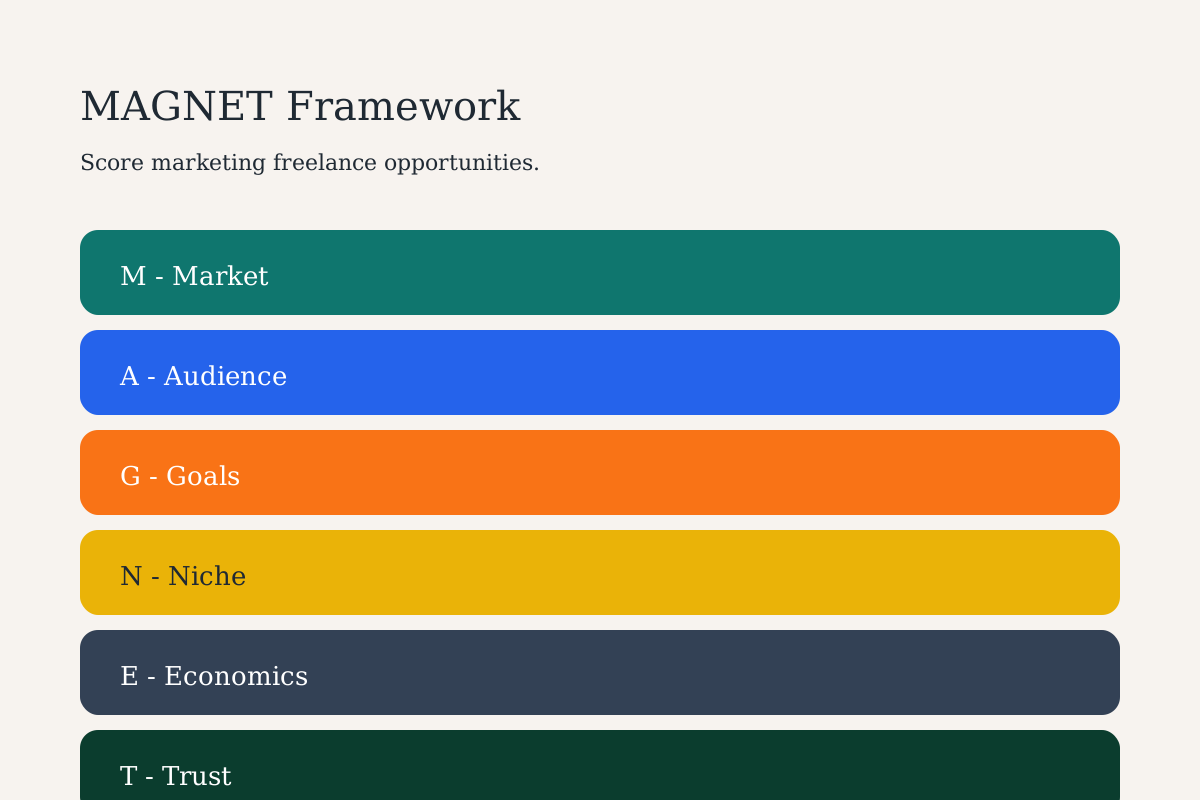
- Market: Is there clear budget and demand for the marketing problem you solve?
- Audience: Can you describe your best buyer in one sentence?
- Goals: Do buyers define success with measurable outcomes?
- Niche: Is your offer specialized enough to reduce competition?
- Economics: Do fees and time costs still leave a healthy margin?
- Trust: Are proof and reviews visible and credible on the platform?
Score each dimension from 1 to 5. If your total is under 22, revisit your offer or platform mix.
This rubric helps you diagnose what to fix first. If your score is below 70, tighten positioning and proof before you scale outreach.
| Category | 0 to 10 | 11 to 17 | 18 to 20 |
|---|---|---|---|
| Positioning | Generic services | Clear niche but weak outcomes | Sharp niche with outcome promise |
| Proof | No case study | One case study | Two or more with metrics |
| Offer clarity | Unstructured | Some packages | Clear ladder and deliverables |
| Pricing | Ad hoc | Baseline rate | Rate tied to value and scope |
| Pipeline | Inconsistent outreach | Weekly outreach | Tracked pipeline and win rate |
| Delivery | No workflow | Basic checklist | Documented process and reporting |
| Retention | One off | Occasional retainer | Repeatable monthly retainers |
| Platform fit | Poor match | Mixed fit | Strong match and visibility |
| Brand assets | No assets | Portfolio only | Proof assets plus content |
| Risk control | No contract | Basic contract | Clear scope and change control |
| Platform type | Best for | Strengths | Tradeoffs |
|---|---|---|---|
| Open marketplace | New freelancers | High volume, fast feedback | Price pressure, heavy competition |
| Curated network | Specialists | Higher quality leads | Stricter vetting |
| Niche directory | Focused services | Targeted buyers | Lower volume |
| Managed services | Packaged offers | Sales support | Less control, higher fees |
| Agency style | Teams | Larger budgets | More ops overhead |
Most freelancers fail because they rely on a single channel. Use this 5 stage pipeline to build resilience:
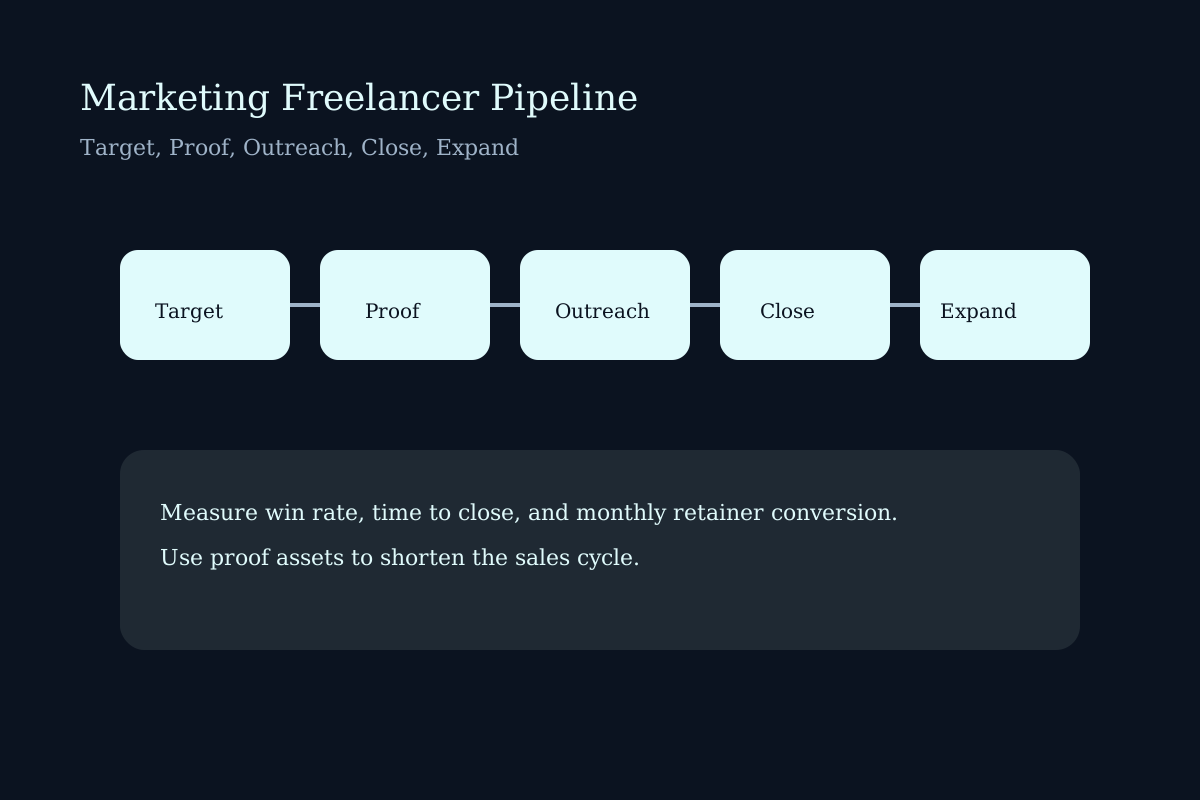
- Target: Define a single industry or use case that you can own.
- Proof: Build one short case study and one before and after snapshot.
- Outreach: Commit to a weekly volume of targeted proposals or messages.
- Close: Run a short discovery call with clear next steps and decision timing.
- Expand: Turn initial wins into retainers with performance reporting.
Pricing is easier when you offer a clear ladder. Use this structure to move buyers from low risk to long term engagement.
- Entry offer: Audit or teardown with fast delivery.
- Core offer: Implementation project with defined milestones.
- Retainer: Monthly optimization with a clear KPI dashboard.
- Performance bonus: Optional upside for revenue wins.
Treat platform fees and admin time as a client acquisition cost. If you target $8,000 per month and can sustainably deliver 32 billable hours, your base rate is $250 per hour. Add a 15% fee buffer and a 10% marketing buffer, and you need to price closer to $312 per hour. If that feels high, tighten the offer or increase the value delivered per hour.
Marketing freelancers often underprice because they think in tasks. Shift to outcomes. A landing page that lifts conversion by 1% can justify a higher price than a generic design task. The point is not to inflate rates, but to align price with impact and risk reduction.
- Fee buffer: 10 to 20% to cover platform take rates.
- Marketing buffer: 10 to 20% to cover outreach time.
- Ops buffer: 5 to 10% for tools, software, and reporting.
- Floor rate: The minimum you accept after buffers.
A strong proposal reduces risk and makes it easy to say yes. Use this structure and keep it under one page.
- Restate the goal in the client language.
- Explain the approach in 3 to 5 steps.
- Define the deliverables and timeline.
- Share proof or a relevant case study.
- Offer a clear next step and decision date.
Most objections are about risk, not price. Buyers want to know if you can deliver and if the timeline will slip. Address this by showing proof, naming assumptions, and offering a small first step. A clear pilot or audit lowers risk and creates momentum.
- Budget is tight: Offer a smaller pilot tied to one KPI.
- We are not sure about timeline: Provide a milestone plan with weekly updates.
- We have worked with freelancers before: Show a case study and a delivery checklist.
Retainers are built on consistent proof. Your reporting should show movement on a small set of KPIs and explain what changed.
- KPI baseline and current value.
- What was shipped this month.
- What was tested and learned.
- Next month plan and risks.
- Decision or feedback requested.
Retainers happen when buyers can see predictable progress. Use this checklist before you pitch a monthly plan.
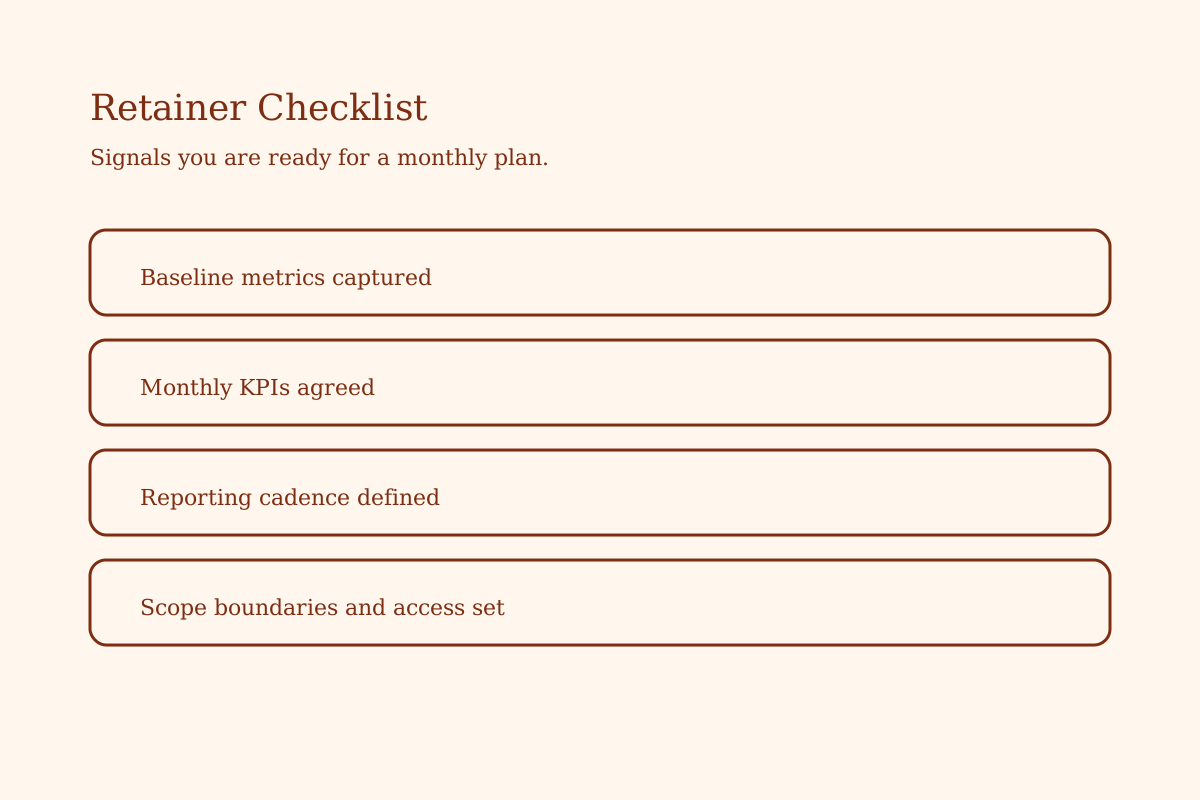
- Baseline metrics documented.
- Monthly goals and KPIs agreed.
- Reporting cadence defined.
- Scope boundaries and revision rules set.
- Access and data permissions verified.
- Decision maker on the call.
Marketing freelancers protect margin by controlling scope and expectations. A clear contract is not optional. It reduces conflict and speeds up delivery.
- Define scope and deliverables in plain language.
- Set revision limits and response times.
- Use milestone payments for larger projects.
- Require access and data before kickoff.
- Set a single point of contact for approvals.
Tools should reduce friction, not add it. Keep the stack lean and standardized across clients.
- Project management: A simple board with milestones and due dates.
- Analytics: A shared dashboard for KPIs.
- Documentation: A single living brief and update doc.
- Communication: One primary channel with response windows.
- Asset delivery: A standard folder structure and naming system.
- Positioning as a generalist without clear outcomes.
- Pricing without accounting for platform fees and admin time.
- Ignoring proof assets and relying on resumes.
- Skipping discovery and writing proposals too early.
- Not tracking win rate or time to close.
Freelancing can be powerful, but it is not a perfect fit for everyone. If you need stable income, prefer deep team collaboration, or dislike selling, a full time role may be a better match. Consider freelancing as a phased experiment rather than a binary switch.
- You do not want to manage your own pipeline.
- You prefer a long term product roadmap over short engagements.
- You dislike client communication or scope control.
- You need a fixed income without variability.
Expect more AI assisted workflows, higher demand for measurable outcomes, and more verification of skills and identity. The freelancers who win will show proof quickly and operate with a repeatable delivery system.
A freelancer focused on DTC subscription brands used a short audit offer to win entry projects, then moved clients into a monthly optimization retainer. The niche focus reduced proposal competition and doubled close rates in two months.
A lifecycle marketer packaged a 30 day onboarding revamp and linked results to revenue per user. The clear KPI story justified a higher monthly fee and led to a 6 month retainer.
A SEO freelancer built a reusable content briefing system and used a single case study with traffic lift charts. That proof asset became the primary sales tool across platforms.
Markework is built for marketing and creative freelancers who want less noise and clearer alignment with client goals. If your work is outcome driven and you want to show proof fast, use Markework as a quality focused channel alongside other platforms.
Learn more on the Markework homepage, review the pricing page, and see how the platform positions trust on the why Markework page. If you have questions, the FAQ covers how the marketplace works. For direct inquiries, use the contact page.
Pick a single niche, build one proof asset, and send a consistent volume of targeted proposals for 4 to 6 weeks. Speed plus relevance wins.
Start with your income target and billable hours, then add a fee buffer and a marketing buffer. If the rate feels too high, narrow the offer or move to higher value outcomes.
Two to three is enough. One for volume, one for quality, plus an owned channel like a portfolio or referral engine.
A one sentence positioning line, a clear outcome statement, and proof such as a case study or KPI screenshot.
Define a monthly KPI, report consistently, and show incremental improvements. Retainers follow visible progress.
Certifications help, but outcomes and proof assets close deals faster. Focus on evidence over badges.
- Freelancers contributed $1.27 trillion to the U.S. economy in 2023 (source: Upwork Freelance Forward 2023).
- 64 million Americans freelanced in 2023, or 38% of the U.S. workforce (source: Upwork Freelance Forward 2023).
- 20% of freelancers regularly use generative AI versus 9% of non-freelancers (source: Upwork Freelance Forward 2023).
- Occasional independents grew 130% from 2020 to 2023, reaching 36.6 million (source: MBO Partners State of Independence 2023).
- BLS reported 9.1 million unincorporated self-employed workers in Q4 2023, or 5.7% of nonagricultural employment (source: U.S. Bureau of Labor Statistics).
- Freelance platforms market expected to reach $14.39 billion by 2030 at 17.7% CAGR (source: Grand View Research press release).
- Positioning: The clear statement of who you help and what outcome you deliver.
- Proof asset: A case study, audit, or KPI snapshot that builds trust quickly.
- Offer ladder: A set of services that moves clients from low risk to retainer.
- Win rate: The percent of proposals or calls that become paid work.
- Retainer: A monthly agreement tied to ongoing optimization and reporting.
- Pick a focused niche and define a clear outcome.
- Build one proof asset with real metrics.
- Score platforms with the MAGNET framework.
- Run a weekly outreach cadence and track win rate.
- Convert wins into retainers with KPI reporting.
Disclaimer: This blog post is provided for informational purposes only and is provided as-is. Markework, its owners, and contributors assume zero liability for any losses, damages, or outcomes resulting from the use of this information.