

An ad agency is not just a company that makes ads. At its best, it is an outside growth partner that helps a brand decide what to say, where to say it, how much to spend, and how to measure whether the work is actually moving revenue, market share, or customer demand. That job matters even more now because the media market is bigger, faster, and more fragmented than it used to be, with U.S. internet advertising alone reaching $258.6 billion in 2024 after 14.9% year-over-year growth.
The modern ad agency also sits in the middle of a harder operating environment. Brands are balancing creative quality, media efficiency, AI adoption, personalization pressure, in-house capability building, and increasing demands for transparency from finance teams and procurement. That combination is exactly why the agency conversation has shifted from “who can make the best campaign” to “who can help us build a system that performs.”
- What an Ad Agency Actually Does
- Why Ad Agencies Still Matter
- The Modern Ad Agency Framework
- Core Services and Team Structure
- How Brands Work With Agencies in Practice
- How to Choose, Measure, and Scale the Right Agency Relationship

What an Ad Agency Actually Does
An ad agency helps a business turn commercial goals into messages, media plans, campaigns, and measurable outcomes. In practical terms, that can include market research, positioning, creative development, media planning, paid media buying, production, measurement, optimization, and reporting. The core idea is simple: the agency gives a brand specialized talent and outside perspective that would be expensive, slow, or unrealistic to build entirely in-house.
That definition sounds broad because the category really is broad now. Some agencies focus on brand strategy and big creative ideas, some live almost entirely in paid search and paid social, some specialize in media buying, and others operate more like integrated growth partners across creative, analytics, commerce, CRM, and automation. The label stays the same, but the operating model has changed with the market.
The easiest way to understand an ad agency is to look at the gap it fills. A brand may know its product, margins, and internal politics better than anyone, but it often lacks enough dedicated specialists across strategy, copy, design, video, platform buying, data, and experimentation to move quickly across every channel. The agency exists to close that gap and turn scattered marketing activity into a coordinated system.
Why Ad Agencies Still Matter
Ad agencies still matter because advertising has become more operationally demanding, not less. The market keeps expanding, formats keep multiplying, and performance expectations keep rising, which means brands need teams that can connect creative quality with channel execution and financial accountability. When digital advertising grows this quickly, waste gets expensive fast, and that makes expertise more valuable, not less.
They also matter because differentiation is hard. In Deloitte’s recent CMO research, marketers outperforming their markets were far more likely to credit a differentiated strategy than simply having more funding, which is a useful reminder that budget alone does not create results. A strong ad agency helps a brand sharpen the message, not just increase the spend.
There is another reason this conversation has become more urgent: brands are no longer choosing between a traditional agency model and a fully internal team. They are building hybrid structures, expanding in-house capabilities, and using external partners where specialization, speed, or scale still matters most. That is why the real question is no longer whether a business needs an ad agency at all, but what kind of agency support creates the highest leverage inside a mixed operating model.
The Modern Ad Agency Framework
A good ad agency does not start with channels. It starts with the business problem, then works forward into strategy, creative, distribution, and measurement. That sounds obvious, but it is exactly where weak agency work usually breaks: teams jump straight into ads, assets, and platform tactics before they have decided what outcome matters most and what message is strong enough to earn attention in a crowded market. IAB’s latest revenue data shows just how competitive that market has become, with U.S. digital advertising climbing to roughly $259 billion in 2024.
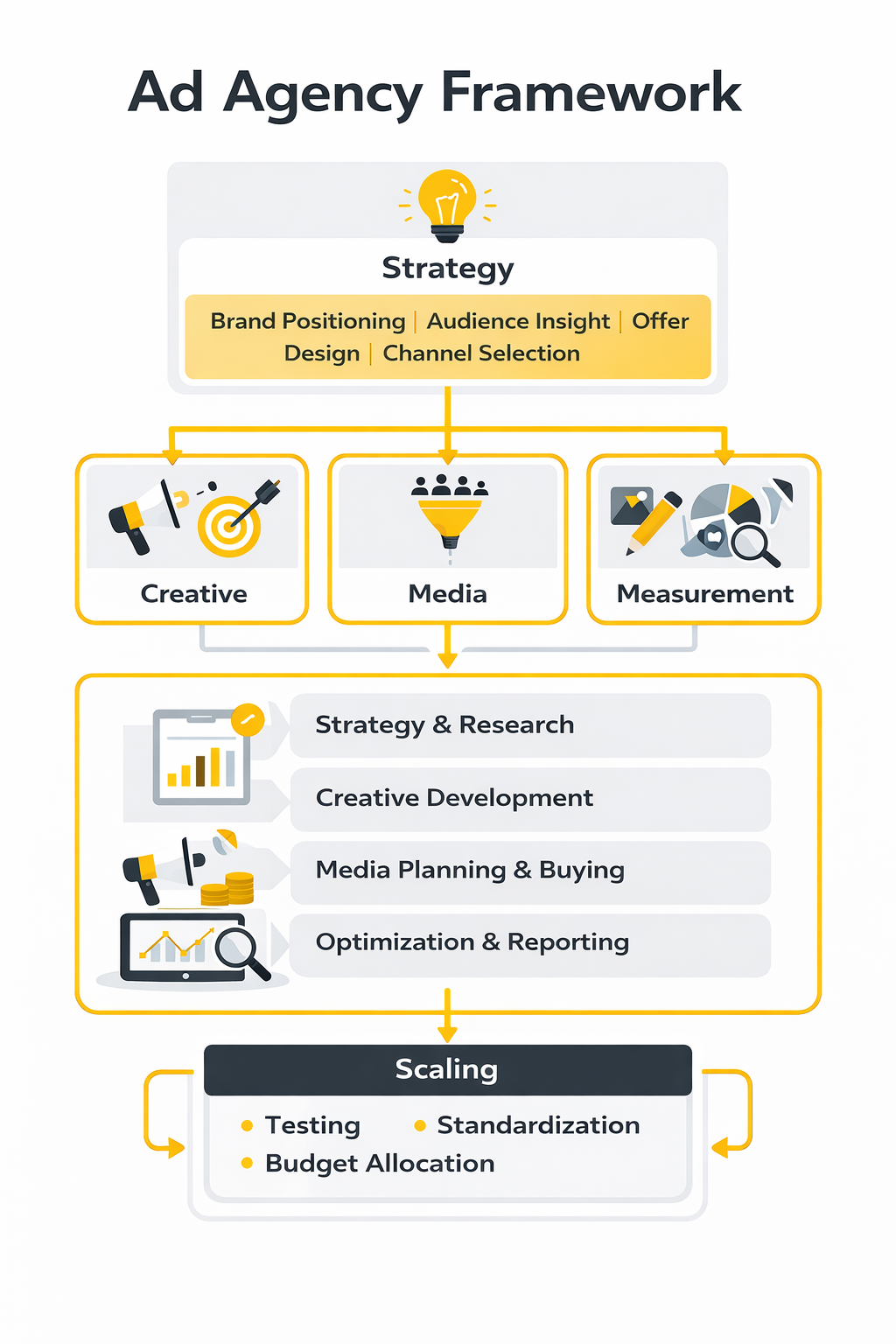
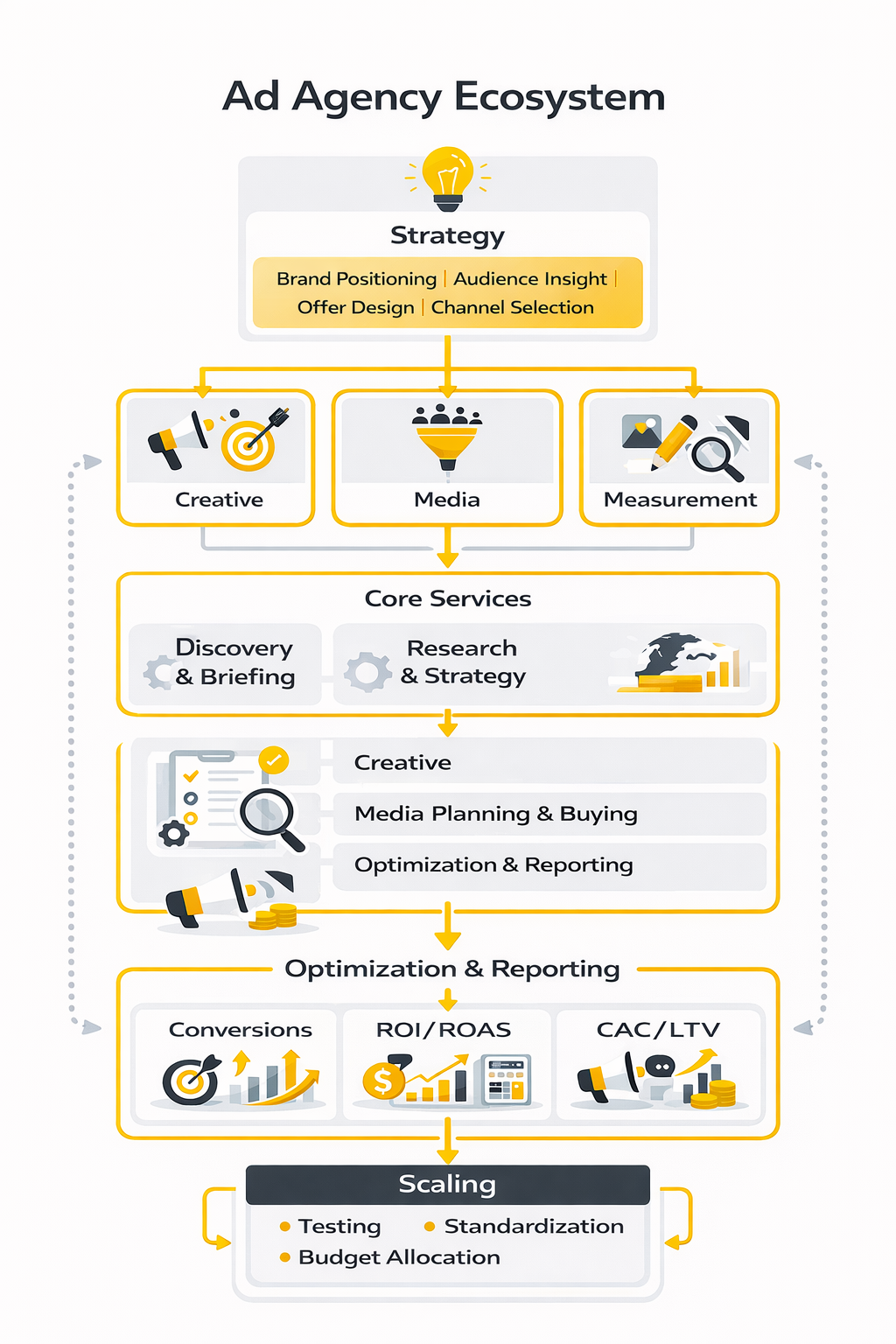
The modern framework is more disciplined than the old “creative first” or “media first” models. The agency has to connect brand positioning, audience insight, offer design, channel selection, and measurement into one operating loop, because isolated excellence is not enough anymore. Marketers are under pressure to do more with flat budgets, and Gartner’s 2025 CMO spend findings show that budgets remained stuck at 7.7% of company revenue even as channel complexity kept rising.
That is why the best ad agency relationships now look less like a vendor agreement and more like a performance system. The agency helps the brand decide what to test, what to standardize, what to stop doing, and where the next marginal gain is likely to come from. When that system works, creative, media, analytics, and operations stop fighting each other and start compounding. McKinsey’s work on marketing operating models points in the same direction: growth comes from connected ways of working, not disconnected specialization.
Strategy Comes First
Strategy is the part many businesses say they want and then quietly rush past. A capable ad agency uses strategy to answer a few brutally practical questions: who exactly needs to care, what belief needs to change, what offer is compelling enough to act on, and what proof will make that message credible. Without those answers, even strong execution turns into motion without leverage.
This is also where agency value is easiest to underestimate. Internal teams usually live close to the product and the politics, which gives them depth but can reduce objectivity. An outside agency can often see positioning gaps, audience confusion, and offer weakness faster because it is not protecting internal assumptions. The Spring 2024 CMO Survey insights make the point clearly: marketers outperforming their markets were much more likely to credit differentiated strategy than funding levels.
Creative and Media Have to Work as One System
Too many brands still separate the message from the distribution plan as if those are different conversations. In reality, creative and media shape each other. A six-second video, a search ad, a landing page, a retail media placement, and a CRM follow-up sequence all ask for different creative decisions, even when they support the same campaign objective.
That matters because the job of an ad agency is not just to produce assets. It is to build creative that survives contact with real buying environments and real audience behavior. Measurement companies like Nielsen keep pushing the same lesson: advertisers need cross-media visibility because reach, frequency, overlap, and outcomes cannot be understood channel by channel in isolation. Nielsen’s cross-media guidance and its planning work on business outcomes both reinforce that the media plan and the measurement plan have to be designed together.
Measurement Is Not the Last Step
A modern ad agency treats measurement as part of campaign design, not a post-campaign autopsy. The team needs to know in advance which metrics indicate signal, which metrics are just platform noise, and how short-term performance indicators connect to longer-term brand and revenue outcomes. That prevents the all-too-common trap of optimizing toward the easiest number instead of the most useful one.
This is where experienced agencies tend to separate themselves from commodity service providers. They know that impressions, clicks, and even platform-reported conversions can tell only part of the story. Nielsen’s recent work on full-funnel outcomes and independent cross-media measurement keeps returning to the same point: planning and optimization improve when marketers can connect exposure to business impact rather than just dashboard activity.
Core Services and Team Structure
Once the framework is clear, the next question is what an ad agency actually delivers day to day. The answer depends on the type of agency, but most serious firms combine some version of strategy, creative, media, production, analytics, account management, and operations. The reason that mix exists is simple: campaigns fail when handoffs are weak, and agency structure is really an attempt to reduce those weak handoffs. The 4As still describes the agency business as a specialized professional field because brands need coordinated expertise rather than one generalist trying to do everything.
The size of the team matters less than the clarity of the roles. A small ad agency can outperform a large one if it has strong decision rights, fast feedback loops, and senior people close to the work. A large agency can still be the better fit when a brand needs scale across markets, channels, languages, legal review, and production volume. WFA’s recent work on content production and in-house evolution shows why this is becoming a structural decision, not just a creative preference.
Strategy and Account Leadership
Strategy turns business goals into choices. Account leadership turns those choices into momentum, alignment, and execution across the client-agency relationship. When these roles are strong, the brand is not left wondering what is happening, why priorities changed, or whether anyone is protecting the bigger objective.
This part of the team also protects against a subtle but expensive problem: activity drift. Campaigns can accumulate requests, edits, and side projects until the original goal gets buried under stakeholder noise. Strong account and strategy leadership keep the work pointed at business outcomes, which matters even more when marketing leaders are being asked to prove efficiency as well as growth.
Creative and Production
Creative is still one of the clearest ways an ad agency earns its fee, but creative work now includes far more than headlines and visuals. It often covers messaging systems, video, static ads, landing pages, scripts, email sequences, creator briefs, and modular assets that can be adapted across multiple placements. Production sits underneath that layer and makes sure the ideas can actually ship at the speed the media plan demands.
That production engine has become more important as brands push for more content, more variants, and faster iteration. WFA’s 2025 research on content production points to brands rethinking how work gets made, with AI and in-house capability reshaping the balance between speed, cost, and control. In other words, modern agency creative is no longer just about originality; it is also about throughput without quality collapse.
Media Buying and Performance Management
Media teams decide where spend goes, how audiences are built, how campaigns are paced, and how budgets shift once real data starts coming in. In a strong ad agency, media is not a mechanical buying function. It is an active decision-making role that manages risk, learns quickly, and reallocates spend before waste hardens into habit.
That role becomes more valuable as digital channels take a larger share of overall marketing spend. Gartner’s 2025 survey found that digital channels accounted for 61.1% of total marketing spend, with paid online channels leading the mix, which is another way of saying the room for costly mistakes is huge. Nielsen’s optimization work adds a practical angle here too: more frequent reporting and smarter in-flight optimization can materially reduce wasted spend.
Analytics, Measurement, and Operations
Analytics turns campaign data into usable decisions. Operations makes sure the process, tooling, approvals, naming conventions, tracking, and reporting structure do not fall apart as complexity rises. These roles rarely get celebrated in pitch decks, but they are often the difference between a campaign that learns and a campaign that merely runs.
This operational layer matters because modern marketing is now too interconnected to manage casually. Personalization, full-funnel measurement, martech integration, and faster testing cycles all increase the value of clean systems and disciplined reporting. McKinsey’s personalization research and Nielsen’s measurement guidance both point to the same conclusion: better outcomes depend on better orchestration, not just better creative ideas.
How Brands Work With Agencies in Practice
Once a brand understands what an ad agency is and how the modern model works, the next question is practical: what does the relationship actually look like once the contract is signed. This is where the difference between a productive partnership and a frustrating one becomes obvious. The strongest agency relationships are not built on vague promises or endless presentations. They run on clear scope, sharp briefs, shared data, fast decisions, and a reporting rhythm that keeps everyone honest.
That matters more now because teams are trying to do more with tighter budgets and more channels at the same time. Gartner’s 2024 CMO spend data showed budgets falling to 7.7% of revenue while paid media remained protected, which means brands cannot afford sloppy onboarding, confused ownership, or campaigns that drift for months without clear learning. An ad agency has to fit into the client’s operating reality, not just into a pitch deck.
A good way to think about implementation is this: strategy gets the agency hired, but process determines whether the strategy ever becomes results. That process is usually less glamorous than the creative, but it is where money is won or lost. When the brand and agency agree on how decisions get made, what success looks like, and how information flows, the work starts to compound instead of reset every week.
The Agency Implementation Process
The implementation phase is where an ad agency stops being a concept and becomes part of the company’s real operating system. This is the stretch where access gets granted, briefs become work, budgets become live, and reporting turns from theory into accountability. Brands that skip structure here usually create the same problems they later blame on the agency.
The actual process varies by company size, category, and channel mix, but the most effective implementations tend to follow the same sequence. They start with business clarity, move into scope and governance, then into assets, tracking, launch, and optimization. That is not bureaucracy. It is risk control for an environment where media fragmentation, measurement gaps, and speed pressures are all getting worse, not better.
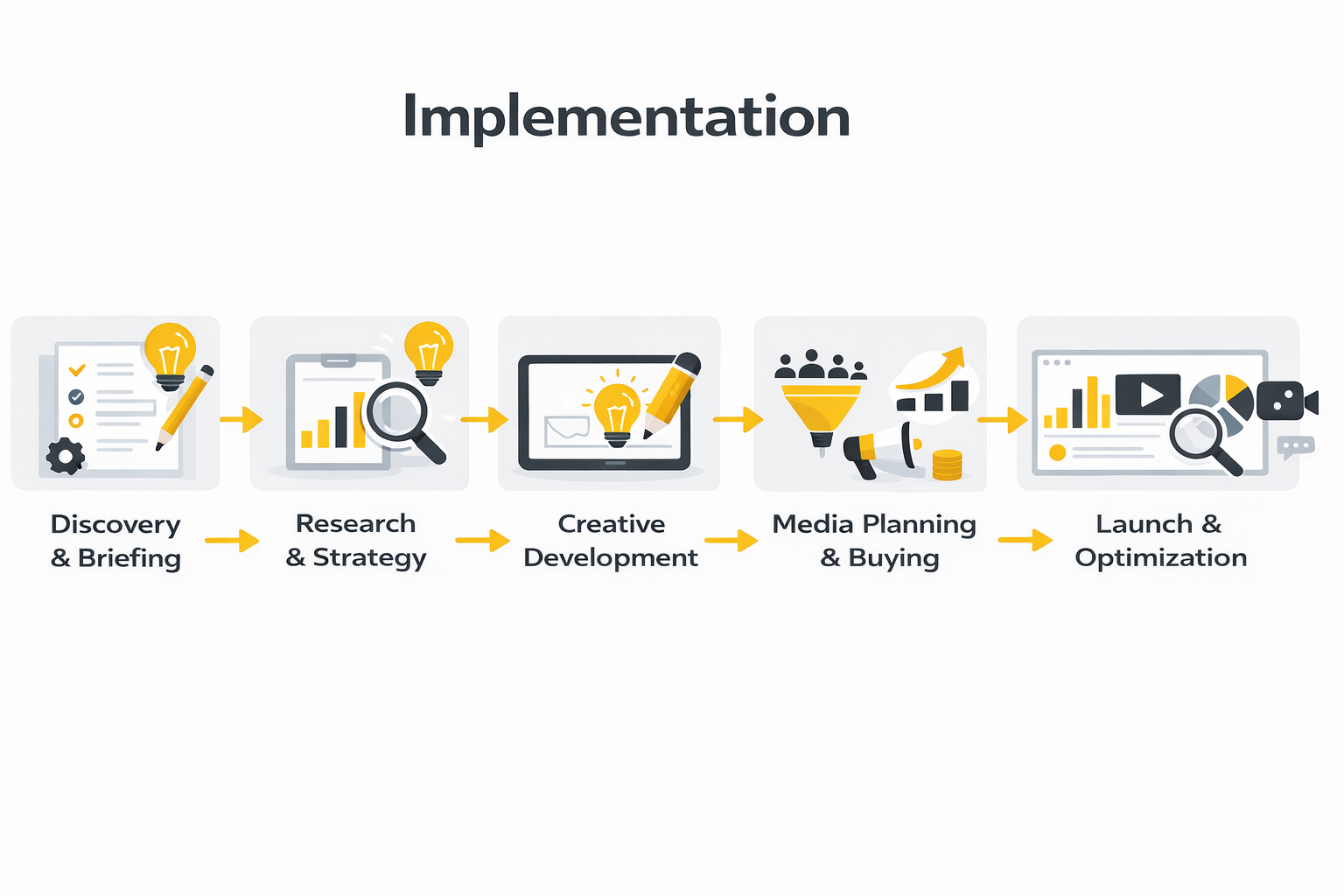
Step 1: Define the Business Problem Before the Marketing Deliverables
The first implementation mistake many brands make is briefing deliverables instead of briefing the problem. They ask an ad agency for campaigns, videos, paid social, or media buying before they define the revenue target, margin pressure, audience shift, pipeline issue, or market expansion goal behind the work. That usually creates activity, but not alignment.
A serious agency starts by translating company priorities into marketing objectives that can be acted on. The brief needs to explain the commercial context, the desired outcome, the constraints, and what success actually means for leadership. The WFA’s 2025 agency selection guidance is very explicit here: agencies need clear and transparent information on requirements, objectives, deliverables, timelines, budgets, and selection criteria in order to respond effectively.
This stage also forces realism. If the business wants aggressive growth with thin margins, limited creative resources, and slow internal approvals, the agency needs to know that upfront. Good implementation begins when both sides stop pretending the work is just about ads and admit it is about solving a business problem under real operational constraints.
Step 2: Lock the Scope, Roles, and Decision Rights
Once the business goal is clear, the next step is turning that goal into a working model. This means deciding what the ad agency owns, what the client owns, who approves what, how fast decisions need to happen, and how changes to scope will be handled. Without that structure, work slows down for reasons that have nothing to do with creative quality or media performance.
This is also where many partnerships quietly become expensive. A brand might assume strategy is included while the agency treats it as out of scope. The agency might expect the client to provide approved assets, landing pages, and analytics access, while the client assumes the agency will build everything. The longer those misunderstandings sit unresolved, the more performance suffers.
That is one reason transparency has become such a live issue in the industry. WFA’s 2025 media transparency push, built with Ebiquity, focuses on governance, rebates, principal media, and broader contract clarity because agency value is heavily shaped by what is or is not clearly defined at the agreement level. In plain English, strong relationships do not run on trust alone. They run on explicit operating terms.
Step 3: Build the Briefing and Asset Pipeline
At this point, the agency can finally do useful work, but only if the inputs are clean. That means messaging documents, offer details, product claims, brand guidelines, historical performance data, landing pages, creative assets, legal rules, and audience knowledge all need to move into one usable workflow. A great ad agency can improve weak inputs, but it cannot magically remove confusion that the client refuses to surface.
This is why briefing should not be treated as a one-time handoff. It needs to be a repeatable operating habit. The WFA guidance stresses that the more complete the brief is, the better equipped agencies are to propose effective strategies and approaches, and that includes being honest about budgets and business size so agencies can size the work correctly.
In practice, the best setup is usually modular. The client provides the commercial truth, the non-negotiables, and the internal context. The ad agency translates that into creative briefs, test plans, channel-specific execution, and a production calendar. That keeps information moving without forcing every campaign to restart from zero.
Step 4: Set Up Tracking, Reporting, and Baselines Before Launch
This step is not optional, even though brands often treat it that way. Before campaigns go live, the ad agency and client need to agree on the tracking architecture, reporting views, attribution limits, baseline performance, and the handful of metrics that will actually inform decisions. If that work happens after launch, the first weeks of spend usually produce noise instead of learning.
That is especially important in a fragmented media environment. Nielsen’s 2025 planning work highlights how difficult it has become to optimize spend across digital and TV, while its broader cross-media guidance keeps stressing the need for independent data and better visibility across channels. If measurement is confused, the agency cannot tell whether the problem is the message, the media mix, the landing page, the audience, or the offer itself.
The baseline matters because optimization only means something relative to a starting point. A competent ad agency should know what the brand’s prior costs, conversion rates, reach patterns, and time-to-result looked like before it starts making bold claims about improvement. Otherwise, reporting becomes storytelling instead of accountability.
Step 5: Launch in Controlled Phases, Not in One Big Reveal
A lot of disappointing agency engagements come from one bad instinct: trying to prove everything at once. The smarter move is to launch in phases. Start with a controlled set of campaigns, offers, or audience groups, confirm the tracking, pressure-test the creative, and learn where the first real signal appears before expanding spend.
This phased approach fits the reality of modern media planning. Nielsen’s 2025 report argues for more nuanced channel mixes as traditional and emerging media continue to coexist, which means an ad agency has to learn how the brand behaves across different environments rather than assuming one channel framework works everywhere. That is true whether the work is search-heavy, retail-media-heavy, video-led, or full-funnel.
A phased rollout also improves internal credibility. Leadership gets early visibility into what is happening, finance sees the logic behind budget release, and the client team has time to fix operational issues before scale magnifies them. In real life, controlled launches are not slower. They are usually faster to profitable learning because they prevent expensive confusion.
Step 6: Create a Weekly Learning Loop and a Monthly Decision Loop
Once campaigns are live, the relationship needs rhythm. Weekly meetings should focus on signal: what changed, what the data suggests, what is being tested next, and what risks need decisions. Monthly reviews should step back and ask the bigger questions: is the account moving toward the actual business outcome, is the channel mix still right, and does the scope still match reality.
This kind of cadence is one of the clearest signs that an ad agency is operating professionally. It prevents the common pattern where teams either overreact to daily dashboard movement or wait too long to address obvious problems. It also creates a written history of decisions, which becomes incredibly useful when performance shifts or leadership asks why the team changed direction.
There is a strong industry reason to take this seriously. The new 4As and ANA tenure data shows the average client-agency relationship now stands at seven years, more than double the level reported in 2016, which suggests the market is rewarding partnerships that behave like durable operating relationships rather than disposable suppliers. Long relationships do not survive on charm. They survive on good governance and repeated business value.
What Usually Breaks the Process
Most client-agency problems are not caused by talent shortages. They are caused by implementation gaps that everyone notices too late. The client wants faster output but cannot approve on time. The ad agency wants better performance but does not have enough access to data, product information, or internal stakeholders. Reporting looks polished, yet nobody can clearly say which decisions it is driving.
Another common break point is trying to optimize before the fundamentals are stable. Teams start changing bids, rotating creative, adding channels, or swapping landing pages before they have enough clean signal to know what is actually wrong. In a fragmented market, that creates motion that feels productive but often just buries the original issue under layers of unnecessary complexity.
The fix is rarely dramatic. It is usually about returning to the basics: sharper briefs, fewer vanity metrics, cleaner ownership, and faster decision-making from the client side. A good ad agency can lead that reset, but the client has to participate in it. That part matters more than people like to admit.
What the Numbers Actually Tell You
A modern ad agency should be judged by the quality of its measurement system, not by how polished its monthly report looks. The reason is simple: performance data only matters when it helps a brand decide where to spend more, where to cut, what creative to change, and which channels are actually creating incremental business value. That standard matters even more in a market where U.S. digital ad revenue hit $259 billion in 2024, up 15% year over year, because larger markets create more room for both scale and waste.
This is where a lot of brands get misled. They see strong click-through rates, lower CPMs, or a spike in platform-reported conversions and assume the ad agency is doing great work. Sometimes that is true. Sometimes it just means the account is optimized around easy-to-measure activity instead of business impact.
The practical question is not whether the dashboard is busy. The question is whether the numbers help you make better commercial decisions. Good analytics should reduce uncertainty, not decorate it.
The Metrics That Matter Most
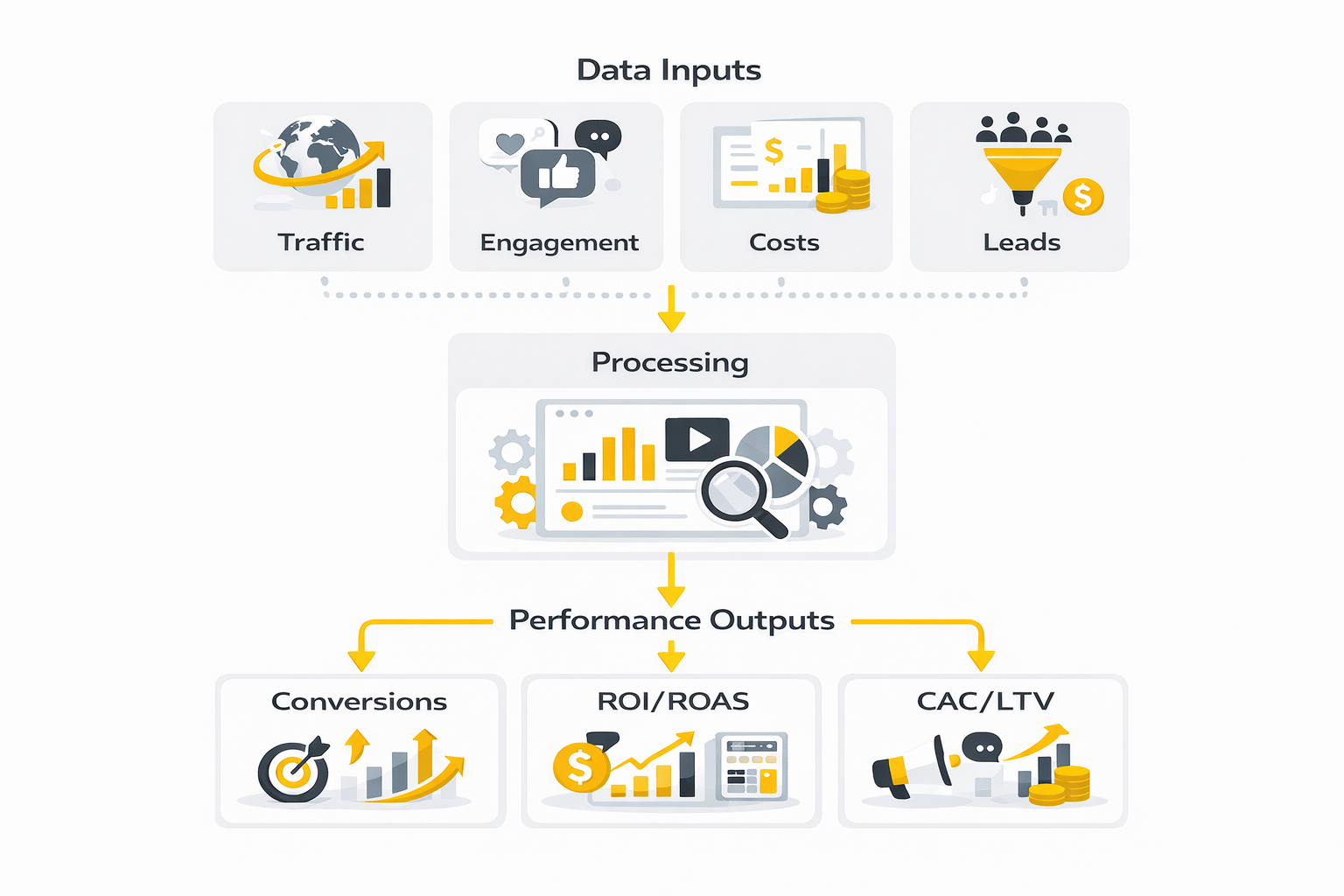
The most useful way to read ad agency data is to separate it into layers. The first layer is delivery, which tells you whether the campaign is reaching people efficiently. The second is response, which shows whether people are engaging or converting. The third is business impact, which tells you whether the advertising changed revenue, profit, customer growth, or another real commercial outcome.
That layered view matters because each metric answers a different question. Impressions, reach, frequency, CPM, and viewability help you understand exposure. CTR, video completion rate, landing-page engagement, lead rate, and platform conversions show response. Incremental ROI, contribution to sales, customer acquisition economics, and media efficiency over time tell you whether the ad agency is improving the business instead of just the dashboard. Google’s recent measurement guidance makes the same point in a more formal way: attribution, incrementality testing, and marketing mix modeling each answer different parts of the performance question, and the strongest measurement systems use all three together.
One stat from Google’s recent measurement research is especially revealing: 79% of surveyed marketers use marketing mix modeling, 86% use incrementality testing, and 81% use attribution. The important takeaway is not that one method won. It is that mature teams no longer trust a single lens. An ad agency that still relies on platform attribution alone is not giving the client the full picture.
How to Read an Agency Analytics System
A strong ad agency analytics system should show how these layers connect. Delivery metrics should feed into response metrics, and response metrics should eventually connect to outcomes the finance team actually cares about. If the reporting stack cannot make that connection, then the agency may be optimizing efficiently inside the platform while still missing the real business target.
This is why cross-media measurement has become such a central issue. Nielsen’s current planning work keeps returning to the same reality: brands are spreading spend across more environments, while audience behavior keeps moving across screens and formats. If the measurement system cannot see overlap, incremental reach, and the relationship between channels, the agency will struggle to answer the most important question of all: what is this mix actually doing together?
The action this should drive is straightforward. Ask whether your ad agency reporting is designed to explain outcomes across channels, or whether it just reports channel-by-channel activity. Those are not the same thing. A tidy platform summary is helpful, but it is not a measurement strategy.
Attribution Tells You What Happened in the Click Path
Attribution is useful because it shows near-term conversion paths and gives fast feedback. It can help an ad agency spot which campaigns are driving traffic, which keywords or audiences are picking up momentum, and where the funnel is breaking. For operational optimization, it is still essential.
But attribution is limited. It tends to over-credit the interactions that are easiest to record and understate the channels that shape demand earlier in the journey. That means search, retargeting, and lower-funnel activity can look disproportionately strong while broader awareness work gets undervalued. Google’s own measurement framework now treats attribution as one tool inside a broader system rather than the final answer.
The right action is to use attribution for speed, not for total truth. It is good for tactical adjustments. It is not enough on its own to decide a full budget strategy.
Incrementality Shows What Changed Because You Advertised
Incrementality testing matters because it tries to answer the causal question. Not just what conversions were observed, but what conversions would not have happened without the campaign. This is one of the clearest ways to judge whether an ad agency is producing real lift instead of harvesting demand that already existed.
That distinction becomes critical when platforms report strong conversion numbers. A campaign can look efficient while mostly capturing people who were already likely to buy. Google’s latest measurement updates emphasize this exact issue and position incrementality testing as the way to understand the true causal impact of advertising activity.
The action here is simple but important. If a brand is making meaningful spend decisions and the ad agency is not running incrementality tests, it is accepting more uncertainty than it should. Not every account needs constant experimentation, but serious budget shifts should be grounded in causal evidence when possible.
Marketing Mix Modeling Helps With Budget Allocation
Marketing mix modeling matters when the brand needs to understand the combined contribution of channels over time. This is where an ad agency moves from campaign reporting into strategic budget guidance. MMM is useful because it can estimate how different investments contribute to sales and help teams compare channels that do not live inside the same attribution system.
That is why Google continues to push MMM so hard in its recent measurement materials, including Meridian. The company’s current guidance frames MMM as a way to improve budget allocation across channels and to calibrate broader investment decisions with experimental evidence.
The action this should drive is not blind faith in a model. It should push the brand and the ad agency to ask better allocation questions. If paid search is efficient, should it get more budget, or is it already near saturation. If video looks weaker in attribution, is it still creating lift that shows up elsewhere. MMM helps answer those bigger allocation questions more credibly than platform dashboards alone.
Useful Benchmarks Without Getting Lost in Vanity Metrics
Benchmarks help when they provide context, but they become dangerous when they replace judgment. A CPM benchmark can tell you whether you are buying media expensively relative to the market. A conversion rate benchmark can show whether the landing page or offer looks weak. A working-media benchmark can reveal how much spend is getting lost in the supply chain. None of those numbers should be read in isolation.
That last point is especially important in programmatic buying. ANA’s recent transparency work shows clear progress, but also confirms that quality governance still has a major impact on how much spend turns into benchmark-qualified impressions and how much value is recovered through cleaner buying practices. In other words, media efficiency is not just about bidding tactics. It is also about governance, quality controls, and the rules the ad agency applies to the supply chain.
The practical move is to benchmark against your own history first, then against the market second. Internal trendlines usually tell you more than generic industry averages because they reflect your category, margin structure, offer strength, and customer journey. A good ad agency knows when an external benchmark is useful and when it is just noise.
What Strong Performance Signals Look Like
Strong performance signals are usually consistent across multiple measurement methods. The ad agency sees improvement in platform response, cleaner efficiency in media delivery, healthy on-site behavior, and some confirmation from experiments or broader business outcomes. When those signals align, confidence goes up.
Weak performance signals usually look fragmented. Platform dashboards are positive, but sales are flat. Reach is growing, but frequency is wasted. Leads are cheaper, but close rates are falling. Attribution says the campaign is winning, yet incrementality or MMM suggests little actual lift. Those contradictions do not mean the agency is failing automatically, but they do mean the brand should slow down and diagnose before scaling.
This is why reporting conversations need to move past “what happened last week.” A serious ad agency should be able to explain whether the current signals are strong enough to justify scaling, mixed enough to require more testing, or weak enough to demand a reset in message, offer, or channel mix.
What the Data Should Make You Do Next
The point of analytics is action. If delivery is weak, fix targeting, inventory quality, creative fit, or channel selection. If response is weak, fix the message, the offer, the landing page, or the audience match. If response is healthy but business impact is unclear, expand measurement with incrementality testing or MMM before scaling budget too aggressively.
This is where many brands need more from their ad agency. They do not need more screenshots from the platform. They need clearer recommendations with an attached level of confidence. They need to know which levers are tactical, which are strategic, and which decisions can safely wait until more evidence appears.
That shift matters because measurement maturity is still far from universal. Google’s recent effectiveness research found that only 40% of senior marketing decision-makers believed their business had a clear marketing effectiveness goal, and just 20% strongly agreed there was a shared understanding across the business on how success should be measured. That gap is not a reporting problem. It is an operating problem, and a good ad agency should help close it.
How to Choose, Measure, and Scale the Right Agency Relationship
By the time a company gets to this stage, the question is no longer whether an ad agency can produce campaigns. The harder question is whether the relationship design helps the business make better decisions as complexity rises. That matters because budgets are still tight, with Gartner reporting that marketing budgets held at 7.7% of company revenue in 2025, so brands have less room for bloated scope, slow approvals, or expensive partner overlap. (gartner.com)
This is also the point where a lot of businesses make the wrong comparison. They compare one ad agency against another based on presentation quality, fees, or channel promises, when the real issue is operating fit. WFA’s recent work on agency models and content production shows that two thirds of brands have changed their agency model in the last four years, which tells you the market is still actively rethinking how external partners should plug into the business. (wfanet.org)
Pick the Model, Not Just the Agency
A business should decide what kind of support it actually needs before it chooses a name. Some brands need a strategic lead partner, some need a performance-heavy execution team, some need production support, and some need a hybrid setup where the ad agency works alongside an in-house function. If that model decision is skipped, even a talented agency can end up solving the wrong problem. (wfanet.org)
That hybrid reality is now normal, not exceptional. WFA’s in-housing research found that 66% of brands already have in-house agencies and another 21% are actively considering them, while 70% already have strategic capabilities in-house. The implication is obvious: an ad agency increasingly has to complement internal capability, not replace it. (wfanet.org)
The practical move here is to map work by advantage. Keep tasks in-house when speed, brand context, and internal access matter most. Use an ad agency where specialization, outside perspective, production scale, or cross-channel experience creates leverage that the internal team does not already have. (wfanet.org)
Watch the Incentives Closely
A surprising number of agency problems are really incentive problems. If the ad agency gets paid for activity volume, headcount growth, or media throughput, while the client cares about profitable growth, speed to learning, and transparency, tension is inevitable. The relationship may still look productive on the surface, but the incentives quietly pull both sides in different directions. (wfanet.org)
That is why governance and contract design matter more than most marketers want to admit. WFA’s newer media transparency tools and benchmarking work were built specifically to help media and procurement teams have more informed conversations with agencies and legal teams around accountability and contract structure. In plain language, the contract is not paperwork after the interesting part. It is one of the main tools that determines whether the ad agency is set up to behave like a partner or like a billing machine. (wfanet.org)
The action this should drive is simple. Ask what the agency is rewarded for, what gets counted as success, what is considered out of scope, and how media, data, rebates, and production economics are handled. If those answers are fuzzy, the relationship is carrying more risk than it appears to be. (wfanet.org)
Scale Creates New Failure Modes
An ad agency that works well at a modest spend level can struggle badly once the budget, geography, product count, or stakeholder group expands. More campaigns usually mean more approvals, more asset variations, more tracking complexity, and more room for message drift. Scaling is not just about adding spend. It is about preserving signal quality and operating discipline while the system gets harder to manage. (gartner.com)
This is where many brands misread early success. They assume the same process can just be stretched, when the real need is to redesign workflow, approvals, analytics, and content production for a larger system. WFA’s 2025 content production findings point directly to this pressure, showing brands changing models to gain more control, asset consistency, and visibility into spend and ROI as complexity rises. (wfanet.org)
The smart move is to scale in layers. Standardize what should stay consistent, like naming conventions, reporting logic, approval rights, and performance definitions. Then give the ad agency freedom where adaptation is actually valuable, such as creative testing, audience strategy, and channel-specific execution. (wfanet.org)
AI Changes the Value Equation, But Not the Core Job
AI is already changing how brands and agencies work, especially in production, workflow acceleration, research support, and creative variation. But it does not erase the core reason an ad agency exists. It changes where the value sits. Routine output becomes cheaper and faster, while judgment, orchestration, governance, and commercial clarity become more important. (wfanet.org)
That shift is happening fast enough that brands need to ask better questions now. WFA’s November 2025 in-house AI research found that most in-house agency teams were either experimenting with AI or partially implementing it, and 93% planned to invest further over the following 12 to 24 months. A client choosing an ad agency today is not just buying talent. It is choosing how that partner will combine human judgment with increasingly automated systems. (wfanet.org)
The risk is obvious: faster production can lower cost and increase output, but it can also flood the system with mediocre work, unclear provenance, and sloppy oversight. That is why the latest WFA and ICAS guidance on AI-generated marketing creative focuses on transparency, disclosure, data use, and responsible governance rather than treating AI as a pure productivity story. The real expert move is not using AI everywhere. It is knowing where AI speeds up the work without weakening trust, distinctiveness, or accountability. (wfanet.org)
Longevity Is Usually Earned Through Governance
A durable ad agency relationship is rarely the result of chemistry alone. It usually comes from clear roles, measurable contribution, transparent economics, and a steady habit of making useful decisions together. That is one reason the latest ANA and 4As tenure research is so interesting: the average client-agency relationship now stands at seven years, more than double what was reported in 2016, with integrated full-service relationships tending to last longer than media-only ones. (aaaa.org)
That finding matters because it pushes back against a lazy assumption in the market. Constant reviews do not automatically create better outcomes. In many cases, long tenure reflects that both sides built a relationship worth keeping because the agency became useful at the operating level, not just at the campaign level. (ana.net)
The lesson here is practical. A brand should not stay with an ad agency out of inertia, but it should not mistake novelty for improvement either. If the partner keeps learning the business, adapting the model, protecting transparency, and improving decision quality, staying longer can actually be the more rational choice. (aaaa.org)
Know When to Change the Relationship
Not every agency problem means the agency should be fired. Sometimes the scope is wrong, sometimes the client team is the bottleneck, sometimes the measurement system is too weak to judge fairly, and sometimes the business has simply outgrown the original model. An ad agency can be the wrong fit without being a bad agency. (wfanet.org)
Still, there are some signs that should not be ignored. If transparency keeps getting resisted, if recommendations are consistently tactical and shallow, if the same operational mistakes repeat, or if the reporting never gets closer to business outcomes, the relationship is probably not healthy enough to scale. Those are not small annoyances. They are structural warnings. (wfanet.org)
The best way to handle that moment is to treat it like an operating decision rather than an emotional one. Decide whether the fix is better governance, a narrower scope, a different compensation model, a hybrid redesign, or a full partner change. That approach keeps the brand focused on results instead of drama, which is exactly how an experienced ad agency relationship should be managed in the first place. (wfanet.org)
FAQ - Built for Complete Guide
What does an ad agency actually do day to day?
An ad agency turns business goals into campaigns, media plans, creative assets, testing cycles, and reporting that leadership can act on. In practice, that usually means some mix of positioning work, campaign strategy, media buying, creative production, analytics, optimization, and client communication. Google’s guidance for evaluating agency partners frames the job in a similar way: strong agencies are expected to connect data, audience insight, creative complexity, privacy, and AI planning to business outcomes, not just produce ads.
Is an ad agency still worth hiring if a company already has an in-house team?
Yes, but only when the agency fills a real capability gap instead of duplicating internal work. WFA’s recent in-housing research shows that many major brands already keep significant strategic capability in-house, which means the smartest agency relationships are usually complementary rather than all-in replacements. The best setup is usually hybrid: internal teams keep the close product context and decision access, while the ad agency brings specialist expertise, outside perspective, and scale where it matters most.
How is an ad agency different from a marketing consultant or freelancer?
A consultant usually gives advice, a freelancer usually handles a narrower execution task, and an ad agency is designed to coordinate multiple disciplines at once. That coordination matters when strategy, creative, media, and measurement all need to move together instead of being handed off piecemeal. The bigger the channel mix and stakeholder complexity, the more that system-level coordination tends to matter.
What is the biggest mistake companies make when hiring an ad agency?
The biggest mistake is hiring based on pitch quality instead of operating fit. A strong presentation can hide weak process, vague incentives, poor transparency, or a delivery model that does not match the client’s actual constraints. The safer move is to evaluate how the agency thinks about measurement, governance, data, and decision-making before getting too impressed by case-study theatre.
How long should a company give an ad agency before judging performance?
Long enough to set up clean tracking, launch properly, and gather signal, but not so long that obvious structural problems are ignored. The right window depends on sales cycle, channel mix, and budget size, yet the broader principle is stable: early weeks should establish data quality and process quality, while later periods should show whether the work is creating measurable lift or better economics. If a company still cannot tell what is being learned, what decisions are changing, or how success will be judged, the problem is usually not patience but weak management of the relationship.
Which metrics should matter most when evaluating an ad agency?
The most important metrics are the ones that connect campaign activity to business outcomes. Delivery metrics like reach, frequency, and CPM matter, but only as part of a chain that also includes response metrics and commercial impact. Google’s current measurement guidance is useful here because it treats attribution, incrementality, and marketing mix modeling as complementary tools, which is a strong reminder that a single dashboard number is rarely enough to judge an ad agency well.
Should a business hire a full-service ad agency or a specialist agency?
That depends on the coordination challenge. If the brand needs one partner to connect multiple channels, stakeholders, and outputs, a full-service model can reduce handoff problems. If the business already has strong internal leadership and only needs deep capability in one area, a specialist ad agency may create more leverage with less overhead.
How important is transparency in the agency relationship?
It is central, not optional. WFA and Ebiquity’s 2025 media budgeting work shows that brands are still navigating major questions around media strategy, supplier relationships, and control over spend, which makes transparency a practical operating issue rather than a philosophical one. If an ad agency cannot clearly explain scope, incentives, media economics, reporting logic, and decision rights, the brand is taking on risk it may not notice until performance stalls.
Does AI make an ad agency less necessary?
AI makes some agency tasks faster and cheaper, but it does not remove the need for judgment. The market is moving toward more automation in content creation and workflow, yet that shift increases the value of strategy, governance, measurement discipline, and the ability to decide what should actually be scaled. WFA’s 2025 prediction that major advertisers will be able to cut content creation costs dramatically within a few years is important, but the real advantage will go to the teams that combine that speed with stronger decision-making.
How can a company tell whether its ad agency is creating real value?
Look for decision quality, not just output volume. A valuable ad agency should help the client understand what is working, what is uncertain, what should be tested next, and what should be stopped before more money is wasted. If the relationship creates better priorities, cleaner measurement, faster learning, and more confidence in budget allocation, value is being created even before every metric is perfect.
What usually causes an agency relationship to fail?
Failure usually comes from misalignment more than talent. The common culprits are vague scope, messy approvals, poor data access, weak measurement, slow client decisions, and incentives that reward activity instead of outcomes. When those issues are fixed early, an ad agency has a much better chance of compounding value over time instead of spending every quarter rebuilding trust.
What should a company ask before signing with an ad agency?
It should ask how the agency makes decisions, what data it needs, how success will be measured, what is included in scope, how communication works, and how AI is being used responsibly inside the workflow. Google’s agency-partner framework is useful here because it emphasizes measurement, audience insight, privacy readiness, creative complexity, and long-term AI plans as core evaluation areas. Those questions tend to reveal far more than generic promises about growth.
Work With Professionals
Explore 10K+ Remote Marketing Contracts on MarkeWork.com
Most marketers spend too much time chasing clients, competing on crowded platforms, and losing a percentage of every project to middlemen.
MarkeWork gives you a better way. Browse thousands of remote marketing contracts and connect directly with companies desperate to hire skilled marketers like you, without platform commissions and without unnecessary gatekeepers. The platform currently promotes “10K+ Remote Marketing Contracts” directly on its homepage and across recent site content, so the positioning is consistent with how MarkeWork presents itself.
If you're serious about finding better opportunities and keeping 100% of what you earn, explore available contracts and create a profile for free at MarkeWork.com.