

An ad campaign is not just a set of ads running at the same time. It is a coordinated push built around one objective, one audience logic, one message direction, and a defined way to measure whether the spend changed business results. Platform documentation from Google Ads and Meta both reflect that same core idea: campaigns organize advertising around a shared goal, budget, and structure.
That sounds simple until real money gets involved. In practice, a strong ad campaign has to connect creative, targeting, offer, landing experience, timing, and measurement without letting the platform do all the thinking for you. That matters even more now because the market is still expanding, digital channels continue to take a bigger share of spend, and marketers are under pressure to prove efficiency while protecting long-term brand growth. Dentsu’s 2025 forecast projected global ad spend growth in 2025, while Nielsen’s 2025 Annual Marketing Report showed many marketers planning tighter budgets and only a minority measuring traditional and digital media holistically.
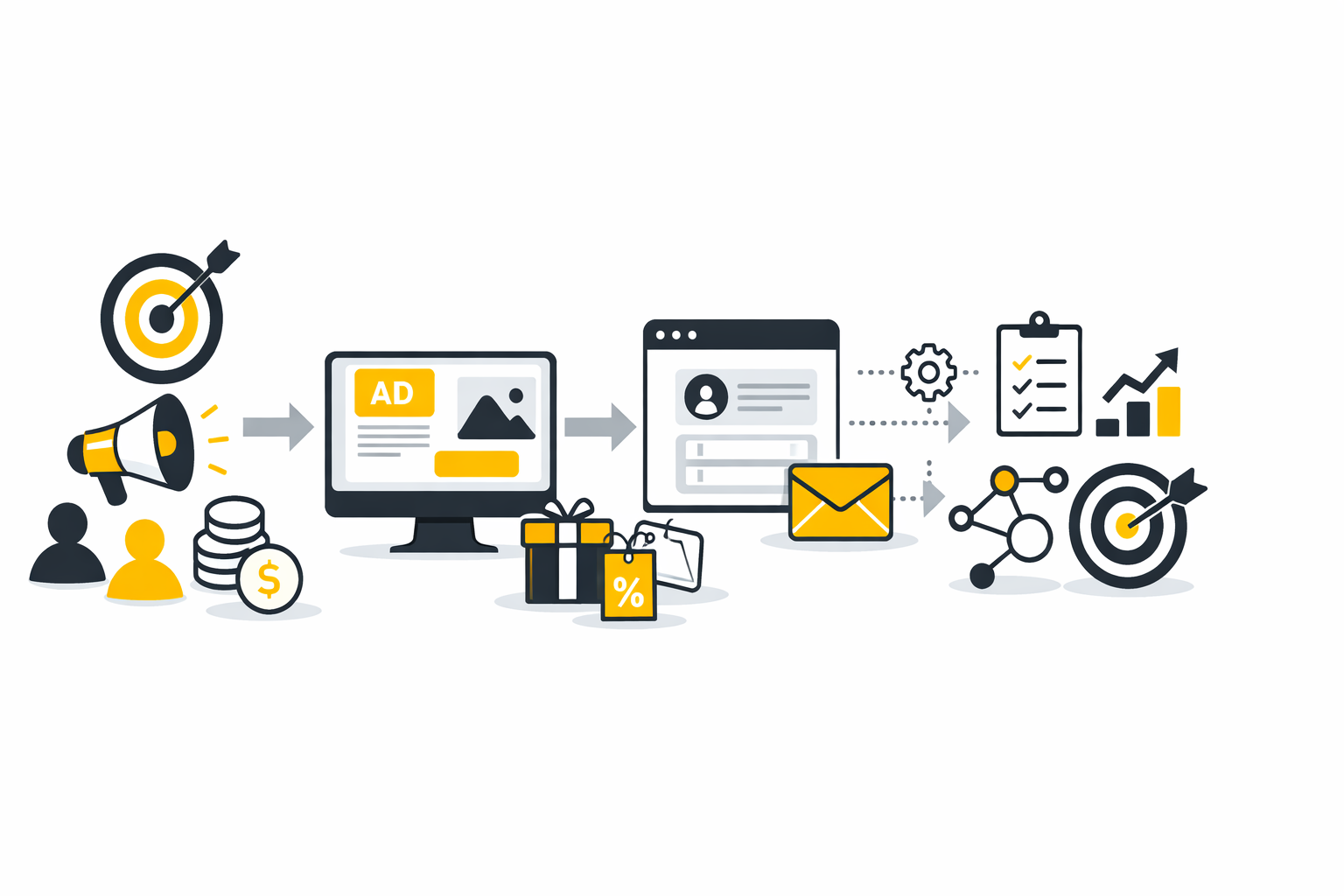
Article Outline
- What an Ad Campaign Really Is
- Why Ad Campaigns Matter More Than Ever
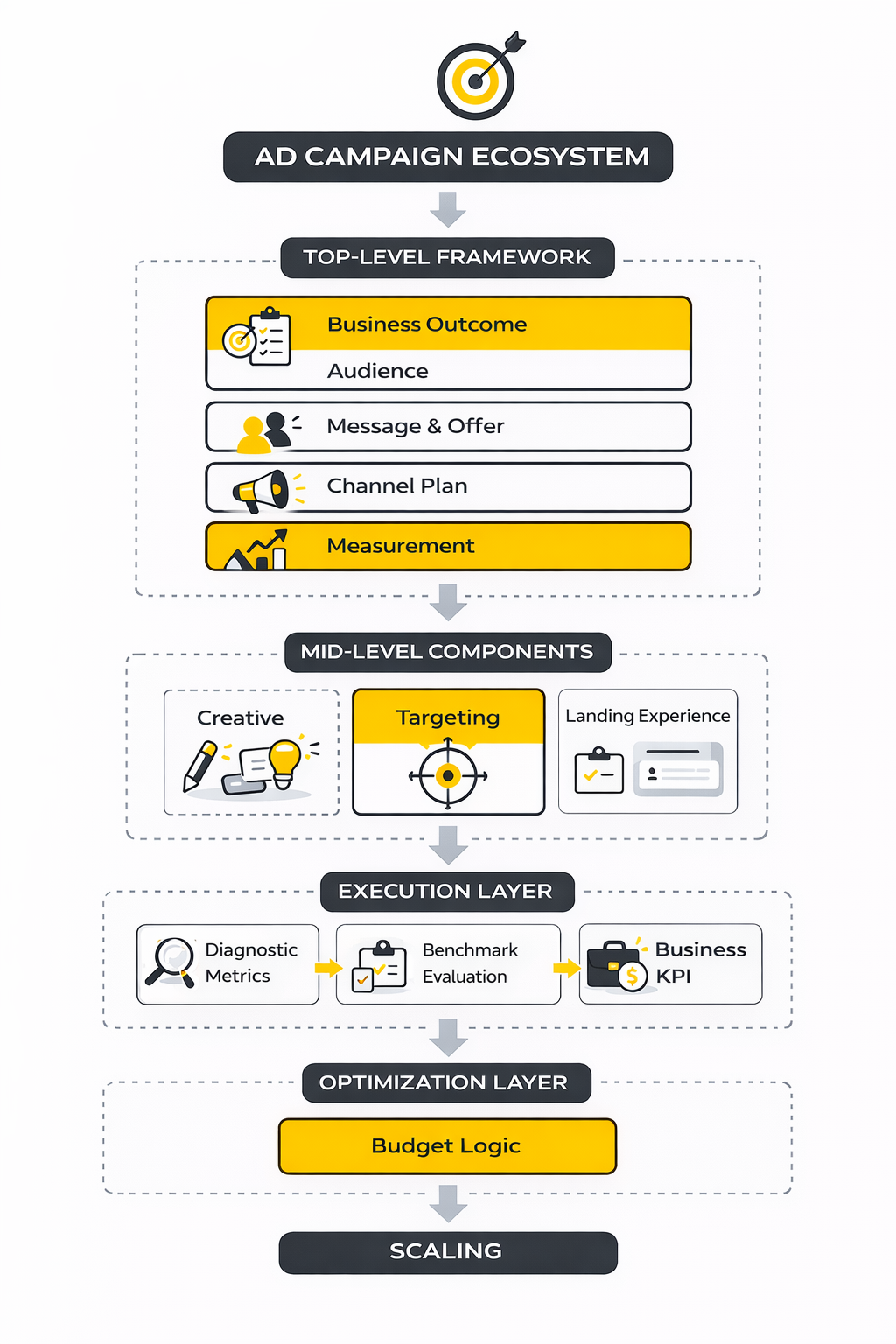
- The Ad Campaign Framework
- Core Components of a High-Performing Campaign
- Professional Implementation Across Channels
- Measuring, Optimizing, and Scaling
What an Ad Campaign Really Is
At the most practical level, an ad campaign is a structured attempt to influence a specific business outcome through paid media. That outcome might be product sales, lead generation, app installs, store visits, or demand creation, but the campaign only works when every part of it points in the same direction. When teams confuse a campaign with a few creative assets or a boosted post, performance usually becomes fragmented fast.
The cleaner way to think about an ad campaign is as a system. The objective tells the platform what success looks like, the message gives the audience a reason to care, the media plan decides where attention will be bought, and the measurement plan decides whether the campaign created real lift instead of vanity metrics. That is why modern campaign planning increasingly leans on a combined measurement stack that includes attribution, marketing mix modeling, and incrementality testing rather than one dashboard screenshot pretending to explain everything. Google’s measurement guidance and The Effectiveness Equation both make that point clearly.
It also helps to separate an ad campaign from the broader idea of a marketing campaign. A marketing campaign can include content, email, PR, partnerships, sales enablement, and community activity around a larger theme. An ad campaign is narrower and more performance-sensitive because money is being spent directly to buy distribution, which means weak positioning, sloppy targeting, or unclear economics get exposed much faster. Shopify’s breakdown captures that distinction well, even though in the real world the best operators still connect paid advertising to the wider marketing engine.
Why Ad Campaigns Matter More Than Ever
Ad campaigns matter because attention is expensive, measurement is harder than it used to be, and competition is not slowing down. IAB’s 2025 outlook pointed to continued growth in overall ad spend, with especially strong momentum in retail media, CTV, and social, while Dentsu’s forecast showed digital taking an even larger share of total media investment. In other words, more brands are bidding for the same moments of attention, so mediocre campaign strategy gets punished quickly.
The pressure is not only about media cost. It is also about relevance. McKinsey’s personalization research found that customers increasingly expect relevant interactions, which means lazy message-to-audience matching can quietly drag down results before a campaign ever has a fair chance to work. At the same time, marketers are being pushed to balance short-term revenue goals with long-term brand building, a tension that showed up directly in Nielsen’s 2025 data.
This is why campaign quality has become a strategic issue rather than a channel issue. A good ad campaign does not start with “Which platform should we use?” It starts with “What change are we trying to create, for whom, with what message, and how will we know it worked?” The rest of this article builds that logic step by step so the later sections on framework, components, implementation, and optimization do not turn into disconnected tactics.
The Ad Campaign Framework
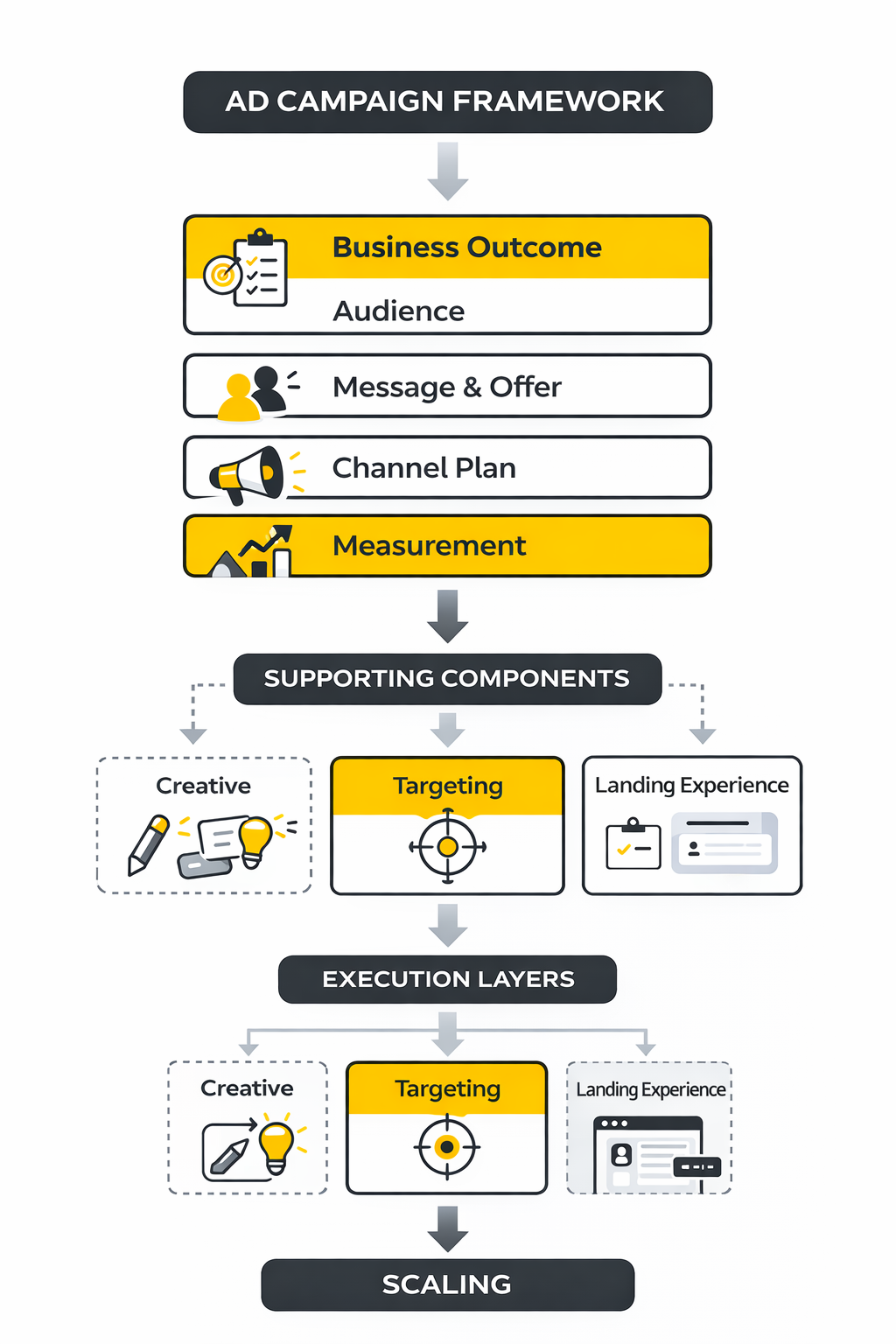
A good ad campaign is easier to build when you stop thinking in platform menus and start thinking in sequence. First comes the business outcome, then the audience, then the message and offer, then the channel plan, and only after that the measurement logic. That order matters because the major ad platforms are built around objectives, budgets, ad groups or ad sets, and creative delivery, but the platform structure only works well when the strategy behind it is already clear.
This is where many campaigns go sideways. Teams often begin with a format they want to use, a piece of creative they like, or a targeting trick they picked up from a case study, and then try to reverse-engineer a strategy around it. The stronger move is to treat an ad campaign like a controlled system: define what success means, decide which audience is most likely to respond, build the offer and message for that audience, choose the media environment that fits the job, and make measurement part of the plan before the first dollar is spent.
Start With the Business Outcome
Every ad campaign needs one primary job. Not three. Not a vague mix of awareness, traffic, leads, and sales all shoved into the same launch doc because nobody wanted to make a tradeoff. Google’s campaign setup documentation and Meta’s campaign references both make the same point in their own way: the campaign objective is the organizing logic that shapes budget decisions, delivery behavior, and what the system is trying to optimize for.
That means the first real question is not which platform you prefer. It is whether you are trying to create demand, capture existing demand, generate qualified leads, move inventory, or support a larger market event such as a launch or seasonal push. When the outcome is blurry, the campaign usually ends up reporting activity instead of progress, and that is how budgets get defended with clicks, impressions, and view rates that never connect cleanly to revenue or pipeline.
Define the Audience Before You Write the Ad
Once the outcome is locked, the next move is deciding who the campaign is really for. That sounds obvious, but plenty of ad campaign planning still treats audience selection like a targeting menu instead of a market choice. Platforms can help you reach people, but they cannot fully rescue weak segmentation or confused positioning.
The practical test is simple: can you explain why this group should care right now, not in theory, but in this buying moment? If you cannot answer that, the campaign will usually lean too hard on algorithmic optimization and hope the machine finds a path to performance. That is a fragile way to operate because the system may find cheap outcomes, but cheap outcomes are not always valuable outcomes.
Build the Offer and Message Together
Message and offer should be designed as a pair. A campaign message creates meaning, but the offer gives the audience a reason to act now, and the two should support the same strategic goal rather than compete with each other. If the creative promises transformation while the offer feels generic, the whole ad campaign starts losing force before the click even happens.
This is also where channel behavior matters. Search campaigns are built for moments of active intent, while broader social, video, and reach-based environments often carry more of the job of creating interest or refreshing memory. That does not mean one is better than the other. It means the message has to fit the context in which the audience encounters it, otherwise the campaign asks the channel to do a job it is not naturally built to do.
Choose the Simplest Structure That Can Still Teach You Something
A lot of ad campaign accounts become messy because people confuse complexity with control. In reality, structure should exist to preserve learning. Google’s campaign hierarchy makes that pretty clear: budget, campaign, ad group, keyword or targeting logic, and ad assets each have a role, and piling on unnecessary segmentation can make optimization harder instead of smarter.
The same principle applies across paid media even when the terminology changes. If you split audiences, geographies, products, or creative angles too early, you often dilute data, slow down learning, and create a reporting maze no one trusts. A cleaner structure usually wins because it lets you see which variable is actually driving the result instead of hiding the answer inside twenty tiny pockets of spend.
Design Measurement Before Launch, Not After
Measurement is not a reporting layer you bolt on once the ads are live. It is part of the campaign framework from the start because measurement determines what counts as success, what gets optimized, and which decisions can be made confidently later. Google’s recent measurement guidance is very direct on this point: attribution, incrementality testing, and marketing mix modeling are stronger together than they are in isolation, especially when teams need both fast feedback and a broader view of business impact.
This matters because every measurement method has blind spots. Attribution can be useful for directional optimization, but it does not answer every causal question. Incrementality can get closer to causal impact, but it is not always practical for every decision, and MMM helps with bigger planning questions but usually works at a broader level. The smartest ad campaign setups accept that reality early and build a learning plan around it instead of pretending one dashboard can explain the whole market.
Keep Brand and Performance Working Together
The final piece of the framework is perspective. A strong ad campaign should be judged by the job it is meant to do, but it should also fit into a bigger growth system that does not sacrifice long-term demand creation for short-term efficiency theater. The effectiveness work collected by the IPA around Les Binet and Peter Field keeps returning to the same uncomfortable truth for performance-obsessed teams: over-focusing on short-term metrics can hurt scale, reach, and long-run effectiveness.
That does not mean every campaign needs to become a brand campaign. It means campaign planning has to respect both timelines of growth. Some campaigns should capture demand now, some should expand future demand, and the best operators know which game they are playing before they launch. That clarity is what makes the next section possible, because once the framework is clear, you can break an ad campaign into the components that actually control performance.
Core Components of a High-Performing Campaign
Once the framework is clear, an ad campaign becomes much easier to execute because you know what each part is supposed to do. This is where a lot of teams get exposed. They may have a decent strategy deck, but once execution starts, the campaign breaks apart into disconnected assets, mismatched targeting, weak landing pages, and reporting that tells a comforting story instead of the real one.
The core components are not complicated, but they do need to line up. You need a sharp objective, a defined audience, a clear offer, creative built for the channel, a destination that carries the same message forward, and a measurement setup that reflects actual business value. If one of those pieces is weak, the whole ad campaign gets harder to scale because the system starts leaking performance at every stage.
Objective and KPI Alignment
The first component is alignment between the campaign goal and the KPI you are actually going to watch. If the goal is qualified pipeline but the team optimizes for cheap form fills, the ad campaign may look efficient while producing weak sales outcomes. That kind of mismatch is common, and it usually creates tension later between marketing, finance, and sales because every team thinks the campaign is doing a different job.
A cleaner setup starts by choosing one primary success metric and a short list of supporting indicators. The primary metric should reflect the real business outcome the campaign exists to influence, while the supporting metrics help explain whether the campaign is moving in the right direction. That structure keeps optimization grounded and prevents teams from jumping at every short-term fluctuation that appears in the ad account.
Audience Definition and Buying Context
The second component is audience definition, but not in the lazy sense of picking interests or uploading a list and calling it strategy. A strong ad campaign works because it understands who the buyer is, what problem they are trying to solve, what level of awareness they already have, and what friction is most likely to stop them. Those details shape not only targeting, but also message angle, creative style, and offer design.
Buying context matters just as much as demographics. The same person can respond very differently depending on whether they are actively searching for a solution, casually scrolling, comparing vendors, or returning after a previous visit. That is why good campaign planning builds for the moment, not just the persona, and why broad reach without message relevance usually burns money faster than most teams expect.
Offer Strength and Conversion Friction
A lot of ad campaign performance problems are really offer problems in disguise. When the offer is weak, too vague, badly timed, or disconnected from the audience’s urgency, no amount of targeting polish will fully save it. The platform may still find some conversions, but they tend to be expensive, inconsistent, or low quality.
The opposite is also true. A compelling offer can make the rest of the campaign easier because it gives the audience a concrete reason to act now instead of later. That does not always mean discounting. Sometimes it means stronger positioning, better packaging, lower perceived risk, clearer proof, or a simpler next step that reduces hesitation.
Creative That Matches the Job
Creative is not decoration. In an ad campaign, creative is the delivery system for attention, relevance, clarity, and persuasion. If the objective is demand capture, the creative may need to get to the point quickly and reinforce immediate intent. If the objective is demand creation, the creative may need to do more work to frame the problem, establish belief, and make the audience care before asking for action.
This is exactly why copy, visuals, hooks, and format should not be produced in isolation. The creative needs to match the audience’s awareness level, the channel environment, and the offer behind the click. When those elements fit together, performance tends to feel steadier because the campaign is not forcing one asset to do every job at once.
Professional Implementation Across Channels
The difference between a rough campaign launch and a professional one usually comes down to process. Good operators do not just upload assets and hope the algorithm figures it out. They build the ad campaign in a controlled sequence, check the tracking, verify the handoff between ad and landing page, and make sure the budget structure supports learning instead of killing it.
That process matters more now because ad platforms are increasingly automated. Automation can absolutely improve execution, but it only works well when the inputs are clean. If the objective is wrong, the conversion event is sloppy, the audience logic is confused, or the offer page is weak, the system will optimize around bad signals and do it very efficiently.
A Practical Launch Sequence
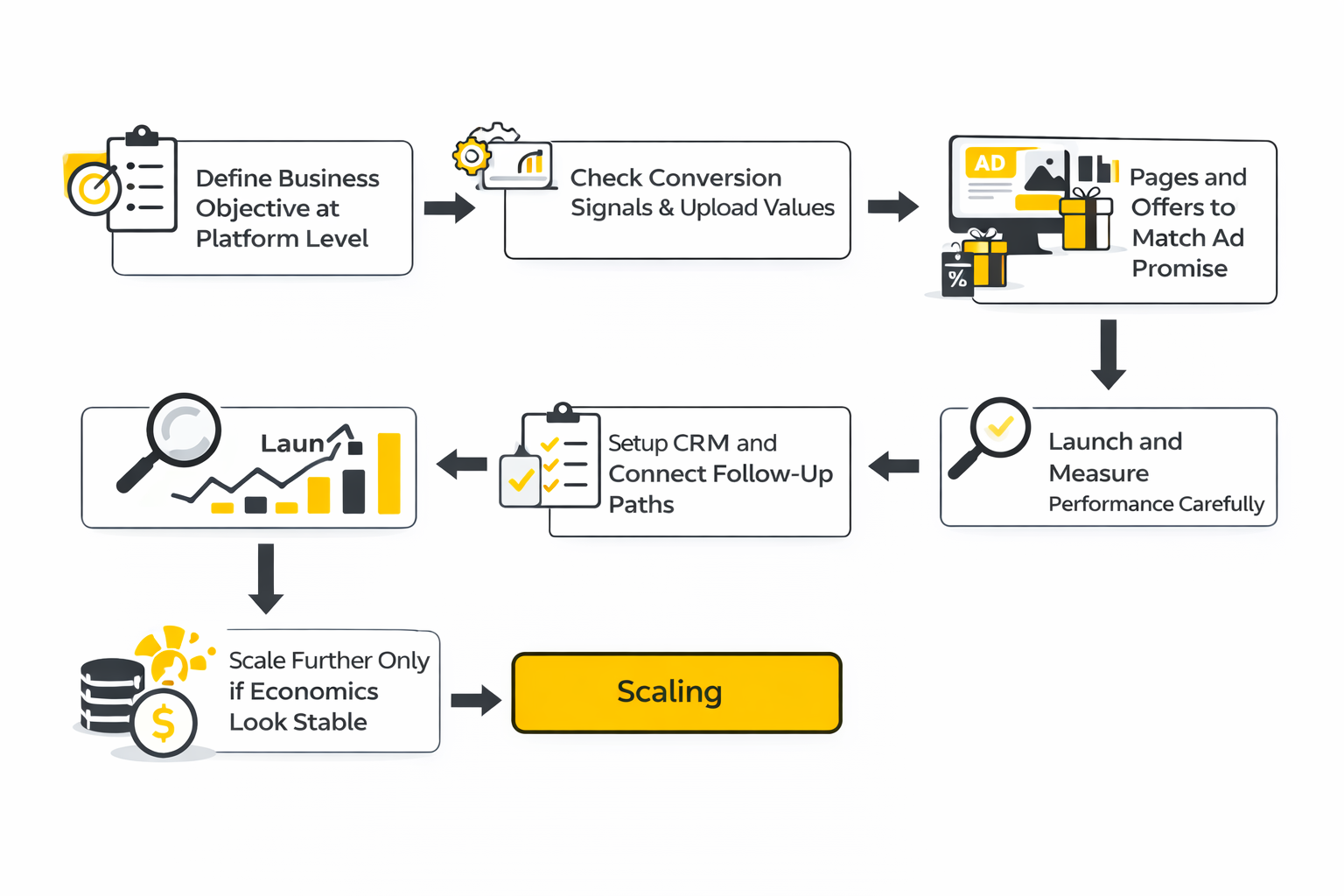
A professional ad campaign launch usually follows a simple order. First, lock the objective and define the conversion event. Second, build the audience and campaign structure. Third, prepare creative variations around distinct message angles. Fourth, align the landing page or destination. Fifth, test tracking before launch. Sixth, monitor early delivery without making panicked edits too quickly.
This order is not glamorous, but it saves money. It forces the team to solve the obvious execution risks before traffic starts flowing. It also makes post-launch optimization easier because you know what was intentional and what was an accident.
Build the Destination Before Scaling the Traffic
One of the easiest ways to waste budget in an ad campaign is to obsess over ad setup while underestimating the destination. The landing page, lead form, booking flow, or product page is where the promise made in the ad gets confirmed or broken. If the user arrives and feels a mismatch, even strong media buying will struggle to carry the campaign.
That is why implementation should treat the page experience as part of the campaign, not as a separate website problem. Fast load speed, message match, clear hierarchy, proof, and a friction-aware call to action all matter. Teams building campaign-specific pages often use tools like Replo, ClickFunnels, or Systeme.io because they make campaign-page iteration faster than waiting on a full development queue.
Set Up Tracking Before You Need the Data
Tracking is one of those things people claim is important right up until launch week gets messy. Then the ads go live, conversions start coming in, and everyone realizes the event naming is inconsistent, the CRM handoff is incomplete, or the campaign is optimizing against the wrong signal. At that point, the ad campaign is already learning from flawed inputs.
The better approach is boring on purpose. Verify tags, confirm key events, test forms, check attribution paths, and make sure offline or downstream outcomes can be connected back to the campaign where possible. If the ad platform is only seeing shallow conversions while the business cares about qualified revenue, you need that gap identified early or the account will train itself on the wrong behavior.
Use Automation as a Multiplier, Not a Substitute for Thinking
Modern ad campaign execution is heavily shaped by automation, and ignoring that is a mistake. But handing everything to the platform without giving it strong inputs is just a more sophisticated way to lose control. Smart bidding, automated placements, AI-assisted asset creation, and predictive delivery can all help, but only when your strategy, measurement, and conversion signals are already disciplined.
This is where operators separate themselves. They do not fight automation for the sake of control, and they do not worship it because a platform rep said to simplify. They decide where human judgment matters most, then let the machine handle the parts it genuinely does better, especially speed, pattern recognition, and delivery optimization.
Coordinate Follow-Up, Not Just Clicks
A lot of campaigns fail after the click, not before it. Leads do not get contacted quickly enough, buyers do not receive the right follow-up sequence, or the business has no consistent system for turning initial intent into revenue. In those cases, the ad campaign gets blamed for poor performance even though the real problem sits in the follow-up layer.
That is why professional implementation often includes CRM, messaging, email, and booking workflows as part of campaign setup. Tools like ManyChat, Brevo, and GoHighLevel can make that side of implementation far tighter when the campaign depends on lead nurture, appointment setting, or multi-step conversion paths.
Launch With Restraint So You Can Learn Faster
The strongest campaign operators are usually more disciplined at launch than beginners expect. They do not stuff every idea into version one. They choose a manageable number of audiences, a few message angles that are genuinely different, and a structure that lets them see what is working without drowning in noise. That restraint is not caution for its own sake. It is what gives the ad campaign room to produce usable learning.
This is also why early optimization should stay focused. In the first phase, the goal is not to prove genius. It is to identify signal, remove obvious friction, and protect the campaign from being derailed by random short-term swings. Once that foundation is stable, you can push harder on budget, creative expansion, audience broadening, and offer refinement without guessing in the dark.
The next step is optimization and scale, because once an ad campaign is live and the process is working, the real challenge becomes knowing what to change, what to leave alone, and how to grow without breaking the system that finally started to work.
What the Data Is Really Telling You
By the time an ad campaign is live, most teams are drowning in numbers and still starving for clarity. That is the real problem measurement is supposed to solve. The point is not to collect more dashboards. It is to decide which signals deserve action, which ones are only context, and which ones are dangerous because they look persuasive while hiding weak business impact.
The market itself makes that discipline more important. IAB’s 2025 outlook projected overall ad spend growth of 7.3% in 2025, while Dentsu’s June 2025 forecast estimated digital would reach 68.4% of global ad spend. When more budget keeps flowing into paid media, mediocre interpretation gets expensive fast because the margin for lazy analysis shrinks as competition rises.
Metrics Only Matter When They Match the Job
The first rule is simple: a metric is only useful if it reflects the actual job of the ad campaign. Impressions can matter when reach is the goal. Click-through rate can matter when message relevance is the problem you are trying to diagnose. Cost per lead can matter when lead generation is the objective. But none of those numbers should be treated as proof of success on their own.
This is where teams get into trouble. They look at platform metrics as if every improvement is good news, when in reality some “improvements” are just local efficiency gains that do not survive contact with revenue, margin, or qualified pipeline. Google’s guidance on value-based bidding points straight at this issue: optimizing for value is different from optimizing for volume, and the difference matters when cheap conversions are not the same as valuable conversions.
The Measurement Stack Should Be Layered
A modern ad campaign should not rely on one measurement method pretending to answer every question. Attribution is useful for operational direction. Incrementality helps answer causal questions. Marketing mix modeling is better for broader budget allocation and channel contribution over time. Google’s modern measurement playbook, IAB’s Unified Media Planning Playbook, and IAB’s Modernizing MMM guide all push toward the same conclusion: use multiple methods together because each one answers a different decision.
That matters in practice because marketers keep running into fragmented visibility. Nielsen’s 2025 Annual Marketing Report found only 32% of marketers globally say they measure digital and traditional media holistically today. That number is not just a nice industry stat. It explains why so many ad campaign decisions still get made inside channel silos, even when the business wants a cross-channel answer.
Benchmarks Are Directional, Not Universal Truth
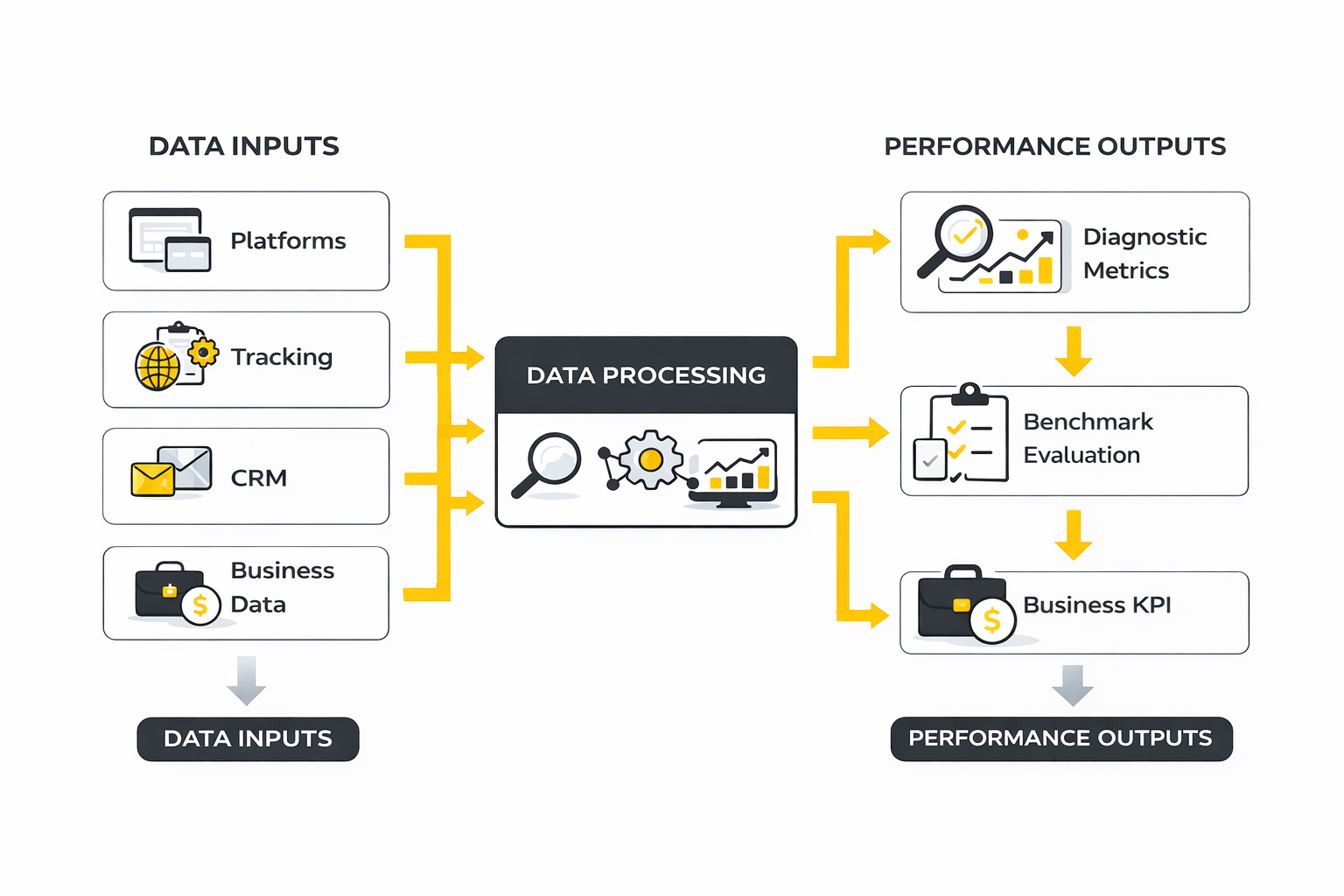
Benchmarks can help, but only if you treat them as a starting point instead of a verdict. A weak click-through rate may signal poor targeting, bad creative, or low message relevance. It may also reflect a channel where the audience is earlier in the journey and not ready to act immediately. A high conversion rate can look great until you realize the campaign is harvesting branded demand that would have converted anyway.
That is why smart teams use benchmarks diagnostically. They compare performance against historical data, campaign type, funnel stage, audience temperature, and margin structure before making decisions. A benchmark without context is one of the fastest ways to misread an ad campaign because it invites shallow comparisons between businesses, offers, and buying cycles that are nothing alike.
Reach, Frequency, and ROI Need to Be Read Together
One of the most useful shifts in measurement right now is the move away from thinking that brand metrics and performance metrics live on opposite planets. Nielsen’s 2025 ROI report showed that 60% of marketers are now focused on both reach and frequency and ROI in their cross-media measurement approach. That is a much healthier direction because it reflects how growth actually works: exposure matters, but so does commercial return. (Nielsen ROI report)
This changes how you read campaign data. If reach is too narrow, the ad campaign may never create enough opportunity to scale, even if efficiency looks solid at a small spend level. If frequency is too low, the audience may not remember the message. If frequency is too high without incremental lift, the campaign may be wasting budget on repeated exposure that is no longer moving outcomes. The useful question is not “Which one matters most?” but “Which one is constraining performance right now?”
Good Performance Signals Usually Travel in Packs
Single metrics can mislead. Strong campaigns often show clusters of healthy signals moving together. That may look like better click quality, steadier conversion rates, higher average order value, stronger lead qualification, or shorter sales-cycle progression after launch. The exact mix changes by business model, but the pattern is consistent: when an ad campaign is genuinely improving, the evidence usually appears in more than one place.
The reverse is also true. If CTR rises but conversion quality collapses, that is not a win. If cost per acquisition falls but return on ad spend weakens because order value drops, that is not real efficiency. If the platform reports success while downstream sales teams complain about lead quality, the campaign is sending you conflicting signals on purpose, and that tension is where the real diagnosis has to happen.
What the Big Numbers Should Make You Do
Industry data becomes useful when it changes behavior. If digital keeps taking a larger share of spend, that should push you to improve creative throughput, first-party data quality, and measurement discipline rather than simply buying more traffic. If only a minority of marketers measure media holistically, that should push you to tighten data governance and connect downstream outcomes back to campaign decisions faster. If modern measurement guidance keeps pointing to attribution, MMM, and experiments working together, then running an ad campaign off one platform dashboard is no longer a serious standard.
This is where tools and systems can help, especially when measurement has to connect ads, pages, CRM, and follow-up. Teams that need cleaner lead routing, pipeline visibility, and campaign reporting often build around platforms like GoHighLevel or use structured data capture with tools like Fillout to reduce reporting gaps before they become expensive. The tool itself is not the strategy, but weak infrastructure absolutely distorts the data you depend on to optimize.
The Best Action From Data Is Usually Focus, Not Panic
The final point is the one most advertisers need to hear. Data should sharpen decisions, not trigger constant emotional overreaction. A strong ad campaign usually improves through disciplined interpretation: identify the bottleneck, form a real hypothesis, make the smallest useful change, and give the system enough time to produce signal. That is very different from chasing every spike or dip as if the account is sending you a personal message.
Once you read the numbers that way, optimization becomes much cleaner. You stop asking whether a metric looks good in isolation and start asking what it is trying to tell you about message fit, audience quality, offer strength, conversion friction, and budget efficiency. That is the right setup for scaling, because scale only works when the numbers mean something and the team knows what action each one should drive.
Scaling an Ad Campaign Without Breaking It
Scaling sounds exciting until you realize how often it destroys the thing that was working. A lot of ad campaign teams mistake early success for proof that the system is stable, then they raise spend too quickly, broaden targeting too fast, or introduce too many creative changes at once. The result is predictable: performance gets noisier, signal gets weaker, and nobody can tell whether the problem is audience fatigue, offer decay, tracking drift, or simple market saturation.
This is where experience matters. A scalable ad campaign is not one that performs well for a week. It is one that can absorb more budget, more reach, more variation, and more scrutiny without losing its underlying economics. That usually requires better operational discipline than most advertisers expect, because scale exposes structural weaknesses that small budgets can hide.
The First Tradeoff Is Efficiency Versus Reach
Most campaigns look most efficient before they reach enough people to matter. That is not a contradiction. It is what happens when an ad campaign is harvesting the easiest conversions inside a narrow pocket of demand. Once you try to expand beyond that pocket, costs often rise because the next layer of audience is colder, less urgent, or harder to persuade.
This is one reason cross-media measurement has become more important. Nielsen’s 2025 report highlighted the growing need for accurate reach, frequency, and ROI measurement together, not as separate conversations. If you only optimize for the cheapest short-term result, the campaign can look healthy while quietly limiting future growth.
Creative Fatigue Is Usually a Strategy Problem First
Teams love to blame creative fatigue because it is an easy explanation. Sometimes that is true. An ad campaign can absolutely wear out a message, especially when frequency rises and the audience pool is small. But in many cases, what looks like fatigue is actually weak message depth, poor audience expansion logic, or an offer that never had enough elasticity to support higher spend.
That is why experienced operators build creative systems, not one-off assets. They develop multiple angles, multiple formats, and multiple levels of proof so the campaign can evolve without losing coherence. WARC’s Multiplier Effect argues that stronger brand equity improves commercial performance rather than competing with it, and that matters here because campaigns with broader message strength usually endure scaling pressure better than campaigns running on one clever hook.
More Automation Raises the Cost of Bad Inputs
As platforms push harder into automation, scaling an ad campaign increasingly means managing inputs better, not managing every lever manually. Google’s value-based bidding guidance makes the logic clear: the system performs better when it can optimize toward real conversion value rather than shallow event volume. That sounds obvious, but a surprising number of campaigns still scale on weak proxies because the business never fixed the underlying data model.
This creates a serious tradeoff. Automation can improve speed and efficiency, but it also amplifies mistakes. If your conversion values are inaccurate, your lead scoring is sloppy, or your CRM feedback loop is delayed, the ad campaign may scale in exactly the wrong direction. The platform is not “wrong” in that situation. It is following flawed instructions very efficiently.
Channel Expansion Should Follow Proof, Not Hope
There is a strong temptation to copy a winning campaign into every available channel. That usually feels like momentum, but it is often just impatience. Different environments ask different things from the same ad campaign. Search can capture intent. Social can interrupt and shape interest. Video can widen memory and meaning. Retail media can influence buying close to transaction. The message and offer may stay related, but the delivery logic should change.
This is where many teams burn budget. They assume what worked in one environment will transfer with minimal adaptation, then blame the channel when it underperforms. A better move is to expand sequentially. Prove the angle, confirm the economics, adapt the creative to the channel, then measure whether the new environment is adding incremental value or simply cannibalizing performance you already had.
Attribution Drift Gets More Dangerous as Spend Grows
Small reporting errors can become big financial errors once the budget rises. When an ad campaign is spending modestly, teams often tolerate messy attribution because the dollar impact feels manageable. At scale, that same looseness can distort major decisions. A channel can look stronger than it really is, branded search can overclaim credit, or lead-gen campaigns can appear efficient while downstream quality quietly deteriorates.
That is why advanced teams treat measurement maintenance as a scaling function, not an admin task. They revisit event quality, conversion definitions, offline data imports, and reporting alignment regularly. IAB’s modernizing MMM guide reinforces the broader point that marketers need decision-ready measurement systems that reflect today’s fragmented media reality, not legacy reporting habits that were already shaky before privacy changes accelerated.
Margin Discipline Matters More Than ROAS Theater
As an ad campaign grows, it becomes easier to win the dashboard and lose the business. Return on ad spend can look healthy while contribution margin weakens, fulfillment costs climb, or the campaign starts attracting lower-value buyers. This is especially dangerous in ecommerce, subscription businesses, and lead-gen models where customer value is not fully visible at the point of conversion.
That is why advanced advertisers keep asking harder questions. Is the campaign attracting customers who repeat, upgrade, or churn fast? Are we buying growth or discount-dependent volume? Are we scaling into profitable segments or just easier-to-measure ones? Google’s broader materials on value-based bidding point toward the right mindset here: optimize for value, not just activity.
Operational Bottlenecks Can Kill a Good Campaign
Sometimes the ad campaign is fine and the business is the bottleneck. Response times slip. Sales teams fail to follow up. Inventory goes out of stock. Landing pages do not keep pace with new traffic patterns. Appointment-setting workflows lag behind volume. None of that shows up neatly inside the ad account, but all of it changes results.
This is why serious scaling usually forces better infrastructure. Teams often tighten routing, CRM logic, and nurture flows as spend rises because the handoff after the click starts to matter more than the click itself. Platforms like GoHighLevel, Brevo, or ManyChat become more useful at that stage because they help connect campaign demand to actual follow-through.
The Real Risk Is Overreacting to Short-Term Noise
The more money a campaign spends, the more emotional the team tends to become. That is understandable, but it is dangerous. Scaling an ad campaign requires stronger nerves, not weaker ones. If every rough day triggers budget cuts, audience resets, or creative overhauls, the team ends up teaching the system chaos instead of consistency.
This is where expert-level judgment really shows. You need enough patience to let the campaign reveal a pattern, but not so much patience that you ignore a real breakdown. That balance is what separates operating discipline from superstition. The best teams do not scale because they have perfect control. They scale because they know which problems are signal, which are noise, and which tradeoffs are worth making on purpose.
Part 6 will close the article by pulling this together into practical takeaways, common questions, and a clear view of what a good ad campaign should actually look like when strategy, execution, data, and scaling all line up.
Measuring, Optimizing, and Scaling
At this point, the full picture should be clear. A strong ad campaign is not a creative idea, a media buy, or a dashboard. It is a connected operating system built around objective, audience, message, offer, destination, measurement, and follow-up, with the platform doing what it does best only after the business has defined what success actually means. Google’s bidding guidance, Google’s value-based bidding resources, and Meta’s objective guidance all reinforce that same practical reality: campaign setup works better when goals, optimization logic, and measurement are aligned from the start.
That is also why mature teams are moving away from one-tool answers. Modern measurement is increasingly built from several layers working together, because privacy shifts, fragmented media, and automated delivery have made single-view reporting less trustworthy on its own. IAB’s recent work on modernizing MMM and Nielsen’s 2025 reporting both point in the same direction: better campaign decisions come from combining business goals, cross-channel visibility, and more disciplined interpretation of outcomes.
Bringing the Ad Campaign System Together
The final system behind a successful ad campaign is usually less glamorous than people hope, but far more effective. It means a clear objective at the platform level, clean conversion tracking, a landing experience that matches the promise in the ad, a reliable handoff into CRM or nurture flows, and a reporting layer that can distinguish cheap activity from valuable growth. Google’s automated bidding documentation, Meta’s campaign and conversion tracking guidance, and Nielsen’s cross-media reporting all support that broader operating model.
For a lot of teams, this is the point where tools become useful because they reduce friction between strategy and execution. A campaign-specific page builder like Replo, a funnel stack like ClickFunnels, a CRM and automation layer like GoHighLevel, or a messaging system like ManyChat can help the ad campaign stay coherent after the click. The tool is never the strategy, but the wrong infrastructure absolutely makes a good strategy harder to execute consistently.
FAQ
What is an ad campaign in simple terms?
An ad campaign is a coordinated set of paid promotions built around one clear goal. The goal might be sales, leads, awareness, app installs, or another business outcome, but the key is that targeting, message, budget, and measurement all work together instead of acting like isolated tasks. That is the simplest useful definition because it matches how major ad platforms structure campaigns around objectives and optimization rules.
What is the difference between an ad campaign and a single ad?
A single ad is one asset or message unit inside a larger system. An ad campaign includes the objective, budget, audience logic, bidding approach, creative set, destination, and reporting structure that determine whether the ad has any real chance to perform. In other words, the ad is the visible piece, while the ad campaign is the operating model behind it.
Why do so many ad campaigns fail even when the creative looks good?
Because creative alone cannot rescue a weak system. A campaign can still fail if the audience is wrong, the offer is soft, the landing page is weak, the follow-up is slow, or the account is optimizing for the wrong conversion event. That is why experienced operators diagnose the full path from impression to revenue instead of obsessing over the ad asset in isolation.
How long should an ad campaign run before you judge it?
Long enough to produce usable signal, but not so long that obvious problems go untouched. The right answer depends on spend level, conversion volume, sales cycle length, and how much volatility the platform is showing early on. The serious point is that judgment should be based on enough data to reveal a pattern, not on panic after one strong day or one weak day.
Should every ad campaign start with a small budget?
Usually, yes, but not because small budgets are magically safer. Starting smaller gives you room to validate message fit, conversion tracking, destination quality, and audience response before larger spend magnifies mistakes. A small start is most useful when it is paired with a learning plan instead of used as an excuse to stay timid forever.
Which matters more in an ad campaign: targeting or creative?
That is the wrong fight because the two depend on each other. Great creative shown to the wrong people wastes money, and precise targeting with weak creative still struggles to create action. A better question is which constraint is limiting performance right now, because that tells you where the next improvement should happen.
Is automation making manual campaign management obsolete?
Not obsolete, but less central than it used to be. Platform automation is increasingly handling bidding, delivery, and some creative assembly, which means human judgment matters more in strategy, value signals, measurement design, and message quality. The operators who win are not the ones clicking the most settings, but the ones giving the machine better inputs.
What metrics should matter most in an ad campaign?
The most important metrics are the ones that reflect the job the campaign is meant to do. That usually means one primary business metric, such as qualified pipeline, profitable sales, or booked appointments, supported by diagnostic metrics like CTR, CPC, conversion rate, and reach. The mistake is treating diagnostic metrics as proof of commercial success when they are really only clues.
How do you know when an ad campaign is ready to scale?
You know it is ready when performance is not just good, but repeatable. That means the campaign has stable tracking, a believable path from platform results to business outcomes, enough creative depth to avoid immediate fatigue, and follow-up systems that can handle more volume. If those conditions are not in place, scaling usually exposes weaknesses faster than it creates growth.
Should brand and performance campaigns be separated?
Sometimes yes, but not mentally separated to the point that each side ignores the other. Some campaigns are built to capture demand now, while others are built to expand future demand and improve commercial performance over time. The healthiest approach is to know which role each ad campaign is playing and then evaluate it against the right expectations rather than forcing every campaign to behave like direct response.
How important is the landing page in an ad campaign?
It is critical because the landing page is where the promise in the ad gets confirmed or broken. Even strong media buying can underperform if the page loads slowly, creates friction, buries proof, or asks for too much trust too quickly. This is why many marketers build campaign-specific experiences instead of sending paid traffic into generic pages that were never designed to convert.
What is the biggest mistake people make with campaign data?
They confuse visibility with understanding. Having more charts does not mean the team knows what is driving outcomes, and strong platform numbers can still hide weak business performance if attribution, lead quality, or downstream conversion is off. The best use of campaign data is to identify the bottleneck, test a real hypothesis, and improve the system one meaningful variable at a time.
Work With Professionals
Explore 10K+ Remote Marketing Contracts on MarkeWork.com
Most marketers spend too much time chasing clients, competing on crowded platforms, and losing a percentage of every project to middlemen.
MarkeWork gives you a better way. Browse thousands of remote marketing contracts and connect directly with companies desperate to hire skilled marketers like you, without platform commissions and without unnecessary gatekeepers.
If you're serious about finding better opportunities and keeping 100% of what you earn, explore available contracts and create a profile for free at MarkeWork.com.