

The way ad copy gets written has changed faster in the last two years than in the previous twenty. What used to take hours of brainstorming, drafting, and revisions can now be generated, tested, and optimized in minutes with ad copy AI tools.
But speed isn’t the real story. Performance is.
Marketers are no longer asking whether AI can write ads. They’re asking whether it can outperform human copywriters—and the answer is nuanced. In controlled tests, human-written ads still achieve higher click-through rates in many cases, with results like 4.98% CTR vs 3.65% for AI-generated ads in some campaigns . Yet at the same time, AI-driven personalization and testing can drive conversion improvements of 35–67% when used correctly .
So the real shift isn’t AI vs human.
It’s AI-powered systems reshaping how ad copy is created, tested, and scaled.
Article Outline
- Why ad copy AI matters now
- How ad copy AI actually works
- The core components of high-performing AI ad copy
- A proven framework for writing AI-powered ads
- How professionals implement ad copy AI at scale
- Common mistakes, optimization tactics, and future trends
Why Ad Copy AI Matters Now
Advertising has become a volume game. Platforms like Google and Meta reward marketers who test more variations, iterate faster, and personalize messages at scale. That’s something humans alone simply can’t do efficiently anymore.
AI changes the equation by generating hundreds of variations in seconds, enabling real-time testing across audiences, platforms, and formats. Instead of guessing what works, you’re constantly feeding data back into the system and refining based on performance.
This shift is already reflected in how teams operate. Recent data shows 79% of marketers now use AI tools in their workflows, but only a small fraction rely on them without human oversight . That tells you something important: AI isn’t replacing strategy—it’s amplifying execution.
The biggest advantage is personalization. AI analyzes behavior, demographics, and engagement patterns to tailor messaging dynamically. That level of precision is nearly impossible to achieve manually, especially across multiple campaigns and channels .
And when you combine that with automation, you reduce wasted ad spend. Instead of running a few variations and hoping for results, you continuously optimize based on real performance data.
For marketers focused on growth, tools like GoHighLevel integrate AI directly into campaign workflows—helping you generate, deploy, and optimize ad copy without switching platforms.
How Ad Copy AI Actually Works
At its core, ad copy AI is powered by a combination of natural language processing, machine learning, and large-scale data analysis. But the real power comes from how these systems learn from performance.
Instead of writing copy from scratch based on intuition, AI analyzes thousands of successful ads, identifying patterns in language, structure, and emotional triggers. It understands which phrases drive clicks, which formats convert, and how messaging changes across audiences.
Here’s what’s happening behind the scenes:
- Pattern recognition: AI identifies high-performing words, structures, and emotional cues from massive datasets
- Predictive modeling: It estimates how well a piece of copy will perform before you even run it
- Dynamic generation: It creates multiple variations tailored to different audiences
- Continuous optimization: It improves outputs based on real campaign data
This is why AI performs especially well in short-form content. In fact, AI-generated microcopy and ad snippets outperform human versions in over 60% of A/B tests in some studies .
But there’s a catch.
AI is only as good as the inputs and structure you give it. Without clear direction, it produces generic, low-impact copy. With the right framework, it becomes a high-performance engine.
That’s why serious marketers don’t just “use AI.” They build systems around it.
The Framework Behind High-Performing AI Ad Copy
To get real results from ad copy AI, you need a structure that guides the output. Otherwise, you’re just generating noise.
The most effective frameworks combine classic copywriting principles with AI-driven iteration. They focus on clarity, relevance, and emotional impact—then use AI to scale and optimize.
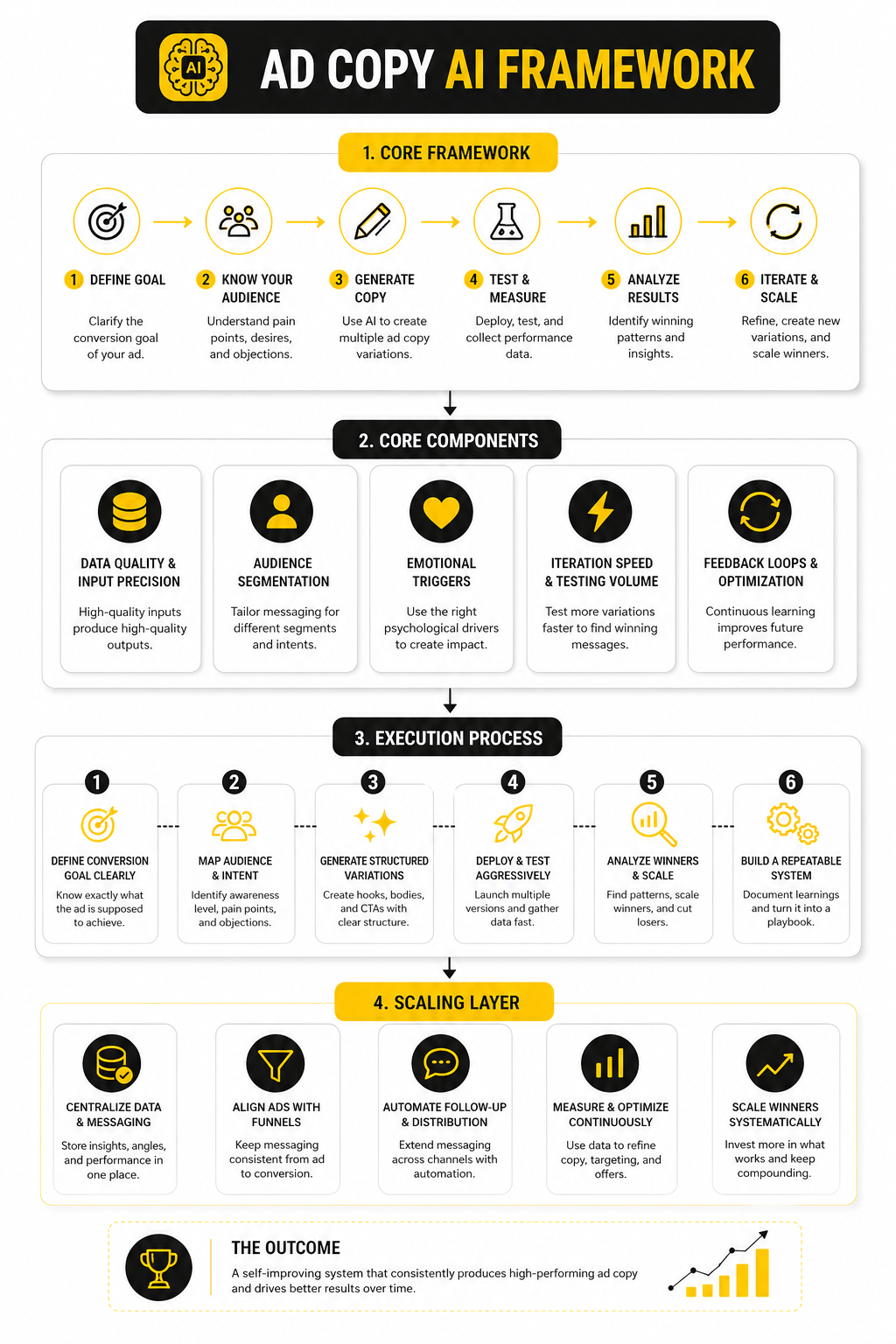
Here’s the simplified structure that consistently works:
- Hook – Capture attention immediately with relevance or curiosity
- Problem – Identify a specific pain point the audience recognizes
- Solution – Present your offer as the answer
- Proof – Add credibility through data, outcomes, or mechanisms
- CTA – Drive a clear, immediate action
AI excels at generating variations for each of these components. Instead of writing one version, you can test dozens of hooks, multiple angles, and different calls to action simultaneously.
This is where tools and platforms make a difference. Systems like Chatbase allow you to integrate AI-driven messaging directly into customer interactions, while platforms like Systeme.io help deploy funnels that align with your ad messaging.
The key takeaway is simple: AI doesn’t replace copywriting fundamentals—it operationalizes them at scale.
And once you understand that, everything changes about how you approach ads.
Core Components of High-Performing AI Ad Copy
Once you move past the basic framework, the real leverage comes from understanding what actually drives performance inside AI-generated ads. Most people stop at “generate more variations,” but that’s surface-level thinking.
The difference between average and high-converting ad copy AI output comes down to how well you structure these core components.
Data Quality and Input Precision
AI doesn’t “think”—it predicts based on patterns. That means the quality of your inputs directly determines the quality of your outputs.
If you give vague prompts, you’ll get generic ads. If you feed it structured data—customer pain points, objections, desired outcomes—you get copy that feels tailored and specific.
This is why advanced marketers build prompt libraries instead of writing one-off instructions. They treat inputs like assets, refining them over time based on performance.
Tools like GoHighLevel allow you to centralize customer data, messaging angles, and campaign insights, which dramatically improves how your AI-generated copy performs across campaigns.
Audience Segmentation and Personalization
One of the biggest advantages of ad copy AI is its ability to adapt messaging across different audience segments instantly.
Instead of writing one universal ad, you can create multiple versions tailored to:
- Cold audiences vs warm leads
- Different demographics or locations
- Behavioral triggers like past purchases or engagement
- Specific objections or desires
This matters because personalized ads consistently outperform generic ones. Campaigns using AI-driven personalization have shown significantly higher engagement and conversion rates across multiple industries (geniecrawl.com).
The key is not just generating variations, but aligning each variation with a clear audience intent.
Emotional Triggers and Psychological Depth
AI can replicate emotional language patterns, but it needs direction to hit the right depth.
High-performing ad copy consistently leverages:
- Urgency
- Curiosity
- Fear of missing out
- Relief from pain points
- Desire for status or transformation
The mistake most people make is stacking these triggers randomly. That creates noisy, unconvincing copy.
Instead, the best approach is to assign one primary emotional driver per ad variation. Then let AI generate multiple executions around that single angle. This creates clarity—and clarity converts.
Iteration Speed and Testing Volume
This is where ad copy AI completely changes the game.
Traditional workflows limit you to a handful of variations. AI allows you to test dozens or even hundreds without increasing workload.
That matters because performance doesn’t come from “writing better.” It comes from testing more.
Campaigns that aggressively test variations consistently outperform those that rely on a few polished ads. AI simply makes that level of testing feasible.
If you’re running funnels through platforms like ClickFunnels, combining AI-generated copy with structured A/B testing can compound results quickly.
Feedback Loops and Continuous Optimization
The real power of ad copy AI shows up after the first campaign.
Every click, conversion, and interaction becomes data that can refine future outputs. This creates a feedback loop where your copy improves over time without starting from scratch.
Here’s how high-level teams approach it:
- Launch multiple AI-generated variations
- Track performance across key metrics
- Identify winning patterns (hooks, angles, CTAs)
- Feed those insights back into the AI system
- Generate new iterations based on proven winners
Over time, this compounds into a system that consistently produces high-performing ads.
And if you integrate messaging automation tools like ManyChat, you can extend this optimization beyond ads into conversations—turning clicks into conversions more efficiently.
A Proven Framework for Writing AI-Powered Ads
Knowing the components is one thing. Turning them into a repeatable system is what actually drives results.
This is the framework that top-performing teams use when working with ad copy AI. It’s not complicated—but it’s disciplined.
Step 1: Define the Conversion Goal Clearly
Before generating anything, you need absolute clarity on what the ad is supposed to achieve.
Is it:
- A click?
- A lead?
- A purchase?
- A booked call?
Each goal requires a different type of messaging. AI can’t guess this—it needs to be specified upfront.
When this step is skipped, you get misaligned copy that sounds good but doesn’t convert.
Step 2: Map the Audience and Intent
Next, define exactly who the ad is targeting and what stage they’re in.
This includes:
- Awareness level (problem-aware vs solution-aware)
- Primary pain point
- Desired outcome
- Objections or doubts
The more precise this mapping is, the more relevant your AI-generated copy becomes.
This is where many campaigns fail—not because the copy is bad, but because it’s misaligned with the audience’s mindset.
Step 3: Generate Structured Variations
Now you bring in AI—but with structure.
Instead of asking for “10 ad variations,” you guide the system:
- 5 hooks focused on curiosity
- 5 hooks focused on urgency
- 5 hooks focused on pain points
- Multiple CTAs with different tones
This creates controlled diversity. You’re not just generating more—you’re generating smarter.
Platforms like Systeme.io make it easier to plug these variations directly into funnels, so you can test messaging in real conditions.
Step 4: Deploy and Test Aggressively
Once your variations are ready, speed matters.
Launch multiple versions at once and let performance data guide decisions. Don’t overthink early results—focus on gathering enough data to identify trends.
The goal here isn’t perfection. It’s learning.
Step 5: Analyze Winners and Scale
After testing, you’ll start seeing patterns.
Certain hooks outperform others. Specific emotional angles drive more conversions. Some CTAs consistently get higher engagement.
This is where most people stop—but this is actually where the real opportunity begins.
Take those winning elements and:
- Expand them into new variations
- Apply them across other campaigns
- Use them in landing pages and emails
This creates a compounding effect where your entire marketing system improves—not just individual ads.
Step 6: Build a Repeatable System
The final step is turning everything into a process.
Document:
- What worked
- What didn’t
- Which angles performed best
- Which audiences responded most
Over time, this becomes your internal playbook.
And once you have that, ad copy AI stops being a tool—and becomes a competitive advantage.
How Professionals Implement Ad Copy AI at Scale
Understanding frameworks is one thing. Actually implementing ad copy AI in a way that drives consistent results is where most marketers fall apart.
The difference between casual users and high-performing teams isn’t access to better tools. It’s how they build systems that connect copy generation, testing, and optimization into one continuous workflow.
At scale, ad copy AI stops being a writing tool and becomes part of your growth infrastructure.
Building a Centralized Copy Engine
The first shift professionals make is centralization.
Instead of writing ads inside individual platforms, they build a system where all messaging—angles, hooks, offers, and insights—lives in one place. This allows every new campaign to build on past performance instead of starting from zero.
That system typically includes:
- A database of proven hooks and angles
- Audience insights and segmentation data
- Winning CTAs and conversion patterns
- Historical campaign performance
Platforms like GoHighLevel are designed for this kind of setup, where your CRM, automation, and AI copy generation all connect. That integration matters because fragmented workflows kill momentum.
When everything is centralized, your ad copy AI becomes smarter over time—not just faster.
Connecting Ads to Funnels and Conversion Systems
One of the biggest mistakes is treating ad copy as a standalone asset.
In reality, performance depends on alignment between the ad, the landing page, and the follow-up sequence. If your messaging breaks between those stages, conversions drop—even if the ad itself performs well.
This is why top teams connect their AI-generated ads directly into funnel systems like ClickFunnels. It allows you to maintain message consistency from the first impression to the final conversion.
The goal is simple: the promise in your ad must match the experience after the click.
When that alignment is tight, conversion rates improve without increasing traffic.
Automating Distribution and Messaging Flows
Once the core system is in place, the next step is automation.
AI-generated ad copy shouldn’t just live in ads. It should flow into:
- Messenger conversations
- Email follow-ups
- SMS sequences
- Retargeting campaigns
This is where tools like ManyChat become powerful. Instead of losing leads after the click, you extend the conversation using the same messaging angles that attracted them in the first place.
This creates continuity.
And continuity is what turns attention into conversions.
The Step-by-Step Execution Process
At this point, the process becomes tangible. This is what a real implementation cycle looks like when done properly.
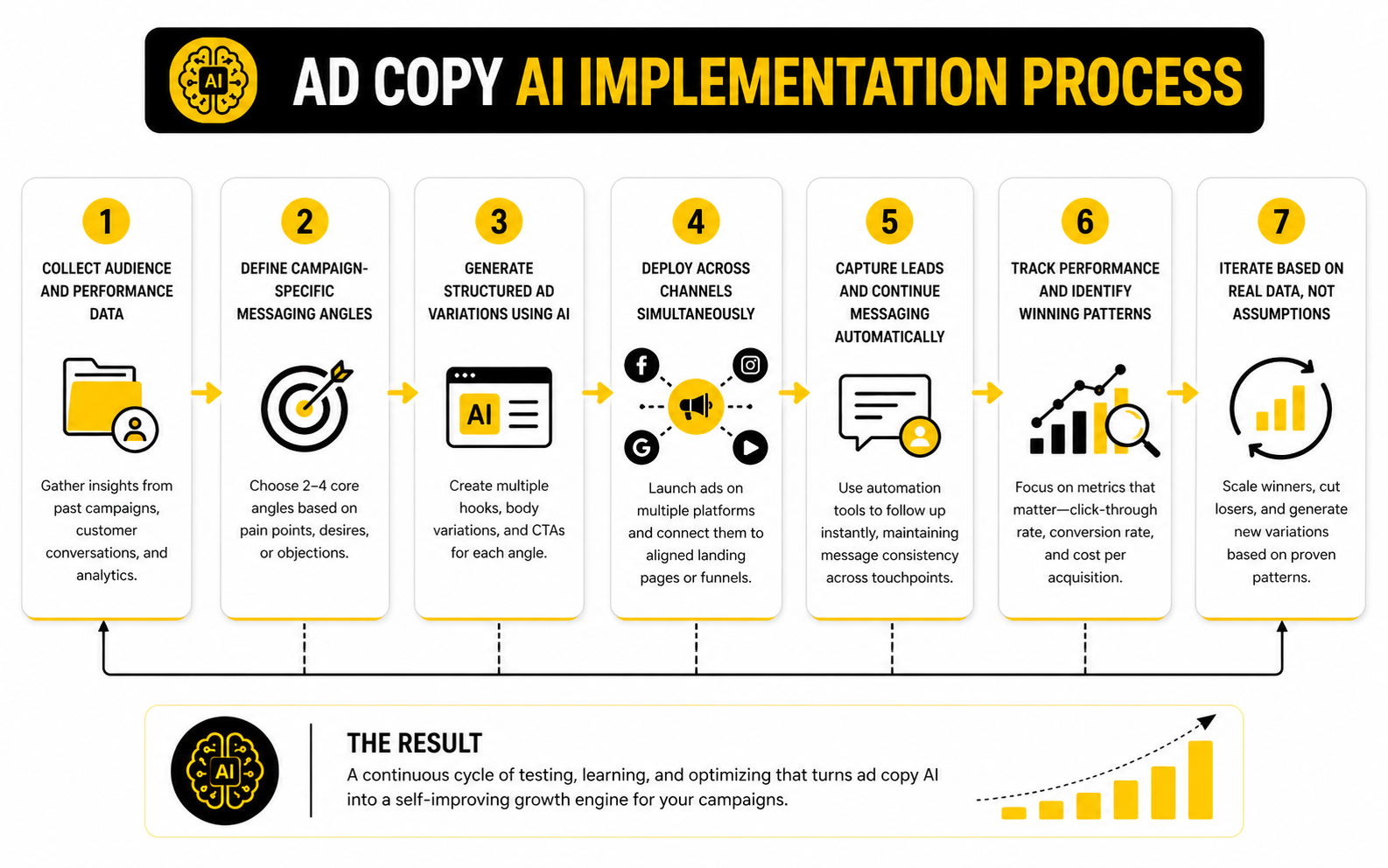
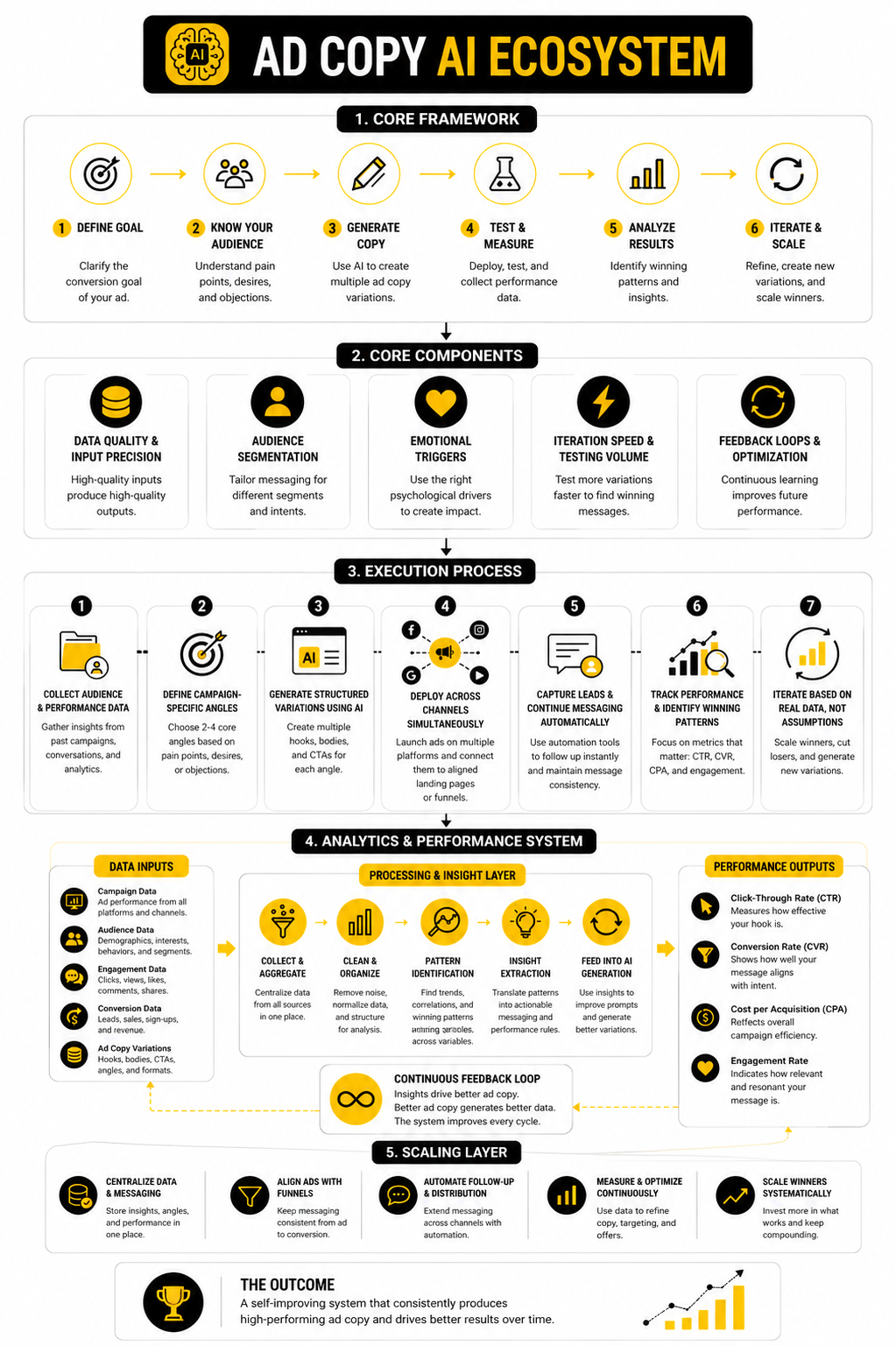
- Collect audience and performance data
Gather insights from past campaigns, customer conversations, and analytics. This becomes the foundation for all AI-generated copy.
- Define campaign-specific messaging angles
Choose 2–4 core angles based on pain points, desires, or objections. Avoid trying to cover everything in one campaign.
- Generate structured ad variations using AI
Create multiple hooks, body variations, and CTAs for each angle. Keep everything organized so you can track what works.
- Deploy across channels simultaneously
Launch ads on multiple platforms and connect them to aligned landing pages or funnels.
- Capture leads and continue messaging automatically
Use automation tools to follow up instantly, maintaining message consistency across touchpoints.
- Track performance and identify winning patterns
Focus on metrics that matter—click-through rate, conversion rate, and cost per acquisition.
- Iterate based on real data, not assumptions
Scale winners, cut losers, and generate new variations based on proven patterns.
This process is simple on paper, but execution is where most fail. The key is consistency. You don’t run this once—you run it continuously.
Scaling Without Losing Message Quality
As volume increases, quality often drops. That’s a real risk with ad copy AI if you rely purely on automation without oversight.
High-performing teams solve this by adding lightweight human review at critical points:
- Validating messaging angles before generation
- Reviewing top-performing ads before scaling
- Ensuring brand voice stays consistent
This hybrid approach consistently outperforms fully automated systems. It combines AI speed with human judgment.
Research shows that human-AI collaboration produces better outcomes than either working alone in most marketing scenarios (empathyfirstmedia.com).
Turning Implementation Into a Competitive Advantage
Once this system is running, something important happens.
You stop guessing.
Every campaign becomes a data-driven iteration. Every ad improves your understanding of what works. And over time, your ad copy AI becomes trained on your specific audience, not just generic data.
That’s when results start compounding.
Instead of chasing trends or copying competitors, you’re building a system that consistently produces high-performing ads—because it’s learning from your own market in real time.
Understanding the Numbers Behind Ad Copy AI Performance
At this point, you have the system. Now the question becomes: how do you know if it’s actually working?
This is where most people get misled. They look at surface-level metrics, make quick decisions, and end up optimizing for the wrong outcomes.
Ad copy AI doesn’t just change how you write ads—it changes how you interpret performance.
The Metrics That Actually Matter
Not all data points are equal. Some metrics tell you what’s happening, others tell you why it’s happening.
Here’s how to break it down:
- Click-through rate (CTR) → Measures how effective your hook is
- Conversion rate (CVR) → Shows how well your message aligns with intent
- Cost per acquisition (CPA) → Reflects overall efficiency
- Engagement rate → Indicates how relevant your message feels
Each metric maps to a specific part of your copy.
If CTR is low, your hook is weak.
If CTR is high but conversions are low, your message is misaligned.
If both are strong but CPA is high, your targeting or funnel needs work.
This layered interpretation is what separates real optimization from guesswork.
Why Benchmarks Can Be Misleading
A common mistake is chasing industry averages.
Yes, benchmarks can give context—but they don’t reflect your audience, your offer, or your positioning. For example, average CTRs vary massively across industries, formats, and platforms, making them unreliable as a decision-making tool on their own.
Instead of asking “Is this good compared to others?”, the better question is:
“Is this improving over time within my system?”
Ad copy AI is about iteration. Your baseline today should be worse than your performance 30 days from now if your system is working correctly.
That’s the only benchmark that matters.
What the Data Actually Reveals
When you start running enough variations, patterns emerge.
You’ll notice things like:
- Certain emotional triggers consistently outperform others
- Specific phrases drive higher engagement
- Some CTAs convert better across multiple campaigns
- Certain audience segments respond to entirely different messaging
This isn’t random.
It’s your market telling you exactly how it wants to be communicated with.
Studies comparing human vs AI-generated ads show that while humans often create stronger initial messaging, AI excels at identifying and scaling winning patterns through rapid iteration (searchenginejournal.com).
That’s the real advantage: not better guesses, but faster learning.
Building a Real Analytics System
To make sense of all this data, you need a simple but structured system.
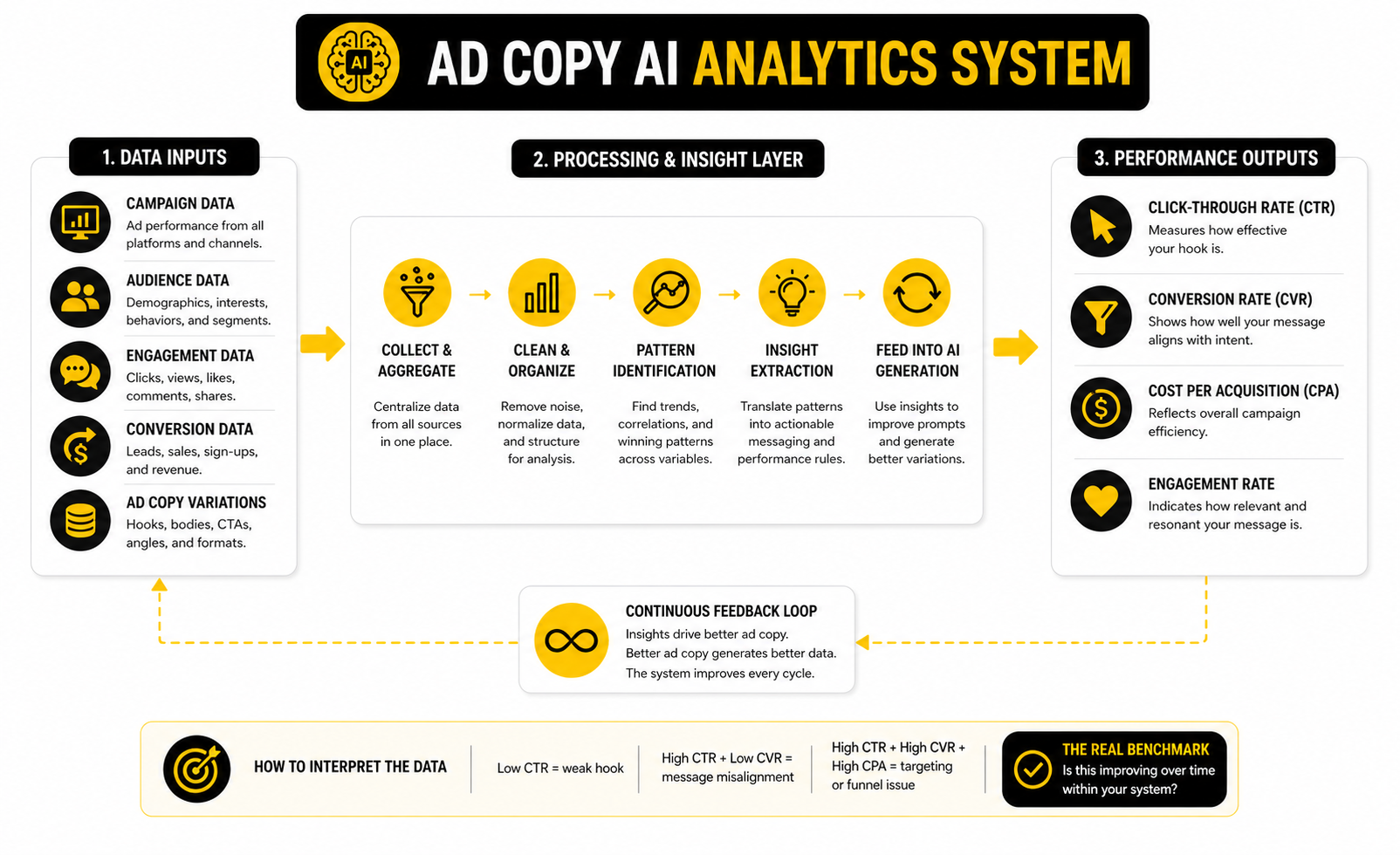
At a high level, your analytics flow should look like this:
- Input tracking
Tag every variation based on angle, hook type, and CTA so you know what you’re testing.
- Performance aggregation
Collect data across platforms in one place. Fragmented data leads to bad decisions.
- Pattern identification
Look for repeat winners, not one-off spikes. Consistency is what scales.
- Insight extraction
Translate performance into actionable rules, like “pain-based hooks outperform curiosity in cold traffic.”
- Feedback into AI generation
Feed those insights back into your prompts and frameworks.
This loop is what turns raw data into a competitive advantage.
If you’re using integrated systems like GoHighLevel, you can connect campaign performance directly to your messaging workflows, which makes this process significantly faster and more accurate.
Leading Indicators vs Lagging Indicators
Another critical distinction is timing.
Some metrics tell you immediately if something is working. Others take time.
- Leading indicators: CTR, engagement, early click behavior
- Lagging indicators: conversions, revenue, lifetime value
If you wait for lagging indicators before making changes, you move too slowly.
But if you optimize only for leading indicators, you risk improving clicks without improving revenue.
The right approach is balance.
Use leading indicators to filter quickly. Then validate decisions using lagging indicators before scaling.
Turning Data Into Action
Data alone doesn’t improve performance. Decisions do.
Here’s how to translate insights into action:
- Double down on winning hooks by expanding variations
- Replace underperforming angles instead of tweaking them endlessly
- Align landing pages with top-performing ad messaging
- Adjust audience targeting based on engagement patterns
This is where most campaigns either scale—or stall.
Ad copy AI gives you the raw capability to test and analyze at scale. But unless you act on what the data is telling you, nothing changes.
And once you start acting consistently, something powerful happens.
Your campaigns stop being unpredictable.
They become systems that improve with every iteration.
Advanced Strategies, Tradeoffs, and Scaling Realities
Once your ad copy AI system is running and producing results, the next challenge isn’t improvement—it’s control.
At scale, small inefficiencies become expensive. Weak messaging compounds. Misaligned targeting wastes budget faster than ever. This is where advanced strategy starts to matter more than tools.
The Tradeoff Between Speed and Signal Quality
AI gives you speed. But speed without structure creates noise.
When you generate too many variations without clear hypotheses, you dilute your data. Instead of learning what works, you end up with scattered results that are hard to interpret.
This is the hidden tradeoff:
- More variations = faster testing
- But too many variations = weaker insights
The solution is constraint.
Limit each campaign to a small set of clearly defined angles. Then generate depth within those angles, not randomness across dozens of unrelated ideas.
That’s how you keep your signal clean while still leveraging AI speed.
Avoiding the “Generic Copy Trap”
One of the most common issues with ad copy AI is sameness.
If you’ve ever seen ads that feel technically correct but emotionally flat, you’ve seen this problem. It happens when AI relies too heavily on generalized patterns without enough specific input.
The fix is specificity.
Instead of prompting with broad instructions, you anchor your inputs in:
- Real customer language
- Specific use cases
- Clear transformation outcomes
- Concrete objections
This is where tools like Guideless can support structured workflows, helping you maintain clarity across messaging and avoid drifting into generic territory.
The more grounded your inputs, the sharper your outputs.
Managing Creative Fatigue at Scale
As you scale campaigns, performance eventually drops. Not because your copy is bad, but because your audience has seen it too many times.
This is creative fatigue.
Even high-performing ads lose effectiveness after repeated exposure. AI helps you generate new variations quickly, but without strategy, you end up refreshing surface-level elements instead of introducing meaningful change.
To avoid this:
- Rotate core angles, not just headlines
- Introduce new emotional drivers periodically
- Refresh offers, not just wording
- Re-segment audiences to maintain relevance
Scaling isn’t about repeating what worked—it’s about evolving it before it stops working.
When to Trust AI vs When to Override It
AI is powerful, but it’s not infallible.
There are moments where performance data suggests one direction, but strategic context suggests another. For example, short-term CTR gains might come from sensational hooks that don’t align with long-term brand positioning.
This is where human judgment matters.
Use AI for:
- Generating variations
- Identifying patterns
- Scaling proven elements
Override AI when:
- Messaging conflicts with brand positioning
- Short-term performance undermines long-term trust
- Data lacks enough volume to be reliable
The goal isn’t blind automation. It’s controlled leverage.
Scaling Across Channels Without Breaking Consistency
As campaigns expand, you’ll likely move beyond one platform.
This introduces a new challenge: maintaining message consistency across different environments. What works on Meta may need adjustment for Google, YouTube, or email—but the core message should stay intact.
This is where centralized systems become critical.
Using platforms like Systeme.io or Brevo, you can align email sequences, landing pages, and ad messaging under one cohesive strategy.
Consistency builds trust. And trust compounds conversions over time.
The Risk of Over-Automation
There’s a point where adding more automation stops helping and starts hurting.
When every part of your system is automated, you lose visibility. You stop understanding why things work, and when performance drops, you don’t know where to fix it.
This is especially risky with ad copy AI because messaging is directly tied to audience perception.
The safeguard is simple:
- Keep human checkpoints in your workflow
- Review top-performing ads regularly
- Stay close to customer feedback and conversations
Automation should increase efficiency—not remove awareness.
Building Long-Term Advantage With Ad Copy AI
At the highest level, ad copy AI isn’t about writing better ads.
It’s about building a system that learns faster than your competitors.
When you:
- Capture and structure your data
- Continuously refine your messaging
- Align ads with funnels and follow-ups
- Maintain control over quality and strategy
You create something difficult to replicate.
Not just better campaigns—but a better process.
And in a market where most people are still guessing, that process becomes your edge heading into everything that comes next.
Bringing It All Together Into a Scalable System
At this point, the pieces are clear.
You’ve seen how ad copy AI works, how to structure it, how to implement it, and how to measure it. What matters now is how everything connects into a single system that keeps improving over time.
Because isolated tactics don’t scale.
What scales is alignment between messaging, data, automation, and execution.
The highest-performing setups all follow the same pattern:
- Centralized messaging and data
- Structured AI generation
- Controlled testing and iteration
- Integrated funnels and follow-ups
- Continuous feedback loops
When these pieces work together, something important happens.
You stop relying on individual wins. You start building predictable performance.
This is the real shift with ad copy AI.
It’s not about writing ads faster. It’s about creating a system that gets smarter every time you use it.
And once that system is in place, growth stops feeling random.
FAQ - Built for Complete Guide
What is ad copy AI in simple terms?
Ad copy AI refers to tools and systems that use machine learning to generate, test, and optimize advertising messages. Instead of writing every ad manually, you guide the AI with inputs and let it produce variations at scale. The real value comes from how it learns from performance data over time.
Can ad copy AI replace human copywriters?
Not entirely. AI can generate and scale variations quickly, but human judgment is still critical for strategy, positioning, and brand voice. The best results come from combining both, not choosing one over the other.
How accurate is AI-generated ad copy?
Accuracy depends on inputs and structure. When guided properly, AI can produce highly relevant and effective copy. Without clear direction, it often generates generic content that underperforms.
What’s the biggest advantage of using ad copy AI?
Speed combined with iteration. You can test significantly more variations than manual workflows allow. This leads to faster learning and better overall campaign performance.
What metrics should I track when using ad copy AI?
Focus on:
- Click-through rate for hooks
- Conversion rate for message alignment
- Cost per acquisition for efficiency
- Engagement for relevance
Each metric tells you something different about your copy performance.
How do I avoid generic AI-generated ads?
Use specific inputs. Include real customer language, clear pain points, and defined outcomes. The more grounded your prompts are, the more distinctive your outputs become.
Is ad copy AI better for short-form or long-form content?
AI tends to perform especially well in short-form formats like ads and social media posts. That’s because patterns are easier to replicate and test at scale. Long-form content still benefits from stronger human oversight.
How many ad variations should I test?
Enough to identify patterns, but not so many that your data becomes noisy. A focused set of variations around a few angles is usually more effective than testing everything at once.
What tools work best with ad copy AI systems?
Tools that integrate messaging, automation, and analytics tend to perform best. Platforms like GoHighLevel, Systeme.io, and ManyChat help connect the entire workflow from ad to conversion.
How long does it take to see results?
You can see early signals within days through metrics like CTR and engagement. Meaningful optimization typically takes a few weeks as you gather enough data to identify consistent patterns.
What’s the biggest mistake people make with ad copy AI?
Treating it like a shortcut instead of a system. Generating copy without structure, testing, or feedback loops leads to poor results. The real value comes from how you use AI within a process.
Can beginners use ad copy AI effectively?
Yes, but results improve significantly with structure. Even simple frameworks can dramatically improve outcomes compared to random generation.
Work With Professionals
Explore 10K+ Remote Marketing Contracts on MarkeWork.com
Most marketers spend too much time chasing clients, competing on crowded platforms, and losing a percentage of every project to middlemen.
MarkeWork gives you a better way. Browse thousands of remote marketing contracts and connect directly with companies desperate to hire skilled marketers like you, without platform commissions and without unnecessary gatekeepers.
If you're serious about finding better opportunities and keeping 100% of what you earn, explore available contracts and create a profile for free at MarkeWork.com.