

Adobe Marketing Cloud is still a common shorthand in search, buying conversations, and internal planning docs, but the product reality has changed. Adobe formally folded that older label into Adobe Experience Cloud, which now spans customer data, journey orchestration, analytics, content operations, commerce, and B2B marketing in a much broader platform model than the original marketing-suite framing suggests.
That distinction matters because teams evaluating adobe marketing cloud are rarely shopping for a single tool. They are usually trying to solve a bigger operating problem: unify customer data, connect content to performance, measure what actually moves revenue, and orchestrate journeys across web, app, email, paid media, and service touchpoints. Adobe’s own recent positioning, earnings commentary, and product launches show that the company is leaning even harder into that end-to-end model, especially around Adobe Experience Platform, Journey Optimizer, Customer Journey Analytics, GenStudio, and AI-powered orchestration.
The reason this topic keeps coming up is simple: personalization and speed are no longer “nice to have” goals. McKinsey’s research on personalization linked stronger personalization maturity with materially higher revenue contribution, while BCG’s 2025 personalization analysis argued that leaders are separating from laggards as AI changes customer expectations. Adobe’s own 2026 marketing research also points to the same tension: adoption is accelerating, but operational maturity is lagging behind.
Article Outline
- Why Adobe Marketing Cloud still matters
- How the Adobe Marketing Cloud framework fits together
- The core Adobe products that actually drive execution
- Data, identity, measurement, and decisioning
- What professional implementation really looks like
- How to evaluate whether Adobe is the right fit
Why Adobe Marketing Cloud Still Matters
The phrase still matters because buyers, stakeholders, and procurement teams often use it as a catch-all for Adobe’s enterprise marketing stack, even when they are really talking about Adobe Experience Cloud. If you treat adobe marketing cloud as just an analytics suite or just a campaign tool, you will miss the actual architecture Adobe is selling today: a connected system built around profiles, journeys, insights, content, and activation. Adobe’s pricing and product navigation make that clear, with offerings grouped around products such as Real-Time CDP, Journey Optimizer, Customer Journey Analytics, Analytics, Marketo Engage, and Commerce rather than a single bundled “marketing cloud” product.
This also matters financially, not just conceptually. In Adobe’s fiscal 2025 annual report, Digital Experience revenue reached $5.864 billion, and subscription revenue for that segment reached $5.409 billion, with management explicitly calling out strength in GenStudio solutions and Adobe Experience Platform and related apps. That tells you where Adobe sees momentum inside its customer-experience business, and it helps explain why recent product messaging is so focused on data foundations, content velocity, and orchestration rather than standalone campaign execution.
In practical terms, adobe marketing cloud matters most to organizations that have already outgrown point solutions. Once a company is juggling disconnected analytics, a weak identity layer, multiple content workflows, and channel teams optimizing in isolation, the cost is not just technical complexity. It shows up as slower launches, weaker attribution, duplicated audiences, inconsistent messaging, and a much harder path to profitable personalization. Deloitte’s personalization research and Adobe’s 2026 AI and Digital Trends research both point to that same operational gap between ambition and execution.
How the Adobe Marketing Cloud Framework Fits Together
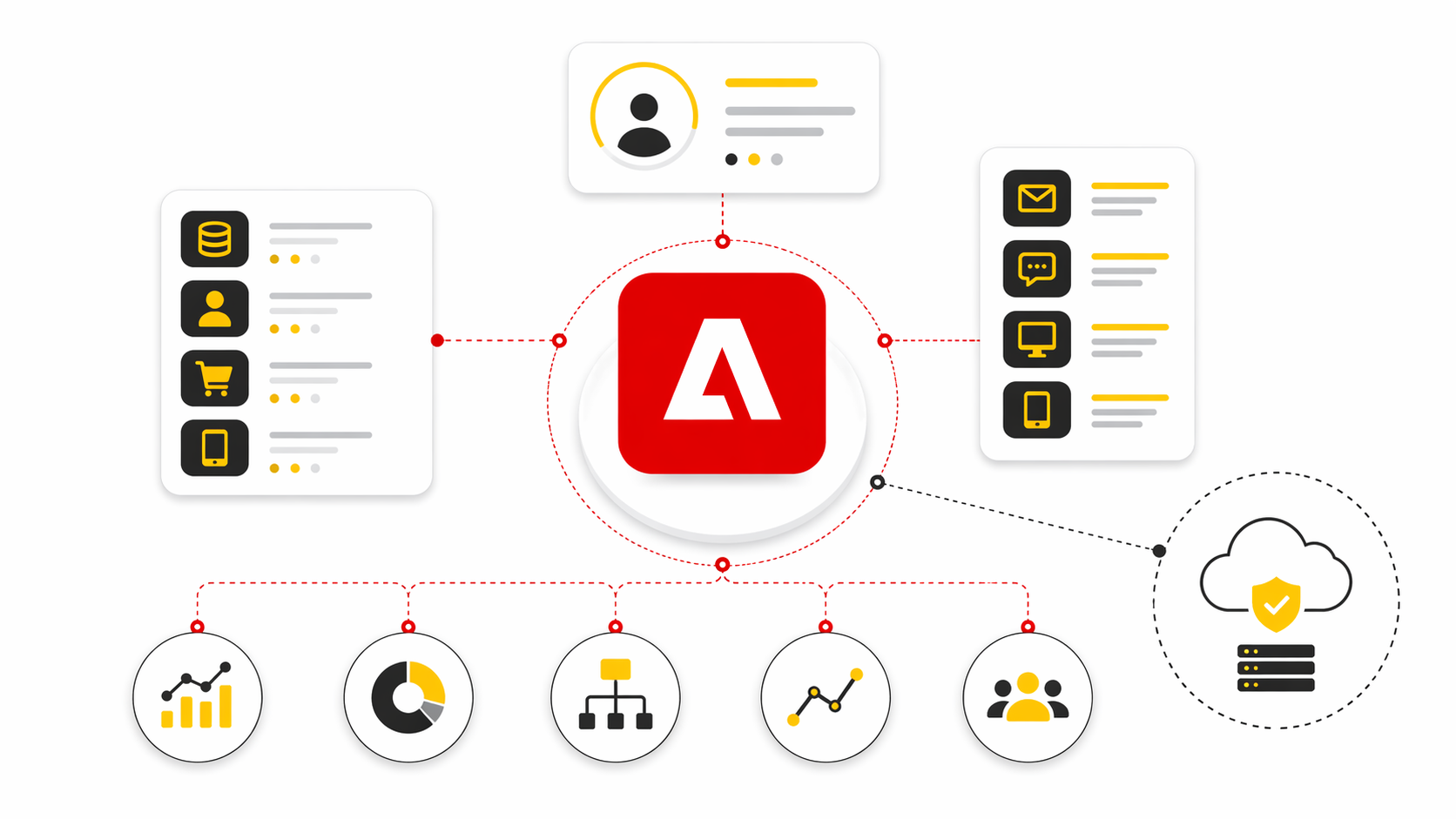
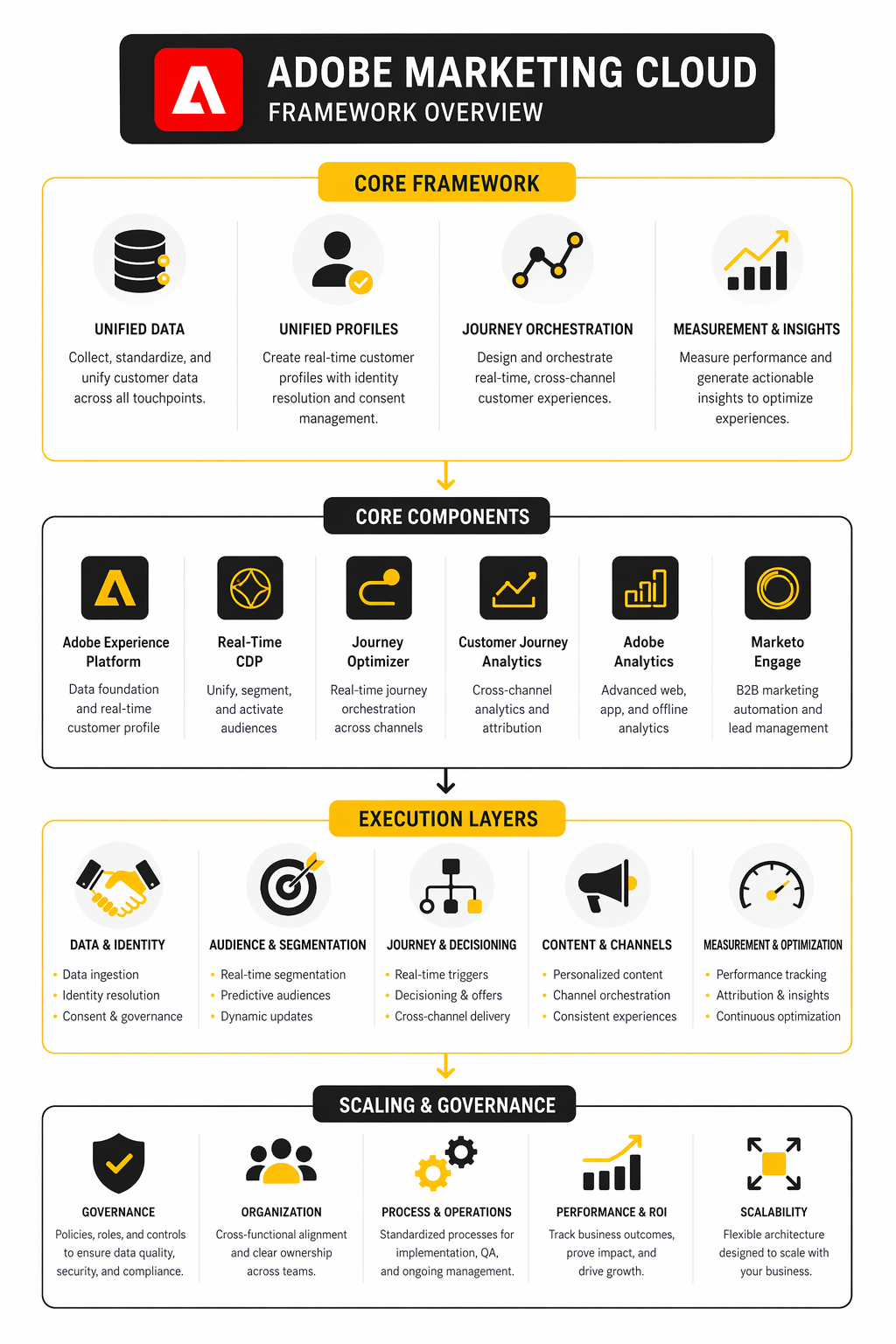
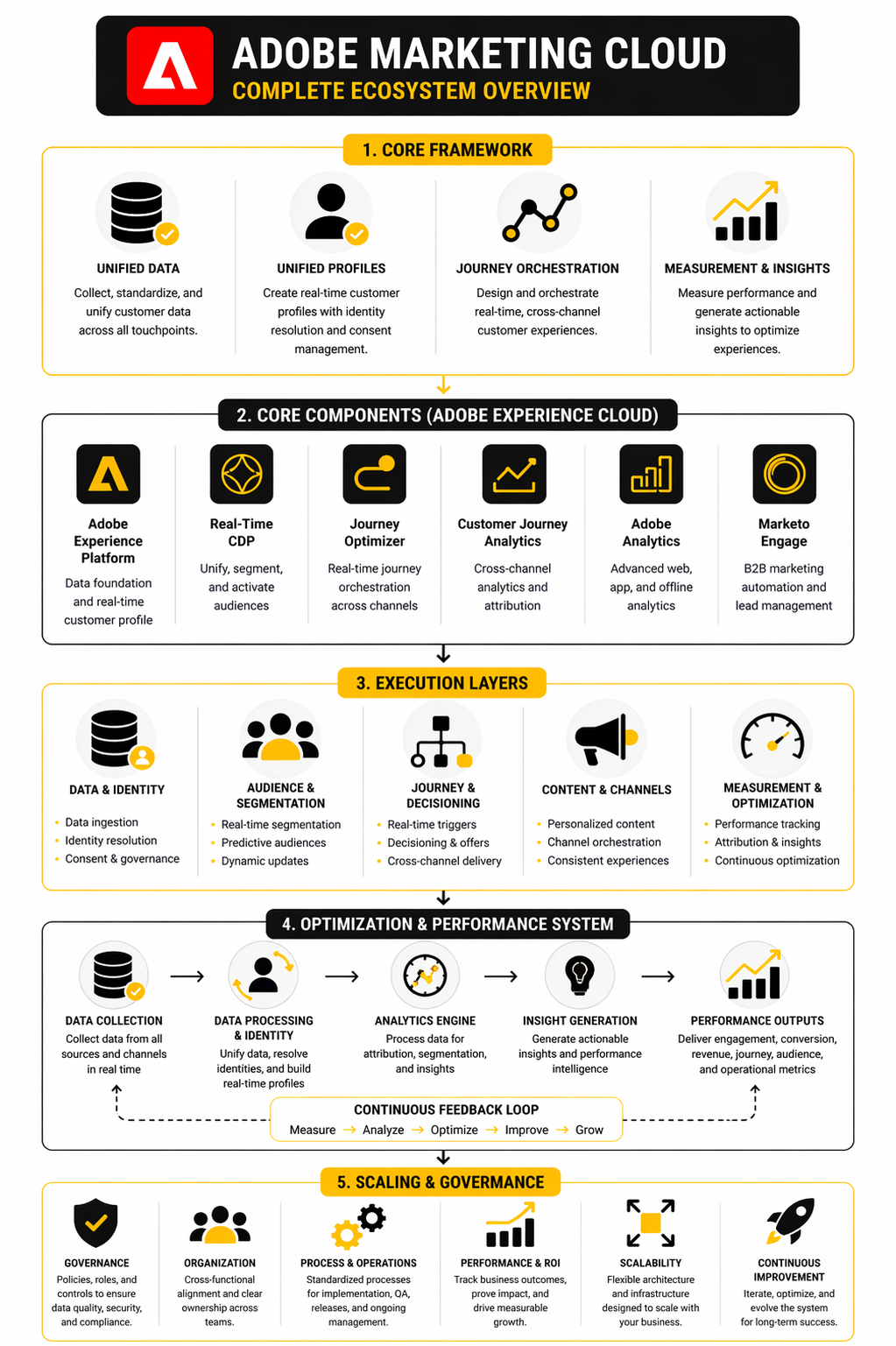
The cleanest way to understand adobe marketing cloud today is to stop thinking in channels and start thinking in layers. At the foundation is Adobe Experience Platform, which acts as the shared data and profile environment. On top of that foundation sit the applications that use the data: Real-Time CDP for audience unification and activation, Journey Optimizer for orchestration and decisioning, Customer Journey Analytics for cross-channel analysis, and newer workflow products such as GenStudio for Performance Marketing and Marketing Campaign Analytics to connect planning, creation, and optimization.
That framework is one reason Adobe continues to show up in enterprise shortlists. Instead of treating data, content, and activation as separate projects, Adobe is pushing a model where those pieces feed each other continuously. Profiles inform journeys, journeys generate response data, analytics clarifies what is working, and content systems increasingly adapt creative production to what performance data is saying in near real time.
You can also see Adobe tightening this framework around AI. At Adobe Summit 2026, the company highlighted new agentic and orchestration capabilities, while recent product updates for Journey Optimizer and Customer Journey Analytics emphasize faster decision-making, experimentation, and insight generation inside the same environment. That does not magically remove implementation complexity, but it does show the strategic direction: Adobe wants the platform to move from system of record to system of action.
What Comes Next in This Article
The next part will move from framework to product reality. That means breaking down the core components people usually mean when they search for adobe marketing cloud, where each product fits, and where overlap or confusion tends to creep in during evaluation.
The Core Adobe Products That Actually Drive Execution
Once you get past the legacy adobe marketing cloud label, the real question becomes much more practical: which Adobe products actually do the work day to day. For most enterprise teams, the stack revolves around Adobe Experience Platform, Real-Time CDP, Adobe Journey Optimizer, Customer Journey Analytics, Adobe Analytics, and, in B2B environments, Marketo Engage. Adobe’s own product structure makes that pretty clear, because these are the products consistently positioned as the operating layer for audience building, orchestration, measurement, and activation in modern customer experience programs. Adobe Experience Platform, Adobe pricing and product lineup
That matters because people often evaluate adobe marketing cloud as if it were one product with one implementation path. It is not. It is closer to a system of connected applications that share data, profiles, governance, and increasingly AI-assisted workflows, which means your results depend less on “having Adobe” and more on whether you picked the right combination of products for your business model. Adobe Experience Platform overview, Adobe Journey Optimizer
Adobe Experience Platform Is the Foundation
Adobe Experience Platform is the base layer because it handles ingestion, normalization, governance, and profile assembly across sources that would otherwise stay disconnected. Adobe describes it as the system that unifies, analyzes, and activates customer data across the broader Experience Cloud portfolio, and that framing is important because nearly every higher-value use case depends on that shared data layer being trustworthy. Adobe Experience Platform
In plain English, this is where adobe marketing cloud stops being a collection of interfaces and starts becoming an operating system. If your web behavior, CRM records, transaction history, consent data, and campaign engagement are not connected here, the rest of the stack will look more sophisticated than it really is. You can still launch campaigns, of course, but you will struggle to maintain a consistent profile, suppress waste, or analyze journeys in a way that reflects reality instead of channel silos. Adobe Experience Platform documentation
Adobe has kept reinforcing that central role through recent releases. The 2026 release notes show ongoing updates not just for the platform itself, but for the applications built around it, including Customer Journey Analytics, Journey Optimizer, federated audience capabilities, and Real-Time CDP Collaboration. That is a strong signal that Adobe is investing in the platform layer as the place where orchestration and intelligence compound. Adobe Experience Platform release notes, Experience Cloud release notes
Real-Time CDP Handles Audience Unification and Activation
If Experience Platform is the foundation, Real-Time CDP is the product many teams feel first. It is designed to unify customer and account data into profiles that can actually be activated across channels, and Adobe explicitly positions it for both B2C and B2B use cases. That is a big reason adobe marketing cloud keeps showing up in enterprise conversations about first-party data strategy, especially now that third-party-cookie dependence has become a weak foundation for audience planning. Adobe Real-Time CDP, Adobe customer data platform solution page
This is where the stack starts creating operational leverage. Instead of rebuilding segments inside each ad platform, email system, and personalization tool, marketers can work from a more durable profile and audience model. Adobe’s current Real-Time CDP messaging also leans heavily into governance and data flexibility, which matters because enterprise teams are not just trying to activate data faster; they are trying to do it without creating privacy and compliance chaos. Adobe Real-Time CDP features
Adobe has also been shipping new capabilities here at a steady pace. The company highlighted fresh Real-Time CDP innovations in April 2026 around stronger data foundations, smarter activation, and agentic support, which lines up with the broader trend of CDPs moving beyond audience storage into decision support and orchestration. New Real-Time CDP capabilities
Adobe Journey Optimizer Turns Profiles Into Action
A unified profile is useful, but it does not create business value on its own. Adobe Journey Optimizer is where adobe marketing cloud becomes operational in the sense most marketers care about: triggered journeys, cross-channel engagement, offers, decisioning, and the ability to respond to customer behavior while it is still relevant. Adobe is explicit that Journey Optimizer runs on Adobe Experience Platform and depends on real-time profiles, streaming data, and governance controls to work properly. Adobe Journey Optimizer
That dependency is not a weakness. It is actually the point. Adobe is trying to make orchestration a direct extension of the shared data model, which is why Journey Optimizer is increasingly positioned as the hub for coordinating messaging, timing, experimentation, and brand consistency across regions and teams. Adobe Journey Optimizer product page
This is also one of the clearest dividing lines between simple marketing automation and a true enterprise orchestration layer. If your business only needs straightforward nurture flows, you do not need this level of machinery. But if you need to coordinate web behavior, email, in-app actions, offers, consent, and analytics inside one governed framework, Journey Optimizer is one of the main reasons people still use the adobe marketing cloud label even though the portfolio itself has evolved far beyond it. Adobe named a Leader in multichannel marketing hubs
Customer Journey Analytics and Adobe Analytics Answer Different Questions
One of the easiest ways to get confused in the Adobe ecosystem is to assume Adobe Analytics and Customer Journey Analytics are interchangeable. They are related, but they are not the same thing. Adobe Analytics remains a powerful environment for digital measurement, while Customer Journey Analytics is built to analyze customer behavior across connected datasets and channels in a broader journey context. Adobe Experience Platform applications, Customer Journey Analytics release information
That difference matters more than it seems. A lot of teams using adobe marketing cloud are not struggling because they lack dashboards. They are struggling because web analytics alone does not explain customer progression across paid traffic, owned channels, transactions, service interactions, and offline events. Customer Journey Analytics is Adobe’s answer to that gap, and it becomes much more valuable once it is connected to the same platform data and profile model powering activation. Adobe Experience Platform
The practical takeaway is simple. Adobe Analytics helps you understand digital behavior in depth, while Customer Journey Analytics is better suited for organizations trying to understand customer movement across a wider operational footprint. If you collapse those two jobs into one vague “reporting” bucket, you will design the wrong stack and probably blame the platform later for a strategy mistake that happened much earlier.
Marketo Engage Still Matters in B2B Environments
For B2B organizations, adobe marketing cloud often means one more product has to be part of the discussion: Marketo Engage. Adobe continues to position Marketo as a major component of its B2B marketing automation story, and outside reports in 2025 still placed Adobe among the leaders in that category. Adobe B2B automation report page
This matters because B2B teams usually have different requirements from B2C teams. Lead lifecycles, buying groups, account scoring, partner motions, and sales alignment all change the shape of orchestration. Real-Time CDP and Journey Optimizer can still matter in those environments, but Marketo Engage often remains the product that holds together the demand generation and lifecycle automation side of the house.
That does not mean every B2B company needs the full Adobe stack. It means that if you are evaluating adobe marketing cloud for a B2B use case, you need to be clear about whether the center of gravity is demand generation, account-based marketing, lifecycle nurture, customer marketing, or true cross-channel journey orchestration. Adobe can play in all of those areas, but the product mix changes depending on what you are actually trying to accomplish.
Data, Identity, Measurement, and Decisioning
The biggest mistake buyers make is focusing on feature checklists before they understand the four disciplines that determine whether the system will work: data, identity, measurement, and decisioning. Those are not side concerns. They are the architecture behind the architecture, and without them, even a very expensive adobe marketing cloud implementation turns into disconnected dashboards and overcomplicated campaign logic.
The next part will go deeper into those four layers, because this is where the real performance gap appears. Teams that get these foundations right can move faster, personalize more confidently, and trust their reporting. Teams that get them wrong usually end up with a polished demo environment and a messy live operation.
Data, Identity, Measurement, and Decisioning
This is the part where adobe marketing cloud either becomes a serious growth system or an expensive collection of disconnected tools. The platform can look impressive in demos, but in live environments the real performance comes from how well you handle data quality, identity stitching, measurement design, and decision logic. If those four layers are weak, every downstream workflow gets noisier, slower, and harder to trust.
Data is the obvious starting point, but it is not just about getting feeds into the platform. It is about standardizing events, enforcing naming discipline, mapping sources to a usable model, and making sure the data arriving in profiles is actually fit for activation and analysis. Most implementation pain starts here because companies underestimate how much messy source data turns into messy segmentation, messy reporting, and messy journeys.
Identity is where the architecture gets more strategic. Adobe’s stack is strongest when teams know how they want to relate anonymous behavior, known profiles, accounts, devices, and consent states before they start launching use cases. If identity strategy is vague, adobe marketing cloud turns into a high-speed way to distribute the wrong message to the wrong person with impressive technical precision.
Measurement is the layer that keeps the whole thing honest. Enterprise teams often talk about personalization, orchestration, and customer journeys in broad terms, but without clear success metrics they cannot tell whether the system is creating real value or just more activity. Good implementation ties every major use case back to business outcomes, operational KPIs, and diagnostic metrics that show where the journey is actually breaking.
Decisioning is where the stack becomes commercially useful. Once you have usable data, a stable identity approach, and clear measurement, you can define what the system should do when a customer qualifies for an offer, exits a journey, triggers a risk signal, or reaches a suppression threshold. That sounds simple on paper, but this is exactly where weak governance creates chaos, because teams start competing for the same audience and the same moment.
What Professional Implementation Really Looks Like
A professional adobe marketing cloud rollout is not a “switch it on” project. It is a phased operating model change that usually touches marketing, analytics, engineering, privacy, data teams, product owners, and sometimes sales or service as well. The companies that get value faster are usually the ones that resist the urge to deploy everything at once and instead sequence the work around a few high-value use cases.
That sequencing matters more than most buyers expect. Adobe gives enterprises a lot of power, but power without order creates drag. The best implementations begin with a narrow, commercially meaningful scope, prove that the data and orchestration model works, and only then expand into more channels, more segments, and more complex decisioning.
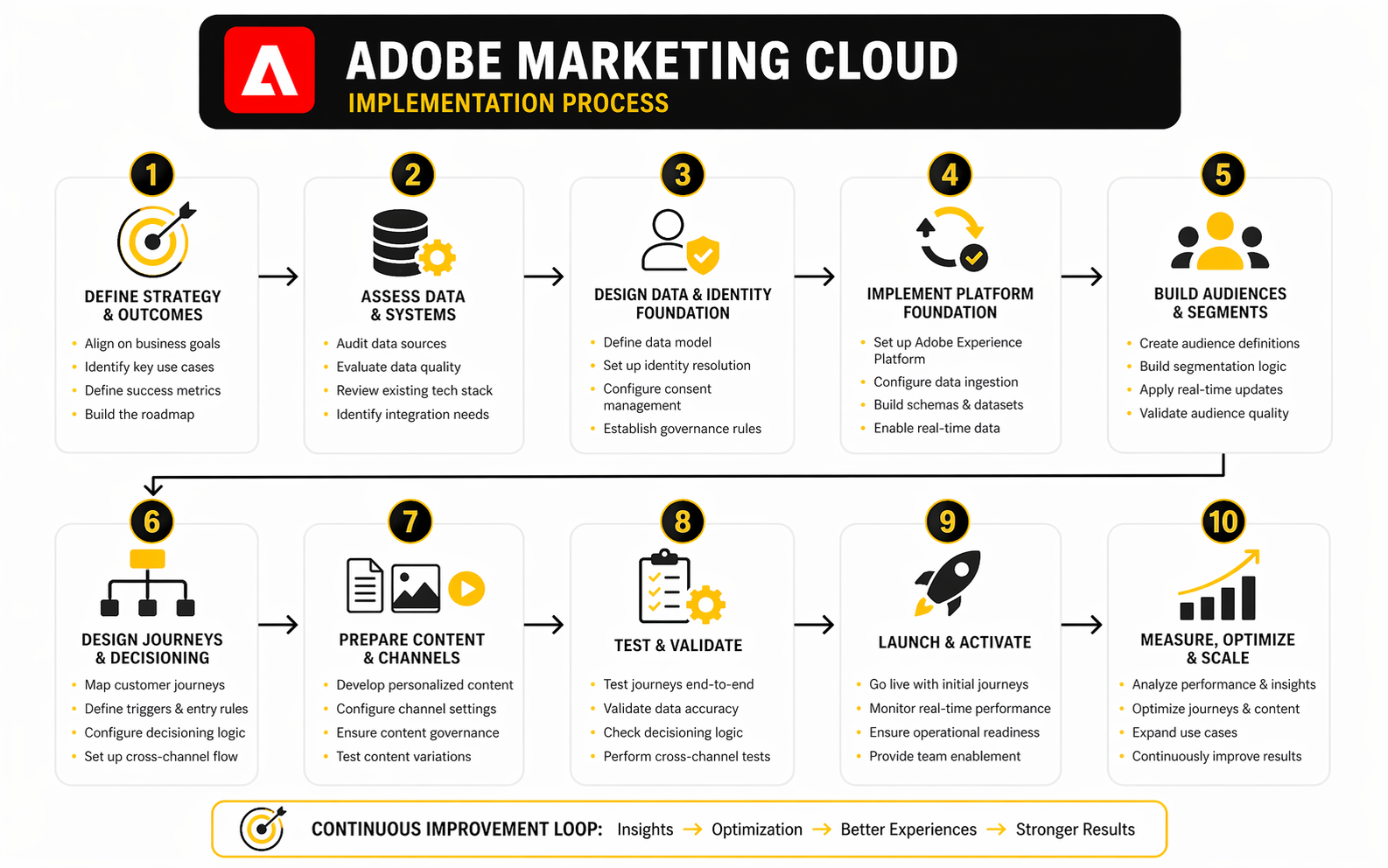
Step 1: Define the Business Outcomes Before the Stack Design
This is where smart projects separate themselves immediately. Before anyone gets lost in schemas, connectors, sandboxes, or audience logic, the team needs a sharp answer to one question: what specific commercial outcomes should this implementation move first? If the answer is vague, the project will drift into platform administration instead of revenue impact.
A strong starting point usually looks like a short list of prioritized use cases. That could be churn suppression, onboarding acceleration, cart recovery, upsell timing, lead qualification, or cross-channel frequency management. What matters is that each use case has a clear audience, a trigger, a decision path, a channel plan, and a measurable outcome.
This step also forces hard trade-offs early, which is healthy. Not every good idea belongs in phase one. The point of adobe marketing cloud implementation is not to prove the platform has a lot of features; it is to prove the business can use those features in a repeatable way.
Step 2: Build the Data Model Around Use Cases, Not Around Org Charts
This is where many implementations quietly go off the rails. Different teams bring different source systems, taxonomies, and reporting habits into the project, and suddenly the platform starts reflecting internal politics instead of customer reality. That makes the stack harder to scale because every new use case has to fight through old naming choices and disconnected assumptions.
A better approach is to design the data model around the journeys you actually want to power. That means agreeing on critical entities, required events, profile attributes, consent signals, and activation-ready fields before you chase completeness. In practice, it is usually smarter to have a smaller, cleaner model that reliably powers live use cases than a giant, unstable one that looks comprehensive but breaks under pressure.
This is also where governance has to stop being an afterthought. Field definitions, ownership, transformation rules, and usage policies should be documented early, because once teams start building journeys and dashboards on top of inconsistent inputs, cleanup gets dramatically harder.
Step 3: Get Identity and Consent Right Before You Scale Activation
Identity and consent are the difference between controlled personalization and operational confusion. Adobe can support sophisticated profile and policy logic, but the business still has to decide how anonymous and known data should connect, which identifiers are trusted, and what activation rules apply under different consent states. Without that clarity, scale just multiplies inconsistency.
This is usually the phase where implementation becomes real for stakeholders outside marketing. Legal, privacy, security, and data governance teams need a seat at the table because their decisions will shape what can be used, where it can be activated, and how long it can be retained. That can feel like friction, but it is actually what keeps the platform usable over time.
The biggest mistake here is treating privacy as a final review step. In a mature adobe marketing cloud program, consent and policy logic are built into the operating model from the start, not bolted onto campaigns later when something breaks.
Step 4: Launch a Small Number of High-Value Journeys First
This is where the process becomes tangible. Once the foundational data, identity, and measurement pieces are good enough, the team should launch a small set of journeys that are commercially important and operationally manageable. That first wave should be ambitious enough to prove value, but narrow enough that teams can diagnose failures quickly.
The best first launches are usually not the flashiest ones. They are the ones with clear triggers, clear audience logic, clear suppression rules, and clean measurement windows. That gives the business a way to learn how adobe marketing cloud behaves under real conditions without exposing every channel and every stakeholder to unnecessary complexity on day one.
At this stage, the implementation should feel more like a disciplined production line than a big-bang transformation. Profiles qualify, rules evaluate, journeys trigger, content renders, messages deliver, and analysts can trace what happened without guessing. Once a team reaches that point, expansion becomes much easier because the process is no longer theoretical.
Step 5: Create a Feedback Loop Between Activation and Analysis
A lot of enterprise teams launch journeys and then move on too quickly. That is a mistake. The real value of adobe marketing cloud comes from the feedback loop between orchestration and analysis, because that is where the team learns which triggers are too weak, which audiences are too broad, which offers fatigue fastest, and which sequences are producing incremental lift instead of noise.
This is why measurement design cannot be treated as post-launch reporting. Analysts and marketers need shared definitions before launch, not just pretty dashboards after the fact. Otherwise the team ends up arguing about attribution logic when it should be improving journey logic.
This step is also where the implementation starts compounding. One successful loop teaches the organization how to improve the next one faster. Over time, that learning speed becomes one of the biggest advantages of a well-run Adobe environment.
Step 6: Operationalize Ownership, Governance, and Change Management
The final stage is where many technically successful implementations still stumble. The platform may be live, the journeys may be working, and the dashboards may be trusted, but if nobody owns prioritization, governance, release discipline, and cross-team coordination, performance stalls. Adobe is powerful, but power without operating structure burns teams out.
Professional implementation means assigning real ownership across the lifecycle. Someone owns the data contracts, someone owns activation standards, someone owns journey QA, someone owns measurement integrity, and someone owns the use-case roadmap. Without that structure, adobe marketing cloud becomes a platform everyone uses but nobody truly governs.
Change management matters just as much. Teams need training, documentation, escalation paths, sandbox discipline, and a clear way to decide what gets built next. That may sound less exciting than AI-driven personalization, but this is the part that determines whether the platform stays valuable a year later.
Why the Process Matters More Than the Pitch
Vendors sell possibility. Implementation delivers reality. That is especially true with adobe marketing cloud because the platform can support sophisticated customer experience programs, but it only does that well when the business is disciplined enough to build around use cases, governance, and learning loops instead of chasing feature breadth.
This is also why Adobe tends to fit organizations that are ready for operational maturity, not just tool adoption. If the business wants a fast tactical fix, the stack will probably feel heavy. If the business wants a governed system for data-driven orchestration across teams and channels, the implementation process is exactly where Adobe starts to justify itself.
The next part will focus on fit. Not every company needs this level of architecture, and not every team should buy into the complexity that comes with it. That decision deserves a blunt evaluation, because this is one of those cases where the wrong platform choice can lock in years of avoidable friction.
Performance Signals, Benchmarks, and What the Data Actually Means
At this stage, adobe marketing cloud stops being a systems conversation and becomes a performance conversation. The question is no longer “can we orchestrate journeys” but “are those journeys actually moving revenue, retention, and efficiency in a measurable way.” This is where a lot of teams get uncomfortable, because the numbers often reveal gaps between what the organization believes is happening and what customers are actually experiencing.
The important shift here is to stop chasing surface-level metrics and start interpreting signals in context. Open rates, click-through rates, and even conversion rates can look strong in isolation while hiding deeper issues like audience overlap, frequency fatigue, or weak incremental impact. The strength of adobe marketing cloud is not that it gives you more dashboards. It is that it gives you a chance to connect signals across the entire journey and understand what is really driving outcomes.
Personalization Performance Is Real, but Only at Maturity
There is strong evidence that personalization works, but only when the underlying system is mature enough to support it. Research on personalization impact shows that companies with advanced capabilities see significantly higher revenue contribution from personalization compared to those still in early stages, but most organizations remain stuck in fragmented execution. McKinsey personalization research
That gap matters because adobe marketing cloud is often bought with personalization as the headline goal. The reality is that the platform does not create personalization value on its own. It creates the conditions for personalization, but the value only appears when data, identity, and decisioning are strong enough to support consistent execution.
This leads to a practical takeaway. If your personalization metrics are flat, the problem is rarely “we need more campaigns.” It is usually “we need better audience logic, cleaner signals, or more disciplined decisioning.” The numbers are not just reporting outcomes; they are diagnosing where the system is weak.
Customer Journey Metrics Are More Important Than Channel Metrics
One of the biggest mindset shifts when using adobe marketing cloud properly is moving from channel reporting to journey reporting. Traditional analytics might show that email is performing well and paid media is performing well, but that does not explain whether those channels are helping the same customer move forward or just competing for attention.
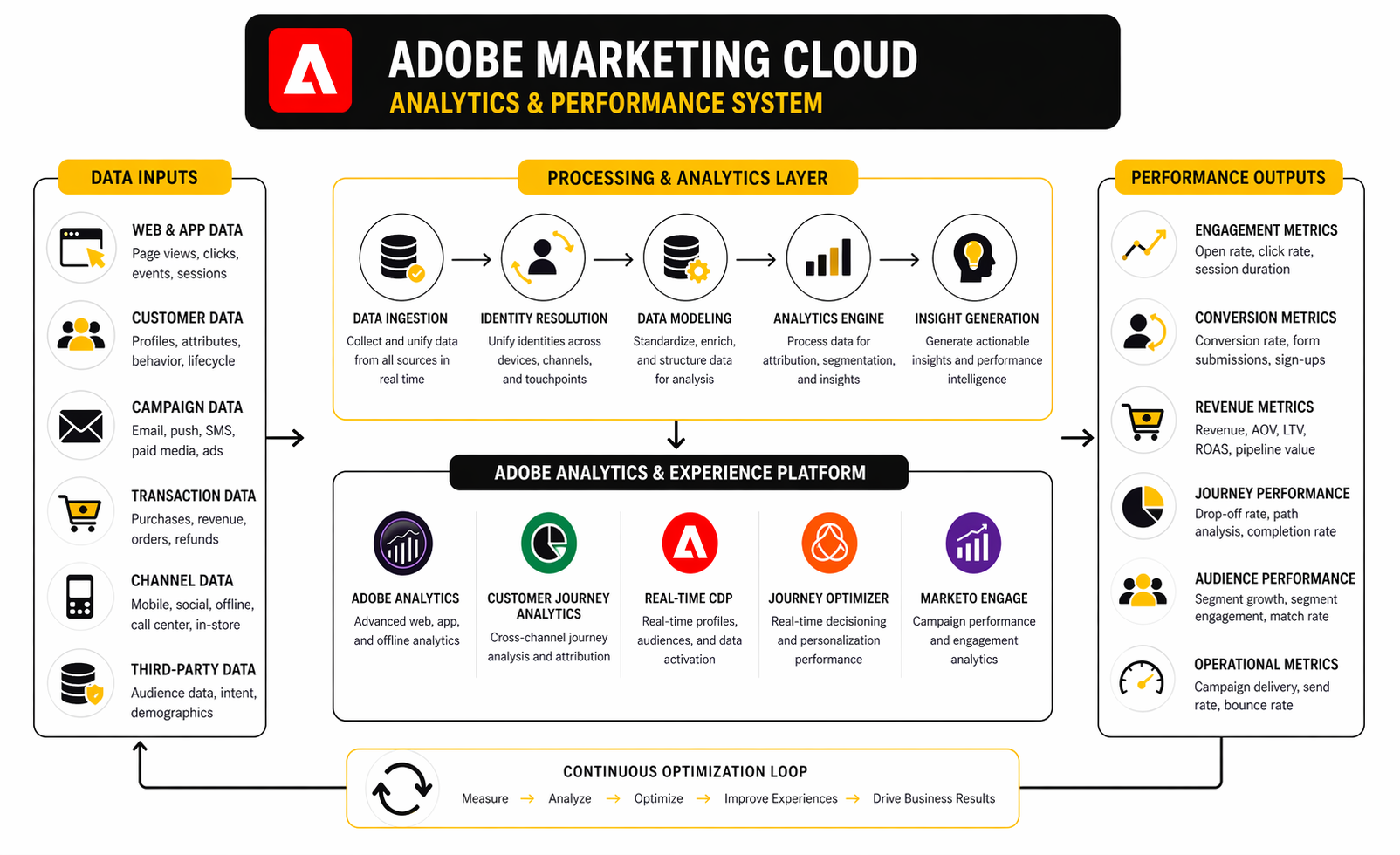
Customer journey analytics changes that by connecting behavior across touchpoints. Adobe’s own positioning emphasizes cross-channel analysis because isolated channel metrics cannot explain customer progression, drop-off, or saturation. Adobe Experience Platform overview
When you look at performance through a journey lens, different signals start to matter more:
- Time to conversion instead of just conversion rate
- Journey completion rate instead of isolated engagement
- Drop-off points across sequences, not just individual campaigns
- Frequency impact across channels, not just per channel
These metrics force better decisions. If time to conversion is increasing, the problem might not be messaging quality but journey friction. If drop-off spikes at a specific stage, it might indicate poor timing, irrelevant content, or conflicting signals across channels.
Data Quality Directly Impacts Measured Performance
There is a less obvious but critical relationship between data quality and performance metrics. When data is inconsistent, delayed, or duplicated, the numbers look cleaner than reality. Campaigns appear to perform better because suppression logic fails, attribution inflates, and audience overlap goes unnoticed.
Adobe’s architecture tries to reduce that problem by centralizing data in a shared platform, but it does not eliminate it automatically. The system reflects the quality of what goes into it. If the input is messy, the output will be misleading, even if the dashboards look sophisticated.
This is why mature teams treat data validation as part of performance optimization. They monitor event accuracy, identity stitching quality, latency, and audience integrity alongside campaign metrics. That may sound technical, but it directly affects revenue decisions. Bad data leads to confident but wrong conclusions, which is far more dangerous than having no data at all.
Incrementality Is the Metric That Separates Good From Great
A lot of marketing reporting still focuses on attribution, but attribution alone is not enough to understand impact. Incrementality answers a harder question: what would have happened if this journey or campaign did not exist at all. That is where adobe marketing cloud becomes more valuable, because it allows for controlled testing, segmentation, and comparison across journeys.
This is also where many organizations realize they have been overestimating their performance. Campaigns that look successful in attribution reports sometimes deliver minimal incremental lift because they target users who would have converted anyway. That insight can feel uncomfortable, but it is exactly what allows teams to reallocate budget and attention more effectively.
The practical move here is to build testing into the system from the beginning. Holdout groups, controlled experiments, and iterative journey optimization should not be optional extras. They should be part of how the platform operates daily.
Efficiency Metrics Matter Just as Much as Revenue Metrics
Revenue impact gets most of the attention, but efficiency is where long-term advantage builds. Adobe’s own Digital Trends research highlights how organizations are under pressure to scale content production, orchestration, and personalization without proportionally increasing cost and complexity. Adobe Digital Trends report
That makes efficiency metrics critical:
- Cost per acquisition across journeys, not channels
- Content reuse and production speed
- Operational time to launch new journeys
- Audience duplication and suppression efficiency
These metrics tell you whether adobe marketing cloud is reducing friction or just moving it around. A system that increases campaign volume but also increases complexity and cost is not actually improving performance.
What the Data Should Drive in Practice
All of these signals only matter if they lead to action. The goal is not to build better dashboards. It is to build faster, smarter decision loops. When data shows that a journey is underperforming, the team should know exactly what to test next. When audience overlap is high, suppression logic should be adjusted immediately. When certain segments respond better to specific timing or channels, those patterns should be encoded into future journeys.
This is where the system starts to feel like an advantage instead of a reporting burden. Adobe marketing cloud becomes valuable when it shortens the distance between insight and action. That is what allows teams to iterate faster than competitors, not just measure more than them.
The next part will bring everything together and answer a harder question: who should actually invest in this level of system, and who should avoid it entirely.
Advanced Considerations, Tradeoffs, and Scaling Realities
By this point, the technical picture of adobe marketing cloud is clear. The harder question is what happens after the initial rollout, when the system is live, teams are using it, and the business expects results to scale. This is where most organizations discover that the real challenge is not capability, but control.
Adobe gives you a system that can handle complexity, but it does not automatically simplify it. As more journeys, audiences, channels, and stakeholders enter the ecosystem, the risk of fragmentation quietly returns unless there is a strong operating model behind it. The difference between high-performing teams and struggling ones is not access to features. It is how well they manage tradeoffs between speed, governance, and clarity.
Complexity Is the Hidden Cost of Power
The biggest tradeoff with adobe marketing cloud is straightforward: you gain flexibility, but you also inherit complexity. Every new use case adds data dependencies, audience logic, suppression rules, and reporting requirements. Without discipline, that complexity compounds faster than value.
This is why experienced teams limit what gets built, not just how it gets built. They prioritize use cases that align with core business outcomes and actively say no to ideas that add operational weight without clear return. That kind of prioritization is uncomfortable, especially in large organizations, but it is one of the few ways to keep the system usable over time.
A useful mental model is this: every journey you launch becomes part of the environment forever unless you deliberately retire it. If you never clean up, you eventually lose visibility into what is running, which audiences are affected, and how different flows interact.
Organizational Alignment Matters More Than Technical Setup
It is easy to treat adobe marketing cloud as a marketing tool, but the reality is closer to a shared infrastructure that multiple teams depend on. Marketing, analytics, product, data engineering, and privacy teams all influence how the system behaves. If those groups are not aligned, the platform reflects that misalignment immediately.
This shows up in subtle but damaging ways. Different teams define audiences differently, campaigns overlap without coordination, reporting definitions conflict, and decision rules compete for the same customer moment. None of these issues are technical failures. They are coordination failures.
High-performing organizations solve this by creating clear ownership layers:
- A central team that governs data models, identity, and activation standards
- Domain teams that own specific journeys or business outcomes
- Shared measurement frameworks that everyone agrees on
Without that structure, scaling adobe marketing cloud becomes slower over time, not faster.
Vendor Lock-In vs Ecosystem Flexibility
Another real tradeoff is how deeply you commit to Adobe’s ecosystem. The platform is designed to work best when multiple components are connected through Adobe Experience Platform, which creates strong internal alignment but also increases dependency on Adobe’s roadmap, pricing, and integration patterns.
For some organizations, that is exactly what they want. A unified system reduces integration overhead and keeps everything moving in the same direction. For others, especially those with strong in-house engineering teams or existing best-of-breed stacks, that level of consolidation can feel restrictive.
The key is to decide this early. If you treat adobe marketing cloud as the center of your architecture, design around it intentionally. If you want a more modular stack, be clear about where Adobe fits and where it does not. Trying to do both at once usually leads to unnecessary complexity.
Scaling Personalization Without Breaking the System
Personalization is often the reason companies invest in adobe marketing cloud, but scaling it introduces a different set of challenges than launching it. The more personalized experiences you create, the more content you need, the more decision logic you maintain, and the more coordination is required across teams.
Adobe’s recent focus on AI-driven content and orchestration reflects this pressure. The goal is not just to personalize more, but to do it without overwhelming content teams or slowing down execution. That is why efficiency metrics from earlier sections become critical at scale.
To manage this, advanced teams focus on:
- Reusable audience frameworks instead of one-off segments
- Modular content systems instead of custom builds for every journey
- Decisioning rules that generalize across use cases instead of duplicating logic
- Continuous testing cycles instead of static “set and forget” campaigns
This is where the system either starts compounding value or starts collapsing under its own weight.
Cost Structure and ROI Reality
Adobe is not a lightweight investment. Licensing, implementation, ongoing operations, and required talent all add up, which means the platform only makes sense if it supports meaningful business outcomes. The ROI is not just about campaign performance. It is about whether the system improves decision speed, reduces waste, and enables growth that would be difficult to achieve otherwise.
This is why smaller teams or early-stage companies often find more immediate value in simpler tools. Platforms like GoHighLevel, ClickFunnels, or Systeme.io solve different problems with much lower operational overhead. They are not replacements for adobe marketing cloud, but they highlight an important point: complexity only pays off when the business is ready to use it.
The mistake is not choosing Adobe. The mistake is choosing it before the organization has the structure, use cases, and data maturity to justify it.
The Real Risk: Stalling After Launch
One of the most common failure modes is not a failed implementation, but a stalled one. The platform goes live, a few journeys perform well, and then progress slows down. New use cases take longer to launch, teams hesitate to make changes, and the system gradually becomes harder to evolve.
This usually happens when the organization treats launch as the finish line instead of the starting point. Adobe marketing cloud is not a static system. It requires continuous iteration, governance updates, and strategic direction to stay effective.
The teams that avoid this trap treat the platform as a living system. They maintain a clear roadmap, regularly review performance, retire underperforming journeys, and invest in capability building across the organization. That is what keeps momentum alive.
Bringing It Together Before the Final Decision
At this stage, the picture should feel complete. Adobe marketing cloud is powerful, but it demands clarity, discipline, and alignment to deliver on that promise. It rewards organizations that think in systems, not campaigns, and that are willing to invest in both technology and operating model at the same time.
The final part will make the decision explicit. Not every company should go down this path, and not every team will benefit from this level of architecture. The goal is to make that call with clear eyes, not assumptions.
Making the Final Call: Is Adobe Marketing Cloud the Right Fit?
At this point, the decision around adobe marketing cloud should feel less like a feature comparison and more like a strategic commitment. This is not a tool you casually plug into your stack. It is a system you build around, operate continuously, and evolve over time.
The clearest signal that Adobe is the right fit is organizational readiness. If your team already thinks in terms of journeys, shared data, coordinated channels, and measurable outcomes, the platform will amplify that mindset. If your organization still operates in silos, struggles with data consistency, or lacks clear ownership, Adobe will expose those weaknesses faster than it solves them.
This is why the best implementations feel almost boring from the outside. They are not chasing every new feature. They are consistently improving data quality, refining audience logic, tightening decision rules, and iterating on journeys. Over time, that discipline compounds into a real competitive advantage.
On the other hand, if the goal is speed without structure, there are simpler paths. Tools like GoHighLevel, ClickFunnels, or Systeme.io can deliver faster execution with far less overhead. They are not competing with Adobe on depth. They are solving a different problem: getting campaigns live quickly without the need for heavy governance or enterprise-scale architecture.
The real mistake is not choosing one over the other. The real mistake is choosing a system that does not match how your business actually operates.
FAQ - Built for Complete Guide
What is Adobe Marketing Cloud today?
Adobe marketing cloud is now best understood as part of Adobe Experience Cloud rather than a standalone product. The term still gets used, but the actual platform includes multiple interconnected applications built around Adobe Experience Platform, data unification, journey orchestration, and analytics.
Is Adobe Marketing Cloud a single tool or multiple products?
It is a multi-product ecosystem. Key components include Experience Platform, Real-Time CDP, Journey Optimizer, Customer Journey Analytics, Adobe Analytics, and Marketo Engage. Each serves a different role, and value comes from how they work together.
Who should use Adobe Marketing Cloud?
It is best suited for mid-size to enterprise organizations with complex customer journeys, multiple channels, and a need for strong data governance. Smaller teams usually benefit more from simpler platforms with lower operational overhead.
How long does implementation typically take?
Initial use cases can go live in a few months, but full implementation is an ongoing process that can take a year or more. The timeline depends heavily on data readiness, internal alignment, and the number of use cases being deployed.
What makes Adobe different from other marketing platforms?
The main difference is the depth of integration between data, identity, orchestration, and analytics. Adobe is designed as a system, not just a campaign tool, which allows for more advanced use cases but also requires more structure.
Is Adobe Marketing Cloud good for personalization?
Yes, but only when the underlying data and decisioning systems are mature. The platform enables personalization at scale, but it does not automatically create it. Execution quality still depends on the organization.
What are the biggest risks when using Adobe?
The biggest risks are complexity, poor governance, and stalled adoption after launch. Without a clear operating model, teams can struggle to scale use cases or maintain consistency across the system.
How does Adobe handle customer data and privacy?
Adobe includes governance and consent controls within its platform, allowing organizations to manage data usage and comply with privacy regulations. However, the business still needs a clear policy and implementation strategy.
Can Adobe Marketing Cloud replace all other tools?
In many cases, it can replace a large portion of the stack, especially around data, orchestration, and analytics. However, some organizations still use specialized tools alongside Adobe depending on their needs.
What kind of team is needed to run Adobe effectively?
Successful teams typically include marketing strategists, data analysts, engineers, and governance leads. The platform requires both technical and strategic expertise to deliver consistent results.
Is it worth the investment?
It depends on scale and readiness. For organizations that can fully utilize the system, the long-term value can be significant. For those without the necessary structure, the cost can outweigh the benefits.
Work With Professionals
Explore 10K+ Remote Marketing Contracts on MarkeWork.com
Most marketers spend too much time chasing clients, competing on crowded platforms, and losing a percentage of every project to middlemen.
MarkeWork gives you a better way. Browse thousands of remote marketing contracts and connect directly with companies desperate to hire skilled marketers like you, without platform commissions and without unnecessary gatekeepers.
If you're serious about finding better opportunities and keeping 100% of what you earn, explore available contracts and create a profile for free at MarkeWork.com.