

An advertising campaign is a coordinated set of messages, offers, channels, creatives, and measurement systems designed to achieve a specific business goal. That goal might be more leads, more sales, more booked calls, stronger brand recall, or faster product adoption.
The mistake most teams make is treating an advertising campaign like a media-buying task. They pick a platform, launch ads, watch the dashboard, and hope the numbers work. Real campaigns start earlier: with positioning, audience insight, offer clarity, creative strategy, funnel design, and a measurement plan that connects attention to revenue.
Digital advertising keeps getting more competitive. The U.S. digital advertising market reached nearly $300 billion in 2025, while global ad spending has been forecast around the $1 trillion-plus range. More money in the market means more noise, higher expectations, and less room for vague campaigns.
Article Outline
- Why Advertising Campaigns Still Matter
- The Advertising Campaign Framework
- Research Before Strategy
- Campaign Goals And Success Metrics
- Audience, Positioning, And Message Strategy
- Offers, Funnels, And Conversion Paths
- Creative Strategy And Ad Formats
- Channel Planning And Media Buying
- Campaign Execution And Launch Management
- Measurement, Optimization, And Reporting
- Common Advertising Campaign Mistakes
- Advertising Campaign Tools And Templates
- Final Checklist
- FAQ
Why Advertising Campaigns Still Matter
Advertising campaigns matter because they turn scattered marketing activity into a focused business push. A single ad can generate clicks, but a campaign gives those clicks context, sequence, and purpose. That is what separates random promotion from a system that can be measured and improved.
The best campaigns do more than “get awareness.” They create a clear path from problem recognition to action. That path might run through paid search, paid social, landing pages, email, SMS, retargeting, sales calls, and customer onboarding.
Measurement is also becoming more demanding. Many marketers say they feel confident about ROI measurement, but only a minority evaluate holistic ROI across traditional and digital channels together, based on Nielsen’s 2024 marketing research. That gap is exactly why campaign planning matters: without a clean structure, teams end up optimizing platform metrics while missing the business outcome.
The Advertising Campaign Framework
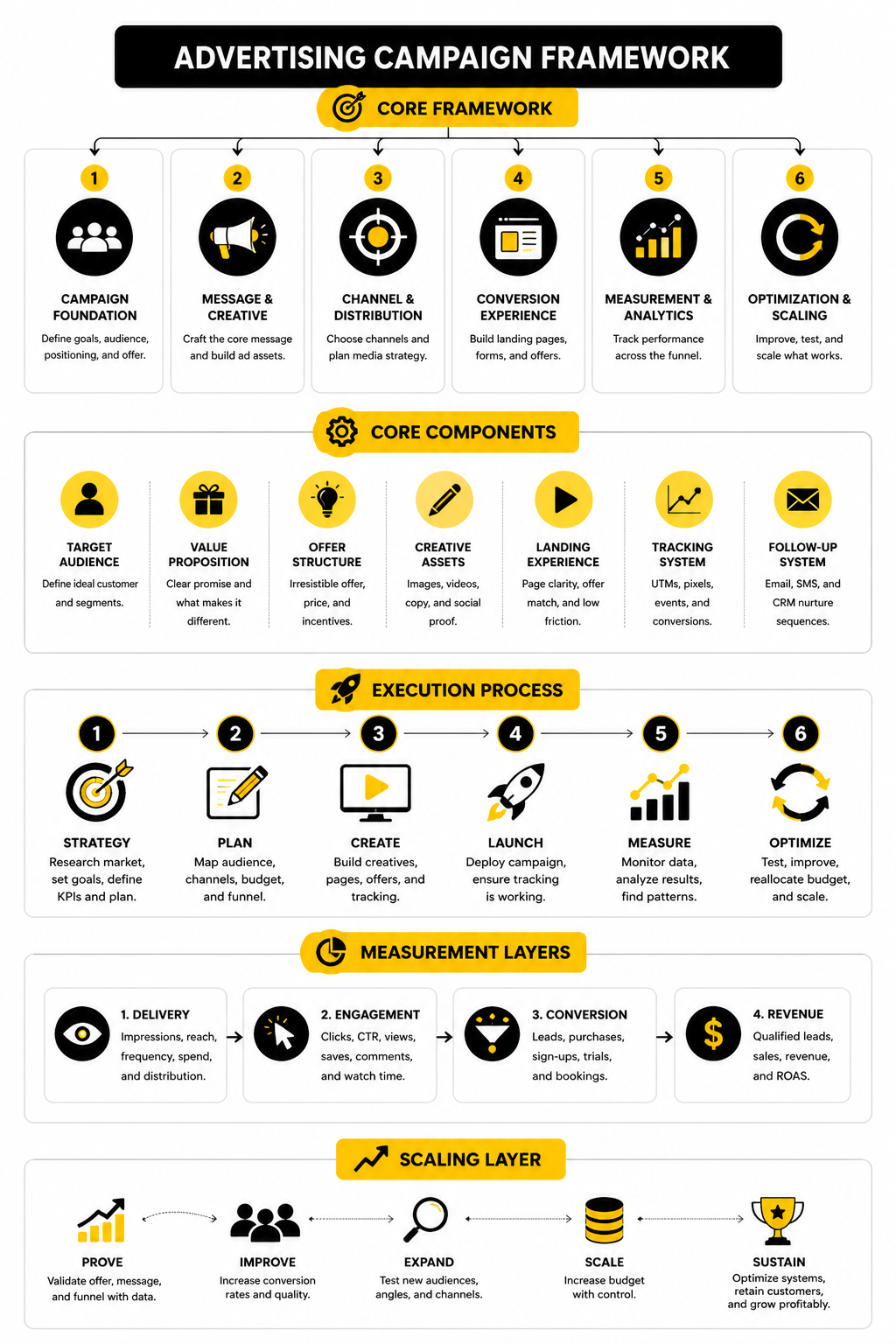
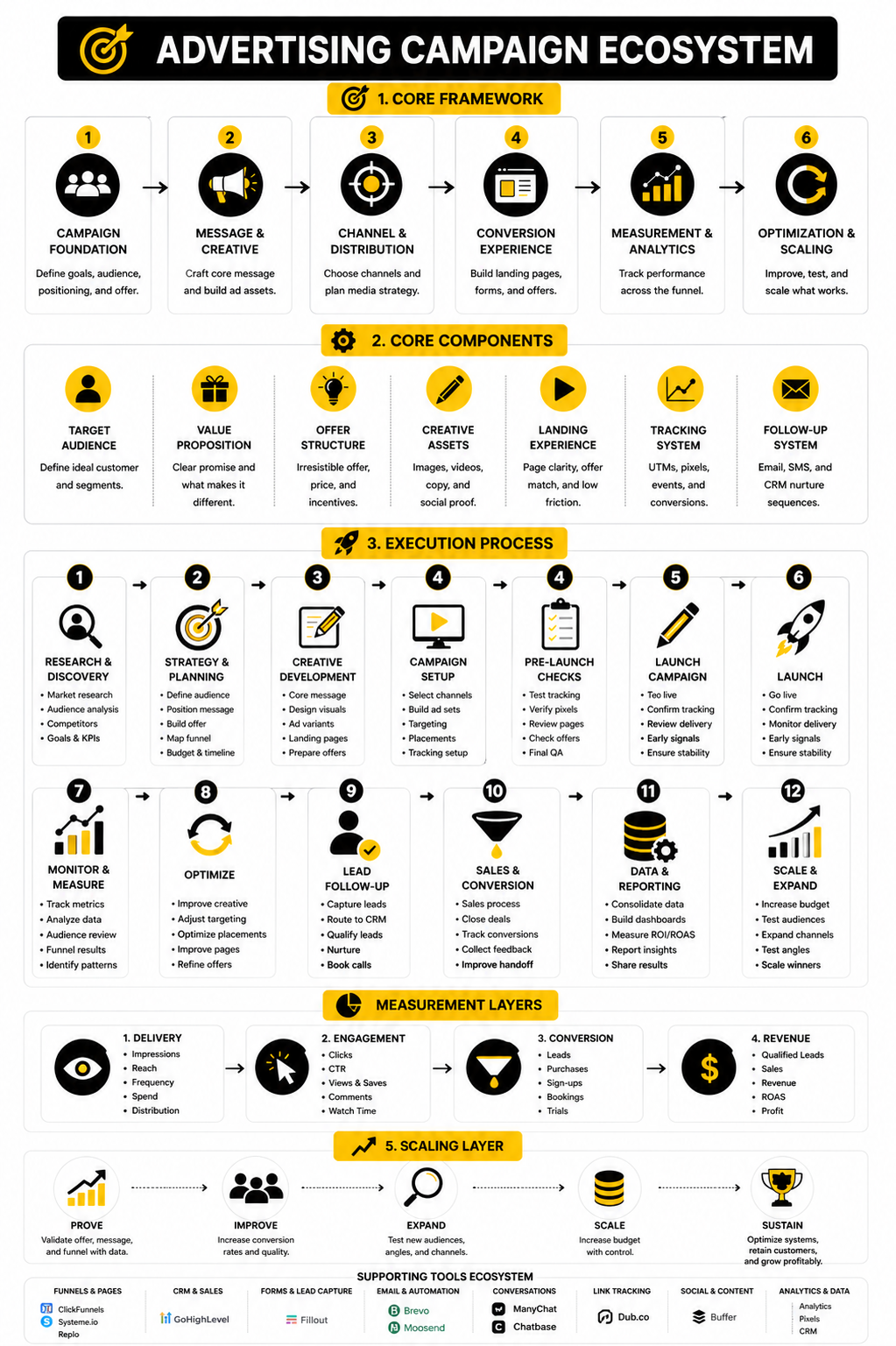
A strong advertising campaign has four layers: strategy, assets, distribution, and optimization. Strategy defines the goal, audience, positioning, offer, and message. Assets turn that strategy into ads, landing pages, emails, videos, scripts, forms, and follow-up sequences.
Distribution decides where the campaign appears and how budget moves across channels. This is where search, social, display, video, creator partnerships, email, SMS, and retargeting come into play. For example, a service business might use GoHighLevel to manage lead capture and follow-up, while an ecommerce brand might use Replo to build focused landing pages for paid traffic.
Optimization is the feedback loop. It uses performance data, customer behavior, sales feedback, and creative testing to improve the campaign while it is live. This is where campaigns become valuable, because the first version is rarely the best version.
Core Components Of An Advertising Campaign
Every advertising campaign needs a clear objective. “Get more sales” is not enough. A better objective would define the product, audience, revenue target, time frame, budget, conversion action, and acceptable acquisition cost.
The campaign also needs a strong message. That message should explain who the offer is for, what problem it solves, why it is different, and why the buyer should act now. Without that clarity, even a large budget only amplifies confusion.
Finally, the campaign needs a conversion system. Ads create demand, but the funnel captures it. That system may include a landing page, checkout page, calendar booking flow, chatbot, email sequence, SMS reminders, CRM pipeline, or sales process; tools like ManyChat can fit when the campaign depends on conversational lead capture.
Research Before Strategy
The research phase is where an advertising campaign either gets sharper or starts drifting. Before choosing channels, writing ads, or building landing pages, you need to understand the buyer’s situation with enough detail to make specific decisions. That means studying demand, objections, alternatives, buying triggers, search intent, competitor promises, pricing expectations, and the moments where buyers lose confidence.
Good campaign research is not just “who is our target audience?” That question is too broad. A better research process asks what the buyer is trying to solve, what they have already tried, what they distrust, what language they use, and what would make them act now instead of later.
This matters because advertising is expensive when the message is vague. U.S. digital advertising revenue reached nearly $300 billion in 2025, which means buyers are surrounded by more paid messages than ever. Your advertising campaign has to earn attention quickly, and research is what gives the campaign enough precision to do that.
What To Research First
Start with the buyer’s problem, not the platform. If the problem is urgent, the campaign may need direct-response messaging, search intent, retargeting, and a fast conversion path. If the problem is important but not urgent, the campaign may need education, proof, comparison content, and stronger follow-up.
Then study the competitive field. Look at what competitors promise, what they repeat, what they avoid saying, and how they frame value. You are not copying them; you are looking for the open space where your campaign can sound clearer, more useful, or more believable.
Finally, review your existing customer and sales data. Sales calls, reviews, support tickets, CRM notes, checkout behavior, form responses, and email replies often contain better campaign language than a brainstorming session. If you collect leads through forms, tools like Fillout can help structure that data before it disappears into scattered spreadsheets.
Campaign Goals And Success Metrics
An advertising campaign needs one primary goal. Not five. Not a vague mix of awareness, leads, sales, engagement, traffic, and “brand lift.” One primary goal keeps the strategy clean and makes optimization decisions easier.
That does not mean you ignore secondary metrics. It means you know which number has the final say. For a lead generation campaign, the primary metric may be qualified booked calls, while cost per click and landing page conversion rate are supporting metrics.
This is where many campaigns get messy. Teams optimize for what the ad platform shows fastest instead of what the business actually needs. Nielsen’s 2025 ROI guidance emphasizes the need to connect campaign performance with broader business impact, not just delivery metrics like reach and frequency in isolation, which is a useful reminder when dashboards start pulling attention in every direction through fragmented measurement.
Practical Campaign Goal Examples
A strong goal gives the campaign a job. It should define the audience, offer, conversion event, budget range, time frame, and business result. This makes the advertising campaign easier to brief, easier to launch, and much easier to judge.
For example, a local service business might aim to generate qualified consultation requests from homeowners in a specific region within 60 days. An ecommerce brand might aim to acquire first-time buyers for a hero product while staying under a target customer acquisition cost. A SaaS company might aim to drive demo requests from a narrow segment that already has budget authority.
The key is to avoid weak goals that sound strategic but cannot guide action. “Increase awareness” is not useless, but it is incomplete unless you define how awareness will be measured and what behavior should follow. If the campaign cannot be evaluated, it cannot be improved.
Audience, Positioning, And Message Strategy
Audience targeting is not the same as audience understanding. A platform can help you reach people by behavior, interest, keyword, job title, location, or lookalike signal, but it cannot automatically tell you what those people need to believe before they buy. That is your job.
Positioning decides how the offer should be understood in the buyer’s mind. Are you the faster option, the safer option, the simpler option, the premium option, the specialist option, or the better-value option? If that is unclear, every ad variation will feel like a different campaign.
Message strategy turns positioning into language. It defines the main promise, proof points, emotional angle, objections, urgency, and call to action. This is where the advertising campaign starts feeling real, because the message finally gives the audience a reason to care.
Matching Message To Buyer Awareness
Not every buyer needs the same message. Someone already searching for a specific solution may need proof, pricing clarity, and a reason to choose you over competitors. Someone who only feels the pain but has not named the solution may need education before the offer makes sense.
This is why one campaign often needs multiple message angles. You might lead with pain for cold audiences, comparison for warm audiences, urgency for retargeting, and proof for high-intent visitors. The campaign still has one strategy, but the message adapts to the buyer’s stage.
The mistake is trying to say everything in one ad. Strong ads usually make one sharp point. The full advertising campaign can carry the bigger argument across the funnel, but each asset should have a clear role.
Offers, Funnels, And Conversion Paths
The offer is the bridge between attention and action. A weak offer makes the campaign work too hard, because the ads must create interest and overcome friction at the same time. A strong offer makes the next step feel obvious, relevant, and worth taking now.
Your funnel should match the level of commitment you are asking for. A high-ticket service usually needs trust-building, qualification, reminders, and a sales conversation. A low-ticket product may need a faster path with a clear landing page, simple checkout, and immediate reassurance.
For service businesses and agencies, GoHighLevel can fit campaigns that need CRM tracking, pipeline management, booking, follow-up, and automation in one place. For funnel-heavy offers, ClickFunnels or Systeme.io can make sense when the campaign depends on dedicated pages, offers, and checkout flows.
Reducing Friction Before Scaling Spend
Before increasing budget, check the conversion path carefully. Is the landing page clear within the first few seconds? Does the form ask for too much too soon? Does the thank-you page explain what happens next?
Small friction points become expensive when traffic increases. A confusing headline, slow page, weak proof section, or missing follow-up sequence can waste a campaign that looked promising inside the ad account. This is why campaign planning should include the full path, not just the ads.
A good advertising campaign makes the next step feel natural. The ad creates the expectation, the landing page confirms it, the offer makes action worthwhile, and the follow-up keeps momentum alive. When those pieces line up, performance becomes much easier to improve.
Creative Strategy And Ad Formats
Creative strategy is where the advertising campaign becomes visible to the market. This is not just about making ads look good. It is about translating the campaign strategy into hooks, visuals, proof, offers, and calls to action that people can understand quickly.
Strong creative usually starts with one clear idea. That idea might be a painful problem, a surprising contrast, a strong promise, a product demonstration, a customer objection, or a before-and-after shift. The point is simple: each ad should give the audience one reason to stop, pay attention, and take the next step.
Creative also needs fit. A search ad should match intent and remove doubt fast. A short-form video should earn attention in the first moments. A retargeting ad should answer the objection that likely stopped the buyer earlier.
Building The Creative Brief
A creative brief keeps the team from guessing. It should explain the campaign goal, target audience, offer, main message, proof points, required assets, channel requirements, and what each ad needs to make the audience believe. Without this, creative production turns into scattered opinions.
The brief should also define what not to do. Some claims may be too broad, some angles may attract the wrong buyer, and some visuals may create expectations the offer cannot support. Clear boundaries make the work faster and protect the campaign from looking polished but saying very little.
A useful brief is short enough to use and specific enough to matter. The team should be able to look at it and know exactly what assets to create, what message to prioritize, and how success will be judged. That is where creative starts becoming a business tool, not just content.
Choosing Ad Formats For The Job
Different formats do different jobs. Static images can communicate a simple promise quickly. Video can show transformation, demonstrate a product, explain a process, or create emotional momentum. Carousel ads can break down options, features, use cases, or steps.
The format should follow the message, not the other way around. If the campaign needs proof, use testimonials, screenshots, demos, comparisons, or expert-led explanations. If the campaign needs speed, use direct headlines, clean visuals, and a frictionless call to action.
Video deserves special attention because it continues to absorb a large share of advertising spend. U.S. digital video ad spend grew 18% year over year in 2024 and was projected to reach $72 billion in 2025, which makes video hard to ignore for many campaigns. Still, video only helps when the concept is strong; a weak idea does not become strategic just because it moves.
Channel Planning And Media Buying
Channel planning decides where the advertising campaign should show up and why. The goal is not to be everywhere. The goal is to choose channels that match the buyer’s intent, awareness level, content habits, and decision process.
High-intent channels usually work well when buyers are actively searching for a solution. Discovery channels can work when the product needs explanation, emotion, repetition, or demand creation. Retargeting helps reconnect with people who already showed interest but did not convert.
The media plan should also consider how channels support each other. A buyer may discover the offer on social, search the brand later, visit the landing page, leave, see a retargeting ad, and convert after an email reminder. If you only judge the final click, you may undervalue the steps that created the sale.
Matching Budget To Campaign Stage
Budget should match the stage of the campaign. In the early stage, you are buying learning. That means testing audiences, messages, creatives, placements, landing pages, and conversion paths before assuming you have a scalable winner.
Once you see reliable signals, the budget can shift toward what is working. This does not mean blindly increasing spend after one good day. It means looking for patterns across enough data to trust the direction.
Campaigns fail when teams scale too early. They see a few strong conversions, raise the budget aggressively, and then wonder why performance falls apart. A better approach is to stabilize the funnel first, then expand with discipline.
Campaign Execution And Launch Management
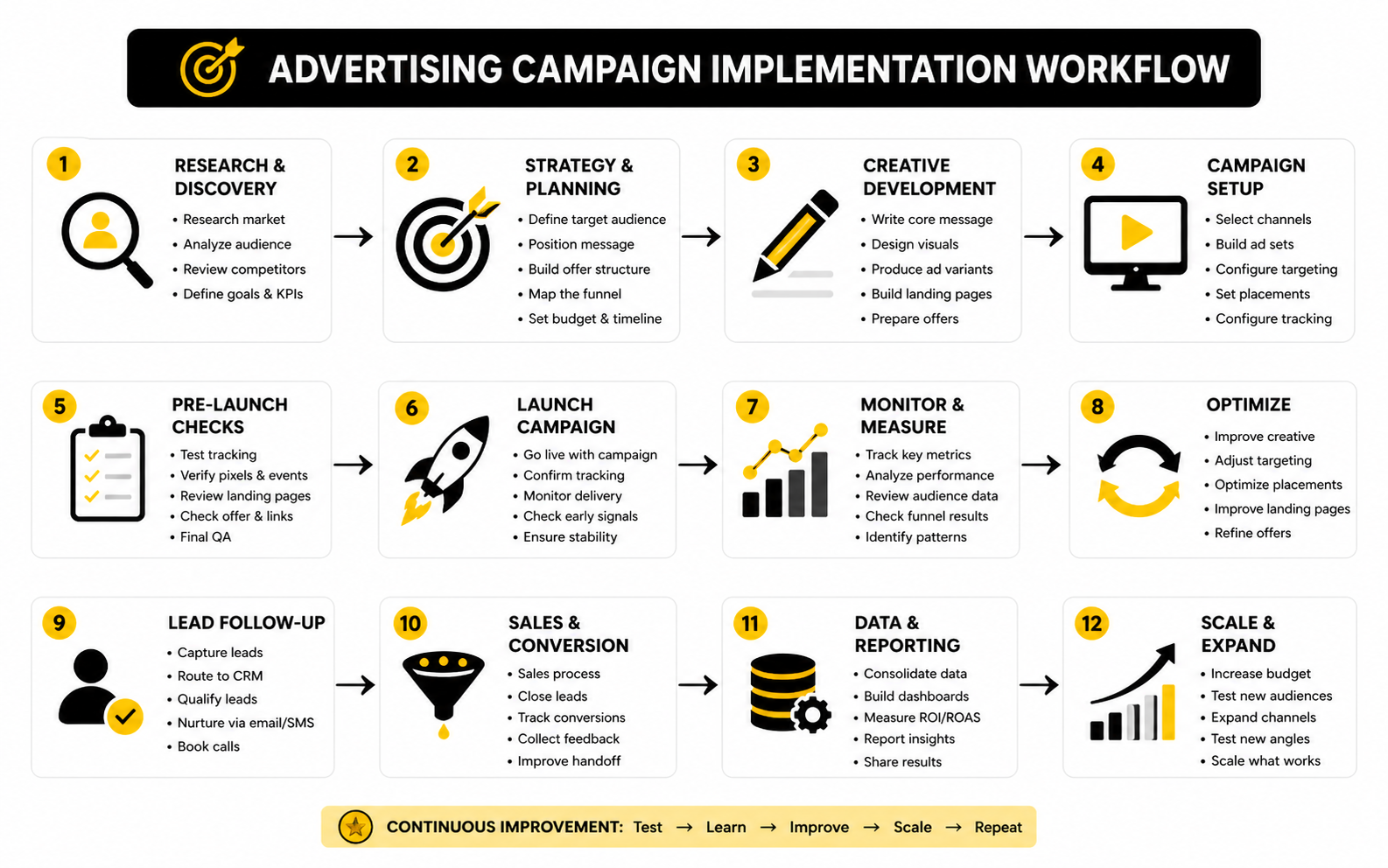
Execution is where the plan becomes a real advertising campaign. This is the stage where assets are built, tracking is checked, ads are uploaded, landing pages are reviewed, automations are tested, and launch responsibilities are assigned. It sounds basic, but this is where a lot of money gets wasted.
A clean launch process removes avoidable mistakes. The offer should match across the ad, landing page, form, checkout, email, SMS, and sales handoff. The tracking should be tested before traffic starts, not after the first budget has already been spent.
This is also where campaign ownership matters. Someone needs to know who approves creative, who monitors spend, who checks lead quality, who updates the funnel, and who makes optimization calls. Without ownership, small issues sit untouched until they become expensive.
The Campaign Launch Checklist
A practical launch checklist keeps the team focused. It does not need to be complicated, but it must cover the full journey from impression to conversion. Use it before every campaign, even when the team feels confident.
- Confirm the primary campaign goal and success metric.
- Review the audience, positioning, offer, and main message.
- Check every ad for clarity, compliance, and channel fit.
- Test every landing page on desktop and mobile.
- Submit forms, complete test checkouts, and confirm confirmation pages.
- Verify tracking pixels, conversion events, UTM parameters, and analytics.
- Review follow-up emails, SMS messages, chatbot flows, and sales notifications.
- Confirm budget, schedule, naming conventions, and reporting views.
- Assign daily monitoring responsibilities.
- Document what will be tested first after launch.
This checklist is not busywork. It protects the budget. A campaign with strong strategy can still fail because the form breaks, the page loads slowly, the wrong conversion event fires, or the sales team receives leads without context.
Follow-Up Systems And Sales Handoff
The campaign does not end when someone clicks. For many businesses, the real money is made in the follow-up. A lead that responds today may convert next week, next month, or after a few more trust-building touches.
That is why the sales handoff should be designed before launch. The sales team needs to know where the lead came from, what offer they responded to, what message they saw, and what expectation was created. Otherwise, the campaign creates demand and the sales process accidentally cools it down.
For campaigns built around calls, consultations, or local services, GoHighLevel can help connect forms, calendars, pipelines, and automated follow-up. For newsletter-style nurturing or ecommerce email sequences, tools like Brevo or Moosend can support the conversion path after the first touch.
Managing The First Week Live
The first week of an advertising campaign is not about panic. It is about watching the right signals and avoiding emotional decisions. You need enough patience to collect data and enough discipline to catch obvious problems quickly.
Start by checking delivery, spend pacing, tracking, click quality, landing page behavior, and conversion events. If traffic is coming in but nobody is taking the next step, inspect the message match between the ad and the page. If leads are coming in but sales says they are poor quality, review the audience, offer, form questions, and ad promise.
Do not change everything at once. That makes learning impossible. Make focused adjustments, document what changed, and let the campaign show whether the change helped.
Measurement, Analytics, And Performance Data
Measurement is where an advertising campaign stops being a guessing game. It shows whether the campaign is attracting the right people, creating enough interest, converting that interest into action, and producing business value. Without measurement, you are not optimizing; you are reacting.
The important thing is not to collect every possible number. The important thing is to know what each number means and what decision it should influence. A click-through rate problem is not the same as a landing page problem, and a lead quality problem is not the same as a media buying problem.
This is why campaign analytics should be built around the buyer journey. You need to see what happens from impression to click, from click to conversion, from conversion to qualified opportunity, and from opportunity to revenue. When those stages are separated clearly, the data becomes useful instead of overwhelming.
Statistics And Data That Actually Matter
The advertising market is still growing, which means competition for attention is not slowing down. The U.S. digital advertising market reached nearly $300 billion in 2025, and global ad spending was forecast to reach around $1.17 trillion in 2025. The takeaway is simple: buyers are seeing more ads, not fewer.
That does not mean you should panic. It means weak campaigns get punished faster. If your message is unclear, your offer is average, or your funnel leaks, rising competition makes those issues more expensive.
Benchmarks can help, but only when you use them properly. For example, the average Google Ads click-through rate across industries was reported around 6.66% in 2025, but that number should not become your campaign goal by itself. A high CTR with low-quality traffic can still lose money, while a lower CTR from a more qualified audience can produce better revenue.
How To Interpret Campaign Benchmarks
Benchmarks are useful for spotting obvious problems. If your search ads are getting almost no clicks, your message, targeting, or keyword intent may be off. If your ads are getting clicks but the landing page is not converting, the issue may be message match, page clarity, offer strength, or friction.
Benchmarks are dangerous when they become the strategy. Every market has different pricing, urgency, competition, buyer sophistication, and sales cycles. A campaign selling a $29 impulse product should not be judged the same way as a campaign selling a $10,000 service.
Use benchmarks as a diagnostic tool, not a scoreboard. They tell you where to investigate. They do not tell you what your business can afford to pay for a qualified customer.
The Advertising Campaign Measurement System
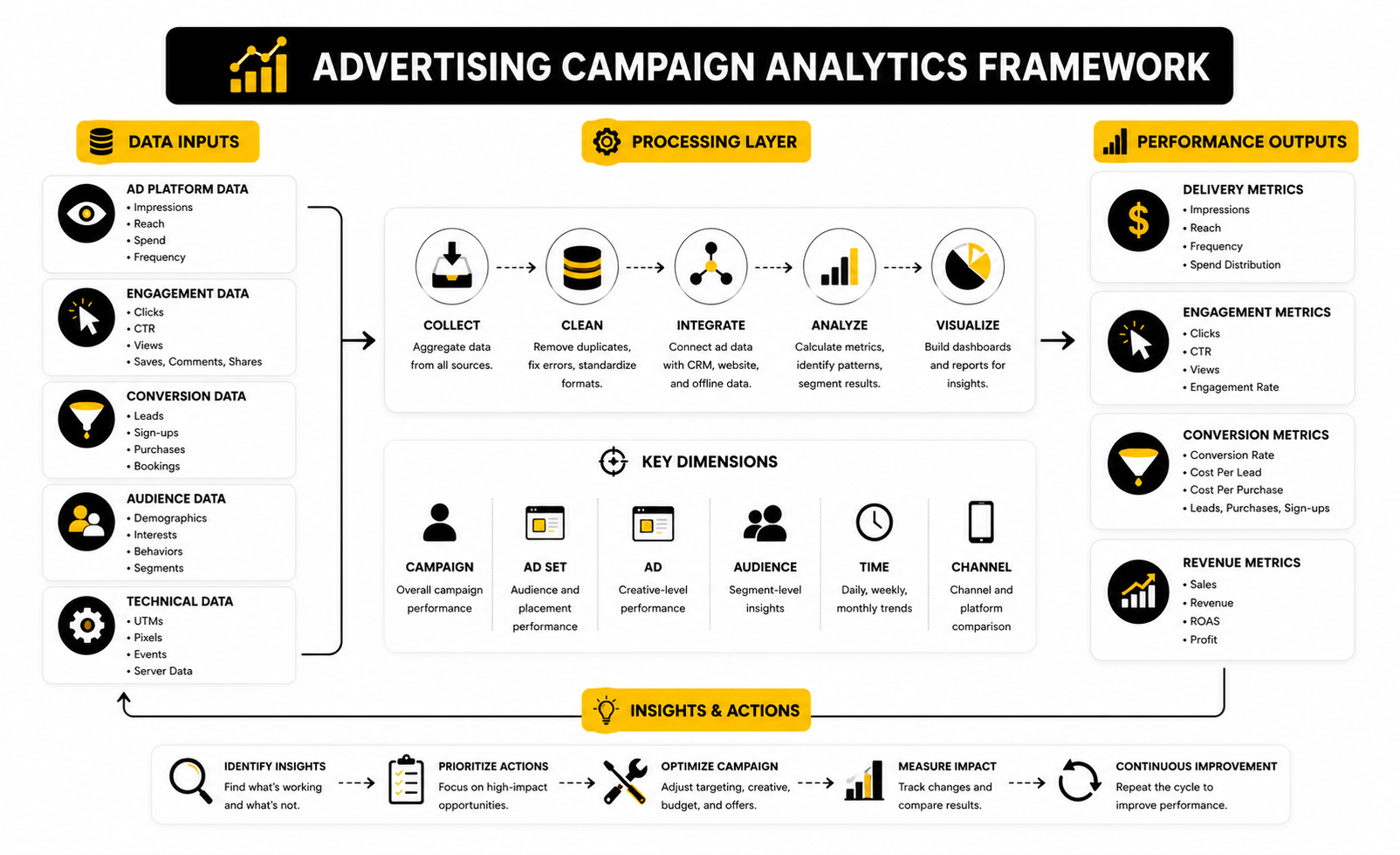
A proper measurement system connects platform metrics with business metrics. Platform metrics show what happened inside the ad environment. Business metrics show whether those actions created value.
At minimum, your campaign should track impressions, reach, clicks, click-through rate, cost per click, landing page conversion rate, cost per lead or purchase, lead quality, sales conversion rate, revenue, and return on ad spend. For lead generation, you also need to track speed to lead, appointment show rate, close rate, and average deal value. Those numbers are often where the real story appears.
The cleanest setup uses consistent UTM parameters, accurate conversion events, CRM tracking, and clear campaign naming. If you want a simple way to keep links organized across ads, emails, creators, and landing pages, Dub.co can fit campaigns where link tracking and attribution discipline matter.
The Four Measurement Layers
The first layer is delivery. This tells you whether the campaign is spending properly and reaching the intended audience. If delivery is limited, unstable, or skewed toward the wrong segment, performance data may be misleading.
The second layer is engagement. This includes clicks, views, saves, comments, video watch behavior, and other signals that show whether the creative is earning attention. Engagement does not pay the bills by itself, but it helps you understand whether the message is connecting.
The third layer is conversion. This is where users become leads, buyers, subscribers, booked calls, trials, or whatever action the campaign was designed to create. If engagement is strong but conversion is weak, the problem usually sits in the offer, page, form, checkout, or next-step clarity.
The fourth layer is revenue. This is the layer too many campaigns reach too late. If the advertising campaign generates cheap leads that never buy, the campaign is not working; it is only producing activity.
Performance Signals To Watch
Early signals help you spot direction before the campaign has full revenue data. Click-through rate can show whether the message is interesting enough to earn attention. Cost per click can show how expensive the traffic environment is for your audience and channel.
Landing page conversion rate shows whether the promise in the ad is being carried through properly. If people click and leave quickly, the page may not match the ad, the offer may feel weak, or the next step may feel too demanding. This is not a small detail; it is often the difference between scaling and bleeding budget.
Lead quality is the signal that protects the business. A campaign can look healthy in the ad platform and still fail in the sales pipeline. That is why qualified lead rate, booked call rate, show rate, close rate, and revenue per lead matter more than raw lead volume.
What The Numbers Should Make You Do
If impressions are low, check budget, audience size, bids, approvals, and campaign settings. Do not rewrite the entire campaign before confirming that the ads are actually getting a fair chance to deliver. Sometimes the issue is mechanical, not strategic.
If clicks are low, inspect the creative, headline, offer, audience fit, and placement. The market may not understand the promise quickly enough. You may need a sharper hook, stronger proof, or a more specific angle.
If conversions are low, move downstream. Review the landing page, page speed, mobile experience, form length, checkout flow, pricing clarity, trust signals, and follow-up. This is where tools like Replo can help when the campaign needs dedicated landing pages that are easier to test and improve.
If sales are low, review lead quality and sales execution. The ad may be attracting the wrong people, the form may be too loose, the offer may be creating the wrong expectation, or the sales team may not be responding fast enough. The campaign data should point you toward the constraint.
Attribution Without Overcomplicating It
Attribution is useful, but it can become a trap. Buyers rarely move in a straight line. They may see an ad, search the brand, visit the website, leave, watch a video, click a retargeting ad, open an email, and convert later.
That means last-click reporting is often incomplete. It can make the final touch look like the hero while undervaluing the earlier touches that created trust. On the other hand, giving every channel credit for everything can make the report useless.
A practical approach is to compare multiple views. Look at platform-reported conversions, analytics data, CRM data, and actual sales outcomes together. Nielsen’s 2025 ROI work points to the ongoing challenge of turning fragmented marketing data into clearer investment decisions, which is exactly the problem most growing teams feel when channels start multiplying.
Reporting That Helps Decisions
A good report should answer three questions. What happened? Why did it likely happen? What should we do next?
Do not send a report that only lists impressions, clicks, spend, and conversions. That is a dashboard, not analysis. The useful part is the interpretation: which audience is improving, which creative is fatiguing, which funnel step is leaking, and which test should happen next.
The report should also separate short-term and long-term signals. A campaign can generate immediate sales while also building retargeting pools, email lists, search demand, and brand familiarity. Those secondary effects should not be exaggerated, but they should not be ignored either.
Optimization Rhythm
Optimization works best on a schedule. Daily checks should focus on spend, tracking, delivery errors, broken links, disapproved ads, and obvious performance issues. Weekly reviews should focus on creative patterns, audience quality, landing page performance, and conversion trends.
Bigger strategic decisions need more patience. If you change the audience, offer, creative, landing page, and budget at the same time, you will not know what caused the result. Good optimization is controlled enough to teach you something.
The goal is not to make constant changes. The goal is to make the right changes at the right time. That is how an advertising campaign becomes smarter instead of just busier.
Advanced Campaign Strategy
Once the advertising campaign is live and measurable, the next challenge is judgment. This is where beginners chase tactics, while stronger operators manage tradeoffs. More budget is not always the answer, more creative is not always the answer, and more channels are definitely not always the answer.
Advanced campaign work is about identifying the constraint. Sometimes the constraint is attention, so the creative needs to improve. Sometimes the constraint is trust, so the page needs better proof. Sometimes the constraint is economics, so the offer, pricing, sales process, or customer lifetime value needs work.
This is why experienced marketers do not look at campaign performance as one number. They look at the system. The ad account may show one story, the CRM may show another, and the sales team may reveal the real issue in five minutes.
Strategic Tradeoffs
Every advertising campaign forces tradeoffs. You can optimize for speed, but speed often reduces learning quality. You can optimize for low cost per lead, but cheap leads may not become customers. You can optimize for reach, but reach without relevance burns budget quietly.
The biggest tradeoff is volume versus quality. A broad campaign may bring more traffic and cheaper clicks, but it can also fill the funnel with people who were never likely to buy. A narrow campaign may cost more per click, but produce better conversations and cleaner sales outcomes.
Another tradeoff is control versus automation. Platform automation can help with bidding, placements, and targeting, but it still needs strong inputs. If the offer, conversion event, creative, and audience signals are weak, automation only helps the platform spend faster.
When To Narrow The Campaign
Narrow the campaign when lead quality is poor, sales feedback is consistently negative, or the funnel is attracting the wrong buyer. This is not a failure. It is useful information.
A narrower campaign can use tighter audience criteria, stronger qualification, more specific copy, and a clearer offer. It may reduce top-of-funnel volume, but it can improve downstream performance where the money actually happens.
The practical move is to remove ambiguity. Say who the offer is for, who it is not for, what problem it solves, and what result the buyer should expect. The more serious the purchase, the more this clarity matters.
When To Broaden The Campaign
Broaden the campaign when the current audience is converting well but cannot spend enough budget efficiently. This usually happens after the offer, creative, and funnel have already proven themselves. At that point, expansion becomes logical instead of hopeful.
You can broaden by testing new angles, adjacent audiences, additional channels, new geographies, or different funnel entry points. Do this in controlled stages so you know which expansion actually works.
Do not broaden just because the team is bored. Many campaigns get worse when marketers abandon a working core too early. Scale should come from evidence, not impatience.
Campaign Risks That Quietly Kill Performance
The obvious risks are easy to spot: broken tracking, weak creative, bad targeting, or a poor landing page. The quieter risks are more dangerous because they can look like normal campaign fluctuation. These include audience saturation, creative fatigue, attribution distortion, offer fatigue, slow sales response, and poor lead routing.
Creative fatigue is especially important when a campaign depends on paid social or video. When the same audience sees the same message too often, click-through rate can fall, frequency can rise, and acquisition costs can climb. Ad fatigue is commonly tracked through signals like declining CTR, rising frequency, weaker conversion rates, and cross-channel performance shifts in current performance marketing analysis from RevenueCat.
Privacy and data quality create another risk. Digital advertising is under pressure from stricter privacy regulation, changing tracking rules, and fragmented customer journeys, which makes first-party data more valuable for targeting and measurement. Research published in the International Journal of Information Management found first-party data can be a viable substitute as third-party data becomes less dependable in digital advertising performance.
Managing Creative Fatigue
Creative fatigue does not mean the entire advertising campaign is broken. It usually means the market has seen the same angle too many times. The fix is not always a new design; sometimes it is a new hook, proof point, objection, format, or offer frame.
Build creative rotation into the campaign before fatigue becomes urgent. Prepare variations around different buyer pains, different levels of awareness, different proof types, and different calls to action. This gives the campaign room to breathe without drifting away from the core strategy.
Also watch fatigue by segment. A broad audience may still respond well while a retargeting pool is exhausted. Treat those differently, because they are not the same problem.
Protecting Data Quality
Bad data creates confident mistakes. If the conversion event is wrong, the platform may optimize for low-value actions. If UTM naming is inconsistent, reporting becomes harder than it needs to be. If the CRM does not capture source and campaign details, revenue attribution becomes guesswork.
Keep the data model simple enough that the team actually uses it. Every campaign should have clean naming conventions, consistent tracking links, clear conversion definitions, and a shared understanding of what counts as success. Tools like Dub.co can help when a campaign needs cleaner link tracking across ads, emails, partners, and creators.
First-party data should also be collected with intent. Forms, quizzes, booking flows, purchases, email behavior, and customer conversations can all improve future campaigns when they are structured properly. For richer qualification, Fillout can support campaigns that need better form logic before a lead reaches sales.
Scaling An Advertising Campaign
Scaling is not just spending more. Scaling means increasing profitable volume without breaking the economics, the funnel, or the customer experience. That requires discipline.
Before scaling, confirm that the campaign works beyond surface-level metrics. Look at cost per qualified lead, sales conversion rate, customer acquisition cost, payback period, average order value, lifetime value, refund rate, and fulfillment capacity. If the business cannot handle the demand, scaling can create operational damage instead of growth.
Scaling should usually happen in layers. First improve the existing campaign. Then expand creative. Then test adjacent audiences. Then add channels. Then build more sophisticated measurement for budget allocation.
Vertical Scaling
Vertical scaling means increasing budget inside a working campaign, ad set, audience, or channel. This is the fastest path, but it can also destabilize performance if done too aggressively. More spend can push the campaign into less efficient impressions, higher competition, or weaker audience segments.
The safer approach is gradual budget increases with close monitoring. Watch whether cost per result, conversion rate, lead quality, and revenue efficiency hold as spend rises. If performance breaks, the audience or creative may not have enough depth.
Vertical scaling works best when demand is strong and the campaign has enough creative variety. If one ad is carrying the entire result, the scale ceiling is lower than it looks.
Horizontal Scaling
Horizontal scaling means expanding the campaign into new audiences, messages, formats, offers, placements, or channels. It is slower than vertical scaling, but it creates more long-term resilience. A campaign with multiple working angles is harder to exhaust.
This is where creative testing becomes serious. You are not only testing headlines. You are testing different buyer beliefs, different emotional triggers, different proof formats, and different entry points into the funnel.
Horizontal scaling also helps reduce dependence on one platform. That matters because platform costs, rules, tracking, and delivery can change without asking your permission. A stronger campaign architecture gives the business more control.
Expert-Level Optimization
Expert optimization starts with asking better questions. Not “which ad has the lowest cost per lead?” but “which ad brings the buyers we actually want?” Not “which channel got the last click?” but “which channel helps create incremental revenue?” Not “how do we get more traffic?” but “where is the constraint in the system?”
Incrementality matters here. A campaign can report conversions that would have happened anyway, especially when retargeting warm audiences or branded demand. More advanced teams use holdout tests, geo tests, matched-market tests, media mix modeling, and blended revenue analysis to understand what the advertising campaign is truly adding.
Media mix modeling is becoming more relevant as journeys get harder to track. Recent retail measurement coverage reported that 61% of U.S. retail business decision-makers used media mix modeling to measure incrementality in late 2025 data from Feedvisor via EMARKETER. The takeaway is not that every small business needs complex modeling today; it is that serious budget decisions need more than platform-reported ROAS.
The Scaling Decision Checklist
Use a checklist before increasing spend. It keeps the team honest and prevents emotional scaling after a short winning streak. If the campaign cannot pass these checks, fix the system before pushing more money into it.
- The campaign has a clear primary success metric.
- Tracking is working across ads, analytics, and CRM.
- The offer has produced consistent conversions.
- Lead or customer quality has been reviewed.
- Sales outcomes support the platform data.
- Creative fatigue is being monitored.
- Follow-up systems are working.
- The business can fulfill additional demand.
- Budget increases have a clear limit and review date.
- The next test is documented before spend rises.
This is not about being cautious for the sake of it. It is about protecting upside. Scaling a weak campaign makes problems louder; scaling a strong campaign turns learning into leverage.
Common Advertising Campaign Mistakes
The first mistake is starting with the channel instead of the strategy. A team decides to “run Facebook ads” or “try Google” before defining the audience, offer, message, funnel, and success metric. That turns the platform into the plan, which is backwards.
The second mistake is judging the campaign too early or too narrowly. Early data can reveal technical issues and obvious message problems, but it may not be enough to judge the full economics. On the other hand, waiting too long to act on clear warning signs wastes budget.
The third mistake is separating marketing from sales. If marketing celebrates cheap leads while sales rejects them, the advertising campaign is not aligned. The campaign should be judged by the business outcome, not by whichever department has the prettiest dashboard.
Mistakes That Hurt Scaling
One common scaling mistake is over-relying on one winning creative. It feels efficient at first, but it creates fragility. When that creative fatigues, the whole campaign can drop.
Another mistake is expanding before the funnel is ready. More traffic will not fix a confusing page, weak offer, slow follow-up, or poor sales process. It will only expose those problems faster.
A third mistake is ignoring margin. Revenue is not the same as profit. If discounts, refunds, shipping, fulfillment, commissions, and support costs are not included, the campaign may look better than it really is.
Advertising Campaign Tools And Templates
Tools do not fix a weak advertising campaign. They only make a strong process easier to execute, track, and improve. The right stack should support the campaign journey from planning to launch, from launch to optimization, and from optimization to revenue.
Start with the essentials. You need a place to manage the campaign plan, a way to build conversion assets, a system for lead capture, clean tracking links, reliable follow-up, and reporting that connects marketing activity to business outcomes. Anything beyond that should earn its place.
For funnel building, ClickFunnels, Systeme.io, and Replo can help when the campaign depends on dedicated pages and clear conversion paths. For lead management, booking, follow-up, and pipeline tracking, GoHighLevel fits campaigns that need more than a simple form submission.
The Practical Campaign Stack
A practical campaign stack should make the work faster without making the team dependent on complexity. If a tool adds five extra steps before one useful insight, it is probably not helping. The best stack is the one your team can actually use every week.
For content scheduling and social workflow, Buffer can support campaigns that include organic reinforcement around paid activity. For email follow-up and nurturing, Brevo and Moosend can help turn first-touch interest into repeat contact.
For conversational campaigns, ManyChat can be useful when the path to conversion depends on messages, comments, DMs, or automated qualification. For AI-assisted support or site conversations, Chatbase can help answer buyer questions before they become abandoned sessions.
Final Checklist
A strong advertising campaign feels simple from the outside because the hard thinking has already happened. The buyer sees a clear message, a relevant offer, a smooth path, and enough proof to take action. Behind the scenes, the campaign has structure, ownership, measurement, and a process for improvement.
Before you launch or scale, review the full system. Do not only ask whether the ads are ready. Ask whether the campaign can actually turn attention into revenue without leaking trust, data, or opportunity along the way.
Use this final checklist as a pressure test:
- The campaign has one primary business goal.
- The audience is specific enough to guide creative decisions.
- The positioning is clear and differentiated.
- The offer gives the buyer a real reason to act.
- The funnel matches the buyer’s level of commitment.
- The creative assets each have a clear role.
- The media plan matches intent, awareness, and budget.
- Tracking is tested before spend goes live.
- Follow-up is ready before leads arrive.
- Reporting connects ad performance to revenue.
- Optimization decisions are documented.
- Scaling only happens after quality and economics are checked.
FAQ - Built For Complete Guide
What Is An Advertising Campaign?
An advertising campaign is a coordinated marketing effort designed to achieve a specific goal through paid messages, creative assets, channels, offers, and measurement. It is not just one ad or one boosted post. A real campaign connects strategy, execution, and optimization into one system.
What Makes An Advertising Campaign Successful?
A successful advertising campaign starts with a clear goal, a defined audience, a strong offer, persuasive creative, and accurate measurement. It also needs a conversion path that makes action easy. The campaign is successful when it produces the intended business outcome, not just clicks or impressions.
How Long Should An Advertising Campaign Run?
The right campaign length depends on the goal, budget, sales cycle, and channel. A short promotion may run for a few days or weeks, while a brand or lead generation campaign may run for months with ongoing creative refreshes. The key is to set review points so the campaign can be optimized without being judged too early.
What Is The Difference Between A Marketing Campaign And An Advertising Campaign?
A marketing campaign can include paid, owned, and earned activity such as content, email, partnerships, events, PR, and sales enablement. An advertising campaign focuses specifically on paid promotion. In practice, the best campaigns often combine both, because paid traffic works better when the surrounding marketing system supports it.
How Much Should I Spend On An Advertising Campaign?
Your budget should be based on the value of the outcome, the cost of reaching the audience, and the amount of data needed to make decisions. Do not choose a budget only because it feels comfortable. Start with what you can afford to test properly, then scale when the campaign shows reliable quality and economics.
Which Channels Are Best For An Advertising Campaign?
The best channels depend on buyer intent and campaign goals. Search works well when people are already looking for a solution. Paid social, video, creator campaigns, and display can work when the campaign needs to create demand, explain value, or stay visible during a longer decision process.
What Metrics Should I Track First?
Track the numbers that explain the journey from attention to revenue. Start with impressions, clicks, click-through rate, cost per click, conversion rate, cost per lead or purchase, lead quality, sales conversion rate, revenue, and return on ad spend. For lead generation, also track booked calls, show rate, close rate, and speed to lead.
How Do I Know If My Campaign Creative Is Working?
Creative is working when it attracts the right audience and moves them toward the desired action. A strong click-through rate can be a good sign, but it is not enough by itself. The creative also needs to produce qualified traffic, conversions, and downstream sales quality.
When Should I Change An Advertising Campaign?
Change the campaign when the data points to a specific problem. If clicks are weak, review the creative and message. If clicks are strong but conversions are weak, review the page, offer, and form. If leads convert poorly into sales, review targeting, qualification, expectations, and follow-up.
How Do I Scale An Advertising Campaign?
Scale gradually after the campaign has proven that it can produce quality outcomes. You can increase spend inside a working channel, expand into new audiences, test new creative angles, or add another channel. Do not scale just because one metric looks good; check the economics first.
What Is The Biggest Advertising Campaign Mistake?
The biggest mistake is launching before the strategy is clear. When the audience, offer, message, funnel, and success metric are vague, every optimization decision becomes harder. The campaign may still generate activity, but activity is not the same as profitable growth.
Do Small Businesses Need Advertising Campaigns?
Yes, but they need focused campaigns, not bloated ones. A small business can run a simple advertising campaign with one offer, one audience, one landing page, one follow-up system, and one clear success metric. Simple is fine when it is intentional.
Work With Professionals
Explore 10K+ Remote Marketing Contracts on MarkeWork.com
Most marketers spend too much time chasing clients, competing on crowded platforms, and losing a percentage of every project to middlemen.
MarkeWork gives you a better way. Browse thousands of remote marketing contracts and connect directly with companies desperate to hire skilled marketers like you, without platform commissions and without unnecessary gatekeepers.
If you're serious about finding better opportunities and keeping 100% of what you earn, explore available contracts and create a profile for free at MarkeWork.com.