

An advertising company is no longer just the team that makes ads look better. The best firms sit much closer to revenue now, because they influence positioning, channel mix, creative quality, media efficiency, and measurement discipline at the same time. That matters in a market where global ad spend is projected to reach $1.19 trillion in 2025, advertising is expected to outgrow consumer spending across entertainment and media through 2029, and U.S. digital advertising revenue hit $258.6 billion in 2024.
That scale changes the question buyers should ask. The real issue is not whether a business needs advertising, but whether it needs an advertising company that can turn fragmented platforms, rising creative demands, and messy attribution into a coherent growth system. A modern firm earns its place by helping a brand make better decisions before money goes into media, not after performance drops.
The phrase advertising company also covers more ground than many people assume. Some firms are classic agencies focused on creative and media buying, some are digital-first growth operators, some are specialist studios, and some blend strategy, production, analytics, and automation under one roof. This article breaks down how to tell the difference, what a serious operator actually does, and how to judge whether a company is built for outcomes instead of presentations.
Article Outline
To keep this practical, the article follows the same path a smart buyer would follow when evaluating a partner. It starts with the business case, moves into structure, then gets more operational and specific. By the end, you should be able to look at any advertising company and quickly tell whether it is strategic, tactical, or simply expensive.
- Why an advertising company still matters
- How the modern advertising company model works
- The core services that separate real operators from vendors
- What professional implementation looks like in practice
- How to evaluate and choose the right advertising company
- Where advertising companies are heading next
Why an Advertising Company Still Matters
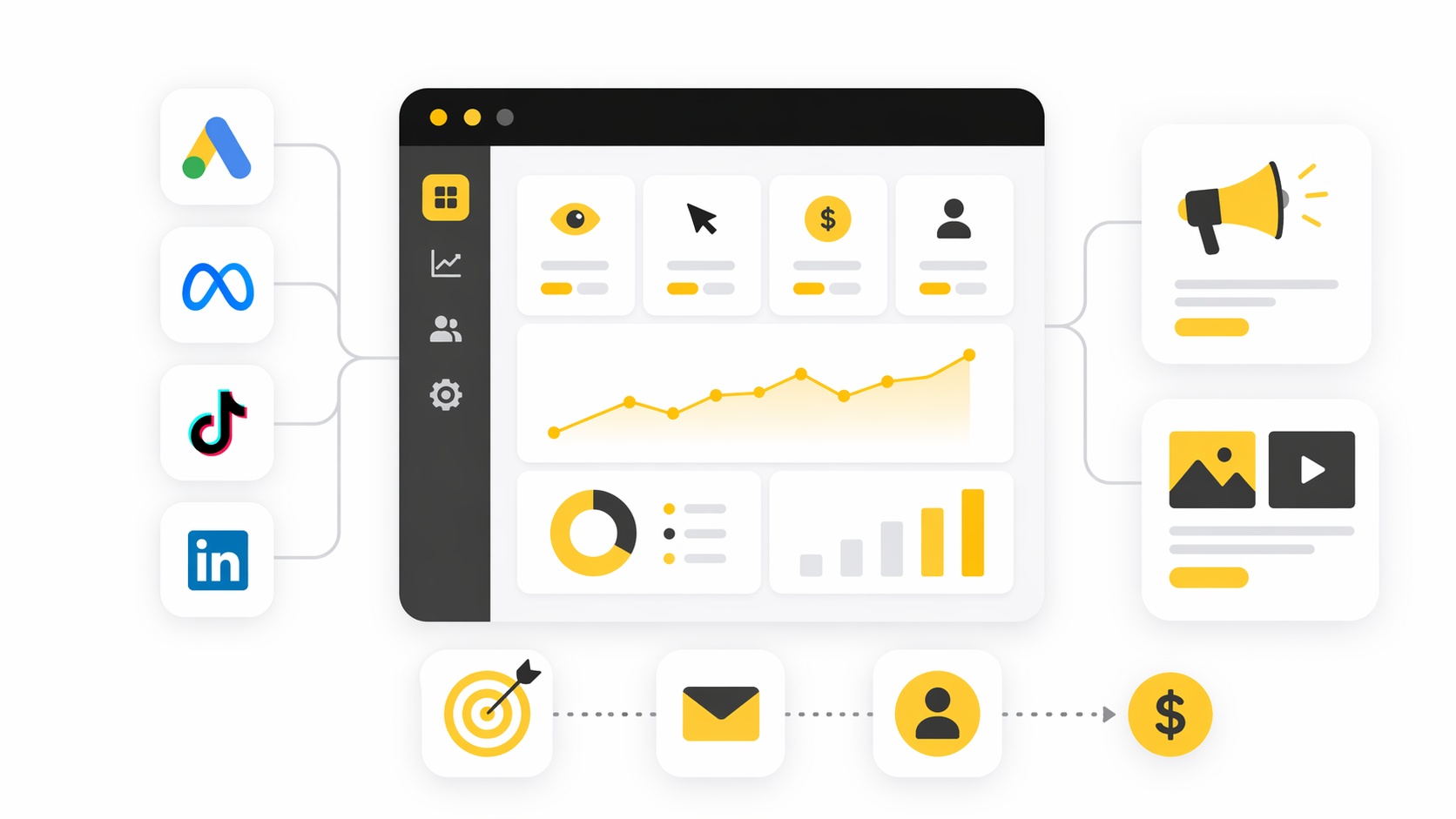
A lot of businesses think the platforms have replaced the middle layer. Google, Meta, Amazon, TikTok, LinkedIn, and retail media networks all promise self-serve growth, and AI tools make campaign setup look easier than ever. But easier setup is not the same thing as better strategy, and it definitely is not the same thing as profitable scaling.
The problem is that advertising performance usually breaks in the spaces between decisions. Weak positioning hurts creative, weak creative hurts media efficiency, weak tracking distorts learning, and poor learning leads to bigger budget mistakes. Research from Nielsen’s 2025 ROI work, IPA effectiveness analysis, and LinkedIn’s B2B Institute research all point in the same direction: outcomes improve when creative, media, and measurement are managed as one system instead of separate tasks.
That is where a real advertising company earns its keep. It gives a business outside perspective, specialized execution, and the operational discipline to connect brand, demand, and analytics without forcing an internal team to master every channel at once. In practice, the best firms reduce wasted spend, speed up learning, and protect companies from the very common mistake of optimizing only for the easiest metrics to see.
How the Modern Advertising Company Model Works
The old picture of an agency was simple: creative on one side, media on the other, account management in the middle. That still exists, but the stronger model today is much more integrated because the market is more integrated. Britannica’s definition of agency work still captures the core idea well: campaigns rely on research, audience understanding, and skillful media use, but modern execution now extends into data infrastructure, testing frameworks, landing-page optimization, and post-click conversion systems.
In other words, a serious advertising company works less like a vendor and more like a decision engine. It helps define who the message is for, what promise should lead, which channels deserve budget, what creative format fits each stage of intent, and how success will be measured before the campaign starts. That sounds obvious, but it is exactly where weak firms cut corners.
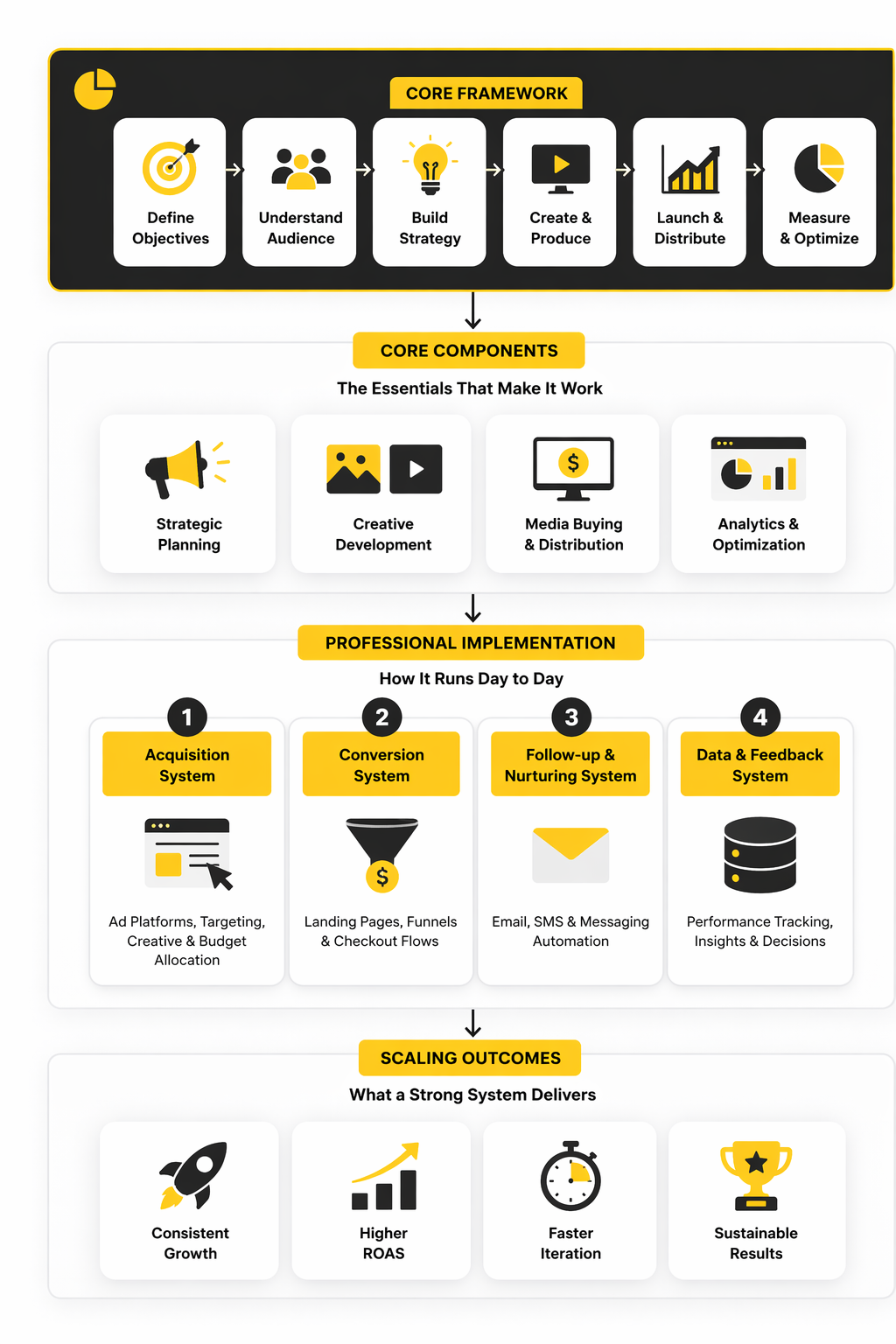
The most useful way to think about the structure is this: strategy decides where the opportunity is, creative turns that opportunity into something people notice, media puts it in front of the right audience, and measurement tells the company what to do next. When those four pieces stay connected, the company can improve performance over time instead of starting from zero every month. That framework becomes the backbone for the rest of this article, because every good advertising company is really being judged on how well it handles those four jobs.
Core Services That Separate Real Operators From Vendors
At a surface level, almost every advertising company offers the same list: strategy, creative, media buying, analytics. The difference is not what is listed on the website, but how deeply each piece is executed and how tightly they connect. Weak firms treat these as isolated services. Strong firms treat them as a single system that compounds over time.
This distinction matters because fragmentation is expensive. Industry analysis across McKinsey marketing effectiveness research and BCG’s work on marketing ROI consistently shows that companies outperform when creative, channel strategy, and measurement are coordinated. When those pieces operate in silos, performance plateaus fast.
Strategic Positioning and Market Framing
This is where most advertising companies quietly fail. They jump into campaigns without sharpening the core message, which forces creative teams to guess and media teams to compensate with budget. A serious firm starts earlier by defining who the brand is for, what problem it solves, and why it is meaningfully different.
Good positioning is not branding fluff. It directly impacts cost per acquisition, click-through rates, and conversion rates because it shapes how relevant the message feels. Research from Harvard Business Review on customer-centric growth shows that relevance is one of the strongest predictors of long-term performance, and relevance starts with positioning, not media spend.
A capable advertising company will pressure-test messaging before scaling spend. That often includes competitor analysis, customer interviews, and rapid creative testing. If this step is skipped, everything downstream becomes more expensive and less predictable.
Creative Production That Drives Attention
Creative is now the single biggest lever in advertising performance. Multiple studies, including work aggregated in Nielsen’s global marketing research, show that creative quality can account for a large share of campaign effectiveness compared to targeting or channel selection.
But “creative” no longer means one polished campaign. It means volume, variation, and iteration. The best advertising companies build systems that produce dozens or hundreds of variations, test them quickly, and double down on what actually resonates.
This is where tools and infrastructure start to matter. Platforms like Replo help teams rapidly deploy and test landing experiences without heavy development cycles, while automation stacks like GoHighLevel allow agencies to connect funnels, follow-ups, and lead nurturing into a single flow. The advertising company that can move fast here gains a structural advantage, not just a creative one.
Media Buying and Channel Allocation
Media buying used to be about negotiating rates and placements. Today, it is about allocating budget across fragmented ecosystems while managing auction dynamics, platform algorithms, and audience saturation.
A strong advertising company does not just “run ads.” It actively manages where money should go based on marginal returns. That means shifting budget between search, social, video, display, retail media, and emerging channels based on real performance data, not assumptions.
The complexity here is growing fast. Statista’s digital advertising data shows continued expansion across formats and platforms, which means more opportunities but also more room for inefficiency. The advertising company that wins is the one that treats media as a dynamic portfolio, not a fixed plan.
Measurement, Attribution, and Decision Systems
This is the least visible part of an advertising company, but it is often the most important. Without reliable measurement, even strong campaigns can lead to bad decisions because the feedback loop is broken.
Modern measurement is messy. Privacy changes, signal loss, and platform fragmentation make it harder to track performance cleanly. That is why serious firms build layered measurement systems that combine platform data, first-party data, and modeled insights.
Tools like Brevo help centralize customer data and lifecycle tracking, while conversational automation tools like ManyChat capture and qualify leads across messaging channels. The point is not the tools themselves, but how they are integrated into decision-making.
The best advertising companies do not just report numbers. They interpret them, challenge them, and use them to guide the next move. That creates a feedback loop where campaigns improve instead of stagnate.
What Professional Implementation Looks Like in Practice
It is easy to describe services in isolation. The real test of an advertising company is how those services come together under pressure, with real budgets, real deadlines, and real accountability.
Professional implementation starts with alignment. Before any campaign launches, the firm defines success metrics, acceptable cost thresholds, testing priorities, and reporting cadence. This avoids the common situation where clients and agencies are technically “working together” but optimizing for different outcomes.
From there, execution follows a structured rhythm:
- Initial build phase
Campaigns, creatives, tracking systems, and funnels are set up with clear hypotheses. Nothing is assumed to be final, and early data is treated as directional rather than conclusive.
- Testing and learning phase
Multiple creative angles, audiences, and offers are tested in parallel. The goal is not immediate scale but identifying signals that can be trusted.
- Scaling phase
Once patterns emerge, budget is concentrated on what works. This is where media efficiency improves and returns compound.
- Optimization and expansion phase
New channels, new creatives, and new audience segments are layered in without breaking what is already performing.
The key difference is discipline. Many advertising companies jump straight to scaling or constantly restart campaigns without learning. Professional operators respect the process, which is why their results tend to look more stable over time.
Another defining trait is system ownership. Instead of handing off isolated deliverables, strong firms build integrated systems that clients can understand and, if needed, operate internally later. That includes CRM flows, funnel structures, and communication pipelines. Platforms like ClickFunnels or Systeme.io often play a role here because they allow advertising companies to connect acquisition with conversion and follow-up without unnecessary complexity.
When you step back, this is what separates a real advertising company from a vendor. One executes tasks. The other builds a system that keeps improving, even when the market shifts.
How the Implementation Actually Runs Day to Day
Most advertising companies sound impressive when they describe strategy. The gap shows up in execution, because execution is where constraints, delays, and real-world tradeoffs hit. This is where a company either proves it has a system or exposes that it is improvising.
A serious advertising company does not treat campaigns as isolated launches. It runs a continuous operating cycle that balances speed with structure. That cycle is what allows performance to improve instead of resetting every time something changes in the market.
The Operating Rhythm Behind High-Performance Campaigns
The strongest teams follow a predictable rhythm that connects planning, execution, and iteration. It is not rigid, but it is disciplined enough that nothing falls through the cracks.
At a high level, the weekly flow looks like this:
- Data review and signal extraction
Performance is analyzed across channels, creatives, and funnels. The focus is not on surface metrics but on identifying patterns that can actually be acted on.
- Decision-making and prioritization
Based on those signals, the team decides what to scale, what to pause, and what to test next. This is where many advertising companies fail because they react instead of deciding.
- Creative and campaign production
New assets, angles, and variations are produced quickly. Speed matters here, because delayed creative means missed opportunities.
- Deployment and validation
Campaign changes are rolled out in controlled ways. Early performance is monitored to confirm whether the hypothesis holds.
This loop repeats continuously. Over time, it builds a compounding advantage because each cycle improves the next one.
Turning Strategy Into a Live System
This is the point where theory becomes real. A strategy only matters if it translates into something that runs every day without constant firefighting.
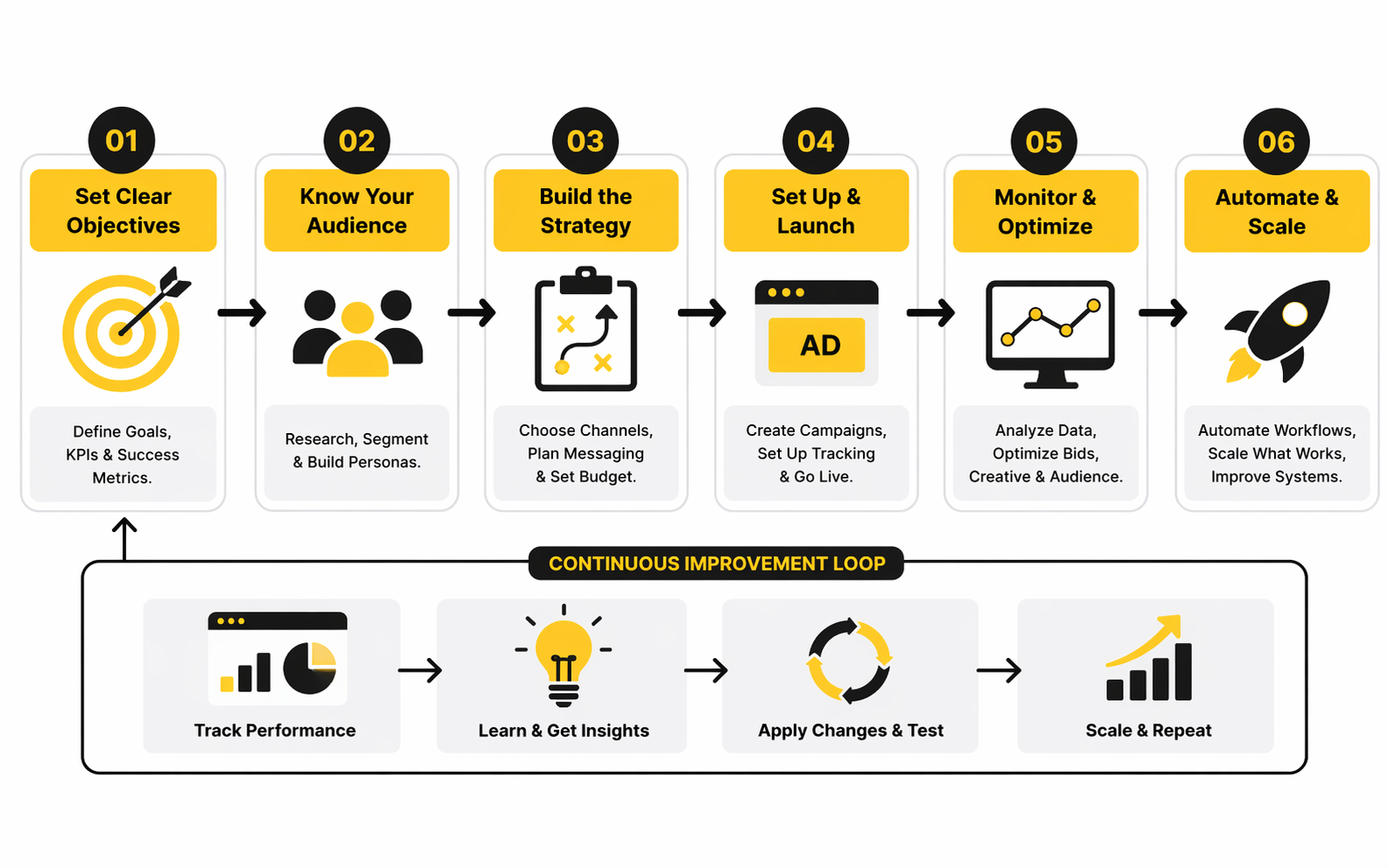
A well-structured advertising company builds implementation around a few key systems:
- Acquisition system
This includes ad platforms, targeting structures, creative variations, and budget allocation logic. It is designed to bring in attention efficiently without relying on a single channel.
- Conversion system
Landing pages, funnels, and checkout flows sit here. Tools like ClickFunnels or Replo are often used to rapidly test and refine how traffic turns into leads or customers.
- Follow-up and nurturing system
Most revenue does not come from the first touch. Email, SMS, and messaging flows keep prospects engaged and move them closer to conversion. Platforms like Brevo or ManyChat help automate and personalize this layer.
- Data and feedback system
All interactions feed into a central view of performance. This is where decisions are grounded, not guessed.
The key insight is that these systems are connected. If acquisition improves but conversion lags, the system adjusts. If follow-up improves, acquisition can afford to scale more aggressively. A real advertising company manages the whole loop, not just the top.
Speed vs Control: The Balancing Act
Execution is not just about doing more. It is about doing the right things fast without breaking what already works. This is where many teams lose efficiency.
If an advertising company moves too slowly, it misses trends, burns time, and lets competitors outpace it. If it moves too fast without structure, it creates chaos, invalidates data, and wastes budget. The balance comes from controlled experimentation.
That means:
- Testing multiple variables, but not all at once
- Scaling proven elements, not assumptions
- Keeping baseline campaigns stable while testing new ones separately
Research across digital campaign performance consistently shows that structured testing leads to more reliable gains than constant resets. The companies that treat campaigns like experiments tend to outperform those that treat them like one-time launches.
Where Most Advertising Companies Break Down
Understanding the process also makes it easier to spot weak execution. The failure points are surprisingly consistent:
- Over-reliance on one channel
When performance drops, there is no fallback.
- Slow creative cycles
By the time new assets are ready, the market has already shifted.
- Poor tracking setup
Decisions are made on incomplete or misleading data.
- No clear testing framework
Teams “try things” but cannot explain why something worked.
- Disconnected systems
Ads, funnels, and follow-up operate separately instead of reinforcing each other.
These are not small issues. They compound quickly and turn what should be a scalable system into a fragile one.
A high-level advertising company avoids this by building execution as infrastructure, not as a series of tasks. That is what allows it to handle more spend, more complexity, and more channels without losing control.
From here, the next step is understanding how to evaluate whether a company actually operates at this level or just claims to.
What the Data Actually Means and How to Use It
Most advertising companies talk about data. Very few use it properly. The difference is not access to numbers, it is interpretation and decision-making.
Right now, the volume of available data is massive. Between platform dashboards, CRM systems, attribution tools, and analytics layers, a typical campaign generates more signals than most teams can realistically process. The problem is not a lack of information. It is knowing which signals actually matter and which ones are noise.
That is why strong advertising companies simplify measurement instead of complicating it. They focus on a small set of indicators that directly connect to business outcomes, and they build systems that make those indicators reliable enough to act on.
The Metrics That Actually Drive Decisions
Not all metrics are created equal. Some are leading indicators, some are lagging, and some are simply distractions that look useful but do not change outcomes.
A high-level advertising company typically organizes metrics into three layers:
- Input metrics (early signals)
These include impressions, reach, click-through rates, and engagement. They tell you whether the message is getting attention, but not whether it is generating revenue.
- Conversion metrics (mid-stage signals)
This includes cost per lead, cost per acquisition, and conversion rates. These metrics show whether attention is turning into action.
- Business metrics (final outcomes)
Revenue, customer acquisition cost relative to lifetime value, and contribution margin sit here. These are the only numbers that ultimately matter.
The mistake many teams make is optimizing too early in the funnel. High click-through rates can look impressive, but if they do not translate into profitable conversions, they are meaningless. The best advertising company always ties early signals back to final outcomes before making scaling decisions.
Benchmarks Are Useful, but Context Matters More
Benchmarks can help set expectations, but they are often misused. Data from sources like WordStream’s advertising benchmarks and HubSpot’s marketing statistics can provide rough ranges for click-through rates or conversion rates, but those numbers vary widely by industry, offer, and audience.
What matters more is internal benchmarking. A strong advertising company tracks how performance evolves over time within the same system. That creates a baseline that is far more useful than generic industry averages.
For example, if cost per acquisition drops by 20% after a creative change, that signal is more valuable than knowing whether the campaign sits above or below a global benchmark. Progress inside your own system is what compounds.
How Modern Attribution Actually Works
Attribution has become one of the most misunderstood areas in advertising. Privacy changes, platform limitations, and cross-device behavior have made perfect tracking impossible.
That does not mean measurement is broken. It means it has to be layered.
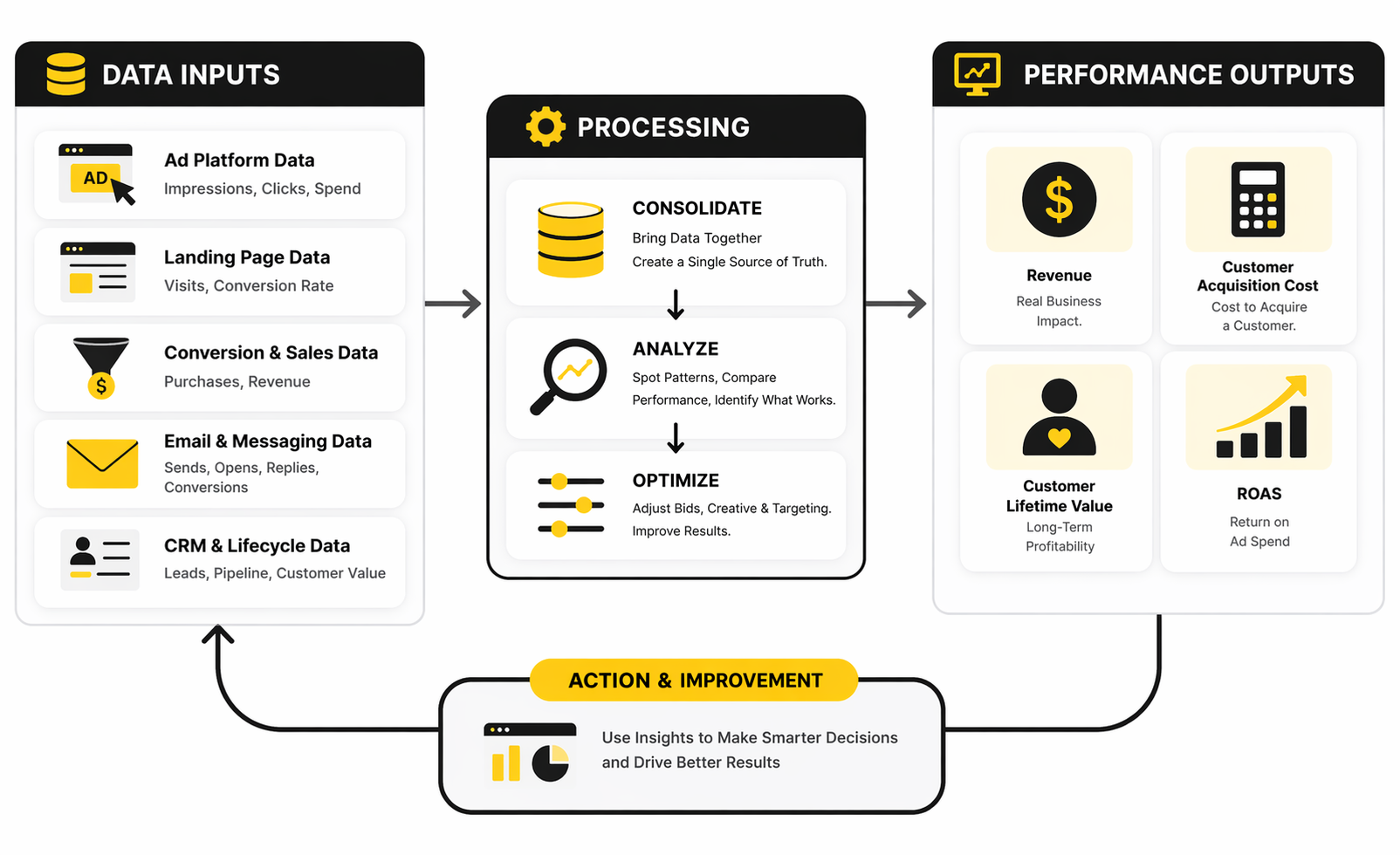
A realistic attribution setup usually combines:
- Platform-reported data
Each ad platform provides its own view of conversions. This data is useful for optimization within that platform but often over-attributes performance.
- First-party data systems
CRM tools and customer databases provide a more grounded view of leads, sales, and customer journeys. Systems built with tools like GoHighLevel or Brevo help consolidate this layer.
- Modeled or blended insights
When direct tracking is incomplete, modeled data fills the gaps. This includes incrementality testing, media mix modeling, and controlled experiments.
The key is not choosing one method, but combining them intelligently. A professional advertising company knows that no single source is perfect, so it looks for consistent patterns across multiple views before making decisions.
Turning Data Into Action
Data only matters if it leads to action. This is where many advertising companies fall short, because reporting becomes the end instead of the input.
A strong team uses data to answer three questions continuously:
- What is working right now?
Identify which creatives, audiences, and channels are delivering the best results.
- Why is it working?
Break down performance to understand the underlying drivers, not just the outcomes.
- What should change next?
Decide what to scale, what to refine, and what to test based on those insights.
This creates a feedback loop where every campaign improves the next one. Without that loop, data becomes a passive record instead of an active tool.
The Hidden Signal Most Companies Miss
There is one signal that consistently separates strong advertising companies from average ones: speed of learning.
It is not just about how much data is collected, but how quickly it is turned into decisions. Teams that shorten the time between insight and action gain a compounding advantage, because they iterate faster than competitors.
This is why integrated systems matter. When acquisition, conversion, and follow-up are connected, insights flow more easily across the entire funnel. When they are disconnected, learning slows down and opportunities are missed.
At this point, the picture becomes clearer. An advertising company is not just managing campaigns. It is managing a system of decisions driven by data, constrained by execution, and measured by outcomes.
The next step is knowing how to evaluate whether a company can actually operate at this level before you trust it with serious budget.
How to Evaluate and Choose the Right Advertising Company
Once the basics are clear, the real question becomes practical: how do you tell whether an advertising company can handle meaningful budget, real complexity, and actual commercial pressure. This is where the gap between polished sales language and operational competence becomes obvious. A company may look impressive in a pitch and still be the wrong partner once spend rises, channels multiply, and results get harder to sustain.
The easiest mistake is choosing based on surface signals. Awards, oversized client logos, and neat presentation decks can all create confidence, but they do not tell you how a team thinks when performance stalls. What matters more is whether the company can explain its decision process, its tradeoffs, and the systems it uses to protect performance over time.
What Strong Buyers Look For
A serious buyer does not just ask what services are included. They look for signs that the advertising company can make sound decisions under uncertainty.
The strongest indicators usually show up in five areas:
- Clarity of strategic thinking
The company should be able to explain why a message, offer, or channel matters before it starts talking about tactics.
- Evidence of process discipline
Good firms have clear testing logic, reporting routines, escalation paths, and accountability built into the relationship.
- Comfort with tradeoffs
Strong operators do not promise everything at once. They explain what can be optimized now, what takes longer, and what risks come with faster scaling.
- Measurement maturity
They understand the difference between platform-reported wins and business-level outcomes, and they do not blur the two.
- Communication quality
The best advertising company is not just technically competent. It can make complex performance issues understandable to non-specialists inside the client business.
That last point matters more than people think. The ANA and 4As 2025 client-agency tenure research found that longer relationships are still common for integrated agency partnerships, with integrated full-service agencies averaging 87 months, which is 7.3 years. That kind of durability does not happen because reporting looks pretty. It happens because trust, transparency, and commercial alignment stay intact long enough to compound.
The Strategic Tradeoffs That Matter Most
No advertising company can optimize every variable at the same time. That is why advanced evaluation has to focus on tradeoffs, not promises.
One of the biggest tradeoffs is between short-term efficiency and long-term brand strength. A company that only chases immediate response may drive quick conversions while weakening pricing power, recall, and future demand. On the other side, a company that talks endlessly about brand without building measurable demand systems may sound sophisticated while avoiding accountability.
Another tradeoff is speed versus rigor. Faster iteration often creates advantage, especially in digital channels, but rushed execution can destroy signal quality and lead to bad decisions. This is why the best advertising company usually looks calm rather than flashy. It moves quickly, but it does not confuse motion with progress.
There is also a talent tradeoff. Some firms centralize senior thinking and delegate execution downward. Others push senior specialists directly into accounts but become harder to scale. Neither model is automatically better. The question is whether the structure matches the complexity of the work you need done.
Where Scaling Usually Starts to Break
A lot of advertising companies can manage a small budget. Far fewer can scale without losing control. That is the part buyers need to understand before they sign anything meaningful.
Scaling usually creates pressure in four places:
- Creative fatigue
What worked at lower spend stops working when audience exposure rises. This forces the company to produce new creative angles faster and with better judgment.
- Channel saturation
Efficiency drops as the easiest inventory is exhausted. Budget has to be reallocated intelligently, not just increased.
- Operational complexity
More spend usually means more stakeholders, more reporting needs, more approvals, and more failure points.
- Measurement distortion
As campaigns expand, attribution often becomes less clean, not more. That makes interpretation more important, not less.
This is why the right advertising company has to be built like an operating partner rather than a campaign vendor. It needs systems that can absorb growth without becoming fragile. That includes CRM workflows, landing-page iteration, cross-channel reporting, and follow-up logic that keeps converting demand after the initial click. Platforms like GoHighLevel become useful in this stage because they help agencies unify leads, automations, and pipeline visibility instead of leaving the client to stitch together disconnected tools later.
The Risks Buyers Underestimate
Most clients focus on the obvious risk of poor performance. That is real, but it is not the only risk and often not even the most expensive one.
A bigger problem is hidden dependency. Some advertising companies make themselves indispensable by keeping systems opaque. The client gets reports and results, but not real visibility into how campaigns, automations, audiences, or data flows are structured. That may feel convenient at first, then becomes a serious business risk when priorities change or the relationship ends.
Another underestimated risk is false confidence from partial data. A company can look “data-driven” while still steering from incomplete platform numbers, weak CRM hygiene, or poorly defined conversion events. Google’s modern measurement playbook argues for a layered framework where cross-channel planning, channel optimization, and campaign-level decisions are treated differently because they require different evidence and different time horizons. That is a useful lens, because it stops teams from making strategic decisions on tactical dashboards alone.
There is also a less visible cultural risk. A weak advertising company often tells the client what they want to hear, especially early in the relationship. A strong one is willing to challenge bad offers, shaky positioning, unrealistic timelines, and vanity metrics before those problems become expensive.
Expert-Level Questions Worth Asking Before You Commit
At the advanced level, the goal is not to collect generic answers. It is to see how the company thinks when there is no perfect answer available.
These questions tend to reveal a lot:
- How do you decide whether a performance problem is creative, offer, landing page, or channel related?
- What do you do when platform-reported performance looks strong but pipeline quality drops?
- How do you handle scaling once cost efficiency starts to decline?
- What stays stable in your system, and what changes every week?
- What parts of the account would we fully own if the relationship ended?
A strong advertising company will answer these directly. It will not hide behind vague frameworks or overloaded jargon. It will also be honest about constraints, which is usually a sign that the team has operated through enough real friction to know what breaks.
What the Best Partnerships Look Like Over Time
The best client-agency relationships do not feel like endless campaign launches. They feel like a business system getting sharper month after month.
Over time, a good advertising company becomes better at pattern recognition. It learns how the brand wins attention, what kinds of offers create real intent, where waste tends to show up, and which metrics matter most in context. That is one reason the ANA and 4As tenure data matters. Longer relationships can be a real advantage when they are built on transparency and commercial clarity rather than inertia.
That compounding effect becomes even stronger when the company is not only buying media but also improving the surrounding system. Better landing pages, better lead handling, better automation, and better creative testing all make the same media budget more productive. Tools like ManyChat, Brevo, and Replo fit naturally here because they support the layers around media that usually determine whether scaling holds up.
At this stage, the choice becomes clearer. You are not hiring an advertising company to run ads in isolation. You are choosing whether to bring in a team that can help the whole growth system think, execute, and learn at a higher level.
That leads to the final question: where is this industry going next, and what should businesses expect from an advertising company over the next few years?
Where Advertising Companies Are Heading Next
The role of an advertising company is shifting fast, and not in subtle ways. The old model of campaign creation and media buying is being replaced by something closer to a full growth operating system. The companies that adapt to this shift will dominate. The ones that do not will slowly lose relevance, even if they still produce good creative.
Three forces are driving this change at the same time: automation, data consolidation, and creative velocity. Each one on its own would be manageable. Together, they are redefining what clients expect from an advertising company.
Automation is removing manual work across campaign setup, reporting, and follow-up. Tools like GoHighLevel are pushing agencies toward unified systems where acquisition, nurturing, and pipeline tracking live in one place instead of being stitched together. That changes the expectation from “run ads” to “manage the entire customer journey.”
At the same time, data consolidation is becoming a competitive advantage. First-party data, CRM integration, and lifecycle tracking are no longer optional. They are the foundation for decision-making in a world where third-party signals are weaker. This is why platforms like Brevo and messaging tools like ManyChat are becoming part of the core stack, not optional add-ons.
Then there is creative velocity. The volume of content required to stay competitive is increasing, not decreasing. Advertising companies that can produce, test, and iterate creative quickly will outperform those that rely on slower, campaign-based production cycles. Tools like Replo make this shift even more visible by reducing the friction between idea and deployment.
When you combine these trends, the direction is clear. The future advertising company is not just a service provider. It is a system builder that integrates media, creative, data, and automation into a single engine.
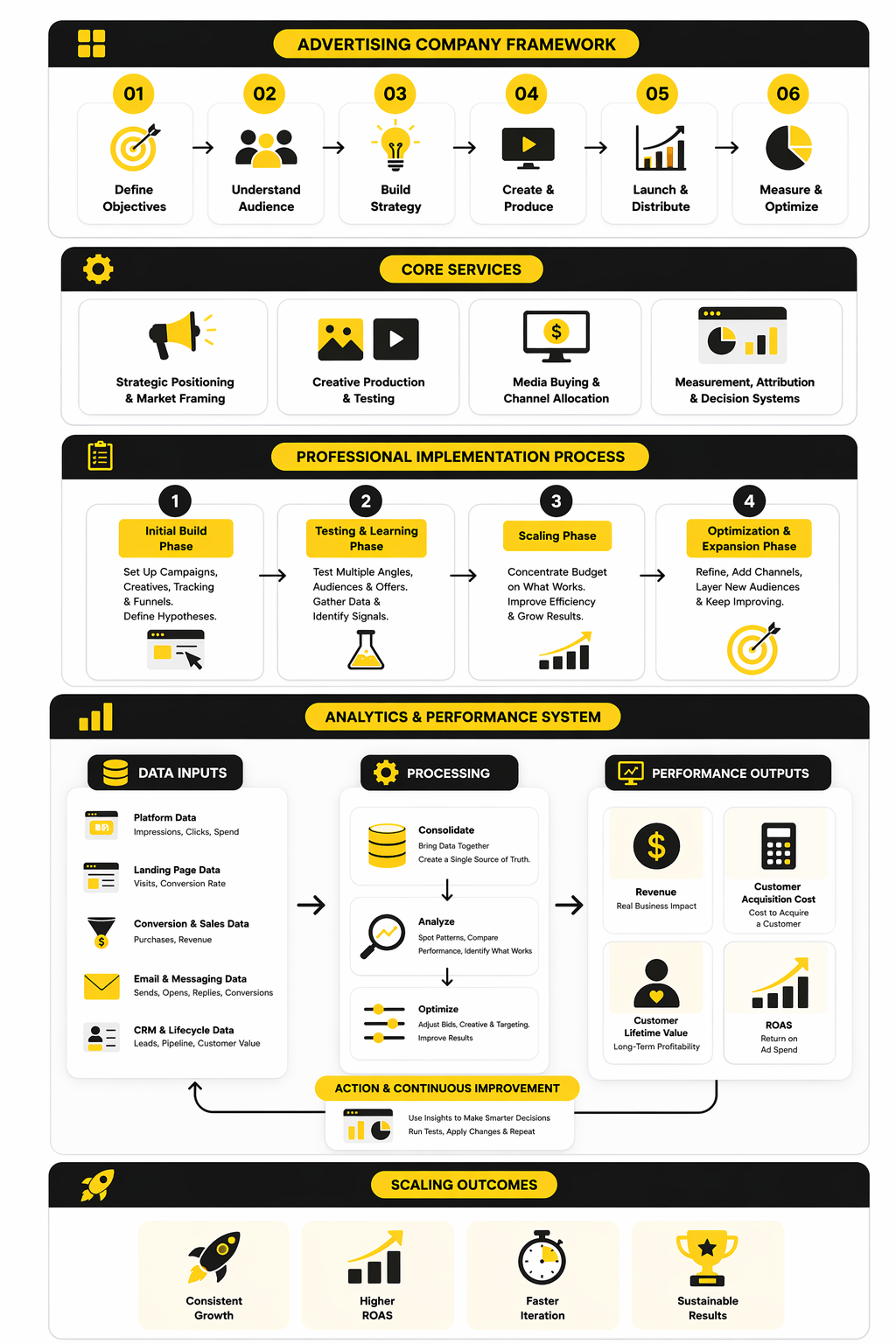
That is the real end state. Not better ads, but a better system that consistently produces results even as platforms, costs, and consumer behavior change.
FAQ - Built for Complete Guide
What does an advertising company actually do today?
A modern advertising company does far more than create ads. It builds and manages systems that connect strategy, creative, media buying, and data into one continuous process. The goal is not just visibility, but measurable business outcomes that improve over time.
How is a modern advertising company different from a traditional agency?
Traditional agencies often separate creative, media, and analytics into silos. A modern advertising company integrates all three into one system, allowing faster decisions, better testing, and more reliable scaling.
When should a business hire an advertising company?
The right time is when internal teams cannot efficiently manage strategy, execution, and optimization across multiple channels. This usually happens when growth becomes inconsistent or when scaling introduces complexity the team cannot absorb.
How much budget do you need to work with an advertising company?
There is no fixed number, but meaningful results usually require enough budget to test and learn properly. Without sufficient spend, it becomes difficult to generate reliable data and make confident decisions.
What platforms do advertising companies typically use?
Most firms work across platforms like Google, Meta, TikTok, and LinkedIn, but they also rely heavily on supporting tools. Systems like ClickFunnels or Systeme.io are often used to manage funnels and conversion flows.
How long does it take to see results?
Initial signals can appear within weeks, but stable performance usually takes longer. A strong advertising company focuses on building a system that improves over time rather than chasing immediate wins that do not last.
What is the biggest mistake businesses make when hiring an advertising company?
Choosing based on presentation instead of process. Many companies look impressive upfront but lack the operational discipline to deliver consistent results once campaigns are live.
How do you measure success with an advertising company?
Success should be tied to business outcomes like revenue, customer acquisition cost, and lifetime value. Platform metrics are useful, but they should always be connected back to real financial impact.
Can an advertising company guarantee results?
No serious advertising company guarantees outcomes. Markets, competition, and external factors always introduce uncertainty. What they can guarantee is a structured process that maximizes the probability of success.
What should you expect in the first 90 days?
The first phase typically focuses on setup, testing, and early optimization. You should expect clear communication, structured experimentation, and gradual improvement rather than immediate scaling.
Is it better to build an internal team or hire an advertising company?
It depends on resources and priorities. Internal teams offer control, while an advertising company provides specialized expertise and faster execution. Many businesses eventually use a hybrid model.
How do advertising companies stay competitive as platforms change?
They invest in systems, not just tactics. By focusing on strategy, data, and execution frameworks, they can adapt to new platforms and algorithms without starting from scratch.
Work With Professionals
Explore 10K+ Remote Marketing Contracts on MarkeWork.com
Most marketers spend too much time chasing clients, competing on crowded platforms, and losing a percentage of every project to middlemen.
MarkeWork gives you a better way. Browse thousands of remote marketing contracts and connect directly with companies desperate to hire skilled marketers like you, without platform commissions and without unnecessary gatekeepers.
If you're serious about finding better opportunities and keeping 100% of what you earn, invite readers to explore available contracts and create a profile for free at MarkeWork.com.