

Advertising in marketing is not just “running ads.” It is the paid part of a broader marketing system that helps a business reach the right people, shape demand, and turn attention into measurable action. Good advertising supports positioning, messaging, offers, sales, retention, and brand growth.
The problem is that many teams treat advertising like a shortcut. They launch campaigns before the offer is clear, before the audience is understood, or before the follow-up system is ready. That usually creates expensive noise instead of profitable growth.
Advertising matters because paid media is still one of the fastest ways to test markets, scale proven messages, and create predictable visibility. Global ad spending is expected to remain above the trillion-dollar level, with digital channels taking the majority of media investment, based on recent forecasts from WARC and eMarketer. But bigger budgets do not automatically create better marketing. Better structure does.
Article Outline
- What Advertising Means Inside Marketing
- Why Advertising Matters For Business Growth
- The Advertising In Marketing Framework
- Core Components Of Effective Advertising
- Professional Implementation Across Channels
- Measurement, Optimization, And FAQs
What Advertising Means Inside Marketing
Advertising is the paid communication layer of marketing. Marketing defines the market, audience, positioning, offer, message, and customer journey. Advertising uses paid placements to distribute that message through channels like search, social, video, display, podcasts, newsletters, creators, and connected TV.
That distinction matters. Advertising is not the whole strategy. It is the amplifier. If the strategy is weak, advertising makes the weakness visible faster.
In practical terms, advertising in marketing works best when it connects three things: a clear business goal, a specific audience, and a message that gives people a reason to act. For example, a landing page built with a tool like Replo can improve the post-click experience, but it only performs when the ad promise and page promise match.
Why Advertising Matters For Business Growth
Advertising gives businesses controlled reach. Organic content, referrals, SEO, and partnerships are valuable, but they are not always predictable. Paid advertising lets a team decide who sees a message, when they see it, how often they see it, and what action should happen next.
It also creates faster feedback. A campaign can show which audience responds, which offer creates intent, and which message fails to land. That feedback can improve more than ads; it can improve sales pages, email sequences, product positioning, and even pricing.
The key is to stop thinking of advertising as a cost center by default. It becomes a growth system when it is tied to customer value, conversion paths, and retention. That is why modern marketing teams often connect ads with CRM, automation, and follow-up systems through platforms like GoHighLevel or messaging tools like ManyChat.
The Advertising In Marketing Framework
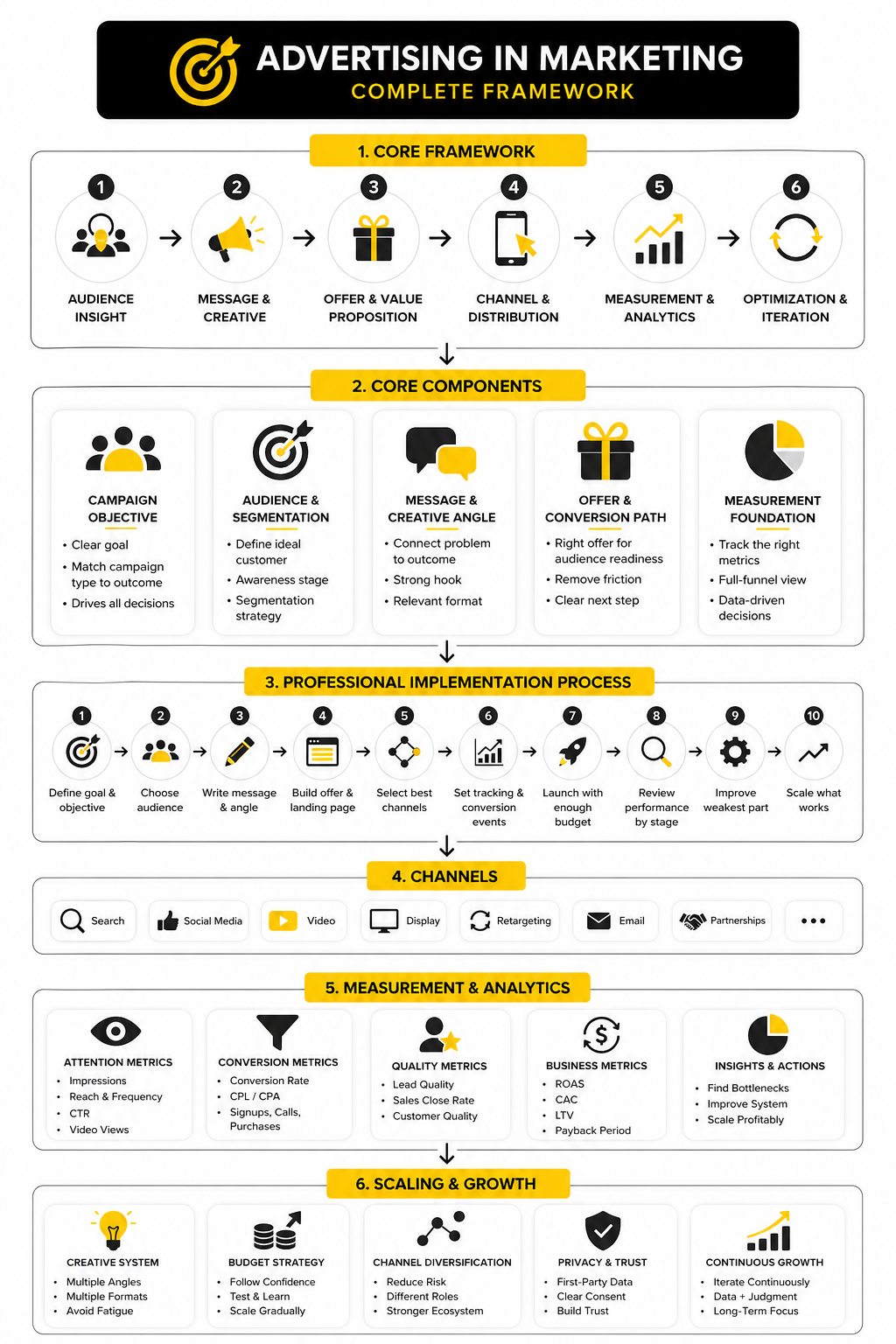
A strong advertising system starts before the campaign goes live. The first layer is strategy: the business goal, target audience, market category, positioning, and offer. Without this layer, the campaign usually becomes a guessing game.
The second layer is execution. This includes creative, copy, targeting, budget allocation, landing pages, tracking, and follow-up. Each part should support the same promise instead of pulling the customer in different directions.
The third layer is learning. Advertising is never finished after launch. The real advantage comes from measuring performance, identifying what changed behavior, and improving the campaign based on evidence rather than opinions.
Why Advertising Matters For Business Growth
Advertising matters because attention is fragmented. People move between search, social feeds, video platforms, email, podcasts, marketplaces, and private communities throughout the same buying journey. A brand that relies on one organic channel is usually leaving too much visibility to chance.
Advertising in marketing gives businesses a way to show up with intention. It can introduce a new brand, support demand for an existing product, retarget interested buyers, and reinforce trust after someone has already visited a website. That is why paid media works best when it is not isolated from the rest of the marketing system.
The bigger point is control. Organic reach can be powerful, but it is rarely predictable. Advertising lets a business control audience selection, budget, message frequency, creative testing, and conversion paths with far more precision.
Advertising Creates Market Visibility
Before people buy, they need to know the business exists. That sounds obvious, but many companies skip this step and expect bottom-of-funnel campaigns to carry everything. The result is usually expensive clicks from a small pool of people who were already close to buying.
Visibility campaigns help expand the future customer base. They put the brand, category problem, or product promise in front of people before they are actively comparing options. This is where advertising supports marketing at the awareness and consideration stages, not just the final conversion stage.
The best visibility is not vague branding. It gives people a useful idea to remember. A strong ad might clarify a problem, name a pain point, show a better way to solve it, or make a category feel easier to understand.
Advertising Accelerates Learning
One of the most underrated benefits of advertising is speed of feedback. A campaign can quickly show which message attracts attention, which offer creates interest, and which audience segment responds with real intent. That learning is valuable even before the campaign becomes profitable.
This is why advertising should not be judged only by immediate sales in the early stage. A new campaign can reveal whether the market understands the offer, whether the landing page matches the ad promise, and whether the pricing feels believable. Those signals can improve the full marketing system.
The danger is treating early data too emotionally. One weak campaign does not mean the product is bad. It may mean the message is unclear, the targeting is too broad, the creative does not stop attention, or the follow-up journey is not strong enough.
Advertising Supports Every Stage Of The Customer Journey
Advertising is often treated as a conversion tool, but that is too narrow. Paid media can support awareness, education, comparison, purchase, onboarding, retention, and reactivation. The job changes depending on where the customer is in the journey.
At the top of the funnel, advertising should make the right people aware of a problem or opportunity. In the middle, it should help them compare approaches and build confidence. At the bottom, it should reduce hesitation and make the next step obvious.
This is where tools matter, but only when the strategy is already clear. A funnel builder like ClickFunnels can help structure conversion paths, while an email platform like Brevo can help continue the conversation after the click. The tool is not the strategy, but it can make the strategy easier to execute.
Advertising Builds Demand And Captures Demand
There are two big jobs inside advertising: building demand and capturing demand. Demand-building campaigns create awareness, preference, and future intent. Demand-capture campaigns reach people who are already searching, comparing, or ready to act.
Most businesses overinvest in demand capture because it feels easier to measure. Search ads, retargeting, and direct-response campaigns often produce clearer short-term numbers. The problem is that capture channels eventually get expensive if there is not enough demand being created upstream.
A balanced advertising system does both. It creates mental availability before the buyer is ready, then gives that buyer a clear path when they start looking. That balance is especially important in competitive markets where customers do not make decisions after one ad impression.
Advertising Makes Marketing More Measurable
Advertising creates measurable signals that can guide marketing decisions. Click-through rate, conversion rate, cost per lead, customer acquisition cost, return on ad spend, and lifetime value all help show whether the system is moving in the right direction. None of these metrics is perfect alone, but together they help marketers make better decisions.
The smartest teams do not obsess over one dashboard number. They look at how paid media affects the full customer journey. That includes lead quality, sales close rate, repeat purchase, churn, and the time it takes for a customer to become profitable.
This matters because a campaign can look good on the surface and still be bad for the business. Cheap leads are not useful if they never buy. High ROAS is not impressive if it only comes from people who would have purchased anyway. That is why measurement has to connect advertising performance with actual business outcomes.
Core Components Of Effective Advertising
Effective advertising starts with a specific objective. Not a vague goal like “get more exposure,” but a clear business outcome such as qualified leads, booked calls, trial signups, product purchases, repeat orders, or pipeline growth. When the objective is clear, every other decision becomes easier.
The second component is audience definition. A campaign should not target “everyone who might be interested.” It should focus on the people most likely to understand the problem, care about the outcome, and take the next step within the buying journey.
The third component is the offer. This is where many campaigns break. The creative may be strong, the targeting may be decent, and the budget may be enough, but if the offer does not feel relevant, timely, or valuable, the campaign struggles.
The Campaign Objective
The objective decides the shape of the campaign. A brand awareness campaign needs different creative, targeting, and measurement than a lead generation campaign. A retargeting campaign needs a different message than a cold acquisition campaign.
This is why advertising in marketing should always begin with the question: what action are we trying to influence? Sometimes the goal is immediate conversion. Other times, the goal is to make the audience more familiar with the brand before asking for a bigger commitment.
A clear objective also protects the campaign from messy reporting. If the campaign is built to generate booked calls, judge it by booked calls and call quality. If it is built to educate a cold audience, do not panic because it does not convert like a bottom-of-funnel search campaign.
The Audience And Market Segment
The audience is not just a demographic profile. Age, location, income, job title, and interests can help, but they are not enough. Better advertising looks at the audience’s problem, urgency, awareness level, objections, and buying context.
For example, someone who has never heard of a category needs a different message than someone actively comparing vendors. The first person may need education. The second person may need proof, pricing clarity, or a strong reason to choose one option over another.
This is where segmentation becomes practical. You can segment by awareness stage, pain point, use case, customer value, industry, geography, or purchase intent. The point is not to create complexity for its own sake. The point is to make the message feel specific enough to matter.
The Message And Creative Angle
The message explains why someone should care. The creative makes them notice it. Both need to work together, because a smart message hidden inside weak creative will not get enough attention, and beautiful creative with a vague message will not drive action.
A good advertising angle usually connects one problem to one desired outcome. It does not try to say everything. It chooses the most important reason the audience should pay attention right now.
This is especially important on fast-moving channels like social and video. People are not waiting for your ad. The first few seconds need to earn attention, then the rest of the ad needs to make the next step feel natural.
The Offer And Conversion Path
The offer is the bridge between attention and action. It can be a product, free trial, consultation, demo, webinar, discount, lead magnet, quiz, audit, or direct purchase. What matters is that the offer matches the audience’s readiness.
Cold audiences usually need a lighter next step. Warm audiences can handle a stronger call to action. Existing leads may need urgency, proof, or a more personal follow-up.
The conversion path should remove friction. If someone clicks an ad, the landing page should continue the same promise instead of starting a different conversation. Tools like Systeme.io can help build simple funnels, but the page still needs a clear headline, believable proof, focused copy, and one obvious next action.
Professional Implementation Across Channels
Professional implementation means turning strategy into a repeatable process. This is where advertising stops being random creative testing and starts becoming a managed growth system. The process does not need to be complicated, but it does need to be disciplined.
The goal is to build campaigns that can be launched, measured, improved, and scaled without losing the original strategy. That requires clear inputs, clean tracking, realistic budgets, and a feedback loop between marketing, sales, and customer data.
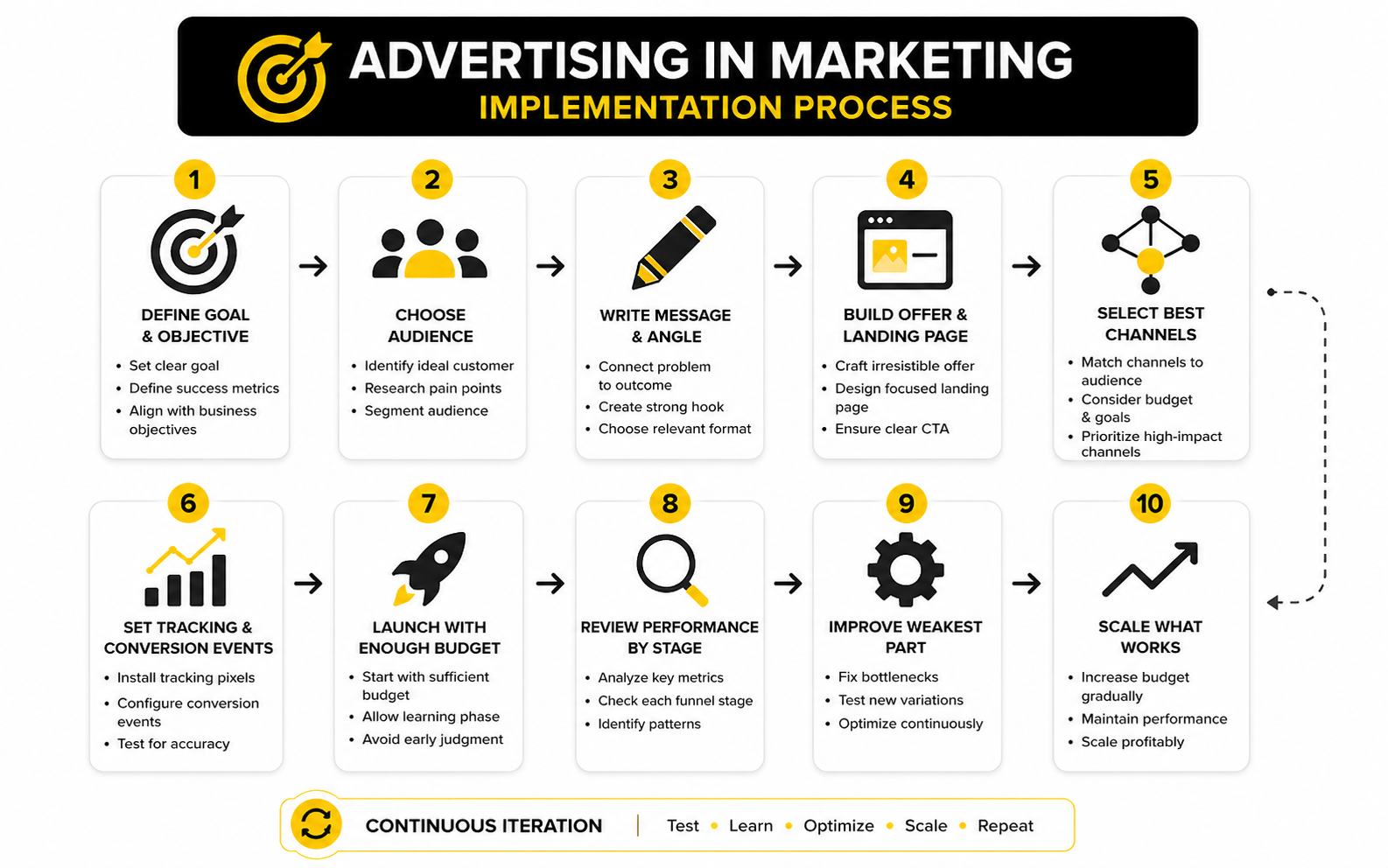
A practical implementation process looks like this:
- Define the business goal and primary campaign objective.
- Choose the audience segment and awareness stage.
- Write the core message and creative angle.
- Build the offer and landing page experience.
- Select the best channels for the audience and intent.
- Set tracking, conversion events, and reporting rules.
- Launch with enough budget to collect meaningful data.
- Review performance by stage, not just by final sales.
- Improve the weakest part of the journey.
- Scale what works without changing too many variables at once.
Step 1: Match The Channel To The Job
Every advertising channel has a different strength. Search is strong when people already have intent. Social is strong for creating demand, testing creative angles, and reaching defined audiences before they search.
Video can explain a product quickly and build familiarity at scale. Email sponsorships, creator partnerships, and newsletters can work well when trust and context matter. Retargeting is useful when people have already shown interest but have not taken the next step.
The mistake is choosing a channel because it is popular. Choose the channel because it fits the job. A campaign designed for immediate purchase should not be built the same way as a campaign designed to introduce a new category.
Step 2: Build The Post-Click Experience
The ad gets the click, but the post-click experience often decides the result. A landing page should make the same promise as the ad, answer the next logical questions, and guide the visitor toward one action. When the page feels disconnected, conversion rates usually suffer.
The page does not need to be long by default. It needs to be complete enough for the decision being asked. A newsletter signup needs less proof than a high-ticket consultation, and an ecommerce product page needs different information than a SaaS demo page.
For ecommerce teams, a platform like Replo can make landing page testing faster. For service businesses and agencies, GoHighLevel can connect pages, forms, calendars, pipelines, and follow-up in one system. The practical win is not the tool itself; it is reducing the gap between click, lead capture, and sales action.
Step 3: Plan Follow-Up Before Launch
Follow-up should not be an afterthought. Many campaigns lose money because leads arrive faster than the business can respond, nurture, qualify, or close them. That is not an ad problem. That is an implementation problem.
Before launch, define what happens after someone converts. They may need an email sequence, SMS reminder, chatbot conversation, sales call, onboarding message, or retargeting flow. The next step should feel immediate and relevant.
This is where automation can protect performance. A tool like ManyChat can support messaging-based follow-up, while Moosend can support email nurturing after the first conversion.
Step 4: Launch With A Testing Plan
A launch should not be a pile of random ads. It should test a small number of meaningful variables. That could mean testing different hooks, offers, audiences, landing pages, or creative formats.
The key is to avoid changing everything at once. If the audience, offer, creative, and page all change together, it becomes hard to know what actually improved performance. Clean tests make better decisions possible.
A simple starting point is to test three creative angles against one clear offer. Keep the landing page consistent at first, then improve it once the campaign has enough traffic to show patterns. This keeps the learning focused instead of chaotic.
Step 5: Improve The Bottleneck
Once data starts coming in, do not optimize blindly. Look for the bottleneck. If impressions are high but clicks are low, the creative or message may be weak. If clicks are strong but conversions are low, the landing page or offer may be the issue.
If leads are coming in but sales are poor, the problem may be lead quality, follow-up speed, qualification, or sales messaging. That is why advertising in marketing has to connect with the rest of the business. Ads cannot fix a broken customer journey by themselves.
The best teams improve one bottleneck at a time. They do not chase every metric. They find the constraint, fix it, and then move to the next part of the system.
Statistics And Data
Advertising data is useful only when it changes a decision. A metric that looks impressive but does not help you improve targeting, creative, offer, conversion rate, or customer value is just dashboard decoration. The job is not to collect more numbers; the job is to understand what the numbers are telling you to do next.
The advertising market is still growing because paid attention remains valuable. Global ad spend has been forecast to pass the trillion-dollar mark, with WARC projecting the market to reach $1.17 trillion in 2025. That matters because more spend usually means more competition, higher creative standards, and less room for lazy campaigns.
Digital advertising is where much of that pressure shows up first. U.S. internet advertising revenue reached $258.6 billion in 2024, up 14.9% year over year. For marketers, the takeaway is simple: digital is not a side channel anymore, so measurement has to be treated like core business infrastructure.
The Metrics That Actually Matter
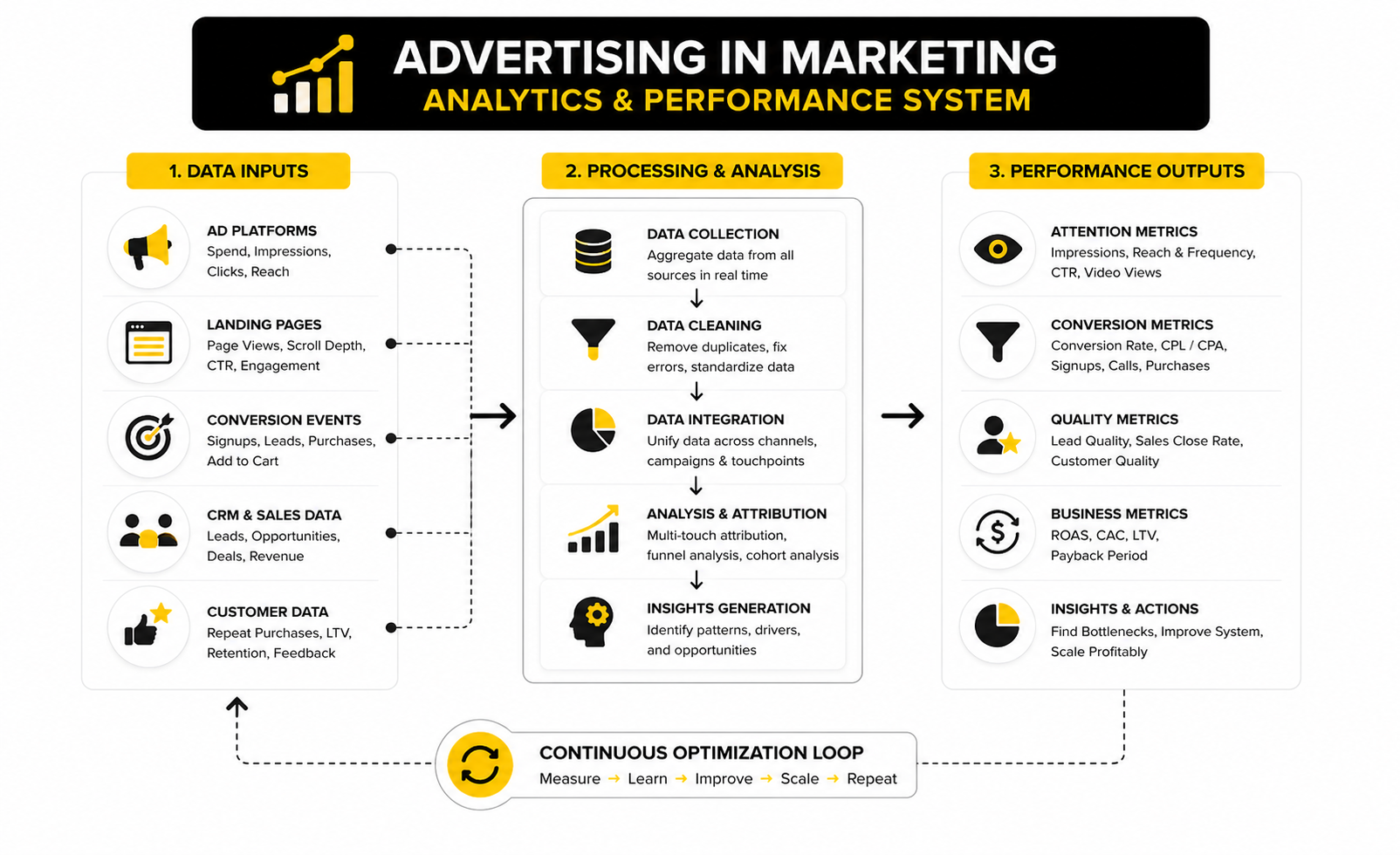
The first layer of measurement is attention. Impressions, reach, frequency, video views, and click-through rate tell you whether the campaign is getting seen and whether the creative is strong enough to earn action. These numbers are useful early, but they do not prove the campaign is profitable.
The second layer is conversion. Conversion rate, cost per lead, cost per acquisition, booked calls, purchases, and trial signups show whether the campaign is turning attention into movement. If clicks are strong but conversions are weak, the issue is usually the offer, page, friction, or audience readiness.
The third layer is business quality. Customer acquisition cost, lifetime value, payback period, retention, refund rate, sales close rate, and lead quality show whether the advertising is attracting the right people. This is where advertising in marketing becomes serious, because a campaign can look cheap at the lead level and still be expensive at the revenue level.
How To Read Performance Signals
A low click-through rate usually means the audience does not feel the message is relevant, the creative is not stopping attention, or the campaign is being shown in the wrong environment. It does not automatically mean the product is bad. It means the first moment of the campaign needs work.
A high click-through rate with a low conversion rate tells a different story. The ad is earning curiosity, but the landing page, offer, price, proof, or next step is not carrying that curiosity forward. In that case, changing the ad may not fix the real problem.
A strong conversion rate with weak lead quality is even more dangerous. It can make the dashboard look healthy while the sales team quietly suffers. If leads do not respond, cannot afford the offer, or never become customers, the campaign needs better qualification and sharper targeting.
Benchmarks Are Starting Points, Not Goals
Benchmarks can help you spot obvious problems, but they should not become the strategy. Average numbers hide huge differences between industries, audiences, offers, price points, and buying cycles. A campaign selling a low-cost product will not behave like a campaign selling enterprise software.
Use benchmarks as a diagnostic tool. If your numbers are far below a reasonable market range, investigate the creative, page, offer, or tracking setup. If your numbers are above average but the business is still not profitable, the benchmark is not the thing that matters.
The only benchmark that really counts is your own improving baseline. Once a campaign has enough clean data, compare new tests against your previous performance. That gives you a more honest view than chasing generic averages from unrelated businesses.
Attribution Needs Context
Attribution is the attempt to understand which touchpoints influenced a result. It is useful, but it is not perfect. People see ads on one device, search later on another, ask a friend, read reviews, join an email list, and then convert days or weeks later.
This means last-click reporting can undervalue channels that create demand. A video ad, creator partnership, podcast sponsorship, or social campaign might influence the sale without getting full credit in the platform dashboard. If you only trust the final click, you may cut the campaigns that are creating future buyers.
A practical approach is to combine platform data, analytics data, CRM data, and sales feedback. Tools like GoHighLevel can help connect lead capture, pipeline movement, and follow-up activity, while a form tool like Fillout can make qualification data easier to collect before a lead reaches sales.
What The Data Should Make You Do
Good advertising data should create action. If reach is too narrow, test broader audiences or new channels. If clicks are weak, test new hooks, formats, and creative angles. If conversions are weak, improve the offer, landing page, proof, and call to action.
If lead quality is weak, tighten the message and qualification process. If acquisition cost is high but lifetime value is strong, the campaign may still be worth scaling carefully. If acquisition cost is high and customer quality is weak, do not hide behind vanity metrics.
This is the discipline that separates professional advertising from random media buying. The goal is not to “optimize ads” in isolation. The goal is to improve the full path from impression to revenue, then keep the system honest with clean data.
Advanced Strategy And Scaling Decisions
Scaling advertising is not just spending more money. It is increasing investment without breaking the economics of the campaign. That means the business needs enough demand, enough creative variety, enough conversion capacity, and enough operational follow-through to handle more volume.
The hard part is that early success can be misleading. A campaign might work at a small budget because it reaches the easiest buyers first. Once spend increases, the campaign has to reach colder audiences, handle more competition, and keep performance stable across a larger market.
This is where advertising in marketing becomes a strategic discipline. The question is not “how do we get more clicks?” The better question is “what has to stay true for this campaign to remain profitable at a higher level of spend?”
Scaling Requires A Wider Creative System
Creative fatigue is one of the first problems that appears during scaling. The same hook, format, and promise can only carry attention for so long. As frequency rises, people stop noticing the ad, engagement drops, and costs start creeping up.
The solution is not to endlessly tweak button colors or rewrite tiny pieces of copy. The solution is to build a creative system with multiple angles, formats, proof points, and audience entry points. That gives the campaign more ways to reach the same market without sounding repetitive.
A practical creative system includes:
- Problem-led ads that name the pain clearly
- Outcome-led ads that show the desired result
- Proof-led ads that reduce skepticism
- Comparison ads that explain why the offer is different
- Objection-handling ads that address hesitation
- Reminder ads that bring warm prospects back
Budget Allocation Should Follow Confidence
Not every campaign deserves more budget. Spend should follow evidence. If a campaign has strong conversion rates, good customer quality, and a reasonable payback period, it may deserve more investment.
If a campaign only has cheap clicks, that is not enough. Cheap attention can become expensive if it attracts the wrong people. The budget should move toward campaigns that create revenue quality, not just platform-friendly metrics.
A simple rule works well: protect testing budgets, scale winners gradually, and cut campaigns that keep failing after the real bottleneck has been addressed. This keeps the account learning without letting weak campaigns drain the business.
Channel Mix Becomes More Important Over Time
A single channel can work for a while, but dependency becomes risky. Platform costs change, algorithms shift, competition increases, privacy rules tighten, and audience behavior moves. If one channel controls the entire acquisition system, the business is exposed.
A stronger marketing system spreads risk across channels that play different roles. Search can capture existing intent. Paid social can test new angles and create demand. Email can nurture and convert. Retargeting can recover interest. Partnerships and creator campaigns can add borrowed trust.
This does not mean every business needs to advertise everywhere. It means the channel mix should become more balanced as the company grows. Start focused, prove the offer, then expand with discipline.
Privacy And Trust Are Now Performance Issues
Privacy is not just a legal topic. It affects targeting, tracking, personalization, attribution, and brand trust. As cookies, device identifiers, and platform signals become less reliable, advertisers need stronger first-party data and clearer consent practices.
This changes how campaigns should be built. Instead of relying only on platform targeting, businesses need better lead capture, better segmentation, and better owned audiences. Tools like Brevo can support email-based audience development, while Fillout can help collect cleaner qualification data before leads enter the sales process.
Trust matters here. If personalization feels helpful, it can improve the experience. If it feels hidden, excessive, or manipulative, it can damage the brand faster than the campaign can recover.
AI Should Improve Judgment, Not Replace It
AI is becoming part of advertising workflows, especially in creative testing, audience analysis, copy generation, reporting, and campaign optimization. That can save time and increase testing speed. But speed without judgment just creates more noise.
The strongest use of AI is not asking it to invent a strategy from scratch. It is using AI to organize research, generate creative variations, summarize performance patterns, and identify possible bottlenecks. Human judgment still has to decide what fits the market, brand, offer, and customer reality.
This matters because advertising is not only a math problem. It is also a meaning problem. The campaign has to say something people believe, remember, and act on.
The Biggest Risks To Watch
The most common risk is over-optimization. A team keeps chasing short-term platform metrics and slowly strips the campaign of its real message. The ads become efficient at getting clicks but weak at building trust.
The second risk is scaling before the customer journey is ready. More leads will not help if follow-up is slow, sales messaging is unclear, or onboarding is broken. In that case, more advertising simply exposes the operational weakness faster.
The third risk is confusing attribution with truth. Platform dashboards are useful, but they do not see the full customer journey. Treat them as directional inputs, not as the final version of reality.
Expert-Level Advertising Comes Down To Discipline
The best advertisers are not just better at launching campaigns. They are better at making decisions. They know when to test, when to wait, when to cut, when to scale, and when the problem is outside the ad account.
That discipline is what makes advertising in marketing powerful. Paid media becomes more than traffic. It becomes a system for learning what the market wants, proving which messages matter, and turning attention into profitable customer relationships.
The final step is bringing everything together: the strategy, the execution, the measurement, and the questions most marketers ask when they are trying to make advertising work in the real world.
Measurement, Optimization, And FAQs
Advertising works best when it is managed as an ecosystem. The ad creates the first touchpoint, the landing page continues the promise, the follow-up system builds trust, and the sales or checkout experience turns intent into revenue. When one part breaks, the whole system feels weaker.
That is why the final layer of advertising in marketing is not another tactic. It is integration. The campaign has to connect paid media, creative, analytics, CRM, email, sales feedback, customer support, and retention into one operating system.
A strong advertising ecosystem gives you cleaner answers. You can see which messages attract qualified people, which channels create profitable customers, which follow-up sequences improve conversion, and which offers deserve more budget. That is when advertising becomes a repeatable growth asset instead of a monthly gamble.
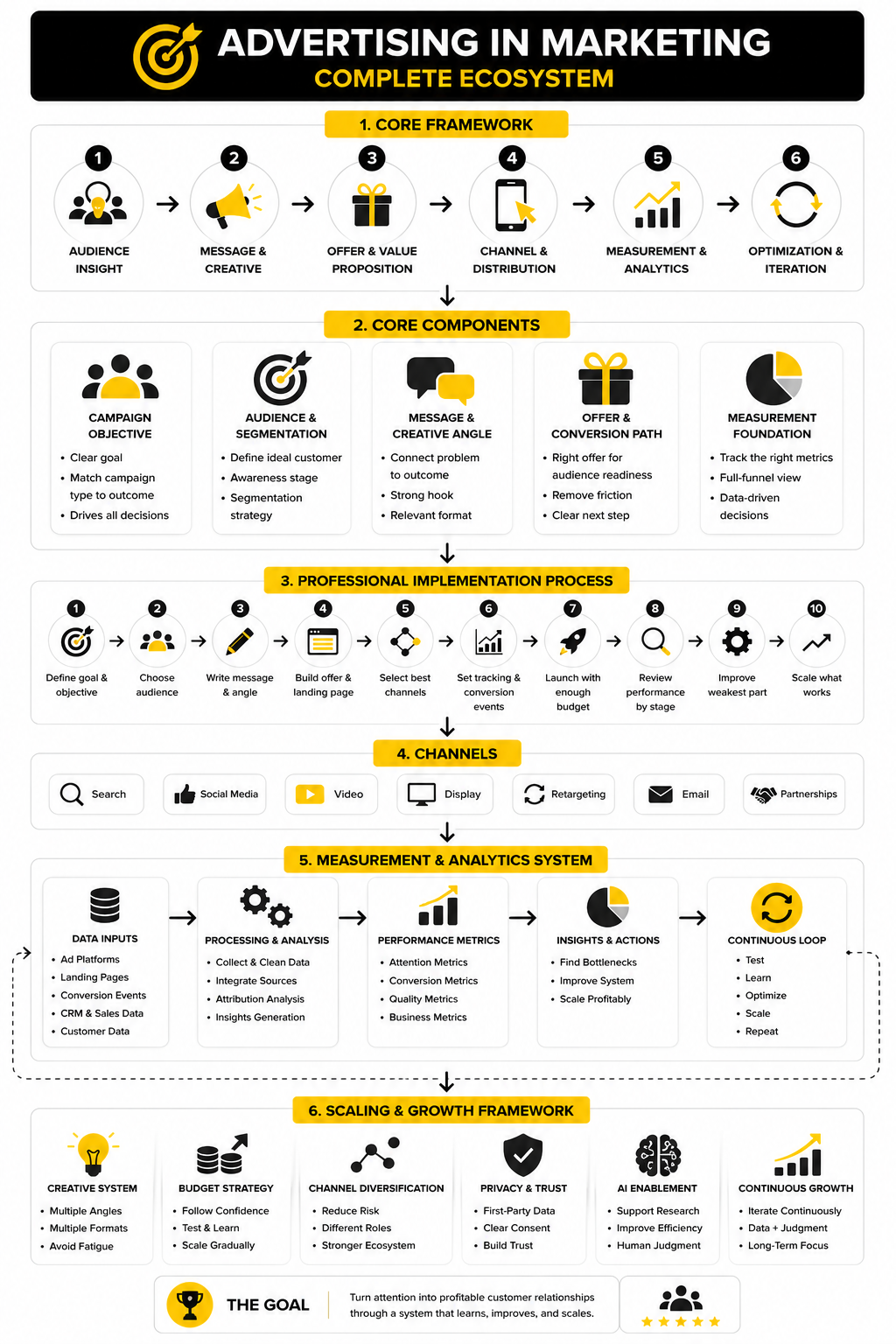
How To Keep The System Improving
Optimization should happen in a clear order. Fix tracking first, because bad data creates bad decisions. Then improve the offer, landing page, creative, follow-up, and budget allocation based on where the real constraint appears.
The best teams review advertising performance in layers. They look at channel metrics, conversion metrics, sales metrics, and customer quality metrics together. This prevents the common mistake of scaling campaigns that look good in the ad platform but produce weak customers in the business.
A practical review rhythm is simple. Check daily for technical issues, review weekly for performance patterns, and review monthly for strategy-level decisions. That keeps the team responsive without overreacting to every small movement in the dashboard.
FAQ - Built For Complete Guide
What Is Advertising In Marketing?
Advertising in marketing is the paid promotion part of a broader marketing strategy. Marketing defines the audience, positioning, offer, message, and customer journey. Advertising pays to distribute that message through channels such as search, social, video, display, podcasts, newsletters, and retargeting.
Why Is Advertising Important In Marketing?
Advertising is important because it gives businesses controlled reach and faster feedback. Instead of waiting for organic visibility, a company can place a message in front of a specific audience and measure how people respond. That makes advertising useful for awareness, demand generation, lead generation, sales, and retention.
What Is The Difference Between Advertising And Marketing?
Marketing is the full system for understanding, attracting, converting, and keeping customers. Advertising is one part of that system. A simple way to think about it is this: marketing creates the strategy, and advertising amplifies the message.
What Are The Main Types Of Advertising?
The main types include search advertising, social media advertising, display advertising, video advertising, native advertising, podcast advertising, influencer or creator advertising, connected TV, print, outdoor, and direct mail. Each type has a different job. Search captures existing demand, while social and video are often better for creating demand and testing creative angles.
How Do You Create An Advertising Strategy?
Start with the business goal, then define the audience, offer, message, channel, budget, and measurement plan. The strategy should explain who the campaign is for, what action it should drive, why the audience should care, and how success will be measured. Without those decisions, campaign execution becomes guesswork.
What Metrics Should Advertising Campaigns Track?
The most useful metrics include reach, frequency, click-through rate, conversion rate, cost per lead, cost per acquisition, return on ad spend, customer acquisition cost, lifetime value, payback period, and lead quality. No single metric tells the whole story. The right view connects attention, conversion, revenue, and customer quality.
What Is A Good Advertising Budget?
A good advertising budget depends on the goal, market size, customer value, conversion rate, and sales cycle. A small test budget can validate messaging, but scaling needs enough spend to collect meaningful data. The budget should increase only when the campaign shows signs of profitable or strategically useful performance.
How Long Does Advertising Take To Work?
Some campaigns can produce leads or sales quickly, especially when they target people with existing intent. Other campaigns need more time because they are building awareness, trust, or category demand. The right timeline depends on the offer, price point, audience readiness, and buying cycle.
Why Do Advertising Campaigns Fail?
Campaigns usually fail because the strategy is unclear, the audience is too broad, the offer is weak, the creative does not earn attention, or the landing page does not match the ad promise. Follow-up is another common failure point. If leads are not contacted, nurtured, qualified, or converted properly, the ad campaign gets blamed for a broken customer journey.
How Is Advertising Performance Improved?
Improve performance by finding the bottleneck. If people are not clicking, fix the creative or message. If people click but do not convert, fix the offer or landing page. If leads convert but do not buy, fix qualification, follow-up, or sales messaging.
Should Businesses Use Multiple Advertising Channels?
Yes, but not too early. Start with the channel most likely to match the audience and goal. Once the offer and message are proven, expand into other channels to reduce dependency, reach more buyers, and support different stages of the customer journey.
What Role Does Automation Play In Advertising?
Automation helps connect the campaign to the next step. It can trigger email follow-up, SMS reminders, chatbot conversations, lead routing, calendar booking, pipeline updates, and retargeting audiences. The point is not to automate everything; the point is to make sure interested people do not fall through the cracks.
Is AI Changing Advertising In Marketing?
Yes, AI is changing creative production, audience research, reporting, personalization, and campaign optimization. But AI should support human judgment, not replace it. The strongest campaigns still need clear positioning, real customer insight, strong offers, and disciplined decision-making.
What Is The Best Way To Start With Advertising?
Start with one audience, one offer, one primary channel, and one measurable goal. Build the campaign carefully, track the full journey, and improve the weakest part before scaling. That is much better than launching across too many channels with no clear learning plan.
Work With Professionals
Explore 10K+ Remote Marketing Contracts On MarkeWork.com
Most marketers spend too much time chasing clients, competing on crowded platforms, and losing a percentage of every project to middlemen.
MarkeWork gives you a better way. Browse thousands of remote marketing contracts and connect directly with companies desperate to hire skilled marketers like you, without platform commissions and without unnecessary gatekeepers.
If you're serious about finding better opportunities and keeping 100% of what you earn, explore available contracts and create a profile for free at MarkeWork.com.