

Affiliate marketing looks simple from the outside. Share a link, earn a commission, repeat. In practice, beginners who do well understand that this is not really a link game. It is a trust game built on clear positioning, useful content, and offers that match real buying intent.
That matters more now because affiliate marketing is not some side corner of the internet anymore. U.S. affiliate marketing spending is projected to climb past more than $12 billion in 2025, and the channel is expected to influence more than $210 billion in U.S. ecommerce sales. At the same time, recent benchmark data shows a tougher reality: clicks can rise while transactions fall, which means beginners cannot rely on traffic alone and need a real system from day one, as shown in this 2025 industry benchmark.
There is also a professional standard you need to respect from the beginning. Affiliate recommendations are advertising, which means disclosures, honest claims, and clear material connections are not optional under the FTC’s endorsement guidance and broader truth-in-advertising rules. That is actually good news, because beginners who build credibility early have a much better shot at long-term revenue than people chasing quick commissions.
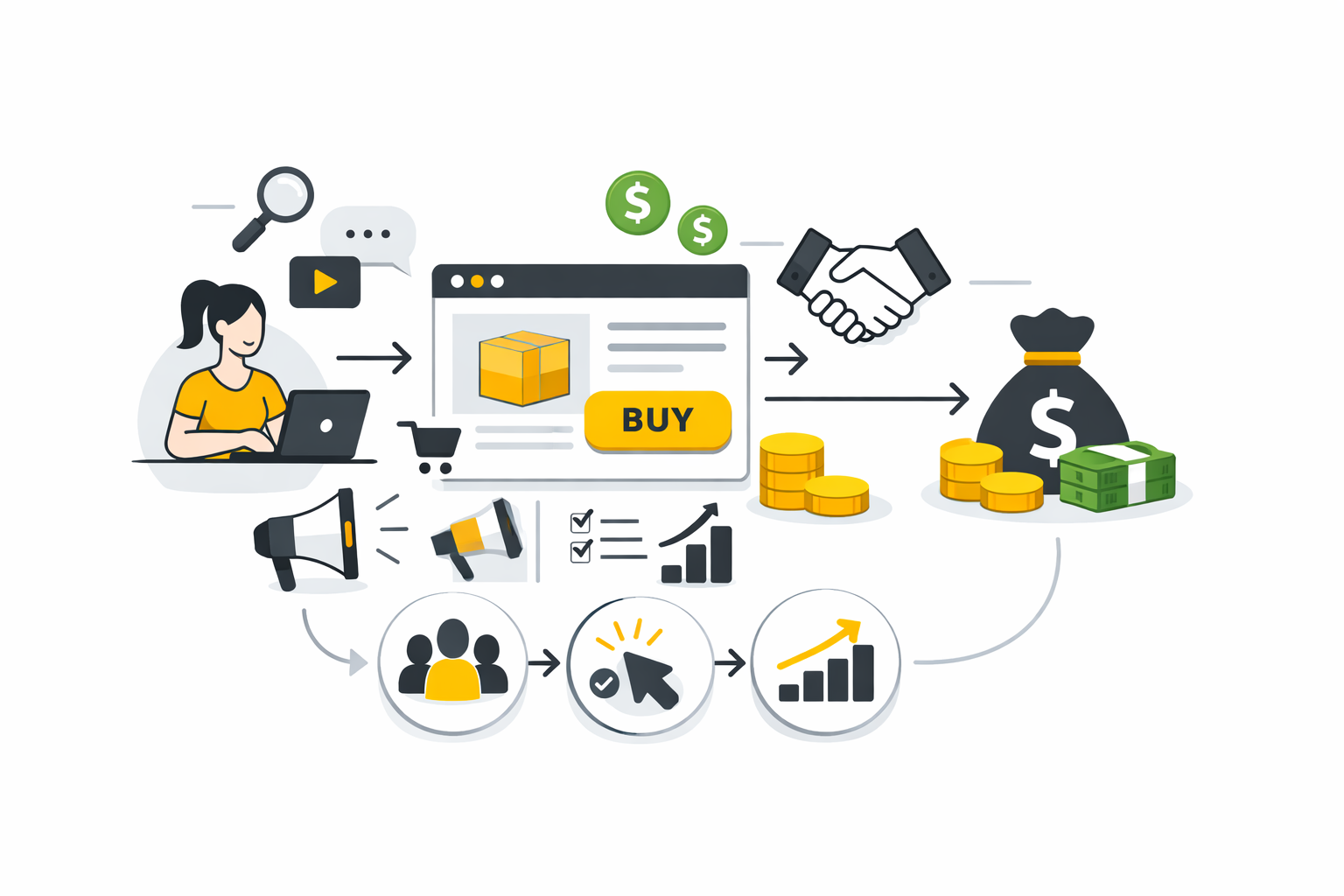
Why Affiliate Marketing Matters for Beginners
Affiliate marketing is one of the few business models a beginner can start without creating a product, hiring a sales team, or managing inventory. The core model is still straightforward: a brand provides a tracked link, a publisher promotes the offer, and a commission is paid when a defined action happens, which is how both Rakuten Advertising explains the model and Shopify defines it for creators and publishers. What makes it attractive is not that it is easy, but that it is accessible, measurable, and flexible enough to fit content websites, email lists, YouTube channels, and social-first creators.
For beginners, that flexibility can also become a trap. Too many people start by signing up for random programs, dropping links into weak content, and hoping a platform algorithm does the heavy lifting. A better approach is to treat affiliate marketing like a small media business from day one, where your niche, your audience problem, your content format, and your offer selection all need to line up.
How This Article Is Structured
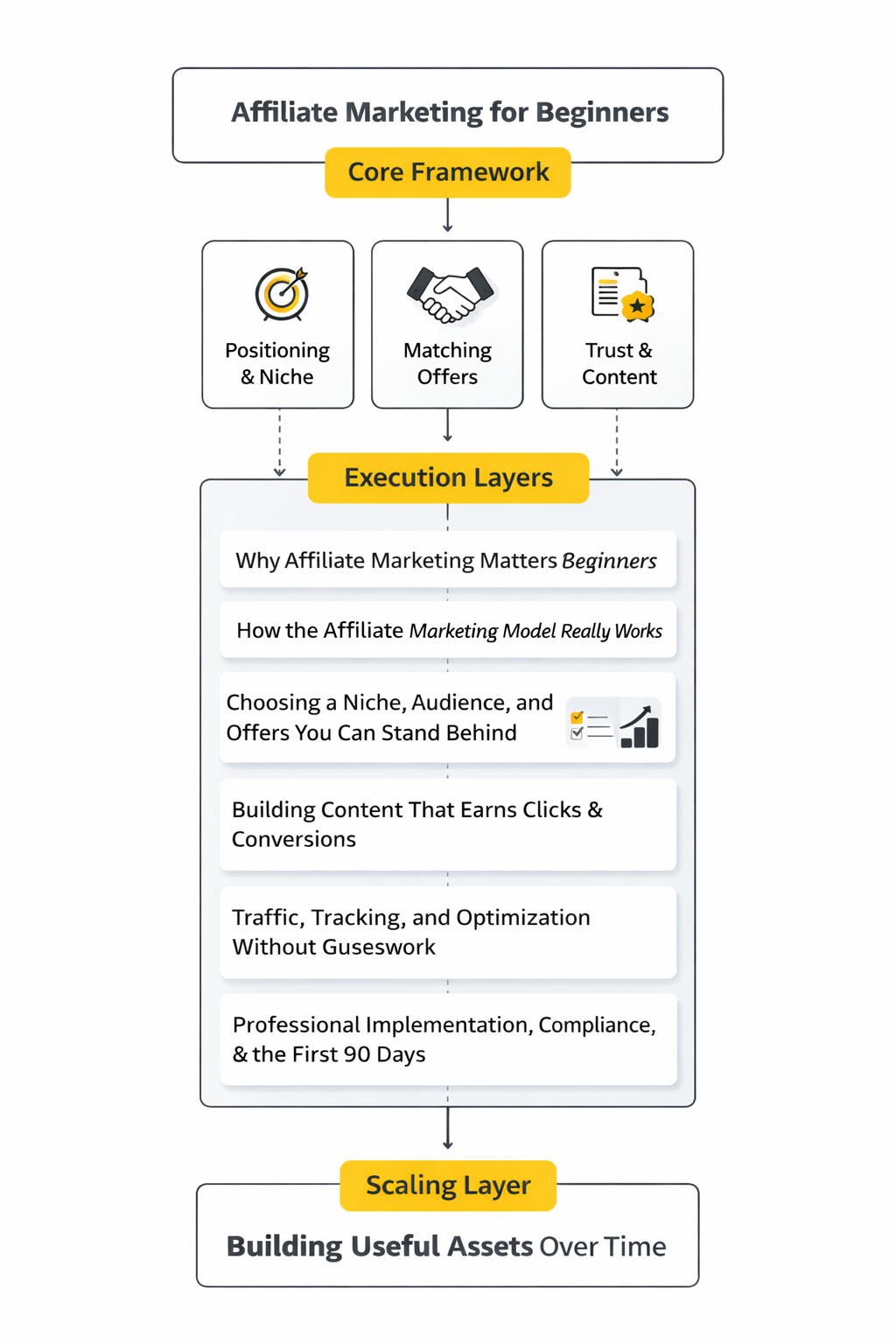
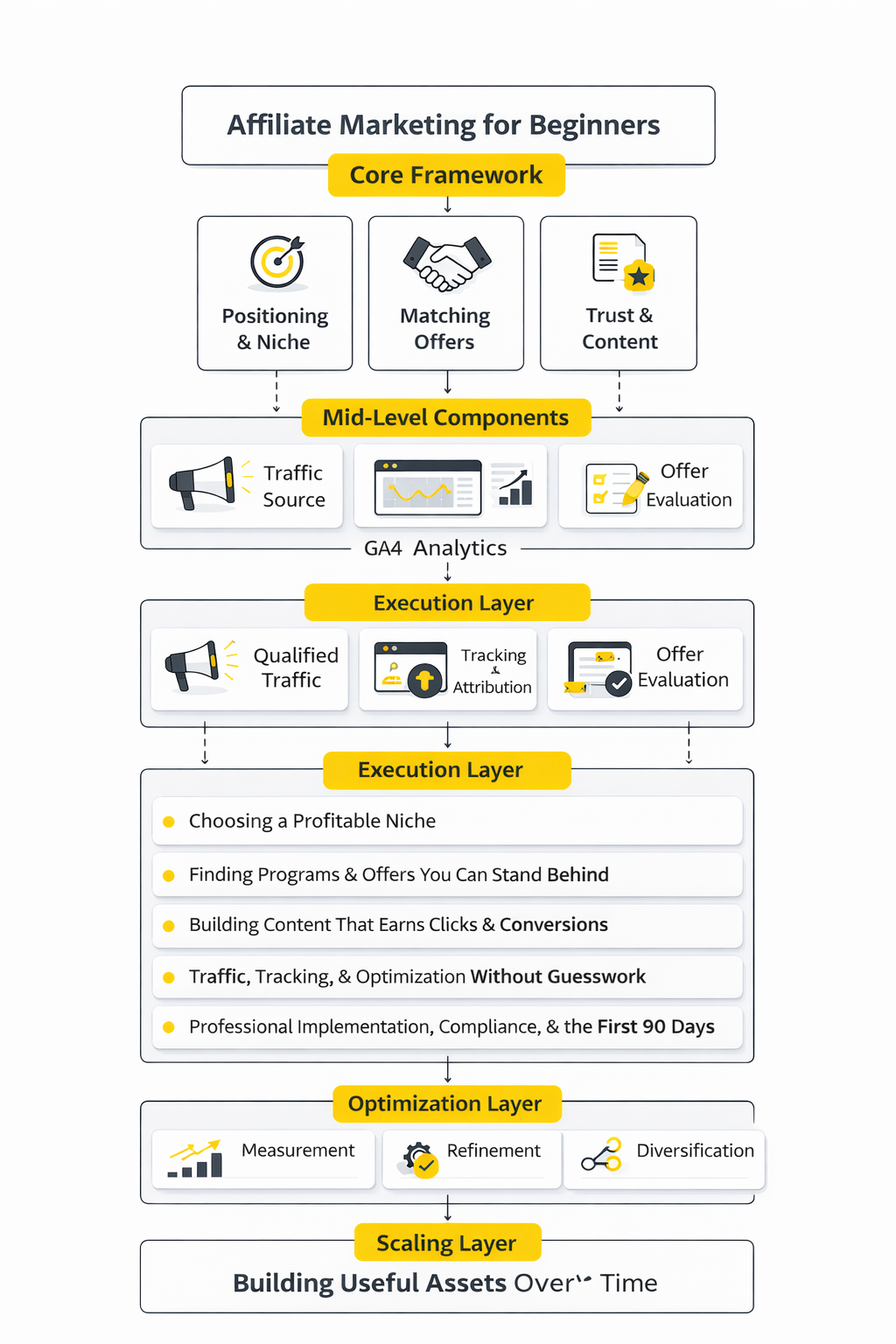
This guide is split into six parts so you can build the right foundation before getting into tactics. The order is deliberate. First you need the model, then the moving parts, then the execution layer, because beginners usually fail when they jump straight to tools and traffic before they understand buyer intent, content fit, and compliance.
Here is the full article outline the rest of the guide will follow:
- Part 1: Why Affiliate Marketing Matters for Beginners
- Part 2: How the Affiliate Marketing Model Really Works
- Part 3: Choosing a Niche, Audience, and Offers You Can Stand Behind
- Part 4: Building Content That Earns Clicks and Conversions
- Part 5: Traffic, Tracking, and Optimization Without Guesswork
- Part 6: Professional Implementation, Compliance, and the First 90 Days
The goal is not to overwhelm you with every possible strategy. It is to give you a framework you can actually use, so by the end of the article you know what affiliate marketing for beginners should look like when it is done properly, what to avoid, and where to focus first.
How the Affiliate Marketing Model Really Works
To get affiliate marketing for beginners right, you need to understand the engine before you start publishing content. The model is performance-based, which means you only earn when a measurable action happens, usually a sale, lead, or qualified signup, as explained by Shopify’s affiliate program overview and its broader guide to how affiliate marketing works. That sounds simple, but the real work sits underneath the link in tracking, attribution, offer quality, and how well your content matches the moment a buyer is in.
This is why beginners should stop thinking like promoters and start thinking like publishers. You are not just dropping links into the internet and hoping for magic. You are creating a path that takes someone from curiosity to action while a tracking system records what happened and decides whether you deserve credit.
The Basic Flow From Click to Commission
At the most basic level, affiliate marketing has a predictable sequence. A brand creates an offer, gives affiliates a unique tracking link, a publisher places that link inside content, a user clicks, and the tracking system records the interaction. If the user completes the required action within the program rules, the affiliate platform attributes the conversion and the commission is paid.
That sounds clean on paper, but real attribution is never just about a click. Networks and platforms use cookies, link parameters, attribution rules, and in some cases multiple tracking methods to decide who gets credit, which is why Awin’s tracking documentation and its newer explainer on cookie types and attribution hierarchy matter more than most beginner tutorials. Once you understand that, you stop assuming every click is equal and start building content that attracts the right click.
The Four Players in the System
Every affiliate setup has four moving parts. First, there is the merchant or brand that owns the product. Second, there is the affiliate or publisher promoting it. Third, there is the customer making the decision, and fourth, there is usually a network or platform that handles tracking, reporting, and payout.
Beginners often focus only on the affiliate side, but the brand and the platform shape almost everything. Commission structure, cookie duration, payout thresholds, allowed traffic sources, and reversal policies are not side details. They decide whether a program is beginner-friendly or whether it looks attractive on the surface while being hard to convert in the real world.
What Tracking and Attribution Actually Mean
Tracking is the technical process that connects your link to a later action. When someone clicks an affiliate link, systems can store information through cookies or other identifiers so the sale or lead can be matched back to the publisher later, which is the core function described in Awin’s explanation of affiliate tracking and its legal summary on tracking technologies for attribution. Without that connection, there is no reliable way to calculate who earned what.
Attribution is the rule set layered on top of tracking. It answers the harder question: when multiple touchpoints exist, who gets the commission? That is where beginners need to pay attention, because a click on your review article can be valuable without always becoming the final click, and some programs may reward the last affiliate touch while others use different rules laid out in platform documentation like Awin’s attribution hierarchy guide.
This matters more than people think. Recent benchmark data shows shoppers are clicking more and buying less often on the spot, with 2025 data showing clicks up while conversion rates fell. In plain English, buyers compare more, research longer, and move across more touchpoints, so affiliate marketing for beginners works better when your content helps close uncertainty instead of just creating awareness.
How Affiliates Actually Get Paid
Not every affiliate offer pays the same way. Some programs pay per sale, which is the model most beginners picture first. Others pay per qualified lead, free trial, booked demo, app install, or another defined action, depending on the business model and partner terms.
The payout mechanics matter because they change your whole strategy. A software referral that pays for trials or subscriptions needs different content than a physical product review, and a lead-gen offer requires much tighter alignment between the audience problem and the landing page promise. You should never join a program before checking what counts as a valid conversion, how long the attribution window lasts, and when commissions can be reversed or approved.
Where Beginners Usually Get Confused
The biggest beginner mistake is assuming affiliate marketing is mainly about traffic volume. Traffic helps, obviously, but the more important variable is whether the traffic has purchase intent. A thousand random visitors from a broad social post can underperform a small number of highly targeted visitors who searched for comparisons, pricing, setup help, or product alternatives.
The second mistake is confusing platform popularity with offer quality. A brand can be famous and still be a poor affiliate fit if the commission is weak, the landing page is unclear, the product has low trust, or the audience you built is not actually ready for that solution. That is why the next part of this guide moves into niche selection, audience alignment, and choosing offers you can confidently stand behind instead of promoting whatever looks shiny this week.
Why Compliance Is Part of the Model, Not a Side Note
A lot of beginners treat disclosure like admin work they will handle later. That is a mistake. If you are recommending a product and may get paid when someone buys, that material connection needs to be clear to readers under the FTC’s guidance on endorsements, influencers, and reviews and its broader rules around truthful advertising and marketing practices.
This is not just about staying out of trouble. Clear disclosure improves trust when it is done properly because it signals that you are willing to be transparent about how the business works. And for affiliate marketing for beginners, trust is not some soft branding concept. It is the asset that makes every future click more valuable.
Choosing a Niche, Audience, and Offers You Can Stand Behind
This is where affiliate marketing for beginners stops being abstract and starts becoming a real business decision. You do not need the biggest niche, the trendiest platform, or the highest commission percentage. You need a specific problem, a specific audience, and offers that genuinely help people solve that problem.
A good niche sits at the intersection of demand, credibility, and repeat content opportunities. That is why broad categories like “make money online” or “fitness” are usually too messy for a beginner unless you narrow them into something more useful, such as email automation for creators, scheduling tools for freelancers, or landing page software for ecommerce brands. The strongest beginner niches usually have clear buyer pain, products people actively compare, and enough depth to support tutorials, reviews, comparisons, and setup content over time, which lines up with how searchable affiliate content compounds over time and why practical niche selection still sits at the center of Shopify’s affiliate guidance for creators.
Pick a Niche You Can Explain Without Hiding Behind Hype
A beginner-friendly niche is not just profitable. It is understandable. If you cannot explain why someone would buy a product, what problem it solves, and what makes one option different from another, you are probably too far from the market to create convincing content.
This is why firsthand familiarity matters so much. You do not need to be the world’s top expert, but you do need enough experience to answer real questions, spot weak positioning, and recommend tools with confidence. The creators and publishers who hold attention tend to win because their content reduces uncertainty, and that matters more now as buyers spend longer researching before they convert, with 2025 benchmark data showing clicks rising while conversion rates fell.
Start With Audience Problems, Not Product Categories
A lot of beginners choose a niche by asking, “What can I promote?” That is backwards. The better question is, “What is this person trying to do, and where do they get stuck?” Once you start there, the content and the offer become much easier to match.
For example, someone trying to launch a simple funnel, collect leads, and send follow-up emails has a very different intent than someone comparing enterprise CRM platforms. One person wants speed and clarity. The other wants depth, integrations, and operational confidence. Affiliate marketing for beginners gets easier when you build around one stage of the buyer journey instead of trying to speak to everyone at once.
The Best Offers Usually Sit Close to a Buying Decision
Not every product makes sense as an affiliate offer for a beginner. Products closest to a real decision point tend to convert better because the audience already understands the problem and is actively evaluating solutions. That usually means software trials, templates, educational products, or tools with obvious use cases rather than vague lifestyle recommendations.
This is also where commission size can fool you. A huge payout on a weak offer is not better than a smaller payout on a product people actually trust, understand, and adopt. In practical terms, that means offer quality, user experience, and landing page clarity often matter more than the headline commission number, which is why high-intent, searchable content outperforms trend chasing for many creators and why targeting the right audience remains central to affiliate performance.
What a Strong Beginner Offer Looks Like
A strong offer for a beginner usually has five things working in your favor. The product solves a clear problem. The landing page explains the value fast. The brand has enough credibility that the recommendation does not feel risky. The conversion event is easy to understand. And the program terms do not punish you with unrealistic conditions.
That is why software and business tools often make sense when you are learning the ropes. If your content naturally serves creators, agencies, coaches, or small online businesses, tools such as Systeme.io, GoHighLevel, or ClickFunnels are easier to explain than random products because people can immediately see the job the software is supposed to do. That does not mean you should promote all of them. It means you should only promote the one that actually fits the reader’s stage, budget, and business model.
Match the Offer to the Content Format
This is where beginners often leave money on the table. They choose decent offers, then place them inside the wrong content. A comparison article, a tutorial, a migration guide, and a quick social post all create very different levels of buying intent, so the same link can perform wildly differently depending on context.
A top-of-funnel post should educate and narrow options. A mid-funnel post should clarify differences and remove doubt. A bottom-funnel page should help someone make the decision they were already close to making. When you understand that, affiliate marketing for beginners becomes much less random because each piece of content has a job instead of just carrying a link.
A Simple Process for Choosing Your First Niche and Offer
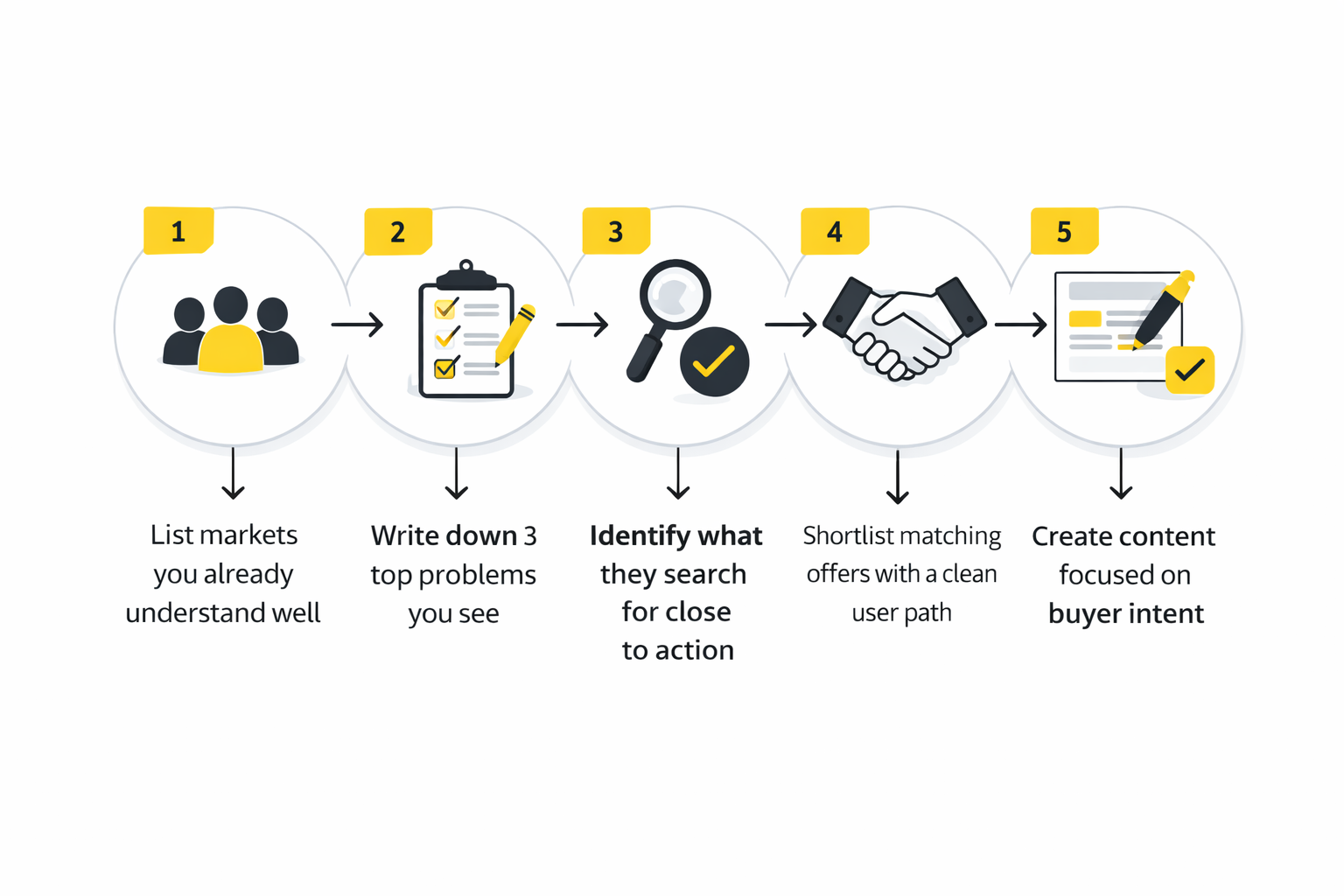
You do not need a complicated spreadsheet to get started, but you do need a decision process. The easiest way to stay grounded is to move in order and refuse to skip steps just because a commission page looks attractive.
- List markets you already understand well enough to discuss clearly.
- Write down the top three recurring problems people in those markets want solved.
- Identify what they search for when they are close to acting, such as setup help, pricing questions, alternatives, templates, or comparisons.
- Shortlist offers that directly solve those problems and have a clean user journey.
- Create content that matches buyer intent before worrying about scale.
That process sounds basic, but that is exactly the point. Beginners usually lose because they add complexity too early. A narrow niche with a clear problem and one good offer is far more useful than a messy content plan built around ten unrelated programs.
How to Validate Demand Before You Commit
You do not need perfect certainty before choosing a niche, but you do need signs that people are actively trying to solve the problem. Search behavior is one sign. Product comparison behavior is another. Repeat questions in communities, comment sections, and support-style forums can also reveal whether the niche has enough pain and enough urgency to sustain useful content.
The key is to validate commercial intent, not just general interest. A topic can be popular and still be weak for affiliates if the audience is mostly curious rather than ready to evaluate solutions. That is one reason practical business software, creator tools, and workflow products can be attractive for beginners: the audience often has a visible task they need to complete, whether that is email automation, page building, appointment booking, or social scheduling with tools like ManyChat, Cal.com, or Buffer.
Do Not Build Around Offers You Would Not Defend Publicly
This is the standard that saves beginners from years of bad habits. If someone replied to your article, email, or video and asked, “Why this product and not the obvious alternative?” you should have a real answer. Not a commission answer. A user answer.
That standard forces you to get more selective, which is good for both trust and conversions. It also helps you avoid the lazy cycle where affiliate marketing for beginners turns into endless tool collecting instead of useful recommendation-driven content. The next part of the guide builds on this by showing how to turn the right niche and offer choices into content that earns clicks and conversions instead of just pageviews.
Building Content That Earns Clicks and Conversions
By this point, the foundation should be clear. You know how the model works, why offer selection matters, and why trust sits underneath everything. Now you need the measurement layer, because affiliate marketing for beginners gets expensive in time very quickly when you publish content without knowing what the numbers are actually telling you.
This is where many beginners go wrong. They look at clicks, get excited, and assume progress is happening. Sometimes it is, but current benchmark data shows a more complicated reality: affiliate clicks rose 2% year over year while conversion rates fell 6%, which points to longer, more comparison-heavy buyer journeys rather than simple linear paths to purchase in this 2025 benchmark.
Statistics and Data That Actually Matter
The first number that matters is not traffic by itself. It is qualified traffic, meaning visitors who land on content that matches what they were trying to solve. If your article attracts the wrong people, better headlines and more impressions will not fix the deeper issue.
The second number that matters is conversion rate after the click, not just the click itself. A program can generate plenty of interest and still perform poorly if the offer is weak, the landing page is confusing, or the reader was too early in the buying journey. That is exactly why the 2025 benchmark is useful: it shows that more clicks did not automatically produce more transactions, and that shift should push beginners toward content that resolves buyer doubt rather than just generating curiosity in the same benchmark report.
The third number that deserves more attention is earnings per click, because it ties traffic to revenue. EPC is simply the average value you earn from each click, which makes it one of the clearest signals for whether your content, audience, and offer are aligned in PartnerStack’s definition of EPC. A page with fewer clicks can easily beat a page with more clicks if the traffic is closer to a purchase decision.
What the Bigger Market Numbers Tell You
Some industry numbers are useful because they show where the channel is heading, not because they tell you how your page performed last week. U.S. affiliate marketing spend is expected to top more than $12 billion in 2025, and affiliate is projected to influence more than $210 billion in U.S. ecommerce sales. That tells you the channel is large, established, and important enough that serious brands continue investing in it.
What it does not tell you is that every niche or every beginner will win easily. Big market growth should increase your standards, not lower them. When more money flows into a channel, the advantage goes to publishers who understand intent, tracking, and content quality better than the average person dropping links into generic posts.
Build a Simple Analytics System Before You Publish More
You do not need a complicated dashboard to start measuring well, but you do need a system. At minimum, your analytics setup should tell you where visitors came from, which page they landed on, where they clicked, and whether those clicks turned into tracked affiliate activity. Google’s campaign URL guidance explains why UTM parameters matter for identifying campaign traffic, and GA4’s traffic acquisition framework shows how source and medium data are surfaced in reporting in Google’s URL builder documentation and its explanation of session-scoped source dimensions.
That means your setup should not rely on memory or guesswork. If you share the same article through search, email, social, and direct outreach, you want clean campaign tagging so you can see which traffic source actually creates quality sessions. Otherwise, affiliate marketing for beginners turns into a foggy loop where you keep “doing content” without learning what deserves more effort.
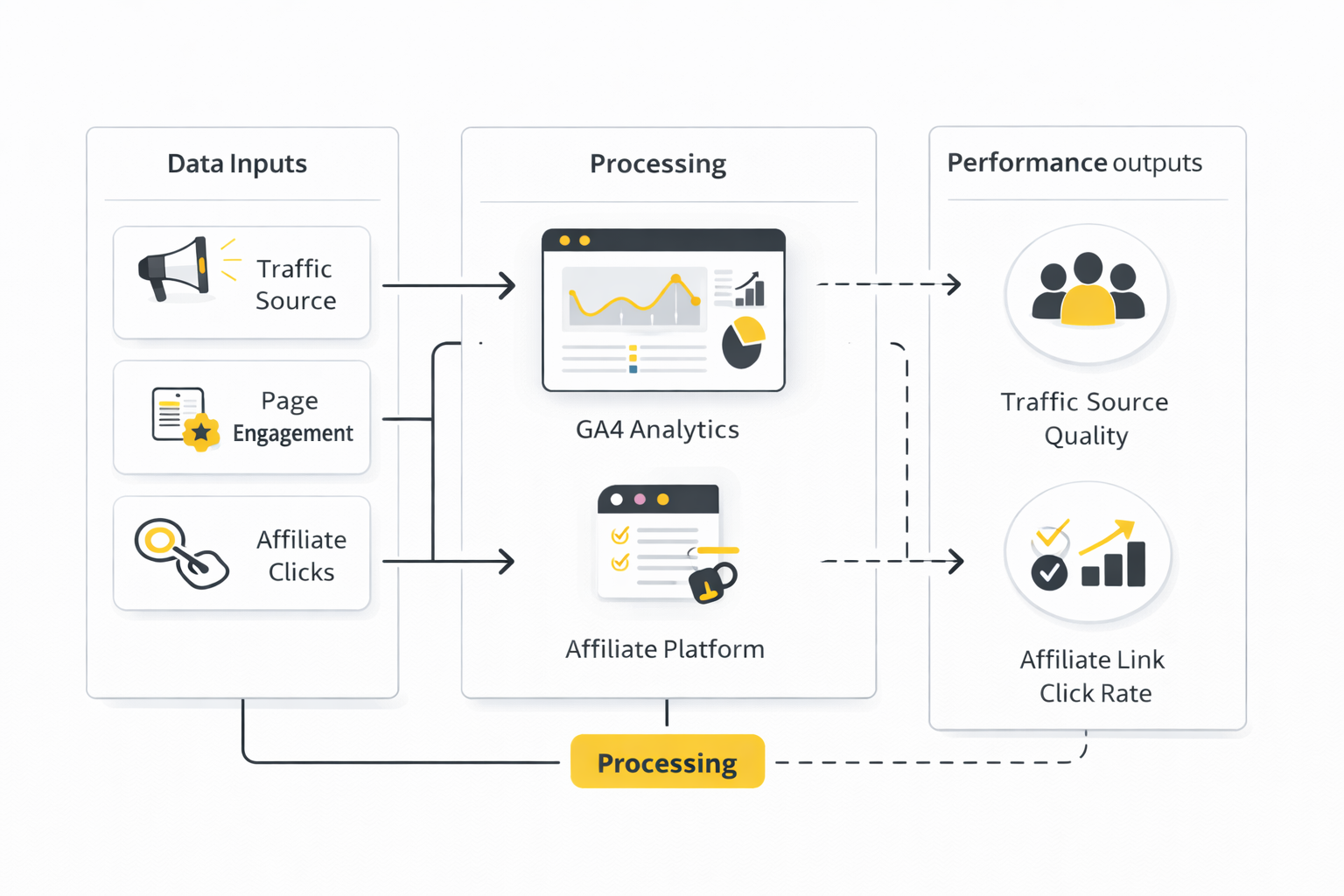
A simple measurement stack usually looks like this. First, track page-level performance in your analytics platform. Second, use tagged URLs so campaign sources are visible. Third, compare on-site engagement with affiliate platform numbers such as clicks, conversions, and EPC. Fourth, review the data together instead of treating content metrics and affiliate metrics as two separate worlds.
That last point matters more than it sounds. A page can look healthy inside GA4 and still be commercially weak if readers never click your recommendation. On the other hand, a page with modest traffic can become one of your best assets if the visitors arrive with high intent and the affiliate offer fits the decision they are trying to make.
The Core Performance Signals to Watch
Start with traffic source quality. Google Analytics separates traffic acquisition using source and medium dimensions, which helps you distinguish whether users came from search, email, referral, social, or other channels in Google’s GA4 scope documentation. That matters because different sources often carry very different purchase intent, and beginners should not assume all visits deserve equal weight.
Then look at affiliate link click rate on the page. This tells you whether your article structure, recommendation placement, and call to action are working. If traffic is strong but clicks are weak, the problem is usually in your content framing, page layout, or audience mismatch rather than in the affiliate offer itself.
After that, focus on conversion rate and EPC. Conversion rate tells you how efficiently the post-click journey turns interest into action, while EPC tells you whether those clicks are valuable enough to justify further effort in PartnerStack’s EPC glossary and Awin’s explanation of why tracking drives better optimization. This is where the most practical decisions happen, because low EPC can signal poor offer fit even when clicks look decent on the surface.
How to Interpret Benchmarks Without Fooling Yourself
Benchmarks are useful, but only when you read them as directional context rather than personal validation. For example, if the broader market is seeing more clicks but fewer conversions, that does not mean your page is performing well just because it attracted traffic. It means buyers are researching harder, so your content needs to answer comparison questions, reduce friction, and help readers move from interest to decision based on the 2025 affiliate benchmark.
The same logic applies to seasonality. A surge in traffic during peak shopping periods can look impressive, but if that traffic does not translate into stronger EPC or conversions, you may be attracting bargain hunters, casual browsers, or low-fit visitors. Good interpretation always asks one follow-up question: what action should this number drive?
If the answer is unclear, the metric may be vanity. Pageviews alone rarely tell you what to fix. Metrics become useful when they point to a decision, such as rewriting an intro, changing the CTA position, improving comparison depth, or replacing a weak offer with one that actually matches the reader’s intent.
The Actions Good Data Should Trigger
When click-through rate is low, improve the content experience before changing the offer. Tighten the headline-to-intent match, place recommendations where they make sense, and make sure the reader understands why the tool is relevant right now. Weak clicks usually mean the article is not guiding the decision clearly enough.
When clicks are healthy but conversions are weak, inspect the post-click experience. That could mean the landing page is not persuasive, the offer is mismatched, or the audience is still too early in the journey. Tracking guidance from affiliate platforms exists for a reason: accurate data helps you separate traffic problems from attribution problems and from offer-quality problems in Awin’s tracking overview and its newer explanation of why tracking underpins fair reporting and optimization.
When EPC improves, that is your signal to scale with care. Do more with the page, keyword cluster, or content angle that is producing commercially meaningful results. In affiliate marketing for beginners, the win is rarely “publish more everything.” The win is noticing what the data confirms, then doubling down on the small number of inputs that are actually turning trust into revenue.
Traffic, Tracking, and Optimization Without Guesswork
Once you have a niche, a content angle, and early performance data, the next challenge is not getting more random activity. It is building a setup that survives platform changes, attribution gaps, and the very normal mess that shows up when content, analytics, and affiliate dashboards stop telling the same story. This is the point where affiliate marketing for beginners starts looking less like publishing and more like operations.
That shift is healthy. If you want predictable revenue, you need a system that can explain where traffic came from, how users moved across your site, where they clicked, and why commissions did or did not appear. Google’s documentation is clear that cross-domain measurement matters when a user journey spans multiple domains, and it recommends a single web data stream with cross-domain measurement for consistent reporting across those journeys in GA4’s setup guidance and its account-structure documentation.
The Real Scaling Problem Is Usually Attribution, Not Effort
Beginners often assume scaling means publishing more pages or posting on more platforms. Sometimes that helps, but once your traffic reaches a meaningful level, the bigger problem is usually measurement quality. If your analytics setup breaks when users move from one domain to another, or if affiliate clicks are being recorded while conversions are not, you can end up making the wrong decisions with total confidence.
That is why technical measurement matters earlier than most people think. Google’s cross-domain guidance exists because separate domains can fragment user journeys unless the setup is configured properly, and affiliate platforms are also pushing more durable tracking approaches as browser restrictions make old setups less reliable in Google’s cross-domain documentation and Awin’s server-to-server tracking guidance. In practical terms, affiliate marketing for beginners becomes much more stable when you treat tracking as infrastructure instead of an afterthought.
Why Diversification Is a Strategic Advantage
Relying on one traffic source is comfortable right up until it stops working. Search can be a fantastic channel, but it is still exposed to ranking volatility, spam enforcement, and changing content standards. Google’s Search Essentials and spam policies make that point directly: content can be ranked lower or removed when it violates quality or spam expectations, and the company has continued tightening enforcement around manipulative publishing patterns in Search Essentials, the spam policies, and the updated site reputation abuse policy language.
That does not mean you should fear search. It means you should avoid building a fragile business around one distribution pipe. Strong affiliate operators usually pair searchable content with an owned audience layer such as email, community, or direct traffic, because that gives them a way to keep reaching people even when a platform changes the rules.
Own More of the Relationship Than the Platform Does
This is one of the clearest tradeoffs in affiliate marketing. Platform traffic is fast, but borrowed. An owned audience is slower, but more defensible. If you depend entirely on rankings, social reach, or marketplace visibility, your business sits on assets you do not control.
That is why list building matters so much once you have a content engine that already attracts the right people. Tools for forms, scheduling, messaging, and email can support that owned-audience layer when they genuinely match the workflow you are teaching, whether that means capturing leads with Fillout, automating conversations with ManyChat, or running email follow-up with Brevo or Moosend. The point is not to stack tools for the sake of it. The point is to reduce dependence on channels you cannot control.
Better Tracking Usually Creates Better Strategy
At small scale, imperfect tracking feels survivable. At larger scale, it becomes expensive. If you cannot tell whether a page, campaign, or audience segment is genuinely producing valuable clicks, you will either overinvest in weak assets or kill the assets that were quietly working.
That is also why server-to-server tracking is becoming more relevant. Awin describes it as a way to send data directly to the platform and reduce the impact of browser-side tracking restrictions, which makes it useful for improving measurement durability as privacy changes continue reshaping attribution in its current server-to-server documentation and developer documentation for direct S2S integration. You do not need to implement advanced tracking on day one, but you should understand that better infrastructure often unlocks better decisions before it unlocks more volume.
The Best Optimization Work Happens Before the Link
A lot of affiliate content gets optimized in the wrong place. People obsess over button text, link color, and CTA placement while ignoring the much bigger question: did the content create conviction? If the reader does not trust your framing, understand the use case, or see why the tool fits their problem, cosmetic CTA tweaks will not rescue the page.
This is where expert-level guidance gets more boring and more effective. Improve the comparison depth. Tighten the article’s promise. Remove filler. Make the recommendation easier to defend. Google’s guidance around people-first, useful content still points in the same direction: pages perform better when they are genuinely helpful, original, and satisfying rather than created mainly to capture traffic in Google’s guidance on succeeding in AI and search experiences and its long-running people-first self-assessment questions.
Use Outbound Links Professionally
Affiliate links are allowed, but they should not dominate the page or create a low-trust experience. Google explicitly documents ways to qualify outbound links and provides rel values such as sponsored to describe paid or sponsorship-related links, which is useful for maintaining cleaner technical hygiene around monetized outbound links in its outbound link guidance. That does not replace disclosure, but it does show how serious publishers treat monetized links as part of site architecture, not just monetization glue.
This is also where restraint matters. A page with one well-explained recommendation usually feels more credible than a page stuffed with five weak ones. The more commercial your content feels, the harder it becomes to preserve the trust that actually makes affiliate marketing work.
Scaling Without Losing Trust
The hardest tradeoff in affiliate marketing for beginners is that the tactics that look scalable on paper often weaken the thing that made early results possible. More pages can become thinner pages. More offers can become noisier positioning. More automation can become worse editorial judgment.
So scale by strengthening the system, not by flooding it. Expand clusters that already attract qualified traffic. Build follow-up content around questions real readers keep asking. Add tools only when they fit the workflow you are teaching, whether that means pages with Replo, funnel infrastructure with GoHighLevel, or lightweight all-in-one setups with Systeme.io. That is how you scale without turning your site into a catalog of disconnected recommendations.
The Risk That Catches Most Beginners Later
The biggest late-stage risk is not failure to start. It is building something that looks like a business but is really just a temporary traffic pattern tied to a single merchant, single page type, or single source of clicks. That kind of setup can produce revenue for a while, then stall fast when the platform, tracking method, or offer economics change.
A more durable affiliate business has a portfolio logic behind it. It has multiple content formats, multiple buyer-intent angles, cleaner measurement, and a deeper relationship with the audience than one affiliate link on one page. The final part of this guide brings that together with professional implementation, compliance, and a realistic first 90-day plan so you can move from theory to execution without drifting into spammy shortcuts.
Professional Implementation, Compliance, and the First 90 Days
At this stage, the big shift is mental. Affiliate marketing for beginners only starts to work consistently when you stop treating it like a collection of links and start treating it like a publishing business with rules, assets, and operating discipline. That means clear disclosures, cleaner tracking, tighter content standards, and a 90-day plan that forces you to build useful assets instead of chasing shortcuts.
The compliance side is not optional. The FTC’s current guidance makes it clear that material connections need to be disclosed clearly, and that includes commissions tied to recommendations and reviews. Google’s Search spam policies are just as clear on the publishing side: manipulative or low-value content can be demoted or removed from search visibility, which is exactly why affiliate sites built on thin pages or scaled junk tend to hit a wall sooner or later.
That sounds strict, but it is actually an advantage for serious beginners. The more noise the market produces, the more value there is in honest positioning, original content, and recommendations you can defend in public. The goal is not to look like a marketer. The goal is to become a trusted filter for a specific kind of buyer.
What Professional Execution Looks Like
Professional execution is usually less flashy than beginners expect. It means every recommendation has a reason, every article has a job, and every metric feeds a decision. It also means your disclosures, link management, analytics, and content quality are handled before scale, not after the first problem shows up.
This is where a lot of people drift into avoidable risk. They publish too fast, promote too many offers, and confuse activity with system quality. The better move is to build a lean setup that is easy to understand and improve, especially while you are still learning what your audience actually trusts.
A practical stack can stay simple. You might build pages with Systeme.io, ClickFunnels, or GoHighLevel, capture leads with Fillout, and handle follow-up through Brevo or Moosend. The point is not the exact software. The point is using a small set of tools you can explain clearly and integrate into content that solves a real problem.
A Realistic First 90-Day Plan
The first 30 days should be about focus. Pick one niche, one audience problem, and one primary offer category you can stand behind. Build a clean site structure, publish your first core pages, and make sure every affiliate placement includes a clear disclosure and a real editorial reason for being there.
Days 31 to 60 should be about signal gathering. Publish comparison content, tutorials, and decision-stage pages that attract higher-intent traffic. Watch click patterns, EPC, page-level engagement, and whether your readers are actually moving deeper into your ecosystem instead of bouncing after the first visit.
Days 61 to 90 should be about refinement, not expansion for its own sake. Tighten weak pages, improve intros, rewrite unclear recommendations, and build one owned-audience layer such as email or lead capture. This is also where better tracking starts to matter more, because affiliate platforms themselves emphasize that reliable tracking is the foundation for fair commissions, optimization, and smarter growth decisions.
The Mistakes That Usually Delay Results
The most common mistake is trying to monetize before earning trust. Beginners often push links too early, recommend products too broadly, and publish content that sounds like it exists for the commission rather than the reader. That usually hurts both click quality and long-term brand equity.
The second mistake is misreading early data. More clicks can feel like momentum, but current benchmark data shows shoppers are researching more and converting less often on the spot, which means a click is only useful when it leads to stronger intent and better decisions. A beginner who understands that will create more comparison content, more decision support, and fewer empty listicles.
The third mistake is letting the channel own the relationship. Search, social, and third-party platforms can all drive great traffic, but they are still borrowed attention. If you never build an owned audience or a recognisable body of useful work, scaling gets harder and recovery gets slower every time a platform changes direction.
FAQ - Built for Complete Guide
Is affiliate marketing actually a good business model for beginners?
Yes, but only when you treat it like a long-term trust business instead of a shortcut. The barrier to entry is low compared with creating your own product, which is exactly why the space attracts both serious publishers and a lot of low-effort noise. Your edge as a beginner is not being bigger than everyone else. It is being clearer, more useful, and more focused than the average affiliate page.
How long does it usually take to make the first commission?
It depends on your niche, traffic source, and how close your content is to buying intent. A beginner publishing random motivational content can wait a long time, while someone creating practical comparison or setup content may see early traction much faster. The more directly your content helps a reader make a decision, the shorter the path usually becomes.
Do I need a website to start affiliate marketing?
Not always, but a website gives you more control, stronger search potential, and a better foundation for compounding content over time. Social platforms can help you validate ideas quickly, but they are weaker as a permanent asset if your reach disappears overnight. For most serious beginners, a simple website plus one owned channel is still the most defensible place to start.
What kind of content converts best for affiliate marketing for beginners?
Content with clear intent usually wins. Tutorials, comparisons, alternative pages, pricing explainers, and setup guides tend to convert better than broad inspiration posts because the reader is already closer to action. The best pages do not just mention a tool. They help the reader understand whether the tool fits the job they need done.
Should I join a lot of affiliate programs at once?
Usually no. Too many programs too early make your positioning messy and your content weaker because you start writing around commissions instead of audience needs. It is much smarter to understand a few solid offers deeply than to scatter shallow recommendations across a dozen unrelated products.
How do I disclose affiliate links properly?
Be clear, direct, and easy to understand. If you may earn a commission from a recommendation, readers should know that before or when they encounter the recommendation, not buried somewhere nobody reads. The FTC’s current endorsement guidance still centers on clear disclosure of material connections, which is exactly the standard beginners should build into every page and post from the start.
Why do I get clicks but not conversions?
That usually means one of three things is broken. Either the traffic is not qualified, the offer is mismatched, or the landing experience fails to close the gap between interest and action. The fix is rarely “get more clicks.” The fix is usually better alignment between reader intent, page content, and the product you are recommending.
Is SEO still worth it for affiliate marketing?
Yes, but not if you plan to play the old volume game with thin pages. Google continues to enforce spam policies against deceptive and low-value content, so search is still valuable for affiliates who produce genuinely useful pages and risky for sites built on scaled filler. That makes SEO more demanding, not less useful.
What metrics should I watch first?
Start with traffic source quality, affiliate click-through rate, conversion rate, and earnings per click. Those metrics tell you far more than raw pageviews because they connect attention to commercial value. When the numbers disagree, that is where the real insight lives, and that is usually where the next improvement should happen.
Can I use AI to create affiliate content?
You can use AI for research support, outlining, formatting, and workflow acceleration, but it should not replace judgment. The danger is not the tool itself. The danger is publishing generic content that sounds polished but adds no real value, no real experience, and no real differentiation. That is bad for trust, bad for search resilience, and bad for conversions.
How do I know whether an affiliate offer is worth promoting?
Ask whether you would still recommend it if there were no commission attached. Then look at the buyer journey, landing page clarity, program terms, and whether the product really solves the problem your audience has. If the answer is vague on any of those points, the offer is usually not strong enough yet.
Should beginners focus on physical products or software offers?
Either can work, but software often gives you more room for educational content, recurring use cases, and deeper tutorials. Physical products can convert well too, especially in strong comparison niches, but software and service tools are often easier to explain in a way that turns content into clear next steps. The better choice is the one that matches the audience problem you understand best.
Work With Professionals
Explore 10K+ Remote Marketing Contracts on MarkeWork.com
Most marketers spend too much time chasing clients, competing on crowded platforms, and losing a percentage of every project to middlemen. MarkeWork gives you a better way. Browse thousands of remote marketing contracts and connect directly with companies desperate to hire skilled marketers like you, without platform commissions and without unnecessary gatekeepers.
If you're serious about finding better opportunities and keeping 100% of what you earn, explore available contracts and create a profile for free at MarkeWork.com.