

Affiliate marketing still attracts beginners because the model looks simple from the outside. You recommend a product, someone buys through your link, and you earn a commission. That basic idea is true, but the gap between dropping links and building a durable income stream is where most people either level up fast or burn out early.
What makes affiliate marketing worth taking seriously now is that it sits at the intersection of search, creator media, email, ecommerce, and performance advertising. US affiliate marketing spend is projected to move past $12 billion in 2025, while affiliate-driven ecommerce sales are expected to top $210 billion, which tells you this is not a side channel anymore but a serious part of digital commerce. EMARKETER+1
This article is built as a six-part playbook, not a motivational rant. The goal is to show you how affiliate marketing actually works today, why trust and structure matter more than hacks, and what separates a professional setup from the usual churn of random links, thin reviews, and zero conversions.
Article Outline
- Why Affiliate Marketing Still Matters
- How the Affiliate Marketing Model Works
- The Core Pieces of a Profitable Affiliate System
- Choosing Offers That Fit Your Audience
- Building Traffic, Trust, and Conversion Paths
- Measuring Performance, Staying Compliant, and Scaling

Why Affiliate Marketing Still Matters
Affiliate marketing matters because it lets a publisher, creator, or niche business monetize intent instead of just traffic. That distinction is huge. Traffic on its own is vanity until it connects the right audience with the right buying moment, and affiliate marketing gives you a measurable way to do that without creating your own product from day one.
It also fits how people actually buy now. Consumers move between search results, creator recommendations, comparison content, email sequences, and marketplace listings before they commit, which makes partner-driven commerce more important than it was when affiliate marketing was treated like a blog sidebar tactic. Large affiliate networks like Awin and Rakuten now frame the channel as a broader partnerships engine that includes creators, editorial publishers, loyalty platforms, technology partners, and brand-to-brand collaborations. Awin+2
The bigger reason it matters is leverage. A useful article, review, tutorial, comparison page, or email sequence can keep producing commissions long after you publish it, but only when it genuinely helps someone make a decision. Google has been explicit for years that affiliate pages need substantial added value, which is the line that separates a real content business from a thin site built to game rankings. Google for Developers+2
That is also why compliance and credibility are not optional extras. The FTC’s current endorsement guidance makes it clear that material relationships must be disclosed clearly, and Google wants paid or affiliate-style outbound links qualified properly. In practice, that means the modern affiliate marketer is not just a promoter but a publisher who has to earn trust, explain relationships, and create content strong enough to stand on its own even before the link gets clicked. Federal Trade Commission+4
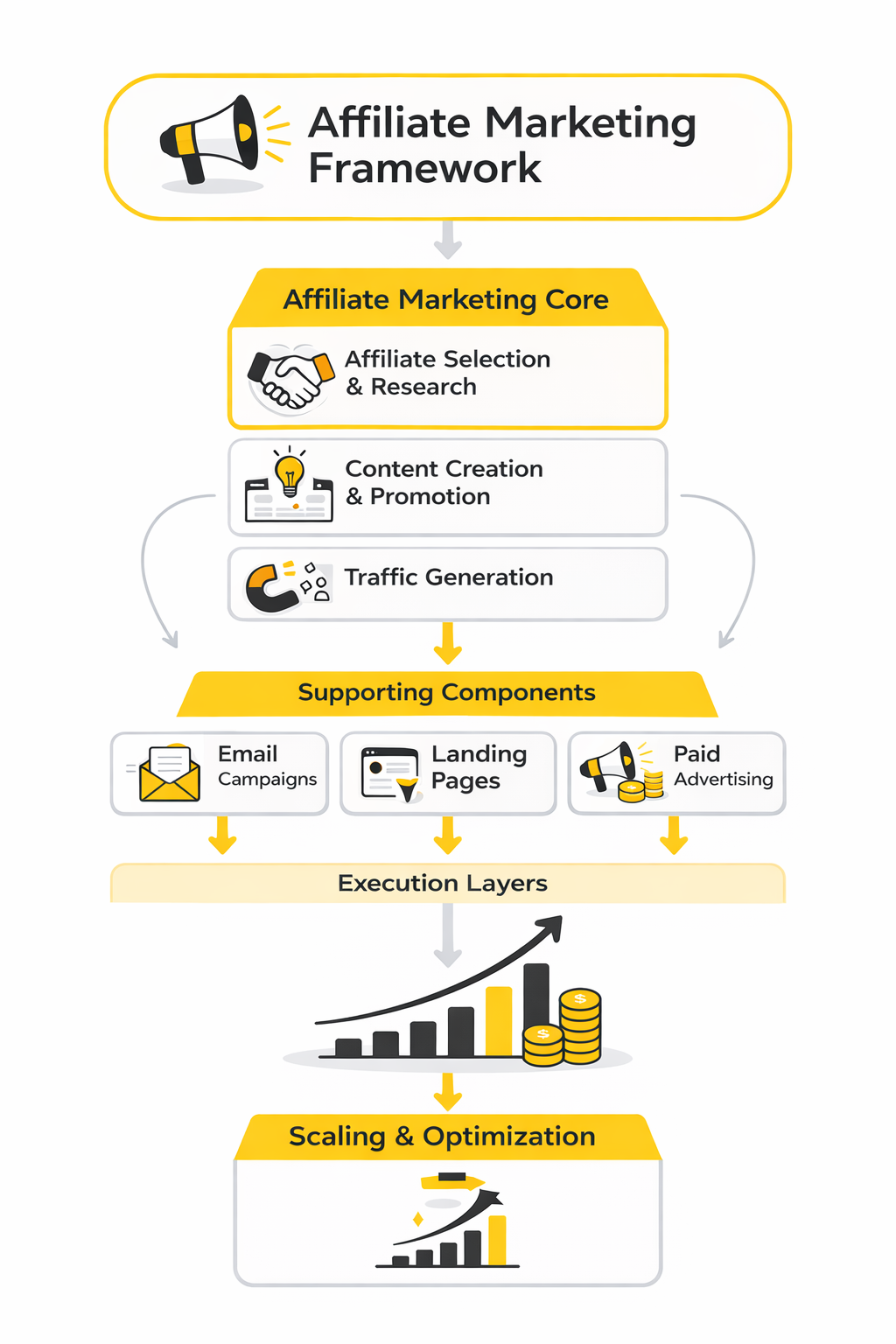
How the Affiliate Marketing Model Works
At its core, affiliate marketing is a referral system with attribution attached. A brand or merchant creates a program, an affiliate joins it, tracked links connect traffic to that affiliate, and commissions are paid when a defined action happens, usually a sale but sometimes a lead, free trial, or another conversion event. Networks and in-house programs both exist, which means the mechanics stay similar even when the platform changes.
The simple version sounds easy, but the real framework has four moving parts: audience, offer, content, and conversion path. You need a specific group of people with a recognizable problem, an offer that genuinely fits that problem, content that bridges uncertainty, and a path that moves someone from interest to action. When even one of those pieces is weak, affiliate marketing feels random because the business model is only as good as the alignment between them.
Here is the professional way to think about it. Your audience is not clicking because a link exists. They click because your page, video, newsletter, or post reduces friction, narrows options, or gives them confidence to buy now instead of later. That is why strong affiliate content usually wins through comparisons, testing, implementation advice, transparent tradeoffs, or curated recommendations rather than hype.
Commission structure matters too, but it is not the first variable to obsess over. Programs like Amazon Associates publish category-based commission rates, while platforms such as eBay Partner Network do the same through their own rate cards, which means payout depends heavily on niche, product type, and shopping behavior. Higher rates can look attractive, but a lower-paying offer with stronger buyer trust, better conversion, and cleaner retention often produces a better business in the long run. affiliate-program.amazon.com+3
The framework gets even stronger when you stop treating affiliate marketing as a link-placement game and start treating it as a systems game. A search article might capture high-intent traffic, an email tool can follow up with buyers who are still comparing options, and a landing page builder can tighten the path to action for readers who need more structure before they commit. That is where affiliate marketing begins to look less like a side hustle and more like a practical media and sales engine.
In the next part, we will break down the core pieces of a profitable affiliate system so you can see exactly what has to be in place before traffic and commissions become predictable.
The Core Pieces of a Profitable Affiliate System
Once you understand the mechanics, the next question is simple: what actually makes affiliate marketing work consistently instead of occasionally. The answer is not more links, more plugins, or more “top 10” posts. It is a system where the audience, the offer, the content, and the conversion path reinforce each other so tightly that the click feels like the obvious next step.
This is where a lot of affiliate marketers get exposed. They may have traffic, but the traffic is vague. They may have offers, but the offers do not match buyer intent. They may publish content, but the content does not reduce uncertainty, compare options clearly, or help a reader move from interest to action.
A profitable affiliate system usually has four parts working together:
- A specific audience with a visible problem
- An offer that fits that problem and the buyer’s budget
- Content that helps someone make a decision
- A conversion path that captures and nurtures intent
Get those four right and affiliate marketing becomes much easier to scale. Get even one wrong and the whole thing starts leaking.
Audience-Problem Fit Comes First
The most important part of affiliate marketing is not the affiliate program. It is the match between a real audience and a real problem. When you skip that step, you end up promoting tools or products because the commissions look attractive, not because the recommendation makes sense for the person reading.
That is why broad niches usually underperform unless they are broken into clear use cases. “Marketing software” is too wide to be useful on its own, but “email tools for a small creator business” or “simple funnel builders for selling a first digital product” creates a much tighter connection between the search intent and the offer. The clearer the use case, the easier it becomes to write content that sounds specific instead of generic.
This also lines up with how content actually gets distributed today. In Content Marketing Institute’s latest benchmark study, B2B marketers said they were relying heavily on organic social, blogs, email newsletters, and email itself, which tells you something important: affiliate content does not live in one channel anymore, and your audience definition has to survive across all of them. (Content Marketing Institute)
A practical way to test audience-problem fit is to ask one blunt question: would this reader feel relieved to find this recommendation right now. If the answer is weak, the niche is still too fuzzy or the angle is wrong.
Offer-Market Match Is More Important Than Commission Size
A common beginner mistake is choosing offers by payout first. It feels rational because affiliate marketing is performance-based, but high commissions do not rescue a weak offer. In most cases, a product with stronger trust, cleaner onboarding, lower friction, and a better fit for the audience will outperform a “high ticket” recommendation that feels forced.
This is why commission tables need context. Even large programs like Amazon Associates use category-based rates rather than one flat payout, which is a reminder that the economics of affiliate marketing vary widely by product type and buyer behavior. (Amazon Associates)
The better question is not “What pays the most?” but “What is easiest for this audience to say yes to?” For a creator who needs a fast way to launch a funnel, a tool like ClickFunnels or Systeme.io may fit better than a heavier all-in-one stack. For someone who mainly needs email automation without extra complexity, Brevo or Moosend can be easier to recommend because the product solves a narrower, clearer problem.
That kind of fit matters because trust compounds. If the first recommendation works, readers are far more likely to take your next recommendation seriously. That is the beginning of a real affiliate business.
Content Has to Reduce Friction, Not Just Attract Clicks
This is where a lot of affiliate content still goes wrong. It aims to rank, but it does not actually help. A page can bring in visits and still fail badly if the reader leaves with the same uncertainty they had before they landed there.
Google’s current review guidance is very clear on what useful review and recommendation content should do. It should evaluate from a user’s perspective, demonstrate expertise, include evidence of real experience, share meaningful measurements, compare alternatives, and explain pros and cons in a way that helps someone decide. (Google Search Central)
That has a direct implication for affiliate marketing. The job of your content is not to announce that a product exists. The job is to answer the questions that stop a buyer from moving forward. Is this tool good for beginners? Is it overkill for a solo business? What breaks when you outgrow the cheap plan? What are the tradeoffs versus competitors?
The strongest affiliate content usually falls into a few reliable formats:
- Detailed reviews with evidence and real limitations
- Comparison pages built around a clear buying decision
- Tutorials that show implementation, not theory
- Best-for lists with obvious selection criteria
- Email follow-ups that help readers choose after the first visit
That last one matters more than many people realize. The same CMI research shows email newsletters and direct email remain major content distribution channels, which is one reason smart affiliate marketers build an owned audience instead of relying only on search traffic. (Content Marketing Institute)
Conversion Infrastructure Separates Casual Promotion From Professional Execution
A lot of affiliate marketers spend months on content and almost no time on the path that turns interest into action. That is backwards. If someone clicks through your content and then hits a weak landing page, confusing CTA, or no follow-up sequence at all, you have not built a system. You have built a leak.
Professional implementation usually means you give the reader one clean next step. That might be a comparison table, a short CTA under a tutorial, an email opt-in tied to a buying guide, or a dedicated landing page that frames the offer more clearly. The exact setup depends on the offer, but the principle stays the same: fewer distractions, stronger relevance, cleaner intent.
This is where funnel and email tools can earn their place in affiliate marketing. If your strategy involves lead capture and nurture before the sale, a simple landing-page setup using ClickFunnels or Systeme.io can make the path easier to manage. If your content model depends on newsletters, product updates, and follow-up recommendations, Brevo or Moosend fit naturally because they help you keep warm intent alive after the first click.
You do not need an elaborate stack at the beginning. You do need a usable one. A basic affiliate system often looks like this: content brings in intent, an email capture keeps the relationship going, a structured follow-up answers objections, and then the affiliate offer is placed where the decision makes sense. Simple beats messy here every single time.
Trust Is Not a Bonus Layer
At this point, you can probably see the pattern. Every part of strong affiliate marketing is really a trust decision in disguise. Audience fit builds trust because the recommendation feels relevant. Offer fit builds trust because you are not forcing the wrong tool on the wrong person. Good content builds trust because it answers the hard questions instead of dodging them.
That is why weak affiliate businesses tend to plateau. They chase traffic before they earn confidence. They optimize clicks before they clarify the value. They talk like promoters when they should be acting like decision-support publishers.
A profitable affiliate system does the opposite. It respects the reader’s hesitation, gives them enough context to choose well, and makes the next step feel useful rather than pushy. That is the foundation you want before you worry about scaling traffic.
Choosing Offers That Fit Your Audience
With the system in place, the next move is selecting offers with more discipline. This is where affiliate marketing starts to look less like content production and more like strategic filtering. The best affiliates are not the ones with the biggest catalog of links. They are the ones who know exactly which offers deserve a recommendation and which ones would quietly damage trust even if they converted in the short term.
In the next part, we will break down how to evaluate affiliate offers properly, how to spot the difference between a good product and a good payout, and how to build a recommendation stack that feels natural to the reader instead of salesy.
Choosing Offers That Fit Your Audience
Once the system is clear, the next step in affiliate marketing is filtering the offers you promote. This sounds obvious, but in practice it is where many affiliate businesses quietly fail. A weak product recommendation might produce a few short-term commissions, but it slowly erodes credibility, which is the real engine behind long-term affiliate revenue.
The strongest affiliates approach offers almost like editors selecting stories. They are selective, intentional, and protective of their audience’s attention. Instead of promoting dozens of products, they build a small stack of tools, services, or platforms that solve the most important problems their readers face.
That discipline matters because affiliate-driven commerce is expanding rapidly. Industry tracking from Statista shows affiliate marketing spending has continued to grow globally as brands rely more heavily on performance partnerships instead of pure advertising channels. When more companies compete for affiliate promotion, the ability to choose wisely becomes an advantage.
Evaluate the Product Like a User, Not a Promoter
A practical rule in affiliate marketing is simple: you should understand the product well enough to explain where it fails. If you cannot clearly describe the limitations, you probably do not know the product deeply enough to recommend it.
That evaluation usually revolves around four questions:
- Does the product solve a clear problem for your audience?
- Is the learning curve reasonable for the people you serve?
- Does the company behind it maintain the product actively?
- Would you still recommend it if commissions disappeared tomorrow?
A surprising number of affiliate promotions collapse on the second question. Tools that look powerful often overwhelm beginners, which leads to refunds, churn, and frustrated readers. In contrast, tools that prioritize usability frequently convert better even with lower commissions because they remove friction from the decision.
For example, creators who want to launch a simple funnel without a complicated stack often prefer platforms like ClickFunnels or Systeme.io because they package landing pages, automation, and checkout flows in a way beginners can implement quickly. The recommendation works not because of the affiliate payout but because the product aligns with a real starting point.
Look for Signals of Long-Term Stability
Affiliate marketing becomes fragile when the underlying product disappears, downgrades its program, or damages its reputation. That is why professional affiliates evaluate the business behind the product, not just the product itself.
Signals worth paying attention to include:
- Active development and regular feature updates
- Clear support channels and documentation
- Transparent affiliate program terms
- Positive long-term user feedback
- Sustainable pricing rather than aggressive discount cycles
Companies investing in their ecosystem are easier to promote because they treat affiliates as partners instead of short-term traffic sources. Many software companies even provide partner dashboards, onboarding resources, and educational material that help affiliates produce better content.
That ecosystem matters more than it might seem. A product with good documentation and tutorials allows you to create richer affiliate content such as walkthroughs, setup guides, or comparison articles. Those formats tend to convert better because they remove uncertainty during the decision process.
Align the Offer With Buying Intent
The best affiliate marketing content connects with a reader at the moment they are trying to decide. That moment might be a search query comparing two tools, a tutorial explaining how to launch a newsletter, or a social post describing the exact workflow someone wants to replicate.
When the content and the offer line up with that decision moment, the recommendation feels helpful instead of promotional.
For instance, a creator researching email marketing platforms usually cares about three things: ease of use, automation capabilities, and deliverability. Recommending tools such as Brevo or Moosend in a tutorial about launching an email list makes sense because the reader is already in the decision phase. The affiliate link simply becomes the most convenient next step.
This alignment is where affiliate marketing becomes powerful. Instead of pushing offers, you place them exactly where they solve a problem.
Professional Implementation: Turning Strategy Into a System
Choosing the right offers is only half the work. The real shift happens when affiliate marketing becomes a repeatable workflow instead of a random collection of posts and links.
Professional affiliates usually operate with a structured pipeline that connects research, content creation, and conversion optimization.
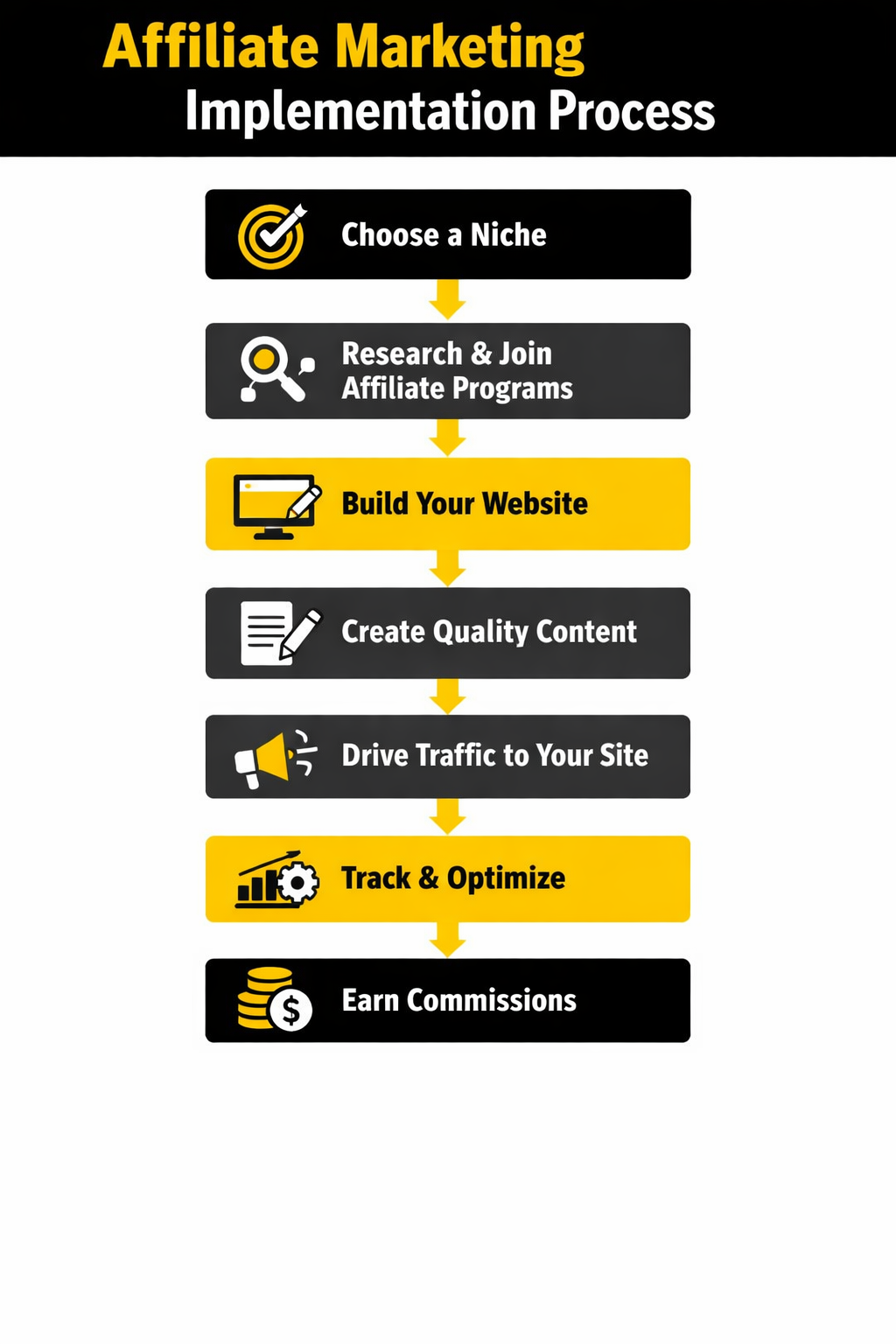
A simple implementation process often looks like this:
- Identify a high-intent topic Start with a problem people actively search for. Product comparisons, setup tutorials, and decision guides usually work well because they capture users close to a purchase.
- Research the decision criteria Before writing, map out what the reader needs to know to choose confidently. This might include price comparisons, learning curves, integrations, or long-term limitations.
- Create decision-support content Instead of writing promotional copy, focus on helping someone evaluate their options. The more useful the evaluation, the more natural the affiliate link becomes.
- Build a conversion path Add clear next steps where they make sense. That might be a tool recommendation, a landing page explaining the workflow, or an email sequence expanding on the topic.
- Capture long-term audience value Smart affiliate marketers do not rely on a single visit. They capture emails, build communities, or use newsletters to continue helping the audience solve related problems.
Turning One Article Into a Conversion Asset
A well-built affiliate page is rarely just a blog post. It functions more like a small decision engine. The article introduces the problem, explores the options, explains tradeoffs, and then shows the reader how to move forward.
Some affiliates strengthen that path with dedicated landing pages. Platforms like ClickFunnels allow you to structure the next step more clearly when a visitor needs a guided walkthrough rather than a standard article.
Others extend the relationship through email. When someone subscribes to a guide or checklist, a short sequence can expand on the original topic, answer common objections, and introduce tools that genuinely solve the problem being discussed.
That approach transforms affiliate marketing from a passive link strategy into an active content ecosystem. Instead of hoping readers click a link, you guide them through a process that helps them reach a confident decision.
Building Traffic, Trust, and Conversion Paths
With the implementation framework in place, the next step is getting consistent traffic and building the trust that turns readers into buyers. Traffic without trust rarely converts, and trust without visibility rarely grows.
In the next section, we will explore the channels that actually drive sustainable affiliate marketing today, how to build authority within a niche, and how to create conversion paths that continue working long after the first visitor arrives.
Building Traffic, Trust, and Conversion Paths
Once your affiliate marketing system is live, the next challenge is not publishing more for the sake of it. It is getting the right people into the system, earning enough trust to influence a buying decision, and making the next step obvious without sounding aggressive. This is where a lot of affiliate content underperforms, not because the offer is bad, but because the path between discovery and action is too weak.
Search remains one of the strongest channels because it captures demand that already exists. Someone searching for a comparison, a review, or a setup guide is much closer to a decision than someone casually scrolling social media. That is also why Google’s review guidance matters so much for affiliate marketing: pages that evaluate products clearly, show evidence, explain tradeoffs, and help users compare options are far more aligned with what both readers and search systems want to surface. (Google Search Central)
Trust is built when your content behaves like a decision aid instead of a pitch. That means being explicit about who a product is for, who should avoid it, where pricing gets tricky, and what happens after the signup. It also means disclosing affiliate relationships clearly, because the FTC’s endorsement rules still treat affiliate recommendations as advertising when a material relationship exists, and readers are quicker to trust transparent content than content that hides incentives. (FTC endorsement guidance)
Conversion paths should feel like useful next steps, not interruptions. If the article is about launching a simple sales funnel, linking to ClickFunnels or Systeme.io makes sense because the reader is already thinking about execution. If the page is about email setup, Brevo or Moosend fits naturally because the click continues the workflow the reader came to solve.
The important point is this: traffic, trust, and conversion are not three separate jobs. In good affiliate marketing, they reinforce each other. Better content attracts more qualified visitors, qualified visitors convert more easily, and stronger conversions tell you which content deserves more investment.
What the Numbers Actually Tell You
A lot of affiliate marketing advice throws statistics around as if scale alone proves a strategy works. That is lazy. The numbers only become useful when they help you make better decisions about content, offers, and distribution.
At the market level, affiliate marketing is clearly not shrinking into irrelevance. eMarketer projects US affiliate marketing spend to exceed $12 billion in 2025, while affiliate-driven ecommerce sales are forecast to move past $210 billion in the same year. (eMarketer spend forecast) (eMarketer ecommerce forecast) Those numbers matter because they show brands are still investing in the channel and because they confirm that affiliate marketing is no longer a side tactic sitting outside the main revenue engine.
But market growth does not mean your content will work automatically. It means competition is real, expectations are higher, and weak execution gets exposed faster. Awin’s 2025 industry outlook highlights the growing role of creators, editorial publishers, AI-assisted workflows, and broader partnership models, which tells you the channel is becoming more sophisticated, not easier. (Awin 2025 trends) In plain English, the days of generic review pages doing all the heavy lifting are fading.
This is why internal performance data matters more than headline industry stats. Your article does not need to beat the whole market. It needs to beat your own baseline.
The Metrics That Deserve Your Attention
Most affiliate marketers track too little or track the wrong things. They look at clicks and commissions, then wonder why growth feels random. Clicks matter, but clicks without context can mislead you badly.
The more useful performance signals usually look like this:
- Qualified traffic Not all pageviews are equal. A thousand visitors from a vague keyword can be less valuable than a hundred visitors from a high-intent comparison query.
- Affiliate click-through rate This shows whether the recommendation is positioned clearly enough for readers to act. A weak click-through rate often points to unclear framing, poor CTA placement, or an offer mismatch.
- Merchant-side conversion rate This tells you whether the traffic you send is actually aligned with the product. Strong content cannot fully rescue a weak sales page or a poor-fit offer.
- Earnings per click This helps you compare offers more intelligently than raw commission totals. A lower-commission product can still win if it converts reliably.
- Content-assisted email signups This is easy to ignore and expensive to ignore. If your article also builds your list, the page may be more valuable than its immediate affiliate revenue suggests.
- Refunds, reversals, or invalidated commissions These numbers often reveal a trust problem before revenue dashboards do. If reversals stay high, the issue may be the offer, the audience match, or how the recommendation is framed.
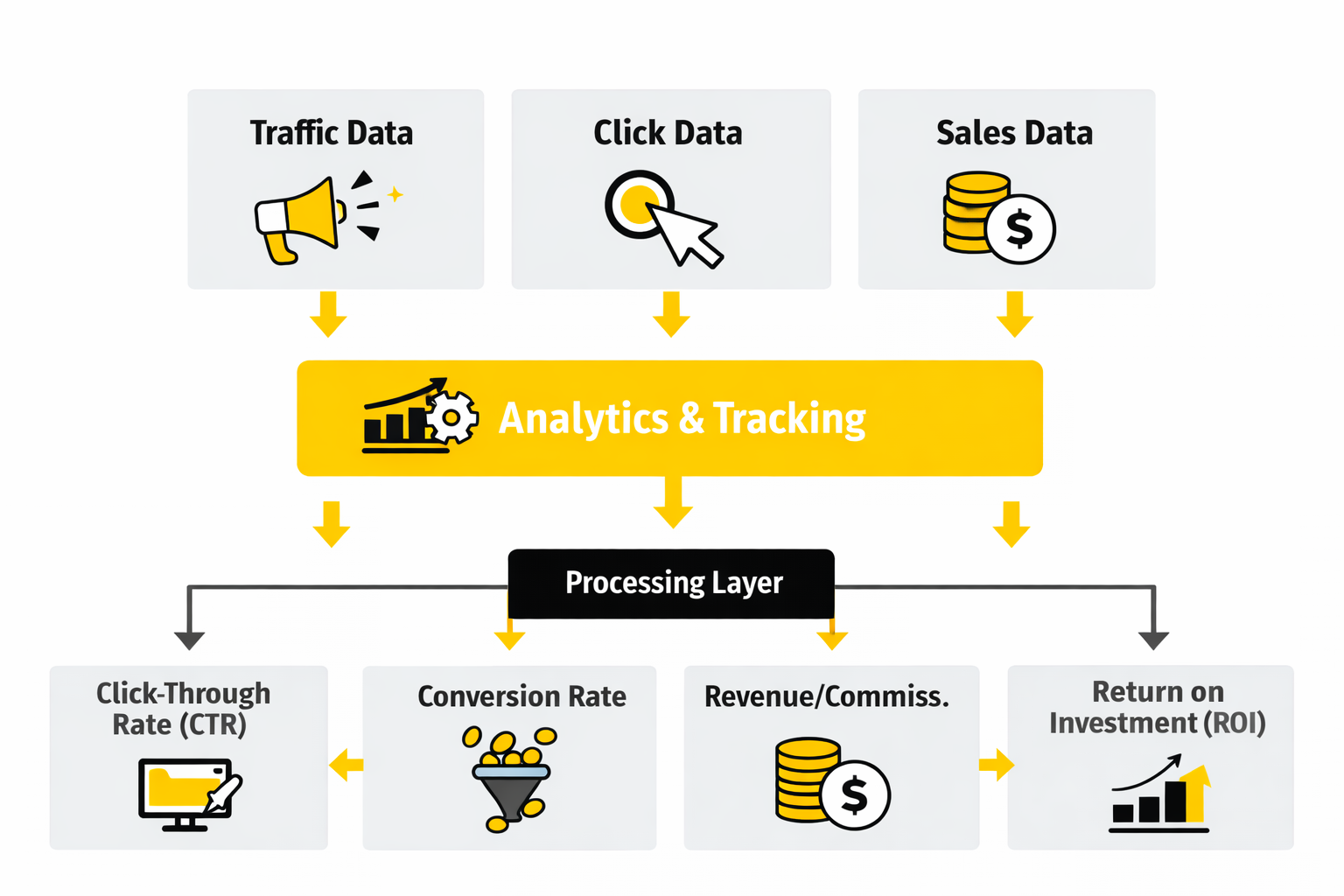
A good analytics system connects these metrics in sequence. Traffic tells you whether people are finding the page. Click-through rate tells you whether the recommendation is compelling. Merchant conversion tells you whether the offer and audience are aligned. Earnings per click tells you whether the whole path is commercially worth scaling.
That sequence matters because it tells you what to fix first. If traffic is healthy but affiliate clicks are weak, the problem is probably on the page. If clicks are strong but conversions are weak, the issue is likely the offer, the merchant experience, or the fit between reader intent and destination.
Benchmarks Are Useful Only When They Change Behavior
The biggest mistake people make with affiliate marketing benchmarks is treating them like universal truth. They are not. A software comparison article and a consumer product roundup can behave completely differently even when both technically belong to affiliate marketing.
What benchmarks can do is stop you from making bad interpretations. For example, a low click-through rate is not automatically bad if the page’s real job is to collect email signups before the recommendation happens later. A strong click-through rate is not automatically good if the merchant conversion rate collapses because the traffic is curious but unqualified.
This is also why channel-level data matters. Content Marketing Institute’s latest research shows marketers continue to rely heavily on blogs, organic social, email newsletters, and email itself for distribution, which reinforces a simple truth for affiliate businesses: you should not evaluate a page only as a one-visit transaction. (Content Marketing Institute research) Some pages generate direct commissions, while others earn the email subscriber who converts weeks later.
The action this should drive is straightforward. Benchmark against the role of the asset, not just against a random internet average. A buyer’s guide should be judged differently from a newsletter lead magnet or a tutorial designed to warm up first-time visitors.
What Healthy Affiliate Performance Usually Looks Like
Healthy affiliate marketing performance usually shows up as consistency before it shows up as scale. A page begins ranking for the right intent, affiliate clicks stabilize, at least one offer starts converting reliably, and the content either produces direct revenue or feeds a broader email or funnel system. That is the kind of data pattern you can build on.
Unhealthy performance has a different shape. Traffic may spike, but clicks stay flat. Clicks may rise, but conversions lag. Revenue may show up briefly, but refund patterns or commission reversals make the gains look better than they really are. When that happens, the right response is not “publish more.” It is diagnose the leak.
This is where simple infrastructure helps. A clean tracking setup, link management, and post-click measurement make affiliate marketing less emotional because you can see where the drop-off happens. Tools like Dub can help with cleaner link tracking and campaign visibility, while a structured email layer with Brevo or Moosend helps you measure value beyond the first visit when your model depends on nurture rather than immediate purchase.
Data Should Make You More Selective, Not More Reactive
The point of analytics in affiliate marketing is not to create a dashboard obsession. It is to make your next decision sharper. Good data tells you which topics deserve expansion, which offers deserve replacement, and which pages need a stronger conversion path.
That usually leads to practical actions:
- Update high-intent pages with clearer comparisons and stronger CTAs
- Replace offers that get clicks but do not convert
- Add email capture where readers need more time before buying
- Expand topic clusters around pages already producing qualified traffic
- Remove promotions that create distrust, confusion, or weak post-click performance
This is the part many people skip, and it is exactly why their affiliate marketing stays inconsistent. They collect numbers but do not let the numbers change the system. The real advantage comes when you use performance signals to become more disciplined, not more busy.
Measuring Performance, Staying Compliant, and Scaling
Once you can read the data properly, the next step is turning that insight into durable growth without creating legal, platform, or trust problems on the way up. This is where affiliate marketing either matures into a real business or starts breaking under its own shortcuts.
In the next part, we will look at how to scale responsibly, how compliance affects performance more than most people realize, and how to grow an affiliate business without undermining the trust that made it work in the first place.
Measuring Performance, Staying Compliant, and Scaling
The moment affiliate marketing starts working, the game changes. Early on, the problem is usually getting traction at all. Later, the problem becomes protecting what works while expanding it without wrecking trust, attracting compliance issues, or building a business that collapses when one traffic source shifts.
This is where a lot of people make the wrong move. They see a page convert, then immediately clone the format across dozens of keywords, stack more offers into each article, and start optimizing for volume before they have protected quality. In a market where brands are investing more heavily in partnerships and where publishers, creators, and technology partners are all competing for the same buyer attention, scale without discipline is usually where performance starts to decay. (eMarketer affiliate spend forecast) (Awin 2025 trends)
Compliance Is Part of Conversion, Not a Legal Afterthought
A lot of affiliate marketers still treat disclosure like a box to tick in the footer. That is a mistake. The FTC’s endorsement guidance is clear that material connections should be disclosed clearly and conspicuously, and that includes affiliate relationships when your recommendation may generate compensation. (FTC endorsement guidance) (FTC endorsements and reviews overview)
The practical reason this matters goes beyond legal hygiene. Readers can feel when a recommendation is trying to hide the incentive structure. A clear disclosure placed near the recommendation often strengthens trust because it signals confidence rather than evasiveness. In affiliate marketing, transparency is not what hurts conversions. Weak recommendations do.
Google’s ecommerce and review guidance reinforces the same broader principle from another angle: pages should be useful, well-structured, and built to help users make decisions, not just to push monetized links. (Google ecommerce best practices) (Google review content guidance) That means compliance and content quality are not two separate tracks. They are part of the same trust system.
The Real Risk Is Overdependence
One of the quiet dangers in affiliate marketing is concentration risk. A site can look healthy while being dangerously dependent on one merchant, one keyword cluster, one email sequence, or one traffic source. When that dependency is hidden, growth feels good right up until the day it does not.
This matters because affiliate programs change. Commission structures get revised, cookie windows change, product positioning shifts, and some programs disappear entirely. Large affiliate ecosystems themselves emphasize that tracking regulations, partner diversification, and broader partnership models are becoming more important, which is another way of saying the channel is maturing and fragile setups get exposed faster. (Awin trends and regulations coverage) (Awin 2025 trends)
The smart move is to diversify deliberately, not chaotically. That usually means having multiple monetization assets around the same audience problem rather than promoting unrelated offers just to “spread risk.” A creator-business audience, for example, might naturally support funnel tools like ClickFunnels, a lighter all-in-one option like Systeme.io, and email platforms like Brevo or Moosend. That is not random diversification. It is category-level resilience.
Scaling Content Without Watering It Down
The hardest scaling problem in affiliate marketing is keeping the content useful while increasing output. Most sites do not fail because they publish too little. They fail because they publish more than they can support with real judgment.
Google’s review documentation keeps pointing back to evidence, expertise, meaningful comparison, and decision-support value. (Google review content guidance) That creates a real operational tradeoff. You can scale volume fast, or you can scale trustworthy evaluation carefully. Doing both well requires process.
A stronger scaling model usually includes a few non-negotiables:
- A fixed editorial standard for what counts as a publishable recommendation
- A repeatable evaluation framework for every product reviewed
- Scheduled refreshes for money pages and comparison content
- Clear separation between informational content and decision-stage content
- Post-publish monitoring tied to clicks, conversions, reversals, and subscriber value
This is where tools can help, but only if they support judgment instead of replacing it. Link-level visibility with Dub can help you see which calls to action are actually earning attention. A cleaner CRM handoff through something like Copper can matter when affiliate content supports a service-led business or B2B lead flow rather than just direct ecommerce clicks. But none of that fixes weak editorial standards. The tooling only amplifies the system you already have.
More Traffic Is Not Always the Best Growth Lever
At a certain point, expert affiliate marketing gets less obsessed with traffic and more obsessed with monetization efficiency. That shift matters. A page going from mediocre to excellent at matching intent can outperform a traffic increase, especially if the original audience was already qualified.
This is one reason email and owned distribution stay important. Content Marketing Institute’s latest benchmark study shows blogs, organic social, email newsletters, and email remain core distribution channels, which is a reminder that not every growth gain has to come from ranking for more keywords. (Content Marketing Institute 2025 benchmarks) Sometimes the best move is to convert more of the attention you already earned.
That usually leads to a more mature set of questions. Should this article add a lead magnet instead of another CTA? Should this comparison page split into separate intent-specific pages? Should this offer be replaced because its conversion rate looks fine but its churn makes the recommendation weaker over time? Those are growth questions too, and often better ones.
Advanced Tradeoffs Experienced Affiliates Learn the Hard Way
The longer you stay in affiliate marketing, the more you realize almost every big decision comes with a tradeoff. High-ticket offers can lift revenue per conversion but often demand more trust and better pre-sell content. Beginner-friendly tools can convert faster but may cap upside if the commissions are lower or retention is weaker. Broad content can attract more traffic, but focused content usually monetizes better because intent is tighter.
There is also a credibility tradeoff. The more aggressively every page is monetized, the harder it becomes to preserve the feeling that your content exists to help first and sell second. That does not mean you avoid strong commercial intent. It means you structure it carefully. A page should know its job.
Experienced affiliates also learn that some products are better for direct recommendation while others need a more guided path. A platform like ClickFunnels may work best after a tutorial or funnel blueprint because people often want context before committing. A simpler email solution like Brevo can fit more naturally inside a tactical setup guide. The lesson is not “push harder.” It is “match the recommendation to the buying psychology.”
What Responsible Scaling Actually Looks Like
Responsible scaling in affiliate marketing is not flashy. It usually looks boring from the outside, and that is a good sign. You expand topic clusters that already attract qualified traffic. You improve underperforming commercial pages before creating ten more. You remove offers that no longer deserve the placement. You keep disclosures obvious. You monitor program changes. You build more owned audience so the business is less exposed to platform shifts.
That is how affiliate marketing becomes an asset instead of a hustle loop. The business gets stronger because the system gets cleaner, not because the publishing calendar gets louder.
By this point, the core model should be clear. Affiliate marketing works when trust, intent, offer selection, content quality, and measurement all move in the same direction. When they do, growth becomes much less mysterious and much more manageable.
In the final part, we will bring everything together with a practical wrap-up and a focused FAQ covering the questions people still get wrong about affiliate marketing, from startup expectations to common mistakes and what actually matters in the first months.
Bringing the Whole Affiliate System Together
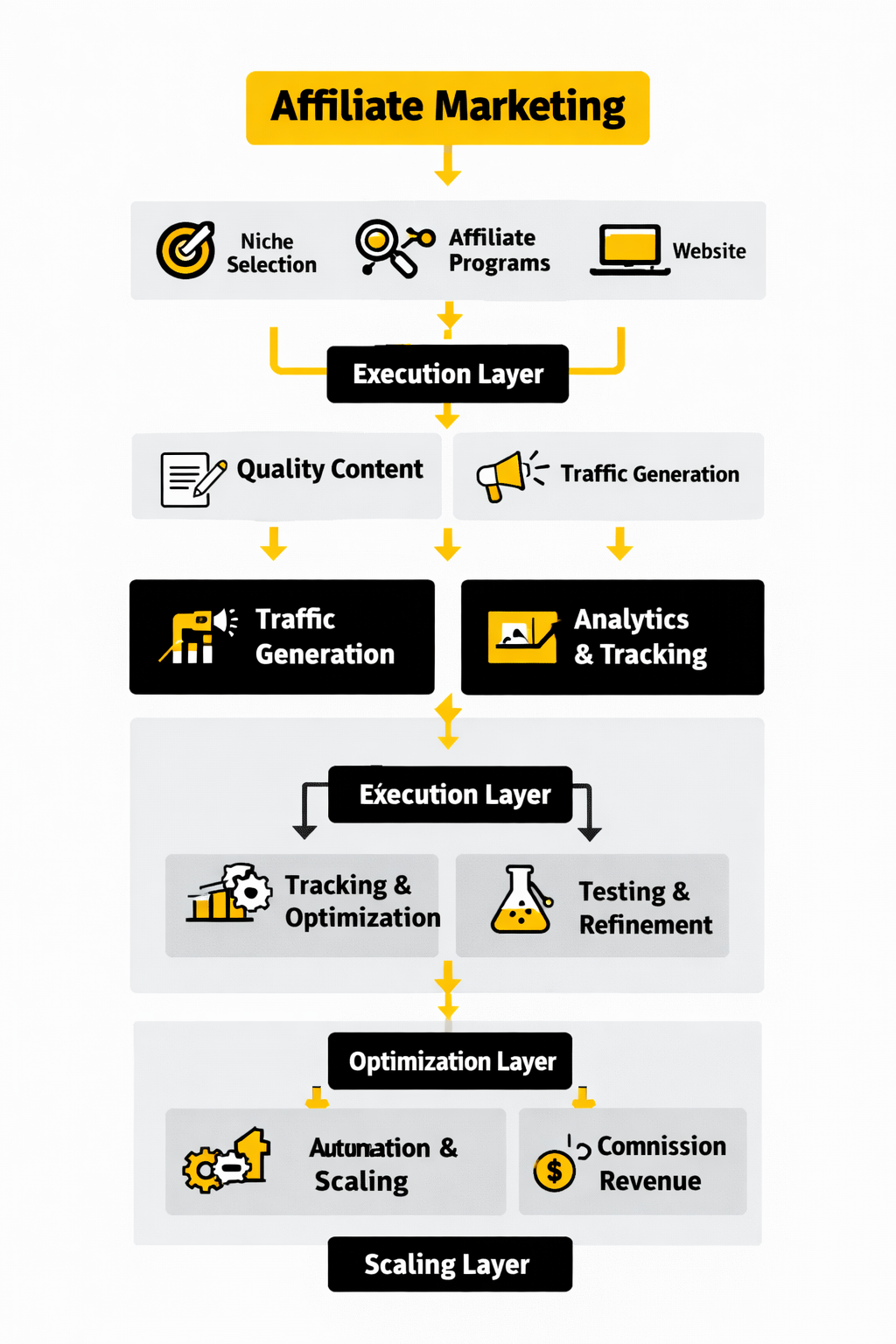
By this point, the pattern should be obvious. Affiliate marketing works best when it is treated like a real publishing and recommendation business, not a shortcut to easy commissions. The durable version combines audience fit, strong offer selection, useful content, measurable conversion paths, and enough discipline to keep trust intact while the system grows.
That is also why the channel keeps attracting serious attention from brands and publishers. Industry forecasts continue to show rising investment in affiliate and partnership-driven commerce, while large networks like Awin keep emphasizing creators, technology partners, and performance-led collaborations as core parts of the next phase of growth. (eMarketer affiliate spend forecast) (Awin 2025 trends) The opportunity is real, but it rewards people who build clean systems, not people who throw links at the internet and hope for the best.
What usually wins is not magic. It is a focused niche, content that genuinely helps someone decide, offers that deserve the recommendation, and a process that keeps getting sharper as the data comes in. That is the version of affiliate marketing that can compound.
FAQ - Built for Complete Guide
Is affiliate marketing still worth starting in 2026?
Yes, but only if you treat affiliate marketing like a business model built on trust and distribution rather than a hack. Brand investment in the channel is still growing, which is a strong signal that companies continue to see affiliate partnerships as a serious revenue engine. (eMarketer affiliate spend forecast) The easier money is gone, though, so the real opportunity now belongs to people who can publish useful content, match offers to intent, and build repeatable systems.
How long does affiliate marketing usually take to produce meaningful results?
It depends on the channel, the niche, and how strong your execution is, but affiliate marketing is usually slower than people expect at the beginning. Search-based content can take months to mature, while email- or social-led models can produce earlier signals if the audience trust already exists. The key is to watch qualified traffic, click-through rate, and conversion quality early, because those signals tell you whether the system is moving in the right direction before revenue becomes impressive.
Do I need a website to succeed with affiliate marketing?
No, but you do need a durable platform you control enough to build trust over time. A website is still one of the strongest assets because it supports search, evergreen reviews, comparison content, and email capture in one place. If you start on social or video first, that can work, but affiliate marketing becomes much safer when you also build an owned layer like a site or email list instead of depending entirely on rented attention.
What kind of content converts best in affiliate marketing?
The content that usually converts best is content that helps someone make a decision, not content that just attracts curiosity. Comparisons, tutorials, implementation guides, and high-quality reviews tend to work because they meet readers closer to the buying moment. Google’s own review guidance reinforces this by emphasizing user-focused evaluation, evidence, expertise, and meaningful comparison. (Google review content guidance) That is a strong clue about the type of affiliate content worth creating.
Should beginners start with high-ticket offers or simpler products?
Beginners usually do better with simpler products that solve a clear problem and are easy to explain. High-ticket affiliate marketing can absolutely work, but it requires stronger trust, better pre-sell content, and a cleaner conversion journey because the buying friction is higher. In practice, a lower-priced tool that fits the audience tightly often outperforms a more lucrative offer that feels like a stretch.
How many affiliate products should I promote?
Fewer than most people think. A tighter recommendation stack is usually better because it makes your content clearer and your positioning stronger. When every page pushes too many offers, affiliate marketing starts to feel noisy and readers lose confidence in whether you are curating solutions or simply monetizing attention.
Do affiliate disclosures reduce conversions?
Usually not when the recommendation is strong. FTC guidance makes it clear that material relationships should be disclosed clearly, and that applies to affiliate promotions just as much as other forms of endorsement. (FTC endorsement FAQ) In reality, honest disclosure often helps because it signals confidence and professionalism instead of trying to hide the business model.
What metrics matter most in affiliate marketing?
The most useful metrics are the ones that show where the system is strong or leaking. Qualified traffic, affiliate click-through rate, merchant-side conversion rate, earnings per click, and refund or reversal patterns tell a much better story than raw pageviews alone. Once you can read those numbers in sequence, affiliate marketing becomes less about guessing and more about improving the exact stage that is underperforming.
Is SEO still one of the best channels for affiliate marketing?
Yes, especially for high-intent content where the user is already comparing options or looking for implementation help. Search is powerful because it captures demand that already exists, which makes the transition from content to recommendation feel natural. The catch is that SEO-led affiliate marketing now demands better content quality, stronger evidence, and a more people-first approach than thin review pages could get away with years ago. (Google people-first content guidance) (Google ecommerce best practices)
Can email marketing improve affiliate revenue even if the sale does not happen on the first visit?
Absolutely, and this is one of the most underrated levers in affiliate marketing. Not every reader is ready to buy on the first click, which is why email can extend the decision process and recover value that would otherwise disappear. If your model depends on nurture, tools like Brevo or Moosend fit naturally because they help you follow up with useful content instead of hoping the first session does all the work.
What is the biggest mistake new affiliate marketers make?
The biggest mistake is confusing content volume with business quality. They publish too broadly, promote products they barely understand, and focus on commissions before they understand the reader’s actual problem. Affiliate marketing gets much easier once you slow down enough to choose a real audience, solve a real decision, and recommend fewer things better.
How do I know whether an affiliate offer is worth keeping?
Keep an offer when it fits your audience, converts cleanly, creates low friction after the click, and does not damage trust over time. Replace it when clicks are decent but conversions stay weak, refunds rise, or the product simply no longer deserves the recommendation. That is one of the most important expert habits in affiliate marketing: protecting the quality of the stack instead of getting emotionally attached to any single program.
Is it better to send traffic directly to an affiliate link or through a funnel first?
That depends on the complexity of the decision. Some offers convert fine from direct, well-placed recommendations inside strong content, while others need more context, comparison, or follow-up before the reader is ready. If the buying journey needs more structure, a simple funnel setup with ClickFunnels or Systeme.io can make affiliate marketing more effective by guiding people through a cleaner decision path.
Can affiliate marketing become a full business instead of just a side income stream?
Yes, but only when the system becomes resilient. That means diversified but relevant offers, strong content assets, owned audience channels, useful tracking, and clear compliance habits. The people who build full businesses with affiliate marketing are usually not chasing tricks anymore. They are operating a recommendation ecosystem with real editorial standards.
Work With Professionals
Explore 10K+ Remote Marketing Contracts on MarkeWork.com
Most marketers spend too much time chasing clients, competing on crowded platforms, and losing a percentage of every project to middlemen. MarkeWork gives you a better way. Browse thousands of remote marketing contracts and connect directly with companies desperate to hire skilled marketers like you, without platform commissions and without unnecessary gatekeepers.
If you're serious about finding better opportunities and keeping 100% of what you earn, explore available contracts and create a profile for free at MarkeWork.com.