

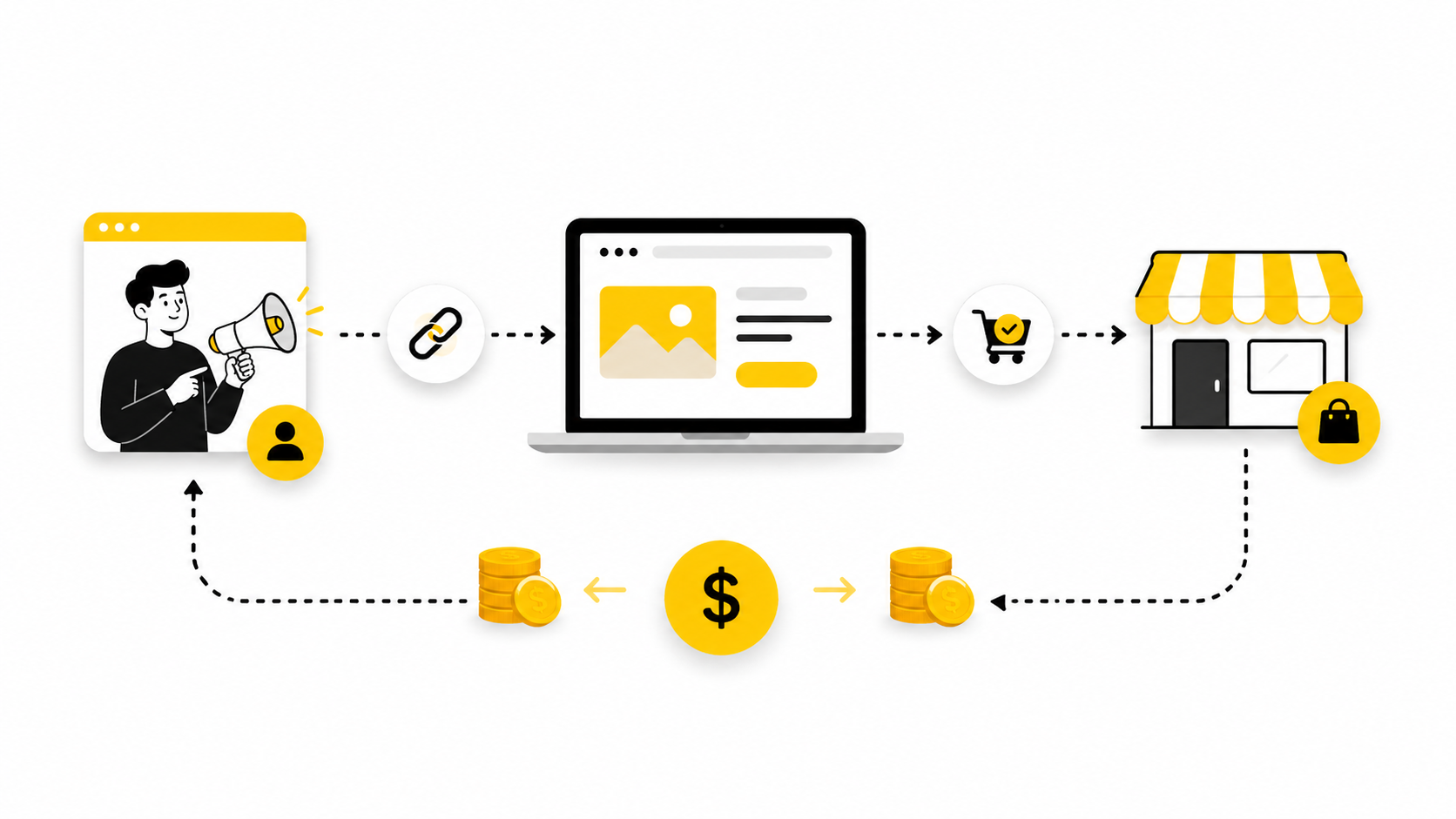
Affiliate marketing means earning a commission by recommending another company’s product, service, or offer and sending people to it through a tracked link. When someone clicks, signs up, books a call, starts a trial, or buys, the affiliate can get paid based on the program’s rules.
It sounds simple because the basic model is simple. The hard part is doing it well: choosing relevant offers, building trust, creating useful content, tracking performance, and staying transparent with readers.
Article Outline
- Affiliate Marketing Meaning
- Why Affiliate Marketing Matters
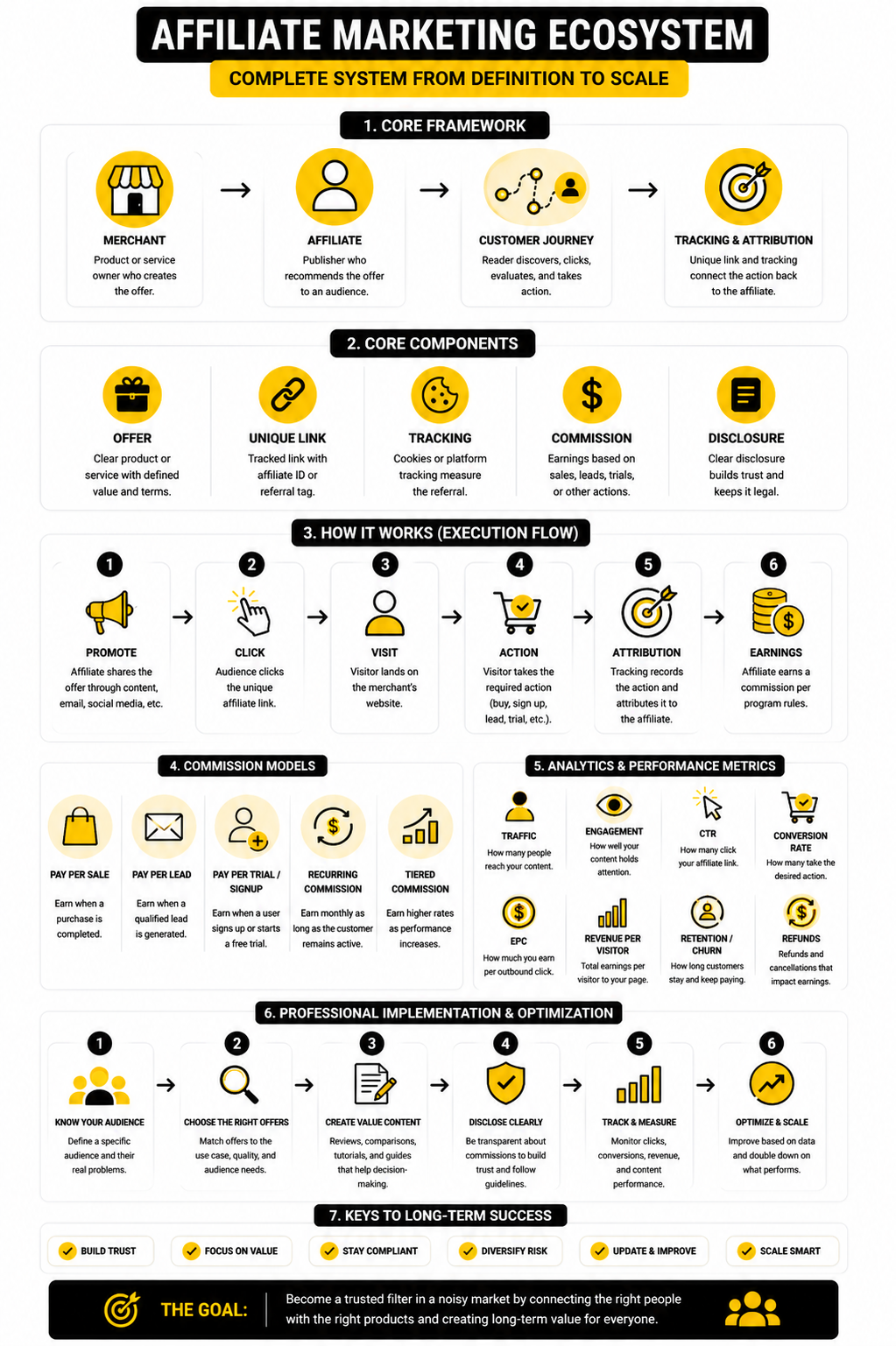
- The Affiliate Marketing Framework
- Core Components of Affiliate Marketing
- How Affiliate Marketing Works in Practice
- Professional Implementation
- Common Mistakes to Avoid
- Tools, Tracking, and Systems
- Affiliate Marketing Examples by Business Model
- How to Start Affiliate Marketing Step by Step
- FAQ
Affiliate Marketing Meaning
Affiliate marketing is a performance-based partnership between a business and a promoter. The business wants customers, leads, or traffic, and the affiliate earns money for helping create that result. In plain English, you recommend something useful, and if your recommendation drives a qualified action, you may earn a commission.
The key word is performance. Unlike a normal ad placement where a brand might pay upfront for exposure, affiliate marketing usually pays only when a measurable action happens. That action can be a sale, free trial, booked demo, app install, email signup, or another conversion defined by the affiliate program.
This is why affiliate marketing sits between content, sales, partnerships, and analytics. A good affiliate is not just dropping links everywhere. A good affiliate understands the audience, explains the offer clearly, and helps the reader make a better decision.
Why Affiliate Marketing Matters
Affiliate marketing matters because it gives businesses a lower-risk way to reach buyers through trusted third parties. U.S. performance marketing spend reached $13.62 billion in 2024, showing that brands continue to invest in partners who can drive measurable outcomes. That growth makes sense because companies want marketing channels that can be tied to revenue, not just impressions.
It also matters for creators, publishers, consultants, and niche experts. Affiliate marketing lets them monetize trust without always creating their own product from scratch. A useful tutorial, comparison, newsletter, video, or resource page can become an income asset when it connects the right person with the right solution.
But the trust part is non-negotiable. The FTC’s endorsement guidance says material connections that a meaningful share of consumers would not expect should be disclosed clearly and conspicuously, so affiliate recommendations need transparency, not hidden incentives FTC endorsement guidance. If the reader feels tricked, the model breaks.
The Affiliate Marketing Framework
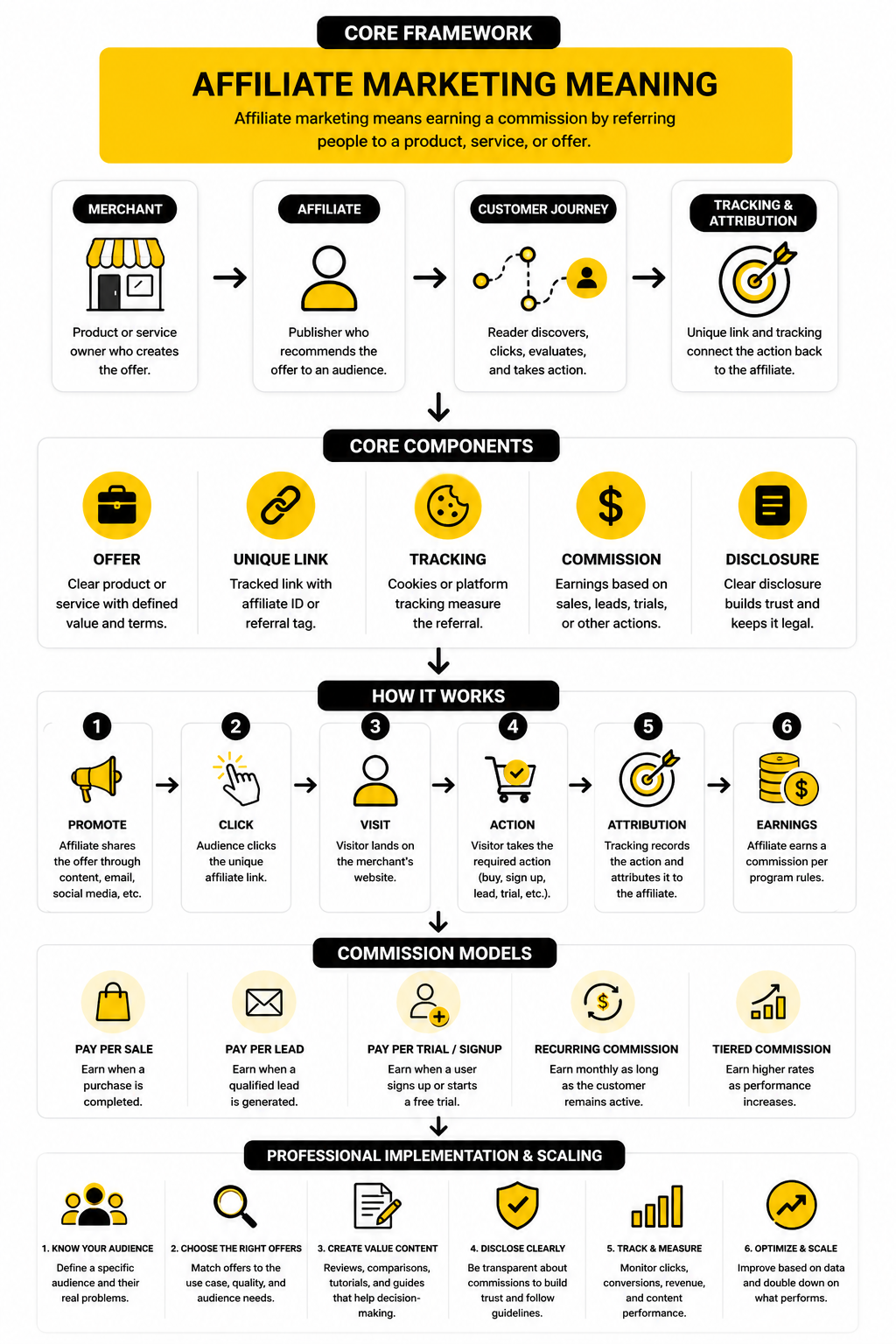
The simplest framework has four moving parts: the merchant, the affiliate, the audience, and the tracking system. The merchant owns the product or offer. The affiliate brings attention, context, and recommendation power.
The audience is the group of people who may need the offer. The tracking system connects the click or referral to the affiliate, usually through a unique URL, cookie, coupon code, referral ID, or platform dashboard. Without tracking, the business cannot attribute the result, and the affiliate cannot prove the commission.
A healthy affiliate setup creates value for all sides. The customer discovers a relevant solution, the merchant gains a customer, and the affiliate gets paid for a real contribution. That is the meaning of affiliate marketing when it is done properly: a measurable referral system built on relevance, trust, and conversion.
Core Components of Affiliate Marketing
Affiliate marketing has a few core components that show up in almost every program. Once you understand these, the whole model becomes much easier to read. The affiliate marketing meaning is not just “promote a link”; it is a system where each part has a specific job.
The first component is the merchant, sometimes called the advertiser, brand, vendor, or product owner. This is the company that owns the offer and decides what counts as a payable result. For example, a software company might pay for a new trial, while an ecommerce brand might pay only after a completed purchase.
The second component is the affiliate, also called the publisher, partner, creator, or referrer. This is the person or business that recommends the offer to an audience. Affiliates can be bloggers, YouTubers, newsletter writers, agencies, comparison sites, consultants, communities, or influencers.
The third component is the customer journey. Someone reads, watches, searches, compares, clicks, and eventually takes action. Strong affiliates understand that journey instead of treating every visitor like they are ready to buy immediately.
The fourth component is tracking and attribution. Affiliate links usually contain a unique partner ID, and many programs use cookies or platform-side tracking to connect the action back to the affiliate. This is what turns a normal recommendation into a measurable referral.
How Affiliate Marketing Works in Practice
In practice, affiliate marketing starts with an offer that has clear commercial intent. The merchant creates a program, sets the commission structure, defines the rules, and gives affiliates tracked links or assets. The affiliate then promotes the offer through content, email, social media, paid traffic, webinars, comparison pages, or direct recommendations.
The buyer does not usually pay extra because an affiliate link was used. The commission typically comes from the merchant’s marketing budget. That is one reason brands like the model: U.S. affiliate and partner marketing spend reached $13.62 billion in 2024, because companies can connect partner activity to measurable revenue more directly than many awareness channels.
For the affiliate, the process is more strategic than just adding links to a page. The offer needs to match the reader’s problem, budget, timing, and trust level. A random link creates noise, but a relevant recommendation can shorten the decision process.
For example, if someone is building a sales funnel, a practical recommendation like ClickFunnels fits naturally in a discussion about landing pages, checkout flows, and lead capture. If someone needs an all-in-one CRM and automation platform for an agency, GoHighLevel fits better because the use case is different. The recommendation only works when the context is right.
Commission Models
Affiliate programs can pay in different ways, and this matters because it changes the strategy. A one-time commission rewards a single conversion, while a recurring commission rewards long-term customer retention. Some programs also pay flat bounties for leads, demos, signups, app installs, or qualified sales opportunities.
The most common commission models are:
- Pay per sale, where the affiliate earns when a purchase happens.
- Pay per lead, where the affiliate earns when a visitor becomes a qualified lead.
- Pay per trial or signup, common in SaaS and subscription tools.
- Recurring commission, where the affiliate earns as long as the customer keeps paying.
- Tiered commission, where higher performance unlocks better rates.
The best model depends on the offer and the audience. A high-ticket B2B product may not need thousands of clicks if a few qualified leads are valuable. A low-cost consumer product may need more traffic, stronger conversion rates, and tighter content targeting.
Disclosure and Trust
Affiliate marketing only works long term when the reader understands the relationship. If you may earn money from a recommendation, say so clearly before the person clicks. The FTC’s endorsement guidance says material connections should be disclosed when they could affect how people evaluate the recommendation FTC endorsement guidance.
This is not just a legal checkbox. It is a trust signal. A simple sentence like “I may earn a commission if you buy through my link, at no extra cost to you” is much better than hiding the relationship in vague language.
Good disclosure does not weaken a recommendation when the content is useful. In many cases, it makes the recommendation stronger because the reader feels respected. The problem is not earning a commission; the problem is pretending there is no incentive when there clearly is.
Professional Implementation
Professional affiliate marketing starts with positioning, not links. Before choosing a product, you need to know who you are helping, what problem they are trying to solve, and where they are in the buying process. This is where many beginners get affiliate marketing wrong: they start with the commission instead of the customer.
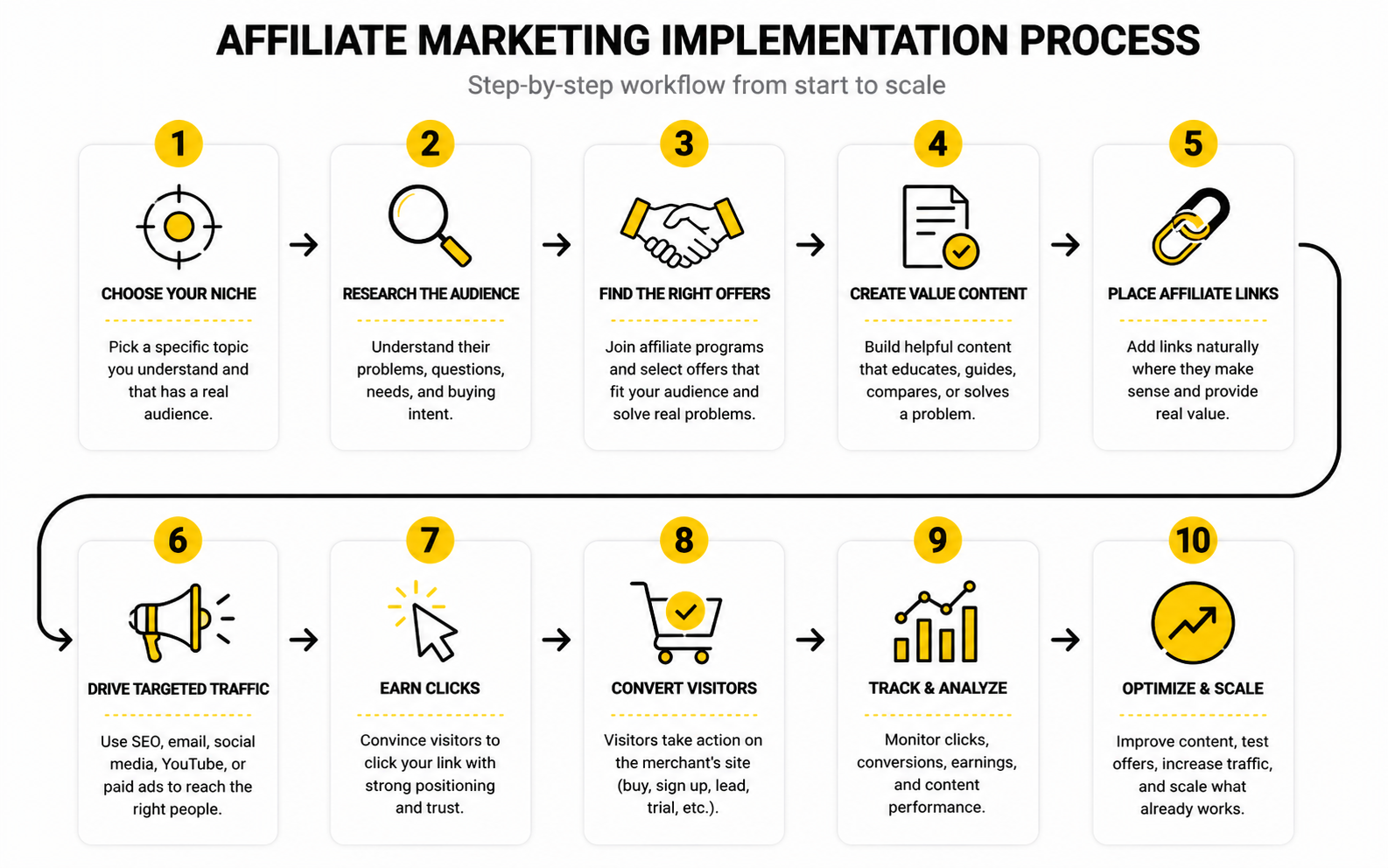
A strong implementation process turns affiliate marketing from random promotion into a repeatable system. You define the audience, choose offers that fit, create content around real decision points, disclose the relationship clearly, and track what happens after the click. That is the practical affiliate marketing meaning in a business context: a referral engine that can be measured, improved, and trusted.
The process looks like this:
- Choose one audience segment. Do not start with “everyone who wants to make money online.” Start with a specific group, such as ecommerce founders, local agencies, solo consultants, creators, coaches, or B2B service providers.
- Identify a painful problem. The best affiliate offers solve something urgent, expensive, annoying, or time-consuming. Weak offers need hype. Strong offers make sense because the problem is already obvious.
- Match the offer to the use case. A funnel builder, CRM, email platform, chatbot tool, booking tool, or landing page builder should appear only where it genuinely supports the reader’s next step.
- Create useful content around the decision. Reviews, comparisons, tutorials, checklists, setup guides, and “best tool for X” pages work because they meet people while they are actively evaluating options.
- Add clear disclosure. The reader should understand that you may earn a commission before they click. This protects trust and lines up with the FTC’s guidance on material connections FTC endorsement guidance.
- Track clicks, conversions, and revenue. If you cannot measure the result, you cannot improve the system. Track the content source, link placement, conversion rate, earnings per click, and refund or churn patterns where the program shares that data.
- Improve based on behavior. If people click but do not convert, the offer may not match the promise. If they read but do not click, the content may not create enough buying clarity.
Choosing the Right Affiliate Offers
The right offer is not always the one with the biggest commission. A large commission on a bad-fit product is still a bad recommendation. The better question is simple: would this tool genuinely help the person reading this page solve the problem they came here to solve?
Start by checking product relevance, reputation, pricing, support quality, refund policy, and commission terms. Look at whether the company has a real product, clear positioning, and a customer journey that will not make your recommendation look careless. If the brand feels unstable, confusing, or overly aggressive, be careful.
For example, a creator writing about funnel building could naturally discuss ClickFunnels, while an agency-focused article about client pipelines could point readers toward GoHighLevel. A newsletter or automation guide might fit Brevo, and a social media workflow article could naturally include Buffer. The point is not to mention every tool; the point is to match the offer to the reader’s intent.
Building Content Around Search Intent
Content is where affiliate marketing becomes useful instead of pushy. People rarely wake up wanting to click an affiliate link. They want to compare options, avoid mistakes, save time, understand pricing, or choose the right setup.
That is why search intent matters. A beginner searching “affiliate marketing meaning” needs a clear explanation and a practical mental model. Someone searching “best CRM for agencies” is much closer to choosing software, so the content can be more specific, more comparative, and more action-oriented.
Good affiliate content usually fits one of these formats:
- Educational content, where the reader is learning the concept.
- Comparison content, where the reader is choosing between options.
- Tutorial content, where the reader wants to implement something.
- Review content, where the reader wants a practical opinion before buying.
- Resource content, where the reader wants a curated shortlist.
Each format has a different job. Educational content builds trust. Comparison content clarifies trade-offs. Tutorial content proves usefulness. Review content reduces risk. Resource content saves time.
Statistics and Data
Affiliate marketing data is useful only when it helps you make better decisions. A big industry number proves the channel is real, but it does not tell you whether your page, offer, traffic source, or audience is working. That is the important distinction: market data gives confidence, but your own data gives direction.
The broader market is strong. U.S. affiliate marketing investment grew from $9.1 billion in 2021 to $13.62 billion in 2024, which shows that brands are still willing to pay for performance-based growth. That does not mean every affiliate wins automatically. It means competition is rising, tracking is becoming more important, and low-effort content is easier to ignore.
A useful analytics system should answer four simple questions. Where did the visitor come from? What did they read or watch before clicking? Which offer did they click? What happened after the click? When you can answer those questions, affiliate marketing stops feeling vague and starts becoming manageable.
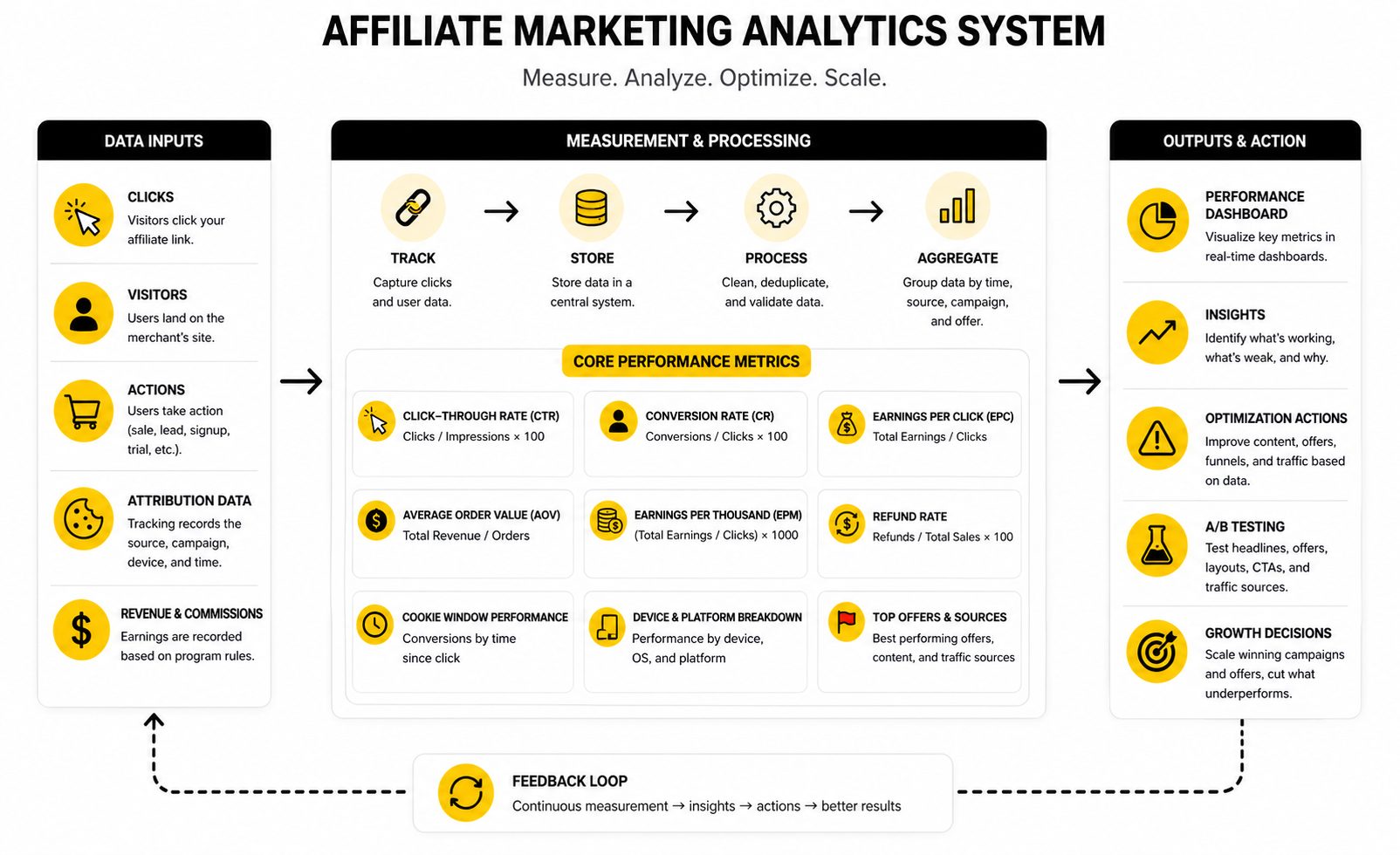
The cleanest way to measure performance is to separate the funnel into stages:
- Traffic, which shows how many people reached the content.
- Engagement, which shows whether the content held attention.
- Click-through rate, which shows whether the recommendation was compelling enough to earn a click.
- Conversion rate, which shows whether the merchant’s offer matched the visitor’s intent.
- Earnings per click, which shows how valuable each outbound click really is.
- Refunds, cancellations, or churn, which show whether the sale quality is actually good.
These numbers work together. A page with high traffic and low clicks may have weak positioning or poor offer placement. A page with strong clicks and weak conversions may be sending people to the wrong offer, the wrong pricing page, or a product that does not match the promise made in the content.
Performance Signals That Actually Matter
The first signal to watch is intent quality. A visitor searching “affiliate marketing meaning” is still learning, while a visitor searching “best funnel builder for coaches” is closer to making a decision. Both can be valuable, but they should not be judged by the same conversion expectations.
The second signal is click quality. A high click-through rate looks good, but it can be misleading if people click out of curiosity and never convert. A lower click-through rate from a highly specific comparison page can produce more revenue because the reader is further along in the buying process.
The third signal is revenue per visitor. This metric combines traffic, clicks, conversion rate, and commission into one practical number. If one article gets fewer visitors but earns more per visitor, it may deserve more updates, internal links, and promotion than a bigger traffic page with weak buyer intent.
Benchmarks Without the Guesswork
Benchmarks are useful as a sanity check, not as a target you blindly copy. Some affiliate campaigns convert at a fraction of a percent, while others convert much higher because the audience is warmer, the offer is clearer, or the traffic source is more qualified. Q1 2024 affiliate channel data showed conversion rates moving from 1.85% to 2.15% year over year, but that number only makes sense when you compare it to traffic type, product category, and content intent.
The real question is not “what is a good affiliate conversion rate?” The better question is “what should this specific page do better next?” A beginner guide may be judged by email signups, return visits, and assisted clicks, while a product comparison page should be judged by outbound clicks and tracked revenue.
For SaaS, tools, and service-based offers, recurring revenue also changes the math. A lower initial payout can still be attractive if the customer stays subscribed. That is why offers like GoHighLevel, Systeme.io, or Brevo need to be evaluated beyond the first conversion when the program gives you enough data.
What the Numbers Should Make You Do
Data should drive action, not decoration. If a page gets impressions but no traffic, improve the title, angle, and search relevance. If a page gets traffic but no clicks, improve the recommendation, comparison, placement, and call to action.
If clicks are strong but conversions are weak, check the fit between the content and the offer. Maybe the reader expected a beginner-friendly tool, but the landing page feels advanced. Maybe the price point is too high for that audience. Maybe the offer needs a better bridge, such as a tutorial, demo, checklist, or clearer explanation of who it is for.
If revenue is strong, do not just celebrate. Protect the asset. Update the content, test better link placement, add internal links from related pages, and make sure disclosure remains clear. The best affiliate marketers do not chase every shiny new offer; they double down on the pages and partnerships that already show proof.
Common Mistakes to Avoid
The biggest affiliate marketing mistake is treating trust like a renewable resource with no cost. It is not. If readers click because you overpromise, hide the commission, or recommend tools you do not understand, you may get a short-term bump, but you weaken the asset that makes affiliate marketing work in the first place.
Another common mistake is building pages that add no real value beyond a merchant’s own sales copy. Google’s spam policies specifically call out thin affiliate pages when they exist mainly to repeat program content without giving users something meaningfully useful Google Search spam policies. That matters because affiliate content has to earn attention, not just redirect it.
A third mistake is relying on one offer, one traffic source, or one ranking. This is risky because affiliate programs can change commissions, tracking windows, terms, product quality, and approval rules. A page that earns today can drop tomorrow if the brand changes its program or search visibility shifts.
Strategic Tradeoffs
Affiliate marketing looks simple from the outside, but every serious affiliate has to make tradeoffs. You can promote high-commission offers, but they may be harder to sell. You can promote low-friction tools, but the payout may be smaller. You can chase trending products, but evergreen problems usually create more durable content.
There is also a tradeoff between depth and volume. Publishing many shallow reviews may feel productive, but it rarely builds authority. A smaller set of genuinely useful pages can perform better because they answer the questions real buyers are already asking.
This is where the affiliate marketing meaning becomes more strategic. You are not just a traffic broker. You are building a decision layer between the reader and the market, and that layer has to be useful enough that people trust it before they click.
Scaling Without Losing Quality
Scaling affiliate marketing does not mean adding more links everywhere. It means building repeatable systems while keeping the recommendation useful. The more you grow, the more important your editorial standards become.
A good scaling system usually includes:
- A clear offer evaluation checklist.
- A disclosure standard used across every page.
- A content brief template for reviews, comparisons, and tutorials.
- A tracking naming system for links and campaigns.
- A regular update schedule for pages that drive clicks or revenue.
- A process for removing outdated, weak, or misleading recommendations.
The danger is that growth can make the content colder. If every page starts to sound like the same recycled product pitch, readers notice. Search engines notice too. Strong affiliate sites scale judgment, not just production.
Managing Risk
Affiliate marketing has operational risk, legal risk, platform risk, and reputation risk. Operational risk comes from broken links, expired offers, inaccurate claims, or dashboards that do not show the full customer journey. Legal and compliance risk comes from unclear disclosures, misleading claims, or ignoring a program’s terms.
Platform risk is just as real. Search algorithms change, social reach fluctuates, email deliverability shifts, and paid traffic rules can tighten quickly. If your whole strategy depends on one channel, you do not really have a business asset; you have a dependency.
Reputation risk is the one people underestimate most. If you recommend a poor-fit product because the payout is attractive, the reader blames you when it disappoints them. Protecting the relationship is more valuable than squeezing another link into the article.
Expert-Level Guidance
Advanced affiliate marketing is less about promotion and more about offer-market fit. The best affiliates understand the buyer’s moment of decision. They know what the reader has already tried, what they are afraid of, what alternatives they are comparing, and what would make them feel safe enough to move forward.
This is why expert affiliates often build supporting assets around the core recommendation. A software recommendation can be supported by a setup checklist, onboarding guide, use-case tutorial, or comparison table. For example, a tool like ManyChat fits better when the content explains how automated conversations support lead capture, follow-up, or social commerce instead of simply saying “try this chatbot.”
The same applies to funnel and CRM tools. ClickFunnels makes more sense in content about offers, landing pages, and checkout flows, while GoHighLevel fits better in agency systems, client management, automation, and pipeline-focused content. Relevance is what turns an affiliate link from a distraction into a useful next step.
The Long-Term Play
The long-term play is to become a trusted filter in a noisy market. People do not need more random recommendations. They need someone to explain what matters, what to ignore, and which option fits their situation.
That means your best affiliate assets should improve over time. Update screenshots, refresh claims, remove dead tools, test better calls to action, and keep the content aligned with the current product experience. A page that stays accurate for years can become far more valuable than a quick post chasing a temporary spike.
Affiliate marketing is not passive in the way beginners often imagine. It can become leveraged, yes. But the leverage comes from useful content, clean tracking, strong partnerships, and consistent maintenance.
Affiliate Marketing Examples by Business Model
Affiliate marketing looks different depending on the business model behind it. A creator promoting a simple tool to their audience has a different job than an agency building referral revenue around client workflows. The meaning stays the same, but the execution changes based on the customer journey.
For creators, affiliate marketing often works best when the recommendation supports content the audience already trusts. A newsletter writer might recommend an email platform, a YouTuber might recommend a camera or software stack, and a consultant might recommend the tools they use with clients. The affiliate link should feel like a useful next step, not a sudden sales pitch.
For agencies and service providers, affiliate marketing can become part of the delivery system. If an agency builds client funnels, booking flows, CRM pipelines, or automations, recommending tools like GoHighLevel, ClickFunnels, Fillout, or Cal.com can make sense when those tools are genuinely part of the solution. The clean version is simple: help the client choose better infrastructure, disclose the relationship, and keep the recommendation aligned with their needs.
For ecommerce, affiliate marketing often works through reviews, comparison pages, creators, newsletters, and shopping content. The buyer usually wants confidence before purchasing, so the affiliate’s job is to reduce uncertainty. That means showing fit, limitations, use cases, and alternatives instead of pretending every product is perfect.
For SaaS, affiliate marketing is usually more education-heavy. People need to understand the workflow before they buy the tool. That is why tutorials, setup guides, automation walkthroughs, and comparison content often work better than generic “best software” lists.
How to Start Affiliate Marketing Step by Step
Start with one audience and one clear problem. Do not begin by joining every affiliate program you can find. That creates scattered content, weak positioning, and recommendations that feel forced.
Then choose offers that match the problem closely. Review the product, commission terms, cookie window, payout rules, support quality, and refund policy. If the product is not strong enough to recommend without the commission, it is not strong enough to recommend with one.
Next, create content for the reader’s stage of awareness. A beginner needs definitions and frameworks. A buyer needs comparisons, use cases, pricing context, and implementation details. A current user may need tutorials, templates, or workflow upgrades.
Finally, measure what happens and improve the system. Track which pages bring clicks, which offers convert, and which content deserves updating. Affiliate marketing gets much easier when you stop guessing and start treating every article, email, and recommendation as part of a measurable system.
FAQ - Built for Complete Guide
What is the simple meaning of affiliate marketing?
Affiliate marketing means earning a commission by referring someone to a product, service, or offer through a tracked link or referral system. When that person takes the required action, such as buying, signing up, or booking a demo, the affiliate may get paid. The simple version is this: you recommend something useful, and the company rewards you for helping create the result.
Is affiliate marketing the same as advertising?
Affiliate marketing is a type of performance-based marketing, but it is not the same as traditional advertising. Traditional ads often charge for exposure, clicks, or placements, while affiliate marketing usually pays for measurable outcomes. That difference matters because the affiliate is rewarded for results, not just visibility.
How do affiliates get paid?
Affiliates usually get paid through a program dashboard, affiliate network, or direct partner agreement. Payment can be based on sales, leads, trials, subscriptions, or other qualified actions. The exact payout depends on the merchant’s rules, attribution model, refund policy, and payment schedule.
Do customers pay more when using an affiliate link?
In most cases, customers do not pay extra for using an affiliate link. The commission usually comes from the merchant’s marketing budget. Still, the affiliate should disclose the relationship clearly so the reader understands the recommendation may generate income.
Is affiliate marketing legal?
Affiliate marketing is legal when it follows advertising, disclosure, and consumer protection rules. The important part is transparency. If a recommendation includes a material connection, the FTC expects that connection to be disclosed clearly and conspicuously FTC endorsement guidance.
Is affiliate marketing good for beginners?
Affiliate marketing can be good for beginners because it does not require creating a product, handling fulfillment, or managing customer support. But it still requires real work. Beginners need to learn audience research, content creation, offer selection, disclosure, tracking, and conversion basics.
How long does affiliate marketing take to work?
Affiliate marketing can take weeks, months, or longer depending on the traffic source, content quality, niche, offer fit, and trust level. Paid traffic can produce faster feedback, but it also increases risk. Search, newsletter, and content-led affiliate strategies usually take longer but can become more durable over time.
What is the best type of affiliate content?
The best type depends on search intent and audience maturity. Beginner guides work well for education, comparison pages work well for buyers, and tutorials work well when the product needs explanation. Strong affiliate content helps the reader make a decision instead of simply pushing them toward a link.
What makes an affiliate offer worth promoting?
A good affiliate offer solves a real problem for a specific audience. It should have a clear use case, fair pricing, trustworthy delivery, reasonable commission terms, and a landing page that matches the promise made in your content. If the offer is hard to defend honestly, skip it.
Can affiliate marketing become passive income?
Affiliate marketing can become leveraged income, but calling it completely passive is misleading. Content needs updates, links break, programs change, rankings move, and products evolve. The income can become less tied to hourly work, but the system still needs maintenance.
What is the biggest risk in affiliate marketing?
The biggest risk is damaging trust. A bad recommendation can cost more than the commission is worth because readers remember who sent them there. Platform changes, commission cuts, tracking issues, and legal compliance also matter, but reputation is the asset you cannot replace quickly.
What tools help with affiliate marketing?
Useful tools depend on the workflow. Funnel builders like ClickFunnels, CRM systems like GoHighLevel, email platforms like Brevo, social scheduling tools like Buffer, and form tools like Fillout can support affiliate campaigns when they match the strategy. The tool is not the strategy, though. The strategy is matching the right offer to the right person at the right moment.
Work With Professionals
Explore 10K+ Remote Marketing Contracts on MarkeWork.com
Most marketers spend too much time chasing clients, competing on crowded platforms, and losing a percentage of every project to middlemen.
MarkeWork gives you a better way. Browse thousands of remote marketing contracts and connect directly with companies desperate to hire skilled marketers like you, without platform commissions and without unnecessary gatekeepers.
If you’re serious about finding better opportunities and keeping 100% of what you earn, explore available contracts and create a profile for free at MarkeWork.com.