

Affiliate networks sit quietly behind some of the most profitable online businesses today. They connect brands with publishers, track conversions, handle payouts, and ultimately make performance-based marketing scalable.
What’s changed in the last few years is scale. The global affiliate marketing industry is now valued somewhere between $17 billion and $20+ billion, with projections pushing far beyond that in the coming years (market growth data). In the U.S. alone, spending is approaching $12 billion annually, and more than 80% of brands now rely on affiliate partnerships to drive revenue (industry adoption insights).
This isn’t a side channel anymore. It’s a core revenue engine.
Affiliate networks are what make that engine run.
They remove friction, standardize relationships, and allow thousands of affiliates to promote products without direct one-on-one negotiation. Without them, scaling affiliate marketing would be chaotic at best and impossible at worst.
Article Outline
- What Affiliate Networks Actually Are
- Why Affiliate Networks Matter More Than Ever
- How Affiliate Networks Work (Framework Overview)
- Core Components of Affiliate Networks
- Choosing the Right Affiliate Network
- Advanced Strategies and Scaling with Affiliate Networks

What Affiliate Networks Actually Are
At the simplest level, affiliate networks are platforms that connect three key players: brands, affiliates, and the tracking infrastructure that makes the entire system measurable.
They act as a centralized marketplace where companies can list their offers and affiliates can choose what to promote. Instead of negotiating individual deals with every creator or publisher, brands plug into a network and instantly gain access to thousands of potential partners.
For affiliates, the benefit is just as clear. Rather than chasing brands manually, they can log into one dashboard and access multiple programs, track performance, and manage payouts in one place.
This structure is what turns affiliate marketing into a scalable system instead of a fragmented mess.
Why Affiliate Networks Matter More Than Ever
Affiliate networks have become essential because of one simple shift: marketing has moved toward performance.
Brands no longer want to pay for impressions or vague awareness. They want measurable results. Affiliate marketing delivers that because payouts are tied directly to actions like clicks, leads, or sales.
The numbers reinforce this shift. Affiliate marketing now drives over $210 billion in U.S. ecommerce sales annually (ecommerce impact data), and businesses often generate multiple dollars in revenue for every dollar spent.
That level of efficiency is hard to ignore.
Affiliate networks make this possible by:
- Standardizing tracking across thousands of partners
- Automating commission payments
- Providing real-time performance data
- Reducing fraud and attribution errors
Without networks, managing even a small affiliate program becomes operationally overwhelming.
How Affiliate Networks Work (Framework Overview)
Behind the scenes, affiliate networks follow a predictable framework. Once you understand it, everything else in affiliate marketing starts to make sense.
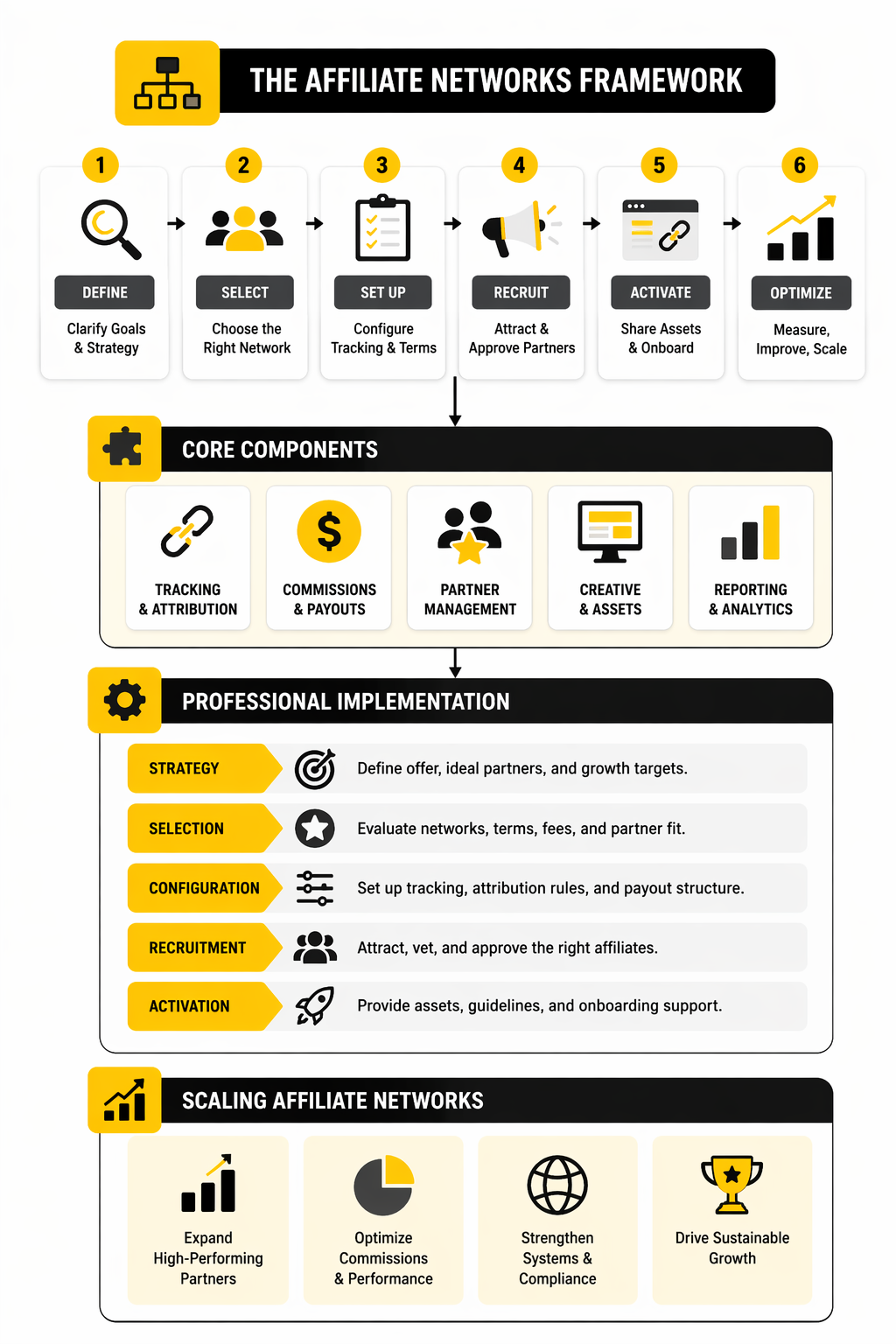
The process typically looks like this:
- A brand joins a network and creates an affiliate program
- Affiliates browse offers and apply to promote relevant products
- Unique tracking links are generated for each affiliate
- Traffic is sent to the brand’s funnel or landing page
- Conversions are tracked automatically through cookies or attribution models
- Commissions are calculated and paid out through the network
What makes this powerful is automation.
Instead of manually tracking referrals, tools handle everything—from attribution to payouts. Platforms like ClickFunnels or GoHighLevel integrate directly into this ecosystem, allowing brands to build high-converting funnels that affiliates can promote immediately.
That combination—networks + conversion infrastructure—is where serious revenue starts to happen.
Core Components of Affiliate Networks
To really understand affiliate networks, you need to break them down into their essential parts. Every network, no matter how big or small, operates using the same core components.
Tracking Technology
This is the backbone of the entire system.
Affiliate networks use tracking links, cookies, and increasingly advanced attribution models to determine which affiliate gets credit for a sale. Without accurate tracking, trust collapses—and so does the entire ecosystem.
Modern platforms now support multi-touch attribution, meaning they can track a user across multiple interactions before a purchase is made.
Affiliate Marketplace
This is where supply meets demand.
Networks host thousands of offers across industries—software, ecommerce, finance, education—giving affiliates the ability to choose products that align with their audience.
The best affiliates don’t promote everything. They choose strategically based on audience fit and conversion potential.
Payment Infrastructure
Handling payouts at scale is complex.
Affiliate networks simplify this by aggregating commissions and distributing payments on a set schedule. Affiliates don’t need to chase individual brands for money, which removes a huge operational burden.
Reporting and Analytics
Data is what separates amateurs from professionals.
Networks provide dashboards that show clicks, conversions, earnings, and trends over time. This allows both brands and affiliates to optimize campaigns continuously instead of guessing.
Integration Layer
This is where things get interesting.
Affiliate networks don’t operate in isolation. They integrate with email platforms, CRMs, funnel builders, and automation tools. For example, connecting a network with tools like Systeme.io allows affiliates to build complete funnels—from traffic to conversion—without needing multiple disconnected tools.
That integration layer is what turns affiliate marketing into a full business system rather than just a traffic source.
This is the foundation. In the next part, we’ll break down how to choose the right affiliate network and what separates profitable networks from the ones that waste your time.
Choosing the Right Affiliate Network
Most people choose an affiliate network the wrong way. They look at the logo, the size of the marketplace, or the number of brands on the homepage and assume bigger automatically means better. It doesn’t.
The right network is the one that fits your business model, your margins, your reporting needs, and the kind of partners you actually want to recruit. Networks differ in how they handle tracking, approvals, fraud controls, payment workflows, and partner discovery, so this is not a cosmetic decision.
A bad fit creates friction fast. You end up with weak attribution, low-quality publishers, delayed payouts, or a program that looks fine on paper but never becomes a real revenue channel. A strong fit does the opposite: it gives you clean data, reliable operations, and a setup you can actually scale.
Match the Network to Your Business Model
Start with the basics. Are you running ecommerce, SaaS, lead generation, subscriptions, or a hybrid model? The answer matters because different affiliate networks are built around different conversion types, commission structures, and partner ecosystems.
If you sell software, you usually need tighter tracking around trials, demos, recurring commissions, and customer quality. If you run ecommerce, product feeds, coupon controls, content publishers, and cart-level attribution may matter more. If you ignore that distinction, you can end up inside a network that technically works but forces your program into the wrong shape.
That’s why smart operators work backward from economics, not hype. Even commission design is more effective when it is tied to your own margins and customer value instead of copied from competitors. That profit-first approach is becoming more important as affiliate programs mature and teams get pushed to prove contribution, not just volume.
Look Hard at Tracking and Reporting
Tracking is where an affiliate network earns its keep. If the platform cannot show you who drove the click, how the conversion happened, and where credit was assigned, then you are not running a serious program. You are just guessing with nicer dashboards.
This matters even more now because affiliate channels overlap with creators, paid media, email, loyalty platforms, and referral programs. Networks that support custom tracking, real-time reporting, and clearer visibility into partner contribution give brands a much better shot at making sound decisions. Awin has argued that better tracking visibility improves performance, and impact positions custom tracking plus real-time insights as core infrastructure rather than optional extras.
You should also pay attention to how the network handles attribution disputes. If coupon sites, browser extensions, loyalty partners, and content creators are all touching the same customer journey, you need confidence that reporting is not quietly over-crediting the wrong partner. That is one of those details people skip early and regret later.
Check Network Quality, Not Just Network Size
A giant marketplace sounds impressive until you realize half the partner pool is irrelevant to your niche. More affiliates does not automatically mean more sales. Often it just means more applications to review, more compliance work, and more noise.
What you really want is partner quality. Can the network help you recruit affiliates that match your category, geography, and conversion goals? Can you filter for publishers that drive incrementality instead of just harvesting branded search or last-click coupon traffic? Those questions matter more than raw scale, and the strongest platforms now lean heavily into data-driven recruitment and partner discovery for exactly that reason.
This is also where implementation tools become useful. If you are building landing pages or partner-specific funnels, platforms like Replo, ClickFunnels, or GoHighLevel can make it easier to tailor the post-click experience for different partner types. That does not replace the network, but it can make a good network perform much better.
Scrutinize Payout Terms Before You Commit
Payouts sound boring until they become the reason affiliates stop promoting you. Payment timing, thresholds, approval windows, reversal rules, and international payout support all shape partner trust. If the process feels messy, good affiliates notice quickly.
This is one reason networks continue to matter. They reduce the admin burden for both sides by centralizing commission handling and standardizing payment workflows across multiple programs. That convenience is not just operational; it directly affects whether affiliates see your program as dependable.
From the brand side, payout structure should also match cash flow reality. A network may look attractive at signup, but if its fee model, minimums, or commission processing rules squeeze your margins, you will feel it later. Read the details before the launch, not after your first hundred conversions.
Don’t Treat Fraud Protection as a Bonus Feature
Fraud is not a side issue in affiliate marketing. It is one of the reasons some programs never reach their potential. Invalid leads, fake accounts, duplicate transactions, self-referrals, bot-driven activity, and manipulated attribution can quietly destroy trust in the channel if you do not catch them early.
That means fraud controls should be part of network selection from day one. Look for device-level detection, anomaly monitoring, payout protections, clearer reporting around suspicious activity, and support teams that actually treat compliance as part of network quality. CJ and impact both emphasize anti-fraud systems as core platform value, which tells you how central this issue has become.
This is especially important if you plan to scale with creators, incentive partners, or international traffic. The more partner types you add, the more important governance becomes. Growth without control is not growth. It is drift.
Evaluate the Professional Fit, Not Just the Technical Fit
A network can check every technical box and still be wrong for you. Maybe its onboarding is weak. Maybe its support is slow. Maybe its advertiser tools are powerful but clunky enough that your team avoids using them properly. Those things matter because affiliate programs live or die in execution.
Professional implementation means asking a more practical question: can your team realistically run this network well over the next 12 to 24 months? If the answer is no, move on. The best platform is the one your team can operate consistently, optimize confidently, and explain clearly to partners.
That’s also why surrounding tools matter. Brands that pair network infrastructure with better CRM, automation, or messaging workflows usually move faster once the program is live. Depending on your setup, tools like ManyChat, Brevo, or Buffer can support the promotion layer around the affiliate program without overcomplicating the stack.
A network should make your program easier to run, easier to trust, and easier to grow. If it does not do all three, keep looking.
What Separates Profitable Networks From Time-Wasting Ones
Profitable networks usually have the same traits. They give you accurate reporting, meaningful partner access, workable payout systems, and enough control to keep the channel clean. They help you scale with less chaos, not more.
Time-wasting networks usually fail in quieter ways. The dashboard looks polished, but recruiting stalls. Tracking exists, but confidence in the data is weak. Applications come in, but partner quality is poor. The program launches, yet nobody on the team feels fully sure what is actually driving revenue.
That difference is everything. Once the foundation is set, the next step is not choosing again. It is learning how to operate the network well enough to turn infrastructure into growth.
Advanced Strategies and Scaling With Affiliate Networks
Once you have chosen the right affiliate network, the real work starts. This is the point where a lot of brands get stuck, because they assume joining the platform is the same as building a program. It isn’t.
A network gives you infrastructure. A profitable affiliate channel comes from how you implement that infrastructure, how clearly you communicate with partners, and how fast you turn early data into better decisions. This is where professional execution separates a live program from a growing one.
Start With a Program That Affiliates Can Actually Sell
Before you recruit anyone, make sure the offer is promotion-ready. That means the pricing is clear, the landing page converts, the commission model makes sense, and the buyer journey is easy to understand. If affiliates have to guess what the product does or how the funnel works, they will move on to something simpler.
This is why implementation should start outside the network dashboard. Review the sales page, the onboarding flow, the checkout experience, and the post-purchase journey before sending traffic. A clean partner program cannot compensate for a messy offer.
For brands that need faster deployment, tools like ClickFunnels, Replo, or Systeme.io can help you build partner-specific pages and cleaner conversion paths without dragging the launch into a long dev cycle.
Build the Tracking Setup Before You Recruit at Scale
This part is not glamorous, but it matters more than almost everything else. If your attribution is weak, you will create payout disputes, lose affiliate trust, and make bad optimization calls based on incomplete data.
At a minimum, your implementation should cover link tracking, conversion events, approval logic, payout timing, and channel exclusions. You should also know how the network handles repeat customers, coupon usage, refunded transactions, and multi-touch journeys. Those are not edge cases. They show up fast once the program gets momentum.
The smarter move is to validate the full journey with test transactions before opening the floodgates. Run traffic through the exact path an affiliate would use, verify every event, and check whether the reporting matches reality. Do that early and you save yourself a lot of pain later.
Create an Onboarding System, Not Just an Approval Email
A lot of affiliate programs technically accept partners but never truly onboard them. That sounds minor, but it kills performance. Affiliates need clarity on what to promote, who the offer is for, what claims are allowed, and how they can earn more.
A strong onboarding system should include:
- a short explanation of the product and ideal customer
- the main conversion paths and best-performing pages
- commission rules and approval timelines
- brand guidelines and compliance boundaries
- ready-to-use assets for content, email, and social promotion
- one clear contact point for support
That is also where support tools can make the program feel more modern. If you want to streamline communication, automate simple partner interactions, or create faster follow-up flows, platforms like ManyChat and Brevo can help you stay responsive without creating operational chaos.
The Professional Implementation Process
This is the point where affiliate networks become tangible. If you want a clean rollout, follow a sequence that protects the fundamentals first and scales recruitment second.
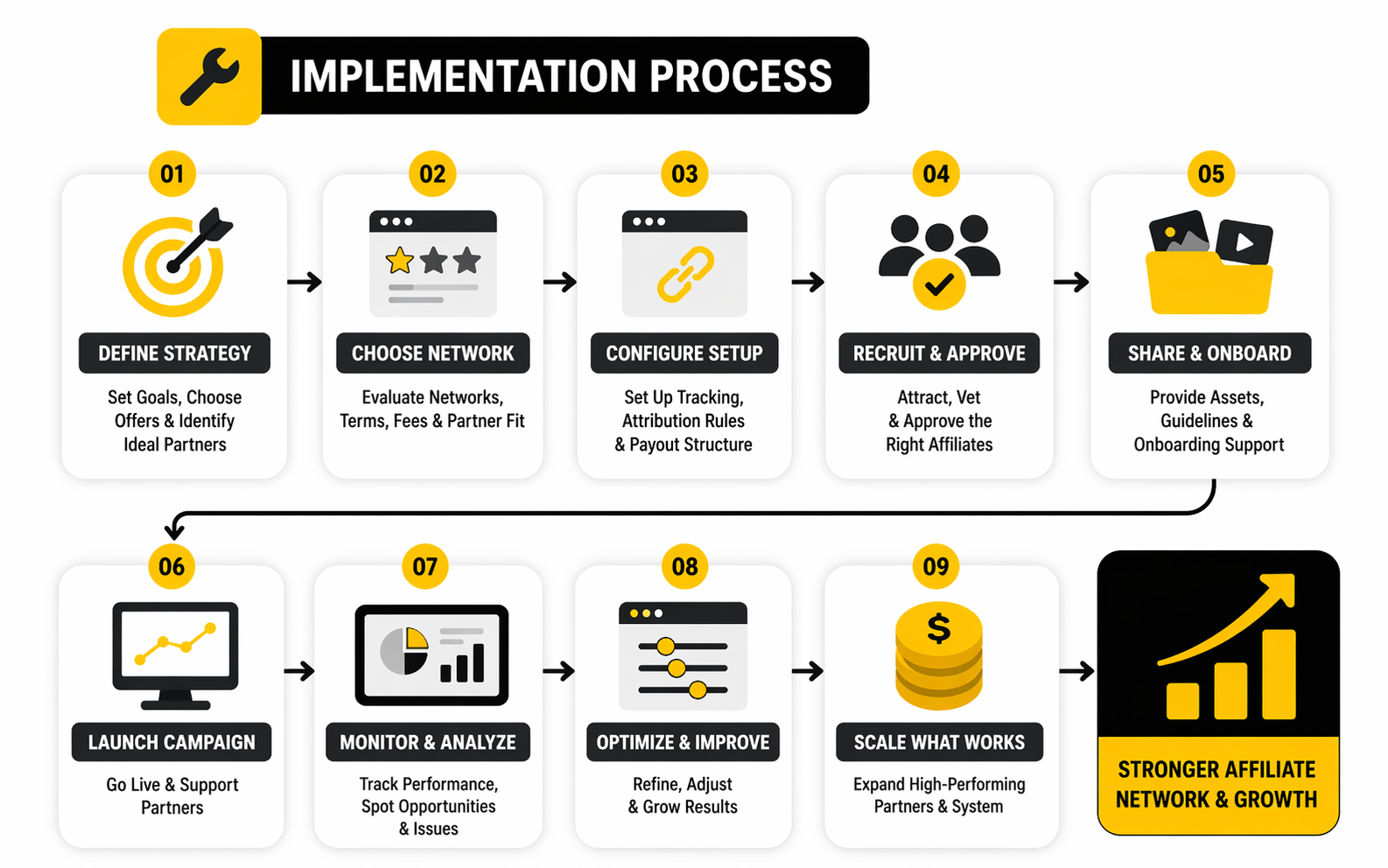
- Define the commercial model
Choose the commission type, approval window, payout timing, and partner rules before the program goes live. Keep it simple enough to understand quickly, but aligned tightly enough with margins that you do not regret growth later.
- Set up tracking and validation
Install tags, server events, or whatever the network requires, then verify the full conversion path with live tests. Do not rely on assumption here. Confirm that every approved action appears correctly in reporting.
- Prepare affiliate assets
Build landing pages, email copy, partner briefs, brand guidelines, and simple promotional resources. Make it easy for a good affiliate to start fast without guessing.
- Launch with a controlled group
Bring in a smaller set of relevant partners first. That gives you cleaner feedback, makes troubleshooting easier, and helps you spot where the funnel or commission model needs adjustment.
- Review early performance weekly
Watch clicks, conversion rates, reversals, average order value, and partner quality. The goal is not just to see activity. The goal is to understand whether the program is attracting the kind of traffic you actually want.
- Expand only after the system is stable
Once tracking is solid, communication is working, and at least a few partners are producing consistent results, then you scale recruitment. Doing this in the wrong order creates volume without control.
That sequence sounds basic, but it is exactly where disciplined operators gain an edge. They do not rush from signup to scale. They build a system that can handle scale without breaking.
Use Segmentation Early, Not After the Program Gets Messy
Not all affiliates should be treated the same. Content publishers, creators, review sites, loyalty partners, agencies, and customer advocates behave differently and need different support. The earlier you segment them, the easier it becomes to manage performance without confusion.
This affects everything from commission design to landing pages. A creator may need a simpler narrative and branded assets. A content affiliate may need comparison angles, proof points, and deeper product context. A loyalty or coupon partner may need tighter rules to prevent them from soaking up credit at the bottom of the funnel.
This is also where specialized tools can strengthen execution. If you are routing partners into different experiences, GoHighLevel can help organize automation and follow-up, while Fillout can be useful for structured partner applications or intake flows. Small operational upgrades like these make affiliate networks easier to run professionally.
Keep Communication Tight Once the Program Is Live
Most affiliate managers focus too much on recruitment and not enough on partner momentum. That is a mistake. Even strong affiliates lose interest if they do not hear from you, do not know what is converting, or feel like the program is on autopilot.
Good communication does not mean constant noise. It means relevant updates, faster answers, clearer promotions, and enough reporting insight that affiliates can improve their own performance. That is how you turn casual promoters into long-term partners.
You also want one simple place to direct people when they need resources or next steps. A clean branded resource hub built with something like Anything.com or supported by scheduling tools like Cal.com can remove friction without making the program feel bloated.
Measure More Than Revenue
Revenue matters, obviously. But if that is the only thing you track, you will miss problems until they are expensive. Strong affiliate network implementation also measures partner activation, conversion quality, refund rates, contribution by partner type, and the time it takes a new affiliate to produce their first real result.
These metrics tell you whether the program is healthy or just busy. A network full of signups with weak activation is not growth. High top-line sales with bad customer quality are not growth either. You need a view that is commercial, operational, and practical at the same time.
That is why the best operators review affiliate networks like systems, not just traffic sources. They look at onboarding friction, asset usage, payout trust, funnel conversion, and partner retention together. When those pieces are aligned, scale gets a lot easier.
Implementation Is Where Confidence Comes From
At this stage, affiliate networks stop being an abstract marketing channel and become an operating system for partnerships. That is the shift that matters. You are no longer asking whether the model works. You are proving whether your implementation works.
Get the structure right, keep the process tight, and make life easier for the right partners. That is how you build momentum without losing control.
In the next part, the focus shifts from setup to growth. That is where we break down how to optimize performance inside affiliate networks once the program is already moving.
Reading the Numbers Inside Affiliate Networks
Once an affiliate program is live, the next trap is obvious. People start staring at dashboards, collecting stats, and feeling productive without actually learning anything useful. Data only matters when it changes what you do next.
That is why the best teams do not ask, “What happened?” and stop there. They ask, “What does this signal mean inside our affiliate network, and what action does it justify?” That second question is where performance management begins.
A good example is channel importance. In impact’s 2025 State of Affiliate Marketing report, 74% of brands said affiliate drives 11% to 30% of total revenue, which tells you this is no longer a side experiment for serious operators. In the U.S., affiliate marketing spend was forecast to reach $10.72 billion in 2024 and drive $307.27 billion in ecommerce, which is a useful reminder that affiliate networks now sit much closer to core commerce strategy than many teams still assume.
Growth Numbers Matter, but They Can Mislead You
Big market numbers are useful for one reason: they show whether the channel deserves internal attention. If affiliate is growing at the market level, that supports investment, hiring, tooling, and better executive buy-in. What they do not tell you is whether your own program is healthy.
That distinction matters. A rising industry can still hide a weak program with poor partner quality, broken attribution, or inflated last-click numbers. Market growth is context, not proof.
So yes, it is relevant that U.S. affiliate investment has continued climbing and that marketers are treating affiliate as a durable revenue lever. But inside your own affiliate network, you still need operating metrics that explain partner quality, conversion behavior, and margin impact.
The Metrics That Actually Matter
The most useful affiliate network metrics are the ones that reveal where performance is strong, where it is fragile, and where attribution is distorting reality. Everything else is just dashboard wallpaper.
You do not need fifty KPIs. You need a smaller set of signals that work together and tell a clear story.
Clicks Without Conversions Are a Warning, Not a Win
High click volume looks exciting, especially in a fast-growing program. But affiliate networks can produce a lot of activity that never turns into profitable buying behavior. More traffic is only good when it leads to qualified conversions.
That is exactly why the recent benchmark data matters. impact’s 2025 industry benchmark found clicks up 2% year over year, while transactions fell 5% and conversion rates dropped 6%. The important takeaway is not that affiliate got weaker. It is that shoppers became more cautious, more research-heavy, and more deliberate before buying.
When you see that pattern in your own affiliate network, the action is not “celebrate more clicks.” The action is to review landing page alignment, promo timing, partner intent, and how many of those clicks are coming from research-stage publishers rather than decision-stage partners.
Average Order Value Can Save a Weak Conversion Picture
One of the easiest mistakes in affiliate reporting is obsessing over conversion rate in isolation. If conversion rate softens but basket size grows, your program may still be healthy. In some cases, it may be getting better.
The same impact benchmark showed consumer spending down just 1% year over year even though transactions declined more sharply, because shoppers were bundling more value into fewer purchases. That is a useful lesson for affiliate managers: a lower conversion rate does not automatically mean weaker economics.
This is where interpretation matters. If your affiliate network is sending fewer buyers who spend more, that may point to stronger content affiliates, better partner education, or better high-intent traffic. If buyers spend less and convert less, that is a very different problem.
Partner Mix Changes the Meaning of Every Benchmark
There is no serious benchmark without partner context. Coupon sites, creators, comparison engines, review publishers, media brands, and email partners all behave differently. If you lump them together, the averages become less useful.
impact’s State of Affiliate Marketing says leading brands tend to work with three to four partner types, not just one. Awin’s 2025 survey with Forrester also showed partner mix shifting in meaningful ways, with email and newsletter partners up 19%, price comparison partners up 14%, and brand partnerships showing strong sales momentum on Awin’s platform.
That matters because the benchmark you should compare against depends on the partner mix you are actually using. A creator-heavy program will behave differently from a coupon-heavy one. A research-led ecosystem will usually show a longer path to conversion than a last-click incentive model.
Attribution Trends Tell You Whether Your Dashboard Is Mature
If there is one number that should change how people read affiliate reports, it is this: 94% of brands in impact’s 2025 study said they were experimenting with or planning to adopt alternative attribution models within the next year. That is not a small optimization trend. It is a sign that the industry knows last-click reporting is no longer enough.
This has a direct implication for how you evaluate affiliate networks. If your reporting still gives full credit to the closest touchpoint before purchase, you may be undervaluing creators, content publishers, and mid-funnel partners that influenced the sale earlier. That leads to bad commission decisions and weak recruitment strategy.
In other words, attribution is not just a measurement issue. It is a growth issue. The brands that fix it first usually make better partner decisions faster.
Building an Analytics System That Leads to Action
The real goal is not collecting stats. It is building a measurement system that helps you decide what to scale, what to fix, and what to cut. That system should be simple enough to use every week and strong enough to survive growth.
A practical analytics stack for affiliate networks usually works in layers: traffic quality, conversion quality, partner contribution, and commercial efficiency. When those layers are reviewed together, patterns become obvious much faster.
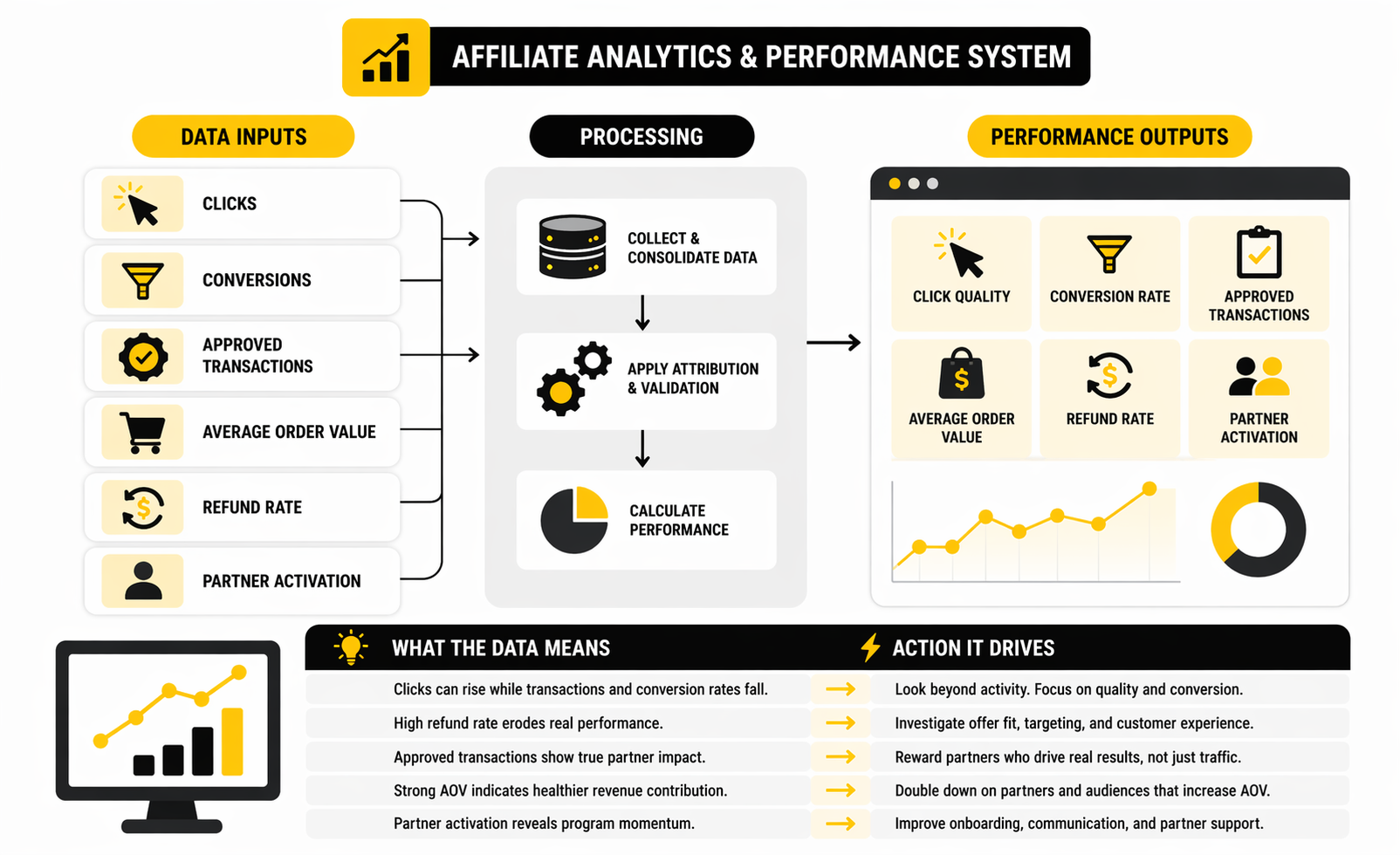
Layer 1: Traffic Quality
Start with clicks, click-through trends, landing page engagement, and partner-level traffic sources. This tells you whether affiliates are sending relevant visitors or just volume. If traffic grows but assisted conversions, time on page, or product engagement stay weak, the issue may sit upstream with partner quality.
This is also where segmentation matters. Compare creator traffic with content traffic, loyalty traffic, and comparison traffic separately. A blended average hides too much.
Layer 2: Conversion Quality
Now look at conversion rate, approval rate, refund rate, average order value, and new-versus-returning customer behavior. This layer tells you whether the traffic is commercially useful. A partner who drives lower conversion but stronger average order value or better first-time customer mix may still be more valuable than a partner with flashy headline volume.
If you want cleaner reporting across campaign links and partner destinations, a tool like Dub can help organize and measure links more intentionally, especially when different affiliate assets are pointing to different pages. But the principle is bigger than the tool: track what shows commercial quality, not just activity.
Layer 3: Partner Contribution
This is where affiliate networks get interesting. Which partners introduce demand, which ones close it, and which ones mostly intercept demand that already existed? Those are three very different roles, and they should not be judged by the same standard.
Awin’s survey results and impact’s research both point in the same direction here: partner diversification matters, because different partner types solve different problems across the journey. If your data cannot distinguish that, your optimization will stay shallow.
Layer 4: Commercial Efficiency
Finally, tie the channel back to business reality. Look at commission cost, effective return, contribution margin, and how much affiliate revenue is incremental rather than merely attributed. This is the layer executives care about most, because it answers the question hiding behind every report: is this growth actually profitable?
Sector context matters here. A 2025 PMA-based ROAS summary showed average affiliate ROAS varying heavily by category, with travel near $19, retail around $11, telecom around $9, entertainment near $6, and healthcare near $5. That is exactly why copying benchmarks from another vertical is such a bad habit.
What Good Benchmarks Really Look Like
Benchmarks are useful when they create better questions. They are dangerous when people treat them like universal targets. A “good” affiliate network number in one business can be weak or unrealistic in another.
Take conversion rate. Broader ecommerce benchmark data shows how wide the range can be, with conversion rates spanning from below 1% in luxury-focused categories to above 6% in faster-moving consumable categories. That means an affiliate program selling high-consideration software, premium products, or complex services should never be judged by the same raw conversion expectations as a low-friction impulse category.
The action here is simple. Benchmark within your vertical, within your partner mix, and within your own margin model. Anything else turns analytics into theater.
Signals That Usually Mean You Should Scale
Some patterns show up again and again in healthy affiliate networks. One is stable or rising average order value even when traffic sources diversify. Another is strong activation among a small number of new partners, which often means the onboarding and offer are landing well.
You should also pay attention to partner-type momentum. If a specific category of affiliate consistently brings cleaner traffic, better first-purchase economics, or stronger assisted conversion paths, that is a real scaling clue. impact’s 2025 benchmark noted that technology partners and influencers showed some of the strongest efficiency gains, with conversion rates up 25% and 8% year over year respectively.
That does not mean every brand should run into those partner types blindly. It means the data may justify testing them more aggressively if your current mix is too narrow.
Signals That Usually Mean You Should Intervene Fast
Some numbers deserve immediate attention. Rising clicks with falling approval rates usually suggest poor traffic quality or weak funnel alignment. High conversion volume paired with low incrementality often points to overreliance on bottom-funnel capture partners. Falling average order value can mean over-discounting, mismatched partner messaging, or promo-led traffic that is eroding margin.
The smartest move is to define these thresholds before the problem appears. That way your team is not debating whether something is wrong after the fact. You already know what a warning pattern looks like.
This is also where workflow matters. If you need better follow-up, tighter reporting loops, or cleaner partner communication around promotions and changes, systems like GoHighLevel or Brevo can help operationalize the response. Analytics only creates value when somebody acts on it.
What the Data Should Push You to Do Next
The deeper point is simple. Affiliate networks are not won by having more data. They are won by reading the data in context and acting earlier than competitors do.
If clicks rise, ask what stage of the journey those partners influence. If conversion rate falls, ask whether basket size, intent, or attribution quality changed. If one partner type starts outperforming, ask whether that is a seasonal spike or the start of a structural shift.
That mindset is what turns reporting into strategy. In the next part, we will move from measurement into optimization, because once the numbers are clear, the only question left is how to improve them.
The Strategic Tradeoffs That Show Up When Affiliate Networks Scale
Affiliate networks feel simple at the beginning. You join a platform, approve partners, set commissions, and watch the first conversions come in. The complexity shows up later, when growth creates tension between scale, control, margin, and partner quality.
That is the stage where a lot of programs stall. Not because affiliate networks stop working, but because the operator keeps using early-stage thinking in a later-stage system. What worked for launch usually is not enough for real scale.
Growth and Control Start Pulling in Opposite Directions
At the start, fast partner growth looks like momentum. More applications, more links, more clicks, more transactions. But once an affiliate network begins to expand, every new partner also increases the load on compliance, communication, reporting, and attribution.
This is the first major tradeoff. If you approve too aggressively, you can grow volume faster than your team can manage quality. If you stay too restrictive, you may protect the program so tightly that it never reaches meaningful scale.
The better move is to separate partner expansion from partner depth. You do not need hundreds of loosely managed affiliates if a smaller group of aligned partners is already producing cleaner revenue. Mature affiliate networks are rarely built on openness alone. They are built on selective growth with tighter standards.
Incrementality Is More Important Than Easy Attribution
This is one of the hardest truths in affiliate marketing. The partner who gets credit is not always the partner who created value. Inside affiliate networks, those are often two different things.
That matters because easy attribution can make a weak program look healthy. Coupon sites, browser extensions, and bottom-funnel partners may close a lot of transactions, but some of those conversions were already on the way to happening. If you only reward the easiest touchpoint to measure, you can slowly train the whole program toward low-incrementality behavior.
The strategic question is not just who converted the sale. It is who moved the customer meaningfully closer to buying. Once you start asking that, your commission structure, partner recruitment, and reporting logic usually need to evolve.
Creator-Led Performance Changes the Rules
Affiliate networks used to lean heavily on classic publishers, review sites, loyalty platforms, and media partners. That still matters, but creator-led performance keeps pushing the channel in a different direction. The old model was mostly link placement and traffic capture. The newer model is much more about trust, context, and audience fit.
That shift creates a real operational change. Creators often need different assets, different payout logic, different communication rhythms, and more flexible attribution windows than traditional affiliates. If you run them through the exact same process as coupon or comparison partners, performance usually suffers.
This is also where your supporting stack starts to matter more. If you want faster campaign launches, cleaner creator-specific landing pages, or more tailored post-click flows, tools like Replo, ClickFunnels, and GoHighLevel can make affiliate networks easier to adapt to this newer partner mix.
Margin Pressure Gets Worse if Commission Logic Stays Lazy
A lot of affiliate programs start with broad commission rules because it is faster. That is fine for testing, but it becomes expensive when the network matures. Paying similar commissions to partners with completely different levels of contribution is one of the easiest ways to create hidden margin leaks.
This is why expert operators stop thinking in flat terms. They start asking which affiliates bring in new customers, which ones increase average order value, which ones support launch campaigns, and which ones mostly sit at the bottom of the funnel collecting easy credit. Once you see those differences clearly, uniform commission structures stop making sense.
The fix is not making the program complicated for the sake of it. The fix is aligning payout logic with actual business value. Sometimes that means tiered commissions. Sometimes it means private deals for strategic partners. Sometimes it means cutting commission on traffic that looks busy but adds very little real growth.
Compliance Becomes a Brand Risk Much Faster Than People Expect
When affiliate networks are small, compliance often feels manageable. Once the program expands across creators, publishers, email partners, community operators, and agencies, the risk changes. Now you are not just managing links and commissions. You are managing claims, disclosures, brand positioning, and partner behavior at scale.
This is where brands get lazy at their own expense. They assume a terms page and a welcome email are enough. They are not. If affiliates are making aggressive claims, hiding disclosures, or using tactics that undermine trust, that damage does not stay isolated. It rolls uphill to the brand.
Professional programs treat compliance as part of growth, not as a legal afterthought. That means clearer partner rules, periodic audits, better asset control, and faster intervention when something drifts. Growth without oversight is one of the fastest ways to make affiliate networks feel risky inside an organization.
Tool Sprawl Can Quietly Break a Good Program
Here is a problem almost nobody talks about enough. The more successful an affiliate program becomes, the more random tools teams tend to bolt onto it. One platform for landing pages, another for CRM, another for forms, another for communication, another for scheduling, another for reporting. Suddenly the affiliate network is not the operating system anymore. It is just one piece in a messy stack.
That fragmentation creates slower launches, worse visibility, more manual work, and more room for mistakes. It also makes it harder for affiliates to know where to go, what to use, and who to contact. Even strong programs can lose momentum here.
The answer is not using fewer tools at all costs. It is using tools with a clear role. A setup with Fillout for intake, Brevo for partner communication, and Cal.com for partner calls can be perfectly clean if each tool removes friction instead of adding another layer of confusion.
Scaling an Affiliate Network Is Really a Relationship Problem
This part gets underestimated because dashboards are easier to talk about than human behavior. But at scale, affiliate networks are still relationship systems. The partners who drive the best outcomes usually do not just need a tracking link. They need context, access, trust, and fast feedback.
That changes how you should think about management. The goal is not approving more people. The goal is helping the right partners perform better over time. That is a very different mindset.
It also changes how you allocate time. A mature program often grows faster by going deeper with high-potential partners than by constantly chasing new applications. Better briefs, better launch coordination, better conversion assets, and better support can unlock more revenue than another wave of low-fit recruits.
The Best Affiliate Networks Become Partnership Infrastructure
This is the big shift. Early on, affiliate networks are often treated like a channel. Later, the strongest programs start acting more like partnership infrastructure. They connect creators, publishers, advocates, agencies, and customer communities into one measurable commercial system.
That is where the upside gets bigger, but only if the operator is ready for it. You need stronger segmentation, smarter commissions, cleaner compliance, tighter reporting, and a much sharper view of contribution. Otherwise the program expands faster than your ability to steer it.
That is also why execution discipline still matters so much this late in the game. You do not scale affiliate networks by adding noise. You scale them by building a cleaner machine around the partners who actually move the business.
What Experienced Operators Learn a Bit Late
Most people enter affiliate networks thinking the challenge is setup. Later they realize the real challenge is judgment. Which partners deserve more support, which data is misleading, which growth is incremental, which commissions are justified, and which systems are making the team slower instead of better.
That is where experience starts to compound. You stop chasing raw activity and start protecting signal quality. You stop rewarding whoever appears closest to the sale and start looking harder at real contribution. You stop assuming more partners means more growth and start building a tighter ecosystem that can scale without getting sloppy.
That is the level where affiliate networks become genuinely powerful. Not because they are easy, but because once you understand the tradeoffs, you can use them with a lot more precision.
In the final part, we will bring everything together with a practical close, clear takeaways, and the FAQ that answers the questions most people still get wrong.
Bringing Affiliate Networks Together as a Real Growth System
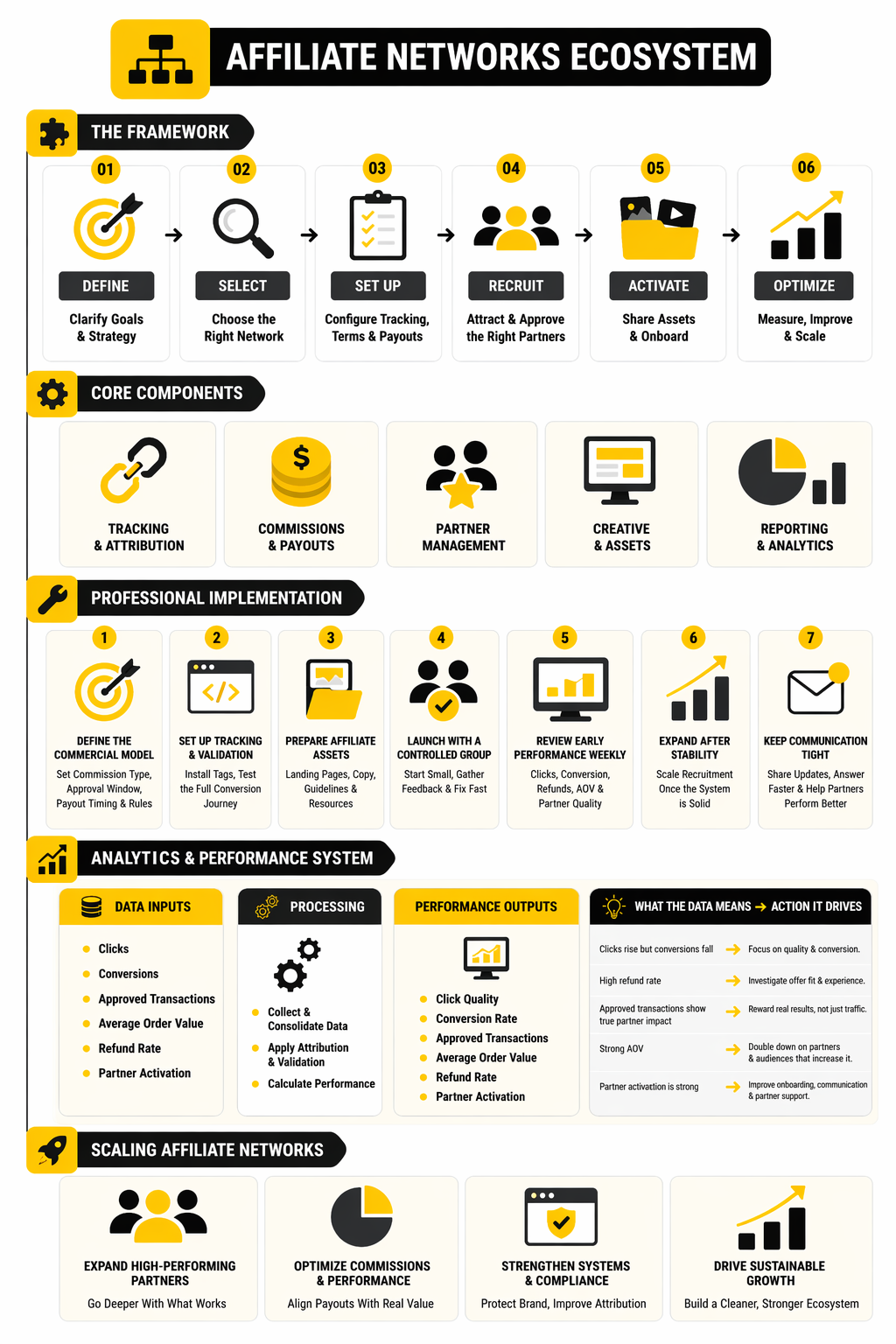
By this point, the pattern should be clear. Affiliate networks are not just marketplaces for links and commissions. At their best, they become a system that connects tracking, partner recruitment, communication, conversion assets, analytics, and payout logic into one operating model.
That is why strong programs usually look calmer from the outside than weak ones. They are not trying to do everything at once. They are aligning the right partners, the right incentives, and the right measurement so growth compounds instead of creating more noise.
The channel is also getting more sophisticated. impact’s 2025 research points to broader partner diversification, heavier focus on attribution, and deeper use of affiliate as a meaningful share of revenue rather than a side experiment. (impact.com) That shift matters because it means affiliate networks increasingly reward operational discipline, not just early enthusiasm.
FAQ - Built for Complete Guide
What is an affiliate network in simple terms?
An affiliate network is a platform that connects brands with affiliates and handles the tracking, reporting, and payout layer between them. It gives advertisers a faster way to manage many partners without building every relationship from scratch. For affiliates, it creates one place to discover offers, generate links, and monitor performance.
Are affiliate networks still relevant now that brands can run direct partner programs?
Yes, very much. Direct programs can work well, but affiliate networks still reduce operational friction, centralize payments, and make partner discovery easier, especially for brands that want scale without building every workflow internally. The broader market trend still supports that role, with affiliate continuing to expand as a serious revenue channel in current industry reporting. (impact.com)
What is the difference between an affiliate network and affiliate software?
Affiliate software usually helps a brand run its own program directly. An affiliate network usually adds a marketplace layer, shared infrastructure, and often a larger pool of publishers or creators already active on the platform. In practice, the difference comes down to whether you need independent infrastructure only or infrastructure plus partner access.
Do beginners need an affiliate network?
Not always, but many beginners benefit from one. If you are new to affiliate marketing, a network can simplify tracking, commissions, approvals, and partner management so you are not stitching the whole system together yourself. That makes the first version of the program easier to launch and easier to trust.
How do affiliate networks make money?
Most affiliate networks earn money through setup fees, recurring platform fees, transaction fees, or a share tied to commission activity. The exact model varies, so brands need to understand the economics before signing anything. A network can still be worth the cost, but only when the operational value and partner access justify the spend.
Are bigger affiliate networks always better?
No, and this is where a lot of people waste time. A bigger network can bring more partner options, but it can also create more noise, more irrelevant applications, and more compliance work. Fit matters more than size, especially if your category needs specific partner types or more careful tracking rules.
What metrics should I watch first inside affiliate networks?
Start with the basics that actually change decisions: click quality, conversion rate, approved transactions, average order value, refund rate, and partner activation. Then look deeper at incrementality and partner contribution so you are not overvaluing whoever happens to appear closest to the sale. Recent benchmarking has reinforced this point by showing that clicks can rise while transactions and conversion rates fall, which means raw activity on its own is not enough. (impact.com)
How important is attribution in affiliate networks?
It is central. If attribution is weak, the wrong partners get rewarded, the wrong partners get recruited, and your reporting starts pushing bad decisions. That is exactly why so many brands are now rethinking last-click logic and exploring alternative attribution models in current affiliate research. (impact.com)
Can creators and influencers work through affiliate networks?
Yes, and that has become more important, not less. Many modern programs use affiliate networks to support creators with trackable links, performance payouts, and better measurement. Awin’s recent trend reporting also points to continued overlap between creator activity and affiliate infrastructure, which is a big reason the channel keeps widening beyond traditional publisher models. (awin.com)
How do I know if an affiliate partner is actually valuable?
Look beyond headline sales. A valuable partner may bring in new customers, stronger average order value, cleaner conversion paths, or meaningful mid-funnel influence that does not always show up in crude last-click reporting. The real test is whether the partner improves business outcomes, not just dashboard activity.
Do affiliates need to disclose their relationship with a brand?
Yes, they do. The FTC makes clear that disclosures should be clear and hard to miss when there is a material connection between an endorser and a brand, including affiliate relationships. (ftc.gov) This matters for brands too, because poor disclosure practices create compliance risk that does not stay isolated with the affiliate.
What causes most affiliate programs to fail?
Usually it is not the concept. It is weak implementation. Poor tracking, unclear commissions, weak onboarding, lazy partner recruitment, shallow reporting, and inconsistent communication can undermine a program long before the channel itself has been tested properly.
Should every brand use the same commission structure?
No. Commission design should reflect margins, customer value, sales cycle length, and the type of partner involved. A flat payout can be useful at the start, but mature affiliate networks often need more nuanced structures because not every partner contributes value in the same way.
Is coupon traffic bad for affiliate networks?
Not automatically. Coupon partners can be useful, especially when they help close price-sensitive buyers at the right moment. The problem starts when they dominate the program, absorb too much credit, or crowd out partners that create new demand earlier in the journey.
What tools help affiliate networks perform better beyond the network itself?
The answer depends on where your bottleneck is. If you need better funnels, tools like ClickFunnels, Systeme.io, and Replo can help. If your bottleneck is partner communication or automation, Brevo, ManyChat, and GoHighLevel can make the operating side much tighter.
What is the biggest mistake people make with affiliate networks?
They confuse access with execution. Joining a network, listing an offer, and approving a few affiliates is not the same as building a strong program. The real advantage comes from recruiting the right partners, measuring the right signals, and improving the system continuously instead of letting the dashboard do all the thinking.
Final Takeaway
Affiliate networks work best when you stop treating them like a shortcut. They are infrastructure. And infrastructure only becomes valuable when the strategy on top of it is clear.
If you choose the network carefully, implement it properly, measure it honestly, and optimize it with discipline, affiliate networks can become one of the most resilient growth channels in your business. If you skip those steps, the same channel can look active on the surface while quietly underperforming underneath.
That is the real difference. Not whether affiliate networks work, but whether the operator knows how to make them work well.
Work With Professionals
Explore 10K+ Remote Marketing Contracts on MarkeWork.com
Most marketers spend too much time chasing clients, competing on crowded platforms, and losing a percentage of every project to middlemen.
MarkeWork gives you a better way. Browse thousands of remote marketing contracts and connect directly with companies desperate to hire skilled marketers like you, without platform commissions and without unnecessary gatekeepers.
If you're serious about finding better opportunities and keeping 100% of what you earn, explore available contracts and create a profile for free at MarkeWork.com.