

If you are searching for affiliate programs that pay daily, you are usually trying to solve one problem faster than anything else: cash flow. Monthly payout cycles can feel brutal when you are paying for content, email software, landing pages, or ads today and then waiting weeks to see the money hit your account. That is exactly why this topic keeps pulling in attention from creators, media buyers, and side hustlers who want shorter feedback loops and less financial strain.
The catch is that “daily pay” is often marketed more aggressively than it is delivered. In the real world, many established affiliate networks still run on weekly, biweekly, or monthly schedules, and even the platforms with faster withdrawal options still depend on approval windows, fraud checks, balance thresholds, and advertiser funding. Official payout documentation from Impact, Awin, ClickBank, PartnerStack, CJ, and Rakuten makes that pretty clear once you read the fine print.
That does not mean the opportunity is fake. It means the smart way to approach affiliate programs that pay daily is to separate true fast-payout systems from offers that only sound fast on a landing page. It also means compliance matters more than beginners think, because the faster a network pays, the more aggressively it tends to review traffic quality, disclosures, and conversion integrity. FTC guidance on endorsements and affiliate disclosures is not optional background reading here; it is part of staying paid.
Article Outline
- What Daily Pay Really Means in Affiliate Marketing
- Why Fast Payouts Matter More Than Most Beginners Realize
- How to Evaluate a Daily-Payout Opportunity Without Getting Burned
- The Types of Affiliate Programs Most Likely to Offer Faster Payouts
- How to Build a Promotion System That Matches Fast Payout Economics
- Mistakes, Risk Checks, and FAQ
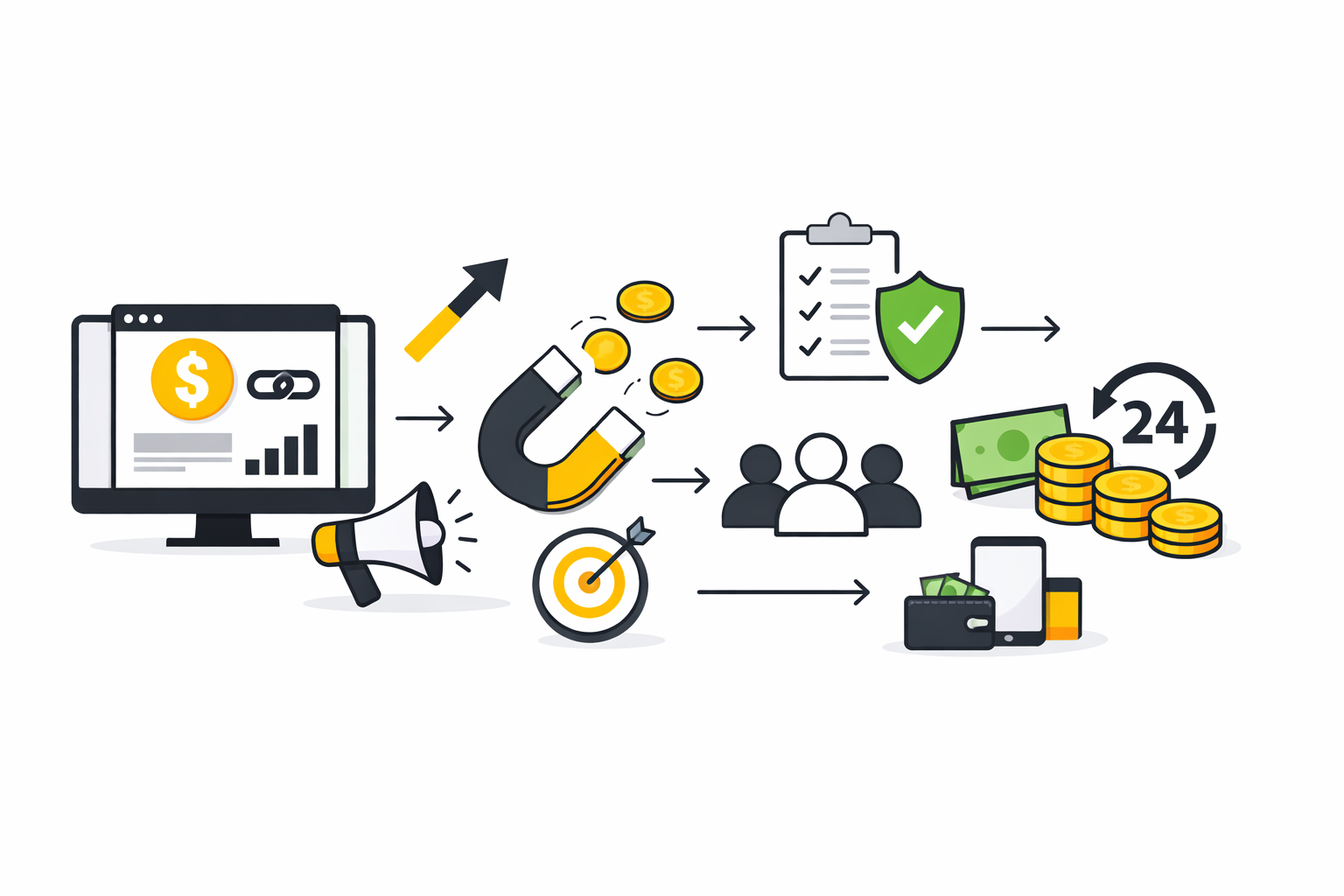
Why Fast Payouts Matter More Than Most Beginners Realize
Fast payouts matter because affiliate marketing is not only about commission rates. It is also about how quickly revenue becomes usable capital. A program that pays 20% but locks earnings for a month can be much harder to scale than a lower-commission offer that clears quickly and lets you reinvest into traffic, content, or testing without waiting for the next billing cycle.
This becomes even more important when you are running anything beyond pure organic content. Paid acquisition, short-form video production, newsletter sponsorships, and landing-page experiments all create real operating costs upfront. If your money is tied up too long, you slow down testing, publish less often, and miss the compounding effect that usually separates steady affiliates from stuck ones.
There is also a psychological edge. Faster payouts shorten the distance between effort and reward, which makes it easier to spot what is working and cut what is not. That shorter loop is one reason many affiliates actively look for weekly or daily options, even though major networks still commonly process on set monthly or twice-monthly cycles rather than true same-day cash release.
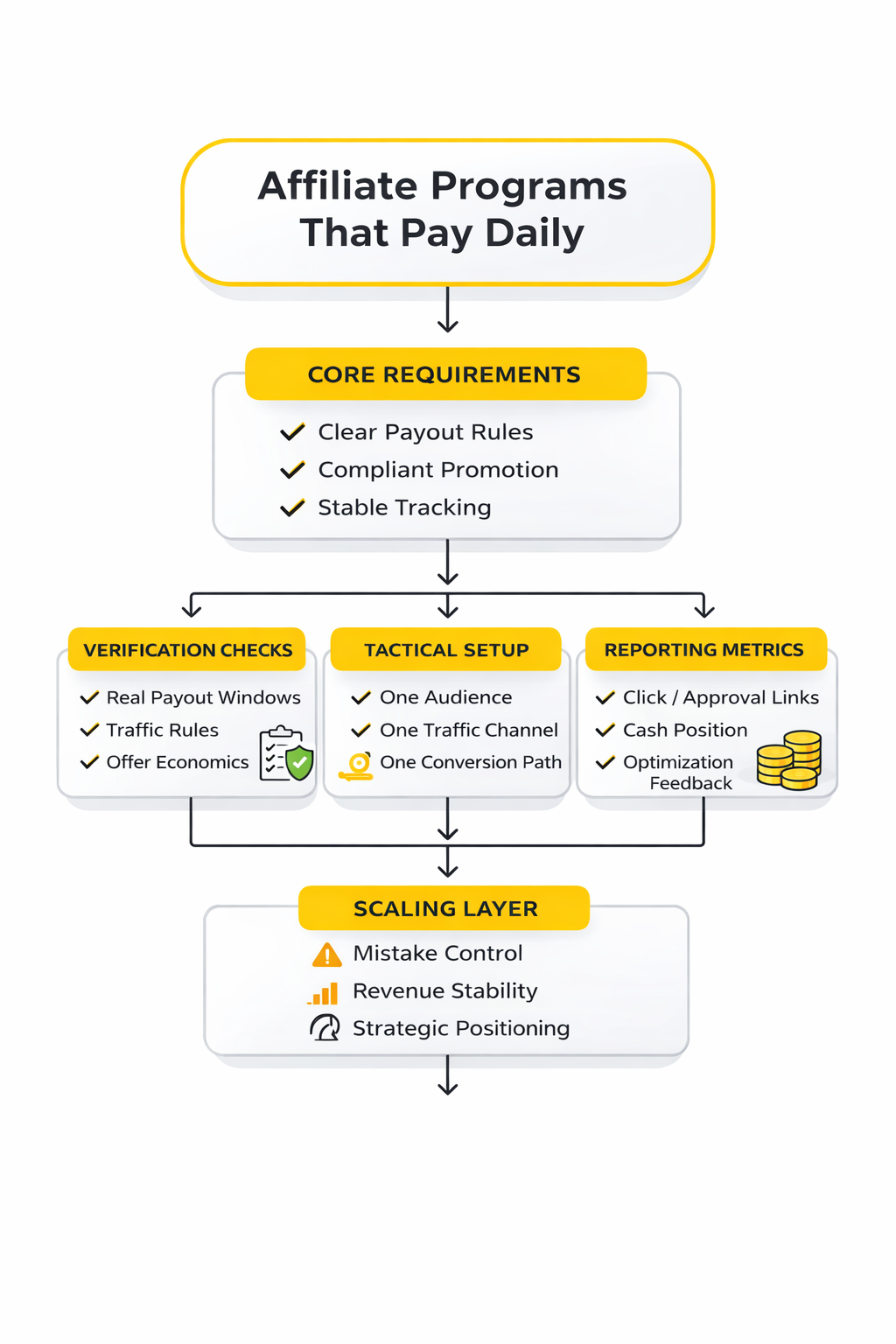
A Practical Framework for Evaluating Daily-Pay Affiliate Programs
The first step is to stop asking only, “Do they pay daily?” and start asking, “What exactly becomes payable, when, and under what conditions?” That is the real question. A serious affiliate program will spell out whether commissions need to be approved first, whether there is a holding period, whether you must hit a minimum threshold, and whether the payout method adds another processing delay after funds are released.
The second step is to judge the economics, not just the headline. A fast payout is not impressive if the offer reverses constantly, the tracking is weak, or the traffic rules are so restrictive that you cannot scale safely. In practice, the best opportunities usually combine four things: clear approval logic, transparent traffic rules, a realistic threshold, and a payout schedule you can verify in official documentation instead of forum hype.
The third step is to treat compliance as a revenue lever, not a boring legal extra. Clear affiliate disclosures, accurate claims, and clean traffic sources reduce the chance of holds, clawbacks, and account reviews. That matters even more in a fast-payout environment because networks and advertisers tend to monitor those programs closely for low-quality leads, brand bidding abuse, or misleading promotion tactics.
In the next part, we will define what “daily pay” actually means across direct programs, CPA networks, creator-focused tools, and established affiliate platforms, because that distinction is where most of the confusion starts.
What Daily Pay Really Means in Affiliate Marketing
When people talk about affiliate programs that pay daily, they are often bundling together several very different payout models. Some platforms mean true daily withdrawals after earnings are approved, some mean offers marked for accelerated release, and some simply mean you can request money more often once you qualify. That distinction matters, because the same phrase can describe a genuinely fast system or a normal network with a better marketing angle.
In practice, most mainstream affiliate infrastructure still does not run on true day-by-day cash settlement. ClickBank states that affiliates can choose weekly or biweekly payments, while PartnerStack generally processes partner withdrawals on a monthly rhythm after company review windows close. That is exactly why so many articles on this topic confuse beginners: they lump weekly payout platforms, CPA networks with fast-pay labels, and direct offers with manual releases into one big “daily pay” bucket.
The cleaner way to think about it is this: daily pay is not one model. It is a spectrum of payout speed layered on top of approval logic, thresholds, and payment rails. Once you see that, you stop chasing slogans and start judging whether a program actually improves your cash position.
The Four Versions of “Daily Pay” You Will See
The first version is true daily withdrawal after approval. This is the closest match to what most people want, and it tends to appear more often in CPA-style ecosystems than in large SaaS affiliate platforms. CPAlead, for example, promotes daily payouts on its publisher side and explains that some offers carry a Fast Pay designation for payout within 24 hours, while others take longer depending on how the underlying networks fund them.
The second version is accelerated but conditional payout. A network may advertise fast payments, but the upgraded timing only applies once you meet volume, quality, or account-history requirements. MaxWeb says payments are weekly by default and can go up to three times a week depending on earnings level, while Advidi describes weekly net terms with faster options for higher-volume partners. That is faster than monthly, but it is not daily in the literal sense.
The third version is platform payout plus processor delay. Even when a network issues funds quickly, the actual arrival time depends on the payment method. ClickBank notes that bank processing times vary by location and payout option, which means “paid” inside the platform and “cash in your account” are not always the same moment.
The fourth version is daily tracking, not daily cash. Some platforms show revenue, commissions, and payouts in daily reporting dashboards, which is helpful for optimization but easy to misunderstand. Daily reporting can make a system feel fast, yet the money may still settle weekly, monthly, or after a hold period.
The Types of Affiliate Programs Most Likely to Offer Faster Payouts
If your priority is speed, the highest-probability category is usually CPA and incentive-style networks rather than classic brand-run affiliate programs. That is not because they are automatically better. It is because those ecosystems are often built around shorter action windows, lead generation, app installs, content lockers, or other conversion types that can be approved and funded more quickly than subscription commissions with refund exposure.
That said, faster does not always mean safer or easier. Networks that move money quickly usually pay very close attention to traffic quality, lead validity, compliance, and fraud patterns. So yes, affiliate programs that pay daily can help your cash flow, but they also demand cleaner execution than a casual blog post with a generic referral link.
CPA Networks and Rewarded Traffic Platforms
This is the part of the market where you are most likely to find actual daily payout language. CPAlead is the clearest example from the research here, because it publicly markets daily payouts and explains that specific offers may qualify for Fast Pay based on how quickly the network itself gets funded. That makes these platforms attractive to affiliates who value liquidity and are comfortable working within stricter offer-level rules.
The tradeoff is that not every traffic source fits these offers, and not every beginner is prepared for the compliance standards. If your traffic is weak, incentivized in the wrong way, or inconsistent with advertiser rules, the same fast-payout environment that looked appealing at first can turn into holds, reversals, or account scrutiny. In other words, the payout speed is real in some cases, but it comes with sharper edges.
Weekly-Fast Networks That Get Framed as Daily Alternatives
The second category is networks that do not truly pay daily but still shorten the waiting period enough to matter. MaxWeb’s default weekly payout with the ability to reach up to three payments per week is a good example, because it gives affiliates a faster reinvestment loop than traditional monthly schedules. Advidi’s weekly net terms with possible upgrades for higher-volume operators fall into the same broader bucket.
For a lot of affiliates, this category is actually the sweet spot. You still get better cash flow than standard monthly programs, but you often avoid some of the chaos that comes with extremely aggressive fast-pay environments. That can be a better fit if you are growing deliberately and want something scalable rather than just immediate.
Established Affiliate Platforms That Usually Pay on Longer Cycles
Then there are the major affiliate ecosystems that are credible, stable, and often excellent for long-term partnerships, but usually not built for true daily withdrawals. ClickBank can be relatively fast compared with many traditional programs because it supports weekly payments once your account settings and thresholds are in place, but that still is not daily. PartnerStack is even more clearly positioned around monthly payout cycles, which is fine for B2B SaaS affiliates but not ideal if immediate liquidity is the main goal.
This is where expectations need to stay realistic. A strong recurring SaaS offer can still outperform a daily-pay offer over time if the retention is better, the conversion quality is higher, and the brand has lower reversal risk. That is why chasing speed alone is not enough. You also need to look at revenue durability.
Direct SaaS Affiliate Programs With Better Economics Than Their Payout Speed Suggests
Some of the most attractive affiliate programs are not the fastest payers, but they can still make more business sense because the offer quality is stronger. Tools like GoHighLevel, ClickFunnels, and Systeme.io appeal to affiliates because they sit close to real business outcomes like funnels, CRM, automation, and client acquisition. Even if those programs are not true daily-pay plays, the commission logic can be more sustainable when the product has serious utility.
That is an important mindset shift. If you only optimize for payout speed, you can end up promoting shaky offers with weak retention. If you balance payout speed with offer quality, refund risk, and recurring potential, you build something sturdier. Later in the article, that balance becomes the core of the system rather than a side note.
In the next part, we will get more tactical and break down how to evaluate a daily-payout opportunity without getting burned, including the specific checks that matter before you ever send a click.
How to Evaluate a Daily-Payout Opportunity Without Getting Burned
The fastest way to lose money with affiliate programs that pay daily is to focus on payout speed before you understand approval rules. A conversion that shows up today is not the same thing as cash you can safely count on tomorrow, and official payout documentation across Impact, Awin, CJ, Rakuten, ClickBank, and PartnerStack keeps pointing back to the same reality: commissions move through validation, thresholds, and funding checks before they become usable money. Impact’s payment lifecycle explainer, Awin’s threshold guide, and CJ’s payment cycle overview all make that plain.
That is why the real job is not “find a daily-pay offer.” The real job is to figure out whether the offer survives contact with refunds, chargebacks, invalid leads, advertiser funding delays, and platform review rules. If it does, then faster payouts become valuable. If it does not, the speed is just decoration.
Read the Payout Terms Like an Operator
Start with the boring pages most affiliates skip. You want the sections covering payment frequency, minimum withdrawal threshold, commission locking or validation, accepted payout methods, and anything describing overdue or delayed payments. ClickBank’s payout schedule, PartnerStack’s partner payment help, and Rakuten’s payment schedule are good examples of the details that separate “sounds fast” from “is actually predictable.”
Then look for what the platform does not promise. If a site says daily payouts but never explains validation windows, fraud checks, or minimums, treat that as a risk signal. Platforms that are serious about paying affiliates quickly usually explain the mechanics in enough detail that you can understand when money becomes pending, approved, and finally withdrawable.
The simple question to ask is this: “What has to happen before I can touch the money?” If the answer is vague, keep moving. If the answer is specific, you have something you can model.
Check the Offer Economics Before You Send a Single Click
A daily-payout offer can still be terrible if the economics are broken. You need to know the payout amount, the likely conversion rate, the reversal risk, the allowed traffic sources, and whether the action is high intent or just easy to trigger but hard to validate. Without that, you are not running a business. You are gambling with better branding.
This is where a lot of affiliates get seduced by surface-level numbers. A high EPC can look exciting, but if the offer only works with one narrow traffic type or the approval rate collapses under scale, the payout schedule stops mattering. Everflow’s glossary and reversal documentation are useful reminders that tracked conversions can later be rejected or reversed when fraud, cancellations, or invalid transactions appear. Everflow’s glossary entry on rejected conversions and its reversal postback documentation show exactly how fragile unqualified revenue can be.
There is a practical way to handle this. Before you scale anything, estimate your numbers with brutal honesty. If you need 500 clicks to earn one approved payout and you are paying for those clicks, your “fast cash flow” strategy may actually be a cash drain.
Stress-Test Tracking, Compliance, and Traffic Rules
Once the economics look reasonable, the next question is whether the offer can track and validate cleanly. If the attribution is fragile, you can end up blaming a traffic source when the real problem is broken setup, missing parameters, or post-conversion errors. That is one reason sophisticated affiliates care so much about clean tracking, clear error handling, and documented conversion rules before they care about volume.
Compliance sits right next to tracking, not below it. The FTC’s current endorsement guidance still expects clear disclosure of material connections, and that matters whether you are writing a review, posting on social, or sending a promo email. The FTC’s endorsement resources and its FAQ on endorsement guides are worth taking seriously because sloppy disclosures and exaggerated claims do not just create legal risk. They also trigger advertiser complaints, lead quality issues, and payment problems.
The cleaner your traffic and disclosures are, the more confidence a network has in your conversions. That is not a side benefit. In the world of affiliate programs that pay daily, it is part of staying eligible for the speed you wanted in the first place.
How to Build a Promotion System That Matches Fast Payout Economics
Once you know an offer is real, the next step is to match it with an operating system that keeps your feedback loop tight. This is where most people overcomplicate everything. They build too many pages, test too many channels, and lose track of which content or message actually produced the sale or lead.
Fast-payout affiliate marketing works better when the system is narrow on purpose. One audience, one core problem, one traffic channel, one conversion path, and one clean tracking method will usually beat a messy setup spread across five platforms. The goal is not to look sophisticated. The goal is to see what is working quickly enough that you can reinvest without lying to yourself.
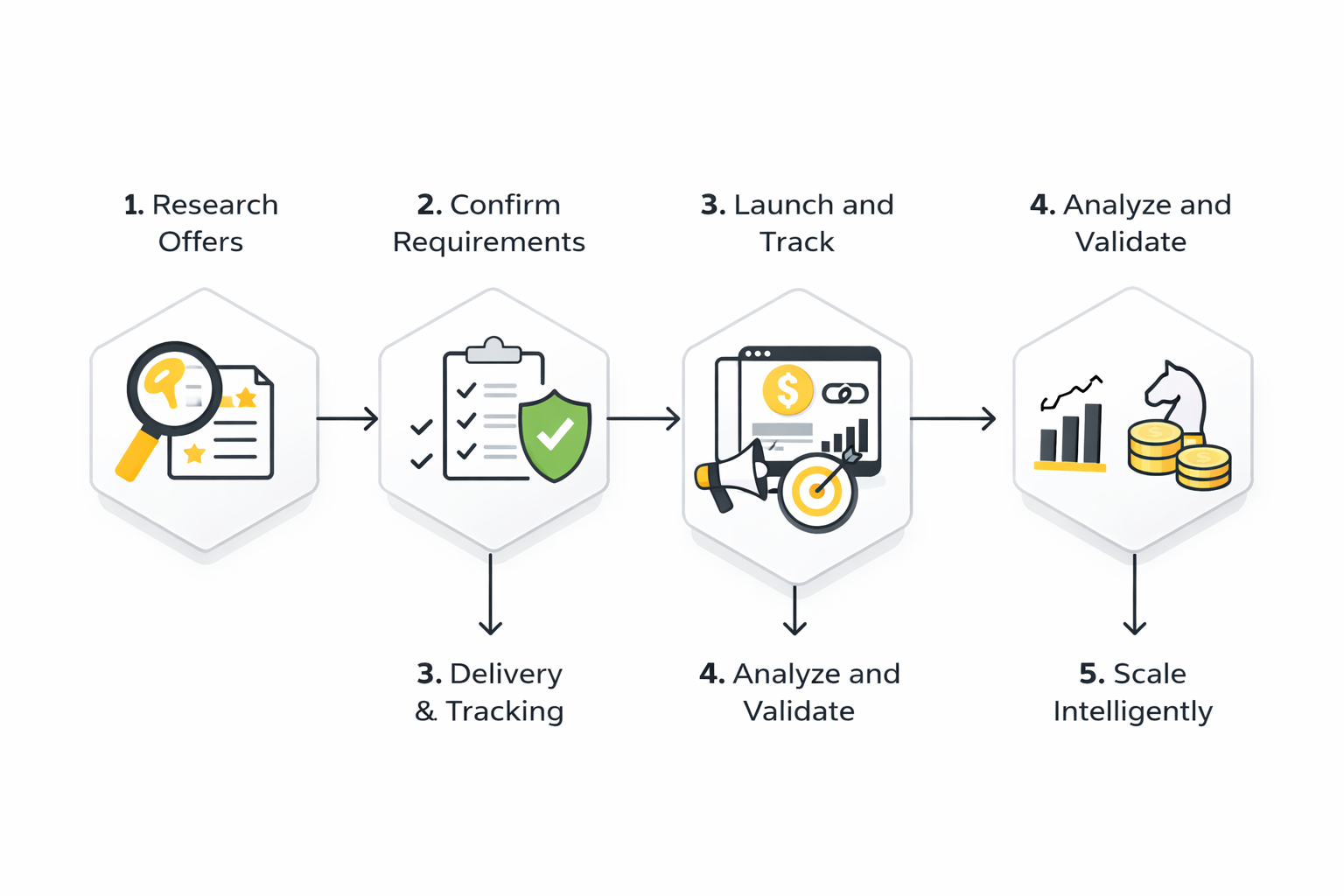
Pick One Traffic Channel and One Conversion Path
Start with a single traffic source you can realistically sustain for 60 to 90 days. That might be search content, short-form social, a niche newsletter, a YouTube format, or a creator-led community funnel. What matters is not which one sounds coolest. What matters is whether you can publish consistently, disclose clearly, and learn fast.
Then build one conversion path that matches how people actually buy. For some offers, that is a direct review page. For others, it is a comparison page, a tutorial, a quiz funnel, or a lead magnet followed by email. If the offer needs explanation, do not dump people straight onto an affiliate link and hope. Give the click a reason.
This is also where better software can improve execution without turning the article into a tool list. A cleaner page builder like Replo can help if you care about high-converting landing pages, while ClickFunnels, Systeme.io, or GoHighLevel make more sense if your conversion path includes lead capture, nurturing, and a longer sales process.
Use a Tool Stack That Shortens the Feedback Loop
If your goal is speed, your stack should help you publish, follow up, and measure without friction. That usually means one page builder or funnel tool, one email or CRM layer, one distribution workflow, and one way to track which links are actually producing approved revenue. Anything beyond that should earn its place.
For audience capture and follow-up, tools like ManyChat, Brevo, Moosend, or GoHighLevel fit naturally when you need a stronger nurture sequence instead of relying on one-click conversions. For content scheduling and repackaging, Buffer and Flick can help keep distribution consistent, which matters because offers with short feedback loops still need steady top-of-funnel attention.
Link visibility matters more than affiliates admit. If you cannot tell which page, email, or social post produced the commission, you cannot improve the system. A cleaner link layer through Dub or a bio-link hub through Anything.com can make that easier without adding a lot of operational overhead.
Track Cash Flow, Not Just Dashboard Revenue
This part is boring, and it is absolutely where smart affiliates win. If you are targeting affiliate programs that pay daily, you need a simple spreadsheet or dashboard that separates tracked commissions, approved commissions, withdrawn funds, and actual cash received. Those are four different numbers, and treating them as one is how people convince themselves they are profitable when they are not.
You also need a reinvestment rule. Decide in advance how much of each payout goes back into content, traffic, tools, and reserves. That protects you from the emotional swing of getting faster payments and immediately spending them as if they are stable recurring income.
The final habit is reviewing every offer against reality at least weekly. If approval rates are sliding, if reversals are rising, or if the payout cadence is slower than promised, fix it fast. Speed only helps when the underlying machine is healthy. In the next part, we will look at how to choose the right promotion channels and content angles for this model so the system does not stall after the initial setup.
What the Data Actually Tells You
At this stage, the goal is not to collect more dashboards. The goal is to understand which numbers actually predict whether affiliate programs that pay daily will stay profitable once you add real traffic, real costs, and real approval delays. A fast payout model only works when your metrics tell a coherent story from click to approved commission.
The most useful way to read performance data is in layers. First, you check whether people are engaging with the message at all. Then you check whether that engagement turns into clicks. Then you check whether those clicks turn into tracked conversions, approved conversions, and finally cash received. If any layer breaks, the payout schedule stops being the main story.
The Metrics That Matter First
The first group of metrics tells you whether your top of funnel is healthy. If you use email, social, or a short-form content channel to feed your offers, you need to know whether people are opening, clicking, and engaging enough to justify the next step. Brevo’s 2025 benchmark, built on more than 44 billion emails, shows an overall open rate of 31.22% and a click-through rate of 3.64%. Those are not affiliate-specific numbers, but they are incredibly useful as directional benchmarks for audience quality and message-market fit.
What matters is not whether your numbers match those averages exactly. What matters is what your gap is telling you. If your open rate is strong and your clicks are weak, the hook is working but the offer bridge is not. If your click rate is strong and your conversion rate is weak, the audience may be curious but not commercially aligned.
On the social side, benchmark data helps you decide where distribution energy belongs. Buffer’s 2026 social engagement study analyzed more than 52 million posts and found LinkedIn leading average engagement at 6.50%. That does not mean every affiliate should rush to LinkedIn, but it does mean platform behavior still matters a lot. If your niche fits professional pain points, platform selection can affect conversion economics before the audience ever sees your offer page.
How to Read Performance Without Fooling Yourself
A lot of affiliates overvalue surface-level wins because the first data point looks encouraging. A post gets attention, an email gets opens, or a landing page gets clicks, and suddenly the campaign feels validated. But in this model, attention is only useful when it survives the full path to approved revenue.
That is why you need to separate engagement metrics from commercial metrics. Engagement metrics tell you whether the market is paying attention. Commercial metrics tell you whether that attention becomes money. Both matter, but they do not matter equally at every stage.
Engagement Metrics Tell You Whether the Hook Is Working
Open rate, click-through rate, click-to-open rate, watch time, saves, replies, and engagement rate are all diagnostic tools. They help you understand whether the angle, creative, and message are landing. Brevo’s own reporting guidance makes the point clearly: a high open rate does not necessarily mean strong engagement if clicks stay weak. That is the kind of distinction affiliates need to respect.
The action this should drive is simple. If opens or impressions look healthy but click intent is soft, change the bridge between content and offer. Tighten the CTA, sharpen the problem statement, or make the next step feel more specific. Do not jump straight to blaming the affiliate program when the real issue is your messaging.
Social engagement should be interpreted the same way. Buffer’s breakdown of social metrics makes the useful point that metrics only matter when they guide the next move. That is exactly right. Engagement data is not there to make you feel good. It is there to tell you whether to double down on a content angle or kill it.
Commercial Metrics Tell You Whether the Offer Can Scale
Once people click, the serious numbers begin. The most important commercial metrics are click-to-conversion rate, earnings per click, approval rate, reversal rate, payout lag, and net cash received after costs. These numbers decide whether your campaign has a real future or just a nice-looking top funnel.
This is where many affiliates make a costly mistake. They optimize for raw EPC too early without checking whether the conversions are being approved consistently. A flashy EPC can hide a weak approval rate, and a fast payout schedule does not rescue a funnel that turns a lot of curiosity into low-quality leads.
The right action depends on which number breaks first. If click-to-conversion rate is low, fix the page, angle, or audience match. If tracked conversions look fine but approvals lag, the issue may be traffic quality, offer fit, or advertiser validation standards. If approvals are strong but net cash remains weak, your content or traffic costs are probably too high relative to the payout.
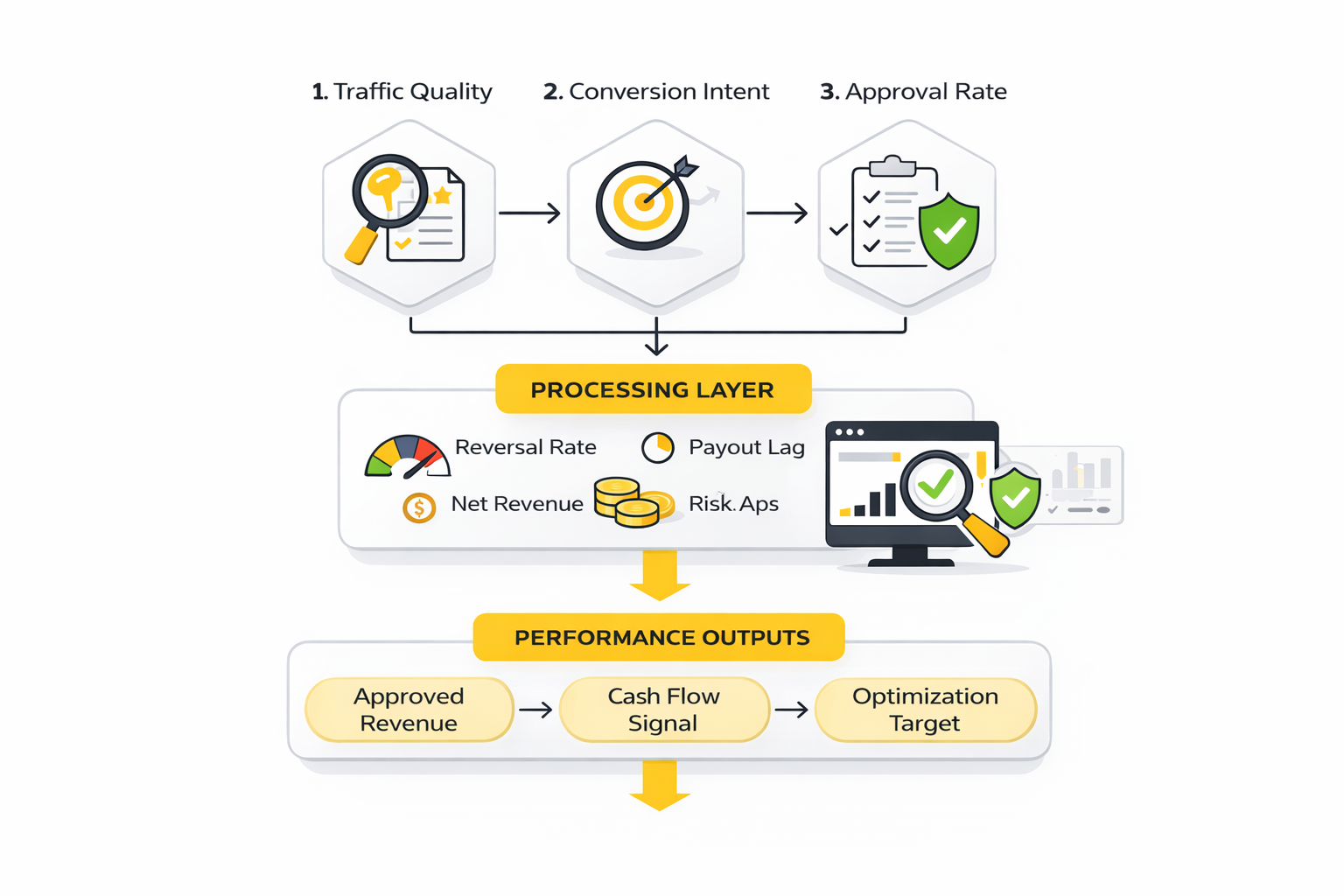
Practical Benchmarks for a Fast-Payout Funnel
Benchmarks only help when they create thresholds for action. Otherwise, they are just interesting trivia. The cleaner way to use benchmarks is to pair each one with a decision rule.
Here is a practical way to think about it:
- If your email open rate is healthy but your click-through rate is weak compared with Brevo’s 2025 averages, your subject line is pulling harder than your offer framing.
- If your social posts get respectable engagement but your affiliate clicks stay soft, the content is attracting the wrong kind of attention.
- If your clicks are strong but conversions are poor, the offer page or audience alignment is the likely bottleneck.
- If conversions are tracked but approvals are unstable, the network or advertiser is telling you something about lead quality.
- If approvals are solid but cash flow still feels tight, your payout lag, cost structure, or reinvestment discipline needs work.
That is the right way to use data in this model. Not as a scoreboard, but as a control panel. Each metric should point to one likely problem and one likely next move.
Timing Data Can Improve Revenue Faster Than More Content
One overlooked part of analytics is timing. People tend to think scale comes from producing more content, but often it comes from distributing the same message at a better moment. Brevo’s 2025 send-time analysis found that the strongest baseline window is Tuesday to Thursday between 10:00 a.m. and 3:00 p.m.. That is not a magic formula, but it is a strong starting point when you are testing email-led affiliate flows.
The action here is straightforward. Do not change your copy, your page, and your send time all at once. Test timing separately. If performance lifts just by moving the same campaign into a stronger window, you have created more approved revenue without increasing workload.
Social scheduling can work the same way. Buffer’s analytics resources are built around sorting posts by engagement rate and identifying the posts worth repeating or boosting. That matters because a fast-payout affiliate system benefits from repetition that is informed, not random.
What the Numbers Should Make You Do Next
The deeper point is this: metrics are only useful when they change behavior. If your data says the channel is wrong, stop forcing it. If your data says the hook works but the offer does not, swap the offer before you create more content. If your data says the offer converts but payout lag destroys momentum, shift part of your effort into better-cadence programs instead of waiting for optimism to fix operations.
This is where a disciplined tool stack helps. A cleaner CRM and nurture flow through GoHighLevel, Brevo, or ManyChat makes measurement easier because you can see where interest drops. A stronger page flow in ClickFunnels, Systeme.io, or Replo gives you a better shot at improving conversion without changing the audience.
That is the real advantage of measurement in affiliate programs that pay daily. It helps you protect speed with evidence. And once that evidence is in place, the next step is obvious: avoid the mistakes that wipe out fast-moving affiliate systems just when they start gaining traction.
Scaling Daily-Payout Affiliate Offers Without Breaking the System
This is the point where a lot of affiliates get tricked by early success. A campaign starts generating clicks, a few commissions land quickly, and suddenly the temptation is to multiply traffic sources, add more offers, and push harder before the system is really stable. That is exactly how a clean fast-payout setup turns into a messy operation with attribution gaps, weaker lead quality, and a payout profile you can no longer trust.
Scaling affiliate programs that pay daily works best when you treat speed as something to protect, not something to exploit recklessly. The moment you add volume, every weakness gets louder. Bad traffic becomes more obvious, weak follow-up costs more money, and inconsistent messaging starts showing up in your approval rate instead of hiding behind a small sample size.
The First Tradeoff: Speed Versus Stability
A fast-payout offer can improve cash flow, but that does not automatically make it the best long-term asset. Some of the strongest affiliate businesses are built on recurring SaaS commissions, slower validation cycles, and more deliberate funnels because the economics stay healthier over time. A funnel with slightly slower cash conversion can still be a far better business if retention, customer value, and upsell behavior are stronger.
That is why you should not build your entire strategy around payout cadence alone. ClickFunnels’ sales funnel efficiency breakdown highlights conversion rate, average order value, and customer lifetime value as the core variables that really shape funnel performance. That framing matters here because daily payouts solve a timing problem, while efficiency and customer value solve a business problem.
The practical move is to use fast-payout offers as part of a balanced portfolio, not as your whole identity. Let them help fund experimentation and operating expenses, while sturdier recurring offers create the base layer of income you are not constantly babysitting.
The Second Tradeoff: More Traffic Versus Better Traffic
When people want to scale, they usually think “more.” More posts, more spend, more channels, more pages. But the smarter move is often better traffic, not just more traffic. A daily-payout system becomes fragile when you expand into audiences that are less qualified just to keep the volume line moving.
This is where consistency beats randomness. Buffer’s creator growth research found that creators posting consistently across 20 or more weeks in a 26-week window saw roughly 450% more engagement per post than creators posting in four weeks or fewer. That does not mean “post more everywhere.” It means steady distribution to the right audience compounds better than bursts of desperate activity.
For affiliates, that translates into a very specific scaling rule: expand only after a channel has proven it can produce qualified clicks repeatedly. If a channel gives you attention but not approved commissions, it is not ready for scale. It is just noisy.
Risk Management Gets More Important as Volume Grows
At low volume, mistakes can hide. At higher volume, they turn into expensive patterns. That is why advanced affiliates spend more time on safeguards than beginners expect. The payout speed may be the thing that got your attention, but risk control is what keeps the system usable once it starts working.
The biggest risk is overestimating the quality of your own revenue. Fast payout dashboards can create emotional momentum, and emotional momentum can make mediocre performance look better than it is. If you do not separate tracked conversions from approved payouts and approved payouts from cash actually received, you can talk yourself into scaling a funnel that has no real operating margin.
Protect Approval Rates Before You Chase Higher Volume
A strong approval rate is usually a sign that the audience, messaging, and offer are aligned. A weak one is a warning that something deeper is broken. That could be the traffic source, the landing-page promise, the device mix, the lead intent, or the advertiser’s review standards. Whatever the reason, you should treat falling approval rates as a scaling alarm, not a temporary annoyance.
This is also where automation starts to matter in a serious way. GoHighLevel’s 2025 CRM strategy piece makes the useful point that modern CRM systems are shifting from simple contact storage into automated lead nurturing, task routing, and behavior-based follow-up. That matters for affiliates because better follow-up often increases conversion quality, not just conversion quantity.
If your offer needs education, reminders, or trust-building, a weak follow-up system can quietly drag down the entire model. That is where a more robust nurture layer through GoHighLevel, Brevo, or ManyChat stops being a nice extra and starts becoming operationally important.
Watch Platform Dependence Before It Turns Into Fragility
The next expert-level issue is concentration risk. If one platform controls nearly all your traffic, or one offer controls nearly all your revenue, your payout speed stops mattering the second that source changes rules, declines quality, or slows approvals. This is one of the least glamorous lessons in affiliate marketing, and one of the most valuable.
The smart answer is controlled diversification. Not random diversification. Controlled. Keep one primary traffic engine, one secondary distribution channel, and at least one backup offer family that fits the same audience. That way, you are not rebuilding from zero every time one variable moves.
This is another place where link infrastructure and routing matter more than people think. A cleaner dispatch layer through Dub or a hub through Anything.com can help you shift traffic paths without rewriting your entire public footprint every time an offer mix changes.
The Best Affiliates Build Systems, Not Campaigns
At beginner level, affiliate marketing feels like a campaign game. Pick an offer, publish a page, send some traffic, hope for conversions. At advanced level, it becomes a systems game. You are designing repeatable acquisition, consistent follow-up, cleaner attribution, and a predictable path from click to approved payout.
That is why the best operators care so much about workflow design. Buffer’s 2026 engagement study and its 2026 content-format analysis of more than 45 million posts both reinforce the same broad lesson: format, consistency, and platform behavior shape results in ways you cannot brute-force with enthusiasm alone. Smart affiliates use that kind of data to reduce waste before they try to increase output.
On the conversion side, page quality matters too. If you are routing traffic through a funnel or landing page, the difference between a generic transition and a persuasive one compounds fast. That is where tools like Replo, ClickFunnels, or Systeme.io can make sense when your current bottleneck is conversion architecture rather than traffic generation.
The expert move is to stop asking, “How do I get more clicks?” and start asking, “What part of this machine is creating the biggest drag?” That question produces much better decisions. It also keeps you from scaling the wrong thing just because you are excited by a few quick payouts.
Strategic Positioning Matters More Than Offer Count
One last point before the close: you do not need dozens of offers to build a real affiliate business around fast payouts. You need a clear market position. The affiliates who last are usually not the ones promoting everything. They are the ones who become useful in one specific problem space and then layer monetization around that trust.
That could mean a creator focused on funnel tools and automation, where products like GoHighLevel, ClickFunnels, Chatbase, Fillout, and Firecrawl fit naturally. Or it could mean a growth stack around communication, scheduling, and workflow, where Cal.com, Wispr Flow, Copper, or ScaledMail make more sense.
That kind of positioning solves a problem that speed never can: trust. And once you have trust, you can choose faster-paying offers without looking like you are chasing whatever pays first. In the final part, we will pull everything together, cover the most common mistakes, and answer the questions people still get wrong about affiliate programs that pay daily.
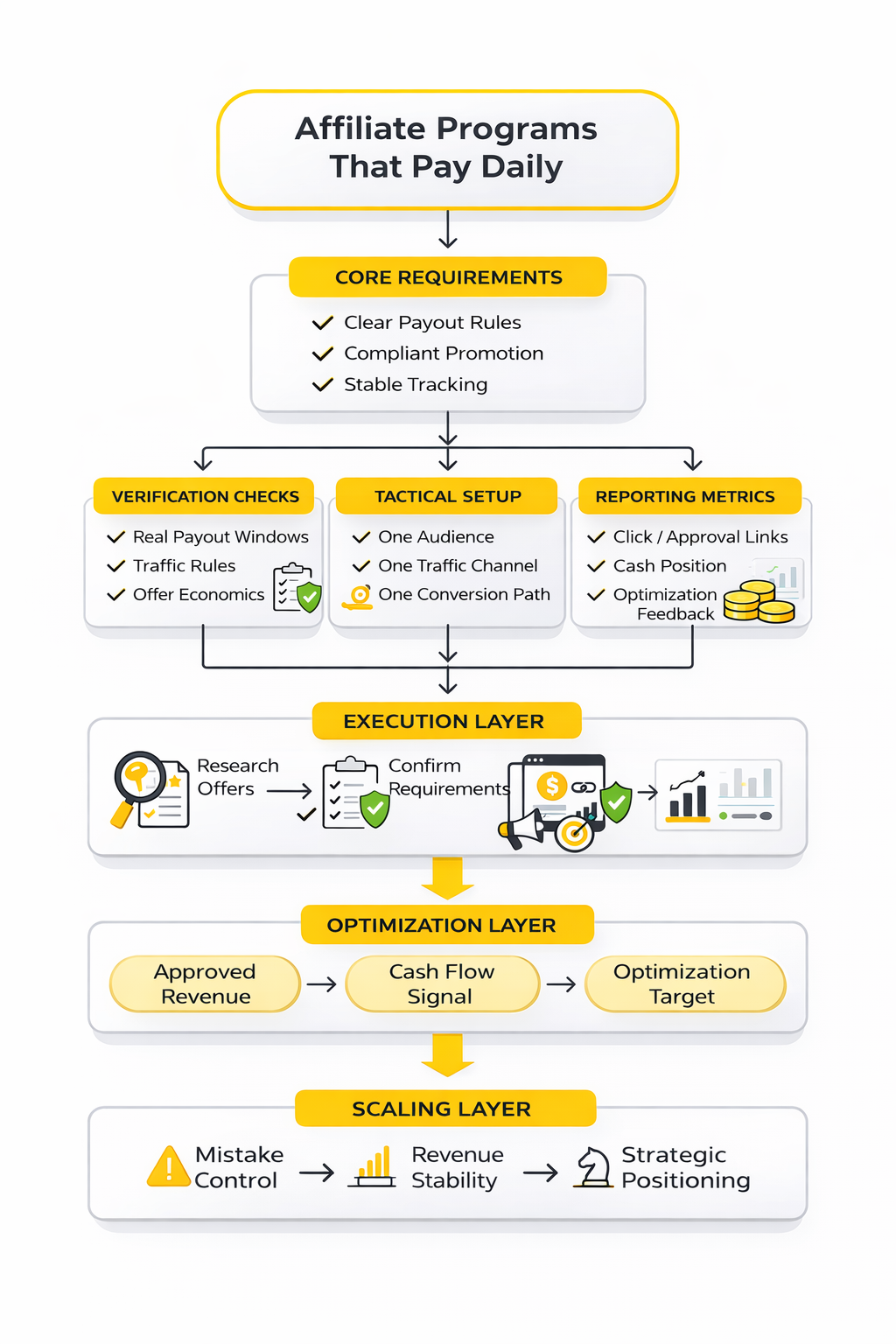
The big takeaway is simple: affiliate programs that pay daily can absolutely improve cash flow, but speed is only useful when the rest of the system is clean. You still need transparent payout rules, compliant promotion, reliable tracking, and an audience that actually matches the offer. When those pieces line up, faster payouts become a real strategic advantage instead of a shiny distraction.
That is also why the best operators do not obsess over payout timing alone. They build a compact ecosystem around one audience, one conversion path, one follow-up flow, and one measurement system that tells them what is actually turning into approved revenue. The payout schedule matters, but the machine behind it matters more.
FAQ - Built for Complete Guide
Are there really affiliate programs that pay daily?
Yes, but they are rarer than the internet makes them sound. In most cases, true daily payouts are more common in CPA-style environments or offers with accelerated release terms than in mainstream SaaS affiliate ecosystems. Even then, you still need to read the fine print because some platforms mean daily withdrawal access after approval, not instant payment on every conversion.
Is daily pay better than weekly or monthly affiliate payouts?
Not automatically. Daily pay is better for cash flow, but it is not automatically better for stability, retention, or long-term earnings. A slower-paying offer with stronger customer value can outperform a faster-paying offer if the approval rate is cleaner and the commissions hold up over time.
What is the biggest mistake beginners make with fast-payout affiliate offers?
The biggest mistake is treating tracked commissions like cash in the bank. A tracked conversion can still be rejected, reversed, delayed, or held if the traffic quality is weak or the advertiser validation process is stricter than expected. That is why beginners who chase payout speed without tracking approval quality usually get surprised fast.
Do I need a website to promote affiliate programs that pay daily?
No, but you do need a real distribution channel and a clear bridge to the offer. That could be a website, a YouTube channel, a niche newsletter, a short-form social account, or a messaging-based funnel. What matters is not the format itself, but whether you can build trust, disclose clearly, and move people toward the offer with intent.
Can I run paid ads to daily-payout affiliate offers?
Sometimes, but you need to be careful. Many offers have strict traffic policies, and some advertisers or networks will reject low-intent or misleading lead generation fast. If you use paid traffic, you need better tracking, tighter economics, and a realistic plan for approval lag, not just front-end click volume.
How do I know whether a program is actually safe to promote?
Start by reading the payout terms, traffic rules, approval logic, and any documentation around holds, fraud checks, or reversals. Then look at whether the product or offer solves a real problem and whether your audience is a believable fit for it. If the program promises easy money but stays vague about how commissions become payable, that is usually a warning sign.
Should I focus on one offer or promote several at once?
At the beginning, one strong offer is usually better. That gives you cleaner feedback, better positioning, and fewer moving parts while you learn what kind of audience and message actually convert. Once the system is stable, adding a second or third offer that fits the same audience makes much more sense than jumping into ten unrelated promotions.
What metrics matter most when I promote fast-payout affiliate offers?
The most important ones are click-through rate, conversion rate, approval rate, reversal rate, payout lag, and net cash received after costs. Surface metrics like impressions and opens still matter, but only as diagnostic signals. If your approved revenue and actual cash flow are not improving, the top-funnel numbers are not enough.
Do affiliate disclosures really matter if I am just posting links online?
Yes, they matter a lot. The FTC’s endorsement guidance is clear that material relationships should be disclosed in a way people can actually understand, especially in social content, reviews, and recommendations on platforms where affiliate links are used. Clear guidance on that sits in the FTC’s endorsements resources and FAQ pages at the FTC’s endorsements hub and the FTC’s endorsement FAQ.
Are SaaS affiliate programs worth promoting if they do not pay daily?
Absolutely, if the economics are stronger. Tools with recurring revenue and real business value can be much better long-term assets than fast-payout offers with weak retention or aggressive reversal risk. That is why platforms like GoHighLevel, ClickFunnels, and Systeme.io often stay attractive even when the payout cadence is not truly daily.
What should I build first if I want to start this the right way?
Build the simplest possible system that lets you learn quickly. That usually means one audience, one offer, one traffic source, one landing or bridge page, and one follow-up path through email, CRM, or chat automation. A setup using tools like ManyChat, Brevo, Replo, or GoHighLevel can make that easier, but the key is clarity, not tool overload.
How long does it usually take to know whether an affiliate offer is worth scaling?
Usually faster than people think, if your measurement is clean. You do not need months of data to spot obvious problems with click quality, weak conversion intent, or low approval rates. What you do need is enough honest volume to see whether the offer produces approved revenue consistently rather than just giving you a few lucky early wins.
Work With Professionals
Explore 10K+ Remote Marketing Contracts on MarkeWork.com
Most marketers spend too much time chasing clients, competing on crowded platforms, and losing a percentage of every project to middlemen.
MarkeWork gives you a better way. Browse thousands of remote marketing contracts and connect directly with companies desperate to hire skilled marketers like you, without platform commissions and without unnecessary gatekeepers.
If you're serious about finding better opportunities and keeping 100% of what you earn, explore available contracts and create a profile for free at MarkeWork.com.