

Affordable email marketing is not about finding the cheapest tool and hoping it works. It is about building a system that can capture leads, send useful emails, automate follow-up, and measure revenue without turning your monthly software bill into a monster.
Email still matters because it is one of the few channels you actually control. Gartner reported that email accounted for 7.4% of total digital marketing spend in 2025, while many marketing budgets stayed tight at 7.7% of company revenue. That tells you something important: teams are still protecting email because it keeps working when paid ads get expensive, algorithms shift, and social reach becomes unpredictable.
This article will be split into six parts:
- Why Affordable Email Marketing Still Matters
- The Affordable Email Marketing Framework
- The Core Components Of A Lean Email System
- How To Choose The Right Platform Without Overbuying
- Professional Implementation For Small Teams
- Mistakes To Avoid, Tool Recommendations, And FAQ
Why Affordable Email Marketing Still Matters
Affordable email marketing matters because most businesses do not have unlimited attention, time, or budget. A small team cannot afford bloated software, messy automations, or campaigns that look busy but produce no measurable result. The goal is simple: spend less on the system, but make every email more intentional.
The economics are still strong when the fundamentals are in place. Litmus reported that many companies see email ROI in the 10:1 to 36:1 range, with stronger programs going higher when they use segmentation, testing, and relevant offers. That does not mean every newsletter magically prints money, but it does show why email deserves a serious place in a lean marketing stack.
The problem is that “affordable” gets misunderstood. A free plan can become expensive if it limits automation, adds branding, blocks segmentation, or forces a migration later. A paid plan can be affordable if it replaces multiple tools and helps you convert leads faster.
The Affordable Email Marketing Framework
The best way to think about affordable email marketing is as a framework, not a tool hunt. You need a clear path from visitor to subscriber, subscriber to buyer, and buyer to repeat customer. When that path is clear, choosing software becomes much easier.
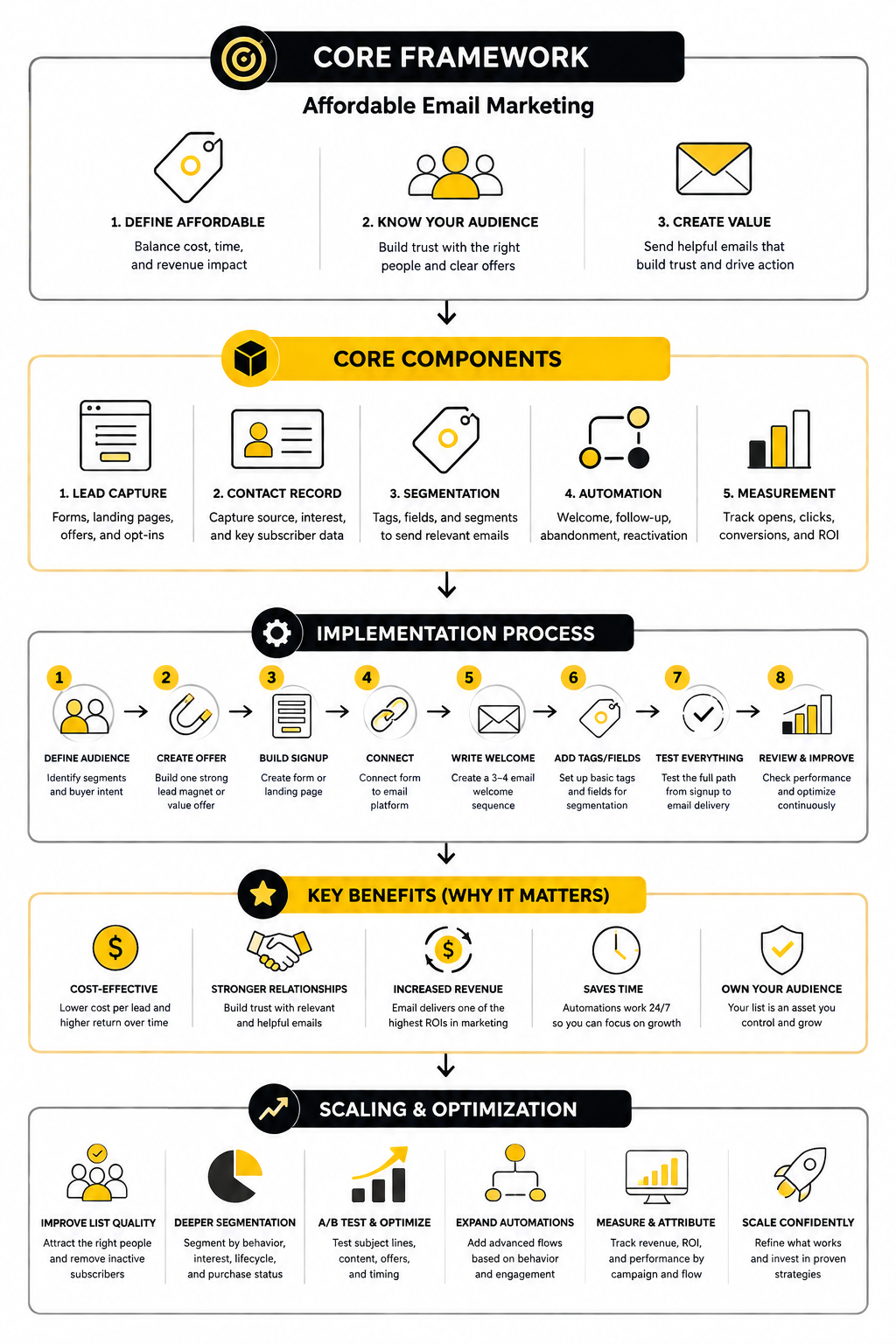
A lean email system has four jobs. It must collect the right contacts, organize them based on behavior or intent, send timely messages, and show what is working. If a platform helps you do those four things without unnecessary complexity, it is probably worth considering.
This is why tools like Brevo, Moosend, Systeme.io, and GoHighLevel often come up in affordable email marketing conversations. They are not identical, and they are not right for everyone. But they each appeal to businesses that want email, automation, and growth tools without immediately jumping into enterprise pricing.
The Core Idea Behind This Guide
The core idea is simple: affordable email marketing should reduce waste, not reduce capability. You do not need every advanced feature on day one. You do need clean list growth, useful automations, deliverability basics, and reporting that connects email activity to real business outcomes.
That means this guide will not treat price as the only decision factor. A cheap platform that makes segmentation painful can cost you sales. A slightly more expensive platform that saves hours every week can be the better deal.
The rest of the article will walk through the system piece by piece. First, we will define what makes email marketing affordable in practice. Then we will look at the core components, platform choices, implementation steps, and the mistakes that quietly drain budget.
What “Affordable” Really Means In Email Marketing
Affordable email marketing is not the same as cheap email marketing. Cheap focuses only on the monthly price. Affordable looks at the full cost of getting a subscriber, keeping that subscriber engaged, and turning that relationship into revenue.
A platform can look inexpensive at first and still become costly once your list grows, your automation needs expand, or your team starts wasting hours on manual work. That is why price should be judged against capability, not in isolation. The real question is whether the tool helps you send better emails with less friction.
This matters even more when budgets are tight. Marketing budgets remained at 7.7% of company revenue in 2025, based on Gartner’s CMO Spend Survey. When every channel has to justify itself, affordable email marketing becomes a practical growth lever, not just a cost-saving move.
The Three Costs You Need To Watch
The first cost is the obvious one: the subscription fee. This includes your monthly plan, contact limits, send limits, automation access, and any add-ons that become necessary as you grow. A free plan can be useful early, but it should never trap you inside a system you will outgrow in three months.
The second cost is operational time. If your team needs five tools, three spreadsheets, and a workaround just to send a welcome sequence, the platform is not really affordable. Time is part of the bill, even when it does not show up on the invoice.
The third cost is lost revenue from weak execution. Poor segmentation, generic campaigns, broken forms, and inconsistent follow-up all reduce the value of your list. Email marketing often delivers returns in the 10:1 to 36:1 range for many companies, based on Litmus email ROI research, but that only happens when the system is built to support real buying behavior.
The Lean Email Marketing Mindset
A lean email system starts with one simple belief: every email should have a job. Some emails build trust. Some educate. Some sell. Some recover missed revenue. What you want to avoid is sending emails just because the calendar says it is newsletter day.
This mindset helps you avoid overbuying. You do not need enterprise-level personalization before you have a clean welcome flow. You do not need advanced predictive analytics before you know which offers your audience actually clicks.
Start with the core jobs first. Capture leads, deliver value, segment based on intent, follow up automatically, and measure results. If a tool supports those jobs clearly, platforms like Brevo or Moosend can make sense for smaller teams that want useful automation without unnecessary complexity.
Where Affordable Email Marketing Creates Leverage
The biggest leverage comes from follow-up. Most visitors do not buy the first time they see your offer, and most leads will not remember you unless you stay useful. Email gives you a low-cost way to keep showing up without paying again for the same attention.
The second leverage point is segmentation. A small list with clear intent data can outperform a large list that receives the same generic message every week. This is where affordable email marketing becomes less about sending more and more about sending smarter.
The third leverage point is automation. A welcome sequence, lead magnet delivery, abandoned checkout reminder, sales follow-up, or reactivation campaign can run quietly in the background once it is set up correctly. That is the real beauty of email: you build the asset once, then improve it over time.
The Core Components Of A Lean Email System
A lean email system starts before the first email is ever sent. You need a clear offer, a simple signup path, and a reason for someone to trust you with their inbox. Without that foundation, even the best affordable email marketing platform will feel disappointing.
The first component is the lead capture point. This could be a form, landing page, checkout opt-in, quiz, booking page, or free resource. The key is that the signup moment must match the promise, because vague forms create weak subscribers and weak subscribers rarely become buyers.
The second component is the contact record. Every subscriber should enter your system with enough context to make future emails more relevant. That does not mean collecting twenty fields upfront, but it does mean tracking where they came from, what they requested, and what action they took next.
Build The Email System In The Right Order
Most teams make email harder than it needs to be because they start with campaigns before they build the foundation. They write newsletters, change templates, debate subject lines, and only later realize their list is poorly organized. That is backwards.
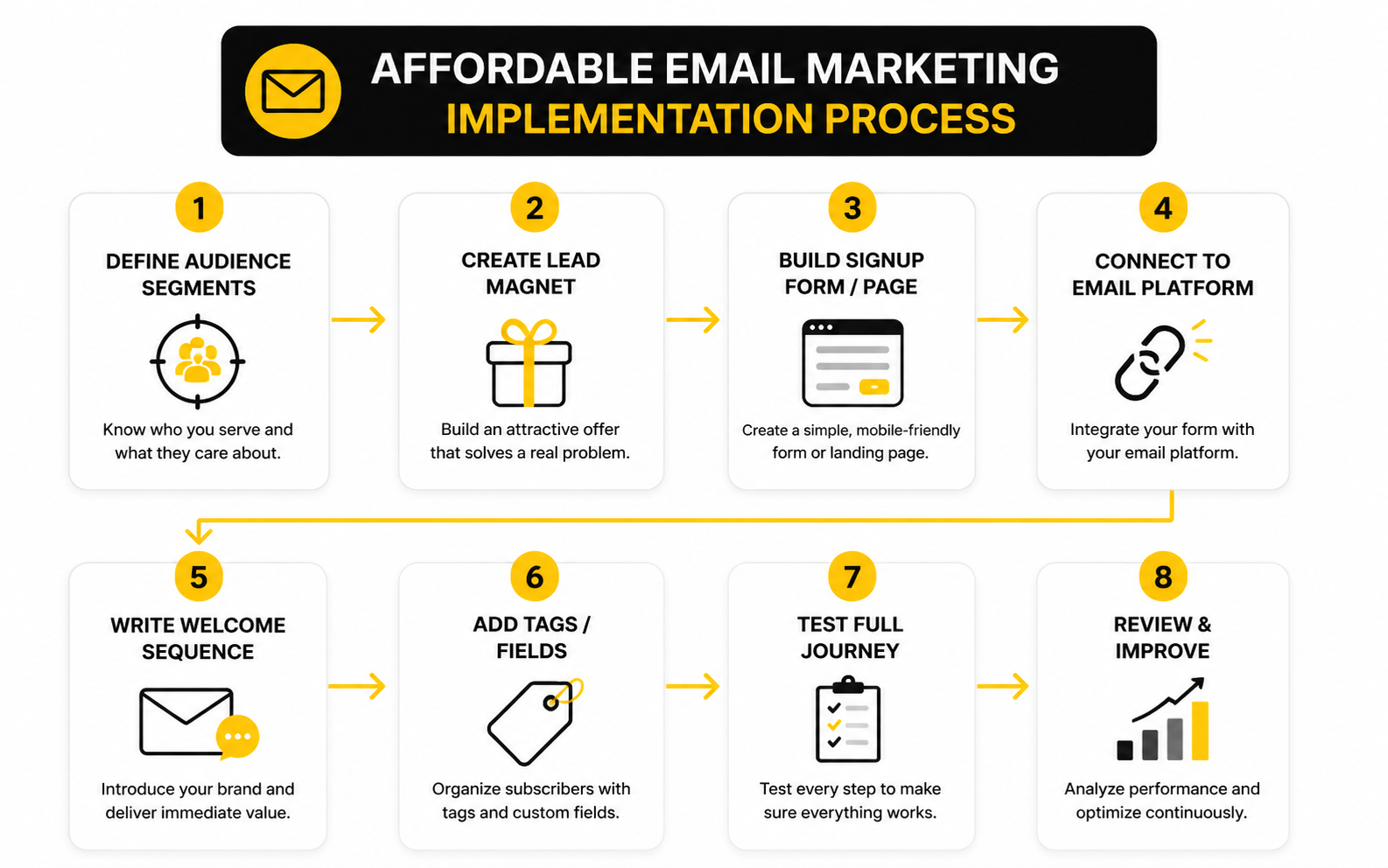
The smarter order is simple:
- Define the main audience segments.
- Create one strong lead capture offer.
- Build the signup form or landing page.
- Connect the form to the email platform.
- Write the welcome sequence.
- Add basic tags or fields.
- Test the full path from signup to delivery.
- Review engagement and improve the sequence.
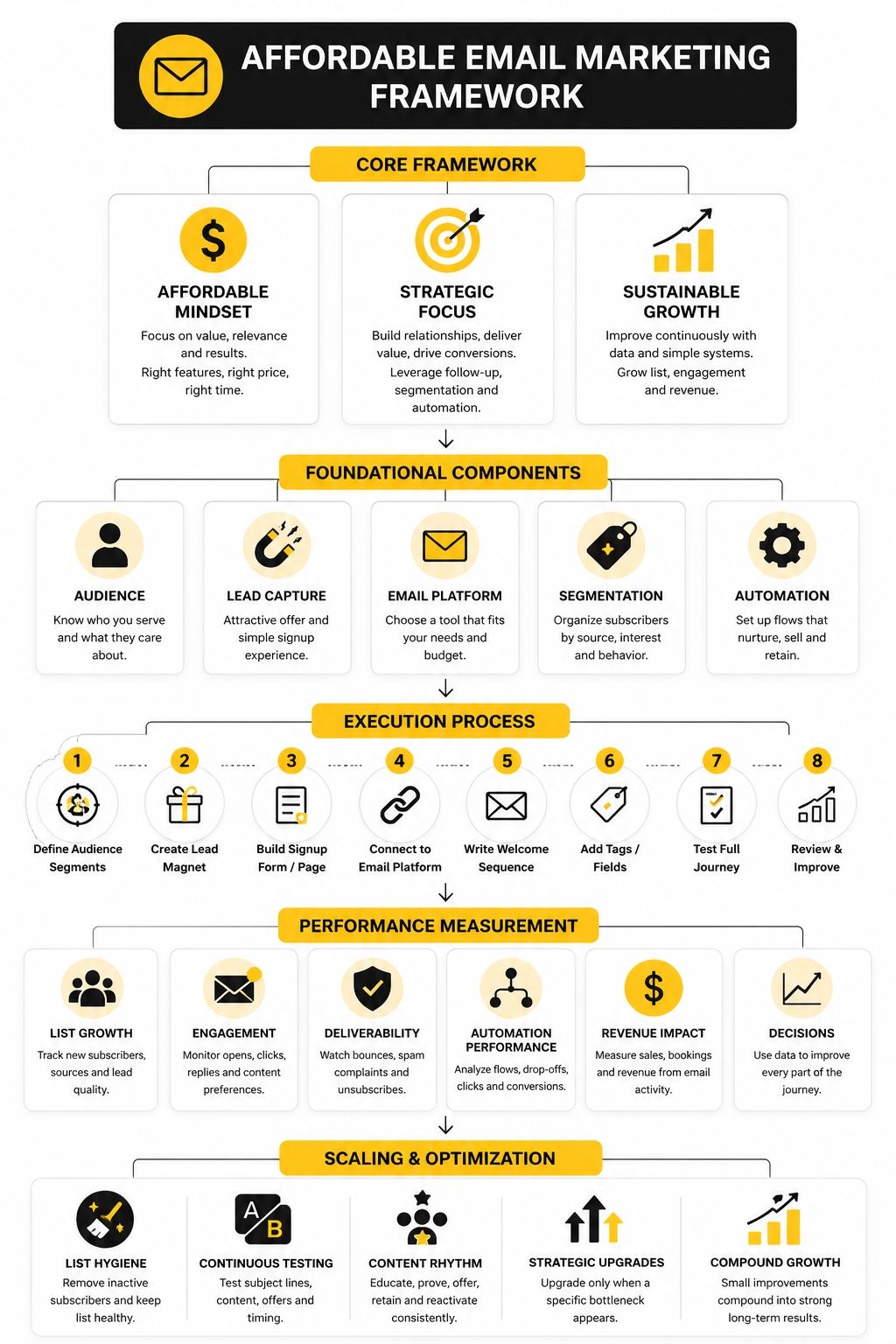
This process keeps affordable email marketing practical. You are not trying to build a giant machine from day one. You are building one clean path that works, then improving it with real behavior instead of guesses.
Start With One Clear Subscriber Journey
The first journey should answer a basic question: what happens after someone joins your list? If the answer is “they get added to the newsletter,” that is not enough. A new subscriber needs context, reassurance, value, and a clear next step.
A simple welcome journey can do more than a complicated content calendar. The first email delivers the promised resource or confirms the signup. The second email explains who you help and what problem you solve. The third email gives practical value. The fourth email introduces a relevant offer without sounding desperate.
This is where tools like Systeme.io can be useful for creators and small businesses that want email, funnels, and simple automation in one place. For service businesses, agencies, or teams that need CRM-style follow-up alongside email, GoHighLevel can make sense because the email system can connect more directly to pipelines, appointments, and sales conversations.
Keep Segmentation Simple At First
Segmentation does not need to be complicated to be useful. In the beginning, you only need enough information to avoid sending the wrong message to the wrong person. That usually means separating leads, customers, inactive subscribers, and people who showed interest in a specific offer.
A practical tagging structure might include source, interest, lifecycle stage, and purchase status. Source tells you where the subscriber came from. Interest tells you what they wanted. Lifecycle stage tells you whether they are a lead, buyer, or repeat customer. Purchase status prevents awkward emails, like promoting an entry-level offer to someone who already bought it.
This is one of the biggest differences between cheap sending and real affordable email marketing. Cheap sending blasts everyone. A lean system respects context, which makes your emails feel more useful and less random.
Write Emails That Move The Relationship Forward
Good email copy does not need to be fancy. It needs to be clear, relevant, and easy to act on. Every email should answer three questions: why is this in the reader’s inbox, why should they care now, and what should they do next?
For a welcome sequence, keep the tone direct and helpful. Do not overload the reader with your entire brand story on day one. Give them a quick win first, then build trust with useful context and a relevant offer.
For promotional emails, connect the offer to a real problem. Do not just announce discounts or features. Explain the situation, the cost of ignoring it, and the better outcome the reader can move toward.
Test The System Before You Scale It
Before you send traffic into the system, test it like a customer. Submit the form, check the confirmation message, open the first email, click every link, and make sure the right tags or fields are applied. Small mistakes here can quietly damage trust.
You should also test mobile formatting. A large share of subscribers will read from a phone, so long paragraphs, tiny buttons, and cluttered templates can hurt performance. Simple layouts usually win because they reduce friction.
Once everything works, start measuring the basics. Watch signup conversion, delivery, opens, clicks, replies, unsubscribes, and sales activity. Affordable email marketing gets stronger when you improve one part of the journey at a time instead of rebuilding the whole system every week.
Statistics And Data That Actually Matter
Affordable email marketing only works when you know what the numbers are telling you. The goal is not to stare at dashboards all day. The goal is to spot friction, protect deliverability, and understand which emails are moving people closer to revenue.
Start with the numbers that connect to decisions. Open rate can show whether your subject line and sender reputation are strong enough to earn attention. Click rate shows whether the email created enough interest to drive action. Conversion rate shows whether the promise, offer, and landing page matched what the subscriber expected.
Benchmarks are useful, but they are not the boss. Mailchimp’s benchmark data shows an all-user average open rate of 35.63%, click rate of 2.62%, and unsubscribe rate of 0.22% across its measured categories, while MailerLite reported a 2025 average open rate of 43.46% and click rate of 2.09%. Those numbers give you a reference point, but your own trend line matters more than someone else’s average.
Read Benchmarks The Right Way
A benchmark should help you ask better questions, not panic. If your click rate is below your industry average, the answer is not automatically “write better emails.” It could be weak list quality, unclear offers, poor mobile formatting, bad timing, or a landing page that fails after the click.
Open rates are especially easy to misread. Privacy changes, image loading behavior, inbox placement, and subscriber habits can all distort the number. Treat open rate as a directional signal, not a final verdict.
Click rate and conversion rate deserve more attention because they are closer to business outcomes. If people click but do not convert, the issue may be the page, offer, pricing, or trust gap. If people open but do not click, the email itself probably needs a sharper promise and a clearer next step.
Build A Simple Measurement System
A good analytics setup does not need to be complicated. For most small teams, the first version should track campaign performance, automation performance, list health, and revenue impact. That is enough to make smart decisions without drowning in reports.
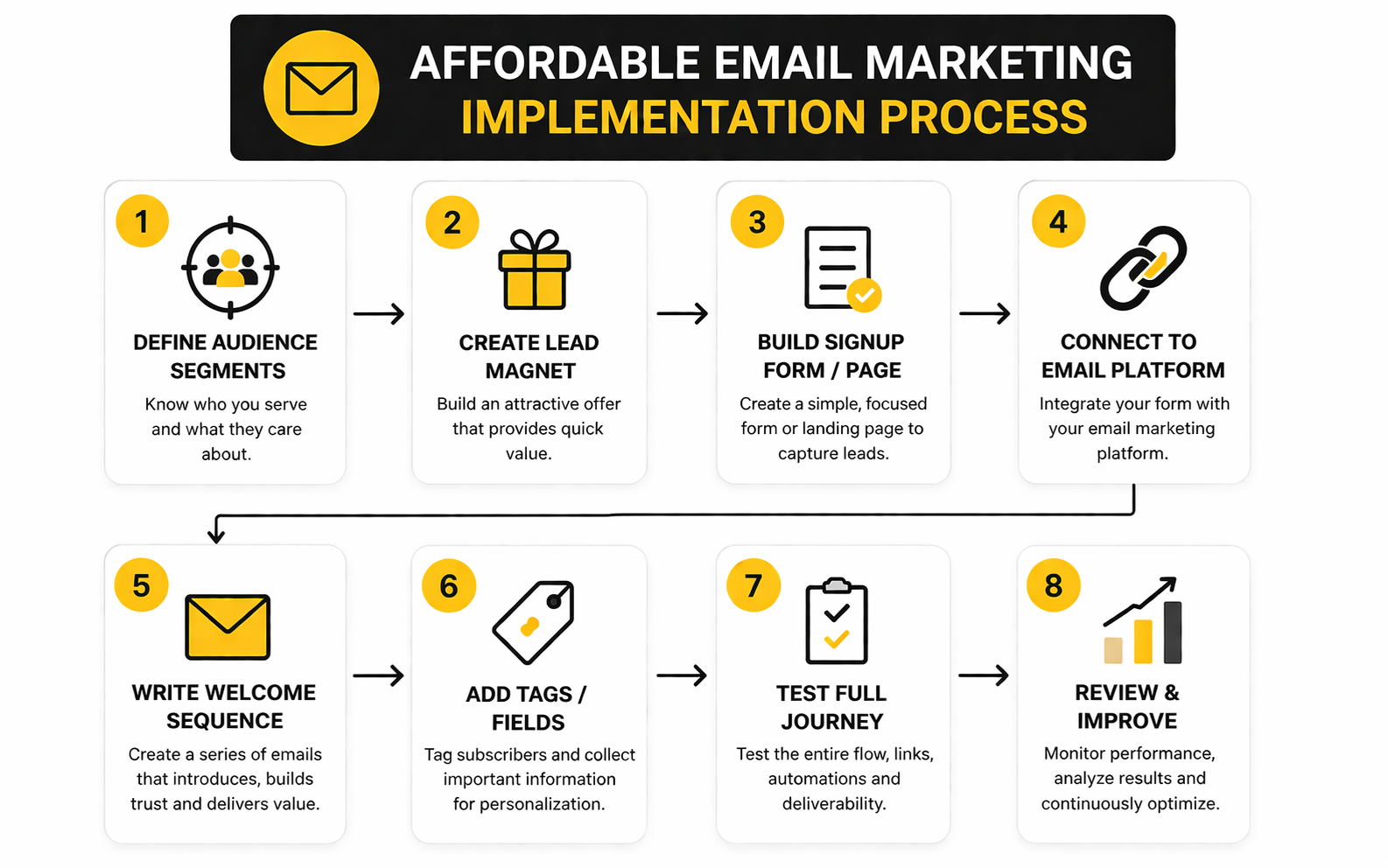
The simplest measurement system looks like this:
- List growth: new subscribers, source, form conversion, and lead quality
- Engagement: opens, clicks, replies, and content preferences
- Deliverability: bounces, spam complaints, unsubscribes, and inbox placement signals
- Automation performance: completion rate, drop-off points, clicks, and conversions by email
- Revenue: sales, bookings, trials, upgrades, and repeat purchases connected to email activity
This is where affordable email marketing becomes more professional. You stop asking whether email “works” in general and start asking which sequence, segment, offer, or source is producing the best return.
Watch Deliverability Before It Hurts You
Deliverability is not exciting until it becomes a problem. Then it becomes everything. If your emails are not reaching the inbox, your copy, design, and offer barely matter.
Spam complaints are one of the most serious signals. Mailgun’s 2025 deliverability research notes that Google and Yahoo bulk sender requirements use a 0.3% spam complaint threshold, while senders are strongly encouraged to stay below 0.1%. That means one complaint in every thousand emails is already a warning sign, not something to ignore.
Unsubscribes are different. A low, steady unsubscribe rate can be healthy because it keeps the list cleaner. A sudden jump after one campaign usually means the message, frequency, or audience match was off.
Measure Revenue Without Overcomplicating Attribution
Revenue tracking does not need to be perfect to be useful. You need enough visibility to know whether email is helping people buy, book, subscribe, renew, or come back. Waiting for flawless attribution is a great way to avoid making decisions.
Use tracked links, UTM parameters, platform revenue reports, coupon codes, CRM stages, and checkout data where possible. If you use a funnel builder like ClickFunnels or an all-in-one platform like GoHighLevel, connect email activity to the next commercial step so you can see more than opens and clicks. If you use a simpler email platform, track the most important conversion manually at first rather than tracking nothing.
The real question is not whether every sale can be attributed with perfect precision. The real question is whether your email system is creating measurable movement. If it is growing qualified leads, increasing repeat visits, recovering abandoned intent, or producing sales conversations, you have something worth improving.
Turn Data Into Better Decisions
Do not optimize everything at once. Pick the weakest visible point in the journey and improve that first. If signups are low, improve the offer and capture page. If opens are low, test sender name, subject line, and list quality. If clicks are low, sharpen the email’s promise and call to action.
If clicks are strong but conversions are weak, stop rewriting emails and inspect the landing page. The subscriber already showed interest. The failure is happening after the click, so that is where the fix belongs.
This is the practical rhythm: measure, diagnose, adjust, and repeat. Affordable email marketing becomes powerful when small improvements compound across every step of the system.
Professional Implementation For Small Teams
Once the system is working, the next challenge is discipline. Affordable email marketing usually fails when a team keeps adding tools, campaigns, and automations without deciding what each piece is supposed to do. More complexity does not automatically mean more revenue.
A professional setup needs ownership. One person should be responsible for the email calendar, one person should understand the platform, and one person should review performance. In a very small team, that may be the same person, but the responsibilities still need to be clear.
This is also where documentation becomes important. Keep a simple record of your forms, tags, automations, segments, offers, and reporting links. When something breaks or performance drops, you should not need a detective investigation just to understand how the system is wired.
Choose Between Simple Tools And All-In-One Platforms
The biggest strategic tradeoff is whether to use a dedicated email tool or an all-in-one growth platform. A dedicated email platform is usually easier to learn, cleaner for campaigns, and often more affordable at the beginning. An all-in-one platform can become cheaper later if it replaces separate tools for funnels, CRM, forms, booking, automation, and follow-up.
For creators, solo operators, and early-stage businesses, Systeme.io, Brevo, or Moosend can make sense because they keep the setup manageable. For agencies, local service businesses, and sales-led teams, GoHighLevel may be a better fit because email can sit closer to pipelines, appointments, SMS follow-up, and client management.
Do not choose based on the longest feature list. Choose based on the workflow you will actually use. The best affordable email marketing platform is the one your team can run consistently without duct tape.
Avoid The Scaling Traps
The first scaling trap is list growth without list quality. A bigger list looks good in a dashboard, but it can hurt performance if the audience is poorly matched, inactive, or collected through weak offers. Growth only matters when it brings in people who are likely to engage, buy, or refer.
The second trap is automation overload. It is easy to build too many branches, tags, delays, and conditions until nobody understands the journey anymore. Keep automations simple enough to audit, because a broken automation can quietly send the wrong message for months.
The third trap is ignoring deliverability until revenue drops. Google’s sender guidance says spam rates should stay below 0.1% and should never reach 0.3% or higher, which makes list hygiene and message relevance operational priorities, not technical details. If people stop engaging, stop blasting and start cleaning.
Build A Smarter Content Rhythm
A strong email rhythm balances consistency with usefulness. You do not need to email daily just because someone online says it works. You need a cadence your audience welcomes and your team can sustain.
For many businesses, one useful newsletter per week plus behavior-based automations is a strong starting point. The newsletter keeps the relationship alive, while automations handle timing-sensitive follow-up. That combination gives you reach without turning every week into a panic.
Your content should rotate through a few clear roles:
- Education: help the reader understand a problem or opportunity
- Proof: show credibility, results, or practical reasoning
- Offer: invite the reader to take the next step
- Retention: help customers get more value after they buy
- Reactivation: bring quiet subscribers back with a relevant reason
Use AI Carefully, Not Lazily
AI can make affordable email marketing faster, but it can also make it generic. That is the tradeoff. If every email sounds like a polished template with no point of view, subscribers will feel it immediately.
Use AI for first drafts, structure, subject line variations, repurposing, and QA checks. Do not outsource the strategy, offer logic, customer insight, or final voice. Those are the parts that make the email worth reading.
This is especially important when your brand relies on trust. A helpful, specific, slightly imperfect email often beats a perfectly polished message that says nothing new. Speed is useful, but relevance wins.
Know When To Upgrade
You should upgrade your platform when the current setup is creating clear friction. That might mean you need better segmentation, stronger automation, CRM visibility, cleaner reporting, higher sending limits, or native funnel tools. Upgrading just because a tool has more features is usually how affordable email marketing becomes expensive.
Look for signs that the system is outgrowing the tool. If you are exporting CSV files every week, manually moving leads between apps, losing attribution, or skipping campaigns because setup is too painful, the cheap option may no longer be cheap. At that point, paying more can actually reduce the total cost.
The upgrade should solve a specific bottleneck. Name the problem first, then choose the tool. That one habit will save you from buying software your business is not ready to use.
Mistakes To Avoid Before You Scale
The biggest mistake is treating affordable email marketing like a one-time setup. Email is not a plug-in you install and forget. It is a living revenue system that needs list hygiene, testing, better offers, and regular cleanup.
Another mistake is choosing a platform only because it is free. Free can be useful, especially at the beginning, but it becomes expensive when it blocks automation, weakens reporting, or forces you into a messy migration later. The better move is to choose the lowest-cost tool that supports the next real stage of your business.
The final mistake is sending more when the system needs better thinking. If engagement drops, do not immediately increase frequency or shout louder. Look at your audience, promise, offer, timing, and deliverability first.
Tool Recommendations By Use Case
For creators and lean online businesses, Systeme.io is worth considering when you want email, funnels, products, and automation in one place. It fits best when simplicity matters more than deep enterprise features. That makes it useful for people who want a practical system without stitching together too many tools.
For small teams that want email marketing and automation without overcomplicating the stack, Brevo and Moosend are strong options to compare. They make the most sense when your main priority is sending campaigns, building automations, and keeping costs under control. The right choice depends on your list size, automation needs, and how much reporting you actually use.
For agencies, consultants, local businesses, and sales-led teams, GoHighLevel is more relevant when email needs to connect with CRM, pipelines, appointments, forms, SMS, and client follow-up. It is not just an email tool, so it only makes sense if you will use the wider system. If you only need newsletters, it may be more platform than you need.
FAQ - Built For Complete Guide
What Is Affordable Email Marketing?
Affordable email marketing is the process of building an email system that keeps software costs reasonable while still supporting lead capture, segmentation, automation, deliverability, and revenue tracking. It is not just about finding the cheapest platform. It is about getting the right capability without paying for features you will not use.
Is Email Marketing Still Worth It For Small Businesses?
Yes, email is still worth it because it gives small businesses a direct channel to leads and customers. Social platforms can change reach overnight, and paid ads can become more expensive quickly. Email gives you more control over follow-up, retention, and repeat sales.
What Is The Cheapest Way To Start Email Marketing?
The cheapest way to start is to use one simple platform, one lead capture offer, one welcome sequence, and one clear call to action. Avoid buying extra tools before the first journey works. A simple setup that gets used consistently beats a complicated stack that nobody maintains.
Which Metrics Matter Most In Affordable Email Marketing?
The most useful metrics are list growth, click rate, conversion rate, unsubscribe rate, spam complaint rate, and revenue from email activity. Open rate can help, but it should not be treated as the only measure of success. Clicks and conversions usually tell you more about real intent.
How Often Should I Email My List?
Start with a cadence you can sustain and your audience can actually value. For many businesses, one strong newsletter per week plus automated follow-up is enough. Increase frequency only when you have a clear reason, not because you feel pressured to send more.
Do I Need Automation From The Start?
You do not need advanced automation from day one, but you should build a basic welcome sequence early. That first sequence creates a better subscriber experience and saves manual follow-up time. Once it works, you can add behavior-based emails, reactivation flows, and sales follow-up.
What Makes An Email Platform Affordable?
An email platform is affordable when it fits your current stage, saves time, supports the automations you need, and gives you enough reporting to make decisions. A low monthly price is only one part of the equation. The real cost includes workarounds, missed sales, migrations, and wasted team time.
Should I Use An All-In-One Platform Or A Dedicated Email Tool?
Use a dedicated email tool if your main need is campaigns, newsletters, and simple automations. Use an all-in-one platform if email needs to connect with funnels, CRM, bookings, pipelines, and follow-up across multiple channels. The best choice is the one that reduces friction in your actual workflow.
How Do I Keep Email Marketing Costs Low As My List Grows?
Keep costs low by cleaning inactive contacts, segmenting properly, avoiding unnecessary add-ons, and choosing tools based on real usage. Do not pay to email people who never engage. A smaller healthy list is often more profitable than a large list full of dead contacts.
What Is A Good Open Rate For Email Marketing?
A good open rate depends on your industry, audience, sender reputation, and list quality. MailerLite’s 2025 benchmark data showed an average open rate of 43.46%, but your trend over time matters more than a global average. If your open rate drops suddenly, check deliverability, subject lines, list quality, and frequency.
What Is A Good Click Rate For Email Marketing?
A good click rate depends on the type of email and the intent of the audience. MailerLite’s 2025 benchmark data showed an average click rate of 2.09%, but promotional campaigns, welcome flows, and customer emails can perform very differently. If people open but do not click, your email likely needs a clearer promise and stronger next step.
How Do I Know When To Upgrade My Email Tool?
Upgrade when your current tool creates real friction. That could mean weak automation, poor reporting, manual data transfers, limited segmentation, or missing CRM visibility. Do not upgrade for status; upgrade to remove a specific bottleneck.
Work With Professionals
Explore 10K+ Remote Marketing Contracts on MarkeWork.com
Most marketers spend too much time chasing clients, competing on crowded platforms, and losing a percentage of every project to middlemen.
MarkeWork gives you a better way. Browse thousands of remote marketing contracts and connect directly with companies desperate to hire skilled marketers like you, without platform commissions and without unnecessary gatekeepers.
If you're serious about finding better opportunities and keeping 100% of what you earn, explore available contracts and create a profile for free at MarkeWork.com.