

Agile marketing is a way of running marketing work in short, focused cycles so teams can learn faster, adapt sooner, and connect daily execution to real business outcomes. It is not “move fast and break things.” It is a disciplined operating system for campaigns, content, experiments, approvals, reporting, and cross-functional collaboration.
That matters because marketing is no longer stable enough for rigid annual plans to carry the whole year. The Agile Marketing Manifesto puts the shift clearly: customer value, early delivery, learning through data, collaboration, and responding to change matter more than activity, perfection, opinions, silos, and static plans.
Why Agile Marketing Matters Now
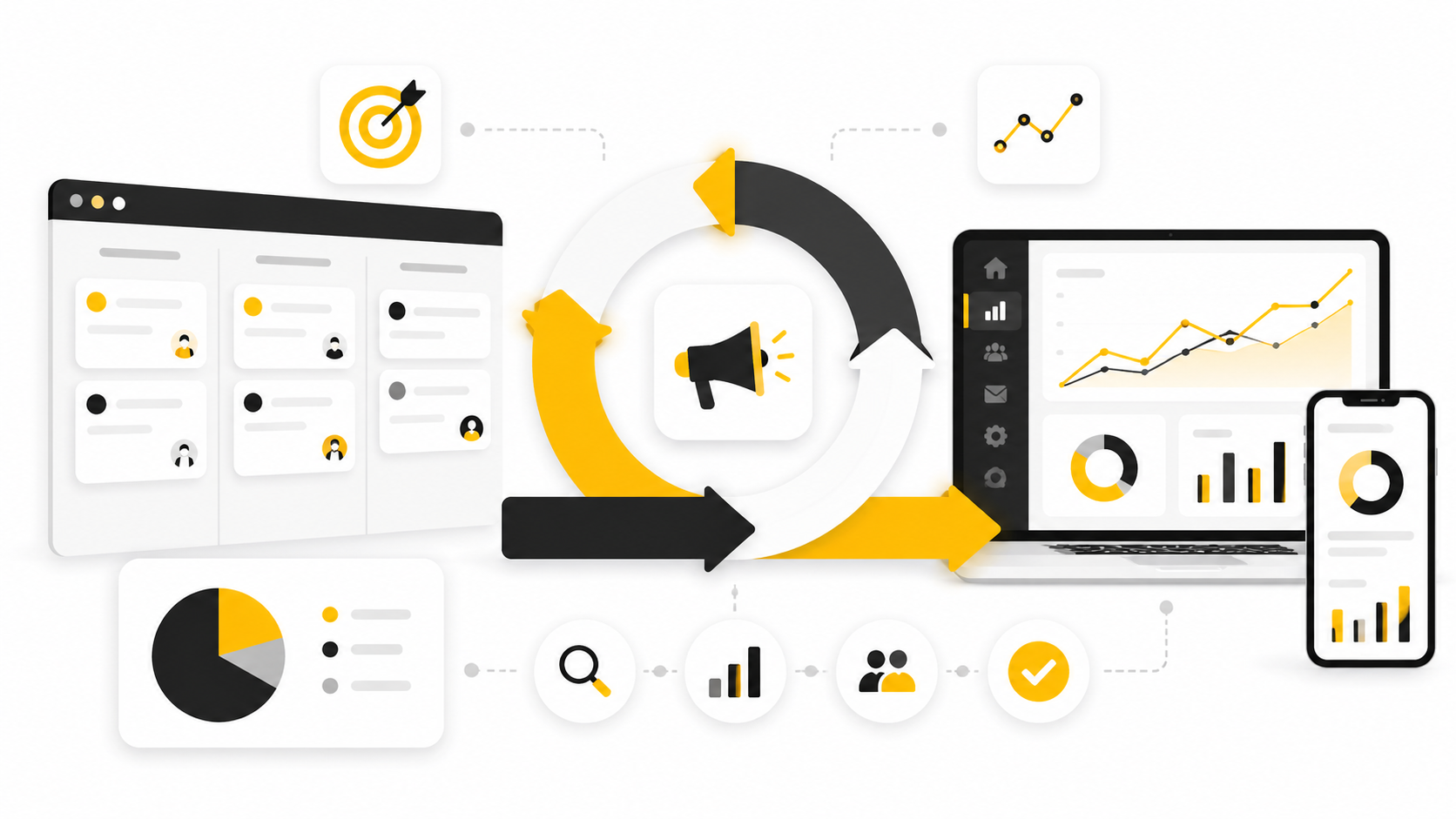
Marketing teams are under pressure from every direction: AI, tighter budgets, fragmented channels, faster competitors, and customers who expect relevance immediately. In that environment, the old model of planning everything upfront, waiting weeks for approvals, and measuring success after the fact creates too much lag. Agile marketing gives teams a practical way to reduce that lag without turning the department into chaos.
The business case is not theoretical anymore. The 2025 State of Agile Marketing Report found that 83% of marketers had a positive experience with agile, 86% of marketing organizations planned to transition some or all teams to agile, and 98% of marketers rated their agile implementation as successful. That does not mean agile fixes bad strategy, but it does show that teams using it seriously tend to see value.
The biggest mindset shift is simple: marketing becomes a learning system. Instead of betting everything on one large campaign, agile teams break work into smaller pieces, ship useful improvements sooner, and use performance data to decide what happens next. That is how you protect strategy while staying flexible in execution.
Agile Marketing Framework Overview
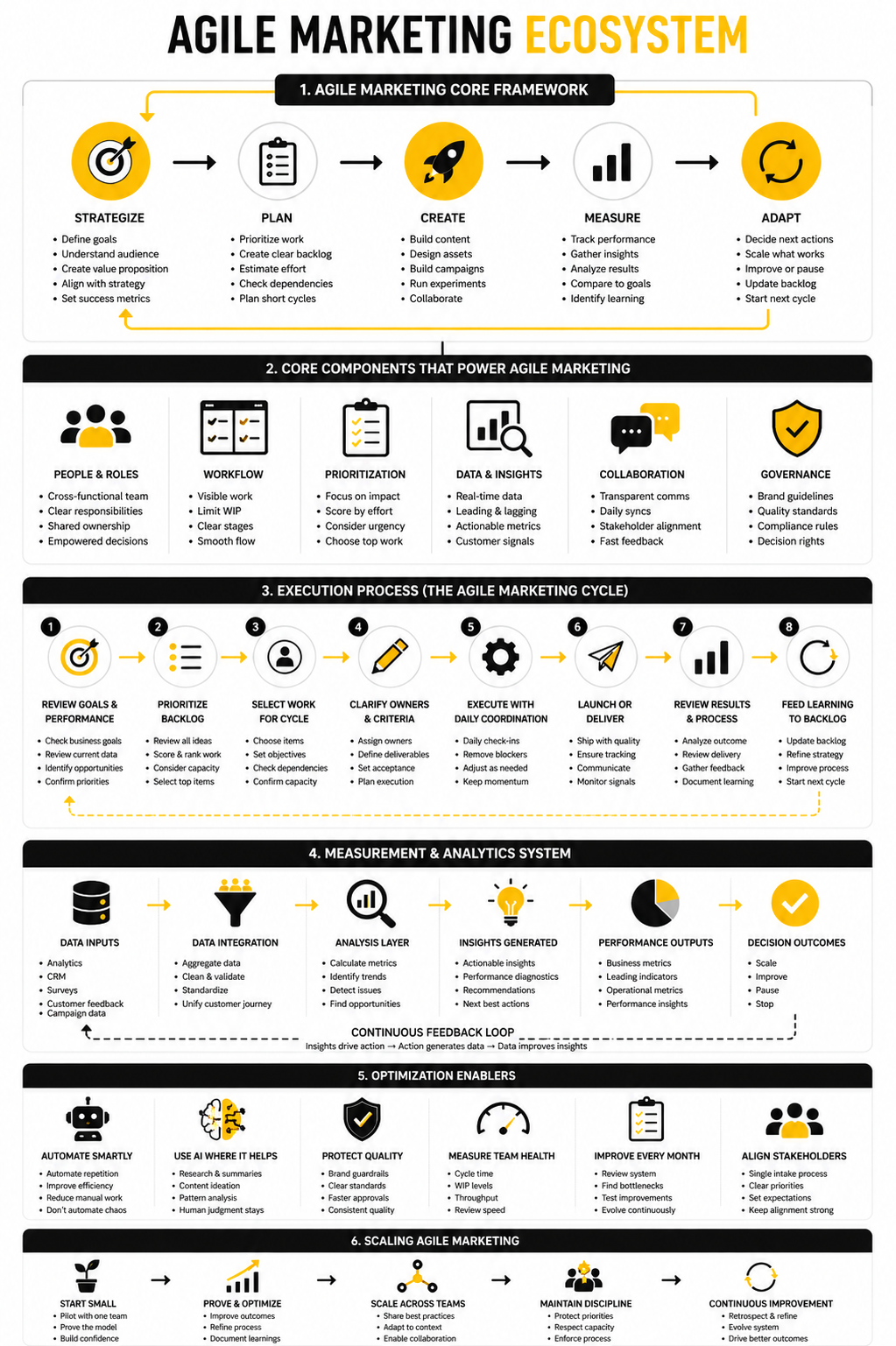
Agile marketing usually combines three practical layers: strategy, workflow, and learning. Strategy defines the outcome the team is trying to create. Workflow turns that outcome into visible, prioritized work. Learning closes the loop by using customer signals, campaign data, and team retrospectives to improve the next cycle.
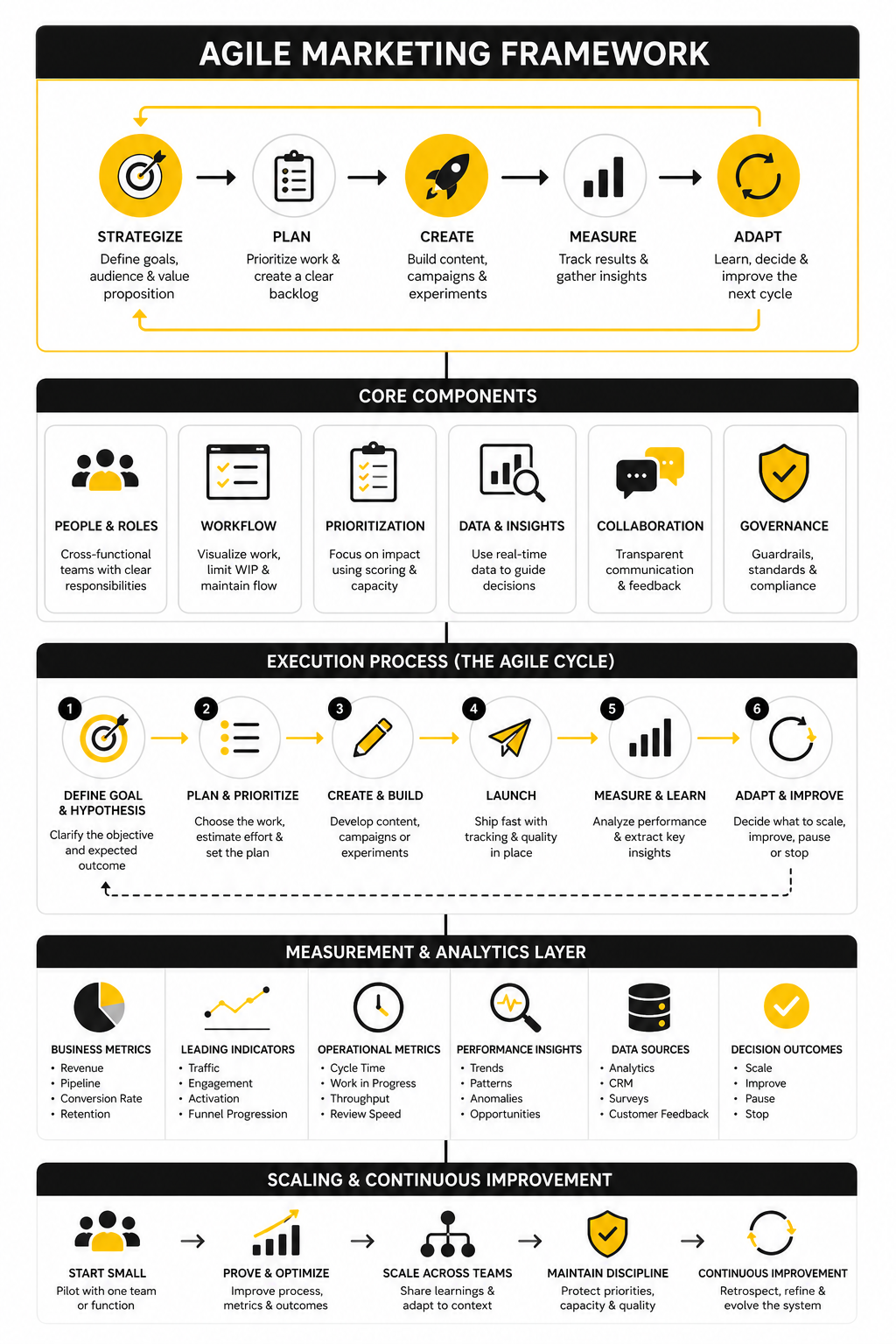
Most teams use a version of Scrum, Kanban, or Scrumban rather than copying software agile word for word. Scrum works well when a team wants fixed sprint cycles and clear planning rituals, while Kanban works well when work arrives continuously and needs visible flow. Atlassian’s agile marketing guide describes the same practical foundation: iterative planning, experiments, data, workflow visibility, and continuous improvement.
The framework only works when it changes behavior. A board full of tasks is not agile marketing by itself. The real test is whether the team can prioritize better, limit work in progress, release faster, measure honestly, and adapt without needing a full replan every time the market changes.
Article Outline
This guide is split into six parts so each section can build naturally on the previous one. Part 1 sets the foundation, defines the structure, and explains why agile marketing matters now. The remaining parts move from strategy into execution, team design, tools, measurement, and long-term implementation.
- Part 1: Agile Marketing Foundations And Framework Overview
- Part 2: Agile Marketing Strategy, Goals, And Prioritization
- Part 3: Core Agile Marketing Components And Team Workflows
- Part 4: Professional Implementation Across Campaigns, Content, And Growth
- Part 5: Tools, Automation, Measurement, And Optimization
- Part 6: Agile Marketing Roadmap, Common Mistakes, And FAQ
Agile Marketing Strategy, Goals, And Prioritization
Agile marketing starts with strategy, not tasks. That is where many teams get it wrong. They hear “agile” and immediately think about boards, standups, sprints, and faster publishing, but speed without direction only creates more noise.
The goal is not to do more marketing work. The goal is to create more customer value with less wasted effort. That lines up with the first value in the Agile Marketing Manifesto: focusing on customer value and business outcomes over activity and outputs.
This is why agile marketing needs a clear strategic layer before the team starts choosing campaigns or experiments. Without that layer, every request feels urgent, every stakeholder has a different priority, and the team becomes reactive. With it, the team can move quickly because it knows what matters.
Start With Outcomes, Not Deliverables
A deliverable is something the team produces. An outcome is the business or customer result that deliverable is supposed to create. That difference sounds simple, but it changes how the whole marketing team thinks.
For example, “launch five landing pages” is a deliverable. “Increase qualified demo requests from paid traffic” is an outcome. Agile marketing works better when the team starts with the outcome, then decides which deliverables are most likely to move it.
This also protects the team from vanity productivity. A content team can publish ten articles and still miss the real goal. A demand generation team can launch three campaigns and still fail to improve pipeline quality. The agile question is always sharper: what are we trying to change, and how will we know it worked?
Turn Strategy Into Clear Priorities
Once the outcome is clear, the next job is prioritization. This is where agile marketing becomes practical. The team needs a consistent way to decide what gets worked on now, what waits, and what gets rejected.
A useful priority filter usually includes three questions:
- Does this support the current business goal?
- Is the customer problem clear enough?
- Can we learn something useful from shipping it soon?
If the answer is weak on all three, the work probably does not belong in the current cycle. That does not mean the idea is bad. It means it is not the best use of attention right now.
This matters because modern marketing teams are already stretched. Gartner reported that 2025 marketing budgets remained flat at 7.7% of company revenue, which puts more pressure on teams to make better decisions with the resources they already have. Agile marketing helps because it forces trade-offs into the open instead of hiding them inside overloaded calendars.
Build A Marketing Backlog That Actually Helps
The marketing backlog is not a dumping ground for every idea, request, and half-formed campaign concept. It is a managed list of work that supports the team’s current goals. If the backlog becomes messy, agile marketing becomes messy too.
A strong backlog usually includes campaigns, experiments, content ideas, conversion improvements, research tasks, automation updates, and reporting work. Each item should have enough context for the team to understand the intended outcome. It does not need a massive brief, but it does need a clear reason to exist.
The best backlog items are written in plain language. They explain who the work is for, what problem it addresses, and what result the team expects. That makes planning easier because the team is not just estimating tasks. It is deciding which work deserves focus.
Choose A Prioritization Method And Stick With It
Agile teams do not need a complicated scoring model, but they do need a repeatable one. If every planning session uses a different logic, prioritization turns into politics. The loudest voice wins, and the team slowly stops trusting the process.
A simple scoring method can work well. Rate each item by expected impact, confidence, effort, and urgency. Then compare the highest-scoring items against available capacity. The point is not mathematical perfection; the point is making assumptions visible.
For growth and funnel-focused teams, tools like ClickFunnels, Systeme.io, or GoHighLevel can support this kind of execution because landing pages, email flows, pipeline tracking, and follow-up systems are close to the actual revenue path. The tool does not create the strategy, though. It only helps the team execute and measure the strategy faster.
Plan In Short Cycles
A short cycle gives the team enough structure to focus without pretending the market will stay still. For many agile marketing teams, that means one-week or two-week planning cycles. Longer campaign themes can still exist, but execution happens in smaller chunks.
This creates a healthy rhythm. The team chooses a limited amount of work, ships it, reviews the results, and adjusts the next cycle. That is much better than spending months building a perfect campaign only to discover too late that the message, audience, or offer was wrong.
Short cycles also make stakeholder conversations easier. Instead of saying no forever, the team can say not this cycle. That small distinction matters because it keeps priorities firm without turning every planning discussion into a fight.
Connect Goals To Measurement Before Work Starts
Measurement should not be added at the end. In agile marketing, the team defines success before execution begins. That makes the work sharper because everyone knows what signal they are trying to create.
A campaign might measure qualified leads, sales conversations, activation rate, trial starts, email replies, pipeline contribution, or retention movement. A content sprint might measure ranking progress, assisted conversions, engaged sessions, or subscriber growth. The right metric depends on the goal, not the channel.
This is also where teams need discipline. Not every metric deserves equal attention. If the goal is pipeline quality, traffic alone is not enough. If the goal is onboarding activation, social engagement is probably not the main signal. Agile marketing works when the team measures what matters and ignores what only looks impressive in a report.
Keep Strategy Stable And Execution Flexible
Agile marketing does not mean changing direction every week. That is not agility. That is panic with a calendar invite.
The strategy should stay stable long enough for the team to learn. The execution should stay flexible enough to respond when the data says something is not working. This balance is the heart of the system.
A practical way to handle this is to separate strategic themes from tactical bets. The theme might be “increase qualified inbound pipeline from mid-market SaaS companies.” The tactical bets might include a comparison page, a webinar, a founder-led email sequence, a LinkedIn content sprint, or a retargeting test. If one bet fails, the team does not abandon the strategy. It replaces the bet.
Make Stakeholder Input Useful
Stakeholders are not the enemy of agile marketing. Unstructured stakeholder input is the problem. When requests arrive randomly, priorities get blurred and the team loses momentum.
A better approach is to create a clear intake process. Stakeholders can submit requests, but each request should include the business goal, audience, urgency, expected impact, and any deadline that actually matters. That gives the marketing team enough context to evaluate the work instead of blindly accepting it.
This also makes the team more credible. When marketing can explain why one request is prioritized over another, the conversation becomes more professional. The team is no longer defending its workload. It is managing investment.
Use Experiments Without Turning Everything Into A Test
Experiments are powerful, but not every marketing activity needs to become a formal test. Some work is foundational. Some work is creative judgment. Some work is operational cleanup that simply needs to happen.
The key is to use experiments when uncertainty is high and the decision matters. Test the message when the audience response is unclear. Test the offer when conversion risk is high. Test the channel when the team is unsure where attention is strongest.
This keeps experimentation useful instead of performative. Agile marketing is not about testing tiny details just because the team can. It is about learning the things that will improve the next decision.
Core Agile Marketing Components And Team Workflows
Once the strategy is clear, agile marketing becomes a process problem. The team has to turn priorities into visible work, move that work through a consistent flow, and learn from what happens after it ships. This is where agile stops being a nice idea and becomes a real operating system.
The process does not need to be complicated. In fact, it should not be. A marketing team needs enough structure to stay focused, but not so much structure that every campaign turns into project management theatre.
The core components are simple: a backlog, a planning rhythm, a visible workflow, clear roles, daily coordination, review, and improvement. When these pieces work together, the team can move faster without losing quality. When one piece is missing, the whole system starts to wobble.
Build The Right Team Shape
Agile marketing works best when the team has enough skills to move work from idea to launch without waiting on five disconnected departments. That does not mean every person needs to be a generalist. It means the team should be cross-functional enough to finish valuable work inside a short cycle.
A practical agile marketing team might include strategy, copywriting, design, performance marketing, lifecycle marketing, analytics, and marketing operations. Smaller teams can combine roles, but they still need access to the skills that unblock execution. The goal is not a perfect org chart; the goal is a team that can actually ship.
This is why silos are so expensive. If every landing page requires a separate queue for copy, design, development, analytics, and approval, the team is not agile even if it has a sprint board. Agile marketing depends on reducing handoff friction so useful work can move from priority to market with fewer delays.
Define Roles Without Creating Bureaucracy
Agile marketing needs ownership, but it does not need heavy hierarchy. Someone has to protect priorities, someone has to manage workflow health, and the team has to own delivery together. Without that clarity, meetings become vague and accountability disappears.
A simple role structure usually works best. The marketing owner or growth lead decides what outcomes matter most. The agile lead or workflow owner helps the team protect focus, remove blockers, and improve the process. The specialists bring the work to life through campaigns, content, creative, data, automation, and channel execution.
The important point is that roles should make decisions easier. They should not create new layers of permission. If a role slows down the team more than it clarifies ownership, simplify it.
Make Work Visible
You cannot improve what you cannot see. That is why a visible workflow is one of the most important parts of agile marketing. The team needs one shared place where priorities, active work, blockers, approvals, and completed items are easy to understand.
A basic board can start with these columns:
- Backlog
- Ready
- In Progress
- Review
- Approved
- Launched
- Learning
This is enough for most teams to see where work is piling up. If ten items are sitting in review, the problem is not that the team needs more ideas. The problem is that approval has become the bottleneck.
Visibility also changes the conversation with stakeholders. Instead of debating feelings, the team can point to the actual work in motion. That makes capacity, trade-offs, and delays much easier to explain.
Run The Agile Marketing Cycle Step By Step
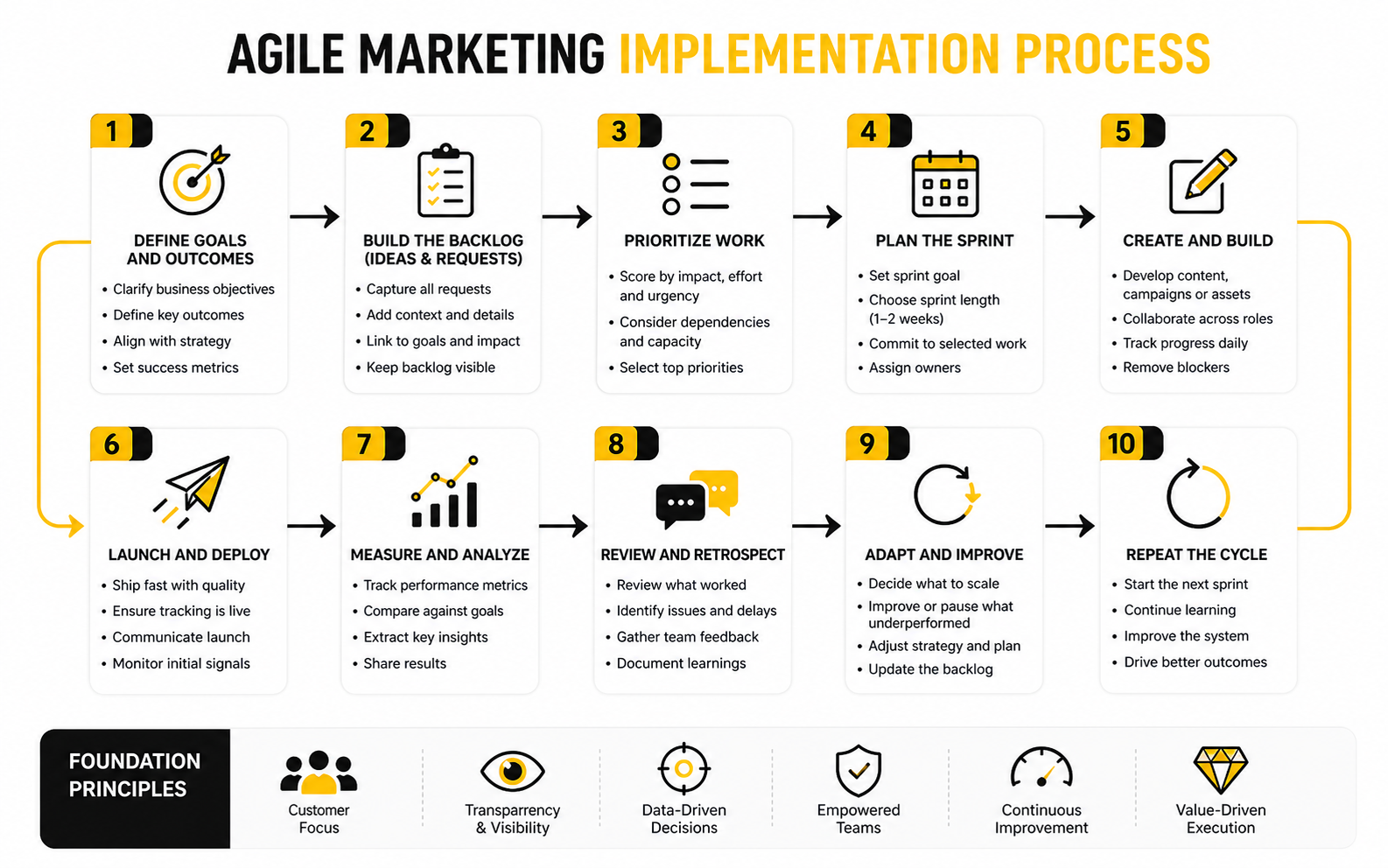
A strong agile marketing cycle starts before the sprint begins. The team reviews the backlog, checks the current business goal, and chooses the work with the strongest connection to that goal. This prevents planning from becoming a random selection of tasks.
The cycle usually looks like this:
- Review goals and current performance.
- Prioritize backlog items.
- Select work for the cycle.
- Clarify owners and acceptance criteria.
- Execute with daily coordination.
- Launch or deliver the work.
- Review results and team process.
- Feed the learning back into the backlog.
That is the whole loop. It is not glamorous, but it works because it creates momentum and learning at the same time. The team always knows what it is doing, why it matters, and what it needs to learn next.
Use Sprints When Focus Matters
Sprints are useful when the team needs a defined window of focus. A one-week or two-week sprint gives the team a clear commitment: these are the priorities, this is the capacity, and this is what we will try to finish before the next review. For campaign launches, content batches, funnel improvements, and coordinated promotions, that rhythm can be extremely helpful.
The sprint should not become a cage. Urgent issues will still appear, especially in marketing. The point is to protect the team from constant priority switching unless the new work is truly more important than what was already selected.
Scrum Alliance describes agile marketing as a way to apply agile values, principles, and frameworks to marketing work, including Scrum-style planning, collaboration, and iteration through its complete guide to agile marketing. That framing matters because sprints are not just deadlines. They are learning cycles with a beginning, middle, and review.
Use Kanban When Work Arrives Continuously
Not every marketing team should force everything into sprints. Some teams handle a steady flow of requests, production tasks, or ongoing optimizations. In those cases, Kanban can be more natural because the team manages flow instead of fixed sprint commitments.
Kanban works by making work visible, limiting work in progress, and improving movement through the system. AgileSherpas’ guide to Kanban for agile marketing highlights the importance of limiting active work, measuring flow, and making process policies explicit. That is exactly what overloaded marketing teams need.
The most important Kanban rule is simple: stop starting, start finishing. If the board has too many active items, the team is not being productive. It is splitting attention until everything slows down.
Limit Work In Progress
Work in progress limits are one of the most practical parts of agile marketing. They force the team to admit that capacity is real. A designer cannot review twelve assets at once, a copywriter cannot write six high-quality pages at once, and a performance marketer cannot properly analyze every campaign if everything is urgent.
A work in progress limit puts a cap on how many items can sit in a workflow stage at the same time. That cap creates healthy pressure. When a column is full, the team has to finish or unblock existing work before starting something new.
This is where agile marketing becomes uncomfortable in the best way. It exposes the gap between what the business wants and what the team can actually deliver well. That visibility is not a problem. It is the beginning of better management.
Create A Real Definition Of Done
“Done” is dangerous when everyone defines it differently. For one person, done means the copy is drafted. For another, it means the page is live, tracked, checked, and ready to measure. Agile marketing needs a shared definition so work does not look finished before it is actually usable.
A strong definition of done might include:
- The asset is approved.
- The page, campaign, or automation is live.
- Tracking is working.
- Quality checks are complete.
- Ownership is clear after launch.
- The learning question is documented.
This removes confusion at the end of the process. It also improves quality because the team is not rushing unmeasured work into the market just to close a task. Done should mean the work can create value, not just leave someone’s to-do list.
Keep Daily Coordination Short And Useful
Daily coordination is not a status performance. It is a fast way to protect flow. The team should leave knowing what is blocked, what needs help, and whether anything threatens the current cycle goal.
A useful daily check-in can be built around three questions:
- What moved forward since the last check-in?
- What is blocked or at risk?
- What needs a decision today?
That is enough. Long updates drain energy and train people to hate the process. Agile marketing meetings should create clarity, not become the work.
Review Results Before Starting The Next Cycle
The review is where agile marketing becomes smarter over time. The team looks at what shipped, what changed, what the data says, and what should happen next. This is not just reporting; it is decision-making.
The review should separate delivery from impact. Delivery asks whether the team finished the work it committed to. Impact asks whether that work created the expected result. Both matter, but they are not the same.
This distinction keeps the team honest. A campaign can launch on time and still underperform. A smaller experiment can miss the original target and still reveal something valuable. The review gives the team a structured moment to turn reality into the next decision.
Run Retrospectives Without Making Them Awkward
A retrospective is a conversation about the process, not a blame session. The team asks what worked, what slowed them down, and what should change in the next cycle. Done well, it becomes one of the highest-leverage meetings in the entire marketing department.
The best retrospectives are specific. “Communication was bad” is too vague. “Creative review took four days because the approval owner was unclear” is useful. That kind of detail leads to process improvements the team can actually test.
This is also where agile marketing builds trust. When people see that problems lead to improvements instead of finger-pointing, they become more honest. And honest teams improve faster.
Protect The Process From Tool Obsession
Tools help, but they are not the system. A team can run excellent agile marketing with a simple board and clear rules. A team can also buy an expensive platform and still stay chaotic if priorities, ownership, and measurement are weak.
That said, the right tools can reduce friction. A marketing team might use Buffer for social scheduling, Brevo for email campaigns, ManyChat for conversation automation, or Fillout for intake forms and research collection. Those tools support the process when the team already knows what it is trying to accomplish.
The rule is straightforward: fix the workflow before you automate it. Otherwise, automation just helps bad work move faster. Agile marketing is strongest when tools serve the operating rhythm, not the other way around.
Statistics And Data
Agile marketing measurement is not about staring at dashboards until a better decision appears. Data only matters when it changes what the team does next. If the numbers do not help the team prioritize, improve, stop, scale, or learn, they are just decoration.
This is where agile marketing becomes more disciplined than traditional campaign reporting. Instead of waiting until the end of a quarter to ask whether the work performed, the team builds feedback loops into every cycle. The goal is not perfect attribution. The goal is faster, clearer decision-making.
That matters even more when budgets are tight. Marketing budgets remained flat at 7.7% of company revenue in Gartner’s 2025 CMO Spend Survey, which means teams cannot afford to treat measurement as a reporting exercise. The data has to protect focus.
Measure The System, Not Just The Campaign
Most marketing teams measure campaign performance. Agile marketing also measures the system that produces the campaign. That difference is important because a strong campaign result can hide a broken workflow, and a weak campaign result can still produce valuable learning.
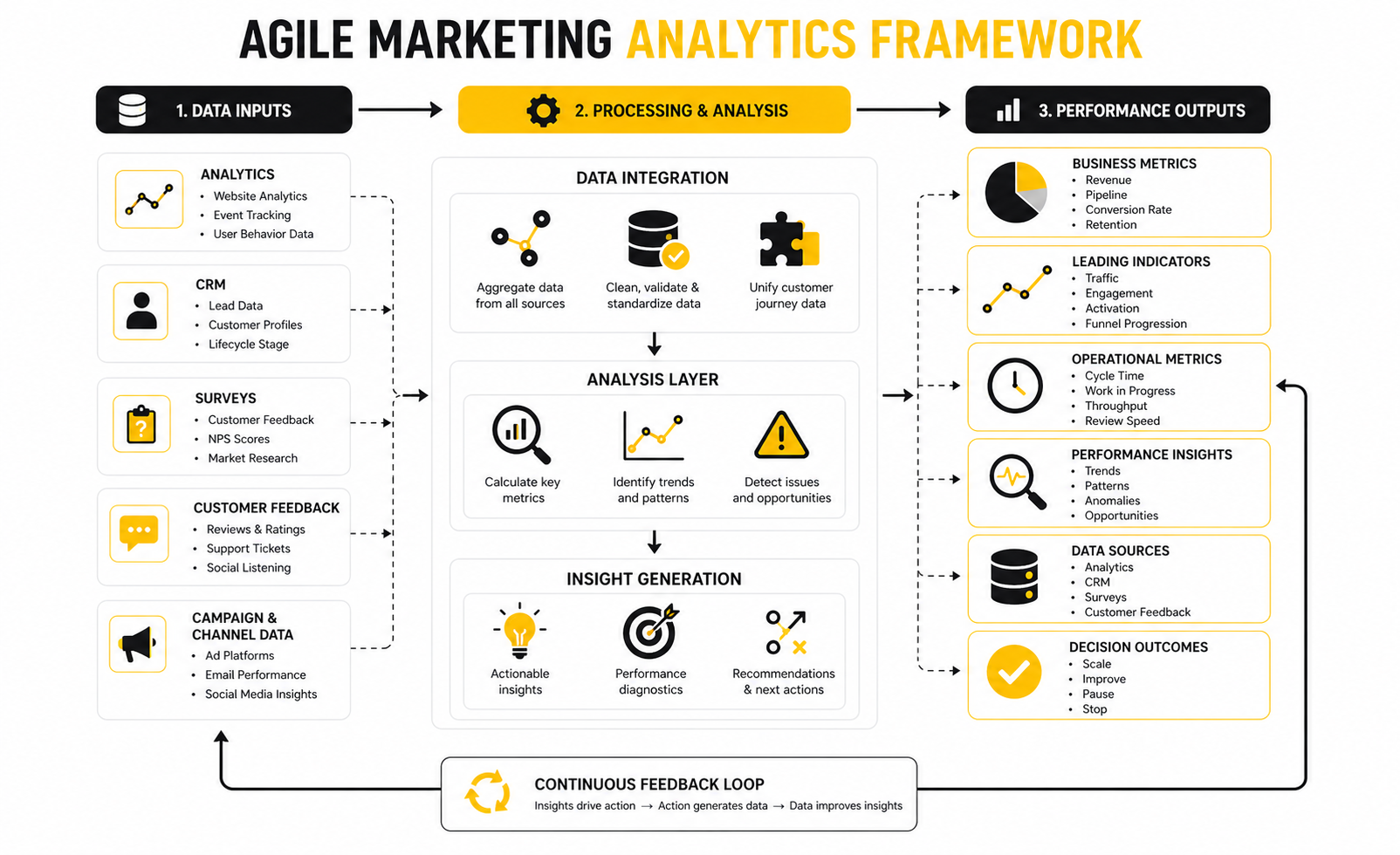
There are two levels of measurement to watch. The first level is business performance: pipeline, revenue, conversion rate, acquisition cost, activation, retention, and customer quality. The second level is operating performance: cycle time, work in progress, blocked work, launch frequency, review speed, and learning velocity.
If the business numbers are weak but the workflow is healthy, the team probably needs better strategy, messaging, targeting, or offers. If the business numbers are weak and the workflow is also slow, the team has a bigger problem. It cannot learn fast enough to improve.
Use Leading And Lagging Indicators Together
Lagging indicators tell you what already happened. Revenue, closed deals, churn, and return on ad spend are lagging indicators. They are important, but they usually arrive too late to guide daily decisions.
Leading indicators show whether the team is moving in the right direction before the final result appears. Examples include qualified traffic, demo intent, email reply rate, trial activation, landing page engagement, sales-assisted conversations, and funnel progression. These signals help the team adjust before the whole campaign is over.
The mistake is choosing one side and ignoring the other. Leading indicators without revenue context can push the team toward shallow wins. Lagging indicators without leading signals make the team slow and reactive. Agile marketing needs both because it operates in short cycles but still has to serve long-term business outcomes.
Build A Simple Analytics Loop
The analytics loop should be easy enough for the whole team to use. If only one analyst understands the system, the team becomes dependent on delayed interpretation. Agile marketing works better when everyone can see the relationship between the work, the signal, and the decision.
A practical analytics loop has five parts:
- Define the decision before the work starts.
- Choose the few metrics that will inform that decision.
- Launch with tracking in place.
- Review results at the end of the cycle.
- Decide whether to scale, improve, pause, or replace the work.
That is the loop. It does not require a massive data warehouse to begin. It requires discipline, clean tracking, and the courage to stop work that is not producing useful signal.
Read Benchmarks Carefully
Benchmarks can be useful, but they can also make smart teams lazy. A benchmark tells you what is common across a market, channel, or sample. It does not automatically tell you what is good for your audience, offer, price point, funnel, or sales cycle.
Use benchmarks as directional context, not as the final judge. If your conversion rate is below a broad industry average, that may be a warning sign. But it could also mean you are targeting a more complex buyer, selling a higher-ticket offer, or qualifying leads more strictly.
The better question is not “Are we above benchmark?” The better question is “Are we improving against our own baseline, and is that improvement connected to the business outcome?” That keeps the team focused on progress instead of chasing generic numbers.
Track Cycle Time Like A Serious Performance Metric
Cycle time is the amount of time it takes for work to move from start to finish. In agile marketing, it is one of the most underrated metrics. It shows whether the team can actually turn ideas into market-facing work quickly enough to learn.
Long cycle time usually points to hidden friction. Maybe approvals are slow. Maybe briefs are unclear. Maybe too much work is active at once. Maybe analytics, creative, and copy are not aligned early enough.
The action is straightforward: find the slowest stage and fix it first. If review takes longer than production, redesign review. If analytics setup delays every launch, create tracking templates. If stakeholder feedback arrives too late, move stakeholder input earlier in the cycle.
Watch Work In Progress Before It Becomes Burnout
Work in progress is not just a workflow metric. It is a stress signal. When too many items are active at the same time, people switch context constantly, quality drops, and every project feels slower than it should.
The 2025 AgileSherpas report found that 75% of fully agile teams said agile reduced their stress, which makes sense when the process is implemented properly. Clear priorities and work in progress limits reduce chaos. They do not remove pressure, but they make pressure manageable.
This is why leadership should care about workflow data. If the board is overloaded, the problem is not motivation. The problem is capacity, prioritization, or intake discipline. Agile marketing makes that visible before the team burns out.
Separate Activity Metrics From Outcome Metrics
Activity metrics are easy to count. Posts published, emails sent, ads launched, pages created, and meetings held all look productive in a report. But activity does not prove progress.
Outcome metrics show whether the work changed something meaningful. Did the campaign improve qualified pipeline? Did the email sequence increase booked calls? Did the landing page improve conversion quality? Did the content attract visitors who actually moved deeper into the funnel?
You still need activity metrics because they show throughput. But they should never be the headline unless the goal is purely operational. In agile marketing, activity is the input. Outcomes are the reason the work exists.
Use Customer Signals Alongside Platform Data
Platform data tells you what people clicked, watched, opened, visited, or ignored. Customer signals help explain why. The strongest agile marketing teams use both because numbers without context can lead to bad decisions.
Customer signals can come from sales calls, support conversations, surveys, form responses, reviews, community discussions, chat transcripts, and customer interviews. Tools like Fillout can help collect structured feedback, while Chatbase can support customer-facing question flows when the use case fits. The point is not to collect endless feedback. The point is to connect real customer language to campaign decisions.
This becomes especially important when personalization matters. McKinsey’s research found that 71% of consumers expect personalized interactions and 76% get frustrated when they do not receive them. Agile marketing gives teams a way to test personalization in smaller, safer cycles instead of betting everything on one large campaign rebuild.
Make Reporting Decision-Focused
A good agile marketing report should make the next decision obvious. It should not be a slide deck full of screenshots, vanity charts, and vague commentary. The report should explain what changed, why it matters, and what the team recommends next.
A decision-focused report usually answers five questions:
- What did we ship?
- What signal did we expect?
- What actually happened?
- What did we learn?
- What should we do next?
This format keeps reporting practical. It also prevents data from becoming a weapon. The team is not reporting to look busy or defend itself. It is reporting to make the next cycle smarter.
Know When To Scale, Improve, Pause, Or Stop
Every agile marketing cycle should end with a decision. If the work performed well and the signal is strong, scale it. If the work showed promise but has obvious friction, improve it. If the signal is unclear, pause and gather better evidence. If the work failed and taught the team enough, stop it.
This is harder than it sounds because teams get emotionally attached to campaigns. They want the idea to work because they spent time on it. Agile marketing reduces that risk by making learning part of the process from the beginning.
The most mature teams are not the ones that win every test. They are the ones that respond honestly to the data. They scale what works, fix what is close, and stop dragging weak ideas through another month of excuses.
Tools, Automation, Measurement, And Optimization
At this stage, agile marketing becomes less about adopting a method and more about building a stronger marketing operating system. The team already has strategy, workflow, roles, and measurement. Now the question is how to scale that system without losing the speed, focus, and learning that made it useful in the first place.
This is where experienced teams need to be careful. Scaling agile does not mean adding more meetings, more dashboards, more software, or more process language. It means removing friction while keeping decision quality high.
The best agile marketing teams are not the busiest teams. They are the teams that can spot what matters, move fast enough to act on it, and stop work that no longer deserves attention. That requires strong tools, but it also requires restraint.
Automate Repetition, Not Judgment
Automation should remove repetitive work from the team’s plate. It should not replace strategic thinking. When automation is used well, marketers spend less time moving data between tools, sending routine follow-ups, formatting reports, or rebuilding the same campaign structure again and again.
The danger is automating a weak process. If the intake system is messy, automation just routes bad requests faster. If the lead scoring model is unclear, automation can push the wrong people into sales. If the reporting setup is shallow, automation can make weak numbers look official.
A clean automation rule helps: automate only after the workflow is proven manually. Once the team knows the trigger, owner, action, and expected outcome, automation can scale it. Until then, the team should keep the process visible and easy to adjust.
Choose Tools Around The Workflow
Tool selection should follow the workflow, not the other way around. A team that starts with software usually ends up bending its process around features. A team that starts with its operating rhythm can choose tools that reduce friction.
For example, an agile marketing stack might include a planning tool, campaign builder, CRM, email platform, analytics layer, form tool, and customer communication system. But not every team needs every category on day one. The right stack depends on the type of work the team ships most often.
A lean funnel-focused team might use ClickFunnels or Systeme.io to launch offers quickly. An agency or service business may prefer GoHighLevel because CRM, pipelines, automations, and client follow-up can live closer together. The point is not which tool is “best.” The point is which tool helps the team reduce cycle time without weakening visibility.
Use AI Where It Improves Flow
AI can fit naturally inside agile marketing because both are built around faster learning. AI can help draft variants, summarize customer research, cluster feedback, generate test ideas, analyze patterns, and speed up production. But AI should not become a content factory with no strategic filter.
McKinsey’s 2026 work on agentic AI in marketing argues that companies only unlock the value of AI when they rebuild workflows around it, not when they simply drop AI into old processes. That matters because agile teams already think in workflows, feedback loops, and decision points. AI becomes more useful when it supports that structure.
A practical AI layer might help with:
- Turning customer interviews into message themes.
- Creating first-draft campaign briefs.
- Generating landing page test angles.
- Summarizing sales call objections.
- Detecting funnel drop-off patterns.
- Drafting follow-up sequences for review.
The human team still owns judgment. AI can speed up options, but it cannot decide what the business should become known for. Agile marketing teams should use AI to increase learning velocity, not to flood every channel with more average content.
Protect Brand Quality While Moving Faster
Speed can damage a brand when the team treats “shipping” as the only virtue. Agile marketing does not mean publishing rough work just because the sprint ends on Friday. The work still has to be clear, credible, useful, and consistent with the brand.
The solution is not slower approvals. The solution is better guardrails. Teams need practical brand guidelines, message principles, creative standards, legal rules, and decision rights that are clear before work begins.
Good guardrails make speed safer. A writer can move faster when the positioning is clear. A designer can move faster when the visual system is documented. A lifecycle marketer can move faster when compliance boundaries are known. The stronger the guardrails, the less the team has to wait for subjective approvals.
Scale Across Teams Without Killing Agility
Scaling agile marketing across a larger organization is tricky. One team can change quickly. Multiple teams need alignment, shared language, and a way to coordinate dependencies without rebuilding the old bureaucracy under a new name.
The biggest risk is over-standardization. Leadership sees one agile team working well and decides every team must use the same sprint length, board structure, meeting rhythm, and reporting format. That usually backfires because content, performance, product marketing, lifecycle, and brand teams do not all operate the same way.
A better scaling model keeps the principles consistent and lets the tactics vary. Every team should have clear goals, visible work, limited active priorities, feedback loops, and regular improvement. But one team may use Scrum, another may use Kanban, and another may use a hybrid model. Consistency should live at the outcome level, not in every tiny ritual.
Manage Dependencies Before They Slow Everything Down
Dependencies are where agile marketing often gets stuck. The marketing team may be ready, but legal review is late. Sales feedback is missing. Product messaging is not approved. Data tracking depends on another team’s queue.
The answer is not to pretend dependencies do not exist. The answer is to make them visible earlier. If a campaign requires input from product, sales, compliance, analytics, or leadership, that dependency should appear in planning before the team commits to the work.
A simple dependency check can prevent a lot of pain:
- Who must approve this?
- Who must provide input?
- What asset, data, or decision could block launch?
- When do we need that dependency resolved?
- What is the backup plan if it slips?
This sounds basic, but it is powerful. Agile marketing teams do not avoid complexity by ignoring it. They reduce complexity by naming it early.
Balance Experimentation With Strategic Consistency
Experimentation is valuable, but too many experiments can fragment the brand. If every sprint creates a new message, offer, landing page angle, and audience assumption, the team may learn a lot while confusing the market. That is not a win.
The right balance is to keep the strategic frame stable while testing inside it. The brand promise should not change every two weeks. The audience should not be redefined after every small signal. The core positioning should stay steady long enough to compound.
Experiments should answer specific questions. Which pain point creates the strongest response? Which proof point builds trust faster? Which offer structure attracts better-fit leads? Which channel creates higher-quality conversations? That kind of testing improves the strategy instead of constantly replacing it.
Build A Better Intake System
A weak intake system quietly destroys agile marketing. Random requests enter through Slack, email, meetings, hallway conversations, and executive comments. The team tries to be helpful, but the backlog becomes a junk drawer.
A strong intake system does not block collaboration. It protects focus. Every request should enter through one place with enough context to evaluate it fairly.
A useful request should include:
- The business goal.
- The target audience.
- The problem or opportunity.
- The desired outcome.
- The deadline and reason for the deadline.
- Any required stakeholders.
- The expected impact.
This makes prioritization much cleaner. It also trains the organization to think in outcomes rather than tasks. That is a big cultural shift, and it matters.
Know The Risks Before They Become Expensive
Agile marketing fails when the organization adopts the language but avoids the discipline. Teams start using words like sprint, backlog, and retrospective, but leaders still interrupt priorities whenever something feels urgent. That creates fake agile, and fake agile is worse than no agile because it adds process without trust.
The most common risks are predictable. Teams take on too much work. Stakeholders bypass the intake process. Leaders demand fixed long-term certainty while asking for flexibility. Measurement becomes a performance review instead of a learning tool. Meetings multiply, but decisions do not improve.
The fix is not a motivational speech. The fix is operational honesty. Agile marketing requires real trade-offs, visible capacity, clear decision rights, and leadership behavior that matches the system. Without that, the team is just decorating chaos with a board.
Optimize The System Every Month
Optimization should not only happen inside campaigns. The operating system itself needs improvement. Once a month, the team should step back and ask whether the way it works is still helping.
This review should look at the full system: intake, backlog quality, prioritization, cycle time, handoffs, approvals, tools, reporting, and stakeholder collaboration. The team should pick one or two improvements, test them, and review the effect. Do not try to fix everything at once.
This is where agile marketing becomes durable. The team is not just improving campaigns. It is improving the machine that creates campaigns. That is the compounding advantage.
Agile Marketing Roadmap, Common Mistakes, And FAQ
The final step is turning agile marketing into a system that survives real pressure. A team can run a few good sprints, clean up its backlog, and improve reporting for a month, but the real test comes later. Can the team keep its focus when leadership changes priorities, channels shift, budgets tighten, and the market gets louder?
That is why the roadmap matters. Agile marketing is not a one-time transformation project. It is a working model that needs ownership, maintenance, and honest improvement.
A strong roadmap gives the team a path without pretending everything will be predictable. It keeps the system practical. Start with one team, prove the rhythm, fix the bottlenecks, then expand the model only when the basics are working.
Start Small Before Scaling Wide
The safest way to adopt agile marketing is to start with one focused team or one clear marketing function. Pick an area where the work is visible, the outcomes matter, and the team can make decisions without being trapped by too many dependencies. Demand generation, lifecycle marketing, content operations, conversion optimization, or campaign production can all work well.
The first goal is not perfection. The first goal is to prove that the team can prioritize clearly, limit active work, ship in shorter cycles, review results, and improve its own process. Once that rhythm works, the organization has a model it can adapt instead of a theory it hopes will work.
This also reduces internal resistance. People trust change more when they can see it working. A small agile marketing pilot gives leadership proof, gives stakeholders a better way to collaborate, and gives the team confidence before the process spreads.
Fix The Biggest Bottleneck First
Do not try to improve everything at once. That is how agile marketing turns into another overwhelming initiative. Find the one bottleneck that slows the most valuable work, fix it, and then move to the next one.
For some teams, the bottleneck is unclear strategy. For others, it is stakeholder approvals, creative review, analytics setup, campaign QA, or too many urgent requests. The right first fix depends on where work actually gets stuck.
This is where the board, cycle data, and retrospectives become useful. They show the real constraint. Once the team can see the constraint, it can stop guessing and start improving the system with focus.
Make Leadership Part Of The System
Agile marketing fails quickly when leadership wants agile output without agile behavior. Leaders cannot constantly override priorities, add emergency requests, skip intake, and still expect the team to deliver calm, focused execution. That is not agility. That is interruption with better vocabulary.
Leadership needs to help protect priorities, clarify trade-offs, and respect capacity. When leaders want to add something new, they should also help decide what comes out. That one habit changes everything.
This does not make marketing less responsive. It makes responsiveness honest. The team can still move quickly, but it stops pretending that unlimited work fits into limited capacity.
Avoid Fake Agile
Fake agile is easy to spot. The team has standups, but no decisions. It has a backlog, but everything is priority one. It has sprints, but stakeholders interrupt them constantly. It has retrospectives, but nothing changes afterward.
Real agile marketing creates better decisions, faster learning, and healthier execution. Fake agile creates more meetings around the same old chaos. The difference is discipline.
The fix is simple but not always comfortable. Limit work in progress. Define decision rights. Protect cycle goals. Review outcomes honestly. Improve the process every month. Agile only works when the organization means it.
FAQ - Built for Complete Guide
What Is Agile Marketing?
Agile marketing is a way of managing marketing work through short cycles, clear priorities, visible workflows, and continuous learning. Instead of planning everything far in advance and waiting until the end to measure results, teams ship smaller pieces of work, review performance, and adjust based on evidence. The goal is faster learning, better focus, and stronger connection between marketing activity and business outcomes.
How Is Agile Marketing Different From Traditional Marketing?
Traditional marketing often relies on long planning cycles, large campaign launches, and fixed calendars. Agile marketing uses shorter cycles, smaller releases, active prioritization, and frequent reviews. The difference is not that traditional marketing is always slow or bad; the difference is that agile marketing is built to adapt when conditions change.
Does Agile Marketing Mean There Is No Long-Term Strategy?
No. Agile marketing needs strategy more than traditional execution does. The strategy gives the team direction, while agile workflows keep execution flexible. The best teams keep strategic themes stable and adjust tactical bets based on real performance signals.
What Are The Main Benefits Of Agile Marketing?
The main benefits are clearer priorities, faster execution, better collaboration, earlier learning, and less wasted work. Teams can see what is active, what is blocked, and what needs a decision. That makes marketing more focused and less reactive.
What Are The Biggest Risks Of Agile Marketing?
The biggest risks are fake agile, weak leadership support, unclear goals, overloaded backlogs, and too many active projects. Agile marketing also fails when teams copy rituals without changing decision-making behavior. A sprint board does not fix a broken prioritization culture by itself.
Which Teams Should Use Agile Marketing?
Agile marketing can work for content teams, growth teams, demand generation teams, lifecycle teams, social teams, product marketing teams, and agencies. It is most useful when the work changes often, performance feedback matters, and priorities need to be managed carefully. Teams with repetitive, predictable production work may prefer a lighter Kanban-style approach.
Is Scrum Or Kanban Better For Agile Marketing?
Neither is automatically better. Scrum is useful when a team benefits from fixed planning cycles, sprint commitments, and structured reviews. Kanban is useful when work arrives continuously and the team needs to manage flow, capacity, and bottlenecks in real time.
How Long Should An Agile Marketing Sprint Be?
Many marketing teams use one-week or two-week sprints. One week can work well for fast-moving teams with smaller tasks and quick feedback. Two weeks can work better for campaigns, content production, creative work, or cross-functional execution that needs more coordination.
What Metrics Matter Most In Agile Marketing?
The best metrics depend on the goal, but agile marketing teams usually track both business outcomes and workflow health. Business metrics may include qualified leads, pipeline, revenue, conversion rate, retention, activation, or acquisition cost. Workflow metrics may include cycle time, work in progress, blocked work, launch frequency, and review speed.
How Do You Start Agile Marketing From Scratch?
Start with one team and one clear goal. Build a simple backlog, choose a short planning cycle, make work visible, limit active projects, and review results regularly. Do not start by buying tools or creating a complicated process. Start by making priorities and work visible.
Can Agile Marketing Work With AI?
Yes, but AI should support the workflow instead of replacing strategy. AI can help with research summaries, draft variations, campaign ideas, customer feedback analysis, and reporting support. The team still needs human judgment for positioning, prioritization, creative direction, and final decisions.
How Do You Keep Agile Marketing From Becoming Chaotic?
Keep strategy stable, limit work in progress, use one intake system, clarify decision rights, and review outcomes at the end of each cycle. Chaos usually comes from unlimited requests, unclear ownership, and constant priority switching. Agile marketing reduces chaos only when the team protects the system.
Do Small Businesses Need Agile Marketing?
Small businesses can benefit from agile marketing because they usually have limited time, limited budget, and fast-changing priorities. A simple board, weekly planning rhythm, and clear measurement loop can make a small team much sharper. The process does not need to be heavy to be useful.
What Tools Are Best For Agile Marketing?
The best tools are the ones that support the team’s workflow without adding unnecessary complexity. A team may need tools for planning, email, funnels, automation, CRM, analytics, forms, or social scheduling. The tool stack should make execution easier, not distract the team from strategy and measurement.
How Do You Know Agile Marketing Is Working?
Agile marketing is working when the team has clearer priorities, shorter cycle times, fewer blocked items, better stakeholder conversations, and stronger learning from each campaign. The team should also be making better decisions over time. If the process creates more meetings but no better outcomes, it needs to be simplified.
Work With Professionals
Explore 10K+ Remote Marketing Contracts on MarkeWork.com
Most marketers spend too much time chasing clients, competing on crowded platforms, and losing a percentage of every project to middlemen.
MarkeWork gives you a better way. Browse thousands of remote marketing contracts and connect directly with companies desperate to hire skilled marketers like you, without platform commissions and without unnecessary gatekeepers.
If you're serious about finding better opportunities and keeping 100% of what you earn, explore available contracts and create a profile for free at MarkeWork.com.