

An ai copy writer is not just a tool that writes faster. Used properly, it becomes a structured writing assistant that helps you research, position, draft, edit, personalize, and test marketing messages with more consistency.
That distinction matters. Speed is useful, but speed without judgment creates generic copy, weak offers, and brand voice drift. The real advantage comes from combining AI output with strategy, customer insight, and human editing.
Article Outline
- Why An AI Copy Writer Matters Now
- The AI Copy Writer Framework
- Core Components Of High-Performing AI-Assisted Copy
- Professional Implementation Workflow
- Tools, Use Cases, And Practical Examples
- Mistakes, Best Practices, And Final Recommendations
Why An AI Copy Writer Matters Now
Marketing teams are under pressure to publish more, personalize more, and still keep quality high. That is exactly where an ai copy writer can help, especially when the work involves first drafts, variations, campaign angles, email sequences, ad copy, landing page sections, and social content.
The shift is already visible. In content marketing, AI-assisted creation has become a mainstream workflow, with HubSpot reporting that content creation is one of the most common AI use cases for marketers. Jasper’s 2025 marketing research also found that 57% of marketers use generative AI for content creation, which shows that this is no longer an experimental side project.
But the best teams are not using AI to replace thinking. They are using it to remove blank-page friction, explore more angles, sharpen messaging, and move faster from idea to usable draft. That is the practical lens this article will use from here on.
The AI Copy Writer Framework
A strong ai copy writer workflow has four layers: context, strategy, draft, and refinement. Context tells the tool who the audience is, what they care about, what they already believe, and what offer is being made. Strategy turns that context into positioning, hooks, objections, proof points, and conversion goals.
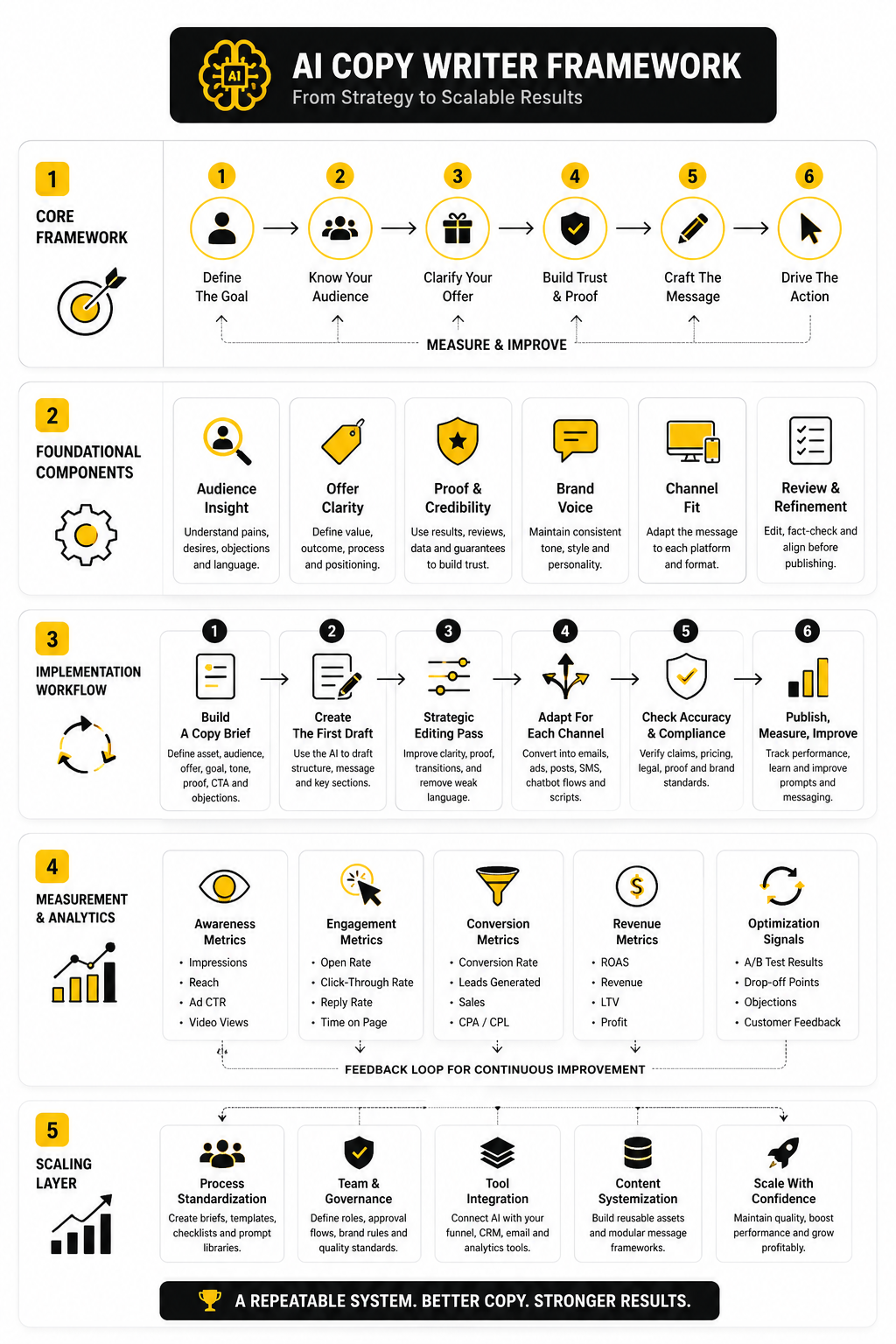
The draft layer is where most people start, but it should not be the first step. If the input is vague, the output will usually sound polished but empty. That is why the refinement layer matters so much: editing for accuracy, tone, specificity, compliance, and conversion intent.
This framework also keeps expectations realistic. AI can generate options quickly, but it does not automatically know your product, customer research, margins, positioning, or legal boundaries. You still need a human operator who can judge whether the copy is true, useful, and persuasive.
What This Article Will Help You Build
By the end of the full article, you will have a practical system for using an ai copy writer without turning your brand into generic AI noise. The goal is not to make every sentence sound clever. The goal is to create copy that is clear, credible, specific, and aligned with the customer’s decision process.
We will look at the core components that make AI-assisted copy work, including audience inputs, offer clarity, prompts, editing passes, quality control, and publishing workflows. We will also cover where tools such as GoHighLevel AI, Buffer, and ManyChat naturally fit when copy needs to move into campaigns, automations, and follow-up sequences.
The main point is simple: AI copywriting works best when it is treated as a system, not a shortcut. When you give it better inputs, structure the process, and edit with intent, it becomes a serious productivity advantage instead of just another content toy.
Why An AI Copy Writer Matters Now
The practical reason an ai copy writer matters is simple: marketing has become too fragmented for slow, manual-only production. A single campaign can now require landing page copy, email follow-up, SMS reminders, ad variations, social posts, chatbot scripts, retargeting angles, and sales enablement notes. That does not mean every piece should be automated, but it does mean the old workflow is too heavy for many teams.
AI becomes useful when it helps you move from one strong idea into many clear, channel-specific versions. HubSpot’s 2025 AI content research found that 55% of marketers identify content creation as the most popular AI use case, while Content Marketing Institute’s 2025 B2B research showed that 39% of B2B marketers expected higher investment in AI for content creation. The message is obvious: the market is not waiting for perfect workflows before adopting AI.
The catch is that adoption alone does not create better copy. If everyone can publish faster, the advantage moves to the people who can brief better, edit better, and connect copy to a real buying journey. That is where most weak AI copy falls apart.
The Real Problem Is Not Writing Speed
Most businesses do not have a copywriting problem first. They have a clarity problem. They are unclear about the audience, the offer, the pain point, the proof, the desired action, or the reason someone should care right now.
An ai copy writer can expose that problem quickly because vague inputs usually produce vague outputs. Ask for “a high-converting landing page” without customer research, and you will usually get polished filler. Give it a specific audience, offer, objection, proof point, and conversion goal, and the quality changes immediately.
This is why AI copywriting should not start with prompts. It should start with decision-making. The tool can help produce the words, but the strategy has to come from a person who understands the market.
Better Inputs Create Better Output
The best way to improve AI-assisted copy is to improve the briefing process. Before you ask for copy, define the audience segment, the awareness level, the offer, the emotional driver, the practical benefit, and the next step. This gives the ai copy writer enough context to create copy that sounds intentional instead of generic.
A useful copy brief should answer five questions:
- Who is this for?
- What do they already believe?
- What problem are they trying to solve?
- Why is this offer different or better?
- What action should they take next?
Once those answers are clear, AI becomes much more powerful. It can generate hooks, rewrite sections by awareness stage, create variations for different channels, and help you test different angles without starting from scratch every time.
AI Copy Needs Human Judgment
The big mistake is treating an ai copy writer like a final decision-maker. It is not. It does not know whether a claim is legally safe, whether a promise matches the product, whether the tone fits the brand, or whether the offer economics actually make sense.
That is why human review is not optional. You need someone checking accuracy, removing hype, tightening the message, and making sure the copy does not overpromise. This matters even more in industries where compliance, customer trust, or financial outcomes are involved.
The best workflow is not “AI writes, human publishes.” The better workflow is “human briefs, AI drafts, human edits, data improves the next version.” That loop is where the leverage is.
The Productivity Advantage Is Real
Used well, AI can reduce the time spent on first drafts, rewrites, repurposing, and campaign variations. That means more energy can go into positioning, creative direction, research, and performance review. In other words, the valuable human work moves upstream.
McKinsey’s 2025 State of AI research noted that revenue increases from AI use are most commonly reported in marketing and sales, strategy and corporate finance, and product or service development. That does not mean AI magically creates revenue. It means the functions closest to customers often have the clearest opportunities to apply it.
For copywriting, the opportunity is practical. You can create more variations, respond faster to campaign data, and personalize messages without rebuilding every asset manually. But the quality still depends on the system around the tool.
The AI Copy Writer Framework
A reliable ai copy writer workflow has to be simple enough to use every week. If the process is too complicated, the team will skip it. If it is too loose, the output becomes inconsistent.
The framework below keeps the work focused. It gives you a repeatable path from research to finished copy without pretending AI can replace judgment.
Step 1: Gather The Right Context
Context is the raw material. Without it, AI fills the gaps with generic assumptions. That is why the first step is to collect the facts before asking for polished copy.
Good context includes customer language, sales objections, product details, offer terms, competitor positioning, testimonials, reviews, call notes, and campaign goals. You do not need all of that for every project, but the more specific the copy needs to be, the more context matters. A homepage rewrite, for example, needs much deeper input than a quick social post.
This is also where tools outside the writing layer can help. A CRM or marketing automation platform like GoHighLevel can centralize lead stages, follow-up behavior, and campaign touchpoints, which makes it easier to understand what copy is supposed to do inside the actual funnel.
Step 2: Define The Conversion Job
Every piece of copy needs a job. A headline should create attention. A landing page section should build belief. An email should move someone toward a reply, click, booking, or purchase. When the job is unclear, the copy becomes decorative.
Before using an ai copy writer, define the conversion job in plain language. For example, the job might be to get cold visitors to understand the offer, get warm leads to book a call, or get existing subscribers to try a new feature. This makes the draft easier to judge because you are not asking whether it “sounds good.” You are asking whether it performs the intended function.
This is where many AI drafts need tightening. They often explain too much, repeat obvious benefits, or use dramatic phrasing where simple clarity would convert better. The conversion job keeps the writing disciplined.
Step 3: Generate Controlled Variations
AI is excellent at variation, but uncontrolled variation creates chaos. You do not need 50 random headlines. You need a few strategically different angles.
A better approach is to ask for variations by category:
- Pain-driven angle
- Outcome-driven angle
- Objection-handling angle
- Speed or convenience angle
- Proof-based angle
- Curiosity-driven angle
This makes the output easier to compare. It also helps you avoid choosing copy just because it sounds clever. Clever is not the goal. Clear, relevant, and persuasive is the goal.
Step 4: Edit For Specificity
The editing pass is where AI copy becomes usable. Remove vague claims, generic adjectives, filler phrases, and unsupported promises. Replace them with concrete benefits, real product details, and language your audience would actually use.
For example, “save time and grow your business” is too broad. A stronger version would explain what task gets faster, who benefits, and what the user can do next because of that time saved. Specificity is what makes copy feel credible.
This is especially important when using an ai copy writer for landing pages or funnel assets. If you are building pages with tools like ClickFunnels, systeme.io, or Replo, the copy has to support the page structure, not just fill space.
Step 5: Match The Channel
Copy that works in an email may not work in an ad. Copy that works on a landing page may feel too heavy in a chatbot flow. The message can stay consistent, but the format has to change.
An ai copy writer is useful here because it can adapt one core message into different channel formats. A campaign idea can become an email subject line, a short-form social post, a landing page hero section, a chatbot opening message, and a retargeting ad. The key is to adjust the level of detail, urgency, and call to action for each channel.
For example, a chatbot flow in ManyChat needs short, conversational prompts. A scheduled social post in Buffer needs a tighter hook and a cleaner payoff. Same campaign, different job.
Step 6: Learn From Performance
The final step is feedback. AI-assisted copy improves when you feed performance insights back into the workflow. Open rates, click rates, conversion rates, replies, scroll depth, sales objections, and customer comments all help sharpen the next draft.
This is where the ai copy writer becomes part of a learning system. It is not just producing more content. It is helping you create controlled tests, compare angles, and refine the message based on what the audience actually does.
The point is not to automate taste. The point is to make testing and iteration easier, so your copy gets closer to the customer with every campaign.
Core Components Of High-Performing AI-Assisted Copy
Once the framework is clear, the next step is understanding what actually makes AI-assisted copy work. An ai copy writer can help with structure, speed, and variation, but the quality still comes from the ingredients you give it. Weak ingredients create weak copy, even when the sentences sound polished.
The core components are audience insight, offer clarity, proof, voice, channel fit, and review. Each one plays a different role. Skip one, and the copy starts to feel thin.
Audience Insight
Audience insight is the difference between copy that sounds relevant and copy that sounds like it could be written for anyone. Before using an ai copy writer, you need to know what the reader wants, what they are trying to avoid, what they have already tried, and what language they use to describe the problem. This is not abstract branding work. It is the raw material that makes the copy feel specific.
Good audience inputs can come from sales calls, support tickets, reviews, surveys, community posts, CRM notes, and customer interviews. The goal is not to dump everything into the tool. The goal is to extract the patterns that keep showing up.
A strong audience brief might include the customer’s current situation, desired outcome, main objection, buying trigger, and emotional pressure. That gives the ai copy writer a real target. Without that target, it will usually default to safe, generic language.
Offer Clarity
Offer clarity is where many campaigns win or lose. If the offer is confusing, the copy has to work too hard. No amount of AI-generated wording can fully fix a weak or unclear offer.
Before drafting, define what the person gets, why it matters, how it works, who it is for, and what makes it easier, faster, safer, or more valuable than the alternative. This should be simple enough that someone outside your team can understand it quickly. If you need five paragraphs to explain the offer internally, the market will probably struggle too.
An ai copy writer is useful here because it can help simplify and reframe the offer. You can ask it to explain the same offer for beginners, advanced buyers, busy executives, or skeptical leads. The best version is usually the one that makes the value obvious without adding hype.
Proof And Credibility
Proof makes copy believable. It can come from customer results, reviews, third-party data, product screenshots, demos, expert credentials, guarantees, transparent pricing, or clear explanations of how the process works. The point is to reduce doubt.
This matters even more with AI-generated copy because readers are becoming better at spotting generic claims. A line like “trusted by businesses worldwide” means very little unless it is backed by a real reason to believe. Specific proof does the heavy lifting.
Google’s own guidance on AI-generated content focuses on whether content is helpful, reliable, and created for people rather than whether it was produced with AI. That is the right standard to apply to copy too. The issue is not whether an ai copy writer helped create the draft; the issue is whether the final copy is accurate, useful, and trustworthy.
Brand Voice
Brand voice is not just a tone preference. It is how your business sounds when it explains value, handles objections, gives instructions, and asks for action. If the voice changes from page to page, the customer experience feels inconsistent.
The easiest way to make AI follow a brand voice is to give it examples. Use strong past emails, landing page sections, sales scripts, or social posts and explain what makes them work. Do not just say “make it friendly” or “make it premium.” Those words mean different things to different people.
A useful voice guide should include words you use, words you avoid, sentence style, level of formality, humor boundaries, and examples of approved phrasing. Once that exists, the ai copy writer can help create drafts that are much closer to your actual brand instead of sounding like a default template.
Professional Implementation Workflow
Implementation is where the whole system becomes real. This is the point where you stop treating an ai copy writer like a random prompt box and start using it as part of a repeatable marketing process. The workflow should be simple, practical, and easy enough for a team to follow without overthinking every step.
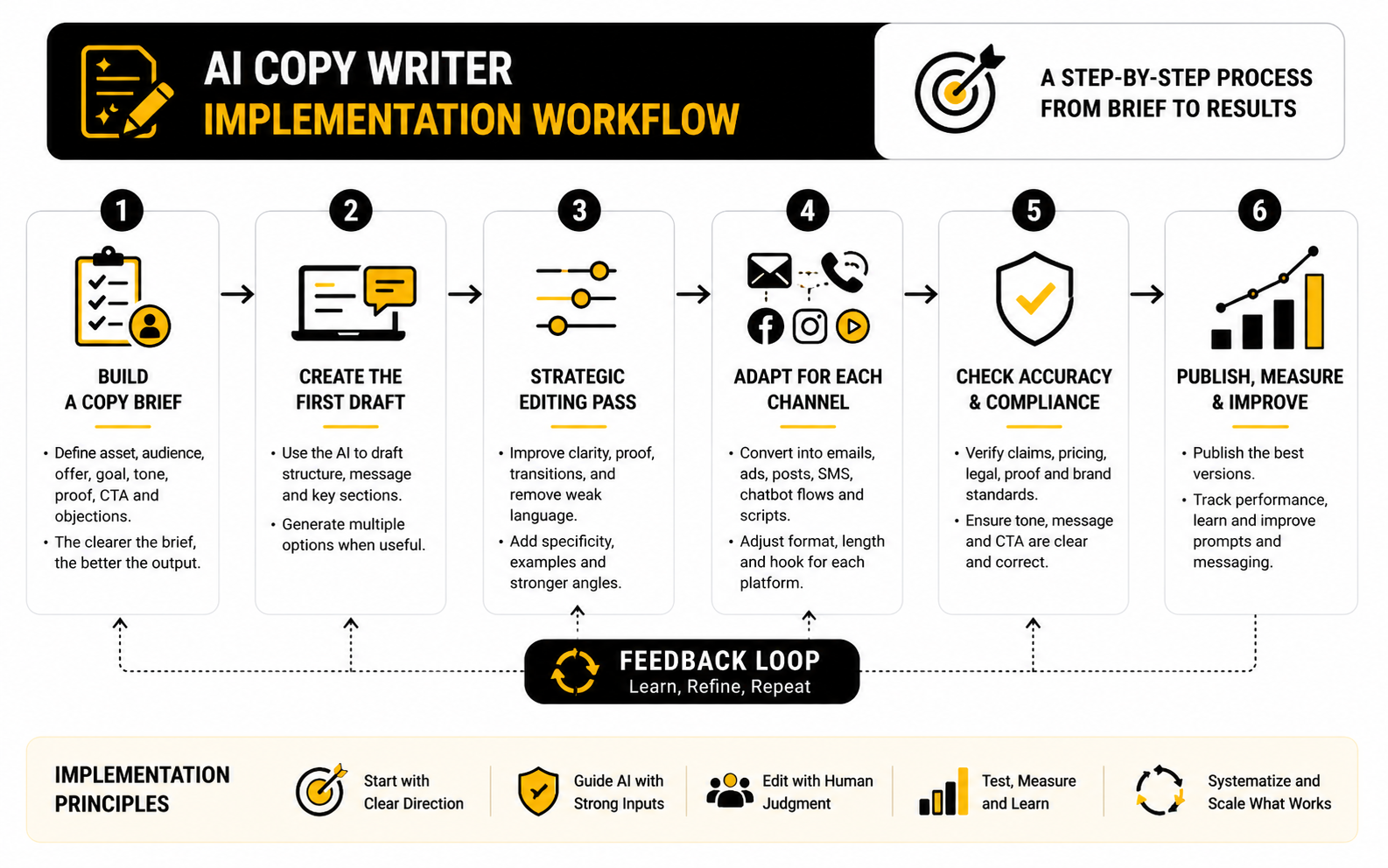
The best implementation process starts before the draft and continues after publishing. That matters because copy is not finished when it sounds good. It is finished when it is accurate, aligned with the campaign goal, approved, published, and measured.
Step 1: Build A Copy Brief
Start with a copy brief before opening the AI tool. The brief should define the asset, audience, offer, goal, channel, tone, proof points, objections, and call to action. This turns the writing task into a clear assignment instead of a vague request.
A simple brief can include:
- Asset type
- Target audience
- Awareness level
- Main problem
- Desired outcome
- Offer details
- Proof points
- Primary objection
- Tone of voice
- Call to action
This does not need to be long. In fact, shorter is often better if the details are sharp. The point is to give the ai copy writer enough direction to produce a useful first draft.
Step 2: Create The First Draft
The first draft should focus on structure and message, not perfection. Ask the ai copy writer to produce a complete version that follows the brief, uses the right tone, and matches the channel. Then judge the draft based on whether the argument flows.
Do not edit line by line too early. First, check whether the copy opens with the right idea, explains the offer clearly, handles the right objections, and leads naturally to the call to action. If the structure is wrong, polishing sentences will waste time.
For funnel assets, the draft also needs to match the page or campaign format. A landing page built in ClickFunnels needs different copy rhythm than an email sequence or chatbot flow. The message can stay consistent, but the execution has to fit the environment.
Step 3: Run A Strategic Editing Pass
The strategic edit is where you ask the hard questions. Is the promise clear? Is the audience obvious? Is the offer specific? Is the proof strong enough? Is there anything that sounds impressive but does not actually mean much?
This is the pass where you remove vague phrases and replace them with concrete language. You also cut repetition, strengthen transitions, and make sure each section earns its place. Strong copy usually feels lighter after this stage, not heavier.
An ai copy writer can help with the edit, but you should control the decision-making. Ask it to identify weak claims, unclear sections, unsupported statements, or places where the reader might lose interest. Then use human judgment to decide what stays.
Step 4: Adapt The Copy For Each Channel
Once the core message is strong, adapt it into channel-specific versions. This is where AI becomes very efficient. You can turn a landing page message into emails, ads, short posts, SMS reminders, chatbot replies, and sales follow-up scripts.
The key is not to copy and paste the same wording everywhere. Each channel has a different level of attention, context, and urgency. Email can carry more explanation, SMS needs to be direct, social needs a sharper hook, and chat automation needs to feel conversational.
For example, ManyChat is useful when the copy needs to guide people through quick conversational decisions. Brevo can fit email and lifecycle messaging. Buffer helps when the finished copy needs to become a consistent social publishing rhythm.
Step 5: Check Accuracy And Compliance
Every AI-assisted draft needs an accuracy check. This includes product claims, pricing, guarantees, comparisons, legal statements, customer results, and technical details. If the copy says something the business cannot prove or deliver, it needs to be changed.
Compliance matters even if you are not in a heavily regulated industry. Misleading claims damage trust. Overpromising might get clicks, but it creates refunds, complaints, and weak long-term performance.
This is also where internal approval should be clear. Decide who signs off on claims, offers, legal language, and brand voice. A simple approval path keeps AI-assisted content fast without letting risky copy slip through.
Step 6: Publish, Measure, And Feed The Results Back
Publishing is not the end of the process. Once the copy goes live, collect performance data and use it to improve the next round. Look at click rates, conversion rates, replies, booked calls, sales notes, unsubscribe patterns, and customer objections.
The best teams turn this feedback into better prompts and better briefs. If one angle outperforms another, document why. If a certain objection keeps appearing in replies, add it to the brief. If a landing page section gets ignored, rewrite it with more direct value.
That is how an ai copy writer becomes more than a drafting tool. It becomes part of a feedback loop that helps your messaging get sharper over time.
Statistics And Data
Measurement is where an ai copy writer stops being a creative toy and becomes part of a serious marketing system. You do not measure AI copy to prove that AI is “good” or “bad.” You measure it to understand which message, angle, offer, and channel actually move people closer to action.
That matters because AI can produce more copy than your team can realistically judge by opinion alone. More output creates more testing opportunities, but it also creates more noise. The only way to separate useful variation from random variation is to define the right performance signals before you publish.
The goal is not to chase every benchmark on the internet. Benchmarks give context, but your own baseline is more important. A 2% click rate might be strong for one audience and weak for another, depending on list quality, offer intent, traffic source, and where the message sits in the customer journey.
What The Adoption Numbers Really Mean
AI adoption in marketing is already high, which means using an ai copy writer is no longer a unique advantage by itself. SurveyMonkey’s AI marketing research found that 93% of marketers using AI use it to generate content faster, while HubSpot’s AI content research found that 55% of marketers identify content creation as the most common AI use case. Those numbers do not mean AI copy is automatically effective. They mean faster content creation has become normal.
That changes the competitive game. If everyone can generate drafts quickly, the advantage shifts to better inputs, better editing, stronger offers, and cleaner measurement. Speed is useful, but speed without learning just helps you publish more average copy.
This is why your measurement system should not only ask, “Did AI save time?” It should also ask, “Did the final copy improve the right business outcome?” If the answer is no, the workflow needs to change.
The Metrics That Actually Matter
The right metrics depend on the asset. A social post should not
Tools, Use Cases, And Practical Examples
At this stage, the question is no longer whether an ai copy writer can help. The better question is where it belongs in the marketing system. Some tasks are perfect for AI assistance, while others still need deeper human strategy, original research, or final executive judgment.
The smartest approach is to use AI where it creates leverage without weakening trust. That usually means using it for drafting, variation, repurposing, summarizing inputs, organizing ideas, and adapting messages across channels. It does not mean handing over positioning, brand strategy, customer promises, or legal claims without review.
Where AI Copy Works Best
An ai copy writer works best when the task has a clear goal, a defined audience, and enough source material to guide the output. Email drafts, ad variations, landing page sections, product descriptions, social captions, lead magnet copy, chatbot scripts, and follow-up messages are all strong use cases. These assets benefit from speed, structure, and controlled variation.
It is especially useful when you need to turn one core message into several versions. A webinar offer can become a registration page, reminder emails, short social posts, retargeting ads, and post-event follow-ups. That is where AI saves serious production time.
But there is a line. If the copy needs original customer research, sensitive claims, legal accuracy, deep technical explanation, or a major positioning decision, AI should assist rather than lead. The difference matters.
Where AI Copy Can Go Wrong
The biggest risk is not that AI writes badly. The bigger risk is that it writes confidently without being right. Generic copy can look acceptable at first glance, but it often hides weak positioning, vague proof, and claims that nobody checked.
Jasper’s 2025 marketing report found that 56% of marketers were still using AI in isolated, ad-hoc ways, while 51% could not track ROI or see the true business impact. That is the problem in one sentence. Random AI usage creates activity, not necessarily performance.
There is also a brand risk. Adobe’s AI marketing trend summary highlights concerns around brand safety, inaccuracies, and bias in AI-generated content. For copywriting, that means you need review rules before scaling output, not after something awkward gets published.
The Scaling Tradeoff
Scaling AI copy sounds attractive because more content feels like more opportunity. But more content also creates more review work, more brand consistency issues, and more chances for weak claims to slip through. Volume is only useful when the system can protect quality.
A team using an ai copy writer at scale needs shared briefs, reusable prompt patterns, approved voice examples, claim guidelines, and a simple approval process. Without those, every person starts using AI differently. The output becomes faster, but the brand becomes less consistent.
This is why governance is not just for large enterprises. Even a small business needs basic rules. Decide what AI can draft freely, what needs review, what claims are off-limits, and who approves final copy before publishing.
Choosing Tools Based On The Workflow
Do not choose tools because they sound impressive. Choose them based on the copy workflow you actually run. A creator-led business, an ecommerce brand, an agency, and a local service business all need different systems.
If your copy mostly supports funnels and lead generation, a platform like ClickFunnels or systeme.io may fit naturally because the copy connects directly to pages, offers, and conversion paths. If your business depends on lead follow-up, pipeline management, and automation, GoHighLevel can make more sense because the copy lives inside a broader customer journey.
For content distribution, Buffer can help turn approved copy into a publishing rhythm. For conversational marketing, ManyChat can help structure short decision-based flows. For email campaigns and lifecycle messaging, Brevo or Moosend may be useful depending on your stack.
Advanced Prompting Is Really Better Direction
People often talk about advanced prompting as if there is a magic phrase that makes AI copy perfect. There is not. Better prompting is mostly better direction.
Instead of asking an ai copy writer to “write better copy,” ask it to solve a specific copy problem. Tell it the audience, awareness level, objection, offer, tone, format, and desired action. Then ask for a defined output, such as five homepage hero options for skeptical buyers or three email angles for leads who downloaded a guide but never booked a call.
Strong prompts usually include:
- The role the AI should play
- The audience segment
- The campaign goal
- The offer details
- The reader’s likely objection
- The desired tone
- The exact format
- The review criteria
This makes the tool easier to manage. You are not hoping for brilliance. You are directing the work.
Using AI Without Losing Originality
A common fear is that AI will make every brand sound the same. That fear is valid when teams use generic prompts and publish lightly edited drafts. The solution is not to avoid AI; it is to feed it better original material.
Your customer research, founder perspective, product details, sales conversations, opinions, frameworks, and proof are what create originality. The ai copy writer should help shape those inputs into usable assets. It should not replace the thinking that makes the message worth reading.
This is where expert-level use looks different from beginner use. Beginners ask AI to invent the copy. Professionals give AI raw strategic material and ask it to organize, sharpen, adapt, and pressure-test it. Big difference.
Quality Control Before Scale
Before scaling AI-assisted copy, create a quality control checklist. Keep it short enough that people actually use it. The goal is to catch the big problems before copy reaches customers.
A practical review checklist should ask:
- Is the audience clear?
- Is the offer easy to understand?
- Is every major claim accurate?
- Is the proof specific enough?
- Does the tone match the brand?
- Is the call to action obvious?
- Is anything exaggerated or unsupported?
- Does the copy fit the channel?
- Is the next step easy to take?
This checklist protects speed from becoming sloppiness. It also gives editors a shared standard, which is critical when more than one person is using the ai copy writer.
The Strategic Advantage
The real advantage is not that AI lets you publish more words. Words are cheap now. The advantage is that AI lets you test more angles, adapt faster, and spend more human time on the parts that actually move revenue.
That means better research, sharper offers, cleaner positioning, stronger proof, and smarter follow-up. McKinsey’s 2025 AI research found that organizations creating value from AI are more likely to use defined processes for when human validation is required for model outputs. That is exactly the mindset copy teams need.
An ai copy writer should make your marketing operation sharper, not noisier. If it helps you produce faster but think less, the system is broken. If it helps you think clearly, draft faster, test smarter, and learn from performance, it becomes a real competitive advantage.
Mistakes, Best Practices, And Final Recommendations
The biggest mistake with an ai copy writer is treating it like a replacement for strategy. It can help you write faster, but it cannot decide what your business should stand for, what promise you should make, or what your market actually needs to hear. Those decisions still belong to you.
The second mistake is publishing too quickly. Fast drafts are useful, but only if they go through a real review process. Accuracy, tone, proof, offer clarity, and channel fit all need to be checked before the copy reaches customers.
The third mistake is measuring only surface-level activity. More copy, more posts, more emails, and more variations do not automatically mean better marketing. The goal is not output. The goal is copy that moves the right person toward the right action.
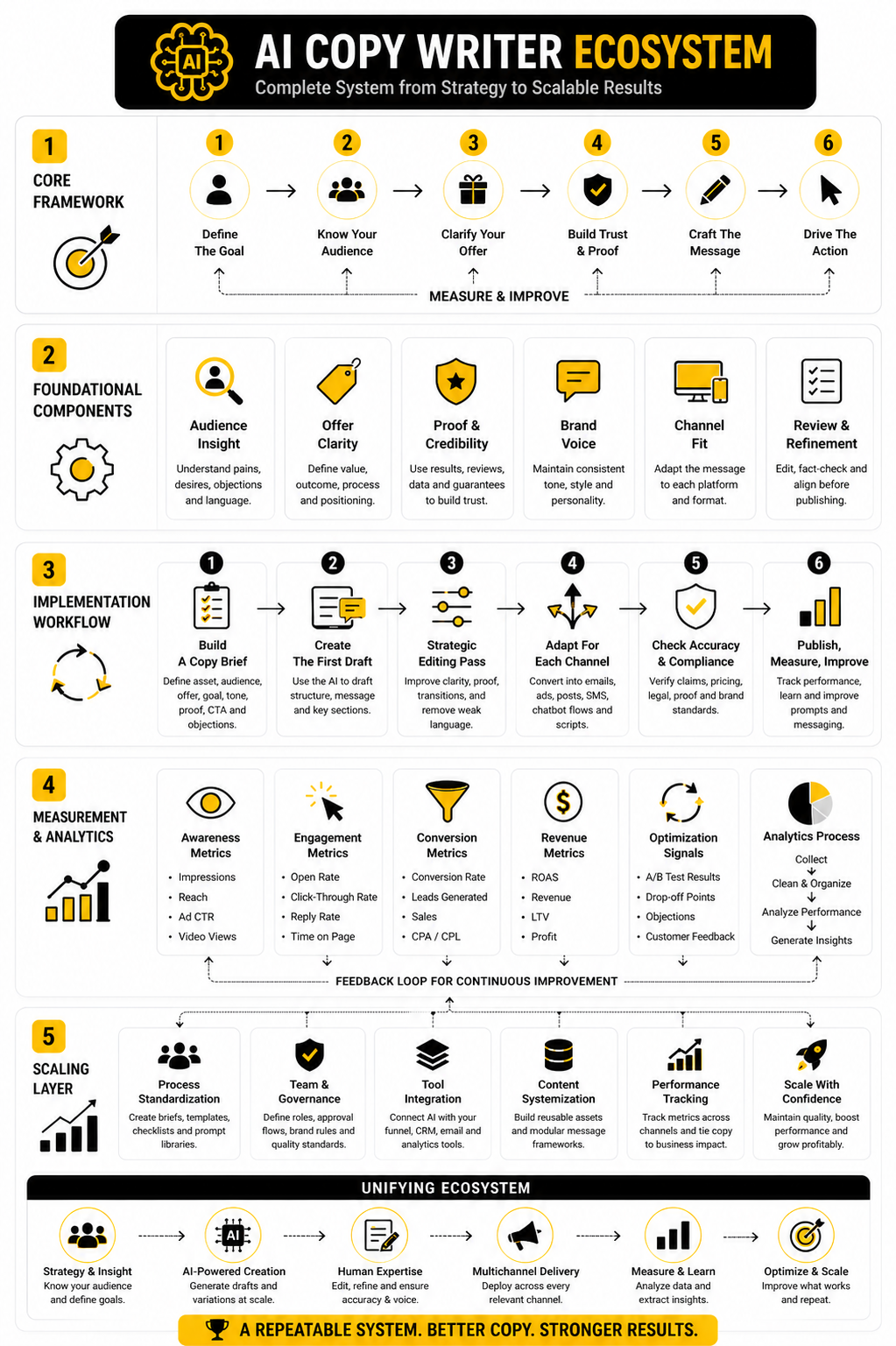
Build A Copy Ecosystem, Not A Content Pile
A strong AI copy system connects research, drafting, review, publishing, automation, and performance feedback. Each part should support the next one. Customer insights improve prompts, prompts improve drafts, drafts become campaigns, campaigns produce data, and data improves the next brief.
This is how an ai copy writer becomes part of a serious marketing operation. It stops being a random tool and becomes a repeatable system. That system is what lets you create faster without sounding careless.
The best teams will not be the ones that generate the most AI copy. They will be the ones that combine AI speed with human judgment, real customer insight, and disciplined measurement. That is the standard worth aiming for.
FAQ - Built for Complete Guide
What is an ai copy writer?
An ai copy writer is a tool or workflow that uses artificial intelligence to help create marketing copy. It can draft headlines, emails, ads, landing page sections, product descriptions, chatbot messages, and social posts. The best results come when the tool is guided by clear strategy, strong inputs, and human editing.
Is an ai copy writer the same as a human copywriter?
No, and that difference matters. An ai copy writer can generate drafts and variations quickly, but it does not bring lived experience, original judgment, customer empathy, or business accountability by itself. A human copywriter should still guide positioning, verify claims, refine tone, and decide what is actually persuasive.
Can AI write high-converting copy?
AI can help create copy that converts, but it does not guarantee conversion. Performance depends on the offer, audience, traffic quality, page structure, proof, timing, and follow-up. The ai copy writer is only one part of the system.
What should I give an ai copy writer before asking it to draft?
Give it the audience, offer, goal, tone, proof points, objections, channel, and call to action. The more specific the brief, the better the draft. Vague prompts usually create vague copy.
Where does AI copy work best?
AI copy works best for first drafts, variations, repurposing, email sequences, ad concepts, landing page sections, chatbot scripts, and social content. It is especially useful when you already have a clear message and need to adapt it across formats. It is less reliable when the task requires original research, legal precision, or sensitive claims.
How do I stop AI copy from sounding generic?
Use real inputs. Add customer language, product details, brand examples, proof points, objections, and strong opinions. Generic prompts create generic copy, but specific context gives the ai copy writer something real to work with.
Should I use AI for SEO content?
You can use AI for SEO content, but the final article still needs to be helpful, accurate, original, and written for readers. Google’s guidance focuses on creating helpful, reliable, people-first content, not on whether AI was involved. Human review is the part you should not skip.
Can an ai copy writer replace my marketing team?
No. It can reduce repetitive writing work and help the team move faster, but it does not replace strategy, research, creative direction, customer understanding, or performance analysis. If anything, AI makes those human skills more important.
What metrics should I track for AI-assisted copy?
Track the metric that matches the asset’s job. For emails, look at opens, clicks, replies, unsubscribes, and conversions. For landing pages, watch conversion rate, scroll depth, button clicks, form completions, and sales quality. For ads, compare click-through rate, cost per lead, cost per acquisition, and downstream revenue.
How often should I test AI-generated copy?
Test whenever the traffic volume is high enough to learn something useful. Do not test tiny changes just to feel productive. Test meaningful differences, such as offer angles, hooks, proof points, objections, and calls to action.
What is the safest way to use AI copy at scale?
Create a repeatable review process. Use approved briefs, brand voice examples, claim rules, compliance checks, and performance feedback. Scaling without standards creates more content, but not necessarily better marketing.
What is the best ai copy writer workflow for beginners?
Start with one asset, not your whole marketing system. Choose a landing page section, email sequence, ad set, or social campaign. Build a clear brief, generate a few versions, edit for accuracy and specificity, publish one controlled version, and learn from the results.
Work With Professionals
Explore 10K+ Remote Marketing Contracts on MarkeWork.com
Most marketers spend too much time chasing clients, competing on crowded platforms, and losing a percentage of every project to middlemen.
MarkeWork gives you a better way. Browse thousands of remote marketing contracts and connect directly with companies desperate to hire skilled marketers like you, without platform commissions and without unnecessary gatekeepers.
If you're serious about finding better opportunities and keeping 100% of what you earn, explore available contracts and create a profile for free at MarkeWork.com.