

AI for copywriting is no longer a novelty tool for quick captions and rough blog drafts. It is becoming part of how marketers research audiences, structure offers, test messages, and produce content across email, ads, landing pages, social media, and sales funnels. The opportunity is speed, but the real advantage comes from building a system where AI supports sharper thinking instead of replacing it.
That distinction matters. AI can help you move faster, but weak positioning, vague prompts, poor source material, and lazy editing still produce generic copy. The teams getting value from AI are not just “using ChatGPT”; they are combining brand strategy, customer insight, human judgment, and repeatable workflows.

Article Outline
This article is structured as a six-part guide so each section builds on the last one. We will start with the strategic role of AI, then move into the practical framework, the core copywriting components, implementation, tools, and final decision-making. The goal is simple: make AI useful for real marketing work, not just faster content production.
- Part 1: Why AI For Copywriting Matters Now
- Part 2: The AI Copywriting Framework
- Part 3: Core Components Of High-Performing AI-Assisted Copy
- Part 4: Professional Implementation Across Marketing Channels
- Part 5: Tools, Workflows, And Quality Control
- Part 6: Choosing The Right AI Copywriting System And FAQ
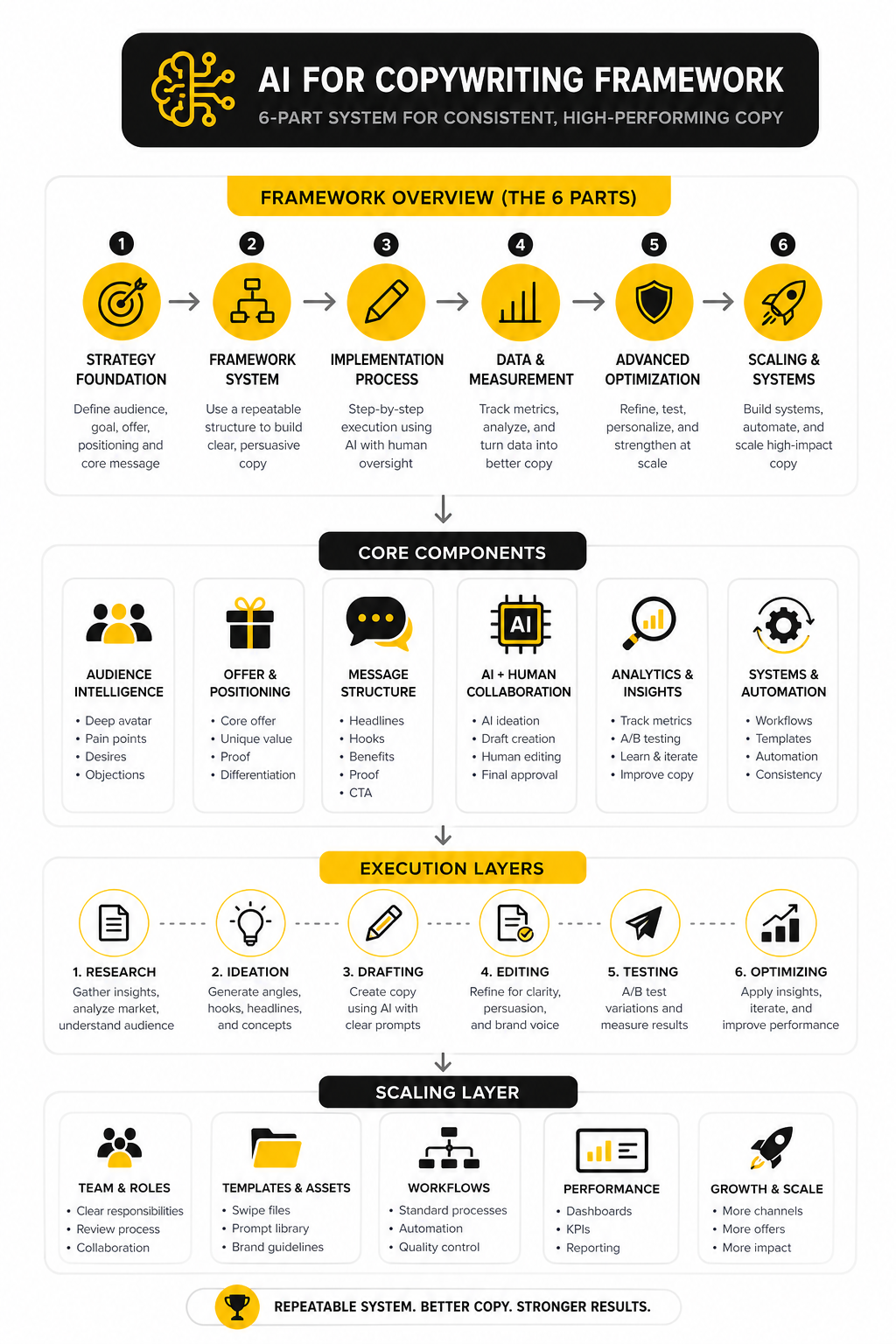
The AI Copywriting Framework
A strong AI copywriting workflow starts before the prompt. The real input is not “write me a landing page”; it is the audience, the offer, the proof, the objections, the channel, and the action you want the reader to take. Without those pieces, AI simply guesses.
The best way to use AI for copywriting is to treat it like a production assistant sitting inside a strategy-led process. It can research patterns, generate angles, organize raw material, rewrite drafts, and adapt copy for different platforms. But the decision-making still has to come from a human who understands the market.
That is where the framework matters. Recent research on generative AI in marketing highlights the importance of matching AI use to the level of human judgment required, especially when brand trust, persuasion, and customer understanding are involved. The strongest results come when AI is used to augment the marketer’s thinking, not replace it entirely, as shown in research on generative AI and marketing strategy.
Start With The Reader
Every piece of copy has one job: move a specific reader closer to a specific action. AI can help you write faster, but it cannot rescue copy aimed at a vague audience. Before you generate anything, define who the copy is for, what they already believe, what they want, and what is stopping them.
This is where many marketers go wrong. They ask AI for “high-converting copy” without giving it the buyer’s situation, level of awareness, pain points, alternatives, and objections. The result sounds polished, but it does not feel specific.
A better prompt starts with context. Tell the AI who the reader is, what they are trying to achieve, what they are afraid of wasting, and what decision they need to make next. When the reader is clear, the copy becomes sharper.
Clarify The Offer Before Writing
The offer is the engine of the copy. If the offer is weak, unclear, or poorly positioned, AI will usually make it sound more exciting than it really is. That can create copy that feels inflated, which hurts trust fast.
Good AI-assisted copywriting starts by breaking the offer into plain language. What does the customer get? Why does it matter now? What makes it easier, faster, safer, cheaper, or more valuable than the alternatives? What proof supports the promise?
Once those answers are clear, AI becomes much more useful. You can ask it to generate angles, headlines, benefit stacks, comparison points, and objection-handling copy based on real offer details instead of vague hype.
Build A Message Map
A message map gives AI a controlled set of ingredients to work from. It keeps the copy consistent across landing pages, emails, ads, and social posts. It also prevents the common problem where every AI-generated asset sounds like it came from a different brand.
A practical message map should include:
- The main promise
- The primary audience
- The biggest pain point
- The desired outcome
- The top objections
- The proof points
- The brand voice rules
- The call to action
This does not need to be complicated. Even a simple one-page message map can improve AI output dramatically because it gives the model boundaries. Instead of asking for random ideas, you are giving it a strategic source of truth.
Use AI For Angles, Not Just Drafts
Most people use AI for copywriting at the draft stage, but the bigger win is angle development. A draft is only one expression of an idea. The angle is the reason the reader should care.
AI is useful here because it can quickly explore multiple positioning routes. You can ask for problem-led angles, outcome-led angles, objection-led angles, comparison angles, urgency angles, and audience-specific angles. Then you choose the ones that actually match the market.
This is important because copy performance often changes more from the angle than from the wording. A better hook, a clearer promise, or a stronger objection reversal can outperform a prettier paragraph. AI helps you test more strategic directions before you commit to the final copy.
Draft In Layers
Trying to generate finished copy in one prompt is usually a mistake. It is faster in the moment, but it gives you less control. A layered workflow produces better copy because each step has a clear purpose.
Start with research and message extraction. Then move into angle generation. After that, create the structure, write the first draft, revise for clarity, revise for persuasion, and finally edit for voice.
This approach matches how professional copy is actually built. AI can support each layer, but you should not ask it to do every layer at once. The more specific the task, the better the output.
Keep Human Editing In The System
AI-generated copy often looks finished before it is actually useful. It may be grammatically clean, confident, and organized, but still too broad, too safe, or too detached from the buyer’s real decision. That is why human editing is not optional.
The editor’s job is to remove generic claims, tighten the promise, check the logic, sharpen the CTA, and make sure the copy sounds like a real brand talking to a real person. This is also where you check whether the copy overpromises or uses proof that the business cannot support.
That matters more as AI adoption grows. McKinsey’s 2025 workplace research found that nearly all companies are investing in AI, but only 1% describe themselves as mature in its use. In copywriting, maturity means having a workflow, not just access to a tool.
Turn The Framework Into A Repeatable Workflow
The practical workflow is simple: strategy first, AI second, human judgment throughout. That gives you speed without giving up control. It also makes your content easier to scale because every asset comes from the same strategic foundation.
A repeatable AI for copywriting workflow looks like this:
- Define the reader and buying situation.
- Clarify the offer and proof.
- Build or update the message map.
- Generate multiple strategic angles.
- Choose the strongest angle manually.
- Draft the copy in sections.
- Edit for clarity, credibility, and conversion.
- Repurpose the final version across channels.
This is the difference between using AI as a shortcut and using AI as leverage. The shortcut gives you more words. The system gives you better marketing.
Core Components Of High-Performing AI-Assisted Copy
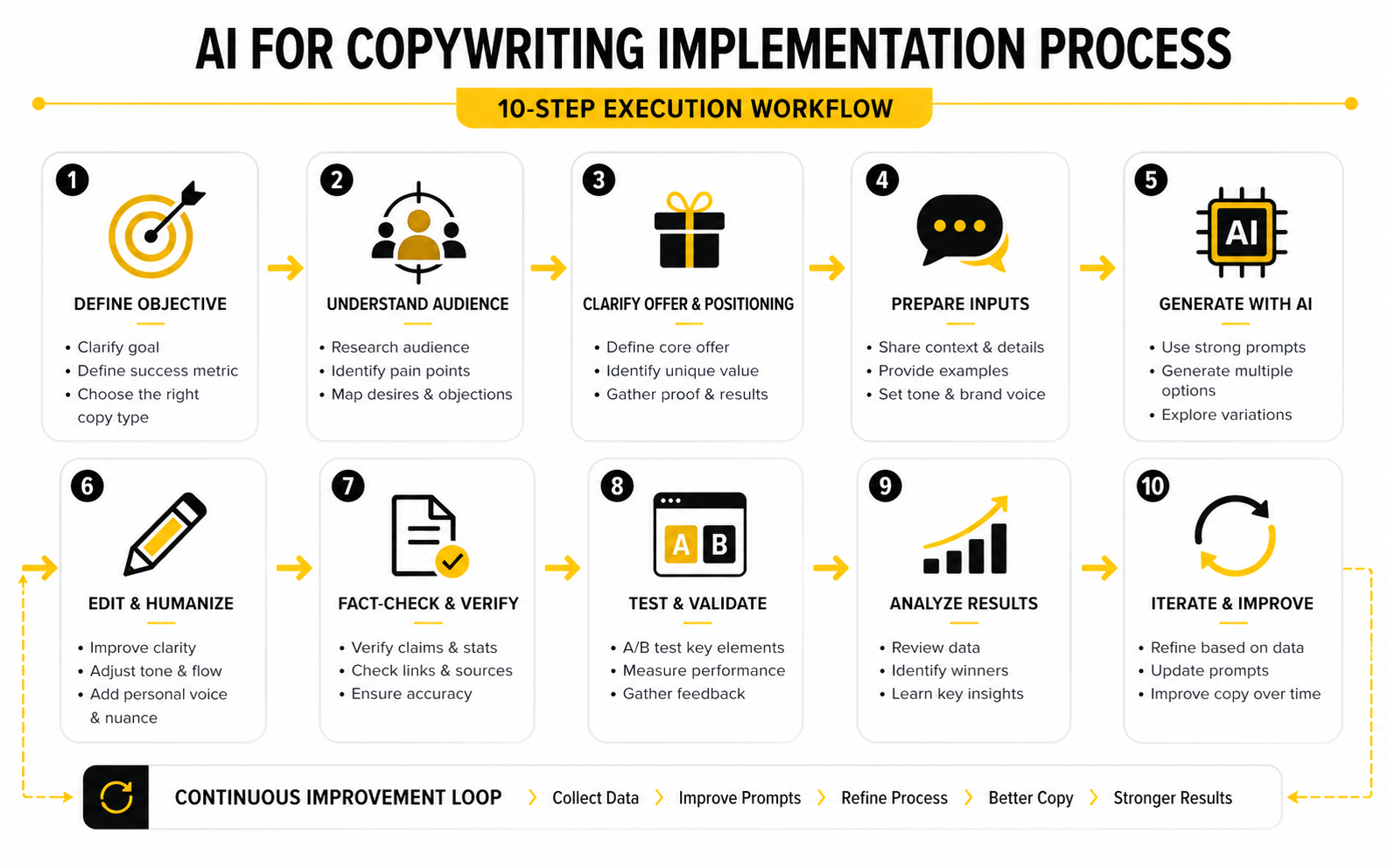
Once the framework is clear, the next step is execution. This is where AI for copywriting becomes practical: not as a magic button, but as a repeatable process for turning strategy into usable marketing assets. The goal is not to make the copy sound “AI-written”; the goal is to make the copy clearer, faster, and easier to test.
The core components are simple, but they need to happen in the right order. You need inputs before prompts, structure before polish, and review before publishing. Skip that order, and the output usually becomes generic.
The Input Layer
The input layer is everything the AI needs before it writes. This includes customer research, offer details, positioning notes, product facts, competitor differences, proof points, and brand voice rules. The better the input, the less the AI has to invent.
This matters because AI models are strong at pattern generation, but they do not automatically know your buyer’s real objections or your offer’s strongest proof. Industry research keeps pointing to the same practical theme: teams get more value when AI is connected to clear workflows, clean data, and human review, not when it is used as a loose drafting toy. A 2025 Basis report on AI in marketing emphasized that marketers are better positioned when they invest in unified first-party data, custom workflows, and team readiness.
The input layer should feel boring. That is a good thing. Boring inputs create sharp outputs because the AI has something real to work with.
The Prompt Layer
The prompt layer turns the input into instructions. A good prompt does not just ask for copy; it defines the role, audience, channel, objective, tone, structure, constraints, and evaluation criteria. This gives AI a job instead of a vague request.
For example, asking for “an email about our new offer” is weak. Asking for “a short launch email for warm leads who know the problem, are comparing alternatives, and need one clear reason to book a call” is much stronger. The second version gives the model a buying situation.
The prompt layer should also include what not to do. Tell the AI to avoid unsupported claims, fake urgency, overused phrases, vague benefits, and exaggerated promises. This one step improves quality fast.
The Structure Layer
The structure layer decides how the copy should move. Headlines, hooks, body sections, proof, objections, and CTAs all need a logical order. AI can suggest structures, but you should choose the one that fits the reader’s awareness level and the channel.
A landing page usually needs a different structure than a cold email. A retargeting ad needs a different structure than an educational blog section. A sales page can carry more detail, while a social post needs the idea to land quickly.
This is where frameworks help, but they should not become templates you blindly reuse. Problem-agitate-solve, before-after-bridge, AIDA, PAS, and story-based structures can all work. The right structure depends on what the reader already understands and what they still need to believe.
The Drafting Layer
The drafting layer is where AI finally writes the first usable version. By this stage, the model should already have the audience, offer, proof, angle, voice, and structure. That makes the draft more focused and much easier to edit.
A smart drafting process works in sections. Generate headlines first, then the opening, then the body, then the CTA. This gives you more control than asking for a complete page in one pass.
It also makes revision easier. If the hook is weak, you fix the hook without rewriting the whole asset. If the proof section feels thin, you strengthen that section instead of polishing weak copy.
The Review Layer
The review layer is where the human earns the result. AI can create fluent copy, but fluency is not the same as persuasion. The copy still needs to be checked for accuracy, specificity, tone, compliance, and strategic fit.
A useful review asks five questions. Is the promise clear? Is the proof real? Is the reader specific? Is the CTA obvious? Is anything exaggerated, vague, or unnecessary? If the answer is yes to the last question, cut it.
This step matters even more because consumer trust around AI-generated marketing is still fragile. Research on generative AI and marketing has raised clear concerns around transparency, authenticity, and consumer protection, especially when synthetic content starts shaping buying decisions. That does not mean brands should avoid AI, but it does mean the final copy needs human accountability.
The Repurposing Layer
The repurposing layer turns one approved message into multiple channel-specific assets. This is one of the best uses of AI for copywriting because the strategic thinking has already been done. You are not asking AI to create a new idea from scratch; you are asking it to adapt a proven message for a new context.
A webinar hook can become an email subject line, a landing page section, a LinkedIn post, a short ad, and a follow-up sequence. The core idea stays the same, but the format changes. That is how you scale content without losing consistency.
Tools can help here when the workflow is clear. For example, teams building funnels may use ClickFunnels for page and funnel execution, while service businesses may prefer GoHighLevel when they want AI-assisted marketing, CRM, automation, and follow-up in one system. The tool is not the strategy, but the right tool makes the strategy easier to execute.
The Testing Layer
The testing layer turns copywriting into learning. AI can produce variations quickly, but you still need a clear reason for each variation. Testing five random headlines is not as useful as testing five different angles.
Good tests isolate one meaningful variable. You might test urgency against credibility, outcome against pain, short-form against proof-heavy copy, or a direct CTA against a softer next step. The point is to learn what moves the audience, not just chase a temporary lift.
This is where AI becomes more valuable over time. Every result gives you better inputs for the next round. The workflow gets smarter because the system is learning from real audience behavior, not just model output.
Statistics And Data
AI for copywriting should be measured by business movement, not word count. Faster production is useful, but speed only matters if the copy improves attention, trust, qualified clicks, conversions, retention, or sales conversations. The wrong metric makes AI look productive while the funnel quietly gets weaker.
The data also needs context. A landing page conversion rate, email click rate, or ad CTR means very little until you know the audience, traffic source, offer type, buying intent, and conversion event. This is why benchmarks should guide your expectations, not control your decisions.
What The AI Adoption Numbers Really Mean
AI adoption in marketing is already mainstream, but adoption is not the same as maturity. The Stanford 2025 AI Index reported that 71% of organizations using AI in marketing and sales saw revenue gains, but the most common increase was under 5%. That is an important signal because it shows AI can contribute to growth, but it also shows that most teams are still capturing modest gains rather than dramatic transformation.
This fits what we see in real marketing work. AI helps teams produce more drafts, test more angles, summarize customer research, and repurpose content faster. But the lift usually comes from better workflows, not from simply adding an AI writing tool.
So the action is clear. Do not ask, “Are we using AI?” Ask, “Where is AI improving measurable copy performance?” That question forces the conversation toward outcomes instead of activity.
The Metrics That Actually Matter
The best measurement system separates production metrics from performance metrics. Production metrics tell you whether the team is moving faster. Performance metrics tell you whether the market is responding.
For AI-assisted copy, track both. Time saved, draft volume, and content velocity matter internally. But the real scorecard should include conversion rate, click-through rate, qualified lead rate, cost per lead, reply rate, booked-call rate, revenue per visitor, and retention-related engagement.
This is where many teams get fooled. If AI helps you publish twice as many emails but the click rate drops, that is not progress. If AI helps you test five stronger landing page angles and one produces more qualified leads, that is useful.
Benchmarks Are Context, Not Targets
Benchmarks help you avoid guessing, but they should never replace your own data. For example, Unbounce’s conversion benchmark data is based on more than 57 million conversions across over 41,000 landing pages, which makes it useful for understanding broad patterns. Still, your page may perform above or below a benchmark for reasons that have nothing to do with copy quality.
A SaaS landing page asking cold traffic to book a demo will not behave like a local service page with urgent buying intent. A webinar registration page will not behave like a checkout page. A lead magnet for beginners will not behave like a consultation offer for enterprise buyers.
Use benchmarks to spot obvious problems. If your page is far below your category range, review the offer, headline, proof, form friction, traffic quality, and CTA. But once you have enough internal data, your own baseline matters more than the industry average.
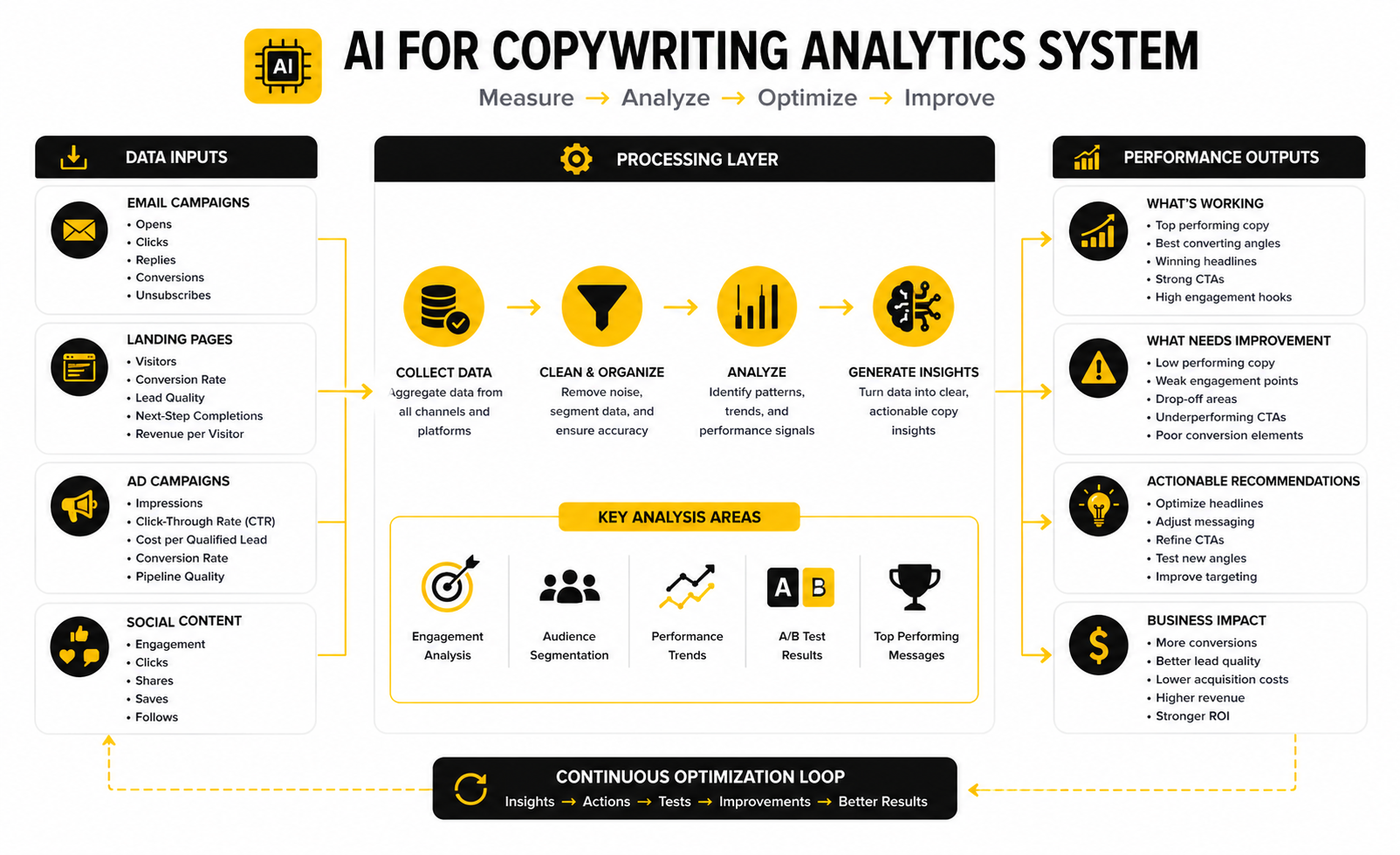
Build A Simple Analytics System
A useful analytics system for AI copywriting does not need to be complicated. It needs to connect each copy asset to one clear goal and one primary metric. If the goal is email engagement, track opens carefully but judge the message by clicks, replies, and downstream conversions.
For landing pages, measure visitor-to-lead conversion, lead quality, and next-step completion. For ads, measure CTR, cost per click, cost per qualified lead, and conversion rate after the click. For social content, measure saves, comments, profile clicks, email signups, and assisted conversions where possible.
The key is attribution discipline. Do not change the headline, offer, page layout, audience, and CTA all at once, then pretend you learned what worked. Change one meaningful thing at a time when possible, and keep a simple testing log.
Read Email Data Beyond Open Rates
Email is one of the clearest places to see whether AI-assisted copy is helping or hurting. Open rates can show whether the subject line creates enough curiosity or relevance, but privacy changes and inbox behavior make opens less reliable than they used to be. Clicks, replies, conversions, and unsubscribes tell you more about the actual quality of the message.
Recent email benchmark roundups show wide variation by industry, with B2B services, SaaS, nonprofit, and travel audiences producing very different open and click patterns in current email marketing benchmark data. That variation matters because a “good” result depends on the relationship with the list and the action requested. A warm buyer list should be judged differently from a cold newsletter audience.
The practical move is to benchmark against yourself. Compare AI-assisted campaigns to your last 5 to 10 similar campaigns. If AI improves speed but increases unsubscribes or lowers qualified clicks, the copy needs tighter targeting and stronger human editing.
Measure Message Quality, Not Just Conversion
Not every important signal is a final sale. Good copy often improves the quality of conversations before it improves revenue. That is especially true for higher-ticket offers, B2B services, agencies, SaaS demos, and consulting funnels.
Look for signals like better reply quality, fewer confused prospects, higher call-show rates, shorter sales cycles, and more specific objections. These indicators show whether your copy is educating the right people and filtering out the wrong ones. AI can help create this clarity, but only if the message is built around real buyer context.
This is where tools and systems become useful. A platform like GoHighLevel can help service businesses connect AI-assisted messaging with CRM activity, automation, pipeline movement, and follow-up. That makes performance easier to read because the copy is tied to the customer journey instead of sitting in isolation.
Turn Data Into Better Prompts
Data should feed the next prompt. If a landing page gets clicks but weak conversions, give AI the page copy, traffic source, offer, and drop-off point, then ask for diagnosis and revised hypotheses. If an email gets replies but not bookings, ask AI to identify where intent may be leaking.
This is much better than asking AI to “make it better.” Give it the metric, the asset, the audience, and the suspected problem. Then ask for specific variations that test one idea at a time.
For example, you might test a clearer promise, a stronger proof section, a lower-friction CTA, or an objection-led opening. Each version should have a reason behind it. Random variation is noise; structured variation creates learning.
Know When The Data Is Too Thin
Small numbers can lie. If 37 people visit a page and two convert, you do not have a stable insight. You have an early signal that needs more traffic, cleaner testing, or a lower-risk decision.
This matters because AI makes it easy to generate many versions quickly. But testing more versions does not automatically create better evidence. Too many variations with too little traffic can make your decisions worse.
When the data is thin, use qualitative signals. Read replies, review call notes, scan chat transcripts, and look at where people hesitate. AI can summarize those patterns, but a human should decide which insights are strong enough to affect the copy.
The Measurement Rule That Keeps You Honest
The rule is simple: every AI-assisted copy asset should have a measurable job. A sales email should create a reply, click, booking, or purchase. A landing page should move the visitor to the next step. A social post should earn attention from the right audience, not just impressions from anyone.
Once the job is clear, measurement becomes cleaner. You know what to track, what to ignore, and what to improve next. That is how AI for copywriting becomes a performance system instead of a content machine.
The strongest teams will not be the ones generating the most copy. They will be the ones learning fastest from the copy they publish. That is the real advantage.
Tools, Workflows, And Quality Control
At this stage, AI for copywriting becomes less about writing and more about operating. The real question is no longer whether AI can produce a headline, email, or landing page section. It can. The real question is whether your workflow can produce useful copy repeatedly without creating brand, legal, or performance problems.
That is the expert-level shift. Beginners chase better prompts. Professionals build better systems. The prompt still matters, but the system decides whether AI becomes a reliable marketing asset or a messy shortcut.
Choose Tools Around The Workflow
Do not pick an AI tool because it has the loudest feature list. Pick tools based on the actual work you need to complete. A solo creator writing newsletters needs a different setup than an agency managing funnels, CRM follow-up, ads, landing pages, and client approvals.
For funnel-heavy businesses, ClickFunnels can make sense when the copy needs to move directly into pages, offers, and conversion paths. For agencies and service businesses, GoHighLevel is more useful when copy, automation, CRM activity, appointments, and follow-up need to live in one operating system. For lean email marketing, tools like Brevo or Moosend may be the better fit because the main job is list communication, segmentation, and campaigns.
The trap is buying software before defining the workflow. Start with the asset types, review steps, approval rules, measurement needs, and handoff points. Then choose the tool that removes friction from that process.
Build A Prompt Library That Improves Over Time
A prompt library is not a folder full of clever commands. It is an operating manual for how your brand uses AI. It should include prompts for research extraction, angle development, headline generation, landing page sections, email sequences, ad variations, repurposing, editing, and compliance checks.
The best prompt libraries also include inputs and examples. Show the AI what a strong output looks like, what a weak output looks like, and what rules should never be broken. This gives your team a practical standard instead of leaving every person to invent their own workflow.
Keep the library small at first. Ten excellent prompts used consistently are better than 100 random prompts nobody trusts. Review them monthly, remove what is not working, and update the best ones with lessons from real campaign data.
Protect Brand Voice Before You Scale
AI makes it easy to produce more content, but more content can dilute the brand fast. If every asset sounds slightly different, the audience starts feeling the inconsistency even if they cannot explain it. That is why brand voice needs to become a usable input, not a vague PDF nobody reads.
A practical brand voice guide should define sentence rhythm, level of formality, preferred phrases, banned phrases, proof standards, CTA style, and how direct the copy should be. It should also show before-and-after examples. AI works better with examples than abstract instructions.
This matters because copy is not just information. It is a trust signal. If your AI-assisted copy suddenly sounds inflated, overly polished, or disconnected from how your brand normally speaks, performance can drop even when the grammar improves.
Manage The Risk Of Hallucinations
AI can write confidently and still be wrong. That is not a small issue in copywriting because claims, statistics, product details, pricing, comparisons, testimonials, guarantees, and compliance language can all affect buying decisions. A polished false claim is still false.
Research on generative AI governance continues to highlight risks such as hallucination, sensitive information leakage, opacity, and implementation control issues in business settings through current AI governance research. Marketing teams should take that seriously because public-facing copy carries reputational risk. The faster the production system gets, the easier it becomes to publish mistakes at scale.
The fix is not fear. The fix is a verification rule. Any factual claim, statistic, comparison, customer result, legal statement, or product promise must be checked against a source before publishing.
Separate Creative Drafting From Final Approval
One of the easiest ways to scale AI safely is to separate creation from approval. Let AI help with ideation, first drafts, variations, summaries, and formatting. But do not let the same stage that creates the copy become the stage that approves the copy.
Final approval should include accuracy, brand, offer, legal, and channel checks. For small teams, one person may own several of those checks. For larger teams, the process should be split clearly so copy does not get stuck or published without accountability.
This is where AI governance becomes practical. McKinsey’s 2025 workplace research found that nearly all companies are investing in AI, but only 1% describe themselves as mature in AI use. Maturity in copywriting means knowing who can generate, who can edit, who can approve, and what standards must be met before anything goes live.
Avoid The Content Velocity Trap
Publishing more is not automatically better. AI can create the illusion of momentum because the calendar fills up, the drafts pile in, and the team feels busy. But if the content is not tied to a clear audience, offer, and measurement system, velocity becomes noise.
This is especially dangerous in SEO, email, and social media. You can produce more articles that never rank, more emails that fatigue the list, and more posts that attract the wrong audience. The machine looks active, but the business does not move.
The better move is to scale winners. Use AI to turn proven messages into more formats, not to create endless new messages from scratch. If a landing page angle converts, use that idea in emails, ads, social posts, webinar hooks, and sales follow-up.
Handle Compliance Before It Becomes A Problem
Some industries need a stricter AI copywriting process than others. Finance, health, legal, insurance, real estate, education, and B2B software all have higher stakes because misleading claims can create real consequences. Even outside regulated industries, exaggerated results and unsupported guarantees can damage trust quickly.
Build compliance into the workflow early. Create a list of claims that require review, phrases that are banned, proof that must be attached, and topics that AI should not handle without human approval. This makes the process faster because the team knows the rules before drafting.
Consumer protection research around generative AI in marketing points to concerns around automated persuasion, personalization, transparency, and misleading synthetic content in recent marketing-focused AI research. That is the line to watch. If the copy manipulates instead of clarifies, you are not building a stronger funnel; you are creating risk.
Train The Team, Not Just The Model
Most AI copywriting problems are people-and-process problems. The tool is only one part of the system. The team needs to know how to brief the AI, evaluate outputs, challenge weak copy, verify claims, and improve prompts based on performance.
This is where training pays off. A trained marketer can use AI to think through positioning, objections, hooks, and variations. An untrained user often accepts whatever sounds smooth.
Do not make AI usage a private habit where every team member does their own thing. Create shared standards, shared prompts, shared examples, and shared review checklists. That is how you keep speed without losing quality.
Use AI Where It Has Leverage
AI is strongest when the task has patterns, inputs, and review criteria. It is useful for turning research into message maps, generating angle options, adapting copy to different channels, rewriting for clarity, summarizing customer objections, and creating test variations. It is weaker when the business has not clarified the audience, offer, proof, or positioning.
That tradeoff matters. AI can accelerate a good strategy, but it cannot create a trustworthy strategy from nothing. If the brief is lazy, the output will usually be lazy with better grammar.
The practical rule is simple: use AI where it multiplies judgment, not where it replaces judgment. Let it expand options, speed up drafts, and reduce manual friction. Keep humans responsible for strategy, truth, taste, and final decisions.
Prepare For More Personalized Copy
The next phase of AI for copywriting will be more personalized, more automated, and more connected to customer data. That can improve relevance, but it also raises the bar for consent, privacy, and message quality. Personalization is powerful only when it feels helpful, not invasive.
This is where CRM, forms, chatbots, and segmentation tools become more important. A business using ManyChat, Fillout, or Chatbase can collect better intent signals and turn those signals into more relevant follow-up. But that data has to be handled carefully and used to improve the customer experience, not just squeeze harder.
The winning brands will not personalize everything just because they can. They will personalize where it reduces friction, answers the right question, or helps the buyer take the next step with more confidence. That is the standard worth aiming for.
Choosing The Right AI Copywriting System
The final step is pulling everything together into a system you can actually use. AI for copywriting works best when strategy, tools, data, review, and distribution all support each other. When those pieces are disconnected, the copy may look productive on the surface, but the business does not get much smarter.
This is why the best system is not always the most advanced system. It is the one your team can run consistently. A simple workflow that produces clear, accurate, measurable copy will beat a complicated setup that nobody follows.
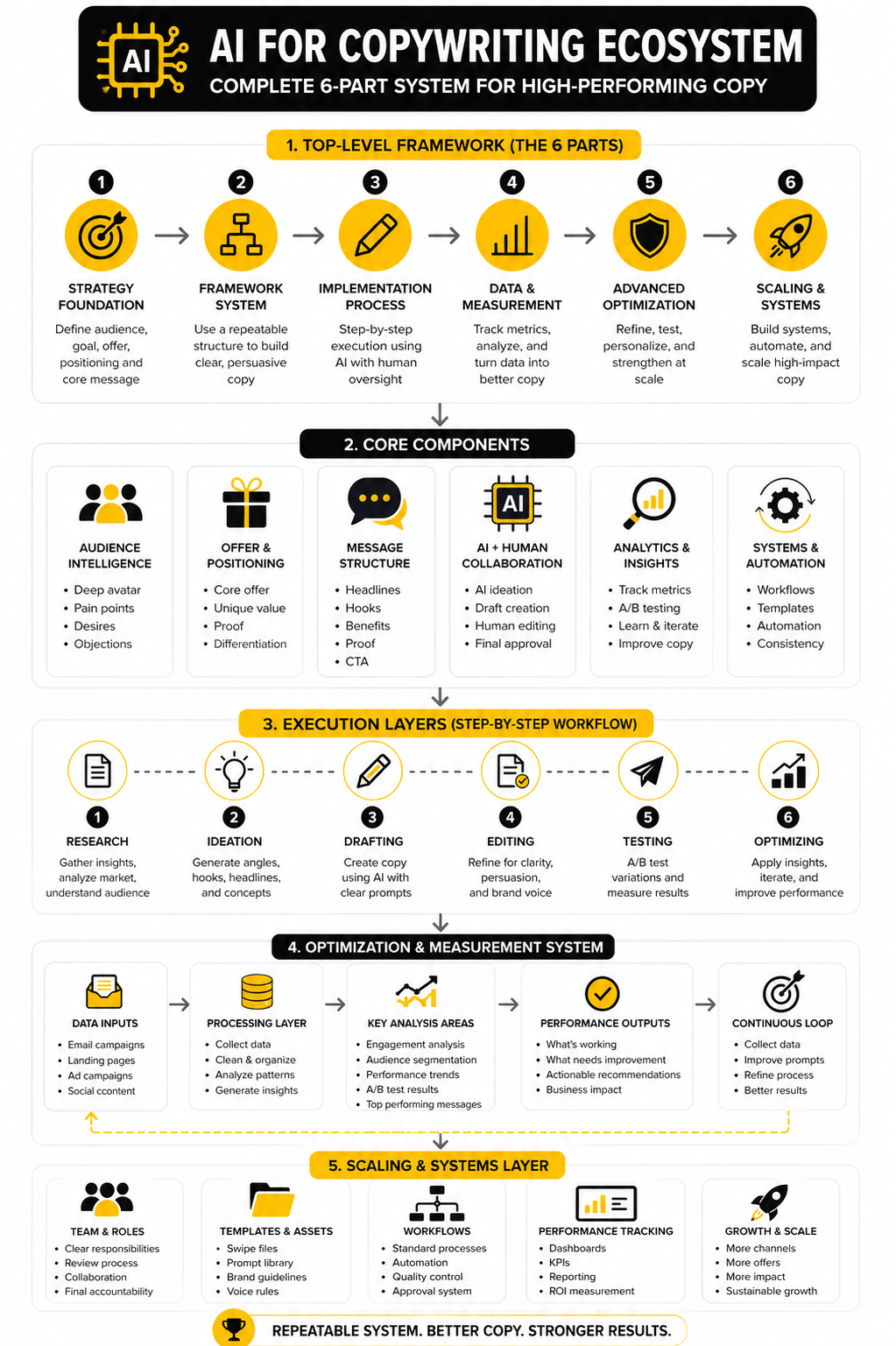
Match The System To Your Business Model
A creator selling digital products needs a different AI copywriting setup than a local agency, a SaaS company, an ecommerce brand, or a consultant selling high-ticket services. The copy assets, decision cycles, proof requirements, and follow-up paths are different. The system should match the way revenue is actually created.
For funnels and direct-response offers, ClickFunnels is a practical option when the copy needs to move straight into pages and offers. For service businesses and agencies, GoHighLevel can be stronger when copy, CRM, follow-up, automations, bookings, and pipeline tracking need to work together. For social distribution, Buffer can help turn approved messages into scheduled content without turning publishing into a daily bottleneck.
The point is not to collect tools. The point is to reduce friction between idea, draft, approval, publishing, and measurement. If a tool does not improve one of those steps, it probably does not belong in the system.
Decide What Humans Own
A strong AI copywriting system needs clear human ownership. AI can help create options, but someone still needs to own positioning, proof, claims, taste, approval, and results. Without ownership, every weak draft becomes “the AI’s fault,” which is just a convenient way to avoid responsibility.
Humans should own the customer insight, the offer logic, the final message, and the publishing decision. AI should support research organization, drafts, variations, summaries, repurposing, and editing assistance. That division keeps the speed without losing judgment.
This matters because AI maturity is still low across most companies. McKinsey’s 2025 workplace research found that nearly all companies invest in AI, but only 1% describe themselves as mature in its use. For copywriting, maturity means the team knows exactly where AI helps, where it does not, and who is accountable for the final result.
Keep The System Small Enough To Improve
The easiest mistake is building a huge AI copywriting process before the team has mastered the basics. Start with one or two high-value workflows. That might be landing page revisions, weekly email campaigns, sales follow-up, ad angle testing, or content repurposing.
Once that workflow produces measurable improvement, expand it. Add better prompts, tighter review rules, stronger analytics, and more channel-specific templates. The system should grow from proven use cases, not from excitement.
This is how AI becomes part of the business instead of another experiment. You build around what works, remove what does not, and keep improving the pieces that drive results. Simple, measured, and repeatable wins.
FAQ - Built For Complete Guide
What is AI for copywriting?
AI for copywriting means using artificial intelligence to help create, improve, adapt, and test marketing copy. It can support headlines, emails, ads, landing pages, product descriptions, social posts, scripts, and sales messages. The strongest use is not replacing human strategy, but speeding up the parts of the process that benefit from structure, variation, and revision.
Can AI replace a copywriter?
AI can replace some low-level drafting tasks, but it does not fully replace a strong copywriter. Good copywriting requires customer insight, offer strategy, proof selection, emotional judgment, positioning, and ethical decision-making. AI can produce words quickly, but humans still need to decide what should be said, why it matters, and whether the message is true.
Is AI-generated copy good enough to publish?
Sometimes, but it should not be published without review. AI-generated copy can sound polished while still being vague, inaccurate, off-brand, or unsupported. The safest workflow is to use AI for the draft, then apply human editing for clarity, specificity, proof, tone, and compliance.
What is the best way to prompt AI for copywriting?
The best prompts include the audience, offer, channel, goal, tone, proof, objections, CTA, and constraints. A weak prompt asks for copy in general. A strong prompt describes the buyer’s situation and tells the AI exactly what the copy needs to accomplish.
What copywriting tasks is AI best at?
AI is especially useful for generating angles, rewriting for clarity, creating headline variations, adapting one message across channels, summarizing customer research, and creating first drafts. It is also useful for turning long-form content into shorter emails, ads, or social posts. The more structured the task, the better the output usually becomes.
What copywriting tasks should humans still handle?
Humans should handle positioning, offer strategy, final claims, sensitive topics, legal or compliance review, customer interpretation, and final approval. Humans should also decide which angle is strongest and whether the copy feels credible. AI can assist, but accountability should stay with the marketer or business owner.
How do you measure AI copywriting performance?
Measure AI copywriting by the job of the asset. For emails, look at clicks, replies, conversions, and unsubscribes. For landing pages, look at conversion rate, lead quality, next-step completion, and revenue per visitor. For ads, track CTR, cost per qualified lead, conversion rate after the click, and actual pipeline quality.
Does AI copywriting hurt SEO?
AI copywriting can hurt SEO when it creates thin, generic, repetitive content with no original value. It can help SEO when it supports research, structure, clarity, topic coverage, and editing. The difference is whether the content genuinely helps the reader or simply fills a page with predictable text.
How do you keep AI copy from sounding generic?
Give the AI stronger inputs. Use real customer language, offer details, proof points, objections, voice rules, examples, and clear constraints. Then edit aggressively, removing vague claims, overused phrases, inflated promises, and anything that does not sound like your brand.
Should small businesses use AI for copywriting?
Yes, small businesses can benefit a lot from AI for copywriting because it helps them create more consistent marketing with fewer resources. The key is to keep the workflow simple. Start with one use case, such as email follow-up, landing page improvement, or social content repurposing, then expand after you see results.
What are the biggest risks of AI for copywriting?
The biggest risks are inaccurate claims, generic messaging, brand voice dilution, overproduction, weak compliance, and publishing copy nobody has properly reviewed. AI hallucinations are especially dangerous because the output can sound confident even when it is wrong, which business risk research continues to highlight in discussions of AI hallucinations and misleading outputs. The practical fix is simple: verify claims before publishing.
How often should AI copywriting prompts be updated?
Prompts should be updated whenever the offer changes, the audience changes, performance data reveals a new insight, or the output starts becoming repetitive. A monthly review works well for most teams. Treat prompts like working assets, not permanent documents.
What is the best AI copywriting workflow for beginners?
Start with a simple five-step workflow. Define the audience, clarify the offer, generate angles, draft the copy, then edit and measure the result. Do not overcomplicate it at the beginning.
How can teams scale AI copywriting safely?
Teams can scale safely by using shared prompts, brand voice rules, approval checklists, source verification, and performance tracking. They should also separate drafting from approval. That keeps the workflow fast without letting weak or risky copy slip into public campaigns.
Work With Professionals
Explore 10K+ Remote Marketing Contracts on MarkeWork.com
Most marketers spend too much time chasing clients, competing on crowded platforms, and losing a percentage of every project to middlemen.
MarkeWork gives you a better way. Browse thousands of remote marketing contracts and connect directly with companies ready to hire skilled marketers like you, without platform commissions and without unnecessary gatekeepers.
If you are serious about finding better opportunities and keeping 100% of what you earn, explore available contracts and create a profile for free at MarkeWork.com.