

AI in marketing is no longer a side experiment for prompt-happy teams. It is becoming part of the operating system for how brands research audiences, produce creative, personalize journeys, score leads, optimize media, and measure performance. That shift matters because the pressure on marketing teams has changed fast: content demand keeps rising, personalization is now expected, and leadership wants more output without a matching increase in headcount.
The problem is that most teams still talk about AI in marketing as if it were mainly a content tool. The stronger research points somewhere else. The biggest gains show up when AI is connected to real workflows, real data, and real business decisions, not when it is used to flood channels with average copy. Early adopters are already reporting faster production cycles, lower content creation time, stronger personalization, and in some cases higher return on ad spend, but scaling those gains is still the hard part.
Why AI In Marketing Matters
What makes AI in marketing such a big deal is not just speed. It is the combination of speed, pattern recognition, and decision support across too many touchpoints for a human team to manage well on its own. McKinsey found that 65% of respondents said their organizations were regularly using generative AI in 2024, while Bain reported that some retailers using AI-powered targeted campaigns saw 10% to 25% higher return on ad spend and faster time to market.
There is also a less glamorous reason this matters: marketing teams are under a production squeeze. Deloitte found that demand for marketing content grew 1.5 times in 2023 while surveyed teams met only 55% of that demand, and HubSpot’s 2026 marketing research shows many marketers now say AI helps them create more content but also makes differentiation harder. In other words, AI can expand output, but it also raises the standard for strategy, taste, and brand clarity.
The AI In Marketing Framework
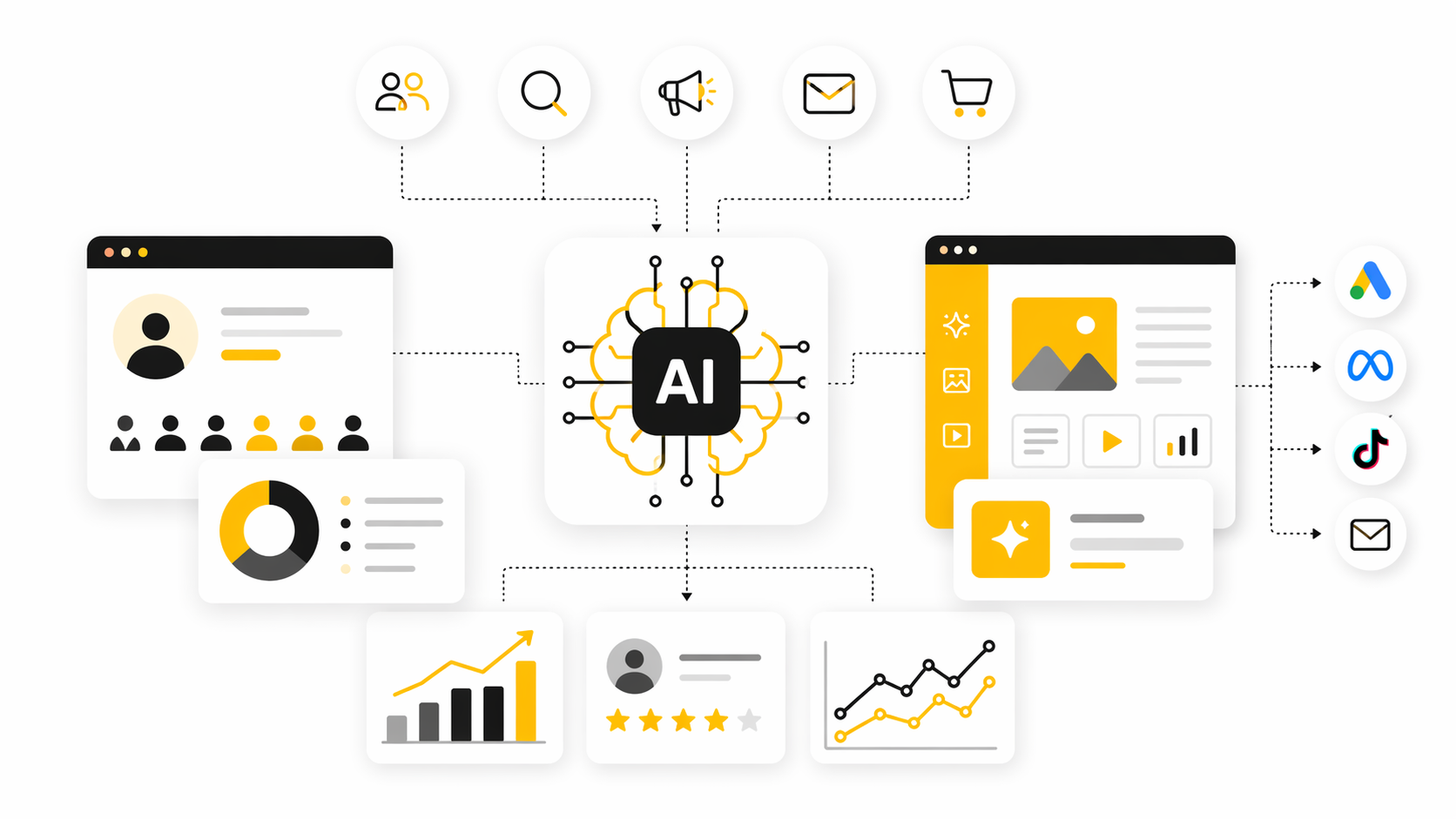
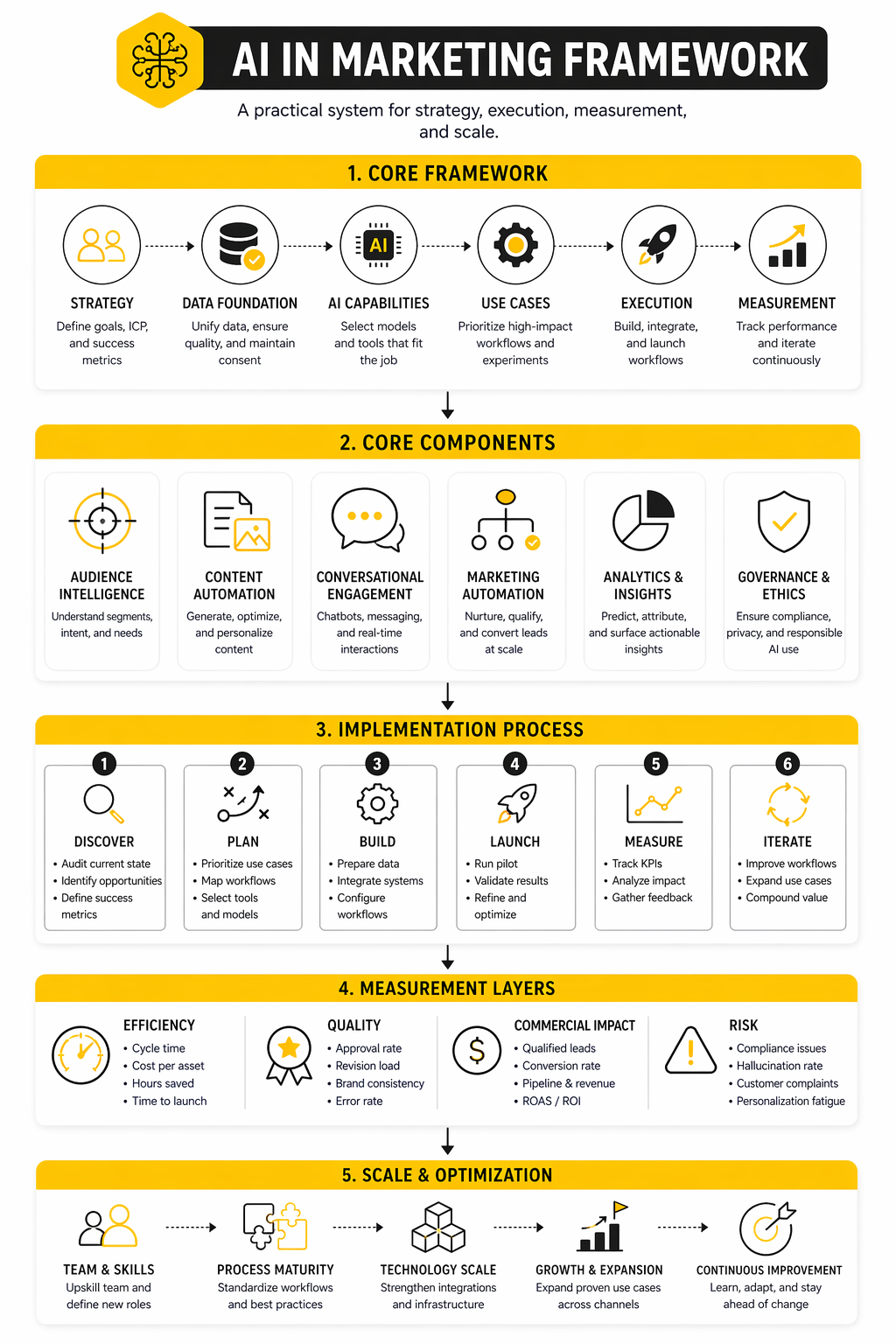
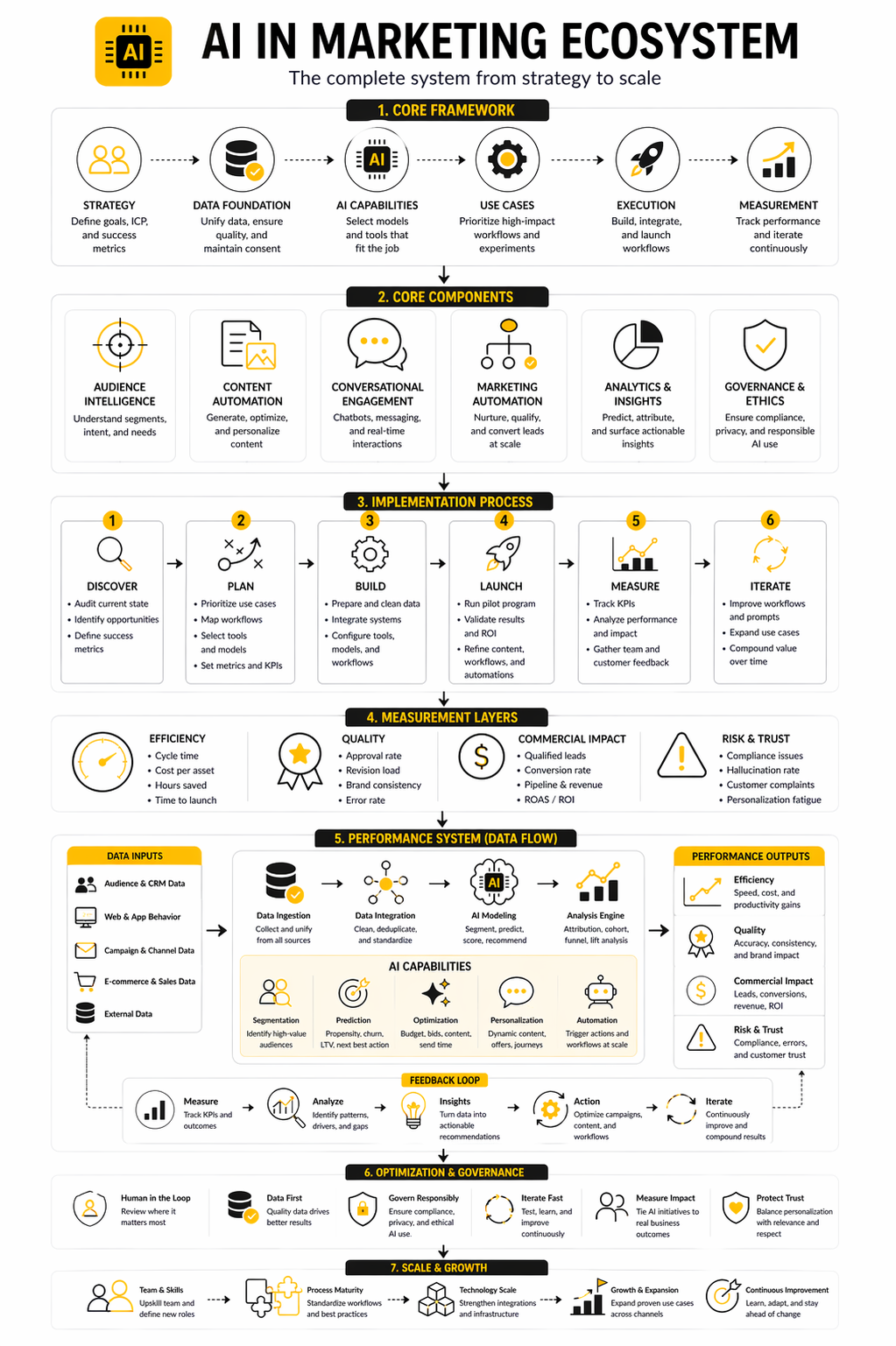
A useful way to think about AI in marketing is as a stack, not a tool. At the top is creative and messaging, where teams use AI to generate drafts, variations, concepts, and summaries. In the middle is orchestration, where AI helps with segmentation, journey design, testing, lead routing, and next-best-action decisions. Under that sits the foundation layer: clean data, governance, brand rules, measurement, and human review.
This framework matters because the market is moving away from isolated pilots and toward integrated systems. BCG found that sales and marketing already account for a meaningful share of realized AI value, while IBM’s research shows the more successful organizations tend to follow a roadmap instead of taking an opportunistic approach. That is the real dividing line now: not who has tried AI, but who has built a repeatable way to use it.
There is one more layer every serious team has to account for, and that is governance. In the EU, the AI Act entered into force on August 1, 2024, with phased obligations already taking effect and full applicability scheduled for August 2, 2026. So professional implementation is no longer just about creativity and efficiency. It is also about documentation, oversight, risk controls, and making sure faster marketing does not become sloppier marketing.
Article Outline
- Why AI In Marketing Matters
- The AI In Marketing Framework
- Core Use Cases That Actually Move Revenue
- Building The Data And Workflow Layer
- How To Implement AI In Marketing Like A Professional
- Risks, Governance, And What Comes Next
Core Use Cases That Actually Move Revenue
The most valuable use cases for AI in marketing are not the flashy ones. They are the ones that help teams make better decisions faster, personalize without exploding headcount, and remove manual work from the path to revenue. That is why the strongest research keeps pointing to a mix of content operations, personalization, media optimization, conversational journeys, and measurement instead of one miracle use case. Bain’s 2025 marketing analysis and McKinsey’s 2025 work on personalization both frame AI as a system for improving how marketing works end to end.
Content Production Becomes A Workflow Problem
Content is usually the first place teams deploy AI because the bottleneck is obvious. Demand is up, channels keep multiplying, and most teams cannot keep pace without sacrificing consistency or burning out the people doing the work. That pressure shows up clearly in Deloitte’s research on content demand, which found demand rose 1.5 times while teams met only 55% of it.
But the real opportunity is not to generate more words. It is to reduce cycle time across briefing, research, variant creation, localization, approvals, and repurposing. Bain reports that early adopters have cut campaign time to market by up to 50% and content creation time by 30% to 50%, which is why AI in marketing works best when it is connected to the production system rather than used as a copy shortcut.
Personalization Starts To Scale For Real
This is where AI in marketing gets commercially serious. Personalization has been a marketing promise for years, but most teams were still running broad segments, generic nurture tracks, and rule-based automations that felt personal only on slides. McKinsey’s January 2025 analysis argues that AI and generative AI are changing that by making it more realistic to tailor experiences across channels and customer moments.
The gap between ambition and execution is still huge, though. Salesforce’s latest State of Marketing says 83% of marketers recognize the shift toward personalized, two-way engagement, but only one in four are satisfied with how they use data to power it. That matters because better personalization is not just a nice customer experience layer anymore. Bain also found that hyper-personalized campaigns have boosted click-through rates by up to 40% in early use cases.
Paid Media Gets More Automated And More Strategic
AI has already reshaped paid media, even if many teams still describe it as campaign management. Bidding, targeting, creative combinations, query expansion, and performance predictions increasingly sit inside platform systems rather than in manual spreadsheets. Google’s 2025 marketing updates make that shift explicit, especially with products designed to expand targeting and creative optimization while keeping advertiser controls in place.
That changes the marketer’s job. Instead of micromanaging every lever, the hard part becomes setting the right inputs: audience signals, creative quality, conversion tracking, exclusions, landing-page alignment, and profit-aware measurement. AI in marketing does not remove media strategy. It punishes weak strategy faster.
Search And Discovery Are Changing Underneath The Funnel
A lot of teams still treat search as a click game, but AI is changing that habit fast. Bain’s work on zero-click behavior found that 80% of consumers rely on zero-click results at least 40% of the time, which means more discovery now happens before a user ever reaches your site. That is a major shift for content strategy, SEO, and brand visibility.
The implication is simple: marketers have to build for answer surfaces, not just page visits. Strong original insights, clean product information, expert-led content, and brand distinctiveness matter more when AI systems summarize the category before a buyer clicks anything. That is one reason HubSpot’s recent marketing reports keep emphasizing brand point of view and differentiation as AI-generated content floods the market.
Conversational Marketing Gets Better When It Is Connected To CRM
One of the most practical uses of AI in marketing is handling early-stage conversations without making the experience feel robotic. This is especially useful for qualification, appointment setting, FAQ handling, lead capture, and handoffs into sales or support. The value is not just speed. It is consistency, always-on responsiveness, and better routing when the system knows the customer context.
That only works when the conversation layer is tied to real workflows. Tools built for conversational journeys, automation, and inbox orchestration can help here, especially when they connect directly to pipeline and follow-up systems like ManyChat, Chatbase, or GoHighLevel. The important point is not the software itself. It is that AI in marketing gets much more valuable once conversations stop living in a silo.
Building The Data And Workflow Layer
This is the part marketers love to skip and regret later. AI looks impressive in demos because the prompts are clean, the data is available, and the outcome is isolated from the mess of real operations. In the real world, performance depends on whether your systems can feed AI reliable context, route outputs into action, and measure what happened afterward.
First-Party Data Is Now The Core Asset
The privacy shift already pushed marketers toward first-party data. AI raises the stakes because weak data now poisons more than reporting. It poisons segmentation, personalization, lead scoring, attribution, and the prompts that guide automated systems. That is why Salesforce’s marketing data showing that 84% of marketers use first-party data and only 31% are fully satisfied with their data unification ability is such a useful reality check.
That gap explains why so many AI projects feel promising but underdeliver. Teams often have enough data to justify the idea, but not enough structure to power reliable execution. AI in marketing becomes far more useful when identity, consent, behavior, transaction data, and CRM records are connected well enough to support action instead of just dashboards.
Unified Data Beats More Data
A lot of marketing teams still have the wrong instinct here. They think the answer is more tools, more dashboards, and more feeds. Usually the answer is cleaner joins, stronger event definitions, better taxonomy, and a shared view of what counts as a lead, an opportunity, or a qualified action.
That is why the unglamorous work matters. Salesforce’s latest report and Twilio’s 2025 customer engagement research both point toward the same operational truth: personalization and AI work better when teams can actually recognize the customer consistently across touchpoints. More data without unification just creates faster confusion.
Workflow Integration Is Where Value Gets Captured
The next big divider is whether AI sits beside the workflow or inside it. If people have to copy and paste briefs, move outputs manually, reformat data, and chase approvals through Slack, the productivity gain gets eaten fast. That is why AI in marketing increasingly needs orchestration across content, CRM, email, forms, scheduling, and reporting instead of one isolated assistant window.
This is where practical stack choices start to matter. A team running email and lifecycle flows may care more about how AI connects to nurture logic and segmentation in Brevo or Moosend than about the model alone. A team focused on social distribution may care more about workflow support in Buffer. The point is not that every team needs more software. The point is that AI creates the most leverage when it is stitched into the steps that already drive revenue.
Governance Has To Be Built Into The Operating Model
Once AI touches audience targeting, messaging, customer records, or decisioning, governance stops being a legal footnote. It becomes a marketing operations issue. The EU AI Act is already rolling in through phased obligations after entering into force on August 1, 2024, with broader applicability coming on August 2, 2026, so teams operating in Europe need clear ownership, review paths, risk policies, and documentation now, not later. The European Commission’s AI Act overview is worth reading closely because this will affect how professional teams deploy AI in marketing.
There is also a brand risk angle that gets overlooked. Gartner’s 2025 personalization findings show that bad personalization can actively damage customer outcomes, not just fail to help them. That is the right warning for this moment. Faster personalization without judgment is not sophisticated marketing. It is automated annoyance at scale.
How To Implement AI In Marketing Like A Professional
Most teams do not fail with AI in marketing because the models are weak. They fail because they jump from excitement to tools without designing the operating system around them. The companies getting real value are doing something much less glamorous: they pick a narrow set of use cases, redesign workflows, assign ownership, train people properly, and build governance into the rollout from day one. McKinsey’s 2025 AI survey and BCG’s 2025 workplace research both point to the same truth: scaling AI is mostly an organizational challenge.
That matters because a lot of AI in marketing still lives in pilot mode. McKinsey’s 2025 workplace report found that almost all companies invest in AI, but only 1% believe they are at maturity. If you want professional implementation, that number should sober you up quickly.
Start With One Painful Workflow, Not A Dozen Cool Ideas
The best starting point is a workflow that is already expensive, repetitive, slow, and measurable. Campaign briefing, creative versioning, paid media reporting, lead qualification, nurture orchestration, and sales handoff are all strong candidates because the before-and-after difference is visible. That is a much better place to start than a vague goal like “use AI for content.”
This is where discipline matters. IBM’s 2025 CMO report makes the case that old marketing operating models are not built for AI-led growth, especially when fragmented systems and unclear ownership get in the way. In practice, that means you should pick one workflow, define where time is wasted, and decide exactly what the AI system is meant to improve.
Define The Outcome Before You Pick The Stack
A professional rollout starts with the business result, not the software demo. Do you want shorter production cycles, better lead qualification, higher conversion rates from nurture, lower cost per qualified lead, or faster response times for inbound prospects? Until that is clear, every tool will look useful and none of them will be accountable.
This sounds obvious, but it is where a lot of teams drift. McKinsey’s 2025 research ties AI value to management practices across strategy, operating model, data, adoption, and scaling rather than tool experimentation alone. The implementation lesson is simple: decide what winning looks like before you decide what to buy or build.
Build The Minimum Viable AI Workflow
Once the outcome is defined, the next step is to design the smallest working version of the process. That usually means mapping the trigger, the data inputs, the AI task, the human review point, the destination system, and the measurement loop. If any of those pieces are missing, AI in marketing tends to become a smart-looking detour instead of a system.
A minimum viable workflow keeps the rollout honest because it reveals the real bottlenecks fast. Sometimes the model is not the issue at all. Sometimes the actual blocker is missing CRM fields, inconsistent naming conventions, broken attribution, or a review chain that kills speed. Google Cloud’s 2025 DORA AI capabilities report makes a related point at the organizational level: internal platforms and system design are what turn isolated productivity gains into broader operational improvement.
A Practical Implementation Process
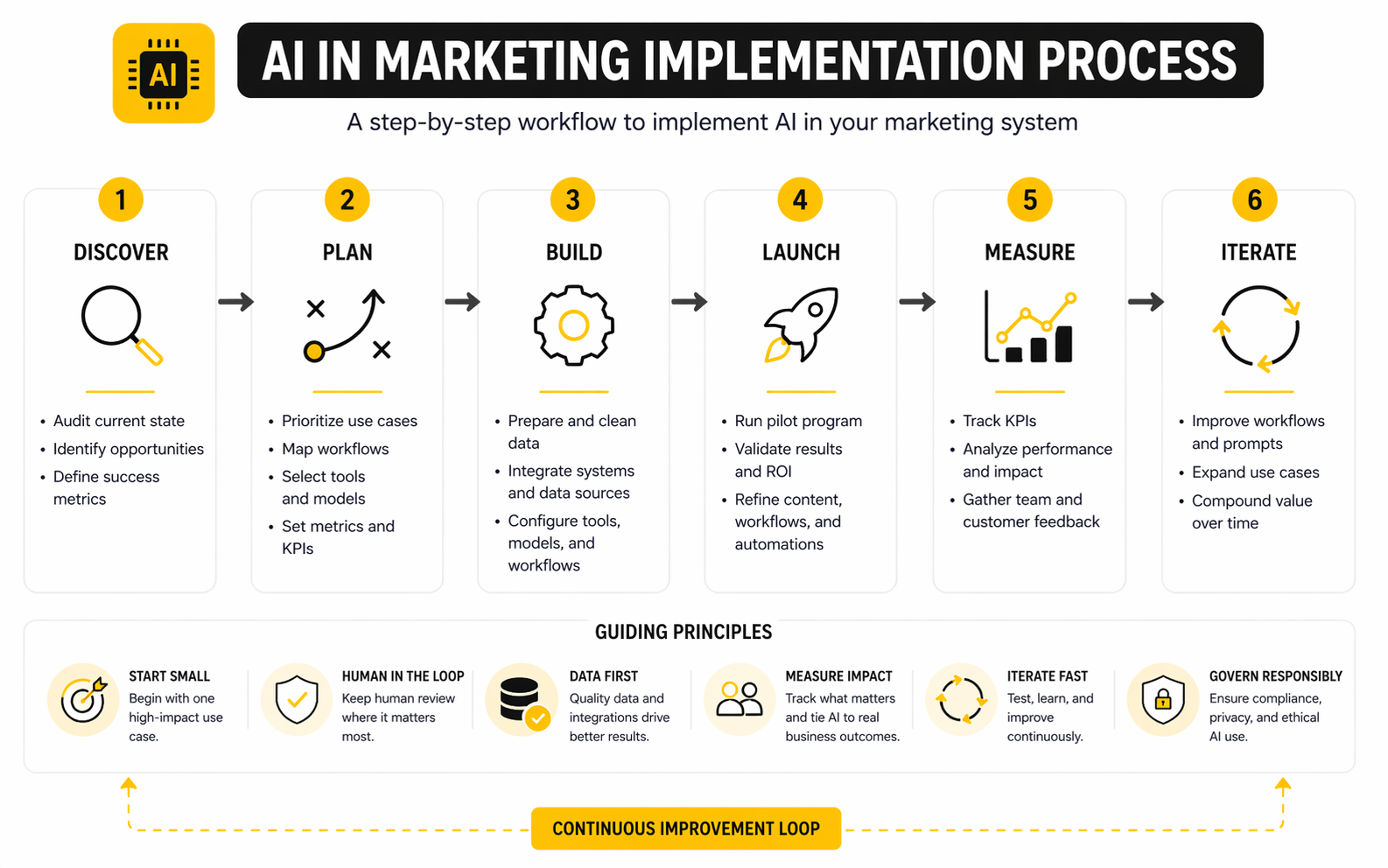
If you want AI in marketing to work in the real world, the rollout needs structure. Not bloated structure. Just enough structure so the team knows what is changing, why it matters, and how performance will be judged.
- Choose one workflow with a visible cost in time, conversion, or quality.
- Define the target metric and baseline before implementation.
- Audit the data sources, handoffs, and approval points involved.
- Decide where AI generates, recommends, routes, summarizes, or scores.
- Add human review where brand, compliance, or revenue risk is highest.
- Push outputs directly into the operating system, whether that is CRM, email, ad ops, or reporting.
- Run a controlled pilot long enough to compare against the old process.
- Document what changed, what broke, and what improved before scaling.
This kind of sequence sounds basic, but it is exactly what keeps implementation from turning into chaos. BCG’s 2025 research stresses workflow reshaping and training as central to value creation, not as side tasks. That lines up with what strong operators already know: AI performs better when the process around it is designed deliberately.
Put Humans At The Right Review Points
There is a bad version of human-in-the-loop and a good version. The bad version is when every output needs approval from everyone, which destroys the speed you were trying to create. The good version is when review happens at the points of highest brand, legal, financial, or customer-risk impact.
That distinction matters more as teams automate more of the marketing chain. Messaging claims, pricing language, regulated offers, sensitive segmentation, and lead-routing logic all deserve tighter review than a first-draft subject line or campaign summary. The European Commission’s AI Act overview is a reminder that governance is becoming operational, not theoretical, especially for organizations working across the EU.
Train The Team On Workflows, Not Just Prompts
A lot of AI training is still too shallow. Teams get a prompt workshop, a few examples, and maybe a new tool license, then leadership wonders why adoption stalls. That misses the deeper change, which is that AI in marketing reshapes how work moves through the team, not just how a sentence gets written.
The stronger research keeps pushing in the same direction. BCG’s 2025 workplace report argues for real investment in people, upskilling, and workflow redesign, while McKinsey’s 2025 workplace study says the biggest barrier is often leadership speed, not employee willingness. Professional implementation means teaching the team how to judge outputs, escalate edge cases, and use AI inside the actual job.
Use Tools That Reduce Friction Across The Workflow
This is where the stack finally becomes relevant. Once you know the workflow, it becomes easier to choose tools that remove friction rather than add more tabs. For example, if your implementation depends on conversational lead capture, follow-up, and pipeline movement, a setup built around ManyChat or GoHighLevel can make sense because the AI layer is tied to automation and follow-through, not just chat.
If the bottleneck is landing page iteration and ecommerce experimentation, a workflow centered on rapid page updates may fit better with Replo. If the issue is lifecycle messaging and campaign delivery, implementation may be more practical inside Brevo, Moosend, or Buffer. The real question is never “Which AI tool is best?” It is “Which tool fits the workflow we are redesigning?”
Measure The Pilot Like You Actually Want To Learn Something
A professional rollout needs a real baseline. That means measuring the old workflow before replacing it, then tracking the new one against speed, cost, conversion, error rate, and team effort. Without that comparison, AI in marketing becomes another internal belief system where everyone has opinions and nobody has proof.
This is also where teams discover whether the gain is genuine or cosmetic. Faster output is not impressive if quality drops or if the team quietly adds manual cleanup behind the scenes. McKinsey’s 2025 AI survey emphasizes bottom-line impact and workflow redesign for a reason: value does not come from activity, it comes from measurable improvement.
Scale Only After The Process Survives Contact With Reality
The temptation after a decent pilot is to roll AI everywhere. That is usually too early. The better move is to pressure-test the workflow first: see where the prompts drift, where approvals slow down, where source data breaks, where handoffs fail, and where the team starts working around the system.
That patience is not caution for its own sake. It is how you keep implementation from collapsing under its own ambition. AI in marketing scales best after the team has evidence, playbooks, ownership, and a version of the process that can survive normal business messiness rather than only clean demo conditions.
The Numbers Behind AI In Marketing
A lot of articles throw around AI statistics as if volume alone proves the case. It does not. The useful question is which numbers actually change how a marketing team should operate. The strongest benchmarks right now point to three things at once: adoption is broad, realized value is uneven, and the gap between experimentation and disciplined execution is still massive. McKinsey’s 2025 global survey and Salesforce’s latest State of Marketing research both support that pattern.
That is why raw adoption numbers are not enough on their own. A team can say it is “using AI” because people prompt a chatbot a few times a week. That tells you almost nothing about performance. The more meaningful signal is whether AI has been tied to a workflow, a metric, and an accountable owner.
Adoption Is High, Maturity Is Not
The headline number most people reach for is usage, and yes, it is high. McKinsey’s 2025 survey says almost all respondents report some organizational AI use, but the same research makes clear that scaled impact remains a work in progress. That matters because it separates market noise from operational reality.
For marketers, the practical read is simple. AI in marketing is no longer optional in the sense of awareness or access, but it is still very optional in terms of real maturity. If you are early, that is normal. If you are still treating AI as an unstructured side habit, that is the part that needs to change.
Performance Gains Show Up First In Speed And Throughput
The cleanest gains are still in efficiency. Bain’s marketing analysis reports campaign time to market reduced by up to 50% and content creation time down by 30% to 50% in early deployments. Those are strong numbers, but they need to be interpreted correctly.
Speed is valuable only when it compounds into better market coverage, more testing, or lower operating cost. If faster production just creates more average content, the number looks good on an internal slide and weak in the market. The action this should drive is not “publish more.” It should drive tighter testing cycles, more responsive campaign operations, and more room for senior marketers to spend time on positioning and decision-making.
Personalization Metrics Can Be Impressive And Still Dangerous
This is where marketers need judgment. Bain’s research says hyper-personalized campaigns have boosted click-through rates by up to 40%, which is exactly the sort of stat that gets leadership excited. Fair enough. Better relevance should improve response.
But response metrics are not the whole story. Gartner’s 2025 personalization survey found that 53% of customers reported negative experiences from personalized marketing and were 3.2 times more likely to regret a purchase in key journey moments. That is the warning label. AI in marketing can lift surface-level engagement while quietly damaging trust if personalization becomes invasive, manipulative, or simply too aggressive.
Data Readiness Is Still A Major Constraint
A lot of teams talk about AI as if the main constraint is model quality. For marketing, that is usually wrong. The bigger issue is whether the business can unify enough customer data to support personalization, journey orchestration, and measurement. Salesforce’s current marketing report says only a minority of marketers are fully satisfied with how they use data to power personalization, even as nearly all of them know customer expectations have changed.
This matters because weak data does not just reduce performance. It distorts decision-making. If your event tracking is broken, your CRM fields are inconsistent, or your attribution logic is shaky, AI will not solve that. It will scale the confusion faster. The action here is boring but important: fix identity resolution, event definitions, naming conventions, and consent handling before expecting AI in marketing to perform like magic.
Zero-Click Discovery Changes What Success Looks Like
One of the most important data shifts in marketing is not a classic conversion metric at all. Bain’s zero-click search analysis found that 80% of consumers rely on zero-click results at least 40% of the time. That means a growing share of discovery and evaluation now happens without a website visit.
That should change how marketers read their dashboards. Traffic alone is becoming a weaker proxy for influence. Strong brands may shape demand, educate buyers, and win consideration before analytics platforms can attribute the moment cleanly. The right action is to combine direct response metrics with broader signals like branded search trends, assisted conversions, share of search, owned audience growth, and sales feedback about category awareness.
Consumer Trust Is Still The Bottleneck For AI-Led Commerce
There is another benchmark that matters more than the hype cycle suggests. Bain’s 2025 research on agentic AI commerce found that 72% of consumers said they had used AI tools, but only 10% had used AI to make a purchase and just 24% felt comfortable letting AI complete purchases for them. That gap tells you where the ceiling is right now.
For marketers, this means AI in marketing can absolutely improve discovery, recommendations, service, and qualification, but trust still limits how far customers want automation to go. The action is to use AI where it reduces friction and improves relevance, not where it strips away control too early. Customers will tolerate helpful assistance much sooner than they will tolerate automated purchasing decisions made on their behalf.
What A Good Measurement System Actually Tracks
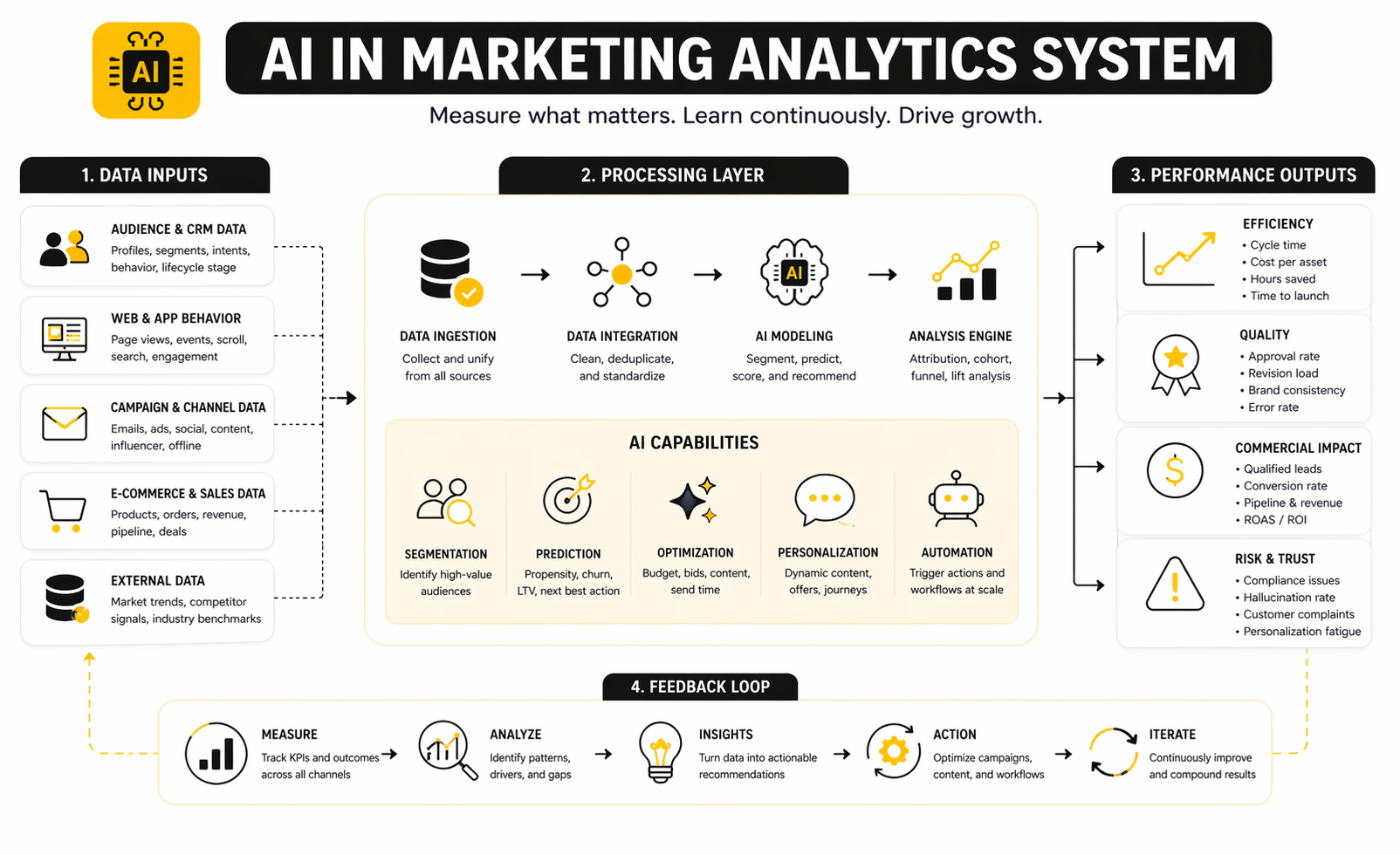
If you want a serious analytics setup for AI in marketing, stop measuring only outputs. Outputs are the easiest numbers to collect and the easiest to misread. A better system tracks four layers: efficiency, quality, commercial impact, and risk.
- Efficiency measures cycle time, cost per asset, turnaround speed, time to launch, and analyst or manager hours saved.
- Quality measures approval rate, revision load, brand consistency, error rate, and engagement quality rather than raw volume.
- Commercial impact measures qualified leads, conversion rate, pipeline influence, retention, revenue per campaign, and return on ad spend.
- Risk measures hallucination rates, compliance issues, customer complaints, personalization fatigue, and escalation frequency.
This kind of measurement matters because AI in marketing often creates a fake win in one layer while hurting another. A team might cut production time dramatically while increasing legal review burden. It might raise click-through rate while reducing downstream conversion quality. If you do not track the full system, you can easily optimize the wrong thing.
Benchmarks Need Context Or They Become Useless
Marketers love benchmark numbers because they create certainty. The problem is that AI benchmarks vary wildly by channel, maturity, category, creative quality, and data readiness. A 30% gain in one workflow may be ordinary in another and impossible in a third. That is why smart teams use outside research to set expectations, then compare against their own baseline rather than chasing industry averages blindly.
This is especially important with broad productivity estimates. McKinsey’s earlier economic analysis of generative AI estimated that generative AI could raise productivity in marketing by 5% to 15% of total marketing spend. That is a helpful directional benchmark, but it is not a promise for every team. The action it should drive is a focused pilot with clear before-and-after measurement, not a blanket assumption that every marketing function will suddenly become 15% more efficient.
The Best Signal Is Still Workflow-Level Improvement
The strongest teams measure AI where work actually happens. They do not ask whether “AI is working” in the abstract. They ask whether campaign launch cycles are shorter, whether qualified lead handling is faster, whether nurture paths are converting better, whether creative testing is happening more often, and whether managers trust the outputs enough to use them consistently.
That mindset is what keeps measurement grounded. McKinsey’s 2025 survey links higher AI value to concrete management practices around strategy, data, operating model, and adoption. In plain English, the metrics that matter most are the ones tied to redesigned workflows, not vanity counts of prompts, generated assets, or tool logins.
What The Data Should Push You To Do Next
Taken together, the data says something very practical. AI in marketing is already useful, especially for speed, personalization, and workflow support, but the advantage does not come from generic adoption. It comes from disciplined implementation, clean data, and better measurement. That is the difference between a team that looks busy with AI and a team that is quietly building an edge.
So the right move is not to collect more random stats. It is to choose a handful of numbers that force honest decisions. Measure where time is saved, where quality rises or falls, where revenue actually moves, and where customer trust starts to wobble. Those are the numbers that deserve attention because those are the ones that tell you whether AI is making your marketing sharper or just louder.
Risks, Governance, And What Comes Next
By the time a team reaches the scaling stage, AI in marketing stops being mainly a productivity story. It becomes a strategy story. The hard questions are no longer about whether AI can draft faster or personalize better. They are about where to trust automation, where to keep human judgment, how to protect brand equity, and how to scale without quietly breaking customer trust or internal accountability.
That shift is important because the market is moving from experimentation to structure. McKinsey’s 2025 State of AI survey shows that organizations creating more value are redesigning workflows and assigning stronger governance roles, not just expanding access. In plain English, AI in marketing gets riskier and more valuable at the same time.
The Biggest Strategic Tradeoff Is Speed Versus Brand Quality
AI makes it dangerously easy to increase output before improving judgment. That sounds efficient until every campaign starts sounding like the same polished, generic machine language. This is one of the central tradeoffs in AI in marketing: speed creates leverage, but it can also flatten the very distinctiveness that makes marketing work.
That is not just a creative complaint. It is a commercial one. In a market where more teams can publish more content faster, brand taste, editorial standards, and positioning become more important, not less. The winning teams will not be the ones that automate everything. They will be the ones that automate the repetitive layer while protecting the voice, angles, and ideas that actually make people care.
Over-Personalization Is A Real Risk, Not A Theoretical One
A lot of marketers still talk about personalization as an automatic good. The data says otherwise. Gartner’s 2025 survey found that 53% of customers had negative experiences with personalization and were 44% less likely to purchase again after regret-heavy moments.
That should change how advanced teams think about AI in marketing. The goal is not maximum personalization. It is effective personalization with restraint. There is a real difference between relevance and surveillance, and customers can feel it immediately even if the dashboard shows a temporary lift.
Agent Hype Is Racing Ahead Of Operational Reality
The next wave of marketing discussion is all about AI agents. Some of that is justified because agentic systems could eventually handle more complex orchestration, research, routing, and execution. But there is a lot of noise mixed in with the signal right now.
The caution flags are already visible. Bain’s 2025 work on agentic commerce shows consumer comfort is still limited, and Reuters’ June 2025 reporting on Gartner forecasts said Gartner expected more than 40% of agentic AI projects to be scrapped by 2027 because of rising costs and unclear business value. That does not mean agents are fake. It means advanced teams should be selective, not hypnotized by the label.
Scaling Fails When Adoption Stalls Below Leadership
One of the more uncomfortable truths in AI rollout is that usage is not evenly distributed inside organizations. Leaders and managers often adopt earlier, while frontline teams hit friction faster because they live in the messiest workflows. BCG’s 2025 AI at Work research highlighted this gap by showing that frontline adoption lagged behind leadership enthusiasm.
That matters a lot for AI in marketing because execution lives with specialists, coordinators, analysts, campaign managers, media buyers, lifecycle operators, and CRM teams. If those people are unconvinced, underskilled, or forced into clumsy systems, scaling slows down fast. Serious adoption depends less on executive excitement and more on whether the tool and process actually help the people doing the work.
Governance Needs An Owner, Not Just A Policy Document
A lot of companies still handle AI governance like a legal appendix. That is not enough. In marketing, governance has to live inside operating routines because the risks show up in segmentation, messaging claims, creative generation, audience targeting, consent handling, and automated decision logic.
This is where structure matters. The European Commission’s AI Act overview makes it clear that AI oversight in Europe is becoming more formal and more consequential over time. For marketers, the practical implication is straightforward: somebody has to own model use rules, review thresholds, escalation paths, vendor standards, and documentation. If that ownership is vague, problems will surface exactly where speed is highest.
Your Data Advantage Can Turn Into A Liability Fast
The more advanced your AI setup becomes, the more your customer data becomes both an asset and a point of vulnerability. Rich first-party data can make AI in marketing more relevant, more efficient, and more commercially useful. It can also increase the blast radius of mistakes if consent logic is weak, access controls are sloppy, or sensitive patterns are exposed to the wrong systems.
That is why mature teams treat data discipline as a growth function, not just a security or compliance function. Good governance is what allows more ambitious personalization and orchestration to happen without crossing lines the company later regrets. The better your system gets, the less you can afford casual data practices.
Vendor Dependence Is Becoming A Strategic Question
Another advanced issue is dependency. The more marketing operations get woven into AI layers inside major platforms, the more teams risk becoming dependent on black-box optimization they cannot fully inspect. That does not mean you should avoid those platforms. It means you need to think clearly about where you want convenience and where you need control.
This tradeoff shows up everywhere. A tightly integrated stack may help a team move faster with conversational automation in GoHighLevel, lead capture in ManyChat, or lifecycle orchestration in Brevo. But speed from integration should be weighed against portability, reporting transparency, and how much strategic logic the company wants to outsource. That is an executive decision, not just a tooling decision.
The Smart Play Is To Build A Human-AI Operating Model
This is the part many people resist because it sounds less dramatic than full automation. But it is the strongest long-term move. The future of AI in marketing is not humans versus machines. It is a human-AI operating model where AI handles pattern-heavy, repetitive, and scalable tasks while humans own prioritization, positioning, ethics, exceptions, and brand-defining judgment.
That view is increasingly supported by the broader research. McKinsey’s work on AI in the workplace argues that organizations create more value when they redesign work rather than simply layering tools on top of old habits. For marketing teams, that means job design, approval design, training, and decision rights matter just as much as prompts or model choice.
What Advanced Teams Will Do Differently
The gap between average adoption and real advantage is starting to widen. Advanced teams will not just use AI more often. They will use it more deliberately. They will know which workflows deserve automation, which customer moments need restraint, which metrics prove value, and which brand decisions must stay unmistakably human.
That is the real strategic edge. AI in marketing will reward teams that can combine speed with taste, automation with governance, and personalization with judgment. Everyone else will be tempted to produce more, automate more, and optimize more without noticing they are making the brand less memorable and the customer experience less trustworthy. That is the trap. And it is one worth avoiding before scale turns it into a very expensive one.
FAQ
What is AI in marketing in plain English?
AI in marketing is the use of machine learning and generative systems to help marketers research audiences, create assets, personalize experiences, automate workflows, and improve decisions. The reason this matters now is that adoption is no longer fringe. McKinsey’s 2025 State of AI research shows AI use is widespread, but the real value still depends on workflow redesign, governance, and adoption discipline rather than access alone.
Is AI in marketing mostly about content generation?
No, and that is one of the biggest misunderstandings in the category. Content generation is the easiest entry point, but the larger upside usually comes from speeding up campaign operations, improving personalization, supporting sales handoffs, and tightening measurement loops. That is exactly why McKinsey’s recent work on marketing workflows with agentic AI focuses on rebuilding workflows, not just producing more copy.
Which marketing teams benefit the most from AI first?
The teams that benefit earliest usually have clear bottlenecks, structured data, and repeatable workflows. Lifecycle marketing, paid media, content operations, CRM, and inbound lead handling are often strong starting points because improvements show up in speed, consistency, and conversion follow-through. That lines up with Salesforce’s marketing research based on nearly 5,000 marketers, which keeps pointing back to data, personalization, and implementation as the real leverage points.
How should a company start using AI in marketing without making a mess?
Start with one painful workflow that is expensive, repetitive, and easy to measure. Then define the baseline, map the handoffs, decide where AI helps, and keep human review at the highest-risk points. That approach sounds less exciting than a full rollout, but it matches what McKinsey’s 2025 AI survey found about the companies creating more value: they are redesigning workflows and formalizing practices rather than improvising.
What are the best use cases for AI in marketing right now?
The strongest use cases right now include creative versioning, audience research, lifecycle messaging, conversational lead capture, paid media assistance, search visibility analysis, and reporting summaries. The common thread is simple: AI works best where there is pattern-heavy work, frequent repetition, and enough data to inform better decisions. For teams building conversational funnels or lead automation, tools like ManyChat, Chatbase, and GoHighLevel can make sense when they are tied to real follow-up workflows rather than used as isolated chat tools.
Can AI actually improve marketing performance, or does it just save time?
It can do both, but only when the time savings turn into better execution. Bain’s marketing analysis reports faster time to market and meaningful reductions in content production time, while its search research shows AI-driven discovery is changing how customers find brands in the first place. The practical takeaway is that AI should not just make output faster. It should make testing, personalization, and market responsiveness better.
How does AI change SEO and content strategy?
AI is changing search from a click-first environment to an answer-first environment. Bain’s zero-click search research found that 80% of consumers rely on zero-click results in at least 40% of their searches, and organic traffic can drop when AI summaries satisfy intent before the visit. That means SEO is no longer only about getting the click. It is also about becoming the source that shapes the answer.
Does AI in marketing make personalization better or creepier?
It can do either, and that depends on restraint. Better personalization can improve relevance and timing, but bad personalization can feel invasive, manipulative, or strangely overfamiliar. Gartner’s June 2025 survey found that 53% of customers reported negative experiences from personalization, which should tell marketers something important: more personalization is not automatically smarter personalization.
What data does a company need before scaling AI in marketing?
You do not need perfect data, but you do need usable data. That usually means clean CRM fields, reliable event tracking, consent handling, identity logic, and enough structure to connect behavior with action. Salesforce’s current marketing statistics show that 84% of marketers use first-party data, yet only 31% are fully satisfied with their data unification ability, which explains why so many AI rollouts stall after the demo stage.
How should marketers measure AI success?
Measure four layers: efficiency, quality, commercial impact, and risk. Efficiency tells you whether the workflow got faster. Quality tells you whether the work stayed usable. Commercial impact tells you whether pipeline, conversion, retention, or revenue improved. Risk tells you whether trust, compliance, or brand consistency got worse. That system is much more useful than counting prompts or generated assets, and it fits the workflow-centered lens in McKinsey’s 2025 AI research.
Will AI replace marketers?
Not in the simplistic way people keep predicting. What AI is much more likely to do is reallocate work, automate repetitive tasks, and raise the standard for strategic thinking, editorial judgment, experimentation, and systems design. The marketers who stay valuable will be the ones who can combine automation with taste, business judgment, and customer understanding. That direction is consistent with McKinsey’s workplace research on AI, which argues for redesigning work around human-AI collaboration.
Are AI agents ready to run marketing end to end?
Not in most organizations, and definitely not without supervision. There is real potential in agentic workflows, especially in research, orchestration, and repetitive execution, but the practical results are still uneven. McKinsey’s recent article on agentic AI in marketing workflows is optimistic about the opportunity, while Reuters’ coverage of Gartner’s 2025 forecast is a useful counterweight because it highlights how many agentic AI projects may be abandoned due to cost and weak business value.
What tools fit an AI in marketing stack best?
The answer depends on the workflow, not the category label. If you need conversational funnels and automated follow-up, ManyChat or GoHighLevel may be a better fit than a generic assistant. If you need landing-page iteration, Replo can be more useful. If lifecycle email and CRM automation matter more, Brevo, Moosend, or Buffer may fit better. The key is to design around the process first.
What is the biggest mistake companies make with AI in marketing?
They confuse activity with progress. A team starts using AI prompts, buys a few tools, maybe even publishes more content, and then assumes it has become “AI-powered.” In reality, the biggest gains come from workflow redesign, data discipline, training, and governance. The biggest mistake is skipping those foundations because the tools feel exciting enough on their own.
What should marketers do next if they want to stay ahead?
Do three things. First, pick one workflow and improve it with measurable discipline. Second, protect brand quality and customer trust while you automate. Third, build skills that are hard to commoditize: positioning, synthesis, experimentation, systems thinking, and decision-making. AI in marketing will reward marketers who can operate both the machine layer and the human layer.
Work With Professionals
Explore 10K+ Remote Marketing Contracts on MarkeWork.com
Most marketers spend too much time chasing clients, competing on crowded platforms, and losing a percentage of every project to middlemen. MarkeWork gives you a better way. Browse thousands of remote marketing contracts and connect directly with companies desperate to hire skilled marketers like you, without platform commissions and without unnecessary gatekeepers.
If you're serious about finding better opportunities and keeping 100% of what you earn, explore available contracts and create a profile for free at MarkeWork.com.