

Amazon AMS is the old name many sellers still use for what is now Amazon Ads. The platform has changed a lot since the Amazon Marketing Services days, but the core job is the same: get your products in front of shoppers while they are already searching, comparing, and buying.
That matters because Amazon is no longer just a marketplace. It is a major advertising channel, with Amazon reporting that its advertising services generated $56.2 billion in 2024. For sellers, that means Amazon AMS is not something to “test later.” It is part of how visibility, ranking, launches, and profit now work on Amazon.
Article Outline
- Why Amazon AMS Still Matters
- The Amazon AMS Framework
- Core Amazon Ad Types
- Campaign Structure And Targeting
- Budgeting, Bidding, And Measurement
- Professional Implementation And Optimization
- Common Amazon AMS Mistakes
- Amazon AMS FAQ
Why Amazon AMS Still Matters
Amazon AMS matters because it reaches shoppers at a very different moment than most ad platforms. On social media, you often interrupt people while they are scrolling. On Amazon, you reach people while they are actively comparing products, reading reviews, and deciding what to buy.
That purchase intent changes everything. Sponsored Products, Sponsored Brands, and Sponsored Display can support discovery, comparison, retargeting, and conversion inside one buying environment. Amazon’s own Sponsored Brands documentation notes placements across shopping results, product detail pages, and the Amazon homepage, which gives brands multiple ways to influence the path to purchase through Amazon Ads.
The mistake is treating Amazon AMS like a simple traffic switch. More spend does not automatically mean more profit. The brands that win usually connect advertising with listing quality, keyword strategy, inventory, pricing, reviews, and margin.
The Amazon AMS Framework
A useful Amazon AMS strategy starts with one question: what job should this campaign do? Some campaigns should protect your branded search terms. Others should find new keyword opportunities, launch a product, defend a product detail page, or scale a proven bestseller.
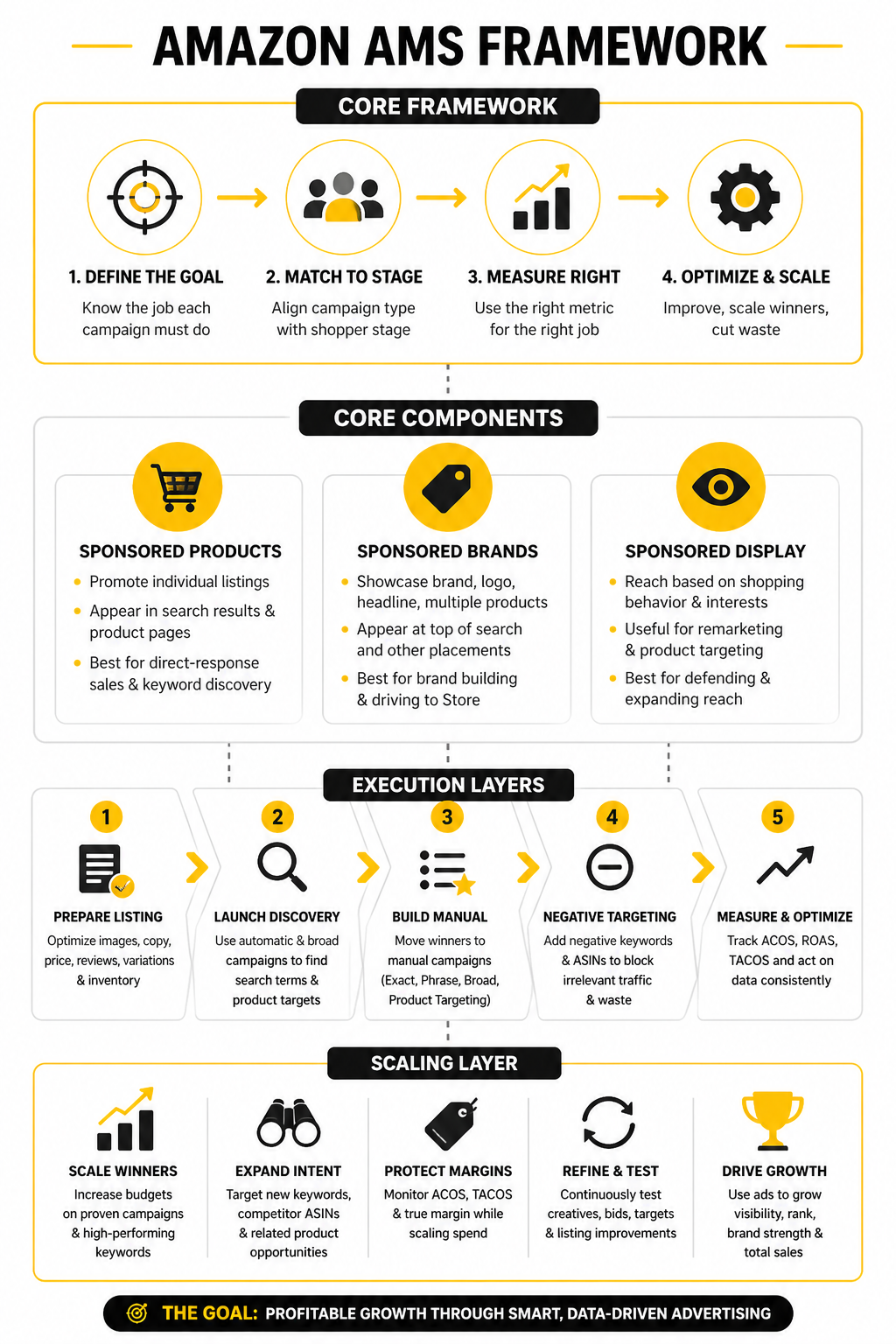
The framework is simple: match the campaign type to the shopper’s stage, then measure it with the right metric. A launch campaign may tolerate a higher ACOS for a short period, while a mature profit campaign needs tighter controls. Amazon defines ACOS as ad spend divided by ad-attributed sales, and the platform also frames ROAS as the inverse metric, which is useful when comparing Amazon performance with other channels like Meta or Google through Amazon Ads support.
The practical point is this: do not judge every campaign by the same number. A branded defense campaign, a category conquesting campaign, and a Sponsored Brands video campaign are not doing the same job. When you force them into one benchmark, you usually cut the campaigns that create future growth and overfund the campaigns that only harvest existing demand.
Core Amazon Ad Types
The next step is understanding what each Amazon AMS ad type is actually for. This is where a lot of sellers get sloppy. They create campaigns because the button is available, not because the ad format matches the product, the funnel stage, or the business goal.
Sponsored Products are usually the workhorse. They promote individual listings and can appear in shopping results and on product detail pages, which makes them useful for direct-response sales, keyword discovery, ranking support, and product-level scaling. Amazon’s targeting documentation explains that Sponsored Products can use automatic targeting, where Amazon matches ads to relevant keywords and products, or manual targeting, where you choose the keywords or products yourself through Amazon Ads.
Sponsored Brands are more brand-led. They can feature a logo, headline, creative, video, or multiple products, and Amazon describes them as ads that can appear at the top of, alongside, or within shopping results through Sponsored Brands. Use them when you want to build brand recognition, move shoppers into a Store, promote a product family, or give a hero product more visual weight than a standard product ad can provide.
Sponsored Display is different again. It is useful when you want to reach shoppers based on shopping behavior, product interest, or remarketing logic instead of only search keywords. That makes it especially relevant for defending product pages, re-engaging shoppers who viewed but did not buy, and staying visible around competitor or complementary products.
Sponsored Products
Sponsored Products should usually be the first Amazon AMS campaign type you learn properly. They are close to the purchase decision, relatively easy to test, and tightly connected to search terms that reveal real shopper intent. When you want to know how customers actually describe the problem your product solves, Sponsored Products data is one of the best places to look.
Automatic campaigns are useful for discovery because Amazon uses your listing and related shopping signals to match your product with relevant searches and products. Manual campaigns are useful for control because you can choose specific keywords or product targets and set more deliberate bids. Amazon’s own targeting guide notes that automatic campaign search term reports can help identify the best keywords or products to move into manual targeting through Sponsored Products targeting.
A clean setup usually separates discovery from scaling. Automatic campaigns find search terms, broad or phrase campaigns test opportunity, and exact match campaigns push the proven terms harder. That structure keeps your Amazon AMS account easier to read, easier to optimize, and much less likely to waste budget blindly.
Sponsored Brands
Sponsored Brands are not just “bigger ads.” They are a different strategic tool. A Sponsored Brands campaign can introduce your brand before the shopper has committed to a specific product, which makes it useful when you have a credible product range, a strong brand angle, or a Store that helps people compare options.
The creative matters here more than many sellers expect. A weak headline, generic image, or random product selection can make the campaign look expensive even when the targeting is fine. Amazon highlights that Sponsored Brands can use custom creative and send shoppers to a Store, a product detail page, or a landing page experience through its Sponsored Brands guide.
Use Sponsored Brands when the brand itself helps the sale. That could mean a specialist range, a premium positioning, a clear use case, or a product set where one click can expose the shopper to multiple buying options. If your listings are disconnected and your Store is thin, fix that before expecting Sponsored Brands to carry the account.
Sponsored Display
Sponsored Display is where Amazon AMS starts to move beyond simple keyword advertising. Instead of only chasing search terms, you can reach shoppers through product targeting, audience-style logic, and remarketing-style placements. That gives you more ways to influence shoppers who are comparing alternatives or who have shown interest but have not purchased yet.
This matters because not every buying journey ends on the first click. A shopper may view your product, compare reviews, check a competitor, leave Amazon, and return later. Sponsored Display can help you stay present during that messy middle without relying only on search-result visibility.
The risk is using it too early or too broadly. Sponsored Display works best when your product page is already competitive, your price makes sense, and your reviews do not create obvious friction. If the listing cannot convert warm shoppers, adding more reach just gives you a more expensive version of the same problem.
Campaign Structure And Targeting
Good Amazon AMS implementation starts before you touch bids. The first job is to decide what each campaign is responsible for, because messy structure creates messy decisions. When discovery, branded defense, competitor targeting, and scaling all sit inside the same campaign, you cannot tell what is actually working.
A practical structure separates campaigns by intent. Keep branded keywords away from non-branded keywords, keep automatic discovery separate from manual scaling, and keep product targeting separate from keyword targeting. This makes budget control cleaner, reporting more useful, and optimization less emotional.
Amazon’s targeting options support this kind of structure because Sponsored Products can use automatic targeting, where Amazon matches ads to relevant products and keywords, or manual targeting, where you choose the keywords or products yourself through Amazon Ads. That flexibility is powerful, but only if you use it deliberately. The goal is not to create more campaigns for the sake of complexity; the goal is to make each campaign easy to understand and improve.
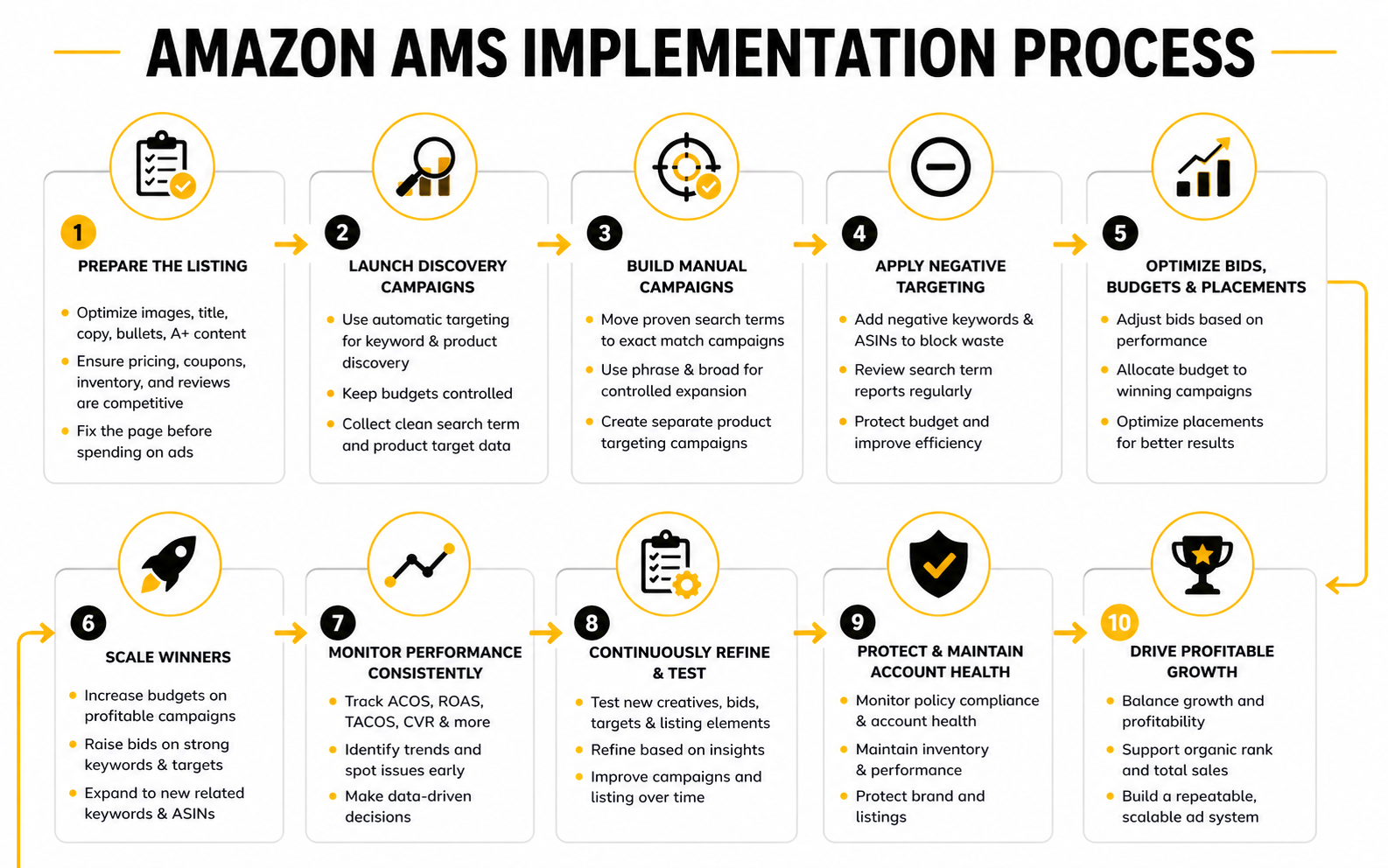
The Amazon AMS Implementation Process
Once the structure is clear, the process becomes much more tangible. You are not “running ads.” You are building a controlled system for testing, harvesting, scaling, and cutting waste.
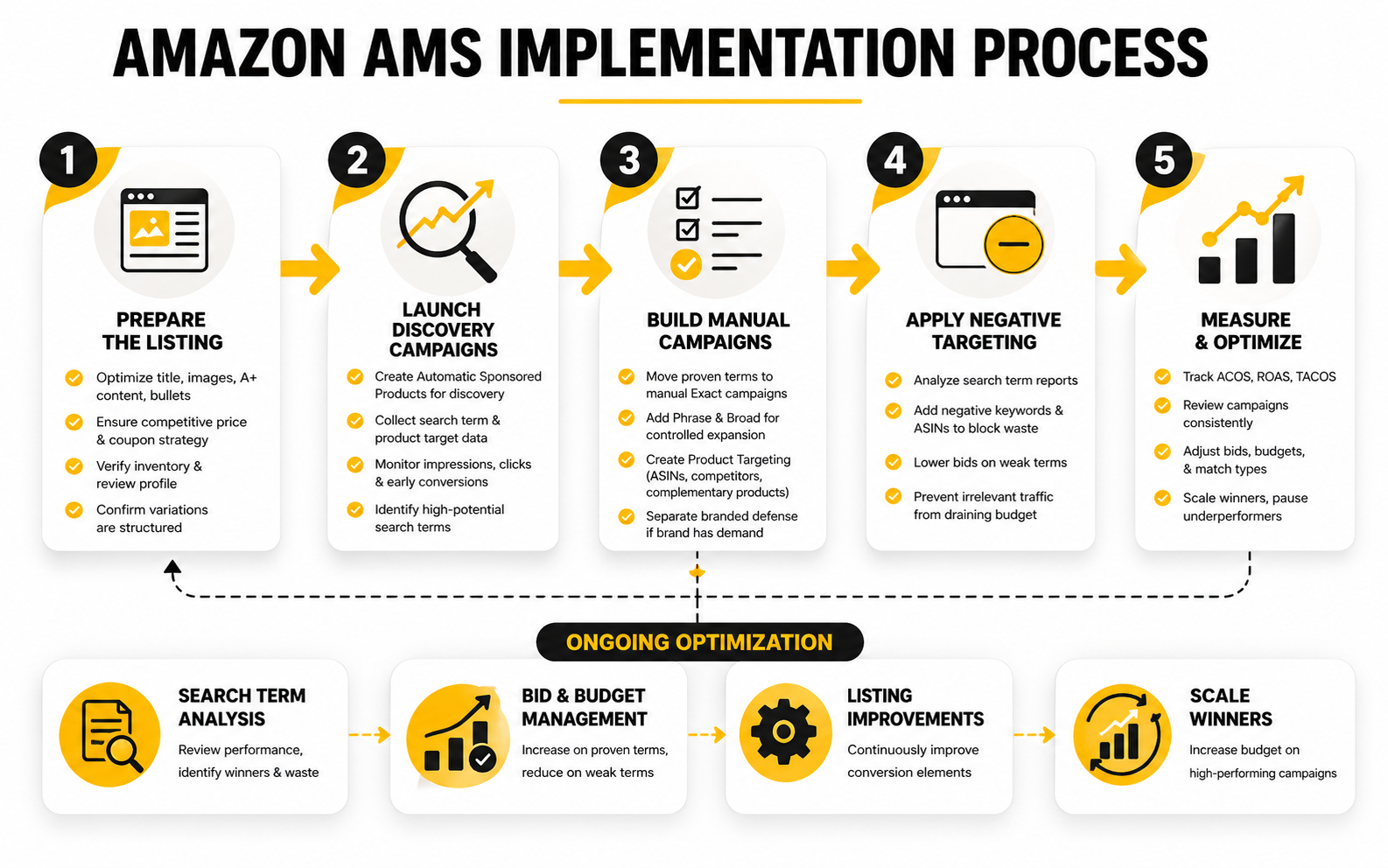
Start with the product. If the listing has weak images, vague copy, poor reviews, missing variations, or an uncompetitive offer, Amazon AMS will expose the problem faster. Paid traffic cannot rescue a product page that shoppers do not trust.
Then build the campaign map. A simple starting point can include one automatic Sponsored Products campaign for discovery, one manual exact campaign for proven keywords, one manual phrase or broad campaign for controlled expansion, one product targeting campaign for ASIN-level testing, and one branded defense campaign if your brand has search demand. That gives you enough structure to learn without turning the account into a maze.
Step 1: Prepare The Listing Before Launch
The listing is the conversion engine. Amazon AMS sends attention to the page, but the page still has to earn the sale. Before spending seriously, check the title, main image, secondary images, A+ Content if available, bullet clarity, price, coupon strategy, inventory, and review profile.
This is not cosmetic work. A better listing can make the same click worth more because more shoppers convert after landing on the page. That means your ads can afford higher bids, survive more competitive auctions, and still hit a reasonable ACOS.
Do not skip this step because you are eager to launch. The fastest way to waste budget is to send paid traffic into a listing that has obvious objections. Fix the page first, then let the campaigns reveal where demand is strongest.
Step 2: Launch Discovery Campaigns
Discovery campaigns help you find search terms and product targets that real shoppers respond to. Automatic Sponsored Products campaigns are useful here because Amazon can match ads based on your listing and related shopping signals. Amazon’s own guidance says automatic campaign search term data can help identify keywords or products to target in manual campaigns through Sponsored Products targeting.
Keep discovery budgets controlled. The point is not to let Amazon spend freely and hope something good happens. The point is to collect enough clean data to see which terms get impressions, clicks, orders, and acceptable efficiency.
Once a term proves itself, move it into a manual campaign where you can control the match type, bid, and budget more precisely. This is where many sellers get the process backward. They either leave everything in automatic forever or build manual campaigns from guesses instead of actual search term data.
Step 3: Build Manual Campaigns Around Proven Intent
Manual campaigns are where your Amazon AMS account becomes more disciplined. Exact match campaigns should usually hold the terms that have already shown real commercial value. Phrase and broad campaigns can explore close variations, but they need tighter monitoring because they can drift into irrelevant traffic.
Product targeting campaigns deserve their own lane. You can target competitor ASINs, complementary products, categories, or products with weaker review counts, weaker images, higher prices, or less relevant positioning. This works best when your offer has a clear reason to win the comparison.
Negative targeting is the cleanup layer. Amazon’s targeting support explains that search term reports can help identify both new keywords and negative keywords to improve return on ad spend through Amazon Ads targeting. Use negatives to block waste, not to over-prune learning too early. A campaign that never gets enough data cannot teach you anything.
Budgeting, Bidding, And Measurement
Amazon AMS performance is not judged by one magic number. A campaign can have a strong ACOS and still be strategically weak if it only captures sales you would have won anyway. Another campaign can look expensive in the short term but still be useful if it helps launch a product, test a new category, or bring new shoppers into the brand.
The core measurement stack should connect spend, clicks, conversion, ad-attributed sales, total sales, and margin. Amazon defines ACOS as ad spend divided by ad-attributed sales, while ROAS flips the relationship by showing revenue generated for each dollar of ad spend through Amazon Ads. Those numbers matter, but they only become useful when you compare them with your gross margin, product lifecycle stage, and campaign purpose.
This is why a profitable Amazon AMS account usually has different targets for different campaign types. Branded defense should normally be efficient. Discovery can be looser because it is buying learning. Scaling campaigns need stricter rules because they consume more budget and should already be built on proven search terms or targets.
Statistics And Data That Actually Matter
The most important Amazon AMS data is not the biggest-looking report. It is the data that tells you what action to take next. Impressions show whether Amazon is giving the campaign enough visibility, clicks show whether the ad is earning attention, conversion rate shows whether shoppers are buying after the click, and ACOS shows whether the economics work.
Start with the funnel, not the dashboard. If impressions are low, the issue may be bids, budget, targeting, relevance, or campaign eligibility. If impressions are healthy but clicks are weak, the problem may be main image, price, reviews, title clarity, or offer positioning. If clicks are healthy but orders are weak, the listing page is usually where you should look first.
Amazon’s campaign reporting is built to show how customers discover, research, and purchase products across ads, with reporting available for Sponsored Products, Sponsored Brands, Sponsored Display, Stores, video ads, and more through campaign measurement. Use those reports to diagnose the next bottleneck. Do not stare at ACOS alone and pretend it explains the whole business.
How To Read ACOS Without Fooling Yourself
ACOS is useful because it connects ad spend to ad-attributed revenue. If you spend $25 and generate $100 in attributed sales, your ACOS is 25%. Simple enough.
The hard part is deciding whether that is good. A 25% ACOS can be excellent on a product with strong margins, repeat purchase potential, or a launch objective. The same 25% can be terrible on a low-margin product where fulfillment, discounts, returns, and Amazon fees leave very little room.
A better way to use ACOS is to calculate your break-even point first. If your true contribution margin after Amazon fees, fulfillment, cost of goods, discounts, and other variable costs is 30%, then a 30% ACOS is roughly break-even before considering wider business effects. From there, you can decide which campaigns should run below break-even, at break-even, or above break-even for strategic reasons.
Why ROAS And TACOS Belong In The Same Conversation
ROAS is helpful when you want a cleaner revenue multiple. If a campaign has a 4.0 ROAS, it generated four dollars in attributed sales for every dollar spent. That can be easier to compare with other ad channels, especially if your team already thinks in return multiples.
TACOS adds a wider lens because it compares ad spend with total sales, not just ad-attributed sales. That matters because Amazon AMS can influence organic ranking, brand searches, repeat purchases, and product visibility in ways that are not fully captured by campaign-level attribution. A campaign can look less efficient in isolation while still supporting total account growth.
Use ACOS to manage campaign efficiency. Use ROAS when you want a return multiple. Use TACOS to understand whether advertising is helping the total business become healthier or simply making you more dependent on paid traffic. That distinction is huge.
Performance Signals That Should Trigger Action
The point of measurement is action. If a keyword gets spend but no orders after enough clicks to make a fair judgment, lower the bid, pause it, or add it as a negative depending on the pattern. If a search term converts consistently, move it into a more controlled campaign where budget and bids can be managed directly.
If click-through rate is weak, do not immediately blame the keyword. The shopper may be seeing a main image that does not stand out, a price that looks too high, or a review count that loses the comparison before the click happens. Amazon AMS data often exposes merchandising problems that are not really advertising problems.
If conversion rate drops while traffic quality stays similar, check the product page before cutting every bid. Price changes, lost coupons, weaker inventory position, review shifts, Buy Box issues, and competitor promotions can all change performance. The best operators read the numbers like symptoms, then diagnose the cause before making the fix.
Professional Implementation And Optimization
At this stage, Amazon AMS becomes less about setup and more about operating rhythm. Anyone can launch a campaign. The advantage comes from how consistently you review data, protect margins, move proven terms into cleaner structures, and stop bad traffic before it quietly eats the budget.
A professional workflow has a simple cadence. Review search terms, bids, budgets, placement performance, product targets, and campaign objectives on a schedule instead of reacting every time ACOS moves. Amazon notes that Sponsored Products daily budgets are averaged over a calendar month and may spend less than or up to 25% more than the average daily budget on a given day, which is exactly why one-day panic decisions can be misleading through Sponsored Products budget guidance.
The goal is controlled improvement, not constant tinkering. If you change bids, budgets, negatives, placements, and targeting all at once, you will not know what caused the result. Strong operators make fewer changes, document them better, and give the data enough time to mean something.
Scaling Amazon AMS Without Breaking Profit
Scaling does not mean raising every budget. It means putting more money behind the campaigns, products, keywords, and audiences that can absorb spend without destroying margin. This is where many sellers get overconfident because a campaign looks profitable at a small budget, then collapses when they push it too hard.
A safer scaling process starts with constraint checks. Make sure inventory can handle higher demand, the Buy Box is stable, pricing is still competitive, and the listing has not lost conversion strength. If those basics are weak, higher Amazon AMS spend can create stockouts, worse efficiency, and a ranking drop after the promotion ends.
Scale in layers. Increase budgets on proven campaigns first, test higher bids on terms with room for more impression share, expand into related keywords, then widen product targeting only where the offer has a clear comparison advantage. That order keeps growth connected to evidence instead of ego.
Advanced Targeting Tradeoffs
Advanced targeting is not about using every option Amazon gives you. It is about knowing what each option costs you in control, reach, and learning speed. Broad match can discover new language faster, but it can also wander. Exact match gives control, but it can miss emerging variations if you stop discovery too early.
Product targeting has a different tradeoff. It can put your product directly next to competitors, but the comparison is brutal. If your price, reviews, image, delivery promise, or offer clarity is weaker, you may pay to prove that shoppers prefer the other option.
Audience and remarketing-style tactics can help when the buying journey is longer, but they should not become a hiding place for weak fundamentals. Amazon Marketing Cloud can support deeper measurement, audience refinement, and cross-channel insight through Amazon Ads. That is powerful for mature advertisers, but it will not fix a product that cannot convert basic high-intent traffic.
Common Amazon AMS Mistakes
The first big mistake is optimizing too narrowly. If you only look at campaign ACOS, you may cut discovery too early, overfund branded terms, and miss the relationship between advertising and total sales. Campaign efficiency matters, but it should be read alongside TACOS, organic rank movement, inventory health, and margin.
The second mistake is mixing too many intents in one campaign. A campaign that contains branded keywords, competitor ASINs, broad research terms, and exact winners will always be hard to manage. The blended result may look fine while individual parts are either wasting money or quietly carrying the account.
The third mistake is treating Amazon AMS as separate from the product page. Weak images, confusing copy, bad variation structure, poor pricing, and review disadvantages all show up inside ad performance. When conversion is the real problem, bid changes are just noise.
When To Use External Funnels And Retention Systems
Amazon AMS is strongest near the buying decision, but it should not be the only growth system around the business. If you have a brand with repeat purchase potential, high education needs, or a product line that benefits from relationship-building, you also need a way to keep customers engaged outside the ad auction. That is where email, SMS, landing pages, and CRM workflows become useful.
For off-Amazon funnels, tools like ClickFunnels, Systeme.io, or GoHighLevel can help build pages, follow-up sequences, and lead capture systems around the Amazon business. For messaging and retention, ManyChat and Brevo can fit when the strategy genuinely needs owned communication rather than more marketplace clicks.
Use these tools carefully. Do not distract from Amazon conversion if the immediate bottleneck is the listing, offer, or campaign structure. But once the Amazon AMS foundation is healthy, owned audience systems can reduce dependence on paid marketplace traffic and make the whole business more resilient.
The Final Amazon AMS System
Amazon AMS works best when it is treated as one part of a full growth system, not a disconnected ad account. The campaigns create visibility, the listing converts attention into sales, the reporting shows where money is moving, and the optimization process keeps the account from drifting. When those pieces work together, advertising becomes easier to scale because every decision has context.
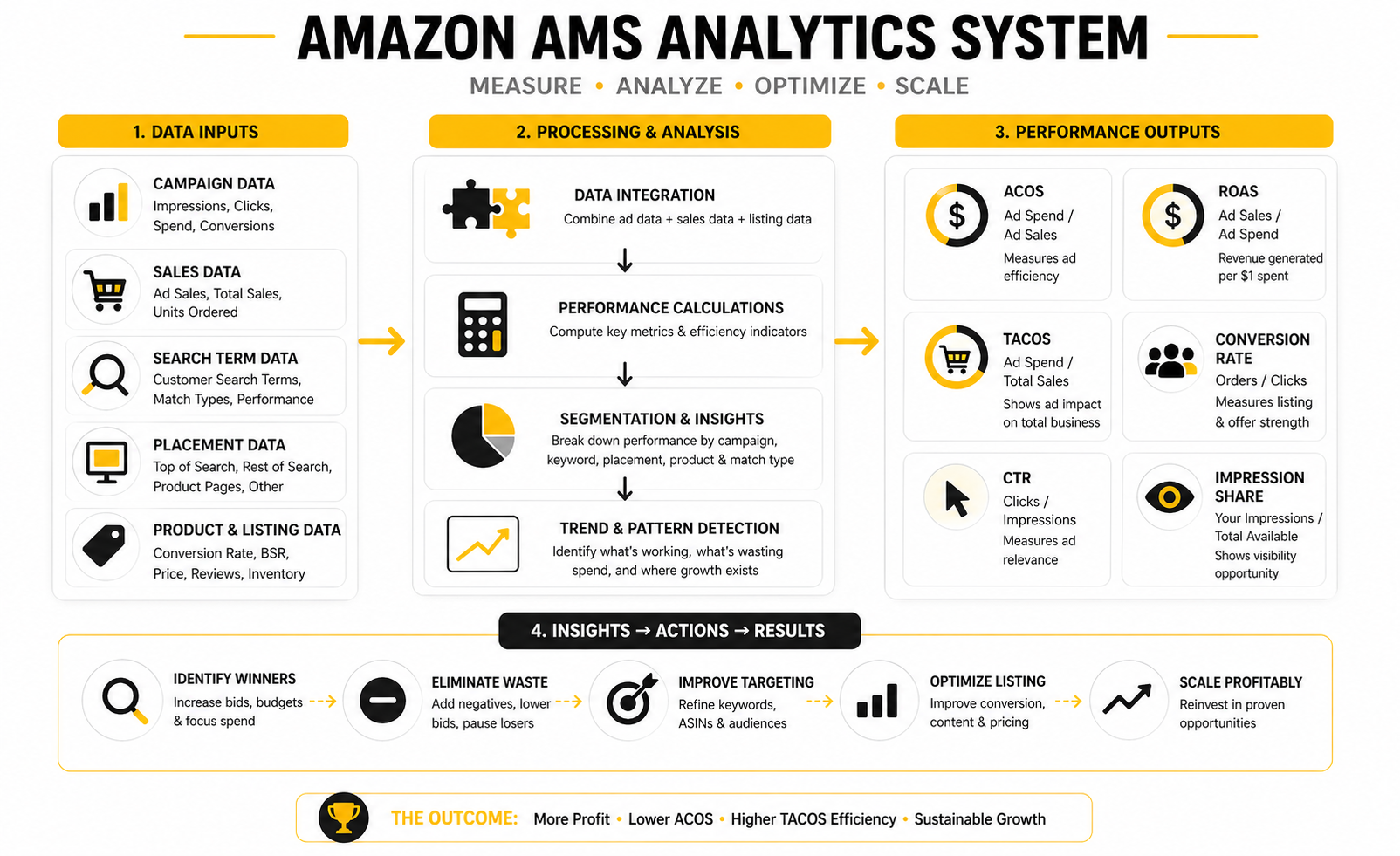
The final system is simple to understand but hard to fake. You need a strong product page, clean campaign structure, disciplined targeting, margin-aware bidding, regular search term analysis, and a clear view of total sales impact. If one part breaks, the whole system becomes harder to trust.
That is why professional Amazon AMS management is not just about lowering ACOS. It is about knowing when to protect profit, when to buy data, when to push growth, and when to stop spending because the offer is not ready. The best advertisers are not the ones who touch the most settings. They are the ones who know exactly why they are making each change.
FAQ - Built For Complete Guide
What is Amazon AMS?
Amazon AMS is the older name for Amazon Marketing Services, which has largely evolved into Amazon Ads. Many sellers still use the phrase Amazon AMS when talking about Sponsored Products, Sponsored Brands, Sponsored Display, and related campaign tools. In practice, if someone says they need help with Amazon AMS today, they usually mean they need help planning, launching, measuring, and optimizing Amazon advertising campaigns.
Is Amazon AMS the same as Amazon Ads?
Amazon AMS is not the current official umbrella name, but it points to the same advertising ecosystem most sellers care about. Amazon Ads is the modern platform that includes sponsored ads, display options, video placements, Stores, reporting, and advanced measurement tools. The language changed, but the seller goal stayed the same: use paid visibility to drive profitable marketplace growth.
Which Amazon AMS campaign should beginners start with?
Most beginners should start with Sponsored Products because the format is closest to the purchase decision. It lets you promote individual products in shopping results and on product detail pages, making performance easier to connect to sales. Start small, separate discovery from proven keywords, and avoid building a complicated account before you have useful data.
How much should I spend on Amazon AMS?
There is no universal budget that works for every seller. Your budget should depend on product margin, category competitiveness, launch stage, inventory depth, and how much data you need to collect. A safer approach is to start with controlled daily budgets, identify converting terms, and increase spend only where the campaign has earned it.
What is a good ACOS for Amazon AMS?
A good ACOS depends on your margins and campaign objective. A branded campaign should usually run more efficiently than a discovery campaign, while a launch campaign may accept a higher ACOS for a defined period. The real question is whether the campaign supports the business goal without damaging cash flow or long-term profitability.
What is the difference between ACOS, ROAS, and TACOS?
ACOS shows ad spend as a percentage of ad-attributed sales, while ROAS shows how much revenue you generated for each dollar spent. TACOS compares ad spend with total sales, which gives you a broader view of whether ads are supporting the full business or making you more dependent on paid traffic. Use all three together because each one answers a different question.
Should I use automatic or manual targeting?
Use both, but give them different jobs. Automatic targeting is useful for discovery because Amazon can match your product with relevant searches and products. Manual targeting gives you more control once you know which keywords, search terms, or ASIN targets are worth pushing.
How often should I optimize Amazon AMS campaigns?
You should review campaigns regularly, but that does not mean changing everything every day. Search terms, wasted spend, bids, budgets, and placement performance should be checked on a consistent schedule. Make changes with a reason, then give the data enough time to show whether the change worked.
Why are my Amazon AMS clicks not turning into sales?
Clicks without sales usually point to a mismatch between traffic and offer. The keyword may be too broad, the product may look weak compared with competitors, or the listing may have problems with images, price, reviews, delivery promise, or copy. Before cutting every bid, check whether the product page gives shoppers a strong enough reason to buy.
Can Amazon AMS improve organic ranking?
Amazon does not give sellers a simple public formula that says ads automatically improve organic ranking. Still, ads can support visibility, clicks, sales velocity, and product discovery, which can indirectly help a product become more competitive when the offer converts well. Treat this as a strategic possibility, not a guaranteed shortcut.
When should I pause an Amazon AMS keyword?
Pause or reduce a keyword when it has enough spend and clicks to show a clear pattern of poor performance. Do not kill keywords too early just because they had one bad day. Look at spend, clicks, conversion, match type, search term relevance, and the campaign’s role before making the call.
Do I need Sponsored Brands if I already run Sponsored Products?
Not always. Sponsored Products can carry a lot of direct-response performance on their own. Sponsored Brands become more useful when you have a real brand story, multiple related products, a strong Store, or a need to build visibility above standard product ads.
Is Sponsored Display worth using?
Sponsored Display can be worth using when your product page is competitive and you want to reach shoppers beyond direct keyword searches. It is especially useful for product targeting, comparison moments, and remarketing-style strategies. It is usually not the first fix for a weak listing or messy Sponsored Products account.
What is the biggest Amazon AMS mistake?
The biggest mistake is treating ads as separate from the business. Amazon AMS performance is tied to price, reviews, inventory, images, copy, category competition, and margin. If you only adjust bids while ignoring the product page and economics, you are optimizing the surface while the real problem stays untouched.
Work With Professionals
Explore 10K+ Remote Marketing Contracts on MarkeWork.com
Most marketers spend too much time chasing clients, competing on crowded platforms, and losing a percentage of every project to middlemen.
MarkeWork gives you a better way. Browse thousands of remote marketing contracts and connect directly with companies desperate to hire skilled marketers like you, without platform commissions and without unnecessary gatekeepers.
If you're serious about finding better opportunities and keeping 100% of what you earn, explore available contracts and create a profile for free at MarkeWork.com.