

The amazon associates program is one of the most accessible entry points into affiliate marketing, but most people approach it backwards. They chase links instead of understanding systems, and that’s exactly why their earnings stall early.
There’s a reason this program still dominates global affiliate ecosystems. Amazon controls a massive share of e-commerce, and data from Statista’s ecommerce market analysis shows Amazon consistently leads in global online retail traffic and conversion rates. That combination—traffic plus trust—creates a unique monetization environment that few platforms can replicate.
But here’s the catch: access does not equal advantage. The difference between earning pocket change and building a scalable income stream comes down to how you structure your approach.
This article breaks that structure down step by step.
Article Outline
- Why the Amazon Associates Program Still Matters in 2026
- How the Amazon Associates Ecosystem Actually Works
- The Core Components of a Profitable Affiliate Setup
- Traffic Strategy That Converts Into Revenue
- Scaling Beyond Basic Affiliate Links
- Long-Term Optimization and Revenue Expansion
Why the Amazon Associates Program Still Matters in 2026
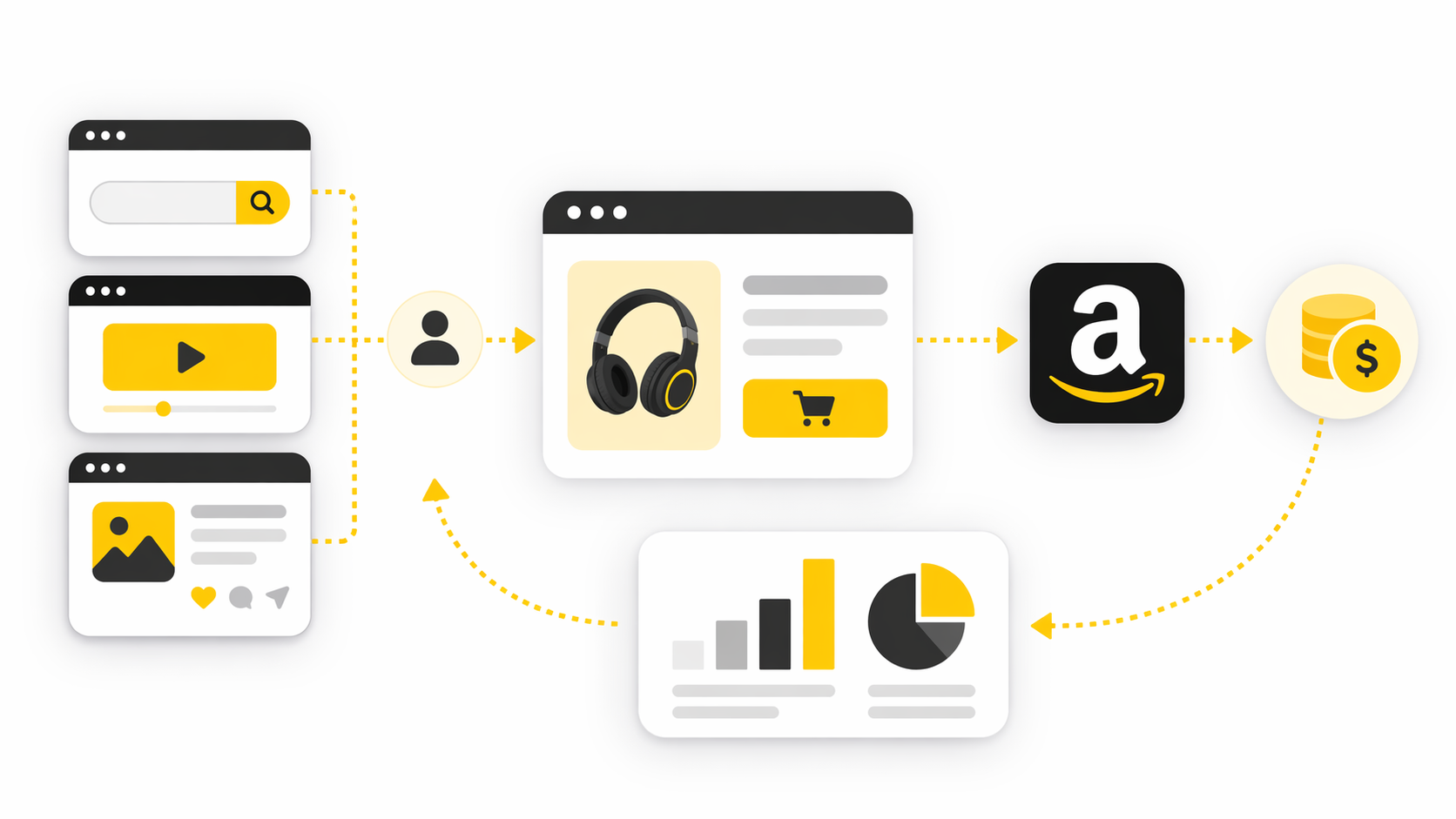
The amazon associates program hasn’t stayed relevant by accident. It benefits from a structural advantage: consumer trust. When people click an affiliate link and land on Amazon, hesitation drops dramatically because the platform already owns the buying relationship.
That trust translates into higher conversion rates compared to standalone stores. Multiple affiliate network benchmarks, including data from Rakuten Advertising performance reports, show that brand familiarity can significantly increase purchase completion rates. Amazon sits at the top of that trust hierarchy.
Another reason it still matters is product depth. You are not promoting one product—you’re tapping into millions. That creates flexibility. If one niche slows down, you don’t rebuild your business. You pivot.
Finally, the program benefits from built-in cross-selling. Even if someone clicks your link for one item, you earn commissions on everything they buy within the cookie window. That single mechanic compounds revenue in a way most beginners underestimate.
How the Amazon Associates Ecosystem Actually Works
At its core, the amazon associates program is simple: you refer traffic, Amazon handles everything else, and you earn a percentage of the sale. But the simplicity hides important mechanics that determine your income.
First, the cookie window. Amazon typically uses a 24-hour attribution window. That means the user must purchase within that timeframe for you to earn a commission. However, if they add the product to their cart, that window extends significantly.
Second, commission structure. Amazon doesn’t pay a flat rate. Categories vary, and that means your niche selection directly affects your earning potential. Some categories sit below 3%, while others go above 10%.
Third, conversion behavior. Amazon’s algorithm optimizes for sales, not your commission. That means product positioning, reviews, and pricing shifts constantly influence your results.
Understanding these dynamics is what separates passive link placement from strategic monetization.
The Core Components of a Profitable Affiliate Setup
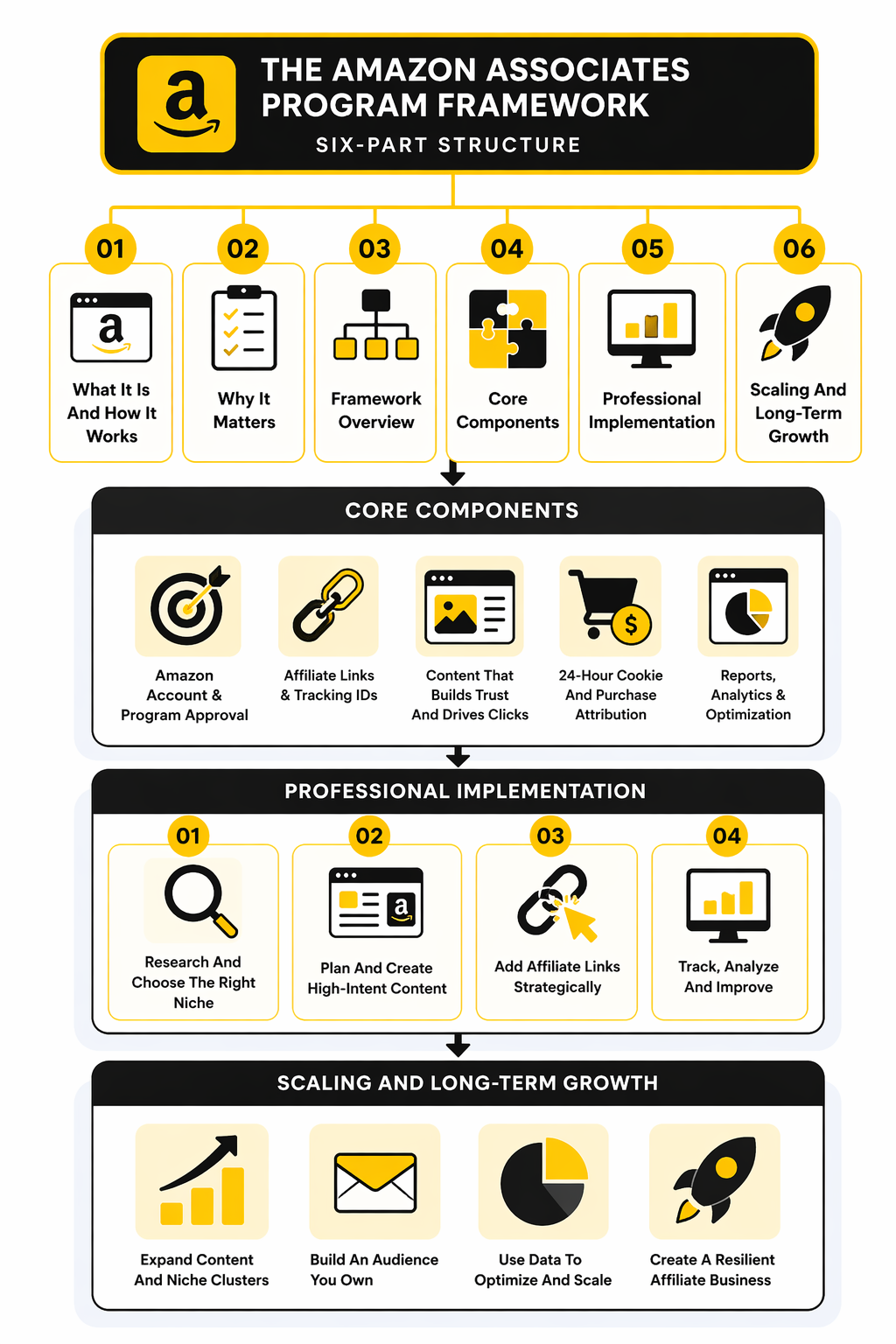
A working amazon associates program strategy isn’t built on links. It’s built on aligned components that reinforce each other.
1. Platform Control
Relying only on social media is unstable. You need an owned platform—typically a website or landing funnel—where you control the user journey.
Tools like ClickFunnels or Systeme.io allow you to structure that journey intentionally. Instead of sending traffic directly to Amazon, you build pre-selling environments that increase conversion probability.
2. Content That Matches Intent
Not all traffic is equal. Someone searching “best budget microphones for YouTube” is far closer to buying than someone casually browsing.
Your content must match that intent level. High-performing formats include:
- product comparisons
- “best of” lists
- problem-solution guides
- detailed reviews
These formats align directly with purchase decisions.
3. Conversion Layer
Most beginners skip this. They send traffic straight to Amazon and hope for the best.
A better approach is adding a conversion layer before the click. This can include:
- email capture
- product summaries
- comparison tables
- personalized recommendations
Platforms like GoHighLevel make it easier to build these layers while keeping everything in one system.
4. Traffic Source Alignment
Different traffic sources behave differently:
- SEO traffic converts consistently but grows slowly
- social media drives spikes but is less predictable
- paid ads scale fast but require precision
The key is aligning your content format with your traffic source instead of forcing one strategy across all channels.
This is where most people start to see the bigger picture. The amazon associates program is not just a link-sharing system—it’s an ecosystem that rewards structure, intent alignment, and controlled user journeys.
In the next part, we’ll break down how traffic actually turns into revenue—and why most affiliate traffic never converts at all.
Traffic Strategy That Converts Into Revenue
Traffic is where most amazon associates program strategies quietly fail. Not because people can’t generate clicks, but because they generate the wrong clicks.
There’s a huge difference between traffic that looks good in analytics and traffic that actually buys. You don’t need volume first—you need intent.
Understanding Buyer Intent Layers
Every visitor sits somewhere on a spectrum. If you ignore that, you end up pushing the same content to completely different mindsets.
The three layers that matter:
- Low intent – browsing, curiosity-driven
- Mid intent – researching options
- High intent – ready to purchase
High intent traffic is where affiliate revenue lives. Search queries like “best noise cancelling headphones under $200” consistently outperform broad queries like “headphones guide” because the user is already filtering for a decision.
This isn’t guesswork. Search behavior studies from Google consumer insights repeatedly show that specific, problem-driven queries convert significantly higher than generic discovery searches.
Matching Content to Intent (This Is Where Most Go Wrong)
You don’t win by publishing more content. You win by publishing the right format for the right intent.
Here’s what actually works:
- High intent → comparison and “best” lists
- Mid intent → detailed reviews and breakdowns
- Low intent → educational and awareness content
If you send low-intent traffic straight to Amazon, you’re essentially hoping they’ll make a decision they weren’t ready for. That’s why conversion rates collapse.
A better approach is guiding them through stages. For example:
- educational article → product comparison → Amazon click
That sequence increases trust and clarity before the purchase decision.
The Pre-Sell Layer That Changes Everything
Direct linking is the default. It’s also the weakest strategy.
A pre-sell layer acts as a bridge between content and Amazon. It warms up the visitor before they ever see a product page.
This layer can include:
- simplified product summaries
- pros/cons breakdowns
- curated recommendations
- short-form decision guides
When done right, it filters out indecisive users and sends only qualified buyers forward.
Tools like GoHighLevel or ClickFunnels let you build these pre-sell pages without relying on complex development. You’re not just sending traffic—you’re shaping behavior.
Traffic Sources That Actually Work for Amazon
Not all traffic sources are equal for the amazon associates program. Some look attractive but rarely convert.
Here’s how they really perform:
SEO (Search Traffic)
This is the foundation. It’s slower to build, but it consistently brings in high-intent users. Once ranked, it compounds without additional cost.
YouTube
Video reviews and comparisons convert extremely well because users can see the product in action. This reduces uncertainty before the click.
Surprisingly effective in visual niches like home decor, fitness, and lifestyle products. It acts as a discovery engine that feeds into buying decisions.
Social Media (Short-Form)
Good for reach, weak for direct conversion. It works best when paired with a funnel or link hub.
If you need a clean way to centralize traffic across platforms, tools like Anything.com help structure your links without losing clarity.
Why Most Affiliate Traffic Never Converts
This is the uncomfortable truth: most traffic fails because it skips alignment.
Common mistakes:
- sending cold traffic directly to Amazon
- targeting broad keywords instead of buying queries
- mixing content intent (education vs purchase)
- ignoring user hesitation
Conversion doesn’t happen because someone clicked. It happens because the path made sense.
When your traffic, content, and destination align, the amazon associates program starts behaving very differently. Clicks turn into sessions, sessions turn into carts, and carts turn into commissions.
At this point, you have the mechanics of traffic and conversion working together. But this is still the baseline.
In the next part, we’ll move beyond simple affiliate setups and break down how to scale this into something that actually grows—without relying on more traffic alone.
Scaling Beyond Basic Affiliate Links
At this stage, most people hit a ceiling with the amazon associates program. They have traffic, they have clicks, and they might even see consistent commissions—but growth slows down.
That plateau happens because the system is still linear. More traffic equals more revenue. And that’s not scalable long term.
Scaling starts when you stop relying on volume alone and start building leverage into your system.
From Linear Growth to System Growth
A basic affiliate setup looks like this:
- traffic → content → Amazon link → commission
A scalable setup adds layers:
- traffic → content → pre-sell → email capture → follow-up → Amazon → repeat engagement
Now, instead of one opportunity to convert, you create multiple.
This matters because most users don’t buy on the first visit. Behavioral data from Think with Google purchase journey insights shows that buyers often interact with multiple touchpoints before committing. If you only rely on a single click, you’re losing most of your potential revenue.
Building an Email Engine (Your Real Asset)
The biggest mistake in the amazon associates program is ignoring email.
Amazon owns the customer. You don’t. That means every click is temporary unless you capture it.
By building an email list, you:
- extend the buying window beyond 24 hours
- create repeat monetization opportunities
- reduce dependency on search or algorithms
Tools like Brevo or Moosend allow you to build automated sequences that nurture users over time instead of relying on a single visit.
The Content Flywheel That Multiplies Output
Scaling doesn’t mean creating random content faster. It means building a system where one piece feeds multiple channels.
A simple flywheel looks like this:
- publish a long-form SEO article
- extract key points into short-form social content
- turn product sections into email campaigns
- create video versions for YouTube
This approach compounds reach without multiplying effort.
If you’re managing multiple channels, scheduling tools like Buffer help maintain consistency without burning time on manual posting.
Automation That Removes Bottlenecks
Once traffic and content start working, the bottleneck becomes time. Manual processes slow everything down.
Automation fixes that.
Here’s where it matters most:
- capturing leads automatically
- sending follow-up sequences
- segmenting users based on behavior
- routing traffic into the right funnels
Platforms like ManyChat can automate conversations and guide users toward buying decisions without requiring constant manual interaction.
The Step-by-Step Implementation Flow
This is where everything becomes practical. If you strip away complexity, a scalable amazon associates program system follows a clear execution path.
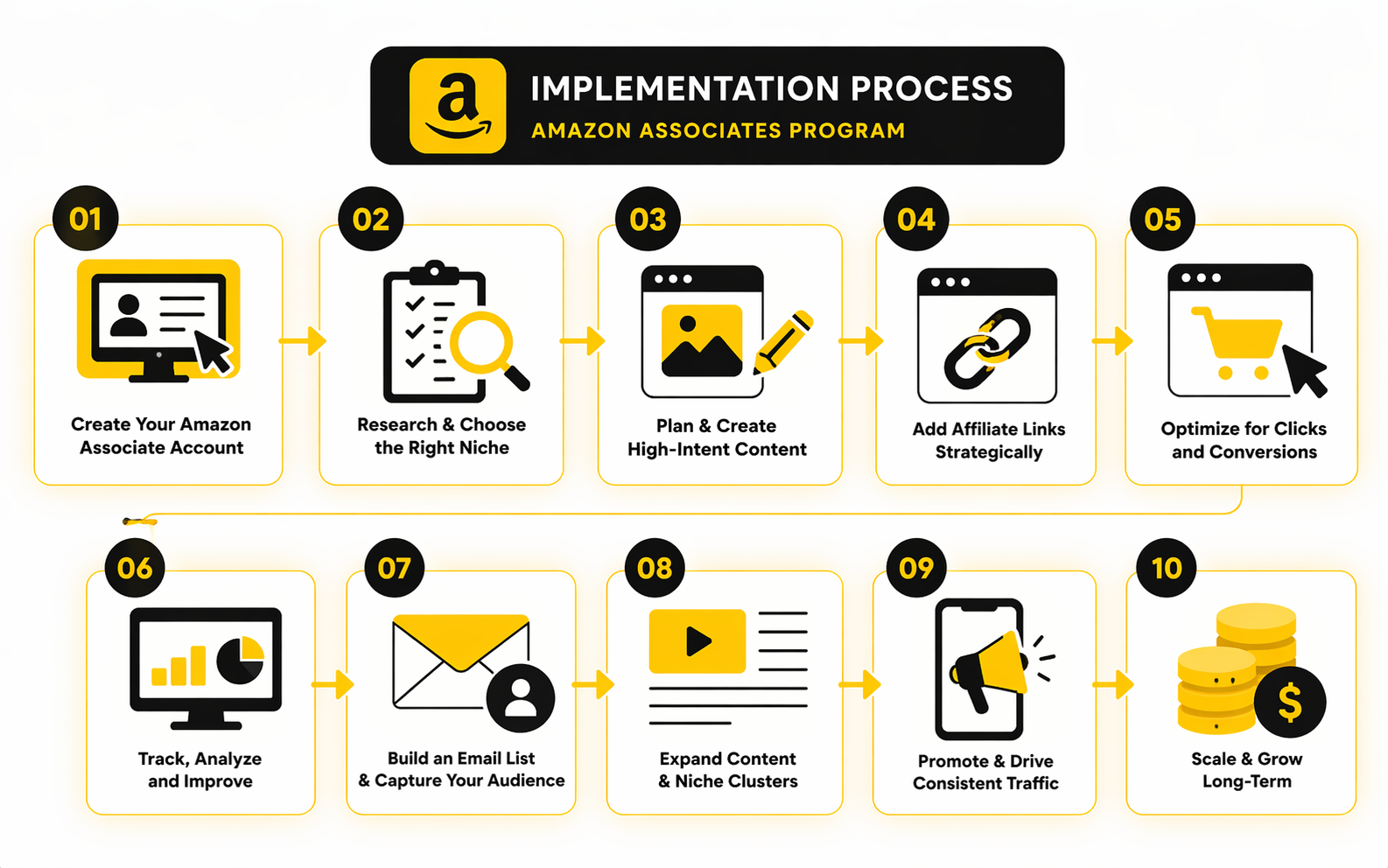
- Choose a high-intent niche
Focus on problems where people are already searching for solutions, not just browsing.
- Build your content hub
Create SEO-driven articles that target buying keywords and answer specific questions.
- Add a pre-sell layer
Structure your content to guide decisions before linking to Amazon.
- Capture user data
Offer simple lead magnets or updates to collect email addresses.
- Set up automated follow-ups
Use email or messaging sequences to re-engage visitors who didn’t convert immediately.
- Expand traffic channels
Repurpose your content across platforms like YouTube, Pinterest, and social media.
- Optimize based on behavior
Track clicks, conversions, and drop-offs, then refine your system continuously.
This process turns a fragile affiliate setup into a structured machine.
At this point, you’re no longer just participating in the amazon associates program—you’re building an ecosystem around it.
In the next part, we’ll go deeper into optimization. Not surface-level tweaks, but the adjustments that actually increase revenue without increasing traffic.
Reading the Numbers That Actually Matter
Once your amazon associates program setup is live, the next job is measurement. This is where a lot of affiliate content businesses lose money without realizing it, because they look at activity metrics and assume those are performance metrics. Amazon’s own reporting is built around clicks, ordered items, shipped items, conversion rates, earnings, link types, and tracking IDs, which tells you very clearly what the platform expects you to optimize. Amazon’s reports documentation and report overview make that structure explicit.
The important shift is this: not every good-looking number is useful. A spike in clicks can mean better positioning, or it can mean your page is attracting curiosity with weak buyer intent. If your traffic rises while orders and shipped items lag, the problem is rarely “more traffic needed.” It is usually poor intent matching, weak pre-sell framing, or the wrong product mix. Amazon’s Orders Report guide and Link-Type Report guide are useful here because they separate what got attention from what actually led to orders and dispatches.
The Core Metrics Inside Amazon Reports
The amazon associates program gives you enough data to diagnose most performance problems if you read the metrics in the right order. Start with clicks, then move to ordered items, then shipped items, and only after that look at earnings. Reading earnings first is emotionally satisfying, but analytically weak.
Here’s the basic logic:
- Clicks tell you whether your content is generating buying curiosity
- Ordered items tell you whether that curiosity turned into action
- Shipped items tell you what actually matured into commissionable revenue
- Conversion rate tells you how efficiently traffic became orders
- Earnings tell you whether the niche, category mix, and buyer behavior are economically worth scaling
That order matters because Amazon credits commissions on qualifying purchases that actually progress through its attribution and dispatch logic. The platform also notes that short reporting windows can show clicks without corresponding orders yet, or orders without matching clicks in the same period, especially because items added to cart within the 24-hour session can still be purchased from cart within 90 days. Amazon’s link-type reporting help and glossary explain those timing gaps directly.
Why Clicks Alone Can Mislead You
Clicks feel like momentum, but they are not proof of monetization. In fact, one of the clearest signals in current affiliate market data is that traffic can rise while revenue efficiency weakens.
Impact’s 2025 benchmark found clicks were up 2% year over year while transactions dropped 5% and conversion rates fell 6%, even as average order value increased from $118 to $123. That is a very useful warning for anyone running an amazon associates program strategy: more top-of-funnel activity does not automatically mean better commercial performance. It often means the market is getting noisier and buyers are taking longer to decide. Impact’s 2025 benchmark and Performance Marketing World’s coverage of the same benchmark point to the same pattern.
The action this should drive is simple. If clicks are rising but ordered items are flat, do not celebrate yet. Tighten the page intent, sharpen the product recommendation, and remove anything that encourages casual clicks from readers who are still in research mode.
What a Healthy Conversion Signal Looks Like
Conversion rate is one of the few metrics that forces honesty. It shows whether your content is bringing the right people to the right offer at the right moment.
In Amazon reporting, conversion rate sits close to the business outcome, because it tracks how efficiently your referred traffic becomes orders. Broader affiliate benchmarks vary by niche and traffic source, but ecommerce affiliate programs are commonly discussed in the low-single-digit range, which means even a small lift can materially change earnings if volume is already there. That makes conversion a leverage metric, not a vanity metric. Amazon’s reporting interface overview, Awin’s benchmark metric definitions, and Impact’s 2025 benchmark all reinforce that conversion rate is one of the central measures of affiliate efficiency.
If your conversion rate is weak, the next move is not automatically to replace products. First check whether:
- the article targets a buying query
- the recommendation appears too early or too late
- the price point creates hesitation
- the page attracts broad informational traffic instead of decision-stage traffic
A low conversion page with strong rankings is often an optimization opportunity. A low conversion page with weak engagement is usually a positioning problem.
The Gap Between Ordered and Shipped Items
This is one of the most misunderstood parts of the amazon associates program. New affiliates often see a promising number of ordered items and assume earnings will follow at the same pace. Then they watch shipped items lag behind and think something broke.
Usually, nothing broke. Ordered items show purchase activity tied to your referral. Shipped items are the items that actually moved forward in the fulfillment cycle during the reporting period, and those are far closer to what turns into payable commission. Amazon documents this distinction clearly across its reporting help and glossary. How to read the Order Report and the Associates glossary are worth reviewing if this gap keeps confusing your decisions.
The practical takeaway is that you should not judge a page too quickly. A content asset with strong ordered-item velocity but temporarily delayed shipped items may still be healthy. But if that gap stays wide over longer periods, it can signal product instability, stock issues, poor product fit, or audiences clicking on impulse rather than buying with confidence.
How to Track the Right Funnel Outside Amazon
Amazon’s dashboard is necessary, but it is not enough. You also need on-site data that shows what happened before the click.
Google Analytics 4 is useful here because it can measure outbound clicks, and its engagement framework helps separate active sessions from weak ones. GA4 defines an engaged session as one lasting longer than 10 seconds, having a key event, or generating at least two page or screen views. That matters because affiliate content that drives outbound clicks with weak engagement often converts worse over time than content that builds intent first. GA4’s outbound click tutorial and GA4 engagement documentation explain the mechanics clearly.
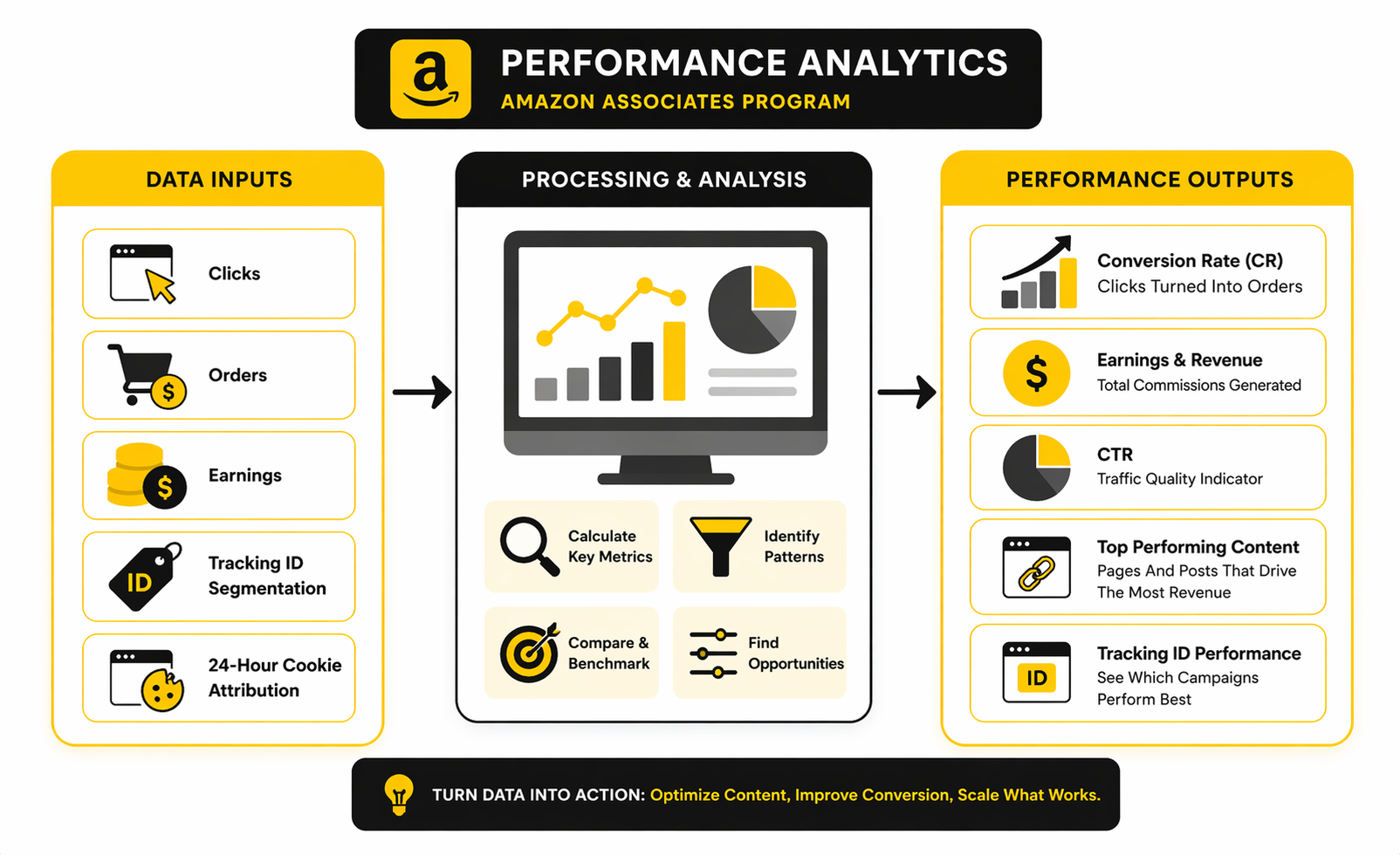
A practical analytics stack for the amazon associates program usually tracks:
- page-level traffic
- engaged sessions
- outbound Amazon clicks
- click-through rate from content to Amazon
- ordered items by tracking ID
- shipped items by tracking ID
- earnings by page, category, or link type
That combination gives you both halves of the funnel. GA4 shows pre-click behavior. Amazon shows post-click monetization. Without both, you are optimizing in the dark.
The Benchmarks That Matter Most
You do not need fifty benchmarks. You need a few numbers that help you decide whether to improve the page, improve the offer, or improve the traffic source.
The most useful benchmark categories are:
- Engagement quality – are people actually consuming the content
- Outbound click efficiency – are readers moving from recommendation to merchant
- Amazon conversion efficiency – are referred users placing orders
- Revenue efficiency – are commissions high enough to justify the effort
Current market data makes one point very clear: efficiency matters more than raw scale. When a broader affiliate market can post higher click volume but lower transaction volume, the winning move is not always “publish more.” Sometimes it is “filter better.” Impact’s benchmark is useful because it shows exactly how misleading raw click growth can be when the deeper conversion layer weakens.
For action, use this interpretation model:
- High traffic, low outbound click rate means your calls to action or recommendation structure are weak
- High outbound clicks, low Amazon conversion means your intent match or product choice is weak
- Strong conversion, weak earnings means your commission category or average basket value is weak
- Strong ordered items, weak shipped items means you should watch fulfillment timing, returns, or buyer hesitation before scaling
That is the kind of reading that improves revenue. Not random dashboards. Not vanity spikes. Clear cause-and-effect interpretation.
Tracking IDs Are More Powerful Than Most Affiliates Realize
A lot of people treat tracking IDs as admin clutter. That’s a mistake.
Amazon lets you create tracking IDs specifically so you can separate performance across sites, content types, placements, or experiments. That means you can compare one article format against another, one traffic source against another, or one niche cluster against another without guessing. Amazon’s tracking ID help page and tracking ID summary explanation make that use case pretty direct.
This should drive a very practical habit. Create different tracking IDs for:
- comparison articles
- single-product reviews
- email-driven clicks
- YouTube link placements
- seasonal content clusters
Now your optimization is based on evidence, not instinct.
What the Data Should Make You Do Next
The point of analytics in the amazon associates program is not reporting. It is decision-making.
If the data says engagement is weak, improve structure and intent matching. If the data says clicks are healthy but conversions are poor, upgrade the recommendation logic and tighten product-market fit. If commissions stay weak even when conversion is good, shift into categories with better economics or higher basket potential, while keeping an eye on Amazon’s official commission schedules because those do change. Amazon’s commission income statement and April 14, 2026 operating agreement update summary are the pages worth checking when category economics matter.
That’s the real role of statistics and data here. Not to decorate the article. Not to impress anyone. To tell you what to fix, what to scale, and what to stop doing.
Long-Term Optimization and Revenue Expansion
By the time you reach this stage, the amazon associates program stops being a simple content-and-links play. It becomes a portfolio management problem. You are no longer asking, “Can this page make money?” You are asking, “Is this business resilient if commissions shift, rankings move, or buying behavior changes?” Amazon’s own program documents make that risk real because operating terms and commission structures can change, including updates published on April 14, 2026.
That is the tradeoff experienced operators understand early. Amazon gives you trust, conversion power, and enormous product breadth, but it also controls the platform, the payout rules, the attribution window, and most of the customer relationship. If you build everything on top of that convenience without adding your own assets, you can grow fast and still stay fragile.
The Real Risk Is Dependency, Not Competition
Most people assume the biggest threat is saturation. It usually isn’t. The bigger risk is overdependence on one merchant, one traffic source, or one content format.
The amazon associates program is powerful because Amazon has unmatched product depth and massive marketplace activity, with more than 60% of sales in Amazon’s store coming from independent sellers. That scale gives affiliates selection and conversion advantages, but it also means your business is tied to decisions made by a platform you do not control.
The action this should drive is straightforward. Diversify the structure before you diversify the brand list. Build your own audience, your own email list, your own analytics, and your own content library first. Then your revenue is not held together by one dashboard.
Compliance Is Not Optional Once You Start Scaling
A small affiliate site can sometimes survive sloppy execution for a while. A growing one usually cannot. The bigger you get, the more dangerous basic compliance mistakes become.
Amazon’s policies restrict how special links and program content can be used, including clear limits around offline promotion and certain promotional methods, while the FTC expects affiliate relationships to be disclosed clearly and conspicuously. The FTC’s guidance on endorsements and disclosures, along with its consumer reviews rule that took effect in October 2024, make it very clear that vague, buried, or evasive disclosure practices are not where smart operators want to live.
This matters strategically, not just legally. Trust compounds when readers understand how you make money and still feel that the recommendation is useful. Trust collapses when the content feels engineered to extract clicks. That line is thinner than most people think.
Commission Pressure Changes What “A Good Niche” Means
A niche can look attractive on traffic volume and still be weak on economics. That becomes obvious only when you compare effort against actual earnings.
The amazon associates program does not pay one flat commission rate across the board. Category-based commission structures mean two pages with similar traffic and similar click volume can produce very different income profiles. That is why experienced affiliates stop evaluating niches only by keyword demand and start evaluating them by category economics, product mix, and basket behavior.
This changes how you scale. Sometimes the right move is not to write ten more articles. Sometimes it is to shift the content portfolio toward products with stronger average order values, better commission categories, lower return risk, or more stable demand. A smaller portfolio with better economics often beats a larger one built on thin-margin categories.
Audience Ownership Is the Strategic Upgrade
This is the point where casual affiliates and serious operators separate. Casual affiliates rent attention. Serious operators build assets around it.
With Amazon, you do not own the checkout and you do not own the customer. So if you want the amazon associates program to become a durable business instead of a temporary monetization channel, you need systems Amazon cannot take away: email, community, first-party data, repeat traffic, and content clusters that keep pulling people back. Amazon’s structure makes that especially important because the attribution window is limited and the merchant relationship belongs to Amazon, not to you.
This is exactly where tools become strategic instead of tactical. A platform like Brevo or GoHighLevel is useful not because email is trendy, but because audience ownership is how you reduce platform dependency over time.
Scaling Creates Operational Tradeoffs
Growth sounds clean in theory. In practice, it introduces messy decisions. More content means more updates, more products to monitor, more affiliate links to maintain, and more pages that can quietly decay.
This becomes more important in a program built around products whose prices, availability, reviews, and ranking positions can change constantly. A page that converts beautifully in one quarter can become stale in the next if the featured products go out of stock, lose relevance, or stop being the best option. Amazon’s own ecosystem moves fast enough that content maintenance is not admin work. It is revenue protection.
That means scaling the amazon associates program responsibly usually involves three tradeoffs:
- publishing less, but maintaining more aggressively
- choosing tighter topical authority over broader topical sprawl
- prioritizing repeatable systems over one-off content wins
That may feel slower at first. It is usually more profitable over time.
The Best Operators Build Optionality Early
Optionality is what keeps a business calm when the market shifts. Without it, every update feels existential. With it, changes are inconvenient, not fatal.
In practical terms, optionality means you can keep Amazon as a core monetization engine while also preparing adjacent revenue paths. That might mean owned lead generation, sponsored placements, consulting, digital products, community memberships, or broader affiliate partnerships that fit the same audience. The point is not to abandon the amazon associates program. The point is to stop forcing it to carry the entire business alone.
This is where many affiliate sites finally become real businesses. They still benefit from Amazon’s trust and conversion power, but they are no longer trapped by it.
What Expert-Level Execution Really Looks Like
At the expert level, success with the amazon associates program is less about hacks and more about discipline. The fundamentals stay boring, but the execution gets sharper.
That usually means:
- tighter intent targeting
- stronger disclosure habits
- more deliberate tracking ID segmentation
- regular refresh cycles for money pages
- commission-aware content planning
- an owned audience outside Amazon
None of that sounds flashy. That is exactly why it works. Mature affiliate businesses are not built on novelty. They are built on systems that survive change.
The final step is pulling everything together. In the last part, we’ll wrap this into a practical close, answer the most important questions people still get wrong, and make the whole amazon associates program picture easier to act on.
Bringing the Entire System Together
At this point, the amazon associates program should look very different from where you started. It’s no longer about placing links inside articles and hoping for clicks. It’s a structured system where traffic, intent, content, conversion layers, and analytics all reinforce each other.
What makes this powerful is not any single tactic. It’s the alignment. When your content matches intent, your pre-sell layer filters decisions, your analytics show clear signals, and your audience becomes an asset, the system starts compounding.
This is where most people underestimate what they’ve built. A well-structured amazon associates program setup is not just a monetization method. It’s a distribution engine that can be extended, diversified, and scaled in multiple directions.
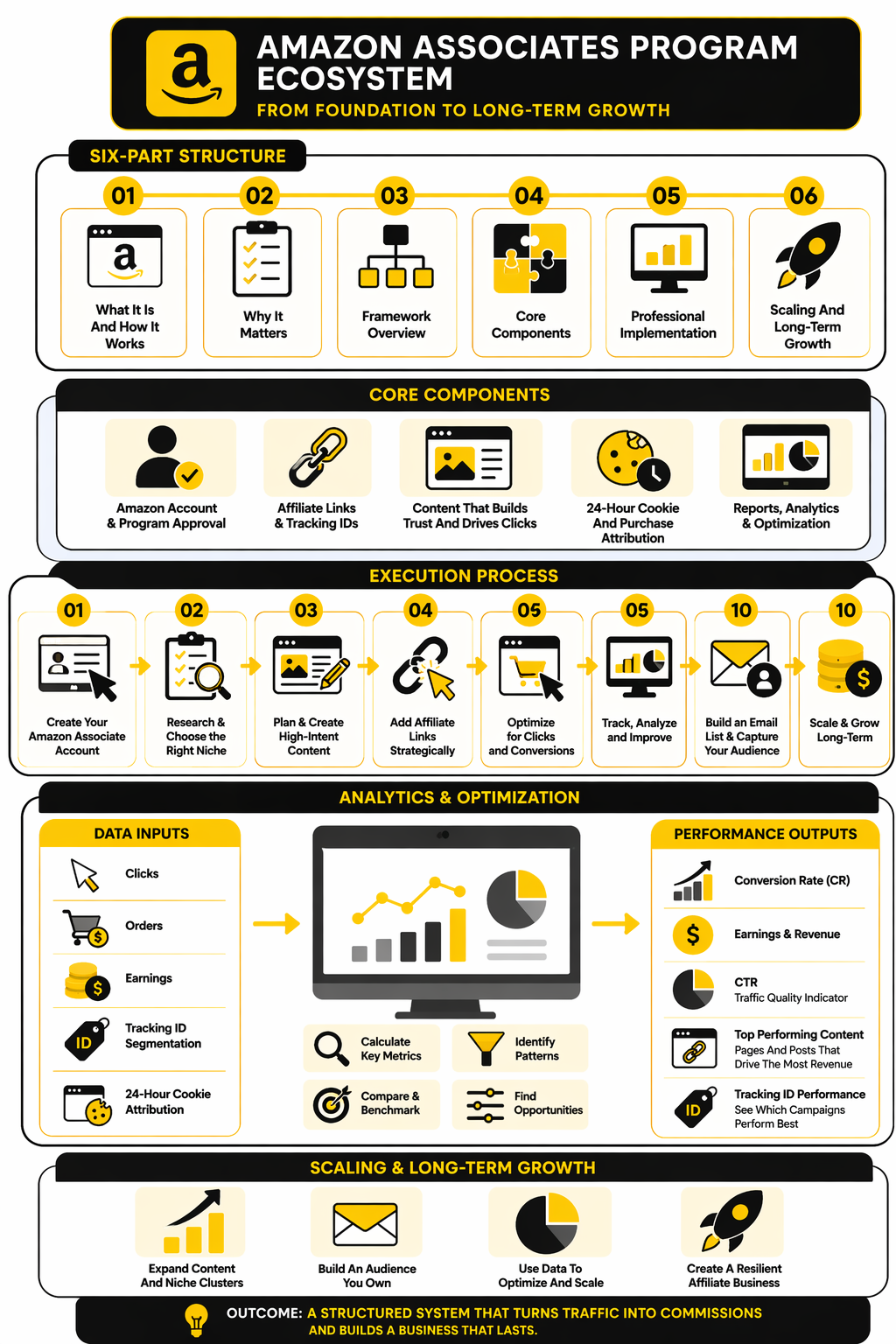
Once everything is connected, your workflow becomes predictable:
- traffic enters through high-intent content
- users move through a guided decision process
- qualified clicks reach Amazon
- data feeds back into optimization
- audience assets capture long-term value
That loop is what turns effort into leverage.
FAQ - Built for Complete Guide
What is the amazon associates program in simple terms?
The amazon associates program is an affiliate system where you earn commissions by referring customers to Amazon products. You generate a unique tracking link, and when someone purchases through it, you earn a percentage of the sale.
The simplicity is why many people start here, but the real opportunity comes from building a system around it, not just using the links.
How much can you realistically earn?
Earnings vary widely because they depend on traffic quality, niche selection, and conversion efficiency. Some sites generate small side income, while others scale into full businesses.
The important part is not the ceiling. It’s how efficiently your system turns intent into revenue.
Is the 24-hour cookie a limitation?
Yes and no. The short cookie window limits delayed purchases, but Amazon compensates with high conversion rates and strong cross-selling behavior.
If you build an email layer or retargeting system, you reduce reliance on that short window significantly.
What traffic source works best?
Search traffic consistently performs the best because it captures users already looking to buy. YouTube is strong for product demonstration, while social media works better as a feeder into your main system.
The key is not choosing one source. It’s aligning each source with the right type of content.
Should you send traffic directly to Amazon?
Direct linking works, but it’s rarely optimal. A pre-sell layer improves conversion by helping users make decisions before they click.
That extra step often increases earnings without increasing traffic.
How do you choose the right niche?
Look for a combination of:
- strong buying intent
- consistent demand
- reasonable competition
- favorable commission categories
A niche that looks popular but has weak monetization potential will stall quickly.
Why is email so important for affiliates?
Because Amazon owns the customer, not you. Without email or another owned channel, every click is temporary.
Email allows you to extend the relationship, re-engage users, and create multiple monetization opportunities.
Tools like Brevo or Moosend make this process scalable.
How do you increase conversion rates?
Focus on:
- matching content to buying intent
- simplifying product comparisons
- removing unnecessary friction
- improving clarity in recommendations
Conversion improves when decisions become easier, not when you push harder.
Is it risky to rely only on Amazon?
Yes. The platform controls commissions, policies, and attribution rules. That creates dependency risk.
The smarter approach is to use Amazon as a core revenue stream while building additional assets around it.
What tools help scale the system?
Tools that support funnels, automation, and content distribution are the most valuable.
Platforms like ClickFunnels, Systeme.io, or GoHighLevel help structure and scale the system instead of managing it manually.
How long does it take to see results?
SEO-driven strategies typically take several months to gain traction. Faster channels like social media can produce early signals, but they are less predictable.
The timeline depends less on time and more on execution quality and consistency.
What separates beginners from advanced affiliates?
Beginners focus on links and traffic. Advanced affiliates focus on systems, data, and leverage.
Once you understand that difference, the entire amazon associates program becomes easier to scale.
Work With Professionals
Explore 10K+ Remote Marketing Contracts on MarkeWork.com
Most marketers spend too much time chasing clients, competing on crowded platforms, and losing a percentage of every project to middlemen.
MarkeWork gives you a better way. Browse thousands of remote marketing contracts and connect directly with companies desperate to hire skilled marketers like you, without platform commissions and without unnecessary gatekeepers.
If you're serious about finding better opportunities and keeping 100% of what you earn, explore available contracts and create a profile for free at MarkeWork.com.