

An Amazon copywriter does more than write polished product descriptions. The job is to turn search intent, product facts, competitive positioning, customer objections, and Amazon’s content rules into a listing that helps shoppers make a confident buying decision.
That matters because Amazon is not a normal website. Shoppers arrive with comparison tabs open, short attention spans, and very little patience for vague claims. Your title has to earn the click, your images have to create instant clarity, your bullets have to answer buying objections, and your A+ Content has to make the product feel like the obvious choice.

This guide breaks the work into a practical six-part system. Instead of treating Amazon copywriting as “write better bullets,” we’ll look at the full listing architecture: research, positioning, titles, images, bullets, descriptions, A+ Content, testing, and implementation.
Article Outline
- Part 1: What An Amazon Copywriter Actually Does
- Part 2: Why Amazon Copywriting Matters
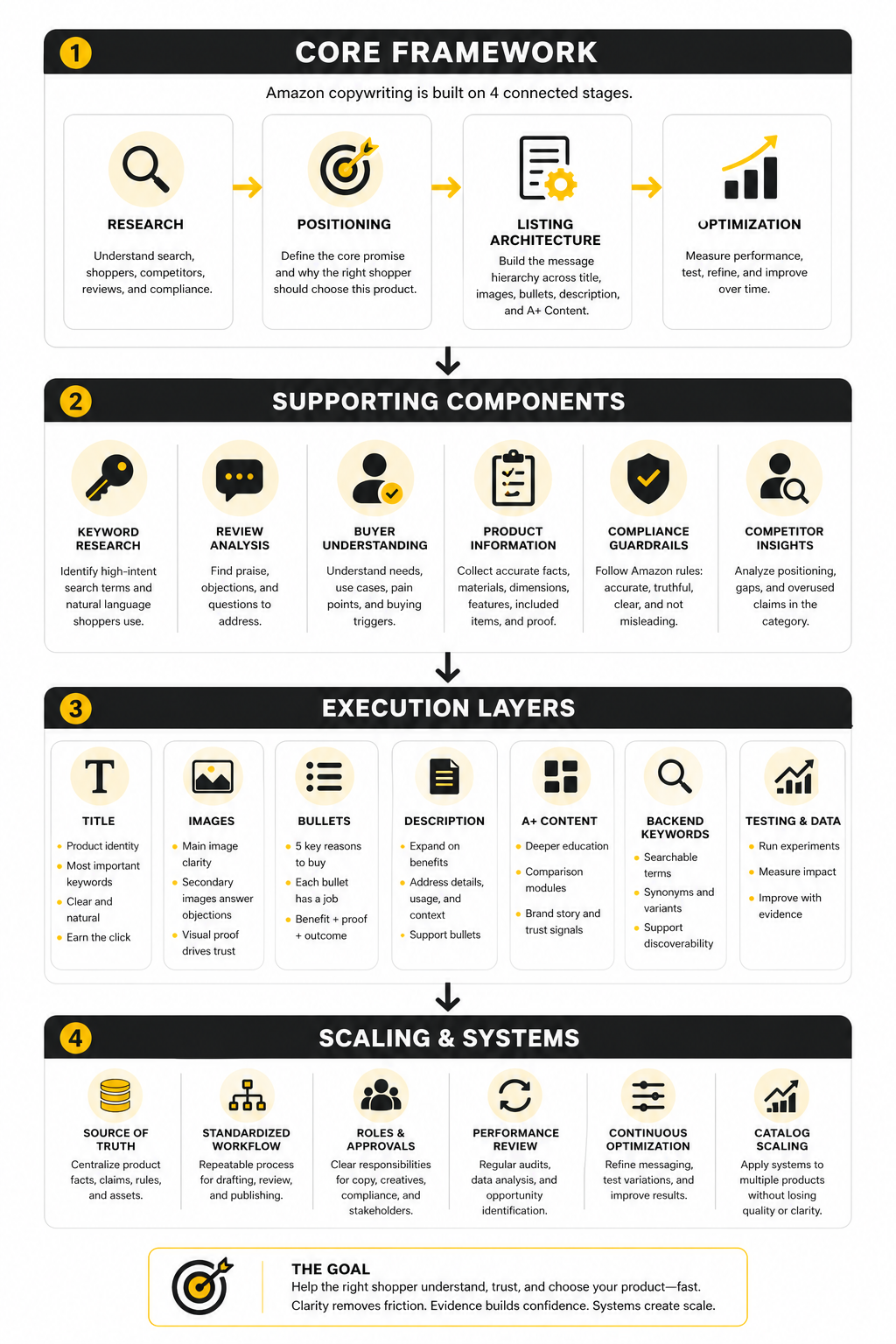
- Part 3: The Amazon Copywriting Framework
- Part 4: Core Components Of A High-Converting Amazon Listing
- Part 5: Professional Implementation For Brands And Agencies
- Part 6: Optimization, Testing, And FAQ
What An Amazon Copywriter Actually Does
An Amazon copywriter writes and structures the words that appear across a product detail page. That usually includes the product title, feature bullets, product description, backend keyword strategy, A+ Content text, image callouts, comparison chart copy, and sometimes Brand Story modules.
But the real value is not just wording. A strong Amazon copywriter understands how shoppers scan, what Amazon allows, which claims need proof, and how to balance keywords with clarity. The best listings do not read like keyword dumps; they read like a helpful sales conversation compressed into a very small space.
That is the difference between generic ecommerce writing and Amazon copywriting. On Amazon, every line has a job. The title supports discovery and click-through, the bullets reduce hesitation, the images carry the fastest proof, and the A+ section builds confidence after the shopper has already shown interest.
The Big Idea Behind Amazon Copywriting
Amazon copywriting sits at the intersection of search, persuasion, and compliance. You are not only trying to sound good. You are trying to help the right shopper quickly understand why this product fits their need better than the alternatives on the same page.
That means the copy has to be specific. Instead of saying a product is “premium,” the listing should explain what makes it premium. Instead of saying it is “easy to use,” it should clarify what the shopper can do faster, avoid, simplify, or feel more confident about.
The strongest Amazon listings usually come from a simple mindset: remove friction. Every unclear phrase, unsupported claim, missing detail, weak benefit, or confusing image caption creates friction. The Amazon copywriter’s job is to remove as much of that friction as possible before the shopper leaves.
How The Six-Part System Works
This article will treat Amazon copywriting as a full listing system, not a single writing task. That is important because the title, bullets, images, and A+ Content should not compete with each other. They should build one clear argument from first impression to final decision.
Part 2 explains why Amazon copywriting matters in practical terms. Part 3 introduces the framework behind effective listing copy. Parts 4 and 5 go deeper into the actual components and implementation process, while Part 6 covers optimization, testing, and common questions.
By the end, you should have a clear way to evaluate whether an Amazon copywriter is doing strategic work or just filling character limits. That distinction matters. Good Amazon copy is not louder; it is sharper.
Why Amazon Copywriting Matters
Amazon copywriting matters because shoppers rarely read a listing from top to bottom. They scan, compare, doubt, and decide fast. A good amazon copywriter understands that the page has to work in layers: first for search visibility, then for click confidence, then for conversion.
The listing also has to survive Amazon’s rules. Amazon says product titles, descriptions, and bullet points must be clear, accurate, trustworthy, and not misleading in its product detail page rules. That means aggressive copy can backfire if it creates claims the product cannot support.
This is why copywriting on Amazon is not just “make it persuasive.” It is controlled persuasion. You need strong selling points, but they have to be grounded in the product, useful to the shopper, and written in a way Amazon will allow.
Search Visibility Is Only The First Battle
A listing cannot convert shoppers who never find it. That is why keyword research matters, and why an Amazon copywriter has to understand how customers describe the problem, category, product type, material, use case, size, and benefit they are looking for.
But visibility alone is not enough. If the title is stuffed, confusing, or hard to read, the shopper may skip it even if it appears in search results. The goal is not to cram every keyword into the first line; the goal is to make the right shopper feel like the product is relevant immediately.
Strong copy connects search language with buying language. It uses keywords naturally, but it does not let keywords control the entire message. That balance is where many weak listings fall apart.
Conversion Depends On Clarity
Most shoppers are not looking for clever writing on Amazon. They want fast answers. They want to know what the product is, whether it fits their need, what makes it different, what is included, and whether there is any hidden downside.
That is where clear copy becomes a sales advantage. A vague bullet like “high quality and durable” does very little. A stronger bullet explains the material, the use case, the practical benefit, and the reason the shopper should care.
An amazon copywriter should remove confusion before it becomes hesitation. If customers have to zoom into images, read reviews, or compare five competitors just to understand the basics, the listing is doing too much work too late.
Trust Is Built Before The Cart
Amazon shoppers are skeptical for a reason. They have seen exaggerated claims, confusing images, inflated promises, and products that looked better online than they did in real life. Copy has to work against that doubt.
Trust comes from specificity. Instead of saying “perfect for everyone,” the listing should say who the product is actually for. Instead of saying “premium performance,” it should describe the feature, outcome, or design choice that supports the claim.
This matters even more in crowded categories. When several products look similar, the listing that explains the product best often feels safer to buy. Not louder. Safer.
Better Copy Supports Better Advertising
Amazon ads can drive traffic, but traffic exposes the quality of the listing. If the copy is unclear, the bullets are generic, or the value proposition is weak, paid clicks become expensive learning instead of profitable growth.
That is why copywriting should happen before serious ad scaling. A campaign can test demand, but it cannot fix a confusing product page by itself. When the listing answers objections clearly, the same ad spend has a better chance of turning into sales.
This is also where tools outside Amazon can support the broader funnel. If a brand is building landing pages for launches, bundles, or external traffic, a focused page builder like Replo can help keep the message consistent before shoppers reach Amazon.
Good Copy Makes The Whole Listing Work Harder
The best Amazon listings do not rely on one perfect line. They create a connected argument across the title, images, bullets, description, and A+ Content. Each section reinforces the same positioning without repeating the same words.
That is the practical reason to hire or become a better amazon copywriter. The work improves the listing as a system, not as isolated text blocks. When every section has a job, the page feels easier to understand and easier to trust.
Part 3 will turn that into a framework. Instead of guessing what to write, we’ll map the research, positioning, message hierarchy, and content structure that make Amazon copywriting easier to execute consistently.
The Amazon Copywriting Framework
A reliable Amazon copywriting process starts before writing. The first job is to understand the market, the shopper, the product, and the rules of the category. Without that, even polished copy becomes guesswork.
A good amazon copywriter works from evidence, not vibes. They look at customer search behavior, competitor positioning, review patterns, product documentation, and brand constraints before building the listing. The point is simple: the copy should reflect what real shoppers care about, while still making the product sound distinct.
This framework has four practical stages: research, positioning, listing architecture, and optimization. Each stage protects the next one. If the research is weak, the positioning gets blurry; if the positioning is blurry, the title, bullets, and A+ Content start saying too many things at once.
Start With Search And Shopper Research
Search research shows how customers already describe the product. Amazon’s Brand Analytics includes a Search Query Performance dashboard that shows query volume, impressions, clicks, cart adds, and purchases, which makes it useful for understanding real shopping behavior inside Amazon’s own ecosystem Amazon Brand Analytics. That data helps a copywriter separate high-intent language from nice-sounding phrases that shoppers may never use.
Review research adds the emotional layer. Positive reviews show what buyers value after purchase, while critical reviews reveal confusion, unmet expectations, sizing issues, missing context, or objections the listing failed to answer. This is where better copy often comes from: not from inventing bigger claims, but from answering the questions customers were already asking.
Competitor research should be used carefully. The goal is not to copy the top listings. The goal is to understand the category language, spot overused claims, identify gaps, and decide how the product can be positioned more clearly.
Define The Positioning Before Writing
Positioning is the core message behind the listing. It answers one direct question: why should the right shopper choose this product instead of the other options they are comparing? If that answer is not clear, the copy will drift.
A practical positioning statement should include the buyer, the use case, the main product advantage, and the proof behind that advantage. For example, the product may be better because of its material, fit, compatibility, ingredients, design, bundle structure, warranty, ease of setup, or brand credibility. The copywriter’s job is to decide which of those actually matters most to the shopper.
This step also prevents the listing from trying to sell to everyone. Amazon rewards clarity because shoppers reward clarity. When the copy speaks to a specific need, it becomes easier to write sharper titles, stronger bullets, and cleaner image callouts.
Build The Listing Architecture
Once the positioning is clear, the listing needs a message hierarchy. The title should communicate the product identity and the most important search signals. The main image should make the product instantly recognizable, while secondary images should handle the fastest objections and most visual benefits.
The bullets then carry the main decision points. They should not repeat the same benefit five different ways. Each bullet should earn its place by covering a different reason to buy: fit, function, material, ease of use, compatibility, care, included items, or risk reduction.
A+ Content can go deeper. Amazon’s A+ Content workflow lets eligible brand owners add modules, product descriptions, images, alt text, mobile previews, and ASIN targeting through Seller Central A+ Content guide. That makes it the right place for comparison, brand context, product education, and details that would make the bullets too crowded.
Turn The Framework Into A Repeatable Process
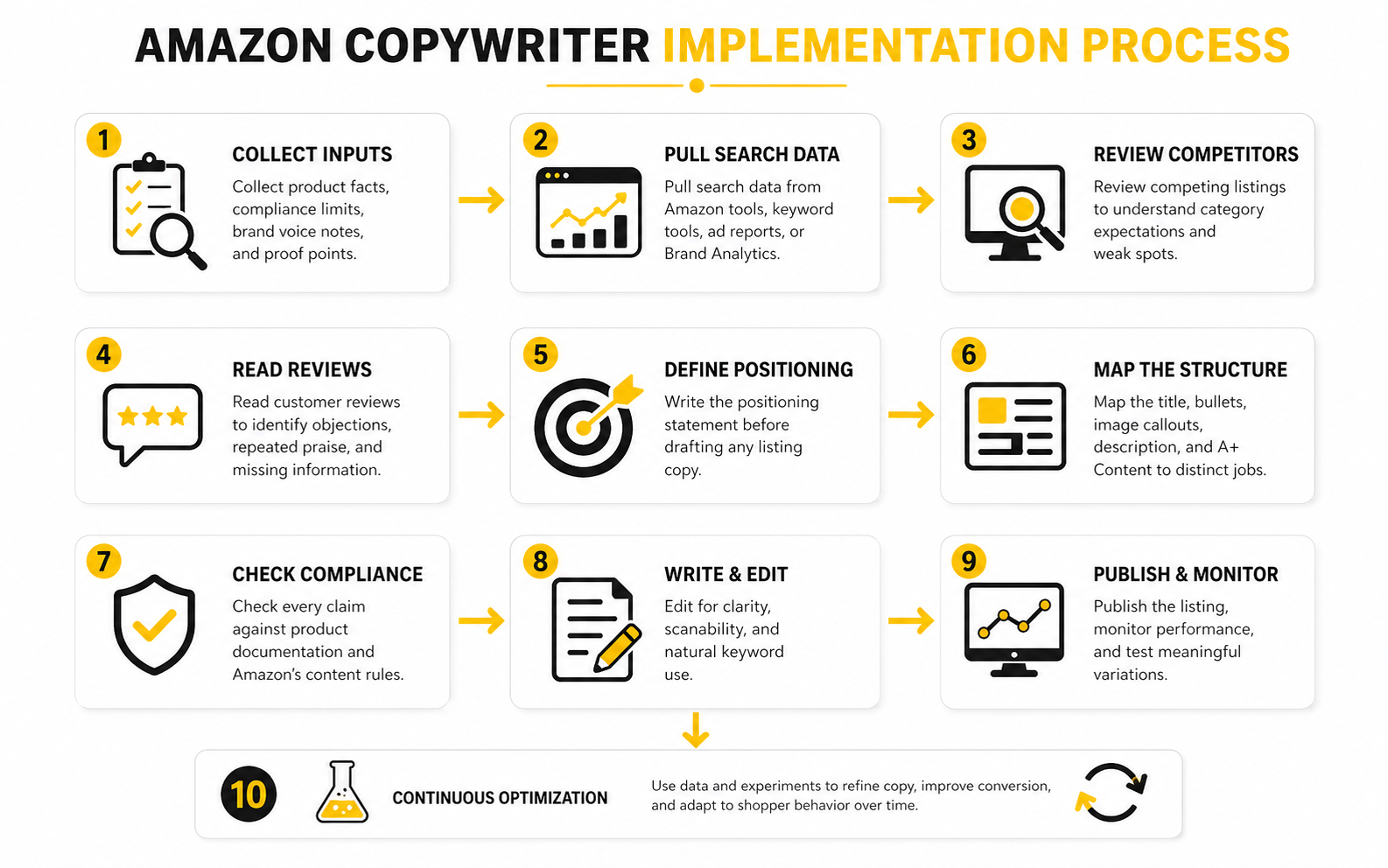
A repeatable process keeps the work clean and prevents random edits from weakening the listing. The exact order may vary by category, but the core sequence should stay consistent.
- Collect product facts, compliance limits, brand voice notes, and proof points.
- Pull search data from Amazon tools, keyword tools, ad reports, or Brand Analytics where available.
- Review competing listings to understand category expectations and weak spots.
- Read customer reviews to identify objections, repeated praise, and missing information.
- Write the positioning statement before drafting any listing copy.
- Map the title, bullets, image callouts, description, and A+ Content to distinct jobs.
- Check every claim against product documentation and Amazon’s content rules.
- Edit for clarity, scanability, and natural keyword use.
- Publish, monitor performance, and test meaningful variations when enough traffic exists.
This is where an amazon copywriter becomes more than a writer. They become the person connecting research, merchandising, compliance, and conversion. That role matters because random copy changes can create real risk: lower clarity, weaker search relevance, rejected content, or claims the brand cannot defend.
Keep Compliance Inside The Process
Compliance should not be a final pass after the copy is already written. It should shape the copy from the start. Amazon’s product detail page rules say titles, descriptions, and bullet points must be accurate, trustworthy, and not misleading product detail page rules.
That means a copywriter should avoid unsupported superlatives, medical-style promises, competitor attacks, fake urgency, warranty claims that are not documented, or benefits the product cannot consistently deliver. Strong copy does not need those shortcuts. In fact, the more specific and useful the copy becomes, the less it needs hype.
This is also why product input matters. The copywriter needs real materials, dimensions, certifications, ingredients, compatibility details, usage limits, care instructions, and package contents. If the brand cannot prove it, the copy should not lean on it.
Prepare The Listing For Testing
The first version of the listing should be built with future testing in mind. That means the copywriter should know which parts are strategic hypotheses, not permanent truths. Maybe the market responds better to durability than convenience, or maybe the strongest objection is fit rather than price.
Amazon’s Manage Your Experiments tool lets eligible brands run A/B tests on listing content and compare versions to see which performs better Manage Your Experiments. That matters because the best copy is not always the copy the team likes most. It is the copy that helps more qualified shoppers understand the offer and buy with confidence.
Part 4 will move from process into the actual listing components. Now that the framework is clear, the next step is breaking down how the title, bullets, images, description, and A+ Content should work together without repeating the same message everywhere.
Statistics And Data
Measurement is where Amazon copywriting becomes honest. A listing may sound better after a rewrite, but the data tells you whether shoppers are actually finding it, clicking it, understanding it, and buying it. That is why an amazon copywriter should care about performance signals, not just word choice.
The mistake is treating every metric like a scoreboard. Metrics are diagnostic tools. Each number points to a different part of the listing, and the real skill is knowing which part to fix.
Amazon reported $638 billion in 2024 net sales, which shows the scale of the marketplace and why small listing improvements can matter when a product has meaningful traffic. But scale also creates competition. Better copy matters because your listing is being judged beside many similar options, often within seconds.
The Metrics That Actually Matter
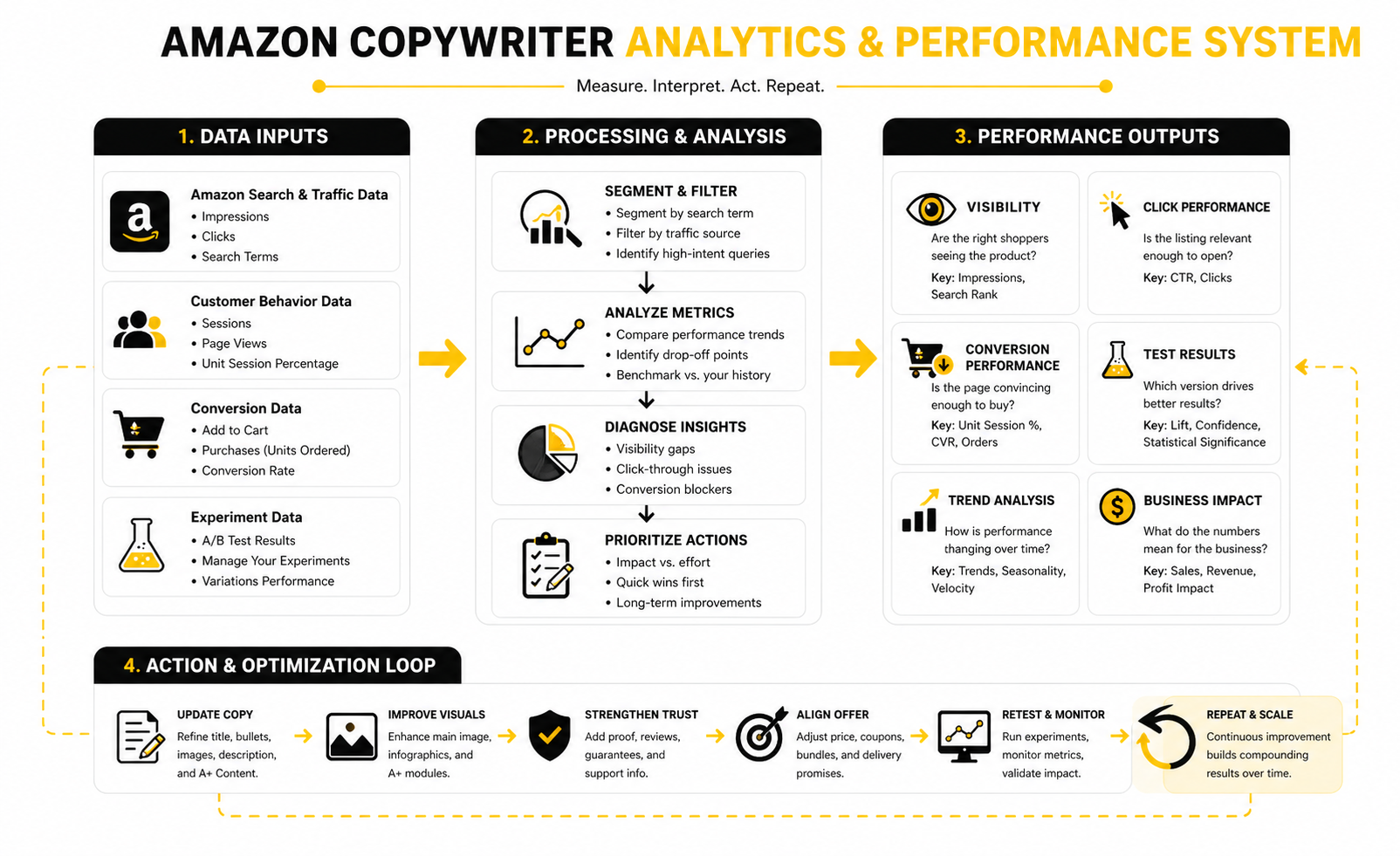
The most useful Amazon listing metrics usually fall into four groups: visibility, click behavior, conversion behavior, and testing results. Visibility shows whether the product is being found. Click behavior shows whether the offer looks relevant enough to open. Conversion behavior shows whether the page answers the shopper’s questions well enough to buy.
Search Query Performance inside Amazon Brand Analytics is especially useful because it connects search terms to impressions, clicks, cart adds, and purchases. That lets you see whether a keyword is only attracting attention or actually driving buying behavior. A keyword with many impressions but weak purchases may need better positioning, clearer images, or a more relevant promise.
Business reports and sales dashboards add another layer. Sessions, page views, ordered units, and unit session percentage help show whether the listing is converting the traffic it already receives. If sessions rise but unit session percentage drops, the problem may not be visibility; it may be mismatch, weak proof, poor pricing context, or copy that attracts the wrong shopper.
How To Interpret Visibility Data
Visibility data answers a simple question: are the right shoppers seeing the product? If impressions are low across important search terms, the listing may need stronger keyword coverage, better category relevance, or more advertising support. But an amazon copywriter should not respond by stuffing keywords everywhere.
The better move is to identify which terms match real buyer intent. A broad keyword may bring traffic, but a specific keyword may bring shoppers who understand the product and are closer to purchase. Copy should prioritize relevance over volume because irrelevant visibility can waste ad spend and distort performance.
This is where title strategy matters. The title should include the clearest product identity and the most important search language, but it still has to read naturally. If the title wins impressions but loses the click, it is not doing its full job.
How To Interpret Click Data
Click-through behavior shows whether shoppers believe the product is worth opening. If impressions are healthy but clicks are weak, the issue often sits in the title, main image, price, rating, review count, coupon, or visible offer details. Copy is only one part of that first impression, but it is still a major one.
The title should make the product instantly understandable. The visible offer should not create confusion. If the shopper has to work too hard to understand what the product is, they will usually choose a clearer competitor.
This is why an amazon copywriter should review search results, not only the product detail page. The listing has to compete before the shopper even lands on it. A beautiful bullet section does not matter if the title and main image fail to earn the click.
How To Interpret Conversion Data
Conversion data shows whether the listing page is doing its job after the click. If sessions are strong but sales are weak, the shopper arrived interested and left unconvinced. That is where the bullets, image callouts, description, A+ Content, reviews, price, and offer stack all need to be reviewed together.
A low conversion rate does not automatically mean the copy is bad. It may mean the product is overpriced, the reviews expose a product issue, the images do not show enough detail, or the offer is weaker than the category standard. The copywriter’s job is to separate message problems from product and offer problems.
Still, copy often plays a direct role. If the bullets are vague, the images miss key objections, or the A+ Content repeats brand fluff instead of answering buying questions, conversion suffers. The fix is not more words. The fix is sharper information in the right place.
What Testing Should Prove
Testing should answer a specific question, not satisfy curiosity. Amazon’s Manage Your Experiments lets eligible brands test listing content so decisions can be based on performance rather than internal opinions. That is useful because teams are often too close to the product to know which message customers will respond to.
A good test isolates one meaningful change. For example, test a clearer title against a benefit-led title, or a comparison-focused A+ module against an education-focused version. If too many things change at once, the result may be interesting but hard to act on.
The best tests are connected to a hypothesis. If shoppers seem confused about compatibility, test copy that makes compatibility more visible. If reviews praise durability, test whether putting durability higher in the message hierarchy improves performance.
Benchmarks Need Context
Benchmarks can be useful, but they are dangerous when treated as universal rules. A strong conversion rate in one category may be weak in another. A premium product, a consumable product, and a technical accessory can behave very differently.
The right benchmark is usually your own trend line. Compare the listing before and after meaningful changes, then look at traffic quality, seasonality, price changes, ad mix, review changes, and inventory status. Without that context, you can easily credit copy for a result caused by something else.
This is why measurement should be practical, not theatrical. The goal is not to produce a dashboard that looks impressive. The goal is to know what to change next.
Turning Data Into Copy Decisions
Data should lead to specific writing decisions. If a high-intent keyword gets impressions but few clicks, improve the title and search-result relevance. If clicks are strong but cart adds are weak, sharpen the first image stack and bullet hierarchy. If cart adds happen but purchases lag, review trust signals, offer clarity, pricing context, and objections.
For external traffic campaigns, the same logic applies before shoppers reach Amazon. A landing page built with Replo can pre-sell the product, explain bundles, or educate shoppers before sending them to the marketplace. That only works if the message stays consistent from ad to page to Amazon listing.
An amazon copywriter who understands analytics becomes much more valuable because they are not just delivering copy. They are helping the brand make better decisions. The words improve because the diagnosis improves.
Professional Implementation For Brands And Agencies
Professional Amazon copywriting gets harder when there are multiple products, multiple stakeholders, and multiple opinions. One person wants more keywords. Another wants stronger brand language. Someone else wants the copy to match the packaging exactly, even when the packaging was never written for Amazon shoppers.
This is where process matters. An amazon copywriter working with a brand or agency needs a repeatable system for inputs, approvals, compliance checks, and performance reviews. Without that system, every listing becomes a messy debate instead of a focused business asset.
The goal is not to make the copy more complicated. The goal is to make the workflow cleaner so better copy can survive review, publishing, and optimization.
Build A Source Of Truth Before Writing
The first scaling problem is product information. If dimensions, materials, compatibility, ingredients, certifications, package contents, and warranty details live in different documents, the listing will eventually become inconsistent. That creates confusion for shoppers and risk for the brand.
Amazon’s listing quality guidance emphasizes that a high-quality detail page needs clear product titles, images, brand information, descriptions, and bullets that help with discoverability and customer clicks Amazon listing quality best practices. That only works if the team gives the copywriter clean inputs. Guessing is not strategy.
A practical source of truth should include product facts, approved claims, banned claims, competitor notes, keyword priorities, brand voice rules, image requirements, and compliance notes. This does not need to be fancy. It just needs to be accurate, accessible, and kept up to date.
Decide What Should Be Standardized
Scaling Amazon copy does not mean every listing should sound identical. It means the structure should be consistent while the message stays specific to each product. That distinction matters.
For a brand with many SKUs, standardized fields can save time and reduce errors. Titles may follow a category-specific pattern, bullets may follow a consistent benefit order, and A+ Content may use repeatable modules for comparison, education, brand trust, and product range navigation. The shopper should feel consistency without feeling like every product page was copied from the same template.
The tradeoff is flexibility. If the template becomes too rigid, it can bury what makes an individual product different. A senior amazon copywriter knows when to follow the system and when the product needs a custom angle.
Manage Compliance Without Killing The Sale
Compliance is not the enemy of conversion. Sloppy claims are. Amazon’s product detail page rules require listing content to be accurate, trustworthy, clearly written, and not misleading product detail page rules.
That does not mean the copy has to be bland. It means every strong claim needs a basis. If the product has a tested material, a documented compatibility range, a clear ingredient profile, or a specific design advantage, use that. Specific proof is usually more persuasive than generic hype anyway.
The risky move is trying to win with unsupported language like “best,” “guaranteed,” “cures,” “perfect,” or “number one” when the brand cannot defend it. Amazon’s prohibited claims policy applies across product detail pages, images, descriptions, packaging, and marketing materials, and it expects claims to be truthful and verifiable misleading and prohibited claims. That is not a small detail. It should shape how the copy is written from the first draft.
Handle AI Like A Production Tool, Not A Strategy
AI can speed up drafts, summarize reviews, cluster objections, and generate alternate angles. Used well, it helps a copywriter move faster through the messy middle of the work. Used badly, it creates generic copy that sounds confident but says very little.
The strategic work still belongs to the human. Someone has to decide which claims are allowed, which benefits matter, which keywords are worth prioritizing, and where the listing needs more proof. AI can help with language, but it cannot take responsibility for the accuracy of the product page.
For teams that use AI in the workflow, the rule should be simple: no AI-generated claim goes live without verification. The copywriter should check product facts, Amazon rules, and brand-approved language before anything is published. Speed is useful. Accuracy is non-negotiable.
Align Amazon Copy With The Wider Funnel
Many brands do not rely only on Amazon search. They send traffic from ads, email, influencers, landing pages, social content, and brand websites. That creates a strategic challenge: the message before Amazon has to match the message on Amazon.
If an external campaign promises one thing and the Amazon listing emphasizes something else, the shopper feels the disconnect. A landing page can educate, pre-sell, or explain bundles, but it should not create expectations the Amazon page cannot support. Tools like Replo can help brands build focused pre-sell pages, but the messaging still needs to be aligned with the listing.
The same applies to post-purchase flows. Email, SMS, support scripts, inserts, and review request language should reinforce the real product experience. Copywriting is not just acquisition; it is expectation management.
Know When Copy Cannot Fix The Problem
This is the part many people avoid saying out loud: copy cannot fix everything. If the product has weak reviews, poor imagery, unclear packaging, bad pricing, frequent returns, inventory issues, or a worse offer than the competition, better words will only go so far.
A serious amazon copywriter should be willing to identify those limits. Sometimes the right recommendation is not “rewrite the bullets.” Sometimes it is improve the image stack, adjust the offer, clarify the bundle, fix the product detail, address review complaints, or stop pushing traffic until the page is ready.
That honesty makes the work more valuable. The job is not to decorate a weak offer. The job is to help the brand understand what the shopper needs to believe before buying, then make sure the listing supports that belief with real information.
Create A Review Rhythm
Amazon listings should not be rewritten randomly every week. They also should not be ignored for a year after launch. The best approach is a simple review rhythm based on traffic, sales volume, seasonality, and catalog importance.
High-volume listings deserve more frequent review because small improvements can compound. New launches need tighter monitoring because early data can reveal positioning problems quickly. Older listings should be audited when reviews shift, competitors change their messaging, Amazon policies update, or the brand changes the product.
A practical review rhythm might include monthly checks for priority ASINs, quarterly audits for the wider catalog, and deeper rewrites when performance data points to a real message problem. That keeps optimization disciplined. No random tinkering, no stale listings, and no pretending the first draft is sacred.
Optimization, Testing, And FAQ
Optimization is the final layer of Amazon copywriting, but it is not a finish line. A listing should become sharper as the brand learns more about search behavior, customer objections, review language, competitor movement, and conversion patterns. The first version is the best informed draft; the next versions should be better because they are informed by real market response.
A serious amazon copywriter does not change copy just because someone got bored with it. They look for a reason. If the data points to weak clicks, unclear positioning, poor conversion, or missed customer intent, then the copy deserves attention.
The best optimization work is controlled. Make one meaningful change, connect it to a hypothesis, and measure the result. Amazon’s Manage Your Experiments exists for exactly