

Amazon digital marketing is no longer just “run Sponsored Products and hope the listing converts.” It now covers search ads, retail media, brand stores, creator content, Prime Video, Amazon DSP, lifecycle follow-up, analytics, and the hard operational work behind pricing, inventory, reviews, and conversion rate.
That matters because Amazon has become one of the most powerful advertising ecosystems in the world. Amazon’s advertising services generated $68.3 billion in 2025, and Prime Video now reaches more than 315 million monthly ad-supported viewers globally. This is not a side channel anymore. It is where product discovery, shopper intent, retail data, and media buying now meet.
This guide will break Amazon digital marketing into a practical system. Not theory. Not random PPC tips. A structure you can use whether you are launching your first product, fixing wasted ad spend, or building a full-funnel Amazon growth machine.
Article Outline
- Part 1: Why Amazon Digital Marketing Matters Now
- Part 2: The Amazon Growth Framework
- Part 3: Core Components Of Amazon Digital Marketing
- Part 4: Building Campaigns That Match Shopper Intent
- Part 5: Professional Implementation And Optimization
- Part 6: Measurement, Scaling, Tools, And FAQ
Why Amazon Digital Marketing Matters Now
Amazon is different from most digital marketing channels because the shopper is already close to action. On social platforms, you often interrupt someone. On Amazon, you meet people while they are searching, comparing, reading reviews, checking delivery dates, and deciding what to buy.
That changes the strategy. Good Amazon digital marketing is not only about impressions or clicks. It is about matching the right product, offer, creative, keyword, audience, and landing experience to the exact stage of the buying journey.
The opportunity is bigger than Amazon search alone. Amazon Ads now connects marketplace ads with streaming TV, display, video, brand stores, and measurement tools like Amazon Marketing Cloud. That means brands can build awareness before the search, capture demand during the search, and retarget shoppers after they leave.
Framework Overview
The best way to think about Amazon digital marketing is as a connected growth system. Each part affects the others. A weak listing hurts ad performance. Poor inventory breaks scaling. Bad creative lowers click-through rate. Weak review quality makes traffic expensive.
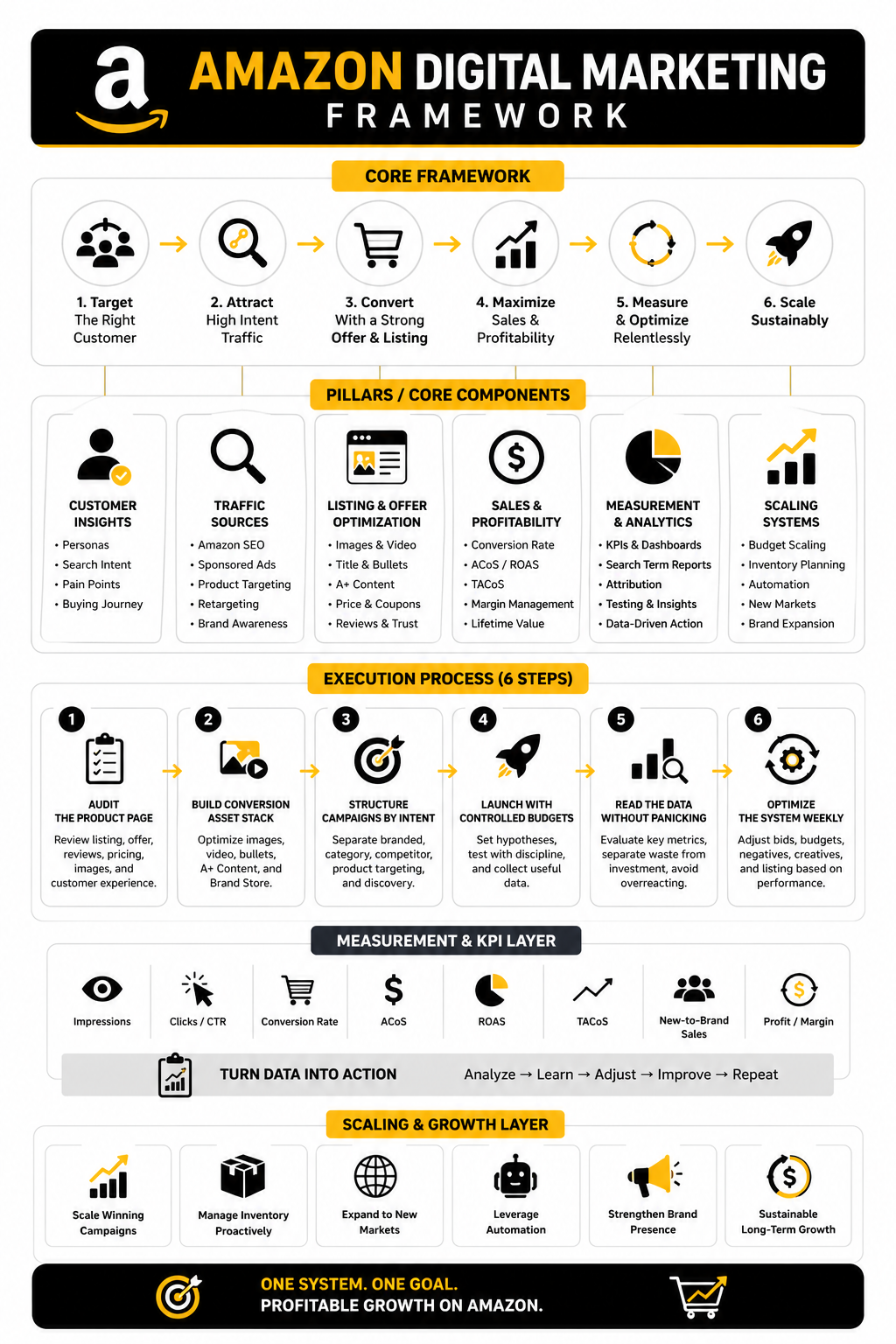
The framework has four layers:
- Market positioning: who the product is for, what problem it solves, and why it deserves attention.
- Conversion assets: product detail pages, images, video, A+ Content, reviews, offers, and brand stores.
- Traffic systems: Sponsored Products, Sponsored Brands, Sponsored Display, Amazon DSP, external traffic, and creator-led discovery.
- Measurement and iteration: keyword data, search term reports, profitability, incrementality, repeat purchase, and funnel performance.
This is why Amazon digital marketing rewards disciplined operators. You are not just buying ads. You are building a marketplace engine where every small improvement compounds.
Core Components
At the center are Sponsored Products, because they capture high-intent searches and usually drive the most direct sales activity. Sponsored Brands help build recognition and push shoppers toward a branded shopping path. Sponsored Display and Amazon DSP expand the system by reaching audiences beyond a single search result.
But ads alone are not enough. The listing must be strong enough to convert the traffic. That means clear product positioning, strong main images, persuasive secondary images, accurate titles, useful bullets, competitive pricing, review quality, and a page experience that answers objections before the shopper hesitates.
External tools can support the wider system when they fit the job. For example, a brand using off-Amazon funnels may build landing pages with ClickFunnels, automate lead capture with GoHighLevel, or use ManyChat for compliant conversational follow-up where it makes sense. The key is simple: every tool must support the Amazon growth system, not distract from it.
Professional Implementation
Professional Amazon digital marketing starts with diagnosis. Before scaling spend, you need to know whether the constraint is traffic, conversion, ranking, offer quality, review strength, margin, inventory, or measurement. Otherwise, ad budgets get blamed for problems they cannot fix.
The implementation process should move in a clear order. First, validate the product page. Then structure campaigns by intent. Then separate branded, category, competitor, and discovery traffic. Then use reporting to cut waste, expand winners, and protect profitability.
The goal is not to “run Amazon ads.” The goal is to build a repeatable system that turns shopper attention into profitable sales. That is what the rest of this article will unpack.
The Amazon Growth Framework
The Amazon growth framework starts with one blunt idea: ads do not fix a weak retail foundation. If the product page is unclear, the offer is not competitive, or the reviews create doubt, more traffic simply exposes the problem faster. That is why Amazon digital marketing has to be built from the product outward, not from the campaign dashboard inward.
A strong framework connects four layers: positioning, conversion, traffic, and measurement. Positioning explains why the product should win. Conversion turns shopper attention into action. Traffic brings qualified demand to the right page. Measurement tells you what to keep, what to cut, and where the next opportunity is hiding.
This matters even more because Amazon is now a full-funnel advertising platform, not only a marketplace search engine. Sponsored ads help brands reach shoppers inside Amazon’s buying environment, while solutions like Brand Stores give brands a dedicated place to showcase products, lifestyle content, and product education. When those pieces work together, the brand is not just chasing sales. It is building a system.
Layer 1: Positioning Before Promotion
Positioning comes first because shoppers make fast decisions. They want to know what the product does, who it is for, why it is different, and whether it feels trustworthy. If those answers are buried, generic, or confusing, the campaign has to work harder than it should.
Good positioning on Amazon is specific. A supplement brand, kitchen tool, skincare product, or office accessory should not sound like every other listing in the category. The product page needs a clear angle that makes comparison easier for the shopper, not harder.
This is where many brands get lazy. They try to win with broad claims, overloaded titles, and bullet points that read like keyword storage. That might check a technical box, but it does not create a buying argument. Amazon digital marketing works better when the page makes the choice feel obvious.
Layer 2: Conversion Assets That Support The Sale
Once positioning is clear, the next layer is conversion. This includes the main image, secondary images, video, title, bullets, A+ Content, price, coupon strategy, review profile, and delivery promise. Each asset should remove friction from the buying decision.
A strong product page does not just describe features. It helps the shopper imagine use, compare alternatives, understand the value, and feel safe clicking the buy button. That means product images need to communicate benefits quickly, not just show the item from five angles.
Brand-owned surfaces matter here too. Amazon says creating and maintaining a Brand Store is free, and it can be used to showcase the full product range, brand story, and lifestyle content. For serious brands, the store becomes more than a nice extra. It becomes the controlled environment where traffic from Sponsored Brands, external campaigns, and retargeting can land with more context.
Layer 3: Traffic That Matches Shopper Intent
Traffic should be organized by intent, not dumped into one messy campaign structure. Someone searching for your brand is different from someone searching a generic category keyword. Someone comparing competitors is different from someone seeing your product through display or video for the first time.
That is why campaigns need separation. Branded search protects demand you already created. Category search helps you compete for active shoppers. Competitor targeting puts your product into comparison moments. Discovery and retargeting help you reach people before or after the exact search.
This is also where Amazon’s broader ad ecosystem becomes useful. Amazon’s advertising services reached $68.3 billion in 2025, which shows how central retail media has become to the company’s business. For brands, the takeaway is simple: the channel is mature enough that random campaign testing is no longer enough. You need structure.
Layer 4: Measurement That Goes Beyond ACoS
ACoS is useful, but it is not the whole story. A campaign can look efficient while limiting growth, or look expensive while helping a product gain rank, visibility, and future sales. The job is to understand what each campaign is supposed to do before judging it.
That means separating efficiency metrics from growth metrics. Branded campaigns should usually be judged differently from non-branded category campaigns. Launch campaigns should be judged differently from mature profitability campaigns. Retargeting should be evaluated differently from cold discovery.
Amazon Marketing Cloud adds another layer for brands that need deeper analysis. Amazon describes it as a clean room environment that helps advertisers work with signals and measurement while protecting underlying data, including through AMC on AWS Clean Rooms. Not every seller needs advanced clean room analysis on day one, but every serious Amazon operator needs the same mindset: measure the role of each activity, not just the last click.
How The Framework Comes Together
The framework works because each layer feeds the next. Better positioning improves conversion. Better conversion makes paid traffic more affordable. Better traffic structure creates cleaner data. Better data helps you improve the product page, campaign mix, and budget allocation.
This is the part most brands miss. They treat Amazon digital marketing as a list of tactics instead of a connected operating system. They optimize bids but ignore images. They test keywords but ignore pricing. They scale ads but run out of inventory. Then they wonder why growth feels unstable.
A professional framework keeps the work grounded. Before spending more, ask what is actually limiting growth right now. If the answer is conversion, fix the page. If the answer is reach, expand traffic. If the answer is profitability, tighten targeting and margin math. That is how Amazon growth becomes manageable instead of chaotic.
Core Components Of Amazon Digital Marketing
Once the framework is clear, the next step is implementation. This is where Amazon digital marketing becomes real work. You stop talking about “growth” in general and start building the assets, campaigns, and feedback loops that create it.
The process should not begin with a random keyword list. It should begin with a practical audit of the product’s ability to win traffic. If the offer is weak, the listing is unclear, or the product is not differentiated, paid traffic will only make those gaps more expensive.
Step 1: Audit The Product Page
The product page is the center of the system. Every ad click, organic search visit, comparison moment, and retargeting touchpoint eventually depends on whether this page earns trust. That means the first implementation step is to review the page like a shopper, not like a seller.
Start with the main image, title, price, rating, review count, delivery promise, and offer clarity. These are the elements shoppers process quickly before they decide whether to continue. Then move deeper into secondary images, video, bullets, A+ Content, and the comparison table if the brand uses one.
Amazon’s own creative guidance emphasizes that strong creative should communicate a clear unique selling proposition and focus on what customers value. That sounds simple, but it is where many listings fall apart. If a shopper needs to work hard to understand why your product matters, the page is not ready for aggressive scaling.
Step 2: Build The Conversion Asset Stack
After the audit, improve the conversion assets in order of impact. The main image has to make the product instantly recognizable. Secondary images should explain use cases, size, ingredients, materials, benefits, and objections. Video should show the product in motion when motion helps the decision.
A+ Content should not be treated as decoration. It should make the product easier to understand and easier to trust. For brand-registered sellers, Amazon’s Brand Stores can also support a stronger shopping path by giving customers a dedicated place to explore the product range and brand story.
This is also where external landing pages can fit, but only when they serve a clear purpose. A brand sending traffic from creators, email, or paid social may use a focused page built in Replo or ClickFunnels before moving shoppers toward Amazon. The page should educate, pre-sell, or capture demand. It should not create an unnecessary detour.
Step 3: Structure Campaigns By Intent
Campaign structure is where discipline starts to show. A clean account separates branded demand, category demand, competitor targeting, product targeting, and discovery. That separation makes the data easier to read and the budget easier to control.
Sponsored Products usually sit closest to purchase intent because they appear in shopping contexts where customers are actively comparing products. Sponsored Brands add more room for brand messaging, with Amazon describing them as ads that can feature a logo, headline, video or lifestyle image, and multiple products across shopping results, product pages, and the homepage. Sponsored Display and DSP can then extend reach across retargeting, audience building, and broader funnel activity.
Do not mix every objective into one campaign. It feels faster at the beginning, but it creates confusion later. When a campaign has multiple jobs, you cannot tell whether it is failing because of the keyword, the product, the bid, the audience, the creative, or the buying stage.
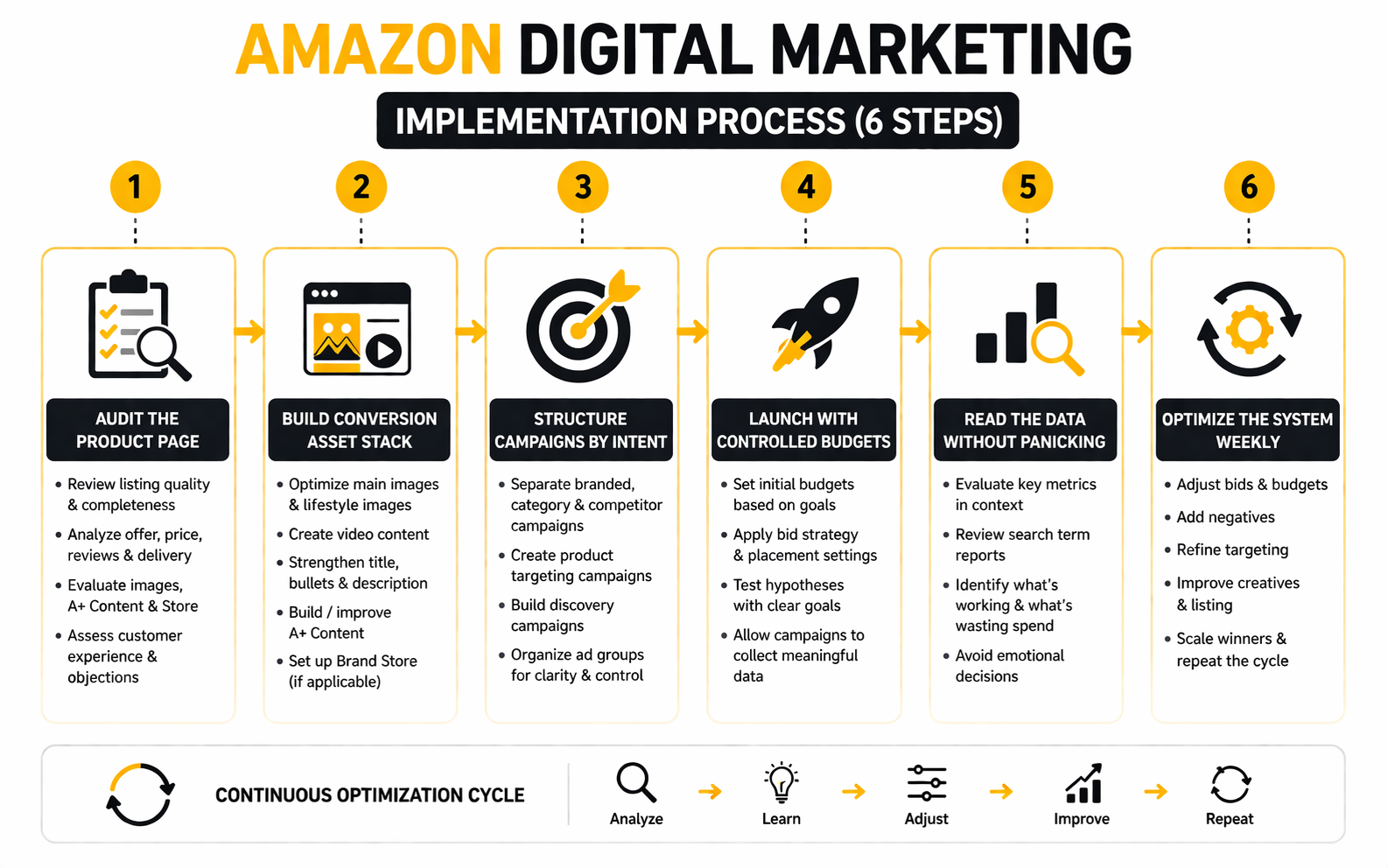
Step 4: Launch With Controlled Budgets
A strong launch does not mean spending blindly. It means giving each campaign enough budget to collect useful data without letting early inefficiency damage the account. You are buying information as much as you are buying traffic.
Start with clear hypotheses. For example, one campaign may test high-intent category keywords, another may test close competitor ASINs, and another may protect branded search. Each campaign should have a reason to exist before it receives budget.
The early goal is to identify search terms, placements, products, and creatives that show signs of quality. That does not mean every test must be profitable immediately. It means every test must teach you something specific enough to act on.
Step 5: Read The Data Without Panicking
Amazon campaign data can tempt brands into overreacting. One bad day does not mean the campaign is broken. One strong day does not mean the campaign is ready to scale. You need enough signal before making serious decisions.
Look at spend, clicks, conversion rate, cost per acquisition, ACoS, TACoS, placement performance, search term quality, and new-to-brand data when available. Each metric has a job. None of them should be used alone.
The most important habit is separating waste from investment. Waste is spend that reaches the wrong shopper or sends people to a page that cannot convert. Investment is spend that helps you learn, rank, retarget, or build profitable demand over time. Confusing those two is one of the fastest ways to either overspend or undergrow.
Step 6: Optimize The System Weekly
Optimization should happen on a rhythm. Weekly reviews are usually enough for most accounts because they give campaigns time to collect data while keeping waste under control. Daily changes can make sense during launches or major promotions, but constant tinkering often creates noise.
The weekly process should include bid adjustments, budget shifts, negative keyword additions, search term harvesting, creative checks, product page reviews, and inventory checks. This is practical work. It is not glamorous, but it is where profitable Amazon digital marketing is built.
The best operators keep improving both sides of the system. They do not only lower bids. They improve images, tighten offers, test Brand Store paths, expand winning keywords, and remove friction from the buying journey. That is how implementation becomes a growth loop instead of a checklist.
Statistics And Data
Data should make Amazon digital marketing easier to manage, not more confusing. The point is not to collect every available metric. The point is to understand which numbers explain shopper behavior, campaign efficiency, and profitable growth.
Amazon’s advertising business gives a useful signal about where the market is heading. The company’s advertising services reached $68.3 billion in 2025, which confirms that brands are putting serious budget behind retail media, streaming, search, and marketplace advertising. That does not mean every brand should spend more tomorrow. It means the channel is competitive enough that weak measurement will get punished.
Benchmarks can help, but they should never replace account-level judgment. A category with expensive clicks, lower conversion rates, or longer consideration cycles will not behave like a low-price impulse product. Treat benchmarks as a warning light, not a verdict.
The Metrics That Actually Matter
Start with the basics: impressions, clicks, click-through rate, cost per click, conversion rate, sales, spend, ACoS, ROAS, and total sales. These numbers explain whether the ad is being seen, whether shoppers care enough to click, whether the product page converts, and whether the economics work. Read together, they tell a story.
A low click-through rate usually points to a mismatch between the shopper’s search and what they see in the ad. That could mean the keyword is too broad, the main image is weak, the price looks wrong, or the product is showing in the wrong competitive set. Do not fix that only with bids. Fix the reason shoppers are ignoring the ad.
A weak conversion rate is different. It usually means the click had some intent, but the product page failed to complete the sale. In that case, look at price, reviews, delivery speed, images, offer clarity, and whether the page answers the shopper’s objections.
How To Read ACoS Without Getting Trapped
ACoS is one of the most watched Amazon ads metrics, but it is also one of the easiest to misuse. A lower ACoS is not always better. A higher ACoS is not always bad.
For branded campaigns, ACoS should often be efficient because the shopper already knows the brand. For non-branded category campaigns, ACoS may be higher because you are competing for new demand. For launch campaigns, ACoS can temporarily rise while the product gathers data, reviews, rank movement, and conversion history.
The real question is whether the campaign has the right job. If the job is profit protection, then tight ACoS matters. If the job is customer acquisition or ranking support, you need to judge the campaign alongside new-to-brand sales, organic lift, total sales, and margin.
Why TACoS Gives A Cleaner Growth Signal
TACoS looks at ad spend compared with total revenue, not only ad-attributed revenue. This matters because Amazon digital marketing should improve the whole business, not just the campaign dashboard. If ads are helping organic sales grow, TACoS can become healthier even while ad spend increases.
A rising TACoS can mean several things. It may signal wasted spend, weaker conversion, more dependence on ads, price pressure, or a launch phase where paid traffic is temporarily carrying growth. You need context before making a decision.
A falling TACoS is also not automatically good. It can mean efficiency is improving, but it can also mean the brand is underspending and missing growth opportunities. The number matters, but the direction and cause matter more.
Build A Measurement System, Not A Report Pile
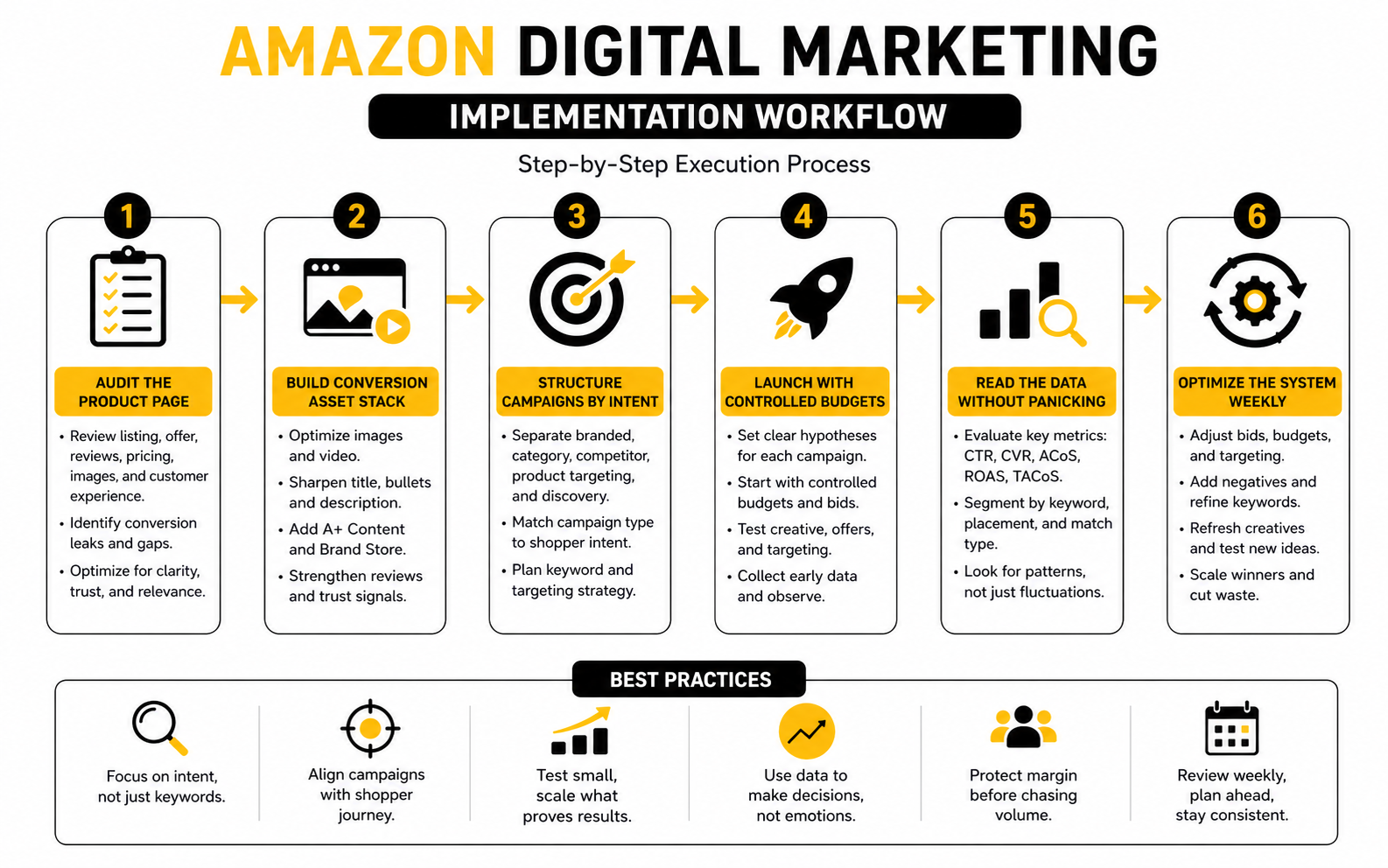
A useful analytics system connects campaign metrics to business decisions. The structure can be simple. Every week, review what happened, why it happened, and what action should follow.
Use this basic measurement flow:
- Traffic signal: impressions, clicks, CTR, and CPC show whether the campaign can attract attention at a reasonable cost.
- Conversion signal: conversion rate, sales, unit session percentage, and product page performance show whether shoppers are buying after they arrive.
- Efficiency signal: ACoS, ROAS, cost per acquisition, and margin show whether the campaign economics are acceptable.
- Growth signal: TACoS, organic sales, ranking movement, repeat purchase, and new-to-brand sales show whether marketing is building the business beyond the immediate click.
- Action signal: bids, budgets, negatives, creative tests, listing updates, and offer changes turn the data into improvement.
This is where tools and dashboards can help, but only if the operator knows what decision the tool is supposed to support. If a brand is running external traffic, landing pages, SMS, email, or lead capture before Amazon, platforms like GoHighLevel, Brevo, or ManyChat can support follow-up and segmentation. The rule stays the same: use tools to clarify action, not to create more noise.
New-To-Brand Data And Customer Acquisition
New-to-brand metrics help brands understand whether ads are reaching existing customers or bringing in first-time buyers. Amazon’s sponsored ads support center explains that new-to-brand metrics are available for Sponsored Brands campaigns and keywords, with Display data available from May 1, 2021 onward. That makes the metric useful for separating demand capture from customer acquisition.
This matters because not every sale has the same strategic value. A repeat buyer may be profitable and important, but a first-time buyer can expand the customer base and create future revenue. If a campaign has a higher ACoS but brings in more new customers, it may still deserve budget.
The mistake is treating all campaign sales as equal. A branded search sale, a category keyword sale, and a new-to-brand sale from a video ad can all show revenue, but they do different jobs. Better measurement helps you fund each job correctly.
What Benchmarks Can And Cannot Tell You
Benchmarks are useful for spotting extremes. If your CPC is far above the category norm, investigate targeting, bids, competition, placement settings, and relevance. If your conversion rate is far below similar products, inspect the product page before blaming the ad platform.
But benchmarks cannot tell you your margin, your inventory risk, your launch strategy, your repeat purchase rate, or your brand strength. That is why they should guide questions, not dictate decisions. A benchmark tells you where to look. Your account data tells you what to do.
The cleanest approach is to build your own benchmark history. Track performance by product, campaign type, season, promotion, and funnel stage. Over time, your own data becomes more valuable than generic averages because it reflects your actual economics.
Turning Data Into Action
Data only matters when it changes behavior. If CTR is weak, improve relevance, main image, pricing, or targeting. If conversion is weak, improve the product page and offer. If ACoS is high but new-to-brand sales are strong, decide whether acquisition is worth the cost.
If TACoS is rising without total sales growth, cut waste and inspect conversion. If total sales are growing while TACoS stays stable, you may have room to scale. If organic sales are improving after paid expansion, the campaign may be doing more than last-click reporting shows.
That is the practical standard. Amazon digital marketing should not be managed by emotion, guesswork, or one isolated metric. It should be managed by a measurement system that tells you what is happening, why it is happening, and what to change next.
Professional Implementation And Optimization
Advanced Amazon digital marketing is mostly about tradeoffs. You are constantly balancing growth against margin, automation against control, and reach against relevance. The brands that scale well are not the ones that chase every new feature. They are the ones that know which constraint they are solving.
At this stage, the work becomes less about launching campaigns and more about operating a system. You need clean rules for budget movement, creative testing, inventory protection, keyword expansion, and profitability. Without those rules, scaling usually turns into expensive guesswork.
Scale Only When The Constraint Is Clear
Scaling should never mean simply increasing budgets across the account. Before spending more, identify what is limiting growth. If impressions are low but conversion is strong, the account may need more reach. If clicks are strong but conversion is weak, the listing or offer needs work. If sales are growing but profit is shrinking, the issue is economics.
This is where many brands make the wrong move. They increase budgets because revenue is up, then realize the extra spend was going into weak keywords, poor placements, or products with thin margins. Growth without control is not scaling. It is leakage.
A cleaner approach is to scale in layers. Expand the strongest campaign types first, then add controlled tests around adjacent keywords, competitor targets, new creatives, and upper-funnel audiences. Each expansion should have a reason, a budget limit, and a success threshold.
Protect Margin Before You Chase Volume
Amazon can make growth look exciting while quietly compressing profit. Ad costs, referral fees, fulfillment costs, discounts, returns, storage, and inventory pressure all affect the real result. A campaign that looks healthy inside the ad console may be weaker once the full margin picture is included.
That is why serious operators work backward from contribution margin. They know the highest ACoS a product can tolerate, the difference between break-even and target profitability, and whether a campaign is meant to drive profit, ranking, launch momentum, or customer acquisition. Without that context, ACoS becomes a blunt instrument.
The practical move is to set campaign goals by product economics. High-margin products can usually support more aggressive acquisition. Low-margin products need tighter targeting, stronger conversion, or bundle strategy. If a product cannot support paid traffic at all, the answer is not clever bidding. The answer is fixing the offer, cost structure, or product mix.
Use Automation Carefully
Amazon’s ad platform continues to move toward more automation, better reporting, and faster optimization workflows. Amazon Marketing Stream provides hourly campaign metrics in near real time through a push-based system, which can help advertisers react faster to pacing, budget, and performance changes. Amazon also introduced unified reporting for campaign analysis across accounts and ad products, with access through the Ads Console, Reporting API, and Amazon Marketing Stream.
That does not mean automation should run the account without judgment. Automation is useful when the strategy is already clear. It is dangerous when the system is messy, the campaign structure is unclear, or the operator does not understand why a rule exists.
Use automation for repeatable decisions, not strategic thinking. Budget pacing, bid adjustments, anomaly detection, and reporting workflows can often be supported by automation. Product positioning, creative direction, margin strategy, and campaign architecture still need human judgment.
Manage Inventory Like A Marketing Variable
Inventory is not separate from marketing. If a product runs out of stock, advertising momentum can break, ranking can suffer, and shoppers can move to competitors. If the brand over-orders, storage pressure and cash flow problems can limit future growth.
Amazon’s Seller University highlights inventory management, advertising, account health, A+ Content, and Brand Analytics as core areas sellers need to understand. That combination matters because stock, content, and ads are connected. You cannot scale a product responsibly if fulfillment cannot support the demand you are creating.
The expert move is to connect campaign planning with inventory planning. Before increasing budgets, check weeks of cover, inbound shipments, seasonality, promotion timing, and fulfillment risk. Strong Amazon digital marketing does not create demand the operation cannot handle.
Separate Testing From Scaling
Testing and scaling need different rules. A test is allowed to be uncertain. A scaled campaign is not. When brands mix the two, they either cut promising tests too early or let weak experiments drain meaningful budget.
A good testing system defines the hypothesis, audience, campaign type, budget, timeline, and decision rule before launch. For example, a Sponsored Brands video test should not be judged the same way as a branded Sponsored Products campaign. A competitor targeting test should not be expected to convert like warm retargeting.
Once a test proves itself, move it into the scaling system. That means cleaner budget allocation, tighter monitoring, and stronger expectations. Keep the experimental budget separate so innovation does not contaminate profitability.
Build A Creative Testing Rhythm
Creative is now a serious performance lever on Amazon. Sponsored Brands, Sponsored Brands video, Store pages, Posts, DSP creative, and streaming placements all reward brands that communicate quickly and clearly. The product page still matters, but the first impression often happens before the shopper arrives there.
The best creative testing starts with shopper objections. What does the customer need to believe before buying? What comparison are they making? What fear or hesitation blocks the purchase? Creative should answer those questions, not just look polished.
A simple testing rhythm works well. Test one clear idea at a time, such as benefit angle, use case, product demonstration, comparison claim, or lifestyle context. Keep winners, retire weak assets, and feed what you learn back into the listing, Store, and external campaigns.
Know When To Add External Traffic
External traffic can help, but it should not be used as a shortcut around weak Amazon fundamentals. If the listing does not convert internal Amazon traffic, sending more visitors from social, search, email, or creators will usually amplify the same weakness. The product page still has to earn the sale.
External traffic makes more sense when the brand has a strong reason to educate before the click. That could mean a product with a longer explanation, a bundle, a high-consideration category, or a creator-led offer that needs context. In those cases, a landing page, email sequence, or guided shopping path can pre-sell the customer before Amazon captures the transaction.
Tools can support that flow when they are used with a clear purpose. A brand might use Replo for a dedicated pre-sell page, GoHighLevel for funnel follow-up, Brevo for email campaigns, or ManyChat for conversational engagement. The tool is not the strategy. The journey is.
Avoid The Most Expensive Scaling Mistakes
Most Amazon scaling problems are predictable. The brand increases spend before fixing conversion. It lets broad campaigns consume budget without clean search term controls. It runs promotions without checking inventory. It optimizes for ACoS while ignoring total profit. Then it reacts too late because the dashboard looked fine at first.
The fix is not complicated, but it does require discipline. Keep campaign structures readable. Review search terms regularly. Track margins outside the ad console. Watch inventory before budget changes. Test creative with a specific learning goal.
Advanced Amazon digital marketing is not about doing more things. It is about making better decisions under pressure. The bigger the account gets, the more important that becomes.
Measurement, Scaling, Tools, And FAQ
The final stage is putting the full system together. Amazon digital marketing works best when the brand can connect listing quality, campaign structure, measurement, inventory, creative, and external demand into one operating rhythm. When those pieces are disconnected, the account becomes reactive.
The mature version of the system is simple to describe but demanding to run. The brand knows which products deserve more budget, which campaigns protect existing demand, which campaigns create new demand, which metrics define success, and which operational limits could slow growth. That clarity is the difference between “running ads” and building a real Amazon growth engine.
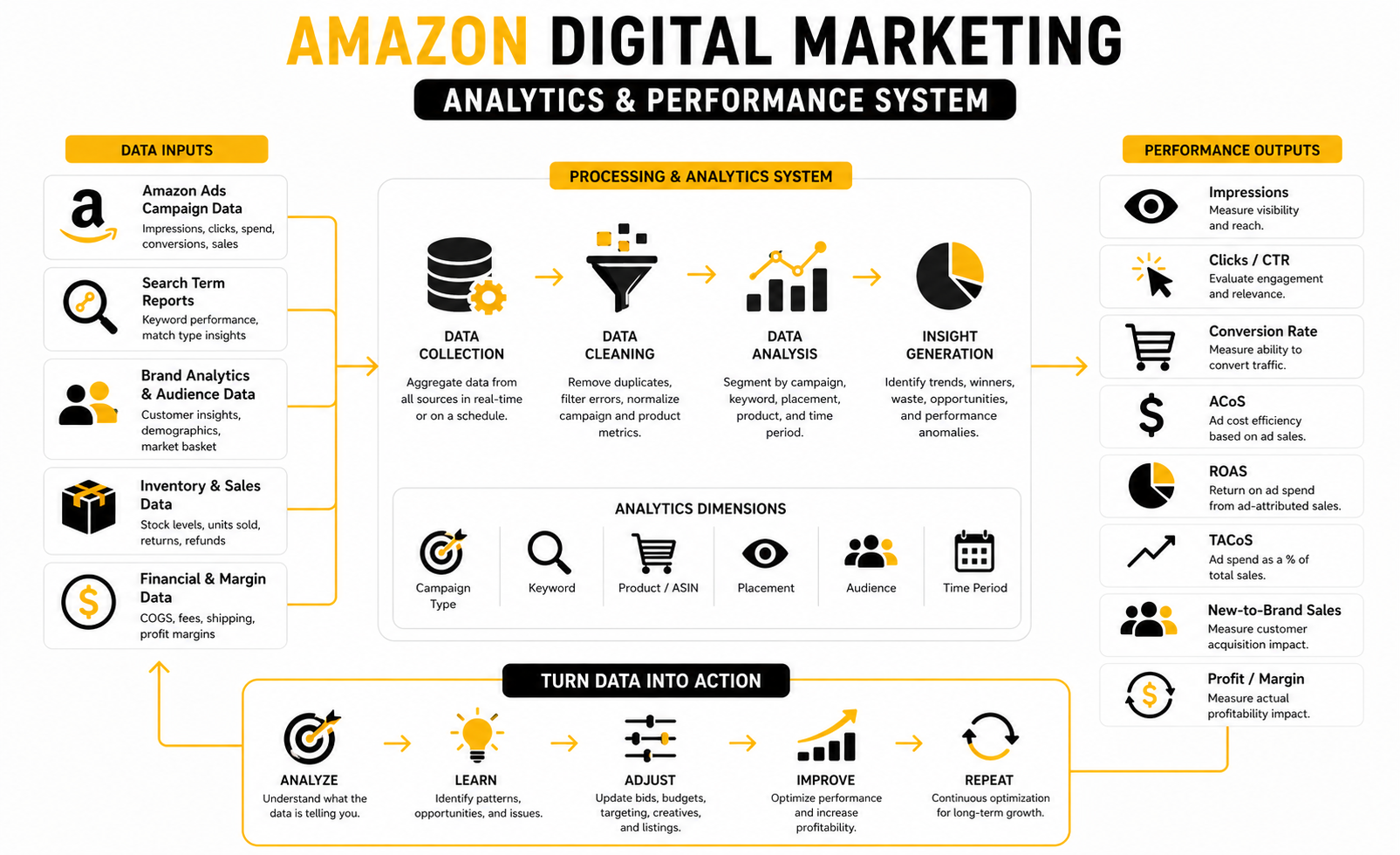
The ecosystem should also extend beyond Amazon when the strategy calls for it. A brand might use Amazon Ads for high-intent marketplace traffic, a Brand Store for controlled discovery, email or SMS for compliant owned follow-up, and external landing pages for education before the Amazon visit. The key is not using every channel. The key is making every channel serve the same commercial goal.
FAQ - Built For Complete Guide
What is Amazon digital marketing?
Amazon digital marketing is the process of using Amazon’s advertising, content, marketplace, and analytics tools to grow product visibility and sales. It includes Sponsored Products, Sponsored Brands, Sponsored Display, Amazon DSP, Brand Stores, A+ Content, product page optimization, and performance measurement. Done well, it connects traffic, conversion, and profitability instead of treating ads as a separate activity.
Is Amazon digital marketing only about paid ads?
No. Paid ads are a major part of the system, but they are not the whole system. Product positioning, images, pricing, reviews, A+ Content, Brand Stores, inventory, and analytics all affect whether paid traffic becomes profitable sales. If the retail foundation is weak, ads usually become more expensive and less predictable.
Which Amazon ad type should beginners start with?
Most brands start with Sponsored Products because they target shoppers inside Amazon’s buying environment. They are useful for testing keyword demand, product targeting, and conversion quality. Once the product page and Sponsored Products campaigns are stable, Sponsored Brands and Sponsored Display can support broader discovery and retargeting.
What is a good ACoS for Amazon ads?
A good ACoS depends on product margin, category competition, campaign goal, and growth stage. A low ACoS may be ideal for branded campaigns or mature profit campaigns. A higher ACoS may be acceptable during launches, category expansion, or customer acquisition if the wider business economics make sense.
How is TACoS different from ACoS?
ACoS compares ad spend with ad-attributed sales. TACoS compares ad spend with total sales. TACoS is useful because it helps show whether ads are supporting overall business growth, not just campaign-level revenue.
Why do Amazon campaigns get clicks but no sales?
Clicks without sales usually mean there is a conversion problem. The keyword may be too broad, the product may be priced poorly, the listing may not answer objections, or the reviews may create doubt. Before cutting every campaign, inspect the product page and offer quality.
Should brands send external traffic to Amazon?
External traffic can work when the product page is strong and the traffic has a clear purpose. It is especially useful when the product needs education, creator context, or a pre-sell journey before purchase. Tools like Replo and ClickFunnels can support that flow when the landing page genuinely improves the buying journey.
How often should Amazon ads be optimized?
Most accounts benefit from a weekly optimization rhythm. That gives campaigns enough time to collect useful data while still controlling waste. During launches, major promotions, or budget-sensitive periods, more frequent checks can make sense.
What should be optimized first: bids or listings?
Listings should usually be reviewed before major bid changes. Bids control traffic cost, but the product page controls whether that traffic converts. If conversion is weak, better images, clearer messaging, stronger offers, and improved page content may produce more impact than bid adjustments alone.
Do small brands need Amazon Marketing Cloud?
Not always. Smaller brands can often start with Amazon Ads reporting, search term reports, Brand Analytics, and clean campaign structures. Amazon Marketing Cloud becomes more useful when the brand needs deeper funnel analysis, audience insights, incrementality analysis, or cross-channel measurement.
What is the biggest mistake in Amazon digital marketing?
The biggest mistake is treating Amazon digital marketing as a set of isolated tactics. Brands often adjust bids, test keywords, or launch video ads without fixing the foundation. The better approach is to connect positioning, conversion, traffic, measurement, and operations into one system.
Can automation manage Amazon ads by itself?
Automation can support Amazon ads, but it should not replace strategy. It can help with budget pacing, bid rules, reporting, and alerts. Human judgment is still needed for positioning, creative direction, offer strategy, product economics, and deciding what the account is actually trying to achieve.
How do reviews affect Amazon marketing performance?
Reviews influence trust, comparison, and conversion. A product with weak review quality may need more traffic to generate the same number of sales as a stronger competitor. Ads can bring shoppers to the page, but reviews often help decide whether those shoppers buy.
How should brands choose Amazon marketing tools?
Choose tools based on the job they need to do. If the goal is landing page testing, use a page builder. If the goal is lifecycle follow-up, use an email, CRM, or automation platform. If the goal is analytics, use reporting tools that clarify decisions. A tool should make the system cleaner, not more complicated.
Work With Professionals
Explore 10K+ Remote Marketing Contracts on MarkeWork.com
Most marketers spend too much time chasing clients, competing on crowded platforms, and losing a percentage of every project to middlemen.
MarkeWork gives you a better way. Browse thousands of remote marketing contracts and connect directly with companies desperate to hire skilled marketers like you, without platform commissions and without unnecessary gatekeepers.
If you're serious about finding better opportunities and keeping 100% of what you earn, explore available contracts and create a profile for free at MarkeWork.com.