

Amazon Marketing Cloud is not just another reporting dashboard. It is Amazon Ads’ privacy-safe clean room for advertisers who need deeper answers than standard platform reports can provide.
That matters because media buying is getting harder to measure. Cookies are weaker, customer journeys are messier, and Amazon’s ad ecosystem now stretches across Sponsored Ads, Amazon DSP, Prime Video, Twitch, Fire TV, and more. The brands that win will not be the ones staring at surface-level ROAS alone; they will be the ones asking better questions.
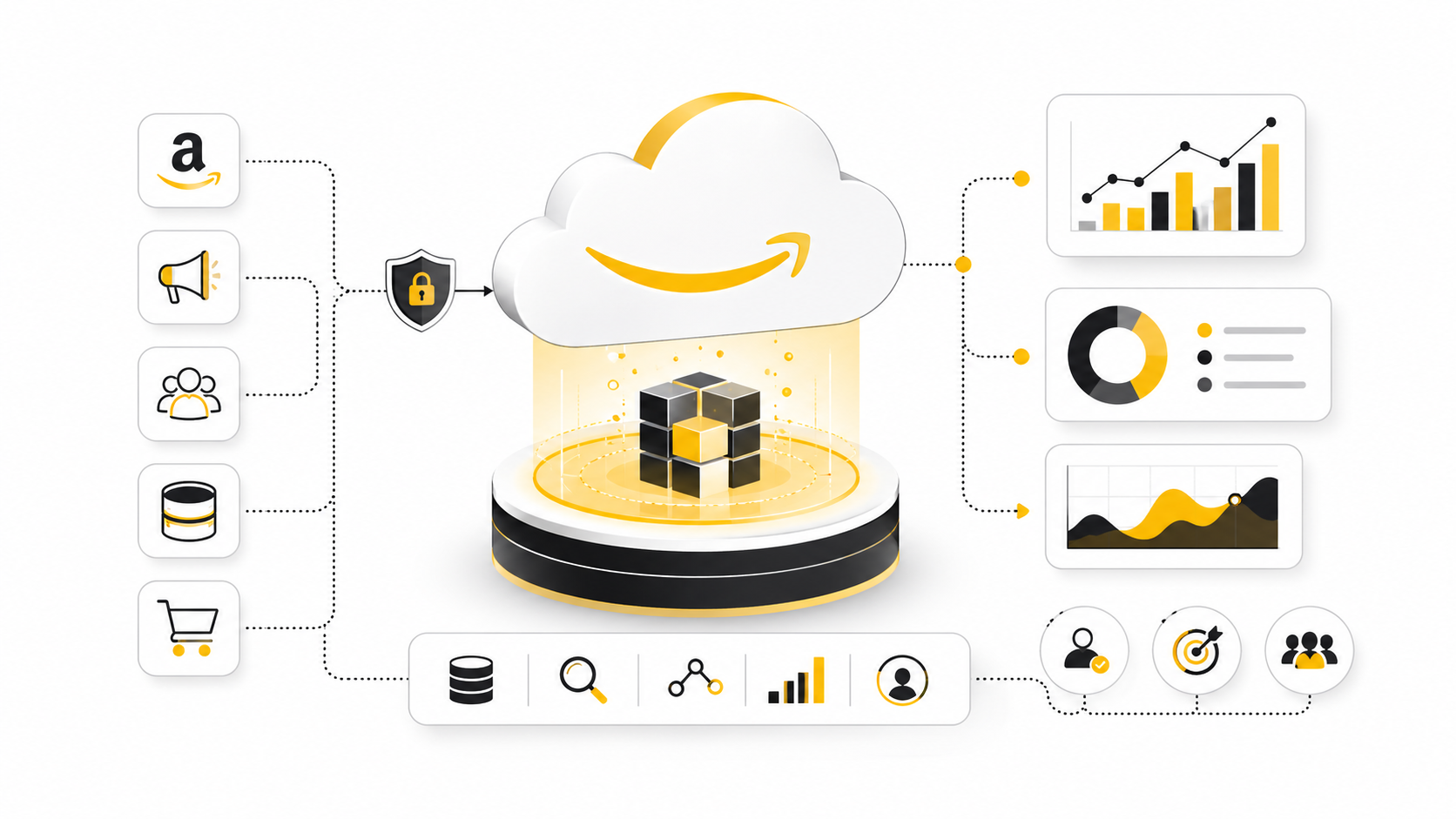
Amazon describes AMC as a way to analyze aggregated, pseudonymized campaign and shopping signals in a dedicated cloud environment through flexible queries, while protecting user-level privacy through aggregation controls and clean room rules: Amazon Marketing Cloud.
Article Outline
This guide is structured as one complete article split across six parts. The goal is to move from strategy to execution without turning Amazon Marketing Cloud into a technical black box. Each section builds on the previous one, so the framework stays practical for marketers, operators, and analytics teams.
- Why Amazon Marketing Cloud Matters Now
- The Amazon Marketing Cloud Framework
- Core Components Of Amazon Marketing Cloud
- What You Can Measure With Amazon Marketing Cloud
- How To Implement Amazon Marketing Cloud Professionally
- Common Mistakes, Best Practices, And FAQ
Why Amazon Marketing Cloud Matters Now
Amazon Marketing Cloud matters because the old measurement model is breaking. A shopper may see a streaming TV ad, ignore a Sponsored Brands placement, click a Sponsored Products ad days later, and finally purchase after comparing several listings. Standard reports can show parts of that path, but they rarely explain the full sequence.
AMC gives advertisers a way to ask more useful questions. Instead of only asking which campaign converted last, teams can analyze reach, frequency, media overlap, new-to-brand behavior, path to purchase, audience quality, and incrementality-style signals inside Amazon’s privacy-safe environment. That shift is important because better measurement changes what gets funded, what gets cut, and what gets scaled.
The practical value is simple: Amazon Marketing Cloud helps teams move from “what happened?” to “why did it happen, and what should we do next?” That is the difference between reporting and decision-making. For serious Amazon advertisers, that difference compounds fast.
The Amazon Marketing Cloud Framework
The best way to understand Amazon Marketing Cloud is to stop thinking about it as a report and start thinking about it as a measurement framework. A normal dashboard answers fixed questions. AMC lets you build the question first, then query the data needed to answer it.
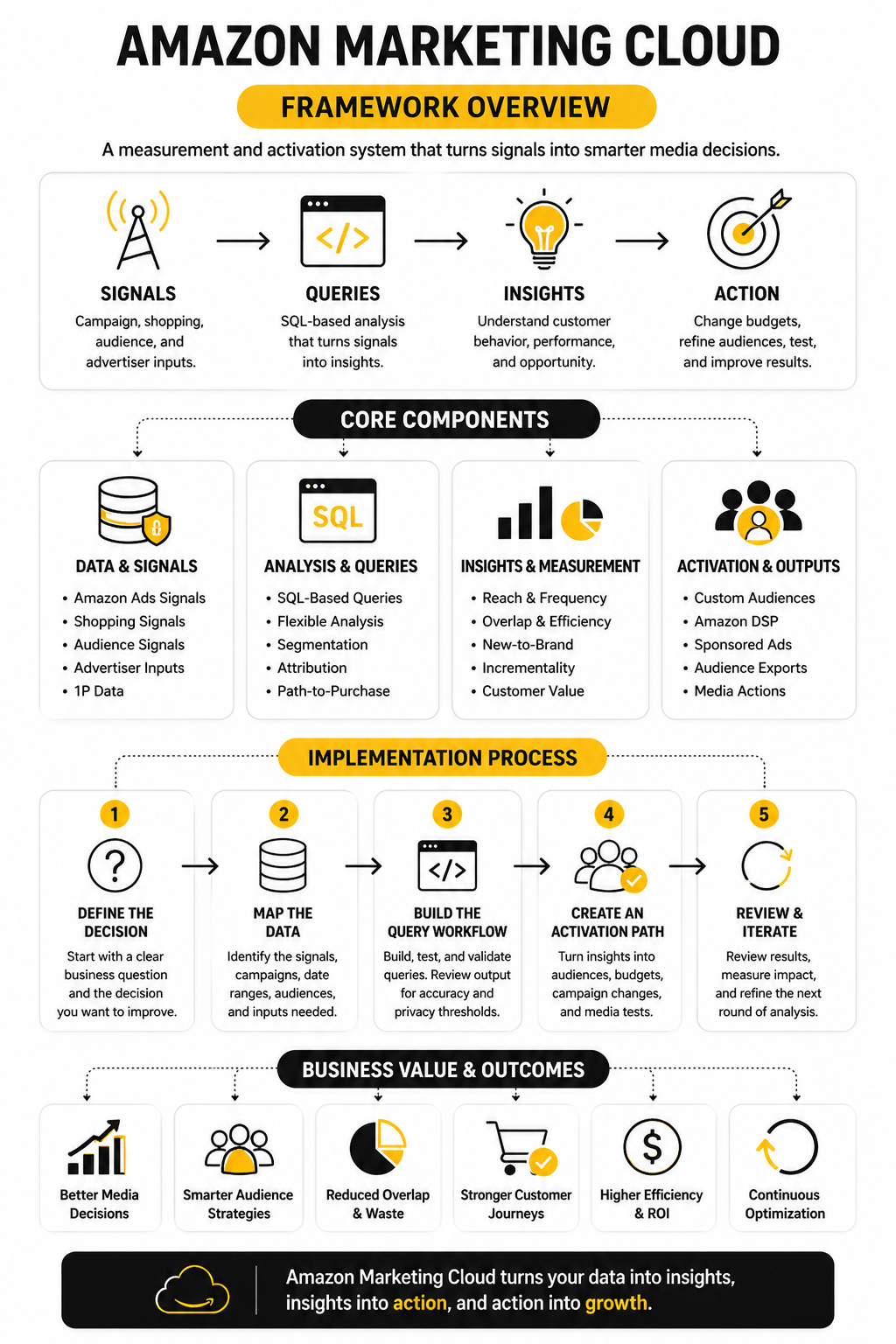
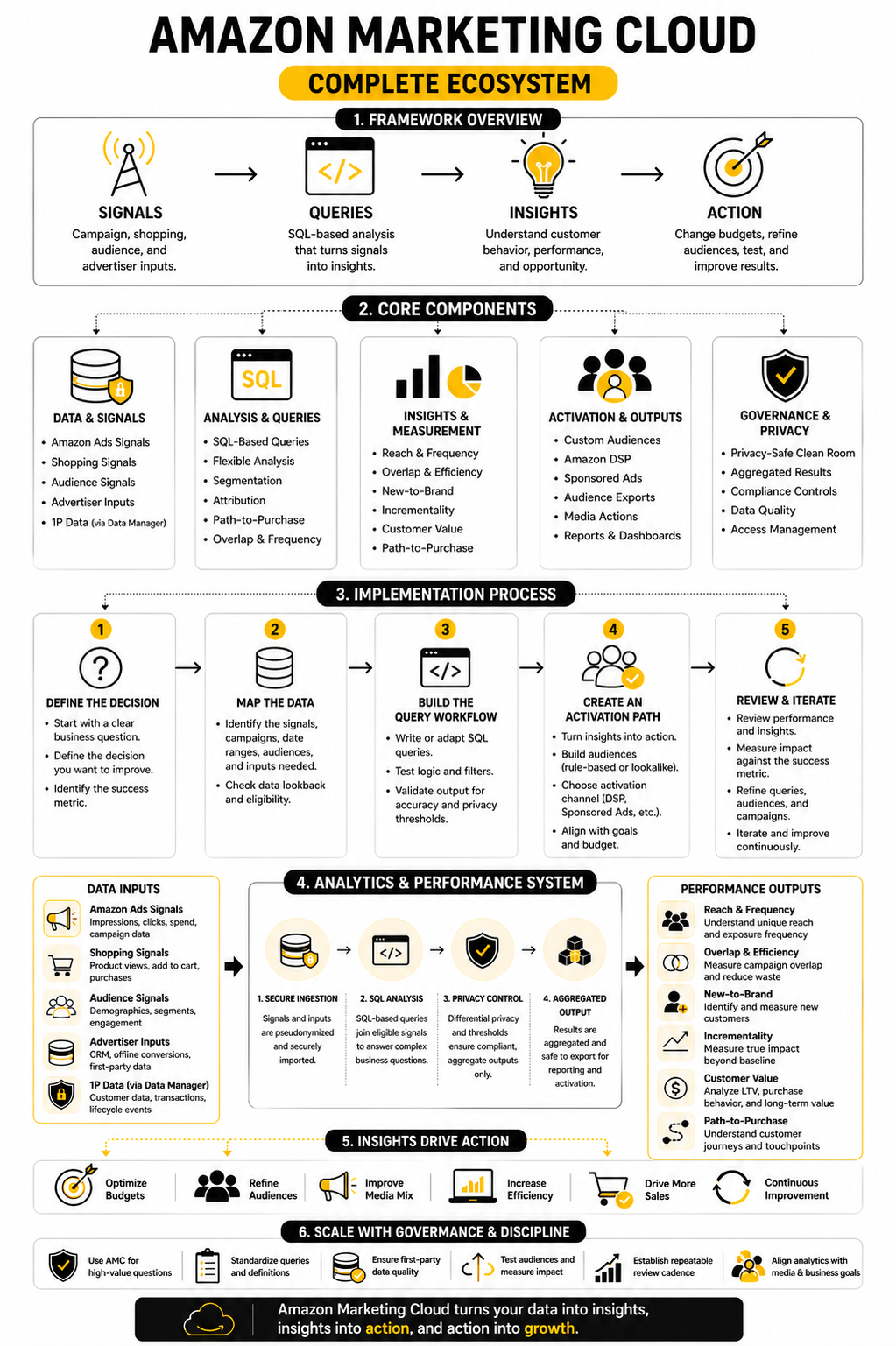
At a practical level, the framework has four layers: signals, queries, insights, and action. Signals are the campaign, shopping, audience, and advertiser-owned inputs available in the clean room. Queries turn those signals into analysis. Insights explain what is happening. Action is where the work becomes useful: changing budgets, refining audiences, improving creative sequencing, or adjusting how campaigns support each other.
That last layer is where many teams fall short. They get excited about advanced reporting, but they never connect the output to a media decision. Amazon Marketing Cloud is only valuable when the insights change what you do next.
Start With The Business Question
A strong AMC workflow starts with a business question, not a SQL query. For example, a weak question is “Can we pull an AMC report?” A better question is “Which campaign combinations are most likely to produce new-to-brand purchases without wasting spend on overexposed shoppers?”
That distinction matters because Amazon Marketing Cloud can become overwhelming fast. There are many possible analyses, but not every analysis deserves time. The goal is not to prove that the team can use AMC; the goal is to find decisions that standard Amazon Ads reporting cannot confidently support.
Good business questions usually sit in one of five buckets:
- Which media touchpoints influence the customer journey?
- Which audiences are worth building or excluding?
- Which campaigns overlap too much?
- Which products or categories benefit from upper-funnel exposure?
- Which buying paths lead to stronger customer value?
Once the question is clear, the technical work becomes much easier. The team knows what data matters, what output format is useful, and what decision the analysis should influence.
Connect Measurement To The Customer Journey
Amazon Marketing Cloud is especially useful because Amazon’s advertising environment is not limited to one ad type. Advertisers may run Sponsored Products, Sponsored Brands, Sponsored Display, Sponsored TV, Amazon DSP, streaming TV, and other placements across Amazon’s broader media ecosystem. Amazon has also expanded AMC access to advertisers running sponsored ads campaigns, including Sponsored Products, Sponsored Brands, Sponsored Display, and Sponsored TV, which makes deeper measurement more accessible beyond enterprise-only teams: Amazon Marketing Cloud for sponsored ads.
That creates a more realistic view of how shoppers actually behave. Someone may first discover a product through streaming TV, later compare products on Amazon, and then convert after seeing a lower-funnel ad. If the team only credits the final click, the upper-funnel investment may look weaker than it really is.
The framework should therefore separate customer journey analysis from basic campaign ranking. A campaign with a lower direct ROAS may still play an important role if it introduces new shoppers, supports branded search, or increases conversion probability later. AMC helps uncover those relationships when the analysis is designed correctly.
Use Privacy-Safe Signals Responsibly
Amazon Marketing Cloud works inside a privacy-safe clean room, which means advertisers can analyze aggregated and pseudonymized signals without receiving raw user-level identity data. Amazon positions AMC as a secure cloud-based environment where advertisers can use Amazon Ads signals, advertiser inputs, and selected third-party provider data for flexible analytics: Amazon Marketing Cloud overview. That is a major reason clean rooms have become more important as traditional tracking gets weaker.
This also means AMC is not a shortcut around privacy rules. It is not there to expose individual shoppers or build invasive profiles. It is there to answer marketing questions using aggregated outputs that meet privacy thresholds.
Professionally, this changes how teams should think about data. The question is not “How much personal data can we extract?” The better question is “What aggregate pattern would help us make a smarter media decision?” That mindset keeps the analysis useful, compliant, and strategically clean.
Turn Insights Into Media Actions
The final part of the framework is action. An AMC insight should lead to a campaign change, an audience change, a budget change, or a testing plan. If it does not, it is probably just an interesting chart.
For example, if a path-to-purchase analysis shows that shoppers exposed to both Sponsored Brands and Amazon DSP convert more efficiently than shoppers exposed to only one touchpoint, the next move is not to celebrate the report. The next move is to test budget allocation, sequence creative more intentionally, or build an audience strategy that supports that path.
This is where Amazon Marketing Cloud becomes a growth system instead of an analytics project. The teams that get the most value from AMC do not treat it as something the analyst team runs once a quarter. They use it as a decision layer that keeps improving how campaigns are planned, measured, and optimized.
Core Components Of Amazon Marketing Cloud
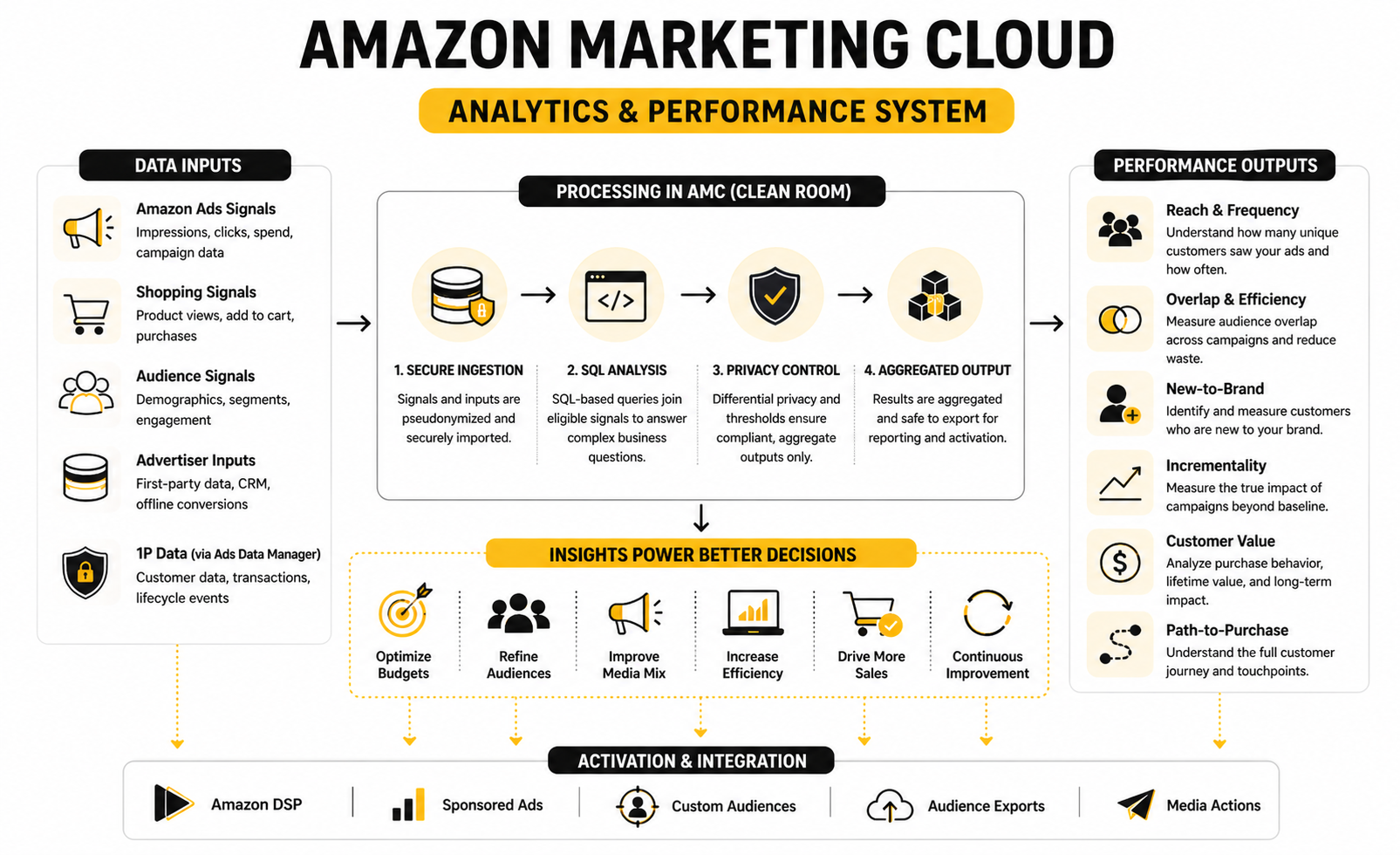
Amazon Marketing Cloud works because it brings several moving parts into one controlled environment. You have Amazon Ads signals, query logic, clean room controls, optional advertiser inputs, and activation paths. Each part matters, but the real value comes from how they work together.
This is where the topic becomes more operational. AMC is not something you “turn on” and instantly use well. You need a process, a clear owner, and a realistic workflow that connects analytics to media execution.
Campaign And Shopping Signals
The foundation of AMC is the data available inside the clean room. This can include Amazon Ads campaign events, impression and click activity, conversion signals, and shopping-related events depending on the advertiser setup and eligible datasets. Amazon’s own documentation shows AMC SQL examples for analyzing impressions, clicks, spend, conversions, campaign overlap, frequency, and paths across available tables: Amazon Marketing Cloud SQL examples.
The important thing is to treat these signals as ingredients, not answers. Raw access to more data does not automatically create better decisions. You still need to define which signals are relevant to the business question and which ones are just noise.
For most teams, the first useful layer is campaign performance by audience, exposure, frequency, and conversion path. That gives you a cleaner view of how different Amazon media investments support each other. Once that foundation is stable, you can move into more advanced work like custom audience creation, first-party data matching, and modeled analysis.
Query Logic And Analysis Design
AMC uses SQL-based analysis, which means the quality of the answer depends heavily on the quality of the query. This is not a bad thing. It gives the team flexibility that fixed dashboards cannot offer.
The mistake is jumping straight into complex queries before the measurement logic is clear. A query should reflect a business rule. For example, if you want to understand frequency, you need to define the exposure window, campaign set, audience condition, and conversion event before anyone writes the final SQL.
Strong analysis design usually includes:
- A clear question
- A defined date range
- A specific set of campaigns or ad products
- A conversion event or outcome
- A segmentation rule
- A decision the output will support
That may sound basic, but it prevents a lot of wasted work. Amazon Marketing Cloud rewards disciplined thinking. The cleaner the question, the cleaner the query.
First-Party Data Inputs
One of the more powerful parts of Amazon Marketing Cloud is the ability to bring advertiser-owned signals into the clean room when the setup supports it. Amazon has expanded first-party data workflows through Ads Data Manager, which is designed to help advertisers use their own data for audiences, measurement, and optimization inside Amazon Ads: Ads Data Manager.
This matters because Amazon data alone may not tell the full customer story. A brand might have CRM segments, email engagement, loyalty tiers, lead forms, or offline customer attributes that help explain which shoppers are more valuable. When those inputs are handled correctly, AMC can support sharper audience analysis and more useful measurement.
The professional standard is simple: only upload data that is permitted, clean, and strategically useful. Do not dump messy customer files into the process because “more data sounds better.” Bad inputs create bad analysis, and in a clean room workflow, the cleanup work must happen before the data is used.
How To Implement Amazon Marketing Cloud Professionally
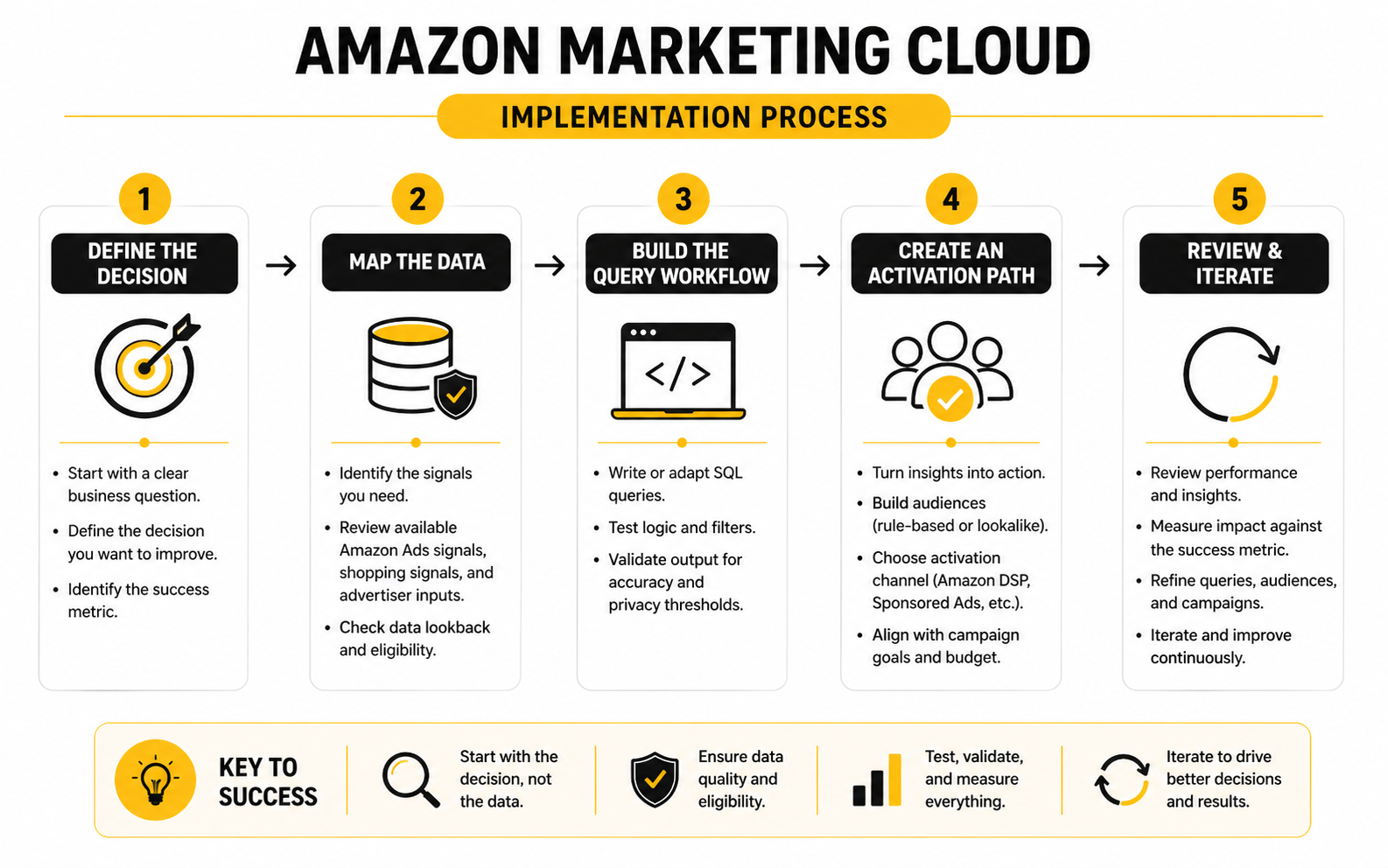
A good AMC implementation is not a one-off analytics task. It is a repeatable operating system for asking better questions, running clean analysis, and turning findings into media decisions. That requires a simple process everyone can understand.
Step 1: Define The Decision Before The Query
Start with the decision you want to improve. This could be budget allocation, audience targeting, campaign sequencing, creative planning, or retail media measurement. The decision must be specific enough that the output can change what the team does.
For example, “understand performance” is too vague. “Identify whether DSP exposure improves new-to-brand conversion when paired with Sponsored Brands” is much stronger. That kind of question gives the analyst a real target and gives the media buyer a reason to care about the result.
This step also keeps Amazon Marketing Cloud from becoming a curiosity project. The goal is not to produce impressive-looking analysis. The goal is to make a better decision than you could have made from standard reports alone.
Step 2: Map The Required Data
Once the decision is clear, map the data needed to answer it. This includes the Amazon Ads campaigns, ad products, date ranges, audience conditions, conversion events, and any advertiser-owned inputs. If a dataset is not needed for the decision, leave it out.
This is also where teams should check whether the question can be answered inside AMC at the required level of detail. Clean room outputs are aggregated and privacy-protected, so not every idea will be possible in the exact format someone imagines. That is normal, and it is better to discover the limitation before the analysis is half-built.
A practical data map should answer three questions. What signals are needed? Where do those signals live? What rule connects them to the decision? If those answers are fuzzy, the implementation will be fuzzy too.
Step 3: Build The Query Workflow
After the data map is clear, the team can build the query workflow. Start with a simple version of the analysis before adding more segmentation. A basic working query is more useful than a sophisticated broken one.
Amazon provides instructional queries and examples for AMC, including campaign-level performance, overlap, frequency, and conversion analysis: AMC instructional queries. These are useful starting points, but they should not be treated as finished strategy. The team still needs to adapt the logic to the brand, campaign structure, and business question.
A strong workflow usually moves in this order:
- Validate the available campaigns and date ranges.
- Pull a simple performance baseline.
- Add the segmentation needed for the question.
- Check whether the output passes privacy and aggregation rules.
- Review the result with the media owner.
- Turn the insight into a test or campaign change.
That sequence keeps the process grounded. It also reduces the risk of building complex reporting that no one uses.
Step 4: Create An Activation Path
Amazon Marketing Cloud becomes more powerful when the insight can feed action. AMC custom audiences can be used for Amazon DSP and, where eligible, for sponsored ads workflows such as Sponsored Products bid boosts, Sponsored Brands bid boosts, and display targeting: AMC custom audiences. That makes AMC useful not only for measurement, but also for audience strategy.
The key is to define the activation path before the analysis is complete. If the result identifies a high-value audience, where will that audience be used? If the analysis finds wasted overlap, which budget will move? If the path-to-purchase insight reveals a useful sequence, which campaign structure will test it?
This is where AMC turns from analytics into execution. A report sitting in a folder does not grow revenue. A measurement insight connected to a media action has a chance to do that.
What You Can Measure With Amazon Marketing Cloud
Measurement is where Amazon Marketing Cloud earns its place. Not because it gives you more numbers, but because it helps you interpret the numbers with more context. That context is what separates a useful analytics system from another dashboard nobody trusts.
The most important shift is moving away from single-metric thinking. ROAS still matters, but it does not explain reach quality, media overlap, shopper progression, frequency waste, or whether a campaign is creating new demand instead of harvesting existing intent. AMC gives teams a cleaner way to connect these signals and decide what the data should actually change.
Statistics And Data That Actually Matter
Amazon’s advertising business is now too large to measure casually. Amazon’s full-year advertising revenue reached $56.2 billion in 2024, while Amazon’s total revenue grew from $575 billion to $638 billion in the same year. The takeaway is not just that Amazon Ads is growing; it is that retail media is now a serious budget line that needs serious measurement.
That matters for decision-making because larger budgets expose weaker analytics. When a brand spends lightly, rough directional reporting may be enough. When the budget grows across Sponsored Ads, DSP, streaming TV, and display, shallow reporting starts creating expensive blind spots.
Amazon also expanded AMC measurement by allowing eligible brands to query up to five years of Amazon store purchase signals, up from a 13-month lookback window. That changes the type of analysis teams can run. Instead of only studying short-term conversion windows, brands can examine longer purchase cycles, repeat behavior, customer development, and how media exposure relates to future value.
Reach And Frequency
Reach tells you how many unique people were exposed to a campaign. Frequency tells you how often those people were exposed. On their own, both numbers are simple. Inside Amazon Marketing Cloud, they become more useful because you can connect them to conversion behavior, new-to-brand activity, and campaign overlap.
The action is straightforward. If frequency rises while conversion quality does not improve, you may be overexposing the same audience. If low frequency appears across high-consideration products, you may not be giving shoppers enough repeated exposure to build confidence.
This is not about chasing a universal “perfect frequency.” That number depends on category, price point, product familiarity, creative quality, and campaign role. AMC helps you find the range where additional exposure starts helping less, so the team can redirect spend before waste becomes normal.
Path To Purchase
Path-to-purchase analysis is one of the most practical uses of Amazon Marketing Cloud. It helps you understand how different ad interactions show up before a conversion. That is especially valuable when upper-funnel and lower-funnel campaigns are running at the same time.
The wrong way to read path data is to treat it like a simple winner-takes-all attribution report. The better way is to identify patterns. Which touchpoint combinations show up before stronger outcomes? Which sequences introduce shoppers earlier? Which campaigns appear to assist without receiving enough credit in normal reports?
This should drive campaign architecture. If one media mix repeatedly supports better new-to-brand conversion, test a budget shift toward that mix. If a campaign only performs when another campaign runs before it, stop judging it in isolation. The point is not to admire the path; the point is to design a better one.
New-To-Brand And Customer Quality
New-to-brand metrics help teams separate demand creation from demand capture. A campaign that produces efficient sales from existing customers may be useful, but it is not doing the same job as a campaign that brings in buyers who have not purchased from the brand before. Amazon Marketing Cloud helps analyze that distinction with more depth than a simple campaign table.
This matters because growth usually requires both efficiency and expansion. If every budget decision is based only on short-term ROAS, the team may slowly bias toward harvesting buyers who were already close to purchase. That can make the account look efficient while the brand becomes less aggressive about acquiring future customers.
The action is to assign campaigns a job. Some campaigns should be judged by profitable conversion. Others should be judged by their ability to introduce qualified new shoppers. When AMC shows the difference clearly, budget conversations become much more rational.
Incrementality Signals
Amazon Marketing Cloud is not a magic incrementality machine. It can support stronger incrementality-style thinking, but teams still need careful test design, comparison logic, and disciplined interpretation. This is important because marketers often want one number that proves everything, and that is not how serious measurement works.
A useful approach is to compare exposed and unexposed groups where appropriate, review conversion timing, and look for whether media exposure is associated with stronger outcomes after controlling for the analysis conditions. Amazon also offers measurement products such as Amazon Brand Lift, which can help advertisers understand upper- and mid-funnel campaign impact beyond direct conversion reporting. AMC can sit alongside these tools as part of a broader measurement system.
The action here is caution plus confidence. Do not overclaim what the data cannot prove. But do use the evidence to decide what deserves a structured test, what deserves more budget, and what should be cut before it keeps draining spend.
Advanced Considerations For Scaling Amazon Marketing Cloud
Once the basics are working, Amazon Marketing Cloud becomes less about access and more about operating discipline. The teams that scale it well do not simply run more queries. They build a measurement rhythm that supports bigger decisions without creating noise.
This is where the work gets more strategic. You are no longer asking, “Can we measure this?” You are asking, “Is this measurement worth the operational cost, and will it change what we do?” That question keeps AMC focused on growth instead of turning it into a reporting maze.
Know When AMC Is Worth Using
Not every campaign question needs Amazon Marketing Cloud. If the answer is already clear in Amazon Ads reporting, use the simpler report and move on. AMC should be reserved for questions where standard reporting lacks the right context, such as cross-campaign exposure, longer customer journeys, custom audience logic, and media overlap.
This matters because advanced analytics can create false sophistication. A team can spend days building a query that confirms something obvious. That is not strategy; that is expensive overcomplication.
A practical filter helps. Use AMC when the question involves multiple touchpoints, privacy-safe audience logic, longer lookback analysis, first-party data, or an activation path that standard reporting cannot support. If the question does not meet that bar, keep the workflow simpler.
Balance Flexibility With Governance
The flexibility of Amazon Marketing Cloud is powerful, but it can also create messy internal reporting if every analyst defines metrics differently. One person may calculate conversion windows one way, another may filter campaigns differently, and suddenly the team has five versions of the truth. That is how confidence breaks.
The fix is governance. Define standard query templates, naming rules, reporting windows, campaign groupings, and review steps. Amazon’s Instructional Query Library gives teams reusable SQL examples for common analytics use cases, but those examples still need to be adapted into a consistent internal system: Instructional Query Library.
This does not mean slowing everyone down with bureaucracy. It means creating enough structure that insights can be trusted. The goal is not to control analysts; it is to make sure leadership can act on the output without wondering whether the number changed because performance changed or because the query logic changed.
Treat Audience Activation As A Test, Not A Guarantee
AMC audience activation is one of the most exciting parts of the platform, especially now that advertisers can use rule-based or lookalike audiences across Amazon DSP and eligible sponsored ads workflows: AMC custom audiences. But an audience built from a smart query is not automatically a profitable audience. It still needs to be tested.
This is a critical distinction. An analysis may reveal a promising behavior pattern, but media performance depends on bid strategy, creative, placement, budget, timing, and category competition. The audience is only one part of the system.
The right move is to build audience tests with clean expectations. Define the audience logic, the campaign role, the comparison group, the success metric, and the time window before launch. Then judge the result like a marketer, not like someone emotionally attached to the query.
Protect First-Party Data Quality
First-party data can make Amazon Marketing Cloud more useful, but only when the data is clean enough to trust. Amazon Ads Data Manager is designed to help advertisers bring first-party data into Amazon Ads for use across audiences, measurement, and optimization: Ads Data Manager. That makes the opportunity bigger, but it also raises the standard for data hygiene.
Bad customer data creates bad strategy. If CRM segments are outdated, consent rules are unclear, or purchase categories are poorly tagged, the analysis can look precise while quietly pointing the team in the wrong direction. That is dangerous because clean room outputs often feel more authoritative than they actually are.
Before scaling first-party data workflows, tighten the source data. Confirm permissions, standardize fields, remove stale segments, and document what each audience or customer attribute really means. In Amazon Marketing Cloud, trust starts before the query runs.
Separate Learning From Optimization
A mature AMC program should have two tracks: learning and optimization. Learning asks bigger questions about customer behavior, media sequencing, purchase cycles, and audience quality. Optimization turns those findings into campaign changes.
Mixing these tracks creates confusion. If every analysis must immediately produce a performance lift, the team may avoid bigger strategic questions. If every insight stays theoretical, the program becomes academic and loses commercial value.
The balance is simple. Use some AMC work to understand the market better, and use other AMC work to improve campaigns directly. Both matter, but they should not be judged by the same timeline or metric.
Build A Repeatable Review Cadence
Amazon Marketing Cloud becomes easier to scale when insights are reviewed on a predictable cadence. That could mean a monthly measurement review, a quarterly media mix review, or a campaign-specific analysis after major launches. The exact rhythm matters less than the discipline.
A good review should answer three questions. What did we learn? What will we change? What should we test next? If the meeting does not produce at least one decision or one sharper question, the process needs tightening.
This is the expert-level shift. Amazon Marketing Cloud should not live only with the analytics team. It should become part of how media buyers, brand managers, ecommerce leads, and leadership make better tradeoffs.
Common Mistakes, Best Practices, And FAQ
Amazon Marketing Cloud becomes most valuable when it sits inside a larger marketing system. It should not be treated as a separate analytics toy, and it should not be treated as a replacement for strategy. It works best when the team knows which questions deserve deeper analysis, which findings deserve activation, and which numbers are only useful as context.
The final layer is integration. AMC can support custom analytics, audience building, first-party data collaboration, and cleaner cross-channel measurement, but the output still needs human judgment. The real advantage comes from combining better data with sharper decisions.
Common Mistakes To Avoid
The first mistake is using Amazon Marketing Cloud without a clear decision attached to the analysis. That creates reports that look impressive but never change budgets, audiences, or campaign structure. A better approach is to define the action before the query starts.
The second mistake is overtrusting the output without understanding the logic behind it. AMC can produce sophisticated analysis, but a flawed date range, campaign grouping, or conversion definition can still lead the team in the wrong direction. Clean room measurement does not remove the need for marketing judgment.
The third mistake is treating audience activation as automatic performance improvement. AMC custom audiences can support Amazon DSP and eligible sponsored ads workflows, including rule-based and lookalike audiences for Sponsored Products bid boosts, Sponsored Brands bid boosts, and display targeting: AMC custom audiences. That is powerful, but every audience still needs a clear test plan, creative strategy, and success metric.
Best Practices For Long-Term Value
Start with a small set of high-value use cases. Do not try to answer every media question at once. Pick the questions that standard reporting cannot answer well and that have a real budget decision attached.
Document your query logic and naming rules. This makes the work easier to repeat, review, and improve. It also protects the team from version-control chaos when multiple people start using Amazon Marketing Cloud.
Build a feedback loop between analytics and media buying. The analyst should know what happened after an insight was used, and the media buyer should know what the next analysis is testing. That loop is where AMC becomes a system instead of a one-time project.
FAQ - Built For Complete Guide
What is Amazon Marketing Cloud?
Amazon Marketing Cloud is Amazon Ads’ privacy-safe clean room for custom analytics and audience building. It lets advertisers analyze aggregated and pseudonymized signals, including Amazon Ads signals and eligible advertiser inputs, inside a secure cloud-based environment: Amazon Marketing Cloud. In practical terms, it helps advertisers answer deeper questions than standard campaign reports can answer alone.
Is Amazon Marketing Cloud only for large advertisers?
No, but larger and more complex advertisers usually feel the value faster. AMC is most useful when a brand is running multiple campaign types, using Amazon DSP, testing sponsored ads audiences, or trying to connect upper-funnel activity to lower-funnel outcomes. Smaller advertisers can still benefit, but they should start with focused use cases instead of building a heavy analytics program too early.
Do you need SQL to use Amazon Marketing Cloud?
Yes, AMC analysis is built around SQL-style querying. That does not mean every marketer needs to write queries personally, but someone on the team needs to understand the query logic. Amazon provides instructional SQL examples for common AMC use cases, which can help teams start with proven patterns instead of building everything from scratch: AMC SQL examples.
What can Amazon Marketing Cloud measure?
AMC can help analyze campaign reach, frequency, overlap, paths to purchase, conversion behavior, audience quality, and media combinations. It is especially useful when a team needs to understand how multiple Amazon Ads touchpoints work together. The strongest use cases are usually questions that standard campaign reporting cannot explain clearly.
Can Amazon Marketing Cloud identify individual customers?
No. AMC is designed for privacy-safe analysis, and advertisers work with aggregated outputs rather than raw personal identity data. That is part of the point. The value is not in exposing individual shoppers; it is in understanding patterns that help improve media decisions.
How does Amazon Marketing Cloud use first-party data?
Advertisers can use eligible first-party inputs in AMC workflows when their setup supports it. Amazon Ads Data Manager was built to help advertisers bring first-party data into Amazon Ads for audiences, measurement, and optimization: Ads Data Manager. The key is to use clean, permitted, well-labeled data that supports a specific business question.
Can AMC audiences be used in sponsored ads?
Yes, eligible AMC custom audiences can be used in sponsored ads workflows. Amazon says advertisers can use rule-based or lookalike audiences in Sponsored Products bid boosts, Sponsored Brands bid boosts, and display targeting: custom audiences in Amazon Marketing Cloud. That makes AMC useful not only for measurement, but also for activation.
Is Amazon Marketing Cloud the same as Amazon Attribution?
No. Amazon Attribution is designed to measure how non-Amazon marketing channels contribute to Amazon shopping outcomes. Amazon Marketing Cloud is a broader clean room environment for custom analytics, audience building, and privacy-safe analysis across eligible signals. Both can be useful, but they solve different measurement problems.
What is the biggest benefit of Amazon Marketing Cloud?
The biggest benefit is better decision-making across complex customer journeys. AMC helps teams understand how campaigns interact, where overlap creates waste, and which media combinations support stronger outcomes. The real win is not a prettier report; it is a better budget, audience, and campaign decision.
What is the biggest risk of using Amazon Marketing Cloud?
The biggest risk is overcomplication. Teams can waste time building advanced analysis that does not change anything. The fix is simple: every AMC project should start with a decision, not a dashboard request.
How often should teams review Amazon Marketing Cloud insights?
Most teams should review AMC insights monthly or around major campaign planning cycles. High-spend accounts may need more frequent analysis, especially when testing audiences or shifting budget across ad products. The rhythm should match the size of the decision being made.
Is Amazon Marketing Cloud worth it?
Amazon Marketing Cloud is worth it when the advertiser has enough media complexity to justify deeper analysis. If the team is only running simple lower-funnel campaigns, standard reporting may be enough for now. If the team is investing across multiple touchpoints and needs cleaner measurement, AMC can become a serious advantage.
Work With Professionals
Explore 10K+ Remote Marketing Contracts on MarkeWork.com
Most marketers spend too much time chasing clients, competing on crowded platforms, and losing a percentage of every project to middlemen.
MarkeWork gives you a better way. Browse thousands of remote marketing contracts and connect directly with companies desperate to hire skilled marketers like you, without platform commissions and without unnecessary gatekeepers.
If you're serious about finding better opportunities and keeping 100% of what you earn, explore available contracts and create a profile for free at MarkeWork.com.