

Amazon marketing services is one of those phrases that refuses to die. The official name changed years ago, but plenty of operators, agencies, founders, and even in-house ecommerce teams still use AMS as shorthand for the advertising engine inside Amazon. That matters because when people search for amazon marketing services, they are usually not looking for a history lesson. They want to know what the platform is now, what it includes, and how to make it work without wasting budget.
The bigger shift is that Amazon is no longer just a marketplace ad channel. It has become a much broader media environment that spans sponsored ads, display, streaming TV, measurement, and audience tools, while Amazon continues to position its ad business as a way to reach shoppers on and off its own properties through shopping, streaming, and browsing signals. Recent Amazon reporting and industry coverage show why so many brands now treat Amazon as a core part of retail media strategy rather than a side channel tied only to seller performance, with ad revenue still growing quickly and retail media continuing to expand as a category at large across digital advertising Amazon Ads and Amazon’s Q4 2025 results and IAB/PwC’s retail media figures.
This article is built for the reader who wants a practical map, not recycled jargon. We are going to translate the legacy term, show the real structure behind modern Amazon advertising, and then move into execution. By the end, you should understand not just what amazon marketing services means today, but how to build a system around it that matches how Amazon actually works now.
Article Outline
- What Amazon Marketing Services Means Today
- Why Amazon Marketing Services Still Matters
- The Amazon Marketing Services Framework
- The Core Components of a Strong Amazon Ads System
- How Professional Teams Implement Amazon Marketing Services
- Common Mistakes, Optimization Priorities, and Final Takeaways

Why Amazon Marketing Services Still Matters
The reason this topic still matters is simple: the old label may be outdated, but the commercial problem behind it is very current. Brands still need a reliable way to win visibility inside Amazon search results, protect branded demand, launch new products, and connect ad spend to actual retail outcomes. The official product family has evolved, yet the core business question remains the same: how do you turn Amazon from a passive sales channel into an active growth engine.
There is also a structural reason amazon marketing services stays relevant in conversation. Amazon’s current ad stack includes sponsored ads, broader display capabilities, streaming inventory, and measurement layers like Amazon Marketing Cloud, which means the platform now supports much more than bottom-of-funnel clicks Sponsored ads and Amazon Marketing Cloud and Streaming TV ads. In plain English, the term AMS may be old, but the opportunity behind it is bigger than ever.
One more thing is worth saying clearly. If you still think amazon marketing services is only about bidding on a few keywords for sponsored products, you are operating with an outdated model. Amazon has been simplifying and unifying its ad experience across formats, and that changes how serious advertisers plan budgets, creative, measurement, and full-funnel execution unBoxed 2025 recap and display ads update.
The Amazon Marketing Services Framework
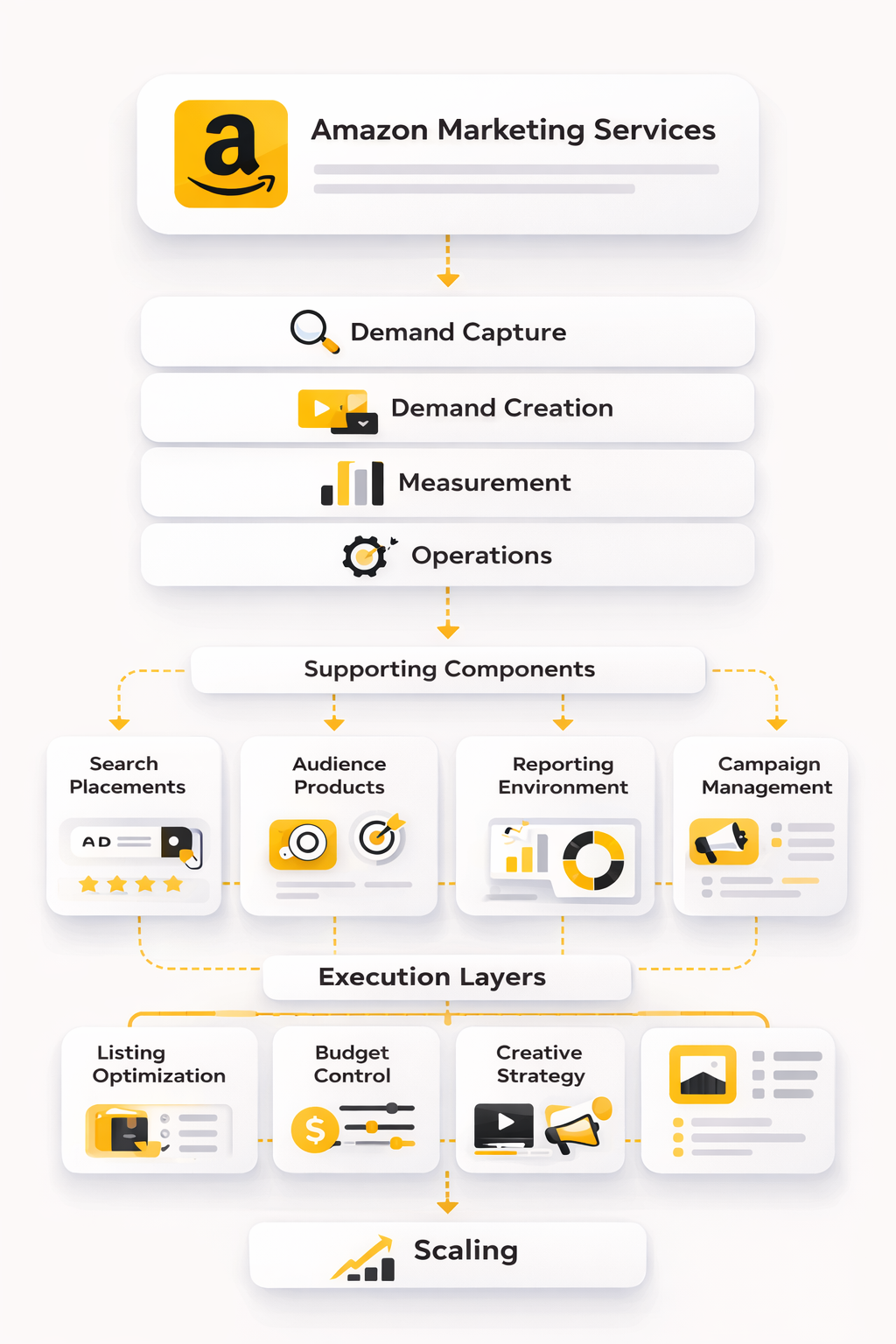
The cleanest way to understand amazon marketing services today is to think of it as a four-layer system. First comes demand capture, where brands use search-led placements to convert existing shopper intent. Second comes demand creation, where they build awareness and consideration through richer brand, video, display, and streaming formats. Third comes measurement, where they connect exposure, traffic, conversion, and incrementality instead of judging everything by last-click return. Fourth comes operations, which is the ongoing work of structuring campaigns, managing budgets, improving listings, and feeding performance data back into decisions.
That framework matters because Amazon rarely rewards isolated tactics for long. A brand can have excellent bidding discipline and still underperform if product pages are weak, reviews are poor, inventory is unstable, or measurement is too shallow. The strongest advertisers do not treat the ad console as a vending machine. They treat it as part of a wider retail operating system.
This is also where many teams get tripped up by the old AMS mindset. The legacy term suggests a toolset. The modern reality is closer to a coordinated commercial framework that ties media, merchandising, creative, and analytics together. That is the model the rest of this article will use, because it is the only one that reflects what Amazon advertising has actually become.
What Amazon Marketing Services Means Today
Strictly speaking, Amazon Marketing Services is a legacy name. Amazon consolidated and expanded its advertising business under the broader Amazon Ads identity, while sellers and marketers kept using AMS in everyday language because the old term remained familiar and convenient Amazon Ads and Understanding Amazon Ads. So when someone says amazon marketing services today, they usually mean the practical ecosystem of Amazon advertising tools rather than a currently branded standalone product.
That distinction is important because it changes how you should search for solutions and how you should build strategy. If you approach amazon marketing services as a legacy label, you risk missing the newer capabilities that now sit around sponsored placements, audience targeting, video, streaming, and advanced analytics. If you approach it as the modern Amazon Ads environment, the structure becomes clearer and the decisions get better.
The rest of this article follows that modern definition. We will use the keyword naturally because that is how real people still search, but the analysis will stay anchored in the current platform, the current ad formats, and the current operating reality. That way, the terminology stays familiar while the strategy stays up to date.
Reading the Numbers Behind Amazon Marketing Services
Once you get into execution, the next trap is obvious: drowning in metrics without getting clearer decisions. That happens all the time with amazon marketing services because the platform gives you enough data to feel informed while still making it very easy to optimize the wrong thing. The goal is not to collect more numbers. The goal is to know which numbers explain demand, which numbers explain efficiency, and which numbers tell you whether the account is actually growing.
The macro picture matters because it tells you this is not a niche channel anymore. Retail media network advertising revenue in the US reached $53.7 billion in 2024, up 23% year over year, and Amazon’s own financial reporting shows its advertising services revenue reached $21.3 billion in Q4 2025 after posting $17.3 billion in Q4 2024. That matters because it confirms something practical: amazon marketing services is operating inside a fast-scaling retail media environment, so the real competitive question is no longer whether brands should measure carefully. It is whether they can measure fast enough and accurately enough to stay ahead.
The Metrics That Actually Matter First
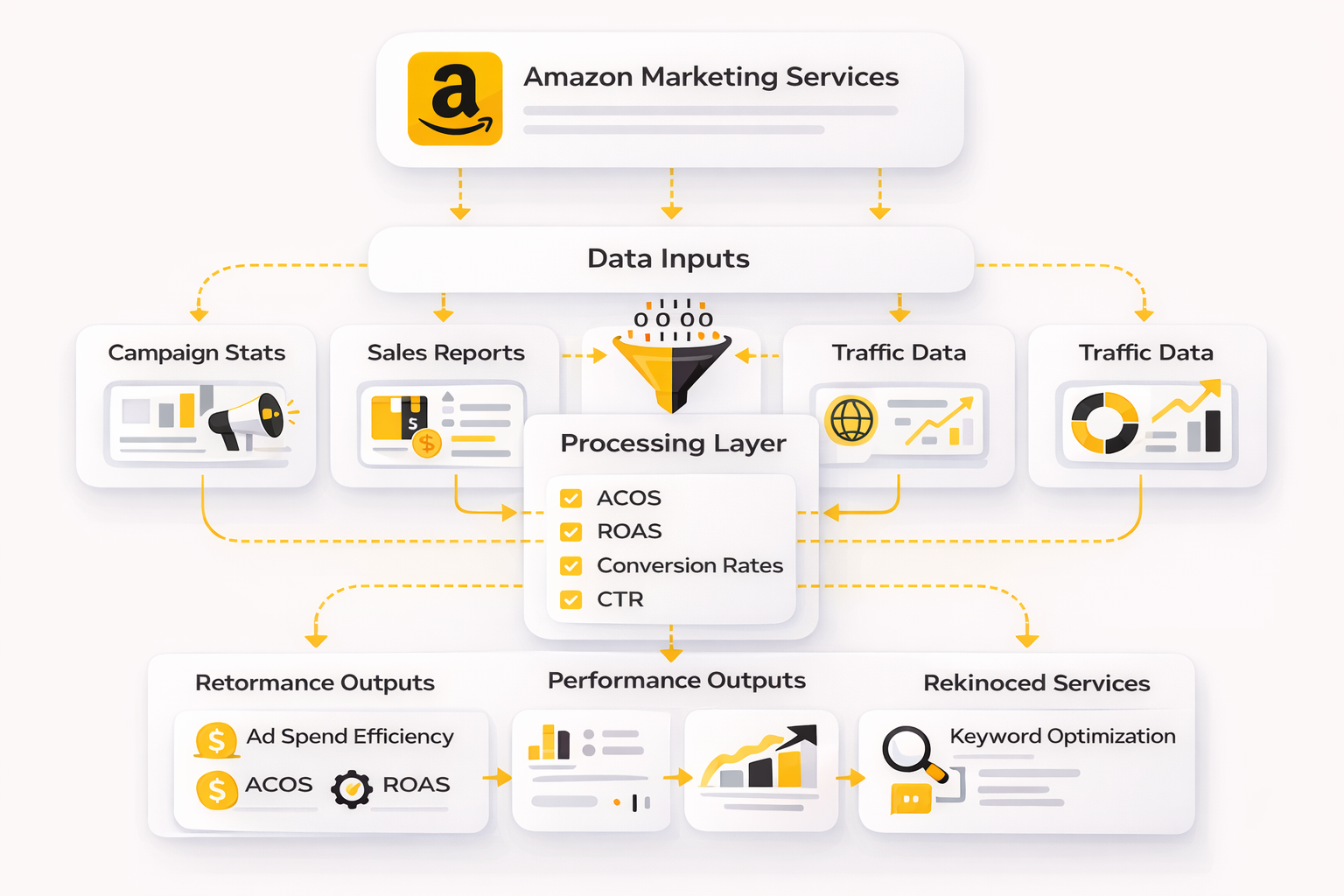
The first layer is efficiency, and that is where most advertisers begin. Amazon defines ACOS as ad spend divided by ad revenue, while ROAS is simply the inverse. Those are useful metrics, but only when the campaign job is clear. A branded defense campaign, a category capture campaign, and a new-to-brand expansion campaign should not be judged by the same tolerance for ACOS.
This is where a lot of teams quietly sabotage themselves. They look at one blended number, decide performance is weak, and cut campaigns that were actually doing the exact job they were supposed to do. Amazon itself explicitly recommends using new-to-brand metrics alongside ACOS and ROAS because campaigns built for discovery often look less efficient in the short term while still growing the customer base in the way the business needs.
The right move is to rank metrics by campaign role. For bottom-funnel search, ACOS, ROAS, conversion rate, and share of branded versus non-branded sales usually matter most. For mid-funnel expansion, new-to-brand orders, detail page views, add-to-carts, and assisted sales deserve more weight. If you do not separate those jobs, your reporting will keep pushing you toward the safest spend instead of the smartest spend.
Why Click-Through Rate and Conversion Rate Need to Be Read Together
CTR gets overused, but it is still valuable when read properly. A rising click-through rate usually means the ad is more relevant, the creative is doing its job, or the targeting is closer to real shopper intent. A falling CTR usually points to mismatch, fatigue, weaker search placement, or declining category interest. Amazon includes CTR, clicks, CPC, ACOS, ROAS, and new-to-brand among the core metrics advertisers should monitor across display and sponsored environments for exactly this reason: no single number explains performance on its own. (advertising.amazon.com)
What matters more is the relationship between CTR and conversion rate. If CTR improves but conversion rate drops, the ad may be attracting curiosity without purchase intent, or the landing page may be failing after the click. If CTR is weak but conversion rate is strong, the offer may still be compelling once shoppers arrive, which usually points to creative or placement issues rather than product-market fit.
That combined reading is one of the fastest ways to diagnose where the problem actually sits. Good amazon marketing services operators do not ask whether a metric is good or bad in isolation. They ask what sequence of metrics is revealing about shopper behavior.
The Analytics System That Makes the Data Useful
The account-level dashboard is only the starting point. Amazon now gives advertisers a broader measurement stack through tools like Amazon Attribution, Amazon Marketing Stream, and Amazon Marketing Cloud. Each one solves a different problem, and that distinction matters if you want the data to lead to action.
Amazon Attribution is useful when you need to understand what non-Amazon traffic is doing once it reaches Amazon. It can show detail page views, add-to-carts, purchases, and new-to-brand outcomes from channels like email, paid social, search, affiliate traffic, and influencer campaigns through Amazon’s own measurement framework. That means you can stop guessing whether off-Amazon promotion is helping retail performance and start comparing traffic sources on outcomes that actually matter inside the marketplace.
Amazon Marketing Stream solves a different issue: speed. Amazon describes it as a push-based system that delivers hourly campaign metrics and near real-time updates, which is useful when budgets exhaust too early, conversion windows shift by hour, or event traffic changes faster than daily reporting can keep up with. Amazon Marketing Cloud sits even higher in the stack by enabling custom analytics and cross-media insight, which is where more advanced teams start answering tougher questions about path-to-purchase, audience overlap, and incremental impact instead of relying only on last-click logic.
What Strong Performance Signals Usually Mean
A healthy amazon marketing services account tends to show a pattern, not a perfect metric. Non-branded visibility grows without branded search efficiency collapsing. Click-through rate and conversion rate move in a direction that makes sense together. Detail page views and add-to-carts rise before sales scale, especially when a product is still early in the growth cycle. New-to-brand share stays meaningful for campaigns built to expand demand rather than simply harvest existing interest.
By contrast, weak performance usually leaves clues before revenue becomes the problem. Rising spend with flat clicks often points to more expensive auctions or weaker relevance. Stable clicks with weaker conversion often points to a listing, price, inventory, or review issue. Strong ROAS with shrinking reach can look comforting for a while, but it often means the account is leaning too hard on branded demand and is no longer creating enough future customers.
That is why interpretation matters more than volume. Fifty metrics will not save an account if the operator cannot tell whether the business is becoming more efficient, more dependent on existing demand, or more capable of generating future demand. The numbers need to answer that strategic question, not just decorate a spreadsheet.
Benchmarks Are Useful, but Only If You Know What You Are Comparing
This is the part people usually want and usually misuse. Benchmarks are helpful for spotting obvious underperformance, but they become dangerous when they turn into universal targets. Amazon itself keeps steering advertisers toward goal-based measurement rather than one-size-fits-all thresholds, because campaign objectives, category economics, price points, and lifecycle stage change what “good” actually means. (advertising.amazon.com)
A premium consumables brand with repeat purchase behavior can tolerate different acquisition economics than a seasonal home product. A mature branded campaign should usually look more efficient than a discovery campaign trying to win new shoppers. A product launch may show ugly ACOS before reviews, ranking, and listing proof catch up. None of that means the account is broken. It means context is doing the heavy lifting.
So yes, benchmark. But benchmark inside the right frame. Compare branded versus non-branded traffic separately. Compare launch phases against launch phases, not against hero products that have years of momentum behind them. Compare ad performance with retail readiness, not in isolation. That is how the data from amazon marketing services becomes operational instead of decorative.
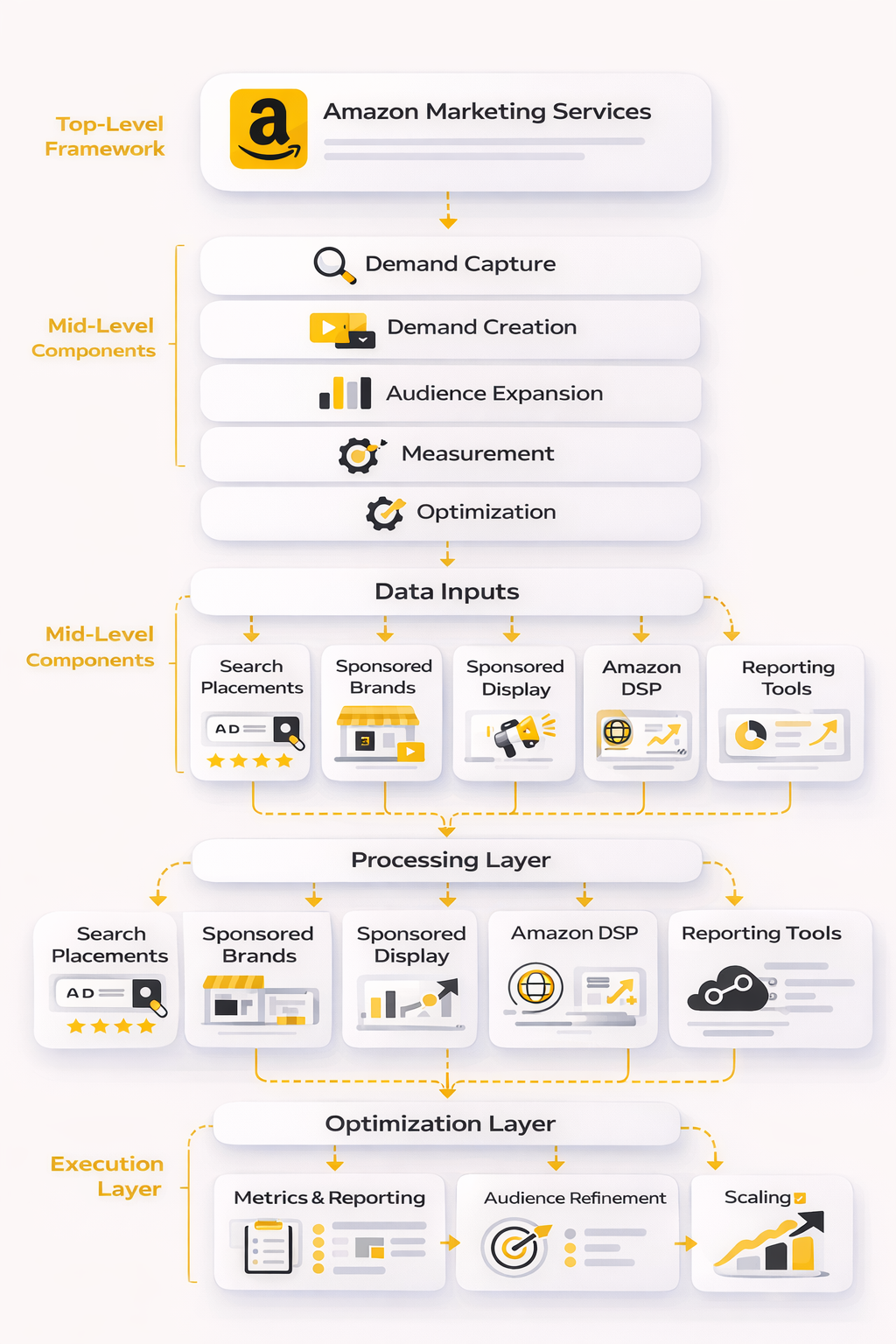
By now, the bigger picture should be clear. Amazon marketing services is not really a single service anymore. It is a connected ecosystem of sponsored ads, display, DSP, attribution, reporting, and analytics tools that now sits inside the broader Amazon Ads environment. That matters because the brands that win tend to stop thinking in terms of isolated campaigns and start thinking in systems: retail readiness, demand capture, demand creation, measurement, and operating rhythm all working together. Amazon’s own product lineup reflects that shift through tools like Sponsored Products, Sponsored Brands, display ads, Amazon DSP, Amazon Attribution, and Amazon Marketing Cloud.
The final step is to make that ecosystem understandable enough to act on. Most readers do not need another abstract framework at this stage. They need clean answers to the practical questions that come up when budgets are real, products are live, and performance pressure is not theoretical. That is what this FAQ is for.
FAQ - Built for Complete Guide
What is Amazon Marketing Services today?
Amazon Marketing Services is a legacy term that people still use to describe what is now the Amazon Ads ecosystem. In current practice, it usually refers to the mix of sponsored ads, display, DSP, Stores, attribution, and analytics tools available through Amazon Ads rather than a standalone product with that exact old branding. The clearest modern source is the current Amazon Ads platform overview, which shows how the advertising stack now spans multiple formats and measurement tools.
Is Amazon Marketing Services the same as Amazon Ads?
In everyday conversation, yes, people often use amazon marketing services when they really mean Amazon Ads. Strictly speaking, Amazon Ads is the current umbrella brand and the more accurate term. That distinction matters because if you search only for the old term, you can miss newer capabilities like Amazon Marketing Cloud, Amazon Marketing Stream, and Streaming TV ads.
Which ad formats matter most for most brands?
For most sellers and brands, the core starting point is still Sponsored Products because it connects directly to active shopping intent. After that, Sponsored Brands, Sponsored Display, and Brand Stores usually become the next logical layer once the account needs stronger brand presence and broader retargeting support, as shown in Amazon’s breakdown of sponsored ads and Stores. The action this should drive is simple: master the bottom of the funnel first, then expand outward.
Do you need to sell on Amazon to use Amazon DSP?
No. Amazon states that Amazon DSP is available to advertisers that sell on Amazon and to those that do not. That matters because DSP is not just a marketplace ad tool. It is a broader audience-buying platform, which means brands can use Amazon’s audience signals for awareness, retargeting, and off-Amazon media even if Amazon is not their primary sales channel.
Who can run Sponsored Products?
Amazon’s guidance for new advertisers says Sponsored Products generally requires an active professional seller account or vendor account, eligible products, and compliance with Amazon’s advertising policies, with some product categories excluded from advertising eligibility in certain cases through its new advertiser success guide. The important takeaway is operational, not legalistic: before planning campaigns, confirm eligibility, inventory status, and whether your product can actually win the featured offer. If that foundation is shaky, campaign performance will usually be shaky too.
What metrics should matter first?
The first metrics should match the job of the campaign. Amazon’s own guidance explains ACOS, ROAS, click-through rate, and broader performance reporting, while product pages like Sponsored Brands also emphasize new-to-brand insights. For bottom-funnel campaigns, efficiency and conversion metrics usually come first. For growth campaigns, new-to-brand behavior, detail page views, and contribution to future demand matter more than a single blended ROAS target.
Is ACOS the best way to judge success?
No, not by itself. ACOS is useful, but it only tells you ad spend relative to attributed revenue, which is why Amazon treats it as one metric inside a larger optimization toolkit rather than the only answer in its ACOS guide. The action this should drive is to stop asking whether ACOS is “good” in the abstract and start asking whether the campaign is doing the right job at the right cost for that specific business objective.
How should brands think about branded versus non-branded campaigns?
They should separate them. Branded campaigns often look more efficient because the shopper already knows the brand, while non-branded campaigns usually do more of the heavy lifting for growth and discovery. Amazon’s newer solutions like Sponsored Brands reserve share of voice show that branded visibility is strategically important, but it should be defended without letting it hide weak non-branded acquisition. The action here is to report them separately and budget them differently.
Does creative really matter on Amazon, or is it mostly bidding?
Creative matters more than many advertisers admit. Amazon’s current ad ecosystem includes rich formats like Sponsored Brands, video ads, and broader display ads, which means better messaging and visual clarity can directly affect click quality and conversion confidence. The practical lesson is that poor creative can make good targeting look mediocre.
What role does a Brand Store play?
A Brand Store gives shoppers a cleaner, more controlled place to explore your assortment and understand the brand beyond a single product page. Amazon presents Stores as a meaningful part of the shopper journey and highlights stronger engagement patterns for store visitors in its materials. That should push brands to think of Stores as part of conversion architecture, not just as a nice-to-have brand asset.
When should a brand start using Amazon Attribution?
A brand should start using it when off-Amazon traffic becomes material enough that guessing is no longer acceptable. Amazon describes Amazon Attribution as a free measurement solution for tracking how channels like search, social, email, display, and influencer traffic perform on Amazon. The action this drives is straightforward: if you are sending traffic from outside Amazon and cannot connect it to on-Amazon outcomes, you are leaving insight on the table.
What is Amazon Marketing Stream actually useful for?
Amazon Marketing Stream is useful when daily reporting is too slow to manage real campaign conditions. Amazon describes it as a source of hourly campaign metrics and near real-time updates, which makes it valuable during major shopping events, budget pacing problems, and intraday optimization. In practice, it matters most when timing affects profitability.
What is Amazon Marketing Cloud, and is it only for advanced teams?
Amazon Marketing Cloud is a measurement environment for custom analysis and cross-media insight, and Amazon now says it is available at no cost to eligible advertisers, including broader access for sponsored ads advertisers through Amazon Marketing Cloud and the 2025 update announcing AMC availability for all advertisers running sponsored ads campaigns. It is more advanced than standard console reporting, but it is no longer reserved only for the largest DSP-heavy organizations. The right action is not to panic about complexity. It is to use it when standard attribution stops answering the questions your business actually has.
Can you scale Amazon marketing services without expanding beyond search?
Sometimes for a while, but usually not forever. Amazon’s product ecosystem clearly supports a broader path that includes display ads, Amazon DSP, and measurement layers like AMC, which reflects the reality that demand capture alone has limits. The action this should drive is to expand only when the search foundation is solid and growth starts hitting a ceiling.
Why do good campaigns sometimes perform badly anyway?
Because media is only one part of the system. Amazon’s best-practice materials for Sponsored Products stress things like in-stock status, competitive pricing, and featured offer readiness. That means campaigns can fail for reasons that have nothing to do with bidding logic. When performance slips, good operators check the retail environment before they assume the media team is the problem.
Is Amazon advertising still growing enough to justify serious investment?
Yes, and the scale matters. Amazon reported $21.3 billion in advertising services revenue in Q4 2025 after reporting $17.3 billion in Q4 2024, while the IAB and PwC reported that US retail media network advertising revenue reached $53.7 billion in 2024. The action here is not “spend more no matter what.” It is to treat amazon marketing services as a strategic channel that deserves real operational rigor because the market around it is already operating at serious scale.
Work With Professionals
Explore 10K+ Remote Marketing Contracts on MarkeWork.com
Most marketers spend too much time chasing clients, competing on crowded platforms, and losing a percentage of every project to middlemen.
MarkeWork gives you a better way. Browse thousands of remote marketing contracts and connect directly with companies desperate to hire skilled marketers like you, without platform commissions and without unnecessary gatekeepers.
If you're serious about finding better opportunities and keeping 100% of what you earn, explore available contracts and create a profile for free at MarkeWork.com.