

Amazon isn’t just a marketplace anymore—it’s one of the largest advertising ecosystems in the world. With more than $56 billion in ad revenue generated in 2024, it has quietly become a dominant force in digital advertising, rivaling Google and Meta in intent-driven traffic .
That’s where AMS Amazon comes in.
If you’ve been around e-commerce long enough, you’ve probably heard the term “AMS” thrown around by sellers, agencies, or consultants. Even though Amazon officially rebranded it, the concept still sits at the core of how products get discovered—and sold—on the platform.
This guide breaks it down properly, without fluff. You’ll understand what AMS Amazon actually means, how it works under the hood, and why ignoring it is one of the fastest ways to stay invisible on Amazon.
Article Outline
- What AMS Amazon Actually Means
- Why AMS Amazon Matters More Than Ever
- AMS Framework Overview
- Core Components of AMS Amazon
- How Professionals Use AMS at Scale
- Common Misconceptions and Strategic Positioning
What AMS Amazon Actually Means
AMS stands for Amazon Marketing Services, which was the original name for Amazon’s internal advertising platform. Today, it’s officially called Amazon Ads, but the functionality is largely the same—just expanded and more sophisticated .
At its core, AMS Amazon is a pay-per-click (PPC) advertising system that allows sellers and brands to promote products directly inside Amazon’s ecosystem.
That means:
- You bid on keywords or audiences
- Your product appears in premium placements
- You only pay when someone clicks
Unlike traditional advertising, you’re not interrupting users—you’re capturing demand that already exists.
This is what makes AMS uniquely powerful.
The Key Difference vs Traditional Ads
Most ad platforms create demand.
AMS captures it.
When someone searches “wireless earbuds” on Amazon, they’re not browsing—they’re buying. And AMS places your product directly in front of that intent.
That’s a completely different game.
Why AMS Amazon Matters More Than Ever
Amazon has fundamentally changed how people shop.
More than 75% of shoppers use Amazon to discover new products , which means the platform is no longer just transactional—it’s a search engine for commerce.
If your product isn’t visible there, it practically doesn’t exist.
Visibility Is No Longer Organic
Years ago, ranking organically on Amazon was enough.
Today:
- Competition is saturated
- Listings are optimized by everyone
- Top spots are dominated by ads
Sponsored placements often appear above organic results, meaning paid visibility comes first.
AMS Influences Organic Rankings
Here’s something many beginners miss:
AMS doesn’t just drive paid traffic—it also impacts organic ranking.
When your ads generate:
- More clicks
- More conversions
- More sales velocity
Amazon’s algorithm rewards you with better organic placement.
That creates a feedback loop:
- Ads drive traffic
- Traffic drives sales
- Sales improve rankings
- Rankings bring more organic traffic
Smart sellers use AMS to trigger that loop intentionally.
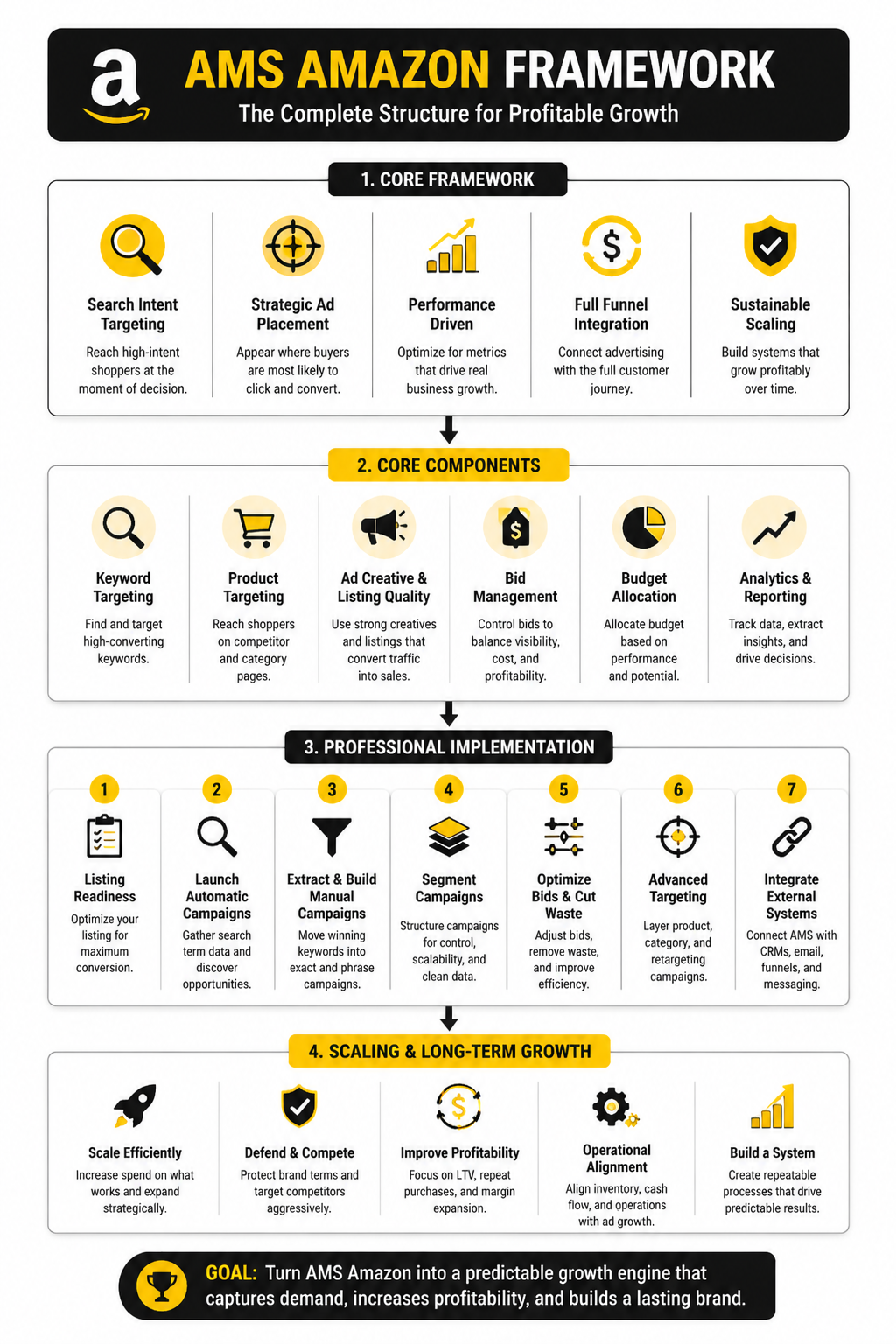
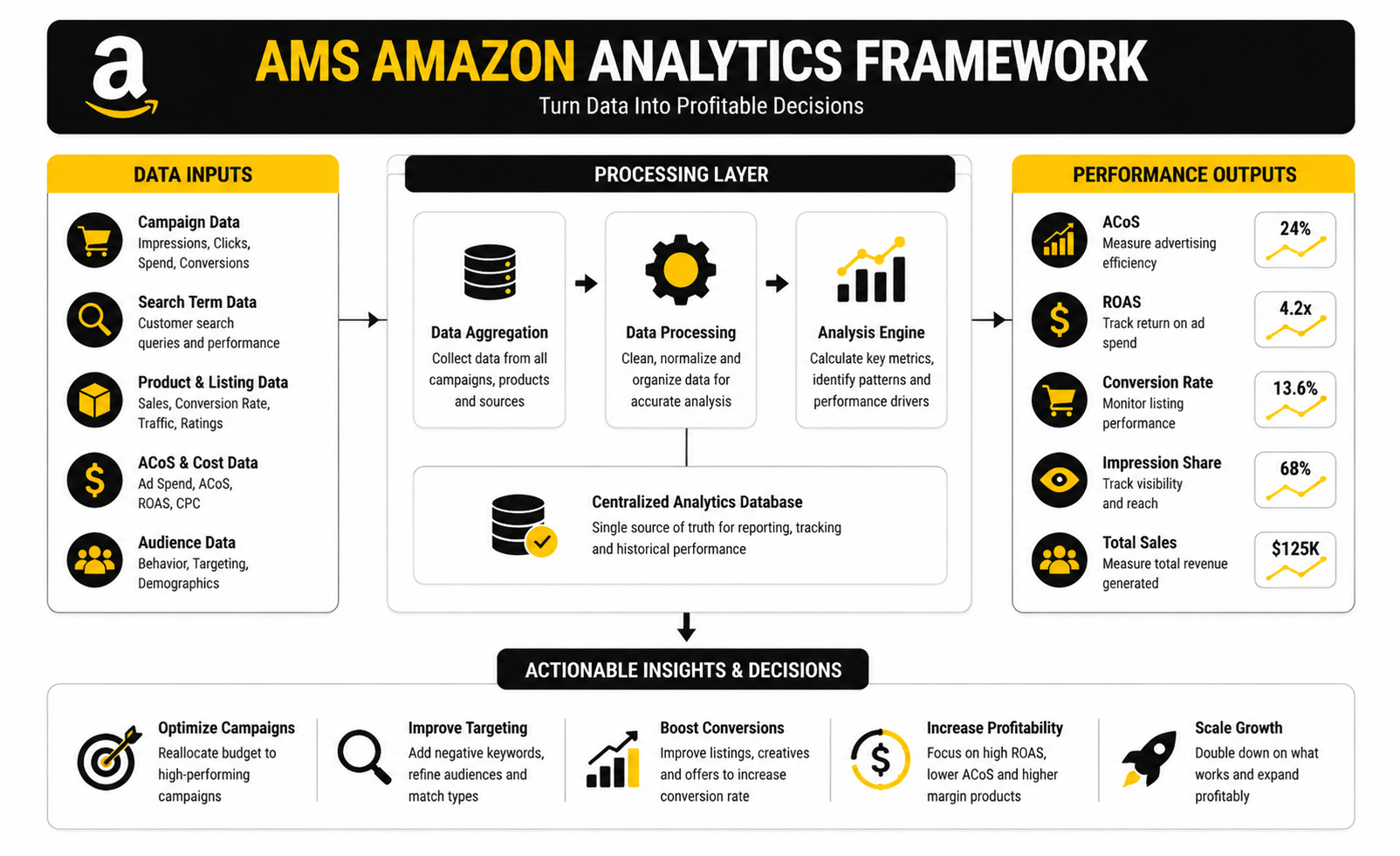
AMS Framework Overview
To understand AMS Amazon properly, you need to stop thinking in terms of “ads” and start thinking in terms of a system.
AMS isn’t one tool—it’s a framework made of multiple moving parts working together.
The AMS System in Simple Terms
At a high level, AMS operates across three layers:
- Targeting Layer
- Keywords
- Product targeting
- Audience signals
- Placement Layer
- Search results
- Product pages
- External placements
- Optimization Layer
- Bids
- Budget allocation
- Performance data
Each layer feeds the next.
And the more data you collect, the smarter your campaigns become.
Data Is the Real Advantage
Amazon isn’t guessing who to show your ad to.
It uses:
- Search behavior
- Purchase history
- Browsing patterns
This allows advertisers to reach high-intent shoppers at the exact moment they’re ready to buy .
That’s why conversion rates on Amazon ads are often significantly higher than on social platforms.
Core Components of AMS Amazon
To actually use AMS effectively, you need to understand its building blocks.
These are not optional—they’re the foundation.
1. Sponsored Products
This is the most widely used ad format.
- Appears in search results and product pages
- Promotes individual listings
- Works on keyword or automatic targeting
It’s usually the starting point for most sellers—and often the most profitable when optimized correctly.
2. Sponsored Brands
These ads focus on brand visibility.
- Appear at the top of search results
- Include logo, headline, and multiple products
- Drive traffic to a storefront or product collection
They’re critical if you want to build brand recognition, not just sell one product.
3. Sponsored Display
This is where things get more advanced.
- Retargets shoppers who viewed your product
- Appears both on and off Amazon
- Uses behavioral targeting
It’s especially powerful for recovering lost buyers and increasing repeat exposure.
4. Analytics and Reporting
Amazon provides detailed campaign metrics, including:
- Click-through rate (CTR)
- Return on ad spend (ROAS)
- Advertising cost of sale (ACoS)
- New-to-brand customers
These insights allow sellers to continuously refine campaigns and improve performance over time .
Transition to Advanced Implementation
At this point, you understand what AMS Amazon is and how it’s structured.
But knowing the components isn’t enough.
The real difference between average sellers and high-performing brands comes down to how AMS is implemented at a strategic level.
That’s exactly what we’ll break down next.
How Professionals Use AMS Amazon at Scale
Understanding AMS Amazon at a surface level is easy. Running it profitably at scale is where things separate quickly.
Most sellers start with a few campaigns and basic keyword targeting. Professionals build structured systems that compound over time. The difference isn’t effort—it’s architecture.
Campaign Structure Is Everything
High-performing accounts don’t run random campaigns. They use layered structures designed for control and data clarity.
A common professional setup looks like this:
- Automatic campaigns for discovery
- Broad match campaigns to expand reach
- Phrase and exact campaigns for precision
- Product targeting campaigns for competitor capture
Each campaign has a specific role. Nothing overlaps without intention.
This allows you to:
- Identify winning keywords faster
- Control budget allocation precisely
- Scale what works without guesswork
Without structure, AMS becomes expensive noise. With structure, it becomes predictable growth.
Budget Allocation Follows Performance
Beginners spread budgets evenly. Professionals don’t.
They aggressively shift spend toward:
- High-converting keywords
- Profitable ASIN targets
- Campaigns with strong ROAS
And they cut or reduce anything underperforming.
This constant reallocation is what turns AMS into a performance engine instead of a cost center.
Data Feedback Loops Drive Growth
AMS Amazon rewards iteration.
Every click, every sale, every impression feeds the system. Professionals build feedback loops where:
- Data is collected daily
- Insights are extracted weekly
- Campaigns are adjusted continuously
This is why tools and automation platforms matter.
For example, using CRM and automation systems like GoHighLevel allows brands to connect ad performance with backend customer journeys, giving a clearer picture of lifetime value—not just first-click ROI.
That’s where real scaling decisions come from.
Common Misconceptions About AMS Amazon
AMS Amazon looks simple on the surface. That simplicity creates a lot of bad assumptions.
Let’s clear the ones that cost people the most money.
“AMS Is Just Paid Traffic”
This is one of the biggest mistakes.
AMS is not just about traffic—it’s about conversion-qualified traffic inside a closed ecosystem.
Unlike external ads, you’re not sending users to a landing page where they might bounce. You’re placing your product directly in a buying environment.
That changes everything.
“You Can Set It and Forget It”
You can—but you’ll lose money.
Amazon’s auction system is dynamic:
- Competitors change bids
- Seasonal demand shifts
- New products enter constantly
If you’re not actively optimizing, your campaigns degrade over time.
Even small changes in bids or keywords can significantly impact profitability.
“More Spend Means More Sales”
Not necessarily.
Scaling AMS blindly often leads to:
- Rising ACoS
- Lower margins
- Inefficient spend
The goal isn’t to spend more—it’s to spend smarter.
That’s why experienced operators focus on efficiency first, then scale.
Strategic Positioning of AMS in Your Business
AMS Amazon shouldn’t exist in isolation.
The most successful brands treat it as part of a broader growth system.
AMS as a Demand Capture Layer
Think of AMS as the bottom of the funnel.
It captures users who are already searching and ready to buy. But where does that demand come from?
That’s where external systems come in.
Brands often combine AMS with:
- Email marketing platforms like Brevo
- Social scheduling tools like Buffer
- Funnel builders like ClickFunnels
These channels generate awareness and interest. AMS converts that interest into revenue.
AMS as a Product Validation Engine
Smart sellers don’t just use AMS to sell—they use it to test.
By launching small campaigns, they can quickly validate:
- Which keywords convert
- Which product angles resonate
- Which listings need improvement
This reduces risk dramatically before scaling inventory or expanding product lines.
AMS as a Competitive Weapon
AMS Amazon also allows direct competition targeting.
You can:
- Bid on competitor brand keywords
- Place ads on competitor listings
- Capture demand at the point of decision
This isn’t theoretical—it’s happening constantly across categories.
Brands that ignore this are effectively giving away customers at the final step.
Where Most Sellers Get Stuck
At this stage, most people understand AMS conceptually.
The problem is execution.
They either:
- Overcomplicate everything and burn out
- Or oversimplify and leave money on the table
The gap isn’t knowledge—it’s systematic implementation.
That’s exactly what we’ll break down next: how to actually build, launch, and optimize AMS campaigns step by step without wasting budget.
Professional Implementation of AMS Amazon
This is where everything becomes real.
You can understand AMS Amazon conceptually, but until you actually build campaigns step by step, none of it translates into results. The goal here isn’t complexity—it’s clarity and control.
A strong implementation removes guesswork. You know what each campaign is doing, why it exists, and how it contributes to revenue.
Step 1: Start With Listing Readiness
Before you spend a single euro on ads, your product listing needs to convert.
Because here’s the reality—AMS amplifies what already exists.
If your listing is weak:
- Low-quality images
- Poor copy
- Weak reviews
You’ll just pay for traffic that doesn’t convert.
Amazon’s own advertising guidance consistently emphasizes that conversion rate directly impacts campaign efficiency, because higher conversion lowers your effective cost per sale (advertising.amazon.com).
So before launching:
- Optimize your title with clear keywords
- Improve images for clarity and differentiation
- Strengthen bullet points with real benefits
- Ensure pricing is competitive
If this step is skipped, everything else becomes harder.
Step 2: Launch Automatic Campaigns for Data
Automatic campaigns are not optional. They’re your discovery engine.
They allow Amazon to:
- Match your product to relevant search terms
- Identify converting keywords
- Surface unexpected opportunities
Start simple:
- One automatic campaign per product
- Moderate daily budget
- Default bid slightly below category average
Let it run for at least 7–14 days.
This gives you real search term data—not assumptions.
Step 3: Extract and Build Manual Campaigns
Once data starts coming in, this is where professionals separate from beginners.
You don’t leave insights inside automatic campaigns—you extract them.
Take high-performing search terms and move them into:
- Exact match campaigns for precision
- Phrase match campaigns for expansion
This gives you control over:
- Bids
- Budget
- Scaling decisions
At this point, your AMS Amazon system starts shifting from exploration to optimization.
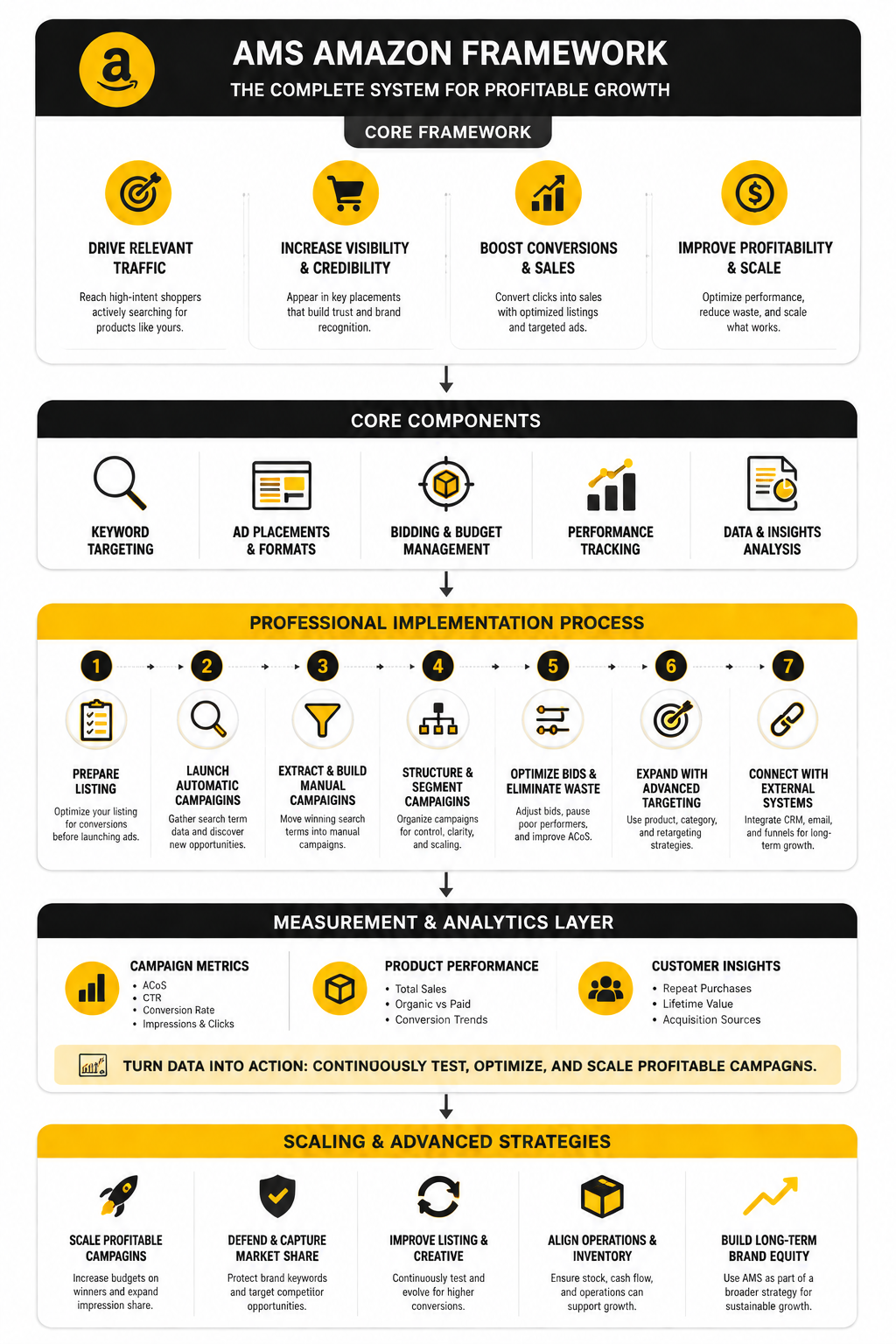
Step 4: Segment Campaigns for Control
Now you build structure intentionally.
Instead of one campaign doing everything, you create separation:
- High-performing keywords get their own campaigns
- Mid-performing keywords are grouped
- Experimental keywords stay isolated
Why this matters:
- You avoid budget cannibalization
- You scale winners without affecting others
- You get cleaner data
This is where most sellers fail—they never segment properly.
Step 5: Optimize Bids and Cut Waste
AMS is an auction. Every click has a cost, and every cost needs justification.
Optimization comes down to three actions:
- Increase bids on profitable keywords
- Reduce bids on borderline performers
- Pause or negate unprofitable terms
Metrics that guide decisions:
- ACoS (Advertising Cost of Sale)
- Conversion rate
- Click-through rate
Over time, your account becomes more efficient because waste is continuously removed.
Step 6: Layer in Advanced Targeting
Once your base system is working, you expand.
This includes:
- Product targeting (competitor listings)
- Category targeting
- Sponsored Display retargeting
This is where AMS becomes more than search—it becomes market capture.
You’re no longer just responding to demand. You’re intercepting it.
Step 7: Connect AMS With External Systems
This is where most Amazon sellers leave money on the table.
They treat AMS as a closed loop.
But the real advantage comes when you connect it with external tools.
For example:
- Use ManyChat to capture and nurture customers through messaging flows
- Use Systeme.io to build simple funnels that support off-Amazon traffic
- Use Replo for high-converting landing pages when driving external campaigns
Why this matters:
Amazon gives you sales.
External systems give you customer ownership.
And long-term, that’s where real brand value lives.
What Execution Looks Like in Practice
At this point, AMS Amazon stops being theoretical.
You’re running:
- Discovery campaigns
- Controlled keyword campaigns
- Competitor targeting campaigns
- Retargeting layers
All connected through data.
And most importantly—you’re not guessing anymore.
Every decision is backed by:
- Real search terms
- Real conversion data
- Real performance metrics
That’s the shift.
From “running ads” to operating a system.
The Hidden Constraint Most People Miss
Even with perfect execution, there’s one factor that limits everything:
Inventory and cash flow.
Scaling AMS means:
- Higher ad spend
- Faster sales velocity
- More inventory turnover
If your supply chain can’t keep up, growth stalls.
That’s why serious operators align:
- Advertising
- Inventory planning
- Cash flow management
AMS Amazon doesn’t exist in isolation. It’s tied directly to how your entire business runs.
Next, we’ll break down how to scale this system without destroying profitability—and how advanced operators maintain control as spend increases.
AMS Amazon Analytics and Performance Signals That Actually Matter
Once your campaigns are live, AMS Amazon becomes a data game.
Not a vanity metrics game. Not a dashboard-watching exercise. A decision system.
The difference between profitable and unprofitable accounts usually comes down to one thing: how well the operator interprets signals and acts on them.
The Core Metrics You Cannot Ignore
Amazon gives you a lot of data. Most of it is noise if you don’t know what to look for.
These are the metrics that actually drive decisions:
- ACoS (Advertising Cost of Sale)
- ROAS (Return on Ad Spend)
- CTR (Click-Through Rate)
- Conversion Rate (CVR)
- Impressions and Click Volume
Each one tells a different story. None of them should be analyzed in isolation.
For example:
- High CTR + low conversion → your listing is the problem
- Low CTR + good conversion → your targeting or creative is weak
- High ACoS + strong sales → you may be scaling too aggressively
This is how professionals read accounts—by combining signals, not chasing one number.
Understanding What “Good” Actually Looks Like
Benchmarks in AMS Amazon are tricky because performance varies by category, price point, and competition.
Still, patterns exist.
Across multiple industry datasets, Amazon ads tend to convert significantly higher than social ads because of purchase intent. Many categories regularly see conversion rates above 10%, with top-performing listings going much higher in optimized niches.
At the same time:
- ACoS often sits between 15%–35% depending on margins
- CTR typically ranges between 0.3%–1%+ for search placements
These numbers matter only in context.
A 30% ACoS might be terrible for a low-margin product—but excellent for a high-LTV brand using AMS for customer acquisition.
That’s the shift: metrics don’t define success—your business model does.
How to Build a Real Analytics System
Looking at campaign dashboards manually isn’t enough once you scale.
You need a system that connects:
- Campaign performance
- Customer behavior
- Revenue over time
This is where structured analytics comes in.
The Three-Layer Measurement Model
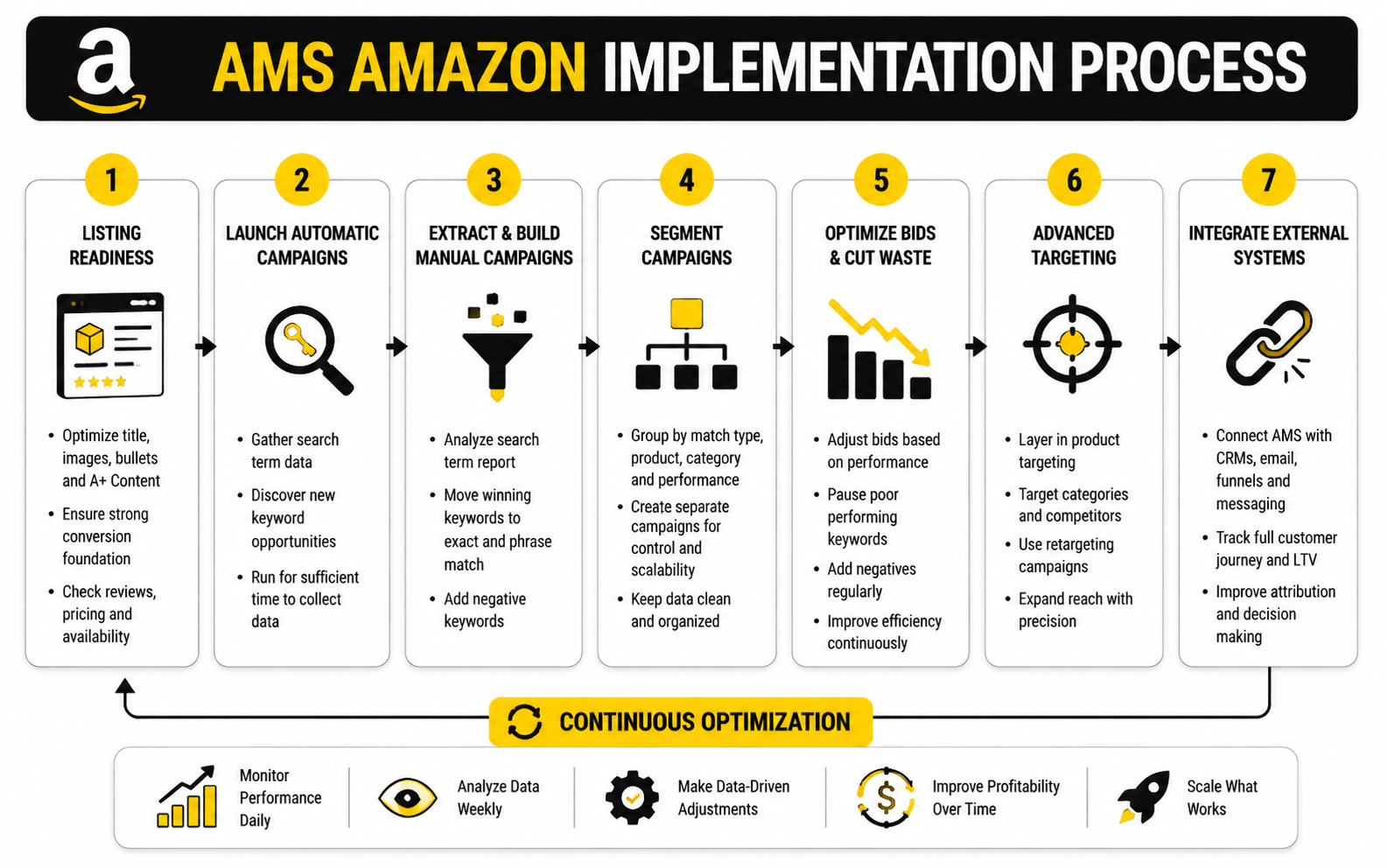
A practical AMS analytics system works across three layers:
1. Campaign-Level Metrics
This is your immediate feedback loop.
You track:
- Keyword performance
- Ad placement results
- Bid efficiency
Decisions here are tactical:
- Adjust bids
- Pause keywords
- Reallocate budget
This is daily or weekly work.
2. Product-Level Performance
Now you zoom out.
Instead of looking at campaigns, you look at:
- Total sales per ASIN
- Organic vs paid contribution
- Conversion trends
This tells you whether AMS is actually improving your product’s position—not just generating isolated sales.
3. Customer-Level Insights
This is where most sellers stop—but it’s where the real advantage is.
Using tools like GoHighLevel, you can start tracking:
- Repeat purchases
- Customer lifetime value
- Acquisition source impact
Why this matters:
A campaign that looks unprofitable on first purchase might be extremely profitable over time.
Without this layer, you’re making incomplete decisions.
Turning Data Into Action
Data without action is just decoration.
The goal is simple: every metric should trigger a response.
When CTR Is Low
This usually means your ad isn’t getting attention.
Actions:
- Improve main image
- Test different titles or positioning
- Refine keyword targeting
CTR is your first filter. If people don’t click, nothing else matters.
When Conversion Rate Is Low
Now the problem shifts.
People are clicking—but not buying.
Actions:
- Improve listing quality
- Add stronger social proof (reviews, ratings)
- Adjust pricing or offer
At this stage, AMS is doing its job. Your listing isn’t.
When ACoS Is Too High
This is where profitability breaks.
Actions:
- Lower bids on underperforming keywords
- Remove irrelevant search terms
- Focus budget on high-converting segments
This is continuous work. There’s no “final” optimization.
The Role of Attribution and External Traffic
AMS Amazon doesn’t operate in a vacuum.
If you’re running external traffic—from email, social, or funnels—you need attribution clarity.
That’s where tools like:
- ClickFunnels for funnel tracking
- Brevo for email performance
start to matter.
They help you answer a critical question:
Is AMS capturing demand—or creating it indirectly through other channels?
This distinction changes how you evaluate performance.
Why Most People Misread AMS Data
Here’s the uncomfortable truth.
Most sellers don’t lose money because of bad ads.
They lose money because they misinterpret data.
Common mistakes include:
- Killing campaigns too early (before enough data accumulates)
- Scaling too fast without stable conversion rates
- Ignoring external factors like seasonality or stock levels
AMS Amazon rewards patience—but not passivity.
You need to:
- Let data stabilize
- Then act decisively
That balance is where profitability lives.
The Real KPI: Control
At the end of the day, AMS isn’t about hitting perfect numbers.
It’s about control.
- Control over visibility
- Control over acquisition cost
- Control over scaling
When your analytics system is working, you don’t feel uncertain.
You know:
- What’s working
- What’s not
- What to do next
That’s the real goal.
And once you reach that point, scaling becomes a strategy—not a risk.
Advanced Scaling Strategies for AMS Amazon
Once your AMS Amazon system is stable, scaling becomes the next challenge—and this is where things get dangerous if done wrong.
Scaling isn’t just increasing budget. It’s managing efficiency under pressure.
Because the moment you push spend higher, three things happen:
- You reach less qualified traffic
- Competition increases on your best keywords
- Margins start to compress
That’s why scaling requires strategy, not enthusiasm.
Horizontal vs Vertical Scaling
There are two fundamentally different ways to scale AMS.
Vertical scaling means increasing spend on what already works:
- Raising bids on profitable keywords
- Increasing budgets on high-performing campaigns
- Expanding impression share
This is the safest way to grow—but it has limits.
At some point, you saturate your audience.
That’s where horizontal scaling comes in:
- Expanding into new keyword clusters
- Targeting adjacent product categories
- Launching new ASINs
Most advanced operators use both simultaneously. Vertical scaling drives immediate growth. Horizontal scaling creates new growth channels.
The Margin Compression Problem
Here’s the part most people don’t talk about.
As you scale AMS Amazon, your efficiency usually drops.
Why?
Because:
- The best keywords get more expensive
- Competitors react to your visibility
- You start targeting less obvious audiences
This leads to rising ACoS.
And if you’re not prepared, it kills profitability.
How Professionals Handle It
Instead of chasing low ACoS forever, experienced operators shift focus:
- They accept higher ACoS on acquisition campaigns
- They optimize backend revenue (repeat purchases, bundles)
- They increase pricing where possible
This is where connecting AMS to systems like GoHighLevel becomes critical, because it allows you to track and monetize customers beyond the first sale.
The mindset changes from:
- “Is this ad profitable?”
to:
- “Is this customer profitable?”
That shift unlocks scale.
Defensive Strategies Against Competition
AMS Amazon is not a passive environment.
The moment you start winning, competitors respond.
You’ll notice:
- Higher CPCs on your best keywords
- Competitor ads appearing on your listings
- Brand name bidding wars
If you don’t defend your position, you lose it.
Brand Defense Campaigns
This is non-negotiable at scale.
You need campaigns that:
- Target your own brand keywords
- Protect your product pages
- Maintain top-of-search presence
These campaigns are usually:
- Low ACoS
- High conversion
- Critical for retention
Letting competitors take these placements is one of the most expensive mistakes you can make.
Offensive Positioning
Defense alone isn’t enough.
You also need to:
- Target competitor brand keywords
- Place ads on competitor listings
- Capture switching behavior
This is where AMS becomes aggressive—not just reactive.
The Role of Creative and Listing Evolution
At scale, optimization isn’t just about bids anymore.
It’s about creative performance.
Your:
- Main images
- Titles
- A+ content
- Brand messaging
all directly impact your ad results.
Even small improvements in conversion rate can:
- Lower ACoS
- Increase total sales
- Improve organic ranking
This is why advanced sellers continuously test and evolve listings.
And increasingly, they use external tools like Replo to refine landing experiences for off-Amazon traffic, then apply those learnings back into Amazon listings.
Scaling Requires Operational Alignment
Here’s the hidden truth behind every successful AMS Amazon account:
It’s not just an ad system—it’s an operational system.
When you scale ads, you’re also scaling:
- Inventory demand
- Customer support volume
- Review velocity
- Supply chain complexity
If any of these break, your growth collapses.
The Inventory Trap
Running out of stock during aggressive scaling is one of the fastest ways to lose ranking.
Amazon’s algorithm penalizes:
- Stockouts
- Inconsistent sales velocity
So even if your campaigns are working perfectly, poor inventory planning can undo everything.
Cash Flow Pressure
Scaling ads means:
- Higher upfront spend
- Delayed payouts
- Increased reinvestment needs
If your cash flow isn’t managed properly, growth stalls—not because ads fail, but because the business can’t support them.
Automation vs Manual Control
As your account grows, managing everything manually becomes unrealistic.
That’s where automation tools come in.
But there’s a tradeoff.
Full Automation
Pros:
- Saves time
- Handles large-scale optimization
- Reacts faster to data changes
Cons:
- Less control
- Can over-optimize short-term metrics
- Misses strategic context
Manual + Assisted Approach
This is what most high-level operators use.
They combine:
- Automation for data processing
- Manual decisions for strategy
For example:
- Automated bid adjustments within limits
- Manual campaign restructuring and scaling decisions
Tools like ManyChat can also automate customer interaction layers, freeing up time to focus on strategy instead of repetitive tasks.
The Long-Term Game With AMS Amazon
At the highest level, AMS stops being about campaigns.
It becomes about market position.
You’re not just trying to get clicks—you’re trying to:
- Own search results for your category
- Control customer acquisition cost
- Build defensible brand presence
And this takes time.
Short-term thinking leads to:
- Over-optimization
- Burned budgets
- Inconsistent performance
Long-term thinking leads to:
- Compounding rankings
- Stronger brand recognition
- Sustainable profitability
What Separates Top 1% Operators
After everything we’ve covered, the difference becomes clear.
Top performers:
- Think in systems, not campaigns
- Optimize continuously, not occasionally
- Connect AMS to broader business strategy
They don’t chase hacks.
They build machines.
And once that machine is working, scaling becomes predictable—not risky.
Next, we’ll close this out by answering the most important questions people still get wrong about AMS Amazon and how to approach it with clarity.
Final Strategic Takeaway
AMS Amazon is not a magic button. It is a growth system that only works when the product, listing, campaign structure, analytics, inventory, and customer journey all support each other.
That is why serious sellers eventually stop asking, “How do I lower ACoS?” and start asking better questions. They look at total profitability, customer acquisition cost, organic ranking movement, repeat purchase potential, and operational capacity.
The platform keeps expanding beyond simple sponsored listings, with Amazon Ads now covering sponsored ads, display, video, streaming TV, and measurement products across a much larger retail media ecosystem. That matters because the brands that win long term will not be the ones running isolated campaigns. They will be the ones building connected systems around search intent, shopper behavior, and measurable business outcomes.
FAQ - Built for Complete Guide
What does AMS Amazon mean?
AMS Amazon refers to Amazon Marketing Services, the older name many sellers still use for what is now Amazon Ads. It includes advertising tools that help sellers and brands promote products across Amazon search results, product detail pages, and other Amazon-owned or partner placements. The name changed, but the practical idea remains the same: paid visibility inside Amazon’s buying ecosystem.
Is AMS Amazon the same as Amazon PPC?
AMS Amazon and Amazon PPC are closely related, but they are not exactly the same phrase. PPC describes the pay-per-click model where advertisers pay when shoppers click an ad. AMS Amazon is the broader advertising system that includes PPC campaign types like Sponsored Products, Sponsored Brands, and Sponsored Display.
Is AMS still used by Amazon officially?
Amazon now uses the name Amazon Ads rather than Amazon Marketing Services. However, many sellers, agencies, and older training materials still use the phrase AMS Amazon. If someone says AMS today, they usually mean Amazon’s self-service advertising platform.
Who should use AMS Amazon?
AMS Amazon is useful for sellers, vendors, private-label brands, book publishers, and agencies managing Amazon growth. It is especially important when organic ranking alone is not enough to generate visibility. If your product has decent margins, strong listing quality, and inventory available, AMS can help you reach buyers faster.
What is the best AMS Amazon campaign type to start with?
Most sellers start with Sponsored Products because they promote individual listings and appear naturally in shopping results. They are simple to launch, easy to measure, and directly tied to product-level sales. Once the account has enough data, Sponsored Brands and Sponsored Display can support broader brand visibility and retargeting.
How much budget do you need for AMS Amazon?
There is no universal budget because category competition, product price, conversion rate, and margin all matter. A practical starting point is enough daily spend to collect meaningful click and search-term data without risking your cash flow. The mistake is not starting small; the mistake is starting blindly.
What is a good ACoS for AMS Amazon?
A good ACoS depends on your margin and business goal. If your product has a 40% contribution margin, a 25% ACoS may be healthy. If your margin is only 15%, that same ACoS may be unprofitable unless repeat purchases or brand growth justify the acquisition cost.
How long should you run AMS campaigns before optimizing?
You need enough data before making decisions. Cutting keywords after a handful of clicks is usually premature, but letting waste run forever is just as bad. A good rhythm is to monitor daily for obvious issues and make deeper optimization decisions weekly once patterns become clear.
Can AMS Amazon improve organic ranking?
AMS can support organic ranking indirectly when paid traffic creates sales velocity, conversions, and relevance signals. It does not guarantee organic ranking, and it will not save a weak listing. But when the listing converts well, paid campaigns can help accelerate the signals Amazon uses to understand demand.
Why do AMS Amazon campaigns stop performing?
Campaigns often decline because competition changes, bids become outdated, inventory issues interrupt momentum, listings lose conversion strength, or seasonal demand shifts. Amazon is dynamic, so performance needs active management. A campaign that worked three months ago may need a different bid, structure, or targeting strategy today.
Should you send external traffic to Amazon or your own funnel?
Both can work, but they serve different purposes. Sending traffic directly to Amazon can support sales velocity and ranking, while sending traffic through your own funnel can help build customer ownership before the sale. Tools like ClickFunnels, Systeme.io, and ManyChat can support that external layer when it makes strategic sense.
What is the biggest mistake sellers make with AMS Amazon?
The biggest mistake is treating AMS like a traffic machine instead of a business system. Ads cannot fix bad positioning, weak images, poor reviews, thin margins, or inventory problems. AMS works best when the full operating model supports profitable growth.
Do agencies need AMS Amazon expertise?
Yes, especially if they serve e-commerce brands, marketplace sellers, or product-led businesses. Amazon advertising is now part of the broader retail media conversation, and clients increasingly expect marketers to understand performance, attribution, and marketplace growth. Agencies that can connect AMS with lifecycle marketing, funnels, email, and retention have a stronger strategic position.
Work With Professionals
Explore 10K+ Remote Marketing Contracts on MarkeWork.com
Most marketers spend too much time chasing clients, competing on crowded platforms, and losing a percentage of every project to middlemen.
MarkeWork gives you a better way. Browse thousands of remote marketing contracts and connect directly with companies desperate to hire skilled marketers like you, without platform commissions and without unnecessary gatekeepers.
If you are serious about finding better opportunities and keeping 100% of what you earn, explore available contracts and create a profile for free at MarkeWork.com.