

Most AI writing tools are built to help you produce more words faster. Anyword AI is trying to solve a different problem. Instead of stopping at generation, it is built around the idea that marketing copy should be judged by how likely it is to perform before you publish it, which is why the platform leans so heavily on predictive scoring, audience context, and brand controls on its official site.
That positioning matters because the market has changed fast. Marketing teams are already using AI for content creation and predictive analytics at scale, while larger organizations are redesigning workflows and governance around generative AI rather than treating it like a side experiment, as recent research from Salesforce and McKinsey makes clear.
So the real question is not whether Anyword can generate copy. Almost every serious writing tool can do that now. The better question is whether Anyword AI gives marketers a more disciplined way to create on-brand content that has a better chance of driving clicks, conversions, and revenue than generic prompting alone.
Article Outline
- What Anyword AI Is and Who It Is Best For
- Why Performance-Driven AI Writing Matters
- How the Anyword AI Framework Works
- The Core Components Inside Anyword
- How Professionals Implement Anyword in Real Teams
- Final Verdict, Alternatives, and FAQ

What Anyword AI Is and Who It Is Best For
Anyword AI is best understood as a performance-focused writing platform for marketers, not as a general-purpose chatbot with a prettier editor. The company describes the product as a system that adds performance prediction, brand voice control, and marketing workflows on top of AI generation rather than treating text generation as the finish line on its own platform overview and enterprise page.
That distinction sounds subtle, but it changes who the tool is actually for. If you mostly need brainstorming help, rough drafts, or flexible long-form writing across many subjects, a general model may already cover most of your needs. If your day-to-day work revolves around paid ads, landing pages, product messaging, lifecycle emails, and conversion-focused website copy, Anyword starts to make more sense because it is built around those use cases and supports them with templates, predictions, and brand controls in its pricing breakdown.
Independent user sentiment points in the same direction. On G2’s Anyword profile, the platform holds a 4.8 out of 5 rating across more than 1,200 reviews, and the recurring themes in recent review summaries are ease of use, speed, and strong marketing copy generation. That does not prove the tool is perfect, but it does suggest that real users are getting value from the product where it is supposed to win: structured marketing execution.
Why Performance-Driven AI Writing Matters
The reason Anyword AI matters is simple. Most teams do not actually have a content production problem anymore. They have a content quality, consistency, and effectiveness problem, especially now that AI makes it cheap to publish enormous volumes of average copy.
That is exactly where performance-led positioning becomes more interesting than raw generation. Gartner reported that 65% of CMOs believe AI will dramatically transform their role within two years, but the same release also notes that only a small minority of leaders using generative AI merely as a tool are seeing major business gains. In other words, using AI is not the same thing as operationalizing AI well.
Anyword is built around that gap. On its homepage, the company says its prediction engine can identify the better-performing copy variant with 82% accuracy versus 52% for GPT-4o without Anyword, and its performance-marketing material claims customers can drive 30% more website conversions when messaging is optimized around intent and prediction. Those are company claims, not neutral lab results, but they explain the platform’s appeal: marketers are tired of AI that sounds polished yet still needs a human to decide whether it will convert.
How the Anyword AI Framework Works
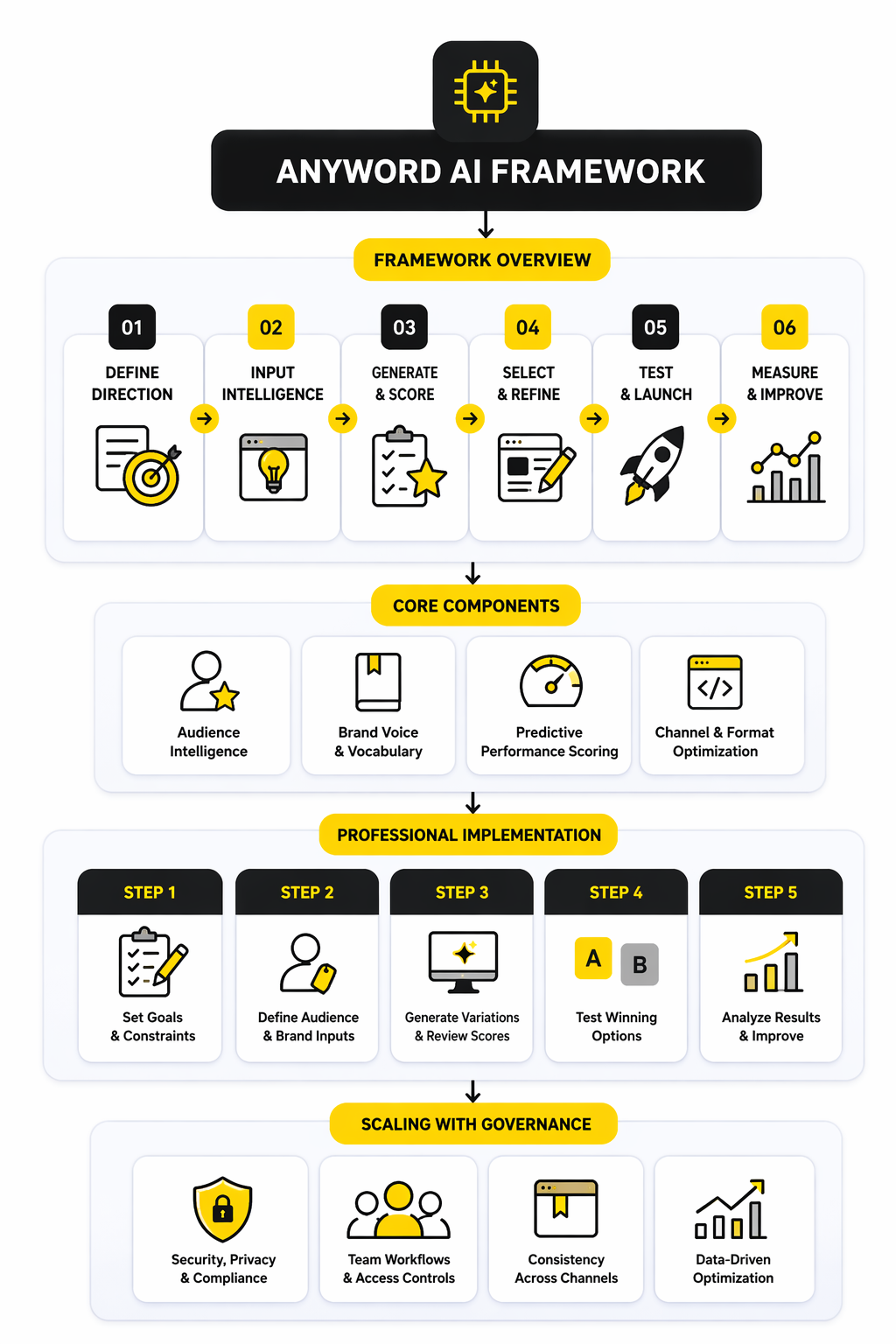
At a high level, Anyword AI follows a practical framework. First, it tries to understand the business context through brand voice, messaging rules, audience definitions, and approved copy assets. Then it generates multiple content options for a specific channel or goal. After that, it layers on predictive scoring and optimization suggestions so the user can choose or improve the version that looks most likely to perform.
That structure shows up clearly across Anyword’s product materials. Its enterprise pages emphasize centralized brand voice, audience profiles, and app integrations, while its brand-voice documentation highlights tools such as approved terminology, reusable copy assets, custom formulas, and audience definitions that help teams keep outputs aligned across channels enterprise overview and brand voice feature update.
What makes this framework different from a plain AI editor is that the workflow is not just prompt in, paragraph out. It is much closer to a marketing operating system for copy, where the platform tries to connect generation, brand governance, and performance prediction in one loop. That is the core promise behind Anyword AI, and it is the lens the rest of this review will use.
The Core Components Inside Anyword
The easiest way to understand Anyword AI is to break it into four working layers: generation, prediction, audience context, and brand control. Most AI writers only handle the first layer well. Anyword tries to make the other three usable inside the same workflow, which is why its platform feels closer to a performance content system than a simple writing assistant on the pricing and plans page and the broader product overview.
Predictive Performance Scoring
This is the feature that gives Anyword AI its identity. The company’s own explanation of its predictive scoring system is straightforward: the platform grades variations of copy based on expected conversion and engagement potential before you publish. That matters because most teams still rely on taste, internal opinions, or a last-minute gut call when choosing between headlines, ad angles, and CTAs.
There is a real strategic advantage in forcing copy decisions through a scoring layer before assets go live. On its current homepage, Anyword says its system can outperform baseline AI models and that advanced go-to-market teams are seeing a 30% increase in sales and business performance compared to baseline AI models. You should treat that as brand-owned performance messaging, not as neutral third-party proof, but it still explains why the product stands out in a crowded market: it is selling confidence, not just content.
What I like here is that the feature solves a practical problem marketers actually feel every week. When a team is staring at five decent options for a hero headline or paid ad variant, “pretty good” is not helpful. A ranking system, even an imperfect one, can create faster decisions and cleaner testing priorities.
Brand Voice and Governance
The second big layer is brand control. Anyword’s brand voice rollout explains that teams can centralize approved terminology, audience definitions, briefs, and reusable formulas so the model has guardrails before it starts writing. That sounds basic until you have multiple marketers, freelancers, agency partners, and sales teams all generating copy at the same time.
This is where Anyword AI becomes more relevant for serious operators than for solo experimenters. A single founder can often get away with loose prompting and manual cleanup. A larger team cannot. The moment five people are using AI to publish across ads, web pages, email, and social, brand drift becomes a real operational problem, and the tool’s governance layer starts doing real work.
That broader enterprise need is visible outside Anyword too. Deloitte’s latest enterprise survey shows generative AI is moving deeper into production, but execution quality and governance still separate serious deployments from scattered experiments in its 2024 year-end enterprise AI report. Anyword is clearly designed to sit on the disciplined side of that divide.
Target Audiences and Messaging Context
A lot of AI copy fails for one very boring reason. It is technically fluent but strategically vague. The words are clean, the tone is acceptable, and the result still falls flat because the message was never sharpened for a specific audience, awareness stage, or intent profile.
Anyword leans hard into fixing that. Its more recent product material around performance integrations for ChatGPT, Canva, and Notion and its guide to using brand, audience, and performance data with ChatGPT both center the same idea: copy gets stronger when the system knows who you are talking to and what kind of message tends to move that audience. That is not revolutionary in theory, but it is still missing from a surprising number of AI content workflows.
This is also why Anyword AI tends to resonate more with performance marketers than with general writers. Performance teams already think in segments, offers, angles, objections, and conversion stages. A tool that reflects that structure is naturally more useful than one that just waits for a clever prompt.
Workflow Tools and Channel Coverage
The platform is not just about headline scoring. On the current plans page, Anyword highlights website automation, a data-driven editor, blog creation, content intelligence, a Chrome extension, integrations, and private model options for larger organizations. In plain English, that means the company is trying to cover both the writing moment and the optimization layer around it.
That wider channel coverage is important because copy rarely lives in one place anymore. A campaign headline might start in an ad account, get adapted for a landing page, turn into an email subject line, and then reappear in retargeting creative. The more fragmented your stack is, the more useful it becomes to have one system tracking message quality and consistency across channels.
This is where Anyword AI starts competing less with a generic chatbot and more with a workflow decision. If your stack already includes tools for pages, CRM, email, publishing, and campaign ops, the question becomes whether Anyword improves the output of that stack enough to justify another layer. For many teams, that answer will come down to how much value they place on prediction and centralized messaging discipline.
How Professionals Implement Anyword in Real Teams
The biggest mistake people make with tools like this is expecting magic from day one. Anyword AI works best when it is implemented like a process upgrade, not like a novelty app. Teams that get value from it usually know which channels matter most, which assets they need to improve, and which brand rules must stay consistent.
Start With One High-Impact Channel
The smartest implementation path is narrow at first. Instead of trying to run every content function through Anyword AI immediately, start with one revenue-adjacent channel where copy quality clearly affects performance, like paid social, search ads, landing page headlines, or lifecycle email. That approach makes it easier to judge whether the platform’s predictions and brand controls are actually helping.
This is also where stack fit matters. If your funnel lives heavily on landing pages, pairing message development with a page builder like Replo can make sense because you can move from copy hypotheses into page iteration faster. If your operation is centered more around CRM, pipeline automation, and campaign orchestration, a platform like GoHighLevel may be part of the practical environment around the copy workflow.
The point is not to stack tools for the sake of stacking tools. The point is to give Anyword AI a real testing ground where message changes can be tracked against actual business outcomes. Without that, you are just generating polished text and calling it strategy.
Build Your Brand Inputs Before You Scale Output
This part is not glamorous, but it matters a lot. Before a team scales content production inside Anyword AI, it should define approved messaging language, audience profiles, offer positioning, prohibited claims, and examples of strong brand copy. Anyword’s own brand voice guidance makes clear that the system gets stronger when these inputs are explicit.
A lot of marketers want to skip this step because it feels slower than jumping straight into generation. That is exactly backward. Fast output without strong inputs creates rework, inconsistency, and endless editing, which kills the efficiency you were trying to gain in the first place.
Professionals know that AI performance is usually an operations problem disguised as a prompt problem. When teams complain that outputs are generic, off-brand, or not persuasive enough, the root issue is often weak source material, vague audience definitions, or missing message hierarchy.
Use It as a Decision Engine, Not Just a Drafting Tool
This is where advanced teams separate themselves. They do not use Anyword AI only to write first drafts. They use it to pressure-test angles, compare variants, challenge default messaging, and identify which version deserves live testing first.
That shift is subtle but powerful. If the platform is only saving you time on wording, it is useful. If it is helping your team make better pre-launch decisions, it becomes much more valuable because it affects media efficiency, conversion lift, and editorial consistency all at once.
This is also why some teams may combine Anyword with adjacent execution tools rather than asking it to do everything. For email campaigns, that could mean moving approved copy into Brevo or Moosend. For social distribution, it could mean publishing through Buffer after the messaging work is already sharpened.
That is the practical mindset to keep here. Anyword AI is strongest when it becomes the place where copy is clarified, scored, and aligned before it flows into the rest of your marketing machine.
A Practical Rollout Plan for Anyword AI
Once the strategy is clear, the next question is execution. This is where a lot of teams either get real value from Anyword AI or quietly turn it into another unused subscription. The difference usually comes down to whether they treat implementation as a controlled system with inputs, testing rules, and clear ownership.
The smartest rollout is not dramatic. You do not need a giant migration, a hundred prompts, or a company-wide AI mandate on day one. You need one use case, one clean workflow, and one measurable outcome that tells you whether the platform is improving marketing performance in the real world.
Step 1: Define the Commercial Goal First
Before anyone writes a single line in Anyword AI, decide what success actually means. For one team, that may be higher click-through rate on paid social. For another, it may be more qualified demo bookings from landing pages, stronger email engagement, or less editing time for campaign launches.
This sounds obvious, but it is the step people skip most often. They open the tool, generate some copy, like a few outputs, and then never connect those outputs to a business KPI. That is how AI gets praised in meetings and ignored in practice.
The broader market data supports this disciplined approach. The 2024 year-end Deloitte enterprise AI report shows that organizations are moving past experimentation, but measurable value still depends on structured implementation rather than enthusiasm alone. The lesson is simple: if your team cannot define the business goal up front, Anyword AI will not magically define it for you.
Step 2: Build the Messaging Foundation
After the goal is set, the next move is to load the platform with the raw material that actually makes AI useful. That means approved value propositions, customer pain points, audience segments, successful past messaging, offer language, compliance boundaries, and examples of tone that your team would genuinely publish.
Anyword’s own materials on brand voice and its workflow for using brand, audience, and performance data inside other writing environments make this point pretty clearly. The platform gets stronger when it knows the difference between generic copy and your copy. If you skip this work, you are basically asking a system to perform without context, and that usually produces polished mediocrity.
This is also the moment when leadership needs to be honest. If the company does not have a clear message hierarchy yet, Anyword AI will expose that problem fast. In that sense, implementation can be useful even before performance improves, because it forces the team to document what the brand actually wants to say.
Step 3: Limit the First Workflow on Purpose
This is where execution becomes tangible. Start with one workflow that has a short feedback loop and visible stakes. Paid ads, landing page messaging, and email subject lines are usually stronger starting points than broad blog production because the performance data comes back faster and the copy decisions are easier to compare.
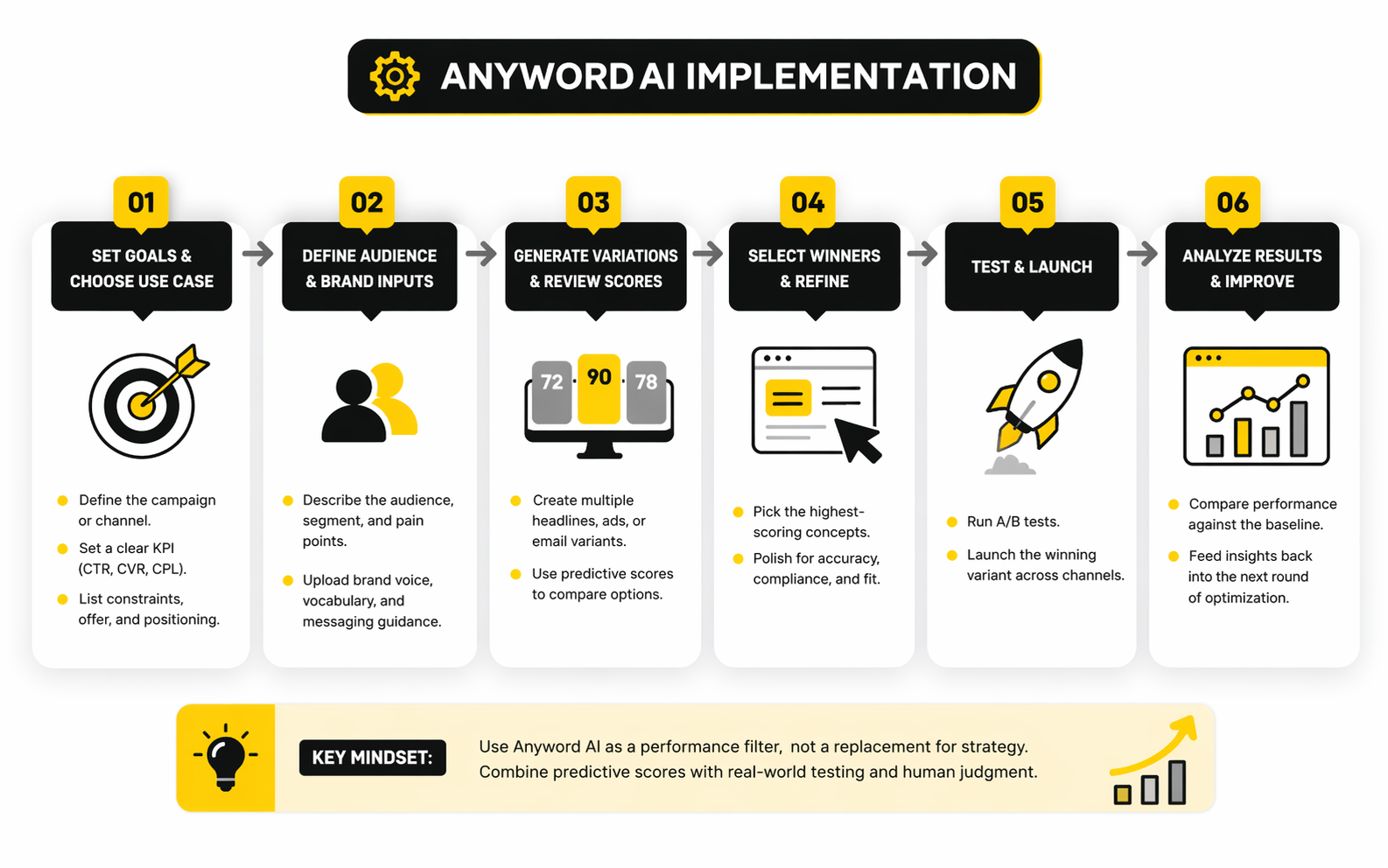
A simple first implementation often looks like this:
- Choose one campaign or channel with a clear KPI.
- Upload or define the relevant brand voice rules and audience context.
- Generate multiple copy variations for the same offer.
- Review predictive scores and message differences.
- Select the strongest candidates for live testing.
- Compare results against the team’s existing baseline.
- Feed the findings back into the next round of prompts and approvals.
That process is not flashy, and that is exactly why it works. It creates a repeatable operating rhythm instead of turning Anyword AI into a random brainstorming tool. Once a team sees a reliable lift in speed, consistency, or campaign efficiency inside one workflow, expansion becomes a rational next move instead of a leap of faith.
Step 4: Create a Human Review Layer
This part matters more than vendors sometimes admit. Predictive scoring is useful, but it should not replace human judgment on sensitive offers, regulated claims, legal language, or brand nuance. Strong teams use Anyword AI to sharpen decisions, not to remove responsibility.
That pattern lines up with the wider AI market. McKinsey’s 2025 global AI survey highlights that organizations getting stronger returns from AI are more likely to have defined processes for oversight, validation, and operating discipline. In plain English, high performers do not just generate faster. They review better.
For marketers, that means building a practical review rule set. Decide who approves ad claims, who owns landing page messaging, when predictive scores can influence final selection, and when a strategist can override the machine. Anyword AI works better when those boundaries are explicit, because the team spends less time arguing and more time iterating.
Step 5: Connect Outputs to the Rest of the Stack
Implementation gets much stronger when the copy workflow is not isolated. Once your team has approved messaging in Anyword AI, that output should move into the systems where campaigns are actually launched, tracked, and improved. Otherwise the gains stay trapped inside the editor.
This is why surrounding tooling matters. A team building ecommerce landing pages may want to carry winning messaging into Replo so page testing happens close to the copy workflow. A team that lives inside CRM automations and funnel operations may be better served by moving approved assets into GoHighLevel, where campaigns, follow-ups, and lead routing are already managed.
The same logic applies to communication channels. If lifecycle messaging is the main battleground, pushing finalized copy into Brevo or Moosend makes more sense than leaving it in a document. The important thing is not which stack you choose. The important thing is that Anyword AI becomes part of the path to execution, not a side tool people visit when they feel stuck.
Step 6: Measure More Than Output Volume
One of the traps in AI adoption is celebrating speed while ignoring outcomes. Yes, faster production matters. But if faster production gives you more weak copy, more internal editing, or more campaigns that miss, that is not real progress.
A better implementation scorecard usually includes a mix of metrics:
- time saved per asset or campaign
- reduction in revision rounds
- lift in click-through or conversion rate
- improvement in brand consistency across channels
- percentage of campaigns using structured testing rather than one-off creative decisions
This is where Anyword AI should be judged honestly. Not by how impressive the interface looks, and not by how many templates it offers, but by whether it helps a team make stronger decisions with less waste. The companies that get the most from tools like this usually measure discipline and performance together, because one without the other creates misleading wins.
Where Anyword AI Usually Works Best
Anyword AI tends to work best in environments where messaging quality can be tested quickly and where multiple people need to stay aligned. That includes paid acquisition teams, lifecycle marketing teams, ecommerce operators, SaaS growth teams, and in-house content groups supporting revenue functions. In those settings, the platform’s combination of generation, prediction, and brand structure has a clear job to do.
It is less compelling when the writing work is mostly exploratory, highly editorial, or dependent on original reporting. If your team’s main challenge is deep thought leadership, long-form journalism, or narrative storytelling with heavy subject-matter nuance, predictive performance scoring is helpful at the margin but not the center of the craft. That does not make Anyword AI weak. It just means the tool is strongest in performance-oriented environments, and that distinction matters.
That is really the core implementation takeaway. The best use of Anyword AI is not “let AI write for us.” It is “let’s build a cleaner system for creating, selecting, and deploying copy that has a better chance of performing.” That is a much more serious use case, and for the right team, a much more valuable one.
What the Numbers Actually Tell You
By this point, the important question is not whether Anyword AI can generate copy. It can. The better question is whether the data around the platform helps you make smarter marketing decisions, or whether it just gives you a more sophisticated way to feel confident about average messaging.
That distinction matters because AI metrics are easy to misunderstand. Teams see a prediction score, a faster drafting cycle, or a few better-performing variants and assume the tool is “working.” Sometimes it is. Sometimes the only thing improving is output volume, while the real performance signal is still hiding in the campaign data.
The First Benchmark: Adoption Is No Longer the Story
The wider market has already moved past basic AI curiosity. McKinsey found that 78% of respondents say their organizations use AI in at least one business function, up from 72% in early 2024 and 55% a year earlier, while 71% report regular use of generative AI in at least one function. Salesforce’s latest marketing research says 63% of marketers are currently using generative AI, and its newest State of Marketing report frames both predictive and generative AI as normal parts of the stack rather than edge experiments for nearly 5,000 marketers worldwide.
That matters because it changes the benchmark. A few years ago, using AI at all could feel like an advantage. Now it is closer to table stakes. For a tool like Anyword AI, the meaningful test is not adoption. It is whether the platform helps you outperform the growing pile of teams that are already using AI but still producing forgettable marketing.
The Second Benchmark: Prediction Matters Only if It Changes Decisions
Anyword’s strongest quantitative claim is also its most important one. The company says its system can identify which of two content variations will perform better with 82% accuracy, compared with 52% for GPT-4o without Anyword. On paper, that is a huge difference. In practice, the value of that number depends entirely on what your team does with it.
If marketers treat the score as a final truth, they will misuse it. Predictive scoring should be interpreted as a decision aid, not as a replacement for testing. What the number really does is narrow the field, reduce low-quality choices, and create a smarter shortlist before money or traffic goes live.
That is where the metric becomes useful. If Anyword AI helps a team avoid weak variants earlier in the process, campaign quality improves before launch. The real value is not the score itself. The value is the reduction in bad bets.
The Third Benchmark: Productivity Without Performance Is a Trap
There is no shortage of AI statistics about speed. McKinsey’s earlier estimate that generative AI could create economic value equal to 5% to 15% of total marketing spend through productivity gains is still useful context, but productivity is only one layer of the story. More output is not automatically better marketing.
This is where teams often fool themselves. They celebrate that they can now generate ten ad variants in ten minutes instead of writing two from scratch. That sounds impressive until you realize none of the ten variants improved click-through rate, conversion rate, or message clarity. Faster production is helpful, but only when it compounds into better commercial outcomes.
Deloitte’s enterprise research keeps returning to that same theme. Its latest generative AI reporting emphasizes that ROI is real but uneven, and that the difference between scattered wins and durable value usually comes from disciplined implementation, measurement, and governance rather than model novelty alone in its 2024 year-end findings and the newer 2026 state of AI in the enterprise series. In plain English, speed only matters if it pushes the right business metric.
The Metrics That Matter Most in Real Use
If you are using Anyword AI seriously, the most useful metrics are not all inside the platform. Some are leading indicators inside the tool, and some are lagging indicators in your campaign systems. You need both.
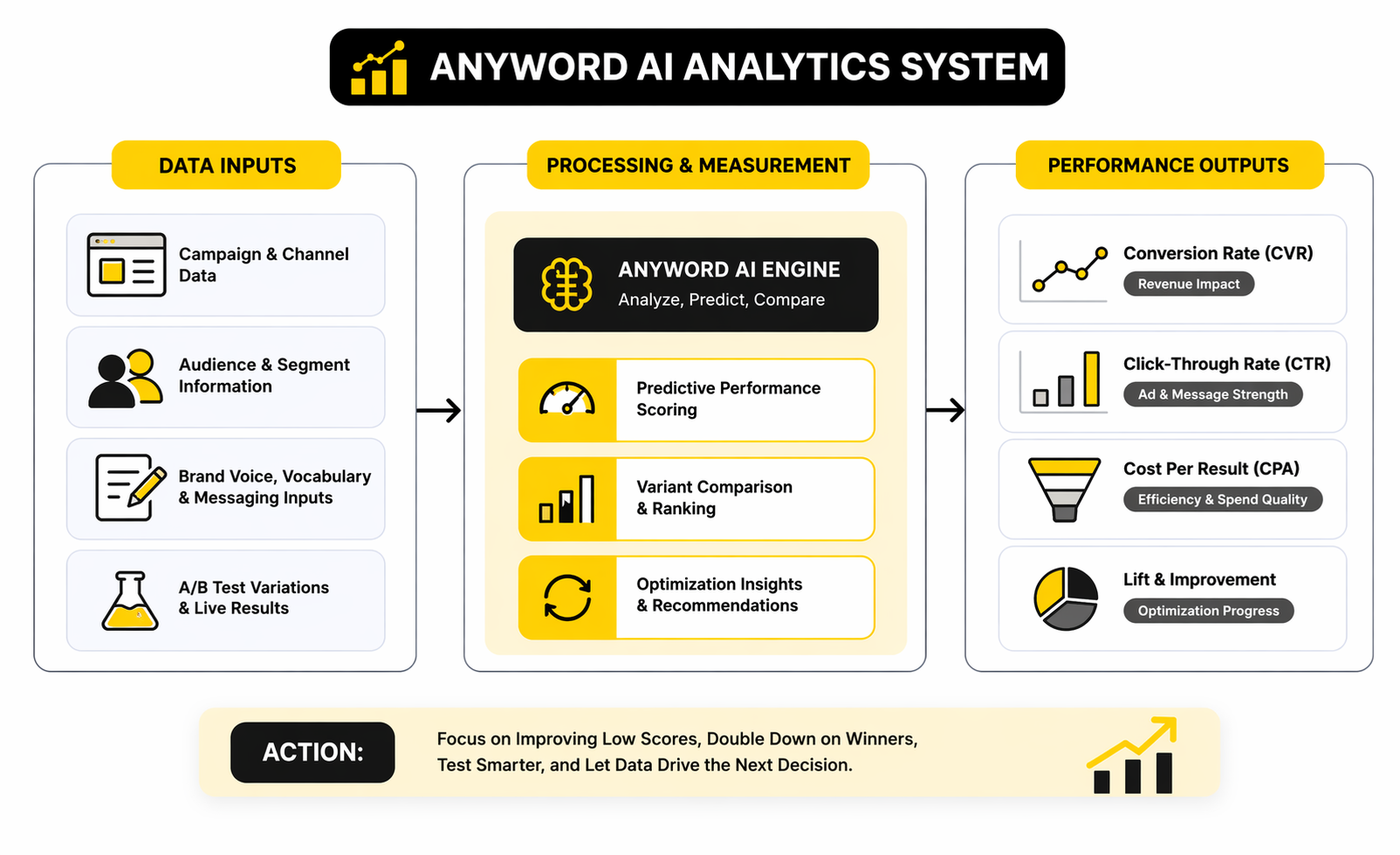
The internal signals are useful because they tell you whether the workflow is getting cleaner:
- how often high-scoring variants are actually approved
- how many revision rounds a team needs before launch
- whether brand voice violations are falling over time
- how quickly a team can move from brief to test-ready asset
The external signals are the ones that prove business value:
- click-through rate
- conversion rate
- cost per lead or cost per acquisition
- email open and click performance where relevant
- landing page conversion lift
- revenue per session, pipeline contribution, or assisted conversions when tracked cleanly
The mistake is to blend these into one fuzzy success story. A better process inside Anyword AI is good. A better campaign result is better. You need to know which one improved, because they do not always move together.
How to Read Predictive Scores Without Overreacting
A lot of teams need this said directly: a predictive score is not a promise. It is a probability-based signal. That means you should use it the way a disciplined operator uses any forecast, with respect but not blind faith.
Here is the practical way to interpret the output:
- Use the score to eliminate obviously weaker variants.
- Compare the highest-scoring options for message angle, not just wording.
- Check whether the top options match the offer, audience, and channel context.
- Launch controlled tests where the cost of being wrong is acceptable.
- Feed live performance back into future selection decisions.
That process makes Anyword AI more useful because it turns the model into a filter, not an oracle. When teams skip the human check and go straight from score to launch, they often confuse statistical confidence with strategic fit. Those are not the same thing.
Why Cross-Channel Consistency Is an Overlooked Data Point
One of the least talked-about measurement benefits of Anyword AI is consistency. This is harder to quantify than CTR or conversion rate, but it matters a lot when multiple people are producing messaging across paid, email, site, and social at the same time.
Salesforce reports that 88% of marketers use analytics or measurement tools, yet the same body of research keeps pointing to data activation and unification as a weak spot. That is exactly why message consistency deserves more attention. If your brand promise shifts from ad to page to email, performance drops in ways that standard dashboards do not always explain cleanly.
So yes, campaign metrics matter most. But a disciplined Anyword AI workflow can also improve the hidden layer underneath those metrics: alignment. Better alignment means fewer contradictory claims, fewer awkward rewrites, fewer last-minute edits, and a stronger chance that a winning message in one channel can travel to another without losing its edge.
The Best Action to Take From the Data
If the numbers in this space point to one conclusion, it is this: Anyword AI should be evaluated as a decision-quality tool, not just a writing tool. The adoption data says AI is already normal. The productivity data says speed alone is not enough. The platform’s own performance claims suggest the real upside is in choosing better variants before launch, not just generating more of them.
So the action this data should drive is pretty clear. Do not ask whether Anyword AI writes fast. Ask whether it helps your team ship stronger copy with fewer weak bets, fewer editing cycles, and better downstream performance. That is the benchmark that actually matters, and it is the one worth carrying into the next part of the review.
Strategic Tradeoffs and Limits You Should Understand
By now, the strongest case for Anyword AI is clear. It gives marketing teams a more structured way to create, evaluate, and scale conversion-focused copy than a generic AI assistant usually can. But the closer you get to serious implementation, the more important the tradeoffs become.
This is where weaker reviews usually fall apart. They either hype the platform like it solves every content problem, or they dismiss it because it is not a perfect replacement for human marketers. Neither view is useful. The truth is that Anyword AI can be very effective, but it works best when you are clear about what it should do, what it should not do, and where the real risks show up at scale.
Anyword AI Is Stronger for Optimization Than Original Thinking
This is probably the most important strategic distinction in the whole review. Anyword AI is built to improve messaging performance, tighten brand consistency, and speed up copy iteration. That is not the same thing as producing deep original strategy, category-defining creative direction, or reporting-based thought leadership.
That difference matters because teams sometimes buy performance tools while secretly hoping for breakthrough originality. They want a platform to generate fresh positioning, discover new market insight, and write conversion-ready copy without much human input. In reality, Anyword AI is strongest when the strategic raw material already exists and the job is to shape, test, and scale it more intelligently.
So the right mental model is this: use Anyword AI after the core thinking is done, not instead of it. If your offer is weak, your message is confused, or your audience insight is shallow, the platform can polish the problem, but it cannot rescue it.
Scaling Creates Governance Pressure Fast
At small scale, AI copy problems feel manageable. One marketer writes a few things, edits the awkward parts, and moves on. At team scale, the same loose workflow turns messy very quickly because more people, more channels, and more assets create more room for drift, inconsistency, and avoidable risk.
That is why governance matters more than people expect. NIST’s AI Risk Management Framework is built around the idea that AI value and AI risk have to be managed together, not separately. McKinsey’s 2025 state of AI research makes a similar point from a business angle, showing that high performers are more likely to define when outputs need human validation and to operationalize AI with disciplined management practices.
This is exactly where Anyword AI becomes more interesting for mature teams. The platform’s push into brand voice controls, brand vocabulary, and enterprise workflows is not just a feature story. It is an answer to the scaling problem. As more teams generate more marketing copy, structure stops being a nice extra and starts becoming the thing that keeps the operation coherent.
Compliance and Data Handling Are Not Side Issues
For serious teams, AI adoption is no longer only a creative decision. It is also a security, privacy, and compliance decision. That becomes even more important in Europe and in regulated sectors, where expectations around documentation, governance, and model-related obligations are tightening.
The European Commission states that obligations for general-purpose AI models under the AI Act entered into application on 2 August 2025, with enforcement powers applying from 2 August 2026. That does not mean every marketing team using Anyword AI suddenly becomes a regulatory expert. It does mean businesses should stop treating AI tooling like a casual browser extension decision with no downstream responsibility.
On this front, Anyword is clearly trying to meet enterprise expectations. Its current security materials say the platform meets SOC 2, ISO 27001, GDPR, and HIPAA requirements, and its enterprise positioning emphasizes security, privacy, and control. Those claims matter because they reduce friction for larger buyers, but they should still lead to practical due diligence, not blind trust. A serious team should always confirm its own data-handling requirements before rolling any AI system into production workflows.
Tool Sprawl Is a Real Risk
There is another scaling issue that does not get enough attention: stack fragmentation. The more capable AI tools become, the easier it is for a team to end up with one platform for copy, one for pages, one for CRM, one for email, one for publishing, and three more for brainstorming, analytics, and automation. That can work, but it can also become expensive and chaotic fast.
Anyword AI sits in an interesting position here. It is specialized enough to do something distinct, but not broad enough to replace the rest of a growth stack. For some teams, that is a strength. They want a dedicated decision layer for messaging and are happy to move the output into tools like Replo, GoHighLevel, Brevo, or Moosend once the copy is approved.
For other teams, though, another specialized layer feels like one tool too many. That is not really a knock on Anyword AI. It is just a reminder that good software can still be the wrong workflow fit if your stack is already overloaded or if your team lacks the process maturity to make one more layer worth the effort.
The Chrome Extension Changes the Competitive Picture
One smart move from Anyword is that it is not trying to keep all value trapped inside its own editor. Its performance boost workflow and Chrome extension materials position the product as a way to bring brand guidance, audience context, and scoring into other environments where marketers already work.
That matters because one of the biggest threats to specialized AI tools is habit. People spend their day in ChatGPT, docs, design tools, social platforms, and CRM systems. If a platform demands that all meaningful work happen in a separate environment, adoption friction goes up immediately. The extension strategy is a direct answer to that problem.
It also changes how you should compare Anyword AI to broader AI products. The question is not only whether Anyword has a better native editor. It is whether it can make the places your team already writes more disciplined and performance-aware. If it can do that reliably, its role in the stack gets much stronger.
Teams Can Still Over-Trust the System
This is the final risk, and it is the most human one. Once a platform looks sophisticated enough, people start relaxing their judgment. A predictive score feels scientific. A polished output feels finished. A branded workflow feels safer than it really is.
That is where experienced operators stay sharp. They remember that Anyword AI is still a probabilistic system layered on top of human assumptions, campaign context, and model behavior. It can narrow the field and improve the odds, but it cannot fully understand your market, your buyer’s emotional state, or the timing pressures affecting a live campaign.
So the expert move is not to resist the tool. It is to keep the right amount of skepticism while using it aggressively. Trust the system enough to benefit from it, but not so much that you stop testing, stop reviewing, or stop thinking. That balance is what turns Anyword AI from an impressive demo into a durable advantage.
Who Should Be Most Careful Before Buying
Anyword AI is not a risky product in the dramatic sense. But it is easier to overspend on specialized AI software when the underlying workflow is still messy. Teams should be more cautious if they do not yet have clean messaging strategy, clear campaign ownership, or a testing culture that can validate whether the platform is helping.
That especially applies to small teams hoping the tool will create strategy out of thin air. It probably will not. If your real bottleneck is weak offers, poor audience clarity, or no measurement discipline, Anyword AI may feel useful for a few weeks and then slowly become another tab no one truly depends on.
The better buyers are the teams that already know where copy quality affects revenue and already have enough operational discipline to act on the platform’s signals. For them, the tradeoffs are easier to justify because the tool has a clear job. And when software has a clear job, it has a much better chance of paying for itself.
Final Verdict and the Broader Tool Ecosystem
After looking at the product from the angles that actually matter, the verdict is pretty straightforward. Anyword AI is not the best fit for every writer, every team, or every content workflow. But for marketers who live inside performance channels and care about message quality before launch, it is one of the more focused and strategically useful AI platforms in the category.
That is really the key point. Anyword AI is not trying to win by being the most open-ended chatbot or the cheapest text generator. It is trying to become the performance layer between raw AI output and real marketing execution, and its current product direction around scoring, brand controls, security, and cross-tool workflows on the official platform makes that ambition pretty clear.
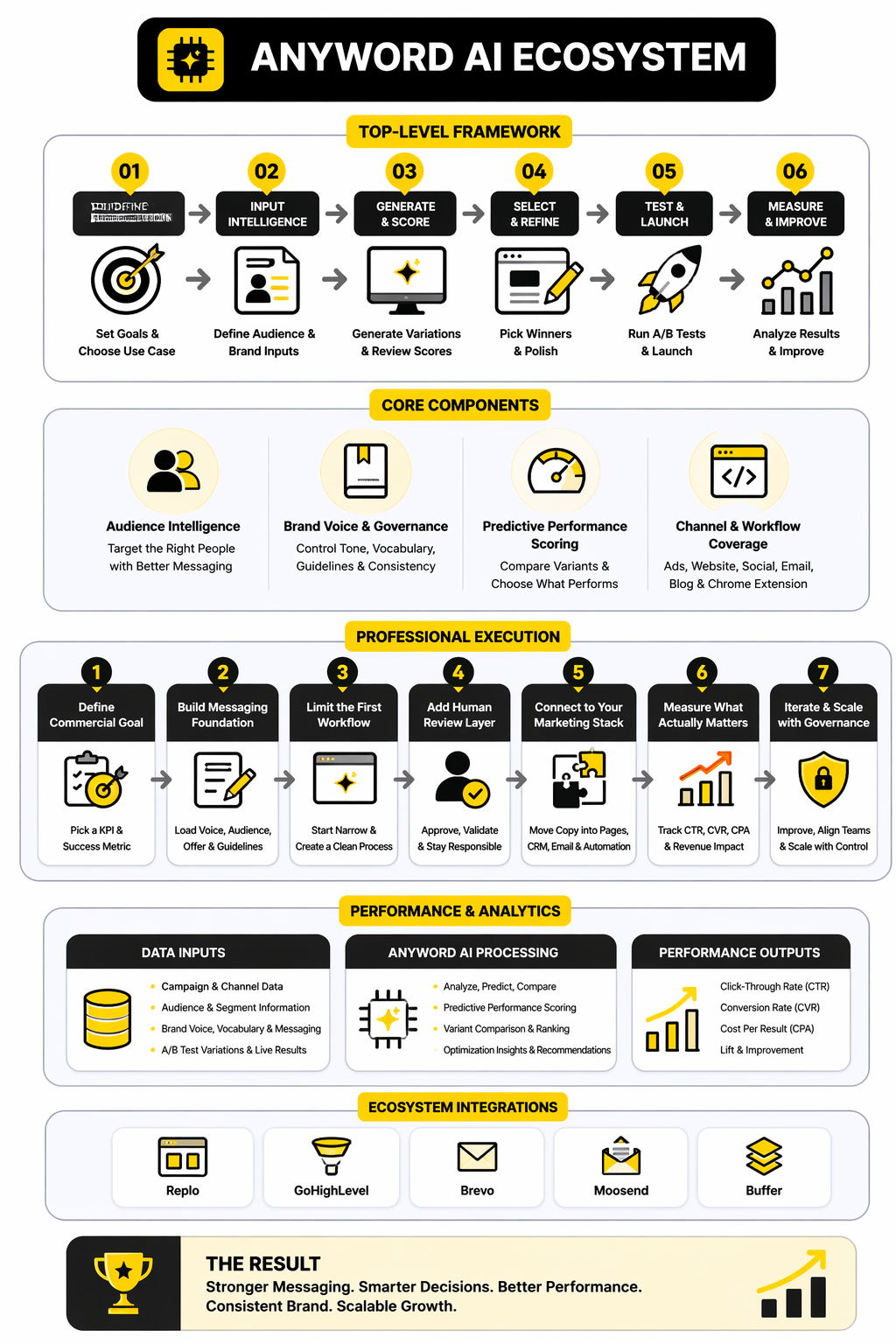
The ecosystem question matters too. Most teams will not use Anyword AI in isolation. They will use it alongside systems for landing pages, email, CRM, scheduling, research, automation, and publishing. That means the right comparison is rarely “Anyword versus everything.” It is usually “Does Anyword improve the quality of the decisions we make inside the rest of our stack?”
For some teams, the answer will be yes. If your world revolves around testing offers, improving conversion paths, and keeping messaging aligned across channels, Anyword AI can be a serious advantage. If your work is more editorial, more research-heavy, or more dependent on original human perspective, the platform becomes more of a supporting tool than a center-of-gravity tool.
That is the honest close. Anyword AI is strongest when copy performance is a business lever, when governance matters, and when your team is mature enough to use predictive signals without mistaking them for absolute truth. In that lane, it is a strong product and a credible one.
If your stack is still taking shape, the surrounding tools you pair with a system like this will shape the outcome. Teams building and testing fast-moving landing pages may want a tighter page workflow through Replo. Teams running lead generation, funnels, and client operations at scale may lean harder on GoHighLevel. Email-heavy operators may prefer to push approved messaging into Brevo or Moosend, while social-focused teams may care more about downstream scheduling in Buffer.
The point is not to build a bloated stack. The point is to understand where Anyword AI sits in the system. It is best used as the place where messaging gets sharpened, scored, aligned, and prepared for execution. Once you see it that way, the buying decision becomes much easier.
FAQ
Is Anyword AI worth it for small businesses?
Anyword AI can be worth it for a small business, but only when copy quality directly affects revenue and the team actually has a workflow to use the tool properly. If the business is running paid campaigns, sales pages, email sequences, or lead generation funnels, the platform’s predictive scoring and messaging structure can be useful. If the real problem is weak positioning or no clear offer, the software will not fix that foundation.
What makes Anyword AI different from ChatGPT?
The simplest answer is focus. ChatGPT is a broad general-purpose assistant, while Anyword AI is built specifically around marketing performance, brand control, and copy evaluation. Anyword’s product direction on its homepage and platform pages makes that clear because the platform centers prediction, audience context, and content intelligence rather than open-ended conversation.
Does Anyword AI actually predict performance?
It does offer predictive performance scoring, and that is one of the main reasons marketers use it. The company says its system can identify better-performing variations with 82% accuracy against 52% for GPT-4o without Anyword. The smart way to use that number is as a filtering aid before live testing, not as a guarantee that a given headline or ad will win in market.
Is Anyword AI good for SEO blog content?
It can help with SEO-oriented blog production, especially for teams that need speed, consistency, and stronger on-brand execution. The platform’s content marketing positioning and blog-related features show that it is designed for more than ads and email. Still, long-form SEO content that requires deep expertise, original reporting, or nuanced analysis will always need a stronger human editorial layer.
Can Anyword AI replace a copywriter?
No, and that is the wrong goal anyway. Anyword AI can absolutely reduce drafting time, improve workflow structure, and help teams make better pre-launch copy decisions. But replacing a strong copywriter is a very different thing from improving the output of a marketing team, and the latter is where the tool is far more believable and useful.
Is Anyword AI better for teams than solo creators?
Usually, yes. Solo marketers can still get value from the platform, especially if they are running performance campaigns themselves. But the bigger advantage shows up when multiple people need shared brand rules, audience frameworks, and a cleaner approval process, which is why Anyword puts so much emphasis on enterprise workflows and security controls.
Does Anyword AI support brand voice controls?
Yes, and this is one of its more important strengths. Anyword has expanded its platform around brand voice, reusable messaging assets, and brand vocabulary controls so teams can create content that stays more consistent across channels. That matters a lot once several marketers or agencies are generating copy at the same time.
Is Anyword AI safe for enterprise use?
The platform clearly aims to be enterprise-ready from a security and compliance standpoint. Its current security page highlights SOC 2, ISO 27001, GDPR, and HIPAA alignment, plus access controls and privacy positioning. That said, any serious company should still review internal legal, procurement, and data requirements before rollout instead of assuming a vendor page alone settles the issue.
What type of marketer gets the most value from Anyword AI?
Performance marketers usually get the clearest value because they can connect copy decisions to measurable outcomes faster. Demand gen teams, paid media operators, lifecycle marketers, ecommerce teams, and SaaS growth teams are usually better fits than purely editorial teams. If your job depends on stronger headlines, better conversion messaging, and faster variant selection, Anyword AI is in the right territory.
Does Anyword AI work across different marketing channels?
Yes, that is part of the appeal. The platform positions itself around ads, website copy, social posts, email, blogs, and other GTM content on the main platform pages and in its Chrome extension and workflow materials. The practical advantage is not just cross-channel generation, but the ability to keep the underlying message more consistent as it moves between channels.
Is Anyword AI expensive compared with alternatives?
Whether it feels expensive depends on what you are comparing it against. Against a generic AI assistant, it will often look more specialized and therefore harder to justify on price alone. Against the cost of wasted ad spend, weak landing pages, messy approval cycles, and inconsistent campaign messaging, the economics can look much better if the platform becomes part of a real workflow.
How should marketers evaluate Anyword AI before committing?
The best way is to run a narrow pilot around one commercial use case. Pick a channel with a visible KPI, define the audience and brand inputs clearly, generate multiple variants, use the predictive layer to shortlist candidates, and compare outcomes against your existing process. That tells you far more than a generic trial ever will.
Is Anyword AI enough on its own for a full marketing stack?
No, and it does not need to be. It is better thought of as a performance messaging layer that improves the copy decisions inside the broader stack. That is why it often makes sense next to tools for pages, CRM, email, automations, and publishing rather than instead of them.
What is the biggest mistake teams make with Anyword AI?
The biggest mistake is treating it like magic instead of infrastructure. Teams either expect the platform to invent strategy from scratch or they trust the scoring layer more than they trust disciplined testing. The strongest teams use Anyword AI aggressively, but they still bring clear strategy, human review, and live performance validation into the loop.
Work With Professionals
Explore 10K+ Remote Marketing Contracts on MarkeWork.com
Most marketers spend too much time chasing clients, competing on crowded platforms, and losing a percentage of every project to middlemen. MarkeWork gives you a better way. Browse thousands of remote marketing contracts and connect directly with companies desperate to hire skilled marketers like you, without platform commissions and without unnecessary gatekeepers.
If you're serious about finding better opportunities and keeping 100% of what you earn, explore available contracts and create a profile for free at MarkeWork.com.