

Attraction marketing is the practice of earning attention, trust, and demand by becoming useful before asking for the sale. Instead of chasing strangers with aggressive pitches, you create content, proof, conversations, and systems that make the right people want to come closer.
That matters because modern buyers do a lot of thinking before they ever speak to a seller. Gartner reported that 61% of B2B buyers prefer a rep-free buying experience, while Sprout Social’s 2025 Index found that brands need more human, original engagement to earn trust in crowded feeds.
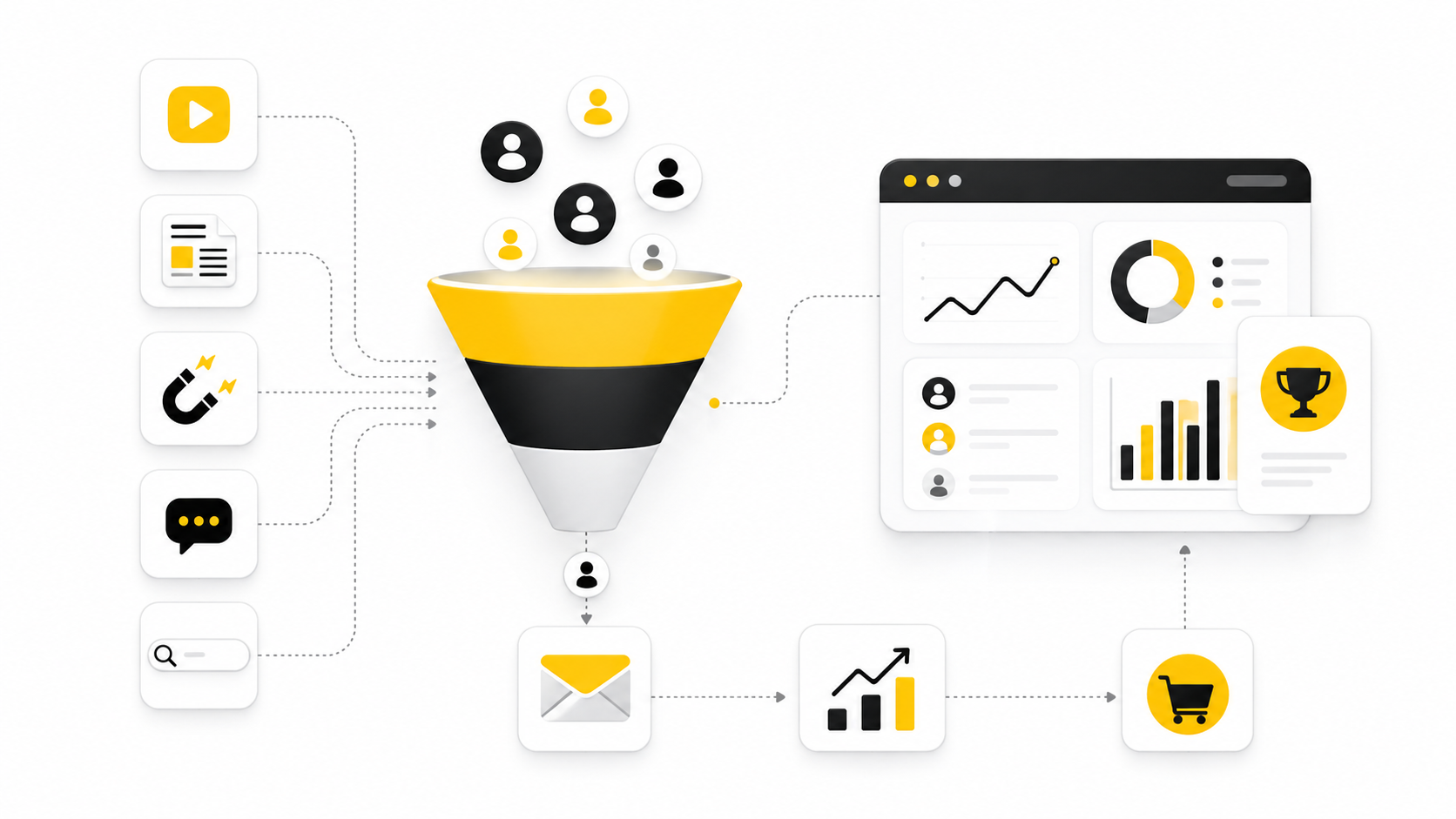
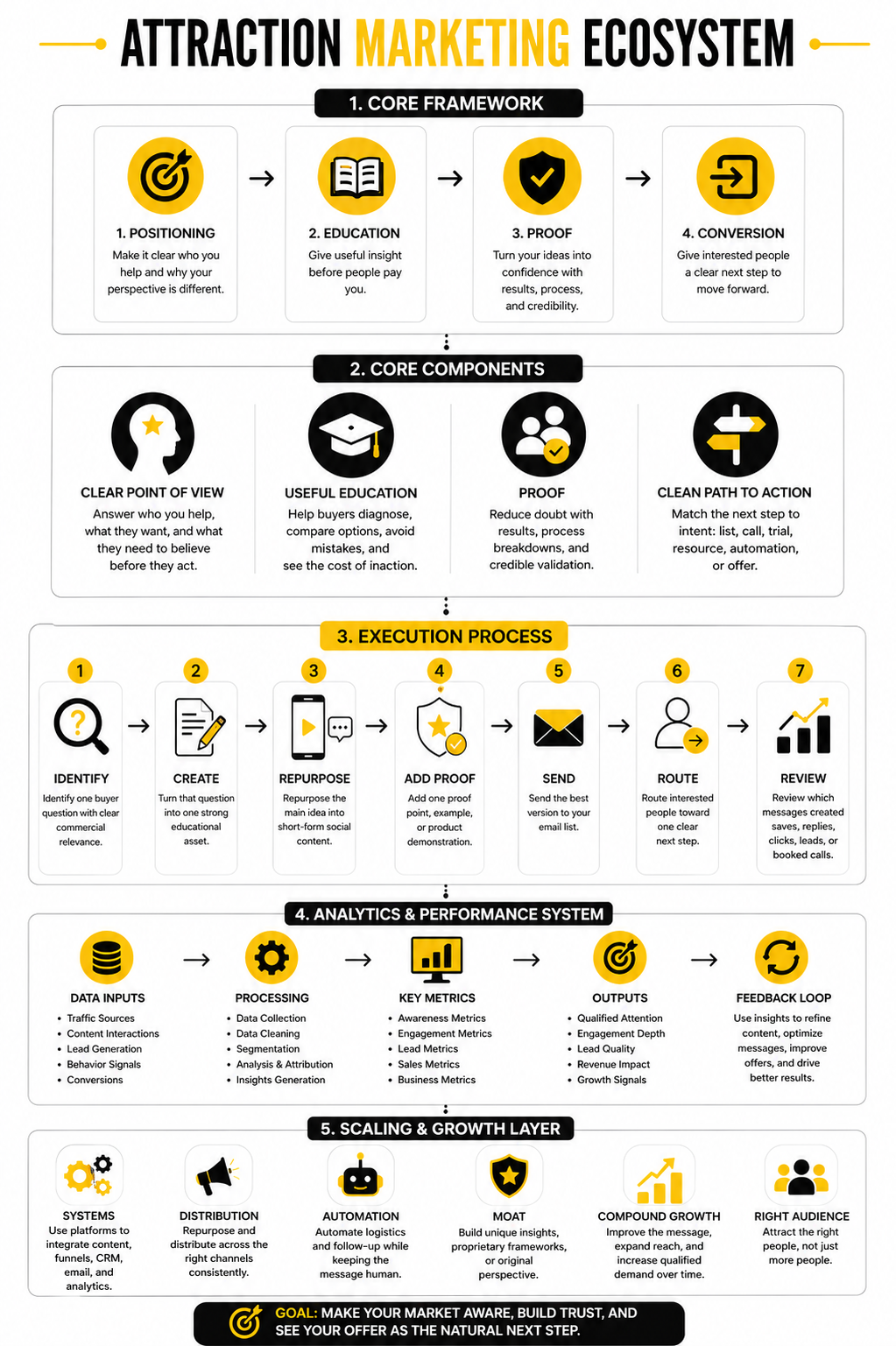
This guide will break attraction marketing into a practical operating system, not a vague “post valuable content” idea. The goal is simple: make your market aware of the problem, trust your perspective, and see your offer as the natural next step.
Article Outline
- Why Attraction Marketing Matters Now
- The Attraction Marketing Framework
- Core Components Of Attraction Marketing
- How To Build Trust Before The Offer
- Professional Implementation Across Channels
- Measurement, Optimization, And FAQs
Why Attraction Marketing Matters Now
Attraction marketing works because buyers are more informed, more skeptical, and more selective than they used to be. They compare options quietly, read reviews, watch creators, ask communities, and judge whether a brand feels credible before they click a call-to-action. That means the first sale often begins long before the landing page.
The old playbook was mostly interruption: grab attention, push the offer, follow up harder. That still has a place, but it breaks down when people feel overwhelmed by ads, AI-generated content, and generic outreach. Attraction marketing gives people a reason to listen before you ask them to buy.
This is especially important for service businesses, creators, agencies, coaches, SaaS companies, and ecommerce brands with education-heavy offers. When the buyer needs belief, clarity, or confidence before purchase, attraction marketing shortens the emotional distance between interest and action.
The Attraction Marketing Framework
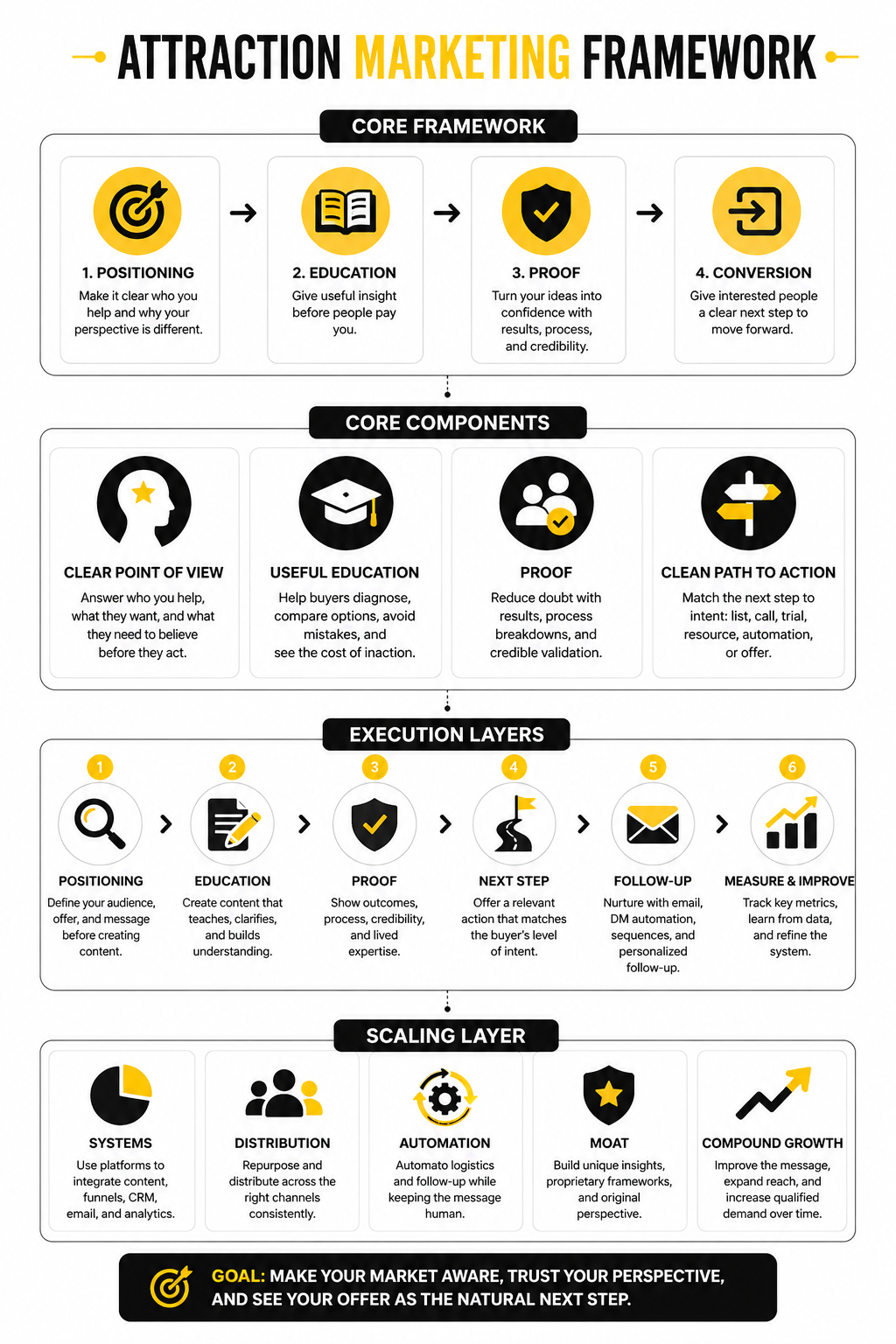
Attraction marketing has four connected layers: positioning, education, proof, and conversion. Positioning makes it clear who you help and why your perspective is different. Education gives people useful insight before they pay you.
Proof turns your ideas into confidence by showing outcomes, process, credibility, or lived expertise. Conversion then gives interested people a clear next step, such as joining a list, booking a call, starting a trial, downloading a resource, or entering an automated follow-up system.
The important part is that these layers work together. Content without conversion becomes free advice with no business model. Conversion without trust becomes pressure. Attraction marketing sits in the middle: helpful enough to earn attention, structured enough to create revenue.
Core Components Of Attraction Marketing
The first component is a clear point of view. People are not attracted to businesses that sound interchangeable. They are attracted to a useful perspective that makes a problem easier to understand, easier to solve, or more urgent to act on.
That point of view should answer three basic questions: who do you help, what do they want, and what do they need to believe before they are ready to move forward? This is where attraction marketing becomes strategic instead of random. You are not just creating content because the calendar says you need another post.
The second component is useful education. Strong attraction content helps people diagnose their situation, compare options, avoid mistakes, and see the cost of staying where they are. This fits the way buyers already behave, especially when B2B buyers increasingly prefer self-directed research before speaking with sales.
The third component is proof. Proof can come from customer results, product walkthroughs, transparent process breakdowns, expert commentary, third-party validation, or consistent public execution. The key is that proof should reduce doubt, not just decorate the page.
The fourth component is a clean path to action. If people like your ideas but cannot tell what to do next, the attraction is wasted. A newsletter, quiz, booking page, DM automation, lead magnet, webinar, or product trial can all work, but the next step has to match the buyer’s level of intent.
Positioning Comes Before Content
A lot of businesses skip positioning and go straight into posting. That usually creates a messy content library full of tips, trends, and recycled advice with no sharp reason to follow the brand. The audience may understand the topic, but they do not understand why this business is the one to trust.
Good positioning makes your content easier to recognize. It gives your audience a mental shortcut, so they can quickly say, “This is for me,” or “This person understands my problem.” That reaction is far more valuable than a passive like.
For attraction marketing, positioning should be specific without becoming tiny. You want enough focus to feel relevant, but enough room to create a full content ecosystem. A simple way to test it is this: could someone describe your value in one sentence after reading five pieces of your content?
Education Builds Demand Without Pressure
Education is not the same as giving away everything for free. It means showing the buyer how to think better about the problem. When you do that consistently, your offer starts to feel like the logical next step instead of a hard pitch.
This works because most buyers are not stuck only because they lack information. They are stuck because they do not know which information matters, what order to act in, or what tradeoffs to accept. Attraction marketing helps by turning confusion into clarity.
Educational content can take many forms: comparison posts, mistake breakdowns, teardown videos, buyer checklists, framework articles, live workshops, and email sequences. Tools such as GoHighLevel, Systeme.io, and ClickFunnels can support this when you need landing pages, funnels, follow-up, and basic automation around that content.
Proof Makes The Message Believable
The internet is full of advice, so the market does not reward claims by default. Proof is what separates a strong attraction marketing system from a content machine that sounds nice but converts poorly. People need to see that your perspective is grounded in something real.
Proof does not always mean dramatic testimonials. It can be a before-and-after process, a transparent audit, a product demo, a customer quote, a benchmark, or a public breakdown of how you solve a problem. What matters is that it makes the buyer feel safer taking the next step.
Trust is especially important because skepticism is high. Edelman’s 2025 research shows a broad trust problem across institutions, while business still carries an important role in earning confidence through visible action and competence. That is the bar now: not louder marketing, but clearer evidence.
How To Build Trust Before The Offer
The implementation starts with trust, not tactics. Before you build a funnel, schedule a month of content, or set up automations, you need to know what your audience must believe before your offer feels obvious. Attraction marketing works best when each touchpoint removes a specific doubt.
Most buyers are carrying silent objections. They wonder whether the problem is urgent, whether the solution fits them, whether the cost is justified, whether they can trust you, and whether they will actually follow through. Your job is to answer those concerns before the sales conversation gets heavy.
This is why useful content needs a clear job. A post can create awareness, a guide can explain the problem, a comparison can clarify options, a case study can reduce risk, and an email sequence can help the buyer commit. When every asset has a job, your marketing stops feeling like noise.
Turn Audience Questions Into Content Pillars
A practical attraction marketing process begins with the questions your market already asks. These questions are usually hiding in sales calls, support tickets, comment sections, search queries, reviews, community threads, and competitor pages. Do not start by asking, “What should we post?” Start by asking, “What does the buyer need to understand next?”
Once you collect those questions, group them into content pillars. A simple structure is problem awareness, solution education, comparison, proof, objection handling, and action. These pillars give you enough variety to stay useful without drifting away from the commercial intent of the business.
This also protects you from creating content that only performs on the surface. A viral post can bring attention, but a strong content pillar creates movement. The best attraction marketing content makes the buyer more ready, not just more entertained.
Build The Execution Process
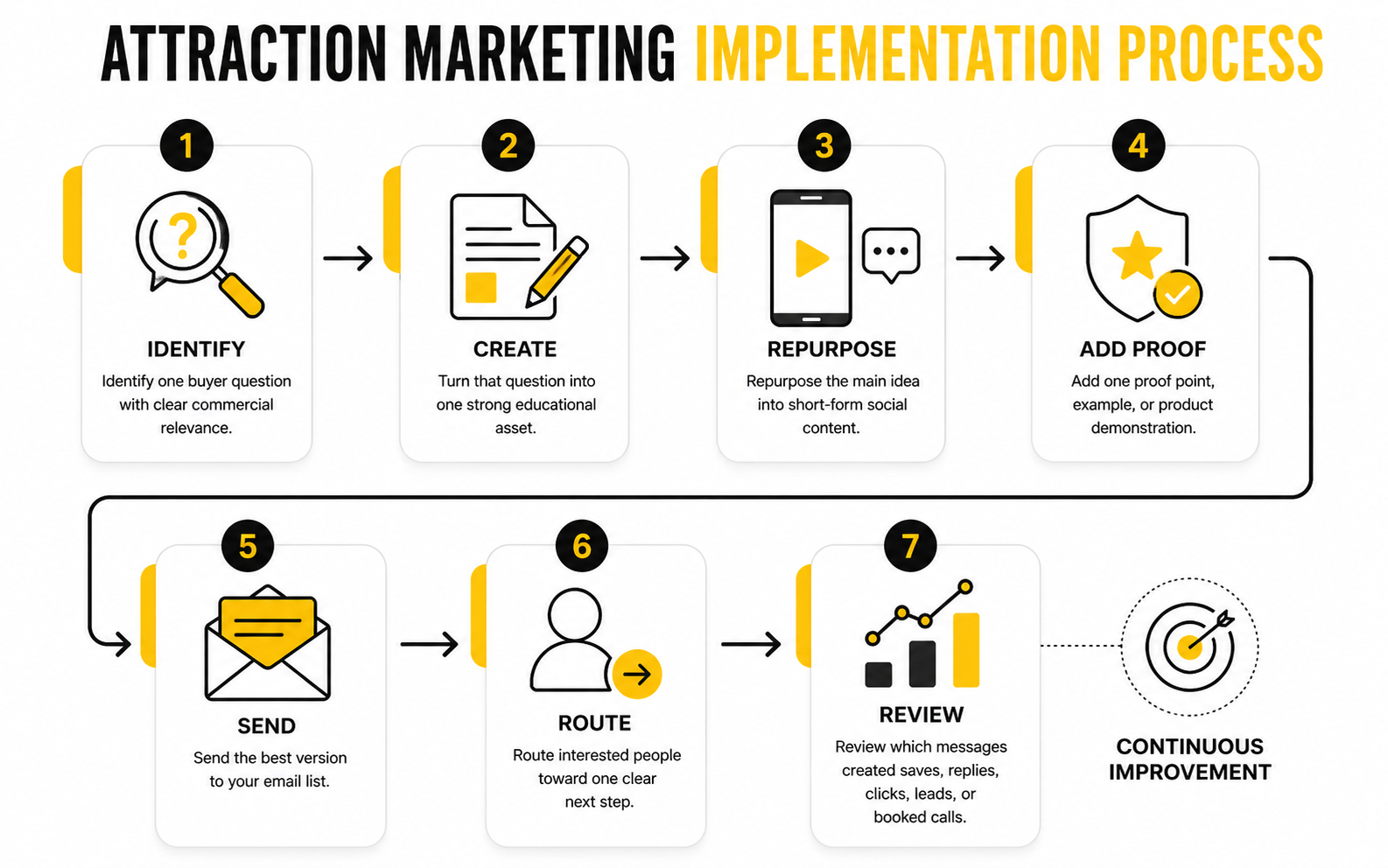
The execution process should be simple enough to repeat every week. If it depends on inspiration, it will break. If it depends on a complicated approval chain, it will slow down until nobody owns it.
Start by choosing one primary audience, one core offer, and one main conversion action. Then build the content path around the beliefs the buyer needs to develop. This keeps the system focused, because every article, post, video, email, and landing page points in the same strategic direction.
A clean weekly process can look like this:
- Identify one buyer question with clear commercial relevance.
- Turn that question into one strong educational asset.
- Repurpose the main idea into short-form social content.
- Add one proof point, example, or product demonstration.
- Send the best version to your email list.
- Route interested people toward one clear next step.
- Review which messages created saves, replies, clicks, leads, or booked calls.
This is where tools can help, but they should not replace the thinking. A scheduling tool such as Buffer can keep social distribution consistent, while ManyChat can help turn comments or DMs into a guided next step. The strategy still has to come first.
Match The Channel To The Buyer’s Intent
Every channel has a different job. Search content is powerful when people are already looking for answers, comparisons, or implementation help. Social content is better for making the problem visible and building familiarity over time.
Email is where attraction marketing becomes more controlled. Social algorithms can change, but an email list gives you a direct relationship with people who have already raised their hand. Recent email benchmark research based on billions of messages found that many brands still rely on very basic personalization, which leaves room for better segmentation and more relevant follow-up.
The mistake is treating every channel like a billboard. A good LinkedIn post, YouTube video, landing page, and email sequence should not all say the exact same thing in the exact same way. They should move the same buyer through different levels of awareness.
Create A Clear Conversion Path
Attraction without conversion is incomplete. You do not need to pitch constantly, but you do need a visible next step for people who are ready. Otherwise, your best prospects may enjoy your content and still never enter your pipeline.
The conversion path should match the level of commitment. A cold audience may need a checklist, workshop, quiz, or newsletter before they are ready for a sales call. A warmer audience may be ready for a demo, trial, audit, consultation, or product offer.
For service businesses and agencies, a platform like GoHighLevel can connect forms, calendars, pipelines, emails, and follow-up in one system. For leaner funnel builds, Systeme.io or ClickFunnels can work when the priority is getting a focused offer path live quickly.
Statistics And Data
Measurement is where attraction marketing becomes a business system instead of a content habit. The point is not to collect every possible number. The point is to understand which signals show attention, trust, intent, and revenue movement.
Start with the buyer journey, then choose the metrics. Early-stage content should be judged by qualified reach, saves, comments, watch time, search visibility, and returning visitors. Mid-stage assets should be judged by email signups, guide downloads, webinar registrations, product page visits, replies, and comparison-page engagement.
Late-stage measurement is different again. At that point, you are looking at booked calls, trial starts, demo requests, checkout starts, close rate, average deal value, sales cycle length, and customer acquisition cost. If one piece of content creates fewer likes but more qualified calls, that is not a failure. That is probably the piece you should study.
What The Numbers Actually Mean
Benchmarks are useful, but only when you use them as context instead of a scoreboard. A social post with average engagement can still be valuable if it attracts the right buyers and creates sales conversations. An email with a modest click rate can still perform well if the clicks come from high-intent prospects.
This matters because platform averages can hide intent. For example, 2025 social benchmark research from Sprout Social is based on 3 billion messages across 1 million active public profiles, which makes it useful for comparison, but your own audience quality still matters more than a generic average. The smarter question is not, “Did this beat the internet?” It is, “Did this move our specific buyer closer to action?”
Email works the same way. Recent benchmark data shows that many B2B services and SaaS emails sit around the high-30% open-rate range, with click-through rates often much lower than opens. That should tell you something practical: subject lines and deliverability get attention, but the offer, timing, and relevance earn the click.
The Four Metrics That Matter Most
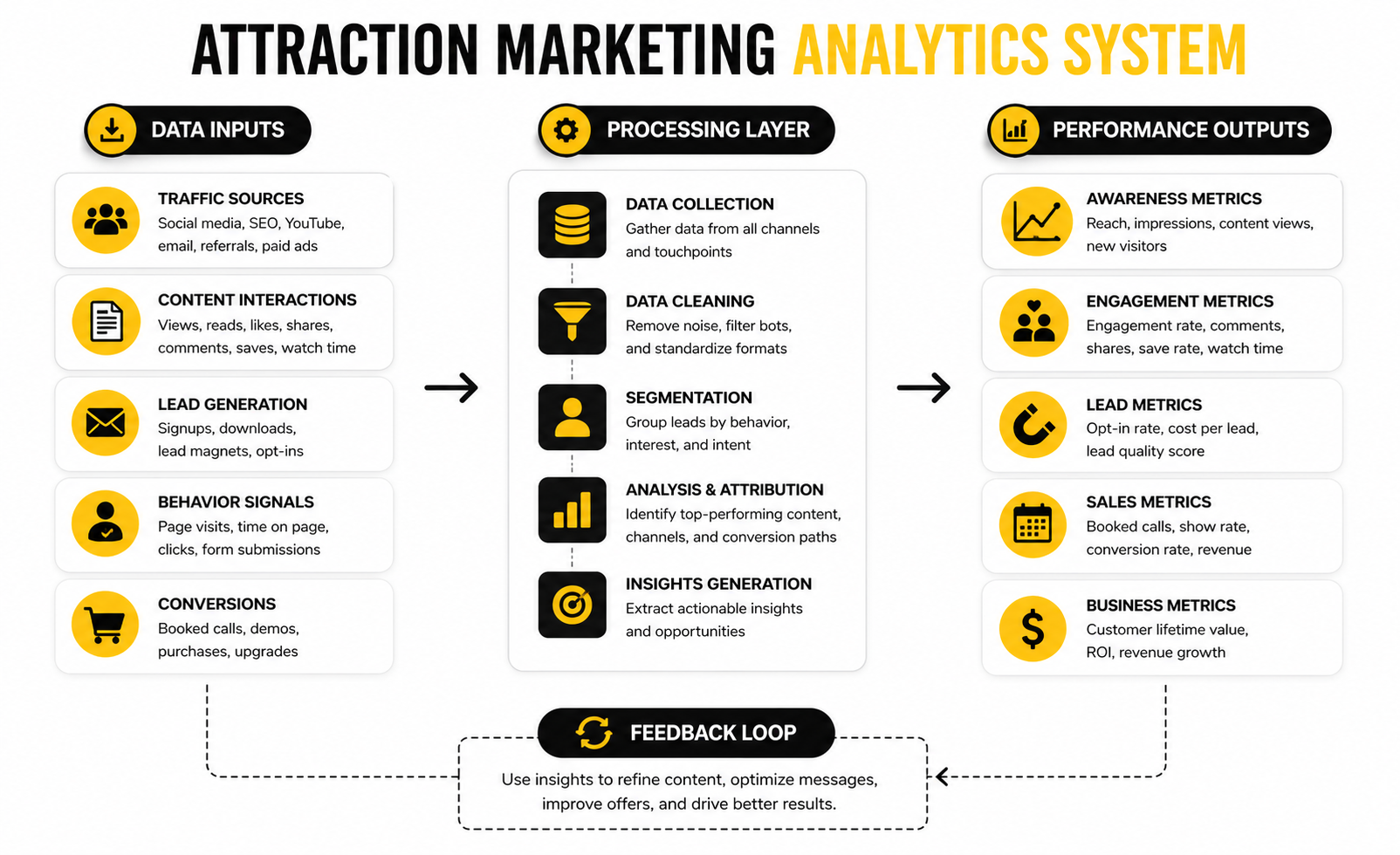
The cleanest attraction marketing dashboard tracks four layers: attention, engagement, conversion, and revenue. Attention shows whether the market is seeing you. Engagement shows whether the message is resonating deeply enough to create a response.
Conversion shows whether interest is turning into a business asset. That could mean subscribers, leads, booked calls, trials, or purchases. Revenue shows whether those conversions are actually worth acquiring.
A simple dashboard can include:
- Qualified traffic by source
- Returning visitor rate
- Search impressions and clicks
- Social saves, replies, shares, and profile visits
- Email open rate, click rate, reply rate, and unsubscribe rate
- Lead magnet conversion rate
- Landing page conversion rate
- Booked call or demo rate
- Sales-qualified lead rate
- Customer acquisition cost
- Revenue influenced by content
Do not make this more complicated than it needs to be. If a metric does not help you make a decision, it probably does not belong on the weekly dashboard.
How To Read Performance Signals
Strong attraction marketing usually compounds before it spikes. That means early progress may show up as better comments, longer watch time, more branded searches, more direct traffic, or more people saying they have seen your content before. Those signals matter because they show familiarity, even before the pipeline fully catches up.
Weak signals are different. If reach grows but saves, replies, clicks, and leads stay flat, your content may be too broad. If leads grow but sales quality drops, the promise may be attracting the wrong people. If sales calls improve but volume is low, your message may be strong but distribution is too limited.
This is where interpretation matters. Data should not push you into random changes every week. It should help you decide whether the problem is positioning, content quality, channel fit, offer clarity, follow-up, or sales conversion.
Turn Analytics Into Better Decisions
A practical review rhythm is simple: check leading indicators weekly, pipeline indicators monthly, and revenue impact quarterly. Weekly reviews keep the content engine honest. Monthly reviews show whether attraction is becoming demand. Quarterly reviews show whether the whole system is worth scaling.
Use the data to ask better questions. Which topics attract the most qualified people? Which formats create actual conversations? Which lead magnets bring buyers instead of freebie hunters? Which pages get traffic but fail to convert?
For teams running funnels, landing pages, CRM follow-up, and pipeline tracking, GoHighLevel can keep the operational view in one place. For email-focused nurturing, platforms like Brevo or Moosend can help measure how well attention turns into repeat contact. The tool is not the strategy, but the right setup makes the strategy easier to improve.
Advanced Considerations For Scaling Attraction Marketing
Scaling attraction marketing is not about posting more. It is about making the message sharper, the system more repeatable, and the buyer journey easier to follow. More volume only helps when the foundation is already clear.
The first tradeoff is depth versus speed. Fast content can keep you visible, but deep content builds authority that keeps working after the first publish window. The best programs usually combine both: short-form content for reach, long-form assets for trust, and email or retargeting for follow-up.
The second tradeoff is personality versus process. A founder-led brand can feel more human, but it can also become a bottleneck if every idea, post, and reply depends on one person. A mature attraction marketing system captures the founder’s point of view, then turns it into repeatable content standards the team can use without flattening the voice.
The Risk Of Attracting The Wrong Audience
Attraction is only useful when it attracts the right people. A broad post can create attention from people who will never buy, never refer, and never fit the offer. That kind of growth looks good in screenshots but weak in the pipeline.
This usually happens when content is built around popular pain points instead of qualified buyer intent. If the message only speaks to beginners, bargain hunters, or people looking for free tactics, the business may end up with a larger audience and a weaker sales process. More leads are not automatically better leads.
The fix is to qualify through the content itself. Talk about the real constraints, decisions, costs, timelines, and tradeoffs your best buyers already understand. The wrong people may ignore it, and that is a good thing.
How AI Changes The Bar For Trust
AI makes content production faster, but it also makes generic content easier to spot. Buyers are seeing more polished summaries, more recycled frameworks, and more posts that sound correct but feel empty. That raises the value of real experience, original analysis, and specific judgment.
Research from EY notes that AI-generated content can improve productivity while putting authenticity, nuance, and creative originality under pressure. That is exactly the tension marketers need to manage. Use AI to speed up research, formatting, repurposing, and workflow, but do not outsource your actual point of view.
This matters because attraction marketing depends on trust. If the content sounds like it could have been written by any brand in the category, it will not create much pull. The advantage goes to the business that combines efficient production with visible expertise.
When To Add Automation
Automation should support attraction marketing, not replace the relationship. It is useful when people have already shown intent and need a timely next step. It becomes a problem when every interaction feels like a sequence pretending to be a conversation.
A good automation setup handles the obvious moments: delivering a resource, confirming a booking, following up after a webinar, segmenting by interest, and reminding a lead about a relevant next step. For agencies and local service businesses, GoHighLevel can centralize many of these workflows. For conversational entry points from social, ManyChat can help turn comments and DMs into a cleaner path.
The important rule is simple: automate logistics, not empathy. Let software move people through the system, but keep the message specific, useful, and honest. That is where many brands lose the plot.
Building A Content Moat
A content moat is the part of your attraction marketing that competitors cannot easily copy. It can come from proprietary data, expert interviews, customer insights, strong creative taste, a distinct founder voice, or a repeatable framework that becomes associated with your brand. Without a moat, your content gets dragged into the same sea of tips as everyone else.
The strongest moat is usually insight from the actual market. Sales calls, customer interviews, community conversations, churn reasons, support tickets, and product usage patterns reveal what buyers really care about. That information is more valuable than guessing from trends.
This is also where expert-level brands separate themselves. They stop asking, “What content should we make?” and start asking, “What do we know that the market has not fully understood yet?” That question creates better content, better offers, and better positioning.
Common Scaling Mistakes
The biggest mistake is scaling distribution before fixing the message. Paid traffic, influencer partnerships, SEO, and outbound promotion can all work, but they amplify whatever already exists. If the offer is unclear or the content attracts weak-fit buyers, scale simply makes the problem more expensive.
Another mistake is treating every platform as equal. Some channels create reach, some create authority, some create intent, and some create conversion. A strong attraction marketing strategy assigns a job to each channel instead of copying the same content everywhere.
A third mistake is measuring too quickly. Attraction often creates delayed demand, especially for high-ticket services, consulting, SaaS, and considered purchases. You still need short-term signals, but the real question is whether the system increases qualified demand over time.
Bringing The System Together
Attraction marketing works best when the pieces stop acting like separate tactics. The content, proof, follow-up, conversion path, analytics, and offer should all support the same buyer journey. When that happens, your marketing starts to feel less like constant promotion and more like a guided path from problem awareness to confident action.
The final system is simple: attract the right people, teach them how to think about the problem, prove that your approach works, give them a relevant next step, and keep improving the message based on real behavior. That is not flashy, but it is durable. It also makes growth easier because each asset has a job instead of floating around as another random piece of content.
The biggest shift is mindset. You are not trying to convince everyone. You are building enough clarity and trust that the right people recognize themselves, understand the value, and move forward with less resistance.
FAQ - Built For Complete Guide
What is attraction marketing?
Attraction marketing is a strategy that brings the right people toward your business by leading with useful content, trust, proof, and relevance before making a direct offer. Instead of pushing a pitch immediately, you help people understand their problem and see why your solution makes sense. It is especially useful when buyers need education, confidence, or repeated exposure before they act.
How does attraction marketing differ from traditional marketing?
Traditional marketing often starts with the offer and works backward to find attention. Attraction marketing starts with the buyer’s problem, then builds trust before presenting the offer. The difference is not that one sells and the other does not; the difference is when and how the sale is introduced.
Does attraction marketing work for B2B businesses?
Yes, attraction marketing works very well for B2B because many B2B buyers research independently before contacting sales. Gartner found that 61% of B2B buyers prefer a rep-free buying experience, which makes clear education, proof, and self-serve content more important. If your content helps buyers make sense of the decision, it can support pipeline quality.
What types of content work best for attraction marketing?
The best content depends on the buyer’s level of awareness. Problem-aware buyers often need educational posts, guides, checklists, and explainers. Solution-aware buyers usually respond better to comparisons, case studies, demos, audits, webinars, and direct offer pages.
How long does attraction marketing take to work?
It depends on the offer, audience, channel, and sales cycle. Low-ticket offers can move faster because the buying decision is smaller. High-ticket services, B2B software, consulting, and agency offers usually take longer because trust has to build across multiple touchpoints.
What should I measure first?
Start with qualified attention, engagement depth, email signups, lead quality, booked calls, and revenue movement. Do not obsess over vanity metrics if they do not connect to buyer intent. A smaller audience with better-fit prospects is usually more valuable than a large audience that never converts.
Is attraction marketing only about social media?
No, social media is only one channel. Attraction marketing can include SEO, YouTube, newsletters, webinars, podcasts, communities, lead magnets, product education, case studies, and sales enablement content. The strategy is bigger than the platform.
Can attraction marketing replace paid ads?
Not always. Attraction marketing can reduce dependence on paid ads by building trust and organic demand, but paid distribution can still help amplify strong content and offers. The smart move is to use paid traffic to support proven messages, not to rescue weak positioning.
What is the biggest mistake beginners make?
The biggest mistake is creating content without a clear buyer journey. Posting tips is not enough if those tips do not move people toward a belief, decision, or next step. Attraction marketing needs structure, not just consistency.
How do I know if my attraction marketing is attracting the wrong people?
Look at the quality of replies, leads, calls, and customers. If engagement is high but sales conversations are weak, your message may be too broad or too beginner-focused. Strong content should filter as much as it attracts.
Do I need automation for attraction marketing?
You do not need automation at the beginning, but it becomes useful once people are taking repeated actions such as downloading resources, booking calls, joining webinars, or asking for information. Automation should make follow-up faster and more relevant. It should not make the relationship feel fake.
What tools are useful for attraction marketing?
The useful tools depend on your system. GoHighLevel can help with CRM, funnels, calendars, and follow-up. Buffer can support social scheduling, while Brevo can help with email marketing and nurturing.
Work With Professionals
Explore 10K+ Remote Marketing Contracts on MarkeWork.com
Most marketers spend too much time chasing clients, competing on crowded platforms, and losing a percentage of every project to middlemen.
MarkeWork gives you a better way. Browse thousands of remote marketing contracts and connect directly with companies desperate to hire skilled marketers like you, without platform commissions and without unnecessary gatekeepers.
If you're serious about finding better opportunities and keeping 100% of what you earn, explore available contracts and create a profile for free at MarkeWork.com.