

Awin affiliate marketing is not just about grabbing a tracking link and hoping commissions appear. It is a structured performance channel where advertisers, publishers, creators, agencies, and technology partners work through Awin to track referrals, attribute sales, and pay commissions.
That matters because affiliate marketing has moved far beyond coupon sites and last-click discount traffic. Awin now sits in the middle of a broader partner ecosystem that can include content publishers, influencers, comparison sites, SaaS tools, email partners, loyalty platforms, and brand-to-brand partnerships.

This guide breaks down how the Awin affiliate model works, where it fits, and how to approach it professionally instead of treating it like a side tactic. The goal is simple: help you understand the channel well enough to decide whether Awin belongs in your growth stack, your publisher strategy, or your client delivery model.
Article Outline
- Why Awin Affiliate Marketing Matters
- The Awin Affiliate Framework
- Core Components Of The Awin Ecosystem
- How Advertisers Use Awin Professionally
- How Publishers Build Revenue With Awin
- Tracking, Attribution, And Commission Logic
- Recruiting The Right Affiliate Partners
- Campaign Setup, Approval, And Compliance
- Tools That Support An Awin Affiliate Strategy
- Common Mistakes To Avoid
- Awin Affiliate FAQs
- Final Takeaways
Why Awin Affiliate Marketing Matters
Affiliate marketing matters because it connects spending to outcomes more directly than many awareness-first channels. A brand does not pay simply because an ad was shown; it usually pays when a tracked action happens, such as a sale, lead, subscription, or qualified conversion. That makes the channel attractive when budgets are under pressure and teams need measurable performance.
Awin affiliate programs can also expand reach without forcing a company to build every audience from scratch. A strong publisher, creator, comparison site, or niche content partner already has trust with a specific audience. When the offer fits naturally, the affiliate becomes a distribution layer that the advertiser could not easily replicate through paid ads alone.
The real advantage is control. Awin gives advertisers a way to define commission rules, approve partners, monitor performance, and manage relationships inside one platform. For publishers, it gives access to brands, tracking, reporting, and commission payments without needing to negotiate every partnership manually.
The Awin Affiliate Framework
Awin works best when you see it as a framework, not just a network. The advertiser brings the offer, the publisher brings the audience, and the platform handles tracking, reporting, partner discovery, and commission flow. When those pieces are aligned, the channel can become a repeatable revenue system.
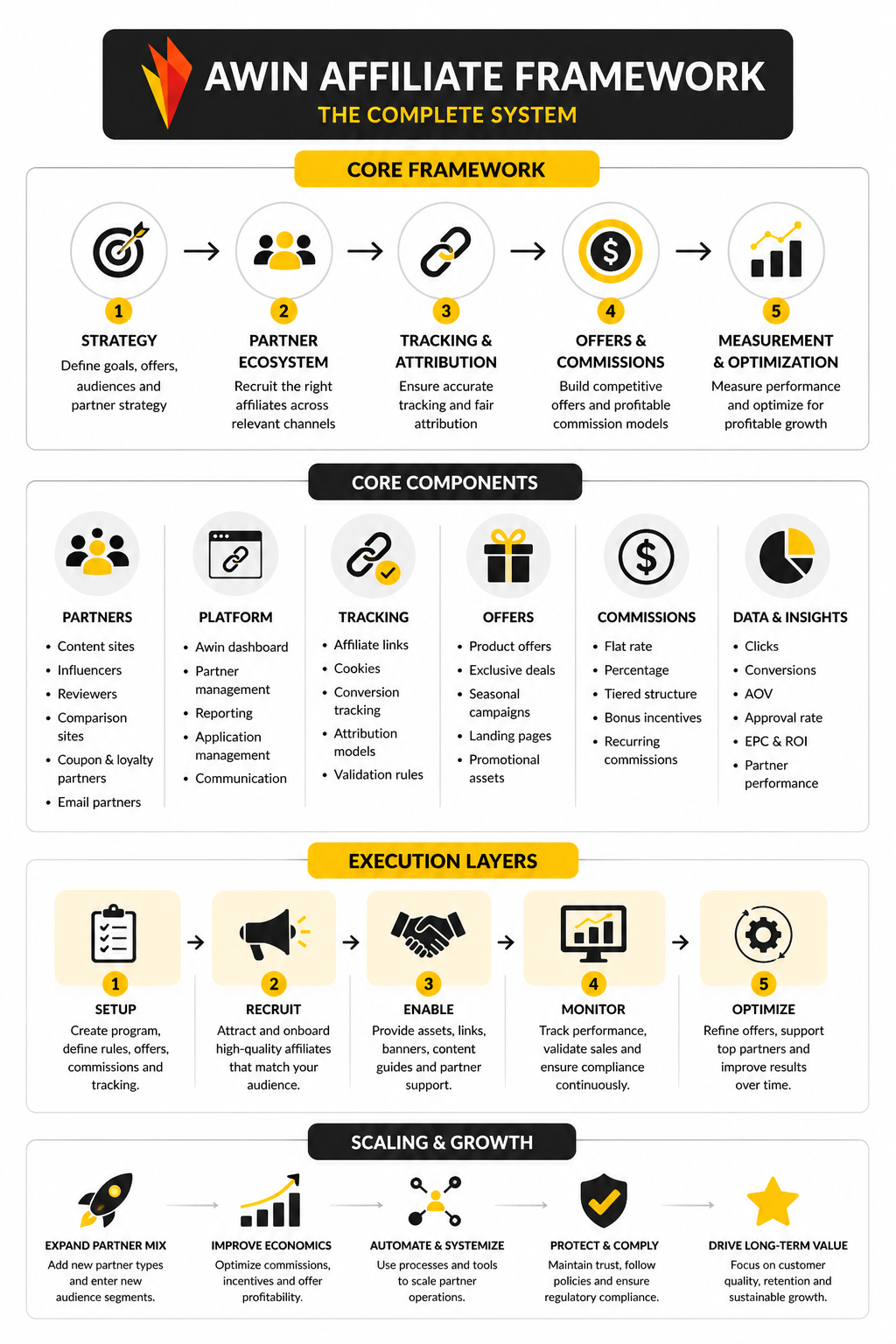
The basic framework has four moving parts. First, the advertiser defines what they want to reward. Second, publishers choose relevant programs and promote them through content, email, social, search, comparison pages, or other approved methods. Third, Awin tracks clicks, conversions, and commissions. Fourth, both sides review the data and improve the partnership over time.
This is where many beginners get affiliate marketing wrong. They focus only on joining programs or recruiting partners, but the money is usually made in the fit between audience intent, offer quality, tracking accuracy, and partner management. Awin gives you the infrastructure, but the strategy still has to be built.
Core Components Of The Awin Ecosystem
The Awin affiliate ecosystem has three main sides: advertisers, publishers, and the platform itself. Advertisers are the brands or businesses that want more sales, leads, bookings, or customer actions. Publishers are the partners who promote those offers through content, communities, search pages, email lists, social channels, comparison sites, loyalty platforms, or other approved traffic sources.
Awin sits between both sides and provides the operating layer. That includes program discovery, partner applications, tracking links, reporting, commission validation, payment handling, and tools for managing partner performance. Awin describes affiliate networks as systems that connect advertisers and publishers while handling tracking and payments, which is why the platform becomes more important as a program grows beyond a few private referral deals.
The most important point is that every party has a different job. The advertiser must build a strong offer and protect margins. The publisher must bring relevant attention. Awin must make the relationship trackable, manageable, and commercially clear.
Advertisers
Advertisers use Awin when they want partners to promote their products or services on a performance basis. That can work for ecommerce brands, travel companies, finance products, subscription services, B2B tools, and many other categories. The model is attractive because affiliate spend can be tied to measurable outcomes instead of vague exposure.
A good advertiser does not simply open a program and wait. They define commission rules, approve the right partners, provide clear brand guidelines, upload creative assets, monitor traffic quality, and keep top partners engaged. The strongest programs treat affiliates like a serious revenue channel, not a passive listing inside a marketplace.
Commission strategy matters here. Awin’s own advertiser guidance highlights factors like competitiveness, customer type, basket value, product category, and partner quality when setting rates. That is practical because a flat commission may be easy to launch, but it often becomes too blunt once different partner types start influencing different stages of the buying journey.
Publishers
Publishers join Awin to monetize attention they already have or are building. A publisher might be a review site, media brand, creator, newsletter operator, paid search specialist, cashback platform, comparison engine, or niche educator. The common thread is simple: they can introduce the right buyer to the right advertiser.
The best publishers do not just paste links into thin content. They understand search intent, buying objections, product positioning, and timing. If someone is comparing email marketing tools, for example, a publisher can add real value by explaining when a platform like Brevo makes sense, when automation matters more than price, and what the buyer should check before signing up.
That is why publisher quality varies so much. Some partners create demand, some capture existing demand, and some only appear at the end of the checkout process. A professional Awin affiliate strategy separates those roles instead of treating every commission as equal.
The Platform Layer
The platform layer is where tracking, attribution, reporting, compliance, and payments become manageable. Without that layer, advertisers would need to manually create referral links, validate orders, calculate commissions, chase invoices, and resolve partner disputes. That can work for a tiny private referral program, but it becomes messy fast.
Awin’s tracking tools can report data points such as basket value, number of products, product type, customer status, coupon usage, and click-to-sale lag time. Those details matter because they help advertisers understand not only who generated a conversion, but what kind of conversion happened. A sale from a new customer at full margin is not the same as a sale from an existing customer using a heavy discount code.
For publishers, the platform layer creates confidence. They can see clicks, conversions, pending commissions, approved commissions, and program terms in one place. That visibility is one reason serious publishers prefer structured networks over vague handshake deals.
How Advertisers Use Awin Professionally
A professional advertiser starts with unit economics before recruiting affiliates. They need to know average order value, gross margin, repeat purchase rate, refund rate, and the maximum commission they can afford. Without that math, the program either becomes unattractive to publishers or too expensive for the business.
Affiliate marketing spend has continued to grow because brands want measurable performance, with the Performance Marketing Association’s 2025 industry study reporting that U.S. affiliate marketing spend rose from $9.1 billion in 2021 to $13.62 billion in 2024. That growth is not happening because brands enjoy paying commissions. It is happening because well-run partner programs can produce commercially accountable revenue.
The smart move is to build the program around partner types. Content partners may need higher commissions because they educate buyers earlier. Coupon and loyalty partners may need tighter rules because they often appear closer to checkout. Influencers and brand partners may need custom landing pages, creative assets, and clearer campaign briefs.
Program Positioning
Program positioning answers one basic question: why should a good affiliate promote this offer instead of another one? The answer cannot be “because we launched an Awin affiliate program.” Strong publishers have options, and they will compare commission rates, conversion rates, brand trust, cookie windows, payment reliability, product relevance, and support.
A good program page should make the opportunity obvious. It should explain who the product is for, what makes it different, what partners are allowed to do, what promotional methods are restricted, and how commissions work. If those details are vague, serious partners may skip the program because uncertainty costs them time.
This is especially important in competitive categories like software, ecommerce, education, finance, and marketing tools. A funnel platform such as ClickFunnels, for example, needs different affiliate messaging than a CRM, a social scheduling tool, or a landing page builder. The affiliate needs to understand the buyer, not just the payout.
Commission Structure
Commission structure is where strategy becomes real. Advertisers can pay a percentage of sale value, a fixed bounty, a lead commission, a subscription commission, or a custom reward tied to specific actions. The right structure depends on margins, sales cycle, customer value, and how much influence affiliates have before the conversion.
Flat commissions are simple, but they are not always optimal. A brand may want to pay more for new customers, selected products, high-margin categories, or partners who create original demand. It may also want to reduce or exclude commissions on returns, cancelled orders, fraudulent transactions, or orders that violate program terms.
This is where Awin affiliate management becomes more than basic setup. The advertiser has to balance attractiveness with profitability. Pay too little, and quality partners ignore the program. Pay too much without controls, and the channel looks good in revenue reports while quietly damaging margin.
Partner Approval
Partner approval protects the brand and the economics of the program. Not every applicant should be accepted. Some partners may use traffic sources that do not fit the brand, rely on misleading claims, bid on restricted keywords, or create compliance risk.
A practical approval process checks the publisher’s site, traffic source, audience fit, promotional method, and historical quality where available. For content partners, the advertiser should look at editorial standards and topic relevance. For paid media partners, the advertiser should define keyword rules, brand bidding restrictions, and landing page expectations before traffic starts.
This is not about being difficult. It is about avoiding cleanup later. A weak approval process can create attribution disputes, brand safety issues, and low-quality sales that inflate topline revenue while hurting the business underneath.
How Publishers Build Revenue With Awin
For publishers, the Awin affiliate opportunity starts with choosing programs that fit the audience, not just programs with attractive commission rates. A high payout means very little if the product does not match the reader’s intent. The better question is always: what would this audience genuinely need next?
A publisher writing for ecommerce founders might naturally compare landing page tools, funnel builders, email platforms, social tools, and automation systems. In that context, mentioning a platform like Replo can make sense when the reader is trying to improve Shopify landing pages, while Systeme.io may fit a beginner looking for an all-in-one funnel and email setup. The link should feel like the next useful step, not a random monetization attempt.
That is the difference between lazy affiliate content and professional affiliate publishing. Lazy content starts with the commission. Professional content starts with the buyer’s problem, then connects that problem to a product, comparison, workflow, or decision point.
Choosing The Right Programs
The first filter is relevance. Awin affiliate publishers should look for advertisers that match their audience’s stage, budget, geography, and buying intent. A strong match between content and offer usually beats a higher commission from a product the audience does not trust or need.
The second filter is commercial quality. Publishers should review the commission type, cookie window, approval rules, average order value, conversion potential, payment reliability, and brand reputation. A program can look attractive on the surface but become frustrating if approvals are slow, reversals are high, or the advertiser does not keep product pages updated.
The third filter is content depth. A publisher needs enough substance to create useful pages, tutorials, comparisons, newsletters, videos, or buyer guides. If the product has weak positioning, unclear benefits, or little demand, even a good affiliate link will struggle.
Building Content Around Buyer Intent
Awin affiliate content works best when it matches where the reader is in the buying journey. Someone searching for “best email marketing tools for ecommerce” needs a different page than someone searching for “Brevo vs Mailchimp” or “how to recover abandoned carts.” Each query carries a different level of awareness and urgency.
Useful publisher content usually falls into a few practical formats:
- Reviews that explain who the product is and is not for
- Comparisons that help buyers choose between similar options
- Tutorials that show how to solve a specific problem
- Roundups that organize options by use case
- Resource pages that help readers build a complete stack
- Newsletters that recommend tools at the right moment
The key is to avoid thin recommendation pages that say the same thing as every other site. If the reader can get the same information from a product homepage, the publisher has not added enough value. The publisher earns trust by helping the reader make a better decision.
Using Deep Links Properly
Deep links are one of the simplest ways to improve affiliate performance because they send readers to the most relevant page instead of dumping everyone on a homepage. Awin explains deep linking as sending users directly to a specific product, category, or content page rather than a generic starting point. That matters because every extra click creates friction.
A publisher reviewing a landing page builder should link to the relevant signup, pricing, demo, or feature page when allowed. A publisher writing a tutorial should link to the exact tool or workflow the reader needs. The more specific the destination, the smoother the user journey feels.
This is where execution gets tangible. The affiliate process is not complicated, but it does need discipline.
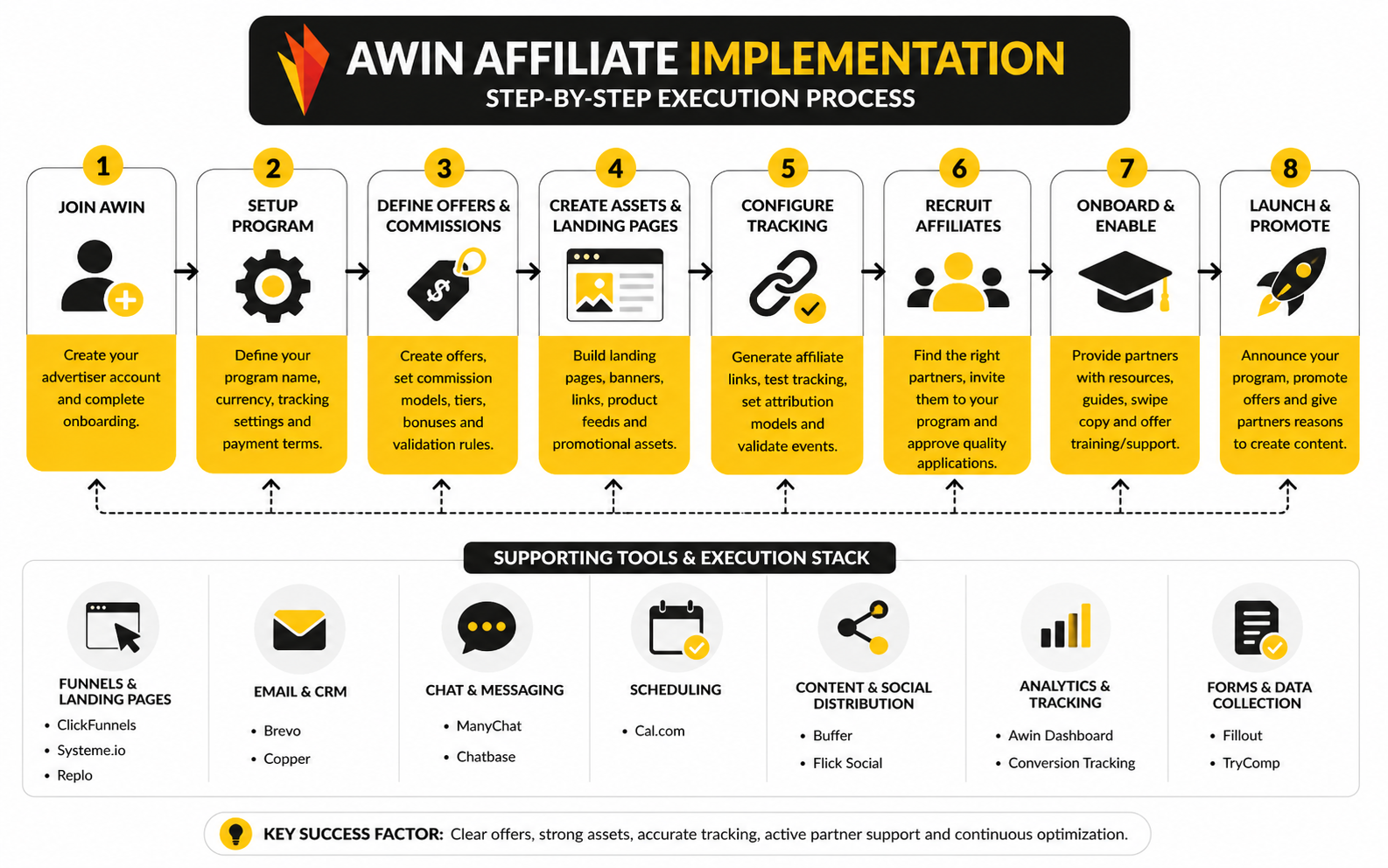
A simple publisher workflow looks like this:
- Choose a topic with clear buyer intent.
- Select advertisers that genuinely fit the reader’s problem.
- Apply to the relevant programs inside Awin.
- Create tracking links or deep links once approved.
- Place links where the reader naturally needs the next step.
- Publish useful content that explains the decision clearly.
- Monitor clicks, conversions, approval rates, and earnings.
- Improve pages based on what the data shows.
That process is boring in the best possible way. It removes guesswork. It also stops publishers from treating affiliate marketing like a lottery ticket and starts turning it into a repeatable publishing system.
Tracking, Attribution, And Commission Logic
Tracking is the part of an Awin affiliate setup that nobody wants to think about until something breaks. But tracking is also where trust is created. Advertisers need confidence that they are paying for valid outcomes, and publishers need confidence that the traffic they send is being measured fairly.
Awin’s advertiser tools can record details such as basket value, product type, number of products, new or existing customer status, coupon usage, and click-to-sale lag time through its tracking platform. That level of detail helps advertisers understand the quality of transactions instead of only seeing a raw sale count.
For publishers, the same logic matters in reverse. If a page sends high-intent visitors but commissions keep getting declined, the publisher needs to understand why. Sometimes the issue is returns, duplicate orders, invalid transactions, restricted coupon use, or program rules that were not clear enough upfront.
Clicks, Cookies, And Conversion Windows
A typical affiliate journey starts when a user clicks a tracked link. The platform records the click, assigns the relevant publisher information, and then waits to see whether the user completes a qualifying action within the advertiser’s rules. The time allowed for that action is often described as the cookie window or referral period.
Longer windows can benefit publishers when buyers need more time to decide. Shorter windows may still work for low-friction purchases or high-intent traffic. The right window depends on the product, the purchase cycle, and how much influence the affiliate has before the conversion.
This is why publishers should not judge programs only by commission rate. A lower payout with a strong brand, fair attribution, and good conversion rate may outperform a high payout attached to a weak offer. Real affiliate revenue comes from the whole equation, not one shiny number.
Validation And Reversals
Validation is the process advertisers use to review tracked transactions and confirm whether they are genuine and commissionable. Awin’s advertiser support describes validation as the review step for pending transactions, which can include checking order references, voucher codes, and other transaction details. This protects advertisers from paying on cancelled, fraudulent, duplicated, or non-qualifying orders.
Publishers should expect some level of validation, especially in ecommerce, travel, finance, and subscription categories. Returns happen. Cancellations happen. Fraud happens. The problem is not validation itself; the problem is when rules are unclear or reversals are unusually high without explanation.
A professional publisher watches approval rate, not just pending commission. A professional advertiser explains reversal reasons clearly, validates on time, and avoids using validation as a lazy margin-control tool. Trust breaks quickly when partners feel they are sending real customers and getting vague declines back.
Attribution Rules
Attribution decides which partner gets credit when multiple touchpoints exist. This can become sensitive because buyers rarely move in a perfectly straight line. They may read a review, click a newsletter link, search again, use a coupon site, and then buy days later.
Many affiliate programs use last-click attribution by default, but that does not mean every partner contributes the same kind of value. Content partners may influence discovery and consideration. Coupon partners may influence conversion timing. Technology partners may improve the checkout flow or recover abandoned demand.
The advertiser’s job is to set rules that match business reality. That may mean different commission groups, partner-specific rates, coupon attribution rules, or custom treatment for selected partners. The goal is not to make attribution perfect. The goal is to make it fair enough that good partners stay motivated and the brand still protects profit.
Statistics And Data
The numbers behind an Awin affiliate program only matter when they lead to better decisions. A dashboard full of clicks, sales, commission values, approval rates, and partner reports can look impressive, but data without interpretation is just noise. The real job is to understand what the numbers say about partner quality, customer intent, margin, and scale.
Affiliate marketing is large enough now that it deserves serious measurement. The 2025 Performance Marketing Association industry study found that U.S. affiliate marketing spend grew from $9.1 billion in 2021 to $13.62 billion in 2024. That scale tells you one thing clearly: brands are not treating affiliate as a small side channel anymore.
But big market numbers do not mean every program performs well. A weak offer, poor tracking setup, bad partner mix, or unclear commission rules can still waste budget. The data has to be read through the lens of commercial quality, not vanity growth.
The Metrics That Actually Matter
The first metric to watch is not revenue. It is approved revenue. Pending revenue can make a program look strong before returns, cancellations, invalid orders, and validation rules are applied, so approved revenue gives a cleaner picture of what the channel truly produced.
The second metric is commission cost as a percentage of approved revenue. This shows whether the program is profitable after paying partners. If an advertiser pays a high commission on low-margin orders, the channel may look productive while quietly damaging contribution margin.
The third metric is partner-level performance. Awin affiliate reports should be reviewed by publisher type, not just total sales. Content partners, influencers, cashback sites, comparison pages, email partners, and coupon partners can all generate conversions, but they usually influence the buyer in different ways.
How To Read Clicks And Conversion Rate
Clicks show attention, but they do not prove quality. A publisher can send thousands of curious visitors who never buy, while another partner sends fewer clicks from readers who are ready to act. That is why click volume should always be read beside conversion rate, average order value, approval rate, and new customer percentage.
Conversion rate shows how well traffic turns into a tracked outcome. If a publisher has strong clicks but weak conversions, the problem may be audience mismatch, weak landing pages, unclear offers, poor mobile experience, or unrealistic content promises. If conversion rate is strong but click volume is low, the advertiser may have a partner worth supporting with better assets, exclusive offers, or higher placement priority.
This is where advertisers should be practical. Do not punish a partner just because one number looks low. Look at the full pattern first, then decide whether the right action is to improve the landing page, adjust commission groups, provide better creative, or stop approving that traffic source.
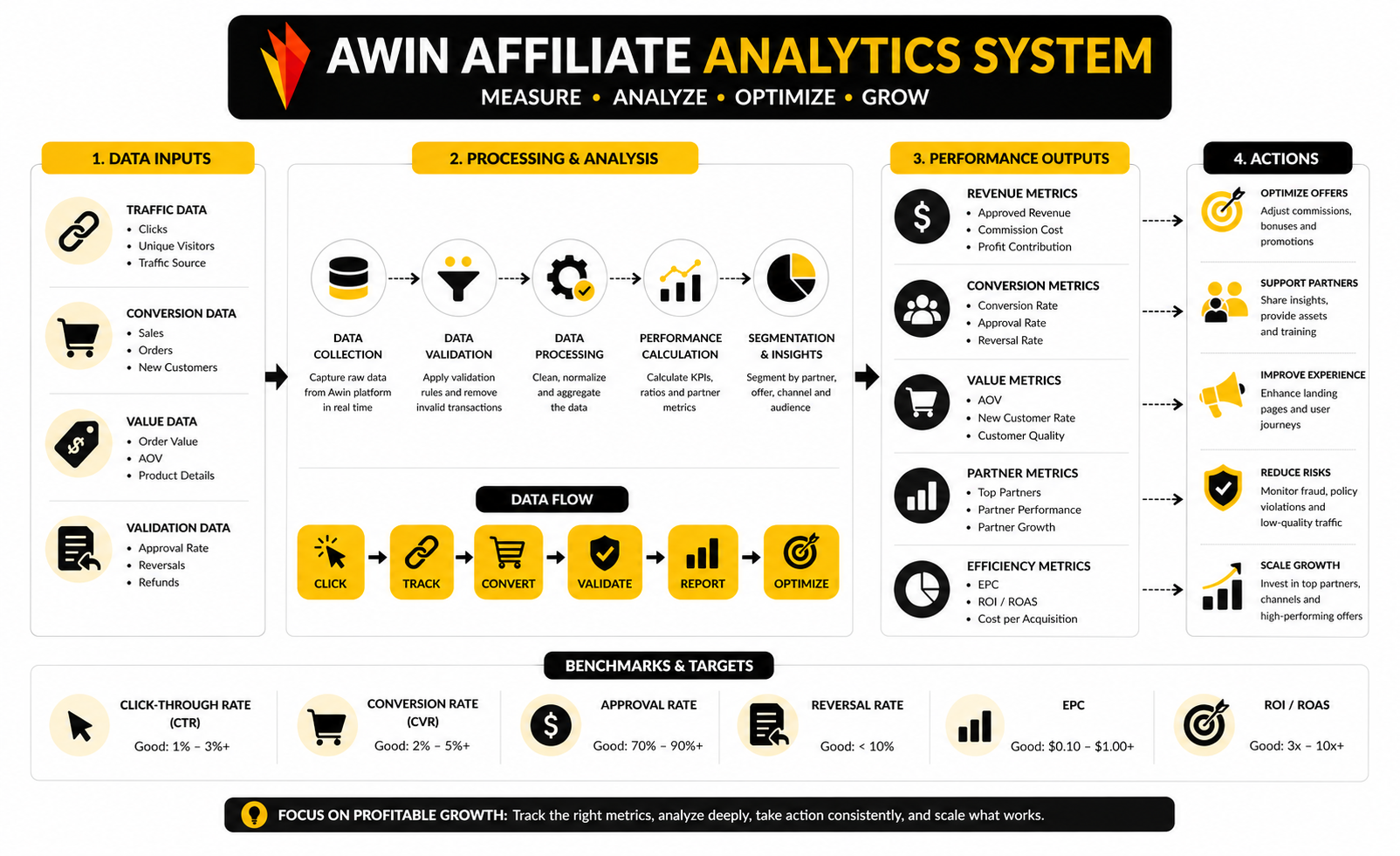
A simple measurement system should connect the full path:
- Exposure shows where the affiliate recommendation appeared.
- Click shows that the audience had enough interest to move forward.
- Landing page behavior shows whether the offer matched the expectation.
- Conversion shows whether the user completed the tracked action.
- Validation shows whether the transaction was genuine and commissionable.
- Approved commission shows what the partner actually earned.
- Customer quality shows whether the buyer was profitable beyond the first order.
That final step matters most. If the program only measures the first sale, it may overpay for low-quality customers and underpay for partners who bring loyal buyers. The best Awin affiliate programs connect affiliate reporting with customer value, margin, refund behavior, and retention wherever possible.
Benchmarks Without Bad Decisions
Benchmarks are useful for spotting direction, but dangerous when treated like rules. The Impact 2025 affiliate benchmark analysis points to shoppers taking more time to research while purchase windows become more compressed. That kind of trend matters because it suggests affiliates may influence buyers earlier than the final click reveals.
For an advertiser, this means last-click data can undervalue content that educates the buyer. A buyer may read a review, compare alternatives, leave, return through another channel, and convert later. If the advertiser only rewards the final touchpoint, it may accidentally discourage the partners doing the hardest persuasion work.
For publishers, the lesson is different. Content needs to be specific enough to survive longer research cycles. Generic “best tools” articles are easier to replace, while detailed comparisons, workflows, tutorials, and buying guides give readers a reason to trust the recommendation.
Approval Rate And Reversal Signals
Approval rate is one of the clearest signals of program health. A high approval rate usually means the traffic is clean, the offer is aligned, and the validation process is not creating unnecessary friction. A low approval rate can mean refunds, cancellations, fraud, duplicate orders, restricted coupon use, or poor-fit partners.
Awin’s documentation on transaction validation explains that validation is used to confirm whether tracked transactions are genuine and commissionable. That is completely fair when it protects the advertiser from invalid sales. It becomes a problem when publishers cannot understand why commissions are being declined.
Advertisers should review reversal reasons by partner type. If one partner has a high cancellation rate, that may point to misleading promotion. If an entire category has weak approval rates, the issue may be program rules, landing page expectations, or offer quality. If reversals spike suddenly, check tracking, coupon rules, inventory issues, and checkout problems before blaming affiliates.
New Customer Value
New customer value is one of the best ways to judge an Awin affiliate program. A partner who brings new customers can be worth more than a partner who only captures people already close to buying. That does not make lower-funnel partners useless, but it does change how commissions should be interpreted.
Advertisers should separate new and returning customers whenever tracking allows it. A commission that is profitable for a first-time buyer may not be profitable for an existing customer using a discount at checkout. That distinction helps prevent one of the most common affiliate mistakes: paying the same rate for very different business outcomes.
Publishers should care about this too. If a publisher can prove they bring new buyers, higher average order value, or better retention, they have a stronger case for better commissions and exclusive campaigns. The conversation becomes easier when it is backed by data instead of vague claims.
Performance Signals That Deserve Action
Good measurement should lead to action quickly. If a partner sends qualified traffic but conversion is weak, improve the destination page before cutting the partner. A focused landing page builder such as Replo can be useful when ecommerce teams need campaign-specific pages instead of sending every affiliate click to a generic product page.
If leads are coming in but follow-up is inconsistent, the issue may be the post-click system rather than the affiliate partner. In that case, a CRM and automation platform like GoHighLevel can help teams organize pipelines, automate follow-up, and track customer conversations after the initial affiliate conversion. That is not an affiliate network problem; that is a revenue operations problem.
If content drives clicks but not sales, the publisher may need clearer comparison angles, stronger buyer education, or better call-to-action placement. If sales happen but commissions are often reversed, both sides need to inspect rules, checkout behavior, and validation logic. The point is simple: every metric should answer “what should we do next?”
Recruiting The Right Affiliate Partners
Scaling an Awin affiliate program is not about accepting as many partners as possible. That usually creates noise, compliance issues, and a reporting mess. The better approach is to recruit partners by role, then manage each role based on the value it brings.
Awin’s guidance on building a program from launch emphasizes a strong foundation, transparent terms, competitive commissions, and active partner engagement. That is the right mindset because good affiliates do not want uncertainty. They want to know the offer, the rules, the upside, and whether the advertiser is serious.
Recruitment should be specific. Instead of saying “we need more affiliates,” define the partner categories that would actually move the business forward. A software company may need comparison publishers, integration partners, newsletter operators, YouTube educators, and niche consultants. An ecommerce brand may need product reviewers, creators, shopping guides, loyalty partners, and content sites with strong category authority.
Partner Fit Beats Partner Volume
Partner volume looks good in a report, but partner fit creates revenue. A hundred inactive publishers are less valuable than five partners who understand the buyer and can explain the offer clearly. This is where an Awin affiliate program becomes a relationship channel, not just a listing in a marketplace.
The first fit signal is audience relevance. Does the partner speak to the same customer the advertiser wants? The second signal is promotional method. Does the partner create demand, compare options, capture bottom-funnel buyers, or support retention? The third signal is trust. Would the advertiser feel comfortable seeing that partner’s content represent the brand?
This matters even more as creator and partner marketing becomes more central to growth. The IAB’s 2025 creator economy report projected U.S. creator ad spend to reach $37 billion in 2025, which tells you brands are fighting for trusted voices, not just ad placements. Affiliate programs that treat quality partners like replaceable traffic sources will lose the best ones.
Outreach That Does Not Sound Lazy
Good affiliate recruitment outreach should feel personal without being overcomplicated. The advertiser should explain why the partner is relevant, what the audience fit is, what the commercial opportunity looks like, and what support is available. Generic “join our program” messages are easy to ignore because serious publishers receive them constantly.
The best outreach usually includes:
- A clear reason the partner was selected
- A short explanation of the audience fit
- The commission model or commercial upside
- The strongest product angle for their audience
- Any launch incentive, sample access, or exclusive offer
- A simple next step
Awin recommends using an advertiser’s own website to recruit partners by explaining the benefits of joining, commission details, incentives, and a direct path to the merchant profile. That is smart because your best future affiliates may already be customers, readers, creators, agencies, consultants, or community members around the brand.
Managing Top Partners
Top partners need more than a standard approval email. They need faster answers, better assets, clearer campaign timing, and sometimes custom commercial terms. If a publisher can move meaningful revenue, the advertiser should treat them like a strategic account.
That does not mean giving every partner a special commission. It means knowing who deserves deeper support. A strong content partner may need product screenshots, access to a demo account, expert quotes, comparison details, or early notice of launches. A creator may need talking points, usage examples, promo timing, and disclosure guidance.
This is also where tools outside the affiliate platform can help. If a team is managing partner conversations, onboarding, and follow-up manually, a CRM such as Copper can keep relationship history organized. If the program depends on booking partner calls or onboarding sessions, Cal.com can make scheduling less painful.
Campaign Setup, Approval, And Compliance
The more an Awin affiliate program grows, the more important rules become. Rules are not there to slow people down. They are there to protect the brand, keep partners aligned, and prevent disputes when money starts moving.
Compliance should cover claims, disclosures, paid search rules, coupon rules, content standards, trademark usage, email promotion, social media promotion, and prohibited traffic sources. If these rules are vague, partners will interpret them differently. That creates problems later when the advertiser declines commissions or asks for content to be changed.
Publishers also need clarity. They need to know what they can say, where they can promote, how they should disclose affiliate relationships, and what could cause a commission to be rejected. The more precise the program is upfront, the fewer uncomfortable conversations happen later.
Disclosure And Trust
Affiliate disclosure is not optional. The U.S. Federal Trade Commission’s endorsement guidance requires material connections between endorsers and brands to be clearly disclosed when they are not obvious to consumers. That applies to affiliate relationships because the publisher may earn money when a reader clicks or buys.
For publishers, this is not just a legal checkbox. It is a trust signal. A clear disclosure tells the reader what is happening without making the recommendation feel shady. Hiding the commercial relationship can damage the very trust that makes affiliate content work.
Advertisers should give partners simple disclosure expectations instead of assuming everyone knows the rules. Creators, bloggers, newsletter writers, and comparison publishers may operate across different formats, so the guidance should be practical. A good rule of thumb is simple: the reader should understand the relationship before or when they encounter the affiliate recommendation.
Paid Search And Brand Bidding
Paid search rules need to be explicit because they can create expensive conflict fast. Some advertisers allow affiliates to run paid search campaigns. Others ban bidding on brand terms, competitor terms, misspellings, or direct-to-site ads. There is no universal answer, but there must be a clear answer.
Brand bidding can be especially sensitive. If an affiliate bids on the advertiser’s own brand name and captures users who were already searching for the company, the advertiser may end up paying commission on demand it already created. In some cases, a partner may still add value through comparison or competitor conquesting, but that should be intentional, not accidental.
The same logic applies to coupon terms, deal pages, and browser extensions. These partners can help conversion, but they can also intercept existing buyers if the rules are too loose. A mature Awin affiliate strategy defines where these partners are useful and where they create margin leakage.
Content Quality And Claims
Content quality is a serious risk area because affiliates are often the first place a buyer encounters the brand outside owned channels. If a publisher makes exaggerated claims, promises impossible results, or misrepresents pricing, the advertiser may get short-term clicks and long-term brand damage. That tradeoff is not worth it.
Advertisers should provide approved messaging, product facts, positioning notes, and claim boundaries. This is especially important in finance, health, software, business opportunity, education, and any category where outcomes vary by user. A partner should be able to explain benefits confidently without inventing guarantees.
Publishers should protect themselves too. A review or comparison should be accurate, current, and specific. If a tool changes pricing, features, or terms, old content can become misleading. That is why affiliate content needs maintenance, not just publication.
Tools That Support An Awin Affiliate Strategy
Awin handles the affiliate network layer, but it does not replace the rest of the growth system. Once traffic arrives, the landing page, funnel, CRM, email sequence, chatbot, booking flow, and follow-up process all affect the final outcome. Weak post-click execution can make good affiliates look worse than they are.
This is where teams should separate affiliate management from conversion infrastructure. Awin can show which partner sent the traffic and what happened inside the affiliate program. It cannot automatically fix a confusing landing page, slow follow-up, weak offer, or messy sales pipeline.
For a lean team, the goal is not to buy every tool. The goal is to remove the bottleneck that is clearly limiting affiliate performance. If the bottleneck is landing pages, fix that first. If the bottleneck is lead follow-up, fix that first. If the bottleneck is content distribution, fix that first.
Funnels And Landing Pages
Affiliate traffic should not always go to the same homepage. A reader coming from a product review, comparison article, email recommendation, or creator campaign may need a more specific page. Matching the message to the landing page can reduce friction and make the recommendation feel consistent.
For funnel-heavy offers, ClickFunnels can make sense when the team needs structured opt-in pages, sales pages, order flows, and follow-up paths. For simpler all-in-one funnel and email setups, Systeme.io may fit teams that want fewer moving parts.
The strategic point is simple. Do not send expensive partner traffic into a generic journey if the buyer needs a specific one. Affiliate performance often improves when the destination page reflects the exact promise that earned the click.
Email, Chat, And Follow-Up
Affiliate traffic is often wasted after the first visit. A buyer clicks, looks around, gets distracted, and disappears. If the business has no email capture, retargeting logic, chatbot, or follow-up system, the affiliate partner may have done their job while the advertiser loses the opportunity.
For email marketing and CRM-style communication, Brevo can support campaigns, automation, and customer messaging after the click. For social messaging and conversational flows, ManyChat can help when the audience is coming from Instagram, Messenger, WhatsApp, or creator-led campaigns.
This is not about stacking software for the sake of it. It is about respecting the traffic. If a partner sends the right visitor, the advertiser needs a system that can convert, nurture, and measure that visitor properly.
Content Distribution And Partner Enablement
Publishers need assets. They need messaging angles, product explanations, comparison points, campaign timing, screenshots, social copy, email swipe ideas, and sometimes short-form content prompts. The easier the advertiser makes promotion, the more likely good partners are to actually publish.
For content planning and social distribution, Buffer can help organize campaign promotion across channels. For short-form social workflows, Flick Social can support hashtag research, scheduling, and content management where social discovery matters.
The expert-level move is to build partner enablement kits. Do not just approve affiliates and leave them guessing. Give them clear angles, tested hooks, positioning notes, compliant claims, and direct links to the best destinations. That is how an Awin affiliate program becomes easier to promote than the alternatives.
Common Mistakes To Avoid
The biggest mistake in an Awin affiliate program is treating partner marketing like a switch you turn on once. A program may launch inside the platform, but growth still depends on offer quality, partner fit, tracking accuracy, clear rules, and active management. If nobody owns those pieces, the channel slowly becomes a pile of inactive publishers and unclear results.
Another common mistake is confusing activity with progress. More partners, more links, more coupon placements, and more clicks do not automatically mean better revenue. The better question is whether the program is attracting customers the business actually wants at a cost the business can afford.
The most dangerous mistake is ignoring trust. Advertisers need partners who represent the offer honestly. Publishers need programs that track fairly and validate commissions transparently. Readers need recommendations that feel useful instead of forced.
Overpaying For Low-Incremental Sales
Some affiliate sales are highly incremental because the partner introduced the buyer to the brand or helped them choose with useful content. Other sales are less incremental because the buyer was already at checkout and simply searched for a discount. Both can have value, but they should not always be paid the same way.
This is where commission groups become important. An advertiser may pay a stronger rate to content partners, niche educators, creators, or comparison publishers while setting tighter rules for coupon, loyalty, or trademark-driven traffic. That is not unfair. It is basic margin protection.
The goal is not to punish lower-funnel partners. The goal is to understand what each partner actually contributes. When a brand pays the same commission for every touchpoint, it often rewards convenience over influence.
Letting Old Content Rot
Affiliate content decays quietly. Pricing changes, product features move, screenshots become outdated, competitors reposition, and old recommendations stop matching the buyer’s reality. A page that was accurate last year can become misleading without anyone noticing.
Publishers should review high-earning pages regularly. Check links, product claims, pricing references, screenshots, comparison tables, disclosure placement, and whether the recommendation still makes sense. This protects revenue, but it also protects reader trust.
Advertisers should help by giving partners update alerts. If pricing changes, terms change, a product is discontinued, or a new feature changes the competitive angle, partners need to know. Awin affiliate performance improves when partners are not left to discover changes by accident.
Scaling Without Partner Support
A program can reach a point where manual management breaks. Applications pile up, top partners wait too long for answers, assets become outdated, and reporting gets reviewed only when something goes wrong. That is usually when performance starts to flatten.
Scaling requires systems. Advertisers need approval criteria, onboarding templates, creative libraries, validation workflows, partner segments, and a regular review rhythm. Publishers need repeatable content operations, link management, update schedules, and reporting habits.
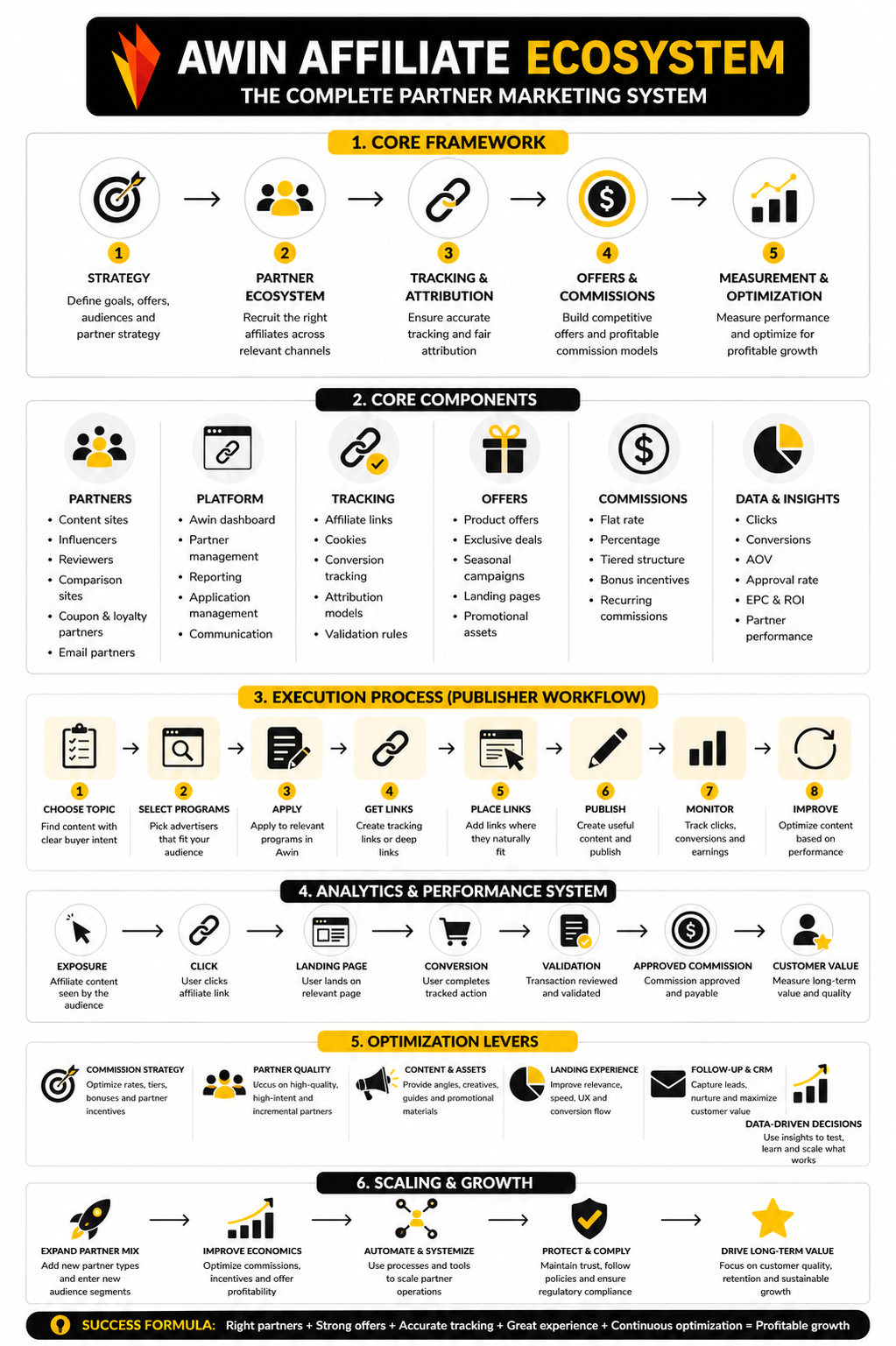
This is the final system view: Awin handles the network layer, but the business still needs partner operations around it. The program grows when the platform, offer, content, tracking, compliance, and follow-up all work together.
Awin Affiliate FAQs
What is an Awin affiliate?
An Awin affiliate is a publisher, creator, content site, comparison platform, loyalty partner, or other approved partner that promotes advertiser offers through Awin tracking links. When a user clicks a tracked link and completes a qualifying action, the affiliate can earn a commission. The exact commission depends on the advertiser’s program terms, validation rules, and attribution setup.
How does Awin affiliate tracking work?
Awin affiliate tracking records the click, connects it to the relevant publisher, and tracks whether the user completes a qualifying conversion. Advertisers can use tracking data to review sales, order value, product details, coupon usage, customer type, and click-to-sale timing. This creates the reporting foundation for commissions and optimization.
Is Awin better for advertisers or publishers?
Awin can work for both, but the value is different. Advertisers use it to recruit and manage partners on a performance basis. Publishers use it to find brands, create tracking links, and earn commissions from relevant recommendations.
How do publishers make money with Awin?
Publishers make money by sending relevant traffic to advertiser offers through approved Awin affiliate links. If the visitor completes a commissionable action, the publisher earns based on the program’s terms. The strongest publishers usually focus on helpful content, clear buyer intent, and products that genuinely fit their audience.
What should advertisers measure first?
Advertisers should start with approved revenue, commission cost, approval rate, partner-level performance, new customer value, and refund or reversal patterns. Clicks and pending sales matter, but they can mislead if they are not connected to commercial quality. The goal is not just more conversions; it is profitable partner-driven growth.
Why do Awin commissions get declined?
Commissions can be declined when transactions are cancelled, returned, duplicated, fraudulent, outside program terms, or not commissionable under the advertiser’s validation rules. This is why publishers should read program terms before promoting an offer. It is also why advertisers should explain reversal reasons clearly.
Do Awin affiliates need a website?
Many affiliates use websites, but a website is not the only possible channel. Publishers may also use newsletters, social content, paid media, communities, comparison tools, or other approved promotional methods. The important part is that the traffic source follows the advertiser’s rules and gives the audience a legitimate reason to click.
Can influencers use Awin?
Yes, influencers can use Awin when their promotional methods are approved by the advertiser and they follow disclosure rules. Influencer partnerships work best when the product fits the creator’s audience and the recommendation feels natural. Forced promotions usually convert poorly and damage trust.
What is a good Awin affiliate commission rate?
There is no universal good commission rate. A strong rate depends on margin, average order value, customer lifetime value, refund risk, product category, and partner influence. A lower rate on a high-converting offer can outperform a higher rate on a weak one.
How can advertisers attract better affiliates?
Advertisers attract better affiliates by offering clear terms, competitive commissions, strong landing pages, useful creative assets, fast communication, and reliable validation. Top publishers want to know the program is worth their time. If the offer is vague or the support is weak, they will promote something else.
How can publishers improve Awin affiliate earnings?
Publishers can improve earnings by choosing better-fit programs, targeting stronger buyer intent, using deep links, updating old content, comparing offers honestly, and watching approval rates. More traffic helps, but better traffic usually helps more. The practical move is to build content around decisions people are already trying to make.
Is Awin affiliate marketing passive income?
It can become recurring or semi-passive in some cases, but it is not truly passive at the start. Publishers need content, optimization, link maintenance, and reporting. Advertisers need recruitment, approval, compliance, validation, and partner management.
Final Takeaways
An Awin affiliate strategy works when everyone understands the system. Advertisers need profitable offers, clean tracking, fair terms, and active partner management. Publishers need audience fit, useful content, compliant promotion, and a reason for readers to trust the recommendation.
The channel is not magic. It rewards clear positioning, good economics, strong partner selection, and constant improvement. When those pieces are missing, Awin becomes another dashboard. When they are in place, it becomes a serious growth channel.
The best way to approach it is simple: build the program like a revenue system, not a link collection. Recruit partners intentionally. Measure what matters. Fix the post-click journey. Protect trust on both sides.
Work With Professionals
Explore 10K+ Remote Marketing Contracts on MarkeWork.com
Most marketers spend too much time chasing clients, competing on crowded platforms, and losing a percentage of every project to middlemen.
MarkeWork gives you a better way. Browse thousands of remote marketing contracts and connect directly with companies desperate to hire skilled marketers like you, without platform commissions and without unnecessary gatekeepers.
If you're serious about finding better opportunities and keeping 100% of what you earn, explore available contracts and create a profile for free at MarkeWork.com.