

A B2B email marketing list is not just a spreadsheet of names, job titles, and company domains. It is a revenue asset only when the people on it are relevant, reachable, legally contactable, and likely to recognize why your message belongs in their inbox. That is the difference between a list that creates pipeline and a list that quietly burns your sender reputation.
This matters more now because inbox providers are stricter, buyers are more skeptical, and low-quality outreach is easier than ever to create at scale. Google’s sender guidance now pushes bulk senders toward authentication, low spam complaints, and easy unsubscribes, while the FTC’s CAN-SPAM guidance still makes clear that commercial email needs honest headers, non-deceptive subject lines, and a working opt-out process. The practical takeaway is simple: the list is not separate from deliverability, compliance, or conversion. It is the foundation underneath all three.
Good B2B email marketing lists help you reach the right buying committees before a competitor does. Bad lists create the illusion of activity while your emails land in spam, get ignored, or trigger complaints. A modern list strategy has to combine targeting, data quality, permission logic, segmentation, messaging fit, and ongoing maintenance.
Article Outline
This article is split into six parts so each layer of the list-building process gets enough space. The section names below are the real sections the rest of the article will continue using, so the structure stays consistent from beginning to end. Part 1 sets the context and framework before the later parts move into sourcing, segmentation, implementation, and measurement.
- Why B2B Email Marketing Lists Still Matter
- A Practical Framework for Better Lists
- Core Components of a High-Quality B2B Email List
- How to Source Contacts Without Damaging Trust
- Segmentation, Personalization, and Campaign Fit
- Professional Implementation, Measurement, and FAQ
Why B2B Email Marketing Lists Still Matter
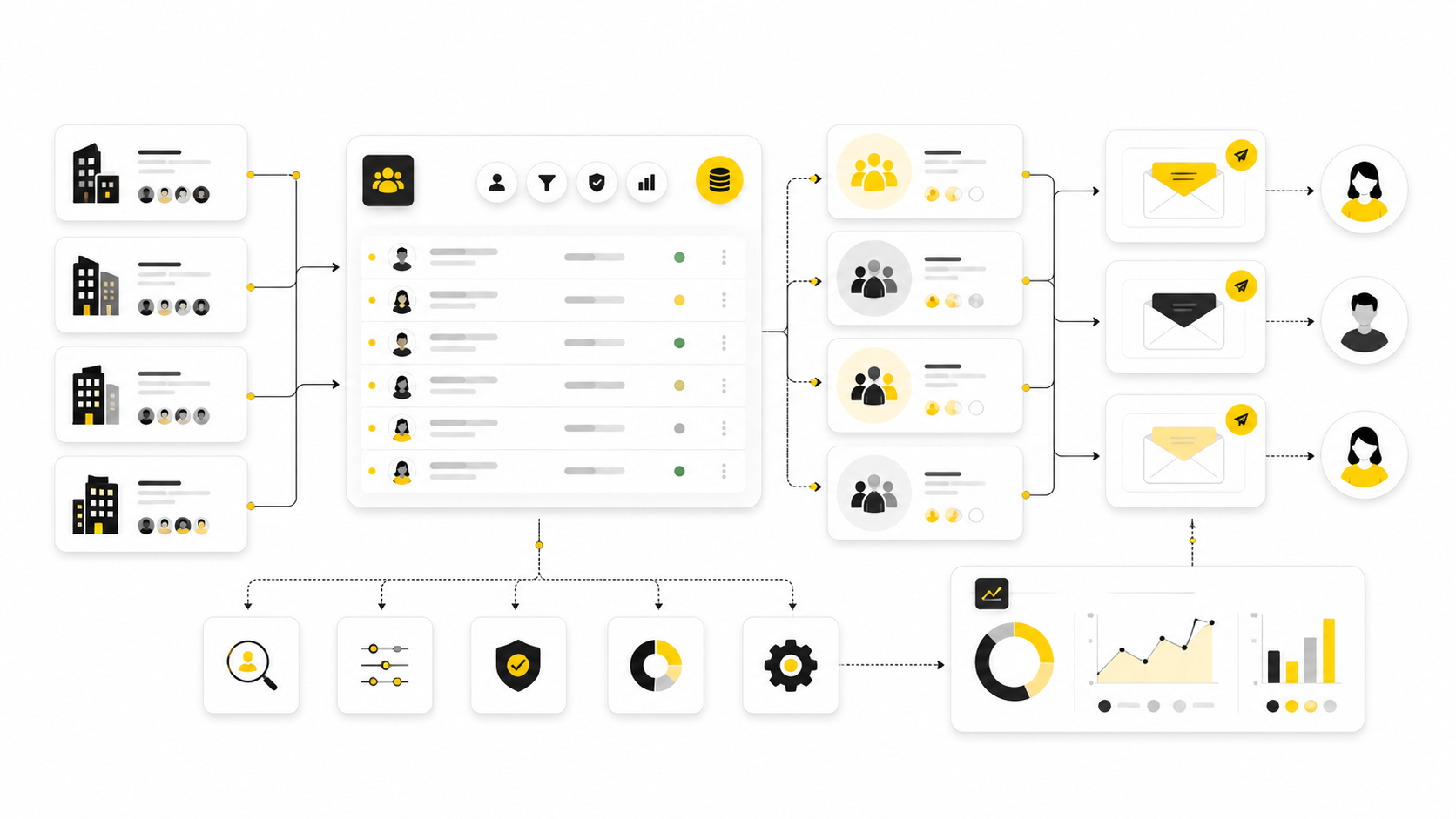
B2B email still matters because business buying is rarely instant. A prospect might not need your product today, but they may need education, comparison points, proof, reminders, and a reason to trust you over time. A relevant list gives you a direct way to build that familiarity without relying entirely on paid ads, social algorithms, or search rankings.
The problem is that many teams treat list growth like a volume game. They buy or scrape contacts, upload thousands of rows, send one generic pitch, and then blame the channel when the campaign fails. That approach ignores the reality that deliverability is now a competitive advantage, not a technical afterthought; Validity’s 2025 benchmark found global inbox placement around 83.5%, which means a meaningful share of legitimate marketing emails still never reach the inbox.
That is why list quality has become more important than list size. If your contacts match your ideal customer profile, your message can be sharper, your segmentation can be useful, and your sending behavior can look more natural to mailbox providers. If the list is bloated with irrelevant people, outdated roles, catch-all addresses, and contacts who never expected to hear from you, every campaign starts with a handicap.
A Practical Framework for Better Lists
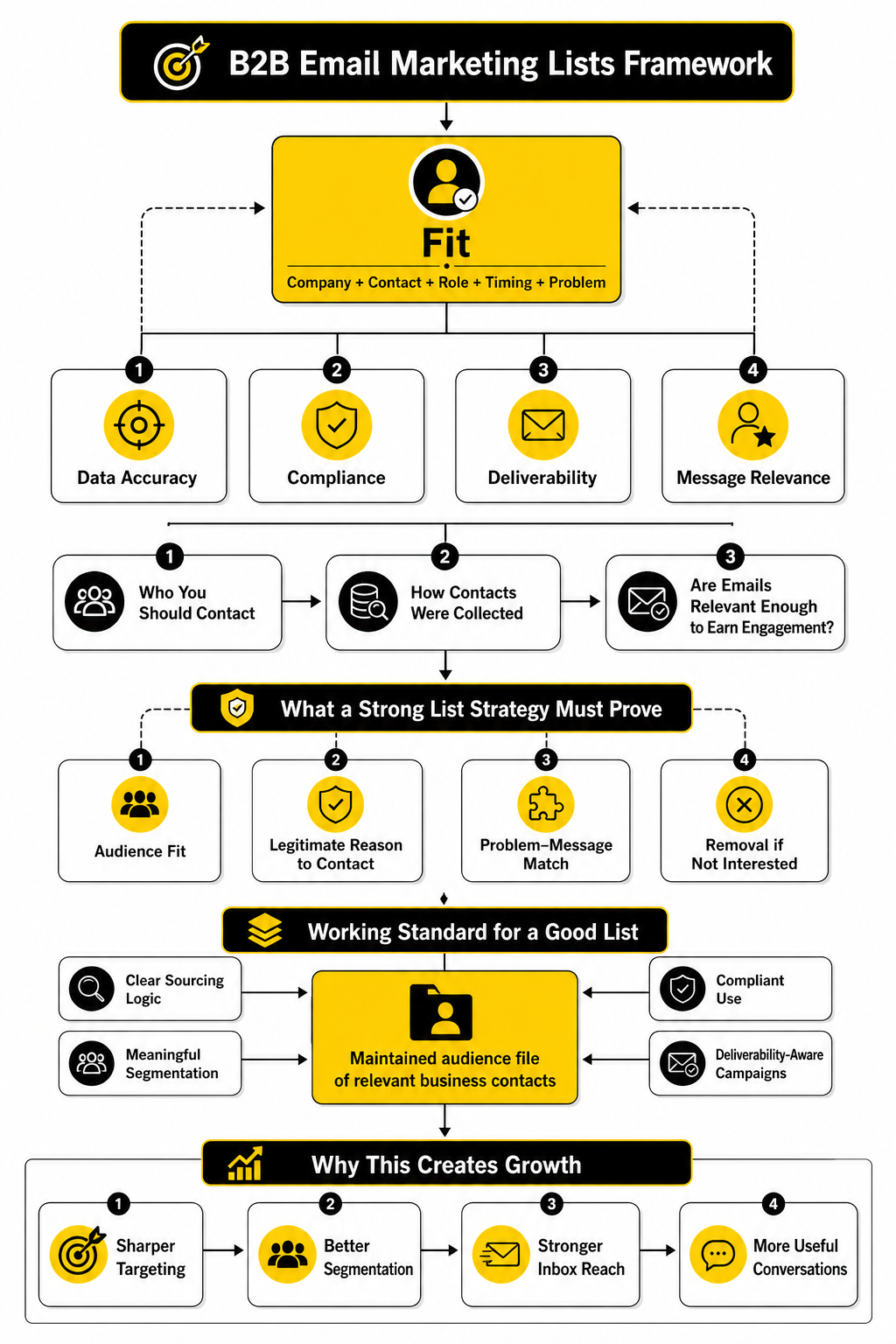
The best way to think about B2B email marketing lists is as a system, not a database. The system starts with who you should contact, continues with how those contacts were collected, and then depends on whether your emails are relevant enough to earn engagement. A list that cannot support those three things is not ready for serious outbound, nurture, or lifecycle marketing.
At the center of the framework is fit. Fit means the company, contact, role, timing, and problem all make sense together. A CFO at a 2,000-person SaaS company, a RevOps manager at a 70-person agency, and a founder at a five-person startup may all be “B2B contacts,” but they do not belong in the same campaign unless the offer, pain point, and buying motion genuinely overlap.
Around fit, you need four supporting layers: data accuracy, compliance, deliverability, and message relevance. Data accuracy keeps you from sending to dead addresses or wrong people. Compliance keeps your outreach aligned with rules like CAN-SPAM, GDPR, PECR, and regional B2B marketing guidance such as the UK ICO’s business-to-business marketing guidance. Deliverability protects your ability to reach inboxes, while relevance gives recipients a reason to open, read, click, reply, or at least not complain.
What a Strong List Strategy Has to Prove
A strong list strategy has to prove that each contact belongs there. That does not mean every person must be ready to buy right now. It means you can explain why they fit the audience, why your company has a legitimate reason to contact them, what problem your message connects to, and how you will remove them if they are not interested.
This is where many teams get lazy. They talk about targeting, but their actual filters are broad: industry, company size, country, and maybe job title. That is not enough for a serious B2B email program, because two people with the same title can have completely different budgets, priorities, tools, and buying authority.
A stronger strategy adds context. It looks at triggers, technology usage, hiring patterns, funding events, content engagement, customer similarity, and sales qualification criteria. It also connects the list to the system that will manage the relationship, whether that is a CRM, a marketing automation platform, or an all-in-one setup like GoHighLevel when the business needs pipelines, automations, and follow-up workflows in one place.
The Standard This Article Will Use
For the rest of this article, a “good” B2B email marketing list will mean something specific. It is not simply a large collection of emails. It is a maintained audience file made up of relevant business contacts, supported by clear sourcing logic, segmented by meaningful buying context, and used through compliant, deliverability-aware campaigns.
That standard is deliberately higher than what most list vendors or quick-growth playbooks imply. You can always find more contacts, but you cannot easily recover a damaged domain, a weak sender reputation, or trust lost through sloppy outreach. This is why the next parts will focus on the mechanics that actually matter: what data belongs in the list, where contacts should come from, how to segment them, and how to run the program professionally.
The goal is not to make email complicated. The goal is to stop treating B2B email marketing lists as a shortcut. When the list is built properly, email becomes calmer, more measurable, and much more useful for the people receiving it.
Statistics and Data
Measurement is where the quality of B2B email marketing lists becomes visible. A list can look perfect in a spreadsheet and still perform badly once real inboxes, real buyers, and real timing are involved. The numbers are not there to make a report look professional; they are there to tell you what to fix next.
The mistake is looking at one metric in isolation. A high open rate does not automatically mean the list is good, especially now that privacy features and bot activity can distort opens. A low reply rate does not always mean the list is bad either, because the offer, timing, subject line, sender identity, and call to action all influence the outcome.
The right way to read performance is to connect metrics together. Deliverability tells you whether the email reached the inbox. Engagement tells you whether the message earned attention. Conversion tells you whether that attention turned into business value. List quality sits underneath all three.
Start With Deliverability Before Engagement
Deliverability comes first because every other metric depends on it. If your emails do not reach the inbox, open rates, click rates, replies, and conversions become misleading. You may think the campaign failed because the message was weak, when the real issue was that the list contained too many risky or stale contacts.
A healthy program should monitor delivery rate, bounce rate, inbox placement, spam placement, block rate, and complaint rate. Delivery rate only means receiving servers accepted the message. Inbox placement is more important because it shows whether the message landed where a person is likely to see it.
This distinction matters because benchmark data shows that inbox access is not guaranteed. Validity’s 2025 benchmark reported global inbox placement around 83.5%, which means a delivered email can still miss the real inbox. For B2B teams, that gap is not just a technical issue; it is lost pipeline visibility.
Watch Complaint Rate Like a Revenue Metric
Spam complaints are one of the clearest signals that a list, message, or targeting strategy is off. Google’s sender guidance says senders should keep spam rates below 0.1% and avoid reaching 0.3% or higher. That sounds tiny, but it is exactly the point: mailbox providers do not need a huge complaint rate to see a sender as risky.
A complaint rate problem usually means one of three things. The contact did not expect the email, the message did not feel relevant, or the campaign made unsubscribing harder than it should be. Sometimes all three are happening at once.
The action is not to panic and rewrite everything. First, isolate the source, segment, and campaign that produced the complaints. Then suppress risky contacts, reduce volume, improve targeting, and make the first email clearer about why the person is being contacted.
Bounce Rate Shows Data Decay
Bounce rate is one of the simplest ways to spot list decay. Hard bounces usually mean an address is invalid, closed, or nonexistent. Soft bounces can come from temporary issues, but repeated soft bounces should still be treated seriously.
For B2B email marketing lists, bounce problems often come from old exports, weak third-party data, company changes, role changes, and unverified addresses. The longer a list sits untouched, the more likely it is to contain contacts who have moved jobs or left the company. That is why verification date matters so much.
The action here is straightforward. Remove hard bounces immediately, quarantine repeated soft bounces, and re-verify older contacts before adding them to a new campaign. If a specific source produces a higher bounce rate than the rest of the list, stop treating that source as reliable until it proves otherwise.
The Analytics System That Actually Helps
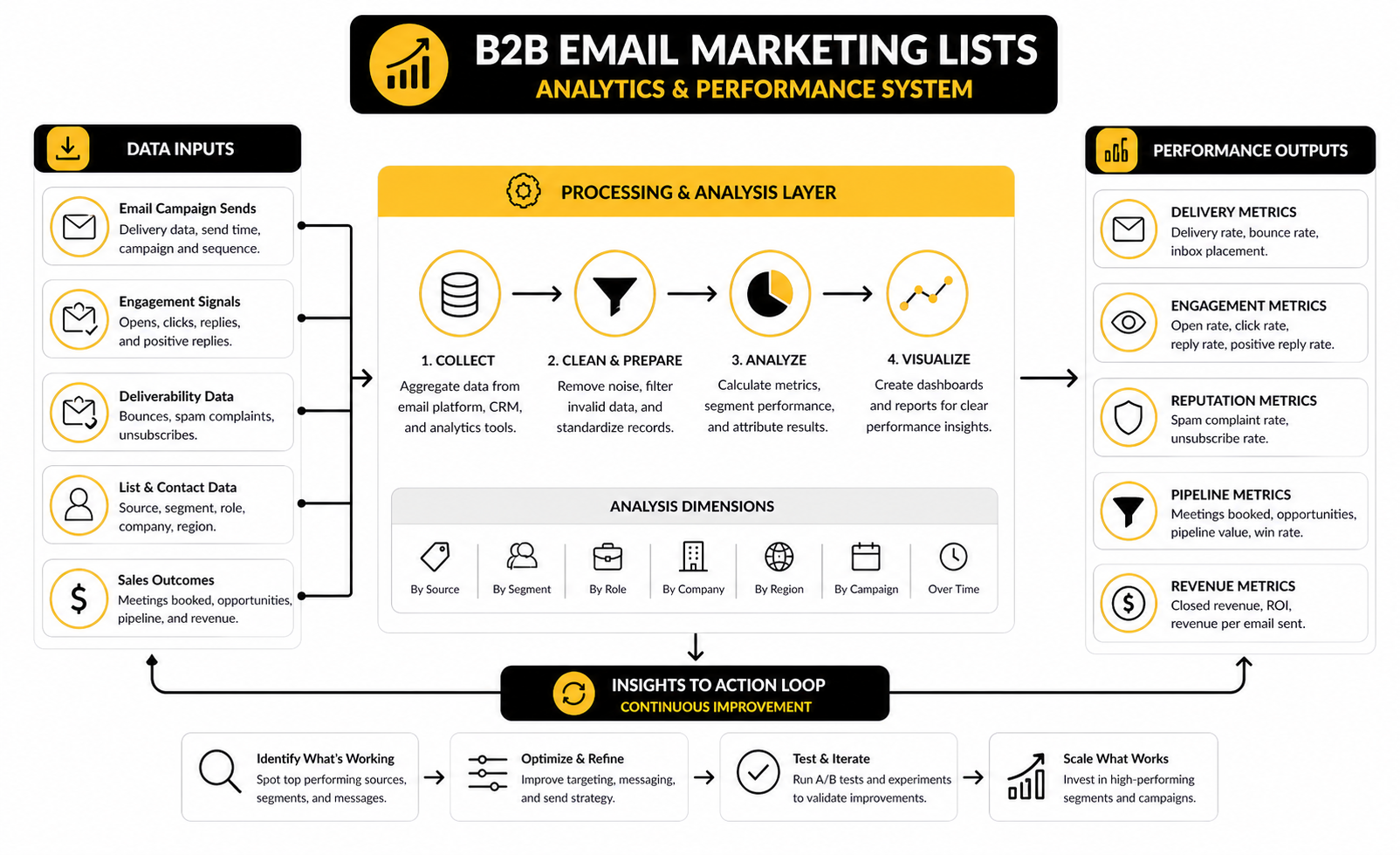
A useful analytics system does not need to be complicated. It needs to show where the list is helping revenue and where it is creating drag. The best setup connects list source, segment, campaign, deliverability, engagement, and sales outcome in one reporting view.
At minimum, track performance by source and segment. A list built from demo requests should not be judged beside a cold outbound list from manual research. A webinar list should not be judged the same way as a reactivation list from old CRM opportunities.
This is where tools and process need to work together. If your CRM or automation platform can connect tags, pipelines, campaign history, and conversion events, use that structure instead of exporting reports into disconnected spreadsheets. For agencies or service teams that want pipelines and automations in the same place, GoHighLevel can be useful when list segments need to trigger follow-ups, tasks, appointments, and opportunity stages.
Measure by Source
Source-level reporting tells you where the best contacts are coming from. Without it, you may accidentally scale a weak source because it produces cheap volume. That is dangerous because cheap contacts can become expensive when they hurt deliverability or waste sales time.
Track bounce rate, complaint rate, open rate, click rate, reply rate, booked calls, opportunities, and revenue by source. Owned sources like forms, demo requests, referrals, and customer lists should usually behave differently from third-party or manually researched contacts. If they do not, that is worth investigating.
The action is to invest more in sources that create qualified engagement and reduce dependence on sources that create noise. A source with fewer contacts but stronger conversion is usually more valuable than a source with thousands of names and weak fit. Volume only matters after quality is proven.
Measure by Segment
Segment-level reporting shows whether your targeting logic is real or just theoretical. If two segments respond very differently, that tells you something about the market. If every segment performs the same, your segmentation may not be meaningful enough.
Strong segments usually have a clear reason to exist. They might share industry, company size, role, lifecycle stage, pain point, or buying trigger. The point is not to create labels for organization; the point is to create groups where different messaging should perform differently.
When a segment performs well, look for the reason. It may be the pain point, the offer, the timing, or the role you targeted. When a segment performs poorly, do not immediately delete it. First check whether the message matched the segment, whether the data was accurate, and whether the call to action was appropriate for that level of intent.
Measure by Campaign Intent
A newsletter, cold outreach sequence, webinar follow-up, reactivation campaign, and demo nurture sequence should not share the same success standard. Each campaign has a different job. The measurement should reflect that job.
For example, a cold campaign may be judged by positive reply rate, qualified meetings, and complaint control. A nurture campaign may be judged by clicks, return visits, content engagement, and eventual conversion. A reactivation campaign may be judged by reopened conversations or contacts removed from the active list because they are no longer relevant.
This is why benchmarks are useful but not absolute. A broad benchmark can tell you whether your numbers are in a normal range, but your campaign intent tells you whether the numbers are good for your business. The real question is always: did this campaign move the right people toward the right next step?
Benchmarks Without the Guesswork
Benchmarks are helpful when they give you context, but they become dangerous when teams treat them like universal targets. Email performance varies by industry, audience, relationship strength, region, sender reputation, and campaign type. A cold B2B list and an opted-in customer newsletter are not playing the same game.
Public benchmarks can still be useful for spotting obvious problems. If bounce rates are high, complaints are rising, or clicks are near zero across multiple segments, something needs attention. If inbox placement is weak, the campaign should not be scaled just because the open rate looks acceptable.
Brevo’s benchmark reporting shows that email metrics vary widely by industry, and that difference matters when interpreting performance across business categories like public administration, nonprofits, retail, and B2B services through its 2025 benchmark analysis. The lesson is not to chase someone else’s average. The lesson is to build your own baseline by source, segment, and campaign type.
Open Rate Is a Directional Signal
Open rate can still be useful, but it should not be treated as the main success metric. Privacy protection, image loading behavior, bot activity, and inbox filtering can all affect the number. A campaign can show strong opens and still produce no meaningful business result.
Use open rate to compare subject lines, sender identity, audience temperature, and broad interest. If one segment opens at a much higher rate than another under similar conditions, that may indicate better fit or stronger recognition. But do not stop there.
The action after a good open rate is to inspect deeper metrics. Did people click, reply, book, visit, or progress in the pipeline? If not, the subject line may have created curiosity without delivering enough relevance in the email body.
Click Rate Shows Message-to-Offer Fit
Click rate is more useful than open rate when the email includes a genuine next step. It shows whether the message created enough interest for the reader to act. In B2B, that action might be viewing a case study, visiting a landing page, opening a calculator, registering for a webinar, or checking a comparison page.
A low click rate can mean the list is wrong, but it can also mean the offer is not compelling enough. The call to action may be too vague, too demanding, too early, or disconnected from the problem the email introduced. That is why click rate should be read beside segment and campaign intent.
For landing-page-driven campaigns, make sure the page continues the promise of the email. If you use a funnel builder such as ClickFunnels, the page should match the audience segment and campaign angle rather than sending every contact to one generic offer. The click is not the finish line; it is the handoff.
Reply Rate Reveals Relevance
Reply rate is especially important for outbound and sales-led campaigns. A reply means the message was clear enough, relevant enough, or timely enough for a real person to respond. Even negative replies can teach you something if they are specific.
Positive reply rate is more useful than total reply rate. Out-of-office messages, unsubscribe requests, vendor replies, and “not interested” responses all count as activity, but they do not mean the same thing. Separate them so the team can see actual buying interest.
If replies are weak but opens are decent, the issue is often the message or offer. If opens and replies are both weak, the issue may be targeting, sender reputation, subject line, or timing. If replies are strong in one segment and poor in another, the list is telling you where to focus.
How to Turn Data Into Better List Decisions
The point of measurement is action. If the data does not change what you send, who you target, how you segment, or what you remove, it is just decoration. A useful reporting rhythm should create decisions every week.
Start by reviewing list health before campaign performance. Check bounce rate, complaint rate, unsubscribe rate, and inbox placement first. Then move into engagement and conversion metrics. This order keeps you from scaling campaigns on top of a damaged foundation.
Your review should produce simple decisions:
- Keep segments that produce qualified engagement.
- Improve segments with good engagement but weak conversion.
- Pause segments with high complaints or poor deliverability.
- Rework campaigns with opens but no clicks or replies.
- Suppress contacts that bounce, complain, or stay inactive across repeated sends.
- Re-check sources that create low-quality records.
- Update qualification rules when sales feedback contradicts the original assumptions.
Build a Feedback Loop With Sales
Sales feedback is one of the most underrated measurement inputs. Marketing data can show engagement, but sales conversations reveal whether the right people are actually entering the pipeline. If the list produces replies from people with no budget, no authority, or no real problem, the campaign is not as healthy as the dashboard might suggest.
Create a simple feedback loop. Sales should flag bad-fit accounts, wrong contacts, weak timing, unclear pain, and promising segments. Marketing should use that feedback to update list criteria, fields, scoring, and campaign messaging.
This keeps b2b email marketing lists connected to reality. The database should not be a marketing artifact that sales complains about later. It should be a shared system that improves as real conversations happen.
Know When to Scale
Scaling should happen only after the list proves it can handle more volume. That means low bounces, low complaints, stable inbox placement, relevant engagement, and clear business outcomes. If those signals are not healthy, scaling just makes the problem bigger.
A good scaling plan increases volume gradually while watching source and segment performance. Do not add every new contact to the same campaign at once. Test batches, compare results, and protect the sender reputation that makes future campaigns possible.
The best teams are not the ones with the biggest lists. They are the ones that know which contacts are worth reaching, which messages deserve to scale, and which numbers are warning signs. That discipline is what turns email from a volume channel into a real revenue system.
Bringing the Full System Together
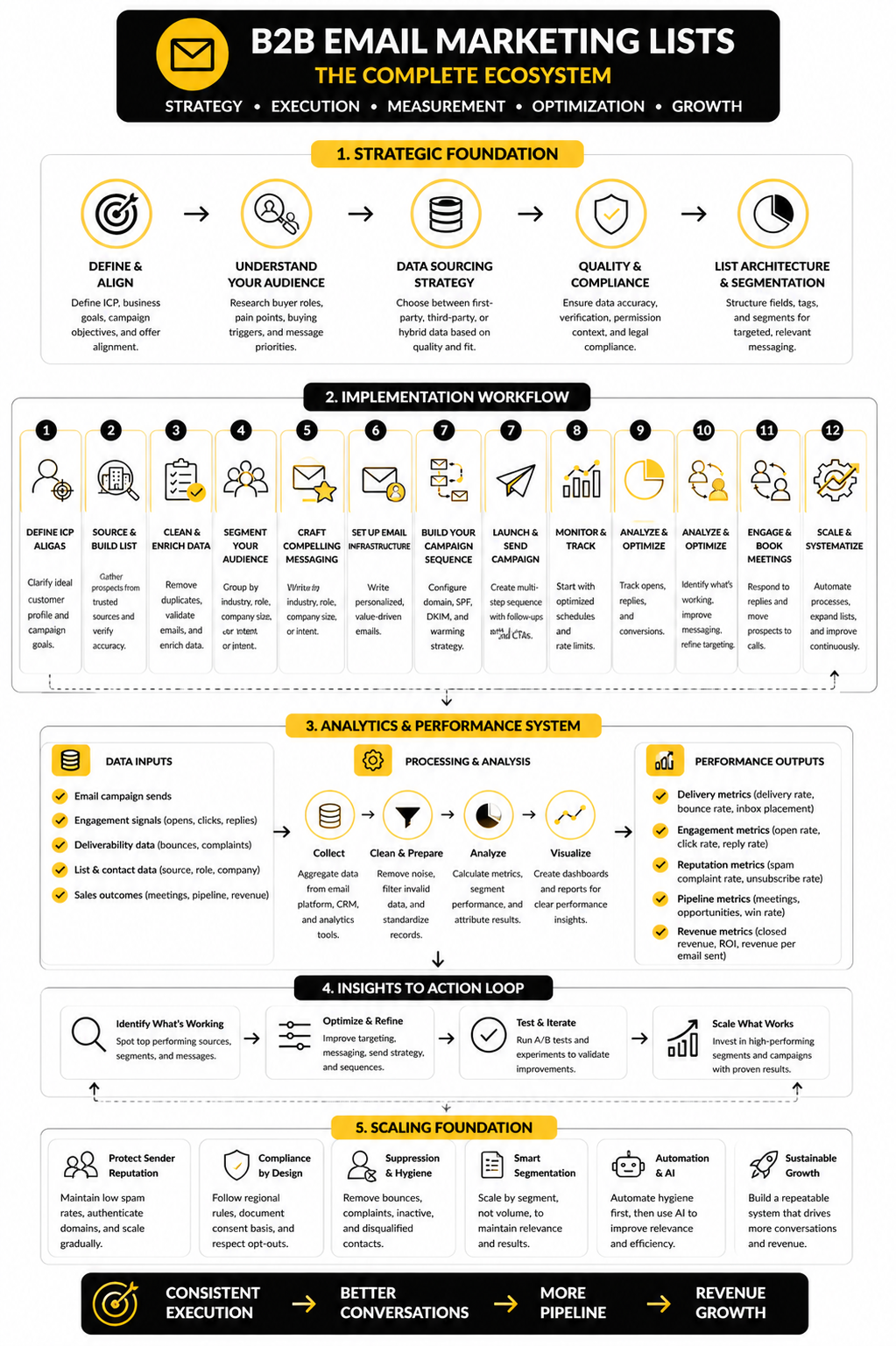
At this stage, the lesson should be clear: B2B email marketing lists are not a shortcut around strategy. They are the operational layer that turns strategy into real conversations. When the list is clean, segmented, compliant, and connected to follow-up, email becomes far easier to trust.
The final system has five connected parts: targeting, sourcing, verification, segmentation, and measurement. If one part is weak, the rest of the system feels it. Bad sourcing hurts deliverability, weak segmentation hurts replies, poor verification hurts sender reputation, and missing measurement keeps the team guessing.
The strongest teams keep this system visible. They know where contacts came from, why they belong, what segment they fit, what campaigns they received, how they responded, and when they should be removed. That is the difference between a list that supports growth and a database that slowly becomes a liability.
Final Checklist Before You Send
Before launching a campaign, run the list through a simple quality check. This does not need to be complicated, but it does need to be consistent. A few minutes of review can prevent days or weeks of damaged performance.
The checklist should confirm that the audience, message, and sending system are aligned. If the contact list is cold, the first email should not read like a warm subscriber newsletter. If the contacts came from a webinar, the message should connect to the topic they actually showed interest in.
Use this checklist before every serious campaign:
- The account profile matches the offer.
- The contact role is relevant to the problem.
- The email address has been verified recently.
- The contact source is recorded.
- The reason for contact is clear.
- The segment has a distinct message or offer.
- Suppression rules have been applied.
- Opt-outs and complaints are excluded.
- The sender domain is authenticated.
- The campaign has a clear follow-up path.
- Replies will be handled by a real person or a clear process.
- Performance will be reviewed by source and segment.
A checklist like this keeps the team honest. It also makes scaling safer because every new campaign follows the same operating standard.
FAQ - Built for Complete Guide
What are B2B email marketing lists?
B2B email marketing lists are structured databases of business contacts used for professional email campaigns. A good list includes more than names and emails; it includes company fit, contact role, source, permission context, segmentation, and engagement history. The goal is to reach relevant people at relevant companies with messages that make sense for their business situation.
Are B2B email marketing lists legal?
They can be legal, but it depends on the region, source, audience type, and how the list is used. In the United States, commercial email must follow rules such as truthful header information, honest subject lines, clear identification, a physical address, and a working opt-out process under the FTC’s CAN-SPAM guidance. In the UK and Europe, B2B email can involve additional privacy and direct marketing rules, so the list needs source, region, and lawful basis context.
Should I buy B2B email marketing lists?
Buying a list is risky if the data is old, poorly sourced, unverified, or missing consent and source context. A purchased list may look efficient because it gives you volume quickly, but it can also create bounces, complaints, and low engagement. If you use third-party data, treat it as raw material that still needs verification, qualification, suppression, and segmentation before any campaign goes live.
What makes a B2B email list high quality?
A high-quality list contains contacts who match the target market, work at relevant companies, have valid business email addresses, and fit a campaign-specific segment. It also includes source tracking, opt-out status, verification dates, and a clear reason for contact. The quality is proven by low bounce rates, low complaint rates, meaningful engagement, and real sales outcomes.
How often should B2B email marketing lists be cleaned?
Clean the list before major campaigns and set a regular maintenance rhythm for ongoing programs. Contacts should be re-verified when they have not been mailed recently, when they come from third-party sources, or when they have been inactive for a long period. Hard bounces, spam complaints, unsubscribes, and clear disqualifications should be removed or suppressed immediately.
What fields should I include in a B2B email list?
Start with first name, last name, business email, job title, role category, company name, company domain, industry, company size, location, source, verification status, opt-out status, lifecycle stage, segment, assigned owner, and last engagement date. These fields are enough to support qualification, segmentation, compliance, and follow-up. Add more fields only when they help the team make better campaign decisions.
What is the difference between cold outreach and email marketing?
Cold outreach usually targets business contacts who have not directly opted into your brand’s emails but may have a relevant professional reason to hear from you. Email marketing often includes subscribers, customers, leads, or contacts who have taken a direct action such as filling out a form or joining a webinar. Both require relevance, suppression handling, and respect for opt-outs, but the relationship context is different.
How do I segment B2B email marketing lists?
Segment by factors that change the message, timing, offer, or follow-up. Useful segments include industry, company size, role category, lifecycle stage, region, source, pain point, buying trigger, and engagement level. If a segment does not change how you communicate, it is probably just a label, not a useful campaign segment.
What metrics should I track for B2B email lists?
Track bounce rate, complaint rate, delivery rate, inbox placement, open rate, click rate, reply rate, positive reply rate, unsubscribe rate, booked calls, opportunities, and revenue. The most useful view is performance by source, segment, and campaign intent. Google’s sender guidance says senders should keep spam rates below 0.1% and avoid reaching 0.3% or higher through its email sender FAQ.
Why do B2B email campaigns fail even with a large list?
Large lists fail when the contacts are not relevant, the data is stale, the source is weak, the message is generic, or the campaign is sent without proper deliverability controls. Volume can hide these problems for a short time, but it usually makes them more expensive. A smaller list with better fit and cleaner execution often outperforms a large list that nobody trusts.
How can I improve deliverability for B2B email campaigns?
Start with authenticated sending, verified emails, clean suppression rules, and gradual volume increases. Monitor complaints, bounces, inbox placement, and engagement instead of only looking at opens. Validity’s 2025 benchmark reported global inbox placement around 83.5%, which is a useful reminder that accepted delivery does not always mean inbox visibility.
Should I use automation for list management?
Yes, but automate hygiene before you automate complexity. Use automation to suppress bounces, honor unsubscribes, stop sequences after replies, flag stale records, route engaged contacts, and prevent incomplete records from entering campaigns. Once that foundation is solid, automation can support scoring, segmentation, follow-up, and CRM updates.
Can AI help with B2B email marketing lists?
AI can help summarize accounts, classify replies, identify segment patterns, draft message variations, and support research. It should not replace human judgment around targeting, compliance, source quality, or final messaging accuracy. AI is useful when it improves relevance; it is dangerous when it simply helps send weak outreach faster.
What is the best way to build a list from scratch?
Start with the ideal customer profile, then build an account list before collecting contacts. Identify the buying roles inside those accounts, verify the emails, record the source and reason for contact, and assign each contact to a specific segment. This takes more discipline than exporting a generic database, but it creates a list your team can actually use.
How do I know when a list is ready to scale?
A list is ready to scale when it shows low bounces, low complaints, stable inbox placement, relevant engagement, and real movement toward sales outcomes. Scale the strongest segments first instead of increasing volume across the entire database. If performance weakens as volume rises, pause and inspect the source, segment, verification, and message fit before sending more.
Work With Professionals
Explore 10K+ Remote Marketing Contracts on MarkeWork.com
Most marketers spend too much time chasing clients, competing on crowded platforms, and losing a percentage of every project to middlemen.
MarkeWork gives you a better way. Browse thousands of remote marketing contracts and connect directly with companies desperate to hire skilled marketers like you, without platform commissions and without unnecessary gatekeepers.
If you are serious about finding better opportunities and keeping 100% of what you earn, explore available contracts and create a profile for free at MarkeWork.com.