

B2B marketing used to be predictable. Whitepapers, trade shows, cold emails—repeat. But that playbook is fading fast. Today’s buyers expect the same level of personalization, speed, and relevance they get in B2C experiences, and companies that fail to adapt are losing deals before they even know they existed.
The shift is measurable. Modern B2B buyers now use an average of 10 different interaction channels during their journey , which means no single tactic wins anymore. The companies growing fastest aren’t doing one thing better—they’re orchestrating multiple strategies into a seamless system.
This article breaks down real B2B marketing examples that work today, not theory. You’ll see what top-performing companies actually do, how their strategies connect, and how to apply the same thinking to your own pipeline.
Article Outline
- Why B2B marketing examples matter more than ever
- Modern B2B marketing framework overview
- Core components behind high-performing campaigns
- Real-world B2B marketing examples across industries
- How to implement these strategies professionally
- Scaling and optimizing for long-term growth
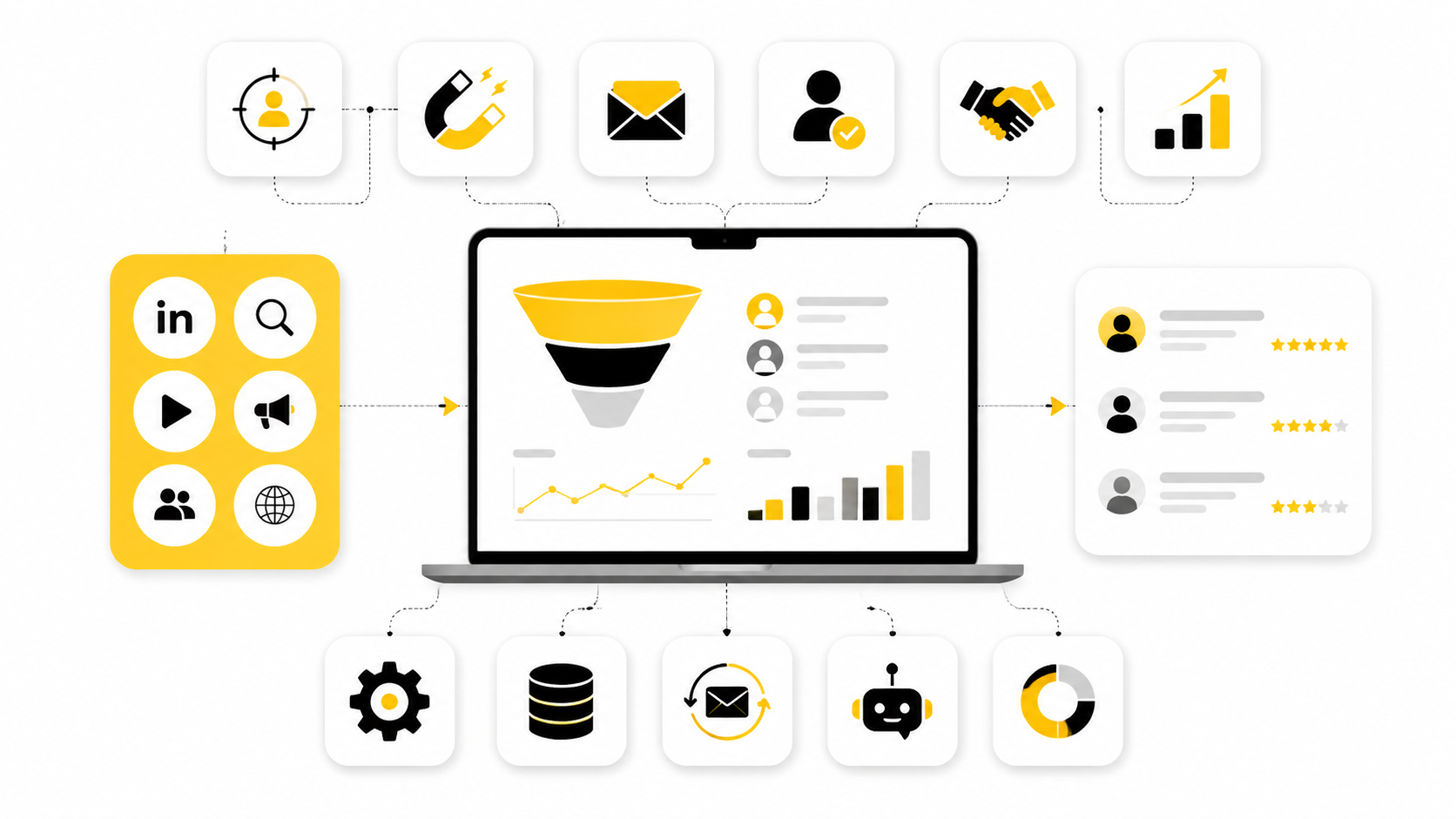
Why B2B Marketing Examples Matter More Than Ever
Most B2B marketing advice is abstract. It talks about “value,” “trust,” or “brand authority” without showing how those ideas translate into actual pipeline. That’s why studying real examples is one of the fastest ways to improve performance—you see what worked, in what context, and why.
The buying environment itself has changed dramatically. Buyers are no longer relying on sales reps as their primary source of information. Instead, they self-educate through content, communities, and peer validation before ever speaking to your team. That’s why strategies like content marketing, SEO, and product-led growth have become central—not optional.
There’s also a structural shift happening. Data shows that companies combining digital self-service with human interaction outperform those relying on just one channel . In practice, this means your marketing must do more than attract attention—it must support decision-making across the entire journey.
This is where real examples become powerful. They reveal how companies connect channels, messaging, and timing into a cohesive system instead of isolated campaigns.
The Reality of Modern B2B Buyer Behavior
If you’re still thinking in terms of funnels, you’re already behind. The modern B2B journey looks more like a web of interactions than a straight path.
Buyers jump between:
- LinkedIn content
- Google search results
- Product demos
- Peer recommendations
- Email sequences
- Retargeting ads
And they expect consistency across all of it.
Research shows that over one-third of buyers prefer digital self-service, another third prefer remote interaction, and the rest still want in-person engagement . That split forces marketers to design flexible systems instead of rigid funnels.
This is why many of the best B2B marketing examples today don’t look like campaigns at all. They look like ecosystems—content, automation, CRM, and personalization all working together.
Tools like GoHighLevel or ClickFunnels are increasingly used to build these ecosystems because they allow businesses to unify funnels, automation, and customer data in one place instead of stitching together disconnected tools.
Modern B2B Marketing Framework Overview
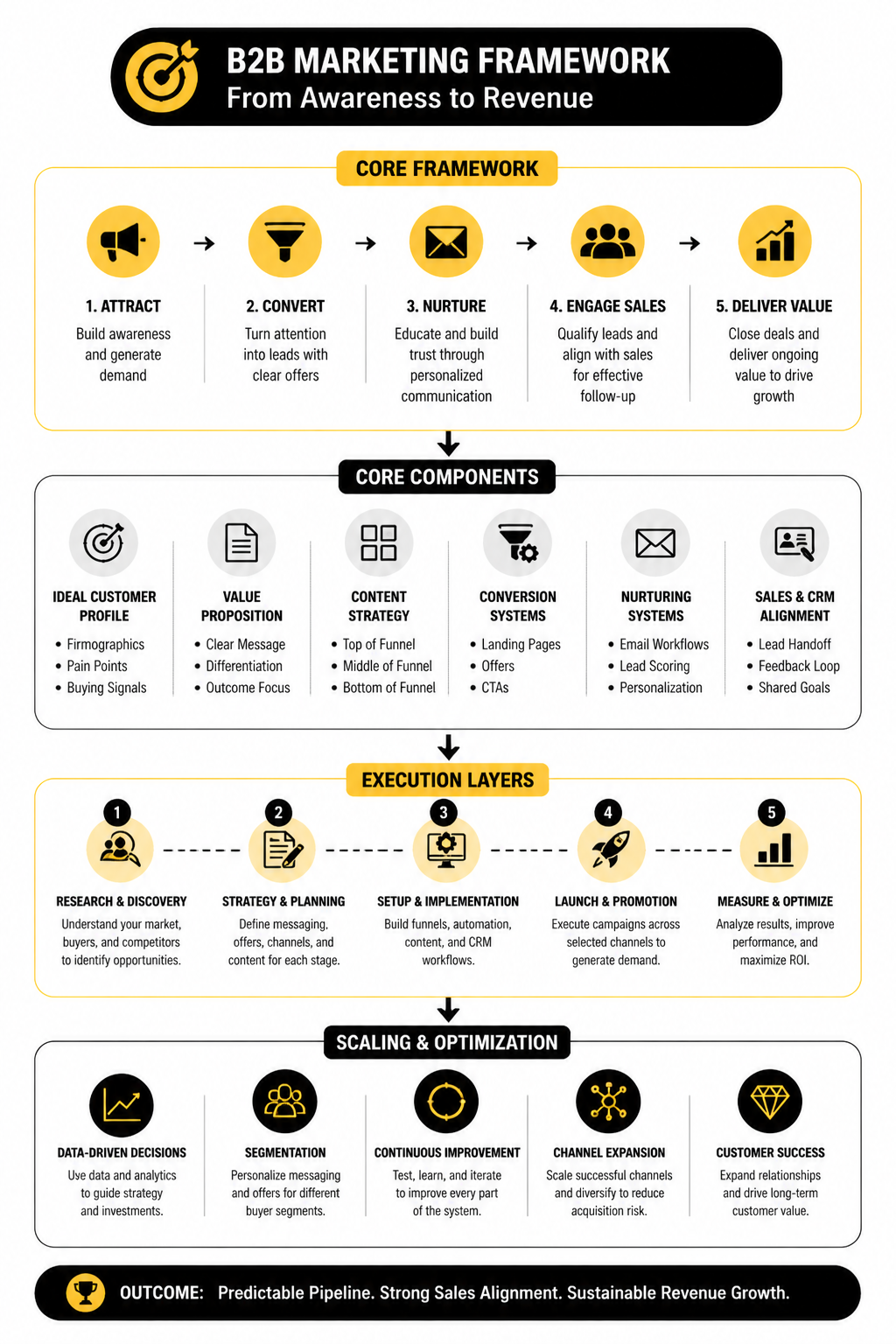
To understand the examples later in this article, you need a simple framework. Without it, everything just looks like random tactics.
At a high level, most successful B2B marketing strategies today follow this structure:
- Attention layer – Content, ads, SEO, social
- Engagement layer – Email, retargeting, webinars, chat
- Conversion layer – Landing pages, demos, sales calls
- Expansion layer – Upsells, retention, referrals
The key difference today is how tightly these layers are connected. High-performing teams don’t treat them as separate departments—they build systems where data flows between every step.
For example, someone reading a blog post might:
- Get retargeted with a case study
- Receive a personalized email sequence
- Be invited to a demo
- Enter a CRM-driven follow-up system
That entire journey can be automated with platforms like GoHighLevel or enhanced with conversational tools like Chatbase, which allow companies to engage visitors in real time using AI.
What Separates Average Campaigns From High-Performing Ones
Looking at dozens of B2B marketing examples, a few patterns show up consistently.
First, personalization is no longer optional. Whether it’s account-based marketing or dynamic website experiences, companies that tailor messaging to specific audiences outperform those using generic campaigns.
Second, multi-channel execution is critical. Data shows both paid and organic channels are growing simultaneously, with paid activity increasing by 120% and organic/direct traffic by 60% . The best campaigns don’t choose—they combine.
Third, speed matters. Buyers expect fast responses, seamless transitions between channels, and immediate access to information. This is why automation tools, AI chat, and CRM integrations are becoming foundational.
Finally, consistency wins. The most effective B2B marketing examples don’t rely on one viral campaign. They build repeatable systems that generate pipeline predictably over time.
In the next part, we’ll break down the core components behind these systems so you can see exactly how they’re built.
Core Components Behind High-Performing B2B Marketing Campaigns
Once you move past theory, the difference between average and high-performing B2B marketing examples comes down to a few core components working together. Not just present—but tightly integrated.
Most companies already have pieces of this puzzle. They run ads, publish content, maybe even have email automation. The problem is these pieces operate in isolation, which kills momentum and conversion efficiency.
The companies winning right now are building systems around four key components.
1. Demand Generation That Builds Trust Early
High-performing B2B marketing doesn’t start with selling. It starts with visibility and trust long before a buyer is ready to act.
Content plays a central role here. Not generic blog posts, but targeted, high-intent content that answers real questions buyers are already searching for. That includes:
- Comparison articles
- Deep product breakdowns
- Industry-specific use cases
- Educational content tied to real problems
This is where many strong B2B marketing examples stand out. Instead of pushing products, they position themselves as the default source of truth in their category.
There’s a reason for that. Research shows that buyers complete the majority of their decision-making before contacting sales (gartner.com). If you’re not influencing that phase, you’re already late.
2. Conversion Infrastructure That Removes Friction
Getting attention is only half the battle. The next step is converting that attention into pipeline without losing momentum.
This is where infrastructure matters more than creativity.
Strong B2B marketing examples consistently use:
- Focused landing pages instead of generic websites
- Clear offers tied to specific stages of awareness
- Fast-loading pages with minimal distractions
- Strong CTAs aligned with buyer intent
Tools like ClickFunnels or Systeme.io are often used to build these conversion paths because they allow marketers to design, test, and optimize funnels without relying heavily on dev teams.
The key idea is simple: every click should move the buyer forward, not sideways.
3. Automated Nurturing That Feels Personal
Most B2B deals don’t close on the first interaction. That’s why nurturing is one of the most important components—and one of the most poorly executed.
High-performing systems don’t rely on generic drip campaigns. They use behavior-based automation to deliver the right message at the right time.
For example:
- A visitor downloads a guide → receives follow-up emails expanding on that topic
- A prospect visits pricing → gets case studies addressing objections
- A lead goes cold → re-engagement sequence with new insights
Email platforms like Brevo or automation systems inside GoHighLevel allow teams to build these flows without creating complexity behind the scenes.
The difference shows in results. Personalized nurturing can significantly increase conversion rates because it aligns communication with actual buyer behavior instead of assumptions.
4. Sales and Marketing Alignment That Closes Deals Faster
This is where many B2B strategies break.
Marketing generates leads. Sales complains about quality. Pipeline stalls.
The best B2B marketing examples eliminate this gap by aligning both teams around shared data and shared goals.
That includes:
- Unified CRM systems
- Clear lead qualification criteria
- Real-time visibility into buyer activity
- Coordinated follow-up sequences
Instead of treating marketing and sales as separate functions, high-performing companies treat them as one continuous system.
Platforms like GoHighLevel or Copper CRM are often used to centralize this process, ensuring no lead falls through the cracks.
How These Components Work Together in Practice
Individually, each component matters. But the real impact happens when they’re connected.
Here’s what that looks like in a real system:
- A potential buyer searches for a solution and finds your content
- They land on a targeted page built for their specific problem
- They convert into a lead through a relevant offer
- They enter a personalized nurturing sequence
- Sales engages at the right moment with full context
This isn’t complicated—it’s structured.
And that’s the key takeaway from the best B2B marketing examples: success doesn’t come from isolated tactics. It comes from systems where every step builds on the previous one.
In the next part, we’ll break down real-world B2B marketing examples from companies that execute this at a high level, so you can see exactly how these components come together in action.
Real-World B2B Marketing Examples Across Industries
Once you understand the structure and components, the next step is seeing how they actually play out in the real world. The strongest B2B marketing examples aren’t random tactics—they’re deliberate systems executed consistently over time.
Below are real companies that have built scalable growth using the exact principles we covered. Pay attention to how each one connects demand generation, conversion, nurturing, and sales alignment.
HubSpot: Turning Content Into a Pipeline Engine
HubSpot is one of the most cited B2B marketing examples for a reason. They didn’t just create content—they built an entire growth engine around it.
Their strategy focused on publishing highly targeted educational content covering every stage of the buyer journey. From beginner guides to advanced implementation strategies, they positioned themselves as the go-to resource for marketing and sales teams.
That approach worked at scale. HubSpot reports that a large share of its leads comes directly from inbound channels like blog content and organic search (hubspot.com). But the real insight isn’t just traffic—it’s how they convert it.
They connect content to:
- Free tools
- CRM trials
- Email nurturing
- Sales follow-up
The result is a self-sustaining system where content continuously feeds the pipeline without relying heavily on outbound efforts.
Salesforce: Ecosystem-Driven Marketing at Scale
Salesforce built one of the most powerful B2B marketing ecosystems in the world. Instead of relying on a single channel, they created multiple entry points into their platform.
Their strategy includes:
- Massive annual events like Dreamforce
- A full media platform with Salesforce+
- Partner ecosystems driving referrals
- Deep integration with customer success content
This multi-channel approach reflects a broader trend. Companies using ecosystem-driven strategies often outperform competitors because they reduce dependency on any single acquisition channel.
The key takeaway here is scale through diversification. Salesforce doesn’t just generate leads—they create an environment where leads naturally enter from multiple directions.
Slack: Product-Led Growth That Replaced Traditional Funnels
Slack is one of the clearest examples of how product-led growth can reshape B2B marketing.
Instead of relying heavily on traditional sales funnels, Slack focused on making the product itself the primary acquisition channel. Teams could start using it for free, experience value quickly, and then expand usage organically.
This approach removed friction from the buying process. Instead of convincing buyers through marketing alone, Slack let the product demonstrate its value directly.
The impact is measurable. Product-led strategies have been shown to significantly improve conversion rates and reduce customer acquisition costs (openviewpartners.com).
Slack still supports this with content, integrations, and ecosystem partnerships—but the product remains the center of the strategy.
IBM: Account-Based Marketing for Enterprise Deals
IBM represents a different type of B2B marketing example—one focused on large, complex enterprise deals.
Their strategy relies heavily on account-based marketing (ABM), where campaigns are tailored to specific high-value companies instead of broad audiences.
That includes:
- Personalized content for target accounts
- Custom landing pages
- Dedicated sales and marketing collaboration
- Data-driven targeting
ABM works particularly well in industries with long sales cycles and multiple decision-makers. Research shows that targeted account strategies can deliver higher ROI than broad campaigns (itsma.com).
IBM’s success highlights an important point: not all B2B marketing examples follow the same model. The structure must match the deal size and complexity.
How to Implement These Strategies Step by Step
Seeing examples is useful. Turning them into action is where most companies get stuck.
The key is not to copy a single strategy, but to build your own system using the same underlying principles. Here’s how that looks in practice.
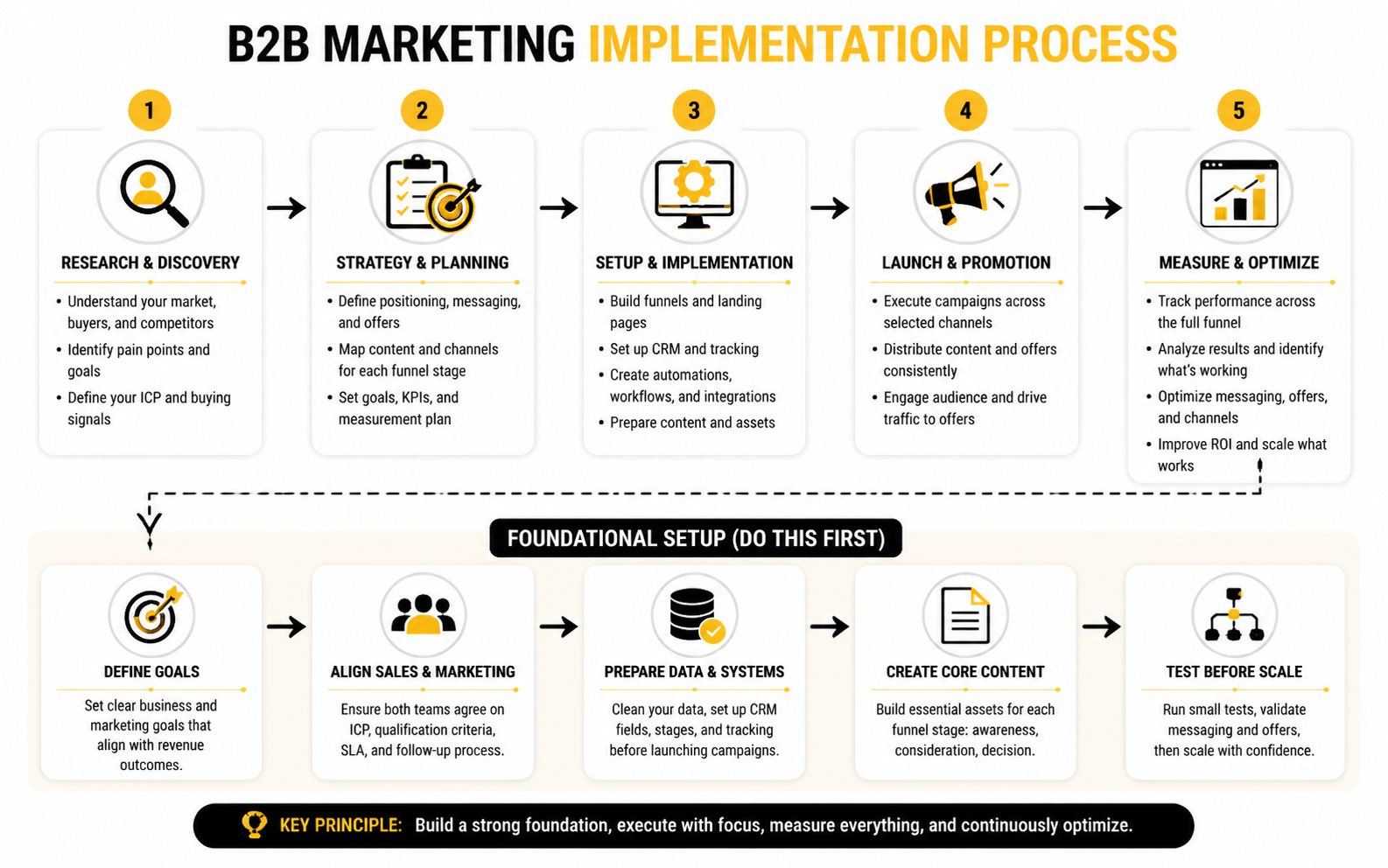
Step 1: Define Your Demand Entry Points
Start by identifying how buyers first discover you. This is your demand layer, and it needs to be intentional.
Choose 1–2 primary channels based on your audience:
- SEO and content if buyers search for solutions
- LinkedIn if your audience is active professionally
- Paid ads if speed is critical
The mistake most companies make is trying to do everything at once. Focus creates traction.
Step 2: Build a Focused Conversion Path
Once you have attention, you need a clear next step. This is where most traffic gets wasted.
Create a dedicated path for each audience segment:
- One landing page per offer
- One clear CTA per page
- One outcome per funnel
Platforms like ClickFunnels or Systeme.io simplify this by allowing you to build and test funnels quickly without technical overhead.
Step 3: Implement Behavior-Based Automation
This is where your system starts compounding.
Instead of sending the same message to everyone, use behavior to guide communication:
- Page visits
- Content downloads
- Email engagement
- Demo requests
Tools like GoHighLevel or ManyChat allow you to trigger personalized sequences based on real user actions, not assumptions.
This dramatically improves engagement because the messaging feels relevant instead of generic.
Step 4: Align Sales With Real-Time Data
At this point, leads are flowing. But without alignment, they won’t convert efficiently.
Make sure your sales team has:
- Visibility into lead behavior
- Context on what content was consumed
- Clear signals for when to engage
This reduces friction and shortens the sales cycle.
Using integrated systems like GoHighLevel ensures marketing and sales operate from the same data instead of disconnected tools.
Step 5: Optimize Based on Pipeline, Not Vanity Metrics
This is where most strategies fail.
Traffic, clicks, and impressions don’t matter if they don’t turn into revenue. The best B2B marketing examples focus on pipeline metrics:
- Cost per qualified lead
- Conversion rates between stages
- Revenue per channel
Companies that optimize based on these metrics consistently outperform those chasing surface-level performance.
At this point, you’ve seen how real companies execute and how to translate that into a working system. In the next part, we’ll break down how to implement these strategies at a professional level, including tools, workflows, and scaling considerations that separate small wins from sustainable growth.
Statistics and Data That Make B2B Marketing Examples Useful
Data only helps when it changes what you do next. Random statistics might make an article look more credible, but they do not improve your strategy unless they reveal a decision, a bottleneck, or a performance gap.
That is why the best B2B marketing examples should be measured against a full revenue journey, not just campaign activity. A LinkedIn post with high engagement may be useful, but only if it attracts the right audience. A landing page with a strong conversion rate may look great, but if those leads never turn into opportunities, the page is not doing its real job.
The goal is not to collect more numbers. The goal is to understand which numbers explain movement from attention to revenue.
The Metrics That Actually Matter
Most B2B teams track too much and understand too little. They monitor impressions, clicks, form fills, email opens, demo requests, pipeline, revenue, and churn, but they often fail to connect those signals into one clear picture.
Start with five practical measurement layers:
- Reach: Who is seeing your message?
- Engagement: Are the right people interacting with it?
- Conversion: Are they taking the next meaningful step?
- Pipeline: Are those actions creating qualified opportunities?
- Revenue: Which campaigns are producing closed deals?
This is where measurement becomes useful. If reach is high but engagement is weak, your positioning may be too broad. If engagement is strong but conversion is low, your offer or landing page probably needs work. If conversion is healthy but pipeline quality is poor, your targeting or qualification criteria are off.
The best B2B marketing examples are not impressive because one metric looks good. They are impressive because the entire chain works.
Buyer Behavior Benchmarks You Should Not Ignore
Modern B2B buyers are more independent than most marketing teams want to admit. Gartner’s 2025 sales research found that 61% of B2B buyers prefer a rep-free buying experience (gartner.com). That does not mean sales is dead. It means your marketing has to answer more questions before the first call ever happens.
This changes how you interpret content performance. A product comparison page, ROI calculator, demo video, or case study might not generate immediate form fills, but it can still influence deal confidence. If you only measure last-click conversions, you will undervalue the assets buyers actually use to make decisions.
McKinsey’s B2B research also reinforces the need for channel flexibility, showing that buyers now expect a mix of digital self-service, remote interaction, and in-person engagement across the journey (mckinsey.com). That matters because channel performance should not be judged in isolation. A webinar, email sequence, LinkedIn post, and sales conversation may all contribute to the same opportunity.
Pipeline Metrics Beat Vanity Metrics
The strongest measurement shift you can make is moving from activity reporting to pipeline reporting. Activity tells you what happened. Pipeline tells you whether it mattered.
Benchmarkit’s 2025 B2B SaaS benchmark data shows that marketing teams most commonly track pipeline generated, opportunities generated, and new ARR bookings as top performance metrics (benchmarkit.ai). That is the right direction, because it forces marketing to prove contribution beyond lead volume.
But there is a catch. Pipeline alone can also mislead you if it is not paired with quality and efficiency metrics.
Track these alongside pipeline:
- Cost per qualified opportunity
- MQL-to-SQL conversion rate
- Opportunity-to-close conversion rate
- Sales cycle length by source
- Average contract value by channel
- Payback period on marketing spend
This is how you spot the truth. One channel may generate fewer leads but better-fit opportunities. Another may look cheap at the top of the funnel but become expensive once you calculate closed revenue.
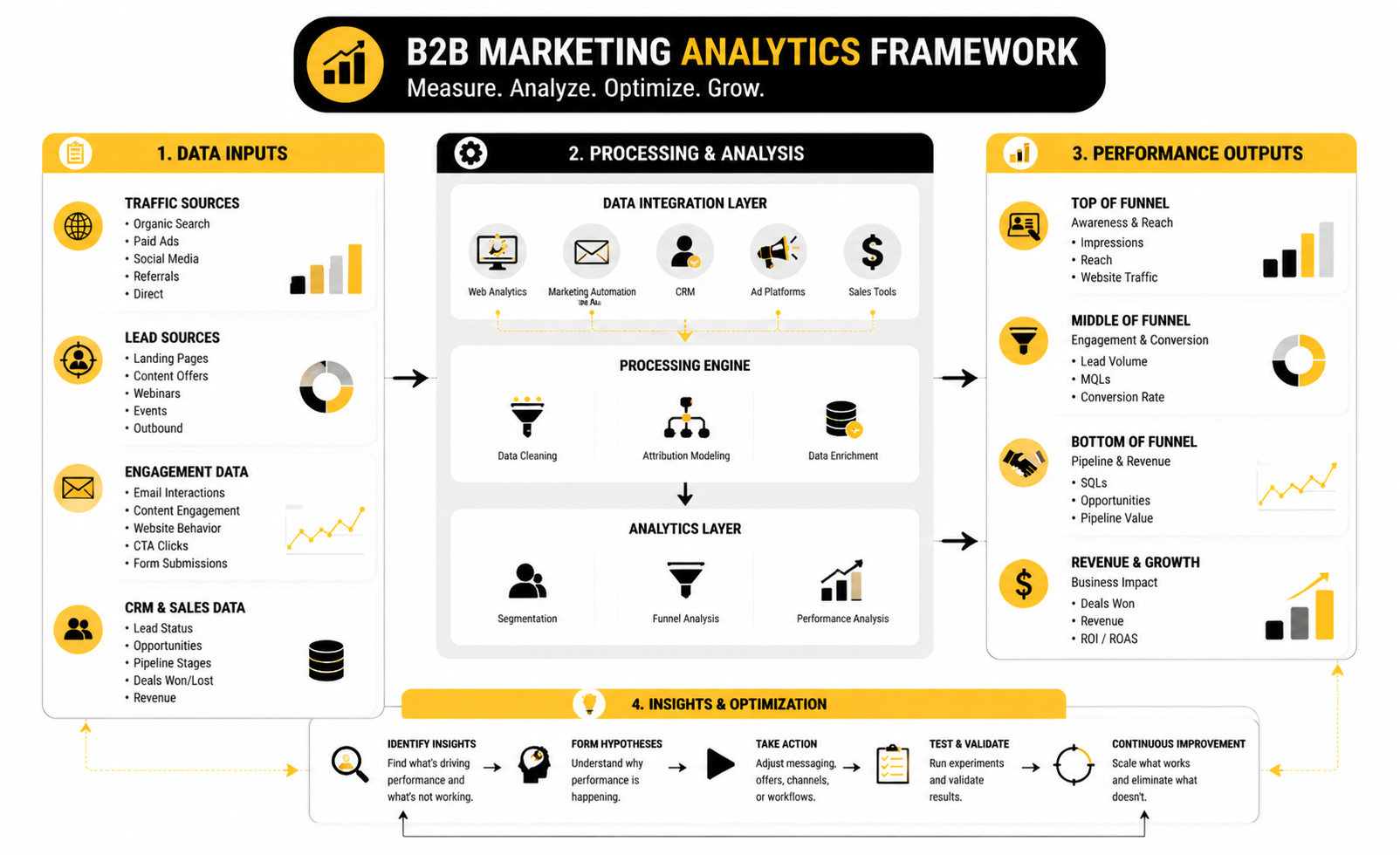
How to Build a Simple Analytics System
A practical analytics system does not need to be complicated. It needs to be consistent.
The cleanest setup connects:
- Traffic source
- Landing page or conversion event
- CRM record
- Sales stage movement
- Closed revenue
That gives you a full view of what is working. Without that connection, you are guessing.
For smaller teams, a system like GoHighLevel can help connect funnels, CRM activity, automation, and follow-up in one place. For content and social distribution, Buffer can help keep campaigns consistent while you measure which topics and formats drive engagement. For forms, surveys, and qualification flows, Fillout can help capture cleaner lead data before it enters the CRM.
The important part is not the tool stack. The important part is making sure every major campaign can be traced from first touch to revenue outcome.
How to Interpret Performance Signals
A number by itself rarely tells the full story. You need to interpret it in context.
If organic traffic is growing but demo requests are flat, your content may be attracting early-stage readers instead of active buyers. That is not automatically bad, but it means you need stronger mid-funnel assets to move people forward.
If demo requests are increasing but close rates are falling, your offer may be too broad or your qualification process may be weak. More leads can actually hurt performance if sales spends time on the wrong accounts.
If paid campaigns generate pipeline but payback is too slow, the channel may still work for higher-value accounts but not for low-ticket offers. This is where segmentation matters. You should not judge every campaign by the same benchmark.
What the Data Should Drive Next
The point of measurement is action. Every reporting cycle should lead to a decision.
Use the data to decide whether to:
- Create more bottom-funnel content
- Rewrite landing page messaging
- Tighten lead qualification
- Shift budget toward higher-quality channels
- Improve sales follow-up speed
- Build better nurture sequences
- Cut campaigns that create noise instead of revenue
This is where B2B marketing examples become genuinely useful. You are not just admiring what another company did. You are comparing their strategy against your own system and asking a sharper question: where is our revenue journey leaking?
Once you can answer that, optimization becomes practical instead of emotional.
Scaling and Optimizing for Long-Term Growth
Once the basics are working, the game changes. You are no longer asking, “Can this campaign generate leads?” You are asking, “Can this system grow without breaking efficiency?”
That is where advanced B2B marketing examples become more useful than beginner playbooks. At scale, the issue is rarely a lack of tactics. The real challenge is choosing the right tradeoffs before more budget, more tools, and more channels create more noise.
The Tradeoff Between Reach and Precision
Broad campaigns can create awareness fast, but they often attract mixed-quality leads. Highly targeted campaigns usually convert better, but they can limit volume if your market is too narrow. Neither approach is automatically right.
The smart move is to match targeting depth to deal size. If you sell a low-ticket B2B offer, you usually need more volume, faster qualification, and tighter automation. If you sell enterprise contracts, you can afford slower, more personalized campaigns because one closed deal can justify the effort.
This is why account-based marketing makes sense for complex deals but can be overkill for smaller offers. A team selling $2,000 annual subscriptions should not copy the same motion as a company selling $250,000 enterprise contracts. The best B2B marketing examples always fit the economics of the business.
Why Scaling Breaks Weak Positioning
Scaling exposes vague messaging. A small campaign can survive on founder energy, personal relationships, or a few strong referrals. But when you increase spend, weak positioning gets expensive fast.
This usually shows up in three ways:
- More traffic, but no meaningful lift in qualified pipeline
- More leads, but lower close rates
- More sales conversations, but longer decision cycles
When that happens, the answer is not always more content or more ads. Sometimes the offer is unclear. Sometimes the ICP is too broad. Sometimes the message sounds like every competitor in the category.
Strong positioning makes growth cheaper because buyers understand faster. That matters even more now that many buyers prefer to research independently before speaking to sales, with 61% of B2B buyers saying they prefer a rep-free buying experience (gartner.com). If your website, content, and funnel cannot explain the value clearly without a salesperson, you are adding friction where buyers already want speed.
The Risk of Over-Automation
Automation is powerful, but lazy automation damages trust. Buyers can tell when every message is triggered by a workflow with no real context.
The goal is not to automate everything. The goal is to automate the repeatable parts while protecting the moments where human judgment matters.
Use automation for:
- Lead routing
- Follow-up reminders
- Segmentation
- Appointment booking
- Basic education sequences
- Re-engagement flows
Keep human judgment for:
- High-value opportunities
- Complex objections
- Multi-stakeholder deals
- Strategic account expansion
- Partnership conversations
This is where tools like GoHighLevel, Brevo, and Cal.com can be useful. They help remove operational drag, but they should not replace strategy. Big difference.
When to Add New Channels
A common scaling mistake is adding new channels before the current ones are stable. More channels feel like progress, but they often spread the team too thin.
Before adding a new channel, ask:
- Is our current best channel predictable?
- Do we know our cost per qualified opportunity?
- Can sales handle more volume without slower follow-up?
- Do we have clear messaging for this audience?
- Can we measure the new channel against pipeline, not vanity metrics?
If the answer is no, fix the current system first. Scaling a leaky funnel just makes the leak more expensive.
When you do expand, choose channels based on buyer behavior rather than hype. If your buyers actively search for solutions, SEO and comparison content may be the best next move. If they rely on peer trust, LinkedIn, communities, and partner-led growth may matter more. If the buying process is visual or product-led, interactive demos and guided experiences can carry more weight.
Content Depth Beats Content Volume
Publishing more does not automatically build authority. In mature B2B markets, thin content gets ignored because buyers have already seen the generic version of every topic.
Better content usually does one of three things:
- Helps buyers compare options
- Helps buyers justify a decision internally
- Helps buyers understand implementation risk
That last point is underrated. Many buyers are not just asking, “Is this product good?” They are asking, “Will this create problems for my team after we buy it?”
The best B2B marketing examples address that fear directly. They explain onboarding, migration, integrations, timelines, risks, and expected outcomes. That is the type of content that supports real buying decisions.
The Economics of Sustainable Growth
At some point, marketing has to prove efficiency. Growth that depends on unlimited spend is not really growth. It is rented attention.
Benchmarkit’s 2025 SaaS data shows how quickly efficiency can become a problem, with many companies spending heavily to acquire each dollar of new customer ARR (benchmarkit.ai). That does not mean paid acquisition is bad. It means payback, retention, expansion, and deal quality matter as much as top-line pipeline.
A healthy scaling model usually improves in one of four ways:
- Lower acquisition cost
- Higher conversion rate
- Higher average contract value
- Stronger retention and expansion
If none of those improve as you scale, the system is becoming heavier, not stronger.
Building a Learning Loop
The most advanced B2B teams do not just launch campaigns. They build learning loops.
Every campaign should answer a question:
- Which pain point creates the strongest response?
- Which audience segment converts into better opportunities?
- Which offer drives serious buyers instead of casual leads?
- Which content helps sales close faster?
- Which channel produces customers who stay longer?
That learning then feeds the next campaign. Over time, the company becomes harder to compete with because its marketing is not just louder—it is smarter.
This is the deeper lesson behind strong B2B marketing examples. The visible campaign is only the surface. Underneath, the best companies are building systems that learn, adapt, and compound.
Bringing the Full B2B Marketing System Together
At this stage, the message should be clear: the best B2B marketing examples are not just clever campaigns. They are connected systems.
A strong system attracts the right buyers, educates them before sales gets involved, converts interest into qualified pipeline, and gives the sales team enough context to close better deals. It also keeps learning from the data so every campaign improves the next one.
This is where most companies either compound or stall. If your content, funnels, CRM, automation, and sales process work together, growth becomes more predictable. If they stay disconnected, every campaign feels like starting from zero.
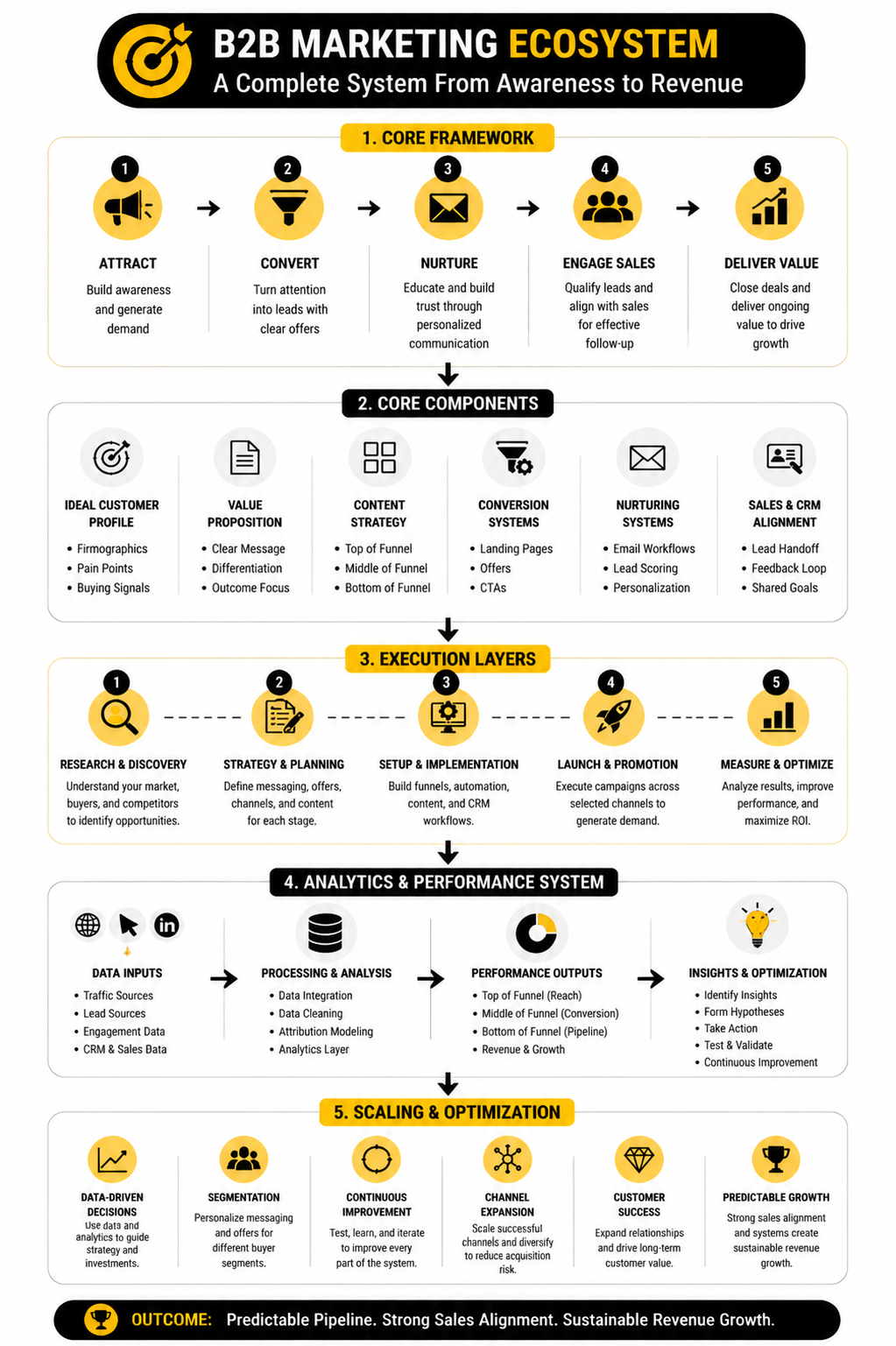
The practical move is to stop asking, “What tactic should we try next?” and start asking, “Where is our system weakest right now?” That question leads to better decisions because it forces you to look at the whole revenue journey instead of chasing whatever looks exciting this month.
FAQ - Built for Complete Guide
What are B2B marketing examples?
B2B marketing examples are real strategies, campaigns, or systems companies use to attract and convert business customers. They can include content marketing, account-based marketing, webinars, LinkedIn campaigns, product-led growth, email nurturing, partner marketing, and sales enablement. The useful ones show not just what a company did, but why it worked.
Why are B2B marketing examples useful?
They make strategy easier to understand because you can see how ideas work in practice. Instead of talking about “building trust” or “creating demand” in a vague way, examples show the actual channels, offers, messages, and follow-up systems involved. That makes it easier to adapt the thinking to your own business.
What is the best B2B marketing strategy?
There is no single best strategy for every company. The right strategy depends on your deal size, sales cycle, buyer behavior, category maturity, and internal resources. A company selling enterprise software may need ABM and sales-led nurturing, while a smaller SaaS company may grow faster with SEO, product-led trials, and automated onboarding.
What are common B2B marketing channels?
Common B2B marketing channels include SEO, LinkedIn, email marketing, webinars, paid search, partner marketing, events, communities, podcasts, comparison pages, and outbound campaigns. The strongest companies usually combine several channels instead of relying on one. The key is making those channels work together instead of running them as isolated efforts.
How do you measure B2B marketing performance?
Measure B2B marketing by tracking the full journey from attention to revenue. Useful metrics include qualified leads, opportunities created, pipeline generated, close rate, sales cycle length, customer acquisition cost, and revenue by channel. Vanity metrics like impressions and clicks can help diagnose performance, but they should not be the final measure of success.
What makes a B2B campaign successful?
A successful B2B campaign reaches the right audience, solves a real business problem, creates a clear next step, and contributes to qualified pipeline. It also gives sales useful context rather than just handing over a name and email address. The best campaigns are built around buyer intent, not just creative ideas.
How is B2B marketing different from B2C marketing?
B2B marketing usually involves longer sales cycles, multiple decision-makers, higher purchase risk, and more rational buying criteria. B2C marketing often focuses more on emotion, convenience, and individual preference. B2B still needs emotion, but the message must also help buyers justify the decision internally.
What role does content play in B2B marketing?
Content helps buyers understand problems, compare solutions, reduce risk, and build confidence before speaking to sales. Strong content supports every stage of the buying journey, from early education to final vendor selection. That is why many high-performing B2B marketing examples use content as the foundation of demand generation.
Should B2B companies use automation?
Yes, but carefully. Automation works best for repeatable tasks like lead routing, email follow-up, segmentation, reminders, and re-engagement. It should not replace human judgment in complex sales conversations, high-value deals, or strategic account relationships.
What is account-based marketing?
Account-based marketing is a focused strategy where sales and marketing target specific high-value accounts instead of broad audiences. It works especially well for enterprise deals, long sales cycles, and buying committees with multiple stakeholders. The goal is quality and relevance, not maximum lead volume.
How do small businesses apply B2B marketing examples?
Small businesses should not copy enterprise campaigns directly. Instead, they should extract the principle behind the example and simplify it. That might mean choosing one strong traffic channel, building one focused offer, setting up basic nurturing, and tracking which leads actually become revenue.
What tools help with B2B marketing execution?
Useful tools depend on the workflow. GoHighLevel can help with funnels, CRM, automation, and follow-up. ClickFunnels can help build conversion paths. Brevo can support email marketing and automation. The tool matters less than whether your system is clear.
What is the biggest mistake in B2B marketing?
The biggest mistake is treating tactics as the strategy. Publishing content, running ads, sending emails, or launching webinars will not fix weak positioning, unclear offers, poor follow-up, or bad targeting. Good marketing starts with understanding the buyer and building a system around how they actually make decisions.
Work With Professionals
Explore 10K+ Remote Marketing Contracts on MarkeWork.com
Most marketers spend too much time chasing clients, competing on crowded platforms, and losing a percentage of every project to middlemen.
MarkeWork gives you a better way. Browse thousands of remote marketing contracts and connect directly with companies desperate to hire skilled marketers like you, without platform commissions and without unnecessary gatekeepers.
If you're serious about finding better opportunities and keeping 100% of what you earn, explore available contracts and create a profile for free at MarkeWork.com.