

B2B marketing is the work of helping one company become the obvious choice for another company. The audience is not a casual shopper making a quick personal purchase. It is a group of professionals weighing risk, ROI, fit, timing, and internal politics, which is why definitions from Salesforce and HubSpot both center on reaching people who buy on behalf of an organization.
That sounds simple until you look at how buying actually happens now. Recent 6sense research on European B2B buying found that the average buying group includes 9 to 10 stakeholders, takes 10 months from research to purchase, and reviews 4 vendors along the way. At the same time, McKinsey’s 2024 B2B Pulse shows buyers now move across an average of ten interaction channels, while Gartner’s 2025 sales survey shows many would rather do most of that work without talking to a rep.
That is the real backdrop for b2b marketing today. You are not just creating campaigns. You are building trust before the buyer raises a hand, making your company easy to find when a problem becomes urgent, and removing friction when a serious buying conversation finally starts.
Article Outline
This article is built as one connected guide, not six disconnected posts. We will move from the strategic foundation into the channels, systems, and execution details that actually create pipeline. That matters because b2b marketing breaks down fast when teams jump to tactics before they agree on how buyers move from awareness to revenue.
- What B2B Marketing Means Now
- Why B2B Marketing Matters More Than Ever
- The Modern B2B Marketing Framework
- The Core Channels and Components That Drive Pipeline
- How to Build a Professional B2B Marketing Engine
- How to Measure, Optimize, and Scale B2B Marketing
What B2B Marketing Means Now
The old view of b2b marketing was heavily lead-centric. Get a name, pass it to sales, and hope the rest sorts itself out. That model looks increasingly weak in a market where buying groups are large, research is mostly digital, and early intent often stays invisible until a shortlist already exists, a shift discussed by 6sense and reinforced by LinkedIn’s B2B Institute.
A better definition is this: b2b marketing creates market attention, buyer confidence, and qualified commercial momentum across the full buying journey. It helps the right companies recognize a problem, understand the options, remember your brand, trust your expertise, and take the next step when timing is right. That is why strong B2B teams do not treat content, paid media, events, website conversion, CRM hygiene, and sales enablement as separate islands.
The practical implication is huge. B2B marketing is no longer just a support function for sales. It is the system that shapes whether your brand gets considered at all, whether your message survives internal stakeholder scrutiny, and whether demand turns into real opportunities instead of anonymous traffic and vanity metrics.
Why B2B Marketing Matters More Than Ever
B2B buying has become more complex at exactly the same time buyers have become more independent. Gartner reports that 61% of B2B buyers prefer an overall rep-free buying experience, and 73% actively avoid suppliers that send irrelevant outreach. That means lazy targeting is not just inefficient now. It can actively damage future revenue.
The audience has changed too. Forrester found that Millennials and Gen Z buyers rose to 71% of B2B buyers, bringing stronger digital expectations and less patience for friction. When those expectations collide with a slow website, vague positioning, weak proof, or disconnected follow-up, marketing does not merely lose a click. It loses credibility with the people who increasingly influence serious budget decisions.
There is also a timing problem that many companies still underestimate. The 95-5 Rule from LinkedIn’s B2B Institute argues that only a small share of category buyers are in-market right now, while the much larger future market is deciding which brands feel familiar and safe long before a formal buying cycle begins. That is why b2b marketing matters so much: it has to capture current demand without starving future demand.
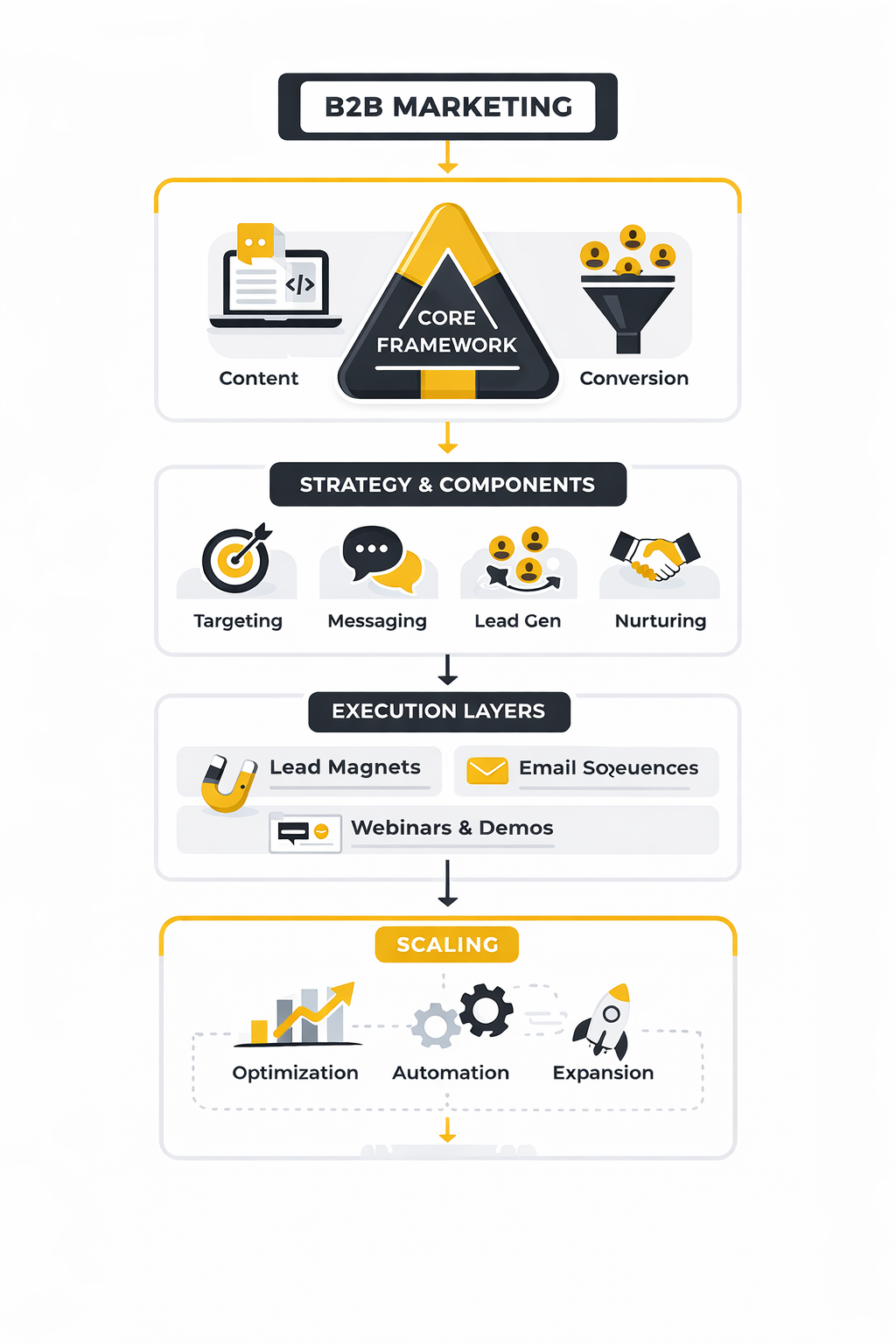
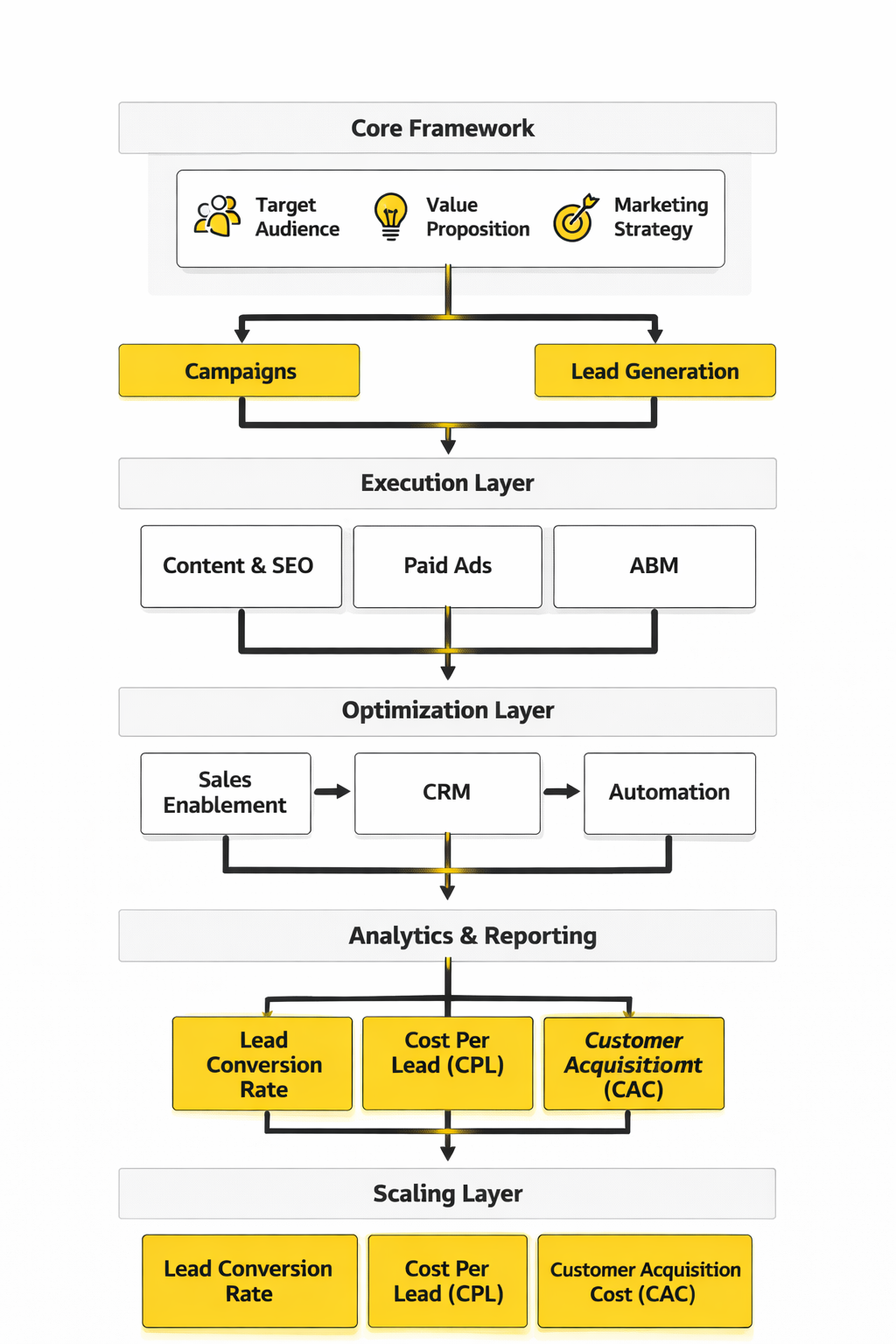
The Modern B2B Marketing Framework
A modern b2b marketing framework starts with a simple idea: brand, demand, and conversion have to work together. If you only invest in brand, you create attention without enough capture. If you only invest in demand capture, you squeeze the tiny percentage already ready to buy and ignore everyone else who will create next quarter’s pipeline. The balance matters more now because McKinsey shows buyers expect smooth movement across channels, while HubSpot’s marketing data shows B2B teams still get strong ROI from fundamentals like websites, blogs, and SEO.
In practice, the framework has four layers. First comes market clarity: audience definition, positioning, category context, and messaging. Second comes trust creation: educational content, proof, thought leadership, and visible expertise, which lines up with how Salesforce describes B2B content marketing as a way to attract, retain, and move a business audience toward profitable action. Third comes demand capture: search, paid campaigns, retargeting, email, events, and partner or outbound coordination. Fourth comes conversion infrastructure: landing pages, forms, CRM workflows, meeting booking, and handoff rules that stop interest from leaking out of the funnel.
The smartest teams also build the framework around operational reality, not theory. Content Marketing Institute’s 2025 B2B research shows that many marketers still lack a scalable content model, which is exactly why elegant strategy documents often fail in execution. A professional setup usually needs a practical tool layer too, and for teams building campaign destinations, lead capture flows, or demo funnels quickly, tools like ClickFunnels, Systeme.io, and Fillout can make the conversion layer far easier to launch and maintain.
What matters most is not the diagram. It is whether the system reflects how real buyers behave. When your positioning is sharp, your content reduces risk, your channels meet buyers where they already research, and your conversion path feels easy, b2b marketing stops looking like a cost center and starts acting like a revenue engine.
The Core Channels and Components That Drive Pipeline
A modern b2b marketing program works best when channels are treated as coordinated jobs, not isolated tactics. One channel builds familiarity, another captures demand, another helps internal stakeholders justify the purchase, and another keeps the conversation moving after a hand raise. That is why the strongest teams do not ask which single channel wins. They ask which combination reduces friction at each stage of the buying journey. gartner.com+2
The mix has changed in recent years, but the underlying rule has not. Buyers still need to understand the problem, trust the vendor, compare options, and feel confident taking the next step. What has changed is that more of that work now happens digitally, across more stakeholders, before sales gets a real chance to influence the deal. gartner.com+1
Content and Thought Leadership Create Early Trust
Content is still one of the core engines of b2b marketing because it does something ads alone cannot do well. It teaches, frames the problem, shows expertise, and gives risk-averse buyers something concrete to share internally. That matters even more now because the 2025 Edelman and LinkedIn thought leadership report, built on insights from nearly 2,000 professionals, argues that thought leadership helps build trust, drive alignment, and open doors that traditional sales methods often cannot. edelman.com
This is also where many teams get stuck. The 2025 Content Marketing Institute benchmark found that 45% of B2B marketers lack a scalable content creation model, which explains why so many companies publish inconsistently or produce content that never compounds into a real advantage. The same research found that 61% expect increased investment in video and 52% expect increased investment in thought leadership content, which tells you where serious teams see momentum right now. Content Marketing Institute’s 2025 B2B benchmark matters here because it points to a simple truth: content only becomes an asset when the system behind it is repeatable. Content Marketing Institute
The practical takeaway is straightforward. You need cornerstone pages for category terms, mid-funnel content that answers serious evaluation questions, and authority pieces that make your team sound like experts rather than just vendors. If your team needs a faster way to turn ideas into structured assets, campaign pages, or repurposable materials, a setup built around PLR Funnels, Firecrawl, or Wispr Flow can reduce production friction without turning your brand voice into mush.
Search Captures Buyers With Active Intent
Search remains one of the most valuable parts of b2b marketing because it meets buyers when intent becomes concrete. At that point, they are not casually browsing. They are actively comparing vendors, looking for pricing logic, researching use cases, and trying to reduce uncertainty before shortlisting. That is why search-driven pages often carry more commercial weight than their traffic numbers alone suggest.
Performance data backs that up. Content Marketing Institute’s 2025 benchmark found that SEM/PPC was the paid channel producing the best results for B2B content marketing at 61%, ahead of paid social and display. HubSpot’s current marketing statistics also continue to show that blogs remain one of the top ROI content formats, which reinforces the value of pairing educational content with strong search intent coverage instead of treating SEO and paid search as separate worlds. HubSpot’s marketing statistics hub and CMI’s B2B benchmark point in the same direction: search works best when content quality and intent mapping are already in place. Content Marketing Institute+1
This is where many B2B sites quietly lose revenue. They publish thought leadership for awareness but neglect comparison pages, solution pages, industry pages, and conversion-focused landing pages that catch buyers later in the journey. When you do need to spin up focused campaign funnels quickly, ClickFunnels or Systeme.io can help bridge the gap between traffic generation and actual demand capture.
Email and Lifecycle Nurturing Turn Interest Into Momentum
Email still matters in b2b marketing, but not for the lazy reasons people often assume. It matters because most serious B2B purchases do not happen after one visit, one ad click, or one webinar. Buyers need reminders, proof, sequencing, follow-up, and timing that respects where they are in the process instead of forcing them into a generic drip.
The benchmark data is still useful here when read carefully. Brevo’s 2025 benchmark, based on billions of messages sent in 2024, reports average EMEA email open rates of 33.21% and click-through rates of 4.05%, while business and financial services emails posted a 39.48% open rate. Those numbers should not tempt you into chasing opens as the goal. They should remind you that relevant lifecycle messaging still earns attention when the list quality, segmentation, and offer match are strong. Brevo’s 2025 email benchmarks are most useful as a reality check: respectable engagement is possible, but only when the message is specific enough to deserve it. brevo.com
That is why lifecycle design matters more than “newsletter consistency.” The better model is to build sequences around buyer actions and decision points: downloaded a guide, viewed a pricing page, attended a webinar, requested a demo, stalled after first meeting, or went dark after proposal. Tools like Brevo, Moosend, and ScaledMail fit naturally here because they help teams operationalize lead follow-up, nurture logic, and outbound coordination without needing a giant ops stack on day one.
Social, Webinars, and Events Expand Reach and Deepen Consideration
Social is often misunderstood in b2b marketing because teams expect it to behave like a bottom-funnel lead form. In practice, social does several different jobs at once. It distributes ideas, reinforces positioning, keeps the brand visible between buying cycles, and gives buyers repeated low-friction exposure to your expertise before they ever convert.
That role is getting more important, not less. LinkedIn’s B2B Institute continues to argue that most category buyers are out of market at any given time, which means brand memory and mental availability matter long before a form fill happens. At the same time, Content Marketing Institute’s 2025 benchmark shows planned investment increases in thought leadership, video, paid advertising, webinars, and community, which reflects a broader shift toward formats that build familiarity as well as capture attention. business.linkedin.com+1
Webinars and digital events deserve a special mention because they sit in the middle of the funnel so well. ON24’s 2025 webinar benchmark emphasizes that webinars remain a strong engagement format, and follow-up reporting on the same benchmark shows that personalization improves webinar performance across attendance and conversion measures. In other words, webinars still work, but only when they are built for a defined audience with a clear reason to show up. ON24’s 2025 webinar benchmark and MarketingProfs’ summary of webinar personalization results both point to the same conclusion: generic webinars are easy to ignore, while targeted ones can create real commercial conversations. ON24+1
Execution matters here more than volume. A webinar should lead to clips, follow-up emails, sales enablement snippets, landing pages, and retargeting audiences, not vanish after one live session. For social distribution and scheduling, Buffer and Flick can support the visibility side, while Cal.com fits naturally when your next step is booking a consult, demo, or workshop without unnecessary friction.
Account-Based Plays Work Best When Sales and Marketing Share the Same Target
Not every B2B company needs a heavy ABM motion, but many higher-value offers do need some version of it. When deal sizes are large, committees are complex, and the total addressable market is selective, broad lead generation alone usually creates too much noise. That is where account selection, tailored messaging, and coordinated outreach become essential.
The discipline itself is not a fad. ITSMA still positions account-based marketing as a core B2B growth approach, and more recent ABM benchmark coverage points to broader adoption and tighter integration with demand generation. One 2025 benchmark preview highlighted that 71% of practitioners use an ABM strategy and 40% are integrating it directly with demand generation, which is exactly the direction many mature revenue teams are moving. ITSMA.com -+1
The key is to avoid fake personalization. Real ABM is not dropping a company name into an email subject line and calling it strategy. It is choosing the right accounts, understanding buying roles, matching content to account context, and making sure marketing air cover supports the same conversations sales is trying to advance. When that coordination is missing, ABM becomes expensive theater.
That coordination also requires decent infrastructure. A shared CRM view, simple attribution discipline, and clean handoff rules matter more than fancy dashboards. If you need a lightweight way to support lead capture, enrichment, routing, and relationship tracking, tools like Copper, Comp AI, and Dub can fit specific parts of that workflow without forcing an overly complex rebuild.
The Real Goal Is Channel Fit, Not Channel Maxing
This is the part too many teams miss. Great b2b marketing is not about doing SEO, email, webinars, paid media, thought leadership, and ABM all at once because a checklist said so. It is about knowing which channels deserve depth in your market, for your sales cycle, with your average contract value, and with the team you actually have.
That is why channel selection should always follow buyer behavior and operational reality. A founder-led consulting firm, an enterprise SaaS company, and a niche industrial supplier may all practice b2b marketing, but they should not run the same system. The winning model is the one that creates trust, captures intent, and moves qualified deals forward without turning your team into a content factory that never ships enough of the right work.
How to Build a Professional B2B Marketing Engine
At this point, the strategy and channels are clear. The real question is execution. This is where most b2b marketing efforts quietly fail, not because the ideas are wrong, but because the system behind them is inconsistent, fragmented, or impossible to maintain.
A professional B2B marketing engine is not a campaign. It is a repeatable process that turns positioning into content, content into demand, and demand into qualified pipeline without constant reinvention. The difference between teams that grow and teams that stall usually comes down to whether this system exists and actually runs every week.
Step 1: Lock Down Positioning Before You Touch Channels
Everything breaks if positioning is vague. When your message is unclear, content becomes generic, ads become expensive, and sales conversations start with confusion instead of momentum. That is why strong b2b marketing always begins with clarity on audience, problem, solution, and differentiation.
This is not a branding exercise. It is a commercial necessity. Research from McKinsey’s B2B growth insights shows that companies with clear value propositions and consistent messaging across channels outperform peers in revenue growth. The reason is simple: buyers can quickly understand why they should care.
A practical way to test positioning is to answer three questions without jargon:
- Who is this for, specifically?
- What problem are you solving that matters right now?
- Why should someone trust you over alternatives?
If your team cannot answer those cleanly, no channel strategy will fix it.
Step 2: Build a Content System, Not Random Assets
Once positioning is clear, content becomes the main vehicle for building trust and capturing intent. But content only works when it compounds. Publishing isolated blog posts or occasional videos rarely creates that effect.
The 2025 B2B benchmark from Content Marketing Institute highlights that many teams still struggle with consistency and scalability. That is not a creativity problem. It is a system problem.
A working content system usually includes:
- Core pages targeting high-intent keywords and use cases
- Supporting content answering real buyer questions
- Authority pieces that position your team as experts
- Repurposing workflows that turn one idea into multiple formats
This is where execution speed starts to matter. Tools like Firecrawl, Wispr Flow, and PLR Funnels can help teams move from idea to published asset faster, but the real leverage comes from consistency, not tools alone.
Step 3: Connect Traffic to Conversion Paths That Actually Work
Traffic without conversion is just noise. One of the most common problems in b2b marketing is that teams invest heavily in content or paid channels but neglect the experience after the click.
Buyers expect clarity when they land on your site. They want to understand what you do, whether it fits their situation, and what the next step looks like. If that path is unclear, they leave and often do not come back.
A strong conversion layer includes:
- Focused landing pages for specific offers or segments
- Clear calls to action tied to buyer intent
- Minimal friction in forms and booking processes
- Immediate follow-up after a conversion event
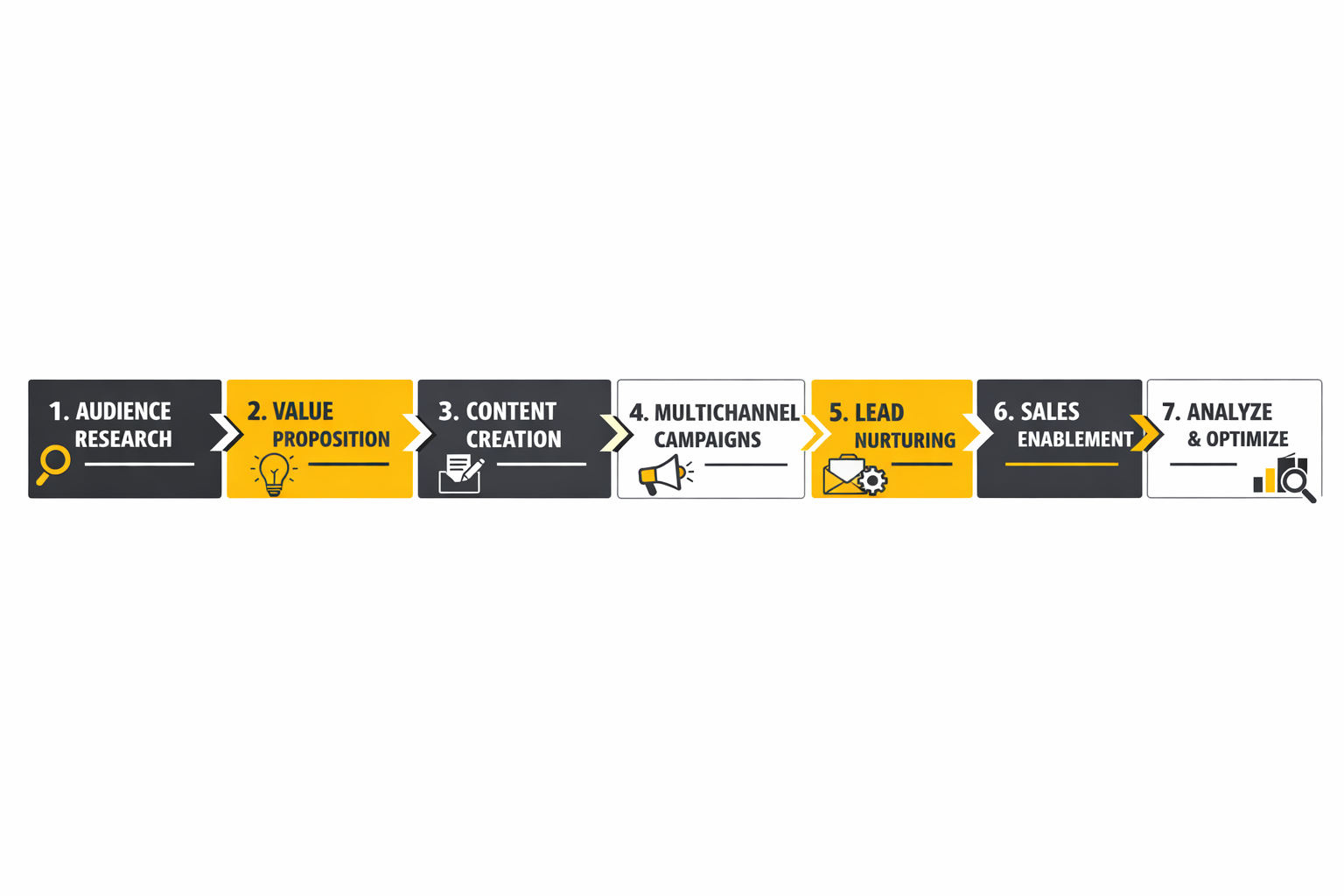
This is where execution becomes tangible. You are no longer talking about strategy. You are mapping exact steps from first visit to booked call or qualified lead.
For teams that need to build these flows quickly, platforms like ClickFunnels, Systeme.io, and Fillout can simplify landing page creation, funnel logic, and lead capture without heavy development work.
Step 4: Align Marketing and Sales Around the Same Journey
One of the biggest hidden problems in b2b marketing is misalignment between marketing and sales. Marketing generates interest, but sales receives leads that lack context, timing, or qualification. That disconnect kills momentum.
The reality is that B2B buying is not linear. Buyers move back and forth between research, evaluation, and internal discussion. That means marketing and sales need shared visibility into what is happening and clear rules for when and how to engage.
A functional alignment model usually includes:
- Defined stages from awareness to closed deal
- Agreed criteria for marketing-qualified and sales-qualified leads
- Shared data inside a CRM or tracking system
- Feedback loops where sales insights improve marketing targeting
Tools like Copper and Comp AI can support this operational layer, but the real value comes from shared ownership of pipeline, not just shared tools.
Step 5: Build Follow-Up Systems That Respect Buyer Timing
Most B2B deals are not lost because of bad positioning. They are lost because follow-up is weak, slow, or irrelevant. Buyers go quiet, priorities shift, and opportunities fade without structured re-engagement.
That is why lifecycle marketing matters. You need sequences that react to behavior, not just time. Someone who visited a pricing page needs a different follow-up than someone who downloaded an educational guide.
Data from Brevo’s 2025 benchmark shows that engagement is still strong when messaging is relevant, which reinforces the importance of segmentation and timing. The takeaway is simple: generic follow-up gets ignored, targeted follow-up gets responses.
Platforms like Brevo, Moosend, and ScaledMail help operationalize this layer, but the logic behind the sequences matters more than the software.
Step 6: Keep the System Running Weekly, Not Occasionally
This is where discipline separates serious B2B marketing from inconsistent activity. The system only works if it runs continuously. That means publishing, distributing, optimizing, following up, and refining every week.
Research across multiple B2B benchmarks shows that consistency is one of the strongest predictors of marketing effectiveness. It is not about producing more content. It is about maintaining a steady rhythm that keeps your brand visible and your pipeline active.
A simple weekly structure often includes:
- Content production and publishing
- Distribution across relevant channels
- Campaign monitoring and optimization
- Lead follow-up and nurturing
- Sales feedback integration
When this rhythm is in place, b2b marketing stops feeling chaotic. It becomes predictable, measurable, and scalable. And that is exactly what turns a collection of tactics into a real growth engine.
How to Measure, Optimize, and Scale B2B Marketing
This is the part where b2b marketing either becomes a revenue system or stays a reporting exercise. Plenty of teams can generate dashboards. Far fewer can explain what the numbers actually mean, which signals deserve action, and which metrics are just noise dressed up as progress.
The biggest trap is measuring activity instead of movement. More traffic, more impressions, and more opens can look healthy while pipeline quality is slipping underneath. That is why serious measurement starts with business outcomes first, then works backward into channel metrics, content signals, and operational diagnostics.
The Data That Actually Matters
You do not need fifty KPIs. You need a small set of metrics that reveal whether your market is finding you, trusting you, engaging with you, and moving toward revenue. The reason this matters so much in b2b marketing is simple: the buying journey is long, multi-touch, and often partially invisible until late in the process.
That complexity shows up clearly in current research. The 2024 European B2B Buyer Experience Report from 6sense found that the average European buying group includes 9 to 10 stakeholders, takes 10 months, and evaluates 4 vendors. McKinsey’s 2024 B2B Pulse research adds another layer by showing that most decision-makers use ten or more channels during the buying journey. That means a single-touch view of performance is not just incomplete. It is structurally misleading.
The right response is to measure b2b marketing in layers:
- Business outcomes like pipeline created, revenue influenced, win rate, deal velocity, and customer value
- Funnel progression like qualified inquiries, sales-accepted leads, meetings booked, opportunities opened, and stage conversion
- Channel performance like search conversions, paid efficiency, webinar attendance quality, and email-assisted progression
- Content signals like engaged sessions, return visits, time on high-intent pages, and assisted conversions
When those layers connect, the numbers start telling a story instead of creating confusion.
Start With Pipeline, Not Vanity Metrics
The cleanest way to judge b2b marketing is to ask one question: did it help create qualified pipeline? Everything else matters only if it supports that answer. A content program that doubles traffic but attracts the wrong audience is not winning. A paid campaign that looks expensive on a click basis but consistently generates late-stage meetings may be far more valuable.
This is exactly why attribution remains such a headache. The 2025 B2B Content Marketing benchmark from Content Marketing Institute found that 56% of B2B marketers struggle to attribute ROI to content and the same share struggle to track customer journeys. That does not mean content is not working. It means many teams are still measuring fragments instead of the full commercial path.
A better model is to track three levels of impact at once:
- Direct impact from channels that produce obvious conversions, like demo requests or booked calls
- Assisted impact from touchpoints that help move deals forward, like case studies, webinars, and nurture emails
- Market impact from metrics that indicate brand traction, like direct traffic growth, branded search lift, repeat visitors, and higher conversion rates over time
This matters because the most valuable parts of b2b marketing often do not appear as last-click wins. They appear as higher trust, faster sales cycles, better close rates, and stronger shortlist presence before sales even gets involved.
Read Benchmarks Carefully or They Will Mislead You
Benchmarks are useful, but only when you treat them as context rather than goals. A benchmark can tell you whether your numbers are wildly off. It cannot tell you whether your strategy fits your category, price point, audience, or sales cycle.
Take email. The Brevo 2025 benchmark reports average EMEA open rates of 33.21% and click-through rates of 4.05%, with business and financial services emails reaching a 39.48% open rate. Those numbers are helpful because they show healthy engagement is still possible. They are dangerous when teams start optimizing for open rates alone instead of asking whether email is helping create meetings, revive stalled deals, or move accounts deeper into evaluation.
The same logic applies to webinars. ON24’s 2025 webinar benchmark summary shows an average registration-to-attendee conversion rate of 57%, average engagement duration of 51 minutes, and 48% higher CTA conversion rates when experiences are personalized. Those figures matter because they reveal what strong engagement can look like. They do not mean every webinar with a 57% attendee rate is successful. If the wrong people attended, or if no commercial next step followed, the benchmark does not save the program.
What benchmarks should drive is action. If your email click-through is weak, improve segmentation and message relevance. If webinar attendance is decent but conversion is poor, fix the offer and the post-event journey. If paid search converts well but opportunity quality is low, tighten targeting and landing-page alignment.
Build an Analytics System That Reflects the Real Buyer Journey
A proper measurement setup should mirror how buyers actually move, not how your dashboard tool prefers to categorize them. In b2b marketing, that means recognizing that a buyer may discover your brand through social, return via search, consume a case study, attend a webinar, ignore three follow-ups, then book a call after a direct visit weeks later.
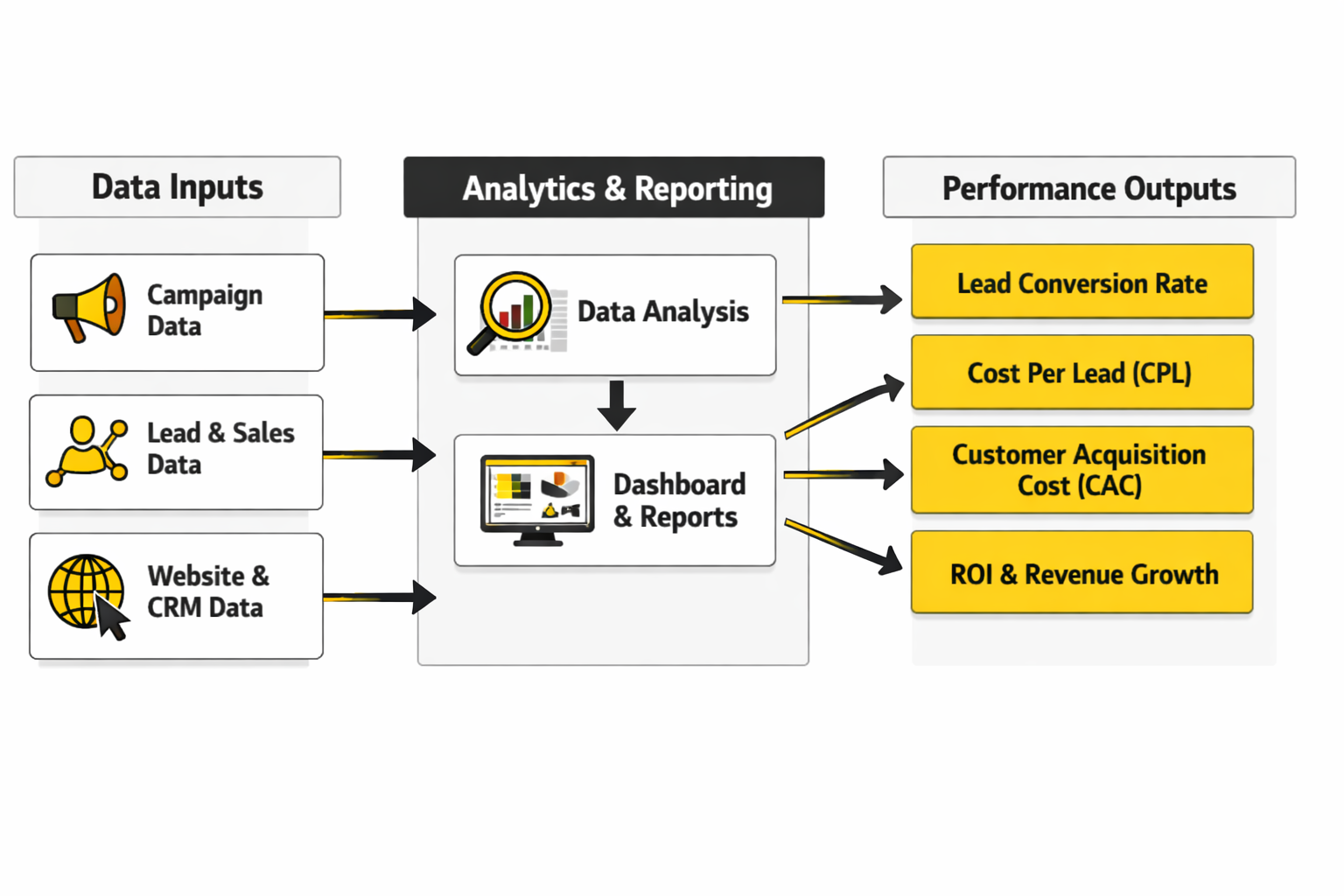
This is why disconnected reporting creates bad decisions. If paid media is measured separately from content, content separately from CRM, and CRM separately from revenue, nobody can see the whole picture. You end up cutting channels that assist pipeline and overfunding channels that simply harvest demand created elsewhere.
A practical analytics system usually needs five connected parts:
- Website analytics to understand behavior on high-intent pages
- CRM and lifecycle tracking to follow lead and opportunity progression
- Campaign reporting to measure source efficiency and conversion quality
- Content reporting to see which assets influence movement, not just views
- Revenue reporting to connect closed business back to marketing influence
For teams tightening this infrastructure, Dub can help with cleaner link-level tracking, Fillout can improve conversion data quality at the form layer, and Copper can support cleaner relationship and pipeline visibility inside the CRM. The point is not the tool stack itself. The point is making the journey measurable end to end.
The Most Useful Performance Signals by Stage
Different stages need different signals. This sounds obvious, but many teams still judge awareness channels using bottom-funnel standards and judge conversion channels using traffic metrics. That distorts decision-making fast.
At the awareness stage, useful signals include branded search growth, direct traffic lift, video completion rates, repeat visitors, and growth in target-account engagement. These metrics matter because they tell you whether b2b marketing is increasing familiarity and trust before a buying window opens. That is especially important in a market where the 95-5 Rule highlighted by LinkedIn’s B2B Institute argues that most buyers are out of market at any given time.
At the consideration stage, stronger signals include high-intent page visits, case study consumption, comparison-page engagement, webinar attendance quality, and return sessions from the same company. This is where buyer seriousness starts becoming visible. You are looking for patterns that suggest internal evaluation is happening, not just casual interest.
At the conversion stage, the metrics need to get stricter. Watch form completion rate, meeting-booked rate, sales acceptance, opportunity creation, opportunity-to-win conversion, and average deal velocity. These are the numbers that reveal whether your message, offer, and handoff process are actually producing commercial movement.
What Top-Performing Numbers Usually Mean
A strong metric does not always mean what people think it means. High traffic can mean better visibility, but it can also mean broad, low-intent reach. High email opens can mean a strong subject line, but not necessarily commercial relevance. High CTR on paid campaigns can still hide poor pipeline fit.
That is why interpretation matters more than celebration. The 2025 CMI benchmark found that only 22% of B2B marketers rated their content marketing as extremely or very successful, and top performers were more likely to credit audience understanding, quality content, industry expertise, and aligned goals. That finding matters because it points away from tactical obsession and toward strategic coherence. Great numbers tend to come from strong alignment, not dashboard heroics.
The same pattern shows up in AI adoption. LinkedIn’s 2025 B2B benchmark on the AI advantage notes that nearly all B2B marketers are now using AI in some form, but deeper, more strategic use correlates with stronger results, including reported gains in revenue growth and cost savings. The lesson is not that AI magically fixes performance. It is that tools help when they strengthen relevance, speed, and decision quality inside an already disciplined system.
Turn Data Into Decisions, Not Reporting Theater
The whole point of measurement is to improve execution. That means every reporting cycle should end with decisions. What content deserves more investment, which channels are attracting the wrong accounts, where buyers are dropping out, and which follow-up sequences need to change.
A useful monthly review in b2b marketing should answer a short list of hard questions:
- Which sources produced qualified pipeline, not just leads?
- Which pages and assets assisted opportunity creation most often?
- Where did conversion rates weaken across the funnel?
- Which campaigns generated engagement from the right companies?
- What should be scaled, fixed, paused, or cut next month?
That discipline matters because data without action is just decoration. The companies that get real leverage from b2b marketing are not the ones with the prettiest dashboards. They are the ones that use measurement to sharpen positioning, improve buyer experience, reduce waste, and steadily compound what works.
The final step is to remember that not every meaningful gain shows up immediately. Some numbers move fast, like landing-page conversion rate or email response rate. Others move slowly, like branded search, shortlist inclusion, sales-cycle compression, and win rate. Strong b2b marketing respects both. It captures what is visible now while building the trust and market presence that pay off later.
Advanced Strategy: What Separates Good B2B Marketing From Expensive Noise
Once the basics are working, b2b marketing becomes less about adding more tactics and more about making sharper tradeoffs. This is where teams decide whether they are building a durable market position or just chasing short-term activity. The hard part is that many scaling decisions look smart in the moment and quietly weaken performance later.
That tension is normal. B2B teams are usually balancing long sales cycles, pressure for faster pipeline, limited headcount, and rising buyer expectations at the same time. Research from McKinsey’s 2024 B2B Pulse work shows that buyers now expect seamless movement across in-person, remote, and digital channels, which means weak coordination gets exposed much faster than it used to.
The First Strategic Tradeoff: Brand Building vs Demand Capture
This is the argument that keeps showing up in B2B boardrooms because both sides sound right. Demand capture feels measurable and urgent. Brand building feels slower, softer, and easier to cut when targets get tight.
The problem is that starving either side creates predictable damage. LinkedIn’s 95-5 rule research makes the case that only a small share of category buyers are actively in market at any one time, which means a pure lead-generation mindset ignores most future revenue. At the same time, a brand-heavy strategy without conversion infrastructure leaves too much existing demand uncaptured.
The strongest b2b marketing teams stop treating this as an either-or debate. They run both clocks at once. One clock captures active intent now, while the other builds familiarity, trust, and memory structures that make future demand easier and cheaper to convert.
The Second Tradeoff: Specialization vs Operational Simplicity
As programs grow, complexity creeps in. More personas, more segments, more campaigns, more landing pages, more workflows, more reporting views. Some of that complexity is necessary because enterprise buyers, mid-market buyers, and niche vertical buyers do not respond to the same message in the same way.
But complexity becomes dangerous when the team cannot maintain it. The 2025 B2B content marketing benchmark from Content Marketing Institute found that only 29% of marketers said their organizations had the right technology to manage content effectively, and just 26% said they had the right workflows for content creation, collaboration, and approval. Those numbers matter because they point to a common scaling trap: strategy expands faster than operations can support.
This is why simple systems often outperform ambitious ones. A clean messaging architecture, a focused campaign calendar, a smaller set of repeatable offers, and tighter reporting discipline usually beat sprawling execution that nobody can sustain. In practice, scale comes less from doing everything and more from doing the right few things consistently well.
AI Can Accelerate Execution, but It Also Raises the Quality Bar
AI is already part of modern b2b marketing whether teams admit it or not. The more useful question is not whether to use it, but where it genuinely improves speed, relevance, and output quality without flattening the brand into generic content.
That shift is moving quickly. LinkedIn’s 2025 B2B Marketing Benchmark found that 95% of B2B marketers use AI weekly or more, and the marketers outpacing their peers are the ones embedding it into more strategic work rather than treating it as a novelty. The implication is important: AI is no longer the differentiator by itself. The differentiator is how intelligently the team uses it.
The risk is obvious too. AI can produce fast drafts, faster research support, and faster repurposing, but it can also flood the market with sameness. That makes positioning, editorial judgment, and original insight even more valuable. If your b2b marketing starts sounding like everyone else using the same prompts, scale becomes a liability instead of an advantage.
For practical execution, tools like Wispr Flow, Firecrawl, and Chatbase can fit naturally into research, content operations, and buyer support workflows. The real win, though, comes from using them to strengthen your existing system, not to replace thinking.
The Biggest Risk at Scale Is Message Drift
As more campaigns launch and more people touch the funnel, message drift becomes one of the biggest hidden problems in b2b marketing. The homepage says one thing, sales decks say another, paid ads emphasize a third angle, and nurture emails drift into generic promises that no longer match the product or the audience. Performance suffers, but the cause is easy to miss because each asset looks fine on its own.
This gets worse when different teams optimize locally. Paid media chases CTR, content chases traffic, sales chases meetings, and customer marketing chases expansion, all without a shared narrative holding the system together. Buyers feel that inconsistency faster than internal teams do, especially in complex purchases where multiple stakeholders are comparing notes.
The fix is brutally simple, but not always easy. Keep a central messaging framework, refresh it regularly, pressure-test it against real sales calls, and force every major asset to stay aligned with it. Strong b2b marketing does not just create more content as it scales. It protects coherence as the system grows.
Scaling Channels Too Early Can Destroy Efficiency
Another classic mistake is expanding channel count before channel depth is proven. Teams launch podcasts, webinars, ABM ads, partner campaigns, social series, email newsletters, and outbound plays all at once because each idea sounds individually reasonable. Then performance fragments, attribution gets messy, and nobody knows what is actually working.
This is where restraint matters. McKinsey’s 2024 findings on omnichannel B2B behavior support an omnichannel model, but omnichannel does not mean random channel expansion. It means buyers should experience consistency across the channels that matter most to them. That is a very different standard.
A better scaling rule is this: prove one channel cluster before adding another. For example, get search, core content, and lifecycle follow-up working together first. Then layer in webinars, paid social, or ABM once the team can support them operationally. Depth creates leverage. Premature breadth usually creates waste.
The Best Growth Often Comes From Sharper Focus, Not Bigger Reach
There is a point where more impressions stop being the answer. In B2B, especially with higher-value offers, growth often comes from better fit rather than broader reach. Better fit means tighter ICP definition, stronger sales-marketing alignment, clearer offer design, and more relevant proof for the specific buyers you want most.
That is one reason account-based approaches keep gaining traction. Broad adoption figures vary by source and methodology, but current industry reporting continues to show that ABM is moving closer to mainstream B2B practice, especially where deal sizes and buying complexity justify more tailored execution. The strategic lesson is not that every company needs a heavy ABM motion. It is that focus tends to outperform vague scale in markets where trust and relevance decide the shortlist.
This also changes how you think about tooling. You do not need a bloated martech stack to scale intelligently. You need the few systems that strengthen fit, visibility, and handoff quality. Depending on the setup, that might mean using Copper for relationship visibility, Cal.com for frictionless meeting conversion, Brevo or Moosend for lifecycle automation, and Buffer for controlled distribution rather than trying to buy your way out of weak strategy.
What Expert Teams Keep Doing Differently
At a high level, expert B2B teams usually look boring from the outside. They are not reinventing the model every month. They are refining positioning, protecting message consistency, improving conversion paths, tightening follow-up logic, and reallocating budget based on real buyer response.
That discipline matters more than hype. The 2025 CMI benchmark found that top performers were more likely to say their success came from understanding their audience, creating quality content, and aligning content with the customer journey. None of that is flashy. All of it compounds.
The final expert-level shift is psychological. Good teams ask, “What campaign should we run next?” Great teams ask, “What part of the system is limiting growth now?” That question changes everything because it moves b2b marketing from campaign thinking to constraint thinking. And once you see it that way, scaling gets a lot more rational.
The practical takeaway from everything above is that b2b marketing works best as an ecosystem, not a pile of disconnected tactics. Positioning shapes content, content supports search and social visibility, lifecycle systems turn interest into momentum, and measurement tells you where the system is creating real commercial movement. When those parts reinforce each other, marketing becomes easier to scale because each asset, campaign, and workflow does more than one job. McKinsey’s B2B growth research, 6sense’s 2025 buyer experience report, and the LinkedIn B2B Institute’s work on how B2B brands grow all point in the same direction: buyers move across many touchpoints, evaluate several vendors, and often form strong preferences before direct sales contact happens.
That is also why discipline matters so much. A company can publish content, run ads, send emails, host webinars, and still get mediocre results if the message is weak, the handoff is sloppy, or the system is measured in fragments instead of as one buyer journey. Strong b2b marketing feels simpler on the outside precisely because the internal operating model is more coherent. Content Marketing Institute’s 2025 benchmark, Gartner’s 2026 sales survey release, and LinkedIn’s 2025 B2B benchmark on the AI advantage all reinforce that buyers expect relevance, self-service, and smarter execution rather than more noise.
FAQ
What is b2b marketing in simple terms?
B2B marketing is the process of helping one business sell to another business. That includes creating awareness, building trust, generating qualified interest, and supporting revenue across a longer and more complex buying cycle than most consumer purchases. It matters because B2B buying groups are often large, self-directed, and multi-channel, which changes how companies need to earn attention and confidence. Salesforce’s B2B marketing guide, HubSpot’s B2B marketing overview, and 6sense’s 2025 buyer report support that broader definition.
How is b2b marketing different from B2C marketing?
The biggest difference is not just audience type. It is buying complexity. B2B purchases usually involve more stakeholders, more risk, more internal scrutiny, and longer timelines, which means the marketing has to educate and reassure rather than simply persuade fast. 6sense’s 2024 European buyer report shows long buying cycles and multi-person committees, while McKinsey’s B2B growth research highlights the importance of consistent omnichannel experiences in business buying.
Why does brand matter so much in b2b marketing?
Because most of your future buyers are not ready to purchase today. If your company is invisible when they are researching casually, learning the category, or building mental shortlists, you make future conversion harder and more expensive. The LinkedIn B2B Institute’s 95-5 Rule and its broader How B2B Brands Grow research argue that future demand is shaped long before formal buying intent becomes visible.
Is content marketing still worth it for B2B companies?
Yes, but only when it is tied to audience needs and commercial intent. Content still builds trust, answers buying questions, improves search visibility, and supports sales conversations, but random publishing is not enough. The 2025 B2B Content Marketing benchmark shows continued investment in video, thought leadership, paid distribution, webinars, and AI-assisted optimization, which suggests serious teams still see content as a core growth lever rather than a side activity.
Which channels usually work best in b2b marketing?
There is no universal winner because channel fit depends on deal size, sales cycle, audience behavior, and team capacity. That said, search, educational content, lifecycle email, webinars, and targeted paid media keep showing up because they map well to how buyers research and evaluate options. McKinsey’s B2B research, CMI’s 2025 benchmark, and ON24’s 2025 webinar benchmark coverage all support a mixed-channel model rather than a single-channel mindset.
How long does b2b marketing usually take to show results?
Some signals move quickly, but the full system usually takes time. You can improve conversion rates, follow-up quality, and landing-page performance in weeks, while brand lift, search visibility, shortlist inclusion, and revenue compounding tend to take longer. That timeline matches what 6sense’s 2024 European report shows about average buying duration and what the LinkedIn B2B Institute suggests about the large share of future buyers who are out of market right now.
What metrics matter most in b2b marketing?
The most useful metrics are the ones closest to business outcomes. Pipeline created, opportunity quality, stage conversion, win rate, and deal velocity usually matter more than traffic alone, because they show whether marketing is actually helping revenue move. That focus is especially important given that CMI’s 2025 benchmark found many teams still struggle with content ROI attribution and customer journey tracking.
Should small B2B companies use ABM?
Sometimes yes, but not because ABM sounds sophisticated. If your market is narrow, your contract value is meaningful, and the number of ideal accounts is limited, some account-based focus can make a lot of sense. The better question is whether tailored targeting and sales-marketing coordination will create more value than broad lead volume, which aligns with how the LinkedIn B2B Institute frames focus and brand growth and how 6sense’s buyer research shows buyers forming preferences early in the journey.
Does email still work in b2b marketing?
Yes, when it is relevant. Email remains valuable because B2B decisions rarely happen after one visit, which means nurture, reminders, proof, reactivation, and deal support still matter. The Brevo 2025 benchmark shows healthy engagement benchmarks across regions and industries, but the real lesson is that segmentation and timing drive results more than sending frequency.
How should B2B teams use AI without damaging quality?
Use AI to accelerate research support, repurposing, workflow speed, and operational consistency, but do not outsource judgment, positioning, or originality to it. The teams pulling ahead are generally the ones connecting AI to real business outcomes rather than using it to publish more generic content faster. That pattern is central to LinkedIn’s 2025 B2B benchmark on the AI advantage, which argues that maturity in how AI is applied matters more than simple adoption.
Why do so many b2b marketing programs underperform even when they are busy?
Because activity is easy to mistake for progress. Teams publish, post, email, advertise, and report, yet the system still underperforms if the positioning is muddy, the message drifts across channels, or sales and marketing are not aligned around the same journey. The 2025 CMI benchmark, McKinsey’s B2B growth research, and Gartner’s 2026 buyer preference release all point toward the same conclusion: relevance, coordination, and buyer-friendly execution matter more than raw output.
What is the smartest way to start improving b2b marketing right now?
Start by finding the biggest constraint in the system instead of adding more tactics. In one company that will be weak positioning. In another it will be poor conversion paths, weak follow-up, thin content depth, or bad reporting logic. The best next move is usually the one that removes friction from the buyer journey and improves commercial clarity, which fits the broader lessons from McKinsey, 6sense, and the LinkedIn B2B Institute.
Work With Professionals
Explore 10K+ Remote Marketing Contracts on MarkeWork.com
Most marketers spend too much time chasing clients, competing on crowded platforms, and losing a percentage of every project to middlemen.
MarkeWork gives you a better way. Browse thousands of remote marketing contracts and connect directly with companies desperate to hire skilled marketers like you, without platform commissions and without unnecessary gatekeepers.
If you're serious about finding better opportunities and keeping 100% of what you earn, explore available contracts and create a profile for free at MarkeWork.com.
The practical takeaway from everything above is that b2b marketing works best as an ecosystem, not a pile of disconnected tactics. Positioning shapes content, content supports search and social visibility, lifecycle systems turn interest into momentum, and measurement tells you where the system is creating real commercial movement. When those parts reinforce each other, marketing becomes easier to scale because each asset, campaign, and workflow does more than one job. McKinsey’s B2B growth research, 6sense’s 2025 buyer experience report, and the LinkedIn B2B Institute’s work on how B2B brands grow all point in the same direction: buyers move across many touchpoints, evaluate several vendors, and often form strong preferences before direct sales contact happens.
That is also why discipline matters so much. A company can publish content, run ads, send emails, host webinars, and still get mediocre results if the message is weak, the handoff is sloppy, or the system is measured in fragments instead of as one buyer journey. Strong b2b marketing feels simpler on the outside precisely because the internal operating model is more coherent. Content Marketing Institute’s 2025 benchmark, Gartner’s 2026 sales survey release, and LinkedIn’s 2025 B2B benchmark on the AI advantage all reinforce that buyers expect relevance, self-service, and smarter execution rather than more noise.
Work With Professionals
Explore 10K+ Remote Marketing Contracts on MarkeWork.com
Most marketers spend too much time chasing clients, competing on crowded platforms, and losing a percentage of every project to middlemen.
MarkeWork gives you a better way. Browse thousands of remote marketing contracts and connect directly with companies desperate to hire skilled marketers like you, without platform commissions and without unnecessary gatekeepers.
If you're serious about finding better opportunities and keeping 100% of what you earn, explore available contracts and create a profile for free at MarkeWork.com.