

Most lists about the best affiliate programs make the same mistake: they sort offers by the biggest commission and call it a day. That is how people end up promoting products that look amazing on paper but fall apart when a real audience sees them. The better approach is to judge programs by audience fit, product quality, retention, tracking, payout reliability, and how easy the offer is to recommend without sounding forced.
That matters more now than it did even a year ago. In the 2025 creator economy ad spend report, IAB showed creator ad spend more than doubled from 2021 to 2024 and projected it to reach $37 billion in 2025. At the same time, impact.com’s 2025 affiliate benchmark found clicks rose 2% year over year while transactions fell 5% and conversion rates dropped 6%, which is a blunt reminder that more traffic does not rescue a weak offer.
The compliance side is not optional either. The FTC’s guidance on endorsements, influencers, and reviews makes it clear that affiliate relationships need proper disclosure, so the safest long-term move is promoting products you would still recommend if there were no commission attached. That is why this guide will focus on programs with real utility, real business demand, and enough trust behind them to support steady revenue instead of short bursts of clicks.
If your audience lives in marketing, automation, creator tools, funnels, or agency operations, the early shortlist usually includes products like Manychat, HighLevel, Replo, ClickFunnels, Systeme.io, Brevo, Buffer, Fillout, Dub, and Cal.com. Not because they all pay the same way, and not because every audience should promote them. They deserve attention because they sit in categories where recurring revenue, operational stickiness, and strong use cases can make an affiliate recommendation far more durable.

The Six-Part Roadmap
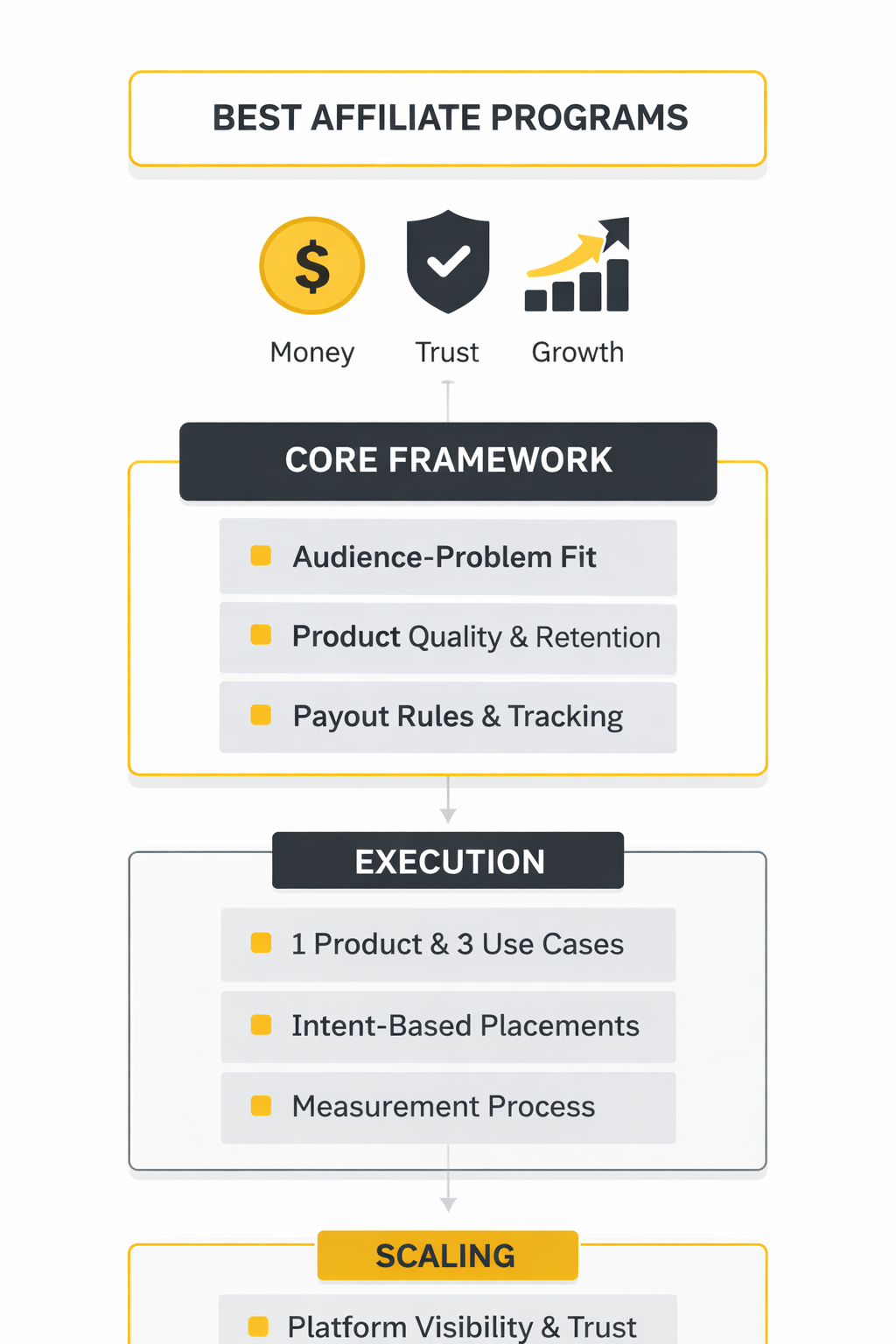
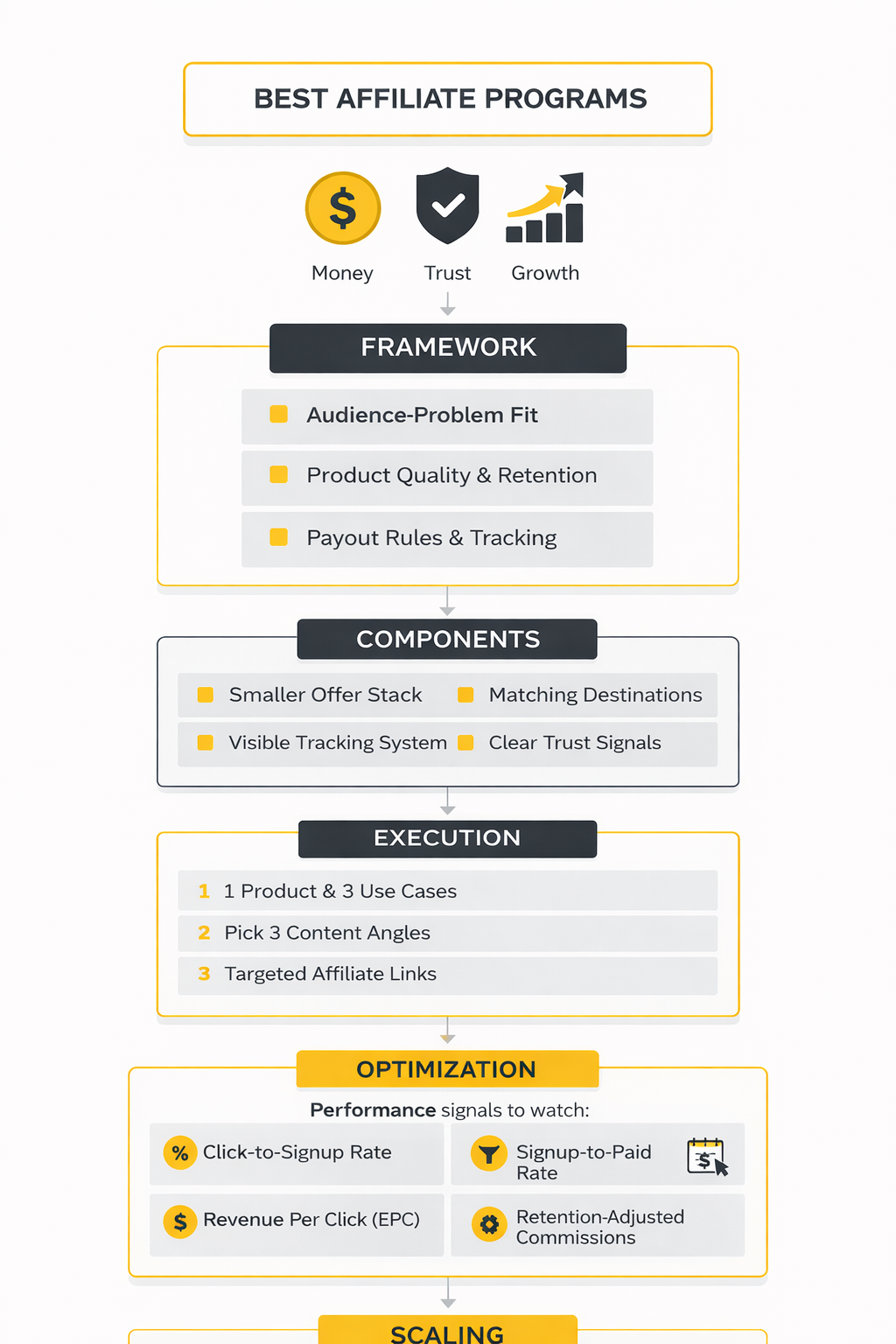
This article is built to help you make better picks, not just collect more links. We are going to move from strategy to selection to execution so the final recommendations actually fit your audience and traffic model. The section names below are the exact structure the rest of the article will follow.
- Why the Right Affiliate Program Matters More Than a Big Commission
- The Framework for Evaluating the Best Affiliate Programs
- Best Affiliate Programs for SaaS, Ecommerce, Creators, and Agencies
- The Core Components to Compare Before You Join Any Program
- Professional Implementation That Builds Trust and Revenue
- Common Mistakes, Smarter Picks, and FAQ
How I’m Defining the Best Affiliate Programs
A flashy payout is nice, but it is not the main event. A lower commission on a product with stronger retention, better onboarding, clearer positioning, and more stable tracking can beat a bigger headline rate that never turns into repeat revenue. That is the lens this guide will use all the way through: fit, conversion potential, customer lifetime value, payout structure, brand trust, and how naturally the offer belongs inside your content.
Some of the strongest opportunities now sit inside software and creator tools because the products are easier to demonstrate and the value proposition is easier to prove. Programs connected to tools like HighLevel, Manychat, Replo, Chatbase, Firecrawl, and Wispr Flow tend to work best when you can show the workflow instead of just describing the brand. That difference is huge, and the rest of this article will keep coming back to it.
Why the Right Affiliate Program Matters More Than a Big Commission
The reason this section comes before any list of recommendations is simple: the best affiliate programs are not the ones with the loudest payout claims, but the ones that can survive a more demanding buyer journey. In impact.com’s 2025 benchmark, clicks rose 2% year over year while transactions fell 5% and conversion rates dropped 6%, which means weak offers get exposed faster than they used to. When buyers compare harder, the quality of the program behind your link matters just as much as the quality of the content that sent the click. impact.com
That shift is happening inside a much bigger wave of creator-led commerce. IAB’s 2025 creator economy report projected U.S. creator ad spend at $37 billion in 2025 after more than doubling from 2021 to 2024, which tells you brands are putting serious money behind creator recommendations. More money in the channel does not automatically make every offer worth promoting, though. It makes bad program selection more expensive, because more creators are competing for the same attention and trust. IAB+1
There is also the compliance reality. The FTC’s endorsement guidance and the current eCFR version of 16 CFR Part 255 make the core rule clear: if there is a material connection, it needs to be disclosed clearly enough that people can actually notice it. That pushes serious affiliates in one direction only: promote products you can explain honestly, defend publicly, and recommend without hiding behind hype. Federal Trade Commission+1
Audience Fit Beats Headline Commission
A 50% commission sounds exciting until you realize the product is wrong for your readers. If your audience is made up of Shopify operators, a tool like Replo is naturally easier to sell than a random high-ticket course because the use case is visible, specific, and tied to revenue. If your audience is agencies, HighLevel makes more sense than a general consumer app because its positioning, onboarding, and business model line up with what those buyers already need. Replo+1
That is why audience fit is the first filter, not a nice bonus. When a product already belongs in the reader’s workflow, your content can stay useful instead of turning into a forced pitch. The best affiliate programs win because the recommendation feels like a shortcut, not an interruption.
Recurring Revenue Changes the Math
This is where a lot of beginners misread the game. A one-time payout can look bigger in a spreadsheet, but recurring or multi-month commissions often create a better business because they reward you for finding customers who stick. That is one reason tools like Manychat, HighLevel, Replo, Buffer, and Dub deserve a close look: their official program materials highlight recurring or time-based revenue sharing instead of a one-off bounty model. GoHighLevel+5
The details matter, of course. Manychat says partners can earn 30% to 50% recurring monthly commissions for the first 12 months, HighLevel promotes 40% recurring commissions, Replo says affiliates can earn up to 50% of subscription revenue for the first 12 months, Buffer offers 25% commission on new customers for 12 months, and Dub launched with 30% for up to 12 months. Those are different structures, but they all reward the same thing: sending buyers who continue to use the product after the excitement of the signup is gone. help.manychat.com+4
Tracking and Payout Clarity Matter More Than Most People Think
A good affiliate program should not make you guess what happened after the click. Manychat says conversions are tracked through PartnerStack and commissions are paid the month after they are earned, HighLevel promotes real-time dashboard tracking, and Buffer says its partner program runs through Dub with real-time reporting and monthly commission payments. That kind of visibility is not a luxury feature. It is the difference between building a repeatable revenue channel and throwing links into the dark. affiliate.manychat.com+2
This is also where decent programs separate themselves from sloppy ones. PartnerStack’s own dashboard overview emphasizes referral links, recent activity, commission visibility, and program stats, while Dub positions itself around conversion analytics, affiliate tracking, and payout infrastructure. If a program cannot show you clearly how attribution works, when commissions lock, and how you get paid, it is already harder to trust. support.partnerstack.com+2
The Framework for Evaluating the Best Affiliate Programs
Now we can build the actual filter. The point of this framework is not to make the process feel complicated. It is to stop you from picking offers based on the one number that looks exciting and ignoring everything else that affects long-term earnings.
You do not need a giant media brand to use this framework well. You need a clear audience, a realistic sense of how you create content, and the discipline to say no to programs that look profitable but do not fit your readers. That is how you end up with fewer links, better conversions, and less reputational drag.
1. Start With Audience-Problem Fit
The first question is not “What pays the most?” It is “What problem does my audience already know they have?” A creator teaching Instagram automation has a natural bridge into Manychat, a funnel consultant has a natural bridge into ClickFunnels or HighLevel, and an ecommerce operator talking about landing page performance has a natural bridge into Replo. manychat.com+3
This sounds obvious, but it is where most affiliate content fails. People promote software their audience does not use, price points their audience cannot justify, or workflows their readers do not recognize. The best affiliate programs are usually the ones your audience can picture themselves using within minutes of hearing the pitch.
2. Check Product Quality and Staying Power
A strong commission on a weak product is still a weak business. HighLevel positions itself as an all-in-one operating system for agencies and small businesses, Manychat is built around automation for Instagram, WhatsApp, TikTok, and Messenger, and Brevo spans email, SMS, CRM, chat, and automation. These are not tiny feature products trying to survive on hype alone. They are broad-use tools attached to ongoing business processes, which is exactly what you want when your revenue depends on customer retention. GoHighLevel+2
That does not mean every broad platform is a fit for every audience. It means product depth should be part of your evaluation because durable tools are easier to teach, easier to review, and easier to revisit in future content. When the product keeps solving real problems, your old content can keep earning.
3. Look at Payout Model, Not Just Payout Size
The payout model tells you what kind of customer behavior the company values. ClickFunnels promotes up to 40% recurring commissions, HighLevel promotes 40% recurring commissions, and Replo emphasizes first-year subscription revenue sharing. Those structures encourage affiliates to educate the buyer properly because a customer who churns fast is worth less than one who stays. affiliates.clickfunnels.com+3
You should also think about your own cash flow. A one-time bounty may be useful when you need faster returns, while recurring programs become more attractive when you are building a content library that compounds over time. Neither model is automatically better, but the best affiliate programs make the trade-off obvious instead of burying it in fine print.
4. Inspect Attribution, Tracking, and Operational Friction
This is the part that sounds boring until it costs you money. If the tracking is unreliable, the dashboard is vague, or the payout process is awkward, your actual earnings will be worse than the program’s sales page suggests. That is why it is worth paying attention to programs that publicly talk about real-time tracking, embedded dashboards, monthly payout systems, and third-party infrastructure like PartnerStack or Dub. affiliate.manychat.com+3
Operational friction also affects how hard the program is to work with over time. If it takes forever to get approved, there are no usable assets, and support is unclear, the problem is not just inconvenience. It is a signal that the partner experience may be an afterthought.
5. Judge How Naturally the Offer Fits Your Content Engine
Some programs are easy to mention once and hard to build a content strategy around. Others naturally support tutorials, comparisons, setup guides, templates, audits, and case-based education. Fillout, Cal.com, Chatbase, Firecrawl, and Buffer all sit in categories where workflows are visible enough to demonstrate inside content instead of being sold through vague promises. Buffer+2
That matters because useful affiliate content tends to outperform generic promotion over time. A recommendation becomes stronger when the reader can see where the tool fits, what problem it solves, and what kind of person should not buy it. Once you evaluate a program this way, the next step is much easier: sorting the best affiliate programs by audience type and business model rather than dumping them into one messy list.
Best Affiliate Programs for SaaS, Ecommerce, Creators, and Agencies
The best affiliate programs start looking very different once you sort them by the buyer in front of you. A Shopify operator comparing landing page tools does not need the same recommendation as a creator trying to automate Instagram DMs, and neither of them thinks like an agency owner building a client delivery stack. Once you organize programs by use case instead of headline commission, the shortlist gets a lot sharper.
Best Affiliate Programs for SaaS Audiences
For SaaS-heavy audiences, a short list worth serious attention includes HighLevel, Fillout, Cal.com, and Firecrawl. HighLevel’s official affiliate pages promote 40% recurring commissions with monthly payouts and real-time tracking, Fillout offers 30% recurring commission for up to one year, Cal.com offers 20% recurring commissions for twelve months while giving referrals 20% off for the same period, and Firecrawl offers 25% of subscription payments for the first twelve months and 15% ongoing after that. Those are different payout structures, but they all reward something important: sending users into software that stays in the workflow instead of getting abandoned after the trial. GoHighLevel+3
This category works especially well when your content can show the product instead of just describing it. HighLevel is positioned as an all-in-one platform for marketers, agencies, entrepreneurs, and small businesses, Cal.com describes itself as customizable scheduling infrastructure, and Firecrawl positions its product as a web data API built for AI agents. That means the recommendation can live inside tutorials, comparisons, implementation videos, and teardown posts instead of relying on vague “best tool” claims. GoHighLevel+2
Best Affiliate Programs for Ecommerce Operators and Sellers
If your readers live in ecommerce, Replo, ClickFunnels, and Systeme.io are far more practical picks than a random high-ticket offer with no operational fit. Replo says affiliates can earn up to 50% of subscription revenue for the first twelve months, ClickFunnels says approved affiliates can reach 30% to 40% monthly recurring commissions, and Systeme.io promotes 60% lifetime recurring commissions on paid referrals. Those numbers are attractive, but the bigger reason they belong in this category is that each one maps to a real selling workflow instead of a theoretical one. docs.replo.app+2
The difference between them is what makes the recommendation useful. Replo is built around Shopify landing pages and fast page creation for campaigns, which makes it a natural fit for merchants who care about launch speed, design control, and conversion testing. ClickFunnels is built around sales funnels and store funnels, while Systeme.io leans into funnels, email, automation, courses, affiliate management, and even physical products, so both make more sense when the reader needs a broader sales system rather than a Shopify page builder alone. Replo+5
Best Affiliate Programs for Creators and Audience Builders
For creators, the cleanest wins usually come from products that can appear inside the content itself. That is why Manychat, Buffer, Flick, and Brevo are easier to recommend honestly than generic business-opportunity offers. Manychat offers 30% to 50% recurring monthly commissions for the first twelve months, Buffer offers 25% commission for twelve months, Flick promotes 20% recurring commissions, and Brevo’s affiliate program offers $5 per free account and $100 per paid account with a 90-day cookie. help.manychat.com+3
These programs also line up with how creators actually publish and monetize. Manychat’s partner materials are aimed at creators, educators, influencers, agencies, and marketers, Buffer explicitly says its partner program is for creators, agencies, and communities, Flick frames itself around social media marketing, and Brevo positions its offer around email, SMS, WhatsApp, CRM, and automation. When the product already belongs in the creator’s workflow, the content does not have to pretend the tool matters. help.manychat.com+3
Best Affiliate Programs for Agencies and Consultants
Agency readers usually need two things at once: a tool they can implement for clients and a commission model that still pays after the setup project ends. That is why HighLevel, Chatbase, Copper, Moosend, and the Brevo expert path deserve more attention than one-off consumer programs. HighLevel promotes 40% recurring commissions, Chatbase’s Experts Program offers 30% revenue share for referred clients, Copper’s referral partner program offers 15% commission on monthly and annual subscriptions, Moosend says agencies can earn up to 30% recurring commission and affiliates can earn up to 40% recurring, and Brevo says expert partners can start with 10% monthly or yearly revenue share for 24 months. GoHighLevel+5
The practical advantage here is bigger than the payout. HighLevel is explicitly built for agencies, entrepreneurs, and small businesses, Chatbase positions its expert program around agencies and consultants building AI automation for clients, Copper’s partner page is aimed at consultants advising small businesses on CRM, and Moosend’s agency program is framed around helping clients grow while creating recurring income for the partner. In other words, these are not just products you mention in content. They are products you can bake into retainers, audits, onboarding packages, and recurring service delivery. GoHighLevel+3
How to Turn One Good Program Into a Repeatable Process
This is where the whole thing becomes tangible. Most people join too many programs, paste links into random articles, and then mistake activity for strategy. The better move is to pick one buyer, one painful workflow, and one offer that solves it clearly enough that your content can keep reinforcing the same decision.
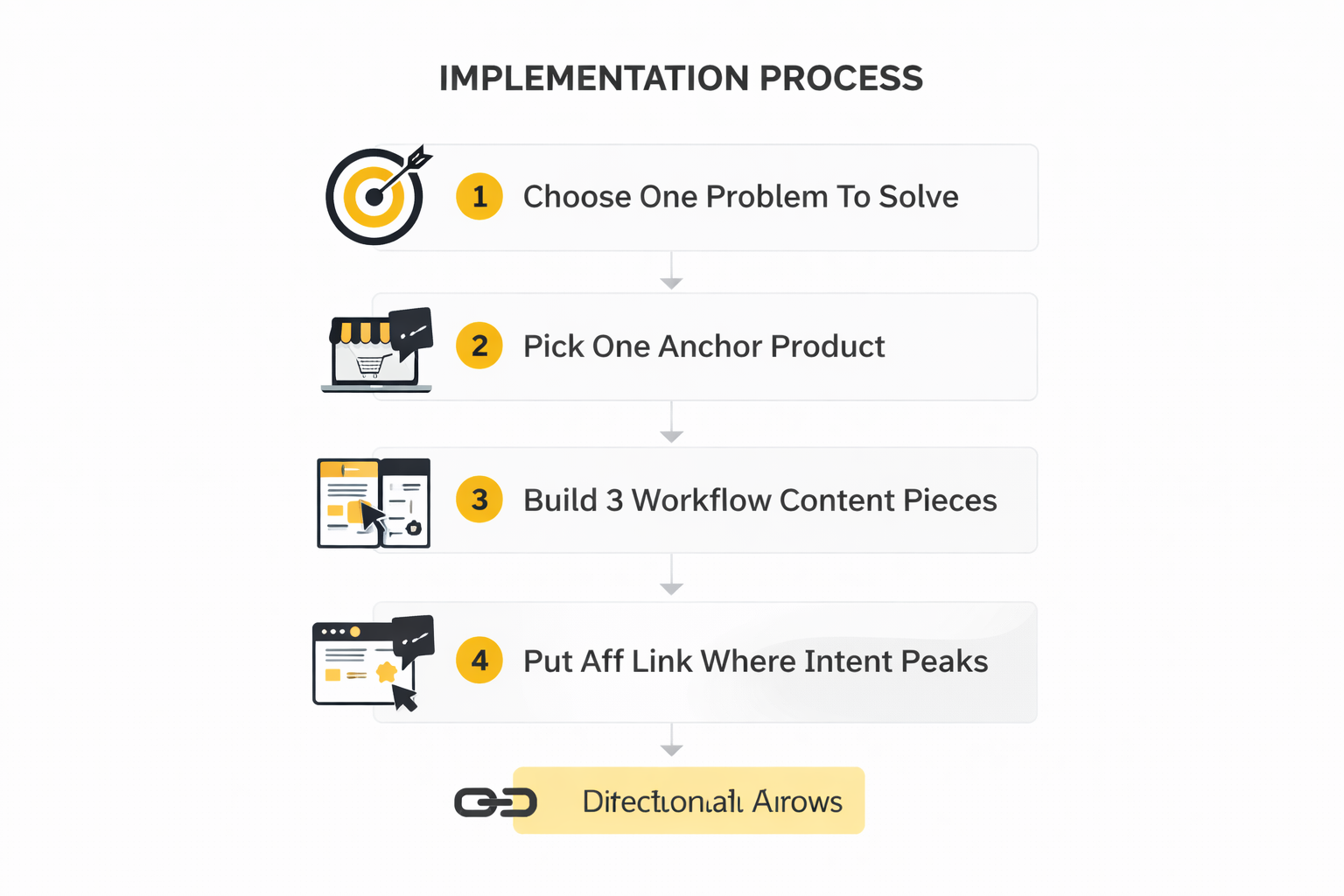
- Choose one commercial problem your audience already wants fixed. For creators, that might be DM automation with Manychat or social publishing with Buffer. For agencies, it might be consolidating client operations with HighLevel or productizing AI support and lead capture with Chatbase. help.manychat.com+3
- Pick one anchor product instead of three competing ones. If your audience is mostly Shopify brands, Replo is strong because the landing-page use case is obvious and close to revenue. If your audience is made up of operators selling courses, services, webinars, or hybrid offers, Systeme.io or ClickFunnels gives you a broader funnel story to build around. Replo+3
- Build three pieces of content around the same problem before you chase a second program. A tutorial shows setup, a comparison shows why one option wins, and a resource page gives the reader a fast way to act. This is exactly why workflow-first tools like Fillout, Cal.com, Firecrawl, and Brevo are easier to monetize cleanly than offers that depend on pure hype. Fillout | Forms that do it all+3
- Put the link where intent spikes, not where your ego wants it. The highest-converting placement is usually right after the reader understands the pain, sees the workflow, and decides they want the shortcut. That sounds simple, but it is the difference between a useful recommendation and a link stuffed into dead air.
- Keep the stack tight enough that every piece of content strengthens the next one. One strong tutorial can become a newsletter segment, a short-form video, a comparison article, and a tools page. That is when affiliate content stops feeling like isolated promotion and starts behaving like a system.
The next step is to go under the hood of these programs and compare the details most lists skip. That is where cookie windows, payout timing, attribution rules, partner support, and onboarding friction start separating a decent program from one that is genuinely worth building around.
The Numbers That Actually Matter
Once you start comparing affiliate programs seriously, the first thing to stop worshipping is raw click volume. The 2025 affiliate benchmark found clicks up 2% year over year while transactions fell 5% and conversion rates dropped 6%, and it also showed Q4 accounting for 33% of annual clicks versus 29% the year before. That is the clearest possible signal that more traffic does not automatically mean a better affiliate program; it usually means you need better measurement. impact.com
The same benchmark showed shoppers buying less often but spending more per order, which is why average order value and revenue per click matter more than vanity traffic spikes. If a program sends a lot of visitors but very little qualified revenue, you do not have a scaling opportunity. You have a reporting illusion. impact.com
Start With Revenue Quality, Not Traffic Volume
A program should earn the right to stay in your stack by proving it can turn the right audience into paying customers, not just curious clickers. That is especially true now that more brands are planning to lean harder into content and review partners, with impact.com reporting a projected +11 percentage point net increase in collaboration with that partner type. The practical takeaway is simple: if your content drives trust early in the journey, do not judge it by last-click alone. impact.com+1
This is where a lot of affiliate marketers get sloppy. They compare a coupon-driven asset, a review article, a tutorial video, and a newsletter placement as if all four should convert the same way on the same timeline. They should not, and once you accept that, the best affiliate programs become easier to spot because you stop rewarding whatever happened to touch the sale last. impact.com+1
Fix Tracking Before You Judge the Offer
Bad tracking makes good programs look weak. Awin compared advertisers with poor tracking against advertisers using server-to-server and mobile app tracking and found the better-tracked group increased sales by 8.3%, improved conversion rate by 9.6%, posted higher ROI, raised earnings per click from 2.9 to 4.0, and lowered CPA from 8.0% to 7.3%. That is not a tiny optimization. That is the difference between scaling a channel confidently and making decisions off broken data. Awin
The reason this matters for affiliate selection is obvious once you see it. If a program has weak attribution, patchy cross-device visibility, or delayed reporting, you cannot tell whether the offer is failing or the measurement is failing. Programs that invest in cleaner tracking infrastructure are simply easier to run well. Awin+1
Build a Simple Analytics Stack
You do not need enterprise software to measure affiliate performance well, but you do need a consistent system. A practical setup is one clean tracking link per content asset, one dashboard that shows clicks, signups, and revenue, and one weekly review process that compares traffic quality against actual payout. That is why tools and programs that expose real reporting are easier to recommend and easier to optimize. Buffer+2
Good examples already exist in the programs discussed earlier. Buffer says partners can track signups in real time and explains that its links are tracked through a server-side event system, Fillout says affiliates can monitor new subscribers in its in-app dashboard, and Dub highlights real-time stats, earnings visibility, conversion analytics, and affiliate tracking in one place. That kind of visibility is not just convenient; it is one of the clearest signs that a program is built to be managed properly. Buffer+3
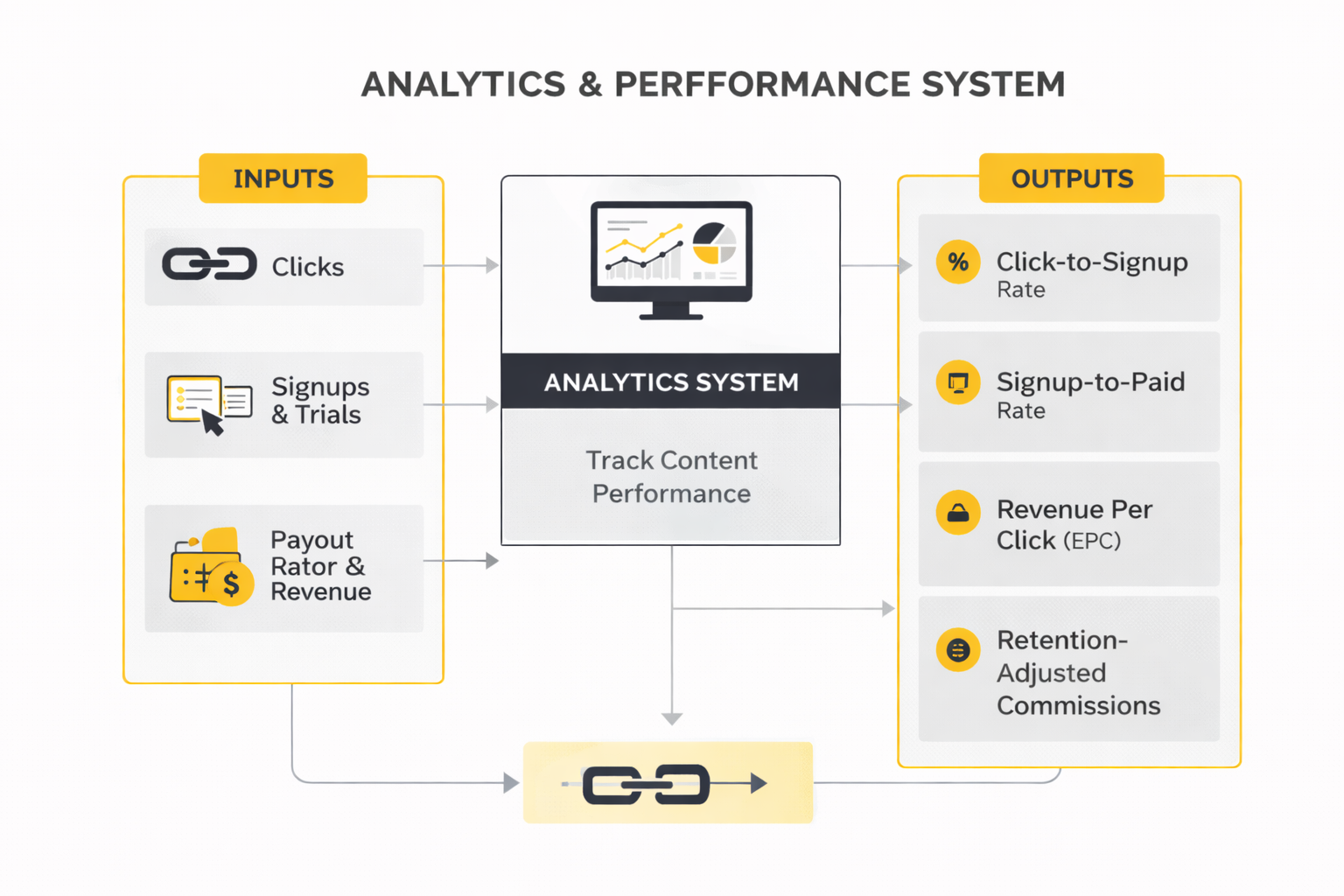
A simple analytics system should answer three questions every week:
- Which content asset generated the click?
- Which clicks turned into signups, trials, or purchases?
- Which of those conversions produced durable revenue instead of one-time noise?
If your dashboard cannot answer those three questions cleanly, do not rush to blame the offer. Fix the measurement first, then judge the program. Awin+1
The Performance Signals Worth Watching
Most affiliate marketers stare at one metric for too long. PartnerStack’s KPI guidance makes the broader point well: revenue is the end goal, but partner program health also depends on where you are in the funnel, whether partners are activating, and whether the program is actually creating repeatable value. In practice, that means you need a small set of signals that tell you what is broken and what deserves more attention. partnerstack.com
The four signals that matter most are these:
- Click-to-signup rate because it tells you whether the message and the audience match.
- Signup-to-paid rate because it tells you whether the product, onboarding, and pricing hold up after the click.
- Revenue per click or earnings per click because it tells you whether the traffic is commercially useful, not just active.
- Retention-adjusted commissions because recurring programs only look great when referred customers stick around long enough to matter.
That last point is why recurring SaaS programs often outperform flashier one-time offers. A tool like Cal.com, Fillout, or Dub can look modest on the first payout, but if the referred customer keeps paying, the economics improve fast. The right action is not to ask which program has the biggest commission headline, but which one gives you the healthiest relationship between conversion, retention, and payout clarity. cal.com+2
Benchmarks Help Only When You Interpret Them Correctly
Benchmarks are useful for direction, not for ego. The impact benchmark found loyalty partners remained execution anchors while influencers and technology partners gained importance, which means the channel is not moving in one straight line. Different partner types are doing different jobs, and your measurement model has to reflect that. impact.com
That is why last-click reporting is often too crude for serious affiliate work. impact.com’s recent analysis on fashion publishers makes the broader measurement point clearly: when you judge everything by the final click, you under-credit the partners creating demand earlier in the journey. The action this should drive is simple but important: compare partners against others with the same role, not against completely different traffic types. impact.com+1
What the Data Should Make You Do
Good affiliate analytics should push decisions, not just decorate a dashboard. If clicks are strong but signups are weak, the content probably attracts the wrong intent or the offer is being framed badly. If signups are healthy but paid conversions are weak, the issue is usually product-market fit, onboarding, pricing friction, or audience mismatch rather than your headline placement. impact.com+2
The cleanest response framework is straightforward. Scale offers where revenue per click and paid conversion quality are rising together, repair offers where traffic looks good but downstream behavior is weak, and drop offers where attribution is too muddy to trust. That discipline is what separates a random pile of affiliate links from a real affiliate business. Awin+2
One more thing matters here, and it matters a lot. The FTC’s disclosure guidance still requires clear disclosure of material relationships, which means you should never optimize for misleading clicks that damage trust just to make a dashboard look better. In affiliate marketing, bad measurement is a problem, but bad trust is fatal.
Professional Implementation That Builds Trust and Revenue
By this point, the real question is no longer how to find the best affiliate programs. It is how to run them in a way that compounds instead of slowly turning your site, newsletter, or channel into a cluttered ad board. Google’s own search guidance says its ranking systems are built to reward helpful, reliable, people-first content rather than content created mainly to manipulate rankings, which is exactly why thin affiliate pages usually stall out after the first burst of traffic. Google for Developers+1
Build a Small Offer Stack Instead of a Giant Catalog
The strongest affiliate businesses usually do not promote everything. They build around one anchor offer, then add a handful of adjacent tools that solve the next problem in the same workflow. For an agency or operator audience, that anchor might be HighLevel, Manychat, or Replo, while the supporting layer could include Cal.com, Fillout, Buffer, Brevo, Moosend, and Dub. That structure works because the recommendation path feels coherent to the reader instead of random to the algorithm and exhausting to the buyer. GoHighLevel+8
The specialist layer is where experienced affiliates get smarter, not noisier. If your audience is moving into AI automation, outbound, customer support, or enablement, offers like Chatbase, Firecrawl, Copper, Guideless, Wispr Flow, ScaledMail, and BetterPic make sense because they extend the same operational story instead of starting a new one from scratch. Chatbase is built for agencies, consultants, and freelancers shipping AI agents for clients, Firecrawl is positioned as web data infrastructure for AI agents, Copper focuses on CRM referrals, Guideless turns workflows into narrated video guides, Wispr Flow sits in cross-app voice dictation, ScaledMail is built around cold-email infrastructure, and BetterPic is aimed at realistic professional AI headshots. That is the real expert move: fewer offers, tighter fit, better context. Chatbase+8
Match the Destination to the Buyer’s Stage
One of the biggest scaling mistakes is sending every visitor to the same page. Cold traffic usually needs lower friction and faster proof, so a trial or starter offer like HighLevel Pro Trial, ClickFunnels 3 Months for $99, or Systeme.io often makes more sense than dropping a reader straight into a complicated sales path. Warmer traffic that already understands the category can handle implementation-heavy pages like HighLevel Bootcamp, the HighLevel AI tools overview, or a more specific tool decision like Replo. And existing operators who are already inside the ecosystem may care more about expansion paths such as the HighLevel SaaS upgrade, the annual plan, or a direct HighLevel Pro upgrade than yet another homepage link. GoHighLevel+5
This matters more now because buyer behavior is getting messier. The latest impact benchmark showed clicks up 2% while conversion rates fell 6%, which means more people are exploring options without being ready to buy on the first touch. When the market behaves like that, the job of your content is not just to get the click. It is to move the reader to the right next step with the least friction possible. impact.com
Reduce Concentration and Attribution Risk Before You Scale
A mature affiliate business should survive three things without falling apart: a ranking dip, a program change, and a tracking problem. The browser and attribution environment is still shifting, with Google publishing another Privacy Sandbox plans update in October 2025 and Awin continuing to push hybrid and server-to-server tracking because fragile measurement leaves real sales unattributed. Awin has been especially direct here, saying strong tracking setups outperform weak ones on sales, conversion rate, ROI, and earnings per click, and it has even tied server-to-server tracking into its broader conversion protection policy. That should change how you choose programs: favor ones with real dashboards, transparent attribution, and cleaner payout visibility over programs that still feel like black boxes. Privacy Sandbox+3
That is also why tools with visible reporting infrastructure become more valuable as your portfolio grows. Buffer, Fillout, and Dub all publicly emphasize real-time or in-app reporting, which makes them easier to diagnose, compare, and optimize when performance changes. If a program cannot tell you cleanly what clicked, what converted, and when commissions lock, it is much harder to scale with confidence. buffer.com+3
Treat Trust and Compliance as Growth Infrastructure
This part is not glamorous, but it is where long-term affiliate businesses either stay clean or get sloppy. The FTC’s guidance on endorsements says material connections need to be disclosed clearly, and the FTC’s Consumer Reviews and Testimonials Rule took effect on October 21, 2024, specifically targeting deceptive and unfair conduct around reviews and testimonials. That means fake urgency, fake screenshots, undisclosed commissions, and borrowed proof are not just bad style. They are avoidable business risk. Federal Trade Commission+3
In practical terms, strong implementation looks simple. You disclose the affiliate relationship clearly, separate what you have used from what you have only researched, and avoid claiming outcomes you cannot document. Readers are already comparing more, and Google is already pushing toward people-first usefulness, so the old trick of dressing up a weak recommendation with louder copy is getting less effective, not more. Google for Developers+2
Scale by Improving Buyer Quality, Not by Adding More Links
Once the basics are working, advanced affiliates stop obsessing over raw volume and start optimizing buyer quality. impact’s recent measurement guidance argues for looking beyond last-click and bringing in metrics like incrementality, new customer acquisition, and channel interaction, while PartnerStack’s KPI guidance makes the same broader point from the operator side: strong partner programs are measured by revenue contribution and funnel health, not by vanity activity. That should push you toward content that pre-qualifies the buyer before the click, because a smaller number of better-fit referrals is usually worth more than a flood of casual interest. impact.com+2
This is where your content engine becomes the moat. A walkthrough built with Guideless, a workflow using Firecrawl and Chatbase, a CRM implementation angle with Copper, or an owned-audience follow-up sequence through Brevo or Moosend all do the same thing: they filter for readers who actually want the outcome, not just the headline. That is how the best affiliate programs stop being isolated links and start acting like a commercial system. guideless.ai+5
Once you operate this way, most of the final mistakes become obvious. Promoting too many offers, hiding disclosures, relying on one traffic source, and sending every reader to the same destination all look much less like growth tactics and much more like unforced errors. That is the right place to be before we close this out with the biggest traps to avoid and the final FAQ.
Common Mistakes and Smarter Picks
The last big separator is not finding more affiliate programs. It is avoiding the mistakes that quietly wreck conversion quality, attribution clarity, and reader trust after the first few wins. Google’s current people-first guidance still points creators toward helpful, reliable content rather than pages built mainly to capture rankings, so the closer your affiliate strategy gets to generic “top tools” filler, the weaker the long-term upside becomes. Google for Developers
Stop Treating Every Program Like the Same Business
A recurring SaaS program, a fixed-bounty referral offer, and a network-style ecommerce offer are not the same business model wearing different logos. Manychat, HighLevel, Replo, Fillout, and Cal.com all reward ongoing usage, which means retention and onboarding matter just as much as the first click. Brevo, by contrast, uses a fixed-reward structure with a 90-day cookie, so it plays differently and should be evaluated differently. help.manychat.com+5
That changes what a “smart pick” looks like. If your content is tutorial-heavy and your audience needs a tool that stays embedded in daily work, recurring programs are often stronger because a good recommendation keeps paying after the initial conversion. If your traffic is broader, colder, or less tool-specific, a simpler bounty model can still work well because the buying decision is shorter and easier to complete. help.manychat.com+5
Protect the System Before You Scale
Scaling without clean disclosures and dependable tracking is how affiliate revenue looks healthy right before it becomes unstable. The FTC still requires clear disclosure of material connections, while Awin’s 2025 tracking analysis showed materially better results for advertisers using stronger tracking setups, including higher sales, better conversion rates, and higher earnings per click. Federal Trade Commission+1
That should drive two expert habits. First, favor programs with clear dashboards and transparent payout rules, such as Buffer, Dub, Replo, and HighLevel. Second, keep your offer stack tight enough that every recommendation still feels like advice instead of inventory. Buffer+3
FAQ for Choosing the Best Affiliate Programs
What actually makes an affiliate program one of the best?
The best affiliate programs are not just the ones with the highest commission headline. They are the ones with strong audience fit, dependable tracking, clear payouts, and a product good enough that you would still recommend it even without the commission. That is the same logic behind Google’s people-first content guidance and the FTC’s disclosure rules: usefulness and trust are the foundation, not an optional extra. Google for Developers+1
Are recurring commissions always better than one-time payouts?
Not always, but recurring programs are often stronger when the product becomes part of the customer’s regular workflow. Manychat offers 30% to 50% recurring monthly commissions for the first 12 months, HighLevel promotes 40% recurring commissions, Replo offers up to 50% of subscription revenue for the first 12 months, and Systeme.io promotes 60% lifetime recurring commissions. The right choice depends on whether your content can attract buyers who will actually stay. help.manychat.com+3
Which affiliate programs are strongest for beginners?
Beginners usually do better with products they can explain clearly and place inside practical content. That is why tools like Buffer, Brevo, Fillout, and Cal.com are often easier starting points than more complex enterprise-style offers. Their official program pages emphasize clear rewards, real dashboards, and workflows that are easy to demonstrate without overcomplicating the pitch. Buffer+3
Which programs make the most sense for agencies and consultants?
Agencies usually need offers they can both recommend and implement. HighLevel is designed around marketers, agencies, entrepreneurs, and small businesses, while Chatbase built its Experts Program specifically for agencies, consultants, and freelancers creating AI agents for clients. That combination of service fit and recurring revenue is why agency-focused programs can outperform more general consumer offers. GoHighLevel+2
Which affiliate programs fit creators and audience builders best?
Creators tend to do best with tools they can show naturally in content. Manychat, Buffer, Flick, and Brevo all sit in workflows that creators already talk about: automation, scheduling, social growth, and email. The official partner materials for those tools also make the economics clear enough that creators can decide quickly whether the offer matches their audience. help.manychat.com+4
Is it smarter to promote one platform or several at once?
In most cases, one anchor offer plus a few supporting tools beats a giant stack of unrelated links. A focused path such as HighLevel for the core system, Cal.com for scheduling, and Fillout for forms is easier to explain than ten disconnected recommendations. The tighter the workflow, the easier it is to build trust, comparisons, and repeatable conversion paths around it. GoHighLevel+2
How important are cookie windows and attribution rules?
They matter a lot more than most affiliate roundups admit. Brevo uses a 90-day cookie, and its help documentation explicitly notes that browser and ad-blocking factors can still affect tracking accuracy. On top of that, Awin’s tracking study showed stronger tracking setups producing higher sales, conversion rates, and earnings per click, which means attribution quality changes the economics of a program in real life, not just on paper. help.brevo.com+1
Do I need to disclose affiliate links every time?
If there is a material connection, clear disclosure is the safe standard. The FTC’s guidance on endorsements, influencers, and reviews says people need to be able to notice and understand that relationship, so hiding a disclosure in a footer or making it vague is the wrong move. Good disclosure does not lower trust when the recommendation is real; it usually strengthens it. Federal Trade Commission
What should I measure first if my clicks are high but sales are low?
Start with click-to-signup rate, signup-to-paid rate, and revenue per click. The 2025 affiliate benchmark from impact.com showed clicks rising while transactions and conversion rates fell, which is exactly why traffic alone is not a useful decision metric anymore. If clicks look healthy but paid conversions are weak, the problem is usually audience fit, offer framing, or onboarding quality rather than “not enough traffic.” impact.com+1
Are all-in-one platforms better than specialized tools?
They are better only when the buyer genuinely wants consolidation. HighLevel, ClickFunnels, and Systeme.io can make sense when the audience needs a central growth system, but specialized tools like Replo, Fillout, or Cal.com often convert better when the pain point is narrower and more urgent. The best affiliate programs win when the product scope matches the buyer’s actual problem, not when the feature list is the longest. GoHighLevel+5
What is the safest way to scale affiliate revenue without losing trust?
Scale by deepening the buying journey, not by spraying more links across more pages. Google’s people-first content guidance still favors content built to help users, and the FTC still expects transparent disclosures, so the safest path is more tutorials, clearer comparisons, stronger qualification, and fewer low-context recommendations. In practice, that means building a real ecosystem around tools you can explain honestly, whether that is Manychat, HighLevel, Replo, Firecrawl, or Chatbase. Google for Developers+1
What is a strong “smarter pick” right now if I want to stay practical?
A smarter pick is usually a product with visible ROI, clean partner terms, and a workflow your audience already understands. For creators and social operators, that often points to Manychat or Buffer; for agencies, HighLevel or Chatbase; for Shopify and ecommerce operators, Replo. Those picks are not “best” because they are trendy. They are strong because the official program terms, product positioning, and implementation use cases line up well enough to support content that feels natural instead of forced. help.manychat.com+4
Work With Professionals
Explore 10K+ Remote Marketing Contracts on MarkeWork.com
Most marketers spend too much time chasing clients, competing on crowded platforms, and losing a percentage of every project to middlemen.
MarkeWork gives you a better way. Browse thousands of remote marketing contracts and connect directly with companies desperate to hire skilled marketers like you, without platform commissions and without unnecessary gatekeepers.
If you're serious about finding better opportunities and keeping 100% of what you earn, explore available contracts and create a profile for free at MarkeWork.com.