

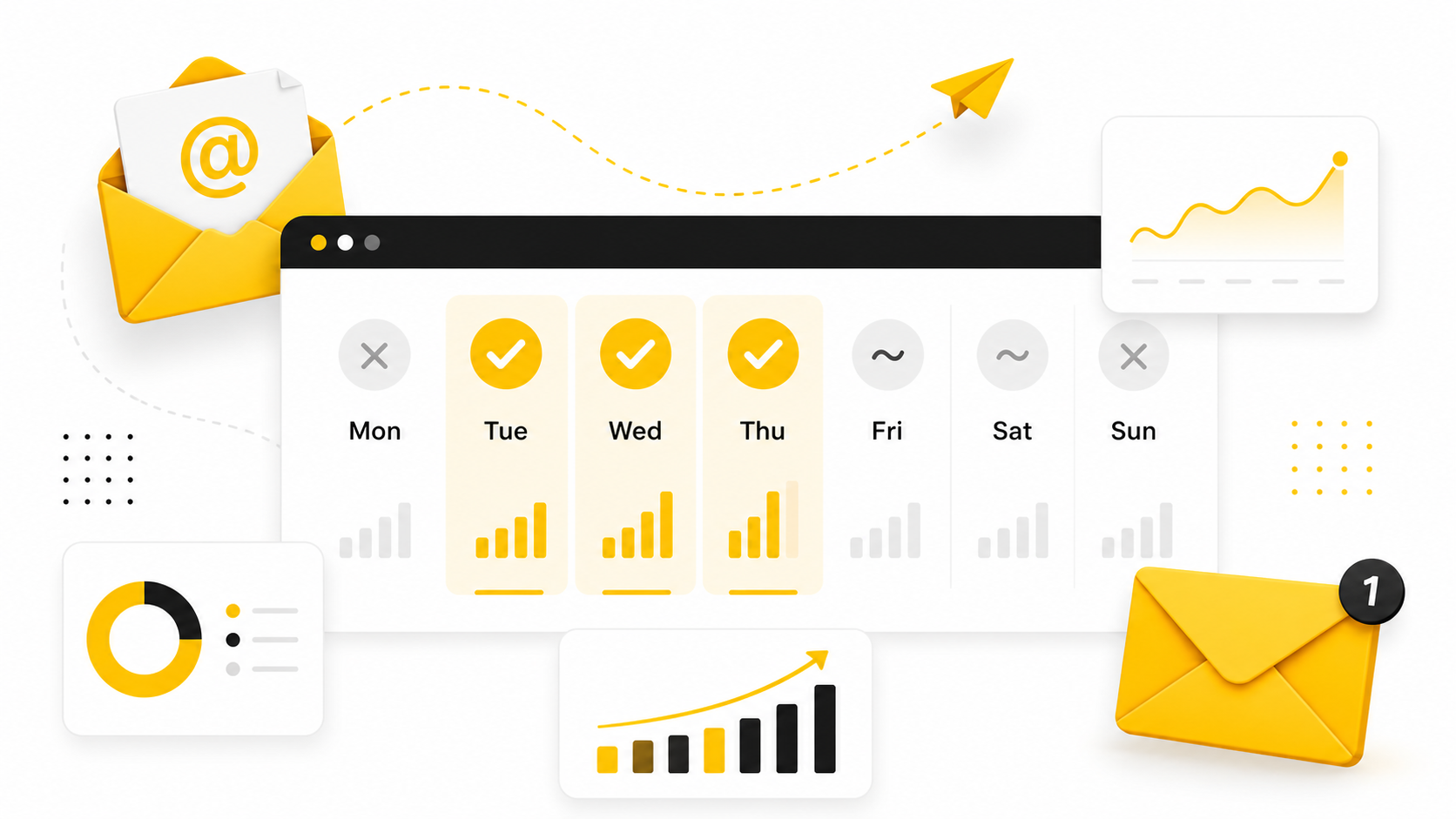
The best days to send email campaigns are usually Tuesday, Wednesday, and Thursday, but that is only the starting point. The real answer depends on your audience, your offer, your industry, your time zone strategy, and whether you care more about opens, clicks, replies, or purchases.
Recent benchmark data keeps pointing in the same direction: weekday campaigns beat weekends, and midweek sends tend to be the safest default. Brevo’s 2025 benchmark found that weekday campaigns drove the strongest engagement, with Tuesday through Thursday performing consistently well and 10 AM to 3 PM standing out as a practical send window in its email timing research.
This article will not pretend there is one magic day that works for every list. That advice sounds clean, but it breaks the moment you compare a B2B newsletter, an ecommerce flash sale, a webinar reminder, and a post-purchase nurture campaign. The practical move is to start with proven send-day patterns, then build a simple testing system around your own subscribers.
Article Outline
- Why Send Day Still Matters
- The Best Days To Send Email Campaigns
- How Email Type Changes The Best Send Day
- The Send-Day Framework
- How To Test And Optimize Your Campaign Timing
- Common Mistakes, Tools, And FAQ
Why Send Day Still Matters
Send day matters because email is still competing inside a crowded, time-sensitive inbox. Even a strong subject line can underperform if it lands when your audience is distracted, offline, or already buried under promotions. Timing will not save a weak offer, but it can absolutely help a good campaign get seen sooner.
The important part is to treat timing as leverage, not as a shortcut. If your list quality is poor, your deliverability is shaky, or your message is irrelevant, Tuesday morning will not magically fix the campaign. But when the fundamentals are solid, choosing the right send day can improve the odds that your email gets opened, clicked, and acted on.
This is also why averages should be used carefully. Midweek is a strong default, but your audience may behave differently based on work schedule, buying habits, location, and intent. A SaaS audience checking email during office hours is not the same as a consumer audience shopping after work.
The Send-Day Framework
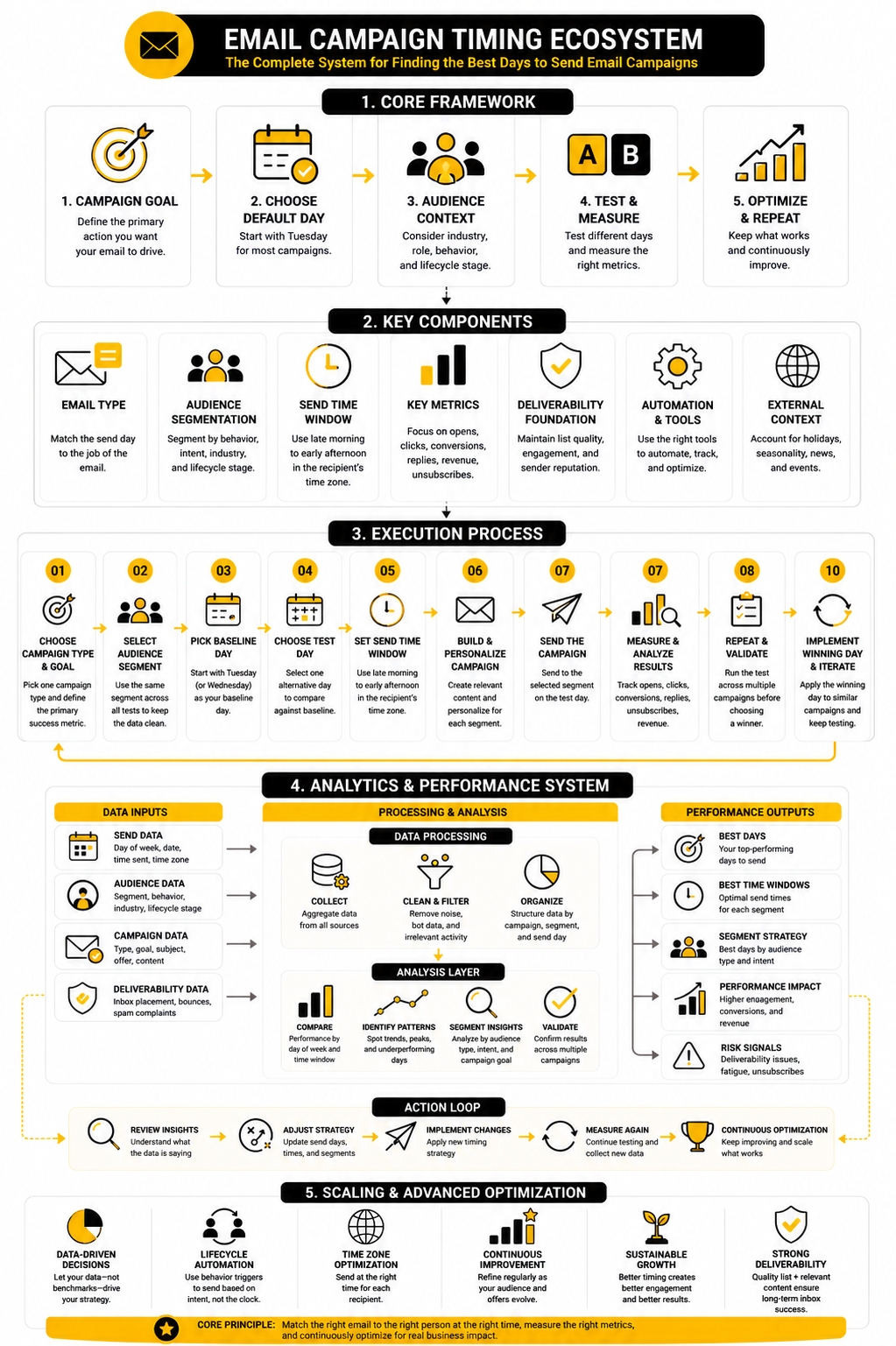
The best way to think about email timing is simple: default, segment, test, then automate. Start with Tuesday, Wednesday, or Thursday if you do not have enough data yet. Then split your campaigns by purpose, because a newsletter, launch email, abandoned cart message, and event reminder should not all follow the same logic.
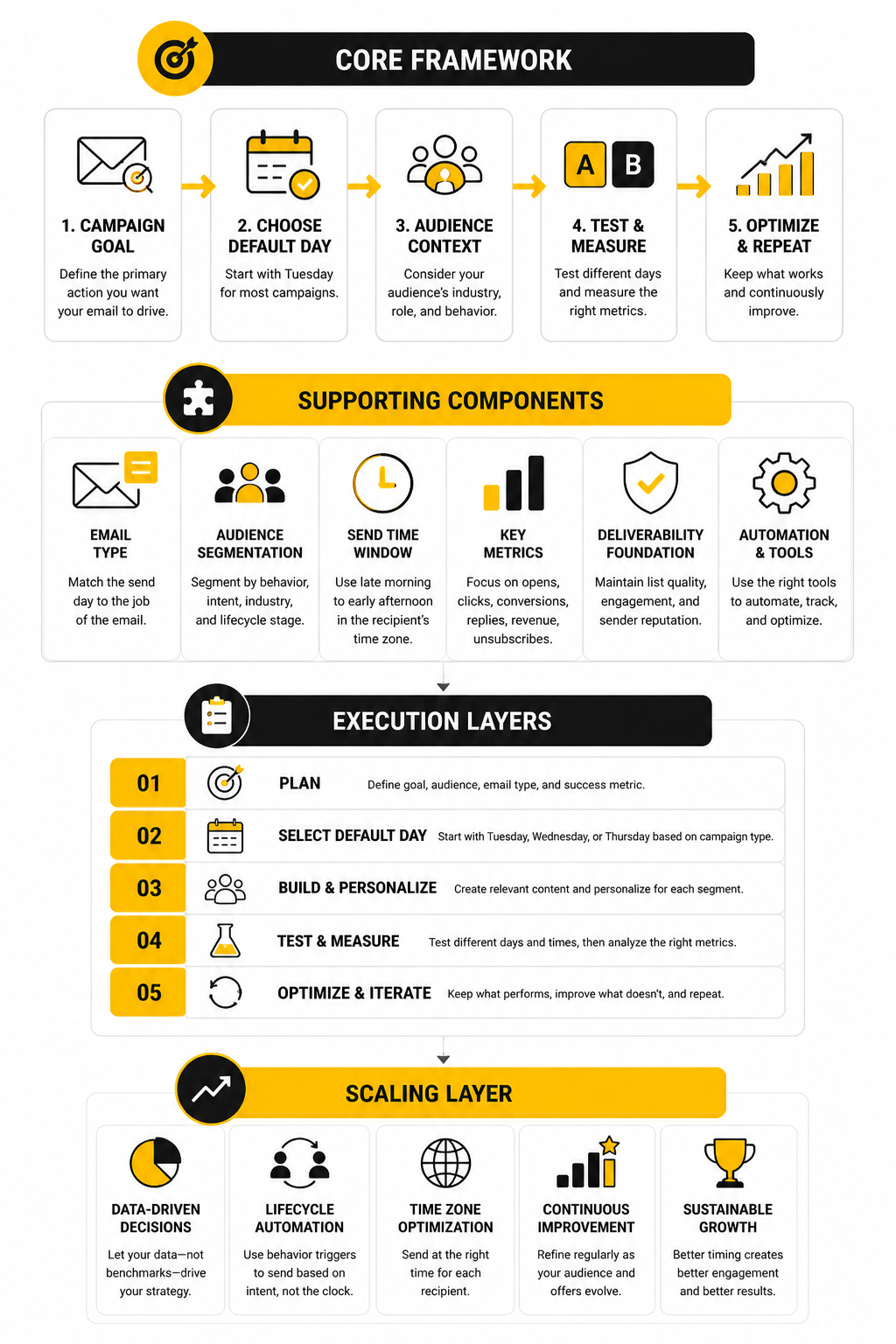
Once you have enough campaign history, your own data should outrank generic benchmarks. Look at opens for visibility, clicks for interest, conversions for buying intent, and unsubscribes for fatigue. The best day to send email campaigns is not the day that looks best in a blog post; it is the day that repeatedly moves your audience toward the action you actually want.
Professional implementation also means using tools without letting tools make lazy decisions for you. Platforms like Brevo, Moosend, and GoHighLevel can help you schedule, segment, and automate campaigns, but the strategy still has to come from your numbers. Use software to execute the system, not to replace the thinking.
The Best Days To Send Email Campaigns
The safest default is still Tuesday, Wednesday, and Thursday. These days usually work because people are past the Monday catch-up rush but not yet mentally checked out for the weekend. That makes midweek a practical starting point when you do not have enough list-specific data yet.
Tuesday is often the strongest single day for broad marketing campaigns. It gives your audience time to settle into the week, clear urgent messages, and pay attention to planned communication. If you are sending newsletters, educational campaigns, product updates, or lead nurture emails, Tuesday is usually a smart first test.
Wednesday is the most balanced day. It often performs well because it sits far enough from Monday pressure and Friday distraction. For many brands, Wednesday is the best day to send email campaigns when the message needs both attention and action.
Thursday can be especially useful when your campaign has a decision attached to it. Promotions, webinar reminders, demo pushes, and deadline-driven emails often make sense on Thursday because the week is still active, but urgency starts to feel more real. This is where timing becomes less about “best day” and more about the psychology of the offer.
Why Monday And Friday Are More Complicated
Monday is not a bad day, but it is a risky default. Many inboxes are overloaded after the weekend, and people are often sorting priorities instead of exploring offers. A Monday send can work well for weekly planning emails, B2B updates, or high-priority internal-style communication, but it needs a clear reason to exist.
Friday has the opposite problem. People may open emails, but their willingness to take action can drop if the message feels like work. That makes Friday better for lighter content, weekend promotions, consumer offers, and reminders that do not require a complex decision.
The mistake is treating Monday and Friday as useless. They are not useless. They are just less forgiving, which means your subject line, offer, and audience intent need to be sharper.
Why Weekends Usually Underperform
Saturday and Sunday are usually weaker for standard campaigns because inbox behavior changes. People are away from work routines, spending time with family, shopping, traveling, or simply ignoring anything that feels like a task. For B2B campaigns, weekends are especially hard to justify unless your audience has a known weekend workflow.
That said, ecommerce and creator-led businesses can sometimes make weekends work. A Sunday evening newsletter can perform well if subscribers expect it and treat it like part of their routine. A Saturday flash sale can work if the offer fits leisure time and mobile browsing behavior.
The point is simple: do not use weekends as your default just because there is less competition. Lower competition does not automatically mean higher intent. If your subscribers are not in the right mindset, the quieter inbox will not help much.
What The Recent Data Actually Suggests
The strongest recent pattern is not “send on one perfect day.” The pattern is that weekday campaigns perform more reliably than weekend campaigns, and midweek sends are usually the most dependable. Brevo’s 2025 analysis of email performance found that weekday campaigns generated the vast majority of opens and clicks, with Tuesday through Thursday standing out in its email timing research.
The same research also shows why you should not obsess over tiny differences between midweek days. Tuesday, Wednesday, and Thursday are often close enough that your audience and offer matter more than the generic benchmark. A weak Thursday email will not beat a strong Tuesday email just because Thursday appears in a chart.
So use benchmarks as a starting point, not a verdict. If you are starting from zero, test Tuesday first, then Wednesday, then Thursday. Once you have real engagement data, let your own subscribers decide the winner.
How Email Type Changes The Best Send Day
The best days to send email campaigns change once you look at the job of the email. A newsletter is not trying to create the same behavior as a checkout recovery email. A webinar reminder is not doing the same work as a product launch announcement.
This is where many teams make timing harder than it needs to be. They ask, “What is the best day?” when the better question is, “What day matches the action we want?” Once you match the send day to the campaign type, the decision becomes much more practical.
Newsletters And Educational Emails
Newsletters usually work best earlier in the workweek, especially Tuesday or Wednesday. People are more likely to read educational content when they are planning, researching, or catching up on industry ideas. That makes midweek a strong fit because the subscriber has enough attention to read without the pressure of Monday overload.
For this type of campaign, the goal is not always an immediate purchase. The goal may be trust, attention, repeat readership, or a click into a useful resource. That is why a clean Tuesday or Wednesday send often makes more sense than pushing a newsletter into a late-week urgency slot.
If your newsletter is highly personal or creator-led, consistency can matter more than the exact day. A weekly send that arrives at the same time can train readers to expect it. Once that habit forms, changing the day too often can do more harm than good.
Promotional Emails And Product Launches
Promotional emails often perform well from Tuesday through Thursday because these days give you enough room to build momentum. Tuesday can introduce the offer, Wednesday can reinforce the value, and Thursday can push urgency before the week closes. This rhythm is especially useful when the campaign has more than one email.
For product launches, do not judge the send day in isolation. The launch calendar matters more than a single blast. If your first email goes out on Tuesday, your reminders and deadline emails should be planned around attention, urgency, and buying behavior.
This is also where your sales page and funnel need to be ready. If you are sending traffic into a campaign funnel, tools like ClickFunnels, Systeme.io, or GoHighLevel can help connect the email timing to the landing page, checkout, follow-up, and pipeline. The day you send matters, but the path after the click matters just as much.
B2B Sales And Demo Campaigns
For B2B sales campaigns, Tuesday and Thursday are usually the best starting points. Tuesday works because prospects are back into execution mode, while Thursday works because people are often trying to close loops before the week ends. Wednesday can also work well for warmer leads who already know the problem and need a nudge.
The key difference with B2B is that the conversion often requires more thought. A prospect may need to check their calendar, talk to a partner, compare vendors, or ask for budget approval. That means your send day should support a decision process, not just chase an open.
This is why demo campaigns should avoid being too cute with timing. If the email is important, send it when the recipient is likely to be working. A clear midweek send with a specific next step will usually beat a weekend send that hopes to catch someone “when the inbox is quiet.”
Ecommerce And Revenue Campaigns
Ecommerce timing depends heavily on buying behavior. Tuesday and Thursday are strong starting points for standard promotions, but Friday and weekends can work when the offer fits leisure browsing, payday behavior, or a seasonal shopping moment. The best day is the one that matches when your customers are most likely to buy, not just open.
For ecommerce, click and purchase data should matter more than open rate. Apple Mail Privacy Protection and changing inbox behavior have made opens less reliable as a standalone signal, so revenue per recipient, click-through rate, and conversion rate are better guides. Brevo’s 2025 benchmark separates open rate, click-through rate, click-to-open rate, unsubscribe rate, and bounce rate because each metric answers a different question in its email benchmark report.
If your store runs frequent offers, be careful with predictable discount timing. Subscribers learn patterns quickly. If every Thursday email means a discount, you may train people to wait instead of buying at full price.
The Send-Day Framework
A useful framework keeps the decision simple. You start with the campaign goal, choose a default day, check the audience context, then test against a clear metric. That beats copying a benchmark and hoping it applies to your list.
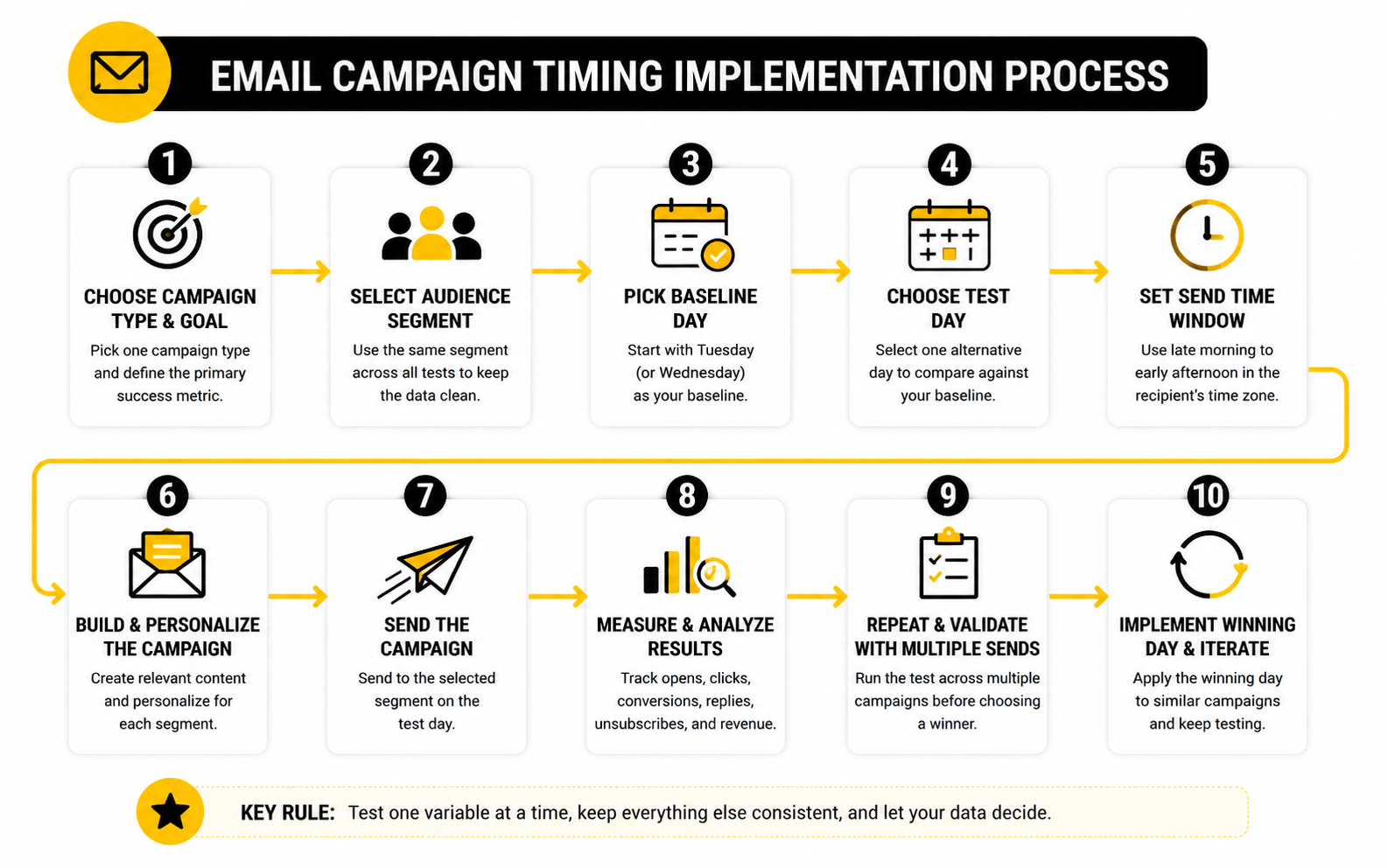
Here is the practical process:
- Define the campaign goal. Decide whether the email is built for opens, clicks, replies, bookings, purchases, or retention.
- Choose the default day. Start with Tuesday for broad campaigns, Wednesday for balanced engagement, or Thursday for deadline-driven action.
- Match the day to the email type. Educational content usually fits earlier in the week, while action-heavy campaigns can work better later in the week.
- Segment by audience behavior. Separate B2B, ecommerce, leads, customers, active subscribers, and inactive contacts when the list is large enough.
- Track the right metric. Use opens for visibility, clicks for interest, replies for conversation, and revenue or bookings for real business impact.
- Run the test long enough. One campaign is not enough proof. Look for repeated patterns across several sends before changing your default.
This process is boring in the best possible way. It stops you from making timing decisions based on one lucky campaign or one bad send. More importantly, it gives you a repeatable way to find the best days to send email campaigns for your actual business, not someone else’s benchmark chart.
Statistics And Data
Benchmarks are useful, but only when you know what they are supposed to tell you. The goal is not to hunt for one perfect number that proves Tuesday is always better than Thursday. The goal is to understand whether your chosen send day is helping the campaign create the behavior you actually care about.
That distinction matters because email metrics do not all measure the same thing. Open rate can suggest visibility, click-through rate can show active interest, click-to-open rate can reveal message strength, and conversion rate tells you whether the campaign created business value. If you treat all of those numbers as equal, you will make bad timing decisions with a lot of confidence.
The Metrics That Matter Most
Open rate is still useful, but it should not be treated as the final answer. Apple Mail Privacy Protection and similar inbox privacy changes have made opens less precise, which means a high open rate does not always mean real human attention. Use opens as a rough signal for deliverability, subject line strength, and timing, not as proof that the campaign worked.
Click-through rate is more useful when comparing the best days to send email campaigns because it shows action. A subscriber had to open, read enough to care, and click. That makes click data a stronger signal than open data when you are deciding whether Tuesday, Wednesday, or Thursday deserves the default slot.
Conversion rate is the metric that should win the argument when revenue is the goal. If Wednesday gets fewer opens but more purchases, Wednesday is better for that campaign type. Clean data beats vanity metrics every time.
What Current Benchmarks Can Tell You
Recent benchmark reports show why midweek is a safe starting point, but they also show why tiny day-to-day differences should not be overinterpreted. Brevo’s 2025 benchmark, based on more than 44 billion emails, reports an overall open rate of 21%, a click-through rate of 3.96%, and day-level results where Tuesday, Wednesday, and Thursday stay close together in its email benchmark data.
That matters because many marketers overreact to small differences. If Tuesday has a slightly higher click rate in one report, that does not mean your Thursday campaign is doomed. It means Tuesday is a reasonable starting point, and your own list should decide what happens next.
Other benchmarks make the same point from a different angle. The DMA’s 2025 Email Benchmarking Report shows delivery rates at 98%, open rates at 35.9%, and unique click rates at 2.3% in its email benchmarking report. Those numbers are useful context, but they should push you toward better measurement rather than blind imitation.
Build A Simple Measurement System
A good measurement system does not need to be complicated. You need consistent naming, clean segments, fixed testing windows, and one primary success metric per campaign. Without those basics, you are not testing send days; you are just comparing messy campaigns that happened to go out on different dates.
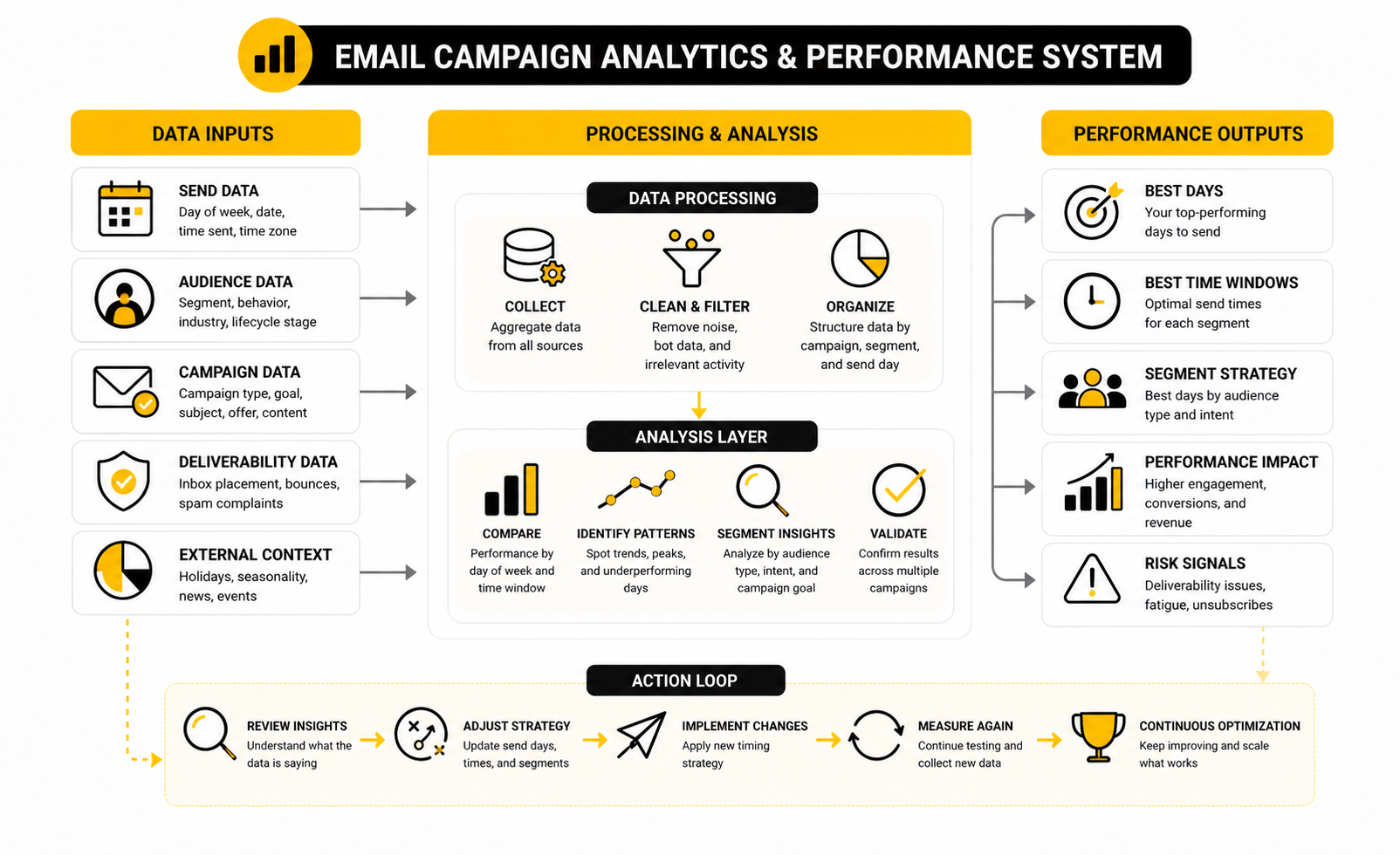
Use a simple campaign log for every send. Track the campaign type, audience segment, send day, send time, subject line angle, list size, open rate, click-through rate, conversion rate, unsubscribe rate, and revenue or bookings when relevant. Over time, this gives you a real decision base instead of a pile of disconnected reports.
The most important part is separating campaign types. Newsletter timing should not be judged against abandoned cart timing. A webinar reminder should not be compared to a general promotion. Each campaign type needs its own pattern because each one asks the subscriber to do something different.
How To Read The Numbers Without Fooling Yourself
Do not change your strategy after one send. One email can win because the offer was stronger, the subject line was clearer, the list was warmer, or the timing happened to line up with a seasonal event. You need repeated results before you declare a send day the winner.
Also, watch negative signals. If a day gets strong opens but higher unsubscribes, that may mean the timing is visible but annoying. If clicks are strong but conversions are weak, the issue may be the landing page, pricing, or offer, not the send day.
The best decision rule is practical: keep the day that improves the metric tied to the campaign goal without increasing list fatigue. For a newsletter, that may be click-through rate and repeat engagement. For a sales campaign, it may be revenue per recipient. For a demo push, it may be booked calls, pipeline value, or qualified replies.
How To Test And Optimize Your Campaign Timing
Once you understand the benchmarks, the next step is building your own timing advantage. This is where most marketers either get too casual or too technical. You do not need a complicated data science model, but you do need a repeatable process that stops random campaign results from becoming fake strategy.
Start by choosing one campaign type and one primary metric. If you are testing a newsletter, optimize for click-through rate and repeat engagement. If you are testing a sales campaign, optimize for revenue per recipient, booked calls, qualified replies, or another business outcome that actually matters.
The best days to send email campaigns should be tested against the same audience segment whenever possible. If Tuesday goes to warm customers and Thursday goes to cold leads, the test is already broken. Keep the list, offer, subject angle, and campaign purpose as consistent as you reasonably can, then compare the send day.
Run Cleaner Tests Before You Scale
A clean test starts with a simple control. Pick one send day as the baseline, usually Tuesday or Wednesday, then compare it against one alternative day. Do not test four days, three subject lines, two offers, and different segments at the same time unless your list is large enough to handle that complexity.
Give each test enough repetition before making a decision. One campaign can be distorted by seasonality, news cycles, holidays, inbox placement, offer strength, or a subject line that happened to hit. A better rule is to look for a pattern across multiple sends before changing your default calendar.
Your testing window should also match your buying cycle. A newsletter may show useful click data within a day or two. A B2B demo campaign may need a longer window because replies, bookings, and follow-up conversations do not always happen immediately.
Segment Timing By Subscriber Intent
The biggest upgrade is moving from one universal send day to intent-based timing. New leads, active buyers, inactive subscribers, trial users, webinar registrants, and past customers do not behave the same way. Treating them like one list creates average results.
For warm subscribers, midweek sends often work well because these people already know you and need a useful reason to act. For inactive subscribers, timing matters less than the reactivation angle, but midweek is still a cleaner place to start. For high-intent leads, speed can beat day-of-week timing because the subscriber’s interest is fresh right now.
This is where automation becomes valuable. A broadcast campaign depends heavily on choosing the right day, but a behavior-triggered campaign should respond to what the subscriber just did. If someone abandons a checkout or books a webinar, the follow-up should be driven by intent, not by waiting until next Tuesday.
Balance Timing With Frequency
Send day does not exist in a vacuum. If you send too often, even the perfect day starts to feel annoying. If you send too rarely, every campaign has to work harder because the audience relationship is weaker.
Frequency should be judged by engagement and list fatigue, not by your internal desire to promote more. Watch unsubscribe rate, spam complaints, declining clicks, and repeated non-openers. A day that performs well for one weekly campaign may not stay strong if you suddenly push three campaigns into the same window.
This matters even more during launches and seasonal pushes. A campaign sequence can use Tuesday, Wednesday, and Thursday effectively, but only if each email has a distinct job. Repeating the same message three times is not a timing strategy; it is inbox pressure.
Account For Time Zones And Local Behavior
Global lists need more care than local lists. If your audience is spread across multiple regions, sending one campaign at 10 AM in your own time zone may land at a terrible hour for a large part of the list. That can make a good send day look weaker than it really is.
Use recipient-local sending when your platform supports it. Many modern email platforms can deliver based on each subscriber’s time zone, which makes day-of-week testing more accurate. This is especially useful for newsletters, promotions, and event reminders where timing consistency matters.
Local behavior also matters around holidays, paydays, school calendars, and business routines. A Thursday campaign may work beautifully most weeks and then underperform before a long weekend. Do not panic when a known calendar disruption explains the result.
Protect Deliverability While You Optimize
Aggressive testing can damage deliverability if you ignore list quality. Sending more campaigns to chase timing data can backfire when inactive contacts stop engaging or spam complaints rise. The inbox providers are not judging only your send day; they are judging how recipients respond to your emails.
Clean segmentation protects your sender reputation. Send more often to people who engage, reduce pressure on people who do not, and remove or suppress contacts that have gone cold for too long. A smaller engaged list often beats a larger tired list.
This is also why open-rate obsession is risky. Apple’s privacy changes made opens less reliable because Mail Privacy Protection can preload email images and distort open tracking, a shift explained in Twilio’s guide to Apple Mail Privacy Protection. Use open data carefully, but let clicks, replies, conversions, and complaints guide the serious decisions.
Use Automation Without Losing Control
Automation can make send-day strategy sharper, but only if the logic is built well. A good automation platform helps you trigger emails from behavior, split segments, schedule campaigns by time zone, and compare performance across sends. A bad setup just sends more email faster.
For agencies, consultants, and service businesses, GoHighLevel can be useful when email timing needs to connect with pipelines, appointment booking, CRM stages, and follow-up workflows. For creators and ecommerce-style campaigns, Moosend and Brevo give you practical ways to schedule, segment, and measure campaigns without turning the process into a spreadsheet nightmare.
The expert move is not to automate everything. The expert move is to automate repeatable behavior while keeping human judgment on the offer, message, audience, and campaign calendar. Software can send the email at the right time, but it cannot decide whether the email deserves attention in the first place.
Common Mistakes, Tools, And FAQ
The biggest mistake is treating send day like a magic switch. Tuesday, Wednesday, and Thursday are strong defaults, but they are not a replacement for relevance, segmentation, deliverability, and a real offer. The best days to send email campaigns only matter when the email itself is worth opening.
The second mistake is using benchmarks as if they are instructions. Brevo’s 2025 benchmark shows Tuesday, Wednesday, and Thursday sitting very close together for engagement, which means the real advantage usually comes from testing your own audience instead of copying a chart. Benchmarks should help you choose a starting point, then your list should tell you what to keep.
The third mistake is optimizing only for opens. Open rates are useful, but Apple Mail Privacy Protection and other privacy changes mean they should not be treated as perfect truth. Clicks, replies, conversions, bookings, revenue per recipient, unsubscribes, and complaints give you a fuller picture of whether your timing strategy is actually working.
The Final Send-Day System
A strong email timing system has five parts: campaign purpose, audience segment, send day, send time, and performance metric. When those five pieces line up, your campaigns become much easier to improve. When one piece is missing, timing decisions become guesswork.
Use Tuesday as your first test for broad campaigns, Wednesday for balanced engagement, and Thursday for urgency or decision-based campaigns. Use Monday only when the email fits planning or business priority, and use Friday or weekends when the offer naturally matches lighter attention or consumer behavior. That gives you a clear starting map without pretending every list behaves the same.
Then build a habit around review. Every month, look at performance by campaign type and segment, not just by overall average. Keep the days that produce the right action, cut the days that create fatigue, and keep testing when the data is too thin to trust.
FAQ - Built For Complete Guide
What are the best days to send email campaigns?
The best days to send email campaigns are usually Tuesday, Wednesday, and Thursday. These days tend to work because subscribers are active in their inboxes but not as overloaded as they often are on Monday. Treat them as starting points, then test your own audience before locking in a permanent schedule.
Is Tuesday really the best day to send marketing emails?
Tuesday is often the best default day because people have usually moved past Monday planning and are ready to engage. It works especially well for newsletters, educational campaigns, product updates, and standard promotions. Still, Tuesday should not automatically win if your own click, reply, or revenue data points to Wednesday or Thursday.
Is Wednesday better than Thursday for email campaigns?
Wednesday is often better for balanced engagement, while Thursday can be better for campaigns with urgency. If your email is educational, relationship-building, or content-heavy, Wednesday is a strong option. If your email asks someone to book, buy, register, or act before a deadline, Thursday can be more effective.
Should I send email campaigns on Monday?
Monday can work, but it is not the safest default. Many people are catching up, sorting priorities, and deleting anything that does not feel immediately useful. Use Monday for planning-related emails, important B2B updates, or campaigns where your audience expects a start-of-week message.
Should I send email campaigns on Friday?
Friday can work for lighter content, consumer promotions, weekend offers, and reminders. It is usually weaker for complex B2B decisions because people may be trying to finish the week rather than start a new buying process. If you test Friday, judge it by clicks and conversions, not just opens.
Are weekends bad for email campaigns?
Weekends are usually weaker for standard business campaigns, especially B2B. But they can work for ecommerce, creators, events, entertainment, hobbies, and audiences that browse outside work hours. The key is matching the send day to the subscriber’s mindset.
What time should I send email campaigns?
A practical starting window is late morning to early afternoon in the recipient’s local time. Many campaigns perform well around 10 AM to 3 PM because people are active but not always in peak meeting or commuting mode. Time zone sending matters a lot if your list is spread across regions.
How many times should I test a send day?
Do not make a decision from one campaign. Test the same campaign type across several sends before declaring a winner. One result can be distorted by the subject line, offer, season, list segment, holiday, or deliverability issue.
Which metric should decide the best send day?
The primary metric should match the campaign goal. Use click-through rate for content engagement, replies for sales conversations, booked calls for demo campaigns, and revenue per recipient for ecommerce or launch campaigns. Opens can help you understand visibility, but they should not be the only metric.
Should different segments get emails on different days?
Yes, once your list is large enough. New leads, active buyers, inactive subscribers, trial users, webinar registrants, and past customers often behave differently. Segment-based timing is more advanced, but it usually beats sending every campaign to every subscriber on the same day.
What tools help with email timing and automation?
Good tools help you schedule, segment, automate, and measure campaigns without turning everything into manual work. Brevo, Moosend, and GoHighLevel can all support different types of campaign workflows. Pick the tool that fits your business model, not the one with the longest feature list.
How do I know if my send day is hurting performance?
Look for falling click rates, weaker conversions, higher unsubscribes, more complaints, or lower revenue per recipient. If opens look fine but business results are dropping, the send day may be attracting attention without producing intent. That is a sign to test another day or adjust the campaign angle.
Work With Professionals
Explore 10K+ Remote Marketing Contracts on MarkeWork.com
Most marketers spend too much time chasing clients, competing on crowded platforms, and losing a percentage of every project to middlemen.
MarkeWork gives you a better way. Browse thousands of remote marketing contracts and connect directly with companies desperate to hire skilled marketers like you, without platform commissions and without unnecessary gatekeepers.
If you're serious about finding better opportunities and keeping 100% of what you earn, explore available contracts and create a profile for free at MarkeWork.com.