

The best digital marketing companies are not just the agencies with the biggest client logos, the prettiest websites, or the loudest case studies. They are the teams that can understand your market, diagnose your growth bottleneck, build a practical acquisition system, and prove what is working without hiding behind jargon.
That matters because digital marketing is now the center of modern growth. Digital channels account for 61.1% of total marketing spend, while global digital ad investment has moved past US$790 billion. In other words, choosing the wrong partner is no longer a small mistake. It can quietly drain your budget, delay your learning, and make good products look weaker than they are.
Article Outline
- Why Choosing the Right Digital Marketing Company Matters
- A Practical Framework for Comparing Digital Marketing Companies
- Core Services the Best Digital Marketing Companies Usually Offer
- How Professional Implementation Actually Works
- Red Flags, Pricing Models, and Questions to Ask Before Hiring
- Final Checklist and FAQ
Why Choosing the Right Digital Marketing Company Matters
The market is crowded, and that creates a real problem for buyers. Many agencies describe themselves with the same words: performance-driven, data-led, full-service, creative, strategic, AI-powered. Those words are not useless, but they are not enough to separate a serious growth partner from a vendor that simply sells deliverables.
The real difference shows up in how a company thinks. A strong digital marketing partner connects positioning, traffic, conversion, retention, analytics, and sales follow-up into one system. A weak one treats each channel like a disconnected task, which is how businesses end up with more content, more ads, more dashboards, and still no clearer path to revenue.
This is also why the best digital marketing companies do not start by promising a channel. They start by understanding the economics of your business. Before they recommend SEO, paid search, paid social, email, funnels, CRM automation, or influencer campaigns, they should know your margins, sales cycle, average order value, customer lifetime value, lead quality issues, and conversion constraints.
A Practical Framework for Comparing Digital Marketing Companies
A useful comparison framework starts with one question: what growth problem are you actually trying to solve? Some companies need demand generation because not enough qualified people know they exist. Others need conversion work because traffic is already coming in but too few visitors become leads or customers. Others need retention, lifecycle marketing, or better sales automation because the money is leaking after the first click.
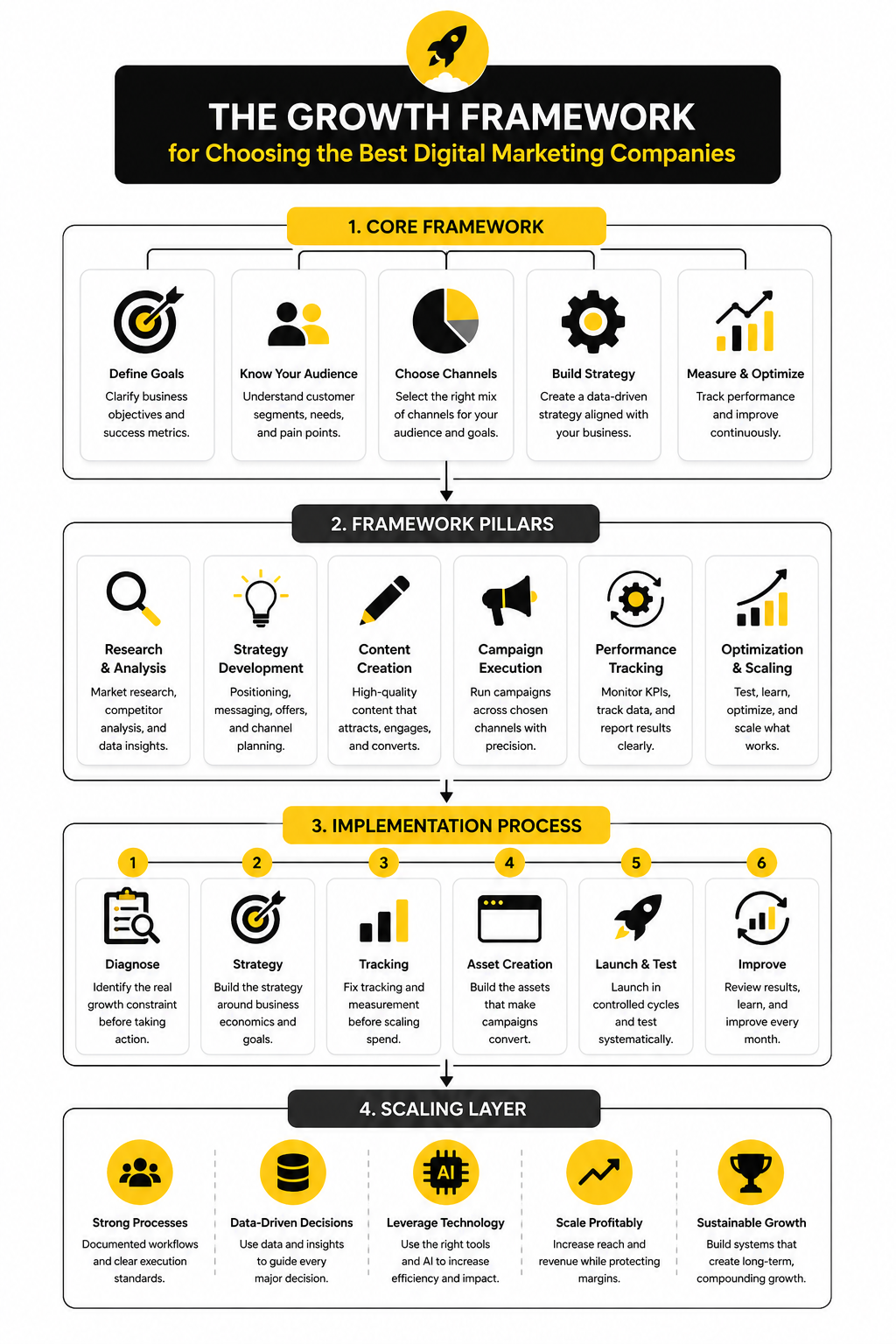
The framework for choosing the right partner should look at four layers: strategy, channel expertise, execution quality, and measurement. Strategy tells you whether the agency understands the business problem. Channel expertise tells you whether they know how to win in the places your customers actually spend attention. Execution quality tells you whether they can ship campaigns, pages, emails, content, and creative at a professional standard.
Measurement is the layer that keeps everything honest. Marketing budgets have stayed tight, with Gartner reporting 2025 marketing budgets at 7.7% of overall company revenue, so vague reporting is not good enough anymore. The best partners make tradeoffs visible, explain what they are testing, and show how marketing activity connects to pipeline, sales, retention, or profit.
Core Services the Best Digital Marketing Companies Usually Offer
The best digital marketing companies usually combine several services, but the service list itself is not the real differentiator. Almost every agency can say it offers SEO, paid ads, social media, email marketing, analytics, and landing pages. What matters is whether those services work together as one growth system instead of separate monthly tasks.
A good agency should be able to explain which channels fit your buying journey and which ones are distractions. For example, SEO can be powerful when customers actively search for answers, comparisons, and solutions. Paid media can move faster when you already know your offer converts. Email and CRM automation become more valuable when you have leads, customers, repeat purchases, or a longer sales cycle.
This is where many businesses choose poorly. They hire based on a channel they think they need, not the constraint that is actually holding growth back. A serious partner will push back when needed, because spending more on traffic does not fix weak positioning, unclear offers, slow follow-up, poor landing pages, or broken tracking.
Search Engine Optimization
SEO is still one of the most important services to evaluate, especially for companies that want durable demand rather than constant dependency on paid traffic. Strong SEO work includes technical fixes, content strategy, topical authority, internal linking, conversion-focused page structure, and ongoing search intent analysis. Weak SEO usually looks like generic blog production with no clear commercial path.
The best digital marketing companies do not treat SEO as a publishing calendar. They map search demand to business value, then decide which pages should attract awareness traffic, comparison traffic, and high-intent buyer traffic. That distinction matters because ranking for broad informational terms can look good in a report while contributing very little to revenue.
Search also keeps changing because AI summaries, social discovery, marketplaces, and video platforms are shifting how people find answers. Even so, search behavior still has commercial weight because people use it when they are actively trying to solve a problem. A good agency should understand classic SEO, but it should also understand how content earns trust across the wider discovery journey.
Paid Media
Paid media is useful when speed matters. It can validate offers, test messaging, build remarketing audiences, and create predictable acquisition when the economics work. But paid ads are also one of the fastest ways to waste money when the agency focuses on impressions, clicks, or platform metrics instead of qualified pipeline and profitable customers.
A strong paid media team should talk about creative testing, audience quality, landing page conversion, attribution limits, and budget allocation. They should be comfortable explaining what the platform reports can and cannot prove. That matters because marketers are putting serious budget into digital channels, with digital now making up 61.1% of total marketing spend.
The practical question is not whether an agency can run Google Ads, Meta ads, LinkedIn ads, TikTok ads, or YouTube campaigns. The better question is whether they can turn paid traffic into a repeatable learning engine. If every month is just “we need more budget,” you are not looking at a strategy. You are looking at dependency.
Conversion Strategy and Landing Pages
Traffic is expensive, so conversion work is not optional. A company that gets more from existing visitors can often improve growth faster than a company that only increases ad spend. This is why the best digital marketing companies pay close attention to landing pages, offer clarity, forms, calls to action, page speed, objections, proof, and user behavior.
For ecommerce brands, this often means better product pages, clearer bundles, stronger trust signals, and sharper post-click experiences. For service businesses and B2B teams, it may mean stronger lead magnets, better consultation pages, more useful comparison content, or cleaner demo-booking flows through tools like Cal.com. The point is simple: clicks do not pay you unless the next step makes sense.
Conversion work also reveals whether an agency is strategic or just channel-focused. A channel-focused agency sends traffic and blames the website when results disappoint. A strategic partner looks at the whole path from first touch to closed revenue and helps fix the parts that are leaking.
Email, CRM, and Lifecycle Marketing
Email and lifecycle marketing often get less attention than acquisition, but they can have a major impact on profit. New traffic is usually more expensive than communicating better with people who already know you. That includes leads who have not bought yet, customers who might buy again, users who need onboarding, and prospects who need more trust before they speak with sales.
A strong agency should understand segmentation, automation, deliverability, behavior-based messaging, and sales handoff. For smaller teams, platforms like Brevo or Moosend can support practical email campaigns without overcomplicating the stack. For agencies and local-service businesses that need pipelines, automations, booking, follow-up, and reporting in one place, GoHighLevel often fits the operational side of implementation.
The key is that lifecycle marketing should not feel like random newsletters. It should answer real buyer questions, reduce friction, and move people toward the next useful step. When done well, it makes every acquisition channel more valuable because fewer leads and customers go cold.
Social Media and Content Distribution
Social media is not just posting for visibility. It can support brand discovery, authority, community, recruiting, retargeting, customer education, and demand creation. The challenge is that many companies confuse activity with momentum.
The best digital marketing companies build social around audience behavior, not vanity output. They know when short-form video matters, when LinkedIn thought leadership matters, when creator partnerships make sense, and when social should mainly support proof and distribution. Global social media user identities reached 5.24 billion in 2025, so the opportunity is real, but attention is fragmented.
A practical partner will also help you repurpose content intelligently. One strong customer insight can become a sales enablement point, a short video, an email, a paid ad angle, a comparison section, and a landing page improvement. That is far better than feeding the content machine just because the calendar says another post is due.
How Professional Implementation Actually Works
Professional implementation is where the gap between average agencies and the best digital marketing companies becomes obvious. Strategy matters, but strategy that never turns into clean execution is just an expensive document. The right partner should have a clear operating rhythm for research, planning, launch, measurement, and improvement.
The process should not feel mysterious. You should know what is being built, why it matters, what decision it supports, and how success will be judged. If an agency cannot explain its implementation process in plain language, that is usually a sign that the process is weaker than the pitch.
Good implementation also protects you from random marketing. Random marketing is when one month is SEO, the next month is paid ads, the next month is a new funnel, and nobody can clearly explain how the pieces connect. A serious digital marketing company turns the work into a focused system with priorities, owners, timelines, and feedback loops.
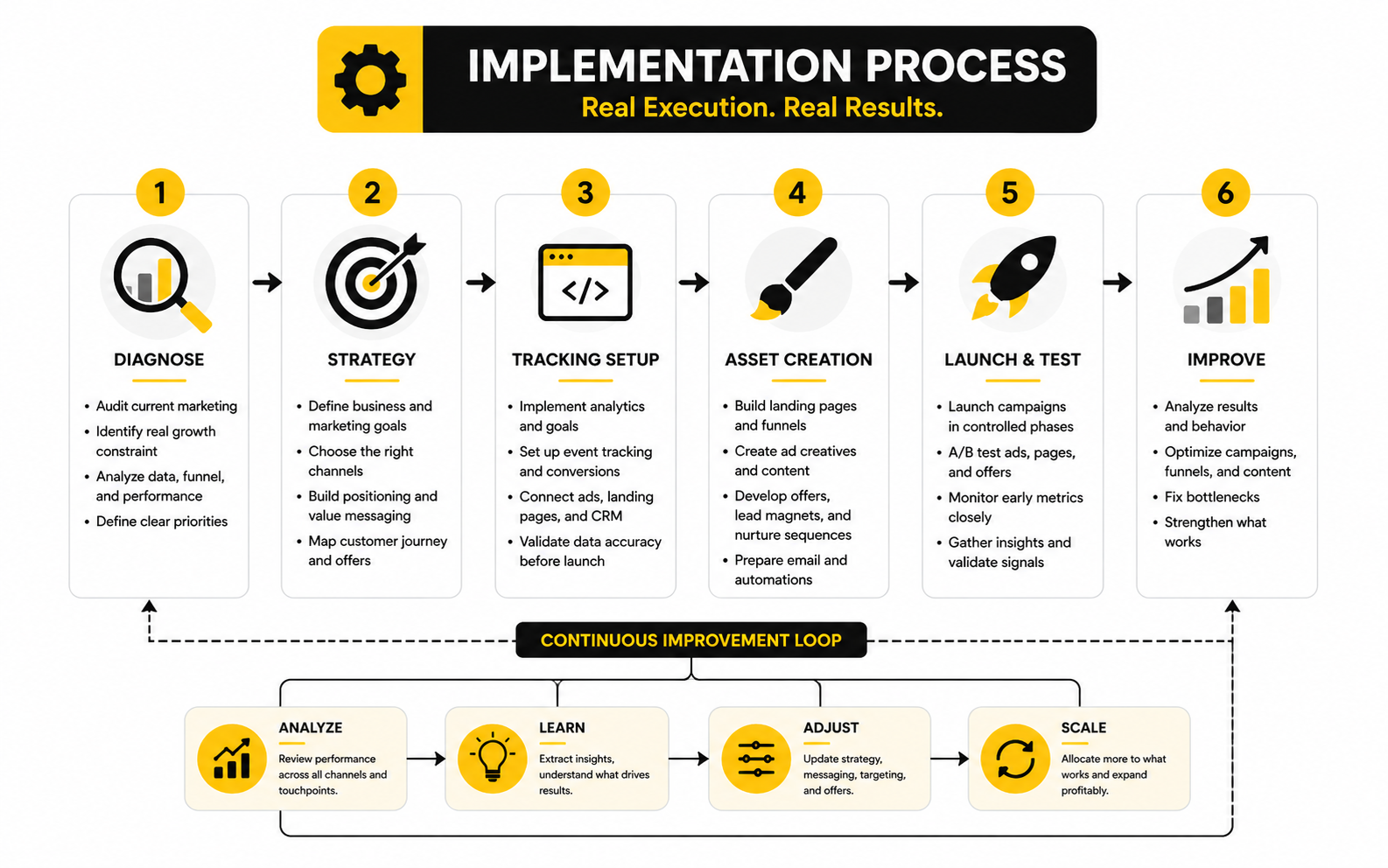
Step 1: Diagnose the Growth Constraint
The first step is diagnosis. Before touching campaigns, a strong agency should review your offer, audience, traffic sources, conversion points, sales process, analytics setup, and current performance. This is not busywork. It prevents the team from solving the wrong problem beautifully.
For example, a company with strong traffic but poor lead quality does not need the same plan as a company with low awareness and no search visibility. A brand with a high-consideration product needs different nurturing than a low-ticket ecommerce store. The best digital marketing companies separate symptoms from root causes before they recommend tactics.
This is also where honest agencies earn trust. They may tell you that your landing page needs work before paid traffic scales. They may tell you that your CRM is too messy for accurate attribution. They may tell you that your offer is not clear enough yet. That can feel uncomfortable, but it is much better than paying for campaigns built on weak foundations.
Step 2: Build the Strategy Around Business Economics
Once the constraint is clear, the strategy should connect directly to business economics. That means the agency should understand your customer acquisition cost targets, average order value, customer lifetime value, close rate, gross margin, and payback period. Without those numbers, marketing performance becomes too easy to spin.
This is especially important while budgets are tight. Marketing budgets have stayed flat at 7.7% of company revenue, so the best partners need to make every major initiative justify its place. That does not mean every campaign must produce instant revenue, but it does mean the role of each campaign should be clear.
A good strategy will usually define the main growth bet, the supporting channels, the conversion assets, the measurement plan, and the first testing cycle. It should also define what the agency will not do yet. That discipline matters because scattered execution is one of the most expensive forms of marketing waste.
Step 3: Fix Tracking Before Scaling Spend
Tracking is not glamorous, but it is critical. If your analytics, pixels, CRM stages, form tracking, call tracking, ecommerce events, and reporting dashboards are broken, the agency will struggle to know what is working. Worse, you may scale campaigns based on misleading numbers.
Privacy changes, platform modeling, and fragmented customer journeys have made measurement harder, not easier. The IAB’s 2025 State of Data work focuses heavily on moving from AI-assisted workflows into more integrated data and measurement systems because campaign performance now depends on cleaner data foundations. That is exactly why implementation should start with measurement hygiene before major budget increases.
For many businesses, this means setting up cleaner CRM stages, better lead source tracking, UTMs, server-side events where appropriate, and dashboards that separate activity from business outcomes. If your team needs a practical operating hub for pipelines, automations, and follow-up, GoHighLevel can fit that role for agencies, local businesses, and service companies. The tool is not the strategy, but the right system makes the strategy easier to execute.
Step 4: Create the Assets That Make Campaigns Work
Campaigns do not perform because someone pressed publish. They perform because the underlying assets are strong enough to convert attention into action. That includes ad creative, landing pages, lead magnets, sales pages, emails, product pages, comparison pages, case studies, scripts, and follow-up sequences.
This is where execution quality becomes visible. A strong agency can translate customer research into sharper messaging, clearer offers, better page structure, and more useful content. For ecommerce teams that need faster landing page testing, Replo can help teams build campaign-specific pages without waiting on a full development cycle.
The same principle applies to funnels and lead capture. Tools like ClickFunnels or Systeme.io can be useful when the goal is to launch simple offers, webinars, opt-ins, and sales flows quickly. But again, the tool only helps if the agency knows the offer, the audience, and the conversion path.
Step 5: Launch in Controlled Testing Cycles
The best digital marketing companies do not launch everything at once and hope. They launch in controlled testing cycles so they can learn what the market is actually responding to. This keeps the work focused and makes performance easier to interpret.
A practical testing cycle might compare two offer angles, three ad concepts, one landing page structure, and one follow-up sequence. That is enough variation to learn, but not so much that the data becomes noisy. The goal is not to test for the sake of testing. The goal is to make better decisions faster.
This is where many teams overcomplicate things. They create too many campaigns, too many audiences, too many messages, and too many reports. A better agency narrows the variables, watches the right signals, and then compounds what works.
Step 6: Improve the System Every Month
Implementation does not end at launch. The real value comes from the improvement cycle after launch, when the agency reviews performance, identifies bottlenecks, and updates the plan. That is where campaigns become more efficient and the business learns what its market actually wants.
Monthly improvement should not be a vague status call. It should cover what changed, what was learned, what decisions were made, and what will be done next. A strong agency should be able to explain why a campaign improved, why it declined, or why the data is not clear yet.
This is also where AI can help, but it should not replace judgment. McKinsey’s 2025 AI research shows that many organizations use AI widely but still struggle to embed it deeply enough into workflows to create material business impact. The agencies worth hiring will use AI to improve research, analysis, creative variation, personalization, and operations, while still keeping human strategy in control.
Statistics and Data That Actually Matter
Data should make marketing decisions clearer, not noisier. The best digital marketing companies know this, which is why they do not bury clients under dashboards full of impressions, clicks, sessions, followers, and open rates without explaining what those numbers mean. A metric is only useful when it helps you decide what to keep, cut, improve, or test next.
This matters because marketing teams are being asked to do more with limited room for waste. Marketing budgets remain at 7.7% of company revenue, while worldwide media ad spend is moving past the US$1 trillion mark. That combination creates pressure. More money is moving through digital channels, but individual teams still need to defend every major decision.
The practical takeaway is simple: you do not need more numbers. You need a measurement system that shows where growth is coming from, where money is leaking, and what action should happen next.
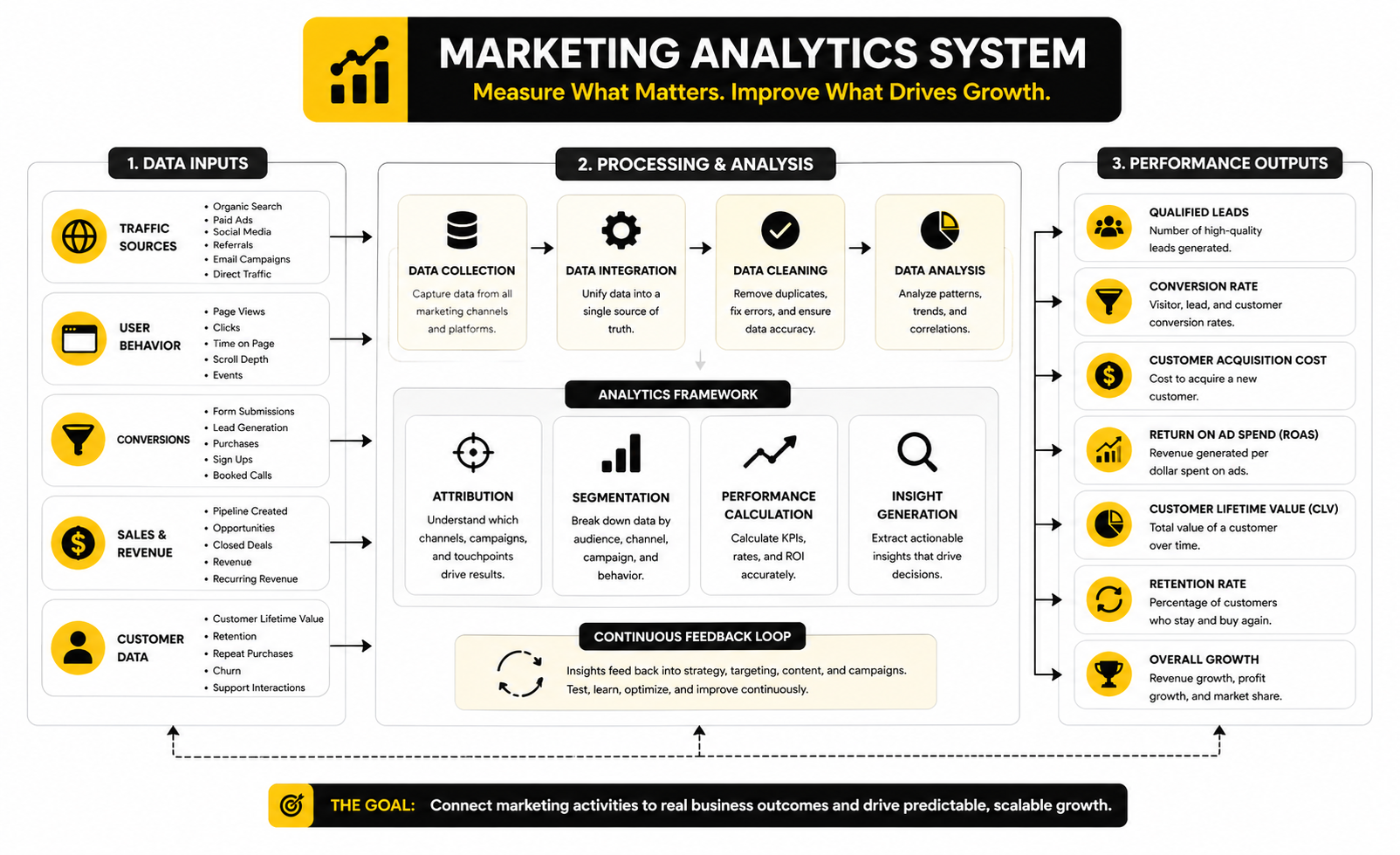
The Metrics That Separate Activity From Progress
Activity metrics show whether marketing work is happening. Progress metrics show whether the business is getting healthier. Both have a place, but they should never be treated as equal.
Impressions, reach, clicks, sessions, rankings, engagement, and email opens can help diagnose visibility and attention. They are useful early signals, especially when a campaign is still gathering data. But they do not prove that the marketing is profitable, and they definitely do not prove that the agency is doing great work.
The stronger signals sit closer to revenue. Qualified leads, sales opportunities, booked calls, pipeline value, conversion rate, customer acquisition cost, payback period, retention, repeat purchase rate, and customer lifetime value are harder to fake. The best digital marketing companies connect upper-funnel indicators to these business outcomes so you can see whether attention is turning into money.
Benchmarks Are Useful, But They Are Not the Goal
Benchmarks can help you spot obvious problems, but they should not become the strategy. A conversion rate that looks low in one industry may be normal in another. A high cost per lead can be acceptable if lead quality and close rates are strong. A cheap lead can be expensive if sales wastes time chasing people who were never serious.
This is why a good agency will use benchmarks as context, not as a scoreboard. They should compare your performance against your own baseline, your margins, your sales cycle, and your growth goals. That is much more useful than chasing generic averages from a report that may not match your offer, market, or funnel.
The smartest question is not “Are we above benchmark?” The smarter question is “What is the next bottleneck?” Once you know that, benchmarks become a tool for diagnosis instead of a distraction.
Attribution Needs Discipline, Not Blind Trust
Attribution is one of the most misunderstood parts of digital marketing. Platforms often claim credit for conversions because they can see a touchpoint, not because they caused the sale. That does not mean platform data is useless, but it does mean you should not let one dashboard control the whole budget.
Modern buyers move across search, social, email, direct traffic, reviews, communities, sales calls, retargeting, and word of mouth. Privacy changes and modeled reporting make that journey even harder to measure perfectly. The IAB’s 2025 State of Data work frames measurement as a strategic data problem, not just a reporting task, because brands, agencies, publishers, and ad tech teams now need cleaner systems to evaluate campaign performance.
A serious agency will explain attribution limits clearly. They may use platform data, CRM data, analytics data, incrementality tests, customer surveys, call tracking, and sales feedback together. That blended view is not perfect, but it is usually much closer to reality than pretending one attribution model tells the full truth.
What a Good Reporting System Should Show
A good reporting system should answer a small set of important questions every month. Did qualified demand increase? Did conversion improve? Did acquisition become more or less efficient? Did the sales team receive better opportunities? Did retention, repeat purchase, or customer value move in the right direction?
The report should also explain what changed. If cost per lead increased, the agency should be able to say whether the issue came from competition, creative fatigue, audience quality, landing page performance, tracking changes, or seasonality. If organic traffic increased, they should be able to separate useful commercial growth from low-intent informational traffic.
For service businesses, this is where CRM visibility becomes important. A tool like GoHighLevel can help connect leads, pipeline stages, appointments, follow-up, and campaign reporting in one operating system. For teams that rely on forms, surveys, quizzes, or intake flows, Fillout can help capture cleaner lead data before it reaches the sales process.
The Data Should Drive Specific Actions
The real test of reporting is whether it changes what happens next. If a monthly report creates no decisions, it is probably just decoration. Good analytics should lead to action.
If paid traffic is producing clicks but weak leads, the next step may be stronger qualification, sharper targeting, better landing page copy, or a different offer. If SEO is producing traffic but not pipeline, the next step may be more commercial content, better internal links, improved calls to action, or stronger comparison pages. If email engagement is weak, the next step may be segmentation, message testing, deliverability work, or a cleaner nurture sequence.
The best digital marketing companies do not hide behind “the data looks good.” They translate the data into priorities. That is the difference between reporting and leadership.
Red Flags, Pricing Models, and Questions to Ask Before Hiring
By this point, the difference between a vendor and a real growth partner should be clearer. The best digital marketing companies are not just selling services. They are helping you make better strategic decisions, prioritize the right work, and build a system that can improve over time.
That is why the hiring process matters so much. A weak agency can look impressive during the sales call because the pitch is polished, the deck is beautiful, and the promises sound confident. But once the contract starts, you may discover that senior strategists disappear, reporting is vague, and the actual work is handled by people who barely understand your business.
The goal is not to become cynical. The goal is to know what to look for before you sign.
Red Flags That Should Make You Pause
One major red flag is guaranteed results without enough context. No serious agency can guarantee exact rankings, exact revenue, or exact customer acquisition costs before understanding your market, offer, budget, sales process, and competition. They can explain probabilities, strategy, assumptions, and expected timelines, but guarantees are often just sales pressure dressed up as confidence.
Another red flag is channel obsession. If an agency recommends paid ads, SEO, social media, or funnels before diagnosing the business problem, they may be selling what they offer instead of what you need. The best digital marketing companies may still specialize, but they should be honest about where their specialty fits and where it does not.
You should also be careful with agencies that avoid ownership. If every disappointing result is blamed on the algorithm, the platform, the economy, your sales team, your website, or your budget, you are not getting a partner. You are getting excuses. A good agency explains what is inside its control, what is outside its control, and what it will change next.
Common Pricing Models
Most agencies use one of several pricing models: monthly retainers, project fees, performance-based pricing, media spend percentages, or hybrid agreements. None of these models is automatically good or bad. The right model depends on the type of work, the maturity of your business, and how clearly success can be measured.
Monthly retainers work well when the agency is managing ongoing strategy, campaigns, content, creative, reporting, and optimization. Project fees work better for defined deliverables like audits, funnel builds, website pages, tracking setup, or launch campaigns. Performance pricing can be attractive, but only when attribution is clean and both sides agree on what counts as a real result.
Be careful with pricing that looks cheap but hides the real cost. A low retainer can become expensive if the agency is under-resourced, slow to execute, or unable to think strategically. On the other side, a high fee is not automatically justified unless the agency can show how its work connects to meaningful business outcomes.
Strategic Tradeoffs You Need to Understand
Every marketing strategy has tradeoffs. SEO can compound over time, but it usually takes patience and consistent execution. Paid media can move faster, but it becomes dangerous when conversion, tracking, or margins are weak. Social content can build trust and demand, but it requires strong ideas and regular distribution, not just posting for the sake of posting.
The best digital marketing companies make those tradeoffs explicit. They do not pretend every channel is equally urgent. They help you choose the sequence that gives your business the best chance of learning and scaling without burning cash.
For example, a new service business may need a simple funnel, a clear offer, fast follow-up, and local paid traffic before it needs a complex content engine. A B2B company with a long sales cycle may need thought leadership, comparison content, retargeting, email nurturing, and CRM discipline. An ecommerce brand may need landing page testing, creative volume, retention flows, and product economics before aggressive scaling makes sense.
Scaling Creates New Problems
Scaling does not simply mean doing more of what worked before. More spend can expose weak creative, weak landing pages, weak operations, weak customer support, or weak retention. This is why a campaign that works at a small budget may become less efficient when the budget increases.
A good agency will prepare you for that. They will watch frequency, audience saturation, creative fatigue, conversion rate changes, lead quality, sales capacity, and fulfillment pressure. They will also know when the answer is not “increase spend” but “fix the system.”
This is where operational tools can support the strategy. A service business may need stronger lead routing, follow-up automations, booking flows, and pipeline visibility through GoHighLevel. An ecommerce team may need faster page testing through Replo. A content-led team may need better scheduling and distribution through Buffer.
Questions to Ask Before You Sign
The right questions will quickly separate confident talk from real capability. You are not trying to trap the agency. You are trying to understand how they think, how they work, and how they respond when things get complicated.
Ask questions like:
- What problem do you think we need to solve first?
- What would you not do in the first 90 days?
- Which metrics would you use to judge progress?
- How do you separate lead volume from lead quality?
- Who will actually work on the account after the sale?
- How often will we review performance and priorities?
- What do you need from our team to make this work?
- What happens if the first strategy does not perform?
- Which parts of the result are inside your control?
- Which assumptions are you making about our market?
The answers should feel specific. If the agency responds with generic claims, vague promises, or a prepackaged pitch, keep looking. Strong partners can explain their reasoning clearly because they have done the thinking.
When a Specialist Beats a Full-Service Agency
Full-service agencies can be useful when you need one team to coordinate multiple channels. They are often a good fit when your internal team is small and you need strategy, execution, reporting, and optimization under one roof. The risk is that “full-service” sometimes means average at everything.
Specialists can be better when you already know the bottleneck. If your tracking is broken, hire a measurement expert. If your paid creative is the issue, hire a creative performance team. If your organic visibility is weak, hire a serious SEO partner instead of a generalist that treats content like a checklist.
The best choice depends on your internal capability. If you already have a strong marketing leader, specialists may plug into the system more effectively. If you do not have that leadership internally, you may need a broader strategic partner that can help set direction before specialists execute.
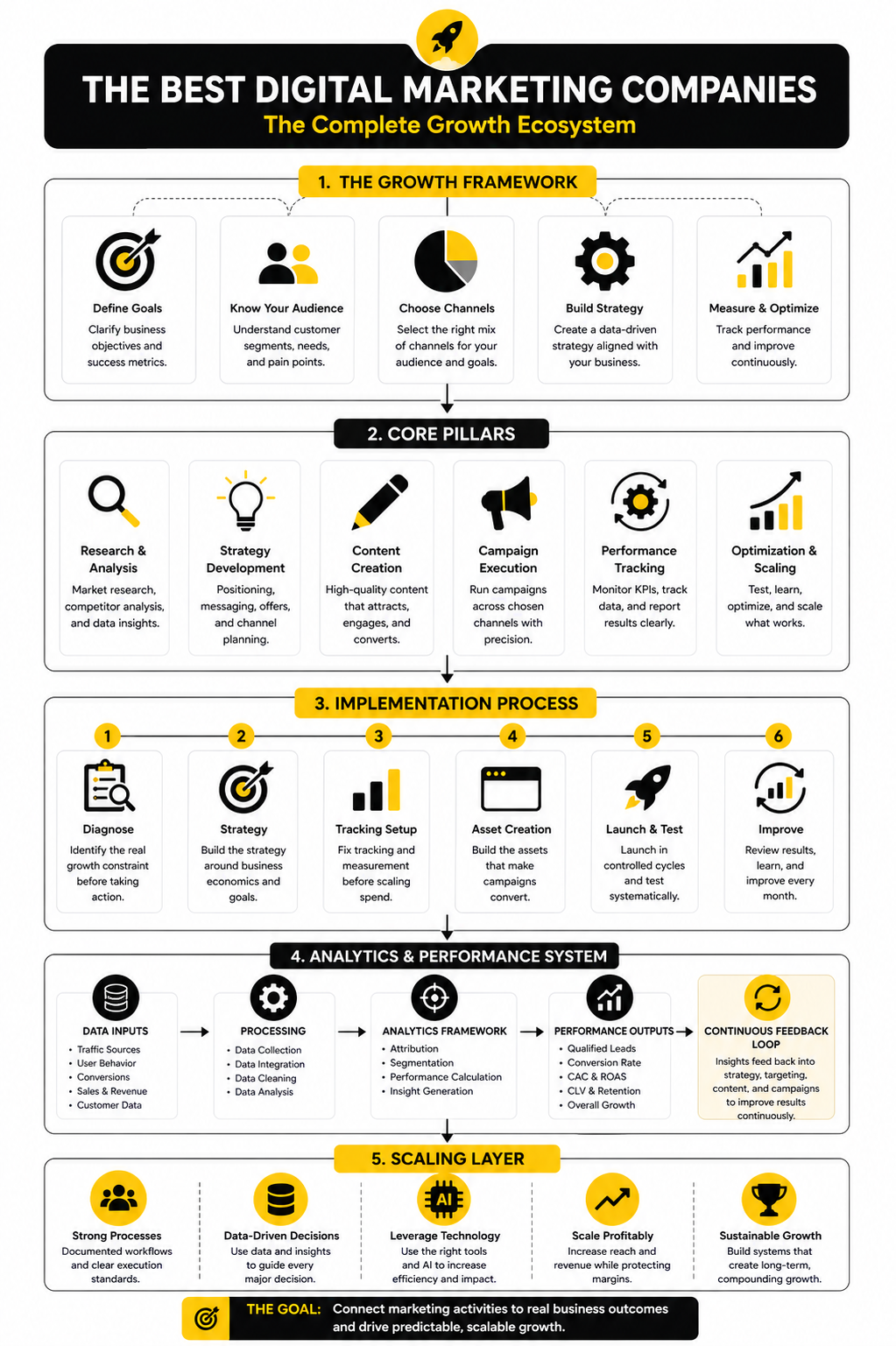
Final Checklist Before Choosing a Digital Marketing Company
The best digital marketing companies make your business easier to understand, easier to market, and easier to scale. They do not hide behind confusing reports or sell every channel as urgent. They help you identify the real constraint, build the right system, and improve it with evidence.
Before hiring, use this checklist:
- The agency can explain your business model in plain language.
- The first 90 days have a clear priority, not a random task list.
- Reporting connects marketing activity to qualified leads, pipeline, sales, or retention.
- The team is honest about attribution limits and testing assumptions.
- The agency explains what it will not do yet.
- Pricing matches the level of strategy, execution, and ownership required.
- The people selling the work are not completely separate from the people doing the work.
- The agency can discuss tradeoffs between SEO, paid media, content, lifecycle, and conversion work.
- The implementation process includes tracking, assets, launch cycles, and monthly improvement.
- The relationship feels like a partnership, not a vendor handoff.
Choosing well is not about finding the most famous agency. It is about finding the company that understands your market, your numbers, your constraints, and your next stage of growth. That is the partner worth paying for.
FAQ - Built for Complete Guide
What are the best digital marketing companies?
The best digital marketing companies are the ones that can connect strategy, execution, analytics, and business outcomes. A company may be excellent for ecommerce, but weak for B2B. Another may be strong in SEO, but not the right choice for paid acquisition or CRM automation.
The best choice depends on your business model, budget, market, and growth constraint. Look for a team that asks sharp questions before recommending channels. That is usually a stronger signal than a big logo wall.
How do I choose a digital marketing company?
Start by defining the problem you need solved. Do you need more qualified traffic, better conversion, stronger retention, cleaner analytics, or a full growth system? Once that is clear, compare agencies based on relevant experience, process, reporting quality, team structure, and how they think through tradeoffs.
Do not hire only because an agency promises fast results. Ask what they would do first, what they would avoid, and how they would measure progress. Strong answers should be specific to your situation.
How much do digital marketing companies charge?
Pricing varies widely based on scope, specialization, market, and deliverables. Small projects may be priced as fixed-fee audits or builds, while ongoing work usually uses monthly retainers. Some agencies also charge a percentage of ad spend or use performance-based models.
The important thing is not just the fee. It is whether the pricing matches the level of strategic ownership and execution quality you need. Cheap marketing becomes expensive fast when it creates noise without progress.
Are digital marketing agencies worth it?
A digital marketing agency is worth it when it brings expertise, execution speed, strategic clarity, and measurable improvement that your internal team cannot produce alone. It is not worth it when the agency simply runs tasks without understanding your business. That is the line.
The right agency should help you make better decisions, not just produce more marketing assets. If the work improves acquisition, conversion, retention, or learning speed, the partnership can be valuable. If it only creates reports and meetings, it is probably not worth the cost.
Should I hire a full-service agency or a specialist?
Hire a full-service agency when you need one team to coordinate strategy, channels, creative, analytics, and implementation. This can work well for smaller teams without senior marketing leadership. It keeps the system connected and reduces coordination problems.
Hire a specialist when you already know the bottleneck. If your SEO is the problem, hire SEO expertise. If your paid creative is weak, hire a performance creative team. If tracking is broken, hire analytics help before scaling spend.
What services should a digital marketing company offer?
Most strong agencies offer some mix of SEO, paid media, content, conversion strategy, email marketing, lifecycle automation, analytics, and social media. But the service list matters less than how those services work together. A disconnected list of services does not create a growth system.
Look for services that match your actual buyer journey. If leads need nurturing, email and CRM matter. If the offer is complex, content and comparison pages may matter. If speed is urgent, paid media and landing page testing may matter first.
How long does digital marketing take to work?
The timeline depends on the channel and the problem being solved. Paid media and landing page tests can create useful signals faster, while SEO and authority-building usually take longer. CRM, lifecycle, and conversion work can show impact once enough traffic or lead volume exists.
A good agency should not give one generic timeline for every business. They should explain what can be learned quickly, what needs patience, and what assumptions must be tested. That is much more useful than promising instant growth.
What metrics should I use to judge an agency?
Judge an agency by metrics tied to business progress. Qualified leads, pipeline, booked calls, sales, customer acquisition cost, payback period, conversion rate, retention, and customer lifetime value are usually more meaningful than impressions or clicks. Activity metrics can help diagnose performance, but they should not be the main proof.
The best digital marketing companies will also explain what each metric means. If a number changes, they should tell you why it likely changed and what action should follow. Reporting without decisions is just decoration.
What are the biggest red flags when hiring an agency?
Major red flags include guaranteed results without context, vague reporting, unclear ownership, generic strategy, poor communication, and pressure to sign before proper diagnosis. Another warning sign is when the agency recommends its favorite channel before understanding your business. That usually means they are selling a package, not solving a problem.
You should also be careful when the senior team disappears after the sales process. Ask who will actually work on your account. The answer matters.
Do I need a digital marketing company if I already have tools?
Tools help with execution, but they do not replace strategy. Platforms like GoHighLevel, ClickFunnels, Systeme.io, Buffer, and Brevo can support the system. They still need the right message, offer, targeting, tracking, and follow-up.
A good agency knows how to use tools without letting the tool become the plan. The tool should make execution cleaner. It should not decide the strategy for you.
Can small businesses work with top digital marketing companies?
Yes, but small businesses need to be careful with fit. A large agency may have strong capabilities, but may not give a smaller account enough senior attention. A smaller specialist or boutique agency may be more practical if it understands your market and can move quickly.
Small businesses should prioritize clarity, responsiveness, and direct commercial impact. You do not need the biggest agency. You need the partner that can identify the highest-leverage work and execute it well.
What should happen in the first 90 days?
The first 90 days should focus on diagnosis, tracking cleanup, strategy, asset creation, controlled launches, and early learning. It should not be a chaotic rush to do everything at once. The agency should define the first constraint and build around that.
By the end of the first 90 days, you should have clearer data, better assets, a sharper understanding of what the market responds to, and a practical next-step plan. You may not have solved every growth problem yet. But you should be smarter than when you started.
Work With Professionals
Explore 10K+ Remote Marketing Contracts on MarkeWork.com
Most marketers spend too much time chasing clients, competing on crowded platforms, and losing a percentage of every project to middlemen.
MarkeWork gives you a better way. Browse thousands of remote marketing contracts and connect directly with companies desperate to hire skilled marketers like you, without platform commissions and without unnecessary gatekeepers.
If you're serious about finding better opportunities and keeping 100% of what you earn, explore available contracts and create a profile for free at MarkeWork.com.