

Picking the best email marketing platform sounds simple until you are the one paying for it, migrating data into it, and living with the consequences for the next two years. Most teams do not fail because they chose a terrible tool. They fail because they chose a platform that looked affordable on day one, then became limiting once automation, segmentation, reporting, and deliverability started to matter.
That is why this article is not built around a lazy “top 10” list. The real question is not which platform has the most features. It is which one fits your business model, your team’s workflow, your growth stage, and the kind of customer journey you actually need to run.
In practice, the best email marketing platform for a creator is rarely the best one for an ecommerce brand, a local service business, or a B2B company with a longer sales cycle. Some tools win on simplicity. Some win on automation depth. Some are really CRM-first platforms with email attached. And some are cheap at the start but expensive the moment your list grows.
This first part sets the foundation for the rest of the article. We will define how to judge platforms properly, what “best” should mean in 2026, and the framework we will use to compare tools without getting distracted by flashy feature lists.

Article Outline
- What Makes an Email Marketing Platform Worth Choosing
- The Evaluation Framework for Comparing Platforms
- Core Features That Separate Basic Tools From Serious Platforms
- Which Platforms Fit Different Business Types Best
- How to Choose Without Regretting the Migration Later
- Final Recommendations and Frequently Asked Questions
What Makes an Email Marketing Platform Worth Choosing
The best email marketing platform is the one that helps you send relevant messages, automate follow-up, keep your list healthy, and measure business results without turning every campaign into a technical project. That sounds obvious, but a surprising number of businesses still choose based on template galleries, free-plan limits, or whatever tool they have heard the most about. Those things matter, but they are not the core decision.
A serious platform should make four things easier: collecting subscribers, segmenting them intelligently, sending campaigns reliably, and moving people through automated journeys. If the software cannot support those jobs without friction, it will eventually slow down growth instead of supporting it. A polished dashboard does not fix weak automation logic, poor reporting, or limited integrations.
This is also where context matters. A newsletter business might care most about writing flow, audience tagging, and deliverability. An ecommerce brand will care far more about revenue attribution, abandoned cart flows, product data, and behavior-based triggers. A local business may get better results from an all-in-one system such as GoHighLevel because email is only one part of the customer pipeline, not the whole game.
The Evaluation Framework for Comparing Platforms
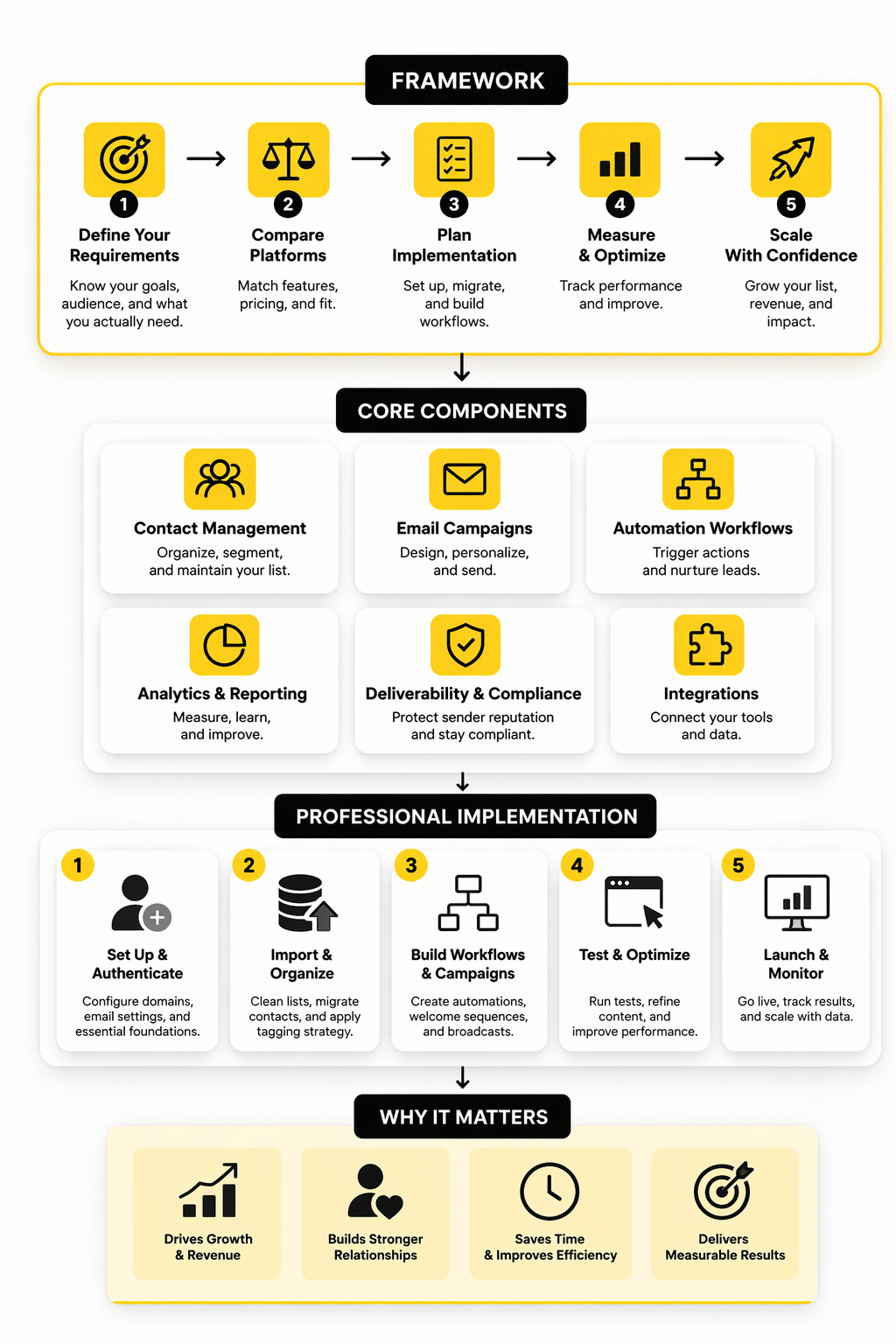
To find the best email marketing platform, you need a framework that filters out marketing noise. The easiest mistake is comparing tools as if they all solve the same problem. They do not. Some are built for newsletters, some for commerce, some for lifecycle automation, and some for agencies or service businesses that need email, CRM, forms, pipelines, and SMS in one place.
The framework used in this article focuses on six practical questions. First, how easy is the platform to use when building real campaigns, not demo campaigns. Second, how strong is its automation engine once your business needs branching logic, tagging, and behavior-based triggers. Third, how well does it handle segmentation, personalization, and reporting. Fourth, how cleanly does it integrate with the rest of your stack. Fifth, how quickly does pricing become painful as your list or send volume grows. Sixth, how hard would it be to leave if the platform stops fitting your needs.
That last point is underrated. Switching email platforms is not just a software change. It affects forms, automations, segments, templates, reporting, lead routing, and often your sales follow-up process too. When a tool is cheap but creates migration risk later, the true cost is much higher than the monthly plan suggests.
How “Best” Changes Based on Your Business Model
The phrase best email marketing platform only makes sense once you define the business it needs to serve. For ecommerce, strong event-based automation, catalog sync, and revenue attribution usually matter more than broad CRM functionality. For B2B, lead nurturing, scoring, CRM connections, and multi-step workflows often matter more than flashy design tools.
For solo creators and lean media brands, the winning tool is often the one that keeps publishing simple while still allowing segmentation and monetization as the audience grows. For local businesses and agencies, the best option may be less about email alone and more about centralizing conversations, follow-up, forms, appointments, and pipeline management. That is why some businesses outgrow simple newsletter tools faster than they expect.
This is also why broad “best of” lists can be misleading. A platform can be excellent and still be the wrong choice for you. In the next parts, we will move from the framework into the actual components that matter most, then match platform types to business needs so the final recommendation feels practical instead of generic.
Core Features That Separate Basic Tools From Serious Platforms
Once you stop asking which brand is the loudest and start asking what the software actually lets you do, the list gets much shorter. The best email marketing platform is rarely the one with the prettiest homepage. It is the one that helps you build relevant campaigns, automate follow-up, understand performance, and keep operating costs under control as your list grows.
This is the point where a lot of businesses make an expensive mistake. They buy a simple sender when they really need a system for lifecycle marketing, or they buy an all-in-one suite when all they really need is clean email execution. The difference matters because every extra layer of complexity either compounds your growth or slows your team down.
Deliverability and Sending Control Come First
If a platform cannot get your emails into inboxes consistently, the rest of the feature set is basically decoration. Good segmentation, smart automation, and polished templates do not matter much when engagement drops because your sending reputation is weak or your setup options are limited. This is why deliverability should sit at the top of the checklist, even if most buyers look at it last.
What matters here is not marketing language. You want clear support for domain authentication, list hygiene, consent-based acquisition, and enough reporting to spot engagement problems before they become revenue problems. A platform like Brevo’s email and transactional setup is useful for businesses that need both marketing sends and operational email in one place, while a more centralized operating system like GoHighLevel’s email marketing stack makes more sense when email is tied tightly to pipeline follow-up and lead management.
This is also where sending volume and pricing model start to matter. Some platforms charge more based on contacts, while others emphasize email volume or bundled communication features, which can change the economics fast once your database expands. The best choice is usually the one that matches how you send, not just how many subscribers you have today.
Automation Depth Is Where Real Leverage Shows Up
A serious platform should let you do more than schedule newsletters. It should let you trigger emails based on actions, delays, tags, purchases, form submissions, booking behavior, or sales-stage movement. That is when email stops being a broadcast tool and starts becoming infrastructure.
This is one of the clearest dividing lines between a basic email tool and the best email marketing platform for growth. When workflows can branch, wait, update contact records, notify a team, and hand off leads across channels, you get compounding returns from the same audience. GoHighLevel’s workflow system leans heavily into this all-in-one approach, while Moosend’s automation positioning stays attractive for teams that want automation without a giant operating system wrapped around it.
The practical question is simple. Can your team build the journey you actually need without duct-taping together five tools and three workarounds. If the answer is no, the platform may still be useful for basic campaigns, but it is probably not the right long-term choice.
Segmentation and Personalization Should Be Built Into the Workflow
Email gets more effective when relevance goes up. That means the platform needs to make segmentation feel normal, not advanced. You should be able to separate contacts by source, behavior, lifecycle stage, purchase history, engagement level, or whatever matters to your business without turning every campaign into a database project.
This matters because the best email marketing platform is not just a sending engine. It is a decision engine. The moment a tool lets you tag users cleanly, update records automatically, and personalize messages based on real behavior, your campaigns start feeling less like mass communication and more like timing.
For leaner operators, this is one reason tools like Systeme.io stay appealing. It combines funnels, email, and automation in a way that is often good enough for creators and small businesses that want simplicity before sophistication. On the other side, businesses that need deeper contact histories and cross-channel orchestration often benefit more from platforms that treat the customer record as the center of the system rather than an afterthought.
Integrations Decide Whether the Platform Helps or Hurts
Most businesses do not run on email alone. They run on forms, landing pages, payments, ecommerce platforms, calendars, CRMs, sales tools, and sometimes SMS or chat layered on top. So even if a tool looks strong on paper, it becomes frustrating fast when it cannot pass clean data between the systems that actually run your revenue.
This is why integration quality deserves more attention than template design. A beautiful editor is nice, but a clean sync between lead capture, email automation, and downstream sales action is what saves time every single week. Businesses that want an all-in-one route often lean toward GoHighLevel, while teams focused on funnels and lightweight business operations sometimes prefer ClickFunnels or Systeme.io.
The right answer depends on what you are trying to reduce. If your main pain is tool sprawl, an integrated platform can be a relief. If your main pain is email execution inside an already mature stack, a more focused platform often keeps things cleaner.
Reporting Has to Connect to Business Outcomes
Open rates still tell you something, but not enough. A platform becomes much more valuable when it helps you see which campaigns drive clicks, replies, bookings, purchases, or qualified pipeline movement. Without that connection, teams end up optimizing surface-level metrics and missing what is actually driving growth.
The best email marketing platform should help you answer practical questions quickly. Which sequences convert best. Which segments are going cold. Which acquisition sources lead to engaged subscribers instead of dead weight. Brevo’s broader customer platform and Moosend’s reporting-focused positioning are good reminders that analytics is not a side feature anymore. It is part of the buying decision.
This is especially important once multiple people touch the funnel. Marketing might own campaigns, sales might own follow-up, and operations might own attribution cleanup. When reporting is weak, the team debates opinions. When reporting is strong, the team can actually improve the system.
Pricing Only Looks Simple Until You Grow
A platform can feel cheap when you have 1,000 contacts and almost no automation running. It can feel very different once you have 50,000 contacts, multiple journeys, and a business that depends on fast support and reliable sending. That is why the monthly number on the pricing page is only the start of the evaluation.
What you really want to understand is the shape of the cost curve. Does pricing rise mainly with contacts, email volume, users, automation access, or add-ons. Brevo’s pricing structure, GoHighLevel’s trial and platform approach, and Systeme.io’s free-entry model all appeal to different kinds of buyers for exactly this reason.
Cheap is not the goal. Economic fit is the goal. A platform that costs more but removes other subscriptions, reduces manual work, and improves follow-up can easily be the better financial decision.
Why These Features Matter More Than “Best Of” Lists
This is where most comparison articles lose the plot. They rank tools as if every reader has the same sales cycle, team size, budget, and growth goals. Real buying decisions do not work like that, and pretending they do is how businesses end up migrating six months later.
The better approach is to evaluate the best email marketing platform through the lens of capability, constraints, and future fit. Does it send reliably. Can it automate the journeys you need. Will it still make sense when your list grows, your segmentation gets more advanced, and your revenue starts depending on the quality of the follow-up.
That sets up the next step naturally. Now that the core components are clear, the real question becomes which types of platforms fit different kinds of businesses best. That is where the decision gets much easier, because the shortlist starts matching actual use cases instead of generic hype.
Which Platforms Fit Different Business Types Best
Once the core feature checklist is clear, the best email marketing platform becomes much easier to identify. You stop comparing tools in the abstract and start asking a more useful question: what kind of business is this platform actually built to serve. That shift saves a lot of money, a lot of migration pain, and a lot of false starts.
The truth is simple. Most platforms are not trying to win every category. Some are stronger for creators and lean operators, some are better for service businesses that need CRM and pipeline control, and some sit in the middle with enough flexibility to support a wide range of teams without becoming overwhelming.
Best Fit for Creators and Small Digital Businesses
Creators, coaches, solo operators, and small digital businesses usually do not need an oversized stack on day one. They need a platform that lets them capture leads, send campaigns, build basic automations, and connect email to landing pages or simple funnels without a week of setup. In that context, the best email marketing platform is often the one that gets out of the way.
That is why tools like Systeme.io remain attractive. The appeal is not that it wins every enterprise feature comparison. The appeal is that it combines pages, email, automation, and product delivery in one environment, which is exactly what many smaller businesses need before complexity starts paying for itself.
ClickFunnels also fits this category when the funnel itself is the center of the business model. If revenue depends on opt-in pages, offers, upsells, and follow-up sequences tied tightly to conversion flow, a funnel-first tool can make more sense than a pure email platform. The tradeoff is that not every business wants email strategy to live inside a funnel builder, so the right choice depends on what drives sales in the first place.
Best Fit for Service Businesses and Agencies
Service businesses usually need more than newsletters. They need forms, appointments, reminders, pipeline stages, follow-up sequences, and sometimes text messaging layered on top of email. That changes the buying decision fast, because the best email marketing platform for a local business or agency is often not an email-first tool at all.
This is where GoHighLevel stands out. It is built around the reality that many businesses do not just need campaigns. They need a system that turns leads into booked calls, booked calls into deals, and missed follow-up into automated recovery. For agencies in particular, the subaccount model, workflow logic, and broader operating system matter more than having the world’s most elegant newsletter editor.
That does not mean every service business needs an all-in-one platform. It means businesses with fragmented tools should take that route seriously. If email, CRM, scheduling, and pipeline follow-up are all separate right now, consolidating can be the smarter move even if the learning curve is slightly steeper at the beginning.
Best Fit for Budget-Conscious Teams That Still Need Real Automation
Some businesses are not looking for the flashiest tool. They want a system that handles email competently, offers automation depth, and stays economically reasonable as they grow. That category is bigger than people think, because many companies sit in the middle: too advanced for bare-bones tools, not complex enough to justify a sprawling enterprise platform.
That is where platforms like Brevo and Moosend stay relevant. Brevo’s position is strengthened by its broader communication stack and pricing structure, while Moosend keeps appealing to teams that want automation and campaign control without unnecessary bulk. Neither tool is the universal answer, but both make sense for businesses that want a practical middle ground.
This is also the segment where platform economics matter a lot. A business with steady growth but disciplined margins cannot afford to choose based on hype. It needs the best email marketing platform for its current stage and its next stage, not just the one with the loudest reputation online.
A Practical Implementation Process
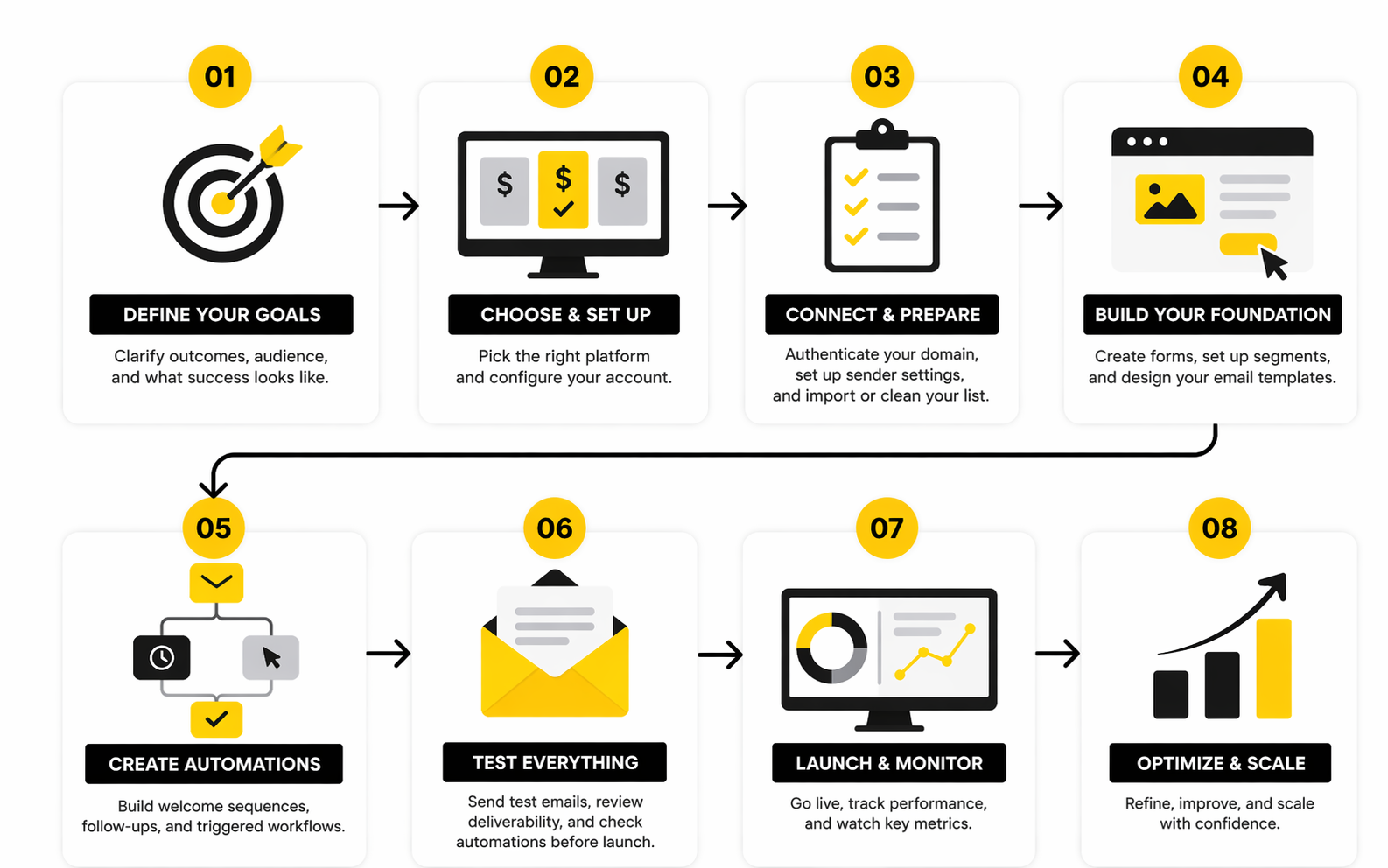
Choosing the platform is only half the job. The businesses that actually get results are the ones that implement with discipline instead of importing a list, sending one campaign, and declaring the software a success or failure. Good implementation is boring in the best possible way. It is structured, deliberate, and tied to real business outcomes.
The process below is what makes the decision tangible. It keeps the evaluation grounded in execution instead of brand perception, and it helps you tell very quickly whether a platform will support the way your business really works.
Step 1: Map the Customer Journey Before You Touch the Software
Before you test any platform, write down the main path from lead to customer. Where do contacts come from. What actions matter most. What messages should be triggered based on those actions. This sounds basic, but skipping it is one of the fastest ways to buy the wrong tool.
A surprising number of teams start inside the software instead of starting with the journey. Then they end up designing their marketing around whatever the tool makes easiest. The best email marketing platform should support your process, not quietly replace it with a weaker one.
Step 2: Define the Non-Negotiable Automations
Every business has a small set of flows that matter far more than the rest. For a service business, that might be lead response, appointment reminders, no-show recovery, and reactivation. For a creator, it might be welcome sequences, lead magnet delivery, nurture flows, and sales follow-up tied to launches or evergreen offers.
This is where you separate nice-to-have features from true buying criteria. If a platform cannot run your highest-value automations cleanly, it is not the right platform. That remains true even if it looks cheaper, easier, or more popular.
Step 3: Test the Data Flow, Not Just the Email Builder
It is easy to get distracted by templates and drag-and-drop editors. The real implementation test is whether contact data enters the system cleanly, updates correctly, triggers the right workflows, and remains usable for segmentation later. That is what determines whether the platform becomes an asset or a mess.
This is why integrations matter so much in practice. If you are using booking tools, forms, checkout pages, or CRM pipelines, the platform has to handle those inputs without constant cleanup. GoHighLevel, Brevo, and Systeme.io each approach that problem differently, which is exactly why implementation testing matters more than feature list reading.
Step 4: Run One Core Workflow End to End
Do not try to build your entire ecosystem in the first week. Build one workflow that matters, launch it, and inspect every step. Watch how the contact enters, how tags or fields update, how the emails fire, what the reporting looks like, and whether the team can actually manage it without confusion.
This is the moment where theoretical fit becomes obvious. A platform can look perfect during evaluation and still feel clumsy when a real workflow is live. On the flip side, a platform that looked slightly less impressive in comparisons can turn out to be the best email marketing platform for your business because your team can operate it confidently every day.
Step 5: Measure Outcome Metrics, Not Vanity Metrics Alone
Implementation is not done when the emails send. It is done when the workflow produces a useful business result. That could be booked calls, completed purchases, improved reactivation, lower lead response time, or stronger conversion from subscriber to customer.
Surface metrics still matter, but they are not enough by themselves. Mailchimp’s benchmark data shows how much performance can vary by industry, and Brevo’s 2025 benchmark analysis reinforces the same point from a different data set. Those benchmarks are useful for context, but your implementation should still be judged by whether the system moves the business forward, not whether one campaign beat a generic open-rate average.
Why Implementation Usually Exposes the Right Choice
This is the part most comparison content skips, and it is exactly where the real decision gets made. The best email marketing platform reveals itself when a real process meets a real team under real conditions. Can people use it without confusion. Can it support the customer journey without awkward workarounds. Can it produce reliable follow-up without constant babysitting.
That is why implementation should not be treated as a post-purchase detail. It is part of the buying decision itself. A platform is not proven when the demo looks clean. It is proven when your core workflow is live and your team would actually be comfortable building the next five automations on top of it.
From here, the next logical step is to tighten the decision even further. The shortlist is clearer now, but avoiding regret comes down to one more thing: knowing how to choose with future migration, pricing pressure, and operational friction in mind.
What the Numbers Actually Tell You
Once you get past feature pages and pricing tables, the best email marketing platform usually reveals itself in the data. Not in one vanity metric, not in one lucky campaign, and definitely not in a screenshot from a sales page. What matters is whether the platform helps you measure the right signals, interpret them correctly, and turn them into better decisions.
This is where a lot of teams go wrong. They look at open rate first, feel good or bad about the number, and stop there. That is far too shallow. Modern email performance has to be read as a system, because one metric can look healthy while the business result underneath it is getting worse.
Benchmark Data Is Useful, but Only in Context
Benchmark reports are valuable because they give you a rough map of what normal looks like. Brevo’s 2025 benchmark data puts overall open rate at 31.22%, click-through rate at 3.64%, unsubscribe rate at 0.4%, and hard bounce rate at 0.19%, while Mailchimp’s benchmark page places a typical open rate closer to 34.23% and CTR around 2.66%. That difference is not a contradiction. It is a reminder that methodology, customer base, geography, industry mix, and privacy adjustments all change the picture.
So the correct question is not “what is the perfect open rate.” The better question is whether your performance is healthy for your list quality, business model, and campaign type. If your numbers are flat but revenue per send is rising, that can still be progress. If opens look strong but clicks, replies, bookings, or purchases are weak, then the apparent success is probably misleading.
That is exactly why the best email marketing platform should not just show dashboard numbers. It should help you connect those numbers to actual business outcomes. Otherwise you are managing optics, not performance.
Open Rate Still Matters, but Less Than Many People Think
Open rate is still useful as a directional signal. It can help you evaluate subject lines, send timing, brand recognition, and whether your list is generally willing to pay attention. But privacy protections have made it a noisier signal than it used to be, which means treating it like the ultimate measure of success is a mistake.
A higher open rate can mean your subject line worked. It can also mean the audience is loyal, the segment is warm, or the sending conditions happened to be favorable. None of that guarantees the email moved anyone closer to action. That is why a platform that overemphasizes opens without making downstream analysis easy is giving you an incomplete picture.
This is one of the practical differences between a lightweight sender and the best email marketing platform for a growing business. Better systems make it easier to compare opens against clicks, conversions, unsubscribe behavior, and the movement of contacts through automations or pipeline stages.
Click-Through Rate Is Usually More Actionable
Clicks are not perfect, but they are closer to real intent. When someone clicks, they are usually doing more than glancing at a subject line. They are engaging with the offer, the message, or the next step you wanted them to take. That makes click-through rate one of the most useful mid-funnel metrics in the entire email stack.
Across large benchmark sets, CTR tends to land in the low single digits, which is exactly why teams should read it carefully rather than dismiss it as small. In email, a small change in click rate can mean a meaningful difference in pipeline, revenue, or booked calls when multiplied across a large list. Brevo’s data by industry and region and Mailchimp’s broader benchmark ranges both reinforce that point.
If open rate is healthy but CTR is weak, that usually points to one of four issues. The offer is not compelling enough. The body copy is not doing its job. The audience segment is too broad. Or the call to action is unclear. That is the kind of interpretation that should drive action inside your platform.
The Metrics That Actually Deserve Weekly Attention
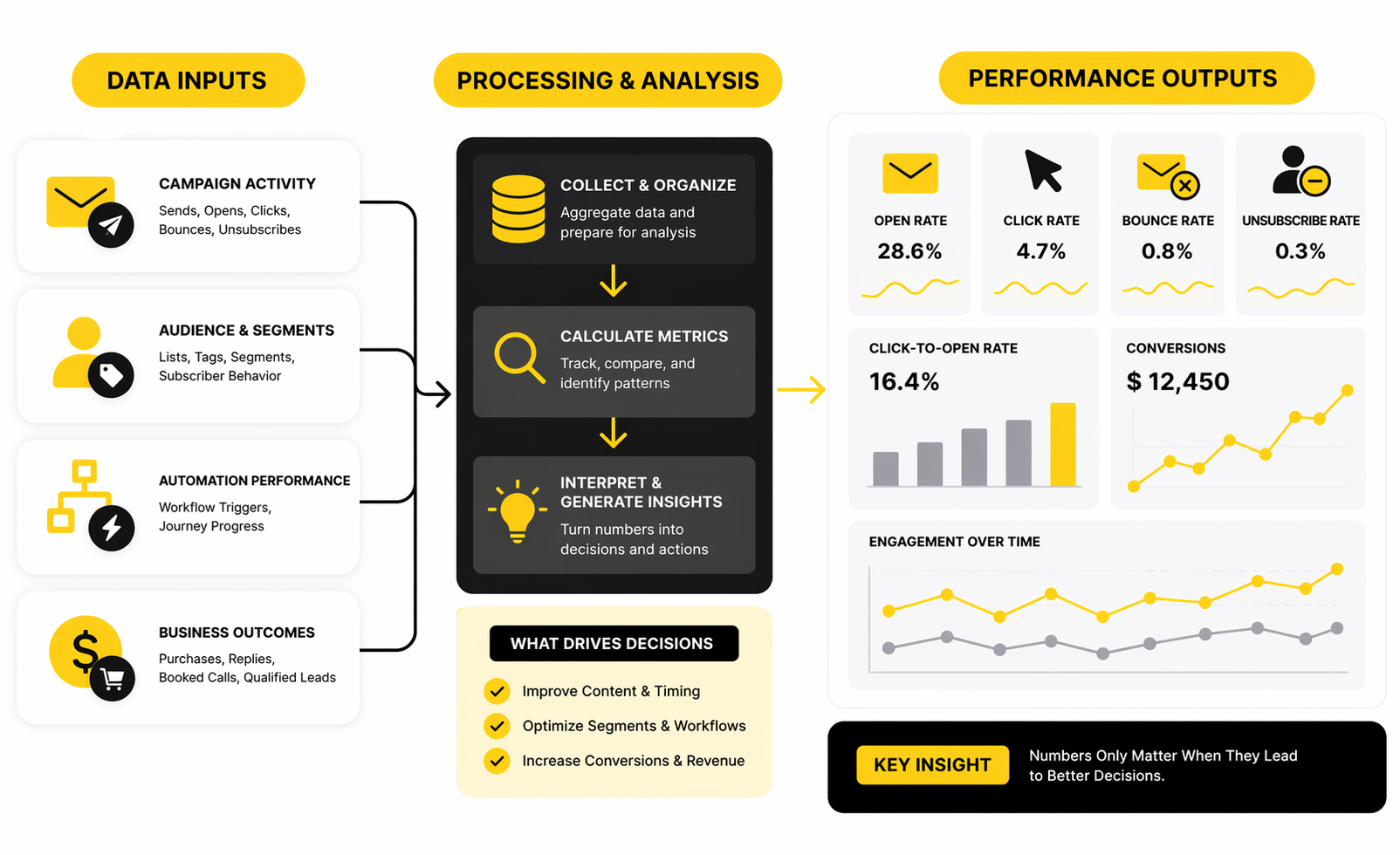
If you want a measurement system that is genuinely useful, focus on a small group of signals that work together. The best email marketing platform should make these easy to review without forcing your team into spreadsheet gymnastics every time a campaign goes out. If that sounds basic, good. Useful analytics usually are.
The core weekly metrics worth tracking are:
- open rate as a directional indicator of subject line strength and audience recognition
- click-through rate as a better signal of message relevance and offer strength
- click-to-open rate to show how well the email converted attention into action
- unsubscribe rate to detect fatigue, weak targeting, or expectation mismatch
- bounce rate to monitor list quality and sender health
- conversion rate or downstream action rate to connect campaigns to real business value
These numbers matter most when read together. A campaign with moderate opens and strong clicks can be healthier than one with high opens and weak action. A slight increase in unsubscribes is not always bad if the email drove strong qualified intent, but a persistent rise usually means something is off in targeting, frequency, or message quality. ActiveCampaign’s unsubscribe guidance frames anything below 0.5% as generally good and below 0.2% as excellent, which is a useful sanity check rather than a rule carved in stone.
Deliverability Data Should Change Behavior Fast
Deliverability is one of the easiest things to ignore until it becomes expensive. A platform might show that emails were sent successfully, but that does not mean they landed where they needed to land. Inbox placement, spam placement, and missing rates tell a much more realistic story about whether your message had a fair chance to perform.
Brevo’s benchmark breakdown by mailbox provider shows visible differences across providers, including lower inbox placement for some ecosystems than many marketers would expect. That matters because weak engagement is not always a content problem. Sometimes the problem starts before the reader even sees the message.
The action here is not subtle. If bounce rate rises, list cleaning becomes urgent. If inbox placement falls, authentication, sending practices, and engagement strategy need attention. If one segment consistently underperforms, suppressing or reactivating it may do more for overall performance than writing another clever subject line.
Benchmarks Should Guide Decisions, Not Ego
A benchmark is a reference point, not a trophy. The goal is not to brag that your open rate beat some cross-industry average. The goal is to understand whether your system is getting healthier, whether your audience is becoming more engaged, and whether the platform is helping you improve performance over time.
That is why trend lines matter more than isolated wins. If the same sequence produces improving clicks, stable unsubscribes, and better downstream conversion over three months, that tells you more than one strong campaign ever could. On the other hand, if headline metrics look decent while revenue per campaign falls, the numbers are trying to warn you.
This is also why the best email marketing platform should make segmentation-level analysis easy. You want to know which source, segment, or journey is performing well, not just whether the account average looks acceptable. Aggregate averages hide too much.
What Data Should Drive Next
Good analytics should lead to a clear next move. If opens are weak, test subject lines, sender identity, and send timing. If clicks are weak, improve the offer, the structure of the email, or the specificity of the call to action. If unsubscribes spike, reduce frequency for that segment or tighten targeting. If bounces rise, clean the list and review acquisition sources immediately.
This is where software choice becomes very practical. The best email marketing platform is not the one that merely reports problems. It is the one that makes it easy to act on them through segmentation, workflow changes, suppression logic, retargeting, and follow-up automation. Analytics without execution is just a prettier form of confusion.
That sets up the next section naturally. Once you know how to read performance signals properly, the final decision comes down to avoiding the common buying mistakes that create regret later: overbuying, underbuying, and choosing a platform that looks good in comparison tables but creates friction once the business grows.
How to Choose Without Regretting the Migration Later
By this point, the shortlist is usually clear. The hard part is not identifying a few strong options. The hard part is choosing the best email marketing platform in a way that still feels smart after your list grows, your workflows get more complicated, and your team has to operate the system every day.
This is where advanced tradeoffs matter. A platform can look impressive in a demo, affordable on a pricing page, and still become the wrong fit once you add more users, more automations, more segments, and more pressure on reporting. The goal now is not to chase the most features. It is to avoid the specific mistakes that create expensive regret later.
The Real Risk Is Usually Operational Friction
Most businesses do not switch platforms because a tool is completely broken. They switch because day-to-day work becomes frustrating. Building workflows takes too long, reporting is too shallow, data gets messy, or the team starts creating workarounds for things that should have been simple from the start.
That friction compounds quietly. One workaround feels manageable, then five workarounds become the operating model, and suddenly the platform is absorbing time that should have gone into better campaigns, better segmentation, or faster follow-up. The best email marketing platform should reduce operational drag as you scale, not increase it.
This is one reason all-in-one systems continue to gain attention. When email, CRM, pipeline, forms, and automations live in one place, teams often reduce handoff issues and tool-switching fatigue. GoHighLevel’s platform positioning speaks directly to that benefit, but the tradeoff is that broader systems usually ask for more setup discipline upfront.
Overbuying Is Just as Dangerous as Underbuying
A lot of businesses worry about picking a tool they will outgrow. That is a valid concern, but the opposite mistake is just as common. They buy a platform built for a much more complex operation than they actually run, and then end up paying for sophistication they never use.
That creates a different kind of drag. The team avoids features because they feel heavy, onboarding takes longer, and simple tasks start requiring unnecessary decisions. In that situation, the best email marketing platform is not the most advanced one on paper. It is the one with the right level of complexity for the current business and a believable path into the next stage.
This is where smaller operators often do better with systems that package email, pages, and automation more simply. Systeme.io remains relevant for exactly that reason. It can be easier to grow into a streamlined platform than to shrink your operations into a heavyweight one you never fully adopt.
Pricing Pressure Changes the Decision More Than People Expect
Pricing is not just about the monthly fee. It is about how the fee changes when your contact count rises, your email volume increases, your team expands, or your business needs more advanced support. That pricing curve is one of the most underestimated parts of the buying decision.
Brevo’s pricing structure and its breakdown of how email marketing costs scale with list size and send volume show why surface-level comparisons can be misleading. A tool that looks cheap at the start can become awkward later, while a platform that seems more expensive upfront may replace other subscriptions or reduce manual labor enough to make the economics better over time. Brevo’s email pricing guide is a useful reminder that list growth changes the cost conversation fast.
This is why serious buyers should model the decision at multiple stages, not just today’s list size. Run the numbers for where the business is now, where it could be in 12 months, and what happens if automation usage expands significantly. That exercise alone eliminates a lot of bad choices.
Deliverability Becomes More Important as You Scale
Early on, many teams can get away with focusing mostly on campaign creation and simple metrics. Once the program matures, deliverability stops being a background concern and becomes central to performance. More sends, more segments, and more automation usually mean more opportunities to damage sender reputation if the system is not managed carefully.
That is one reason platform support and documentation matter more than many buyers expect. GoHighLevel’s deliverability documentation and Brevo’s benchmark and deliverability guidance both point toward the same reality: authentication, list hygiene, and engagement quality matter more as programs expand. The platform itself does not solve deliverability for you, but it absolutely affects how easy it is to monitor and manage.
This should influence the decision earlier than most teams think. If the business plans to lean heavily on automation, reactivation, lifecycle campaigns, or high-volume sending, the best email marketing platform needs to make sender-health management feel like a built-in discipline rather than an afterthought.
Platform Lock-In Is Real, Even When Nobody Talks About It
The more successful your setup becomes, the harder it is to leave. That is the paradox. Good implementation creates value, but it also creates dependency through workflows, custom fields, forms, templates, reporting structures, and team habits. So part of choosing well is understanding how painful an eventual migration could become.
This does not mean you should avoid powerful platforms. It means you should avoid messy architecture inside powerful platforms. Use clear naming conventions, document your core automations, keep your segmentation logic understandable, and avoid building a system that only one person on the team can explain. That is not just good operations. It is future-proofing.
The businesses that regret their platform choice most are often not the ones that picked a weak tool. They are the ones that built a confusing system inside a capable tool. The best email marketing platform cannot protect you from bad architecture, but the right platform will make good architecture easier to maintain.
Scaling Gets Easier When the Platform Matches Your Operating Model
This is the expert-level filter that matters most. Not “does the platform have advanced features,” but “does the platform match how the business actually operates.” A service business with multi-step lead follow-up and appointment flow needs a different operating model than a creator selling digital products or a lean team running straightforward promotions.
That is why one business sees massive leverage from GoHighLevel while another does better with Brevo, Moosend, or Systeme.io. The winning choice is not the one that wins the broadest comparison. It is the one that fits the underlying motion of the business.
That is also why expert buyers look beyond features and into workflow alignment. If the platform matches your operating model, scale tends to feel like expansion. If it does not, scale feels like more admin, more cleanup, and more complexity layered on top of weak foundations.
The Shortlist Should Be Smaller Now
At this stage, the decision should feel less noisy. You are no longer comparing every tool with every other tool. You are comparing a handful of realistic options against the way your business captures leads, follows up, converts customers, and reports results.
That is the right place to be before making the final call. The last step is not another giant comparison table. It is a clear recommendation based on business type, growth stage, and practical fit, followed by the questions people usually ask right before they commit.
Final Recommendations and Frequently Asked Questions
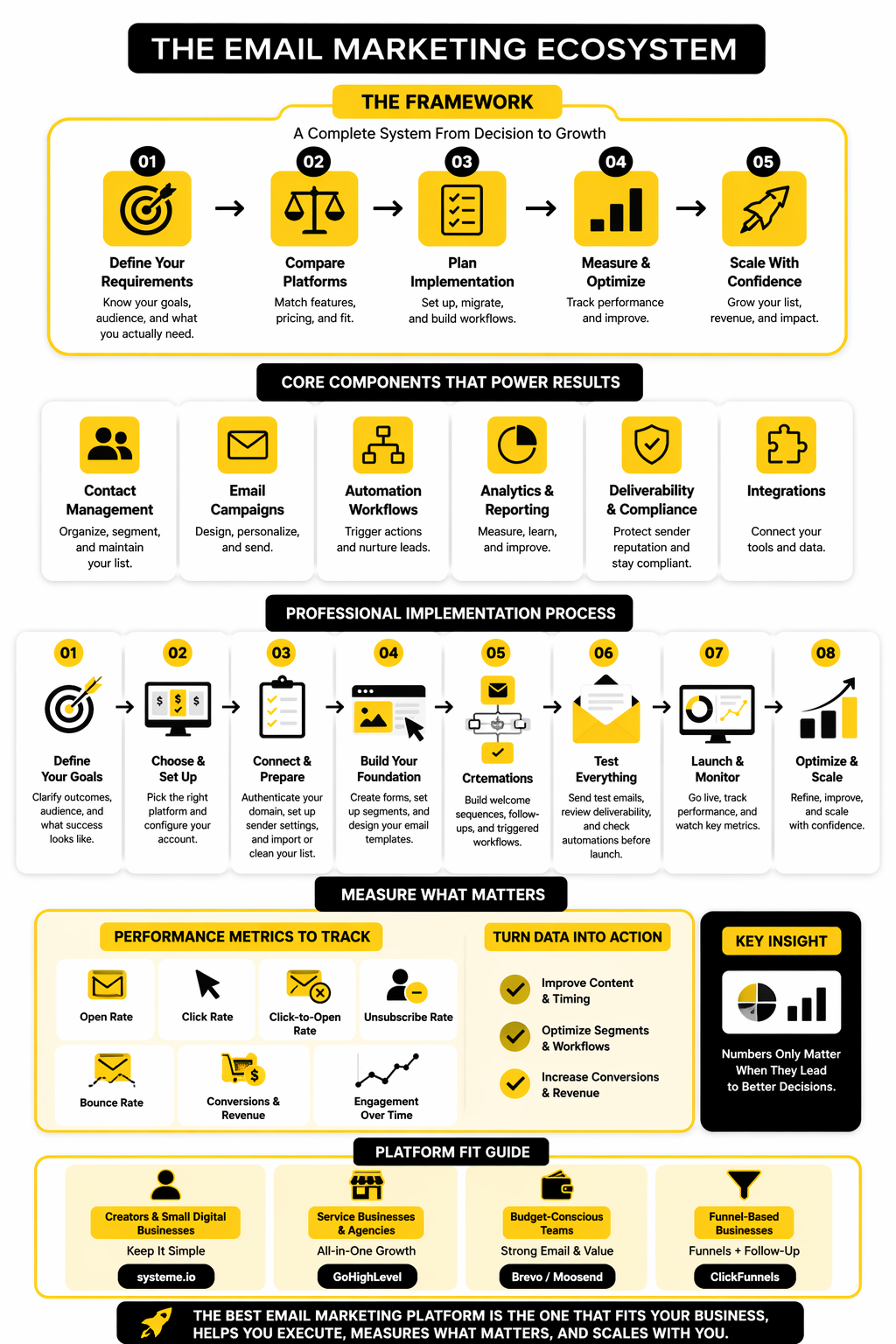
At this stage, the best email marketing platform should not feel like a mystery anymore. The right choice depends less on hype and more on whether the tool matches your business model, your automation needs, your reporting expectations, and the way your team actually works. That is the thread running through this entire guide.
For service businesses, agencies, and operators who need email tied directly to CRM, pipeline stages, booking flows, and follow-up automation, GoHighLevel is usually the strongest fit. For lean digital businesses that want simplicity across funnels, email, and automation without a heavy operational layer, Systeme.io remains a practical choice. For businesses that want strong email functionality with a broader multichannel stack and flexible entry pricing, Brevo deserves a serious look. For teams that want capable automation without turning the whole business into a giant software project, Moosend stays in the conversation for good reason.
The biggest mistake now would be searching for one universal winner. There is no single best email marketing platform for every business. There is only the best fit for your operating model, your growth stage, and the kind of customer journey you need to run consistently.
FAQ - Built for Complete Guide
What is the best email marketing platform for most small businesses?
For many small businesses, the best email marketing platform is the one that keeps setup manageable while still giving you room to automate. That is why lighter all-in-one tools and mid-market platforms tend to outperform bloated enterprise systems for smaller teams. If simplicity matters most, Systeme.io is often easier to adopt, while Brevo gives more room for multichannel growth.
Which platform is best for agencies and service businesses?
Agencies and service businesses usually need more than broadcast email. They need pipelines, forms, workflows, reminders, and lead follow-up connected to revenue activity. In that setup, GoHighLevel is often the strongest answer because it treats email as one piece of a broader operating system rather than the whole product.
Is the cheapest platform usually the best long-term option?
Usually not. Cheap at the beginning can become expensive once list size grows, send volume rises, or advanced automations become necessary. Brevo’s pricing structure and its broader discussion of how email marketing costs scale make that pretty clear. The better question is whether the cost curve still makes sense when your business gets bigger.
What matters more, automation or templates?
Automation matters more once the business starts relying on lifecycle marketing. Templates help presentation, but automation determines whether leads are followed up with, segmented correctly, and moved into the right journey at the right time. That is why the best email marketing platform is usually the one with the stronger workflow logic, not the one with the nicest drag-and-drop editor.
How important is deliverability when comparing platforms?
It is absolutely central. A platform can have great workflows and clean reporting, but weak deliverability will crush performance before the rest of the system gets a fair shot. Brevo’s 2025 benchmark material and its campaign guidance show how inbox performance, bounce behavior, and engagement signals work together, which is exactly why deliverability should be part of the platform decision from day one.
Is an all-in-one platform better than a dedicated email tool?
Sometimes yes, sometimes no. If your business suffers from tool sprawl, handoff problems, and disconnected data, an all-in-one platform can be a major upgrade. If your stack is already mature and you mainly need focused email execution, a dedicated or lighter platform may keep operations cleaner. The best email marketing platform is the one that reduces friction in your actual workflow, not the one that sounds best in a comparison headline.
What metrics should I actually watch every week?
Most teams should watch opens, clicks, click-to-open rate, unsubscribe rate, bounce rate, and one real business outcome such as purchases, replies, booked calls, or qualified leads. Brevo’s email metrics guide is useful here because it pushes beyond vanity metrics into interpretation. That matters because numbers only help when they lead to better decisions.
Are benchmark stats still useful in 2026?
Yes, but only as context. Brevo’s benchmark report and its public benchmark summary show strong variation by industry, region, and use case, which means averages should guide interpretation rather than define success. Your own trend lines and downstream outcomes still matter more than beating a generic average.
How hard is it to switch platforms later?
Harder than most businesses expect. Migration usually affects forms, tags, automations, templates, segments, reporting, and often the sales process tied to those workflows. That is why choosing the best email marketing platform is partly about future-proofing. Clean architecture, documented workflows, and a realistic view of lock-in matter just as much as the feature list.
Which platform is best if I sell through funnels?
If the funnel is the center of the business, a funnel-first setup can make a lot of sense. ClickFunnels is often worth considering when opt-ins, offer flows, upsells, and email follow-up are tightly connected. That said, not every funnel business needs a funnel-first platform, so the right answer still depends on whether email is supporting the funnel or functioning as a wider lifecycle system.
What if I need email plus CRM plus automation in one place?
That is usually a sign you should look beyond basic newsletter software. Businesses that need contact records, sales-stage movement, workflow branching, reminders, and email inside the same operating system usually benefit from a broader platform. In those cases, GoHighLevel is often a more natural fit than a narrow email tool.
Can a simple platform still scale?
Yes, but only if the underlying business stays relatively simple too. A lean platform can scale well for straightforward offers, smaller teams, and clean journeys. Systeme.io is a good example of a tool that can go surprisingly far for the right business. The risk appears when the business model becomes more complex than the system was designed to handle comfortably.
What is the smartest next step before committing?
Run one real workflow end to end before making the final decision. Do not rely only on demos, review sites, or feature tables. Build a real lead capture path, a real automation, and one meaningful report. That process exposes fit much faster than any comparison article ever will, and it is often where the best email marketing platform becomes obvious.
Work With Professionals
Explore 10K+ Remote Marketing Contracts on MarkeWork.com
Most marketers spend too much time chasing clients, competing on crowded platforms, and losing a percentage of every project to middlemen.
MarkeWork gives you a better way. Browse thousands of remote marketing contracts and connect directly with companies desperate to hire skilled marketers like you, without platform commissions and without unnecessary gatekeepers.
If you're serious about finding better opportunities and keeping 100% of what you earn, explore available contracts and create a profile for free at MarkeWork.com.