

Most lists about the best free email marketing tools sound helpful until you look closer and realize they are mixing together forever-free plans, short free trials, stripped-down newsletter tools, and platforms that become expensive the moment your list starts moving. That makes the category harder to judge than it should be. If you want a tool you can trust, the real question is not just whether it is free today, but whether it lets you build a serious email program before the upgrade pressure kicks in.
That distinction matters right now because some platforms still offer a genuine no-cost starting point, while others have shifted to trial-based access or tighter limits. Brevo still keeps a time-unlimited free plan with a daily send cap and large contact storage, while Moosend positions its free access as a 30-day trial rather than an ongoing free tier, which changes how you should evaluate both options from day one Brevo free plan limits Moosend pricing. So in this guide, I am treating “free” the way a practical operator would treat it: as a real starting lane for building campaigns, collecting subscribers, learning what works, and creating a system you will not regret six months later.
Article Outline
- What Free Really Means in Email Marketing
- Why Free Email Marketing Still Matters
- A Practical Framework for Choosing the Right Platform
- The Best Free Email Marketing Tools Worth Considering
- How to Implement a Professional Setup Without Overspending
- Common Mistakes, Upgrade Signals, and FAQ
What Free Really Means in Email Marketing
Before comparing platforms, it helps to clean up the language. In this market, “free” can mean a permanent free plan, a temporary free trial, a freemium account with branding, or a plan that is technically free but too restricted to do meaningful work. Those are not small differences, because they determine whether you are testing software, building a channel, or locking yourself into a migration later.
Brevo is a good example of a true free-plan model because it allows ongoing access with no time limit, even though it caps sending at 300 emails per day and includes branding on free emails Brevo free plan limits. Moosend is different: it gives you broad feature access during a 30-day free trial, including automations and unlimited sends for up to 1,000 contacts, but that is still a trial, not an indefinitely free operating model Moosend pricing FAQ. If you skip that distinction, you can easily choose a platform that looks generous in week one and becomes a headache by month two.
The best way to think about free email marketing is simple. A useful free tool should let you build a list, send consistently, segment at least the basics, and learn enough about performance to improve your next campaign. If it cannot do those things, it may be free on paper, but it is not actually helping your business grow.

Why Free Email Marketing Still Matters
Free email marketing still matters because email is one of the few channels you can directly control. Social reach can collapse, paid acquisition can get expensive fast, and algorithm changes can wipe out visibility overnight. Your email list is different because it is a permission-based audience you can reach without paying for every click.
That is exactly why even a limited free plan can be valuable when you use it intentionally. Brevo’s free plan, for example, still supports up to 100,000 stored contacts, which means the bottleneck is usually sending volume and advanced features, not your ability to start collecting subscribers and organizing them early Brevo free plan limits. That is a meaningful difference for creators, service businesses, local brands, and early-stage ecommerce teams that need to build the habit of emailing before they have budget for a larger stack.
There is also a professional advantage that people miss. When you start with the right free platform, you are not just saving money. You are building the workflows, audience structure, signup assets, and campaign rhythm that make paid upgrades worth it later. A bad free tool delays growth, but a smart free tool becomes your training ground.
A Practical Framework for Choosing the Right Platform
Most people compare free email marketing tools the wrong way. They focus on the headline number first, like monthly sends or subscriber limits, and miss the deeper question: can this platform support the kind of business you are actually trying to build? A free plan with a big allowance can still be the wrong choice if the editor is clunky, the automation is missing, or the upgrade path gets punishing fast.
The framework I will use throughout this article is straightforward. First, I look at the kind of free access you get: permanent plan or time-limited trial. Then I look at the real operational limits, including sends, contacts, branding, automation caps, reporting, and whether the platform is clearly designed for newsletters, ecommerce, creators, or broader CRM-led marketing.
After that, I look at the part that usually decides whether a tool stays or goes: professional implementation. That means how easy it is to create signup forms, organize subscribers, build automations, send polished campaigns, and keep your setup clean as you grow. A platform is only one of the best free email marketing options if it can help you act professionally before you are paying professionally.
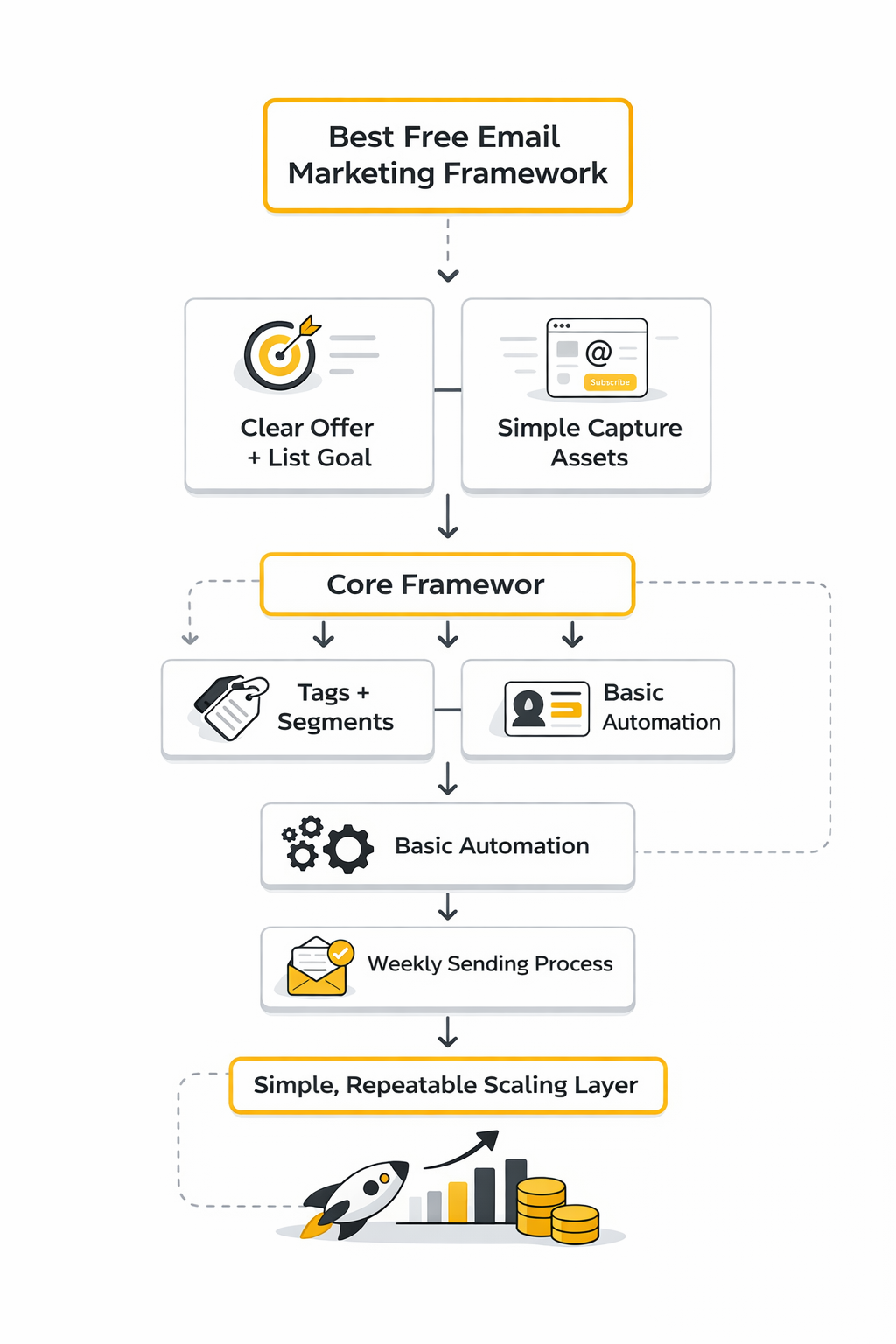
In the next part, I will use that framework to break down the core components that separate a genuinely useful free platform from one that only looks good in a pricing table. From there, we can move into the tools that are actually worth considering and which type of user each one fits best.
The Best Free Email Marketing Tools Worth Considering
Now that the framework is clear, we can move from theory to selection. This is where most articles get messy, because they throw every recognizable platform into one pile and pretend a forever-free plan is the same thing as a time-limited trial. It is not, and if you care about choosing the best free email marketing option for the way you actually work, that distinction needs to stay front and center.
The shortlist here is built around practical use, not brand familiarity. I am looking at whether the platform gives you enough room to build a list, send campaigns consistently, set up at least some automation, and avoid getting trapped by artificial limits too early. That is how you separate tools that are useful from tools that are just good at getting included in roundup posts.
Brevo Is the Best Fit for Most Small Businesses Starting Free
If you want the cleanest answer for most beginners, Brevo is the one that makes the most sense to start with. Its free plan is not a trial, it has no time limit, it lets you store up to 100,000 contacts, and it gives you core email marketing functionality without asking for a paid upgrade just to get through the door Brevo free plan details Brevo pricing. That alone puts it ahead of a lot of tools that look generous until you realize the clock is already ticking.
The biggest catch is the send cap. Brevo limits free accounts to 300 emails per day, applies branding to your emails, restricts advanced reporting, and allows only one user on the free tier Brevo free plan details. That sounds restrictive, and for some businesses it will be. But for a local business, service provider, consultant, coach, or early creator who is still building a list and sending modest campaigns, it is often enough to get real traction before paying anything.
What makes Brevo especially strong is that it does not feel like a toy. Even on free, you are getting access to a real marketing platform with email, forms, contact storage, basic reporting, and limited automation, including up to 2,000 unique contacts entering active automations Brevo free plan details. That matters because the best free email marketing platform is not the one with the flashiest headline. It is the one that helps you build good habits on infrastructure you will still respect once revenue starts coming in.
Systeme.io Is the Smartest Free Option If You Also Need Funnels
Systeme.io takes a very different angle, and that is exactly why it deserves a place near the top. Instead of offering a classic email-first tool with a strict send ceiling, it gives you a broader business stack on the free plan, including up to 2,000 contacts, unlimited email sending, funnels, and basic automation limits that are clearly designed for a single focused offer or a lean business model Systeme.io pricing Systeme.io features Systeme.io email automation overview.
That makes it especially attractive for solo operators who do not just want to send newsletters. If you are building a lead magnet funnel, selling a digital product, running a simple course offer, or capturing leads from one main landing page, Systeme.io can be more useful than a pure email platform because it keeps the list-building and conversion assets under one roof Systeme.io pricing. In other words, it does not just help you send emails. It helps you connect the email part to the thing you are actually trying to sell.
The tradeoff is structure. The free plan includes limits like 3 funnels, 1 automation rule, and 1 custom domain, so this is not the right tool for someone who wants elaborate segmentation, multiple complex customer journeys, or a large editorial newsletter operation Systeme.io pricing. But if your business is simple and direct, those limits can actually force clarity, which is not a bad thing when you are trying to get a lean email system working fast.
There is another reason Systeme.io stands out in a guide like this. A lot of “free” email tools let you collect contacts cheaply, then punish you on sending volume. Systeme.io flips that by tying the free plan more tightly to contact count while keeping email sending unlimited for up to 2,000 contacts Systeme.io help article on sending and contacts. That is a very practical model for businesses that email frequently but keep a relatively focused list.
Moosend Is Strong, but It Belongs in the Trial Category
Moosend is worth considering, but it needs to be categorized honestly. This is not a forever-free platform. It is a 30-day free trial that gives access to core features, including the email builder, templates, automation, segmentation, landing pages, forms, and unlimited email sends for up to 1,000 contacts during the trial period Moosend pricing FAQ. That makes it a serious evaluation option, but not a long-term free operating choice.
That distinction does not make Moosend bad. It just changes the job it can do for you. If you want to test a more feature-rich email setup, build a polished short-term campaign, or evaluate automation before committing to a paid tool, Moosend can be a strong candidate because the trial experience is broad enough to let you see how the platform really works rather than trapping you inside a fake demo environment Moosend pricing.
Where people get this wrong is in the recommendation itself. If someone searches for the best free email marketing platform because they want something they can stay on for months while growing carefully, Moosend should not be presented as equivalent to Brevo or Systeme.io. But if the real goal is to test advanced capabilities before choosing a paid stack, Moosend becomes much more compelling. The platform is good. The label is what needs precision.
How to Match the Right Free Tool to Your Situation
This is the part that usually saves people from making the wrong decision. The best free email marketing tool is not universal, because your list size, business model, and workflow matter more than generic rankings do. A creator sending one newsletter a week has different needs from a service business nurturing leads, and both are different from a business that needs forms, funnels, and checkout logic in the same stack.
Brevo is the best match when you want a stable forever-free plan and a more traditional email marketing environment. It works well when your send volume is still modest, your contact list may grow faster than your actual mailing frequency, and you care about having a solid platform that can keep up once you upgrade Brevo free plan details. That is why it is the safest all-around recommendation for most small businesses.
Systeme.io makes more sense when email is only one piece of the machine. If you need landing pages, a lead capture funnel, and a basic email engine without stitching together several tools, its free plan can punch above its weight as long as you can live inside the plan’s structural limits Systeme.io pricing. It is less flexible for sophisticated email teams, but often more useful for lean operators who care about speed and simplicity.
Moosend belongs in a different decision path. Use it when you are actively evaluating software and want to test what a more advanced platform feels like before moving to a paid plan Moosend pricing FAQ. Just do not confuse a generous trial with a free long-term solution, because that is where a lot of bad software decisions start.
In the next part, I will keep going through the shortlist and then narrow it down into a more practical recommendation set, including which platform is best for beginners, which one is best for funnel-driven businesses, and which options stop making sense once your email operation becomes more serious.
How to Implement a Professional Setup Without Overspending
Choosing the best free email marketing tool is only half the job. The other half is what you do in the first few days after signup, because that is where most people either build a system that compounds or create a messy account full of disconnected forms, random tags, and campaigns they never learn from. Free tools can absolutely work, but only if you treat setup like a real operating process.
The good news is that professional implementation does not require a giant stack. Brevo already gives you signup forms, landing pages, contact management, and automation on its broader platform Brevo landing pages Brevo pricing. Systeme.io gives you a free plan that combines contacts, funnels, emails, and basic automation rules in one place, which is often enough for a lean lead-generation machine Systeme.io pricing Systeme.io automation rules. So the right move is not to overcomplicate things. It is to build a simple system that can keep working once your list starts growing.
Start With One Clear Offer and One List Goal
This is the step people rush past, and it costs them later. Before you touch the editor, decide what your email list is actually for. Are you collecting leads for a service business, building an audience for weekly content, or capturing prospects for one specific product or funnel? Those are different motions, and your setup needs to reflect that from the start.
A free account works best when it has one obvious job. If you are using Brevo, that might mean creating one lead magnet path and one newsletter list instead of building five overlapping segments on day one Brevo pricing. If you are using Systeme.io, it might mean one funnel, one opt-in page, one email sequence, and one call to action, because the free plan already gives you enough structure to run that cleanly without drowning in options Systeme.io pricing.
The mistake is trying to look advanced too early. The best free email marketing setup is not the one with the most moving parts. It is the one where every new subscriber enters a path you can actually explain in one sentence.
Build the Capture Layer First
Once the goal is clear, the next job is simple: make it easy for people to join. This means creating the signup point before obsessing over campaign design. Brevo supports forms and landing pages, which makes it workable for businesses that need a straightforward lead capture flow without buying extra tools immediately Brevo landing pages. Systeme.io is especially useful here because its free plan includes funnels, so your opt-in path and follow-up logic can live inside the same system Systeme.io pricing.
This is where you want restraint. One landing page, one form, one primary promise, and one reason to subscribe. That could be a lead magnet, a booking incentive, a mini email series, or a simple “get updates and offers” message if you already have audience trust. What matters is clarity, because confused signup pages do not convert just because they look polished.
A good free setup also keeps the form fields minimal. Name and email are usually enough unless you genuinely need more information to route the lead properly. Every extra field introduces friction, and friction is especially expensive when you are still proving whether your list-building process works at all.
Set Up Tags, Segments, and Basic Automation Early
This is the part that makes a free tool feel professional. A lot of beginners wait until the list becomes messy before organizing contacts, and by then the cleanup is annoying. It is far better to decide how people will be labeled when they join, what action should trigger a follow-up, and what happens after the first email is sent.
Brevo supports segmentation and automation, though its free plan keeps automation usage within contact-entry limits for active workflows Brevo free plan details. Systeme.io’s rule-based automation structure is simple on purpose: you define a trigger, then an action, which is enough for common flows like form signup followed by sequence enrollment or tag assignment Systeme.io automation rules. That simplicity is actually useful when you are building your first serious process.
The easiest way to implement this well is to think in three layers:
- source tag, which tells you where the lead came from
- intent tag, which tells you what they wanted
- next action, which tells the system what should happen now
That structure gives you cleaner reporting later, even if your free plan has limited analytics. More importantly, it stops your list from becoming a pile of emails with no context attached to them.
A Simple Process You Can Actually Run Every Week
Professional email marketing is not about complexity. It is about repeatability. The setup needs to be simple enough that you can keep using it when the week gets busy, because the best free email marketing system in the world does not matter if you stop sending after two campaigns.
Use this process:
- create one signup asset
- connect it to one list or core segment
- tag new subscribers by source or offer
- send one welcome email immediately
- queue a short follow-up sequence or one manual campaign
- review opens, clicks, and unsubscribes
- improve one variable next time instead of changing everything
That process works inside Brevo, Systeme.io, and even trial-based platforms like Moosend if you are evaluating a richer feature set before paying Moosend pricing. The point is not to look sophisticated. The point is to build a weekly rhythm that improves with use.
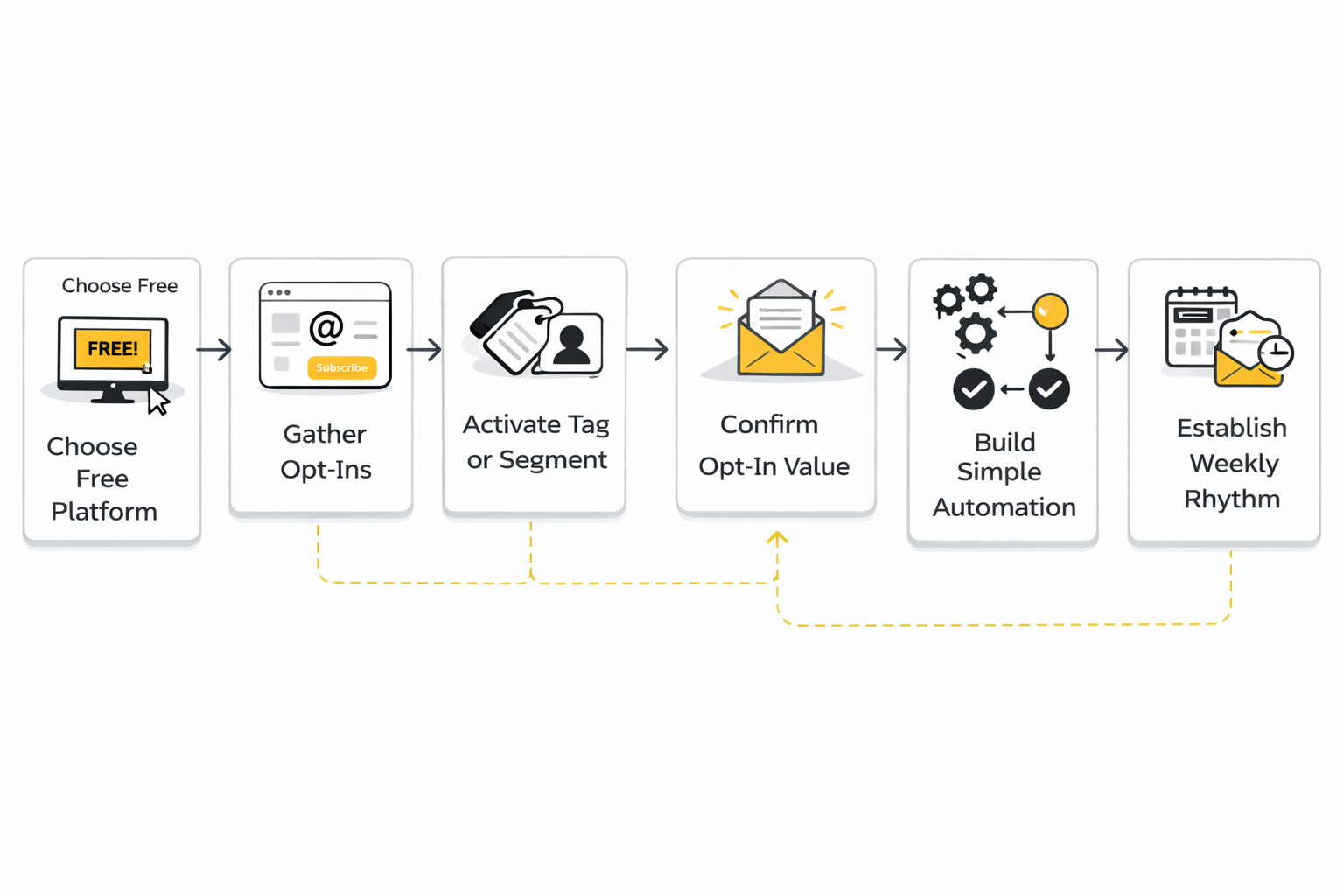
Once the process becomes visible step by step, the whole thing gets easier to manage. You stop thinking in terms of random campaigns and start thinking in terms of flow: capture, welcome, nurture, offer, learn, repeat. That is the moment a free tool starts behaving like a real marketing asset.
Make the First Emails Do Real Work
This is another place where small businesses often miss the opportunity. They spend all their effort getting the subscriber and then send a bland first email that says almost nothing. Your welcome email should do a job. It should confirm the signup, deliver the promised value, set expectations, and point the reader toward one useful next action.
That first action matters more than people think. It could be reading a key article, booking a call, browsing a category, replying with a pain point, or simply watching for your next email. What matters is that the subscriber understands what happens now. A vague welcome message wastes the warmest moment in the relationship.
If you are building inside a funnel-oriented tool like Systeme.io, this becomes even more important because the email is part of a broader conversion path Systeme.io pricing. If you are working inside Brevo, the same principle applies even if your motion is more newsletter-driven Brevo pricing. The first email should move the relationship forward, not just acknowledge that it exists.
Keep Reporting Simple Enough to Act On
You do not need an advanced dashboard to get better. What you need is a small set of numbers you will actually review. Open rate is useful directionally, though privacy changes have made it less definitive than it used to be. Clicks, replies, conversions, unsubscribes, and list growth usually tell you more about whether the system is working.
That is one reason not to chase complexity too early. Even if a free plan limits analytics depth, you can still learn a lot by comparing subject lines, calls to action, and landing-page intent across a few sends. Brevo’s platform already supports the basic structure needed to make those adjustments over time, even if advanced reporting lives higher up the pricing ladder Brevo pricing.
The key is to review with discipline. After each send, ask three things: did the right people join, did the first email lead somewhere useful, and did the campaign create movement? That is enough to improve steadily without pretending you are running an enterprise operation on a free account.
In the next part, I will move from implementation into the common mistakes that make free email setups underperform, along with the signs that tell you it is time to upgrade instead of squeezing more out of a plan that no longer fits.
What the Numbers Actually Mean
Once your setup is live, the next question is obvious: how do you know whether it is working? This is where a lot of people using the best free email marketing tools go wrong. They stare at one number, usually open rate, and then make decisions that have nothing to do with business results.
Measurement only becomes useful when you understand what each metric is really telling you. An open suggests subject-line and sender-name interest, a click shows content-level engagement, an unsubscribe signals friction or mismatch, and a bounce points to list quality or deliverability trouble how to calculate open rate email KPI definitions Brevo benchmark guide. If you read those signals correctly, even a free platform can give you enough visibility to improve fast.
Start With the Metrics That Actually Change Decisions
Not every metric deserves equal attention. Open rate still matters, but it is no longer a clean truth signal because Apple Mail Privacy Protection and security bots can inflate opens and some clicks, which makes raw engagement data less reliable than it used to be Brevo on Apple MPP and bot activity. That does not mean you should ignore opens. It means you should stop treating them like the final verdict.
The stronger core set is simple. Watch delivered emails, open rate directionally, click-through rate, click-to-open rate, unsubscribe rate, bounce rate, and the downstream action you actually care about, whether that is a reply, booking, purchase, or lead form completion Brevo benchmark guide click-through and click-to-open explanation. That mix gives you a much better read on what part of the campaign is weak. If opens are fine but clicks are soft, the problem is usually the email body or the offer, not the subject line.
This is especially important when you are using a free tool. Limited dashboards can still be enough if you track the numbers that actually drive action. You do not need enterprise analytics to see whether people joined, opened, clicked, stayed, and moved forward.
Benchmarks Help, but Only When You Use Them Properly
Benchmarks are useful for context, not for ego. Brevo’s 2025 benchmark data, based on more than 44 billion emails, shows an overall open rate of 31.22%, click-through rate of 3.64%, unsubscribe rate of 0.4%, soft bounce rate of 3.6%, and hard bounce rate of 0.19% Brevo 2025 benchmark data. Those numbers are helpful because they tell you what “normal” can look like at scale, but they do not automatically define success for your business.
Industry context matters a lot. In the same benchmark set, ecommerce campaigns show a 38.58% open rate and 2.08% click-through rate, while business and financial services show a 39.48% open rate but only a 1.1% click-through rate Brevo 2025 benchmark data. That gap tells you something important: a strong open rate does not guarantee persuasive content. Different industries create different click behavior, so you need to benchmark against the right environment, not just the prettiest number.
The same goes for geography and sending patterns. Brevo’s regional data shows EMEA outperforming APAC and LATAM on both open rate and click-through rate, and its day-of-week table shows Monday and Tuesday with slightly stronger engagement than weekends Brevo 2025 benchmark data. That should shape testing, not dogma. Use benchmark data to set expectations, then compare your own sends against your own history.
Build a Simple Analytics System You Can Review Every Week
This is where measurement becomes practical. You do not need a giant reporting stack. You need one repeatable review loop that makes it obvious what to change next.
Use a system like this:
- check delivery first, because undelivered emails break the entire chain
- review opens as a directional signal for subject line, sender name, and timing
- review clicks to judge message clarity and offer relevance
- compare click-to-open rate to see how persuasive the email was after the open
- watch unsubscribes and bounce rates for audience mismatch or list hygiene issues
- connect the campaign to the business outcome that matters most
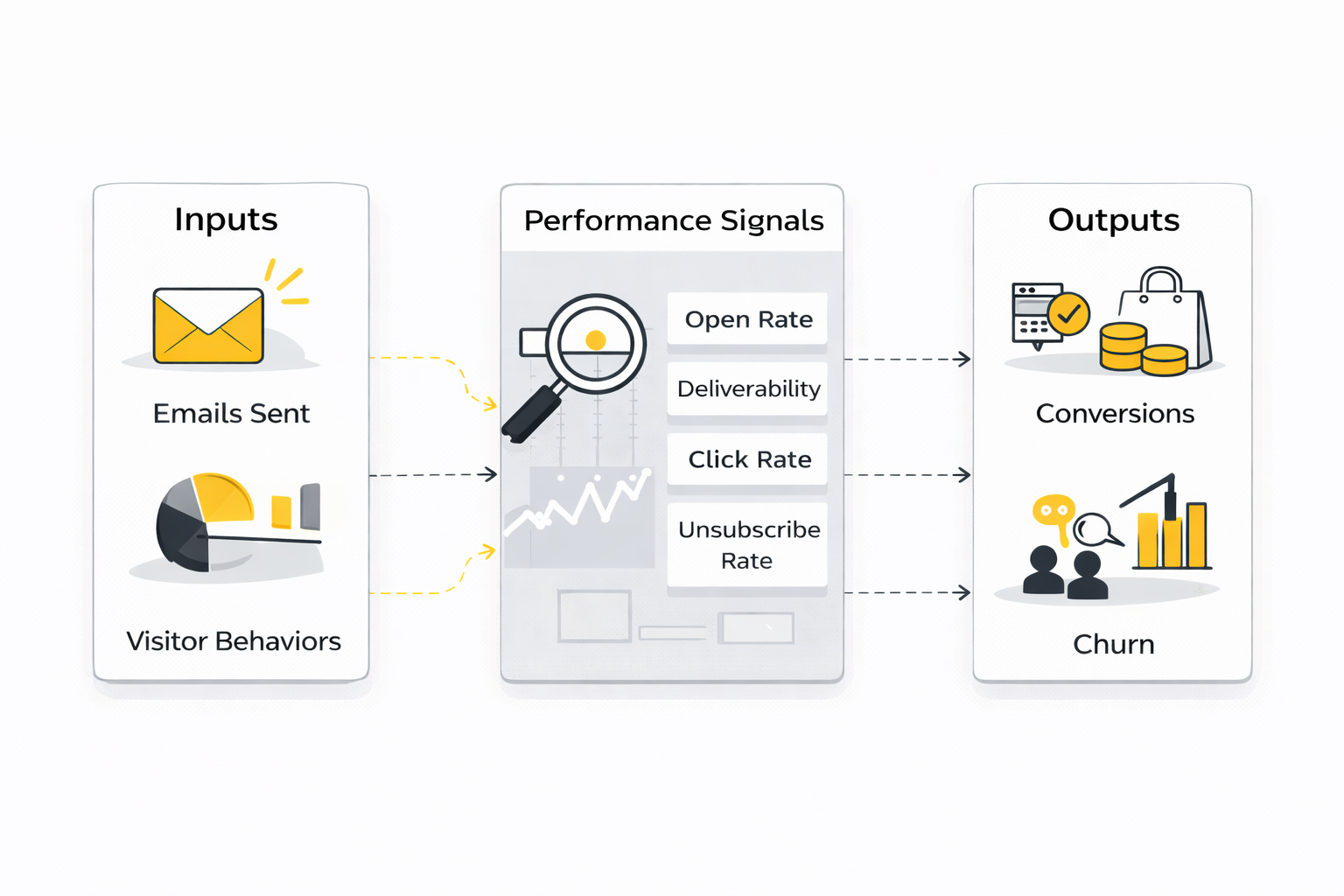
This is the point where free email marketing starts to become disciplined instead of reactive. You are no longer asking whether a campaign “felt good.” You are asking whether the email reached the inbox, earned attention, created movement, and protected list quality. That is a much better way to manage a channel, especially when every send matters.
The real advantage of a simple analytics system is speed. When you review the same sequence every week, patterns show up earlier. You stop guessing and start seeing whether the problem lives in targeting, copy, timing, or deliverability.
How to Read Deliverability Signals Before They Become a Problem
Deliverability is one of the most misunderstood parts of measurement. People often notice it only after performance drops, but the warning signs usually show up earlier in bounce rates, spam placement, missing inbox placement, and disengaged segments. If your list quality slips or your sending pattern changes too abruptly, mailbox providers notice before you do.
Brevo’s benchmark data includes mailbox-provider-level inbox placement that makes this concrete. Gmail inbox placement is shown at 88.1% and Microsoft at 82.5%, while Apple shows much weaker inbox placement and a much higher spam percentage at 22.9% in the same dataset Brevo deliverability benchmarks. That matters because weak engagement is not always a copy problem. Sometimes the campaign simply is not landing where people will see it.
The action here is straightforward. Keep your list clean, avoid importing cold contacts recklessly, and warm up sending volume when you switch providers or start mailing more aggressively systeme.io contact import guidance deliverability basics. If bounce rates rise or inbox placement weakens, do not solve it with more volume. Solve it with better list hygiene and more controlled sending behavior.
What Good Performance Should Make You Do Next
Data only matters if it creates action. If your opens are weak, test subject lines, sender identity, or send timing before rewriting the entire campaign how open rate works best-time discussion. If opens are healthy but clicks are weak, tighten the message, reduce competing links, and make the call to action more obvious click-through and click-to-open explanation.
If unsubscribes or bounce rates climb, assume the issue is targeting, expectation mismatch, or list quality before blaming the platform unsubscribe rate guide soft bounce guidance. And if every engagement metric looks acceptable but conversions stay flat, the bottleneck is probably the offer or the landing experience, not the email itself. That is a crucial distinction because it stops you from optimizing the wrong layer.
This is the big takeaway. The best free email marketing setup is not the one with the most dashboards. It is the one where the numbers tell you what to do next with enough clarity that you actually do it.
In the next part, I will get into the mistakes that quietly ruin free email marketing performance, the warning signs that tell you a plan no longer fits, and the moment when upgrading becomes the smarter move rather than an annoying extra cost.
Common Mistakes and Upgrade Signals
Free plans are useful, but they can also hide problems for longer than people expect. That is the uncomfortable truth. A setup can look efficient because the software bill is still zero, while the real cost is showing up somewhere else in the form of weak segmentation, manual work, deliverability drag, or campaigns you are no longer sending because the system has become annoying to use.
This is where the best free email marketing tools need to be judged a little more brutally. The right question is not whether the plan is still technically free. The right question is whether the plan is still helping you grow without creating friction that costs more than the upgrade itself.
The Biggest Mistake Is Choosing Based on Price Instead of Operating Model
A lot of people pick a platform by comparing the free plan headline and nothing else. That usually leads to bad-fit choices. A business with low send volume but growing contact storage needs is dealing with a different constraint than a business with a compact list that emails aggressively every week, and those two businesses should not pick the same tool for the same reason.
That is why Brevo and Systeme.io solve different problems even when both look attractive at zero cost. Brevo’s free plan is often better when you want a stable email-first platform with long-term room to store contacts, while Systeme.io is often better when your growth path is funnel-driven and you want the page, opt-in, and email sequence connected from the start Brevo pricing Systeme.io pricing. Price matters, obviously. But operating model matters more.
The strategic mistake is pretending all growth looks the same. If you choose the wrong model early, you end up rebuilding forms, tags, automation paths, and reporting logic later. That rebuild is usually more painful than paying for the right tool one stage earlier.
Manual Work Is a Hidden Cost, and It Adds Up Fast
This is where many free setups quietly start losing value. The platform may still be free, but now you are manually exporting contacts, fixing list structure, sending one-off campaigns by hand, or working around limitations that should have been solved by automation weeks ago. Once that happens, the software bill is no longer the number that matters most.
Systeme.io’s free plan is powerful for lean businesses, but it is intentionally constrained, with limits such as 1 automation rule, 1 workflow, and 1 tag on the free tier Systeme.io pricing. That can be perfectly fine when your business has one offer and one clean path. It becomes a bottleneck when you need multiple intent buckets, more nuanced segmentation, or different follow-up paths for different subscriber behaviors.
Brevo has a different version of the same issue. Its free plan gives you more room in contact storage, but the 300-emails-per-day cap and limited automation depth can start shaping your behavior in ways that slow down growth Brevo free plan details. If you are delaying campaigns, splitting sends awkwardly, or keeping your strategy artificially simple just to stay inside the plan, that is not efficient anymore. That is the free plan running your business instead of supporting it.
Poor Segmentation Becomes a Serious Risk as the List Grows
At a small size, sloppy segmentation feels survivable. Everyone gets roughly the same emails, you make a few sales, and nothing seems broken. Then the list grows, intent starts to split, and suddenly one message is trying to serve buyers, browsers, leads, repeat customers, and cold subscribers at the same time.
That is exactly when performance usually flattens out. Systeme.io’s own segmentation guidance highlights the payoff of relevant segmentation, including materially higher engagement when emails match subscriber intent more closely Systeme.io segmentation guide. The point is not to build a giant enterprise taxonomy. The point is to avoid turning your list into one undifferentiated audience that stops responding because the emails no longer feel relevant.
This is also why tag limits matter more than they seem. A free tool can look generous until your business needs to separate newsletter readers from lead-magnet subscribers, customers from prospects, or engaged subscribers from quiet ones. When that structure breaks, your performance data gets harder to interpret and your content gets less precise at exactly the moment precision matters more.
Deliverability Trouble Usually Starts Before People Notice It
One of the most expensive mistakes in free email marketing is assuming the platform will protect you from weak sending practices. It will not. Deliverability is partly technical, but it is also behavioral. If you collect low-intent contacts, neglect list hygiene, or send inconsistently, inbox placement can weaken long before the dashboard makes it obvious.
Systeme.io’s deliverability guidance is blunt on this point: sender reputation, list quality, consent, and sending practices all influence whether your emails land where they should good practices for deliverability deliverability overview. That means the risk is not just lower open rates. The risk is building a larger list that becomes less reachable over time because the foundation was loose from the beginning.
This is where scaling discipline matters. As your list grows, you need cleaner acquisition, better tagging, more intentional re-engagement, and more willingness to remove dead weight. A bigger list is not automatically an asset if a meaningful part of it is dragging down sender reputation and confusing your campaign signals.
The Real Upgrade Signal Is Operational Friction
A lot of people wait for the wrong sign before upgrading. They wait until they are angry. That is too late. The better signal is friction that keeps repeating: you need more automation, more team access, cleaner branding, deeper analytics, higher send capacity, or more flexible landing-page and testing options, and you keep finding yourself boxed in.
Brevo’s paid tiers make that transition relatively clear. Starter removes the daily sending cap, while higher tiers add features like landing pages, A/B testing, and more advanced analytics and automation Brevo pricing Brevo pricing plan details. Systeme.io’s upgrade logic is different. You upgrade when your business model needs more structural flexibility, not just more sends, because the free plan already lets you email freely within its contact and workflow constraints Systeme.io pricing.
This is the strategic shift people need to see clearly. Upgrading is not a failure. It is often the moment when you stop paying with time, complexity, and missed opportunities and start paying with money instead. In many cases, that is a very good trade.
When an All-in-One Platform Starts Making More Sense
There is one more tradeoff worth being honest about. Sometimes the right move is not upgrading your free email tool to the next tier. Sometimes the right move is switching categories entirely. If email is becoming part of a bigger customer journey that includes pipelines, booking flows, lead routing, follow-up automation, multi-channel messaging, and client management, a more complete operating system may make more sense than a standalone email-first setup.
That is where platforms like HighLevel start entering the conversation. It is not a free email marketing option, and it should not be positioned like one, but its value proposition is different: CRM, workflows, email, forms, calendars, and broader business automation in one place HighLevel homepage HighLevel email marketing HighLevel pricing. For agencies or businesses running more complex customer journeys, that can eventually be more efficient than stacking workarounds on top of a free plan that was never designed for that level of coordination.
That does not mean everyone should jump there early. Most should not. But it is an important expert-level distinction: sometimes scale is not about more volume inside the same tool. Sometimes it is about needing a different architecture altogether.
The Smart Way to Scale From Here
The best free email marketing setup should do one thing extremely well: buy you time to prove the channel before you invest more heavily. That is the goal. Not eternal free usage. Not squeezing every last drop out of a starter tier. Just enough room to build a real process, learn your numbers, and understand what kind of business your email system needs to support.
Once you know that, scaling gets much easier. You either stay lean with a tool that still fits, upgrade inside the same platform because the friction is now obvious, or move to a broader system because email has become part of a bigger machine. Those are all good outcomes if you reach them intentionally.
The final part will wrap this up with a direct recommendation set and a practical FAQ, including which free email marketing tool makes the most sense for beginners, which one is strongest for funnel-led growth, and which warning signs tell you not to stay on a free plan too long.
Final Recommendation and Next Move
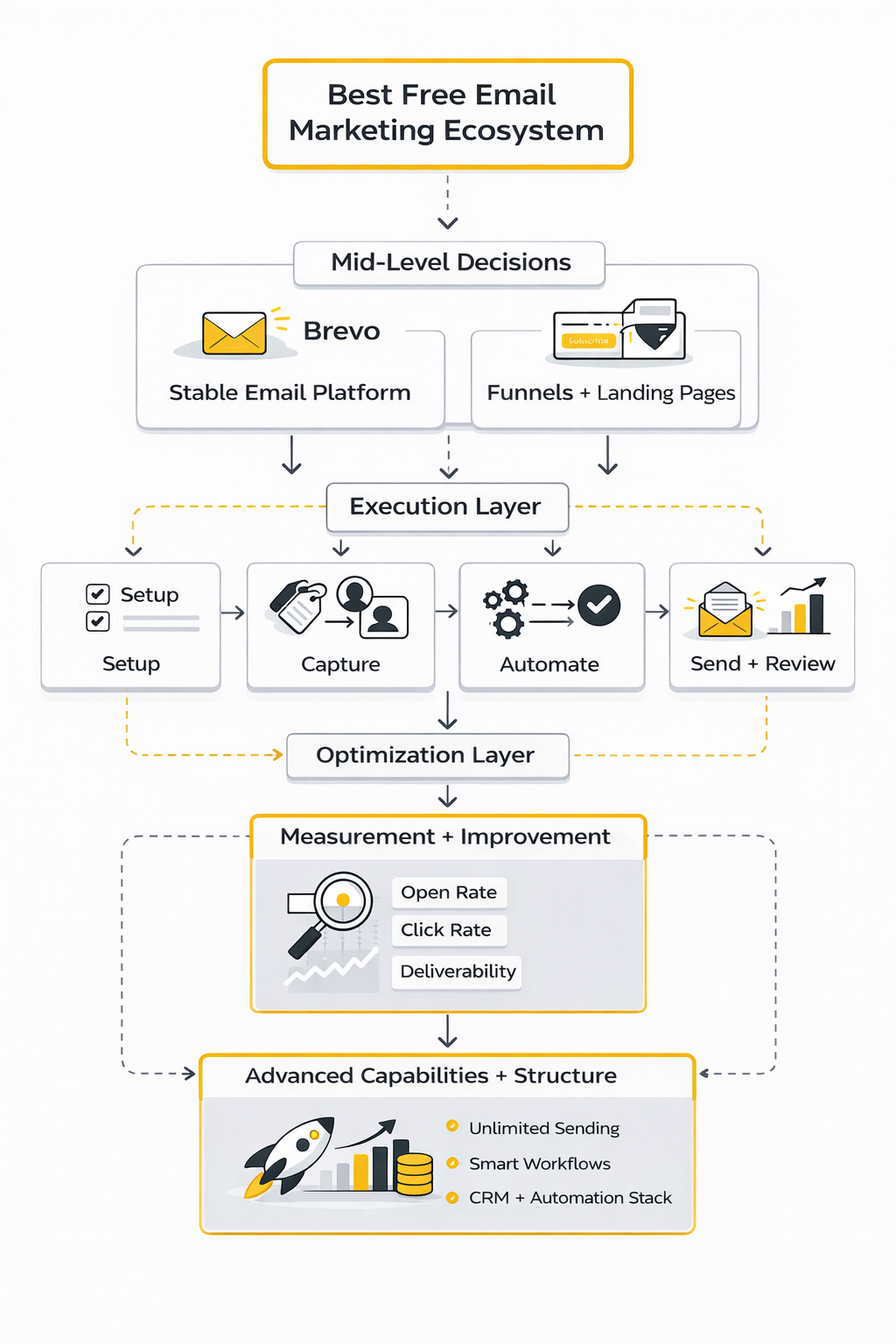
At this point, the decision is not that complicated anymore. If you want the safest long-term free starting point for a real email program, Brevo is still the most balanced choice because its free plan remains ongoing, includes 300 emails per day, and supports up to 100,000 stored contacts while giving you a serious email platform instead of a stripped-down toy Brevo free plan details Brevo pricing plans. That makes it the cleanest recommendation for most small businesses, consultants, creators, and operators who want to build patiently without being forced into a paid plan too early.
If your business is more funnel-driven and you care just as much about landing pages, opt-in flows, and simple automation as you do about the email tool itself, Systeme.io is often the smarter free choice. Its free plan still centers on up to 2,000 contacts, unlimited emailing, and an all-in-one structure that is unusually generous for lean offer-based businesses, though it stays intentionally limited on tags, workflows, and automation depth Systeme.io pricing Systeme.io free plan limits. That is a great trade if your business is simple, but it stops being a great trade once segmentation and multi-path automation start to matter more.
Moosend still belongs in the conversation, but only if you categorize it correctly. It offers a 30-day free trial with core features rather than a forever-free operating model, which makes it useful for evaluation and short-term testing, not as the strongest answer for someone who wants to stay free for months while growing steadily Moosend pricing. That distinction matters, because the best free email marketing tool is not just the one that looks generous on day one. It is the one that still supports your workflow once the excitement wears off and the weekly sending routine begins.
FAQ
What is the best free email marketing tool overall?
For most people, Brevo is the strongest all-around answer because its free plan is genuinely ongoing, not just a trial, and it gives you real operating room with 300 daily sends and up to 100,000 stored contacts Brevo free plan details. That balance makes it easier to build a list, learn the channel, and avoid getting pushed into a paid upgrade too fast. It is not perfect, but it is usually the safest starting point for a real business.
Is there really a free email marketing platform with no time limit?
Yes, Brevo still offers a free forever plan with no required end date, which is a major reason it stands out in this category Brevo pricing. Systeme.io also keeps a genuine free plan, though its structure is more tied to all-in-one business-building than to pure email-first flexibility Systeme.io pricing. The key is to separate free forever from free trial, because those are completely different commitments.
Which free tool is best for funnels and lead magnets?
Systeme.io is usually the better fit when your email flow is attached to a lead magnet, simple product, booking funnel, or one-off conversion path. Its free plan combines contacts, landing pages, funnels, and unlimited email sending in one system, which makes execution faster when you are building a lean acquisition machine Systeme.io pricing. The tradeoff is that you accept tighter limits on tags, workflows, and advanced structure as your marketing grows more complex.
Is Moosend free or just a trial?
Moosend is best described as a trial-based option, not a forever-free platform. Its current offer centers on a 30-day free trial with access to core features, which is useful if you want to evaluate the product seriously before paying Moosend pricing. That means it can still be a smart test platform, but it should not be ranked the same way as a tool you can keep using for free indefinitely.
How many subscribers do you need before a free plan starts feeling tight?
That depends less on the raw number of contacts and more on how often you send, how segmented your audience is, and whether you need automation depth. Brevo can feel tight early if you send frequently because the 300-emails-per-day limit becomes operationally restrictive even while contact storage remains generous Brevo free plan details. Systeme.io can feel tight sooner when your business needs more than one basic workflow or more granular tagging, even if the contact count is still manageable Systeme.io pricing.
Are free email marketing tools good enough for a real business?
Yes, they can be, but only when the business model and the platform limits actually fit each other. A small service business, solo operator, creator, or early-stage offer can absolutely build meaningful momentum on a free plan if the setup is clean and the sending rhythm is consistent Brevo pricing plans Systeme.io pricing. They stop being good enough when the limits start distorting your process, not just when you feel like upgrading emotionally.
What metrics should beginners watch first?
Beginners should focus on delivery, open-rate direction, clicks, unsubscribes, bounce rate, and the actual downstream action they care about, such as replies, bookings, or sales. Open rate still has value, but platform and privacy changes mean it should be treated as directional rather than absolute truth Brevo benchmark guide. If clicks and conversions are improving, that matters more than chasing vanity numbers.
When should you upgrade from a free email marketing plan?
You should upgrade when the plan’s limitations start creating repeated friction in your actual workflow. For Brevo, that often means the daily send cap, branding, limited analytics, or more advanced automation needs are getting in the way Brevo pricing. For Systeme.io, it is more often about structure, such as needing more workflows, more rules, more funnels, and better segmentation logic Systeme.io pricing.
Can you build automation on a free plan?
Yes, but the amount of useful automation varies a lot by platform. Brevo allows automation on the free tier but limits how many unique contacts can enter active automations, while Systeme.io includes basic automation capability in a more tightly constrained all-in-one format Brevo free plan details Systeme.io free plan limits. That means automation is possible, but it needs to stay simple and intentional if you want the free plan to remain usable.
Is it better to choose an email-first tool or an all-in-one platform?
That depends on what email is supposed to do inside your business. If email is primarily a communication and nurture channel, an email-first platform like Brevo usually makes more sense because the structure is cleaner and the list-management logic is stronger for that use case Brevo pricing plans. If email is just one part of a lead-capture and conversion system, an all-in-one option like Systeme.io can reduce tool sprawl early on Systeme.io pricing.
What is the biggest mistake people make with free email marketing?
The biggest mistake is choosing a free plan based only on headline pricing instead of how the business actually operates week to week. That leads people into tools that look generous at signup but become frustrating when segmentation, automation, or sending volume starts to matter. Free is only a win when it supports a real process instead of forcing awkward workarounds.
Should ecommerce brands use the same free tools as service businesses or creators?
Not always, because the sending pattern and lifecycle needs can be different. Ecommerce businesses often need tighter segmentation, behavior-based automation, and more frequent campaigns, which can make plan limits appear sooner even when the list is not huge Brevo 2025 benchmark data. Service businesses and creators can often stay productive on a free plan longer because their email motion is simpler and lower frequency.
What if your business outgrows both free plans and basic upgrades?
That is when the conversation shifts from “best free email marketing” to “best overall operating system for the next stage.” If your business needs CRM coordination, deeper automation, lead routing, booking flows, and broader lifecycle management, a platform like HighLevel can make more sense than stacking extra workarounds on top of a basic email tool HighLevel homepage HighLevel pricing guide. That is not a beginner move, but it can be the right move once email becomes part of a bigger machine.
Work With Professionals
Explore 10K+ Remote Marketing Contracts on MarkeWork.com
Most marketers spend too much time chasing clients, competing on crowded platforms, and losing a percentage of every project to middlemen.
MarkeWork gives you a better way. Browse thousands of remote marketing contracts and connect directly with companies desperate to hire skilled marketers like you, without platform commissions and without unnecessary gatekeepers.
If you're serious about finding better opportunities and keeping 100% of what you earn, explore available contracts and create a profile for free at MarkeWork.com.