

The best marketing agencies are not the ones with the flashiest case studies. They are the ones that understand your market, diagnose the real growth constraint, and build a system that keeps improving after the first campaign goes live.
That matters because marketing budgets are under more pressure than they used to be. Gartner reported that 2025 marketing budgets stayed flat at 7.7% of company revenue, which means companies need sharper decisions, not just more activity.

This guide breaks the topic into six parts so you can evaluate agencies with a clear head instead of getting pulled in by polished sales decks. We will look at strategy, services, pricing, red flags, implementation, and the final decision process.
- Why Choosing The Right Marketing Agency Matters
- The Framework For Comparing Marketing Agencies
- Core Services The Best Marketing Agencies Usually Offer
- How Professional Agency Implementation Actually Works
- How To Evaluate Pricing, Fit, And Red Flags
- Final Checklist, Tools, And FAQs
Why Choosing The Right Marketing Agency Matters
Choosing an agency is not a small vendor decision. A good agency can improve positioning, acquisition, retention, creative output, analytics, and sales follow-up. A bad one can burn months of budget while making the underlying problem harder to see.
The best marketing agencies usually bring outside pattern recognition. They have seen what works across multiple accounts, channels, and industries, so they can move faster than a team learning everything from scratch. That speed matters when paid media costs are high, organic search is changing, and AI is reshaping how teams produce and test campaigns.
The real goal is not to “hire marketing help.” The goal is to find a partner who can turn marketing into a measurable growth engine. That means strategy before tactics, clean reporting before opinions, and execution that connects directly to revenue.
The Framework For Comparing Marketing Agencies
A practical agency comparison should start with four questions: what problem do they solve, who have they solved it for, how do they measure success, and what will they actually do in the first 90 days. If an agency cannot answer those clearly, the relationship usually becomes vague fast. Vague marketing is expensive.
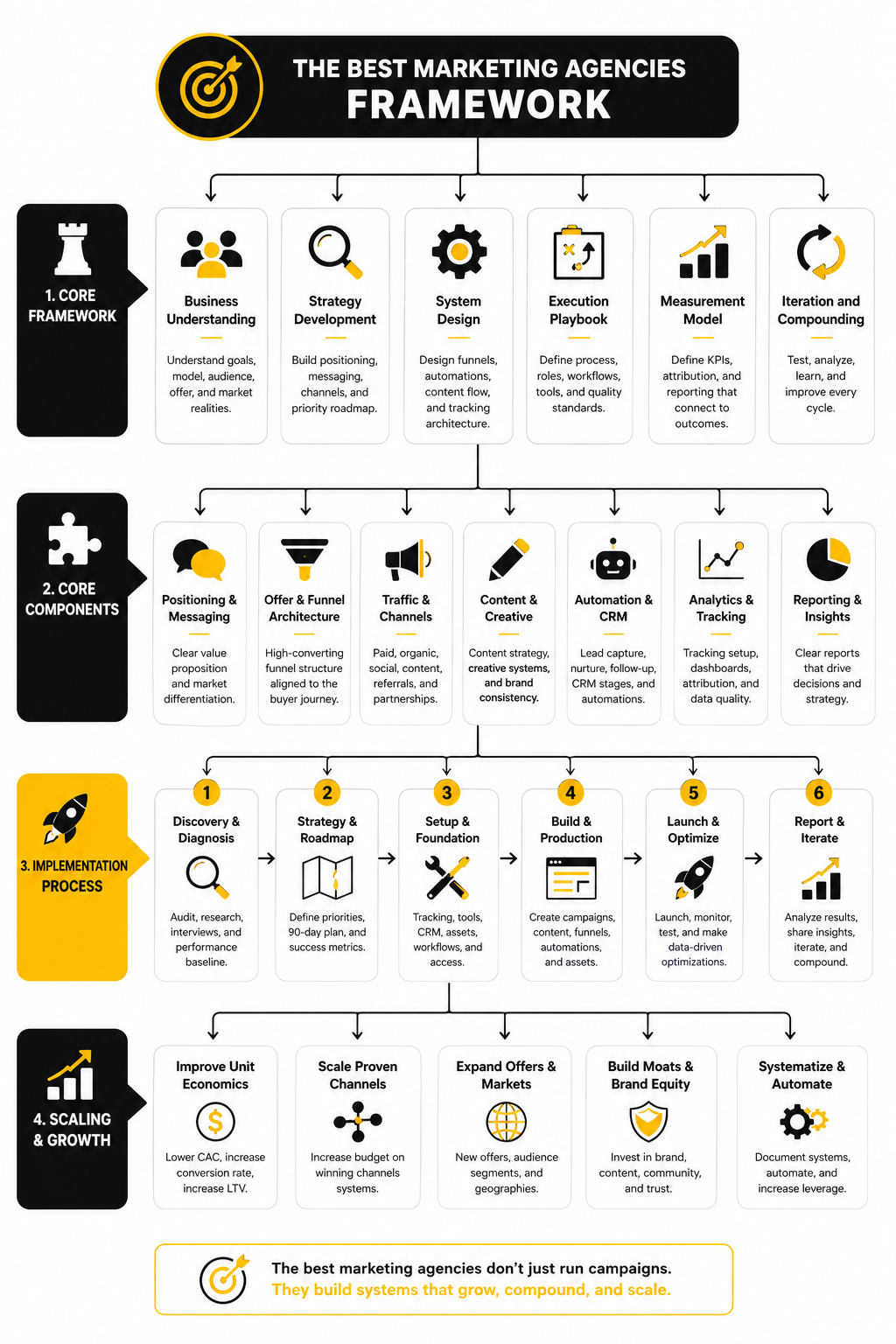
The strongest agencies tend to sit at the intersection of strategy, execution, data, and communication. Strategy keeps the work focused. Execution turns the plan into campaigns. Data shows what is working. Communication keeps your team aligned before small issues become expensive problems.
This framework also helps you avoid a common mistake: comparing agencies only by service list. Two agencies may both offer SEO, ads, email, funnels, and social media, but one may have a rigorous testing process while the other is just completing tasks. The difference shows up in results.
Core Services The Best Marketing Agencies Usually Offer
The best marketing agencies do not all offer the same services, and that is a good thing. A B2B SaaS company with a long sales cycle does not need the same agency model as an ecommerce brand trying to improve conversion rate. The right agency should match the business model, buying journey, budget, and internal team capacity.
Most serious agencies will cover a few core areas: strategy, acquisition, conversion, retention, analytics, and creative. The difference is how deeply they can connect those areas. If paid ads generate leads but the funnel, CRM, email follow-up, and sales handoff are broken, the campaign is not really working.
That is why service fit matters more than service volume. A giant menu of services can look impressive, but it can also hide shallow execution. You want an agency that can explain which services matter now, which can wait, and which would only distract your team.
Strategy And Positioning
Strategy is where the agency proves whether it understands the business or just the channel. Strong agencies ask about margins, sales cycles, customer quality, market maturity, offer strength, and internal bottlenecks before they recommend campaigns. Weak agencies jump straight into deliverables because deliverables are easier to sell.
Good positioning work clarifies who the company is for, why those buyers care, and what makes the offer easier to choose. This is not fluffy branding. It affects ad angles, landing pages, sales enablement, SEO topics, email sequences, and every other part of execution.
This is also where the best marketing agencies push back. If your offer is unclear, your market is too broad, or your sales process cannot handle the demand you want to create, they should say that early. The right partner protects the budget before they spend it.
Paid Advertising And Demand Generation
Paid advertising is still one of the fastest ways to test markets, offers, and creative. The 2025 agency benchmark data from AgencyAnalytics found that 68% of agency leaders expected paid advertising to deliver the strongest results in 2025, which says a lot about where agencies see reliable near-term performance. That does not mean every company should rush into ads, but it does mean paid acquisition remains central when speed and measurement matter.
A good paid media agency should talk about more than platform setup. They should understand creative testing, audience quality, landing page conversion, attribution limits, and the economics behind customer acquisition. If the agency reports only clicks, impressions, and cost per lead, you are not getting the full picture.
For service businesses and local companies, platforms like GoHighLevel can help connect ads, forms, pipelines, automations, and follow-up in one place. That matters because many paid campaigns do not fail at the ad level. They fail because leads are not followed up quickly, tracked clearly, or nurtured properly after the first conversion.
SEO And Content Marketing
SEO has changed, but it is not dead. It is becoming more selective, more brand-driven, and more dependent on content that deserves to exist. AgencyAnalytics reported that 73% of agency leaders believe generative AI has changed how people discover content, so the old playbook of publishing thin articles at scale is getting weaker.
The best SEO agencies now think beyond rankings. They look at search intent, topical authority, brand mentions, technical health, conversion paths, and how content supports the full buying journey. Ranking for a keyword is useful only if the traffic can become pipeline, customers, or qualified demand.
This is where content quality becomes a real business issue. If an agency relies on generic AI output with no research, no point of view, and no original structure, it may increase publishing volume while lowering trust. Strong agencies use AI carefully, but they still bring human strategy, editing, and subject-matter judgment.
Funnels, Landing Pages, And Conversion Rate Optimization
Traffic is expensive, so conversion matters. The best marketing agencies usually inspect landing pages, forms, checkout flows, calls to action, page speed, message match, and friction points before scaling spend. More traffic rarely fixes a weak conversion path.
For ecommerce and direct-response campaigns, dedicated landing page builders can make testing faster. A tool like Replo can be useful when Shopify teams need polished landing pages without waiting on a full development cycle. For offer-driven funnels, ClickFunnels or Systeme.io can make sense when speed, testing, and simple funnel deployment matter more than a fully custom build.
The agency should still own the thinking, not just the tool setup. A funnel is not automatically good because it has a countdown timer, upsell, or multi-step form. It works when the offer, audience, proof, page structure, and follow-up sequence all support the same decision.
Email, CRM, And Lifecycle Marketing
Email and CRM work often separate decent agencies from serious growth partners. Acquisition gets attention, but follow-up is where many companies recover lost revenue. If leads enter a messy spreadsheet or customers receive the same generic emails forever, there is obvious money being left on the table.
Good agencies segment audiences, map lifecycle stages, build automations, and measure revenue from repeat engagement. They think about welcome sequences, abandoned checkout flows, lead nurturing, reactivation, customer education, and referral prompts. This is less glamorous than a new ad campaign, but it can be much more profitable.
Tools matter here because implementation needs to be clean. Brevo can fit teams that want email marketing and automation without unnecessary complexity, while ManyChat can be useful for conversational flows across social and messaging channels. The right agency will recommend tools based on the customer journey, not because they have a favorite stack.
Social Media And Creative Production
Social media is not just posting more often. It is a distribution system for ideas, proof, personality, offers, and community signals. The strongest agencies understand the difference between content that looks active and content that creates demand.
Creative production has also become more demanding. Brands need more variations, more formats, and faster testing cycles, especially when paid and organic channels feed each other. That does not mean every brand needs to chase every trend, but it does mean creative operations need structure.
A practical social workflow includes content pillars, production cadence, approval rules, repurposing, and performance reviews. Tools like Buffer or Flick Social can support scheduling and planning, but the agency still needs a clear editorial point of view. Without that, social becomes noise with a calendar attached.
How Professional Agency Implementation Actually Works
Professional implementation is where the difference between a polished agency and a useful agency becomes obvious. The best marketing agencies do not disappear after the contract is signed and return with random deliverables three weeks later. They run a clear process that turns strategy into execution, then execution into learning.
That process matters because modern marketing has too many moving parts to manage casually. Paid media, creative, CRM, analytics, landing pages, email, social, SEO, and sales follow-up all influence each other. If the agency treats each channel as a separate task list, performance gets messy fast.
The strongest implementation process is simple enough to understand but disciplined enough to repeat. It should show what happens first, who owns each step, how decisions are made, and how results will be reviewed. You are not buying “marketing activity.” You are buying an operating rhythm.
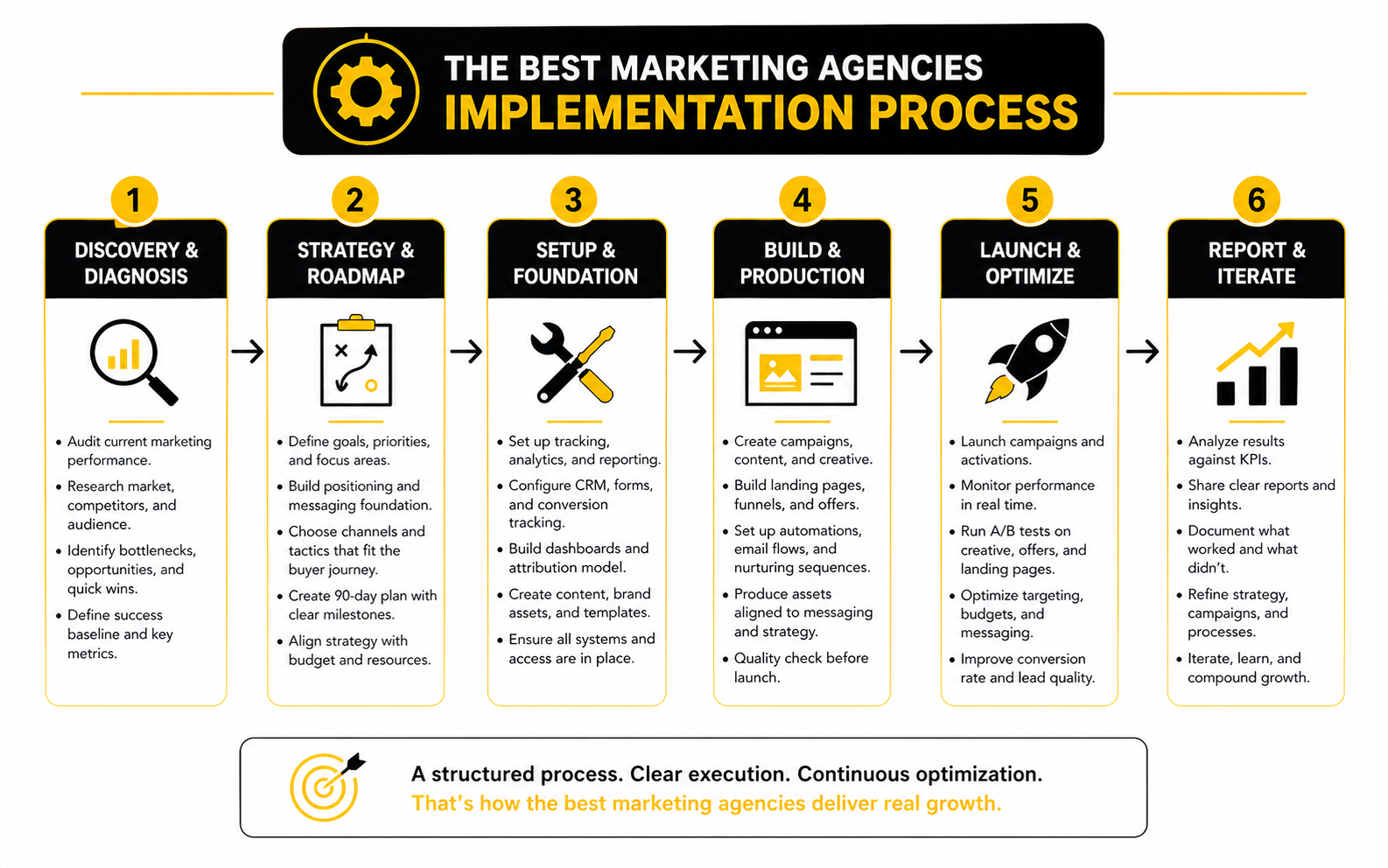
Step 1: Discovery And Diagnosis
The first stage should be diagnosis, not production. A serious agency will review the business model, existing campaigns, customer data, website analytics, sales process, offer structure, and competitive landscape before recommending a plan. This protects you from paying for work that looks productive but does not address the actual constraint.
The agency should also ask uncomfortable questions early. What is the real close rate? Which leads are valuable and which are noise? Where does the handoff between marketing and sales break? These questions can feel slower than jumping straight into ads or content, but they save time because they stop the team from optimizing the wrong thing.
This is also the stage where expectations get grounded. If the company has no tracking, weak landing pages, unclear positioning, or slow follow-up, the agency should say that directly. The best marketing agencies are confident enough to tell you what must be fixed before scale makes sense.
Step 2: Strategy, Roadmap, And Priorities
Once the diagnosis is clear, the agency should turn it into a roadmap. This should not be a 40-page deck that nobody uses. It should explain the priority channels, the first campaigns, the testing plan, the measurement model, and the decisions that need to happen in the first 30, 60, and 90 days.
The roadmap should also separate foundational work from growth work. Foundational work includes analytics setup, tracking cleanup, CRM structure, landing page fixes, creative direction, and offer refinement. Growth work includes campaigns, content, automation, outreach, experiments, and scaling decisions.
This distinction matters because many clients get frustrated when the first few weeks are not full of visible campaigns. But if the foundation is broken, faster execution only creates faster waste. Gartner’s 2025 CMO research shows budgets staying tight at 7.7% of company revenue, so teams cannot afford sloppy setup disguised as momentum.
Step 3: Tracking, Tools, And Workflow Setup
Before launch, the agency should make sure the basic operating system is in place. That includes conversion tracking, CRM stages, form routing, campaign naming, dashboard structure, access permissions, approval workflows, and reporting cadence. None of this is glamorous, but it is what keeps campaigns from turning into guesswork.
For many service businesses, a platform like GoHighLevel can help centralize forms, pipelines, automations, SMS, email, appointments, and lead tracking. For teams that need cleaner forms and intake flows, Fillout can make the conversion path easier to manage. For agencies handling scheduling-heavy campaigns, Cal.com can also help reduce friction between interest and booked conversations.
The tool choice should follow the process, not the other way around. A weak agency sells a stack before understanding the workflow. A strong agency maps the workflow first, then chooses the simplest tools that support it.
Step 4: Campaign Buildout And Creative Production
After the setup is stable, execution becomes tangible. The agency builds campaigns, writes copy, designs creative, creates landing pages, configures automations, and prepares the first testing plan. This is where the strategy starts turning into assets your audience can actually see.
Good agencies build with testing in mind. They do not create one ad, one landing page, one email sequence, and hope the market loves it. They create controlled variations around meaningful differences, such as offer angle, audience segment, proof type, page structure, or call to action.
The creative process should also include approval rules that prevent bottlenecks. If every headline needs five internal opinions, the campaign will move too slowly. The agency should help define who gives feedback, what kind of feedback matters, and when the work is good enough to test.
Step 5: Launch, Monitoring, And Early Optimization
Launch is not the finish line. It is the start of the learning cycle. The agency should monitor delivery, tracking, lead quality, conversion behavior, budget pacing, and early creative signals before making aggressive changes.
This first period needs discipline because early data can be noisy. A campaign may look weak because tracking is wrong, the audience is too narrow, the creative needs more reach, or the landing page has a technical issue. The agency’s job is to separate signal from noise instead of reacting emotionally to every short-term movement.
AgencyAnalytics found that agency leaders are adapting around AI, reporting, paid media, and client relationships in its 2025 agency benchmark research. That is exactly why launch monitoring cannot be treated as a passive reporting task. The best agencies use reporting to make decisions, not just to prove they were busy.
Step 6: Reporting, Learning, And Iteration
Reporting should make the next decision easier. If the agency sends a dashboard full of numbers but cannot explain what should change, the report is not useful. You need clear takeaways: what worked, what did not, what was learned, what will be tested next, and what the business should do differently.
The best marketing agencies connect marketing metrics to business outcomes. That means looking beyond impressions, clicks, engagement, and leads. They should care about qualified opportunities, revenue, retention, cost per acquisition, payback period, and customer quality where the data is available.
Iteration is where compounding starts. Each cycle should improve the next one because the team understands the audience, offer, creative, funnel, and follow-up better than before. That is the real value of professional implementation: not one perfect campaign, but a system that gets smarter every month.
Statistics And Data That Actually Matter
Measurement is where agency conversations either become clear or completely useless. The best marketing agencies do not throw random statistics into a report to look smart. They use data to answer practical questions: what is working, what is wasting money, what should change, and what deserves more budget.
The key is context. A cost per lead can look great until you discover the leads never close. A campaign can look weak in the first week but become profitable after the sales cycle catches up. A channel can look expensive on last-click attribution while quietly creating demand that converts somewhere else later.
This is why you should not judge an agency by one dashboard screenshot. You judge them by how they interpret the numbers and what decisions they make from them. Data is useful only when it improves action.
Start With Business Metrics, Not Channel Metrics
Channel metrics are easy to report because every platform gives you plenty of them. Impressions, clicks, engagement, rankings, open rates, and form submissions all have a place, but they are not the main scoreboard. The main scoreboard is whether marketing is helping the business create qualified pipeline, revenue, retention, and profitable growth.
This matters even more when budgets are tight. Gartner’s 2025 CMO Spend Survey showed marketing budgets holding at 7.7% of overall company revenue, which means teams have less room for vanity metrics. If the budget is not expanding, the measurement system has to become sharper.
A good agency should connect every major campaign to a commercial reason. That does not mean every blog post, social post, or creative test needs instant revenue attribution. It means the agency should explain how each activity contributes to awareness, demand, conversion, sales efficiency, customer value, or retention.
Build A Measurement System Before Scaling
A clean measurement system starts before the campaign launches. The agency should define goals, events, attribution assumptions, reporting cadence, lead stages, conversion definitions, and ownership. If those pieces are unclear, the team will argue about performance later instead of improving it.
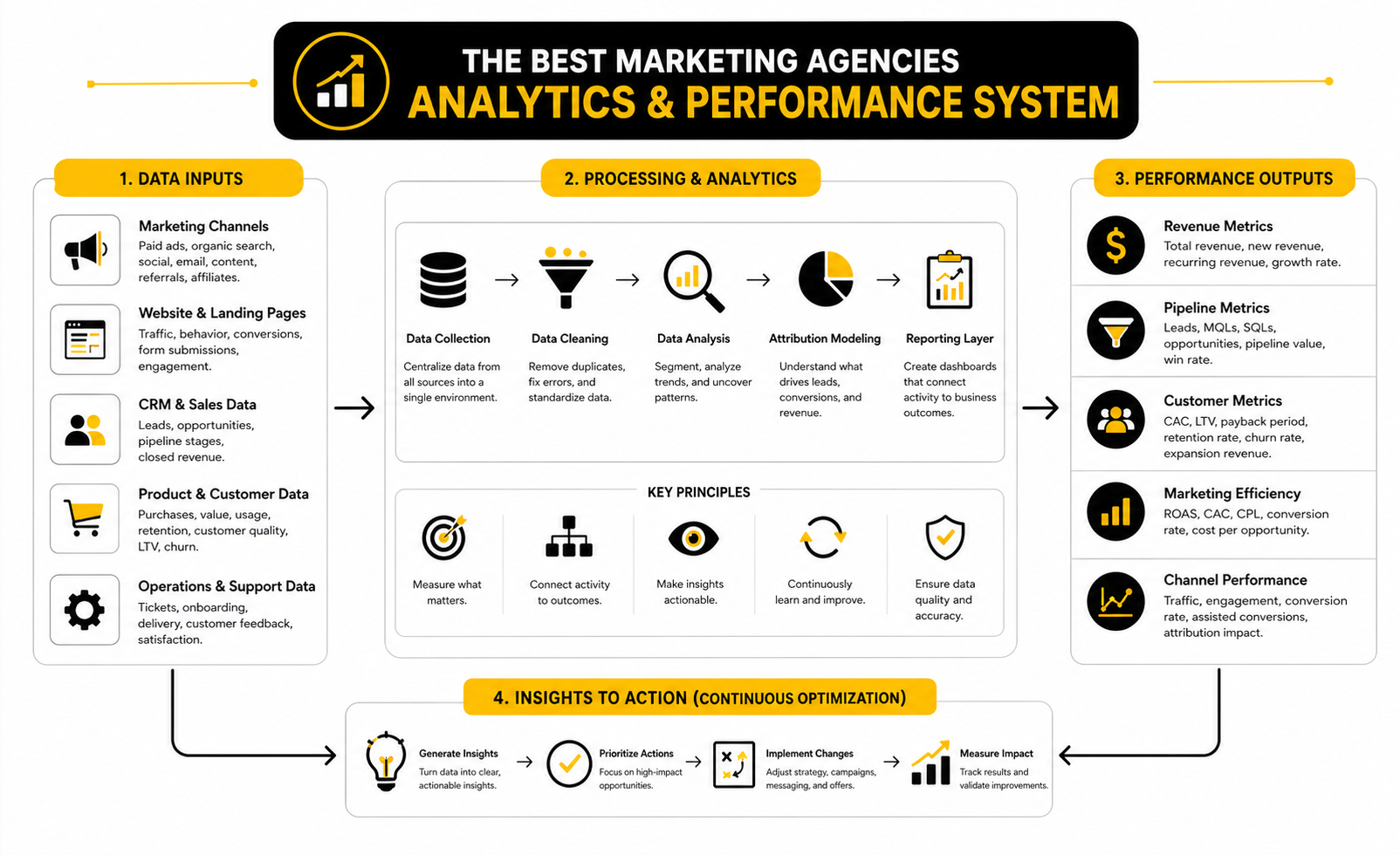
The best marketing agencies usually build measurement in layers. The first layer tracks basic delivery and conversion health. The second layer tracks quality signals, such as qualified leads, booked calls, opportunities, and revenue. The third layer looks at longer-term patterns, including retention, payback period, customer acquisition cost, lifetime value, and channel contribution.
This layered view prevents bad decisions. If you only look at cheap leads, you may scale a campaign that fills the pipeline with poor-fit prospects. If you only look at closed revenue, you may kill early-stage channels before they have enough time to prove themselves. Measurement should help you see the whole journey, not just the easiest number.
Benchmarks Are Useful, But They Are Not The Goal
Benchmarks can help you understand whether performance is obviously broken, but they should not become the target. Your market, offer, price point, sales cycle, brand strength, and competition all affect what “good” looks like. A $50 lead can be terrible for one company and excellent for another.
Agency benchmark research is still useful because it shows where the market is moving. AgencyAnalytics reported that 68% of agency leaders expected paid advertising to deliver the strongest results in 2025, while 73% said generative AI has changed how people discover content. The practical takeaway is not “spend everything on ads” or “stop doing SEO.” The takeaway is that agencies need stronger testing, better creative, better attribution, and more flexible channel strategy.
Use benchmarks as a diagnostic, not a command. If your conversion rate is far below market norms, investigate the offer, landing page, traffic quality, and follow-up. If your cost per acquisition is above your target, look at funnel efficiency before blaming the ad platform. Numbers point to questions first, then decisions.
Watch The Signals That Predict Revenue
Revenue is the outcome, but it often arrives late. That is why good agencies track leading indicators that predict whether revenue is likely to follow. These signals are not perfect, but they help the team make smarter decisions before the full sales cycle is complete.
For lead generation, useful signals include form completion quality, booked-call rate, show-up rate, sales acceptance rate, opportunity creation, close rate, and average deal size. For ecommerce, useful signals include add-to-cart rate, checkout completion, repeat purchase rate, contribution margin, customer acquisition cost, and payback period. For content and SEO, useful signals include qualified organic traffic, assisted conversions, branded search growth, content engagement from target accounts, and movement across high-intent topics.
This is where the agency’s experience matters. A junior team may celebrate a low cost per lead because the dashboard looks green. A stronger team will ask whether those leads are worth anything. That difference can save a lot of money.
Understand Attribution Without Worshipping It
Attribution is helpful, but it is not a perfect truth machine. Platform dashboards are biased toward their own activity, cookies are less reliable than they used to be, and many buying journeys involve multiple touches across search, social, email, referrals, sales conversations, and dark social. Treating one attribution model as absolute can lead to very bad budget decisions.
Nielsen’s 2025 marketing research emphasizes the need to move from fragmented measurement toward more unified, outcome-connected ROI analysis. That matters because many companies still evaluate channels in silos. When each channel is judged alone, brand work looks too soft, performance work gets overcredited, and the full customer journey becomes invisible.
The practical move is to combine multiple views. Look at platform data, analytics data, CRM data, sales feedback, customer surveys, and blended business performance. None of these views is perfect alone, but together they create a more honest picture.
Reporting Should Drive Decisions, Not Just Updates
A report should not feel like a receipt for agency activity. It should feel like a decision document. After reading it, you should know what happened, why it happened, what the agency recommends, and what will change next.
Strong reports usually include a plain-English summary, performance against goals, key learnings, budget notes, risks, next actions, and decisions needed from the client. They do not hide behind screenshots. They make the tradeoffs clear.
If an agency cannot explain the report without jargon, that is a problem. The best marketing agencies make the numbers easier to understand, not more intimidating. Clear reporting builds trust because everyone can see the same reality and move faster.
Use Data To Improve The Agency Relationship
Measurement is not only for campaigns. It should also improve the relationship between the company and the agency. If deadlines slip, approvals stall, leads are mishandled, or feedback loops are too slow, those operational issues should be visible too.
This is important because some performance problems are not caused by the agency alone. A campaign may generate solid leads, but sales may take too long to respond. An SEO plan may be strong, but content approvals may sit for weeks. A creative testing roadmap may be smart, but internal stakeholders may keep rewriting every ad until the concept is watered down.
The best client-agency relationships treat data as a shared operating system. Everyone can see the goals, the constraints, the wins, and the bottlenecks. That makes the partnership more honest, more useful, and much easier to scale.
How To Evaluate Pricing, Fit, And Red Flags
By this point, the conversation should move from “Can this agency do marketing?” to “Is this the right partner for this business right now?” That is a much better question. The best marketing agencies are not universally best for every company, every stage, or every budget.
Pricing, fit, and risk need to be evaluated together. A cheaper agency can become expensive if it wastes internal time, produces weak work, or misses the real constraint. A premium agency can be a smart investment if it shortens the learning curve, protects the budget, and creates a repeatable growth system.
The goal is not to find the agency with the lowest retainer. The goal is to understand what level of strategy, execution, access, and accountability you are actually buying. That is where most bad agency decisions happen.
Understand What You Are Really Paying For
Agency pricing usually reflects a mix of expertise, seniority, team size, scope, speed, software, creative volume, and management complexity. Two proposals can look similar on the surface while offering completely different levels of involvement. One may include senior strategy and active testing, while another may include basic execution from a junior team.
You should ask what is included, what is excluded, who will actually do the work, and how many active initiatives the agency can realistically manage. A proposal that promises every channel at a low price should make you pause. Multi-channel marketing is not automatically better if each channel is under-resourced.
Tight budgets make this even more important. Marketing teams are being pushed to prove more with limited resources, and Gartner’s 2025 CMO research shows budgets remaining at 7.7% of company revenue. That means the agency’s scope should be focused enough to execute well, not broad enough to sound impressive.
Compare Specialists, Full-Service Agencies, And Fractional Teams
A specialist agency is usually best when you already know the problem. If you need better Google Ads management, a stronger SEO system, paid social creative, lifecycle email, or landing page testing, a focused expert can move quickly. The tradeoff is that specialists may not solve problems outside their lane.
A full-service agency can be useful when the business needs coordination across strategy, creative, media, content, analytics, and automation. The upside is alignment. The risk is that “full-service” sometimes means average execution across too many areas, so you need to inspect the actual team and process.
Fractional marketing teams sit somewhere in the middle. They can be helpful when you need senior direction and flexible execution without hiring a full internal department. This model works best when responsibilities are clearly defined, because blurry ownership between internal staff, freelancers, and agency partners can create delays fast.
Know The Tradeoff Between Speed And Depth
Fast execution is valuable, especially when a company needs momentum. But speed without diagnosis creates noise. The agency may launch campaigns quickly, yet still miss the deeper issue: unclear positioning, weak offer economics, poor sales follow-up, or a conversion path that leaks demand.
Depth has its own risk. Some agencies over-strategize and under-ship. They produce audits, decks, and workshops, but the market never sees enough real tests to generate learning.
The best marketing agencies balance both. They move fast where the decision is reversible and slow down where the decision affects positioning, tracking, budget allocation, or the operating model. That is the practical standard: move quickly, but not blindly.
Watch For Red Flags Before You Sign
Red flags often appear before the contract is signed. The problem is that companies ignore them because the agency sounds confident. Confidence is useful only when it is backed by clear thinking.
Be careful if an agency guarantees specific revenue without seeing your data, promises instant SEO results, avoids questions about lead quality, refuses to explain who will work on the account, or talks only about tactics. Also be careful if they cannot describe what happens in the first 30 days. A vague onboarding process usually becomes a vague working relationship.
You should also watch how they handle pushback. A strong agency can explain tradeoffs without becoming defensive. A weak agency either agrees with everything to win the deal or hides behind jargon when you ask practical questions.
Evaluate Their AI Approach Carefully
AI is now part of modern agency work, but it should not become a shortcut for lazy thinking. AgencyAnalytics reported that 73% of agency leaders say generative AI has changed how people discover content, which means agencies need to adapt. But adaptation does not mean publishing generic content, automating every message, or pretending human judgment no longer matters.
Ask how the agency uses AI in research, creative testing, reporting, customer analysis, content production, and workflow automation. Then ask where humans stay involved. The answer should be specific, because the risk is not AI itself. The risk is unreviewed output, inaccurate claims, weak differentiation, and content that sounds like everyone else.
Good agencies use AI to increase speed and pattern recognition while keeping strategy, editing, ethics, and brand judgment human-led. That balance matters. If the agency’s AI process would make your brand less trustworthy, it is not a productivity gain.
Check Operational Fit, Not Just Strategic Fit
An agency can be strategically smart and still be hard to work with. Operational fit is about communication style, meeting cadence, turnaround time, approval process, documentation, and how decisions are made. This is where many partnerships quietly break down.
Ask what communication looks like week to week. Ask how they handle urgent issues, delayed feedback, creative revisions, reporting questions, and campaign underperformance. You want the working relationship to be boring in the best way: clear, predictable, and easy to manage.
Tools can help here, but they will not fix poor habits. A CRM like Copper can support relationship tracking, while GoHighLevel can help agencies and service businesses centralize campaign operations. Still, the tool is only useful when the team has a clean process behind it.
Think About Scaling Before You Need To Scale
A small agency can be perfect at the beginning and become a bottleneck later. A larger agency can have impressive capacity but feel too slow or expensive for an early-stage company. The right choice depends on what the next stage of growth requires.
Before signing, ask what happens if the campaign works. Can the agency increase creative output? Can they manage more spend responsibly? Can they support more landing pages, more reporting complexity, more markets, or more lifecycle automation? Growth creates operational pressure, and you want to know whether the agency can handle it.
Scaling also requires stronger decision rules. When budgets increase, small inefficiencies become expensive. The agency should already have a view on what needs to be true before spend increases, channels expand, or new services are added.
Protect Yourself With Clear Terms
The contract should make the relationship easier, not scarier. Clear terms protect both sides because they define scope, timelines, ownership, cancellation rules, reporting expectations, payment structure, confidentiality, and access to assets. If these details are vague, the partnership can become frustrating even when the people are good.
Pay close attention to asset ownership. You should know who owns ad accounts, landing pages, creative files, analytics properties, tracking setup, CRM data, content, and templates if the relationship ends. Never let a vendor relationship put your core marketing infrastructure at risk.
Also look at minimum commitments. A reasonable commitment can give the agency enough time to prove the strategy, especially for channels with longer feedback loops. But a long lock-in with unclear deliverables is a risk. The best agencies are confident enough to define what they will do and how progress will be judged.
Final Checklist, Tools, And FAQs
The final decision should feel calmer than the early research stage. By now, you should know what kind of agency you need, what results matter, how implementation should work, and which risks to avoid. The best marketing agencies make that decision easier because they can explain their process without hiding behind complexity.
A strong agency choice usually comes down to fit, clarity, and trust. Fit means they understand your business model and stage. Clarity means they can explain the strategy, scope, metrics, and operating rhythm. Trust means they will tell you the truth when something is not ready, not working, or not worth doing.
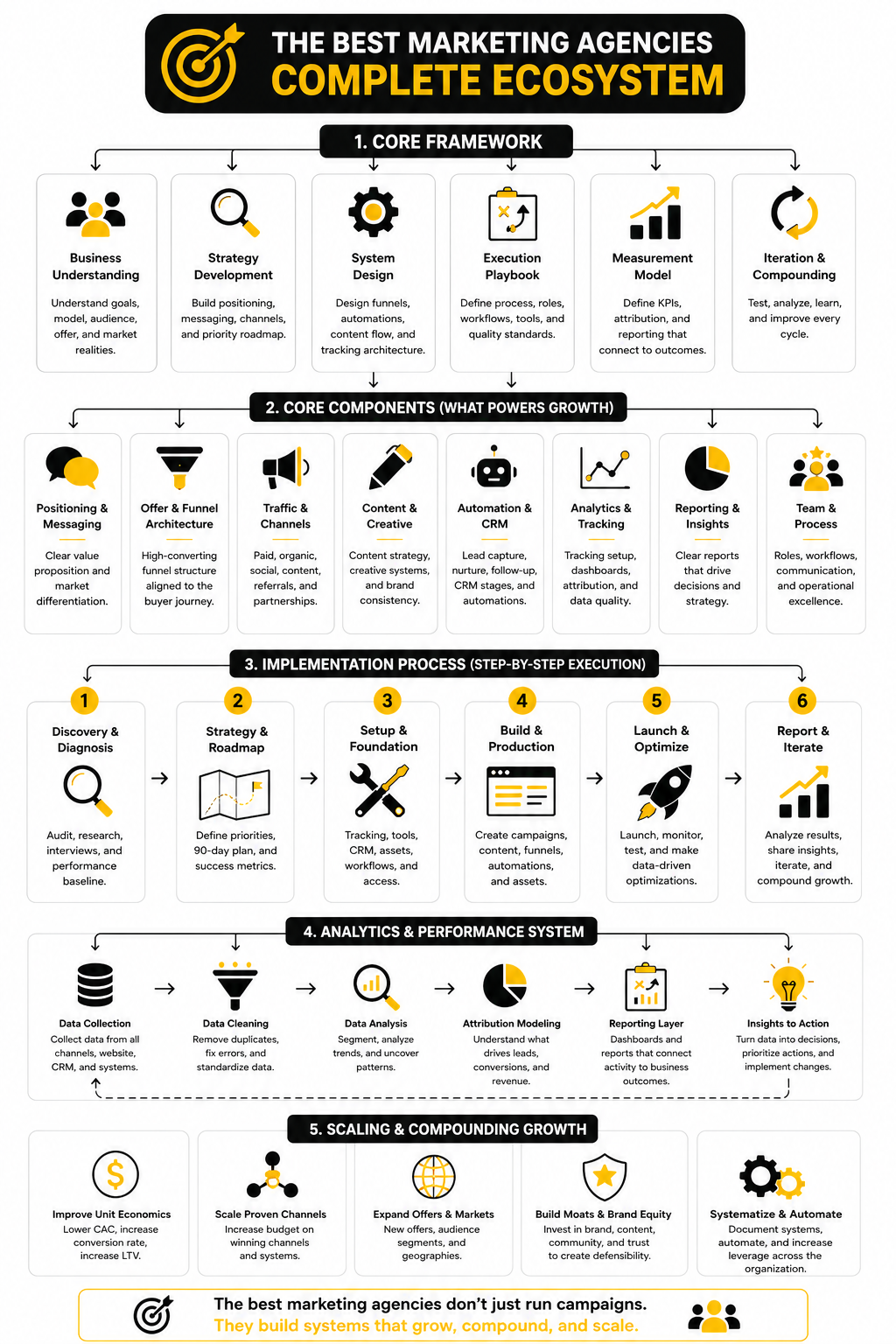
The simplest way to make the final call is to look at the full ecosystem. Strategy, channels, creative, analytics, sales follow-up, lifecycle marketing, and operations should work together. If one agency can own that system well, great. If not, build a smaller expert team with clear responsibilities and one person accountable for the whole picture.
The Final Agency Selection Checklist
Use this checklist before signing anything. It will not make the decision for you, but it will expose weak proposals quickly. If an agency cannot answer most of these clearly, keep looking.
- The agency understands your business model, margins, sales cycle, and customer quality.
- The proposal explains priorities instead of listing every possible service.
- The first 30, 60, and 90 days are clear.
- Reporting connects activity to business outcomes, not just channel metrics.
- The agency can explain what they will test and why.
- You know who will actually work on the account.
- Communication cadence, approvals, and responsibilities are documented.
- Asset ownership and account access are clear.
- The contract has reasonable scope, timelines, and cancellation terms.
- The agency is honest about what they cannot do well.
- The team has a practical AI policy that protects quality and brand trust.
- The agency has a plan for scaling if the work starts performing.
Useful Tools For A Stronger Marketing System
Tools should support the strategy, not replace it. Still, the right stack can make a good agency relationship much easier to manage. Use tools when they reduce friction, improve visibility, or make execution faster.
For service businesses and agencies that need one place for CRM, funnels, automation, booking, and follow-up, GoHighLevel is worth reviewing. For funnel-heavy campaigns, ClickFunnels and Systeme.io can help teams launch offers faster. For ecommerce landing pages, Replo can be useful when creative testing needs to move quickly.
For lifecycle and communication work, Brevo can support email and automation, while ManyChat can help with conversational marketing flows. For social planning, Buffer and Flick Social can support publishing and workflow. None of these tools magically creates strategy, but they can help the right team execute with less chaos.
FAQ - Built For Complete Guide
What are the best marketing agencies?
The best marketing agencies are the ones that match your business model, growth stage, budget, and internal team. There is no universal winner because a startup, local service company, ecommerce brand, and enterprise B2B company all need different support. A strong agency should diagnose the problem, explain the plan, execute consistently, and report on the numbers that actually matter.
How do I choose the right marketing agency?
Start by defining the business outcome you need, not the service you think you need. Then compare agencies by relevant experience, strategic thinking, implementation process, reporting quality, and team fit. The best choice is usually the agency that gives you the clearest path from current bottleneck to measurable improvement.
Are full-service marketing agencies better than specialists?
Full-service agencies are better when you need coordination across multiple channels and do not have the internal team to manage everything. Specialists are better when you already know the exact problem and need deep expertise in one area. The wrong move is hiring a full-service agency for shallow execution or hiring a specialist when the real problem is strategic.
How much should a marketing agency cost?
Agency pricing depends on scope, seniority, service mix, market, and workload. A small tactical engagement may cost far less than a full growth partnership with strategy, creative, analytics, paid media, content, and lifecycle marketing. Instead of asking only what it costs, ask what the agency is responsible for improving and how success will be measured.
How long does it take to see results from a marketing agency?
Some channels can show early signals within weeks, especially paid ads, landing page tests, and conversion fixes. SEO, brand, content, lifecycle marketing, and complex B2B demand generation usually take longer because the buying journey is slower. A serious agency should explain which results are expected early and which need more time.
What should be included in a marketing agency proposal?
A good proposal should include the diagnosis, recommended strategy, scope of work, timeline, deliverables, reporting structure, team roles, pricing, assumptions, and next steps. It should also clarify what is not included. If the proposal is mostly buzzwords and service lists, it is not strong enough.
What are the biggest red flags when hiring an agency?
Major red flags include guaranteed results without data, vague reporting, unclear ownership, weak onboarding, no discovery process, and pressure to sign quickly. Be careful with agencies that talk only about tactics and never ask about revenue, margins, sales quality, or customer journey. Good agencies ask better questions before they sell you the answer.
Should I hire an agency or build an internal marketing team?
Hire an agency when you need speed, specialized expertise, or outside perspective. Build internally when marketing is central to the company and you need long-term ownership close to the product, customers, and leadership team. Many companies use both: an internal lead for strategy and accountability, plus agencies or contractors for specialized execution.
How should I measure agency performance?
Measure agency performance with a mix of business outcomes, channel metrics, and operational quality. Revenue, pipeline, qualified leads, conversion rate, acquisition cost, retention, and payback period matter more than vanity metrics. Also measure whether the agency communicates clearly, ships on time, learns from data, and improves the system over time.
Do the best marketing agencies use AI?
Yes, most serious agencies now use AI in some part of their workflow. The important question is how they use it. AI can help with research, analysis, drafting, ideation, reporting, and workflow speed, but human judgment should still guide strategy, quality control, brand voice, and final decisions.
What should I ask before signing an agency contract?
Ask who will work on the account, what happens in the first 30 days, how reporting works, what access the agency needs, who owns the assets, and how success will be judged. You should also ask what could prevent the strategy from working. A confident agency will answer directly instead of pretending there are no risks.
Can a marketing agency fix a weak offer?
An agency can help clarify, package, position, and test an offer, but it cannot magically make an unwanted offer strong. If customers do not understand the value, do not trust the proof, or do not feel enough urgency, marketing will struggle. The best marketing agencies will identify that issue early instead of hiding it behind more campaigns.
Work With Professionals
Explore 10K+ Remote Marketing Contracts on MarkeWork.com
Most marketers spend too much time chasing clients, competing on crowded platforms, and losing a percentage of every project to middlemen.
MarkeWork gives you a better way. Browse thousands of remote marketing contracts and connect directly with companies desperate to hire skilled marketers like you, without platform commissions and without unnecessary gatekeepers.
If you are serious about finding better opportunities and keeping 100% of what you earn, explore available contracts and create a profile for free at MarkeWork.com.