

Finding the best PPC agency is not really about finding the loudest brand, the biggest client list, or the prettiest dashboard. It is about finding a team that can turn paid traffic into profitable growth without hiding behind vanity metrics, vague reporting, or platform jargon. That sounds obvious, but in practice, this is where most businesses get burned.
Paid search is more demanding than it used to be. Automation is stronger, competition is tighter, attribution is messier, and weak inputs now get exposed faster because modern ad platforms optimize around the data you feed them. A great agency can make that complexity work in your favor. An average one can waste budget while making everything look busy.
This guide breaks down what separates a real performance partner from an agency that just manages clicks. It is built for founders, operators, and marketing leaders who want clarity before they hire, switch, or scale.
Article Outline
- Why Choosing the Right PPC Agency Matters More Than Ever
- The Framework Behind a High-Performing PPC Agency
- What the Best PPC Agencies Do Differently
- How to Evaluate PPC Agencies Before You Sign
- Red Flags That Signal a Bad PPC Fit
- How to Make the Final Decision With Confidence
Why Choosing the Right PPC Agency Matters More Than Ever
Search advertising is still one of the biggest forces in digital media, and that matters because it keeps the market crowded, expensive, and unforgiving. When a channel is this mature, the easy wins disappear first. What remains is execution quality, measurement quality, and how quickly a team can improve the whole system instead of just tweaking bids.
Recent benchmark data also shows why agency quality matters so much. Click-through rates and conversion rates can look healthy at the market level while costs keep rising underneath, which means weak operators can burn through budget faster than ever. If two agencies buy traffic from the same auction, the one with better tracking, stronger landing pages, cleaner account structure, and smarter offer strategy will almost always look like it has “better media buying,” even when the real difference is business discipline.
That is why the best PPC agency is rarely just a media buyer. The best one acts more like a performance operator. It understands bidding, yes, but it also understands conversion architecture, sales feedback loops, first-party data, lead quality, creative relevance, and how to make the ad account learn from the right signals.
A lot of businesses hire too early based on surface-level promises. They hear phrases like full-funnel management, AI optimization, or omnichannel growth, but never get a clear answer to simple questions. What counts as success? Which conversions matter most? How will lead quality be validated? What happens if branded search is carrying the entire account? How will landing pages, forms, CRM data, and retargeting work together?
Those questions are not side details. They are the difference between hiring a vendor and hiring a growth partner. If an agency cannot connect paid traffic to revenue reality, it is not the best PPC agency for your business, no matter how polished its sales process looks.
The Framework Behind a High-Performing PPC Agency
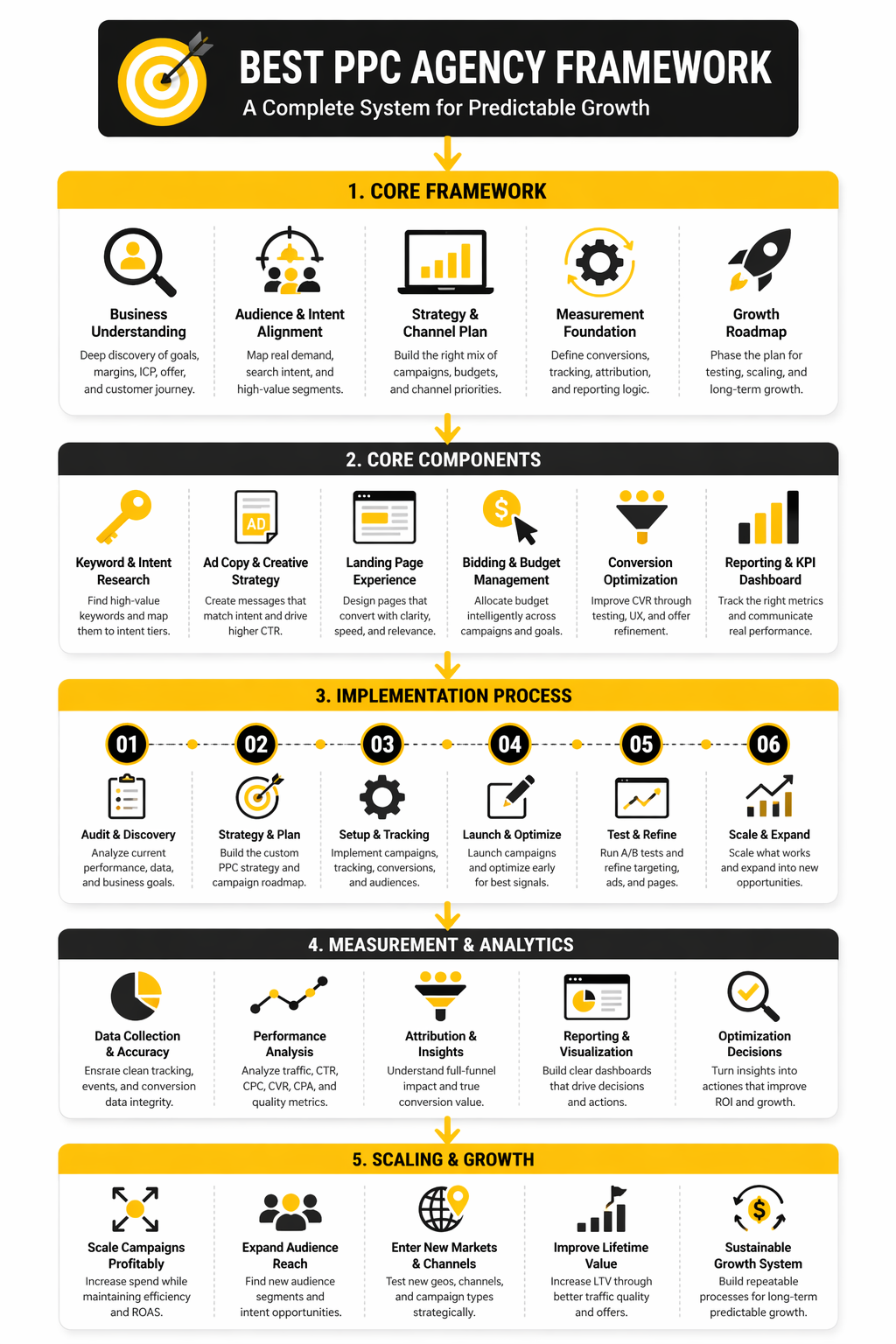
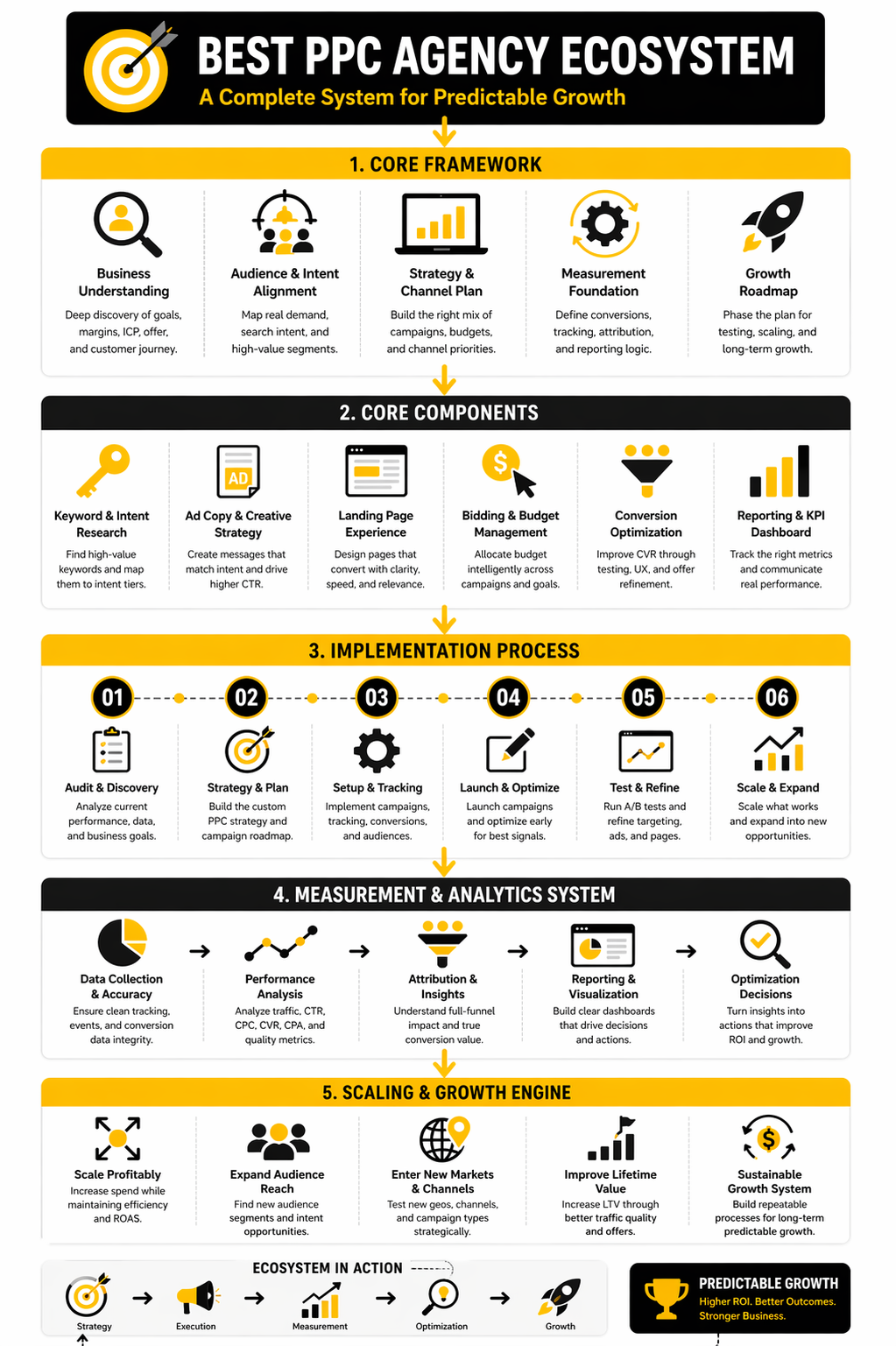
The easiest way to compare agencies is to stop thinking in terms of services and start thinking in terms of systems. A serious PPC partner should be able to explain how demand is captured, how traffic is qualified, how intent is matched to creative, how conversions are measured, and how budget decisions get made over time. That is the framework you are really buying.
At a high level, great PPC management sits on four layers. The first is strategy, which includes market positioning, offer selection, account priorities, and channel mix. The second is execution, which covers campaign builds, bidding models, search term control, audience signals, ad assets, and landing page alignment. The third is measurement, where tracking, attribution, CRM feedback, offline conversions, and reporting standards live. The fourth is optimization, which is the ongoing process of testing, learning, and reallocating budget based on real business outcomes.
When an agency is weak, one of those layers usually collapses first. Sometimes the ads are fine but the tracking is broken. Sometimes the dashboard looks impressive but lead quality is poor. Sometimes the account is organized neatly but nobody is challenging the offer, the funnel, or the conversion experience. The best PPC agency keeps all four layers connected, because paid media performance is rarely a single-platform problem.
This is also why implementation matters more now than it did a few years ago. Modern platforms use automation aggressively, and that can be a huge advantage when the account is built on strong inputs. But when conversion tracking is incomplete, consent setup is sloppy, offline sales data never flows back, or landing pages are misaligned with search intent, automation does not save you. It scales your mistakes.
That is where good agencies earn their fees. They know when to trust automation and when to constrain it. They know that broad match, smart bidding, responsive assets, and AI-assisted campaign formats can perform exceptionally well, but only when the account has the right structure and the right feedback loops. They do not romanticize manual control, but they do not surrender strategy to the platform either.
What “Best” Actually Means in PPC
The phrase best PPC agency is usually treated like a leaderboard term, but that is not how smart buyers should use it. Best does not mean best for everyone. It means best for your growth stage, sales cycle, budget tolerance, conversion path, and internal team setup.
For a local service business, the best agency may be the one that can improve call tracking, tighten geo targeting, reduce junk leads, and build a tighter follow-up workflow. For a B2B company, the right partner may be the one that knows how to import offline revenue data, optimize for qualified pipeline instead of form fills, and work closely with sales. For an ecommerce brand, it may be the team that understands feed quality, landing page speed, offer testing, and search demand shaping across branded and non-branded campaigns.
That is why you should be careful with generic “top agency” lists. They can be useful for discovery, but they do not tell you whether an agency fits your economics, your decision cycle, or your measurement maturity. A smaller specialist can outperform a famous agency if it understands your buying journey and works closer to the revenue signal.
The strongest agencies also know paid media does not live in isolation. They think about follow-up, appointment setting, CRM hygiene, landing page flexibility, and remarketing infrastructure because those pieces shape PPC performance directly. In practice, that is why teams often pair ad management with systems that improve lead handling and funnel speed, whether that means using GoHighLevel for pipeline visibility, ManyChat for conversational lead capture, or Replo for faster landing page iteration on ecommerce offers.
In the next section, we will get specific about the core components that separate elite PPC agencies from competent but limited ones. That is where the comparison becomes much easier, because once you know what to look for, a lot of agency positioning starts to fall apart very quickly.
What the Best PPC Agencies Do Differently
The best PPC agency does not win because it has secret bid strategies or some magical dashboard nobody else can access. It wins because it gets the fundamentals right at a much higher level and keeps those fundamentals connected as the account scales. In a market where recent benchmark data shows average search advertising costs around a $5.26 CPC and $70.11 cost per lead, that difference in discipline is not small. It is often the difference between paid media that compounds and paid media that quietly drains margin.
A lot of agencies still operate like channel managers. They launch campaigns, adjust bids, send reports, and call it optimization. The best PPC agency operates more like a revenue team with buying power. It treats media, measurement, landing pages, lead handling, and sales feedback as one system, because that is how the platforms now reward good operators.
They Build Around Conversion Quality, Not Just Conversion Volume
This is one of the clearest dividing lines. A weak agency celebrates more leads, more demo requests, or more purchases without asking whether those actions actually translate into profit, qualified pipeline, or repeatable customer value. A strong agency pushes deeper and asks what the platform should learn from, what counts as a high-quality conversion, and how that signal gets sent back into the ad account.
That matters because modern platforms are built to optimize toward conversion signals. Google states that Smart Bidding uses machine learning to optimize for conversions or conversion value, and Google’s own documentation around offline conversion uploads and enhanced conversions for leads makes it clear that better first-party data improves what the system can learn from. In plain English, if your agency is optimizing toward weak form fills, junk calls, or shallow events, the platform will get better at finding more of the wrong thing.
The best PPC agency closes that loop. It works with CRM data, validates lead quality, imports offline outcomes when possible, and pushes the account toward signals tied to real business value. That is especially important for B2B, local services, healthcare, legal, and any business where the first conversion is only the start of the revenue process.
They Treat Tracking as a Growth Lever, Not a Setup Task
Most agencies say they “handle tracking.” That phrase sounds reassuring until you realize it often means basic tag installation and a quick thank-you-page check. In 2026, that is nowhere near enough. Good PPC performance depends on whether the account has clean conversion definitions, event consistency, consent-aware measurement, and enough structure for the platform to understand what success really looks like.
Google Analytics is now fundamentally event-based, and Google’s documentation on recommended ecommerce events and key events shows how important event design is to measurement quality. On top of that, consent infrastructure now matters more than ever, especially in Europe, where Google explicitly requires advertisers measuring users with Google tags to pass end-user consent choices through consent mode.
The best PPC agency knows that broken attribution rarely looks broken at first. It looks like unstable performance, conflicting reports, weird platform recommendations, or campaigns that stop scaling after an initial lift. Agencies that understand this do not just install tags and move on. They audit the full path from click to sale, pressure-test the data, and build reporting around decisions instead of pretty charts.
They Improve the Entire Conversion Path, Not Just the Ads
A mediocre agency lives inside the ad platform. A great one keeps asking what happens after the click. That is where a huge amount of paid search performance is either unlocked or destroyed.
Google’s own ecosystem has spent years emphasizing the business impact of speed, relevance, and user experience, and even older but still widely cited Google-backed performance research found that small load-time improvements could materially lift conversion outcomes in sectors like retail and travel, with one summary showing 0.1-second improvements tied to meaningful conversion gains. You do not need to obsess over every decimal place to understand the takeaway. If the landing page is slow, confusing, generic, or disconnected from the ad promise, the account is handicapped before bidding strategy even enters the conversation.
That is why the best PPC agency usually has opinions about pages, forms, offer clarity, and follow-up speed. For ecommerce brands, that might mean using something like Replo to ship landing page tests faster. For lead generation, it may mean tightening workflows in GoHighLevel or using Fillout to reduce form friction and improve data capture. The point is not the tool itself. The point is that elite agencies care about the entire path to conversion because that is where real leverage sits.
They Use Automation Intelligently Instead of Worshipping or Fighting It
By now, every PPC buyer has heard some version of the same pitch. One agency says AI and automation will handle everything. Another says manual control is the only serious approach. Both positions are usually too simplistic to trust.
Google openly frames Smart Bidding as an AI-driven system that sets bids at auction time to improve conversion or conversion value performance, and Microsoft and LinkedIn have continued expanding server-side and offline measurement tools like Conversions API connections to strengthen optimization data. The platforms are clearly moving toward more automation, more modeled measurement, and more dependence on first-party inputs. That trend is not reversing.
So the best PPC agency does not waste time pretending it can out-click every algorithm by hand. It focuses on the parts humans still control best: offer strategy, signal quality, account architecture, exclusions, creative direction, landing page alignment, sales feedback, and budget allocation. That is professional implementation. It is not anti-automation. It is what makes automation useful.
The next step is practical: how do you separate agencies that really do this from agencies that only know how to talk about it? That is where evaluation gets sharper, because once you know the questions to ask before signing, most weak PPC pitches become a lot easier to spot.
How to Evaluate PPC Agencies Before You Sign
Once you understand what separates a strong operator from a surface-level one, the next step is simple: make the agency explain its process in detail. This is where a lot of polished sales presentations start to crack. The best PPC agency will usually welcome specific questions because it has a repeatable system. Weak agencies tend to stay vague, jump to promises, or hide behind general claims like “we optimize continuously.”
You are not just buying media management. You are buying diagnosis, implementation quality, communication rhythm, and decision-making under pressure. That means the evaluation process should focus less on logo slides and more on how the agency thinks when it has to turn a messy business into a clean performance system.
Start With the Discovery Process, Not the Pitch Deck
A serious PPC agency should ask sharp questions before it talks about solutions. It should want to understand margins, sales cycle length, lead qualification rules, close rates, seasonality, existing attribution issues, landing page constraints, and how your team handles follow-up. If the conversation starts and ends with ad spend, target CPA, and platform preference, that is not enough.
Google’s own guidance around Smart Bidding repeatedly stresses choosing bid strategies that align with business objectives, conversion goals, and conversion value goals. That sounds basic, but many agencies still skip it and rush into tactical recommendations. A good evaluation process reveals whether the agency can translate business reality into account design. That is one of the clearest signs you may be talking to the best PPC agency for your situation rather than just another campaign manager.
A strong discovery call should also make room for friction. Good agencies are willing to challenge bad assumptions, weak offers, unrealistic CAC targets, or messy internal workflows. That is a positive sign. The wrong partner tells you everything sounds great because it wants the contract. The right partner shows you where the constraints really are.
Ask for the Implementation Process in Plain English
This is where the execution process becomes tangible. A competent agency should be able to walk you through what happens in the first 30, 60, and 90 days without turning the answer into buzzword soup. You want a step-by-step view of setup, launch, testing, reporting, and optimization.
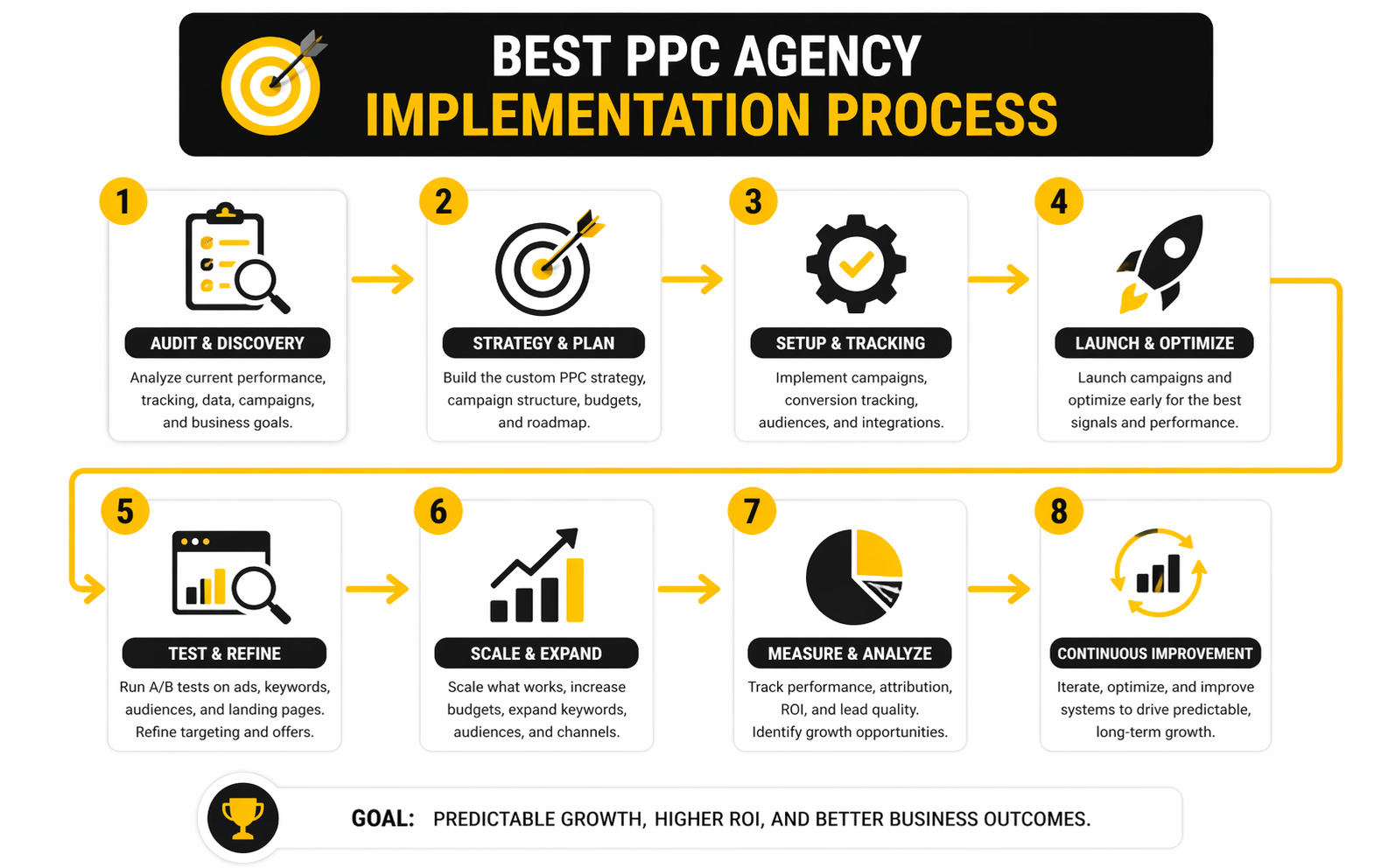
At a minimum, the process should look something like this:
- Business and measurement audit
- Tracking validation and conversion mapping
- Account structure and campaign planning
- Landing page and offer alignment
- Creative and asset production
- Launch with clear budget controls
- Search term, audience, and placement review
- Conversion quality review
- Reporting tied to business outcomes
- Iteration based on what the data actually says
If an agency cannot explain its process at that level, it probably does not have one. That matters because paid media performance is rarely saved by clever optimizations later. It is usually set up for success or failure in the early implementation phase, when tracking, conversion priorities, and campaign architecture are being defined.
Check How They Handle Attribution, Bidding, and Learning Periods
This is where you separate people who actually know platform behavior from people who memorize platform vocabulary. A real PPC partner should be able to explain attribution choices, how data-driven models work in practice, when to use value-based bidding, and how it handles the noisy period after major account changes.
Google explains that data-driven attribution distributes credit based on how ad interactions contribute to conversions, and GA4 documents that its own data-driven attribution model uses algorithmic fractional credit across touchpoints. That means the agency needs a clear answer for how it interprets assisted conversions, how it avoids over-crediting branded demand, and what it does when platform numbers and CRM numbers diverge. If it cannot answer that cleanly, reporting will become a trust problem later.
The same goes for bidding. Google states that Smart Bidding optimizes bids at auction time for conversions or conversion value, so the right agency should talk less about “manual control” as a virtue and more about input quality, signal quality, and stabilization periods. It should also explain when it expects performance volatility, what changes reset learning, and how it avoids making too many overlapping edits at once.
Review How They Turn Lead Data Into Action
A lot of agencies still stop at top-of-funnel reporting. That is not good enough for most serious businesses. If lead quality varies, the best PPC agency should have a clear method for feeding that reality back into optimization.
That can mean importing offline conversion data, segmenting by qualified lead stage, or separating soft conversions from revenue-linked outcomes. Microsoft’s own documentation makes this distinction visible in reporting by separating standard conversion columns from all-conversion columns and excluded-from-bidding goals. In other words, even the platforms themselves assume not every conversion should drive bidding equally.
This is also where supporting systems matter. If your agency is serious about lead handling, it will care about how leads are routed, tagged, followed up, and scored after they come in. That is why some teams strengthen the back end with tools like GoHighLevel for pipeline and automation, Copper for relationship visibility, or Cal.com when faster booking flow can materially improve close rates. Again, the tool is not the story. The process is.
Ask What They Actually Report Every Week or Month
Reporting tells you what the agency thinks matters. That is why this question is so useful. If the answer is mostly impressions, clicks, average CPC, and broad conversion counts, you are looking at a shallow reporting culture. If the answer includes cost by qualified lead, revenue-linked performance, search term trends, landing page drop-off points, and action items for the next testing cycle, you are in a different category.
The best PPC agency usually treats reporting as decision support, not client theater. It should be able to show what changed, why it changed, what it believes the cause was, and what happens next. That last part matters. A lot of reports describe performance but do not lead to decisions.
You should also ask who owns the communication. Will you hear from the strategist, the account manager, or whoever happens to be available? A strong process includes operating rhythm, clear responsibilities, and a consistent feedback loop with the client. Paid media gets better faster when both sides know how information moves.
By the time you finish this evaluation stage, you should have a much clearer picture of whether the agency has substance. In the next section, we will make that even easier by looking at the red flags that usually show up before bad PPC relationships go sideways.
What the Numbers Are Really Telling You
This is the part most businesses either overcomplicate or completely misunderstand. They collect a pile of PPC metrics, stare at a dashboard, and still cannot tell whether the account is healthy. The best PPC agency is not the one with the most numbers. It is the one that knows which numbers actually matter, what they mean in context, and what decision each one should trigger.
That is why benchmarks need to be handled carefully. They are useful for orientation, not for blind comparison. If you treat industry averages like universal goals, you can make bad decisions very quickly.
Use Benchmarks as Context, Not as a Scorecard
Recent search advertising benchmarks are helpful because they show how competitive the environment has become. WordStream’s latest benchmark set, based on more than 16,000 U.S. campaigns, shows a 6.66% average click-through rate, a $5.26 average cost per click, a 7.52% average conversion rate, and a $70.11 average cost per lead. The prior benchmark set, based on more than 17,000 campaigns, showed 6.42% CTR, $4.66 CPC, 6.96% conversion rate, and $66.69 CPL. That trend matters because it shows a channel where efficiency is still possible, but cost pressure is real.
What matters more is how you interpret those numbers. A higher CPC is not automatically bad if lead quality improved and close rates rose. A lower CPL is not automatically good if the leads are weak, unqualified, or impossible to close. This is exactly why the best PPC agency does not chase cheap conversions in isolation. It asks whether the economics behind those conversions are actually improving.
The benchmark shift also tells you something operational. If your costs are rising faster than your conversion quality, you do not have a bidding problem alone. You probably have a message match problem, a landing page problem, or a signal quality problem. That is the kind of interpretation that separates performance analysis from dashboard tourism.
Build a Measurement System That Matches the Business
The analytics setup should reflect how the business really makes money. In GA4, Google defines a key event as an event that measures an action particularly important to business success. That sounds simple, but it is one of the most important ideas in the whole stack. If you mark the wrong actions as important, every report downstream becomes less useful.
A serious measurement system usually has layers. The first layer tracks primary business outcomes such as purchases, booked calls, qualified demos, or completed applications. The second layer tracks supporting behaviors like add to cart, begin checkout, lead form start, or pricing page engagement. Google’s own recommended events for online sales and lead journeys make this structure pretty clear. The problem is not that businesses lack data. The problem is that they often fail to separate leading indicators from actual outcomes.
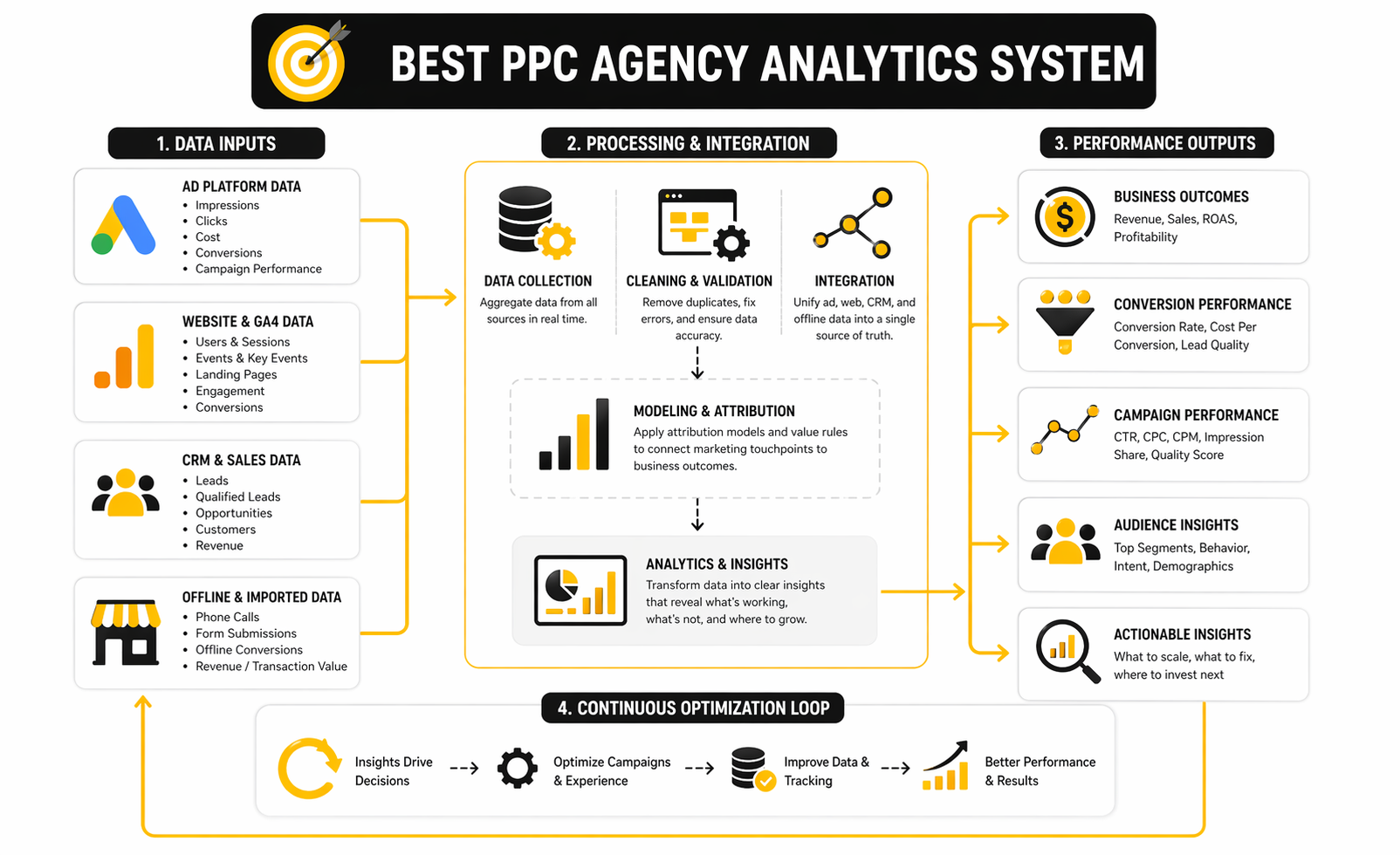
Once that structure is clear, the account becomes easier to manage. You can see whether traffic quality is weak, whether conversion friction is too high, or whether the closing process is the real bottleneck. That is what a proper analytics system does. It turns performance from vague opinion into a series of testable explanations.
This is also where tools outside the ad platform start to matter. A team that wants clean reporting may pair ad platform data with CRM and automation layers in GoHighLevel, routing and enrichment through forms in Fillout, and scheduling flow in Cal.com. The best PPC agency usually cares about those systems because better inputs produce better optimization.
Know Which Signals Should Trigger Action
Not every PPC metric deserves the same attention. Some are directional. Some are diagnostic. A few should change what you do immediately.
Click-through rate is mainly a relevance signal. If CTR is low, the first questions are usually whether the keyword targeting is too broad, the ad promise is too weak, or the offer is not compelling enough in the auction. Conversion rate is a stronger bridge metric because it tells you how well intent survived the click and turned into action. Cost per lead matters after that, but only when paired with lead quality or revenue quality.
Impression share is one of the most useful expansion metrics when you already know the account converts well. Google defines impression share as the percentage of impressions your ads received compared with the total they were eligible to receive. That sounds technical, but the practical use is simple. If impression share is low because of budget constraints, you may have room to scale. If it is low because of rank, you may need stronger relevance, better landing pages, or sharper bidding strategy instead of just more spend.
Quality Score helps too, but only when used correctly. Google describes it as a diagnostic score from 1 to 10 that reflects how your ad quality compares with other advertisers. That means it is useful for spotting relevance and experience problems, but it is not a business KPI by itself. Too many advertisers obsess over Quality Score while ignoring whether the account is generating profitable customers. That is backward.
Attribution Only Helps If the Inputs Are Clean
Attribution is where a lot of smart-sounding PPC conversations go off the rails. Google’s documentation explains that data-driven attribution distributes conversion credit based on how people engage with ads across the path to conversion. In theory, that gives a more realistic picture than pure last-click reporting. In practice, it only becomes really useful when the underlying conversion data is trustworthy.
Google also notes that while all conversion actions are eligible for data-driven attribution, performance improves with more data and recommends at least 200 conversions and 2,000 ad interactions in a 30-day period. That is an important reality check. If an account does not have enough volume, attribution sophistication can become a distraction. In that situation, clearer conversion definitions and cleaner data are often more valuable than more reporting complexity.
This is also why enhanced conversions and offline feedback loops matter more than they used to. Google has already confirmed that beginning in April 2026, Google Ads can simultaneously accept user-provided data from website tags, Data Manager, and API connections, with the goal of improving tracking accuracy and campaign bidding. That is a strong signal about where the ecosystem is heading. First-party data is not a nice extra anymore. It is part of competitive execution.
Consent, Data Quality, and Reporting Discipline Matter More Than Fancy Dashboards
A clean report is not the same thing as clean measurement. If consent handling is sloppy, if tags fire in the wrong order, or if key events are poorly defined, the dashboard can look polished while the decisions coming from it are wrong. That is a dangerous place to be, especially when budgets are growing.
Google Tag Manager’s own documentation makes this pretty explicit by highlighting the Consent Initialization trigger and consent management controls designed to ensure consent settings are honored before other tags fire. This is not just a compliance detail. It affects how much usable measurement data you actually collect, how stable your attribution is, and how much trust you should place in platform reports.
So when you evaluate a PPC partner, ask a blunt question: do they report what is easy to export, or what is necessary to decide? The best PPC agency usually builds reporting around a short chain of interpretation. Are we attracting the right demand? Are users taking the right next step? Are those conversions high quality? Are we losing scale because of budget, rank, or funnel friction? That chain is far more valuable than a dashboard with thirty widgets nobody acts on.
Once you understand the numbers this way, the next part becomes easier. Red flags stop being vague feelings and start looking obvious, because you can see exactly where weak agencies hide behind activity, reporting noise, or metrics that never connect to revenue.
Red Flags That Signal a Bad PPC Fit
By this point, you should have a decent sense of what a strong agency looks like. Now it helps to flip the lens and look at failure patterns. This is usually where the wrong agency becomes much easier to spot, because bad PPC relationships tend to break in predictable ways.
The biggest mistake is assuming poor performance always comes from poor intent or a hard market. Sometimes that is true. But a lot of the time, the real issue is that the agency does not know how to diagnose the system, so it keeps changing tactics without fixing the bottleneck underneath.
They Sell Tactics Before They Understand the Business
This is one of the most common warning signs. If an agency quickly recommends Performance Max, aggressive broad match expansion, landing page rebuilds, or a full-funnel retargeting stack before it understands your margins, sales process, and qualification logic, it is guessing. That is not strategy. That is packaging.
Google’s own documentation on choosing the right Smart Bidding strategy is built around business goals, not trendy campaign formats. That should tell you something important. The best PPC agency starts with commercial reality and only then decides how the platform should be used.
When an agency skips that step, the account usually becomes noisy fast. You get more activity, more changes, and often more spend, but not necessarily more good outcomes. That is the kind of motion that feels productive until the invoice and pipeline numbers stop lining up.
They Hide Behind Vanity Metrics and Reporting Theater
A weak PPC partner often over-reports easy numbers because those numbers are less dangerous. Clicks, impressions, average CPC, and raw conversion counts can all move in the “right” direction while the business gets worse underneath. That is why bad agencies love dashboards with lots of widgets and very little interpretation.
This matters even more now because the platforms are giving advertisers richer optimization and reporting systems, not simpler ones. Google continues to expand measurement infrastructure around enhanced conversions and offline conversion imports, which means serious operators have more ways to connect ad performance to real business outcomes. If an agency is still reporting like it is 2019, that is not a harmless stylistic difference. It is a capability gap.
The best PPC agency will gladly talk about qualified leads, closed revenue, lag time, assisted conversions, and measurement limitations. A bad one usually tries to keep the conversation at the level where it looks competent and you cannot challenge the logic too hard.
They Change Too Many Variables at Once
This is where a lot of accounts quietly fall apart. Instead of running disciplined tests, the agency changes bidding, match types, budget allocation, landing pages, offers, geo settings, and conversion goals at the same time. Then when performance moves, nobody really knows why.
That is especially dangerous in machine-learning-driven environments. Google explains that Smart Bidding uses auction-time signals to optimize for conversions or conversion value, which means the system needs stable, high-quality feedback to learn effectively. If the account is constantly being shaken from five directions at once, the platform is not learning from a clean environment. It is reacting to chaos.
A good agency knows the difference between active management and random interference. It understands that speed matters, but sequencing matters more. When an agency cannot explain which variable is under test, what outcome it expects, and how long it needs to judge the result, you should be concerned.
They Cannot Explain Why an Account Is Not Scaling
Every account hits a wall eventually. That wall might be budget, impression share, market size, lead quality, creative fatigue, landing page friction, close-rate leakage, or a mismatch between what the business wants and what the platform can realistically deliver. The agency does not need to solve every scaling problem overnight, but it should be able to diagnose the wall clearly.
Google’s help documentation on Search impression share exists for a reason. If the account is conversion-efficient but not growing, you need to know whether you are losing impression share to budget or to rank. Those are different problems. One may justify more spend. The other may require better relevance, stronger offers, or improved landing pages.
This is where expert-level thinking shows up. The best PPC agency does not just say “we need more budget” or “the market is saturated.” It identifies the limiting factor, shows the tradeoff, and explains the likely next move. If an agency cannot articulate that, scaling will feel like guesswork.
Advanced Tradeoffs That Matter Once You Start Scaling
The deeper you get into PPC, the more the job becomes about tradeoffs instead of simple wins. This is where a lot of businesses outgrow surface-level agencies. Early on, almost any competent operator can clean up waste and produce a lift. Later, the real work is deciding what kind of growth is worth buying and what kind is not.
That is why the best PPC agency becomes more valuable as complexity rises. It helps you choose where to be aggressive, where to protect efficiency, and where to accept slower growth so the economics do not unravel.
Efficiency and Scale Usually Pull Against Each Other
This is one of the hardest truths in paid acquisition. The campaigns with the strongest efficiency are often the most constrained. They include the highest-intent searches, the best retargeting pools, the strongest branded demand, and the easiest conversions. Once you want more volume, you usually have to move into less certain territory.
That does not mean expansion is bad. It means expansion needs a framework. The right agency will explain that pushing for more impression share, broader query coverage, new markets, or more aggressive bidding often raises acquisition cost before the system stabilizes. That is normal. What matters is whether the additional volume still produces acceptable economics over a realistic window.
This is also why your internal systems need to keep up. If faster scale creates slower lead follow-up, weaker qualification, or poorer nurturing, the ad account can look like it got worse when the real issue happened after the click. In practice, this is why some teams reinforce communications with tools like ManyChat for faster conversations, Brevo for nurture flow, or Chatbase for higher-speed qualification. The channel scales better when the business around it scales too.
Broad Match, Automation, and AI Are Powerful but Not Self-Managing
This is where agency quality really shows. The platforms are moving toward broader targeting, stronger automation, more modeling, and more first-party-data dependence. Google’s ongoing updates across Ads and Analytics make that direction obvious, and the 2026 Ads API release notes continue expanding reporting and conversion capabilities across campaign types and assets, including enhanced conversions for leads support and more granular performance breakdowns.
The mistake is thinking this means strategy is less important. It actually means strategy moves upstream. Instead of micromanaging every bid, the hard part becomes signal design, offer quality, segmentation discipline, landing page alignment, and decision hygiene. The best PPC agency understands that AI can amplify strong inputs just as easily as it can amplify bad ones.
That is the core tradeoff. More automation can unlock more scale and reduce manual overhead, but it also punishes sloppy tracking, weak qualification, and unclear goals. Businesses that do not understand that often mistake platform convenience for performance maturity.
The Real Risk Is Not Wasting Clicks but Misreading the Market
A lot of teams worry about overspending on bad traffic, and that is fair. But the more subtle risk is making strategic decisions from the wrong interpretation of performance. If branded search is carrying the account, if demand capture is being mistaken for demand creation, or if reported conversions are drifting away from actual sales quality, you can scale the wrong lesson for months.
This is why the best PPC agency stays close to the commercial truth. It wants CRM feedback, sales conversations, deal-stage visibility, and a clear understanding of revenue lag. It does not assume the ad platform is the source of truth for the business. It treats the platform as one important layer of the picture.
That discipline becomes even more valuable when a company starts layering PPC into broader growth systems. Maybe the paid search traffic gets routed into GoHighLevel, maybe landing page velocity improves with Replo, or maybe follow-up coordination gets cleaner through Cal.com. Those systems can create real gains, but only if the agency can tell which part of the machine is actually driving them.
In the final part, we will bring this together into a practical decision framework so you can choose the right PPC partner with confidence and avoid getting trapped in an expensive relationship that looked great in the pitch and weak in the real numbers.
How to Make the Final Decision With Confidence
At this stage, choosing the best PPC agency should feel less mysterious. You are not picking the company with the flashiest promises. You are picking the team that understands your economics, can explain its implementation process clearly, measures the right outcomes, and stays honest about tradeoffs when scale gets harder.
That usually means the final decision comes down to a short list of practical questions. Which agency understands your revenue model best. Which one can show how it will connect ad platform data to real sales outcomes. Which one communicates like an operator instead of a salesperson. If one team sounds slightly less exciting but far more specific, that is usually the better bet.
The best PPC agency is rarely the one that promises the fastest miracle. It is the one that makes you confident the system will get stronger over time. That confidence comes from clarity, not charisma.
FAQ
How do I know if I need a PPC agency at all
You usually need outside help when paid search has become too important or too complex to run casually. If you are dealing with multiple campaigns, lead quality issues, offline sales cycles, or conversion tracking gaps, the work quickly moves beyond simple ad setup. Google’s own documentation on Smart Bidding and offline conversion imports makes it clear that real performance depends on strategy, measurement, and feedback loops, not just launching ads.
What makes the best PPC agency different from a freelance media buyer
A great freelancer can absolutely outperform a weak agency, so this is not about company size. The real difference is whether the person or team can handle strategy, implementation, landing page alignment, tracking, reporting, and conversion-quality feedback without breaking the system. The best PPC agency usually has a stronger operating process because modern platforms rely on things like key events in GA4 and auction-time Smart Bidding, which both reward clean infrastructure.
Should a PPC agency manage only Google Ads or multiple channels
That depends on your business model, not on what sounds more advanced. For many companies, Google Ads is still the best place to capture high-intent demand, while broader channel expansion only makes sense after the core economics are stable. Google explains that Performance Max can extend reach across Google inventory, but it is designed to complement strong conversion goals rather than replace the need for strategic channel judgment.
How long should it take to see results from a new PPC agency
You can often see early directional improvements within the first few weeks, especially if tracking is broken or waste is obvious. But meaningful judgment usually takes longer because the agency needs time to validate data, let bidding stabilize, and compare lead quality or revenue outcomes across a realistic window. Google’s guidance on upgrading offline conversions even recommends waiting the longer of three conversion cycles or four weeks before swapping new conversion actions into bidding, which tells you patience is part of professional implementation.
What should I expect during the first 30 days
The first month should feel more diagnostic than flashy. A strong agency will usually audit tracking, confirm conversion definitions, review search terms, map funnel stages, align landing pages, and make sure the account is optimizing toward meaningful business outcomes. That approach lines up with Google’s emphasis on recommended GA4 events and conversion value rules, because the system performs better when the data structure is right from the beginning.
Is Performance Max always the right move in 2026
No, and that is exactly why agency judgment matters. Performance Max can be extremely useful because it gives advertisers access to all Google Ads inventory from a single goal-based campaign, but that does not mean it should automatically dominate every account. The best PPC agency will decide based on your offer, your search coverage, your data quality, and whether you can actually evaluate incremental value rather than just reported platform conversions.
What metrics should matter most when hiring a PPC agency
The most important metrics are the ones that connect ad spend to business outcomes. That usually means qualified leads, revenue, conversion value, close rate, cost per acquisition, and the speed at which weak traffic is filtered out before it wastes more budget. Google’s documentation on value-based bidding and maximize conversion value reflects the same logic: not every conversion carries the same business value, so your optimization system should not treat them as equal.
How important is GA4 when choosing the best PPC agency
It is very important, but not because GA4 itself is magical. It matters because GA4 gives the agency a more structured event-based framework for measuring the journey, defining key events, and understanding how supporting actions differ from real success events. The best PPC agency does not just “have GA4 installed.” It knows how to make the analytics setup useful for decisions.
Can a PPC agency improve lead quality, or is that just a sales problem
It can absolutely improve lead quality, although sales still plays a big role after the lead arrives. Agencies influence lead quality through search intent control, conversion definitions, landing page framing, qualification friction, geo and device filters, and the signals they send back to the platform. Google’s help docs on offline conversion imports and enhanced conversions settings updates for 2026 show why this matters: better first-party data gives the system a better chance to find people who are actually valuable.
Should I care about modeled conversions and consent mode
Yes, because privacy and measurement limitations now directly affect optimization. Google explains that modeled key events in GA4 are used to estimate conversions that cannot be directly observed, and Tag Manager documentation shows how consent controls and Consent Initialization are meant to shape how tags behave before data collection happens. That means the best PPC agency needs to understand both performance and compliance, because weak consent setup can quietly degrade the data the campaigns learn from.
How much transparency should I expect from an agency
You should expect a lot. That includes account access, clear reporting logic, honest commentary on what is working and what is not, and a direct explanation of what changes are being made and why. If an agency cannot clearly explain impression share, Quality Score as a diagnostic metric, or the reason it is choosing a specific bidding model, it is asking you to trust process it cannot properly defend.
When should I replace my current PPC agency
You should start considering a change when the agency cannot explain performance, cannot connect reporting to business outcomes, or keeps repeating the same actions without a new learning loop. That is especially true if the account has stalled and nobody can tell you whether the bottleneck is budget, rank, funnel friction, bad lead routing, or poor conversion inputs. Google’s own guidance on Performance Planner and fixing discrepancies in offline conversion imports reinforces the point: strong PPC management is about forecasting, diagnosis, and data integrity, not just ongoing motion.
Work With Professionals
Explore 10K+ Remote Marketing Contracts on MarkeWork.com
Most marketers spend too much time chasing clients, competing on crowded platforms, and losing a percentage of every project to middlemen. MarkeWork gives you a better way. Browse thousands of remote marketing contracts and connect directly with companies desperate to hire skilled marketers like you, without platform commissions and without unnecessary gatekeepers.
If you're serious about finding better opportunities and keeping 100% of what you earn, explore available contracts and create a profile for free at MarkeWork.com.