

Finding the best SEO companies is harder than it sounds because the market is full of agencies that all promise rankings, traffic, and growth, while only a smaller group can clearly show how they work, what they measure, and why their approach still holds up as search keeps changing. That matters more now because search is not just ten blue links anymore. Google still holds roughly 89.85% of worldwide search market share, organic search still drives a major share of trackable web traffic at 53.3%, and the same SEO foundations increasingly influence visibility inside newer AI-driven search experiences too, as both Google’s AI features guidance and Bing’s AI Performance announcement make clear.
That shift is exactly why choosing an agency is no longer a matter of picking whoever says they “do SEO.” Google’s own documentation says hiring an SEO can improve your site and save time, but it also warns that an irresponsible provider can damage your site and reputation through bad practices or manipulative tactics, which is why the difference between a real partner and a risky one is enormous (Google’s guidance on whether you need an SEO, Google spam policies). The best SEO companies today are the ones that can connect technical work, content quality, authority building, and reporting to real business outcomes while staying aligned with people-first content guidance instead of chasing shortcuts.
This article is built to help you evaluate SEO companies the way an operator would, not the way a directory page would. Instead of pretending there is one universally best agency for every business, we are going to break down what separates strong firms from polished sales decks, how to compare service models, what professional implementation actually looks like, and how to match an agency to your size, goals, and internal resources. That approach matters because even strong directories such as Clutch’s SEO company rankings are best used as a starting point, not as a substitute for due diligence.

Article Outline
- How to Define the Best SEO Companies for Your Business
- Why Choosing the Right SEO Company Matters
- A Practical Framework for Comparing SEO Companies
- The Core Components of a Strong SEO Engagement
- What Professional SEO Implementation Looks Like
- FAQ: Common Questions About the Best SEO Companies
The rest of the article follows that exact structure so you can evaluate agencies in a logical order instead of jumping straight into vendor lists. We will start by defining what “best” should actually mean in this market, then move into the evaluation framework, the service components that matter most, and the implementation signals that separate serious SEO operators from agencies selling recycled deliverables. By the end, you should have a clearer way to shortlist firms with confidence and avoid expensive mistakes.
How to Define the Best SEO Companies for Your Business
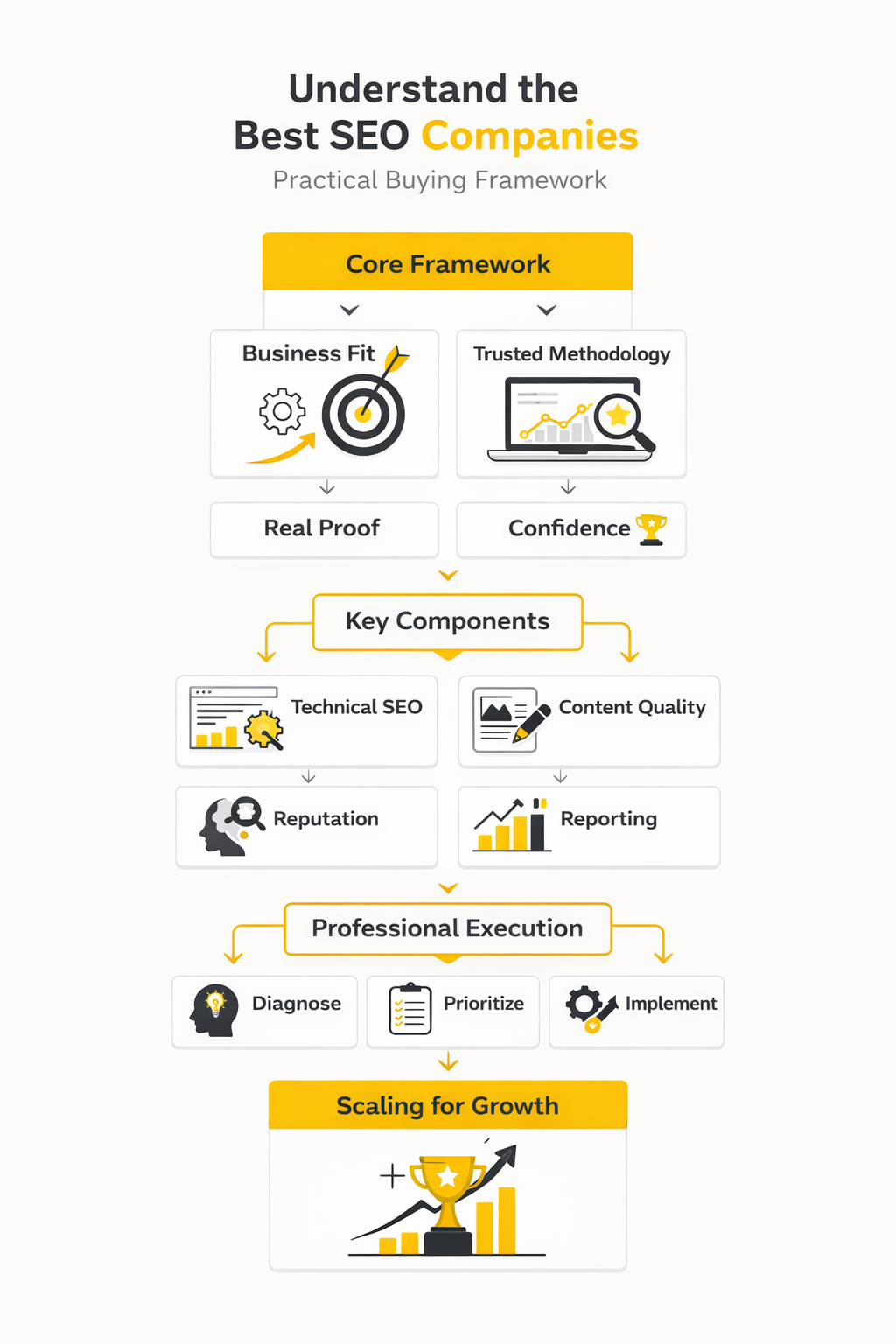
The best SEO companies are not the agencies with the loudest branding, the biggest retainer, or the most awards on a directory profile. They are the ones that can show a clear process, connect SEO work to business goals, and operate in a way that still makes sense under Google’s people-first content guidance and current core update guidance. In practice, that means the right agency for a local service business can look very different from the right agency for a SaaS company, a publisher, or a multi-location brand.
That distinction matters because SEO is not one service. Google’s own explanation of what an SEO does includes technical advice, content development, market-specific expertise, training, and site structure reviews in addition to keyword research, which is a useful reminder that strong SEO work is usually cross-functional rather than one-dimensional (Google’s “Do you need an SEO?” page). When an agency tries to reduce everything to “we build links” or “we write blogs,” you are usually looking at a narrow service wrapped in broad promises.
A good working definition is simple: the best SEO companies are the firms that can improve your search visibility in a way that is durable, measurable, and aligned with how search engines actually evaluate sites today. Durable means they are not leaning on tactics that could collapse after an update or drift into spam policy violations. Measurable means they can tie activity to rankings, qualified traffic, leads, revenue, pipeline influence, or another real business metric instead of hiding behind vague “visibility” language.
Best for you does not mean best for everyone
A lot of searchers make the mistake of looking for one master list of the best SEO companies, as if there is a universal top five that fits every business model. Real buying decisions do not work that way. Even large agency directories such as Clutch’s SEO rankings are more useful for filtering by size, industry, location, and price range than for declaring one absolute winner.
This is where context becomes everything. A B2B SaaS brand often needs technical SEO, product-led content, and close coordination with product marketing. A local franchise group may need location page governance, review generation, and Google Business Profile execution, especially when review expectations keep rising and 68% of consumers in BrightLocal’s 2026 survey said they would only use a business with four stars or more. An ecommerce brand may care more about crawl depth, faceted navigation, product page templates, feed visibility, and category-page intent matching.
The best SEO companies understand those differences before they pitch. They do not start with a recycled deliverables sheet. They start by asking how your business acquires customers, where search fits in the funnel, what resources your team already has, and what type of growth would actually move the business.
What strong SEO companies consistently have in common
The strongest agencies usually share a small set of traits, even when their specializations differ. They are transparent about methodology, realistic about timing, and specific about scope. They also tend to educate while they sell, because serious operators know informed clients are easier to retain than confused clients.
You will also notice that better firms are comfortable talking about tradeoffs. They will tell you when technical debt is blocking progress, when content quality is the issue, when internal approvals are the real bottleneck, or when you simply do not need a giant engagement yet. That kind of honesty lines up with Google’s own warning that hiring an SEO can help a site significantly, but the wrong provider can cause real damage to both performance and reputation (Google’s hiring guidance).
Another strong signal is how an agency handles search change. Search has not stood still. Organic search still drives a major share of trackable website traffic at 53.3% in BrightEdge’s research, while Google still commands the vast majority of global search demand at 89.85% worldwide market share in March 2026. But the mechanics of visibility are getting more complex, which means the best SEO companies now need to think beyond rankings alone and build strategies that can survive SERP shifts, AI-driven results, and constant interface changes.
Why Choosing the Right SEO Company Matters
Choosing the right SEO company matters because SEO compounds when it is done well and drags when it is done badly. A strong agency can improve how your site is crawled, understood, trusted, and surfaced for commercial queries that matter to your business. A weak one can burn months of budget on vanity reporting, generic content, and tactics that leave you worse off than when you started.
This is especially important because organic search is still one of the few channels that can scale intent-rich discovery without paying for every click. That does not make SEO cheap or easy. It makes it strategically important. When you choose the wrong partner, you do not just lose money on a retainer. You lose time, internal momentum, and sometimes the confidence of leadership teams that expected search to become a growth lever.
Bad SEO is expensive in ways people underestimate
Most companies think bad SEO means slow results. Sometimes it means much more than that. Google is explicit that manipulative behavior can lead to reduced visibility or removal from search results under its web spam policies, and its core update guidance makes clear that there are rarely quick fixes for sites that have deeper quality problems.
Even when things never cross into obvious spam, weak SEO still creates hidden costs. You may publish content that ranks for irrelevant queries, attract traffic that never converts, or spend months fixing technical issues that should have been diagnosed in week one. In local markets, weak execution can also damage trust signals that influence customer choice, especially when review quality, recency, and ratings now matter so much more than many businesses realize, as shown in BrightLocal’s 2026 review research (review survey, related 2026 analysis).
That is why the cost of choosing the wrong agency is not just the invoice. It is the opportunity cost of missing the months when stronger execution could have been building authority, improving pages, and generating compounding returns.
Good SEO companies reduce risk, not just chase upside
The best SEO companies are valuable because they reduce uncertainty. They know how to prioritize fixes, sequence work, and explain why one initiative should happen before another. Instead of treating SEO as a bag of disconnected tactics, they create a system that aligns technical health, content quality, site architecture, authority signals, and measurement.
That risk reduction is a bigger deal than many buyers realize. Google’s documentation repeatedly pushes site owners toward sustainable, user-centered improvements rather than reactionary hacks, and that is exactly how experienced agencies tend to work (helpful content guidance, core update guidance). They do not promise overnight wins because they understand that durable visibility is usually built through accumulated improvements, not magic tricks.
There is also a credibility advantage. When leadership teams can see a clear roadmap, real KPIs, and a logic behind execution, SEO stops feeling like a mysterious black box. That alone can unlock better collaboration with engineering, content, design, and sales teams, which often has as much impact on results as the agency’s tactical skill.
The right partner changes how fast your SEO can mature
An experienced agency does more than execute tickets. It can accelerate how quickly your business learns what matters in search. That includes identifying content gaps, uncovering technical blockers, improving reporting discipline, and helping internal teams stop wasting energy on low-impact requests.
This matters because the search environment is still large, competitive, and worth winning. Google continues to dominate global search behavior, while organic search remains one of the largest traffic drivers on the web (Statcounter market share data, BrightEdge channel-share research). If your company depends on discoverability, category education, local demand capture, or non-branded acquisition, your SEO agency is not a minor vendor decision. It is a growth decision.
That is the lens to keep through the rest of this article. The point is not to find an agency that sounds impressive. The point is to find one that fits your business, earns trust through process, and can execute the kind of SEO work that still makes sense in 2026. The next step is building a practical framework you can use to compare SEO companies without getting distracted by polished sales language.
A Practical Framework for Comparing SEO Companies
Once you stop treating the search for the best SEO companies like a popularity contest, the buying process gets much easier. You do not need a giant spreadsheet full of vanity criteria. You need a framework that helps you separate firms that understand your business from firms that simply know how to sell SEO.
That framework should start with fit, move into methodology, and end with proof. Clutch can help surface agencies by review volume, pricing band, location, and specialization, but even its own rankings work best as a filtering tool rather than a final decision-maker (Clutch SEO rankings). The real decision happens when you compare how each agency thinks, what it prioritizes, and whether its operating model matches the stage your company is actually in.
Start with business fit before you look at deliverables
A lot of companies evaluate agencies backward. They ask for deliverables first, then try to figure out whether those deliverables matter to the business. The better approach is to start with the business model, the sales cycle, the website’s current condition, and the role organic search is supposed to play.
That sounds basic, but it changes everything. A company trying to capture branded demand, non-branded demand, and category education at the same time needs a different SEO partner than a business that mainly wants local lead flow or product page growth. Google’s own SEO guidance makes it clear that SEO spans content, site structure, technical setup, and market understanding, which is exactly why the best SEO companies usually specialize by problem type instead of pretending every website needs the same playbook (Google’s SEO starter guide, Google on whether you need an SEO).
This is also where industry experience becomes useful, but not in the lazy way people often assume. An agency does not need to have worked with your exact brand category to be credible. It does need to show that it understands the search behaviors, content constraints, buying journey, and competitive environment that shape SEO success in your space.
Judge the strategy, not just the service menu
Every agency can make a service menu look impressive. Technical SEO, content strategy, link building, CRO, local SEO, analytics, digital PR. None of that tells you whether they can prioritize the right work in the right order. The strongest firms are the ones that can explain why page indexing issues matter before new content production, or why internal linking and template improvements may create more lift than publishing another ten blog posts.
That kind of prioritization matters because Google Search is still built on crawling, indexing, and ranking systems that depend on a site being discoverable, understandable, and worth surfacing (How Google Search works). Google also explicitly says payment does not make crawling happen more often or improve ranking, which is a useful reminder that agencies promising special access or secret influence should be treated as an immediate red flag (How Google Search works). The best SEO companies talk about constraints, dependencies, and sequencing because they know execution breaks when strategy is vague.
You want to hear a point of view, not a bundle of tasks. If an agency cannot tell you what it would likely audit first, what it would likely ignore at the beginning, and where it expects the highest-leverage wins to come from, you are probably looking at a generic process dressed up as expertise.
Make reporting a buying criterion, not an afterthought
Reporting is where a lot of weak SEO engagements hide. Agencies know most buyers will ask about rankings, traffic, and backlinks, so they build reports that look busy enough to feel valuable. That is exactly why you should make measurement part of the vetting process before you sign anything.
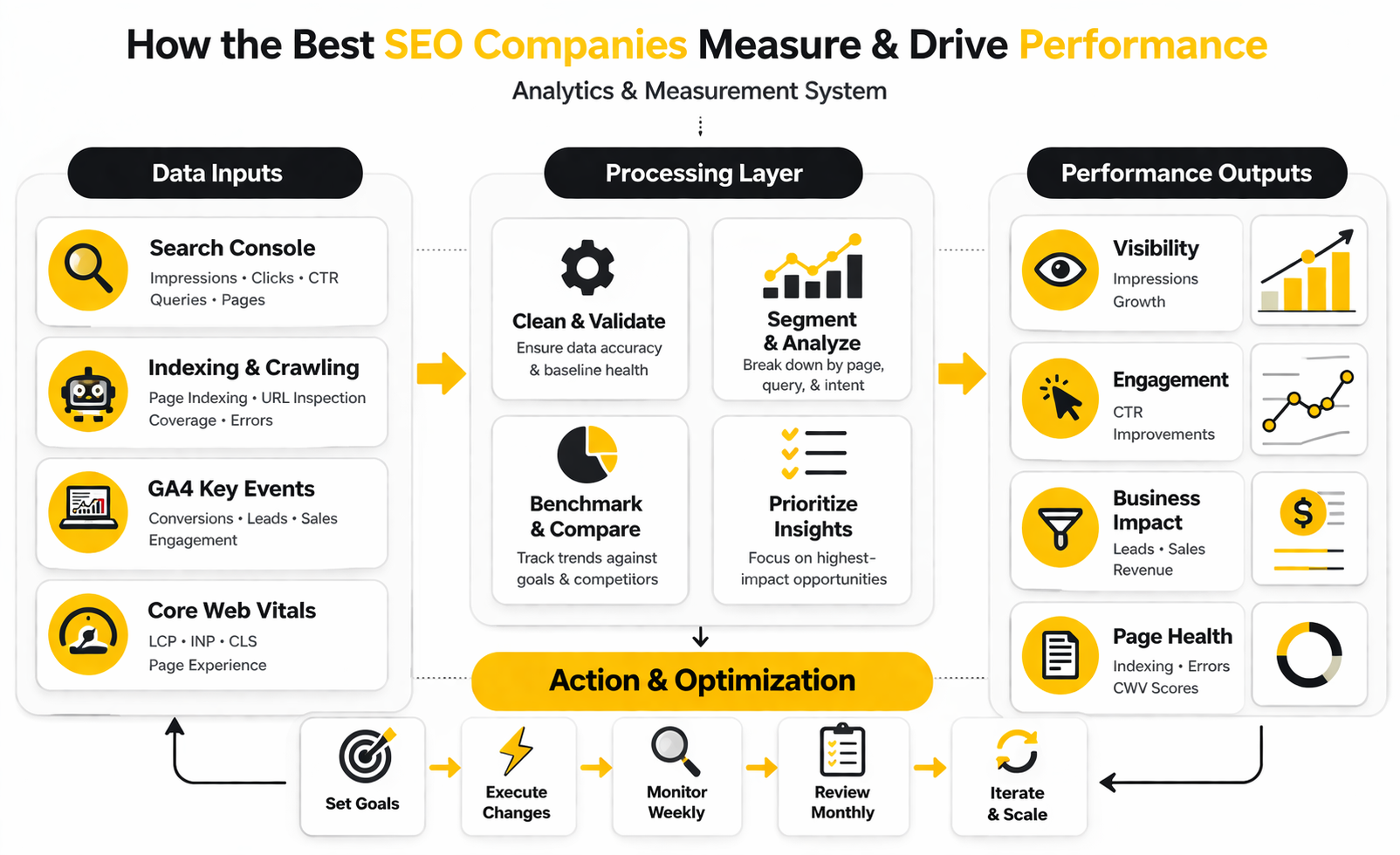
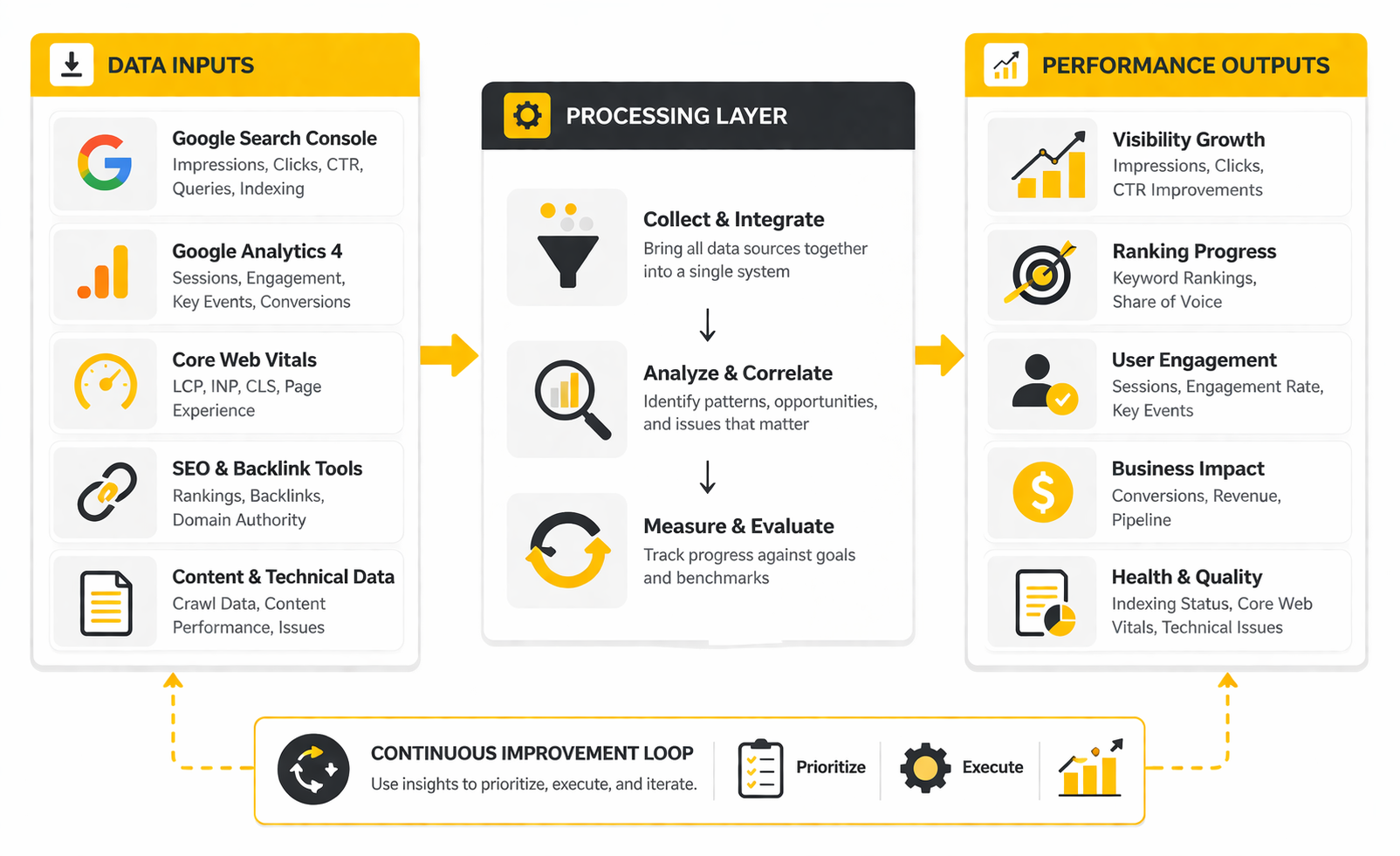
At a minimum, a serious SEO company should be able to explain how it uses Google Search Console and GA4 event or key-event tracking to connect search visibility with business outcomes (Search Console overview, GA4 recommended events). Search Console’s Performance report shows clicks, impressions, CTR, and average position and helps isolate changes by query, page, country, device, and search appearance, which makes it one of the most important first-party tools in any SEO relationship (Performance report overview). If an agency barely mentions it, that is not a small omission. It is a sign they may be relying too heavily on third-party tools while underusing the platform that reflects Google’s own reporting.
The same goes for conversion measurement. SEO should not be judged only by whether traffic went up. It should also be judged by whether meaningful actions increased, whether lead quality improved, and whether the site got better at moving users toward revenue. Agencies that cannot speak clearly about that usually end up overproducing activity and underdelivering outcomes.
Verify who is actually doing the work
One of the most overlooked parts of buying SEO is operational reality. The person who wins the pitch is often not the person doing the work. Sometimes that is normal. Sometimes it is a problem. The difference comes down to visibility, process, and quality control.
The best SEO companies do not get weird when you ask who handles strategy, who handles implementation, and how work is reviewed. In fact, they usually welcome those questions because they know delivery quality depends on specialist depth. A technical SEO lead, a content strategist, and an account lead can be a strong model. A single generalist juggling ten accounts with templated recommendations usually is not.
This matters even more on technically complex sites. Google’s documentation on JavaScript SEO, indexing controls, redirects, structured data, and site moves shows how quickly SEO work can become implementation-heavy once you move past surface-level optimizations (JavaScript SEO basics, robots meta tag guidance, redirect guidance, site move guidance). If the agency selling you on growth has no credible delivery structure behind the pitch, you are not really hiring a partner. You are hiring a slide deck.
A simple process for shortlisting SEO companies
Once you have a long list, the smartest move is to run every agency through the same decision process. This keeps you from being swayed by brand polish, aggressive sales energy, or a shiny proposal that says very little. It also forces the comparison back onto the things that actually matter when you are choosing among the best SEO companies for your situation.
A practical process usually looks like this:
- Define what success means in business terms. That could be qualified demo requests, booked consultations, ecommerce revenue, local lead volume, or visibility for a category you want to own.
- Filter agencies by relevant fit. Use factors like business model, market type, website complexity, and budget range before you look at anything else.
- Ask each agency for its first-principles diagnosis. You are not asking for free consulting. You are testing whether they can identify the probable bottlenecks without drowning you in jargon.
- Review how they measure progress. Look for a clear connection between Search Console data, analytics events, page-level changes, and business KPIs.
- Check references, case studies, and review context. Review volume matters less than whether the outcomes described sound similar to the kind of growth problem you need solved.
- Confirm operating details before signing. Know who owns strategy, how often priorities change, how implementation gets pushed live, and what happens when results lag.
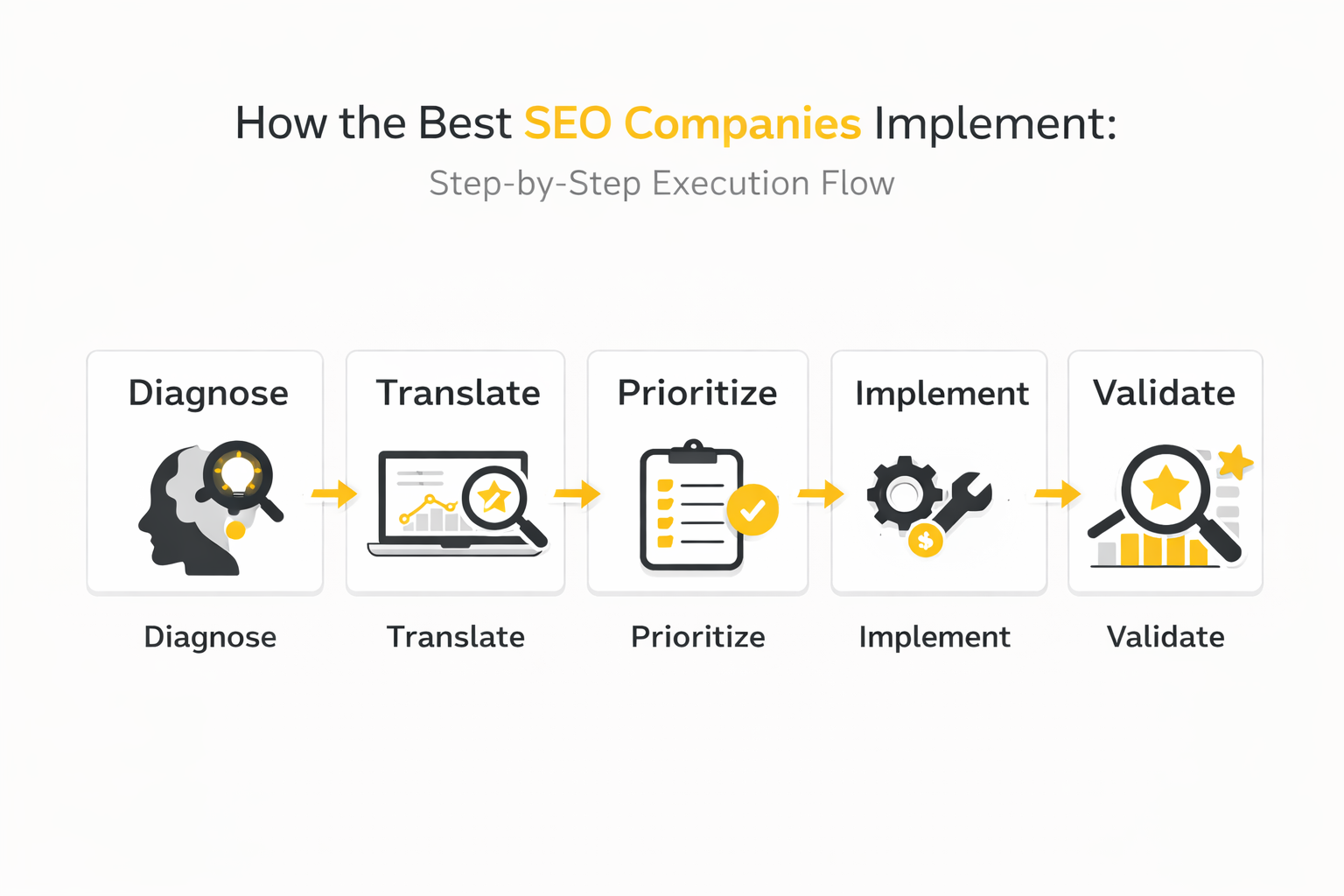
That sequence works because it mirrors how good SEO is actually executed. First you understand the business. Then you diagnose the constraints. Then you prioritize. Then you measure the effect of changes. Agencies that cannot sell through that logic usually do not execute through that logic either.
The Core Components of a Strong SEO Engagement
Once an agency passes the comparison framework, the next question is whether its engagement model covers the right building blocks. This is where many companies get trapped by partial SEO. They hire for one channel-specific function, then wonder why growth stalls after a few months. The answer is usually that the engagement was missing one or two foundational components from the start.
Strong SEO engagements tend to bring together technical health, content quality, information architecture, authority development, and measurement. Google’s documentation does not frame SEO as a single tactic, and that is the point. Search performance depends on multiple systems working together, from crawlability and indexability to relevance, helpfulness, and page experience (SEO starter guide, Search Essentials, Core Web Vitals overview). The best SEO companies build around that reality instead of over-optimizing one narrow lane.
Technical SEO should remove friction, not become theater
Technical SEO matters because it affects whether search engines can find, render, understand, and properly index your content. But it is also one of the easiest areas for agencies to overcomplicate. A huge technical audit is not automatically valuable. What matters is whether the technical work removes constraints that were suppressing growth.
That includes issues around crawl access, indexing, canonicalization, redirects, rendering, internal linking, and site performance. Search Console’s URL Inspection tool and performance reports are central here because they help validate what Google knows about a page and how the site is showing up in search (URL Inspection overview, inspect and troubleshoot a page, Search Console reports overview). The best SEO companies do not just send you an audit. They translate the findings into a prioritized implementation plan that engineering or your CMS team can actually execute.
That distinction is huge. If technical SEO never turns into shipped fixes, it becomes a reporting ritual rather than a growth driver. Good agencies know that and structure the work so it moves from diagnosis to deployment fast enough to matter.
Content strategy has to map to search intent and business value
Content is still one of the clearest ways to expand non-branded search visibility, but only when it is driven by intent and quality rather than publishing volume. Google’s people-first content guidance makes the standard pretty clear: content should be made to help users, demonstrate real value, and avoid the empty pattern of creating pages primarily to rank (people-first content guidance). That is why the best SEO companies do not just pitch “X articles per month.”
A strong content program usually maps keywords to business goals, page types, and realistic authority levels. Some queries belong on product or service pages. Some belong in commercial comparison content. Some belong in education-focused resources. Some are not worth targeting at all. Agencies that understand this create fewer but better opportunities because they know page purpose matters as much as keyword volume.
This is also where modern SEO firms need better editorial discipline. Search is increasingly influenced by how well a page answers a need, how clearly it demonstrates expertise, and how efficiently it helps a user move forward. Content calendars built on random keyword exports are weaker than they used to be, and the best SEO companies have already adjusted for that.
Authority building still matters, but the method matters more
Authority has always mattered in SEO, but the safest and strongest ways to build it are not the same as the tactics many agencies still sell. Google’s spam policies are explicit about link spam, scaled abuse, and manipulative tactics intended to game ranking systems (spam policies, spam updates guidance). So when an agency talks about link building, the important question is not whether they do it. It is how.
The best SEO companies usually frame authority work as a mix of digital PR, linkable assets, strategic partnerships, reclaiming unlinked mentions, improving internal linking, and creating content worth citing. That is a much healthier model than buying placements or pushing low-value guest posting at scale. It is also easier to defend internally because it sounds like brand building, not loophole hunting.
Authority work should feel connected to reputation and visibility, not isolated from them. When it does, the SEO program becomes much more durable because the trust signals are being earned through real value instead of rented through shortcuts.
What the Data Should Tell You
Measurement is where SEO stops being opinion and starts becoming a management system. This is also where many companies get misled, because they track whatever is easiest to screenshot instead of what actually explains performance. The best SEO companies do not just hand over a dashboard. They show how search visibility changes, how user behavior changes after pages improve, and which numbers should trigger action instead of applause.
The reason this matters is simple. Organic search still represents a huge share of trackable web traffic, with BrightEdge continuing to cite organic at 53.3% of traffic in its channel-share research, which means even small improvements in the right pages can have outsized business impact. But that same scale also makes bad interpretation expensive, because one wrong conclusion can send an SEO program chasing the wrong keywords, pages, or technical fixes for an entire quarter.
A serious measurement model should answer five questions clearly. Are more of the right pages getting seen? Are more of the right searches generating clicks? Are those visitors doing something valuable on the site? Are there experience or indexing problems limiting progress? And are changes in performance tied to shipped work rather than random weekly noise? If an agency cannot answer those questions cleanly, its reporting may be active, but it is not useful.
The four search metrics everyone watches, and what they actually mean
Search Console puts four headline metrics front and center: clicks, impressions, average CTR, and average position. That is helpful, but it also creates a trap, because people often treat those numbers as universal indicators when they are really diagnostic signals that need context. Google’s own documentation is clear that these are the main metrics shown in the Performance report, and it also explains that their exact interpretation depends on query, page, SERP layout, and search appearance.
Impressions tell you whether your pages are entering relevant search demand. If impressions are rising on strategic pages, that usually means Google is surfacing your site for more queries or showing it more often for existing ones. That is useful early in an SEO engagement, because impressions often move before clicks do, especially after technical fixes, content expansion, or better internal linking.
Clicks tell you whether that visibility is translating into actual visits from search. Rising clicks matter more than rising impressions because they indicate users are choosing your result, not just scrolling past it. But clicks still need page-level interpretation, because more clicks to low-intent blog content can look good in a report while doing very little for pipeline or revenue.
CTR is where people get sloppy. Google defines CTR in the usual way, clicks divided by impressions, but Google also notes that visibility and position behavior can vary based on result type and layout, which means a flat or declining CTR is not automatically a content problem. Sometimes the page title is weak. Sometimes the query mix changed. Sometimes more SERP features appeared and reduced click opportunity even when rankings held steady.
Average position is useful, but only when you stop treating it like a score. It is an aggregate across many rankings and queries, not a clean summary of commercial visibility. A site can improve its average position while losing traffic if it gained more low-value rankings, and it can hold average position while gaining business value if its best money pages moved up where it counts. That is why smart agencies segment by page group, query class, device, and brand versus non-brand rather than reporting one sitewide average like it tells the whole story.
What good SEO reporting should include beyond rankings
The best SEO companies know rankings alone are not enough, because rankings describe search exposure, not business performance. A proper reporting system usually connects Search Console with analytics events so you can see whether organic visitors are completing the actions that matter to the business. In GA4, Google defines a key event as an event that measures an action particularly important to business success, which is exactly the right framing for SEO measurement too.
That changes the conversation in a useful way. Instead of asking whether organic traffic grew by 20%, you start asking whether demo requests, qualified leads, purchases, booked calls, or other key events grew on the pages the agency actually improved. That is the kind of reporting that helps leadership teams trust SEO, because it ties visibility work to outcomes instead of to abstract performance theater.
A strong monthly view usually includes several layers at once:
- Search visibility movement by page group or template type
- Click and CTR changes on priority queries and priority pages
- Organic sessions and engaged sessions by landing page
- Key events or revenue from organic landing pages
- Technical health signals affecting crawlability, indexability, or experience
- A shipped-work log showing what changed and when
That last point matters more than most companies realize. Without a visible record of what was shipped, reporting becomes storytelling. With it, you can actually test whether the strategy is working.
Benchmarks are useful only when they drive a decision
There is nothing wrong with benchmarks. The problem is that most SEO benchmarks get used like decoration. A company hears that organic search is still a leading channel, or that top positions attract disproportionate click share, and then treats that as proof the program is healthy or unhealthy without looking at its own page mix, market, and intent profile. Good measurement is not about collecting impressive numbers. It is about deciding what to do next.
Take the 53.3% organic-share figure from BrightEdge. That number matters because it reinforces that search remains a major source of web traffic and deserves executive attention. But it does not mean every business should expect 53.3% of its own traffic from organic, and it definitely does not mean every site is underperforming if it is below that level. A brand with heavy repeat traffic, strong paid demand capture, or partner-led acquisition may have a very different mix. The action this number should drive is investment discipline, not blind comparison.
The same logic applies to position and CTR benchmarks. If a service page ranks in a visible range but has weak CTR, the likely next action is to review title tags, meta descriptions, query alignment, and how the result appears against competitors. If impressions are rising but clicks are not, that can signal either poor snippet appeal or a mismatch between the query intent and the page being surfaced. If clicks are rising but key events are flat, the likely issue is not search exposure anymore. It is landing-page relevance, offer strength, or conversion flow.
This is exactly why the best SEO companies spend less time flexing raw numbers and more time interpreting them. Good agencies do not just tell you that impressions went up. They tell you whether that growth happened in branded terms, informational content, local intent, or bottom-funnel pages, and they explain what that means for the next sprint.
Performance signals that deserve executive attention
Some signals matter because they directly affect revenue potential. Others matter because they explain why growth is stalling. A strong SEO company knows the difference and reports both. That balance is what keeps teams from overreacting to noise while still spotting genuine risk early.
One of the most important diagnostic areas is page experience. Google says Core Web Vitals measure real-world user experience for loading, interactivity, and visual stability, and the Search Console report is based on field data rather than lab simulations. That makes Core Web Vitals useful not as a vanity score, but as a way to identify groups of URLs where user experience could be undermining performance or where engineering attention is warranted.
It is also important to interpret these metrics correctly. Google explicitly recommends achieving good Core Web Vitals, but it does not support the lazy idea that every ranking issue is a speed issue. In March 2024, INP replaced FID as the responsiveness metric inside Core Web Vitals, which is a good reminder that experience measurement evolves and that agencies should keep their diagnostic language current. The action here is not to obsess over every millisecond. It is to fix user experience issues that are widespread, real, and tied to priority templates or journeys.
Another executive-level signal is the relationship between branded and non-branded performance. Google added newer ways to inspect recent and segmented performance in Search Console, and those kinds of breakdowns are useful because they help distinguish between growth driven by existing brand demand and growth driven by genuine market expansion. That distinction matters when you are evaluating the best SEO companies, because a weak agency can sometimes look successful by riding branded traffic that would likely have happened anyway.
What the numbers should make you do next
The point of measurement is action. If a report does not naturally lead to a priority change, a content revision, a technical fix, a snippet rewrite, or a stronger attribution model, it is probably too shallow. Numbers are only useful when they help you decide what to stop, what to scale, and what to investigate further.
Here is the practical way to think about it. Rising impressions with stagnant clicks usually call for SERP-level analysis and page-intent refinement. Rising clicks with weak downstream key events usually call for landing-page and conversion review. Strong rankings on secondary pages with weak performance on strategic pages usually call for internal-linking, template, or information-architecture work. Poor Core Web Vitals on revenue-driving templates usually call for engineering prioritization, not just reporting commentary.
That is the standard worth holding agencies to. The best SEO companies do not drown clients in dashboards. They use data to create clarity, and then they use that clarity to push better decisions into the next round of implementation. The next part of this article moves from measurement into what professional SEO implementation looks like when an agency is actually executing at a high level.
What Professional SEO Implementation Looks Like
Professional SEO implementation is where the best SEO companies separate themselves from agencies that are really just selling audits, content calendars, and monthly commentary. At this stage, the work becomes operational. It is less about saying the right things in strategy calls and more about turning priorities into shipped changes, validating what happened after release, and adjusting fast when the evidence says the first assumption was incomplete. Google’s own guidance keeps pointing back to this same reality: performance in Search depends on discoverability, indexability, page quality, and compliance with search policies, not on presentations or promises.
A strong agency usually runs implementation as a sequence, not a pile of disconnected tasks. First it confirms what Google can crawl and index. Then it fixes the page groups where technical friction is suppressing visibility. Then it aligns page purpose with search demand, strengthens internal linking, improves titles and snippets where CTR is weak, and uses reporting to decide what should be scaled, revised, merged, or cut. That sounds simple, but it is exactly where weak SEO programs fall apart, because they skip validation and move straight from idea to output.
Execution should move from diagnosis to deployment fast
The first sign of professional implementation is speed of translation. A good agency does not leave findings trapped in a 90-slide deck. It converts them into tickets, owners, timelines, and expected impact ranges. That matters because Google Search Console’s Page indexing report is designed to show the indexing status of URLs Google knows about, and the URL Inspection tool is built to help verify how Google sees a specific page, which makes both tools useful only if they drive action.
This is where the best SEO companies tend to be very practical. They know some problems are sitewide and some are template-specific. They know a canonical issue affecting thousands of URLs deserves attention before another thought-leadership post. They also know that some recommendations are not worth shipping yet, because they do not materially affect priority pages or revenue paths. That prioritization is what turns SEO from a knowledge service into an operating function.
Strong agencies build around page groups, not random pages
One of the biggest differences between amateur and professional execution is how work is organized. Weak agencies bounce from page to page based on whichever keyword moved last week. Strong agencies work in systems. They group pages by template, intent, business role, and technical behavior, then improve those groups in a way that can scale.
That approach is far more defensible because Search Console reporting itself is aggregate and segmented by dimensions like queries, pages, countries, devices, and appearances. Google also notes that reporting can vary depending on how data is aggregated, which means professional analysis has to go deeper than sitewide summaries. The best SEO companies understand this and avoid building strategy around random page anecdotes.
For example, service pages, location pages, blog articles, product pages, and help content should almost never be treated as one unit. They attract different query types, convert differently, and often fail for different reasons. When an agency segments work this way, implementation gets sharper because each round of changes has a clear hypothesis behind it.
Real implementation includes validation after launch
Shipping changes is not the finish line. It is the midpoint. The next step is checking whether Google processed the change, whether the page remains indexable, whether impressions or CTR moved, and whether downstream behavior improved. Google’s documentation on Search Console performance data, indexing status, and URL inspection exists for exactly this kind of validation loop.
This is one of the most important habits to look for when comparing the best SEO companies. Some firms treat implementation as complete the moment a recommendation goes live. Better firms treat every launch as a test. They watch the affected page group, compare before-and-after behavior, and decide whether to scale, revise, or roll back based on evidence. That is how SEO becomes cumulative instead of chaotic.
Technical quality control matters more as a site scales
The larger the site gets, the more damaging small mistakes become. A bad redirect rule, a noindex error, a broken canonical pattern, or a rendering problem can affect hundreds or thousands of URLs instead of one page. That is why professional SEO implementation includes quality control mechanisms, not just recommendations. Google’s Search Essentials and indexing tools are explicit that technical requirements and indexability issues directly affect whether pages can appear properly in Search.
Scaling also changes the kind of SEO company you need. A smaller service business may do well with a lean agency that can improve core pages, local signals, and reporting discipline. A larger publisher, marketplace, or ecommerce brand usually needs a team that can handle template logic, crawl waste, governance, QA, and cross-functional coordination with engineering. The best SEO companies are honest about that difference instead of pretending the same delivery model works at every size.
The smartest SEO tradeoff is often focus, not volume
A lot of companies still assume better SEO means doing more. More pages, more keywords, more deliverables, more backlinks, more reports. In reality, professional implementation often means doing fewer things with tighter alignment. Google’s recent policy and spam guidance makes that even more important, especially after the March 2024 changes that added policies against scaled content abuse and related manipulative practices.
That does not mean publishing less by default. It means refusing to scale content or authority work before the underlying model is strong enough to justify it. If a site cannot get priority pages indexed consistently, cannot convert search traffic well, or keeps publishing pages that overlap each other, adding more output usually deepens the mess. The best SEO companies know when the right move is acceleration and when the right move is constraint.
Risk management is now part of professional SEO
Modern SEO implementation is not just about upside. It is also about avoiding avoidable damage. Google’s spam policies explicitly say that deceptive or manipulative tactics can lead to pages or entire sites ranking lower or being omitted from Search, and its updated site reputation abuse language makes clear that trying to exploit a host site’s ranking signals with third-party content is a violation regardless of first-party oversight. That is a major warning for any company tempted by shortcut-heavy agency offers.
This is where expert-level agency selection becomes very practical. Ask how the firm approaches authority building. Ask how it avoids content overlap. Ask how it handles AI-assisted production, outsourced editorial workflows, user-generated content, and sponsorship-style publishing. If the answers sound evasive or overconfident, that is a problem. The best SEO companies are not scared of these questions because they are already building within the guardrails Google has published.
Page experience still matters, but only in the right way
Professional agencies also know how to treat performance signals without turning them into superstition. Google says Core Web Vitals measure real-world user experience for loading, interactivity, and visual stability, and it strongly recommends achieving good Core Web Vitals for success with Search and for users generally. It also updated the responsiveness metric so that INP replaced FID in March 2024, which is a reminder that technical measurement evolves and agencies need to stay current.
The key is interpretation. Strong firms do not blame every ranking issue on speed or every engagement drop on design. They use page experience data to identify whether slow or unstable templates are creating enough friction to justify engineering work, especially on high-value pages. That is a very different mindset from waving around scores for cosmetic effect.
What to expect when an SEO company is genuinely good
By the time you reach this stage, a pattern should be obvious. The best SEO companies are not defined by a single trick, tool, or promise. They are defined by how well they connect strategy, implementation, validation, risk control, and business relevance. They know what Google can measure, what your business actually needs, and where not to waste time.
That is the standard worth using before you hire anyone. You are not just buying rankings work. You are choosing whether your search program will be run like a disciplined growth function or like a monthly content subscription with prettier reporting. The final part of this article answers the most common questions buyers still have when narrowing down the best SEO companies for their business.
FAQ: Built for a Complete Guide
How do I know whether I need an SEO agency at all?
You do not always need an agency immediately. Google’s own guidance says hiring an SEO can improve your site and save time, but it also warns that the wrong provider can damage your site and reputation, which means the decision should depend on your internal bandwidth, technical complexity, and growth goals rather than hype alone. A business with a simple site and strong in-house execution may only need consulting, while a larger site with indexing, content, and reporting problems usually benefits from a more hands-on partner through Google’s guidance on hiring an SEO.
What makes the best SEO companies different from average agencies?
The best SEO companies do not just sell deliverables. They build a system that connects crawling, indexing, content quality, internal linking, reporting, and business outcomes, which matches the broader view Google takes in its SEO Starter Guide. Average agencies often stop at audits and activity, while stronger firms push work into implementation, validate what happened after launch, and change course when the evidence says they should.
How long should SEO take before I expect meaningful results?
SEO is not a channel where every good decision pays off immediately. Google’s core updates guidance makes it clear that quality changes can take time to be reassessed, and Search Console reporting itself is designed to help you monitor progress over time rather than assume instant outcomes through its Performance report documentation. In real terms, you should expect early signs such as cleaner indexing, stronger impressions, or better CTR before you expect large business outcomes, especially in competitive markets.
Should I trust agencies that guarantee rankings?
No. That is one of the easiest ways to filter out weak or risky providers. Google explains how Search works and makes no suggestion that agencies can buy or secure rankings through special relationships, and its spam policies make clear that manipulative tactics can lead to pages ranking lower or being omitted from Search. A serious agency can promise process, transparency, and disciplined execution, but not guaranteed positions for meaningful queries.
What should I ask an SEO company before signing a contract?
Ask who owns strategy, who does the actual work, how priorities are set, how results are measured, and how implementation gets pushed live. You should also ask how the agency uses tools like the URL Inspection tool, the Page indexing report, and the Search Console overview because those tools reveal whether the firm is grounded in first-party evidence or just third-party dashboards. The goal is not to hear perfect answers. It is to see whether the agency thinks clearly under pressure and can explain tradeoffs without hiding behind jargon.
How much do good SEO companies usually cost?
Pricing varies a lot because scope varies a lot. Clutch’s current SEO agency pricing guide says monthly SEO agency fees typically range from $2,000 to $20,000, while WebFX’s more recent SEO pricing overview says monthly retainers often fall between $1,000 and $5,000, which shows how much pricing depends on complexity, geography, and service depth. The useful takeaway is not one exact number. It is that very cheap SEO usually means either narrow scope or thin execution, and very expensive SEO only makes sense when the site, competition, and internal demands are genuinely complex.
Is local SEO different from general SEO agency work?
Yes, and the difference matters more than many buyers expect. Local SEO has its own trust signals around reviews, location relevance, Google Business Profile management, and proximity-driven intent, which is why BrightLocal’s Local Consumer Review Survey 2026 is so useful when evaluating agencies serving local businesses. If you are a service-area brand, a multi-location company, or a local franchise, the best SEO companies for you should be able to explain local ranking factors, review workflows, and location-page strategy without drifting into generic national SEO talk.
Do backlinks still matter when comparing the best SEO companies?
Authority still matters, but the way an agency talks about authority is what you should pay attention to. Google’s spam policies and the March 2024 core update and spam policy changes make it very clear that manipulative link tactics and scaled abuse are dangerous. So yes, backlinks and mentions still matter, but the best SEO companies build authority through digital PR, useful assets, brand visibility, and internal-linking discipline rather than through rented placements and questionable schemes.
How important is content quality now that AI tools are everywhere?
It is still central. Google’s people-first content guidance does not ban AI-assisted workflows, but it does make the standard clear: content should help people, show value, and avoid being produced mainly to game rankings. That means the best SEO companies are not the ones producing the most content. They are the ones using stronger editorial processes, sharper search-intent mapping, and better page purpose so content can actually earn visibility and conversions.
What metrics should an SEO agency report every month?
At a minimum, the agency should report on impressions, clicks, CTR, and relevant page and query segments using the Search Console Performance report. It should also connect those search metrics to business actions through GA4 key events, which Google defines in its Analytics help documentation as actions especially important to business success. Rankings can still appear in a report, but they should never be the whole story because they do not tell you whether the right users arrived or whether they did anything valuable after landing.
Are Core Web Vitals something I should obsess over when choosing an SEO company?
You should care about them, but not worship them. Google says in its Core Web Vitals documentation and page experience guidance that these metrics reflect real-world user experience and are used by ranking systems, while also making clear that good scores alone do not guarantee top rankings. A good agency uses Core Web Vitals to identify real friction on important templates, not to distract you with performance theater on pages that do not matter.
Can a freelance consultant be better than an agency?
Absolutely, in the right situation. If you need strategic direction, periodic audits, or senior oversight for an internal team, a consultant can be a better fit than a full-service agency. But if your business needs technical implementation, content production, reporting, stakeholder management, and cross-functional coordination, the best SEO companies usually outperform one-person setups simply because they have broader delivery capacity and more specialized roles.
What is the biggest red flag when evaluating SEO companies?
The biggest red flag is a provider that sounds certain without being specific. If an agency guarantees rankings, avoids talking about indexing and measurement, cannot explain who does the work, or pitches scaled content and aggressive link tactics while ignoring Google’s current Search Essentials and spam policies, walk away. Confidence is good. Unaccountable certainty is usually expensive.
How should I make the final decision between two strong SEO agencies?
Choose the one that understands your business model more clearly and can explain the first 90 days in a way that feels both focused and realistic. Clutch’s current SEO company rankings can help with external validation through reviews and market positioning, but the final call should come down to fit, operating discipline, and how well the agency’s reporting model connects search work to business outcomes. The best SEO companies rarely win because they sound the flashiest. They win because their process feels coherent from diagnosis through implementation.
Work With Professionals
Explore 10K+ Remote Marketing Contracts on MarkeWork.com
Most marketers spend too much time chasing clients, competing on crowded platforms, and losing a percentage of every project to middlemen.
MarkeWork gives you a better way. Browse thousands of remote marketing contracts and connect directly with companies desperate to hire skilled marketers like you, without platform commissions and without unnecessary gatekeepers.
If you're serious about finding better opportunities and keeping 100% of what you earn, explore available contracts and create a profile for free at MarkeWork.com.
Jaký obrázek se ti líbí víc?
12