

The best SEO digital marketing strategy is not a pile of keywords, blog posts, backlinks, and tools. It is a connected growth system where search intent, useful content, technical performance, conversion paths, and customer follow-up all work together. That matters because search is still one of the strongest demand channels, while AI search, social discovery, and paid media are changing how people find and trust brands.
Google’s own guidance is clear: SEO is about helping search engines understand your content and helping users decide whether your site is useful for them through search results Google Search Central. At the same time, digital advertising keeps getting more competitive, with U.S. internet ad revenue reaching nearly $300 billion in 2025 IAB. So the real advantage is not “doing SEO.” The advantage is building SEO into your full digital marketing engine.
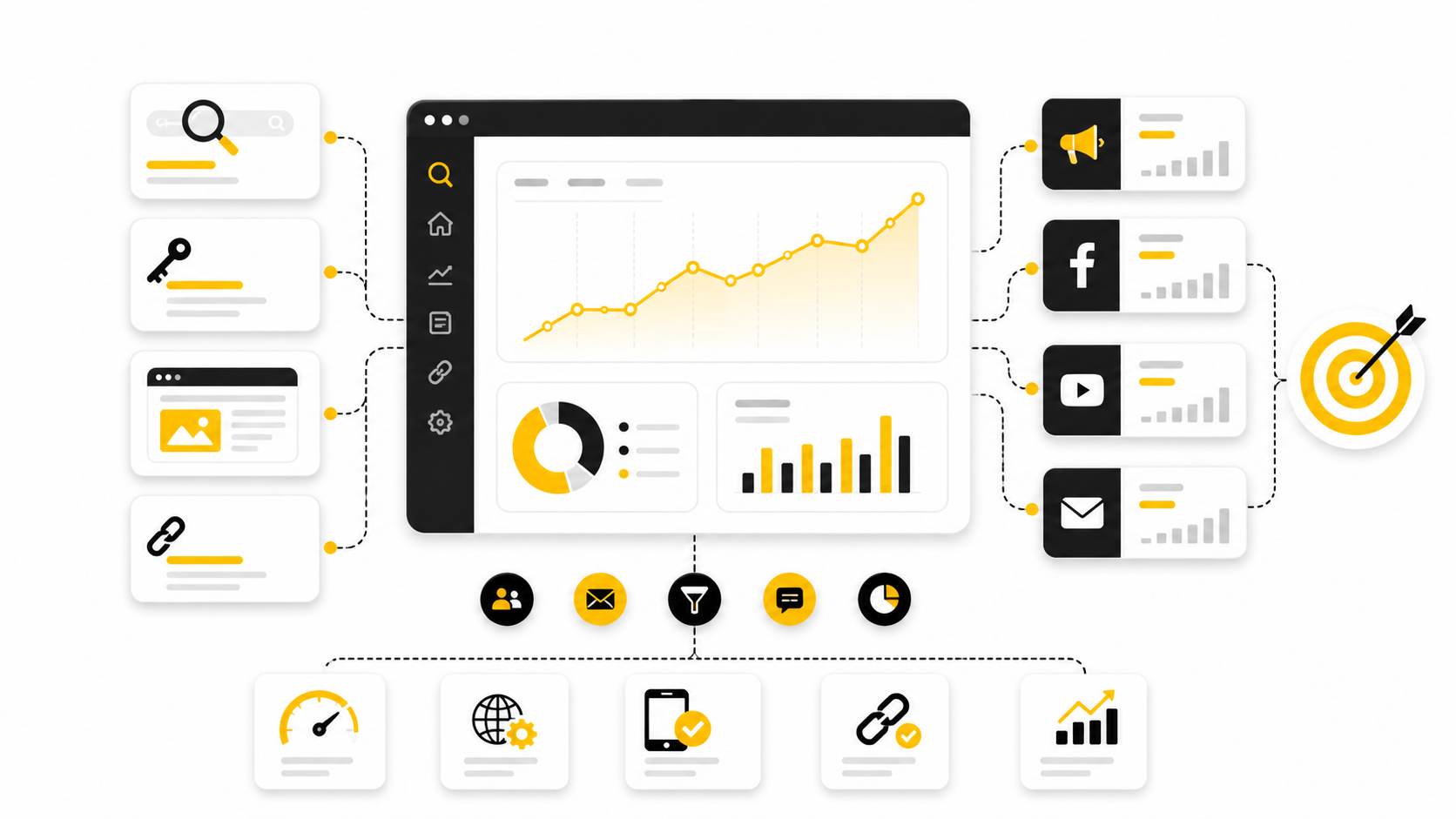
Article Outline
This article is structured as one complete guide split across six parts. Each part builds on the last, so the strategy moves from the big picture into execution, measurement, and optimization. The goal is to make SEO practical enough to implement without turning it into a checklist nobody follows.
- Why SEO Still Matters in Digital Marketing
- The Best SEO Digital Marketing Framework
- Core Components of a Search-Led Growth System
- Professional Implementation Across Content, Technical SEO, and Funnels
- Tools, Automation, and Channel Integration
- Measurement, Optimization, and Frequently Asked Questions
Why SEO Still Matters in Digital Marketing
SEO matters because people still search when they have intent. They search when they are confused, comparing options, validating a recommendation, checking a brand, or getting ready to buy. That makes search different from interruption-based marketing because the user is already moving toward a decision.
The best seo digital marketing approach does not treat SEO as a separate department. It uses SEO to understand demand, content to answer that demand, and marketing automation to turn attention into leads, sales, and retention. This is why a strong SEO strategy should connect naturally with email, paid ads, landing pages, CRM workflows, and conversion tracking.
Search is also becoming more complicated, not less important. Google emphasizes helpful, reliable, people-first content Google Search Central, while AI Overviews and answer engines are changing how visibility works. That means brands need clearer positioning, stronger expertise, better content structure, and pages that deserve to be cited, clicked, and trusted.
The Best SEO Digital Marketing Framework
A strong framework starts with one simple idea: SEO should create qualified demand, not just rankings. Rankings are useful, but they are not the business outcome. The outcome is the right person finding the right page, trusting the brand, and taking the next step.
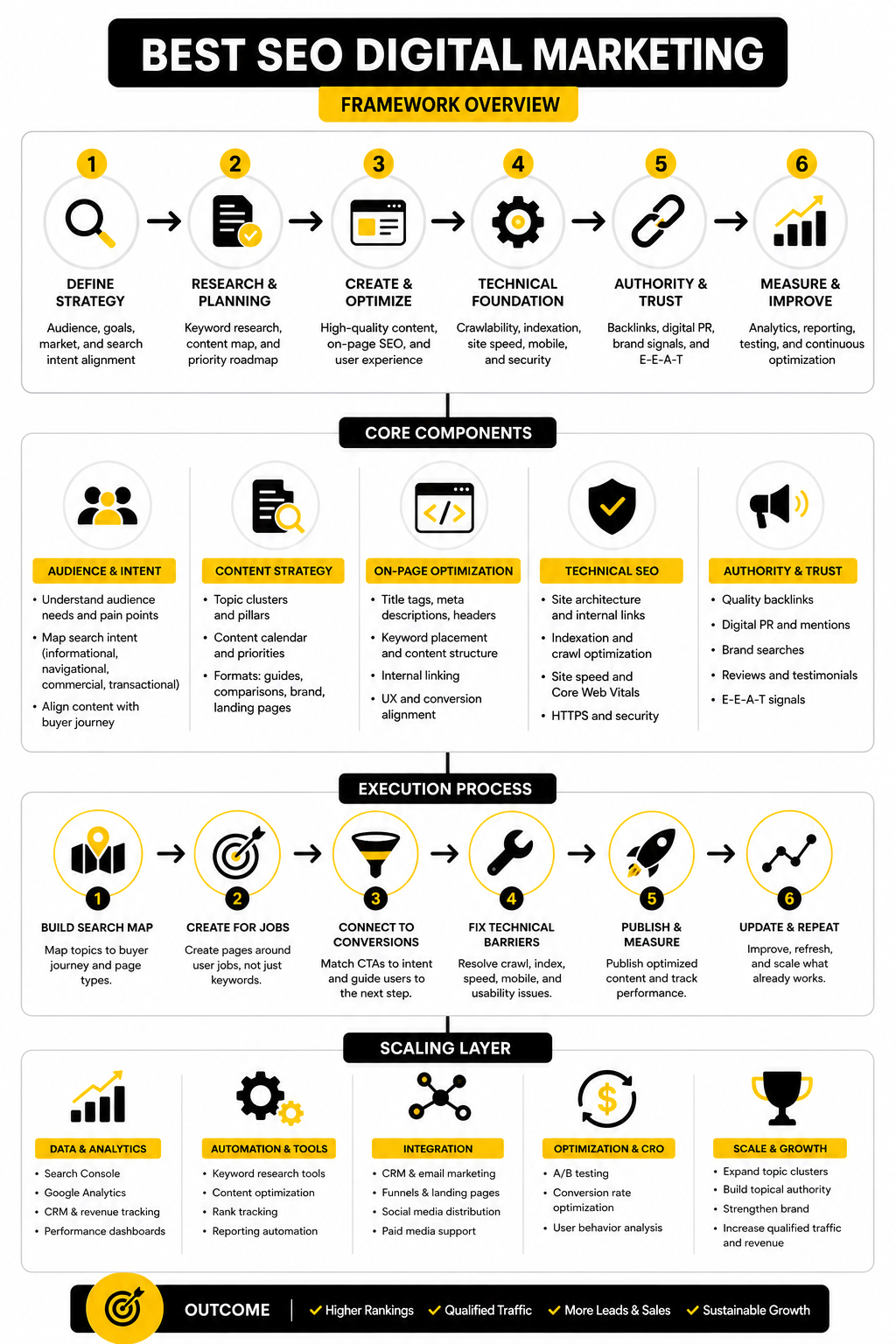
The framework has four layers. First, you identify search intent and market demand. Second, you build useful content and optimized pages around that demand. Third, you connect those pages to conversion assets such as offers, forms, booking pages, email sequences, or funnels. Fourth, you measure what actually creates pipeline, revenue, or long-term customer value.
This is where many businesses get SEO wrong. They publish content, wait for traffic, and hope the visitor magically becomes a customer. A better system connects search pages to clear next actions, whether that is a consultation, a product page, a lead magnet, a demo, or a workflow inside a platform like GoHighLevel.
Core Components of a Search-Led Growth System
A search-led growth system starts with intent. Not traffic. Not publishing volume. Not how many keywords you can squeeze into a content calendar. Intent is the reason someone searches in the first place, and it tells you whether the person needs education, comparison, proof, pricing, implementation help, or a direct path to buy.
That is why the best seo digital marketing strategy begins by mapping queries to business outcomes. Some searches should lead to tutorials. Some should lead to product pages. Some should lead to comparison pages, calculators, demos, audits, email capture forms, or booking pages. When every page has a clear job, SEO stops being a vague visibility channel and becomes part of your revenue system.
The mistake is treating every keyword the same. A keyword with high search volume but weak buyer intent can waste months of content work. A lower-volume keyword with strong commercial intent can bring fewer visitors but better leads, better sales conversations, and faster payback.
Search Intent and Demand Mapping
Search intent usually falls into a few practical categories. People want to learn something, solve a problem, compare options, validate a brand, or take action. Your job is to match the page to the intent instead of forcing every visitor through the same generic funnel.
Informational pages should build trust and answer the question clearly. Commercial pages should help the reader compare choices without feeling manipulated. Transactional pages should remove friction, explain the offer, and make the next step obvious.
This matters even more as zero-click search changes user behavior. In 2024, a large share of Google searches in both the U.S. and Europe ended without a click, which means your content has to work harder when a searcher does land on your site SparkToro zero-click research. You do not win by chasing every click. You win by earning the right clicks.
Content That Deserves to Rank
Good SEO content is not just “long-form.” Length does not create value by itself. A strong page answers the searcher’s real question, shows experience, explains tradeoffs, and helps the reader make a better decision than they could make from a shallow answer.
Google’s Search Essentials focus on making content crawlable, indexable, and useful for people Google Search Essentials. That sounds basic, but it is where a lot of SEO campaigns fail. They optimize titles and headings, then publish thin content that adds nothing new to the conversation.
Useful content usually has a sharper angle. It explains when a tactic works, when it does not, what to do first, what to avoid, and how to judge success. That is the difference between writing “for SEO” and building a page that can support rankings, sales, and trust at the same time.
Technical SEO and Site Experience
Technical SEO is the foundation that lets good content perform. If search engines cannot crawl, render, understand, or index your pages properly, the best content strategy in the world becomes limited. Technical problems do not always destroy performance overnight, but they quietly cap growth.
The essentials are straightforward. Your site needs clean architecture, logical internal links, fast-loading pages, mobile-friendly layouts, descriptive metadata, structured data where it helps, and no unnecessary indexation clutter. This is not glamorous work, but it protects every other marketing effort.
Site experience also affects conversions. A slow, confusing, or bloated page can rank and still lose money because visitors do not continue. For ecommerce and landing-page-heavy brands, tools like Replo can help teams build sharper pages without waiting on a full development cycle, but the principle is bigger than any tool: every page should be easy to use, easy to understand, and easy to act on.
Authority, Trust, and Proof
Authority is not just backlinks anymore. Links still matter, but trust is built through a wider mix of signals: expert content, brand mentions, original research, useful tools, customer proof, clear authorship, consistent messaging, and a reputation that exists beyond your own website. Search engines and users both need reasons to believe you.
This is where digital marketing and SEO overlap hard. A brand that is visible in newsletters, communities, podcasts, social platforms, comparison searches, and customer conversations becomes easier to trust when someone finds it through Google. SEO does not operate in a vacuum.
Your proof should fit the buyer’s stage. Early-stage visitors may need definitions, frameworks, and practical examples. Later-stage visitors need pricing clarity, objections answered, case studies, demos, and direct next steps. When proof is placed where doubt appears, the entire journey feels smoother.
Professional Implementation Across Content, Technical SEO, and Funnels
Implementation is where the strategy either becomes real or stays as a pretty document. A lot of teams understand SEO in theory, but they fail because nobody owns the process from keyword research to publishing, indexing, internal linking, conversion tracking, and follow-up. The work has to move through a clear system, or it gets stuck in meetings, drafts, and half-finished audits.
The best seo digital marketing implementation process should feel boring in the best possible way. You want repeatable steps, clean ownership, and enough flexibility to improve pages when the data tells you something useful. That is how SEO becomes an operating rhythm instead of a random burst of activity every quarter.
The goal is not to publish as much as possible. The goal is to publish the right assets, connect them properly, and improve them based on evidence. Google’s own SEO starter guide frames SEO around helping search engines understand your content and helping users decide whether to visit your site Google Search Central. That is still the practical foundation.
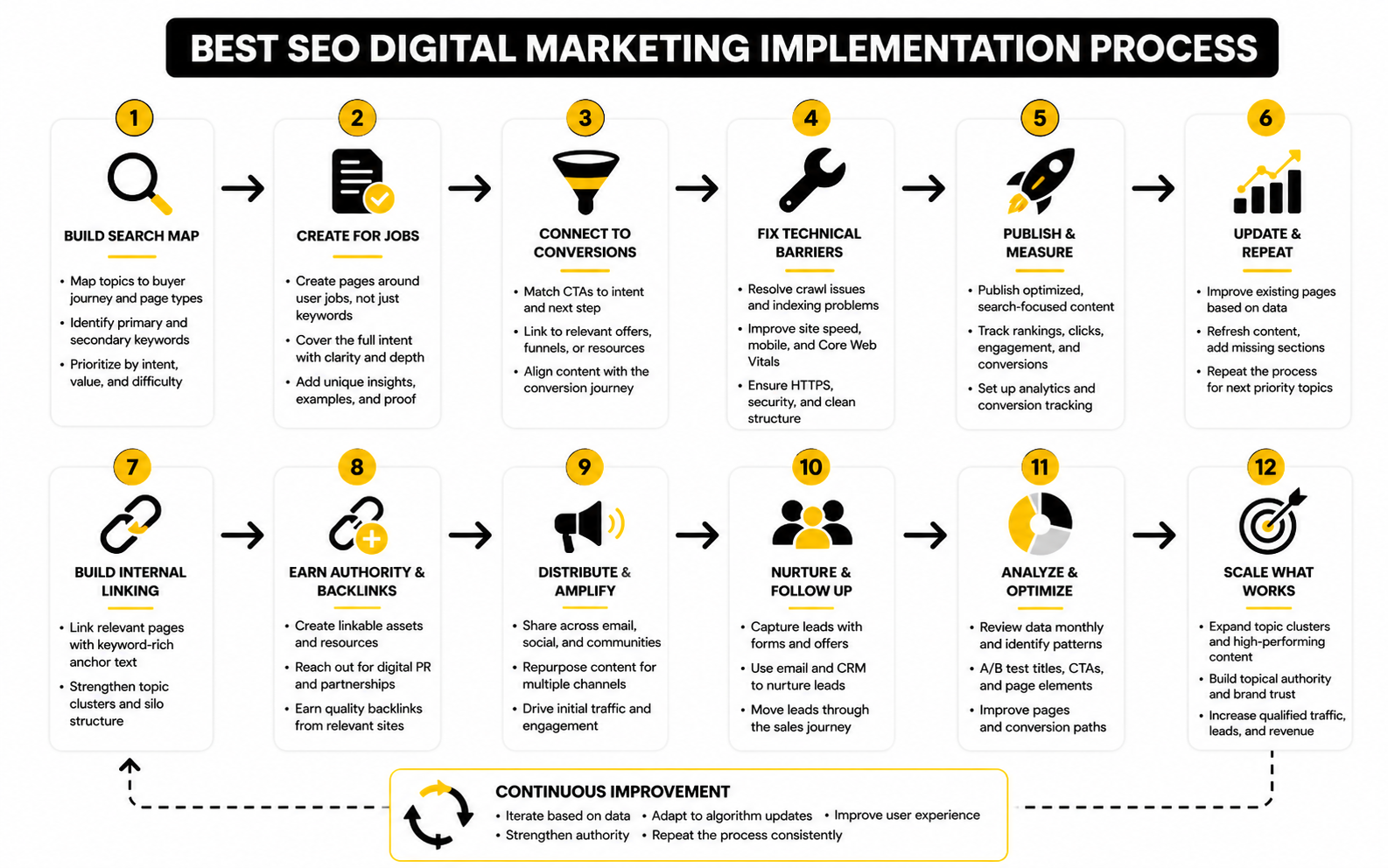
Step 1: Build the Search Map Before You Build Content
Start by mapping topics to the buyer journey. You need to know which searches belong at the awareness stage, which belong at the comparison stage, and which belong close to conversion. This prevents the classic mistake of filling a site with informational content while ignoring the pages that actually help people choose, book, buy, or request a quote.
A useful search map should include primary keywords, supporting questions, page type, search intent, conversion goal, and internal links. For example, a broad educational topic may lead to a guide, while a high-intent comparison query may need a decision page with pricing context, objections, alternatives, and a clear next step. When the map is clear, writers, designers, SEOs, and sales teams can work from the same logic.
Do not make this complicated just to look sophisticated. A spreadsheet is enough if it helps the team decide what to create, what to update, and what to ignore. The win is clarity, not decoration.
Step 2: Create Pages Around Jobs, Not Keywords Alone
Every SEO page should have a job. Some pages educate. Some pages compare. Some pages capture leads. Some pages sell directly. Some pages support existing customers and reduce friction after the sale.
This is where content quality becomes practical. Google’s Search Essentials explain that pages need to be accessible, crawlable, and eligible to appear in Search Google Search Essentials. But eligibility is only the starting line. A page also needs to satisfy the reader better than the alternatives already ranking.
The easiest way to improve a page is to ask what the reader needs next. Do they need a checklist, a pricing explanation, a product comparison, a booking option, a calculator, a form, or a stronger reason to trust you? Once that next step is obvious, the page becomes part of the marketing system instead of just another article.
Step 3: Connect Content to Conversion Paths
Traffic without a conversion path is wasted attention. A visitor should never reach the end of a useful page and wonder what to do next. The next step does not need to be aggressive, but it does need to be clear.
For service businesses, that might mean an audit request, consultation page, booking link, or nurture sequence. For ecommerce, it might mean a product collection, quiz, comparison page, or offer-driven landing page. For creators and lean teams, a simple funnel built with ClickFunnels or Systeme.io can be enough to turn search traffic into leads and buyers without overbuilding the tech stack.
The key is matching the CTA to the intent. A beginner reading an educational guide may not be ready for a sales call. A visitor comparing tools may be ready for a trial, demo, pricing page, or direct offer. When the CTA fits the moment, it feels helpful instead of pushy.
Step 4: Fix Technical Barriers Before Scaling Production
Before scaling content, clean up the technical basics. Make sure important pages are indexable, internal links are logical, duplicate pages are controlled, redirects work properly, and your site structure helps both users and search engines move through the site. If the foundation is messy, publishing more content can make the problem worse.
Technical SEO also protects crawl efficiency. Large sites especially need to avoid wasting search engine attention on thin pages, filters, duplicates, expired URLs, and low-value archives. Smaller sites usually have simpler issues, but they still need clean navigation, fast templates, mobile usability, and clear page hierarchy.
This is not the place to guess. Use Google Search Console, analytics data, crawl tools, and actual page performance to decide what needs attention first. Fix the issues that block visibility, harm user experience, or prevent conversions before chasing tiny optimization wins.
Step 5: Publish, Measure, Update, and Repeat
SEO implementation does not end when the page goes live. That is just the first version. After publishing, you need to check indexing, impressions, rankings, click-through behavior, engagement, assisted conversions, and whether the page is supporting the right business goal.
This is where a practical review cycle matters. Some pages need title and meta improvements because impressions are high but clicks are weak. Some need better internal links because they are isolated. Some need stronger sections because users are landing but not continuing. Some need a different CTA because the intent was misread.
The teams that win treat SEO pages like assets, not posts. They maintain them, improve them, and connect them to campaigns. That discipline matters even more as AI changes search behavior and marketers increase investment in content formats like video, thought leadership, and AI-assisted optimization Content Marketing Institute.
Statistics and Data
Data is useful only when it changes what you do next. In SEO, the problem is not a lack of numbers. The problem is that teams track too many numbers without knowing which ones prove progress, which ones reveal friction, and which ones are just noise.
A strong analytics system for the best seo digital marketing strategy should connect visibility, traffic quality, engagement, conversion, and revenue. That means you should not celebrate rankings unless they create qualified visits. You should not celebrate traffic unless it produces meaningful actions. And you should not judge a page too early if the data is still too thin to tell you anything reliable.
The numbers also need context. A drop in clicks can happen even when rankings stay stable because search results now include more AI summaries, answer boxes, ads, videos, shopping units, and other features. A rise in impressions can be a good sign, but only if the page is appearing for relevant queries and moving searchers toward the right next step.
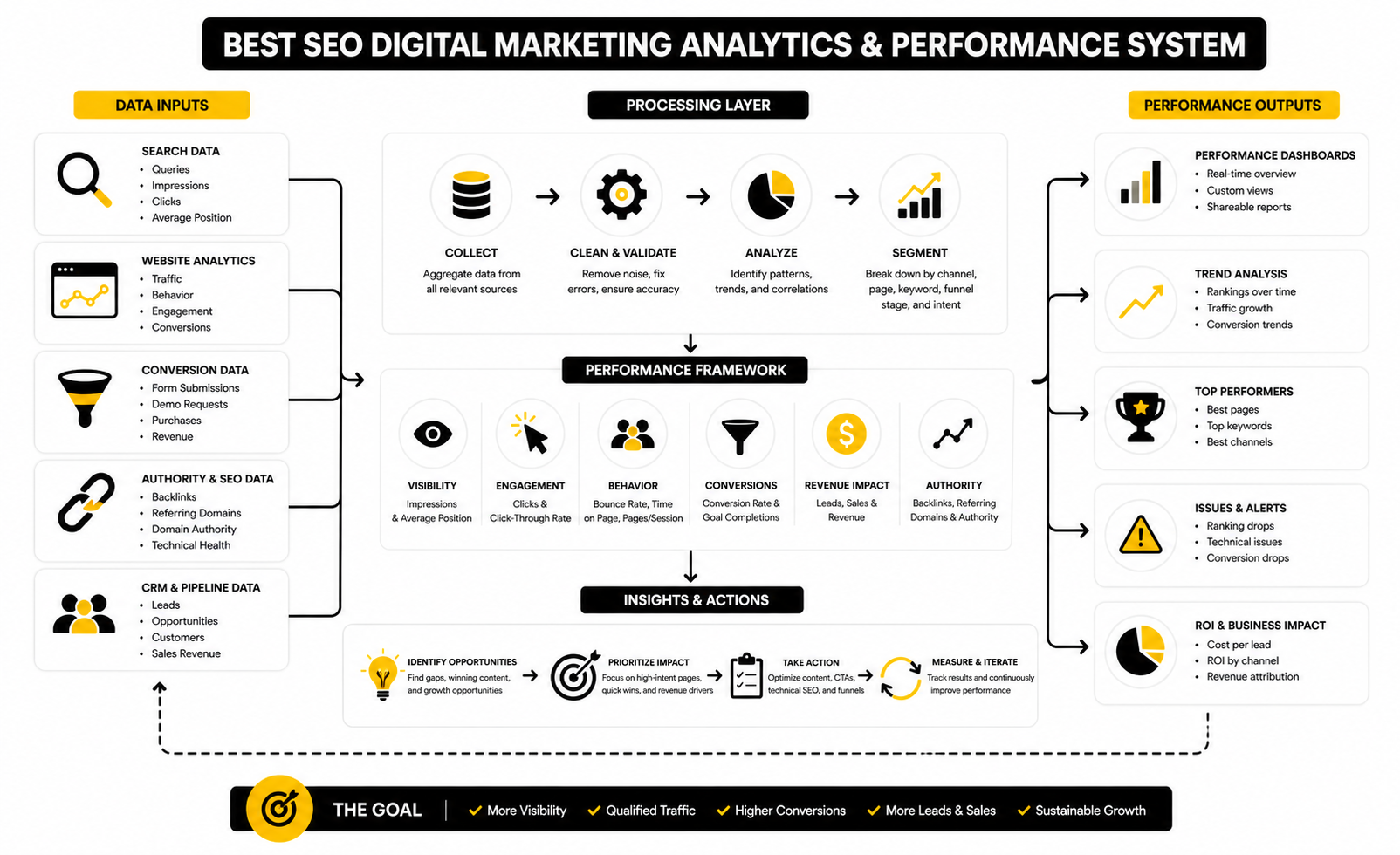
The Metrics That Actually Matter
Start with impressions, clicks, click-through rate, and average position in Google Search Console. Impressions show how often your site appeared in search results, clicks show how often people visited, CTR is clicks divided by impressions, and average position reflects the average ranking of the top result from your site Google Search Console performance reporting. These metrics are not perfect, but they are the cleanest starting point for understanding search visibility.
Then connect those search metrics to analytics and CRM data. You want to know which landing pages produce leads, booked calls, email subscribers, purchases, assisted conversions, and repeat engagement. A page with modest traffic but strong conversions may be more valuable than a high-traffic article that attracts the wrong audience.
The practical dashboard should answer five questions. Are we becoming more visible for the right searches? Are more qualified people clicking? Are they staying long enough to engage? Are they taking the next step? Are those actions turning into pipeline, sales, or retention?
Benchmarks Are Directional, Not Personal
Benchmarks are helpful, but they are not your strategy. Industry averages can show whether something looks unusual, but they cannot tell you what your audience, offer, market, or funnel should achieve. A local service business, SaaS company, ecommerce store, and affiliate site should not judge SEO performance the same way.
Recent search behavior makes this even more important. Zero-click search remains a major pressure point, with research showing that many Google searches end without a visit to the open web SparkToro zero-click search research. That does not mean SEO is dead. It means raw traffic is a weaker success metric than qualified clicks, brand demand, assisted conversions, and revenue contribution.
Paid search benchmarks also explain why organic performance matters. The average cost per lead in Google Ads reached $70.11 in 2025 WordStream Google Ads benchmarks. If your SEO program consistently creates qualified leads at a lower blended acquisition cost, it can protect margins while paid channels become more expensive.
How to Read Performance Signals
A page with high impressions and low CTR usually has a messaging problem. The topic may be relevant, but the title, meta description, angle, or search result appearance is not strong enough to earn the click. The action is not to rewrite the whole page immediately. First, improve the title promise, sharpen the meta description, and check whether the page matches the search intent.
A page with strong clicks but weak conversions has a journey problem. The visitor arrived, but the page did not move them forward. The fix may be a clearer offer, better internal links, stronger proof, a more relevant CTA, or a smoother landing-page experience through tools like ClickFunnels or Systeme.io.
A page with good engagement but poor ranking may have an authority or coverage problem. It might need better internal links, more complete topical support, stronger external references, clearer structure, or a better match between the page and the queries it is trying to win. Do not guess. Compare the page against the actual search results and look for what users are being rewarded for clicking.
What AI Search Changes in Measurement
AI search makes measurement less linear. People may discover a brand in an AI-generated answer, search the brand later, visit directly, or convert through a different channel entirely. That means last-click attribution will understate the value of useful content.
This does not mean you should abandon measurement. It means you need to watch more signals together. Branded search growth, direct traffic quality, assisted conversions, newsletter growth, demo requests, and mentions across channels can all show whether SEO content is strengthening demand.
Content investment is also shifting because teams know search behavior is changing. In 2025, marketers expected increased investment in video, thought leadership, AI for content optimization, and paid advertising Content Marketing Institute B2B benchmarks. That matters because the best SEO strategy now needs more than articles. It needs assets that can be reused across search, social, email, sales enablement, and AI-influenced discovery.
Turning Analytics Into Action
A clean review process beats a bloated dashboard. Once a month, sort pages into simple action groups: improve CTR, improve conversions, strengthen internal links, refresh content, consolidate duplicates, or leave alone. This keeps analysis tied to decisions instead of turning reporting into theater.
For lead-driven businesses, connect SEO pages to a CRM so you can see which queries and pages create real opportunities. A platform like GoHighLevel can help connect forms, calendars, pipelines, email follow-up, and attribution in one place. That matters because SEO rarely works as one isolated touchpoint; it often starts or supports a longer buying journey.
The final rule is simple: measure the full path, not just the first click. Visibility tells you whether the market can find you. Engagement tells you whether the page is useful. Conversions tell you whether the journey is working. Revenue tells you whether the strategy deserves more investment.
Tools, Automation, and Channel Integration
Scaling SEO is not just about publishing more. It is about building a system where research, content, technical work, distribution, conversion, and follow-up can move faster without losing quality. That is the difference between a serious growth engine and a content treadmill.
The best seo digital marketing teams use tools to remove friction, not to replace judgment. Automation can speed up keyword clustering, reporting, brief creation, internal linking checks, CRM follow-up, email segmentation, and social distribution. But the strategy still needs human decisions around positioning, offers, expertise, trust, and what the customer actually needs.
This matters because AI has raised the volume of average content everywhere. Google’s guidance on AI-generated content still points back to usefulness, originality, quality, and people-first value rather than the production method itself Google Search guidance about AI content. So the advantage is not “using AI.” The advantage is using AI without becoming generic.
Choosing Tools Without Building a Mess
A good tool stack should make the workflow cleaner. If every new platform creates another dashboard, another login, another disconnected report, and another place where leads can fall through the cracks, the stack is working against you. Simple beats impressive when simple gets used every week.
Start with the essentials: Google Search Console for search performance, analytics for behavior, a CRM for leads and customers, a publishing system, and a way to manage follow-up. Then add specialist tools only when they solve a clear bottleneck. For many agencies and service businesses, GoHighLevel can be useful because it connects funnels, forms, calendars, pipelines, email, SMS, and automation in one operating system.
The tradeoff is flexibility versus complexity. All-in-one platforms reduce scattered workflows, but they can also shape how your team operates. Specialized tools can go deeper in one area, but they require stronger process discipline. Pick based on your team’s reality, not based on what looks impressive in a software comparison.
AI Should Support Strategy, Not Dilute It
AI can help with outlines, topic clustering, content refresh ideas, repurposing, structured summaries, and first-pass analysis. That can save time, especially when the team already has strong positioning and clear editorial standards. But AI can also create a flood of content that sounds correct and says nothing memorable.
Marketing teams are clearly moving in this direction, with 65% of marketing leaders planning to increase investment in AI and automation tools during 2025 HubSpot AI marketing trends. That does not mean every team should automate everything. It means the baseline is rising, and weak content will get easier to produce at scale.
The smart move is to use AI for leverage while protecting the parts that create trust. Keep human ownership over expert insights, product truth, customer language, original examples, point of view, and final editorial judgment. If your page could be published by any competitor with the same prompt, it is not strong enough.
Distribution Is Part of SEO Now
Publishing a page and waiting is too passive. Strong SEO content should be distributed through email, social media, communities, sales conversations, paid retargeting, and internal enablement. Search can be the starting point, but it should not be the only channel that sees the asset.
This is especially important because search results are becoming more crowded with AI answers, ads, videos, forums, shopping elements, and rich results. Google has said AI Overviews have increased usage for the types of queries where they appear in major markets like the U.S. and India Google AI in Search update. That creates opportunity, but it also means brands need visibility beyond the traditional blue link.
A practical distribution system can be simple. Turn one strong SEO asset into a newsletter, LinkedIn post, short video script, sales enablement note, retargeting angle, and follow-up email. Tools like Buffer can help schedule and manage social distribution, but the strategy is the important part: do not let useful content die on one URL.
The Risk of Scaling Too Fast
Scaling bad SEO makes bad SEO more expensive. If the search map is weak, more content creates more clutter. If the site architecture is messy, more pages create more crawl waste. If the offer is unclear, more traffic creates more confused visitors.
The biggest risk is publishing before the business has a sharp point of view. Generic pages can rank temporarily, but they are easier to replace, easier to ignore, and weaker in AI-influenced discovery. Strong pages are built around real expertise, clear positioning, and useful decisions the reader can make.
There is also a resource risk. Content production, technical fixes, link development, analytics, CRO, and lifecycle marketing all compete for time and budget. Deloitte’s CMO Survey tracks how marketing leaders continue balancing investment priorities across budgets, staffing, analytics, and digital channels Deloitte CMO Survey. The takeaway is practical: do not scale a channel faster than your team can maintain quality and measure impact.
Advanced SEO Means Better Decisions, Not More Tricks
Expert-level SEO is often less flashy than beginners expect. It is deciding which pages not to create. It is consolidating overlapping content instead of adding another article. It is improving a high-intent page before writing ten low-intent posts. It is strengthening internal links, sharpening titles, improving proof, and making conversion paths easier.
Advanced work also means knowing when SEO is not the immediate answer. If a business has no clear offer, no proof, no sales process, or no way to follow up with leads, SEO will expose those weaknesses. Fix the business journey first, then scale traffic.
The strongest strategy is integrated and honest. Use SEO to capture intent. Use content to build trust. Use automation to follow up. Use analytics to improve decisions. Use paid and social channels to amplify what already works. That is how SEO becomes part of a durable marketing system instead of another isolated tactic.
Measurement, Optimization, and Frequently Asked Questions
At this point, the strategy should feel like a complete system. Search intent guides what you create. Technical SEO protects visibility. Content builds trust. Funnels and follow-up convert attention into action. Analytics tells you what to improve next.
That is the real difference between scattered SEO work and the best seo digital marketing system. One is a collection of tasks. The other is an ecosystem where every useful page has a role, every channel supports the others, and every improvement is tied to a business outcome.
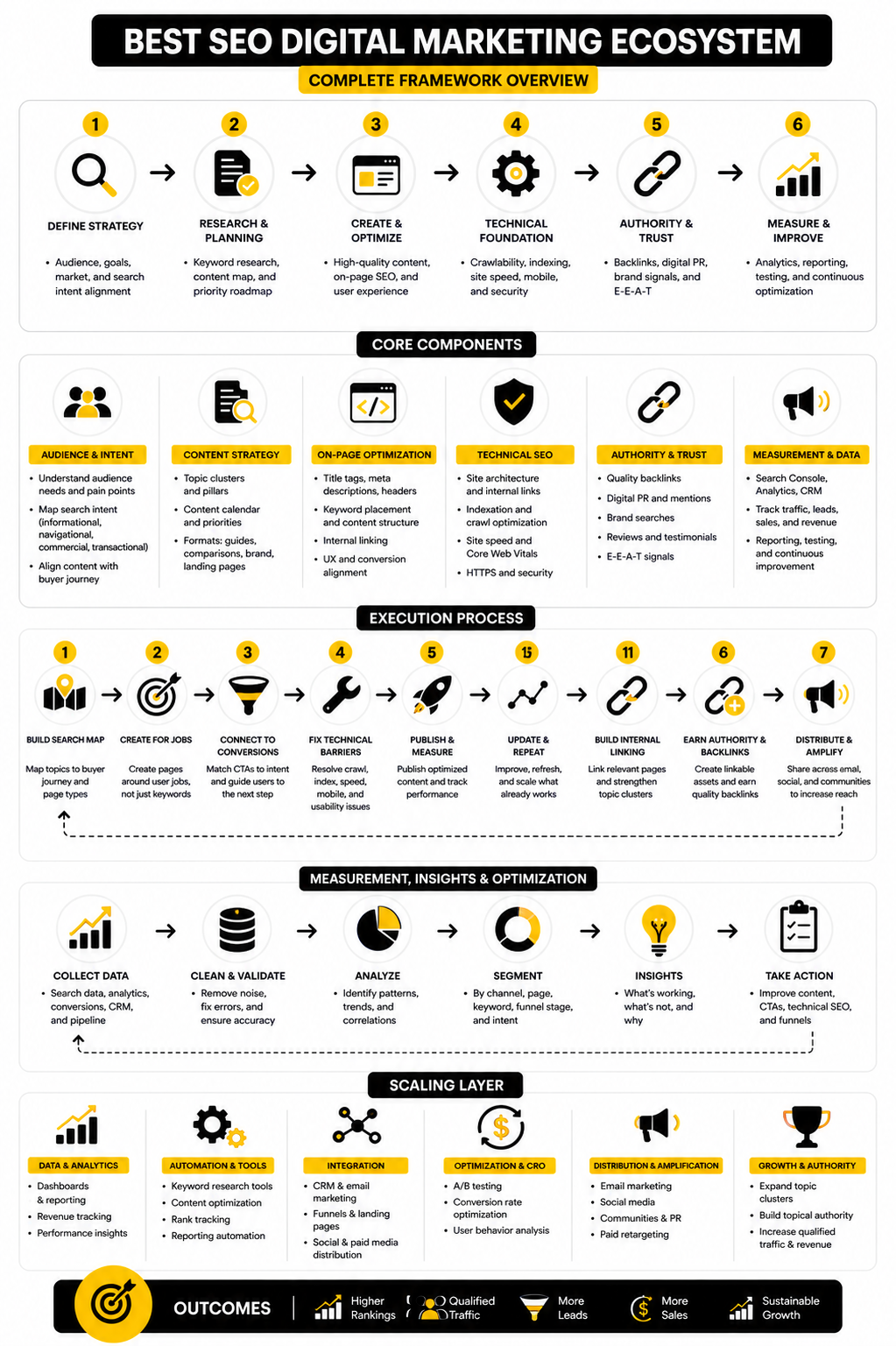
The final step is discipline. Keep the system simple enough to run consistently, but strong enough to reveal what is working. Review the data, improve the assets, remove what is weak, and double down where search intent, trust, and conversion all line up.
FAQ - Built for Complete Guide
What is the best SEO digital marketing strategy?
The best SEO digital marketing strategy connects search intent, useful content, technical SEO, conversion paths, and follow-up. It does not treat SEO as a standalone traffic tactic. It turns search visibility into a full customer journey.
That means your content should answer real questions, your site should be easy to crawl and use, and your pages should lead visitors toward clear next steps. Google’s own SEO starter guide focuses on helping search engines understand your content while making it useful for people Google Search Central. That is the foundation.
Is SEO still worth it with AI search?
Yes, but the game is changing. AI search makes generic content less valuable because users can get basic answers faster. That means SEO now depends more on original insight, trust, brand authority, and content that helps people make decisions.
Zero-click behavior also means not every search will produce a website visit. In 2024, many Google searches in the U.S. and Europe ended without a click to the open web SparkToro. The practical move is to focus on qualified clicks, branded demand, assisted conversions, and content strong enough to support visibility across search, social, email, and AI-influenced discovery.
How long does SEO take to work?
SEO usually takes time because search engines need to discover, crawl, index, evaluate, and compare your pages against existing results. The timeline depends on site authority, competition, technical health, content quality, and how well your pages match search intent. New sites usually need more patience than established brands.
The smarter question is not only “how long until rankings?” It is “how quickly can we improve the assets that influence rankings, clicks, leads, and revenue?” When the process is clear, every month should produce better pages, stronger internal links, cleaner tracking, and more useful data.
What metrics should I track first?
Start with impressions, clicks, click-through rate, average position, indexed pages, organic landing-page conversions, and assisted revenue. These metrics show whether people can find you, whether they click, and whether the traffic is worth anything. Google Search Console is the cleanest starting point for query, impression, click, and position data Google Search Console.
Then connect SEO data to analytics and CRM outcomes. A page that gets traffic but produces no meaningful action may need a better CTA or a stronger offer. A page with fewer visits but high conversion intent may deserve more internal links, updates, and promotion.
How many keywords should one page target?
One page should have one primary intent, not just one keyword. It can rank for many related queries if those queries share the same searcher goal. Trying to force unrelated keywords onto one page usually makes the content weaker.
A good page can target a primary keyword, related subtopics, common questions, and natural variations. The key is coherence. If the reader came for one problem, the page should not drift into five different topics just to capture extra search volume.
Should I publish blog posts or landing pages?
You need both if they serve different jobs. Blog posts are useful for education, awareness, problem-solving, and building trust. Landing pages are better for offers, services, products, demos, lead magnets, and conversion-focused actions.
The mistake is using blog posts when the searcher clearly wants to compare or buy. The opposite mistake is sending early-stage visitors to a hard-sell landing page before they understand the problem. Match the asset to the intent.
How does content quality affect SEO?
Content quality affects whether a page deserves attention, links, trust, engagement, and long-term visibility. A page that repeats what everyone else already said is easy to replace. A page with clear structure, useful judgment, practical explanation, and real expertise is harder to ignore.
Google’s helpful content guidance keeps pointing toward people-first content that is useful, reliable, and created to help users Google Search Central. That does not mean every page needs to be long. It means every page needs to be genuinely useful for the intent it targets.
What role do funnels play in SEO?
Funnels turn SEO traffic into a guided journey. Without a funnel, visitors may read a page and leave with no next step. With a funnel, the page can lead to a form, consultation, product offer, email sequence, demo, or booking flow.
For lean teams, tools like ClickFunnels, Systeme.io, or GoHighLevel can help connect pages, forms, calendars, email follow-up, and pipeline tracking. The tool matters less than the logic: the next step must fit the visitor’s intent.
How often should SEO content be updated?
Update content when the page is outdated, losing visibility, missing important intent, underperforming in CTR, or failing to convert qualified traffic. Do not update pages just to change the date. Update them because the page can become more useful.
A practical review cycle is monthly for priority pages and quarterly for broader content libraries. High-intent pages deserve the most attention because small improvements can have a bigger business impact. Low-value pages should sometimes be consolidated or removed instead of endlessly refreshed.
Is paid advertising still needed if SEO works?
Paid advertising can still be useful because it gives speed, testing data, and controlled targeting. SEO builds durable visibility, but paid campaigns can validate offers, test messaging, support launches, and retarget organic visitors. The strongest systems often use both.
The tradeoff is cost. Google Ads benchmarks show the average cost per lead reached $70.11 in 2025 across industries WordStream. That makes organic traffic valuable when it produces qualified leads at a lower blended cost, but it does not make paid media useless.
What is the biggest SEO mistake businesses make?
The biggest mistake is separating SEO from the rest of marketing. Teams publish content without a conversion path, run ads without learning from search intent, collect leads without follow-up, and report rankings without connecting them to revenue. That creates activity, not growth.
The fix is to build one connected system. Search tells you what people want. Content earns trust. Pages guide action. Automation follows up. Analytics shows what deserves more investment.
Can small businesses compete with bigger brands in SEO?
Yes, but they need focus. A small business usually should not try to compete with broad, national, high-authority keywords first. It should target specific problems, local intent, niche services, comparison searches, and high-intent long-tail queries where relevance matters more than size.
Small businesses also have an advantage bigger brands often lack: speed. They can update pages faster, speak more directly, show sharper expertise, and build content around real customer conversations. That is exactly where practical SEO can win.
Work With Professionals
Explore 10K+ Remote Marketing Contracts on MarkeWork.com
Most marketers spend too much time chasing clients, competing on crowded platforms, and losing a percentage of every project to middlemen.
MarkeWork gives you a better way. Browse thousands of remote marketing contracts and connect directly with companies desperate to hire skilled marketers like you, without platform commissions and without unnecessary gatekeepers.
If you're serious about finding better opportunities and keeping 100% of what you earn, explore available contracts and create a profile for free at MarkeWork.com.