

Brand advertising is the work you do so buyers remember you before they are ready to buy. It is not just a logo, a slogan, or a pretty campaign. It is the disciplined use of message, media, memory, and consistency to make your brand easier to recognize, trust, and choose.
That matters because most people are not ready to buy the moment they see your ad. Performance marketing captures demand that already exists. Brand advertising creates the conditions that make future demand easier, cheaper, and more profitable to convert.

This article will break brand advertising down into a practical operating system. No vague “build awareness” advice. No fluffy brand theory. Just the structure, decisions, and execution standards that help a brand become familiar, distinctive, and commercially useful.
Article Outline
- Why Brand Advertising Matters
- The Brand Advertising Framework
- Core Components Of Effective Brand Advertising
- Professional Implementation
- Measurement, Optimization, And Budgeting
- Brand Advertising FAQ
Why Brand Advertising Matters
Brand advertising matters because buyers are overloaded. They see endless offers, funnels, posts, videos, emails, and ads every day. If your brand does not create memory before the buying moment, you are forced to compete only when the buyer is comparing options.
That is the expensive place to compete. At that point, every competitor can shout about features, discounts, guarantees, and urgency. A strong brand gives you an advantage before that comparison starts because the buyer already has a mental shortcut attached to your name.
This is why brand advertising should not be treated as “extra” work after performance campaigns are running. It supports performance by making clicks warmer, sales conversations easier, referrals more natural, and pricing pressure less brutal. The better your brand is remembered, the less your business depends on last-click persuasion.
The Brand Advertising Framework
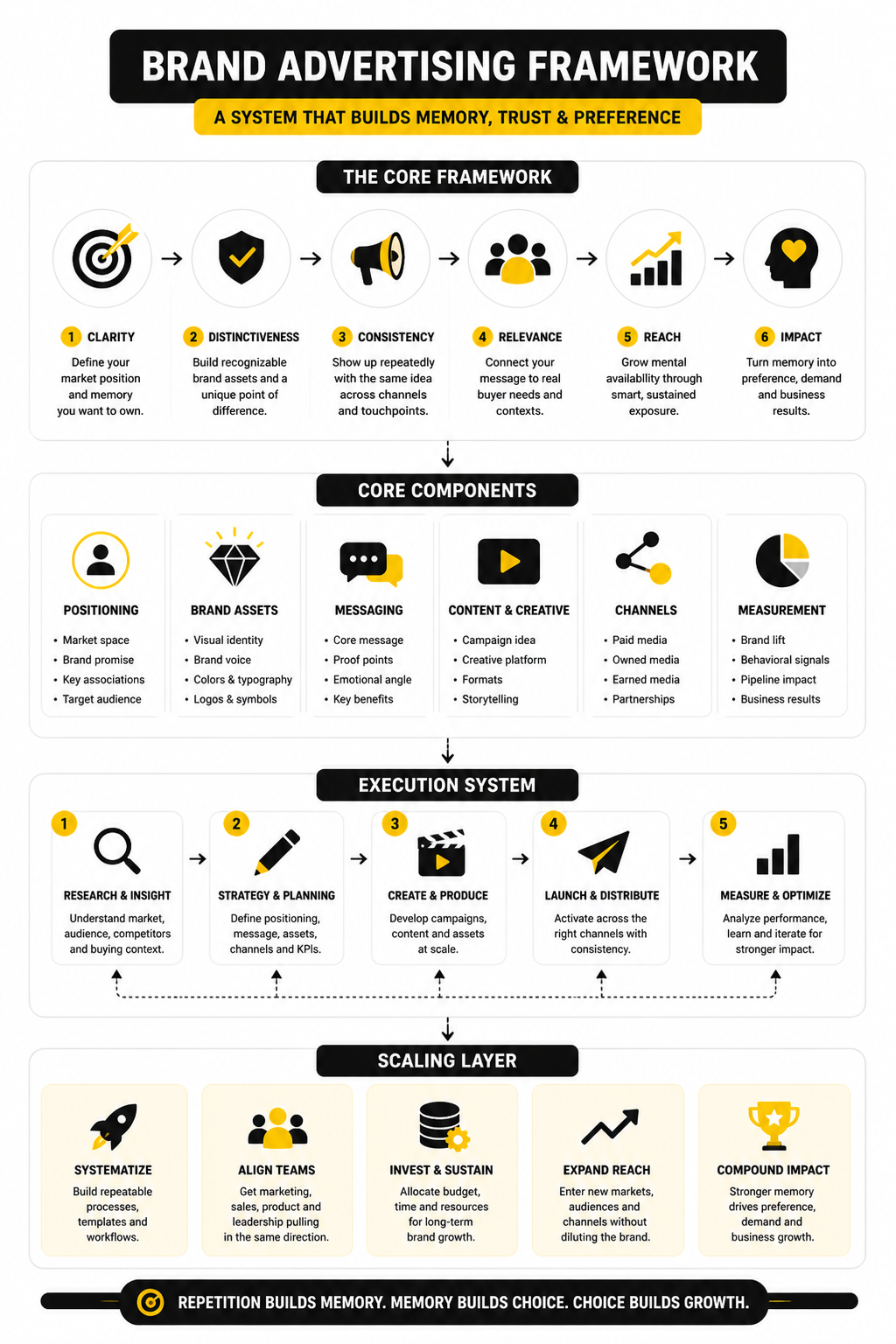
A useful brand advertising framework starts with one simple question: what should the market remember about you? Not what do you want to say this week. Not what angle is trending. What should stick in the buyer’s mind after repeated exposure?
From there, brand advertising becomes a system. You define the positioning, turn it into memorable creative, distribute it through the right channels, repeat it with discipline, and measure whether the market is becoming more familiar with you. That is the foundation the rest of this article will build on.
The key is consistency without becoming boring. Strong brands do not randomly reinvent themselves every month. They find a sharp idea, express it in different ways, and keep reinforcing the same mental association until the market knows what they stand for.
Core Components Of Effective Brand Advertising
Effective brand advertising is not one big inspirational campaign. It is a set of connected decisions that make the brand easier to notice, easier to remember, and easier to prefer when the buyer enters the market. The strongest brands usually win because they repeat the right signals long enough for people to connect the dots without working hard.
The first component is positioning. Your positioning defines the space you want to own in the buyer’s mind, and it has to be simple enough to survive real-world distractions. If someone needs a long explanation to understand what your brand stands for, the market will not remember it.
The second component is distinctiveness. Distinctive brand assets can include colors, shapes, characters, sounds, packaging, phrases, layouts, product cues, and recurring creative devices. Their job is not decoration. Their job is to help people recognize the brand before they even read the name.
The third component is reach. Brand advertising needs to reach future buyers, not just people actively searching today. That is why strong brand work often feels broader than direct-response campaigns. You are building memory across the market, not only chasing the hottest leads.
The fourth component is consistency. This is where many brands lose patience. They change the message, the visual system, the offer, the tone, and the channel mix too often, then wonder why nothing sticks.
Positioning Comes Before Creative
Creative cannot fix weak positioning. It can make weak positioning louder, but that usually just wastes more money. Before you make ads, you need to know who the brand is for, what problem it is tied to, and why the market should remember it instead of every alternative.
Good positioning is specific without being narrow. It gives your brand a clear role in the buyer’s life or business, but it does not trap you in one tiny campaign angle. For example, a software brand should not only be “easy to use” because everyone says that. It needs a sharper memory structure around the outcome, the use case, or the type of customer it serves best.
This is where brand advertising becomes strategic instead of cosmetic. You are not asking, “What ad will get attention this week?” You are asking, “What idea should repeated advertising build in the market over time?” That shift matters because short-term attention without memory is just rented noise.
Distinctive Assets Make The Brand Easier To Recognize
Distinctive assets are the parts of your brand people can recognize quickly and repeatedly. They reduce the mental work required to connect an ad, post, landing page, email, or video back to you. The Ehrenberg-Bass view of distinctive brand assets focuses on assets being both famous and unique, meaning people recognize them and connect them to one brand rather than the whole category.
This is why brand advertising should not rely only on clever copy. Copy changes from campaign to campaign, but assets compound when they are used consistently. A color system, recurring visual style, sonic cue, spokesperson, mascot, packaging structure, or phrase can become a shortcut if the brand protects it and uses it often enough.
The practical mistake is treating every campaign like a blank canvas. That may feel creative internally, but it makes the market start from zero every time. Better brand advertising keeps enough familiar codes in place so new creative still feels connected to the same brand.
Reach Builds Future Demand
Brand advertising works best when it reaches people before they are actively shopping. That feels uncomfortable to performance-focused teams because the response is not always immediate. But that is the point: you are creating familiarity before the buyer has a deadline, budget, or urgent reason to compare vendors.
This is especially important in categories with long buying cycles. A buyer may see your content, ads, sponsorships, videos, or creator partnerships months before they ever book a call or search for a solution. When that buying moment arrives, familiarity can make your brand feel safer than a competitor they are seeing for the first time.
Reach does not mean spraying money everywhere. It means reaching the right market broadly enough that your future buyers are not invisible to your media plan. A good brand advertising strategy balances precision with scale, because a tiny retargeting pool will never build a large brand.
Consistency Turns Exposure Into Memory
One exposure rarely changes anything. Memory comes from repeated exposure to connected ideas and recognizable assets. That is why consistency is not boring; it is how brand advertising becomes useful.
Consistency should show up in message, design, tone, proof, and customer experience. If the ad says one thing, the landing page says another, the sales call feels different, and the product experience breaks the promise, the brand loses credibility. People may not describe that disconnect in marketing language, but they feel it.
This is also where tools and systems help. A small team running brand campaigns, social content, email, funnels, and follow-up needs a clear operating system, not scattered execution. For agencies and service businesses that want the brand promise to carry through lead capture and nurturing, platforms like GoHighLevel can support the follow-through after the advertising creates interest.
Professional Implementation
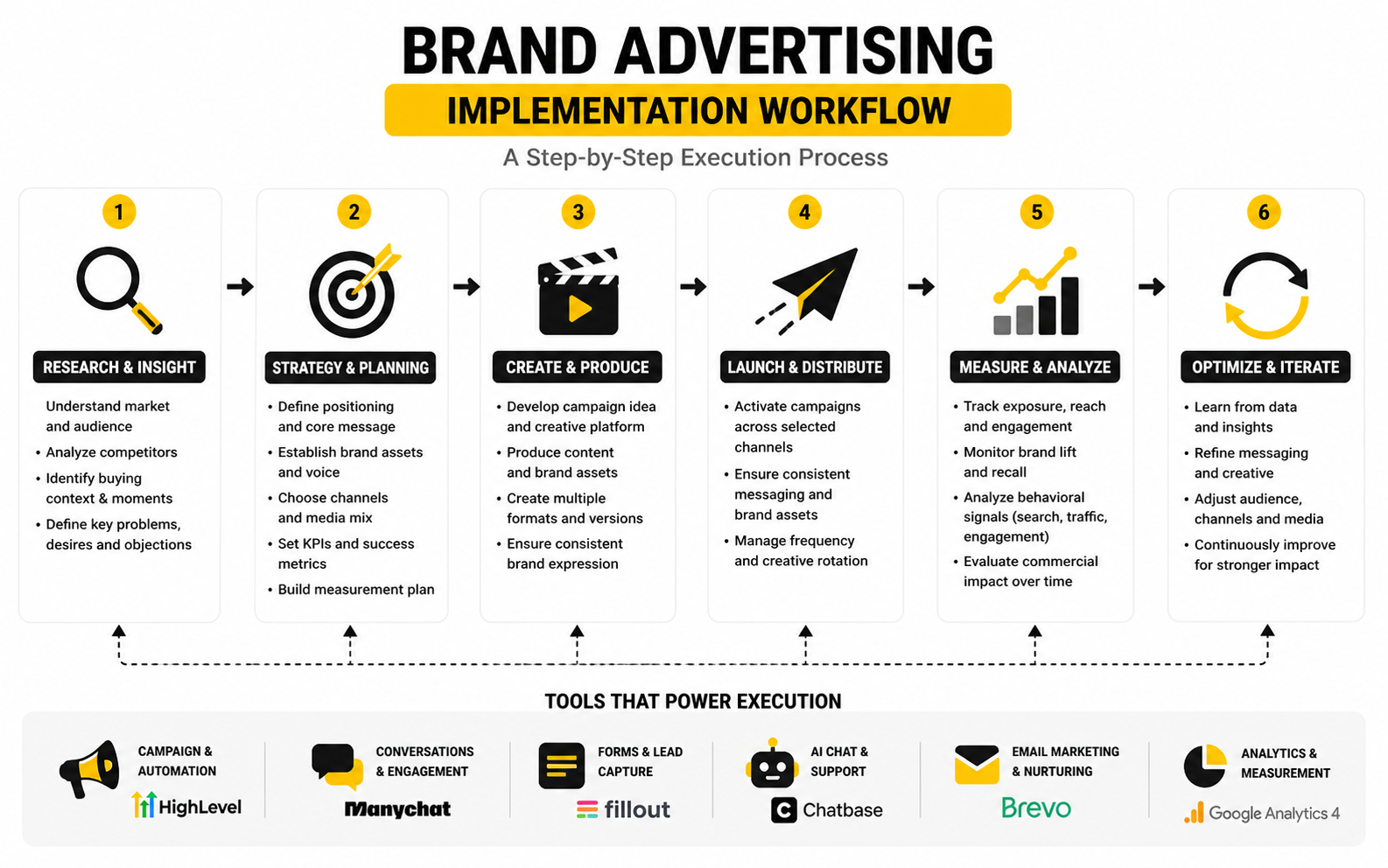
Professional brand advertising starts by turning strategy into a repeatable process. This is where the work becomes tangible. Instead of hoping a strong idea appears in a campaign meeting, you build a system that moves from positioning to assets, creative, media, measurement, and iteration.
The process matters because brand advertising compounds slowly and then suddenly. One campaign can create attention, but a disciplined operating rhythm creates memory. That rhythm is what keeps the team from chasing random trends, changing direction too early, or mistaking short-term engagement for long-term brand strength.
Step 1: Define The Memory You Want To Build
Start with the market memory you want to own. This should be a clear sentence, not a brainstorm board full of adjectives. A buyer should be able to connect your brand with a specific problem, outcome, situation, or category need.
This is where weak brand advertising usually breaks. The team jumps into ads before deciding what the market should remember. That creates disconnected campaigns that may look nice but do not build a stronger mental position over time.
A practical way to pressure-test this is to ask, “When someone is finally ready to buy, what should make them think of us first?” If the answer sounds generic, keep working. The sharper the memory target, the easier it becomes to judge creative ideas, channel choices, and campaign consistency.
Step 2: Audit Your Current Brand Signals
Before creating new assets, audit what the market already sees. Look at your website, ads, social posts, emails, landing pages, sales decks, product screens, videos, thumbnails, proposals, and customer onboarding. The goal is to find the signals that already feel recognizable and the inconsistencies that are weakening memory.
Distinctive asset research from the Ehrenberg-Bass Institute emphasizes that assets become useful when people can both notice them and connect them back to one brand, not just the category. The practical takeaway is simple: if your colors, layouts, phrases, and visual codes keep changing, you are making buyers relearn you every time.
This audit should not become an endless brand-policing exercise. Focus on the handful of signals that could realistically become recognizable with repetition. Keep what has equity, remove what creates confusion, and document the standards clearly enough that your team can apply them without asking for permission every time.
Step 3: Build A Creative Platform
A creative platform is the campaign idea that connects your brand advertising across multiple executions. It is bigger than one ad, but smaller than your whole brand strategy. It gives the team a repeatable way to express the same positioning without producing identical creative every week.
This is where you define the message territory, the emotional angle, the proof points, the visual codes, and the recurring creative devices. The platform should be flexible enough for video, paid social, YouTube, creator partnerships, newsletters, events, and landing pages. But it should still feel unmistakably like the same brand.
Do not confuse variety with inconsistency. You can change the story, format, hook, and execution while keeping the same underlying memory structure. That is the sweet spot: fresh enough to earn attention, consistent enough to build recognition.
Step 4: Choose Channels Based On Buying Context
Channel selection should follow the buyer’s world, not your team’s personal preferences. A B2B software brand, a local service business, an ecommerce brand, and a creator-led education business may all need brand advertising, but they should not copy the same media plan. The right question is where your future buyers spend attention before they are actively comparing options.
For some brands, that means YouTube, podcasts, LinkedIn, newsletters, and industry communities. For others, it may mean TikTok, Instagram, creator collaborations, connected TV, retail media, or search-supported content. The channel is not the strategy. The channel is the delivery system for the memory you are trying to build.
This is also where owned media becomes important. If you create demand but do not capture and nurture it, you leak value. Tools like Buffer can help keep social publishing consistent, while platforms like Brevo can support email follow-up after people move from passive awareness to active interest.
Step 5: Create A Campaign Rhythm
Brand advertising needs a rhythm the business can sustain. That usually means building campaigns in waves instead of random one-off pushes. Each wave should reinforce the same brand idea while testing new angles, formats, and distribution paths.
A simple rhythm could include one main campaign concept, several short-form variations, supporting organic content, email reinforcement, landing page alignment, and sales enablement material. This keeps the brand idea visible across the buyer journey without forcing every asset to do the same job. The ad creates memory, the content adds context, the landing page captures interest, and the sales material turns familiarity into confidence.
The mistake is trying to make every piece of creative close the sale immediately. Some assets should create recognition. Some should explain the problem. Some should prove credibility. Some should convert. When each asset has a job, the whole system performs better.
Step 6: Connect Brand Advertising To The Customer Journey
Brand advertising should not sit in a separate folder from the rest of marketing. It should influence the full customer journey, from first impression to post-purchase experience. Otherwise, the brand promise becomes a campaign claim instead of something the buyer can actually feel.
This means your landing pages, lead magnets, forms, demos, onboarding, and follow-up sequences should all carry the same promise and tone. If your brand advertising says you make growth simpler, the next step should not feel confusing. If your brand advertising says you are premium, the sales experience should not feel generic.
For funnel-heavy businesses, this connection is especially important. A builder like ClickFunnels can help turn campaign attention into structured buyer journeys, but the funnel still has to feel like the same brand people saw in the ad. Continuity is what prevents a strong first impression from dying on the next click.
Measurement, Analytics, And Budgeting
Brand advertising needs measurement, but it needs the right kind of measurement. If you judge brand work only by last-click conversions, you will almost always undercount it. Brand advertising usually creates familiarity, trust, search demand, direct traffic, easier sales conversations, higher conversion intent, and better pricing power before it shows up as a clean conversion inside one ad platform.
That does not mean brand advertising gets a free pass. It still has to prove that it is moving the business forward. The difference is that you measure it with a layered system, not one dashboard number pretending to explain everything.
Statistics And Data
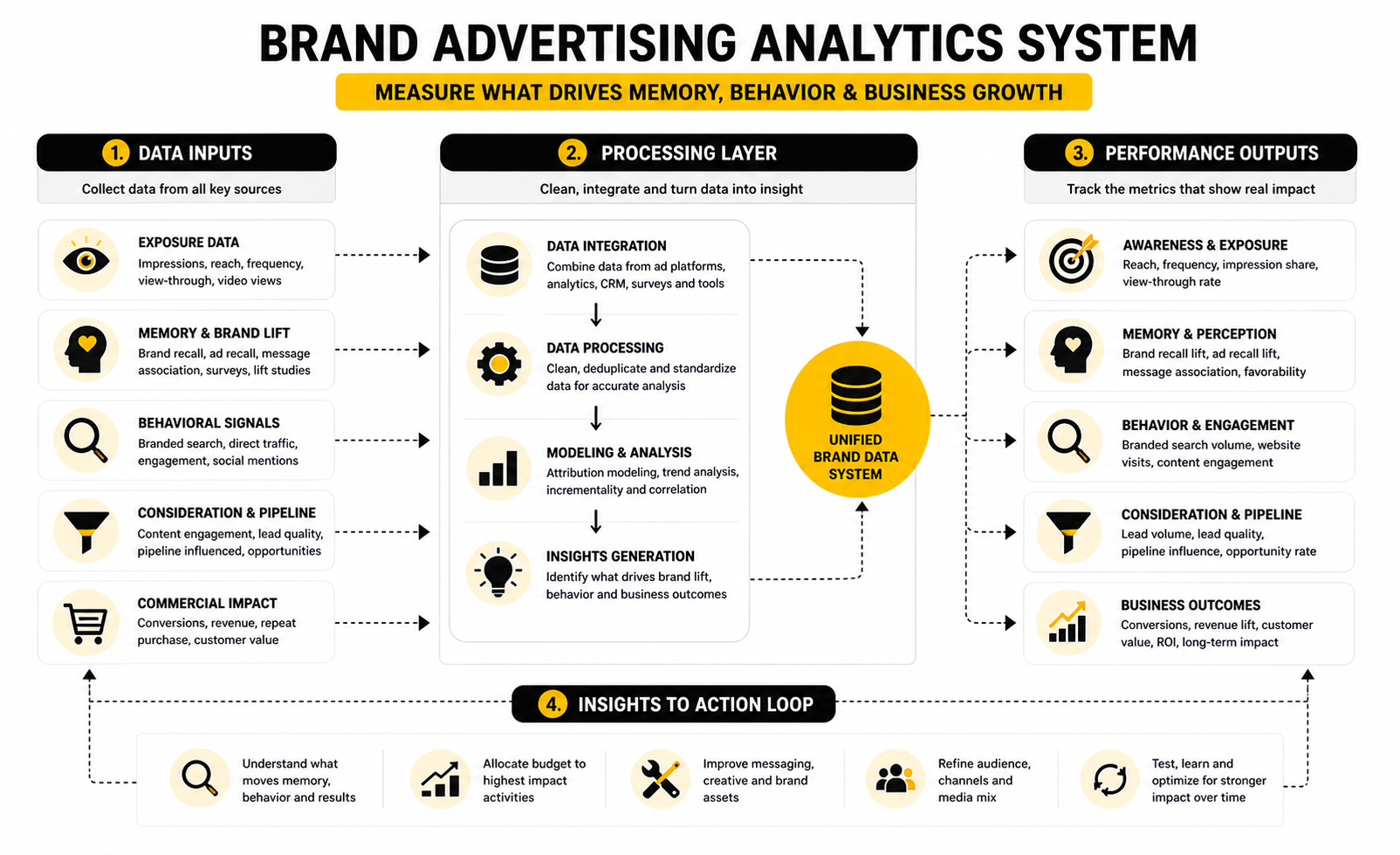
The most useful brand advertising data falls into four buckets: exposure, memory, behavior, and commercial impact. Exposure tells you whether the right people are seeing the work. Memory tells you whether they are remembering the brand. Behavior tells you whether market interest is changing. Commercial impact tells you whether those changes are helping revenue, margin, pipeline, or customer acquisition.
The reason this matters is simple. A campaign can get high reach and still fail if nobody remembers who it was for. A campaign can get strong recall and still fail if it does not connect to a relevant buying situation. A campaign can drive traffic and still fail if the next step feels disconnected from the promise.
The best measurement system does not ask, “Did this one ad instantly pay for itself?” It asks, “Is the brand becoming easier to recognize, easier to search for, easier to trust, and easier to buy from?” That is a more honest way to evaluate brand advertising because it matches how buyers actually move.
Exposure Metrics Show Whether The Market Is Being Reached
Reach, frequency, impressions, video completion, viewable impressions, and audience quality are the first layer. They do not prove brand impact by themselves, but they tell you whether the campaign had enough opportunity to work. If your target market barely saw the campaign, weak results are not a positioning problem yet; they may simply be a distribution problem.
Frequency needs careful interpretation. Too little frequency means people may not remember the brand. Too much frequency can waste budget or create fatigue, especially when the creative is narrow and repetitive. The goal is not to hammer people endlessly; the goal is to create enough repeated exposure for memory to form.
This is why media planning and creative planning should talk to each other. If you plan higher frequency, you need enough creative variation to stay interesting while keeping the same brand codes. If you plan broad reach, your message needs to be simple enough for distracted people to understand quickly.
Memory Metrics Tell You Whether The Brand Is Sticking
Brand awareness, ad recall, brand recognition, category association, message association, and consideration are more useful than raw impressions because they measure what remains after exposure. This is where brand lift studies, surveys, panel research, and platform lift tests can help. They are not perfect, but they are far better than guessing from clicks alone.
The key is to measure the specific memory you were trying to build. If the campaign was meant to make people associate your brand with faster implementation, then measure that association. If it was meant to increase consideration among a specific buyer group, measure that group separately instead of hiding the signal inside a broad average.
Benchmarks can help, but they should not become the strategy. A lift that looks small may be valuable in a large market, while a high percentage lift in a tiny audience may not matter commercially. The action should come from the pattern: which audiences moved, which message stuck, which assets were remembered, and which channels created the strongest signal.
Behavioral Signals Show Whether Demand Is Warming Up
Behavioral data is where brand advertising starts connecting to active demand. Look at branded search volume, direct traffic, returning visitors, organic social engagement quality, email signups, content consumption, demo page visits, creator code usage, sales call source notes, and CRM self-reported attribution. None of these numbers is complete alone, but together they show whether the market is leaning in.
Branded search is especially useful because it often reflects memory becoming action. When more people search your brand name, product name, campaign phrase, or comparison terms, it can signal that advertising is creating curiosity. You still need to account for seasonality, PR, promotions, and sales activity, but the trend is worth watching closely.
This is also why your tracking setup matters. If leads are captured across landing pages, forms, chat, social, and email, you need clean follow-up and source visibility. A CRM and automation platform like GoHighLevel can help connect campaign interest to pipeline activity, while form tools like Fillout can make it easier to capture cleaner first-party data at the point of conversion.
Commercial Impact Takes Longer But Matters Most
The final layer is business impact. This includes pipeline quality, conversion rate, close rate, average order value, customer acquisition cost, retention, margin, price sensitivity, and customer lifetime value. Brand advertising should eventually make some of these numbers easier, even if the change is not immediate.
For example, if brand familiarity improves, sales teams may hear fewer basic trust objections. If consideration increases, paid search may convert better because buyers already know the name. If the brand becomes more distinctive, the business may need fewer discounts to win the same type of customer.
This is the part most teams rush. They want a clean answer after two weeks, but brand effects often need more time and more context. The practical move is to set short-term diagnostic metrics, medium-term demand signals, and long-term commercial goals before the campaign starts.
The Metrics That Actually Deserve Attention
A strong brand advertising dashboard should be small enough to use. If the dashboard has fifty numbers, nobody will make better decisions from it. Focus on the metrics that connect directly to the campaign’s job.
Useful measurement areas include:
- Reach in the right market: Did enough future buyers see the campaign?
- Frequency and attention quality: Did they have enough exposure to remember it?
- Brand recall and recognition: Can people connect the creative back to the brand?
- Message association: Do they remember the idea you wanted to build?
- Branded search and direct traffic: Are more people looking for you by name?
- Consideration and preference: Are more buyers willing to choose you?
- Pipeline and revenue quality: Is demand becoming easier to convert?
The action is the important part. If reach is low, adjust media. If recall is low, improve distinctiveness. If message association is weak, simplify the idea. If traffic rises but conversion does not, fix the landing page, offer, or follow-up.
Budgeting Should Match The Job
Brand advertising budgets should not be built from leftovers. If brand work only gets whatever remains after performance campaigns, it will be inconsistent by design. That makes it harder to build memory, harder to learn, and harder to defend the investment internally.
A practical budget starts with the market you need to reach, the channels required to reach them, the creative volume needed to avoid fatigue, and the measurement setup needed to learn. For smaller brands, this may mean a focused campaign in a narrow audience with strong repetition. For larger brands, it may mean broader reach across several channels with formal brand tracking.
The real mistake is expecting brand advertising to behave like a coupon campaign. It is not there only to harvest buyers who are ready today. It is there to make the next six to eighteen months of demand easier to create, capture, and convert.
Advanced Brand Advertising Decisions
Once the basics are working, brand advertising becomes a game of tradeoffs. You are no longer asking whether the brand needs awareness, memory, and consistency. You are deciding how aggressively to scale, how much risk to take creatively, how tightly to connect brand and performance, and when to protect the idea instead of changing it.
This is where stronger operators separate themselves from random campaign teams. They do not treat brand advertising as a mood board. They treat it as a commercial asset that needs creative courage, financial discipline, and operational patience at the same time.
Balance Brand And Performance Without Turning Them Into Enemies
Brand and performance should not fight for identity. Performance marketing captures active demand and gives you fast feedback. Brand advertising builds the mental availability that makes future demand easier to capture.
The mistake is forcing one side to do the other side’s job. A brand campaign should not be judged only by immediate purchases, and a bottom-funnel campaign should not be expected to build deep memory across the whole market. They work best when they support each other instead of competing for credit.
The practical move is to build shared planning. Brand work should influence performance creative, landing pages, email angles, and sales enablement. Performance data should reveal which buyer problems, objections, and messages are worth feeding back into the brand system.
Know When To Stay Consistent And When To Refresh
Consistency is powerful, but it is not the same as freezing the brand forever. Markets change, competitors copy, customer language evolves, and creative wear-out is real. The question is not whether to refresh; the question is what you can change without breaking recognition.
Protect the assets that are already building memory. Change the executions around them. Keep the brand codes stable while refreshing the stories, formats, hooks, and proof points.
This is a simple rule, but it prevents expensive damage. Too many brands throw away valuable recognition because the team is bored internally. The market is not living inside your campaign deck, so it usually needs more repetition than your team thinks.
Make Creative Risk Intentional
Safe brand advertising is often the riskiest choice because nobody notices it. If the work looks and sounds like every competitor, it may get approved quickly, but it will not build much memory. Bland creative feels comfortable in meetings and invisible in the market.
That does not mean being weird for attention. Creative risk should serve the positioning. The job is to dramatize the brand idea in a way people can remember, not to create a stunt that gets separated from the brand.
Use a simple filter before approving bold creative. Is it distinctive? Is it connected to the brand? Is it tied to a real buying situation? If it only passes the first test, you may get attention without commercial value.
Avoid The Attribution Trap
Attribution can make brand advertising look weaker than it is because many brand effects happen before the measurable click. Someone may see your campaign, hear your podcast sponsorship, notice your founder on LinkedIn, ask a colleague about you, search your name later, and finally convert through paid search. A last-click report will give the credit to the final touch.
That does not make attribution useless. It means attribution should be treated as one input, not the judge and jury. Use it to understand conversion paths, but do not let it erase the demand creation that happened earlier.
This is especially important as privacy changes continue to weaken overly precise tracking. Modern measurement is moving toward a blend of experiments, modeled data, brand lift, first-party data, and commercial trend analysis. The teams that accept this reality make better decisions than the teams pretending every sale can be perfectly traced to one touchpoint.
Scale Only After The Brand System Is Coherent
Scaling brand advertising before the system is coherent is a fast way to waste money. If the positioning is unclear, the assets are inconsistent, the landing pages do not match, and the follow-up is weak, more media simply spreads the confusion. Bigger spend does not fix a broken brand system.
Before scaling, check whether the message is clear, the creative is recognizable, the customer journey is aligned, and the measurement setup can detect meaningful change. If those pieces are not in place, spend time tightening the system before increasing budget. That is not caution; it is leverage.
When the system is coherent, scale becomes much more productive. You can expand channels, increase reach, test new audiences, and build deeper creative libraries without losing the core memory structure. This is how brand advertising becomes an asset instead of a series of expensive launches.
Keep The Promise Operationally True
The biggest brand risk is making a promise the business cannot keep. Advertising can create expectations quickly, but customer experience decides whether those expectations become trust or disappointment. A strong brand campaign can actually hurt if it sends more people into a weak product, confusing funnel, slow sales process, or poor support experience.
This is why advanced brand advertising has to involve more than the marketing team. Sales, product, customer success, leadership, and operations all shape whether the brand promise feels real. If the campaign says “simple,” the product and onboarding need to feel simple. If the campaign says “premium,” the entire customer experience needs to feel premium.
Tools can help tighten the experience, but the strategy still comes first. For example, a business using ManyChat for automated conversations or Chatbase for AI support still needs the experience to sound like the same brand people saw in the advertising. Automation should reinforce the promise, not make the brand feel colder.
Build A Brand Advertising Review Rhythm
Advanced teams review brand advertising on a different rhythm than short-term acquisition. They check creative quality before launch, early delivery signals during the campaign, memory and behavioral signals after enough exposure, and commercial effects over a longer window. That rhythm prevents panic decisions.
A useful review should answer four questions. What did the market see? What did the market remember? What did the market do next? What should we keep, improve, or stop?
This keeps the discussion practical. You are not debating personal taste or defending a campaign because someone liked the concept. You are making decisions based on whether the work is building the right memory, reaching the right people, and creating stronger business conditions over time.
Brand Advertising FAQ
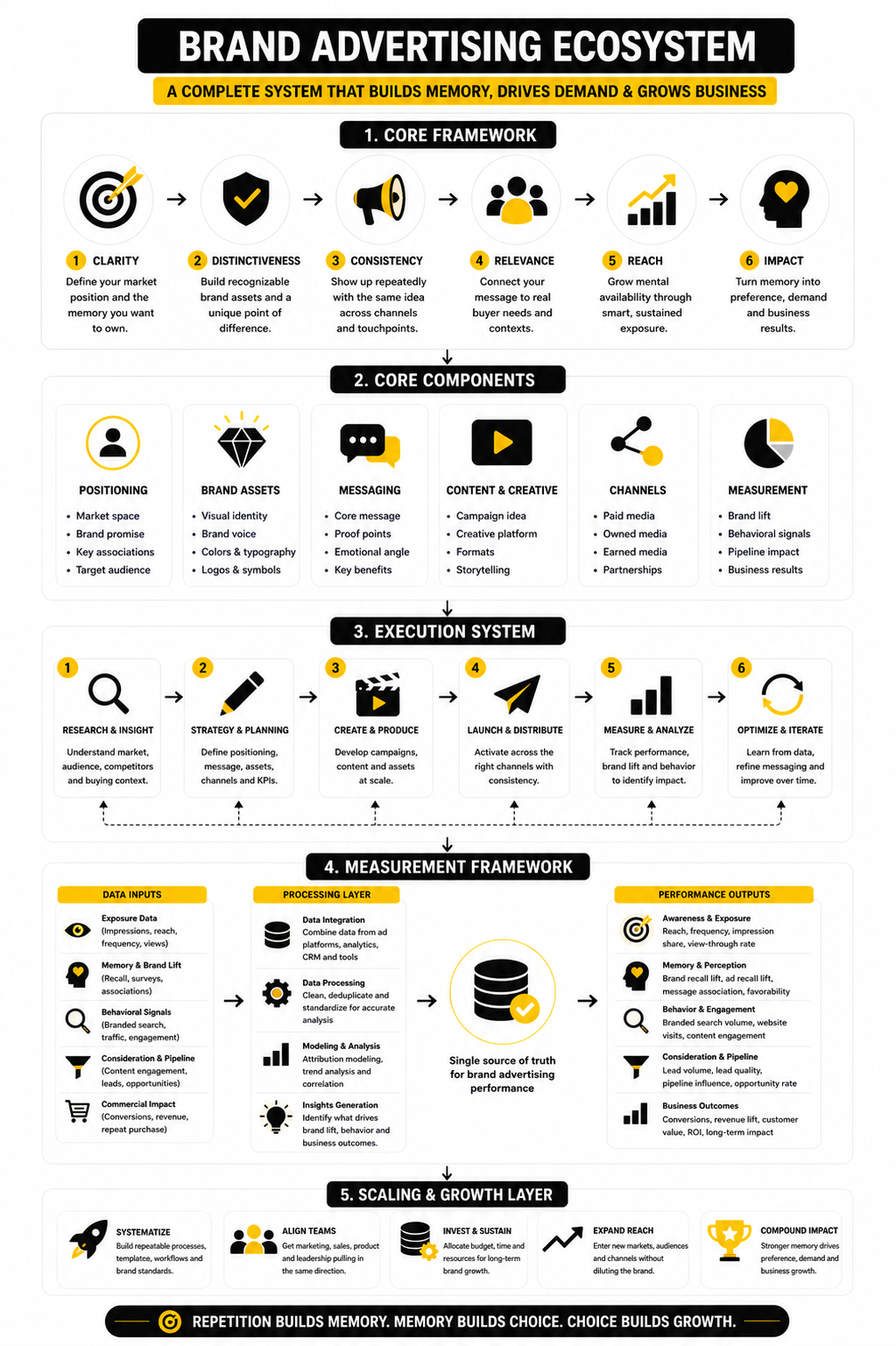
Brand advertising works best when it becomes an ecosystem, not a disconnected campaign. The brand idea shapes the creative. The creative builds memory. The media plan creates reach. The customer journey captures interest. The measurement system tells you what to improve.
That is the complete loop. When one part breaks, the whole system gets weaker. When every part supports the same brand memory, the business becomes easier to notice, easier to trust, and easier to choose.
What Is Brand Advertising?
Brand advertising is advertising designed to build recognition, memory, trust, and preference for a brand over time. It is not limited to direct sales messages or immediate lead generation. Its job is to make the brand more familiar and easier to choose when buyers enter the market.
How Is Brand Advertising Different From Performance Marketing?
Performance marketing usually focuses on measurable short-term actions like clicks, leads, purchases, bookings, or signups. Brand advertising focuses on building future demand by improving awareness, recall, recognition, and consideration. The best businesses do both because brand creates the conditions that make performance easier.
Why Does Brand Advertising Matter?
Brand advertising matters because most buyers are not ready to buy right now. If they only discover you at the final comparison stage, you are forced to compete on price, urgency, and claims. If they already know and trust your brand, the buying conversation starts from a stronger place.
What Makes Brand Advertising Effective?
Effective brand advertising is clear, distinctive, consistent, and well distributed. It gives the market something simple to remember and repeats that idea through recognizable brand assets. It also connects the advertising promise to the actual customer experience, which is where trust gets confirmed or broken.
How Long Does Brand Advertising Take To Work?
Brand advertising usually takes longer than a direct-response campaign because it builds memory before it captures demand. You may see early signals through branded search, direct traffic, engagement quality, or survey lift, but commercial impact often shows up over a longer window. The mistake is quitting before the market has had enough repeated exposure to remember you.
What Should A Brand Advertising Campaign Include?
A strong campaign should include a clear positioning idea, distinctive brand assets, a creative platform, channel plan, measurement plan, and customer journey alignment. The campaign should not live only in ads. It should carry through landing pages, content, email, sales material, and follow-up.
How Do You Measure Brand Advertising?
Measure brand advertising with a layered system. Track exposure, recall, recognition, message association, branded search, direct traffic, consideration, pipeline quality, and commercial outcomes. No single metric tells the whole story, so the goal is to read the pattern instead of worshipping one number.
What Is A Good Brand Advertising Budget?
A good budget depends on market size, category competition, buying cycle, creative needs, and channel costs. Smaller brands can start with focused reach in a defined audience, while larger brands may need broader market coverage. The important rule is to fund brand advertising consistently enough for memory to build.
Can Small Businesses Use Brand Advertising?
Yes, but small businesses need focus. You do not need a massive national campaign to build a stronger brand. You need a clear promise, recognizable assets, consistent content, smart distribution, and a customer journey that makes the promise feel real.
What Are The Biggest Brand Advertising Mistakes?
The biggest mistakes are changing direction too often, copying competitors, measuring only last-click results, using generic creative, and making promises the business cannot keep. Another common mistake is separating brand from the rest of marketing. Brand advertising works better when it connects to funnels, sales, product, service, and retention.
Should Brand Advertising Use Emotional Or Rational Messaging?
It can use both, but the mix depends on the category and buying situation. Emotional cues help memory and preference, while rational proof helps reduce risk and justify action. The strongest brand advertising often uses emotion to make the brand memorable and proof to make the choice feel safe.
How Do Distinctive Brand Assets Help?
Distinctive brand assets help people recognize the brand faster and connect advertising back to the right company. These can include colors, shapes, characters, sounds, phrases, layouts, or product cues. Research-led brand systems treat these assets as long-term memory builders, not decoration.
When Should A Brand Refresh Its Advertising?
Refresh the advertising when the creative is wearing out, the market has changed, or the message no longer reflects the business. Do not refresh just because the internal team is bored. Keep the assets that are building recognition and update the executions around them.
What Is The Best Channel For Brand Advertising?
There is no universal best channel. The best channel is where your future buyers already spend attention before they are ready to buy. For some brands that means YouTube, LinkedIn, podcasts, newsletters, and search-supported content; for others it means creators, social platforms, events, connected TV, or retail media.
How Do You Know If Brand Advertising Is Working?
You know it is working when the market starts showing stronger recognition, more branded demand, better engagement quality, warmer sales conversations, higher consideration, and improved commercial efficiency. The signal will rarely appear perfectly in one report. Look for consistent movement across memory, behavior, and business outcomes.
Work With Professionals
Explore 10K+ Remote Marketing Contracts on MarkeWork.com
Most marketers spend too much time chasing clients, competing on crowded platforms, and losing a percentage of every project to middlemen.
MarkeWork gives you a better way. Browse thousands of remote marketing contracts and connect directly with companies desperate to hire skilled marketers like you, without platform commissions and without unnecessary gatekeepers.
If you're serious about finding better opportunities and keeping 100% of what you earn, explore available contracts and create a profile for free at MarkeWork.com.