

Brand awareness is not just whether someone has heard your name. It is whether your brand comes to mind when the customer has a problem, sees a trigger, compares options, or finally decides to buy.
That matters because most buyers are not ready to purchase right now. In B2B especially, the widely discussed 95:5 rule argues that only a small share of buyers are in-market at any given time, which means the brands that win later are often the brands building memory now.
This guide breaks brand awareness into a practical system: what it means, why it matters, how to build it, how to measure it, and how to turn it into revenue without becoming obsessed with short-term clicks.
Article Outline
- Why Brand Awareness Matters
- Brand Awareness Framework Overview
- Core Components Of Strong Brand Awareness
- How To Build Brand Awareness Professionally
- How To Measure Brand Awareness
- Brand Awareness FAQ And Final Action Plan
Why Brand Awareness Matters
Brand awareness matters because customers rarely start from zero when they buy. They bring memories, associations, category shortcuts, past impressions, social proof, search results, creator mentions, ads, packaging, reviews, and conversations into the decision. The brand that already feels familiar often has an advantage before the sales page, demo call, or checkout even appears.
This is why brand awareness should not be treated as a “nice to have” metric. Kantar’s brand equity work consistently frames strong brands around being meaningful, different, and salient, with salience referring to whether the brand comes easily to mind in buying situations. That is a more useful way to think about awareness: not vanity reach, but mental availability.
The practical point is simple. If people do not know you, remember you, or connect you with the right problem, your performance marketing has to work much harder. If they already recognize you and understand why you matter, every search ad, sales email, retargeting campaign, landing page, and referral has more weight.
Brand Awareness Framework Overview
Brand awareness works best when you treat it as a system, not a slogan. The goal is to create repeated, relevant memory structures around your brand so the right people recognize you in the right moments. That means you need more than impressions; you need positioning, consistency, distribution, proof, and measurement working together.
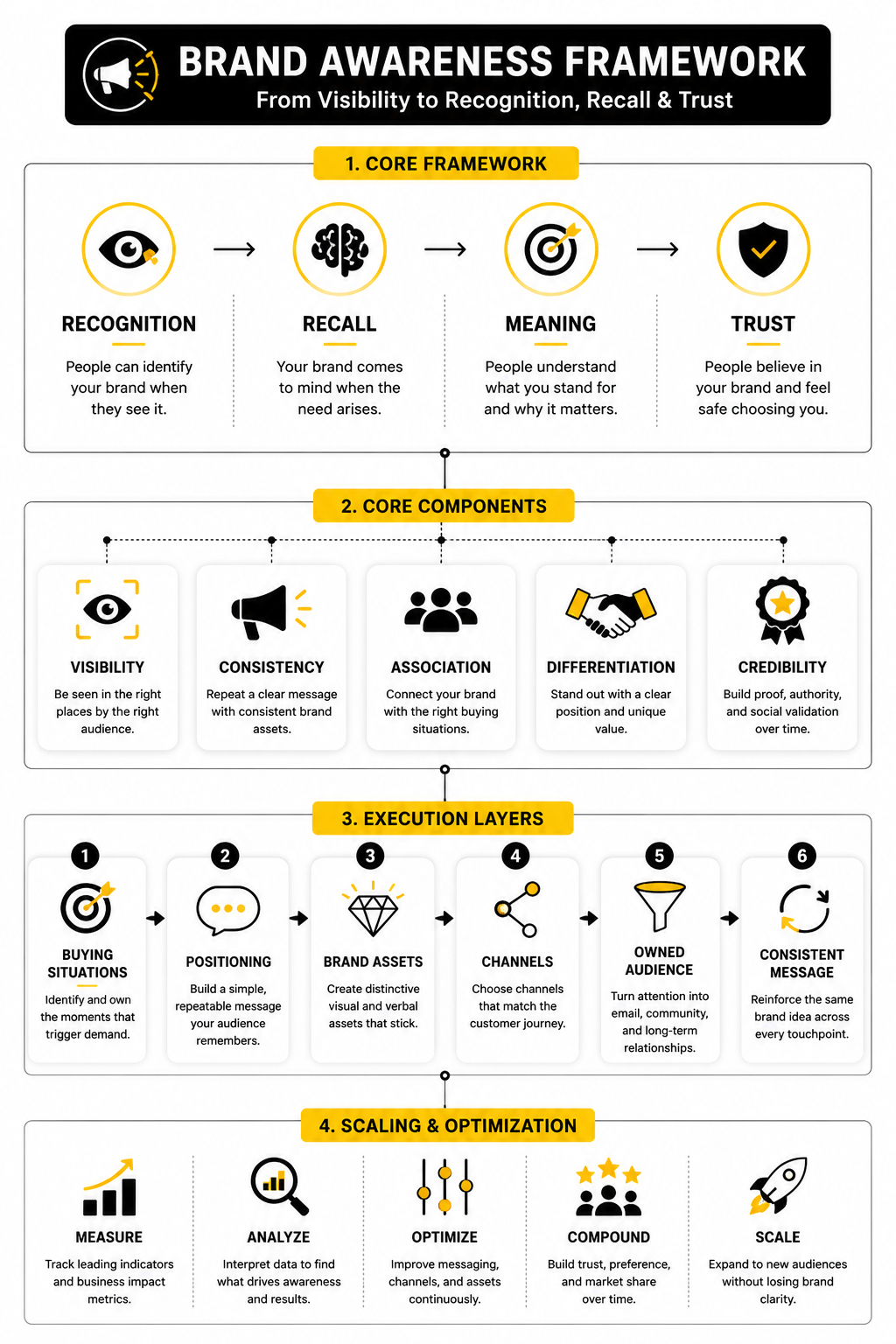
A strong framework starts with the customer’s buying context. What problem are they trying to solve? What language do they use? What brands do they already compare? What moments make them search, ask, click, subscribe, trial, book, or buy?
From there, brand awareness becomes easier to manage. You are not just “getting your name out there.” You are making your brand easier to notice, easier to understand, easier to trust, and easier to recall when the customer enters the market.
Core Components Of Strong Brand Awareness
Strong brand awareness is built from several parts working together. Recognition is the easiest layer: people can identify your name, logo, colors, product, founder, or offer when they see it. Recall is stronger because the brand comes to mind without a direct prompt, especially when the buyer is thinking about a problem, category, or buying situation.
That distinction matters because awareness is not one single metric. A person might recognize your brand in a feed but never think of you when they need a solution. Another person might not follow you closely but still remember your positioning at the exact moment they start comparing options.
The best brands build both. They make themselves visually and verbally easy to recognize, then repeat the right associations until the market knows what they stand for. That is the foundation of practical brand awareness.
Recognition
Recognition is the “I’ve seen this before” layer of brand awareness. It shows up when someone notices your logo, ad style, product interface, founder, tone of voice, packaging, or social content and connects it back to your brand. This is why consistency is not boring; it is useful.
Recognition becomes stronger when a brand uses distinctive assets repeatedly. Research from Ipsos and JKR found that only 15% of brand assets were truly distinctive, which means most brands are making themselves harder to remember than they need to. The opportunity is obvious: create assets people can identify quickly, then stop changing them every quarter.
For a software company, those assets might include the product UI, the demo format, a recurring content series, a clear tagline, and a recognizable founder voice. For an ecommerce brand, they might include packaging, photography style, product names, colors, and creator partnerships. The format changes by business model, but the job is the same: make the brand easier to spot.
Recall
Recall is more valuable because it happens when the buyer thinks of you without seeing your brand first. Someone searches for a landing page builder and remembers ClickFunnels. Someone needs a social scheduling tool and thinks of Buffer. Someone wants automated Instagram or Messenger conversations and remembers ManyChat.
That kind of brand awareness is built through category entry points. These are the situations, needs, frustrations, and goals that trigger demand. A brand becomes easier to recall when it keeps linking itself to the moments buyers actually experience.
The mistake is trying to be remembered for everything. A brand that wants to own every use case usually owns none. Start with the most commercially important buying situations, then build content, messaging, ads, partnerships, and proof around those moments.
Meaning
Awareness without meaning is weak. People might know your name but still have no clear reason to care. Strong brand awareness gives the market a simple answer to three questions: who you help, what problem you solve, and why you are different enough to remember.
This is where positioning does the heavy lifting. Kantar’s Meaningful, Different, and Salient framework links brand equity to commercial outcomes such as penetration, market share, willingness to pay, and growth potential through its MASB-certified brand equity measurement approach. In plain English, being known is not enough; the market also needs a reason to choose you.
Meaning should be specific, not poetic. “We help local agencies sell automated marketing systems” is clearer than “we empower growth.” “Build faster landing pages for Shopify campaigns” is clearer than “create better digital experiences.” The clearer the meaning, the easier the awareness becomes to turn into demand.
Trust
Trust turns awareness from attention into confidence. A buyer may discover you through an ad, creator post, search result, or podcast mention, but they usually need more signals before taking action. Reviews, customer results, founder credibility, public expertise, community presence, guarantees, and transparent product education all help close that gap.
This is especially important when the offer is expensive, complex, or tied to business risk. A local business owner choosing a CRM, a founder choosing an ecommerce landing page platform, or an agency choosing automation software is not just buying features. They are deciding whether your brand feels safe enough to let into their workflow.
Trust also compounds. Every useful tutorial, honest comparison, helpful support answer, and consistent customer experience adds another reason to believe the brand. That is why brand awareness and customer experience cannot be separated for long.
How To Build Brand Awareness Professionally
Building brand awareness professionally starts with focus. You are not trying to reach everyone, say everything, or show up on every channel at once. You are trying to make the right market remember the right thing about your brand when the right buying situation appears.
That means the work has to be structured. A random podcast appearance, a few social posts, and a short ad campaign might create activity, but they rarely create memory on their own. The brands that become easier to recall usually repeat a clear message across enough high-quality touchpoints for long enough that the market starts to connect the dots.
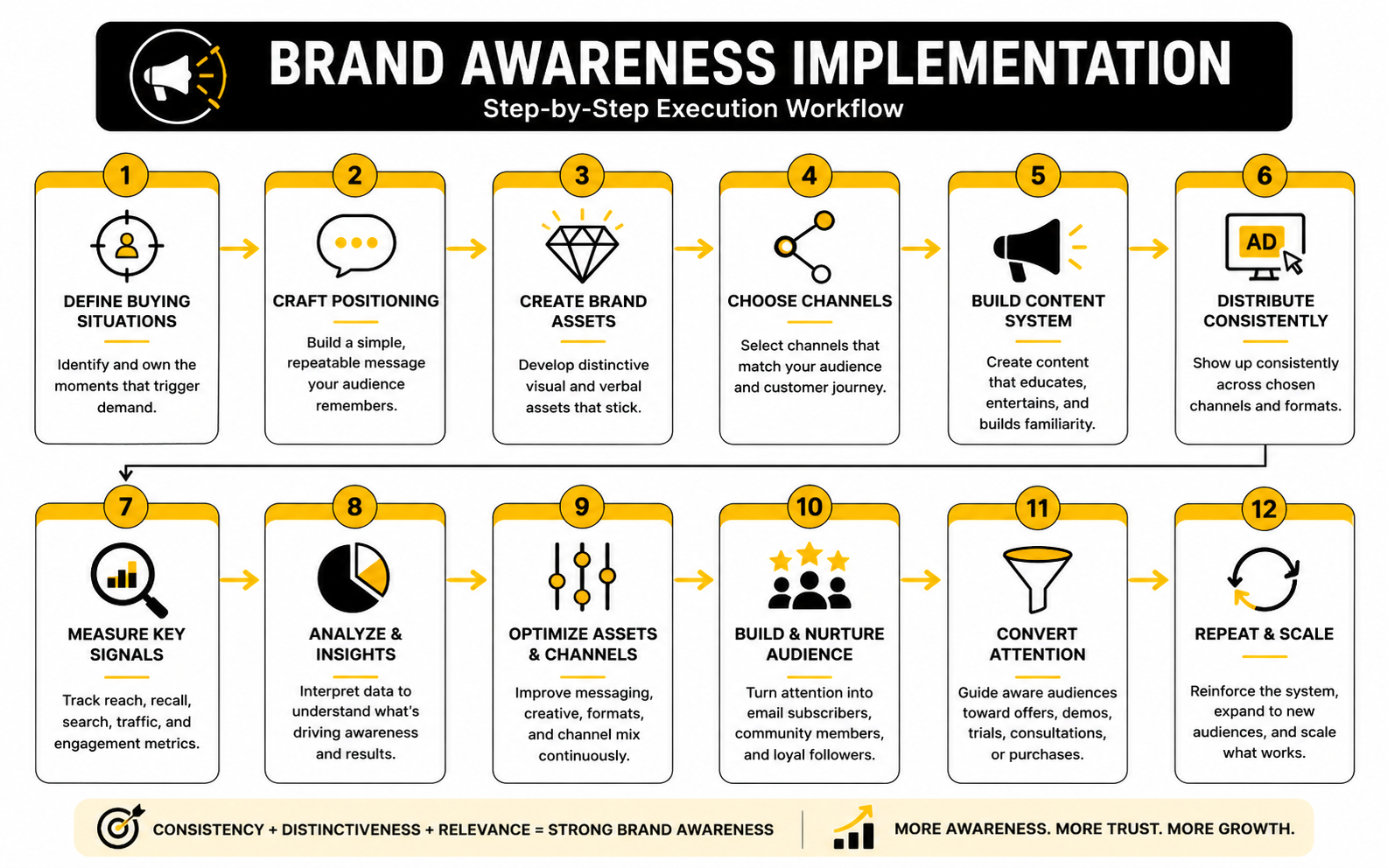
The process below is simple, but it is not casual. It forces you to decide what you want to be remembered for, where that memory should be built, and how each campaign will support the same strategic idea.
Step 1: Choose The Buying Situations You Want To Own
Start by listing the moments that make someone need a solution like yours. These are not demographics. They are real situations: launching a campaign, replacing a messy tool stack, trying to improve conversion rates, hiring an agency, preparing a product launch, or needing a faster way to capture leads.
This connects directly to category entry points, which Ehrenberg-Bass describes as the thoughts buyers have as they move toward a category purchase. In practical terms, brand awareness gets stronger when your brand is linked to specific buying situations, not just broad category labels. A CRM brand does not only want to be known as “CRM software”; it wants to be remembered when a business owner thinks, “I’m losing leads because follow-up is messy.”
Pick the situations with the strongest commercial value first. If you sell automation software, one strong buying situation might be “I need to follow up with leads faster.” If you sell landing page tools, it might be “I need to launch a campaign without waiting on developers.” That level of specificity makes your content, ads, partnerships, and landing pages much sharper.
Step 2: Make Your Positioning Easy To Repeat
Your positioning should be simple enough that a customer can repeat it after hearing it once or twice. That does not mean your product is simple. It means your market needs a clean mental shortcut for why you exist.
A useful positioning statement answers four questions. Who is this for? What painful problem does it solve? What makes it different? What outcome should people associate with it? If the answer takes five paragraphs, the market will not remember it.
This is where many brands overcomplicate brand awareness. They keep adding benefits until the message becomes heavy. Strong positioning usually removes noise. It gives every channel one clear job: reinforce the same useful idea again and again.
Step 3: Build Distinctive Brand Assets
Distinctive assets make your brand easier to recognize before someone reads the full message. These assets can include your color system, logo, content format, founder voice, product screenshots, naming style, recurring phrases, visual layout, packaging, or even the way you structure your offers. The goal is not decoration; the goal is memory.
This matters because most markets are crowded with similar claims. Everyone says they save time, increase revenue, simplify work, or help teams grow. Distinctive assets help people attach those claims to you instead of forgetting who said what.
Keep the assets consistent once they start working. Changing your design language, tone, tagline, and content pillars every month resets the memory you are trying to build. Refresh when needed, but do not confuse “new” with “strong.”
Step 4: Choose Channels That Match The Customer Journey
The right channels depend on how your audience discovers, evaluates, and trusts brands. A local agency might build awareness through short-form video, referrals, search content, webinars, and community partnerships. A SaaS company might use founder-led content, comparison pages, product education, newsletters, paid social, and partner integrations.
Do not choose channels just because they are popular. Choose them because they can repeatedly reach the people you need to influence. Nielsen’s 2025 marketing research highlights the need to balance short-term performance with long-term brand presence, which is exactly the tension most teams feel when budgets get tight.
A practical stack might look like this: use search content to capture existing demand, social content to build familiarity, email to deepen trust, retargeting to reinforce memory, and partnerships to borrow credibility from people your audience already follows. Tools can help here, but the strategy comes first. For example, Buffer can support consistent social publishing, while Brevo can help turn that attention into ongoing email relationships.
Step 5: Turn Attention Into Owned Audience Growth
Brand awareness becomes more valuable when you can keep communicating with the people you attract. If every touchpoint depends on an algorithm or ad platform, you are renting attention. Owned audiences give you a second, third, and tenth chance to build familiarity.
This is where email lists, communities, SMS lists, webinars, lead magnets, and customer education become important. Someone might not be ready to buy today, but they may still want a useful checklist, template, newsletter, workshop, or product demo. That gives your brand permission to stay visible while the buying need develops.
The key is to make the next step genuinely useful. Do not push every unaware visitor straight into a hard sales call. Offer a low-friction step that matches their awareness level, then keep showing up with practical content that strengthens the same brand idea.
Step 6: Keep The Message Consistent Across Campaigns
Consistency is what turns isolated marketing into brand memory. Your homepage, ads, emails, product pages, sales deck, social content, and customer onboarding should not feel like they came from six different companies. Each touchpoint can have a different role, but the underlying message should feel connected.
This does not mean repeating the same sentence everywhere. It means repeating the same strategic association in different useful ways. If your brand wants to be remembered for helping agencies automate lead follow-up, then your case studies, tutorials, ads, demos, and email sequences should all reinforce that idea.
For agencies and service businesses, an all-in-one platform like GoHighLevel can make this easier because funnels, CRM, automation, messaging, and reporting live closer together. The tool will not create your positioning for you, but it can help you execute the same message across more customer touchpoints without turning the backend into chaos.
Statistics And Data
Brand awareness data is only useful when it changes a decision. If a number does not help you choose a channel, fix a message, defend a budget, or improve recall, it is probably noise. The point is not to collect every possible metric; the point is to understand whether more of the right people are becoming familiar with your brand and connecting it with the right buying situations.
The mistake most teams make is measuring brand awareness like direct response. They expect every campaign to produce immediate conversions, then cut the activity that was quietly building future demand. Nielsen’s 2025 marketing research puts the challenge clearly: marketers need to balance short-term performance goals with long-term brand presence, because over-focusing on one side leaves growth exposed.
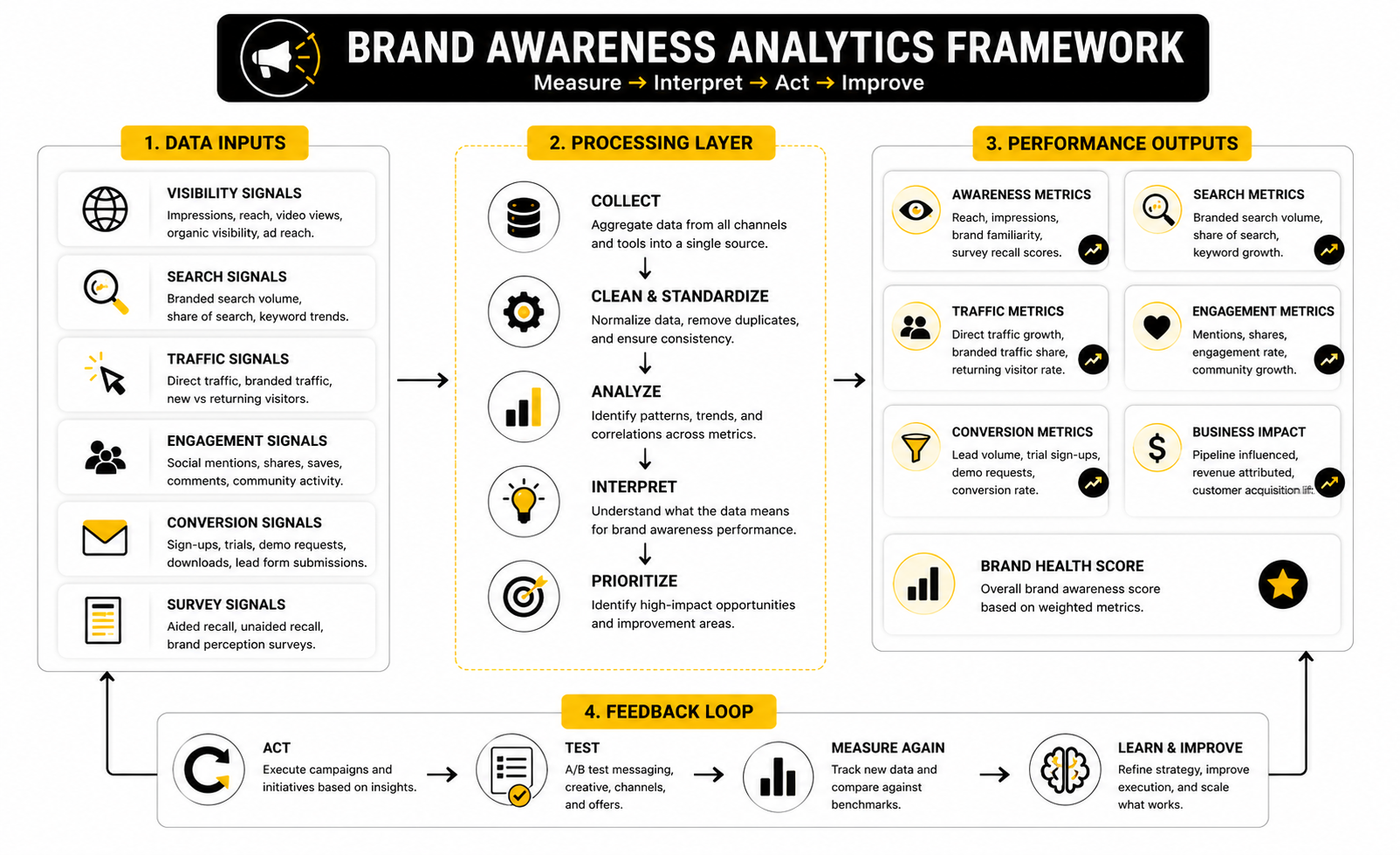
A smarter measurement system separates leading indicators from business outcomes. Leading indicators show whether awareness is moving. Business outcomes show whether that awareness is starting to create commercial advantage.
The Awareness Metrics That Actually Matter
The first group of metrics is reach and visibility. This includes impressions, video views, podcast listens, PR mentions, creator reach, search visibility, and social distribution. These numbers do not prove strong brand awareness by themselves, but they show whether enough people are being exposed to your brand in the first place.
The second group is memory and demand signals. This includes branded search volume, direct traffic, returning visitors, aided awareness, unaided awareness, share of search, and survey-based recall. These metrics matter more because they show whether people are actively remembering or looking for your brand instead of just scrolling past it.
The third group is commercial lift. This includes conversion rate changes, lower paid search dependency, improved close rates, shorter sales cycles, higher email opt-in rates, and more direct inquiries. These signals usually move later, but they are the reason brand awareness deserves budget in the first place.
How To Interpret Brand Awareness Benchmarks
Benchmarks are useful, but only if you treat them as context rather than commandments. A new niche SaaS brand should not compare its unaided awareness to a household consumer brand. A local agency should not panic because its search volume is lower than a national software company.
The better benchmark is your own baseline. Measure where you are today, run consistent activity for a defined period, then compare the movement. If branded search, direct traffic, social mentions, email subscribers, and recall surveys all improve together, you are probably building real awareness.
Industry benchmarks can still help you sense whether your results are healthy. Kantar’s BrandZ work has repeatedly shown that strong brands create financial advantage over time, and its 2024 report noted that the Top 100 most valuable global brands grew 20% in total value. That does not mean every brand will grow at that rate, but it reinforces the bigger point: brand strength is not a soft idea when it compounds into market value.
What The Data Should Make You Do
If reach is low, fix distribution. You may have a decent message, but not enough people are seeing it often enough. In that case, the answer might be better media buying, more consistent content, stronger partnerships, SEO expansion, creator collaborations, or repurposing one core idea across more formats.
If reach is strong but recall is weak, fix distinctiveness and positioning. People are seeing you, but they are not remembering you. That usually means your assets look generic, your message sounds like everyone else, or your brand is not tied clearly enough to a specific buying situation.
If awareness is rising but revenue is flat, fix the bridge between attention and action. That could mean weak offers, poor landing pages, unclear CTAs, slow follow-up, or a messy email system. Tools like ClickFunnels, Systeme.io, or GoHighLevel can help turn attention into a clearer journey, but only after the strategy is sharp.
A Simple Brand Awareness Dashboard
Keep the dashboard practical. Track a small set of metrics monthly so you can see patterns without drowning in reports. For most brands, a useful dashboard includes:
- Branded search volume
- Direct website traffic
- Returning visitor percentage
- Social reach and engagement quality
- Share of search or share of voice
- Email subscriber growth
- Aided and unaided awareness survey results
- Conversion rate from branded traffic
- Revenue influenced by direct, organic, referral, and returning audiences
The power is not in one metric. It is in the pattern across multiple signals. If more people search your name, visit directly, recognize your offer, engage with your content, and convert through branded journeys, your brand awareness is becoming commercially useful.
This is also why measurement needs patience. A campaign can drive clicks this week, but brand awareness usually becomes clearer across months. Measure consistently, look for directional movement, and use the data to decide what to repeat, what to sharpen, and what to stop.
Advanced Brand Awareness Strategy
Once the basics are working, brand awareness becomes a resource allocation problem. You have to decide how much attention goes into reach, how much goes into conversion, how much goes into retention, and how much goes into making the brand harder to copy. That is where the strategy gets more serious.
The goal is not to spend more for the sake of looking bigger. The goal is to build a brand that lowers friction across the entire customer journey. A stronger brand should make cold traffic warmer, make sales conversations easier, make referrals more natural, and make competitors feel less interchangeable.
This is also where leadership matters. If brand awareness is treated as a side project, it will get cut the moment performance metrics tighten. If it is treated as a growth asset, it becomes part of how the business protects margin, creates preference, and stays visible before buyers are ready.
Balance Brand And Performance Without Turning Them Into Enemies
Brand marketing and performance marketing should not fight each other. Performance captures demand that exists now, while brand awareness helps create and shape demand before the buyer is active. When one side dominates completely, the business usually becomes fragile.
If you only run performance campaigns, you may get fast feedback, but you can become dependent on paid traffic, rising ad costs, and buyers who already know what they want. If you only build brand, you may create attention without enough conversion infrastructure to turn it into pipeline or revenue. The best systems connect both.
The practical move is to design campaigns with two jobs. One job is to create a memory around the brand. The other is to give ready buyers a clear next step. That could be a demo, trial, newsletter, workshop, comparison page, lead magnet, or consultation depending on the business model.
Protect Distinctiveness As You Scale
Scaling often makes brands more generic. More people join the team, more channels get added, more campaigns go live, and suddenly the brand starts sounding like everyone else. This is dangerous because brand awareness depends on memory, and memory depends on consistency.
You need clear rules for what should stay recognizable. That includes your core message, visual assets, tone, offer structure, proof points, and the buying situations you want to own. Teams can still test hooks, formats, audiences, and creative angles, but the brand should not feel reinvented every time a new campaign launches.
This matters even more with AI-assisted content. AI can speed up production, but it can also flatten your voice if nobody owns the brand system. Use AI for drafts, research support, repurposing, and workflow speed, but keep human judgment in charge of positioning, taste, and final messaging.
Avoid The Awareness Trap
The awareness trap happens when a brand becomes visible without becoming useful, trusted, or chosen. You get impressions, views, and mentions, but the market still does not know why you matter. This feels good in reports and bad in revenue.
The fix is to connect every awareness campaign to a clear strategic association. Do you want to be remembered as the fastest option, the safest option, the premium option, the easiest option, the specialist option, or the category educator? Pick the association before you pick the campaign format.
This is why vague virality is risky. A funny post can bring attention, but if it does not strengthen the right memory, it may not help the business. Strong brand awareness is not just being seen. It is being seen in a way that makes future buying easier.
Build For Category Growth, Not Just Brand Mentions
A more advanced move is to educate the category, not just promote the brand. When buyers understand the problem better, they become more likely to value a solution. This is especially powerful in newer categories, complex services, and software markets where customers may not even know what to search for yet.
Educational content can expand demand by helping people name their problem. Tutorials, benchmarks, teardown content, checklists, workshops, and comparison pages all help buyers move from vague frustration to active evaluation. For example, a funnel platform can teach conversion strategy, while a CRM platform can teach lead follow-up systems.
This approach works because it earns attention before the buyer is ready to be sold. The brand becomes associated with clarity. When the customer finally decides to act, the company that helped them understand the problem often has a stronger position than the company that only appeared at the bottom of the funnel.
Know When To Narrow And When To Expand
Early brand awareness should usually be narrow. Pick a specific audience, a specific buying situation, and a specific promise. This gives your message a better chance of sticking because the market can understand what you are about.
As the brand grows, expansion becomes possible, but it should be deliberate. You can add new segments, new products, new channels, or new use cases only when the original memory is strong enough to carry the weight. Expanding too early creates confusion.
The test is simple. If your current market still cannot clearly explain what your brand does, do not add more complexity yet. Strengthen the core association first. A sharp brand can scale; a blurry brand usually just gets louder.
Turn Brand Awareness Into Operational Discipline
Brand awareness is not only a marketing task. Sales needs to repeat the same positioning. Product needs to deliver on the promise. Support needs to reinforce trust. Leadership needs to protect the brand from short-term decisions that damage long-term memory.
This is where operational discipline matters. Keep a shared messaging guide, define your distinctive assets, document your customer language, review campaigns against the brand strategy, and track awareness signals monthly. Simple systems beat scattered opinions.
As the company grows, this discipline becomes a competitive advantage. Competitors can copy your offer, mimic your ads, or undercut your price. It is much harder to copy the trust, memory, and market familiarity that come from consistent brand awareness built over time.
Brand Awareness FAQ And Final Action Plan
At this stage, brand awareness should feel less abstract. It is not just reach, not just content, not just paid ads, and not just logo recognition. It is the full system that helps the right people notice, remember, trust, and choose your brand when a buying situation appears.
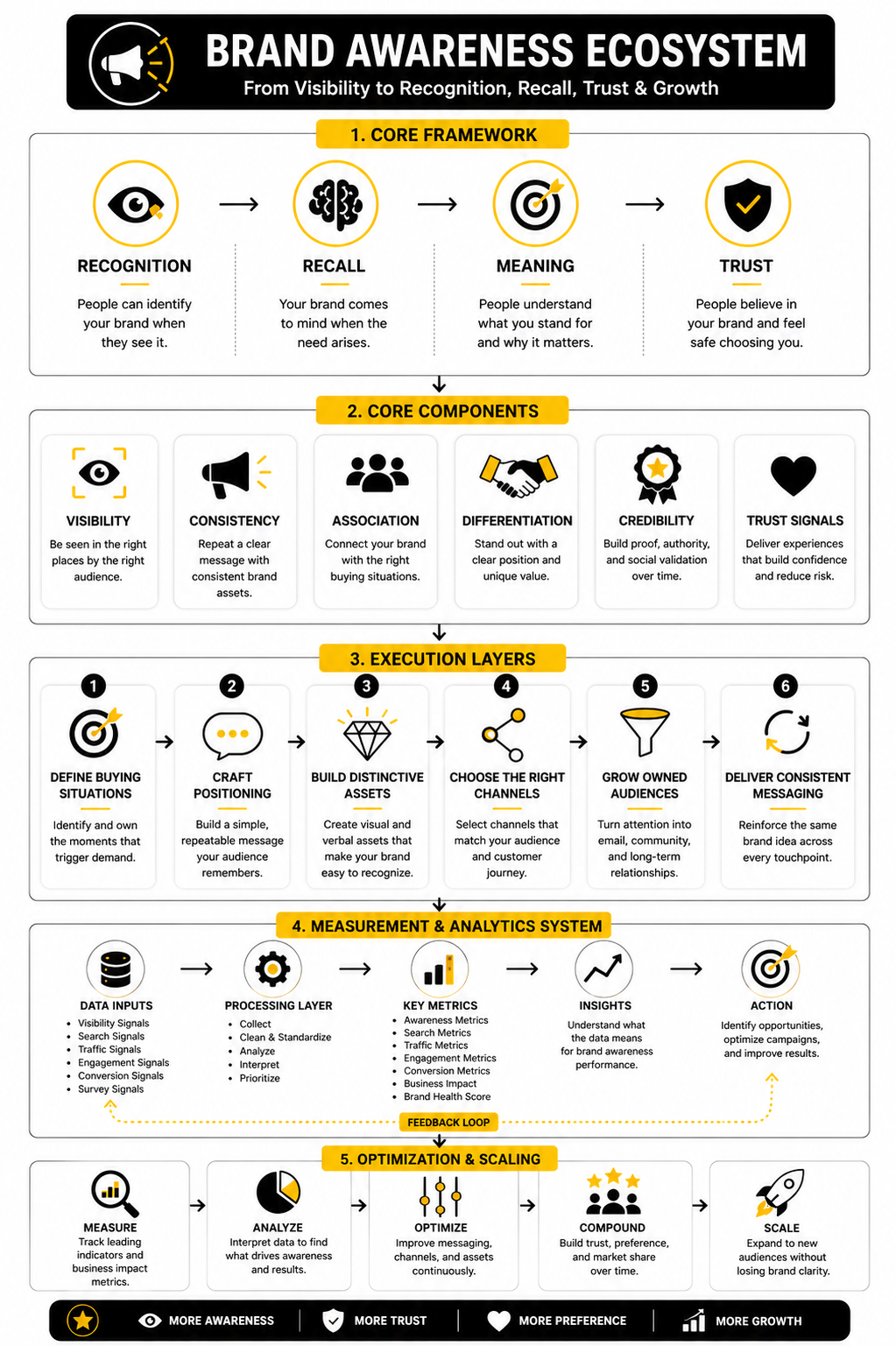
The final move is to turn the system into a repeatable operating rhythm. Pick the buying situations you want to own, sharpen the message, build distinctive assets, choose channels that match the customer journey, measure the right signals, and keep improving without constantly resetting the brand. That is how awareness becomes a business asset instead of a marketing buzzword.
FAQ - Built For Complete Guide
What Is Brand Awareness?
Brand awareness is the degree to which people recognize, remember, and understand your brand. It includes simple recognition, like knowing your name or logo, but it also includes deeper recall when someone thinks of your brand during a relevant buying situation. Strong brand awareness means the market connects your brand with a specific problem, category, or outcome.
Why Is Brand Awareness Important?
Brand awareness matters because buyers usually prefer brands that feel familiar, credible, and easy to understand. If people already know your brand before they need you, your sales and marketing have less resistance to overcome. It also helps performance campaigns work harder because your audience is not meeting you cold every time.
How Do You Measure Brand Awareness?
You measure brand awareness by tracking a mix of visibility, memory, and commercial signals. Useful metrics include branded search volume, direct traffic, returning visitors, social mentions, share of search, survey-based recall, and conversion rates from branded traffic. No single number tells the full story, so look for patterns across several metrics.
What Is The Difference Between Brand Awareness And Brand Recognition?
Brand recognition means someone can identify your brand when they see it. Brand awareness is broader because it includes recognition, recall, meaning, trust, and category association. Recognition is useful, but recall is often more valuable because it means your brand comes to mind without a direct prompt.
How Long Does It Take To Build Brand Awareness?
Brand awareness usually takes months, not days. You can create short-term spikes with ads, PR, or viral content, but durable awareness comes from consistent exposure and repeated brand associations. The more specific your audience and message are, the faster the early momentum usually becomes visible.
What Are The Best Channels For Brand Awareness?
The best channels depend on where your audience pays attention and how they evaluate solutions. Search, social content, paid media, newsletters, partnerships, podcasts, creator campaigns, webinars, and community activity can all work. The right channel is the one that repeatedly reaches the right people and strengthens the same brand memory.
Can Small Businesses Build Brand Awareness Without A Huge Budget?
Yes, but they need focus. A small business should not try to copy enterprise brand campaigns. It should choose a tight audience, repeat a clear message, build trust through useful content, and show up consistently in the few channels where its customers already spend time.
What Is A Good Brand Awareness Strategy?
A good brand awareness strategy defines who you want to reach, what you want to be remembered for, which buying situations matter most, which distinctive assets will make you recognizable, and how you will measure progress. It should connect awareness to business outcomes instead of treating it as a separate creative project. The best strategy is simple enough for the whole team to repeat.
How Does Brand Awareness Affect Sales?
Brand awareness affects sales by making buyers more familiar with your brand before they compare options. That can improve trust, increase branded search, lift conversion rates, and make sales conversations easier. It does not replace a strong offer, but it makes the offer easier to believe.
What Is The Biggest Mistake Brands Make With Awareness?
The biggest mistake is chasing attention without building memory. Views, impressions, and mentions can look impressive, but they do not automatically mean people understand or trust the brand. Awareness only becomes valuable when the audience connects your brand with a clear, relevant reason to choose you.
Should Brand Awareness Campaigns Have A CTA?
Yes, but the CTA should match the audience’s stage of awareness. A cold audience may respond better to a guide, checklist, newsletter, webinar, or helpful comparison than a hard sales pitch. Ready buyers still need a clear path to book, buy, trial, or request more information.
How Do You Improve Brand Awareness Over Time?
Improve brand awareness by repeating a sharper message, using distinctive assets consistently, expanding distribution, creating useful category education, and measuring memory signals monthly. Do not change everything at once when results feel slow. Improve the system, keep what is working, and remove the parts that do not strengthen recall or trust.
Work With Professionals
Explore 10K+ Remote Marketing Contracts on MarkeWork.com
Most marketers spend too much time chasing clients, competing on crowded platforms, and losing a percentage of every project to middlemen.
MarkeWork gives you a better way. Browse thousands of remote marketing contracts and connect directly with companies desperate to hire skilled marketers like you, without platform commissions and without unnecessary gatekeepers.
If you're serious about finding better opportunities and keeping 100% of what you earn, explore available contracts and create a profile for free at MarkeWork.com.