

Brand marketing is the work of making a business recognizable, trusted, and easy to choose before the buyer is ready to buy. It shapes what people think, feel, and expect when they see your name, product, content, ads, packaging, founder, or offer. Good brand marketing does not replace performance marketing; it makes performance marketing work harder because people already understand why you matter.
This matters more now because buyers are cautious, crowded with options, and harder to persuade with one-off campaigns. Brand trust has become a serious purchase factor, with Edelman’s 2025 research showing that trust now competes directly with price and quality in brand choice: trust is now a competitive advantage. That means the brands that win are not always the loudest; they are the ones people recognize, believe, and remember at the moment of decision.

Article Outline
- Why Brand Marketing Matters
- The Brand Marketing Framework
- Core Components of a Strong Brand
- Professional Implementation
- Measurement, Optimization, and Common Mistakes
- Brand Marketing FAQ and Final Takeaways
Why Brand Marketing Matters
Brand marketing matters because most buyers do not make decisions the first time they discover you. They notice, compare, ignore, come back, ask someone, read reviews, and then decide when the timing feels right. If your brand has no clear position in their mind, you become just another option fighting on price.
Strong brands create memory, and memory lowers friction. Kantar’s BrandZ research shows that the world’s top 100 most valuable brands grew their total value by 20% in 2024, based on millions of consumer interviews across thousands of brands: Kantar BrandZ global brand valuation. That is not just a vanity signal; it shows how brand strength becomes a business asset.
The practical point is simple: people buy what they understand, remember, and trust. Performance campaigns can capture demand, but brand marketing creates the conditions that make demand easier to capture. When the market gets noisy, your brand becomes the shortcut.
The Brand Marketing Framework
Brand marketing works best when it has a structure instead of a pile of random messages. The framework starts with positioning, moves into identity and messaging, then turns into consistent market presence across content, channels, customer experience, and community. Each layer should make the next layer clearer.
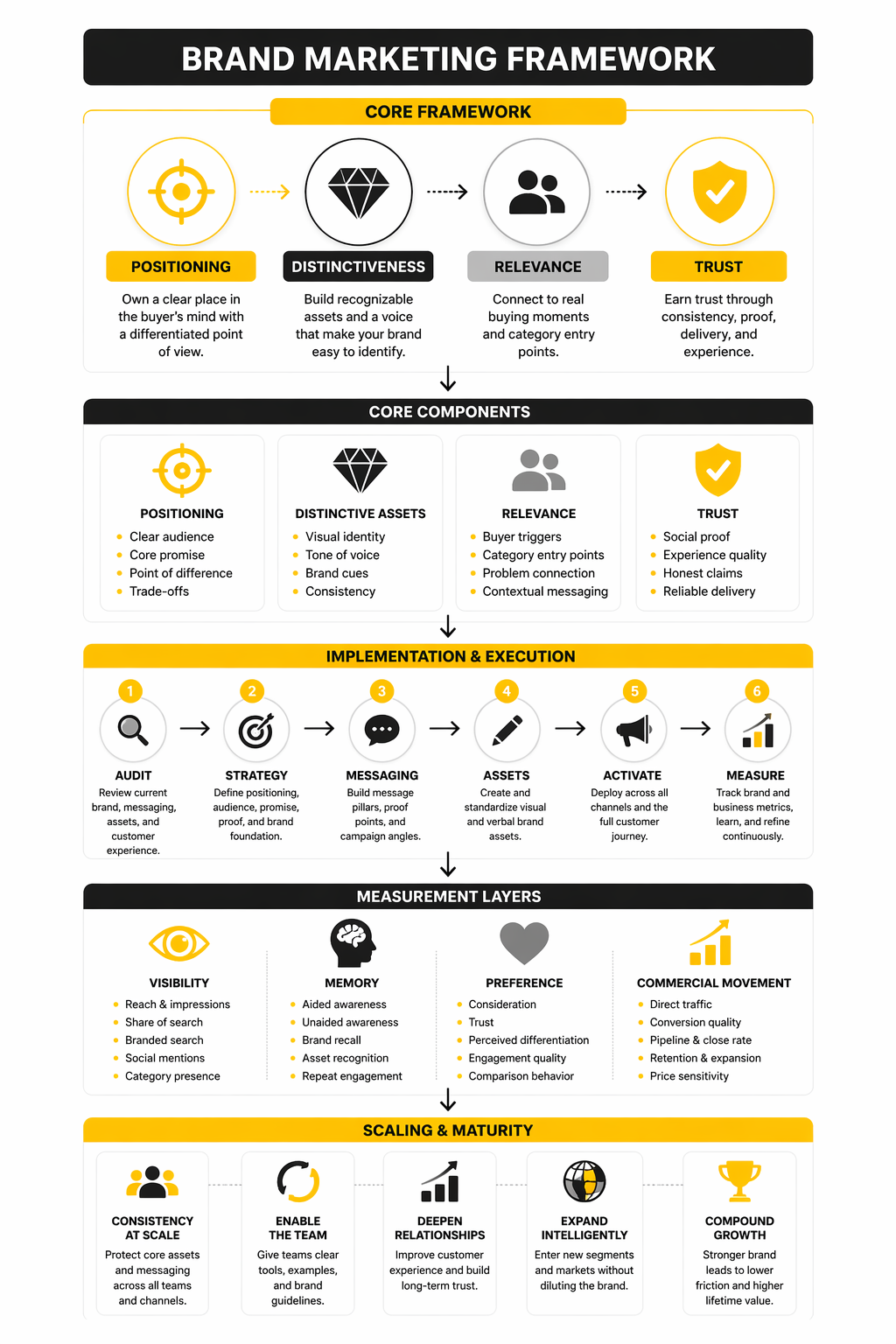
The goal is not to sound impressive; the goal is to become distinct and useful in the buyer’s mind. Nielsen’s 2025 marketing research highlights the pressure marketers face to balance brand building with measurable performance: 2025 Annual Marketing Report. That balance is where serious brand marketing lives.
A useful brand marketing framework answers four questions. Who are we for? Why should they care? What should they remember? Where will we show up consistently? Without those answers, marketing becomes activity instead of strategy.
Core Components of a Strong Brand
A strong brand starts with positioning. Positioning is the clear place you want to own in the buyer’s mind, not a slogan you paste on a homepage. If people cannot explain who you help, what you help them achieve, and why you are different, your brand marketing has no stable foundation.
The next component is distinctiveness. This includes your name, visual identity, tone of voice, product experience, content style, and the recurring assets people associate with you. Ehrenberg-Bass research defines mental availability as the probability that a buyer will notice, recognize, or think of a brand in buying situations, which is why distinctive brand assets matter so much for long-term growth: mental availability depends on memory structures.
The third component is relevance. A brand can be recognizable and still fail if it does not connect to real buying situations. This is where category entry points become useful: the moments, needs, problems, or occasions that make someone think, “I need a solution like this.” Your brand marketing should link your brand to those moments again and again until the connection feels natural.
The fourth component is trust. Trust comes from consistency, proof, delivery, and the absence of unpleasant surprises. Edelman’s 2025 research shows that brand trust now plays a direct role in whether people buy, advocate, stay loyal, and accept innovation from a company: trust has become central to brand action.
Positioning Comes Before Promotion
Many businesses skip positioning because promotion feels more urgent. They want more posts, more ads, more funnels, more emails, and more launches. But if the market does not understand what the brand stands for, more promotion simply spreads confusion faster.
Good positioning should make trade-offs. You cannot be the premium expert, cheapest option, easiest tool, most advanced platform, and friendliest brand all at once. Strong brand marketing chooses the most valuable perception to build and then reinforces it everywhere.
This also makes creative work easier. When positioning is clear, content has a spine, campaigns have a point of view, and offers feel connected instead of random. Without positioning, every marketing decision becomes a debate about personal taste.
Distinctive Assets Make the Brand Easier to Remember
Distinctive assets are the cues people use to recognize you quickly. They can be visual, verbal, auditory, or behavioral. A color system, phrase, mascot, product layout, founder style, packaging shape, or repeated content format can all become useful if the market consistently connects it with your brand.
The mistake is changing everything too often. Many teams refresh their identity before the market has had enough time to remember the old one. Brand marketing rewards consistency because memory takes repetition.
That does not mean your brand should become boring. It means your creative should vary the message while protecting the recognizable signals. Change the campaign, not the entire identity every quarter.
Relevance Connects the Brand to Real Buying Moments
Relevance is not about talking about yourself louder. It is about showing up in the situations where the buyer’s problem becomes active. A project management brand might connect itself to missed deadlines, messy approvals, remote collaboration, or leadership reporting. A coaching brand might connect itself to stalled revenue, unclear positioning, inconsistent content, or weak sales calls.
This is where brand marketing becomes practical. You are not just building “awareness” in a vague sense. You are building associations between your brand and the moments that create demand.
The best way to find those moments is to listen to customers before they become customers. Look at sales calls, reviews, search behavior, community questions, support tickets, and objections. The language is already there; your job is to organize it into a brand system people can remember.
Trust Turns Attention Into Preference
Attention is fragile. Trust is what gives attention commercial value. A brand can go viral and still lose the sale if people do not believe the promise, understand the proof, or feel safe taking the next step.
Trust is built through visible competence. Clear offers, honest claims, real customer proof, transparent pricing, reliable delivery, and useful content all contribute. Even small things matter because buyers read inconsistency as risk.
This is also why the customer experience belongs inside brand marketing. Your ads can promise simplicity, but if onboarding is confusing, the brand becomes confusing. Your content can promise expertise, but if your sales process feels sloppy, the brand feels sloppy.
Professional Implementation
Professional brand marketing starts by turning strategy into operating rhythm. This is where most teams struggle, because they understand the brand in a workshop but fail to translate it into weekly decisions. The brand cannot live in a slide deck; it has to show up in campaigns, sales conversations, onboarding, emails, product pages, support replies, and leadership communication.
A serious implementation process also needs ownership. Someone has to protect the positioning, someone has to manage creative consistency, someone has to connect customer insight to messaging, and someone has to measure whether the brand is becoming easier to recognize and choose. Without ownership, brand marketing becomes everyone’s opinion and nobody’s responsibility.
The pressure to prove value is real, especially when budgets are tight. Gartner’s 2025 CMO Spend Survey found that marketing budgets stayed flat at 7.7% of overall company revenue, which means teams cannot afford vague brand activity. The work has to be disciplined enough to guide execution and practical enough to survive real business constraints.
Build the Brand System Before You Build More Campaigns
Before launching another campaign, define the system that every campaign should follow. This includes your positioning statement, audience segments, buyer triggers, proof points, tone of voice, visual rules, message hierarchy, and the few distinctive assets you will repeat consistently. The system does not need to be complicated, but it does need to be specific.
A good brand system helps teams make decisions faster. Designers know what should stay recognizable, writers know which claims matter most, sales teams know how to explain the difference, and leaders know what the company should stop saying. That clarity is a massive advantage because scattered execution is expensive.
This is also where many founders and marketers need to be honest. If every campaign sounds different, every landing page has a different promise, and every social post chases a different trend, the market will not connect the dots for you. You have to do that work first.
Turn Strategy Into a Repeatable Execution Process
The easiest way to make brand marketing practical is to use a repeatable process. Start with research, define the brand strategy, translate it into assets, activate it through channels, measure what changed, and refine without destroying what people are starting to remember. That loop keeps the brand alive without turning every quarter into a rebrand.
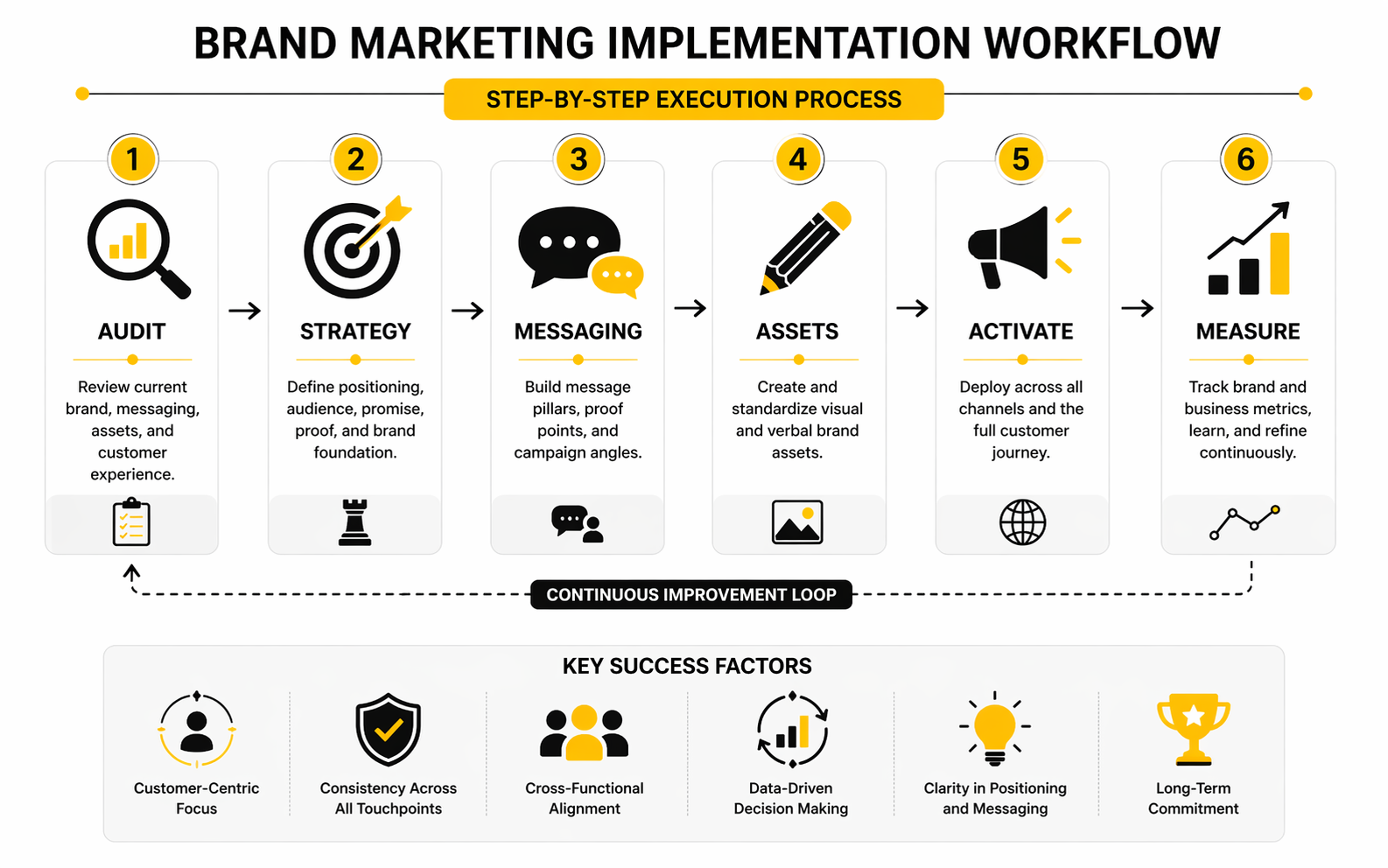
A practical execution process looks like this:
- Audit the current brand
Review the website, ads, emails, social content, sales materials, customer reviews, and onboarding experience. Look for mixed promises, weak proof, inconsistent visuals, vague language, and moments where the customer experience contradicts the message. The goal is not to criticize the team; the goal is to find the gaps that make the brand harder to trust.
- Define the strategic foundation
Clarify the audience, category, point of difference, primary promise, emotional payoff, and reasons to believe. This foundation should be written in plain language, not agency jargon. If a salesperson, designer, founder, and support rep cannot use it, it is not finished.
- Create the messaging system
Build message pillars, proof points, objection responses, campaign angles, and reusable language for key buying moments. This gives your content and campaigns a consistent spine without making everything sound identical. Strong messaging gives people different doors into the same brand idea.
- Standardize the brand assets
Document the visual and verbal cues that must stay consistent across channels. This can include logo usage, colors, typography, content formats, naming patterns, founder voice, product screenshots, social templates, and offer language. Consistency is not about control for its own sake; it is about making recognition easier.
- Activate across the full customer journey
Apply the brand to awareness content, comparison pages, email nurture, sales decks, demos, onboarding, retention campaigns, and customer success. Brand marketing gets stronger when every touchpoint reinforces the same core meaning. If the promise only appears in ads, it is not a brand yet.
- Measure, learn, and refine
Track whether people recognize the brand, understand the difference, remember the promise, engage with the content, search for the name, and convert with less friction over time. Nielsen’s 2025 marketing report emphasizes the need to balance brand building and performance measurement in a fragmented media environment: marketers need holistic measurement. The point is not to measure everything; it is to measure the signals that show whether the brand is becoming stronger.
Choose Channels Based on the Job They Need to Do
Not every channel should do the same job. Some channels create reach, some build authority, some capture demand, some nurture trust, and some help customers feel connected after purchase. Brand marketing becomes sharper when each channel has a clear role.
For example, social content can make the brand more familiar, but email can deepen the relationship. Search can capture active demand, while founder-led content can build credibility before the buyer is ready. A landing page builder like Replo can support brand-consistent ecommerce pages, while a platform like GoHighLevel can help agencies connect campaigns, CRM, automation, and follow-up in one operating system.
The key is to avoid chasing channels just because they are popular. Start with the buying journey, then assign each channel a job. When every channel has a role, the brand feels coordinated instead of scattered.
Make the Brand Easy for the Team to Use
A brand system only works if people actually use it. Long brand books often fail because they look polished but do not help someone write a better email, design a better page, record a better video, or handle a sales objection. Practical brand marketing needs usable tools.
Create a simple internal brand kit with examples. Include approved claims, banned phrases, positioning language, content angles, visual references, customer proof, and before-and-after examples of weak versus strong messaging. The more concrete it is, the less people have to guess.
This matters because execution quality compounds. One strong campaign helps, but one hundred consistent touchpoints build memory and trust. That is where brand marketing starts to feel less like a campaign and more like a business advantage.
Statistics and Data
Brand marketing measurement should not be treated like a hunt for one magic number. A brand is built through repeated exposure, memory, trust, preference, and experience, so the data has to show movement across those layers. The goal is to understand whether the market is becoming more familiar with you, more likely to consider you, and more willing to choose you when the buying moment arrives.
That matters because brand activity is often judged too narrowly. If a campaign does not create immediate conversions, weak teams call it a failure. Strong teams ask better questions: did branded search rise, did direct traffic improve, did sales conversations get easier, did conversion rates lift after repeat exposure, and did the audience start using the brand’s own language back to the company?
Budgets make this discipline even more important. Gartner’s 2025 CMO Spend Survey found that marketing budgets stayed flat at 7.7% of overall company revenue, which means brand marketing has to be connected to measurable business signals. Not because every brand action should be squeezed into last-click attribution, but because serious marketers need evidence that the brand is getting stronger.
What Brand Marketing Metrics Should Actually Measure
The cleanest way to measure brand marketing is to separate leading indicators from business outcomes. Leading indicators tell you whether the market is noticing, remembering, and engaging with the brand. Business outcomes tell you whether that improved perception is helping revenue, retention, pricing power, or sales efficiency.
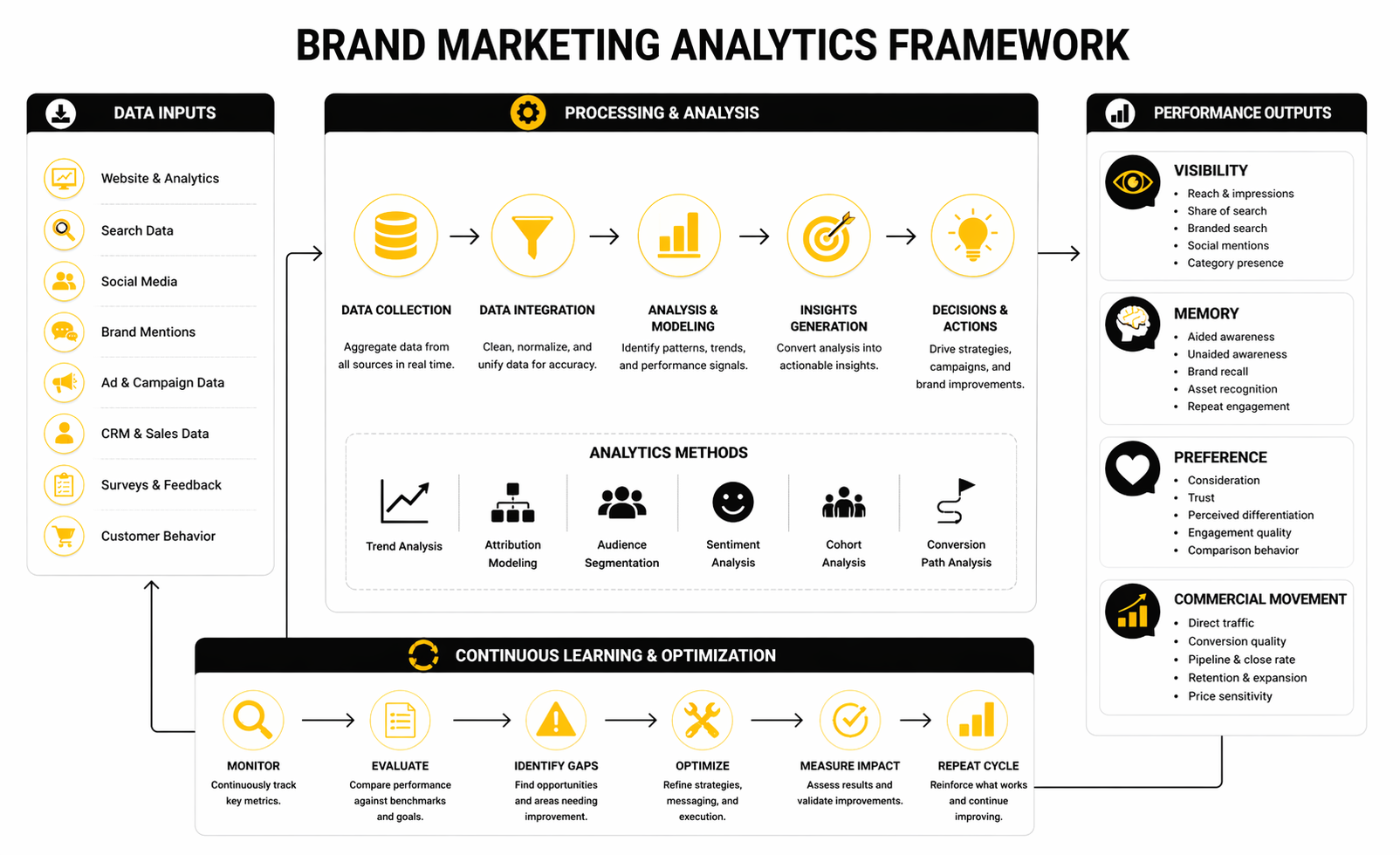
A practical analytics system should include four layers:
- Visibility
Track reach, impressions, share of search, branded search volume, social mentions, PR visibility, and category presence. These numbers show whether the brand is entering more buying conversations. They do not prove business impact on their own, but they reveal whether the market has enough exposure to remember you.
- Memory
Track aided awareness, unaided awareness, brand recall, distinctive asset recognition, and repeat engagement. These metrics show whether people can connect your brand to the category and buying situation. This is where brand marketing starts becoming an asset instead of just media spend.
- Preference
Track consideration, trust, perceived differentiation, review quality, demo intent, email replies, comparison page behavior, and sales-qualified demand. These signals show whether recognition is turning into commercial preference. A brand that is known but not preferred still has a positioning problem.
- Commercial movement
Track direct traffic, branded conversion rate, pipeline quality, close rate, customer acquisition cost, retention, expansion, and price sensitivity. These are the numbers leadership cares about most. They should be read together with brand signals, not used as a blunt replacement for them.
Benchmarks Are Useful, but Trends Matter More
Benchmarks can help you spot whether something is unusually weak, but they should not become the strategy. A small B2B company, a creator-led business, a local service brand, and a global consumer brand will not have the same awareness curve. Comparing them directly creates bad decisions.
What matters more is directional movement. If branded search is growing, direct traffic is improving, conversion from returning visitors is higher, and sales calls include more prospects who already understand the offer, the brand is doing work. Those signals may not all appear in the same week, but together they show whether brand marketing is reducing friction.
Nielsen’s 2025 marketing research shows why this balance matters. Marketers in North America and Asia-Pacific are weighing brand awareness almost evenly against revenue growth, while European marketers prioritize revenue growth more heavily, with 59% naming revenue growth as the top priority compared with 37% for brand awareness. That split is a useful reminder: measurement has to connect brand and revenue, not force teams to choose one side blindly.
How to Interpret Brand Data Without Fooling Yourself
Brand data becomes dangerous when teams interpret it in isolation. A spike in impressions can mean the campaign reached more people, but it does not mean the right people understood the message. A drop in cost per click can look efficient while the brand becomes less differentiated. A viral post can create noise without improving trust.
The better approach is to look for patterns across multiple signals. If awareness rises but consideration stays flat, the brand may be visible but not compelling. If traffic rises but conversion falls, the message may be attracting the wrong audience. If sales cycles shorten after a brand campaign, the campaign may be improving pre-sell education even if attribution software undercounts it.
This is where qualitative data matters. Sales call notes, customer interviews, review themes, support questions, and social comments help explain what the numbers cannot. Brand marketing is partly about meaning, and meaning does not always show up cleanly in a dashboard.
The Metrics That Should Drive Action
Metrics are only useful when they change decisions. If awareness is low, the action is more reach, sharper distinctive assets, and clearer category linkage. If awareness is healthy but consideration is weak, the action is stronger positioning, better proof, and more relevant messaging.
If consideration is strong but conversion is weak, the issue may be offer clarity, pricing, sales process, landing page experience, or trust gaps. Tools like ClickFunnels or Systeme.io can help structure funnels and follow-up, but the tool will not fix a weak brand promise. The strategy still has to come first.
If conversion is strong but retention is weak, the brand may be overpromising or attracting customers who are not a fit. That is not just a customer success issue. It is a brand marketing issue because the promise people buy should match the experience they receive.
Strategic Tradeoffs in Brand Marketing
The hardest part of brand marketing is not knowing that brand matters. The hard part is deciding what you will not do. A focused brand requires tradeoffs, and those tradeoffs often feel uncomfortable because they force the business to stop chasing every audience, every trend, every channel, and every possible message.
The first tradeoff is reach versus relevance. Broad reach helps more people notice the brand, but relevance makes the message feel worth remembering. If you go too broad too early, you waste attention. If you go too narrow for too long, you may build a respected niche brand that never becomes a bigger market choice.
The second tradeoff is consistency versus freshness. Consistency builds recognition, but freshness keeps the brand alive. The mistake is treating every campaign like a new identity. Strong brands keep the same core meaning while finding new ways to express it.
Brand Building and Demand Capture Need Different Jobs
Brand building and demand capture should work together, but they should not be judged by the same short-term lens. Brand building creates memory, trust, and future preference. Demand capture converts people who are already closer to buying.
The IPA’s effectiveness research has long argued for a broad balance between brand building and activation, and its updated guidance still points to investing just over 60% into brand building and just under 40% into activation. That does not mean every company should copy the ratio blindly. It means you need both engines, because short-term capture without long-term brand demand eventually becomes expensive.
This is where many businesses quietly create their own ceiling. They keep optimizing bottom-of-funnel campaigns while the pool of warm demand stays the same size. Then costs rise, creative gets tired, and the team blames the channel instead of the missing brand work.
The Risk of Over-Optimization
Over-optimization looks smart in dashboards and dangerous in the market. A team keeps testing hooks, thumbnails, subject lines, discounts, and landing page tweaks until every asset becomes a short-term conversion device. The numbers may improve for a while, but the brand slowly becomes less distinctive.
This is especially risky when algorithms reward immediate reaction. The content that gets clicks today is not always the content that builds trust tomorrow. Brand marketing requires enough discipline to ask whether a tactic attracts attention in a way that strengthens the brand or weakens it.
There is nothing wrong with testing. The problem starts when testing removes the brand’s point of view. If every winning variation makes the company sound more generic, the team is not optimizing; it is sanding off the edge that made the brand worth choosing.
Scaling Without Losing the Brand
Scaling creates a new problem: more people create more touchpoints, and more touchpoints create more chances for inconsistency. The founder is no longer writing every post. The same person is not reviewing every ad, page, email, sales deck, onboarding sequence, and support script.
This is why brand governance matters. Not corporate bureaucracy, but simple rules that help the brand travel across the company without getting diluted. A practical brand system should make it easier for teams to move fast while still protecting what the market is starting to remember.
As the company grows, the brand also needs more customer feedback loops. What people believe about the brand may shift as new segments, markets, and use cases appear. The job is to evolve the expression without abandoning the strategic core.
Category Leadership Requires Point of View
A brand that wants to lead a category needs more than nice design and consistent messaging. It needs a point of view. People should be able to tell what you believe about the problem, the market, the customer, and the better way forward.
This does not mean manufacturing controversy. It means taking a clear stance that helps the right audience make sense of their world. Kantar’s 2025 BrandZ ranking shows the Top 100 most valuable global brands reaching a record $10.7 trillion in total brand value, which reinforces a simple truth: strong brands are not just known, they carry meaning at scale.
A useful point of view gives your content more weight. It turns posts into a consistent argument, campaigns into chapters of the same story, and product updates into proof of the brand’s direction. Without that point of view, marketing becomes a calendar full of disconnected announcements.
When to Refresh the Brand
A brand refresh should solve a strategic problem, not satisfy internal boredom. If the audience has changed, the offer has matured, the category has shifted, or the current identity no longer reflects the business, a refresh may be useful. If the team is simply tired of the colors, the risk is usually higher than the reward.
The danger is losing valuable memory. People may only be starting to recognize your assets when the team decides to replace them. That is why refreshes should protect the strongest distinctive elements unless there is a clear reason to change them.
A good refresh sharpens the brand rather than erasing it. It keeps what still carries recognition, removes what creates confusion, and updates what no longer supports the strategy. Done well, it makes the brand easier to understand. Done badly, it makes the market start over.
Advanced Brand Marketing Mistakes to Avoid
The first mistake is confusing polish with strength. A brand can look premium and still have no clear position. Design matters, but design cannot rescue a vague promise.
The second mistake is building the brand only around the company’s preferred self-image. Customers do not care how you want to describe yourself unless it helps them make a better decision. The brand has to connect internal ambition with external relevance.
The third mistake is separating brand from operations. If marketing promises speed but delivery is slow, the brand becomes less trustworthy. If the website promises simplicity but the product experience is confusing, the brand becomes less believable. Brand marketing is not just what you say; it is what the business repeatedly proves.
Final Takeaways
Brand marketing becomes powerful when it works as a complete ecosystem. The strategy defines what the brand should mean, the assets make it easier to recognize, the channels create repeated exposure, the customer experience proves the promise, and the measurement system shows whether the market is moving closer to trust and preference. When those pieces work together, the brand stops being decoration and starts becoming a growth asset.
The big lesson is simple: do not treat brand as something separate from revenue. Nielsen’s 2025 research frames revenue growth and brand awareness as connected priorities, not opposing goals, with marketers balancing both depending on region and business pressure: revenue growth and brand awareness are two sides of the same coin. That is the mindset serious teams need.
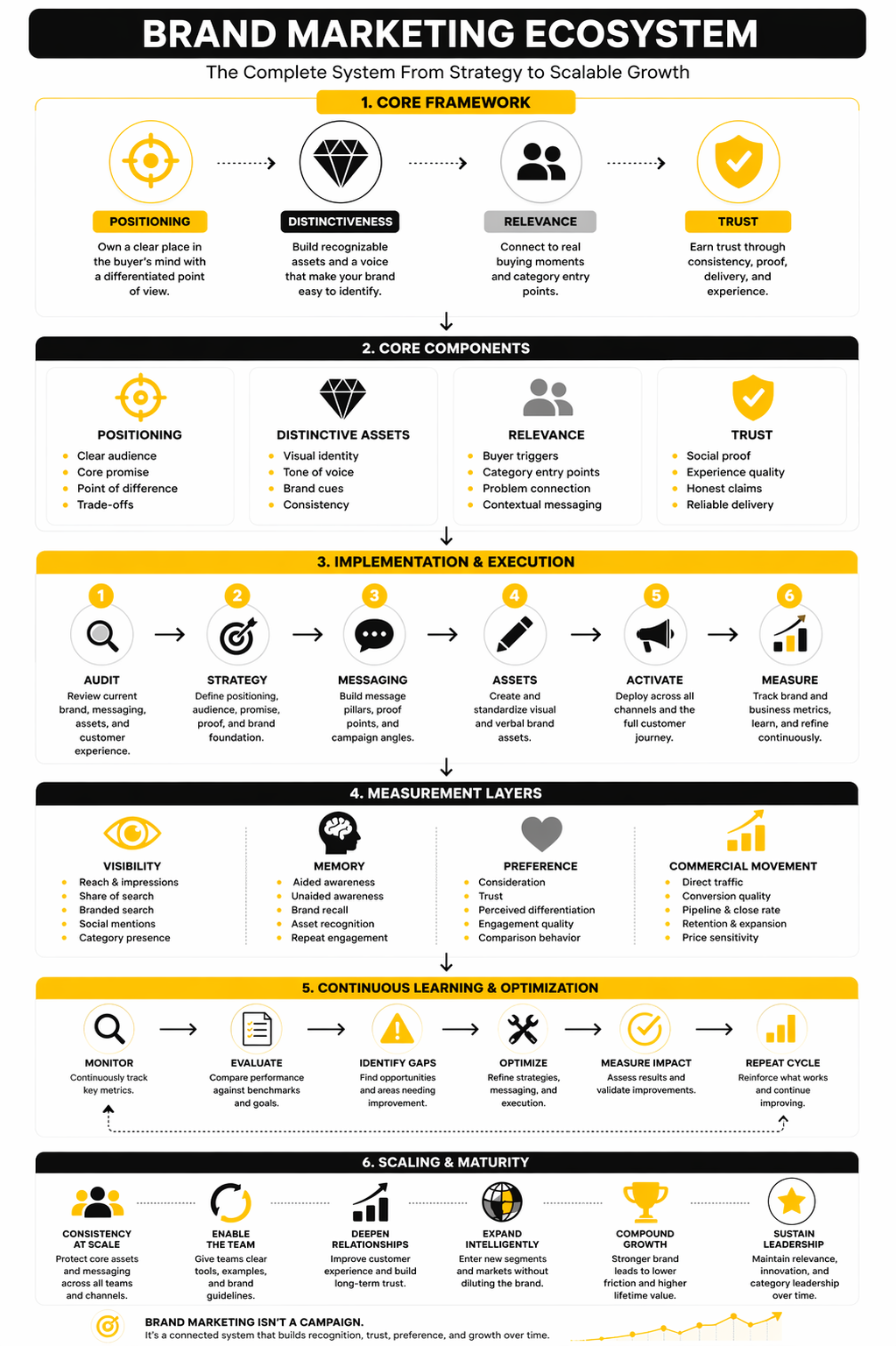
Brand marketing is not about sounding bigger than you are. It is about becoming easier to understand, easier to remember, easier to trust, and easier to choose. Build that system patiently, protect the signals that make you recognizable, and keep improving the customer experience until the brand promise feels true from first impression to long-term relationship.
FAQ - Built for Complete Guide
What is brand marketing?
Brand marketing is the process of shaping how people recognize, understand, trust, and remember a business. It includes positioning, messaging, identity, content, customer experience, and repeated market presence. The goal is to make the brand easier to choose before the buyer is ready to buy.
Why is brand marketing important?
Brand marketing matters because most buyers do not purchase immediately after discovering a company. They need repeated signals that help them understand what the brand stands for and why it is worth trusting. Strong brand marketing reduces confusion, builds preference, and makes performance marketing more efficient.
How is brand marketing different from performance marketing?
Brand marketing builds memory, trust, and future demand. Performance marketing captures demand that already exists or is close to conversion. The strongest companies use both because short-term sales activity works better when the brand is already known and trusted.
What are the main components of brand marketing?
The main components are positioning, audience understanding, distinctive brand assets, messaging, proof, channel strategy, customer experience, and measurement. Each part should reinforce the same core meaning. If these pieces are disconnected, the market receives mixed signals.
How long does brand marketing take to work?
Brand marketing usually compounds over months and years, not days. Some signals, such as engagement or branded search, may move faster, but trust and memory take repetition. The point is to build a system that keeps creating recognition and preference over time.
What should a brand marketing strategy include?
A brand marketing strategy should include the target audience, category position, core promise, reasons to believe, brand voice, visual identity, key buying moments, channel roles, and measurement plan. It should also define what the brand will not say or do. Clear tradeoffs make the strategy usable.
How do you measure brand marketing?
Measure brand marketing through visibility, memory, preference, and commercial movement. Useful signals include branded search, direct traffic, awareness, recall, consideration, trust, conversion quality, close rate, retention, and customer feedback. No single metric tells the full story, so look for patterns across the system.
Can small businesses use brand marketing?
Yes, and small businesses often need it more than they realize. A smaller company may not have a massive media budget, but it can still own a clear position, repeat recognizable assets, publish useful content, and deliver a consistent customer experience. Brand marketing is not reserved for global companies.
What is the biggest mistake in brand marketing?
The biggest mistake is inconsistency. When every campaign, page, email, and sales conversation says something different, the market cannot remember the brand clearly. Consistency does not mean being boring; it means repeating the right signals long enough for people to connect them with you.
Should brand marketing use storytelling?
Brand marketing can use storytelling, but only when the story is real, relevant, and useful to the buyer. Fake origin stories, exaggerated case studies, and vague emotional content weaken trust. A strong story should clarify the brand’s point of view and make the promise easier to believe.
How often should a brand be refreshed?
A brand should be refreshed when the business, audience, category, or offer has changed enough that the current brand no longer fits. It should not be refreshed just because the team is bored. A smart refresh protects valuable recognition while making the brand clearer and more relevant.
What tools help with brand marketing execution?
Tools can help with publishing, automation, landing pages, email, analytics, and customer follow-up, but they cannot replace strategy. A platform like Buffer can support consistent social scheduling, while Brevo can support email communication and customer journeys. The real advantage comes from using tools to reinforce a clear brand system.
Work With Professionals
Explore 10K+ Remote Marketing Contracts on MarkeWork.com
Most marketers spend too much time chasing clients, competing on crowded platforms, and losing a percentage of every project to middlemen.
MarkeWork gives you a better way. Browse thousands of remote marketing contracts and connect directly with companies desperate to hire skilled marketers like you, without platform commissions and without unnecessary gatekeepers.
If you're serious about finding better opportunities and keeping 100% of what you earn, explore available contracts and create a profile for free at MarkeWork.com.