

https://chatgpt.com/backend-api/estuary/content?id=file_0000000017d8720aadd2732f040f666d&ts=493365&p=fs&cid=1&sig=603bee734496de32477a5cca47e671d81e797edada49e4bc857b390289a88eca&v=0
Build Your Target Account List Like a Revenue Team, Not a Media Team
This is where a lot of ABM marketing programs quietly fall apart. Teams say they are focused on “high-value accounts,” but what they really have is a broad wish list, a handful of firmographic filters, and too many names for sales to pursue properly. The best programs tighten the list fast, because account-based teams that align with sales around strategically chosen account cohorts and buying groups consistently outperform teams that stay stuck in lead-centric thinking, as shown in the 2024 benchmark from 6sense.
A strong target account list starts with business reality. That means looking at closed-won customers, retention patterns, expansion potential, deal velocity, sales cycle length, and margin quality before you start layering in intent or ad targeting. It sounds obvious, but it is easy to chase logos that look impressive and ignore the accounts your business is actually built to win.
The buying environment makes this even more important. Forrester’s 2024 business buying research found that 86% of B2B purchases stall, while the average purchase involves 13 people and 89% of purchases involve two or more departments. In other words, ABM marketing is not just about finding one perfect contact. It is about choosing accounts where your company can realistically help a messy group make a decision.
Define Tiering Before You Create Campaigns
Most companies want personalization at a one-to-one level for far too many accounts. That is how teams burn budget, create operational chaos, and disappoint sales at the same time. A cleaner approach is to decide your tiers first and let that drive the level of effort, not the other way around.
A practical structure looks like this:
- Tier 1: a very small list of strategic accounts that deserve deep research, custom messaging, sales leadership involvement, and account-specific plays
- Tier 2: a larger group of strong-fit accounts that can be grouped by industry, problem, or buying trigger
- Tier 3: a broader set of good-fit accounts that get lighter personalization, paid reach, and automated nurture
This matters because ABM marketing is really a resource allocation strategy. You are deciding where to spend human time, not just ad money. When the tiering is clear, content, SDR outreach, paid media, direct mail, executive involvement, and measurement all become easier to prioritize.
Use Signals, But Do Not Worship Signals
Intent data is useful. It is not magic. A spike in research activity can help you spot movement inside an account, but it does not replace fit, timing, budget reality, or political complexity inside the buying group.
That is one reason the stronger teams collect more buying signals and track group activity rather than obsessing over a single lead score, a pattern highlighted in the 6sense benchmark. The trap is thinking every signal should trigger the same response. One account might need executive outreach because it matches your expansion strategy, while another should stay in nurture because the fit is weak even if the intent spike looks exciting.
The better question is not “Did this account surge?” It is “Does this account fit our win pattern, and does the signal suggest a real opening for coordinated action?” That framing keeps ABM marketing disciplined instead of reactive.
Map the Buying Group, Not Just the Champion
One contact can open the door. One contact almost never closes the deal alone. LinkedIn’s analysis of buying committees shows how influence is spread across functions such as IT, finance, business development, operations, and administrative roles, and that mix changes by industry.
That means your account selection process should include a simple buying-group hypothesis. Who is likely to own the problem, who blocks risk, who controls budget, who needs operational proof, and who cares about implementation friction? Without that map, ABM marketing turns into repetitive outreach to the loudest person in the CRM.
You do not need a perfect org chart to start. You need a working point of view. Once the account is active, sales conversations, engagement data, website behavior, event attendance, and content consumption will help you sharpen the picture.
Build Plays That Match How B2B Buyers Actually Buy
Once the right accounts are selected, the next mistake is launching disconnected tactics. Paid ads go live, sales sends cold emails, webinars get promoted, and the website stays generic. That is activity, not orchestration.
Today’s buying journeys are more self-directed and more fragmented than many teams want to admit. Gartner reported in March 2026 that 67% of B2B buyers prefer a rep-free experience, while McKinsey’s B2B Pulse research found buyers now use an average of 10 interaction channels during the journey. So ABM marketing has to feel joined up across channels even when the buyer moves without telling you.
Orchestrate Around Moments, Not Channels
A strong ABM play starts with a moment that matters. Maybe a target account enters a new market, hires a new executive, opens a regional office, changes vendors, raises funding, or shows category-specific research behavior. That moment becomes the spine of the campaign.
From there, you design a sequence that makes sense from the buyer’s side:
- targeted ads that frame the problem
- outreach from sales that references the business context
- landing pages that reflect the account’s industry or use case
- proof assets that reduce perceived risk
- remarketing and follow-up content that moves the conversation forward
That is a much better model than assigning random channels to arbitrary timelines. ABM marketing works when every touch feels like part of the same conversation.
Make the Website Pull Its Weight
Most ABM teams spend too much time worrying about outbound touches and not enough time fixing the destination. That is a problem because buyers do a huge amount of research before they ever want to talk. In the 2024 B2B Buyer’s Survey from Demand Gen Report, 66% of buyers used web search early in the journey, 45% turned to vendor websites, and 86% looked for pricing when vetting vendors.
That should change how you build account experiences. If your ABM marketing sends a prospect to a page that looks generic, hides commercial information, and forces them to decode who you help, you are making the journey harder right when trust needs to increase.
This is also where relevance matters more than volume. The same buyer survey found that 77% of prospects looked for content that speaks directly to their company on vendor websites. You do not always need a fully custom page for every account, but you do need messaging, proof, and navigation that make the account feel understood.
Build Content for the Committee, Not for the Funnel Stage Alone
Traditional funnel content often assumes a linear path and one main decision-maker. Real enterprise buying does not work like that. One stakeholder wants technical validation, another wants financial clarity, another wants implementation confidence, and another just wants to know whether switching is worth the internal pain.
The same Demand Gen Report study showed buyers are doing more detailed ROI analysis, more research, and leaning more on peer recommendations and reviews during the process. That means ABM marketing content should be built in layers: strategic point of view for senior stakeholders, practical proof for operators, commercial justification for finance, and confidence-building evidence for the wider group.
A simple way to structure it is to ask four questions for each target segment:
- What does this stakeholder need to believe?
- What objection do they need resolved?
- What proof would feel credible to them?
- What action should they take next?
That framework produces content people can actually use inside accounts. It also makes sales conversations much sharper, because reps are no longer improvising everything from scratch.
Tighten the Sales-Marketing Handshake
ABM marketing gets praised for alignment so often that people forget alignment still has to be operational. Sales and marketing need agreement on target-account tiers, trigger thresholds, outreach timing, ownership rules, and what counts as meaningful engagement. Without that, both teams say they support ABM while quietly working from different definitions.
This is exactly why the strongest ABM teams tend to outperform. The 6sense benchmark points to tighter alignment around account cohorts, buying groups, and more advanced measurement. The strategic idea is important, but the real win comes from deciding what happens next when an account shows movement.
At a minimum, both teams should agree on:
- which accounts belong in the program now
- which signals trigger human follow-up
- which personas matter most in each account
- what messaging themes are active this quarter
- how feedback from calls gets pushed back into campaigns
When that loop is working, ABM marketing stops feeling like a marketing initiative and starts acting like a revenue system.
How To Implement ABM Marketing Without Creating Internal Chaos
This is the point where strategy has to turn into an operating system. A lot of teams love the idea of ABM marketing right up until they have to decide who owns the list, what triggers action, how campaigns get built, and which metrics actually matter. That is where the gap between “we do ABM” and “ABM is driving pipeline” becomes painfully obvious.
The reason implementation matters so much is simple: B2B buying is already hard enough. Forrester’s 2024 research found that 86% of B2B purchases stall, and that means your process cannot add more friction on top of an already messy decision environment. ABM marketing has to reduce confusion inside your own team before it can reduce confusion for the buyer.
The good news is that the strongest programs do not start with a giant tech stack or a perfect playbook. They start with a small number of well-defined accounts, clear ownership, shared language, and a repeatable execution rhythm. That is what makes the whole thing manageable.
Start Small Enough To Actually Learn
The fastest way to damage an ABM marketing rollout is to go too broad too early. If sales, marketing, ops, and leadership have never worked this way before, launching across hundreds of accounts usually creates more noise than insight. You get scattered execution, weak personalization, and reporting nobody trusts.
A smarter rollout starts with a controlled pilot. That usually means one segment, one ICP, one or two sales pods, and a limited account list with obvious strategic value. The point is not to prove that ABM marketing sounds smart in a planning deck. The point is to learn which plays create engagement, which signals deserve follow-up, and where the handoff between teams breaks down in real life.
This smaller start also makes feedback usable. Instead of arguing in abstract terms, you can look at specific accounts and ask better questions. Did the message land? Did the outreach hit the right people? Did the website experience help or confuse? Did the account move?
Assign Owners Before You Build Campaign Assets
A surprising amount of implementation pain comes from unclear ownership. Marketing thinks sales will follow up. Sales thinks marketing is still warming the account. Operations assumes definitions are already settled. Leadership expects pipeline without realizing nobody agreed on the process.
That is why ownership needs to be explicit before campaign work starts. Someone owns account selection, someone owns tiering, someone owns intent and signal review, someone owns campaign orchestration, and someone owns post-launch analysis. In smaller teams, one person may handle multiple parts, but the responsibilities still need names attached to them.
This is especially important because modern ABM marketing is built around buying groups, not single leads. The 2024 ABM benchmark from 6sense shows that high-performing teams align with sales on strategically chosen account cohorts and monitor buying groups across the journey. That only works when ownership is clear enough for action to happen quickly.
A Simple ABM Marketing Execution Process That Teams Can Actually Run
Once the foundation is set, the process needs to become tangible. Not fancy. Not overengineered. Just clear enough that everyone knows what happens next when an account enters the program.
The easiest way to think about implementation is as a sequence. Each step should make the next step easier, and each step should create evidence you can use to improve the program. That is how ABM marketing becomes repeatable instead of turning into a collection of one-off experiments.
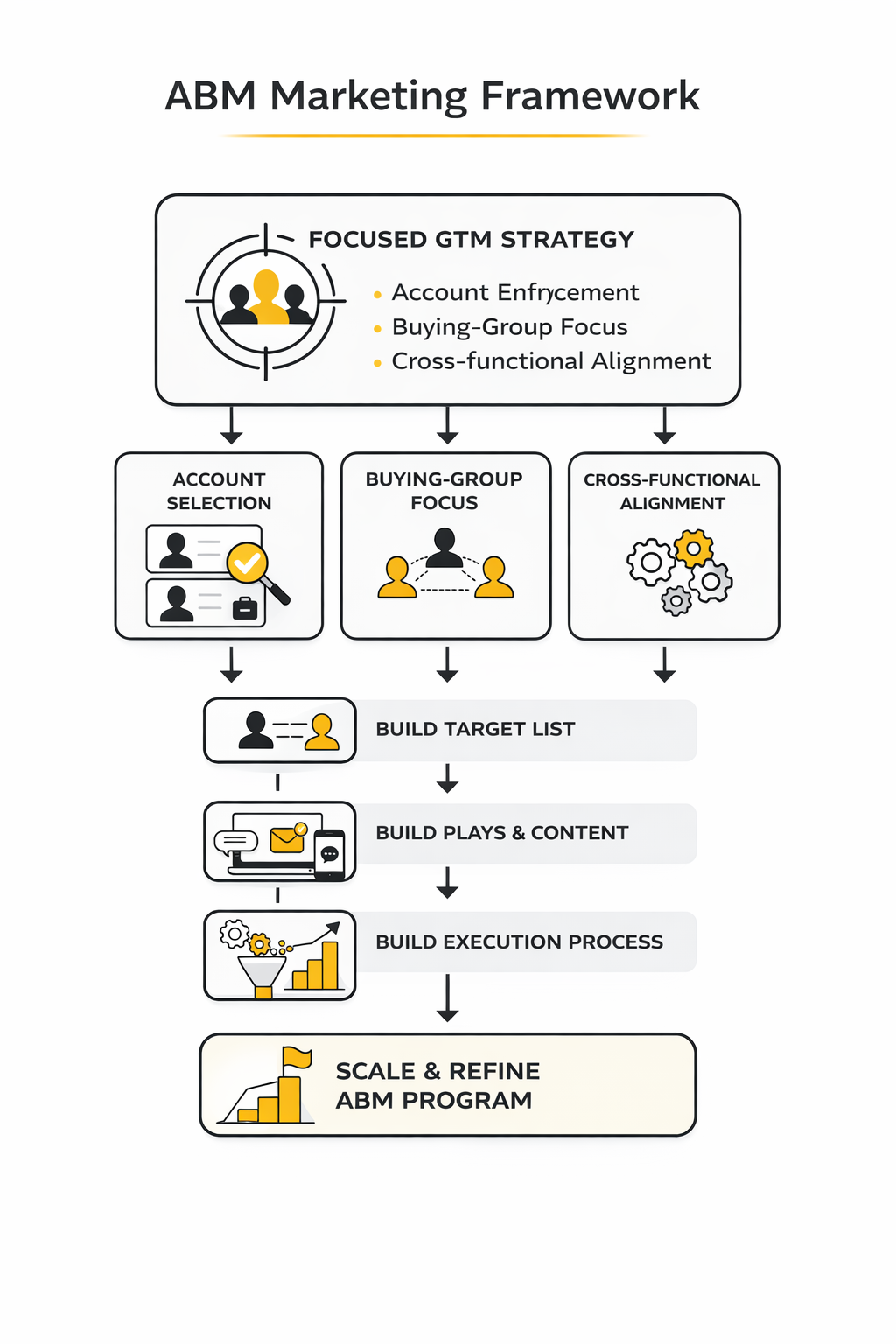
Step 1: Lock The ICP And Build The Initial Account List
Everything starts here. Before you write messaging or launch ads, you need a clear view of which companies belong in the program and why. That means using your best revenue data, customer patterns, sales insight, and fit criteria rather than building a wish list from brand names everybody recognizes.
The strongest lists reflect actual business economics. Good-fit accounts tend to share traits like similar pain points, similar buying complexity, similar deal size, and similar expansion potential. When ABM marketing starts from that reality, campaign decisions become more grounded because the list itself is built around likely wins rather than marketing ambition.
This also gives sales confidence early. Reps do not want an “ABM list” that looks disconnected from field reality. They want accounts that make sense.
Step 2: Tier Accounts And Match Effort To Value
Not every account deserves the same level of personalization. That sounds obvious, but many teams still act like every target account should get custom treatment. The result is predictable: quality drops, execution slows down, and the program becomes impossible to scale.
Tiering fixes that problem. Strategic accounts get deep customization, coordinated outreach, and leadership attention. Strong-fit accounts get segmented plays by industry, use case, or trigger. Broader target accounts get lighter-touch personalization and automated reach. This keeps ABM marketing focused where human effort produces the highest return.
It also helps prevent internal resentment. Sales can see why certain accounts get more support, and marketing can defend resource allocation with logic instead of politics.
Step 3: Identify The Buying Group And Message By Role
Once an account is in the program, the next job is figuring out who actually matters inside it. That means identifying likely stakeholders across business, technical, financial, and operational roles. Forrester’s 2024 business buying data found that 89% of purchases involve two or more departments, which is exactly why ABM marketing cannot rely on one champion and hope for the best.
This is where message architecture matters. Senior leaders usually care about strategic upside, risk reduction, or competitive advantage. Operators care about workflow change, implementation effort, and daily usability. Finance cares about commercial logic. Technical teams care about feasibility, security, and integration friction.
If all of them receive the same message, the campaign usually feels generic. If each of them gets relevant proof tied to the same account narrative, the campaign starts to feel coordinated.
Step 4: Build A Multi-Channel Play Around A Real Trigger
The best ABM marketing campaigns are built around something happening, not just something scheduled. That trigger could be hiring, expansion, funding, a product launch, a competitor switch, or meaningful category research behavior. The trigger gives your play urgency and context.
Once you have that moment, you can sequence the channels around it. Paid media can create familiarity. Sales outreach can reference the business context. Retargeting can reinforce the message. Website personalization can carry the conversation forward. Direct mail, executive outreach, events, or custom content can be layered in when the account tier justifies it.
This channel mix matters because B2B buyers do not move in one straight line. McKinsey’s B2B Pulse research found that buyers now use an average of 10 interaction channels, and Gartner reported in March 2026 that 67% of B2B buyers prefer a rep-free experience. That makes orchestration a practical necessity, not a buzzword.
Step 5: Create Landing Pages And Content That Feel Relevant Fast
This is one of the most underappreciated steps in implementation. Teams spend weeks debating targeting and outreach, then send accounts to pages that could apply to almost anyone. That breaks momentum immediately.
The buying-side evidence here is clear. The 2024 B2B Buyer’s Survey from Demand Gen Report found that 45% of buyers use vendor websites during research and 77% look for content that speaks directly to their company. So your ABM marketing execution has to treat the website as part of the campaign, not just the place where traffic happens to land.
That does not always mean building one fully custom page per account. Sometimes a segment-specific page with the right proof, use cases, commercial clarity, and next steps is enough. The key is that relevance shows up quickly.
Step 6: Set Service-Level Rules For Follow-Up
This is where many programs quietly lose momentum. Marketing generates engagement signals, but the response from sales is inconsistent. Or sales jumps too early and burns the account before enough context exists. Both problems come from weak execution rules.
Set clear thresholds. Decide which signals matter, who gets notified, how fast follow-up should happen, what kind of outreach should happen first, and how the result gets logged back into the system. ABM marketing works better when follow-up feels like part of the design rather than an improvisation.
This is not just a process issue. It is a trust issue between teams. When everyone knows the rules, fewer leads get ignored, fewer accounts get over-contacted, and performance becomes easier to improve.
Step 7: Review Accounts Weekly And Adjust The Play
Implementation is never one-and-done. Accounts change, signals fade, buying groups expand, priorities shift, and sometimes the original hypothesis was simply wrong. That is normal. What matters is whether your team has a regular way to inspect what is happening and make decisions without drama.
A weekly account review is usually enough to keep the program healthy. Look at account engagement, buying-group coverage, active opportunities, stalled movement, campaign touches, and rep feedback. The goal is not to create another reporting meeting. The goal is to keep ABM marketing close to reality.
These reviews also surface execution gaps quickly. Maybe one industry segment responds better to ROI proof than thought leadership. Maybe one sales pod follows up brilliantly while another hesitates. Maybe your “high intent” threshold is too sensitive. This is where the program gets smarter.
The Tech Stack Should Support The Process, Not Replace It
A lot of ABM marketing purchases happen in the wrong order. Teams buy tools first, then try to invent a workflow that justifies the spend. That usually leads to bloated dashboards, fragmented data, and a process nobody actually follows.
The better approach is boring in the best way. Start with the process, define the signals you care about, clarify account ownership, and then choose the tools that make those tasks easier. Technology should reduce manual friction, not create a second strategy layer on top of the real one.
For most teams, the core categories are straightforward:
- CRM for account and opportunity truth
- marketing automation for nurture and campaign execution
- ad platforms for account reach
- intent or account intelligence tools for signal enrichment
- analytics or dashboards for account-level visibility
- scheduling, form, and workflow tools that remove operational drag
If you need simple support tools around execution, something like GoHighLevel can help centralize campaign workflows, and Fillout is useful when you need cleaner intake or qualification flows across teams. The point is not the brand itself. The point is keeping the ABM marketing process easier to run than to avoid.
What Good ABM Implementation Looks Like In Practice
When implementation is working, the signs are obvious. Sales knows which accounts matter right now. Marketing knows what message is active and why. Leadership can see movement at the account level instead of staring at MQL volume that says very little about revenue quality. And ops is no longer stuck translating vague strategy into emergency fixes.
You also start to notice something else. Meetings get shorter because the definitions are tighter. Campaigns get better because feedback loops exist. The program becomes easier to scale because it is built on decisions and routines, not heroics.
That is really the difference. Strong ABM marketing implementation does not feel glamorous from the inside. It feels calm, clear, and commercially useful. And that is exactly what you want before you start judging whether the program is working.
The ABM Marketing Numbers That Actually Matter
This is the section where a lot of teams get lost. They collect dashboards full of impressions, clicks, opens, and form fills, then still cannot answer the one question leadership actually cares about: is ABM marketing moving the right accounts toward revenue. That is why measurement in this model has to be account-centered, buying-group-aware, and tied to commercial outcomes instead of campaign vanity.
The data supports that shift pretty clearly. 6sense found in 2025 that nearly 80% of organizations say they have an ABM program, but only 29% of ABM teams are measured solely through ABM-aligned metrics. That gap matters because it explains why some teams “run ABM” while still reporting success through lead-era numbers that were never built for complex account journeys.
Why Traditional Metrics Mislead ABM Teams
The old lead model rewards volume. More names, more form fills, more MQLs, more activity. The problem is that ABM marketing is supposed to do almost the opposite. It narrows focus, concentrates resources, and tries to create progress inside a smaller set of accounts that actually matter.
That is why the wrong metrics can make a good program look bad or a weak program look busy. 6sense’s 2025 marketing metrics research shows that many organizations still center measurement on traditional KPIs even while claiming to operate with an ABM strategy. In practice, that keeps teams optimizing for what is easiest to count instead of what is hardest to fake.
The shift is simple in theory, but important in practice. Instead of asking whether marketing generated enough leads, ask whether the target accounts are showing broader engagement, deeper buying-group penetration, stronger opportunity creation, and faster revenue movement.
ABM Marketing Should Be Measured At Four Levels
A clean ABM measurement system usually works across four layers. This is where the numbers become useful rather than decorative.
- Coverage: are you in the right accounts and reaching the right people inside them
- Engagement: are those accounts showing meaningful activity across channels and stakeholders
- Pipeline: are target accounts creating, advancing, and expanding real opportunities
- Revenue: are those accounts turning into won business, larger deals, better retention, or faster growth
This layered view matters because no single metric tells the whole story. An account can be heavily engaged but commercially weak. Another can show light surface activity but move quickly once the right stakeholder enters. ABM marketing gets smarter when you interpret metrics as a pattern rather than hunting for one magic KPI.
What To Track First And Why It Matters
If you are building measurement from scratch, start with a small set of metrics you can actually trust. More dashboards are not the answer. Cleaner interpretation is.
Coverage Metrics Tell You Whether The Program Is Even Looking In The Right Place
Coverage answers a brutally important question before anything else: are you reaching enough of the buying group inside the right accounts. This is not glamorous, but it is foundational. If your target list is wrong or your buying-group penetration is shallow, strong creative and perfect follow-up will not save the program.
This matters even more because enterprise buying is rarely a one-person decision. Forrester reported in late 2024 that the average B2B purchase involves 13 people and 89% of purchases involve two or more departments. So when ABM marketing only touches one enthusiastic contact, that is not evidence of market traction. It is usually evidence that the account is still under-covered.
Useful coverage questions include:
- how many target accounts are active right now
- how many relevant stakeholders have been identified in each account
- how many key roles have actually engaged
- which tier-one accounts still have weak buying-group reach
These numbers should drive action fast. If coverage is thin, the answer is not “run more ads.” The answer is usually better list quality, better contact mapping, or better sales coordination.
Engagement Metrics Show Whether Interest Is Broadening Inside The Account
Engagement is where many teams stop too early. They celebrate one click, one reply, one demo request, or one webinar attendee and assume the account is warming up. That is not enough. ABM marketing works best when engagement spreads across multiple people, channels, and moments.
That buying-group view is backed by current research. 6sense reported in 2025 that 92% of B2B buying is done by groups of three or more and 65% by groups of five or more. So a healthier signal is not just “someone engaged.” It is “more of the group is showing coordinated interest.”
Good engagement metrics include:
- number of engaged people per target account
- repeat visits from the account over time
- content depth, not just top-of-funnel clicks
- account engagement score trends
- intent signal consistency instead of one-off spikes
This is also where interpretation matters. A sudden engagement spike can be real buying movement, or it can be one curious individual doing research with no internal momentum. The safest read comes from breadth and consistency.
Build An Analytics System That Matches The Buying Journey
A lot of ABM marketing reporting gets weaker as soon as it tries to explain causation. That is normal. Enterprise journeys are long, messy, and multi-threaded. The goal is not perfect certainty. The goal is a reporting system that helps you make better decisions quarter after quarter.
The strongest systems usually combine account coverage, buying-group activity, pipeline progression, and revenue outcomes into one shared view for sales and marketing. That is far more useful than splitting performance into isolated channel dashboards that never meet each other.
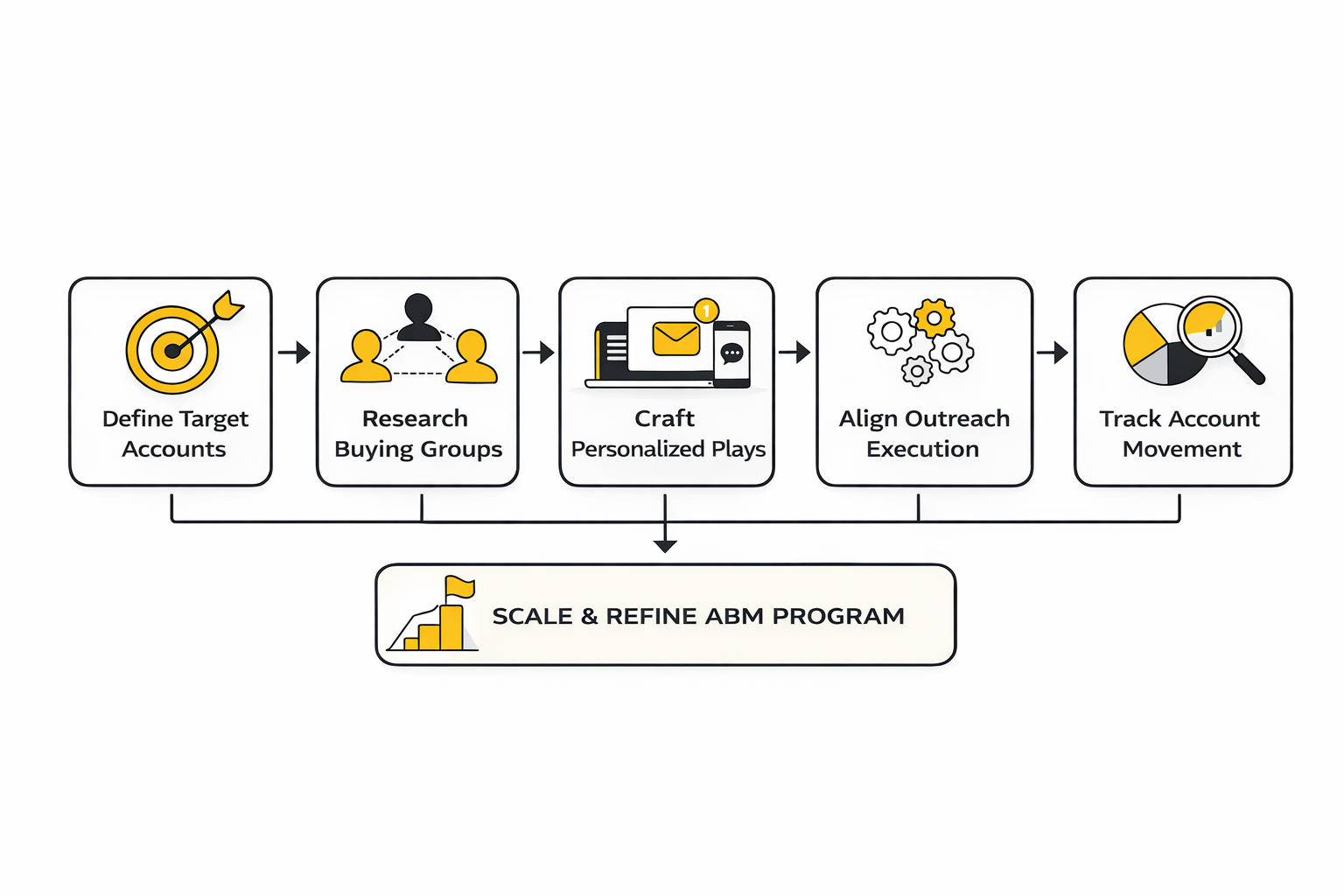
Use Stage-Based Measurement Instead Of Channel-Based Reporting Alone
Channel reports are still useful, but they are not the center of ABM measurement. Paid media may help create awareness. SDR outreach may open a conversation. Content may help a champion build internal support. The website may do most of the persuasion before sales ever joins the discussion. Looking at each channel alone misses the actual story.
A better approach is to measure stage progression at the account level. Did the account move from unknown to aware, from aware to engaged, from engaged to opportunity, from opportunity to pipeline progression, and from there to revenue. That framing turns ABM marketing into a progression model instead of a traffic report.
It also mirrors how real buyers behave. Demand Gen Report’s 2024 buyer survey showed that 66% of buyers start with web search and 45% use vendor websites early in the process. So when a target account shows growing anonymous website activity before a rep conversation ever happens, that is not “dark funnel mystery.” In ABM marketing, that is often the early part of the buying journey becoming visible.
Watch For Buying-Group Expansion, Not Just More Touches
This is one of the most practical signals in the whole model. If the number of involved stakeholders inside an account is growing, your program may be gaining internal traction even before pipeline jumps. If engagement stays trapped with one role, the deal may be fragile no matter how enthusiastic that person seems.
That is why buying-group expansion is often a better leading indicator than raw engagement volume. More touches from one contact can mean obsession, confusion, or polite research. More involvement from finance, operations, technical evaluators, and decision-makers usually means the account is moving closer to a real internal decision.
ABM marketing teams should treat this as a diagnostic signal. When stakeholder breadth increases, support the account with role-specific proof. When it does not, your next move is probably not more nurture. It is a coordinated plan to open the rest of the committee.
Pipeline Velocity Is One Of The Most Useful Reality Checks
Velocity is where the story gets commercial. If your target accounts are progressing faster than comparable non-target accounts, or faster than they did before the program, your orchestration is probably doing something useful. If they are stuck, all the engagement in the world may just be expensive interest.
This is exactly why pipeline velocity keeps showing up in serious ABM measurement frameworks. 6sense’s ABM metrics guide names pipeline velocity as a core pipeline development metric, and Demandbase’s 2025 ABM measurement guide frames the core challenge the same way: proving which target accounts justify investment across long, complex cycles. Velocity gives you a way to test whether the program is reducing friction or simply generating motion.
The practical read is straightforward. If engagement rises but velocity does not, your campaign may be interesting without being decisive. If buying-group coverage improves and velocity improves with it, you are probably helping the account make progress.
Statistics And Data In Context
Raw numbers only help if you know what they should change. That is the part many ABM marketing articles skip. They pile up statistics, but never explain which decision each number is supposed to drive.
A few of the most important recent data points do exactly that when you interpret them correctly.
Forrester’s 2024 buying research found that 86% of B2B purchases stall. That should push teams to measure not just demand creation, but deal progression and stall points. If accounts are engaging but then freezing at the same stage, your problem is not top-of-funnel volume. It is likely proof, internal alignment, procurement friction, or poor multi-stakeholder support.
Demand Gen Report’s 2024 survey found that 77% of buyers want content that speaks directly to their company and 86% look for pricing. That should change how you measure content performance. Generic pageviews are not enough. The more useful question is whether your target accounts are consuming relevant proof and commercial clarity that helps them move internally.
6sense’s 2024 ABM benchmark found that marketing teams with account-based practices report better and more consistent financial outcomes, with top performers aligned around strategically chosen accounts and buying groups. That should push teams to benchmark account quality, buying-group penetration, and cross-functional alignment, not just campaign output.
These numbers matter because they tell you where to look. They move measurement away from isolated tactics and toward buying reality.
The Metrics That Usually Deserve A Seat In The Weekly Review
By this stage, the reporting model should be narrow enough to use and rich enough to guide action. Most teams do not need a giant scorecard. They need a weekly operating view.
A strong ABM marketing review often includes:
- target account coverage by tier
- buying-group penetration in active accounts
- account engagement trend by tier or segment
- number of marketing qualified accounts or equivalent account-threshold status
- opportunities created from target accounts
- stage progression and pipeline velocity
- win rate, average deal size, and expansion where data volume allows
- stalled accounts and the likely reason they stalled
This mix works because it balances leading and lagging indicators. Coverage and engagement tell you what may happen next. Pipeline and revenue tell you what actually happened. Together, they make the program easier to steer.
What Good Measurement Should Change In Your Next Quarter
The point of ABM marketing analytics is not to make the dashboard prettier. It is to change where you put budget, time, and human attention. If measurement is working, it should make decisions easier.
You should be able to answer questions like:
- Which account tier is actually producing pipeline
- Which segments engage but fail to convert
- Which channels consistently help account progression
- Which buying roles are under-engaged
- Which accounts deserve more human effort right now
- Which campaigns should be cut, scaled, or rebuilt
That is the standard. Not “did the ads perform.” Not “did open rates improve.” The real question is whether the numbers are helping your team concentrate effort where revenue is most likely to move.
If you want one place to keep those workflows tighter, GoHighLevel can help centralize reporting and follow-up operations, but the tool is secondary. What matters most is that your ABM marketing measurement system tells the truth about account movement, buying-group depth, and commercial impact. Once it does that, the next decisions usually get much clearer.
Advanced ABM Marketing Decisions That Separate Mature Teams From Everyone Else
Once the basics are working, ABM marketing gets more interesting and more difficult. The easy questions are mostly gone by this point. You already know how to build a target list, coordinate campaigns, and measure account movement. The harder questions now are about tradeoffs: where to personalize deeply, where to standardize, when to expand the program, and when to leave a target account alone instead of forcing more touches.
This is where maturity shows up. Early-stage ABM marketing is often about enthusiasm and experimentation. Mature ABM marketing is about judgment. The teams that scale well are usually the ones that stop treating every account as a special case and start building a model that can adapt without breaking.
The Biggest Strategic Tradeoff Is Depth Versus Scale
Every ABM team runs into this wall sooner or later. The more personalized the program becomes, the harder it is to scale. The more standardized it becomes, the easier it is to run but the less differentiated it can feel to the buyer.
There is no perfect answer because the right balance depends on deal size, sales complexity, average contract value, and internal capacity. A company selling six-figure or seven-figure deals can justify much deeper account work than a team chasing smaller, faster-moving opportunities. That is why smart ABM marketing leaders stop asking, “Should we personalize more?” and start asking, “Where does extra personalization change win probability enough to deserve the cost?”
The practical answer is usually a hybrid model. Reserve true one-to-one effort for strategic accounts, build strong one-to-few plays for clusters with similar needs, and keep lighter one-to-many orchestration for the broader target universe. That structure protects quality without freezing growth.
Scaling Too Early Usually Breaks The Program
A lot of teams interpret early ABM success as permission to expand fast. That instinct is understandable, but it often creates the exact problems that the pilot avoided. Account quality drops, sales alignment weakens, campaign logic gets blurry, and reporting turns into a negotiation instead of a source of truth.
The issue is not scale itself. The issue is scaling before the operating model is stable. If your team still argues about account ownership, follow-up thresholds, buying-group mapping, or attribution logic, adding more accounts will magnify those problems. ABM marketing scales well when the process is boring enough to repeat and clear enough to inspect.
A safer way to grow is by adding one layer at a time. Expand into one new segment, one new region, or one new sales pod, then check whether execution quality holds. That keeps the program commercial instead of ceremonial.
Where ABM Marketing Commonly Goes Wrong
Most failures are not dramatic. They are slow, polite, and easy to rationalize for a few quarters. A team keeps launching campaigns, sales keeps saying accounts are “interesting,” dashboards keep showing activity, and yet real revenue impact stays fuzzy. That kind of failure is more dangerous than a loud crash because it can continue for a long time before anyone admits the model is drifting.
Mistaking Activity For Progress
This is still one of the biggest traps in ABM marketing. More engagement does not automatically mean more buying intent. More touches do not guarantee more internal momentum. And more accounts in a dashboard do not prove the program is reaching the right companies at the right time.
The fix is not to ignore engagement. The fix is to judge it in context. When activity broadens across the buying group, repeats over time, and connects to pipeline movement, it starts to mean something. When it stays shallow or isolated, it should trigger questions rather than celebration.
This matters because teams under pressure often cling to visible motion. That is understandable, but dangerous. ABM marketing only earns trust when the signals are interpreted with discipline.
Treating Sales Alignment As A One-Time Setup Task
Sales and marketing alignment is not something you achieve in kickoff week and then move on from. It is a live operating habit. Accounts change, reps change, priorities change, markets shift, and good intent disappears quickly when the process is no longer useful to the people running it.
That is why the best programs build alignment into routines, not slogans. Weekly account reviews, shared definitions, common dashboards, feedback loops from calls, and clear service-level expectations matter more than lofty messaging about collaboration. ABM marketing gets stronger when sales believes the program helps close business, not when sales is told to “support marketing’s strategy.”
If that sounds obvious, good. It should. But this is exactly where many programs go soft.
Forgetting That Customers Deserve Account-Based Thinking Too
One of the more advanced shifts in ABM marketing is realizing the model should not stop at pipeline creation. Existing accounts often offer the clearest expansion path, the richest data, and the fastest trust transfer, yet many teams still reserve their most coordinated account work only for net-new logos.
That is a miss. Expansion, retention, cross-sell, multi-product adoption, and renewal defense can benefit from the same principles: account selection, stakeholder mapping, coordinated plays, role-specific proof, and stage-based measurement. In many businesses, this is where the economics of ABM marketing actually get better.
It also changes how you judge account value. A smaller initial deal in the right customer can be more strategically important than a larger first contract with limited expansion potential. Mature teams understand that and build their programs accordingly.
Personalization Needs Governance Or It Turns Into Noise
Personalization sounds great in theory. In practice, it can become expensive fluff if nobody sets standards. That is why advanced ABM marketing programs need content governance just as much as they need creative ambition.
A useful rule is that personalization should either increase relevance, reduce friction, or improve credibility. If it does none of those things, it is probably decoration. Slapping an account name on a landing page is not meaningful if the proof, message, and next step are still generic. Writing a custom email about a company milestone is not impressive if it has no connection to a business problem you can actually solve.
This is where message architecture becomes an advantage. Instead of inventing content from scratch every time, mature teams build reusable narrative blocks tied to industries, buying roles, priority pains, competitive situations, and commercial objections. That keeps ABM marketing flexible without making it chaotic.
AI Can Speed Up Execution, But It Also Raises The Quality Bar
AI is already changing how teams research accounts, adapt messaging, summarize calls, draft follow-up, and build content variations. Used well, that can make ABM marketing faster and more responsive. Used badly, it creates polished nonsense at scale.
The danger is not just inaccuracy. It is sameness. If every competitor is using AI to generate “personalized” outreach from the same public signals, your program can end up sounding more generic than before. Speed alone is not an edge. Useful specificity is the edge.
That means AI should support judgment, not replace it. Let it help with synthesis, pattern recognition, drafting, and workflow support, but keep humans responsible for account selection, commercial nuance, stakeholder politics, and message quality. In ABM marketing, bad automation is often worse than slower execution because it can destroy trust across multiple high-value accounts at once.
The Best ABM Marketing Teams Build For Operational Resilience
One of the less glamorous but more important signs of maturity is resilience. Can the program survive turnover, shifting budgets, a CRM cleanup, territory changes, or leadership pressure for short-term wins? If the whole thing depends on a few heroic operators, it is not really scalable yet.
Resilient programs usually share a few traits. Their account selection logic is documented. Their tiering rules are defensible. Their measurement framework is understood across teams. Their campaigns can be launched without custom chaos every single time. And their feedback loops do not disappear when one strong marketer or sales leader leaves the company.
This is the real case for process discipline. It is not bureaucracy for its own sake. It is how ABM marketing stays effective when real business conditions get messy.
Your Stack Should Get Lighter As Your Thinking Gets Sharper
A common mistake at this stage is assuming sophistication requires more tools. Sometimes it does. More often, it requires better decisions with the tools you already have. Mature ABM marketing programs tend to get more selective, not more bloated.
That means asking harder questions about each platform in the stack. Does it improve account visibility, campaign coordination, or speed to action? Does it reduce manual friction in a meaningful way? Does it help sales and marketing work from the same commercial picture? If not, it may be complexity disguised as capability.
For teams tightening execution, tools like GoHighLevel, Copper, or Fillout can support cleaner workflows, but the stack only helps when the underlying operating model is already clear. ABM marketing gets stronger when technology removes friction from good decisions, not when it tries to compensate for weak ones.
When ABM Marketing Is The Wrong Answer
This part matters because not every go-to-market problem should be solved with ABM marketing. Some teams adopt it because it sounds more strategic than fixing positioning, product-market fit, messy pipeline stages, weak sales management, or poor conversion fundamentals. That rarely ends well.
If your ideal customer profile is still vague, your win pattern is unstable, your messaging is confused, or your sales team cannot consistently close in a core segment, ABM marketing may amplify the confusion rather than solve it. A tighter market definition, stronger offer, or simpler demand capture model might deserve attention first.
The same goes for teams with tiny budgets trying to imitate enterprise playbooks. You do not need to reject ABM marketing entirely, but you may need a lighter version that fits your economics. Focus, selectivity, and account intelligence still matter. Massive orchestration does not always.
The Real Endgame Is Not More Campaigns
At the advanced level, the goal is not to keep adding tactics. It is to make the go-to-market system smarter. Better account choices. Better stakeholder coverage. Better timing. Better commercial proof. Better decisions about where humans should spend their energy.
That is the deeper payoff of ABM marketing when it is run well. It teaches the company to think in terms of account quality, buying-group complexity, and revenue concentration instead of treating demand generation like a volume game forever. Once that shift happens, even the parts of the business outside marketing start to change.
And that is usually the sign you are doing it right. ABM marketing stops feeling like a campaign framework and starts behaving like a serious revenue discipline.
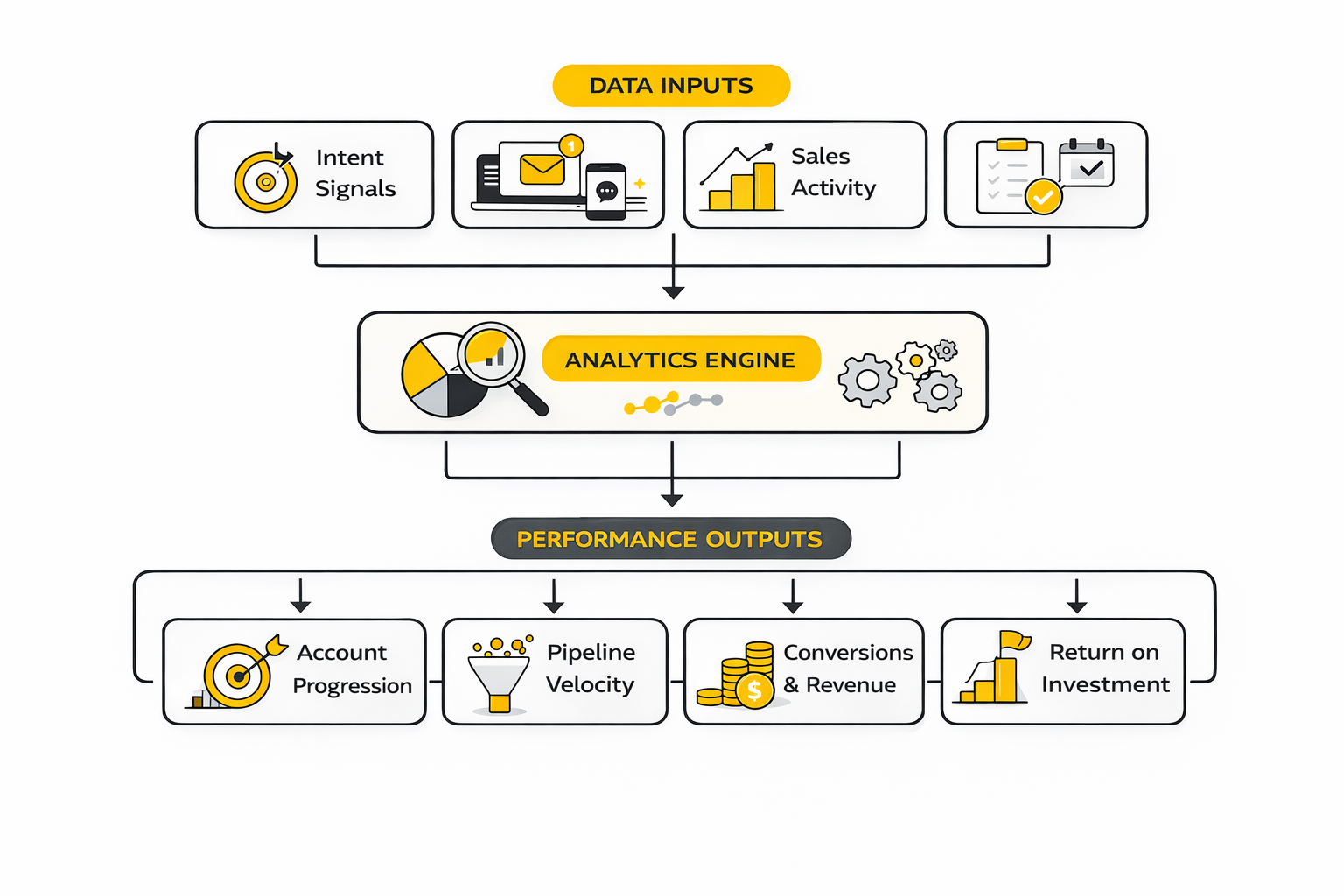
Before you scale ABM marketing any further, it helps to zoom out and look at the whole system. By now, the pattern should be clear. Strong account selection feeds better orchestration, better orchestration improves buying-group engagement, and better measurement tells you where to double down and where to stop wasting effort.
That ecosystem view matters because ABM marketing breaks when teams treat each piece in isolation. Targeting without sales alignment is fragile. Personalization without process is expensive. Reporting without commercial context is distracting. The whole model only gets stronger when those parts reinforce each other.
The final shift is mental. ABM marketing is not just a campaign type. It is a way of running focused go-to-market work around accounts that matter, stakeholders that influence decisions, and signals that show whether the account is really moving.
FAQ - Built for Complete Guide
What is ABM marketing in simple terms?
ABM marketing is a focused approach where sales and marketing work together on a defined set of target accounts instead of trying to generate as many leads as possible. The point is to concentrate budget, messaging, and human effort where the revenue upside is highest. That model makes more sense in complex B2B buying environments where deals often involve multiple stakeholders and long decision cycles, which is exactly the kind of environment described in Forrester’s 2024 business buying research.
How is ABM marketing different from traditional lead generation?
Traditional lead generation is usually designed to create volume first and qualify later. ABM marketing flips that logic by choosing the right accounts first, then building campaigns and outreach around them. That difference matters because many teams still run ABM programs while measuring success through legacy lead metrics, a disconnect highlighted in 6sense’s 2025 metrics research.
Is ABM marketing only for enterprise companies?
No, but it does work best when deal value, sales complexity, and stakeholder count are high enough to justify the extra focus. A smaller B2B company can still use ABM marketing if it has a clear ICP and a limited set of high-potential accounts worth coordinated effort. What changes is the scale and sophistication, not the underlying logic.
How many accounts should you start with?
Start with fewer accounts than your team thinks it can handle. In most cases, a smaller pilot produces better learning because messaging quality, sales follow-up, and measurement stay tight enough to inspect properly. ABM marketing almost always improves when the first rollout is narrow enough to manage and wide enough to reveal patterns.
Does ABM marketing require expensive software?
No, not at the beginning. You need a reliable source of account truth, a way to coordinate outreach and campaigns, and a reporting view that can show account movement clearly. More tooling can help later, but ABM marketing usually fails because of weak process and unclear ownership long before it fails because the stack was too small.
What metrics matter most in ABM marketing?
The most useful metrics usually sit across four layers: coverage, engagement, pipeline, and revenue. That means you want to know whether you are reaching the right accounts, penetrating the buying group, creating and progressing opportunities, and turning those accounts into real commercial outcomes. This account-level shift matters because only 29% of ABM teams are measured solely through ABM-aligned metrics in 6sense’s 2025 guide to ABM metrics, which explains why many programs still struggle to prove real impact.
How long does ABM marketing take to show results?
That depends on your sales cycle, account tier, and how mature your current go-to-market process already is. Early signals can appear fairly quickly in coverage and engagement, but revenue proof usually takes longer because B2B buying is slow and often stalls before a decision gets made. That is why ABM marketing should be judged with both leading and lagging indicators rather than expecting immediate closed-won outcomes.
Should sales or marketing own ABM marketing?
Neither team should “own” it in a way that turns the other into a service department. Marketing usually drives orchestration, campaigns, and content, while sales drives account conversations, stakeholder intelligence, and opportunity movement. ABM marketing works best when both teams share the same account priorities, signal thresholds, and stage definitions instead of arguing over whose program it is.
How personalized does ABM marketing need to be?
Less than many teams assume, but more than lazy segmentation usually delivers. The right level of personalization depends on account value, sales complexity, and where the account sits in your tiering model. In practice, ABM marketing performs better when personalization is reserved for moments that improve relevance, reduce friction, or increase credibility instead of being used as decoration.
What role does content play in ABM marketing?
Content is not just there to attract clicks. In ABM marketing, content helps different stakeholders inside the same account understand the problem, compare options, justify investment, and reduce perceived risk. That matters because buyers still rely heavily on self-serve research, vendor websites, and pricing information during evaluation, as shown in the 2024 B2B Buyer’s Survey from Demand Gen Report.
Can ABM marketing work if buyers do not want to talk to sales early?
Yes, and that is one of the strongest reasons to build the program well. Modern buyers often prefer to research independently before engaging a rep, which makes coordinated content, website relevance, and account-level visibility more important than ever. That trend is hard to ignore when Gartner reported in March 2026 that 67% of B2B buyers prefer a rep-free experience.
What is the biggest mistake teams make with ABM marketing?
The biggest mistake is pretending activity equals progress. Teams see engagement spikes, ad impressions, webinar attendance, or a few warm replies and assume the account is moving toward revenue. ABM marketing gets much stronger when teams ask tougher questions about buying-group depth, stakeholder coverage, pipeline velocity, and whether the account is actually becoming easier to close.
Should ABM marketing stop once an opportunity is created?
No, that is usually where some of the highest-value work begins. Once an opportunity is live, the same account-based thinking can help support internal consensus, reduce friction for additional stakeholders, strengthen proof, and improve expansion or renewal potential later. Mature ABM marketing programs often create value beyond pipeline creation because they stay useful throughout the account lifecycle.
Is ABM marketing worth it for smaller teams?
It can be, but only if the team stays disciplined. A smaller company should not copy an enterprise playbook just because the term sounds strategic. ABM marketing is worth it when focus creates an advantage, when the target account list is tight, and when the business would benefit more from winning the right deals than from generating more top-of-funnel noise.
Work With Professionals
Explore 10K+ Remote Marketing Contracts on MarkeWork.com
Most marketers spend too much time chasing clients, competing on crowded platforms, and losing a percentage of every project to middlemen.
MarkeWork gives you a better way. Browse thousands of remote marketing contracts and connect directly with companies desperate to hire skilled marketers like you, without platform commissions and without unnecessary gatekeepers.
If you're serious about finding better opportunities and keeping 100% of what you earn, explore available contracts and create a profile for free at MarkeWork.com.