

Business to business marketing looks simple from the outside. You define an audience, run campaigns, collect leads, and hand them to sales. In practice, it is much tougher than that because B2B buyers rarely move in a straight line, rarely decide alone, and almost never respond to generic messaging.
That is why strong business to business marketing is less about chasing attention and more about creating confidence. Your market needs to understand what you do, why it matters, why your company is credible, and why now is the right time to engage. When that foundation is missing, even a good product struggles to create steady pipeline.
The companies that win here usually do not win because they publish more content or spend more on ads. They win because their positioning is sharper, their campaigns are tied to real buying stages, and their marketing feels connected to revenue instead of floating beside it. That is the standard this article is built around.
Article Outline
- Why Business to Business Marketing Matters More Than Ever
- The Modern B2B Marketing Framework
- The Core Channels That Actually Move Pipeline
- Content, Demand Generation, and Sales Alignment
- How to Build a Professional B2B Marketing Engine
- Measuring Performance and Improving What Works
Why Business to Business Marketing Matters More Than Ever
Business buyers are more informed than they used to be, and that changes everything. They can research vendors, compare offers, read peer opinions, watch product walkthroughs, and form preferences long before they ever speak with a salesperson. That means marketing is no longer just there to support sales at the top of the funnel. It shapes how a company is understood across the entire buying journey.
A lot of teams still treat business to business marketing like a lead factory. They push gated assets, celebrate form fills, and hope volume will solve weak conversion. It usually does not. If the market does not trust your message, if your offer is not clear, or if your content does not match real buying questions, more activity just creates more noise.
What matters now is market presence with commercial intent. You need visibility, but not empty visibility. You need authority, proof, relevance, and consistent follow-through so that when a buyer enters the market, your brand already feels familiar and lower risk.
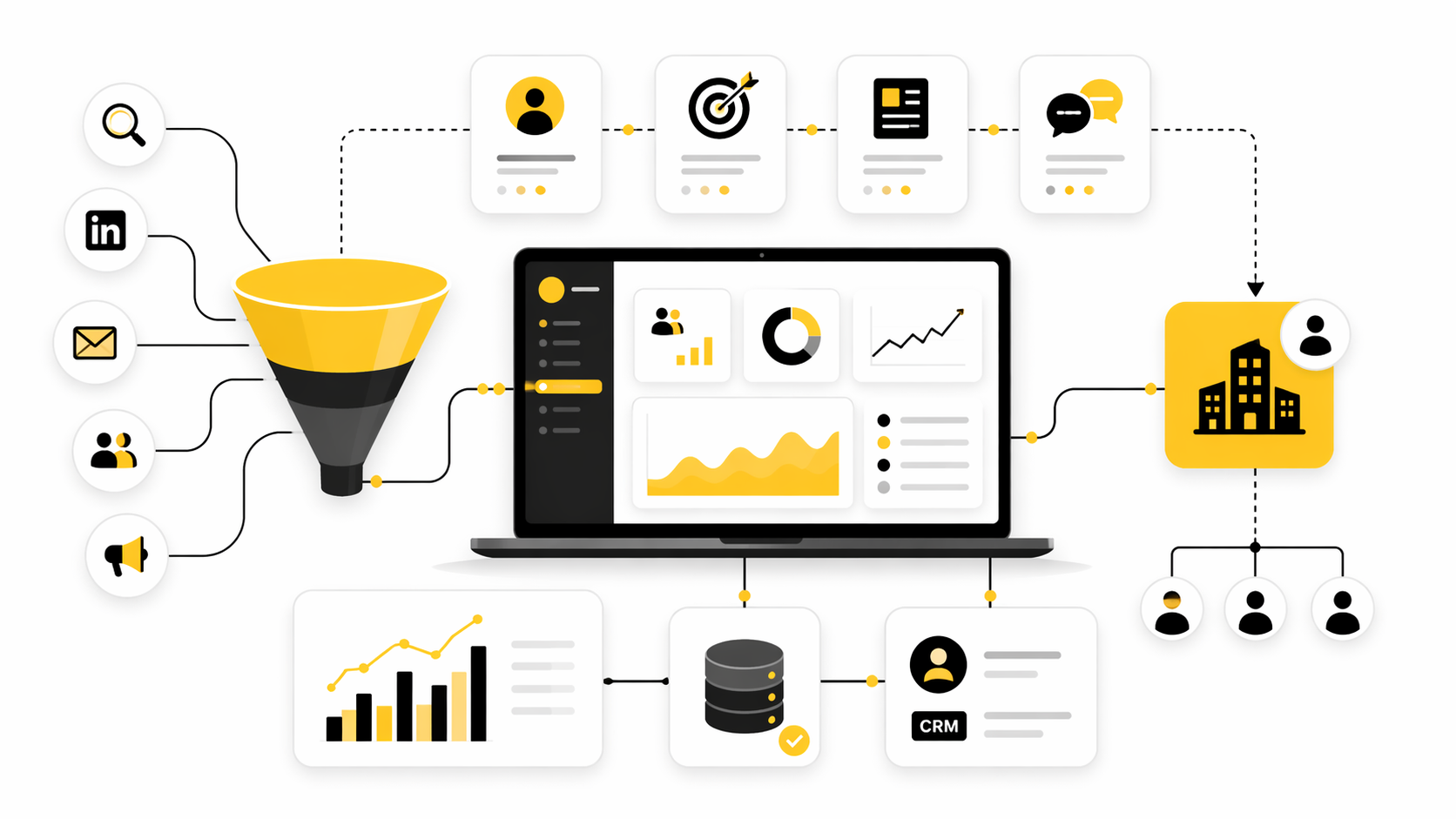
That shift is why B2B marketing matters more than ever inside modern companies. It is not just about traffic or awareness anymore. It is the system that turns expertise into demand, demand into qualified conversations, and qualified conversations into revenue opportunities the sales team can actually close.
The Modern B2B Marketing Framework
A practical business to business marketing framework starts with a simple idea: not every prospect needs the same message, the same channel, or the same level of friction. Some people are just discovering the category. Some are comparing vendors. Some are trying to justify a purchase internally. Your marketing has to meet each stage with the right kind of value.
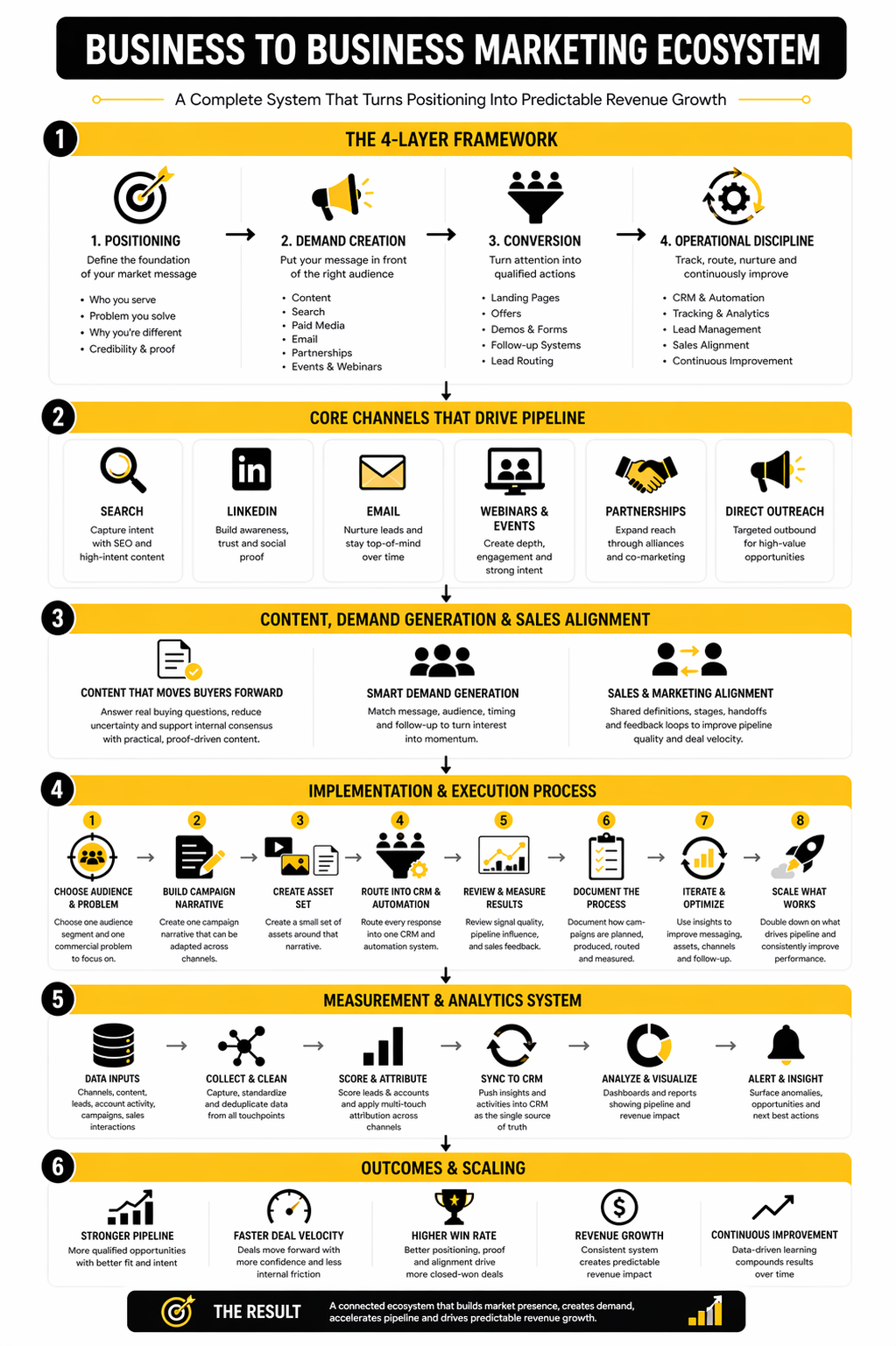
That is why the strongest framework is built in layers, not random tactics. The first layer is positioning, which defines who you serve, what problem you solve, and why your approach is different. The second layer is demand creation, which puts that message in front of the right audience through content, search, paid media, email, partnerships, and direct distribution. The third layer is conversion, where landing pages, offers, demos, forms, and follow-up systems turn attention into action.
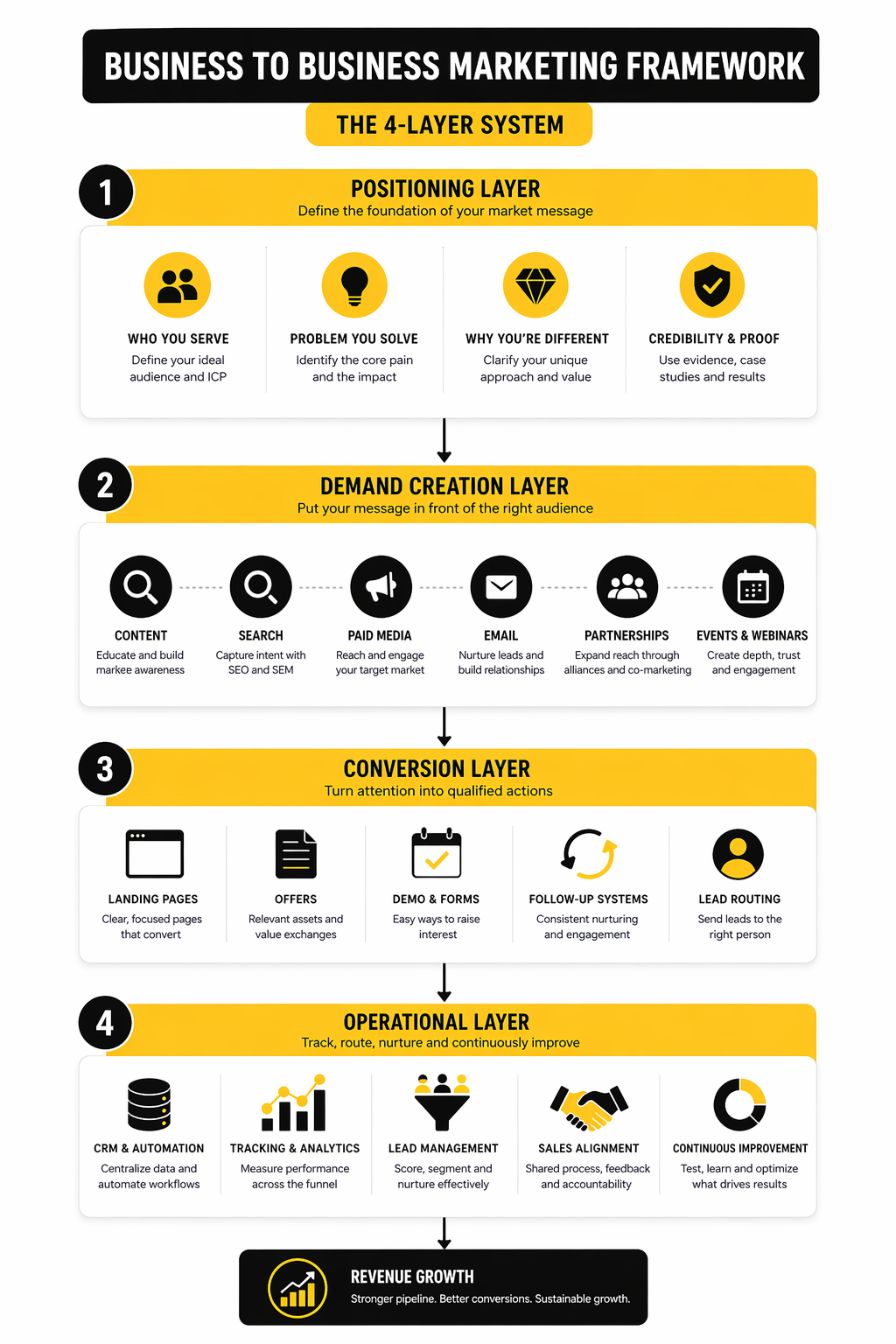
The final layer is operational discipline. This is where many teams fall apart because they launch campaigns without the infrastructure to track, route, nurture, and learn from demand. A professional setup usually includes a CRM and automation backbone such as GoHighLevel, a content distribution workflow, and clear ownership between marketing and sales so leads do not vanish between teams.
The point of this framework is not complexity. It is control. When your business to business marketing runs through a clear system, you can see which messages create interest, which channels create pipeline, and which assets help deals move forward instead of just making dashboards look busy.
In the next part, the article moves into the specific channels and building blocks that make this framework work in the real world.
The Core Channels That Actually Move Pipeline
Once the strategy is clear, the next question is where business to business marketing actually creates momentum. This is where a lot of teams get distracted, because every channel can look useful in isolation. The better way to think about it is simpler: choose channels that help buyers discover you, understand you, trust you, and move closer to a serious commercial conversation.
That usually means building around a small set of channels instead of trying to be everywhere. Search matters because buyers use it when pain becomes urgent. LinkedIn matters because professional discovery, peer influence, and category education happen there in public. Email matters because it is still one of the most reliable ways to nurture interest over time, and webinars or events matter because they create attention with more depth than a cold ad click ever will.
Search Captures Existing Demand
Search is still one of the cleanest signals of intent in B2B. When someone searches for a problem, a category, a comparison, or a specific solution, they are often much closer to action than someone casually scrolling a feed. That is why strong business to business marketing usually treats search as a core commercial channel, not just a traffic channel.
The catch is that search is changing. Google’s rollout of AI Overviews is pushing more answers directly into the results page, which means weak content has even less room to survive. If your brand wants to win through search now, your pages need to be clearer, more useful, and more tightly matched to the exact buying questions prospects are already asking.
This is also where category-specific content starts to matter more than generic SEO publishing. A page built around a real use case, a high-intent comparison, or a specific operational problem will usually outperform broad thought pieces that never get close to a buying decision. Search rewards relevance, and B2B buyers reward clarity.
LinkedIn Is the Distribution Layer Most B2B Teams Cannot Ignore
For most B2B companies, LinkedIn is no longer optional. It functions as a mix of media channel, credibility layer, retargeting environment, and public proof system. Buyers may not convert directly from one post, but they do form impressions there, and those impressions shape what happens later in search, email, demos, and sales calls.
The content mix matters here. LinkedIn’s 2024 benchmark research found that short-form social video produced the highest reported ROI among surveyed B2B marketers, while thought leadership blog posts and case studies also remained highly effective. That combination makes sense because buyers want fast signal first, then deeper proof once interest grows.
This is why a serious business to business marketing program should not treat LinkedIn as a dumping ground for company updates. It works best when the content is built to create recognition and trust around a sharp commercial narrative. Short expert takes, buyer-focused breakdowns, customer evidence, and strong creative all do more work than polished but empty brand talk.
Email Still Does the Quiet Work
Email is less glamorous than newer channels, but it still carries a huge amount of B2B revenue weight because it supports consistency. Buyers rarely make one fast decision after one touch. They revisit the problem, share materials internally, and compare vendors over time. Email keeps your brand in that process without forcing a hard sell on every interaction.
Benchmark data still shows healthy engagement in many industries. Mailchimp’s current benchmark page lists an average open rate of 31.35% for business and finance and 35.63% across all users, which is a useful reminder that inbox attention is still available when the targeting and message are strong.
The mistake is treating email like a weekly blast. Strong business to business marketing uses email to extend a conversation that already makes sense. That can mean follow-up after a webinar, a nurture sequence tied to product education, or point-of-view emails that help buying committees understand risk, implementation, or ROI before they are ready for a live sales conversation.
Webinars and Events Create Depth Faster Than Most Digital Channels
Some channels are better for reach. Others are better for depth. Webinars, virtual sessions, and well-run events matter because they compress learning. In one session, a buyer can hear your point of view, see how you think, evaluate expertise, and decide whether your team feels credible enough to keep exploring.
That is one reason these formats remain important even in a digital-first market. ON24’s webinar benchmark reporting continues to frame webinars as a strong source of engagement and first-party intent data, and the broader market is still leaning into live experiences because human interaction builds trust in ways static assets often cannot.
This does not mean every B2B company needs a giant events strategy. It means the channel deserves a real job. A webinar should answer a live market question, move a prospect closer to confidence, and feed useful engagement signals back into your CRM. When it is just another presentation with a registration form, it underperforms. When it is built around buyer friction, it becomes one of the strongest trust-building assets in the mix.
Content, Demand Generation, and Sales Alignment
Channels by themselves do not create pipeline. They only carry the message. What makes business to business marketing effective is the connection between what your market needs to hear, how demand is generated, and what happens after someone shows interest.
This is where many teams create their own bottleneck. Marketing publishes content that sounds smart but does not help a buyer make progress. Demand generation drives names into the system that sales does not trust. Sales follows up with messaging that ignores the story marketing spent weeks trying to build. The result is not just inefficiency. It is lost momentum.
The next part goes deeper into that connection, because this is where the difference between activity and revenue becomes impossible to ignore.
Content, Demand Generation, and Sales Alignment
Content only works in business to business marketing when it helps a buyer make a decision. That sounds obvious, but plenty of teams still create assets around what they want to say instead of what the market is trying to understand. The result is content that fills calendars but does very little to reduce uncertainty, build trust, or move a deal forward.
The better approach is to treat content as commercial infrastructure. It should answer real buying questions, clarify trade-offs, handle objections early, and give internal champions something useful to pass around inside the company. That matters even more now because the buying group is larger, more self-directed, and often invisible until late in the process, a pattern reinforced by recent buyer research from 6sense and by the 2025 hidden buyer findings from Edelman and LinkedIn.
This is where demand generation has to grow up. Good demand gen is not just paid traffic plus a form. It is the discipline of matching message, audience, timing, and follow-up so that interest becomes momentum instead of leakage. When that system is missing, companies mistake lead volume for progress and end up wondering why sales says the pipeline is weak.
What Strong B2B Content Actually Does
The strongest B2B content does not try to entertain everyone. It tries to help the right buyer see the problem more clearly, understand the stakes, compare options, and feel more confident about action. That is why useful categories tend to outperform vague thought pieces: implementation guides, category breakdowns, comparison pages, ROI explainers, product walkthroughs, customer proof, and objection-handling content.
Recent content marketing research keeps pointing in the same direction. Content Marketing Institute’s 2025 B2B benchmark highlights rising investment in video, thought leadership, webinars, and paid distribution, which makes sense because effective teams are focusing less on publishing volume and more on relevance, format fit, and distribution strength (contentmarketinginstitute.com). The same pattern shows up in LinkedIn’s 2025 B2B benchmark, where marketers are moving from AI experimentation into orchestration and performance-minded execution rather than scattered testing (business.linkedin.com).
That matters because content is now doing several jobs at once. It helps the market discover you, it shapes what buyers believe about your expertise, and it gives sales teams better assets to use in live deals. When one asset can do all three, business to business marketing starts compounding instead of restarting from zero every campaign cycle.
Demand Generation Works Best When It Respects Buyer Timing
Demand generation becomes expensive fast when it ignores how people actually buy. Not everyone who touches your brand is ready to book a demo, talk to sales, or compare contracts. A lot of buyers are still framing the problem, benchmarking options, or quietly educating a wider committee before they ever raise a hand.
That is why a strong demand generation system separates attention from readiness. Top-of-funnel content and paid distribution build familiarity. Mid-funnel content gives serious prospects deeper clarity. Conversion offers and sales outreach should appear when signals show that a real buying motion is starting, not just because someone downloaded one asset three weeks ago.
Forrester’s 2025 B2B marketing and sales outlook puts even more pressure on this point because alignment and smarter go-to-market execution are becoming central growth levers, not nice extras (forrester.com). In other words, business to business marketing works better when demand generation is treated as a sequence of calibrated moves instead of one loud push for immediate conversion.
Sales Alignment Is Not a Meeting, It Is a Shared System
A lot of companies talk about sales and marketing alignment as if the solution is one weekly sync. That helps a little, but it is nowhere near enough. Real alignment means both teams agree on who the best-fit buyer is, what problems matter most, what signals indicate buying intent, how handoffs work, and what counts as a qualified opportunity.
Without that shared system, marketing chases engagement while sales chases urgency. Marketing celebrates names in the database, sales ignores half the leads, and leadership gets conflicting stories about what is actually happening in the market. It is one of the fastest ways to burn budget while still feeling busy.
The fix is more operational than inspirational. Shared definitions, common dashboards, documented stages, and clear follow-up standards matter more than slogans about collaboration. Once those pieces are in place, content becomes more useful, campaigns become easier to score honestly, and sales conversations start from stronger context instead of cold confusion.
How to Build a Professional B2B Marketing Engine
Professional implementation is where business to business marketing either becomes repeatable or falls apart. Strategy sounds good in decks, but execution is what determines whether the company creates a predictable pipeline or keeps lurching between random campaigns. This is the part that needs process, discipline, and a stack that supports the work instead of slowing it down.
The goal is not to create a massive machine on day one. The goal is to build a system that can reliably turn positioning into campaigns, campaigns into signals, and signals into sales-ready action. That is a much more practical standard, and it is how strong teams avoid wasting months on disconnected experiments.
Start With Positioning Before You Touch Campaigns
Implementation should begin with message clarity, not channel selection. If the company cannot explain who it helps, what problem it solves, why its approach is different, and what proof supports the claim, every campaign will struggle. Paid media becomes expensive, content becomes generic, and sales calls end up doing basic message repair instead of advancing deals.
This is why the first operational asset is usually not an ad account or a landing page. It is a tight positioning document that defines audience, pain points, value proposition, differentiators, objections, and commercial proof. Once that exists, the rest of the business to business marketing engine has something solid to build on.
A strong positioning base also helps with consistency. Buyers move across channels, so the story cannot change every time they land on a new page, open an email, or speak with a rep. Repetition with clarity builds trust. Inconsistency kills it.
Build the Execution Layer Around One Clear Workflow
Once positioning is stable, the next job is execution design. That means defining how campaigns are planned, how assets are produced, where traffic is sent, how leads are captured, how follow-up is triggered, and how reporting flows back into the next campaign cycle. Most underperforming teams do pieces of this work, but they do not connect the pieces.
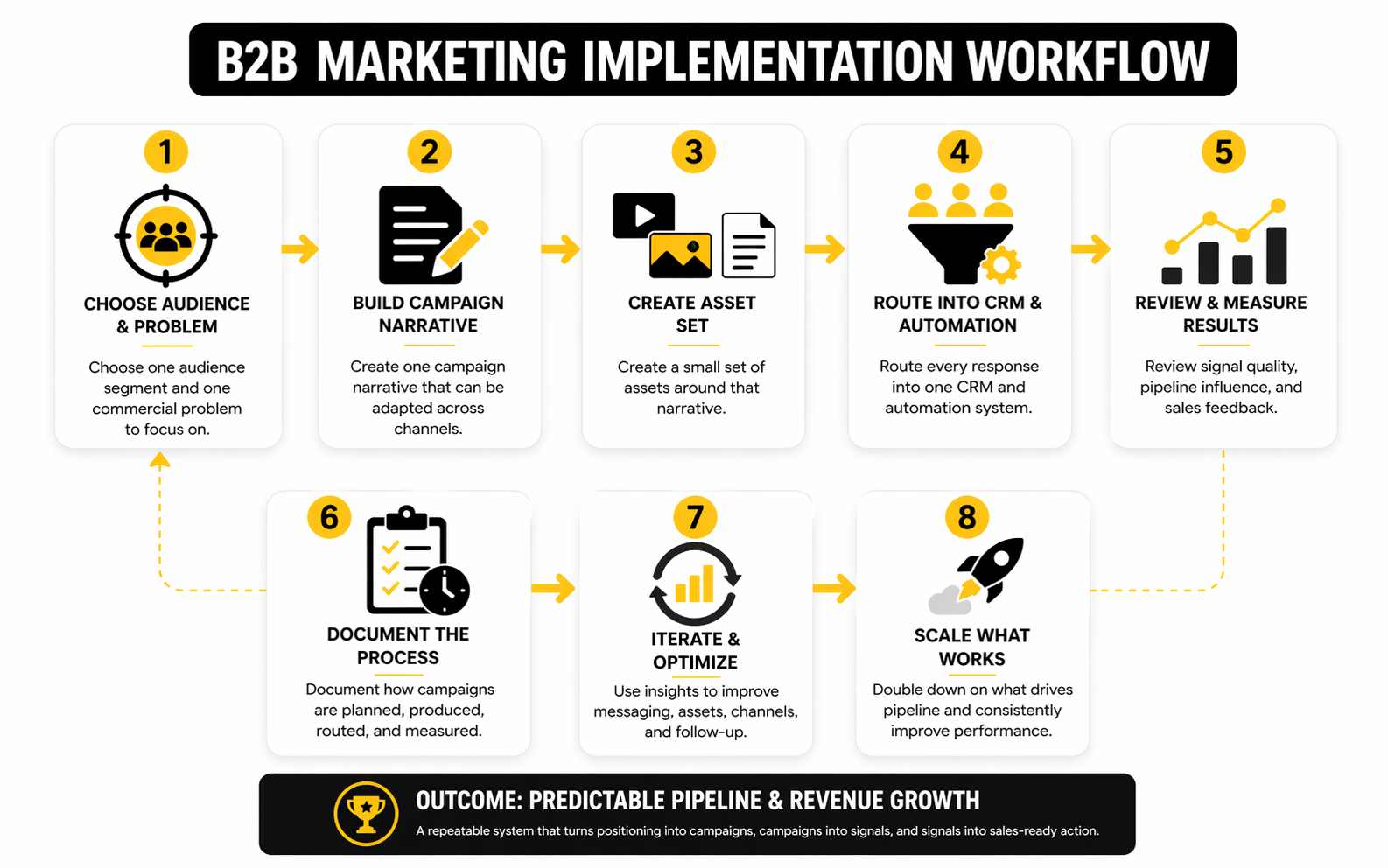
A practical workflow usually looks like this:
- Choose one audience segment and one commercial problem to focus on.
- Build one campaign narrative that can be adapted across search, social, email, and sales enablement.
- Create a small asset set around that narrative, such as a landing page, a comparison piece, a webinar, short-form social content, and follow-up emails.
- Route every response into one CRM and automation system so ownership is clear.
- Review signal quality, pipeline influence, and sales feedback before scaling anything.
This is where tools matter, but only after the process is clear. A platform like GoHighLevel can help centralize forms, automation, CRM workflows, and follow-up sequences, while a tool like Buffer can simplify distribution once the content engine is running. The tool should support the operating model. It should not become the strategy.
Use Automation to Remove Friction, Not Humanity
Automation is valuable in business to business marketing because it protects consistency. It makes sure leads are routed correctly, follow-up happens on time, reminders are not missed, and campaign data does not disappear into spreadsheets. Used well, it gives the team more time for better thinking and better conversations.
Used badly, it turns outreach into noise. Buyers can tell when they are being pushed through a sequence that reacts to clicks but ignores context. That is why automation should handle logistics, timing, and segmentation, while the message itself still feels relevant to the buyer’s actual situation.
This is also where AI can help without taking over the whole function. LinkedIn’s 2025 benchmark frames the current shift as orchestration rather than isolated experimentation, which is a useful way to look at it (business.linkedin.com). The teams getting the most value are not just generating more content faster. They are using technology to improve workflow speed, personalization quality, and campaign coordination.
Document the Process So Performance Can Scale
If the system only works when one smart person remembers everything, it is not a real engine yet. Professional implementation means documenting how campaigns are briefed, how assets move through production, how demand is scored, how sales gets context, and how results are reviewed. That documentation turns good performance from a lucky streak into something the team can repeat.
This does not need to become corporate theater. A clear campaign brief, a consistent launch checklist, agreed stage definitions, and one reporting rhythm can do more than a giant playbook nobody reads. The point is not bureaucracy. The point is reliability.
Once that reliability exists, business to business marketing gets much easier to improve. Weak points become visible, experiments become cleaner, and leadership can finally see which parts of the engine are driving pipeline instead of guessing from surface metrics.
Measuring Performance and Improving What Works
Most business to business marketing dashboards look busy long before they look useful. They show impressions, clicks, opens, form fills, and maybe a few campaign charts, but they still leave leadership with the same question: is marketing actually creating revenue momentum or just generating activity. That is why measurement has to move beyond channel reporting and into commercial decision-making.
The challenge is bigger now because buyers are doing more on their own. Gartner found that 61% of B2B buyers prefer a rep-free buying experience, while 6sense reports buyers can complete about two-thirds of their journey before engaging sellers. If your measurement model only rewards the final demo request or booked call, you miss most of the buying process that created the opportunity in the first place.
Start With the Signals That Appear Before Revenue
The first job of measurement is to identify whether the market is moving in your direction before closed-won revenue shows up. In B2B, that usually means tracking qualified website engagement, target account activity, repeat visits, content consumption by role, demo intent, and sales-accepted opportunities. Those are not vanity metrics when they are tied to the right audience and connected to later pipeline stages.
This matters because buyers often stay invisible until late. 6sense’s 2025 buyer research and Gartner’s survey on self-service buying behavior both point to the same reality: marketing influence starts earlier than seller engagement. So the right action is not to obsess over more top-of-funnel volume. It is to build reporting that shows whether the right accounts are leaning in before they formally convert.
A practical B2B scorecard usually gets stronger when it is organized in layers. The first layer measures audience quality and engagement. The second measures conversion into pipeline. The third measures velocity, win rate, and revenue contribution. When those layers are connected, business to business marketing becomes much easier to diagnose because you can finally see whether the problem is traffic quality, message fit, conversion friction, or sales-stage drop-off.
Benchmarks Are Useful, but Only in Context
Benchmarks help when they tell you where to investigate, not when they become fixed goals copied from somebody else’s business. A conversion rate that looks weak in one category may be normal in another. Unbounce’s 2025 B2B conversion benchmark summary puts the overall median at 6.6%, while SaaS is much lower at 3.8%. That gap alone is a good reminder that raw numbers mean very little without industry context, offer type, traffic source, and funnel stage.
The same logic applies to email. Mailchimp explains that benchmarking works by comparing campaigns against peers using industry, audience demographics, and audience size, based on hundreds of millions of emails. That is useful because it keeps a team from judging performance against a random global average. It is less useful when marketers ignore deliverability, list quality, or send intent and then act surprised that the benchmark did not fix the campaign.
This is the real lesson behind statistics in business to business marketing. Numbers are there to surface questions, not to replace judgment. When a landing page underperforms a relevant benchmark, the right next step is to inspect traffic quality, message clarity, offer fit, and form friction. When email clicks lag peer performance, the right move is usually tighter segmentation, better sequencing, and a clearer call to action rather than simply sending more often.
Build an Analytics System That Connects Marketing to Pipeline
A professional analytics system should make it easy to answer four questions. Which channels are creating qualified engagement. Which campaigns are turning that engagement into pipeline. Which opportunities are moving fastest. And where revenue is actually coming from over time. If the stack cannot answer those questions reliably, the team is still measuring fragments instead of performance.
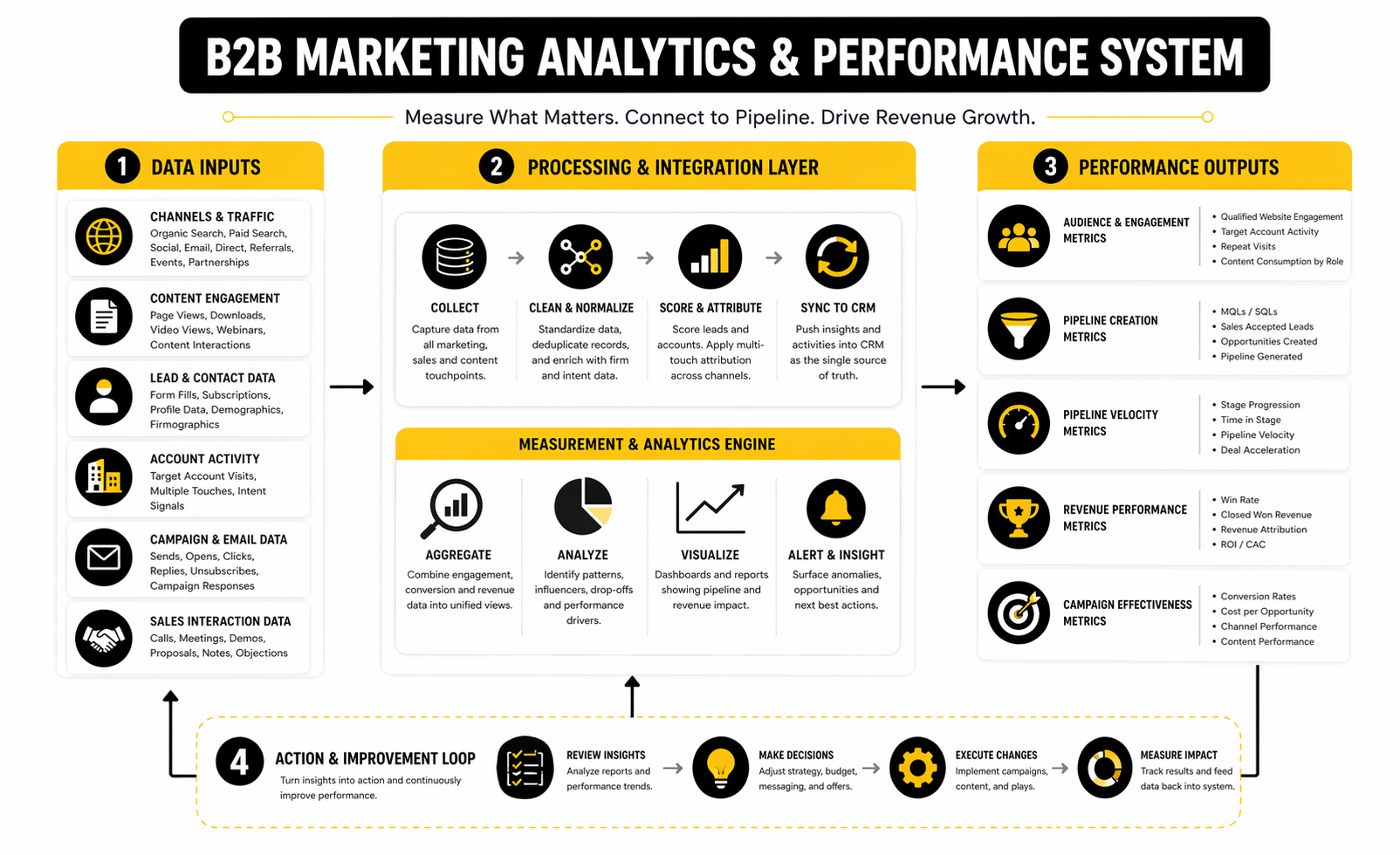
This is where attribution becomes practical instead of theoretical. RevSure’s 2025 attribution study notes that nearly 90% of respondents still rely on single-touch or basic multi-touch models, while the same study says only 18.2% use integrated attribution across channels. That matters because disconnected measurement naturally overcredits the easiest touchpoint to track and underestimates the combined effect of search, paid social, content, email, events, and direct traffic working together.
The action this should drive is straightforward. Use one CRM truth source, standardize campaign naming, normalize lead and opportunity stages, and connect contact-level data to account-level reporting. A platform like GoHighLevel can help centralize the operational side if your current stack is fragmented, but the important part is the measurement design, not the logo on the tool. If the system is clean, business to business marketing can be evaluated by influence on pipeline and revenue instead of by whichever dashboard shouts the loudest.
What the Data Should Change in Real Life
Data is only useful when it changes behavior. If target accounts are engaging but conversion is weak, the likely fix is in the offer, page, or follow-up process. If conversion into pipeline is healthy but deals stall, the problem may sit in sales enablement, proof assets, pricing communication, or internal consensus building. If engagement is broad but shallow, the market may understand the topic but not why your company is different.
That is also why historical visibility matters. RevSure reports that over 70% of marketers still lack year-over-year visibility into MQL performance, and Content Marketing Institute found that 45% of B2B marketers still lack a scalable content creation model. Those two issues are connected more than they look. If execution is inconsistent, measurement gets noisy. If measurement is noisy, teams make bad budget decisions and call it optimization.
The better standard is brutally simple: track fewer metrics, tie them to commercial stages, review them on a fixed cadence, and make one clear decision from each review. That decision might be to scale a channel, rewrite a page, cut a campaign, tighten audience selection, or change how sales follows up. Once that discipline is in place, business to business marketing stops being a reporting exercise and starts becoming a real performance system.
Looking at the Right Numbers Without Getting Lost in Them
There is no shortage of data in modern B2B marketing. The real shortage is interpretation. Strong teams know the difference between a metric that describes activity and a metric that helps predict commercial movement.
That difference matters more every year because pressure is rising to prove value faster. RevSure’s 2025 attribution research frames modern attribution as a requirement for revenue planning and cross-functional collaboration, not just analytics, while Content Marketing Institute’s 2025 benchmark shows more teams are prioritizing AI-powered automation and scalable execution. In plain English, teams are being pushed to do more, prove more, and improve faster.
The next part turns that into action by showing how to keep improving what works without turning the whole function into endless reporting and reactive tinkering.
Bringing the Whole B2B Marketing System Together
At this point, the shape of effective business to business marketing should be clear. It starts with positioning, moves through channel selection, gets stronger with useful content and demand generation, and becomes durable only when sales alignment and measurement are handled seriously. The companies that keep improving are usually not doing one magical thing better than everyone else. They are running a cleaner system.
That system matters because B2B growth is rarely driven by a single touchpoint. Buyers move between search, social proof, peer influence, email, demos, internal discussions, and budget conversations before a deal ever closes, which is exactly why recent work from 6sense on the 2025 buyer journey, Gartner on rep-free preferences, and Edelman with LinkedIn on thought leadership trust keeps landing on the same conclusion. Buyers want clarity, confidence, and credibility before they want another pitch. That means your marketing system has to work as one connected environment, not a pile of disconnected tactics.
The practical takeaway is simple. Build a system that makes discovery easier, trust faster, conversion cleaner, and follow-up more relevant. When business to business marketing does those four jobs well, growth becomes much more predictable.
FAQ
What is business to business marketing in simple terms
Business to business marketing is the process of helping one company sell products or services to another company. It includes positioning, content, campaigns, lead generation, sales enablement, and measurement, all aimed at influencing a business buying decision. The reason it feels more complex than consumer marketing is that B2B purchases usually involve more stakeholders, more risk, and a longer decision cycle.
Why is business to business marketing different from B2C marketing
The biggest difference is the buying context. In B2C, one person can often make a quick decision based on convenience, price, emotion, or habit, while B2B decisions usually involve committees, budget scrutiny, procurement steps, and operational consequences. Recent buyer research from 6sense and Gartner reinforces that B2B buyers want more independence and more proof before they engage directly.
What are the main goals of business to business marketing
The core goals are to create awareness in the right market, generate qualified demand, support sales conversations, and contribute to revenue growth. Good B2B marketing also reduces friction by helping buyers understand the problem, compare solutions, and justify the purchase internally. When those pieces are working, marketing stops being a cost center argument and starts acting like a revenue function.
Which channels work best for business to business marketing
There is no universal channel stack that works for every company, but search, LinkedIn, email, webinars, partnerships, and direct outreach consistently matter in B2B. The right mix depends on your offer, deal size, market maturity, and how buyers prefer to research. Current benchmark work from LinkedIn, Mailchimp, and ON24 shows that performance comes less from chasing every channel and more from using the right ones with discipline.
How long does business to business marketing take to show results
Some channels can produce early signals within weeks, but meaningful B2B results usually take longer because trust and internal decision-making take time. Search content, email nurturing, thought leadership, and account-based campaigns often compound rather than spike. That is why smart teams watch leading indicators first, then pipeline movement, then revenue, instead of expecting instant closed-won results from every campaign.
What content works best in business to business marketing
The best content usually helps buyers make progress, not just consume information. That includes comparison pages, implementation guides, category explainers, ROI content, case-backed proof, webinar sessions, product walkthroughs, and objection-handling assets. The 2025 research from Content Marketing Institute and Edelman with LinkedIn shows that useful expertise and credible thought leadership still carry real weight when buyers are evaluating risk.
Is SEO still worth it for B2B companies
Yes, but not in the lazy way many teams used to approach it. B2B SEO works when it targets real buying questions, category comparisons, and specific commercial use cases instead of publishing broad filler content that never helps someone make a decision. Search is still valuable because it captures existing intent, but the bar is higher now, especially as Google keeps changing how results are displayed and summarized in search experiences documented by Google.
How important is sales and marketing alignment in B2B
It is critical, and honestly, a lot of teams still underestimate this. If marketing attracts the wrong audience, or sales ignores the context behind a lead, pipeline quality drops fast and both teams blame each other. Alignment works best when both sides share definitions, stages, follow-up rules, and visibility into what actually moves deals forward.
What metrics should B2B marketers care about most
The useful answer is not more metrics. It is better metrics tied to commercial stages, such as qualified engagement, target account activity, sales-accepted opportunities, pipeline created, win rate, and revenue contribution. Attribution research from RevSure is a good reminder that fragmented reporting still creates blind spots, so the real priority is building a system that connects activity to pipeline without pretending every touch deserves equal credit.
Is account-based marketing the same thing as business to business marketing
No, account-based marketing is one approach inside a larger B2B marketing strategy. It is especially useful when you are selling to a defined set of target accounts and need tight coordination between marketing and sales. Business to business marketing is broader because it includes positioning, content, channels, lifecycle systems, analytics, and brand trust in addition to account-specific plays.
Can small companies do business to business marketing well without a huge team
Yes, and in some cases they do it better because they are forced to stay focused. A smaller team can win by choosing one market, sharpening one message, building a small number of strong assets, and running one clear system instead of trying to imitate enterprise complexity. The real advantage comes from relevance and consistency, not from having the biggest department.
Should B2B companies use automation and AI heavily
They should use them deliberately, not blindly. Automation is excellent for routing, follow-up, segmentation, scheduling, and cleaning up repetitive work, while AI can help with research support, production speed, and workflow orchestration. The pattern highlighted in the latest LinkedIn B2B benchmark and Content Marketing Institute research is that mature teams are moving past novelty and using these tools to strengthen execution quality.
What is the biggest mistake in business to business marketing
The most common mistake is confusing motion with progress. Teams launch campaigns, publish content, and generate dashboards, but the message is weak, the offer is unclear, and the follow-up process is messy. When that happens, business to business marketing looks active from the outside while pipeline quality quietly gets worse underneath.
Work With Professionals
Explore 10K+ Remote Marketing Contracts on MarkeWork.com
Most marketers spend too much time chasing clients, competing on crowded platforms, and losing a percentage of every project to middlemen. MarkeWork gives you a better way. Browse thousands of remote marketing contracts and connect directly with companies desperate to hire skilled marketers like you, without platform commissions and without unnecessary gatekeepers.
If you're serious about finding better opportunities and keeping 100% of what you earn, explore available contracts and create a profile for free at MarkeWork.com.