

Buying an email list for marketing sounds like the fastest shortcut in the world. You skip the slow audience-building work, upload thousands of contacts, and start selling. That is the fantasy.
The reality is sharper. Purchased lists can create legal risk, wreck sender reputation, trigger spam complaints, and get accounts suspended by email platforms that prohibit third-party lists. The smarter question is not “Where can I buy emails?” It is “How do I reach the right people without poisoning my growth engine?”
- Why Buying Email Lists Is So Risky
- The Legal And Deliverability Framework
- What Makes A Contact Usable
- Safer Ways To Build A Marketing List
- Professional Implementation For Email Growth
- Tools, Checklist, And FAQ
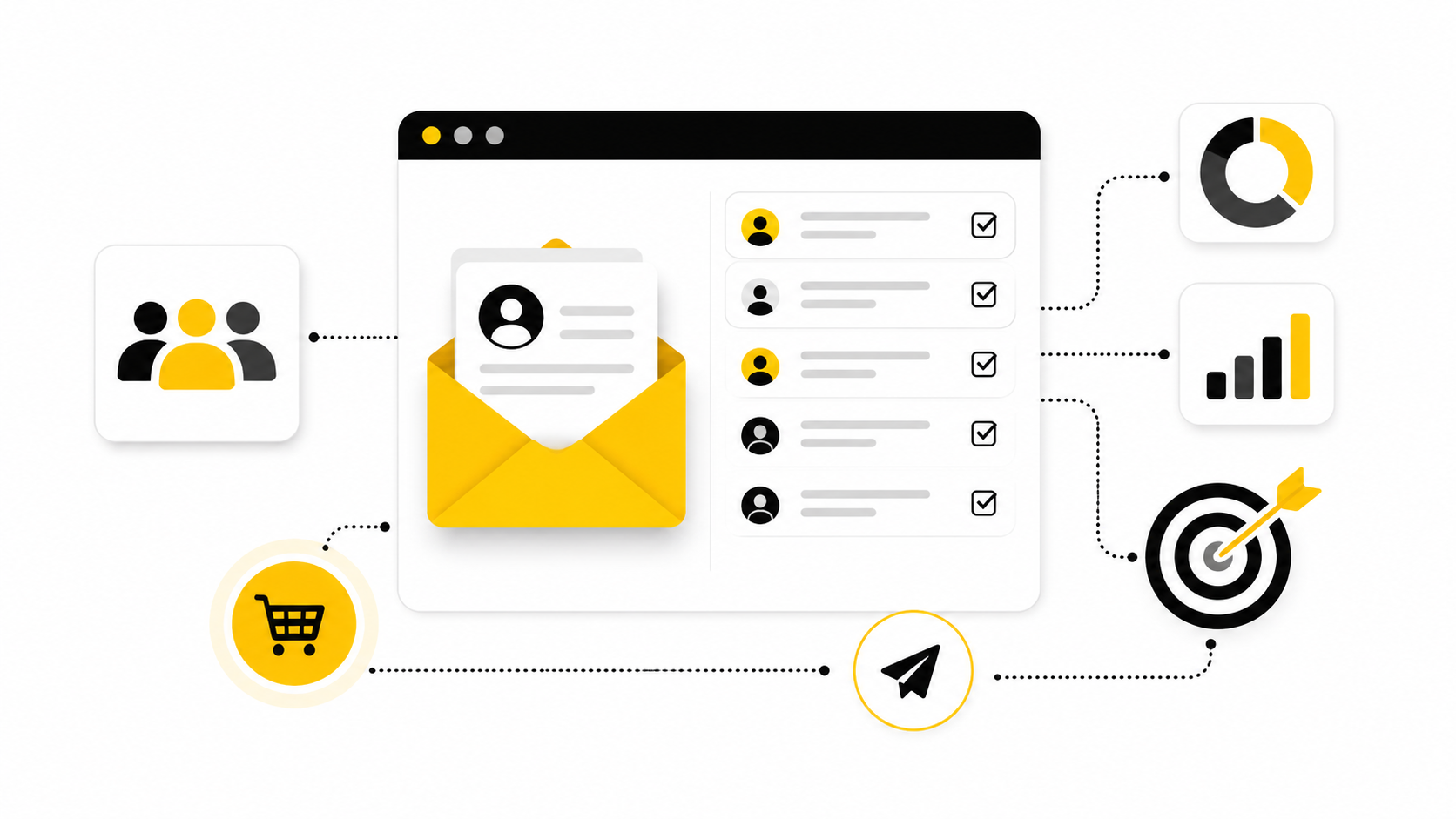
Why Buying Email Lists Is So Risky
Email still matters because it is one of the few channels where you can build a direct relationship with prospects and customers. But that only works when people recognize you, expect your messages, and have a clear reason to engage. The moment you send campaigns to strangers who never asked to hear from you, the channel starts working against you.
The risk is not only about annoyance. The FTC’s CAN-SPAM guidance requires truthful headers, non-deceptive subject lines, a valid postal address, and a clear opt-out process for commercial email. In the UK and EU context, the ICO’s guidance on electronic mail marketing is stricter for individuals because marketing emails generally need specific consent unless a narrow soft opt-in applies.
Deliverability is the second wall. Gmail requires bulk senders to authenticate mail, make unsubscribing easy, and keep spam complaints low, while Yahoo’s sender guidance says senders should keep spam rates below 0.3%. That means a cheap list can damage the very infrastructure you need for real customers, abandoned-cart flows, onboarding sequences, launches, and newsletters.
Framework Overview
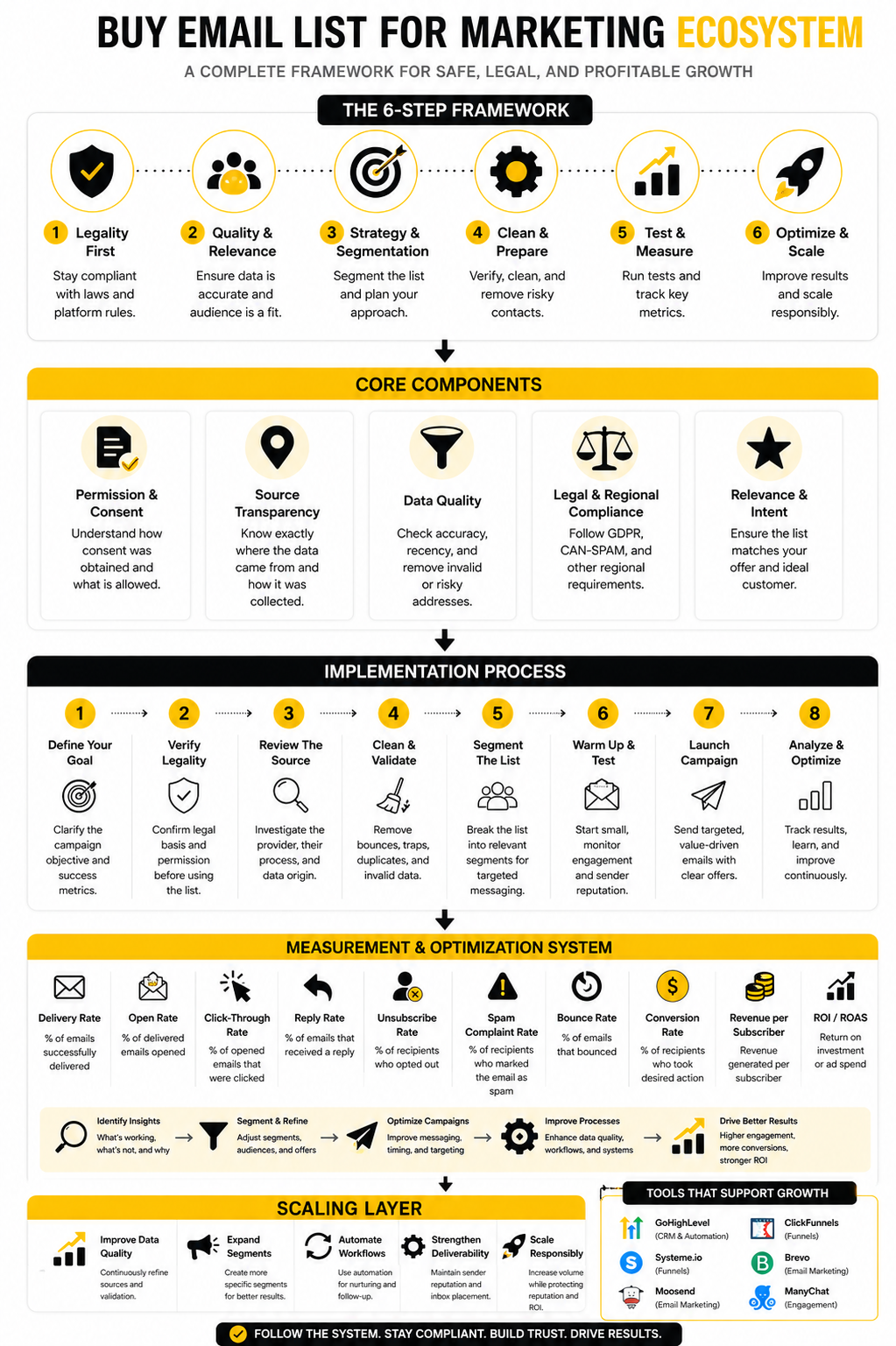
The practical framework is simple: legality, permission, quality, relevance, and infrastructure. If any one of those breaks, the campaign becomes fragile. A list can look large in a spreadsheet and still be useless in the inbox.
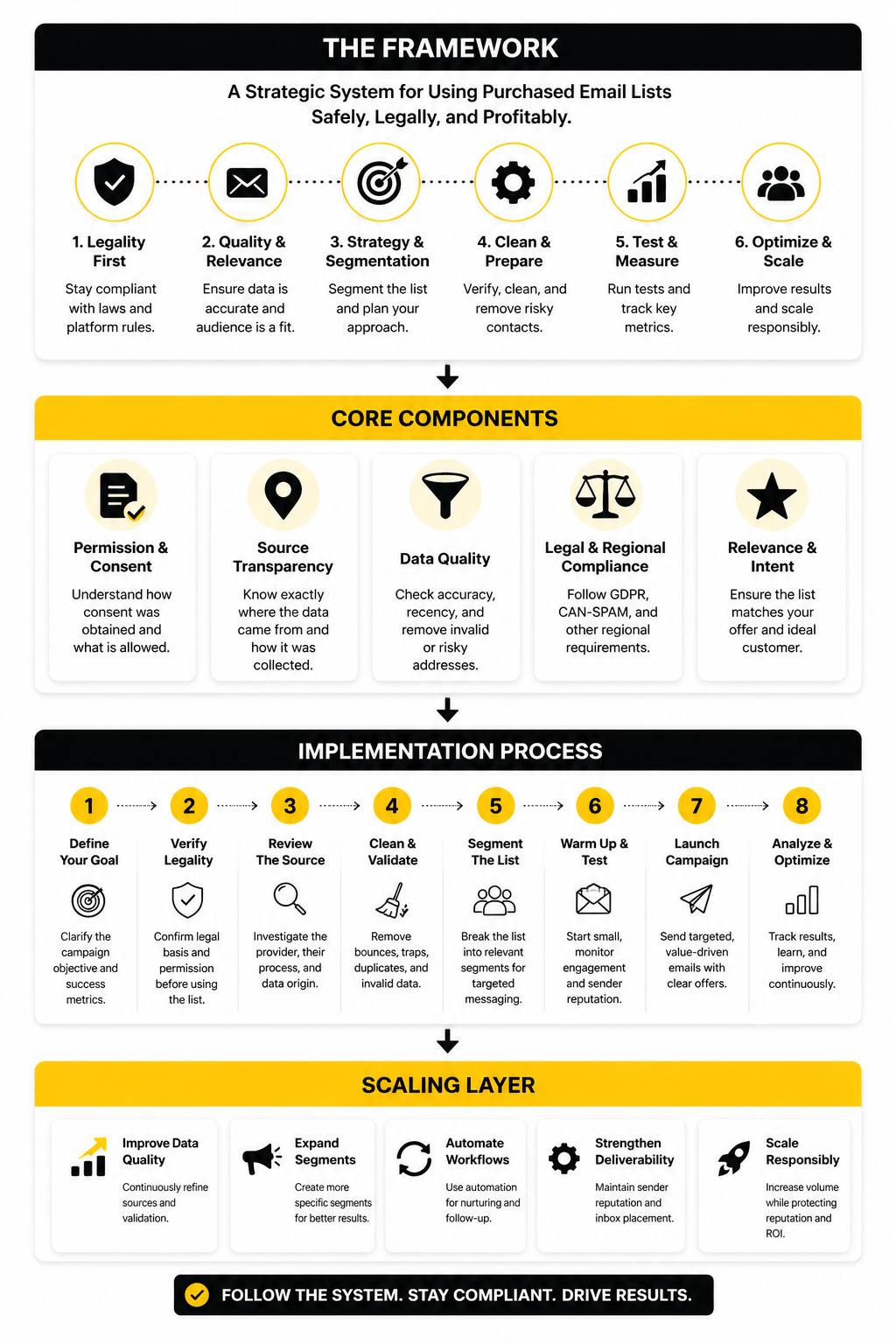
Legality asks whether you have the right to contact the person in the market where they live. Permission asks whether they clearly agreed to receive messages from your brand, not just “selected partners.” Quality asks whether the data is accurate, recent, and free from traps, role accounts, scraped contacts, and dead addresses.
Relevance is where most marketers fool themselves. A founder, CMO, or ecommerce manager is not a good prospect just because they match a title. They need a problem, a timing signal, a category fit, and a reason your message belongs in their day.
Core Components Of A Safer Email Growth System
A safer system starts with owned acquisition. Lead magnets, webinars, waitlists, product quizzes, checkout opt-ins, creator partnerships, and content upgrades may feel slower than buying a database, but they create permission and intent. That is what makes the list valuable.
Your email platform matters too. If you are building marketing automations, segmentation, pipelines, and follow-up workflows, tools like GoHighLevel, Brevo, or Moosend fit better than trying to force a purchased list into a system designed for consent-based marketing. The tool will not save a bad list, but the right setup helps you protect reputation once your acquisition is clean.
The core idea is boring but profitable: build lists people actually belong on. That means clear consent, useful segmentation, working unsubscribe links, authenticated sending domains, and messages that match the reason someone joined. When you do that, email becomes an asset instead of a liability.
The Legal And Deliverability Framework
When people search for how to buy email list for marketing, they usually want a simple answer. Can I use it or not? The honest answer is that it depends on where the recipient is, how the data was collected, what permission exists, and whether your sending setup can survive the response.
In the United States, the FTC’s CAN-SPAM compliance guide focuses on truthful identity, honest subject lines, a valid physical address, and a working opt-out process. That does not magically make every purchased list a smart idea. It only means the legal baseline is different from markets where prior consent is often required.
In the UK, the ICO’s electronic mail marketing guidance explains that individual subscribers generally need consent unless the soft opt-in applies. The soft opt-in is not a loophole for random bought contacts. It is mainly for existing customers who gave you their details, had a clear chance to opt out, and are being contacted about similar products or services.
Permission Is Not The Same As Data Access
A vendor may be able to sell you a spreadsheet, but that does not mean you have permission to market to every person in it. This is the part many businesses skip, and it is where the trouble starts. Access to an address is not the same thing as consent, intent, or trust.
The cleanest question is simple: did this person knowingly agree to receive marketing from your brand? If the answer is no, you should treat the contact as high risk. If the answer is “they opted in to partner offers,” you still need to understand the wording, jurisdiction, data source, and proof trail before sending anything.
This matters because enforcement is only one side of the problem. The inbox is controlled by recipient behavior. If people ignore, delete, unsubscribe, or report your messages, mailbox providers learn fast.
Deliverability Has Become Less Forgiving
Email providers have tightened the rules because inboxes are under constant pressure from spam, phishing, and low-quality bulk campaigns. Gmail’s sender rules require all senders to authenticate outgoing mail, avoid unwanted messages, and make unsubscribing easy, with extra requirements for senders delivering more than 5,000 messages per day to Gmail accounts. Yahoo’s sender best practices also emphasize authentication and keeping spam complaints below 0.3%.
That 0.3% number is brutal in practice. It means three spam complaints per 1,000 delivered messages can put a sender into dangerous territory. A purchased list full of people who do not know you can hit that threshold quickly, even if the copy is polished.
This is why buying an email list for marketing often fails before the offer gets a fair test. The damage happens at the reputation layer. Once your domain or IP looks risky, even your legitimate emails can start landing in spam or getting blocked.
The Five-Part Risk Check
Before using any external contact source, run it through a practical risk check. This is not legal advice, but it is a strong operating filter for marketers who care about long-term results. If a list cannot pass these questions, it should not touch your main sending domain.
- Source: Can the vendor explain exactly how the contacts were collected?
- Permission: Can they prove the recipient agreed to receive marketing from your brand or a clearly defined category?
- Jurisdiction: Are you following the rules for where the recipient lives, not just where your company is based?
- Freshness: Is the data recent enough to avoid dead addresses, recycled inboxes, and role accounts?
- Relevance: Is there a strong business reason this person would expect your message?
The point is not to make purchased data look cleaner than it is. The point is to protect the asset you are building. Your domain reputation, CRM, automation workflows, and customer communication channels are worth more than a cheap database.
What To Do If You Already Bought A List
Do not upload it into your primary email marketing platform and blast it. That is the fastest way to turn a questionable decision into a bigger problem. Slow down and separate validation, compliance review, and outreach strategy before anything is sent.
Start by checking whether the vendor gave you usable proof of collection, consent language, source dates, suppression handling, and geographic coverage. Remove personal emails where consent is unclear, remove role-based addresses, and do not contact people in stricter consent markets unless you have a lawful basis you can document. If you cannot explain why a recipient is on the list, they should not receive a marketing campaign.
Then decide whether email is even the right first touch. In many cases, the safer path is to use the data for research, account prioritization, ad audience strategy where permitted, or manual business development rather than mass promotional sending. That may feel slower, but it keeps your real email list clean and your brand intact.
What Makes A Contact Usable
A usable marketing contact is not just an email address that passes verification. That is too low a bar. A usable contact has a clear source, a lawful basis, a relevant reason to hear from you, and enough context for you to send something specific instead of generic noise.
This is where many marketers get the buy email list for marketing decision wrong. They treat list quality like a technical problem, when it is really a trust problem first. Verification can tell you whether an inbox may exist, but it cannot prove the person wants your offer, recognizes your brand, or expects your message.
The practical standard is higher: you should be able to explain why the person is in your system, what they are likely interested in, and why your first message is reasonable. If you cannot answer those three things, the contact is not ready for a marketing campaign.
Start With The Source
The first step is source review. Ask where the contact came from, when it was collected, what page or form created the record, and what consent language was shown at the time. If a vendor cannot answer that clearly, you do not have a list problem; you have a proof problem.
For consent-based markets, that proof matters because permission needs to be specific enough to mean something. The ICO’s direct marketing guidance makes clear that electronic mail marketing depends heavily on consent or a valid soft opt-in. Broad language like “selected partners may contact you” is not the same as a clean relationship with your brand.
Even in markets where opt-out rules are more flexible, source quality still affects performance. People who do not remember opting in are more likely to ignore, unsubscribe, or complain. That reaction is what mailbox providers see.
Separate Research Data From Marketing Data
Not every contact record should become a campaign recipient. Some data is useful for research, account mapping, sales planning, or enrichment, but still not suitable for bulk email. This distinction protects you from using a spreadsheet in the wrong way.
For example, a list of companies in your target industry can help you define segments, build landing pages, plan ads, or prioritize outreach. That does not automatically mean every person in that file should receive a promotional sequence. The contact may be useful, but the channel choice may still be wrong.
This is a better way to think about purchased or third-party data. Use it to understand the market, then create a permission-based path where people choose to engage. That is slower than blasting, but it gives your email program a real chance.
Safer Ways To Build A Marketing List
The safest alternative is not “do nothing.” The safer alternative is to build demand capture systems that turn attention into permission. You still move aggressively, but you stop pretending that strangers in a database are the same as subscribers.
A strong list-building system usually starts with a clear offer. That could be a checklist, calculator, demo, webinar, audit, buyer guide, free course, discount, or waitlist. The asset must be useful enough that the right person understands why giving an email address makes sense.
This also gives your first email a natural reason to exist. Instead of opening with a cold sales pitch, you can deliver the promised resource, set expectations, and invite the next step. That is how email starts feeling like a relationship instead of an interruption.
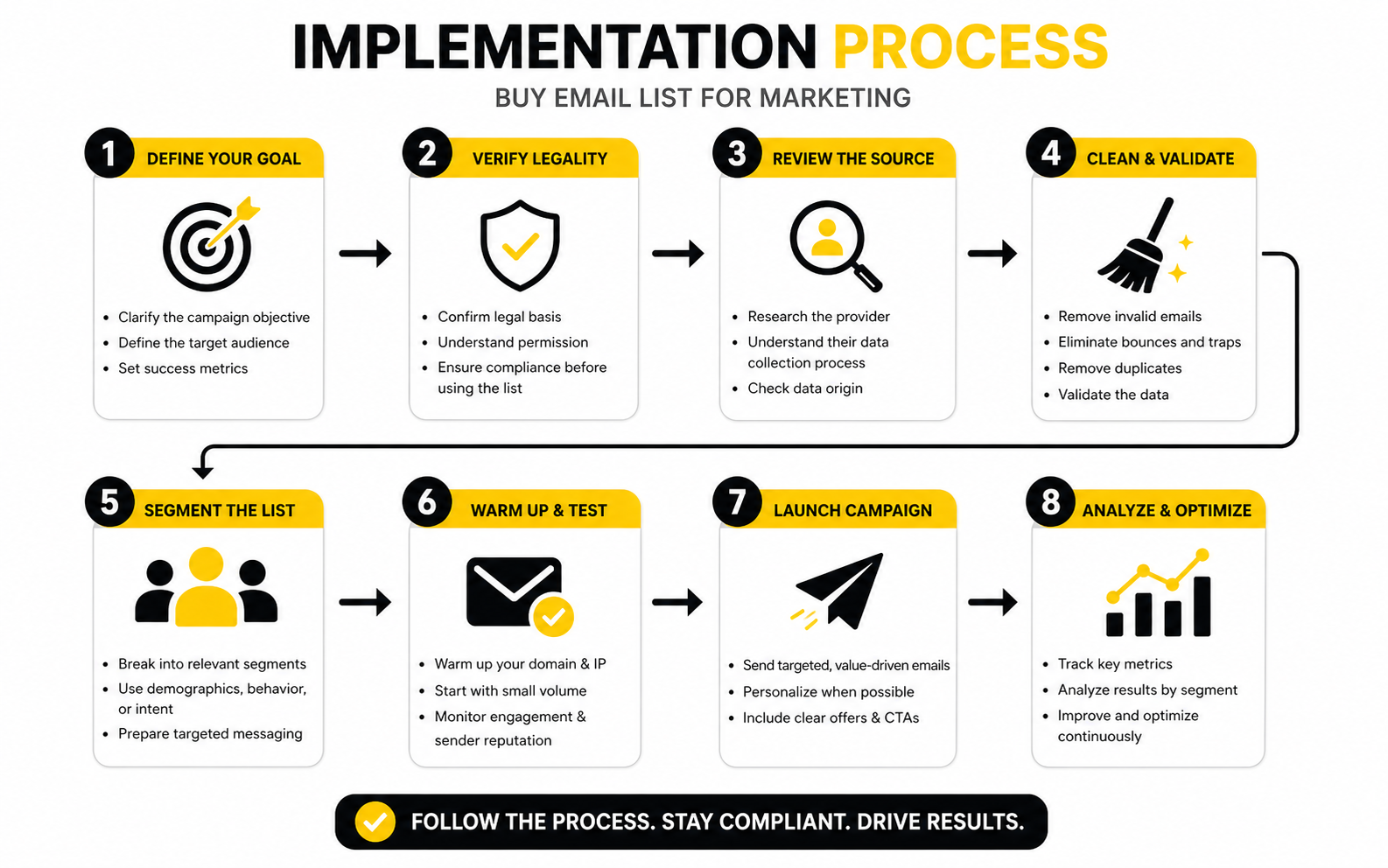
Build The Capture Path
The execution process is simple, but every step has to be clean. Start with one audience, one problem, and one promise. Then build the smallest path that captures permission and moves the person toward a useful next action.
- Define the audience you want to reach.
- Choose one painful problem they already understand.
- Create a lead magnet or offer that helps with that problem.
- Build a focused landing page with a clear opt-in.
- Explain what subscribers will receive after signing up.
- Send the promised resource immediately.
- Follow up with helpful emails before asking for a sale.
Tools can make this easier, but they should not complicate the strategy. If you need funnels, checkout pages, and opt-in flows, ClickFunnels or Systeme.io can help you create the path. If you need forms for quizzes, applications, surveys, or intake flows, Fillout can be useful because the form itself becomes part of the segmentation.
Use Segmentation From The Beginning
Do not wait until your list is large to segment it. Segmentation is easiest when you collect the right signals from the start. Ask one or two useful questions at opt-in, then use behavior to refine what people receive next.
For B2B, that might mean role, company size, use case, or buying timeline. For ecommerce, it might mean product category, style preference, budget, or first-purchase intent. For creators and consultants, it might mean experience level, desired outcome, or biggest obstacle.
The goal is not to collect everything. The goal is to collect enough to avoid sending the same generic message to everyone. Relevance is what keeps your unsubscribe and complaint risk down while improving conversion quality.
Warm Up The Relationship Before Selling Hard
The first few emails should prove that subscribing was a good decision. Deliver the promised asset, explain how to use it, and give the reader a quick win. Then introduce your paid offer only when the context feels earned.
A simple welcome sequence can do more for revenue than a giant unqualified list. One email can deliver the resource, one can explain the problem more clearly, one can show the cost of inaction, and one can invite a consultation, demo, purchase, or reply. That flow works because it respects the path the subscriber chose.
This is the opposite of blasting a bought list. You are not trying to force attention from people who never asked for you. You are creating a small commitment, building trust, and turning that trust into measurable pipeline.
Statistics And Data
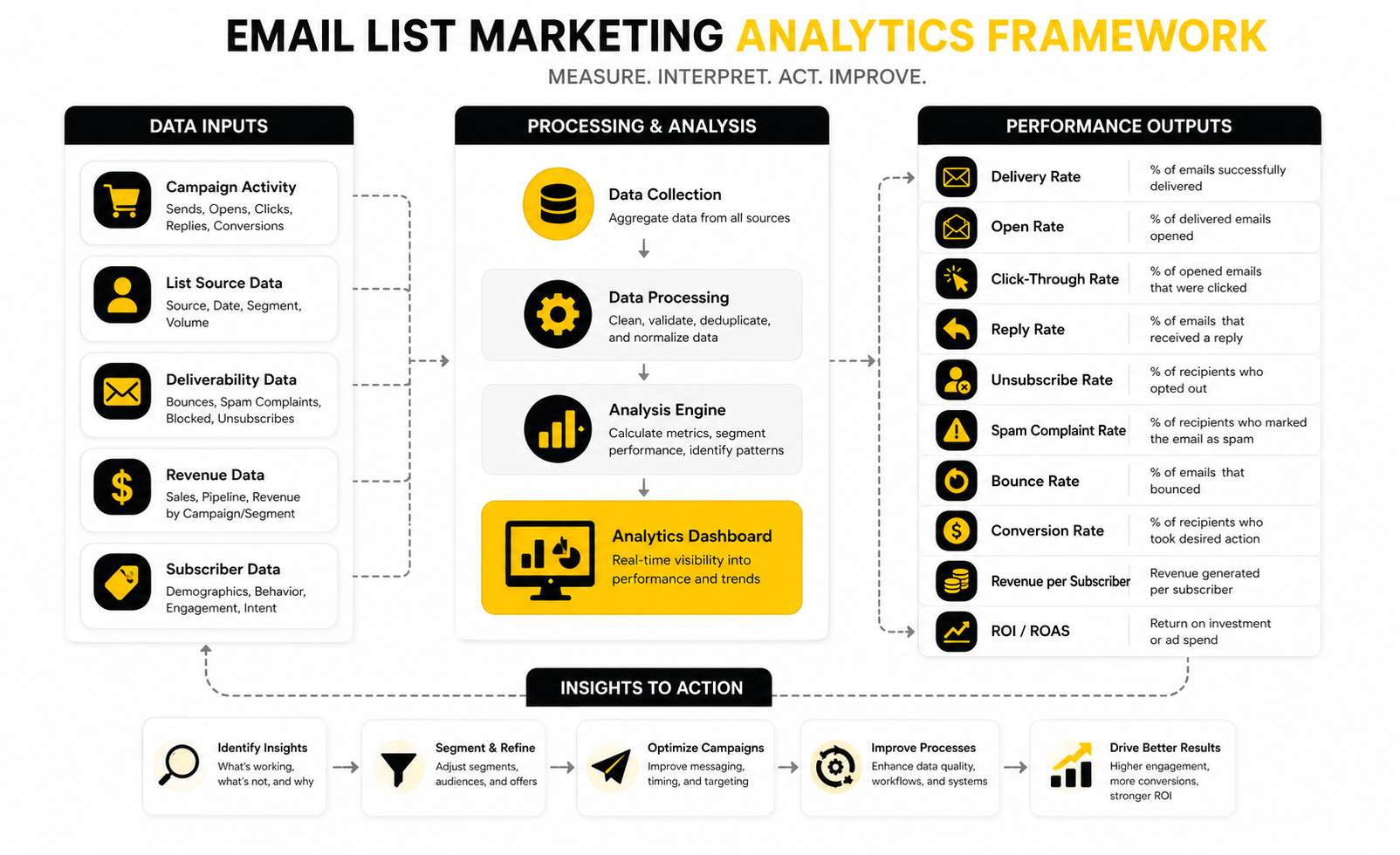
Data should not be used to justify blasting strangers. It should be used to decide whether your email program is healthy, trusted, and profitable. When someone wants to buy email list for marketing, the numbers that matter most are not list size or “verified contacts.” The numbers that matter are deliverability, complaints, engagement quality, conversion, and revenue per subscriber.
This is where a lot of marketers lie to themselves. A campaign can have a big send volume and still be a bad campaign. If the audience did not ask for the message, every metric becomes harder to interpret because low engagement may reflect weak targeting, weak permission, weak timing, or all three at once.
The Metrics That Actually Matter
Open rate can be useful, but it is not the final truth. Privacy changes, image loading, bot activity, and inbox behavior can distort it. Treat opens as a directional signal, not a business result.
Click rate is stronger because it shows active interest. MailerLite’s 2025 benchmark data reported an average email click rate of 2.09% across its benchmark dataset, which gives you a rough reference point for consent-based email performance. If a purchased list produces a tiny fraction of that, the problem is usually not the button color.
Complaint rate is the metric you cannot ignore. Gmail’s sender guidance says bulk senders with user-reported spam rates above 0.3% become ineligible for mitigation, and Yahoo’s sender best practices also tell senders to keep spam rates below 0.3%. In plain English, three complaints per 1,000 inboxed emails can become a serious deliverability problem.
How To Read The Numbers
Do not compare a cold purchased list against your best subscribers and pretend the difference is only creative. They are different audiences with different expectations. A person who downloaded your guide, joined your webinar, or bought from you has a reason to recognize your name.
The first comparison should be source by source. Measure subscribers from organic search, paid ads, referrals, webinars, checkout opt-ins, partner campaigns, and any third-party data separately. If one source creates more complaints, fewer clicks, and fewer conversions, you have a source-quality issue.
The second comparison should be cohort based. Look at people who joined this week, last month, and three months ago. If engagement collapses immediately after signup, your promise is misaligned; if it decays slowly, your nurture and offer strategy may need work.
Benchmarks Are Guardrails, Not Goals
Benchmarks help you avoid flying blind, but they are not a strategy. A software company, local service business, ecommerce brand, and creator newsletter will not share the same healthy baseline. Your real benchmark is your own performance by audience, offer, and source.
Still, there are useful guardrails. Unsubscribe spikes usually mean expectation mismatch. Complaint spikes usually mean permission or relevance problems. Click-through weakness usually means the message, offer, segment, or timing is not strong enough.
Email’s upside is still real when the list is earned. Litmus reports that 35% of companies see email ROI of 36:1 or more, which is exactly why protecting the channel matters. You do not protect that upside by pushing low-permission contacts through the same infrastructure you use for customers.
Build A Simple Measurement System
You do not need a complicated dashboard to make better decisions. You need clean source tracking, consistent campaign tags, and a weekly view of the numbers that reveal trust. The goal is to spot risk before mailbox providers or customers punish you.
Track these signals every week:
- Delivery rate by source
- Bounce rate by source
- Spam complaint rate by source
- Unsubscribe rate by source
- Click rate by source
- Reply rate for sales-led outreach
- Conversion rate by offer
- Revenue per subscriber
- Time from opt-in to first meaningful action
A CRM and automation platform like GoHighLevel can help connect forms, pipelines, follow-up, and revenue attribution in one place. For email-focused teams, Brevo or Moosend can support segmentation and campaign reporting. The tool matters less than the discipline: every new contact source should be measured before it gets scaled.
What The Data Should Make You Do
Good data should change behavior. If complaint rates rise, reduce volume, suppress weak segments, and review permission. If clicks are low but opens are acceptable, improve the offer and call to action before blaming the list.
If conversions are low after clicks, the issue may be the landing page, pricing, proof, or sales process. That is where funnel tools like ClickFunnels or Systeme.io can help you test clearer pages and cleaner next steps. But again, no funnel can rescue a list that never wanted the email.
The real win is not having the biggest list. The real win is knowing which contacts trust you enough to act. That is the measurement mindset that keeps email profitable instead of risky.
Professional Implementation For Email Growth
At an advanced level, the decision is not simply whether to buy email list for marketing. The better decision is how to build a growth system where every contact source has a job, a risk profile, and a clear path to revenue. That is how serious operators think.
A purchased list is usually attractive because it promises speed. But speed without control is dangerous. If the source creates weak engagement, legal uncertainty, spam complaints, and platform risk, the list is not an asset; it is a liability disguised as reach.
Separate Your Growth Channels By Permission Level
Not every audience should be treated the same way. Someone who booked a demo, joined a webinar, downloaded a guide, replied to a sales email, or bought from you has a different relationship with your brand. Your system should reflect that difference.
Use permission level as the first strategic filter. High-permission contacts can receive newsletters, nurture sequences, offers, product education, and launch emails. Low-permission contacts should stay out of promotional automations until they take a clear action that changes the relationship.
This protects your best channels from your riskiest experiments. If you test a third-party source, do not mix it into your core customer list, newsletter audience, or main promotional calendar. Keep the experiment contained, measured, and easy to shut down.
Build A Suppression Strategy Before Scaling
A suppression strategy sounds boring until it saves your domain. Suppression is the process of excluding contacts who should not receive messages, even if they technically exist in your database. This includes unsubscribes, bounced addresses, complainers, inactive contacts, competitors, customers who should not get prospecting offers, and regions where you do not have the right permission.
This is where many teams create silent damage. They keep importing contacts, syncing tools, launching campaigns, and retargeting audiences without one clean source of truth. Eventually, the same person gets too many messages from too many angles, and the brand feels sloppy.
Your suppression rules should be stricter than the minimum platform requirements. Mailchimp states that purchased lists violate its permission-based model, and Brevo’s anti-spam policy says solicitations must be legitimate and expected by recipients. That tells you where the industry is headed: platforms want permission, expectation, and clean consent trails.
Use Third-Party Data For Targeting, Not Blasting
Third-party data is not always useless. It can help you identify accounts, understand market segments, enrich CRM records, prioritize sales territories, or build better creative angles. The mistake is assuming that useful intelligence automatically equals permission to send bulk marketing emails.
A smarter approach is to use external data to improve the path into consent. Build account lists, then run ads to useful resources. Create industry-specific landing pages. Use sales research to personalize one-to-one outreach where legally appropriate. Invite people into a webinar, checklist, calculator, or diagnostic that gives them a reason to opt in.
That shift changes the whole game. You are no longer asking a cold spreadsheet to act like a warm audience. You are using data to find the right people, then giving those people a cleaner way to raise their hand.
Protect Your Sending Infrastructure
Your email infrastructure is part of your revenue system. Treat it like an asset. That means using authenticated domains, separating risky experiments from core customer communication, monitoring reputation, and avoiding sudden volume spikes.
Gmail’s sender guidance requires authentication and explains that bulk senders with user-reported spam rates above 0.3% are ineligible for mitigation. That threshold should shape your operating discipline. If a source might generate complaints, it should never be tested at full scale on your main domain.
For established businesses, it can make sense to separate categories of email. Transactional messages, customer updates, newsletters, lifecycle campaigns, and sales outreach should not all depend on the same fragile setup. The goal is resilience, not complexity for its own sake.
Decide When To Stop
Scaling is not just doing more of what worked once. Scaling means increasing volume only when the source keeps producing healthy signals. If a contact source gives you low clicks, high unsubscribes, weak conversions, or complaint risk, the smart move is to stop instead of trying to “optimize” a broken foundation.
Create clear stop rules before a campaign launches. For example, pause a source if complaints rise, if bounce rates exceed your internal limit, if replies show confusion about why people were contacted, or if revenue does not justify the risk. This keeps ego out of the decision.
The best marketers are not attached to a tactic. They are attached to the outcome. If buying a list threatens deliverability, customer trust, or platform access, it is not growth. It is borrowed attention with interest due later.
Scale The Permission Engine Instead
Once you know which opt-in sources create engaged subscribers, put more money and creative energy there. Improve the lead magnet, sharpen the landing page, test stronger forms, build better follow-up, and connect email behavior to sales outcomes. That is how you turn list growth into predictable pipeline.
A tool like GoHighLevel can help if you need CRM, funnels, automation, pipeline tracking, and follow-up in one system. ClickFunnels or Systeme.io can work well when the priority is building focused opt-in and sales paths. ManyChat can also support list growth when social conversations naturally lead into permission-based follow-up.
The strategic move is simple: scale what earns attention, not what steals it. A smaller list of people who asked to hear from you will outperform a larger list of strangers in the only places that matter: trust, deliverability, conversion, and long-term revenue.
FAQ - Built For Complete Guide
Is It Legal To Buy Email List For Marketing?
Sometimes a list can be purchased legally, but that does not automatically make it usable for marketing. The real question is whether you have the right permission, a lawful basis, and a clear reason to contact each person. In stricter markets, especially where consent rules apply, a purchased list can become risky very quickly.
Can I Send Marketing Emails To A Purchased List In The United States?
The United States uses an opt-out model under the FTC’s CAN-SPAM compliance guide, so commercial email must follow rules around truthful identity, honest subject lines, physical address, and opt-out handling. That does not mean purchased lists are smart. You can still damage deliverability, trigger complaints, and violate platform policies.
Can I Send Purchased List Emails In The UK Or EU?
For individual subscribers in the UK, the ICO’s electronic mail marketing guidance says you generally need specific consent unless the soft opt-in applies. The soft opt-in usually depends on an existing customer relationship, not a random bought contact. That makes purchased personal email lists especially dangerous for broad campaigns.
Why Do Email Platforms Dislike Purchased Lists?
Email platforms depend on deliverability, sender trust, and recipient engagement. Purchased lists usually create weaker signals because recipients often do not recognize the sender. That means more bounces, unsubscribes, spam complaints, and account reviews.
What Spam Complaint Rate Is Dangerous?
Gmail says senders should keep spam rates below 0.1% and prevent rates from reaching 0.3% or higher. Yahoo also tells bulk senders to stay below 0.3%. That means even a small number of complaints can create serious risk when you send at scale.
Is Email Verification Enough?
No. Verification can help identify invalid or risky addresses, but it does not prove consent or interest. A verified address can still belong to someone who never asked to hear from you.
What Should I Do Instead Of Buying A List?
Build a permission-based list through lead magnets, webinars, useful content, checkout opt-ins, waitlists, quizzes, and partner campaigns. The goal is to give people a reason to subscribe before you ask them to buy. A smaller list with clear intent is usually more valuable than a larger list of strangers.
Can I Use Purchased Data For Anything Safely?
Yes, but not automatically for bulk email. Third-party data can support market research, account planning, segmentation, ad strategy, or one-to-one sales research where appropriate. The safer move is to use data to identify the right audience, then create a permission-based path into your email list.
What Tools Help Build A Cleaner Email System?
For CRM, funnels, automations, and pipeline tracking, GoHighLevel can help centralize the system. For focused funnel pages, ClickFunnels and Systeme.io can help capture permission. For email campaigns and segmentation, Brevo and Moosend are worth considering.
How Do I Know If A List Source Is Working?
Track performance by source, not just total campaign results. Watch bounce rate, complaint rate, unsubscribe rate, click rate, conversion rate, and revenue per subscriber. If one source creates weak engagement or high complaints, stop scaling it.
Should I Use A Separate Domain For Risky Outreach?
Separating infrastructure can reduce damage, but it does not fix bad permission. A separate domain may protect your main customer communication channel, yet poor outreach can still hurt your brand. Use separation as a safety layer, not as permission to send low-quality campaigns.
What Is The Best Final Rule?
Do not build your email strategy around people who never asked to hear from you. Build it around useful offers, clear consent, strong segmentation, and measurable trust. That is how email becomes a long-term asset instead of a short-term gamble.
Work With Professionals
Explore 10K+ Remote Marketing Contracts on MarkeWork.com
Most marketers spend too much time chasing clients, competing on crowded platforms, and losing a percentage of every project to middlemen.
MarkeWork gives you a better way. Browse thousands of remote marketing contracts and connect directly with companies desperate to hire skilled marketers like you, without platform commissions and without unnecessary gatekeepers.
If you're serious about finding better opportunities and keeping 100% of what you earn, explore available contracts and create a profile for free at MarkeWork.com.