

BuzzSumo is easy to underestimate if you have only seen it used for finding popular headlines. That is the shallow version. The deeper version is a research and monitoring platform that helps teams spot what is gaining traction, which topics keep earning attention, who is shaping the conversation, and where a brand should react before a trend passes by. BuzzSumo’s product pages describe the platform around content discovery, content research, monitoring, influencers, a Chrome extension, and an API, which is a much broader stack than most marketers remember from its earlier reputation.
That wider view matters more now than it did a few years ago. Google continues to push creators toward helpful, reliable, people-first content, while discovery itself has become messier because a large share of searches end without a click and audience attention is spread across search, social, communities, newsletters, and AI-assisted discovery. In that environment, a tool like BuzzSumo is not just about content ideation. It is about reducing guesswork before you invest time, budget, and editorial energy in a topic.

- Why BuzzSumo Matters in 2026
- A Simple Framework for Using BuzzSumo
- The Core Tools Inside BuzzSumo
- Smart Ways to Use BuzzSumo for Content, PR, and SEO
- Professional Implementation for Teams and Agencies
- Pricing, Limits, and When to Choose an Alternative
Why BuzzSumo Matters in 2026
BuzzSumo still matters because content teams are under pressure to publish work that is both original and commercially useful. Recent industry research shows marketers are still leaning harder into video, thought leadership, and AI-supported workflows, while blogging remains one of the formats marketers keep using and investing in. That combination creates a practical problem: teams need faster research, sharper prioritization, and better evidence for why one angle deserves production time over another.
This is where BuzzSumo earns its place. Its current product structure is built around finding content patterns, tracking mentions and trends, identifying relevant creators and journalists, and extending that data into workflows through browser-based research and API access. For a solo operator, that can mean fewer weak content bets. For an agency or in-house team, it can mean a more defensible editorial process because topic selection is tied to observable traction instead of opinion alone.
There is also a timing advantage here that many teams miss. When Google emphasizes people-first content, the bar is not simply to publish more. The bar is to publish material that is genuinely useful, clearly targeted, and informed by what audiences are already engaging with across the web. BuzzSumo helps with the research side of that equation, which is why it keeps showing up in serious content, PR, and competitive intelligence workflows instead of disappearing as just another old-school social sharing tool.
A Simple Framework for Using BuzzSumo
The biggest mistake people make with BuzzSumo is using it like a random idea generator. They search a broad keyword, glance at a few high-engagement articles, and assume they now understand the market. That usually leads to shallow copycat content, which is exactly what strong teams are trying to avoid.
A better approach is to treat BuzzSumo as a decision system. You use it to move from noise to patterns, from patterns to angles, and from angles to formats that your team can actually publish well. That matters because many content teams still do not have a scalable creation model, while 45% say they lack one entirely, so better research discipline is not optional anymore.
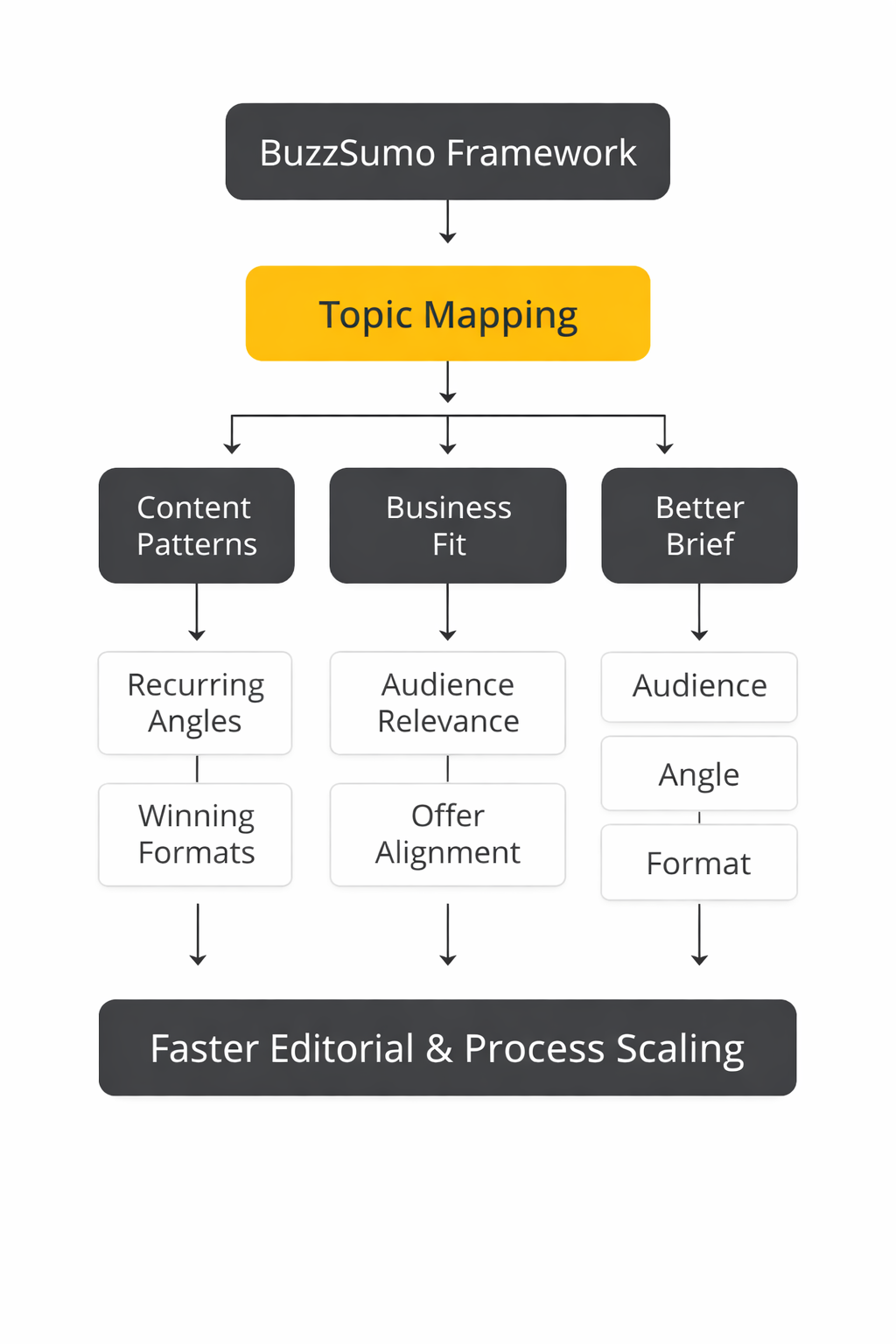
The simplest working framework has four stages. First, map the topic. Second, identify the content patterns that keep surfacing. Third, validate whether those patterns fit your audience, offer, and expertise. Fourth, turn the winning angle into a publishable brief instead of jumping straight into drafting. That is where BuzzSumo becomes useful, because it helps you narrow the field before production starts.
Start With Topic Mapping, Not Headline Hunting
When you begin with topic mapping, you stop obsessing over single viral posts and start looking at the shape of the conversation. BuzzSumo’s content research layer is built for exactly that kind of work, with the platform explaining that it scans billions of articles and social posts so users can pull meaningful insights from a much larger data set than a manual Google search can realistically cover. That lets you see whether a keyword is fragmented, evergreen, seasonal, or suddenly accelerating.
This stage is where you separate broad themes from usable subtopics. For a keyword like buzzsumo, the main topic is obvious, but the practical subtopics are not. Some searchers want a product overview, some want pricing, some want alternatives, and some want implementation advice. If you do not separate those intents early, your article turns into a vague mess.
Topic mapping also helps you identify where the market is already saturated. If every top result covers the same beginner explanation, that is your signal to either go narrower or go deeper. Strong content rarely wins because it exists. It wins because it resolves a more specific tension than the competing pages.
Look for Repeatable Patterns, Not One-Off Winners
After the topic map is clear, the next job is pattern recognition. BuzzSumo is strong here because it gives you a way to compare what keeps showing up across articles, domains, and formats instead of fixating on one article that happened to spike. That difference matters because one lucky post can distort your judgment, while repeated patterns usually point to durable interest.
You want to look for signals like these:
- recurring angles around the same topic
- formats that keep getting traction
- publication sites that consistently perform well
- headlines that imply a familiar promise
- themes that stay active over time instead of peaking for a week
This is the point where research becomes strategic. The goal is not to say, “this article did well.” The goal is to say, “this specific framing keeps working, and here is why it likely matches audience intent.” That is a much better foundation for content planning, especially when only 19% of B2B marketers say AI is integrated into daily workflows, which means human judgment around research and prioritization still matters a lot.
Validate Against Business Fit Before You Write
A topic can be popular and still be useless for your business. This is where many teams waste time. They find attention, but not relevance. BuzzSumo helps you surface what people engage with, but it does not decide whether that traffic can turn into pipeline, sales, or authority for your brand.
That is why validation has to sit between research and writing. Once you see a promising pattern, ask whether your team has firsthand expertise, whether the topic connects to a real offer, and whether the format fits the way your audience actually buys. That sounds obvious, but it is one of the cleanest filters for avoiding content that looks smart and performs poorly.
This is also where surrounding tools can matter. If your workflow turns research into lead capture or campaign automation, a platform like GoHighLevel can make sense on the execution side, while Buffer is more relevant when the next step is distribution and testing across social. BuzzSumo helps you choose the angle. The rest of the stack determines whether you can capitalize on it.
Turn the Insight Into a Brief, Not Just a Draft
The final stage is where professional teams pull away from casual users. They do not leave BuzzSumo with a vague idea. They leave with a brief that spells out the audience, the promise, the angle, the evidence, the likely objections, and the format. That one shift alone improves content quality because the writing process starts with a sharper editorial decision.
A strong brief should answer a few things clearly. What exactly is the reader trying to solve. What angle is under-covered or better supported. Which structure will make the content easier to consume. And what proof points can be cited without padding the page with empty noise. BuzzSumo does not replace that thinking, but it gives you the raw material for it.
This is especially important now because more teams are under pressure to scale without publishing generic content. In the same 2025 benchmark data, 27% of marketers expected their content teams to grow while 64% expected them to stay the same size. That means most teams are being asked to do more with roughly the same headcount, and tighter briefing is one of the few reliable ways to keep standards up.
The Core Tools Inside BuzzSumo
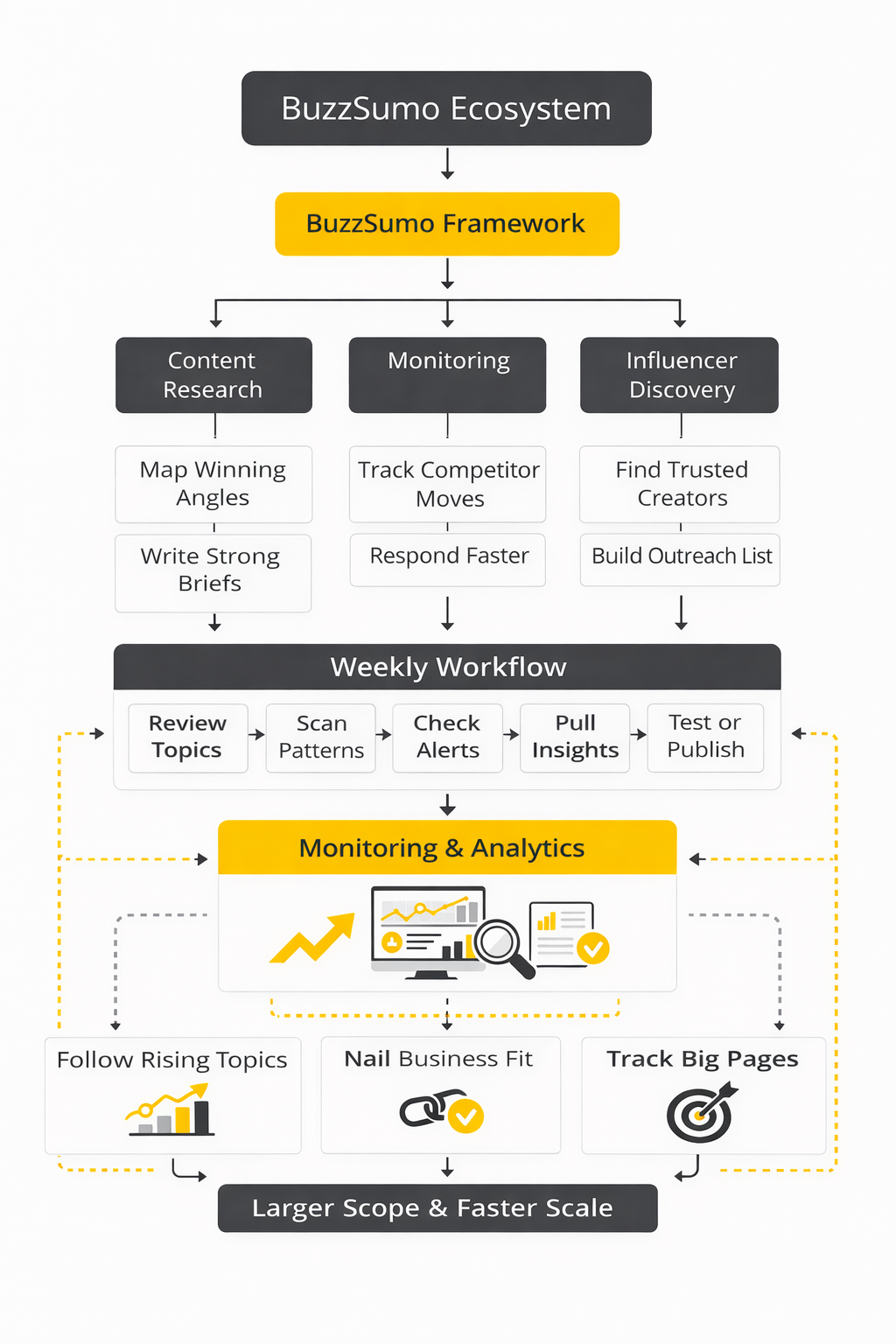
Once you understand the framework, the next question is practical. What exactly inside BuzzSumo helps you do this work. The answer is not one magic dashboard. BuzzSumo’s current structure is a toolkit, and its official product pages consistently group the platform around Content Discovery, Content Research, Influencers, Monitoring, the Chrome Extension, and the API. If you understand what each piece is for, the product starts making far more sense.
That structure also explains why BuzzSumo still shows up in content, PR, and research workflows. It is not trying to be your CRM, your email platform, or your CMS. It is focused on helping you find what matters, monitor what changes, and identify who is driving attention around a topic. Used properly, that is a serious advantage.
Content Research Is the Strategic Center
If you only used one part of BuzzSumo, this would usually be it. Content Research is where you explore keywords, domains, topics, and performance patterns to understand what is already resonating. BuzzSumo describes this layer as the place where you create content with data rather than guesswork, which is exactly how it should be used in practice. The official content research page frames it around finding meaningful insights from huge volumes of articles and social posts.
This is the feature set that helps with editorial planning, competitor review, and angle development. It is especially useful when a topic feels crowded, because raw search results alone often hide pattern depth. With BuzzSumo, you are not just asking what exists. You are asking what consistently gets attention and which subtopics deserve deeper investment.
Content Research is also where you begin to see the difference between trend-driven pieces and durable evergreen opportunities. That distinction matters because not every content asset should be built for the same time horizon. Some pieces are meant to catch an active wave. Others should compound value for a year or more.
Monitoring Is What Keeps You From Reacting Too Late
Monitoring is where BuzzSumo moves beyond planning and into active market awareness. The company’s monitoring page is straightforward about the use case: it is built to track competitors, brand mentions, and industry updates with alerts. For PR teams, that is obvious value. For marketers and founders, it is just as useful because timing changes outcomes.
A surprising number of teams still discover relevant conversations too late. They notice a press mention after the cycle has cooled off. They spot a trend when competitors have already published on it. They realize an industry topic is heating up only after the easy distribution window is gone. Monitoring reduces that lag.
That is one of the less flashy reasons BuzzSumo keeps earning budget. A lot of content success is not just about quality. It is about being early enough to matter. If your research process ends at planning and never includes ongoing alerts, you are leaving one of the platform’s most practical advantages on the table.
Influencer and Journalist Discovery Expands the Use Case
BuzzSumo is often described as a content tool first, but that undersells its outreach value. Its platform and API materials highlight influencer discovery as a core feature, including the ability to find influencers by keyword or topic and see who shared a particular article. That makes the product useful not just for content teams, but for digital PR, partnerships, and amplification.
This matters because distribution is one of the hardest parts of modern content marketing. Publishing something good is not enough. You need relevant people, outlets, creators, or journalists who already operate inside that topic space. BuzzSumo helps identify that landscape faster than starting from scratch with manual searches.
The smart way to use this feature is not to blast generic outreach. It is to build a short list of people who demonstrably care about the topic, then tailor the pitch around what they have already engaged with. That is a much more professional move, and it usually produces better response quality than broad untargeted lists.
The Chrome Extension and API Make the Workflow Faster
Two BuzzSumo features matter more in real execution than they do in sales copy: the Chrome extension and the API. The Chrome extension is useful because it lets you evaluate links, shares, and rankings in context instead of bouncing between tabs and separate tools. That sounds small, but it shortens the distance between research and editorial judgment.
The API matters for a different reason. BuzzSumo positions it around building dashboards, reporting software, and internal workflows, which is exactly where more mature teams start to care. The API page makes it clear that the product is not only for manual research sessions. It can also feed recurring reporting, client dashboards, and internal systems when a team wants to operationalize insight instead of treating it as a one-off activity.
That distinction is important because process maturity is becoming a real competitive edge. Teams are under pressure to move faster, but speed without a repeatable system usually creates more noise, not more output. If BuzzSumo is going to pay for itself, it has to become part of a workflow.
Smart Ways to Use BuzzSumo for Content, PR, and SEO
The most useful BuzzSumo implementations are not complicated. They are disciplined. You take the same research loop and apply it to different business goals: content planning, digital PR, topic validation, competitor tracking, and refresh decisions. The platform becomes powerful when you stop asking what it can do and start asking which recurring decisions it should support.
That is also why this section matters more than a feature tour. Features tell you what exists. Use cases tell you whether the platform belongs in your stack. For most teams, the answer depends on whether BuzzSumo helps them make better decisions before publishing, during promotion, and after performance starts to show.
Use BuzzSumo to Build Better Content Briefs
The cleanest use case is content briefing. You start with a target topic, review the content patterns around it, look at which angles continue to surface, and decide what your page needs to do differently. The Content Research product page is built around that exact idea of using large-scale article and social data to surface meaningful patterns rather than relying on instinct alone.
In practice, this helps with three things. First, it improves angle selection. Second, it reduces the odds that you publish a generic page that says the same thing as every competing result. Third, it gives your writer a better brief, which matters because most content quality problems begin long before drafting starts.
That last point is bigger than it looks. Strong content teams usually do not win because their writers are magically better. They win because the writer receives a sharper assignment. BuzzSumo helps you create that sharper assignment by giving you evidence for why one framing deserves attention and another one does not.
Use It for PR Timing and Media Awareness
BuzzSumo is also strong when the goal is not publishing a blog post but reacting to a live conversation. Its monitoring tools are built around alerts for mentions, competitors, and industry developments, which is exactly what matters in PR and rapid-response content. Timing is often the difference between relevance and invisibility.
This is where a lot of teams lose. They have good ideas, but they notice the opening too late. A journalist trend is already cooling off. A competitor narrative is already spreading. A topic starts moving, but the brand only sees it after the useful response window has passed. Monitoring reduces that lag.
For PR teams, that means faster reaction. For founders and operators, it means better awareness of how a category is evolving. For agencies, it means fewer surprises in client conversations because the team has already seen the topic building before the client asks about it.
Use It to Support SEO Decisions Without Confusing It for an SEO Suite
BuzzSumo is helpful for SEO, but not in the way some people expect. It is not a full search platform trying to replace your ranking tracker, technical crawler, or keyword database. Its value is earlier in the chain. It helps you understand which topics attract attention, which formats keep resurfacing, and which ideas deserve a deeper SEO investment.
That makes it especially useful in topic selection and content refresh work. If a keyword space looks crowded, BuzzSumo can help identify underplayed angles or adjacent ideas that create a better entry point. If a page is underperforming, the tool can help you see whether the topic framing itself is weak or whether the page simply needs stronger execution.
Used that way, BuzzSumo complements search-focused tools instead of competing with them. If your team wants a broader funnel around content capture, nurture, and follow-up once the traffic arrives, GoHighLevel is more relevant on the CRM and automation side, while BuzzSumo stays in the research lane. That separation is healthy. It keeps your workflow cleaner.
Professional Implementation for Teams and Agencies
This is the point where BuzzSumo either becomes a serious asset or another subscription people open twice a month. Professional implementation is not about using every feature. It is about deciding who owns the research process, when the platform gets used, what outputs it must produce, and how those outputs change actual publishing decisions.
That sounds operational because it is. Most teams do not fail with tools because the tools are weak. They fail because nobody builds a workflow around them. The result is scattered usage, vague reporting, and very little institutional learning.
A proper implementation should answer a few basic questions. Who runs weekly research. What alerts are worth setting. Which outputs belong in briefs, reports, or planning meetings. And how insight gets turned into action instead of sitting in a dashboard no one revisits. Those are simple questions, but they are the difference between software and infrastructure.
A Practical Weekly Workflow That Actually Works
The easiest way to implement BuzzSumo is with a fixed weekly cadence. Do not wait until someone “needs inspiration.” Put it into the operating rhythm. That makes the research habit more consistent and the output more useful.
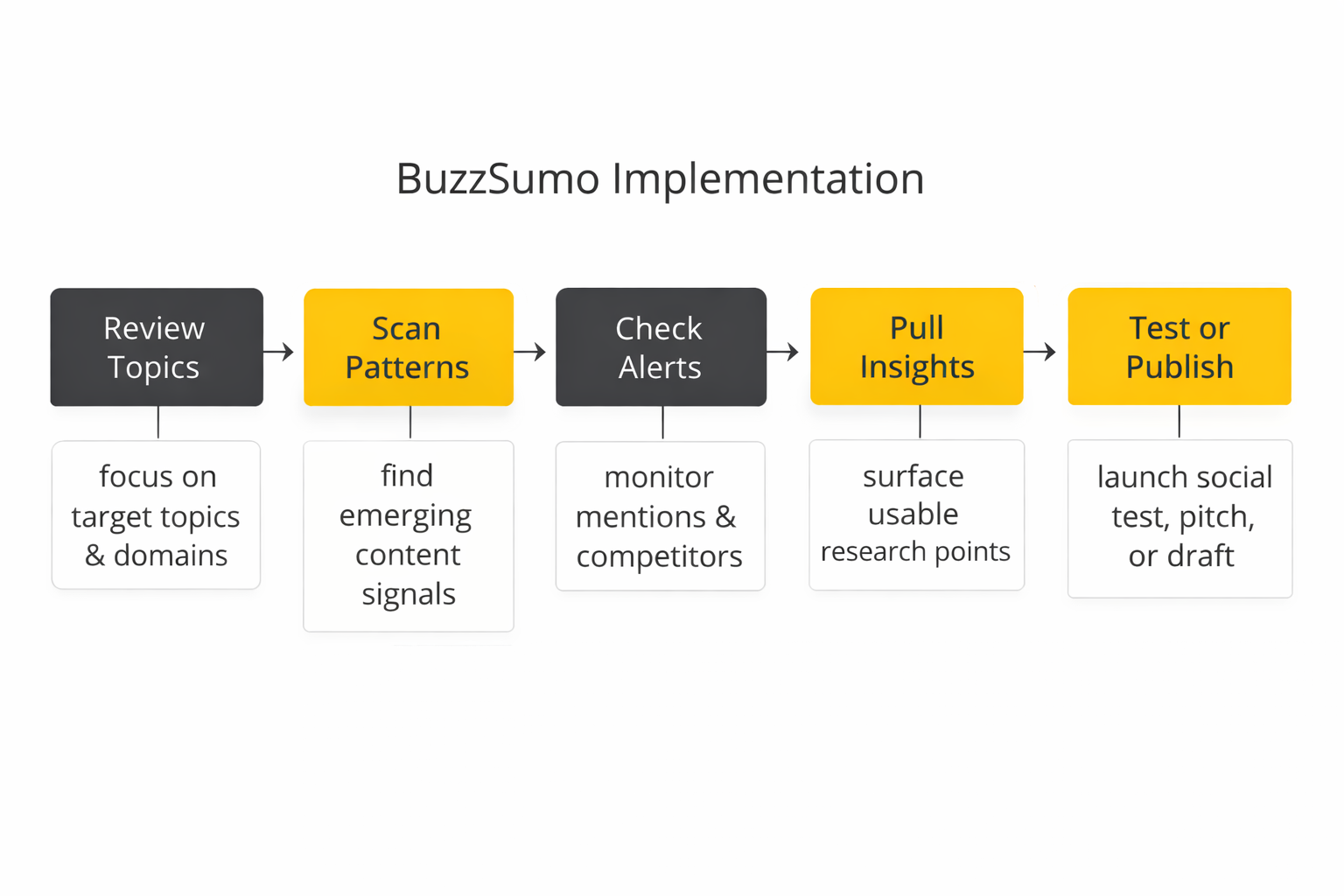
A practical weekly workflow looks like this:
- review the target topics, brands, and competitors that matter this week
- scan for content patterns, emerging conversations, and notable shares
- check alerts and mentions for reactive opportunities
- pull one or two usable insights into the editorial or campaign pipeline
- turn those insights into a brief, pitch angle, refresh decision, or social test
This is where the platform starts to feel tangible instead of theoretical. A workflow like this fits solo creators, in-house teams, and agencies because the principle is the same. Research should produce a decision, not just a spreadsheet.
The key is to keep the output narrow. Most teams do not need twenty findings every week. They need a few high-quality insights that clearly change what gets published, refreshed, pitched, or promoted. That is a much better standard than trying to prove activity with endless dashboards.
What Each Role Should Own
Implementation becomes easier when ownership is explicit. Content strategists should usually own topic mapping, angle validation, and briefing. PR or communications leads should own monitoring, mentions, and journalist-adjacent use cases. SEO leads should use BuzzSumo more selectively for topic framing, refresh opportunities, and competitive pattern analysis.
Agencies need one more layer of discipline because client reporting can become bloated fast. This is where the BuzzSumo API starts to justify itself. If the agency wants repeatable reporting or internal dashboards, automating the output makes more sense than exporting manually forever. It is not glamorous, but it is efficient.
That role clarity also protects the tool from becoming everyone’s side project and no one’s responsibility. When ownership is vague, usage becomes reactive. When ownership is clear, the platform starts feeding planning, outreach, and reporting with much less friction.
The Best Implementation Output Is a Better Decision
A lot of teams measure tools the wrong way. They ask whether people logged in or whether a dashboard looks busy. That is the wrong test. The better question is whether BuzzSumo helped the team make a smarter decision this week than it would have made without it.
Sometimes that decision is to pursue a topic more aggressively. Sometimes it is to kill a weak idea before production starts. Sometimes it is to update an old asset, react to a trend, or reach out to the right people faster. Those are practical wins, and they compound.
This is also why documented workflows still matter so much. Content Marketing Institute has been making that point for years, and the logic holds up because documented process creates consistency where good intentions do not. In a market where teams are trying to scale output without drowning in generic content, process is not bureaucracy. It is leverage.
What the Data Is Actually Telling You
Measurement is where a lot of BuzzSumo users get lost. They open the platform, see shares, trends, mentions, and article performance signals, then treat every visible number as proof that a topic deserves investment. That is not how this works. The value is not in collecting more metrics. The value is in understanding which metrics signal attention, which ones signal fit, and which ones are just noise dressed up as evidence.
This matters even more now because content teams are being pushed to do more with tighter scrutiny on output. The 2025 B2B benchmark data shows marketers are increasing investment in formats like video, thought leadership, and AI-supported optimization, which means competition for attention is not easing up. When more teams are publishing aggressively, weak interpretation gets expensive fast because a bad content bet no longer wastes only writing time. It also wastes distribution, design, stakeholder confidence, and editorial momentum. The 2025 benchmarks from Content Marketing Institute make that pressure very clear.
BuzzSumo helps because it gives you directional data before you commit. But directional data only becomes useful when you tie it to a decision. That is the frame for everything in this section.
The First Metric Is Attention, Not Value
The most obvious numbers inside BuzzSumo usually reflect attention. A topic is being shared, referenced, discussed, or published around more heavily than another topic. That is useful because it tells you where energy already exists in the market. It does not automatically tell you whether the topic will drive qualified traffic, leads, authority, or revenue for your business.
That distinction matters because many teams confuse visibility with usefulness. A topic can travel well socially and still be a poor fit for your audience or offer. Another topic can look quieter on the surface and still be more commercially valuable because it aligns with a real buying problem. BuzzSumo is strongest when it helps you separate those two cases early.
This is also why broad performance numbers need context. A high-share article may reflect strong distribution, a timely news angle, an influential publisher, or a headline format that attracts attention. None of those are meaningless, but none of them should be copied blindly. The real question is what the number suggests about audience behavior and whether that behavior matters to your business.
Why Reach Metrics Need a Reality Check
One reason BuzzSumo still matters is that discovery is fragmented. Search remains huge, but a large share of searches never produce a click to the open web. The 2024 analysis from SparkToro and Datos found that 59.7% of EU Google searches ended without a click, while only about 36% of clicks went to the open web. Search Engine Land’s coverage of the same study reinforces the same takeaway.
That changes how you should interpret content opportunity. If a topic shows signs of attention in BuzzSumo, that does not guarantee a proportional traffic upside from search alone. It may still be worth covering, but the action should be different. You may need stronger distribution, more deliberate newsletter placement, better social packaging, or a clearer conversion path once people do land.
In other words, attention now has to be interpreted across channels, not through a simple “search volume equals opportunity” lens. That is exactly why BuzzSumo can be valuable in modern research. It gives you a wider view of what people are reacting to than keyword numbers alone.
The Best Signals Usually Come in Clusters
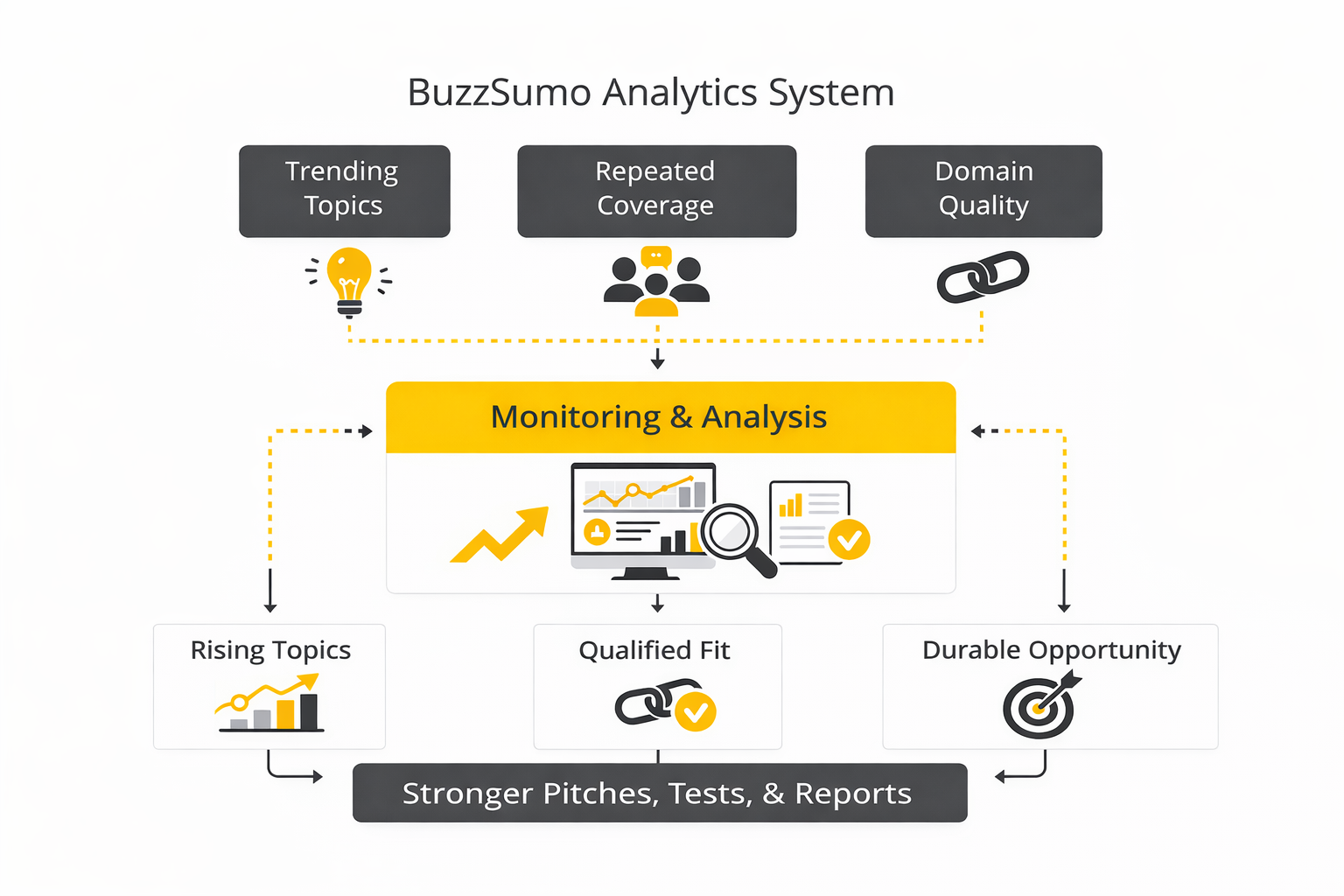
Single metrics are easy to overread. The smarter move is to look for clusters. If a topic shows repeated article traction, appears across multiple credible domains, gets ongoing mentions, and aligns with what your audience is already asking, that is a much stronger signal than one isolated spike. BuzzSumo’s own product framing around content research and monitoring supports this kind of multi-signal use because the platform is built to show topic patterns, not just standalone wins.
This is where a lot of the real judgment lives. You are not asking whether one article performed well. You are asking whether the topic has enough momentum, enough durability, and enough relevance to deserve action. That is a very different question, and it leads to much better planning.
A useful way to think about it is this. One number can tell you that something happened. A cluster of numbers can tell you whether it is likely to matter again. That is the level you want to operate on when using BuzzSumo professionally.
How to Read BuzzSumo Metrics Without Fooling Yourself
Once you stop treating every metric as equal, the platform gets easier to use. The next step is knowing what each type of signal should actually trigger. Some numbers should push you to explore a topic further. Others should push you to validate business fit. Others should tell you to monitor, not publish. Good measurement creates the next right action.
That is why analytics inside a research tool should be read as decision support. They are not the final verdict. They are inputs into an editorial, PR, or SEO decision that still needs human judgment.
Treat Share Velocity as a Timing Signal
When a topic starts moving quickly, that usually tells you something about timing rather than long-term value. It may be news-driven, debate-driven, or simply benefiting from a platform shift in distribution. BuzzSumo is useful here because it can help you spot acceleration before the opportunity has completely passed.
The action this should drive is speed with discipline. If the topic fits your expertise and audience, move faster. If it does not fit, do not chase it just because the graph looks exciting. A lot of content teams burn time on motion that feels urgent but has no strategic payoff.
This is one reason monitoring matters so much. BuzzSumo’s alert-based monitoring setup is less about vanity and more about reducing reaction time. When timing matters, a slightly earlier response can outperform a better piece that shows up too late.
Treat Repeated Coverage as a Topic Validation Signal
Repeated coverage across different publishers often matters more than one viral post. It suggests there is enough sustained interest in the topic for multiple outlets to keep revisiting it. That is especially useful for evergreen planning because it helps you distinguish a durable subject from a short-lived burst.
The action here is usually to invest in a stronger asset, not just a quick post. If the conversation keeps resurfacing, that often justifies a better brief, deeper research, original framing, and a clearer conversion path. This is where BuzzSumo supports higher-conviction decisions rather than reactive publishing.
That also aligns with what broader marketing data is showing. HubSpot’s current marketing statistics page notes that blog posts remained one of the highest-ROI content formats for marketers in 2025, even while video formats grew aggressively. That is a useful reminder that written content still matters, but weak written content does not. Repeated coverage should push you toward quality, not quantity.
Treat Domain Quality as a Credibility Filter
Not every mention or article source should carry the same weight. If a topic is circulating mainly through weak, repetitive, or low-trust sites, that should lower your confidence even if engagement looks decent. If the same topic is being covered by credible publishers, specialized industry outlets, and thoughtful operators, that signal is stronger.
The action this should drive is source weighting. Do not just ask whether a topic is active. Ask who is making it active. BuzzSumo helps expose that landscape, but you still have to judge whether the attention is credible, commercial, or just noisy.
This is one of the easiest ways to improve content planning fast. Teams that weight sources well usually waste less time chasing recycled internet chatter. Teams that ignore source quality often overestimate weak signals and end up producing content that looks current but adds very little.
Build a Simple Measurement System Around Decisions
The cleanest way to use BuzzSumo data is to turn it into a simple internal scoring model. Not a bloated dashboard. Not a giant spreadsheet nobody updates. Just a clear way to decide whether a topic deserves monitoring, testing, publishing, or deeper investment.
A practical model can use four questions:
- is the topic clearly attracting attention right now
- is that attention showing up across more than one credible source or format
- does the topic connect directly to our audience pain point or offer
- does the signal suggest a quick reaction, an evergreen asset, or a refresh
This kind of system works because it keeps the analytics tied to action. It stops the team from collecting numbers for their own sake. More importantly, it creates shared language. Instead of vague debates about whether an idea “feels promising,” the team can point to evidence and decide what to do next.
Benchmark Against Yourself Before You Benchmark Against the Internet
External benchmarks are useful, but internal comparison is usually more actionable. If your team consistently performs well when a topic shows repeated cross-domain traction, that pattern matters. If your best pages tend to come from quieter but high-intent topics rather than flashy trending ones, that matters too. BuzzSumo should help you understand the market, but it should also help you understand your own operating pattern.
This is where many teams get more value than they expect. They stop asking whether a topic is universally big and start asking whether it behaves like the kind of topic their brand already wins on. That is a more mature question, and it usually leads to better decisions.
Professional teams eventually build this into reporting. Research signals go in, publishing decisions follow, and outcomes get reviewed later against the original logic. That loop is where the tool becomes genuinely strategic.
What the Numbers Should Drive Next
Every metric in BuzzSumo should point to a next move. Rising topic activity should drive faster validation. Repeated high-quality coverage should drive stronger asset creation. Ongoing mentions should drive monitoring and outreach. Weak or noisy attention should drive restraint, which is often the most underrated decision in content marketing.
That is the big takeaway from measurement. Numbers are not there to impress you. They are there to sharpen your judgment. If the data does not change what you publish, update, pitch, or ignore, then the analytics are just decoration.
And that is the difference between casual use and professional use. Casual use looks at the numbers and feels informed. Professional use reads the same numbers and makes a better decision.
Advanced Strategy, Tradeoffs, and Scaling With BuzzSumo
Once you move past basic usage, BuzzSumo becomes less about finding ideas and more about managing tradeoffs. Every serious content team eventually hits the same constraint: there are more viable topics than resources to execute them well. At that point, the tool is no longer about discovery. It is about prioritization under pressure.
This is where most casual users plateau. They continue collecting insights, but nothing changes in how decisions are made. Advanced users do the opposite. They narrow harder, say no more often, and use BuzzSumo to justify focus instead of expanding scope. That shift is what turns the platform into a strategic filter instead of a research habit.
The Tradeoff Between Trend Chasing and Authority Building
One of the biggest decisions you will face is how much to lean into trending topics versus long-term authority assets. BuzzSumo makes trends visible very quickly, which is both a strength and a risk. It is easy to get pulled into reactive publishing cycles that feel productive but do not build lasting value.
Trend-driven content works best when you have distribution leverage or a clear angle that adds something new. Without that, you are competing in crowded, short-lived conversations where speed matters more than depth. That can work, but it is not a reliable long-term strategy for most teams.
On the other side, authority content takes longer to produce and often looks less exciting in early BuzzSumo data. It may not spike immediately, but it tends to compound over time. This is where the tool needs to be used differently. Instead of looking for velocity, you look for repeated coverage, stable interest, and gaps that are not being addressed properly.
The best teams balance both. They use BuzzSumo to spot timely opportunities, but they anchor their strategy in topics that justify deeper investment. That balance is not accidental. It is a conscious tradeoff.
The Risk of Overfitting to What Already Works
BuzzSumo is built on existing data. That is its advantage, but it can also become a trap. If you rely on it too heavily without independent thinking, you end up overfitting to what already exists. You produce cleaner versions of current content instead of creating something that actually shifts the conversation.
This is where judgment matters more than data. Patterns tell you what is working. They do not tell you what is missing. If every top-performing piece follows the same structure, tone, and promise, there is usually an opportunity to approach the topic differently. That is not obvious in raw metrics, but it is often where the real upside sits.
A practical way to handle this is to treat BuzzSumo as a baseline, not a blueprint. Use it to understand the landscape, then deliberately decide where you want to align and where you want to diverge. That is how you avoid becoming another indistinguishable result.
Scaling Research Without Slowing Down Execution
As teams grow, research can become a bottleneck. More stakeholders want input. More topics are under consideration. More reporting is expected. Without structure, BuzzSumo usage expands in all directions and slows everything down.
The solution is not more data. It is tighter process. The weekly workflow outlined earlier should scale, but the outputs need to stay focused. Instead of producing longer reports, teams should produce clearer decisions. That means fewer insights, but better ones.
This is also where integration starts to matter. If BuzzSumo insights feed directly into planning tools, CRM systems, or campaign workflows, the time between research and execution shrinks. For example, if content leads are being captured or nurtured after publication, connecting research insights to a system like GoHighLevel can make the entire funnel more coherent. Research informs content, content feeds leads, and leads are managed in one place.
Scaling is not about doing more research. It is about making research more decisive.
Where BuzzSumo Fits in a Modern Stack
BuzzSumo is not trying to replace your entire marketing stack, and that is a good thing. It sits upstream. It helps you decide what to create, when to react, and where to focus. Everything that happens after that belongs to other tools.
That separation becomes clearer as your stack grows:
- BuzzSumo handles discovery, patterns, and monitoring
- SEO tools handle rankings, keywords, and technical performance
- CRM and automation tools handle leads, pipelines, and follow-up
- Social tools handle distribution, testing, and scheduling
For distribution, something like Buffer becomes relevant after the content is live, not before. For capture and conversion, platforms like systeme.io or funnel builders like ClickFunnels take over where BuzzSumo stops.
This division of labor is important. When teams try to force one tool to do everything, they usually end up with weak execution across the board. When each tool has a clear role, the system becomes easier to manage.
The Hidden Cost of Using BuzzSumo Poorly
The obvious cost of BuzzSumo is the subscription. The hidden cost is wasted attention. If the platform leads your team to chase low-value topics, overanalyze weak signals, or delay decisions, it becomes expensive in ways that do not show up on an invoice.
This is why disciplined usage matters so much. The goal is not to maximize time inside the tool. The goal is to minimize uncertainty before making a decision. If BuzzSumo helps you kill weak ideas faster, it is already paying for itself. If it helps you double down on the right ones, it becomes a multiplier.
Most teams do not need more insights. They need better filters. That is what advanced usage looks like.
When BuzzSumo Is the Wrong Tool
There are also cases where BuzzSumo is simply not the right fit. If your business relies almost entirely on direct sales outreach with minimal content, the platform will have limited impact. If your niche has very little public content or social activity, the data may be too thin to guide decisions.
It is also less useful if your team is not prepared to act on the insights. Research without execution is just expensive curiosity. If there is no system for turning insights into briefs, campaigns, or outreach, the tool will not deliver meaningful returns.
This is not a weakness of BuzzSumo. It is a reminder that tools amplify behavior. If the underlying process is weak, better data does not fix it. It just makes the problem more visible.
The Real Advantage Comes From Consistency
At an expert level, the advantage is not a single breakthrough insight. It is consistency. Teams that use BuzzSumo well do not just find one good topic. They build a steady pipeline of better decisions over time.
That is what compounds. Better topic selection leads to stronger content. Stronger content leads to better engagement. Better engagement creates clearer signals for future decisions. The loop reinforces itself.
This is why the platform still holds its place in serious marketing workflows. Not because it promises magic, but because it supports disciplined thinking in an environment where most content decisions are still made too quickly or with too little evidence.
Pricing, Limits, and When to Choose an Alternative
By the time you reach the buying decision, the real question is not whether BuzzSumo is useful. It is whether the value you get from better research, monitoring, and topic prioritization is worth the subscription relative to your workflow. That is a more honest test than asking whether the platform has “good features,” because almost every serious marketing tool can make that claim.
BuzzSumo’s current pricing page lists four main plans billed annually: Content Creation at $199 per month, PR & Comms at $299 per month, Suite at $499 per month, and Enterprise at $999 per month. The same page also spells out meaningful differences in seats, alerts, historical depth, and advanced features, including Content Analyzer access, monitoring, media database capabilities, article uploads, and API-adjacent workflow support. The current pricing breakdown is detailed enough that you can usually tell quickly whether you are shopping for basic research, PR monitoring, or a broader team setup.
That pricing matters because BuzzSumo is not a casual impulse purchase for most solo operators. It sits in the category where the tool has to either save significant research time, prevent expensive content mistakes, or improve the quality of your topic decisions enough to justify ongoing spend. If it does not do one of those things inside your process, even a technically strong feature set will feel expensive.
Which Plan Usually Fits Which Team
The lowest paid tier makes the most sense for solo marketers, consultants, and lean content teams that mainly need research, idea development, and light monitoring. The middle tiers make more sense when the team is doing active PR, journalist research, and alert-driven market awareness. The higher plans become easier to justify when multiple users, deeper history, and more structured reporting are part of the weekly operating model.
The plan differences are not just cosmetic. BuzzSumo’s pricing page shows user counts, alert counts, historical data windows, and feature access changing meaningfully from one tier to the next. That means the wrong plan can make the product feel artificially limited, while the right one can fit naturally into a team workflow.
This is why smart buyers should start from use case, not budget alone. If your main need is content research, do not overbuy. If your workflow depends on monitoring, coverage reporting, media outreach, or broader team access, do not pretend the entry tier will behave like a full PR system.
The Real Limits You Should Think About
The first limit is not the plan. It is your team’s ability to act on the insights. If your process is weak, more data will not rescue you. BuzzSumo can sharpen judgment, but it cannot substitute for editorial discipline, clear ownership, or a system that turns research into actual briefs and campaigns.
The second limit is data interpretation. BuzzSumo is excellent at showing patterns, momentum, and content behavior, but it is still a research platform, not a guarantee machine. You still need to decide whether a topic fits your business, whether a signal is durable, and whether a trend deserves a fast reaction or a deeper evergreen asset.
The third limit is stack overlap. If you already have strong SEO tooling, strong social distribution tooling, and robust media monitoring elsewhere, BuzzSumo has to earn its seat by making those systems better connected or more decisive. Otherwise it becomes one more tab people open without changing what they do.
When BuzzSumo Is Worth It
BuzzSumo is worth it when content ideas are expensive for you. That usually means your team has real production costs, real distribution spend, or real pressure to publish work that performs. In those cases, better topic selection alone can justify the subscription because weak content decisions are far more expensive than the monthly fee.
It is also worth it when timing matters. PR teams, agencies, and category leaders can get real value from earlier detection, better monitoring, and faster reaction to live conversations. The faster a team can spot credible movement and connect it to action, the easier the platform is to justify.
And it is worth it when you actually operationalize it. If BuzzSumo feeds briefs, campaign decisions, outreach lists, and reporting, the platform starts behaving like infrastructure instead of software. That is usually the difference between “nice tool” and “important tool.”
When You Should Choose an Alternative Instead
If your main problem is funnel building, page creation, email capture, or automation, BuzzSumo is not the center of gravity. In that situation, a platform like ClickFunnels or systeme.io is usually more relevant because the bottleneck is conversion infrastructure, not research. Those tools solve a different problem, and that distinction matters.
If your biggest need is social publishing and distribution management, Buffer is a more natural fit because it focuses on scheduling, publishing, and managing social workflows after the content already exists. BuzzSumo can inform what to publish, but it is not designed to be your social execution hub.
If your real operational pain is CRM, lead handling, and multi-step nurture after traffic arrives, GoHighLevel is more directly connected to that outcome. BuzzSumo sits upstream from that work. So the choice is not always BuzzSumo versus another tool. Often it is a question of where the real bottleneck lives in your stack.
The Best Buying Decision Is a Workflow Decision
The cleanest way to decide on BuzzSumo is to map one real workflow. Pick a weekly content planning cycle, a PR monitoring cycle, or a competitor intelligence cycle and ask whether BuzzSumo materially improves that loop. If the answer is yes, the price is easier to justify because the tool is anchored to a repeatable business process.
If the answer is vague, do not force it. Tools bought on vague optimism usually become forgotten subscriptions. Tools bought to improve a clearly defined workflow are much more likely to create compounding value.
That is the honest close on pricing. BuzzSumo is not cheap enough to buy casually, but it is also not hard to justify when research quality, timing, and decision-making genuinely affect your results.
FAQ
Is BuzzSumo mainly an SEO tool
Not really. BuzzSumo can support SEO decisions, especially at the topic selection and content research stage, but it is not a full technical SEO platform. The better way to think about it is that BuzzSumo helps you choose smarter topics and angles before you go deeper with search-specific tools.
Is BuzzSumo still relevant now that AI tools can generate ideas fast
Yes, because idea generation is not the hard part anymore. The harder part is deciding which ideas deserve real investment, which topics are already saturated, and which angles are actually getting traction in the market. BuzzSumo helps with evidence and pattern recognition, while AI tools are better used later for drafting, summarizing, or workflow acceleration.
Can a solo marketer justify the cost of BuzzSumo
Sometimes, but only if the tool is tied to revenue-producing work. If you publish regularly, sell strategy, run content for clients, or depend on making better topic bets, the subscription can make sense. If you create occasionally and do not have a repeatable workflow, the cost will feel harder to justify.
What is the biggest mistake people make with BuzzSumo
The biggest mistake is treating it like a headline inspiration engine. That leads to shallow research and copycat content instead of stronger editorial decisions. The better approach is to use it to map topics, detect patterns, validate fit, and then build sharper briefs.
Does BuzzSumo help with PR or only content marketing
It absolutely helps with PR. BuzzSumo’s current product setup includes monitoring, coverage reports, and media-related capabilities that make it useful well beyond blog planning. That is why PR teams, agencies, and communications leads often get more value from it than people who only think about content ideation.
How should I interpret high engagement numbers inside BuzzSumo
Treat them as a signal of attention, not automatic proof of business value. A highly shared topic may be interesting, but it still has to fit your audience, expertise, and offer. The right move is to combine engagement signals with source quality, repeated coverage, and commercial relevance before acting.
Is BuzzSumo better for evergreen content or trend-driven content
It can support both, but the way you read the data should change. Trend-driven work depends more on velocity and timing, while evergreen planning depends more on repeated coverage and durable topic interest. The best teams use BuzzSumo for both, but they do not confuse one use case with the other.
How often should a team use BuzzSumo
For most serious teams, weekly is the sweet spot. That cadence is frequent enough to catch live movement and steady enough to build into planning without becoming constant background noise. If you are running active PR or monitoring a volatile space, daily alerts can matter, but most strategic decisions still benefit from a weekly review rhythm.
What should BuzzSumo output inside a professional workflow
It should output decisions, not just observations. That might mean a stronger content brief, a refresh recommendation, an alert-driven PR response, or a clearer case for killing a weak topic before production starts. If the output is only a dashboard or exported spreadsheet, the workflow is probably underdeveloped.
When should I skip BuzzSumo entirely
Skip it when your bottleneck is not research. If your real problem is publishing capacity, funnel infrastructure, CRM follow-up, or social execution, another tool may deserve priority first. BuzzSumo is strong upstream, but it should not be expected to solve downstream operational gaps.
Can BuzzSumo replace other research tools in my stack
Usually no, and that is fine. It works best as a complement to SEO platforms, social tools, CRM systems, and content production workflows. The real value comes from letting BuzzSumo do what it is good at, which is surfacing patterns, timing signals, and content opportunities before the rest of the stack takes over.
What is the clearest sign that BuzzSumo is paying for itself
The clearest sign is not time spent in the app. It is better decisions outside the app. If your team is choosing better topics, reacting faster to live conversations, and avoiding weak content bets more consistently, BuzzSumo is doing its job.
Work With Professionals
Explore 10K+ Remote Marketing Contracts on MarkeWork.com
Most marketers spend too much time chasing clients, competing on crowded platforms, and losing a percentage of every project to middlemen.
MarkeWork gives you a better way. Browse thousands of remote marketing contracts and connect directly with companies desperate to hire skilled marketers like you, without platform commissions and without unnecessary gatekeepers.
If you're serious about finding better opportunities and keeping 100% of what you earn, explore available contracts and create a profile for free at MarkeWork.com.